







Abstract
This article examines the digital transformation of frontline revenue administration through the evolving role of the Tehsildar in Sirsa district, Haryana. Drawing on qualitative fieldwork—including in-depth interviews, focused group discussions, content analysis of official records and non-participant observation—the study investigates how Tehsildars navigate the transition from traditional land administration to digital revenue governance. Three substantive dimensions are examined in depth: the new digital responsibilities, guidelines and legislative frameworks governing the Tehsildar’s mandate; the mechanisms and challenges of data accuracy management under digital operations; and the multi-platform digital grievance redressal architecture within which the office now functions. The analysis additionally foregrounds four structural challenges: the politicisation of transfers, chronic resource constraints, digital literacy gaps and the complexity of hybrid digital–manual operations. The article argues that effective digital governance of land administration requires institutional strengthening, protection of administrative autonomy and contextually grounded policy reform alongside the deployment of technology. Evidence-based recommendations are offered to strengthen the Tehsildar’s office’s institutional capacity.
Keywords
Introduction
Land revenue administration constitutes one of the oldest and most citizen-proximate functions of the Indian state. At its operational core sits the Tehsildar—a frontline revenue officer who serves as the primary interface between the government and citizens for land-related matters. In contemporary India, this office occupies a peculiar institutional position. It is simultaneously expected to preserve the rigour of centuries-old settlement law, adapt to successive rounds of digital reforms and maintain administrative impartiality amid persistent political pressure.
India’s land governance landscape has undergone considerable transformation since the early 2000s, driven by successive national-level initiatives to digitise land records. The Digital India Land Records Modernisation Programme aimed at creating a system of continuously updated land records with automatic mutation following registration. States such as Karnataka, with the BHOOMI programme, and Andhra Pradesh demonstrated that digitalisation could reduce friction between citizens and the state in routine land transactions. Yet scholarship has consistently noted that the gains from technology deployment vary sharply depending on the institutional conditions into which digital tools are introduced.
This article examines how these dynamics play out through a focused case study of the Tehsildar’s office in Sirsa district, Haryana. Sirsa, established as a separate district in 1975, is a representative north Indian agricultural district where land administration remains central to everyday governance. Its four Tehsils—Sirsa, Dabwali, Rania and Ellenabad—collectively administer 333 villages with a workforce of only sixty Patwaris, a staffing ratio that signals the structural resource stress within which digital modernisation is being pursued.
Three dimensions of the Tehsildar’s evolving role receive focused treatment in this article, responding directly to the gaps identified in extant scholarship: first, the new digital responsibilities, legislative frameworks and operational guidelines that now define the office’s mandate; second, the practices and challenges of data accuracy management under a digital regime; and third, the multi-platform digital grievance redressal architecture within which the Tehsildar now operates. These are then situated within the broader structural challenges of politicisation, resource constraints, frequent transfers and citizen engagement dynamics that collectively shape administrative performance.
Situating the Tehsildar: Literature and Research Gap
The institutional genealogy of the Tehsildar traces directly to colonial land settlement systems. The Mahalwari settlement, introduced through Regulation VII of 1822, created a layered hierarchy of revenue functionaries—Lambardars, Tehsildars and Patwaris—whose structural forms persist to the present (Husain, 2017). Wilson (1855) described the Tehsildar as a native officer responsible for collecting revenue from a defined tract, combining fiscal authority with local administrative oversight. Misra (1965) traces how the Collector’s office evolved from a revenue-focused mandate under Munro’s administration into a comprehensive district executive authority, positioning Tehsildars as generalist administrators whose responsibilities exceeded revenue collection. This generalist orientation creates enduring tensions with the specialised technical demands of contemporary digital land governance.
Research on district-level administration has highlighted systemic vulnerabilities predating the digital era. Sharan and Narayanan (1986) documented high turnover among district and block-level officers, finding that teams rarely served together for even two years—eroding institutional memory and development continuity. The Second Administrative Reforms Commission (2009) recognised Tehsildars as the primary government-citizen interface, noting that the effectiveness of revenue administration depends substantially on their operational efficiency, while acknowledging the breadth of duties that can overwhelm individual officers.
E-governance literature offers an ambivalent assessment of reform outcomes. Bhatnagar (2004) documented how e-government initiatives in India produced early gains in access and transparency but required comprehensive process redesign rather than mere technology installation. Heeks (2003) developed the influential ‘design-reality gap’ concept to explain why many e-government projects in developing countries fail: systems designed for idealised administrative environments encounter complex, resource-constrained operational realities. This gap is acute in rural land administration, where field conditions, staff capacities and infrastructure availability diverge sharply from embedded design assumptions. Norris (2001) further cautioned that digitalisation of public services can intensify existing socio-economic inequalities when differential digital access mirrors existing exclusions. Wade (1985) offered a structural insight into India’s political economy of administration, identifying what he termed the ‘market for public office’—a system in which political connections condition postings, transfers and careers in ways that conflict with impartial service delivery.
Despite this scholarship, specific governance challenges facing frontline revenue officers—particularly Tehsildars—in digital transition remain empirically underexplored. Scholarly attention has concentrated on historical settlement systems or state-level programme evaluations, leaving a gap in understanding how frontline authorities navigate competing pressures of digitisation, politicisation, resource scarcity and evolving policy mandates. Three dimensions are particularly absent from existing studies: the specific new legal and operational frameworks governing the digitised Tehsildar role; the institutional management of data accuracy under digital systems; and the functioning of multi-platform grievance redressal at the Tehsil level. This article addresses these gaps through an in-depth case study of the Sirsa Tehsil office.
Methodology
This study adopts a qualitative case study design, chosen for its capacity to generate contextually grounded insights into complex institutional processes. Multiple data collection methods were employed to achieve methodological triangulation. The Sirsa Tehsil office was selected through purposive judgemental sampling, based on geographic accessibility and the institutional diversity of its caseload.
Five individual in-depth interviews were conducted with the then-Tehsildar of Sirsa—three at the officer’s residence and two at the office—each lasting 25–30 minutes. The interview schedule covered the impacts of digitisation, political pressure, citizen engagement and administrative guideline changes. A focus group discussion involving twelve staff members, comprising a reader, an office Kanungo, a field Kanungo, two Patwaris, one retired Patwari, a registry clerk, a Tehsil Revenue Clerk, two HRKN Patwari assistants and two computer operators, provided perspectives across functional roles and experience levels.
Content analysis of accessible revenue records examined documentation practices, case processing timelines and record quality. Disposal statistics for Partition, Girdawari, Kankut, Execution, Chowkidari and Demarcation categories were analysed across multiple months. Non-participant observation of office operations, officer–citizen interactions and daily workflows provided contextual grounding. Secondary sources—including the Haryana Land Records Manual, 2013, the Land Administration Manual and the Haryana District Gazetteers Sirsa (Haryana Gazetteers Organisation, 1988)—provided the institutional and policy context. Thematic coding was applied to transcripts and observation notes, with quantitative content analysis data providing a contextual scaffold.
Findings
New Digital Responsibilities, Guidelines and Legislative Frameworks
A central finding of this study is that the Tehsildar’s functional mandate has been substantially reconstituted by a layered set of digital governance reforms, legislative provisions and operational guidelines introduced over the past decade. These changes have not merely added digital tools to existing work; they have restructured the office’s jurisdictional scope, accountability relationships and data management obligations in ways that the foundational Haryana Land Record Manual (2013) does not fully address.
Legislative Framework
Three legislative and regulatory instruments now directly govern the Tehsildar’s digital operations. The Haryana Land Records Manual (2013), while predating the full digital transition, outlines five primary duties that have been reinterpreted through digitalisation: managing land records and timely mutations; conducting systematic field tours, now enhanced through the e-Girdawari application; maintaining and updating revenue records, with digitisation reducing tampering risks; overseeing financial transactions, now routed through direct bank transfers; and administering and supervising staff through electronically managed workflows. However, this manual provides no specific operational protocols for twenty-one of the twenty-six revenue services the office administers in the digital environment— a regulatory gap that generates inconsistency across sub-offices.
The Haryana Right to Service Act (2014) constitutes the primary legislative accountability framework for the Tehsildar’s digital service delivery. The Revenue Department has listed forty-four services under the Act, with statutory delivery timelines ranging from one day for certified copies to sixty days for specific land partition requests. The Tehsildar serves as the designated officer for most of these services and as the first or second Grievance Redressal Authority when timelines are breached. This legislative designation significantly expands the Tehsildar’s accountability exposure: Non-delivery within prescribed timelines now triggers automatic appeal mechanisms rather than requiring citizen-initiated escalation.
The Parivar Pehchan Patra (PPP) scheme, which assigns every Haryana household a unique digital identity containing socio-economic data, has restructured the architecture for certificate issuance. Under this framework, the Tehsildar’s office now retains authority to issue only residence and marriage registration certificates, both fully digitalised and deliverable remotely through the eCertificate system. All remaining certificates are issued by the Additional Deputy Commissioner, who serves as the district-level nodal officer for the Citizen Resource Information Department (CRID), drawing data directly from the PPP database. This redistribution represents a significant jurisdictional change: Functions that were previously core to the Tehsildar’s citizen-facing mandate have been administratively relocated to a higher tier.
New Operational Roles and Digital Infrastructure
Beyond legislative changes, several new operational roles have been assigned to the Tehsildar under digital governance frameworks. The office now holds a digital ID enabling real-time tracking of issued and pending digital transactions—a monitoring function with no manual intervention. The Tehsildar acts as Circle Revenue Officer and Sub-Registrar for land registry documents within the Haryana State Land Records Modernization Programme (HSLMP) system, with the District Revenue Officer assuming this function only in exceptional cases. The government has initiated a pilot project in Faridabad district to make all revenue records digitally accessible to citizens without office visits—a development that, if extended to Sirsa, will further transform the Tehsildar’s public-facing role from document custodian to digital access administrator (Table 1).
Transformation of the Tehsildar’s Key Responsibilities Under Digitalisation.
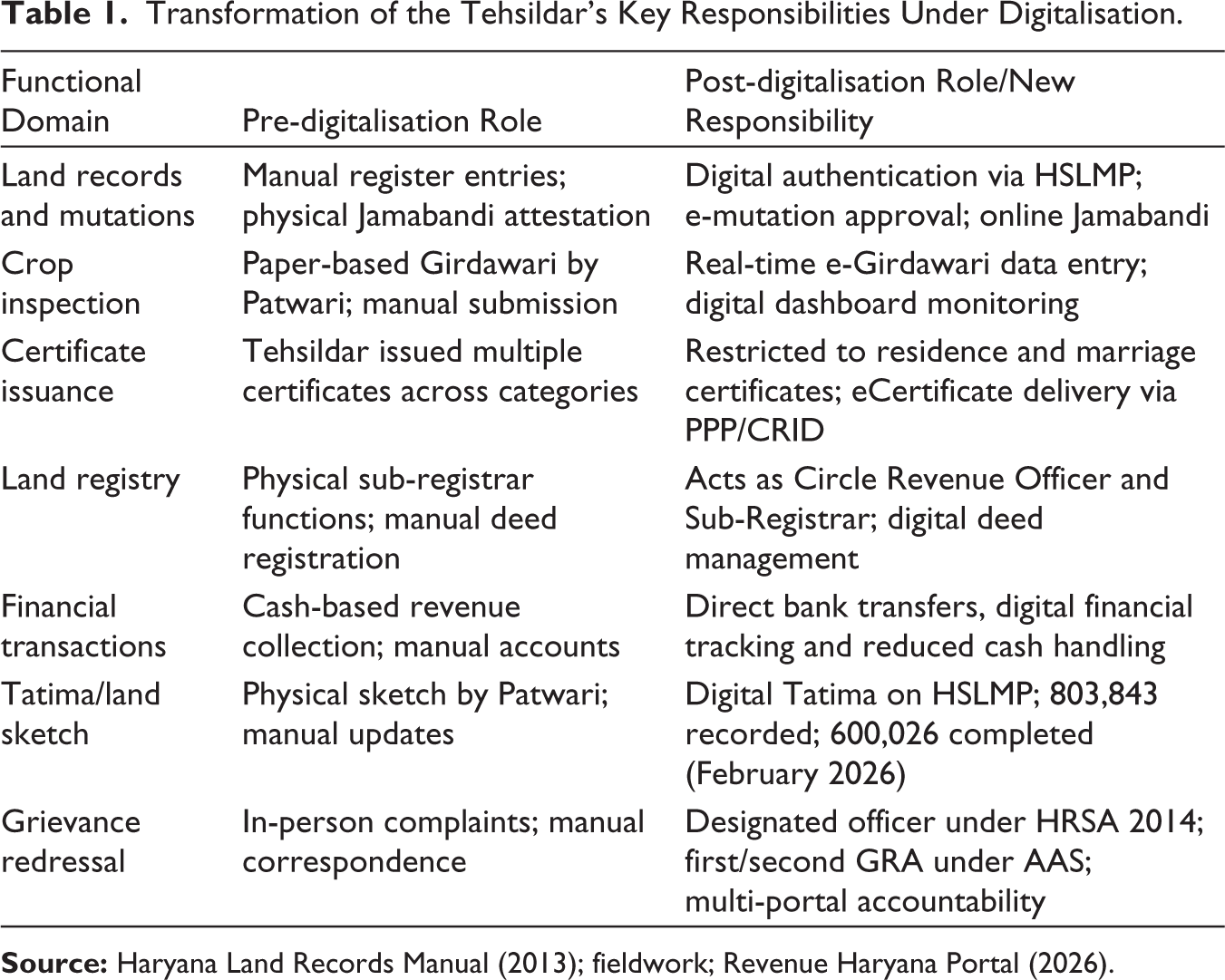
The Sizra map of land—previously managed manually by the Lambardar, Patwari and Kanungo—is now publicly accessible online, enabling citizens to independently view ownership status, plot dimensions and ownership changes. The Tatima, a detailed digital sketch of land parcels crucial for boundary demarcation, is maintained on the HSLMP government server; as of 21 February 2026, 803,843 Tatimas had been recorded, with 600,026 completed. These developments represent a structural shift in the Tehsildar’s role from information gatekeeper to digital governance administrator—a shift for which the existing regulatory framework provides only partial guidance.
Data Accuracy Management
The transition from paper-based to digital land records has made data accuracy simultaneously more consequential and more institutionally complex. In the manual system, errors in records were typically localised, visible at the point of entry and correctable through standard administrative procedures. Under digital operations, errors propagate rapidly across interconnected databases, acquiring a surface appearance of official authentication, making subsequent correction procedurally demanding and legally contested. The Tehsildar’s role in managing data accuracy has therefore expanded from supervisory oversight of written records to active quality governance of a digital information system.
Field-level Data Quality: The Patwari–Tehsildar Chain
Land record data originate in the field through the Patwari, who records seasonal crop inspections via the e-Girdawari application, enters on-site mutations, updates field maps and reports the condition of survey pillars and patwarkhanas. These data, once entered and verified by the Kanungo, lack legal sanctity until authenticated by the Tehsildar. The authentication chain is thus the first institutional mechanism for controlling data accuracy. In practice, however, authentication pressures under the digital system are more acute than under paper operations: The volume of entries generated by continuous digital recording exceeds what periodic supervision can systematically review, creating conditions in which authentication functions as a throughput mechanism rather than a genuine quality check.
The Tehsildar’s mandatory field tours function, in data management terms, as structured field audits: verifying harada entries, inspecting survey marks and baseline stations and cross-checking entries against physical ground conditions. The quinquennial Jamabandi attestation formalises data quality standards at scale, requiring the Tehsildar to verify—on site or through documented cross-checks—at least 25 per cent each of Khatauni holdings, mutations compared against Khewats, Khewat holdings cross-checked against previous Jamabandis, new Khatauni holdings verified across both Parat Patwar and Parat Sarkar copies, Shajra Nasb readings and Tatima physical checks. Each of these requirements constitutes a data quality control standard. A critical governance question that the 2013 Manual does not address is whether these verification thresholds have been meaningfully translated into the digital system—through automated anomaly alerts, mandatory field confirmation before data are locked or digital checklists—or whether they remain formal obligations applied selectively to a digital data environment for which they were not designed.
Structural Accuracy Challenges: Rounding, Measurement and Urbanisation
A technically specific but administratively significant data accuracy challenge involves the rounding conventions embedded in the HSLMP platform’s land measurement records. Digital systems standardise measurement to defined decimal points, while traditional land measurement norms—particularly the Marla-Kanal system used in Haryana—operate on conventions that do not align precisely with decimal standardisation. In agricultural areas, where plot sizes are large and land values are relatively stable, minor rounding discrepancies carry limited material consequences. In rapidly urbanising areas on Sirsa town’s periphery, where land values have appreciated sharply and even small plot dimension differences translate into significant financial stakes, these discrepancies give rise to property valuation disputes that require manual adjudication outside the digital workflow. Respondents documented multiple cases in which the HSLMP-recorded dimensions differed from physical measurements in ways that neither the Tehsildar’s office nor the aggrieved landholders could resolve through standard digital procedures.
The e-Girdawari platform, which accelerates seasonal crop inspection data collection and reduces opportunities for post-facto manipulation of paper records, simultaneously raises the stakes for supervisory oversight in ways the 2013 Manual does not address. The Tehsildar must now monitor a data stream that moves faster and is less visible than physical registers—a transition from reading written entries to interpreting digital dashboards. When internet connectivity fails in the field during seasonal inspection windows, Patwaris resort to offline manual recording and subsequent secondary digitalisation; this double-entry process introduces transcription errors that are difficult to detect once the digital record has been authenticated. The office dimension compounds this challenge: Data integration across multiple streams—e-Girdawari inputs, mutation entries, Tatima updates and registry records—requires seamless synchronisation to maintain coherent land records. Unsynchronised entries, particularly during system outages or connectivity gaps, create reconciliation burdens that stretch beyond the technical capacity of current Tehsil staff.
Data Security, Custody and Institutional Capacity
Digitalisation has transformed data custody and preservation responsibilities, creating new institutional vulnerabilities. Under manual systems, the physical security of record rooms and the continuity of paper registers constituted the primary preservation challenges. In digital operations, data backup protocols, server reliability and access control are equally critical—and the Tehsildar’s office is responsible for these functions without commensurate technical support. Interview data revealed that staff members at all levels expressed uncertainty about backup procedures and recovery protocols in the event of system failure, pointing to a gap between the formal assignment of data custodianship to the Tehsildar’s office and the actual technical capacity to fulfil it. Data security and accountability have also emerged as concerns: the risk of unauthorised modifications to digital records—whether through internal manipulation or external intrusion—creates fraud vulnerabilities that paper records, despite their limitations, did not present in the same form.
Digital Grievance Redressal Mechanism
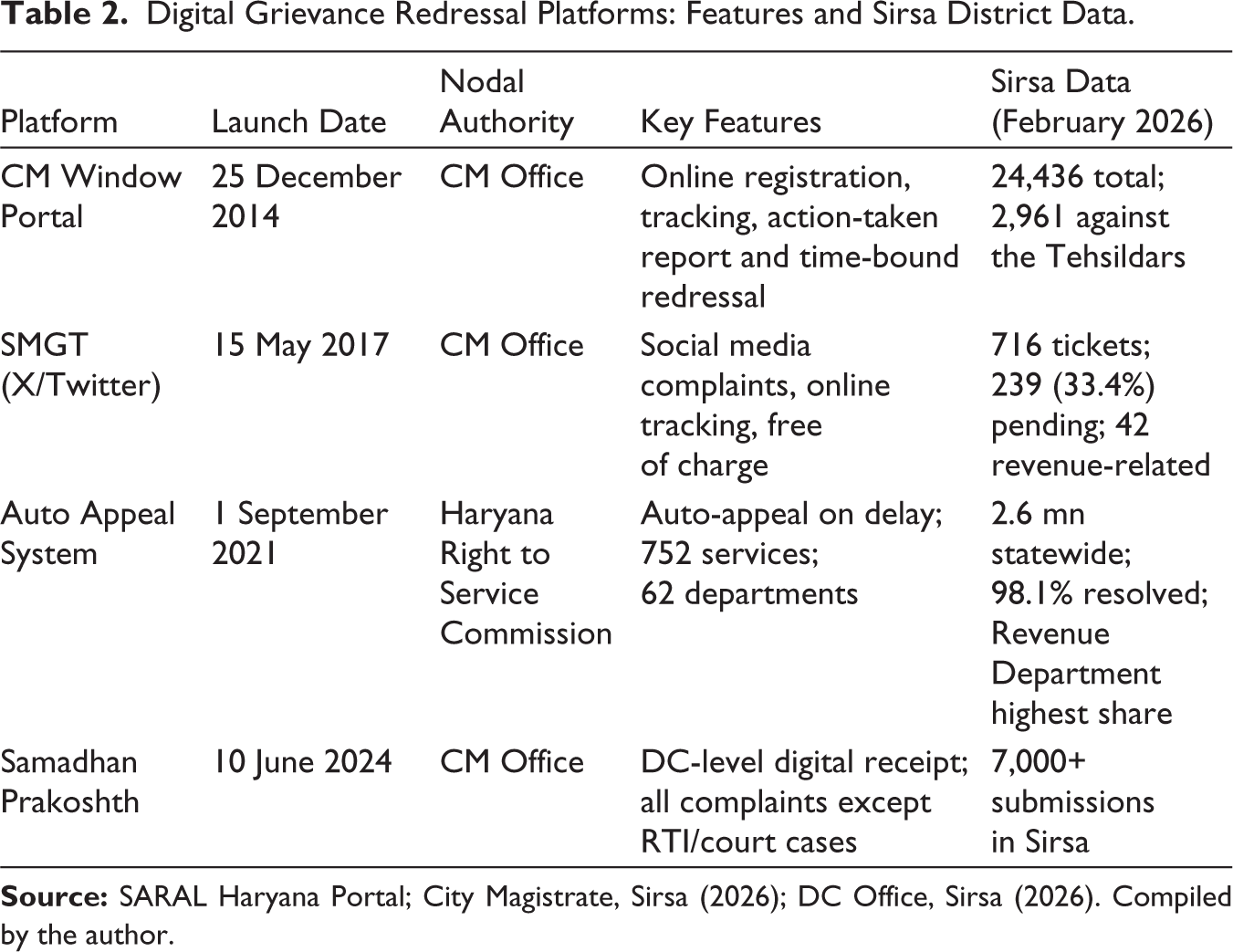
One of the most substantive transformations in the Tehsildar’s operating environment has been the emergence of a multi-platform digital grievance redressal architecture that places the office under continuous, multi-channel public accountability. Prior to digital reform, citizen grievances against revenue administration followed a predominantly hierarchical, paper-based escalation pathway that offered limited real-time visibility to either citizens or monitoring authorities. The current framework, constructed progressively through legislative and administrative initiatives since 2014, constitutes a qualitative departure from this model (Table 2).
Digital Grievance Redressal Platforms: Features and Sirsa District Data.
Haryana Right to Service Act (2014) and the Auto Appeal System
The Haryana Right to Service Act (2014) established the foundational legislative guarantee for time-bound service delivery, listing forty-four Revenue Department services with defined timelines. The Tehsildar serves as the designated officer for most of these services and as the first or second Grievance Redressal Authority when obligations are not met. The Act’s most operationally significant implementation instrument is the Auto Appeal System (AAS), launched on 1 September 2021, which covers 752 services across sixty-two departments statewide. The AAS eliminates the need for citizens to manually initiate appeals against service delays by automatically generating an appeal record when prescribed timelines are breached and routing it to the designated appellate authority without citizen action. This automation structurally shifts the burden of accountability initiation from the citizen to the system—a significant institutional change in the power relationship between the administration and the public.
The data generated by the AAS is significant. As of the fieldwork period, over 2.6 million appeals had been recorded statewide through the SARAL Haryana portal, with a resolution rate of 98.1 per cent. The Revenue Department accounts for the largest share of appeals within the system, with income and resident certificates being the most contested services—a concentration within the Tehsildar’s jurisdiction that reflects the volume of citizen interactions the office manages within statutory timelines. The high statewide resolution rate, while indicative of administrative responsiveness, should be read in context: it measures formal closure of appeal records rather than citizen satisfaction with the quality or substantive correctness of outcomes.
CM Window Portal and Social Media Grievance Tracker
The CM Window Portal, launched on 25 December 2014, operates under the Chief Minister’s Office and enables citizens to register grievances across all government departments for online redressal, tracking and time-bound action. The Social Media Grievance Tracker (SMGT), operational since 15 May 2017, extends the redressal architecture to the social media platform X (formerly Twitter), allowing citizens to lodge complaints through a public, directly visible channel to the Chief Minister’s Office. Both platforms offer complaint tracking, action-taken documentation and free-of-charge access, making them particularly accessible to citizens who may be reluctant to engage with formal bureaucratic channels.
The Sirsa-specific data reveal the operational significance of these platforms for accountability in revenue administration. As of 23 February 2026, Sirsa had recorded 24,436 total complaints on the CM Window Portal, of which 2,961 were filed specifically against six Tehsils and one sub-Tehsil—representing approximately 12 per cent of the district’s total complaints directed at the Tehsil level, a concentration that underscores the public salience of Tehsil-level administration. Under the SMGT, 716 tickets had been registered in Sirsa, of which 239 (33.4%) remained pending at the time of data collection. Of the revenue-related SMGT complaints, forty-two tickets pertained to the Revenue Department—preceded in volume by the Power Department, Urban Local Bodies, Panchayati Raj and Rural Development and Public Health departments—indicating that while revenue administration is a significant source of complaints, it is not uniquely disproportionate relative to other departments. The substantive content of revenue grievances centres on four recurring categories: conduct of Patwaris and Tehsildars, property and land registration procedures, land boundary and ownership disputes, including Lal Dora demarcation, and certificate issuance delays.
Samadhan Prakoshth
The Samadhan Prakoshth portal, launched on 10 June 2024, represents the most recent addition to the grievance redressal architecture. Operating under the Deputy Commissioner’s office, it enables district-level digital receipt and processing of citizen complaints across all departments, excluding RTI matters and cases sub-judice before courts. By 23 February 2026, the portal had accumulated over 7,000 submissions in Sirsa district alone, indicating substantial citizen uptake within less than two years of operation. The portal’s proximity to the Deputy Commissioner—who exercises supervisory authority over the Tehsildar—gives complaints filed through this channel an administrative weight that differs from those lodged on platforms managed by the Chief Minister’s Office. Though cost-effective in deployment, the portal’s impact on substantive administrative reform remains incompletely measured, as no systematic evaluation of outcomes has been conducted.
Institutional Implications of the Multi-platform Architecture
The proliferation of grievance platforms, while strengthening citizen accountability, has created new administrative burdens. The Tehsildar’s office must now monitor and respond to complaints across four distinct platforms simultaneously, each with its own escalation logic, response timelines and reporting requirements. This multi-channel accountability demand has not been accompanied by corresponding increases in dedicated staff or administrative support. The result is that compliance with grievance mechanisms competes directly with primary service delivery functions for the same limited administrative capacity—creating a structural tension between accountability performance and operational performance that the current resource environment cannot resolve.
Additional Structural Challenges
Beyond the three primary dimensions addressed above, fieldwork identified four further structural challenges that collectively shape the Tehsildar’s operational environment.
Political interference constitutes a pervasive challenge to operational effectiveness. Long-serving staff consistently documented increasing political involvement in administrative processes, concentrated in revenue assessments (takshim), boundary demarcation (nashan dehi), property transfers (intqaal) and encroachment removals. Interview estimates indicate that 20–30 per cent of the Tehsildar’s working time is absorbed by politically motivated demands, diverting capacity directly from service delivery. Officers who resist political pressure face punitive transfers and negative evaluations, generating a culture of compliance that is particularly corrosive among younger officers who come to regard professional integrity as institutionally impractical.
Severe resource constraints critically undermine the digital transition. With sixty Patwaris responsible for 333 villages—each managing five to six villages—the staffing ratio is untenable under expanded digital workflows. Equipment shortfalls compel staff to procure operational materials personally; field transportation for Patwaris is unsupported; and shared technology systems create processing bottlenecks. Additional non-revenue duties—electoral work, disaster management coordination—further compress operational capacity. The consequence for citizens is material: Partition cases remain unresolved for years, disproportionately affecting elderly persons, women and low-income landholders.
Frequent transfers of Tehsildars generate cascading losses of institutional knowledge. Incoming officers require three to six months to develop working familiarity with the district’s land records and pending caseload—during which complex cases are effectively stalled. This pattern, documented by Sharan and Narayanan (1986) four decades ago, has not been structurally remedied. The transfer system—originally designed as an anti-corruption safeguard—has, in practice, become a mechanism through which political leverage over administrative careers is exercised, thereby inverting its intended purpose.
Citizen awareness and engagement have expanded considerably, driven by mobile technology, social media and the Right to Information Act. However, this expansion deepens demands on an already overburdened administration managing more scrutinising citizens with diminishing per-capita capacity. Differential engagement persists: Less-educated, elderly, rural and women citizens continue to face geographic distance, procedural complexity and limited digital access— replicating inequalities that Norris (2001) identifies as endemic to unmediated digitalisation.
Discussion
The findings collectively portray a revenue administration system at an institutional inflexion point, pressured simultaneously by modernisation mandates and constrained by structural legacies. Four analytical threads merit extended discussion.
The digital responsibilities analysis reveals a fundamental regulatory asymmetry: The pace of legislative and functional change has substantially outrun the revision of operational guidelines. The Haryana Land Records Manual (2013) governs an office whose digital mandate is radically different from the one the manual was designed to regulate. The redistribution of certificate issuance authority to the Citizen Resource Information Department/Additional Deputy Commissioner tier, the assumption of digital sub-registrar functions and the accountability obligations under the Right to Service Act collectively constitute a transformed role—one that requires a revised and comprehensive digital operations manual to ensure consistent implementation across Tehsils.
The data accuracy analysis illustrates what Heeks (2003) theorised as the design-reality gap: Digital systems conceived for environments with stable connectivity, trained workforces and standardised measurement conventions encounter ground conditions in which none of these assumptions reliably hold. The persistence of accuracy challenges around measurement rounding, authentication bottlenecks and synchronisation failures is not attributable solely to staff inadequacy; it reflects the absence of systematic design adaptation to the specific measurement conventions, connectivity conditions and authentication pressures of Haryana’s Tehsil environment. Bhatnagar’s (2004) argument that successful digitisation requires comprehensive process redesign rather than technology superimposition is directly corroborated by these patterns.
The grievance redressal analysis demonstrates the paradox of accountability infrastructure outpacing administrative capacity. The four-platform digital grievance architecture is, by design, comprehensive and citizen-accessible. Yet the administrative capacity required to respond meaningfully across all platforms has not grown commensurately with the architecture’s expansion. The result is that accountability mechanisms—designed to improve service quality—generate compliance obligations that compete with the service delivery functions they are intended to improve. This tension cannot be resolved through further platform development; it requires investment in the underlying administrative capacity.
The political economy of transfers, documented through Wade’s (1985) framework of the ‘market for public office’, remains the most structurally entrenched challenge. Digital governance reforms have not insulated the Tehsildar from political pressure; if anything, the greater accountability and visibility created by digital platforms have increased the political salience of favourable administrative decisions in revenue matters. The Second Administrative Reforms Commission’s (2009) recommendations on tenure security and transparent transfer protocols have not been institutionalised in a manner that effectively insulates postings from political calculation.
Policy Recommendations
Seven evidence-based recommendations follow from the analysis:
Developing a Comprehensive Digital Operations Manual
The Haryana Land Records Manual (2013) requires a comprehensive revision to incorporate specific operational guidelines for all twenty-six revenue services administered digitally, clearly defined protocols for authentication responsibilities under HSLMP, standardised procedures for managing the interface between PPP/CRID and Tehsil-level issuance and updated data management obligations reflecting current digital infrastructure. This revision should be preceded by systematic consultation with frontline Tehsildars and Patwaris rather than being drafted exclusively at the departmental secretariat level.
Institutionalising Data Accuracy Standards
The data quality control standards embedded in the Jamabandi attestation process should be formally translated into the digital environment through automated anomaly alerts for data entries that deviate from historical baselines, mandatory field confirmation workflows before certain categories of mutation data are locked, and digital checklists that mirror the verification standards of the 2013 Manual. A dedicated mechanism for resolving measurement rounding disputes—by applying field-verified physical measurements when digital standardisation yields contested valuations—should be established, with clear procedural authority vested in the Tehsildar.
Strengthening Grievance Response Capacity
The multi-platform grievance architecture requires dedicated administrative support at the Tehsil level. A designated grievance cell—staffed by at least one trained officer and a data entry operator—should be established to manage cross-platform compliance, freeing the Tehsildar from the routine compliance burden while ensuring timely response. Periodic analysis of grievance data across platforms should be institutionalised as a performance monitoring tool, with findings used to identify recurring service failure patterns and drive process improvement.
Strengthening Institutional Autonomy
Systemic reforms to curb political interference must combine legislative prohibition of interference in specified revenue functions, independent oversight mechanisms insulated from the departmental hierarchy and transparent performance evaluation systems anchored in measurable service delivery outcomes. A documented rationale should be mandatory for all transfer orders, with officers entitled to a formal appeal against transfers that cannot be justified on administrative grounds.
Addressing the Resource Crisis
A minimum staffing ratio of one Patwari per two to three villages should be established through evidence-based norms, with one Kanungo for every five Patwaris. Accelerated recruitment, including lateral and contractual hiring for digital specialist functions, should be accompanied by improved rural posting incentives. Systematic infrastructure investment—computers, printers, scanners, power backup, field connectivity—must be treated as a governance prerequisite. Additional non-revenue duties should be assigned to dedicated teams to rationalise core workloads.
Stabilising Tenure
A statutory minimum tenure of three years for Tehsildars should be established, with transfers restricted to documented circumstances approved through a transparent process. Structured handover protocols—comprehensive case notes and a minimum overlap period—should be standardised as mandatory transition procedures. Tenure security should extend to key support staff, particularly experienced Patwaris whose local knowledge is equally critical to institutional continuity.
Reforming Digitisation Implementation
Digitisation should be reoriented from a technology-centric to a user-centric approach, with multi-tiered training delivered before system deployment, frontline staff consulted in system design, and hybrid operations formally recognised as valid modalities rather than transitional failures. Success metrics should encompass citizen satisfaction, data accuracy rates, staff competency benchmarks and deployment counts.
Conclusion
This article has examined the evolving role of the Tehsildar in Sirsa district, Haryana, with a focus on three dimensions that existing scholarship had not adequately addressed: the new digital responsibilities and legislative frameworks governing the office, the institutional management of data accuracy in digital operations and the multi-platform digital grievance redressal architecture. Together, these analyses reveal an office whose functional mandate has been substantially transformed by digital reform, but whose regulatory foundations, staffing resources and institutional protections have not kept pace.
The digital governance gains are real—e-Girdawari has accelerated crop inspection, the Tatima platform has enhanced land boundary transparency, and the grievance redressal architecture provides citizens with multiple accessible accountability channels. Yet these gains are constrained by a regulatory asymmetry between the pace of digital reform and the revision of operational guidelines; by data accuracy vulnerabilities arising from the deployment of standardised digital systems into measurement environments for which they were not specifically designed; and by grievance accountability architecture that places compliance burdens on an already resource-constrained administrative capacity.
The article’s central argument is that digital governance of land administration requires simultaneous investment across four dimensions: updated regulatory frameworks that reflect the actual digital mandate; institutional data quality management that translates manual verification standards into digital equivalents; adequate administrative capacity to meet multi-platform accountability obligations; and protection of administrative autonomy from political interference. Technology deployment in the absence of these foundations amplifies existing institutional vulnerabilities rather than resolving them. Future research should extend this inquiry comparatively across districts and states, systematically incorporate citizen perspectives—particularly from disadvantaged groups—and assess the conditions under which digital reforms translate into durable improvements in equitable service delivery.
Footnotes
Declaration of Conflicting Interests
The author declared no potential conflicts of interest with respect to the research, authorship and/or publication of this article.
Funding
The author received no financial support for the research, authorship and/or publication of this article.