







Abstract
The passage of the Constitution (128th Amendment) Bill 2023 marks a significant shift in the discourse of women’s empowerment in India. While the Bill may be considered an important move for the representational rights of women, to what extent it contributes to gender justice and women’s empowerment will be a significant matter of enquiry. This article argues that leadership and agency need to be emphasised as significant elements guiding women’s empowerment in the context of India’s patriarchal value paradigm. The Bill should not be considered as an end in itself unless it provides substantial scope for women leaders to exercise political agency within political parties and legislative bodies. Moreover, only a bottom-up approach characterised by quotas within political parties alongside dual-member constituencies is seen as a necessary solution to the limitations of the Bill. In this context, this article critically examines the questions of leadership, agency and women’s empowerment in the context of the Constitution (128th Amendment) Bill 2023.
Introduction
The Constitution (128th) Bill 2023 1 marks an important shift in the direction of gender justice and women’s empowerment 2 in India. It is an outcome of a prolonged struggle seeking representation of women in the higher-level legislative bodies. Consequently, the Nari Shakti Vandan Adhiniyam 2023 reserves one-third of the seats in the Lok Sabha, legislative assemblies of the states, and the legislative assembly of the National Capital Region of Delhi for women representatives. Further, it seeks to have reservation of seats for women from the Scheduled Castes (SCs) and the Scheduled Tribes (STs) categories. The legislation is expected to propel a wider level of opportunities, alongside the existing framework of representational rights laid down under the 73rd and 74th Amendments of the Constitution. These provisions together may be expected to facilitate a meaningful exercise of women’s political agency and engender inclusive decision-making processes in India.
However, its massive potential notwithstanding, the Act also needs to be examined critically, considering the structural challenges of empowering women’s leadership in India’s patriarchal socio-political context. It is necessary to study emerging issues and/or debates on the political empowerment of women globally, and where we can locate this Act within the global crosscurrent. This article raises the much-debated concern that reservation of seats is required, but not a sufficient condition for women’s empowerment. Apparently, the Act may have the desired effect only when it goes beyond ‘tokenism’ 3 and contributes across broader aspects of women’s empowerment, such as ‘exercise of political agency’ and ‘emergence of leadership’, including through proper representation of marginalised social categories. As such, based on precedents of gender-based reservation at local bodies, this article seeks to engage critically with the possible implications of the Act in the socio-historical milieu of the country.
In such a context, the debate on women’s reservation in legislative bodies may be understood vis-à-vis three main perspectives.
(i) whether the policy of reservation for women can act as an effective instrument for their empowerment, (ii) whether alternate methods of increasing representation of women in legislatures are feasible, and (iii) whether there are any issues with the proposed method for reservation in the Bill (Chakrabarty, 2023).
The above questions highlight the intricacies associated with women’s empowerment through gendered quotas in the legislature. In this context, this article interrogates the questions of leadership, agency and women’s empowerment regarding the Nari Shakti Vandan Adhiniyam 2023.
Approaches to the Study
This article explores the triangulation of a few approaches to meet the objectives of the present study. While it largely navigates through analytical, descriptive and historical approaches to substantiate the issue of women’s leadership along with agency vis-à-vis a gendered quota, new institutionalism appears as the overarching lens. The historical understanding of women’s participation in the legislature, and the prolonged struggle to get the Bill enacted, help one contextualise the Act in the socio-historical distinctiveness of the country. Further, the article goes on to describe various dimensions of women’s reservation by highlighting the significance of leadership and agency in women’s empowerment. Apparently, the analytical approach takes its course while comprehending the intricacies embedded in the question of women’s empowerment through a gendered quota and its different implications across democracies. As observed in other studies, the analytical approach helps us answer ‘why’ and ‘how’ questions associated with women’s empowerment through gendered quotas in the legislature (Manu & Akotia, 2021). The new institutional approach provides the impetus to understand the institutionally structured nature of parliamentary representation, path-dependency around recent corrective measures against the historical exclusion of women representatives, as well as the probable structural constraints and the likely solutions.
The Long Road to the Parliament and Legislative Assemblies
The Nari Shakti Vandan Adhiniyam 2023 passed through a long and contested terrain before getting parliamentary approval. The failure of parliament to pass the earlier versions 4 of the Bill insinuates the resistance within the political structure to provide space for women in legislative bodies. 5 Further, those failures also reaffirmed the male subjectivity-based moral reasoning and a condescending attitude towards acknowledging women’s political agency and their representational rights.
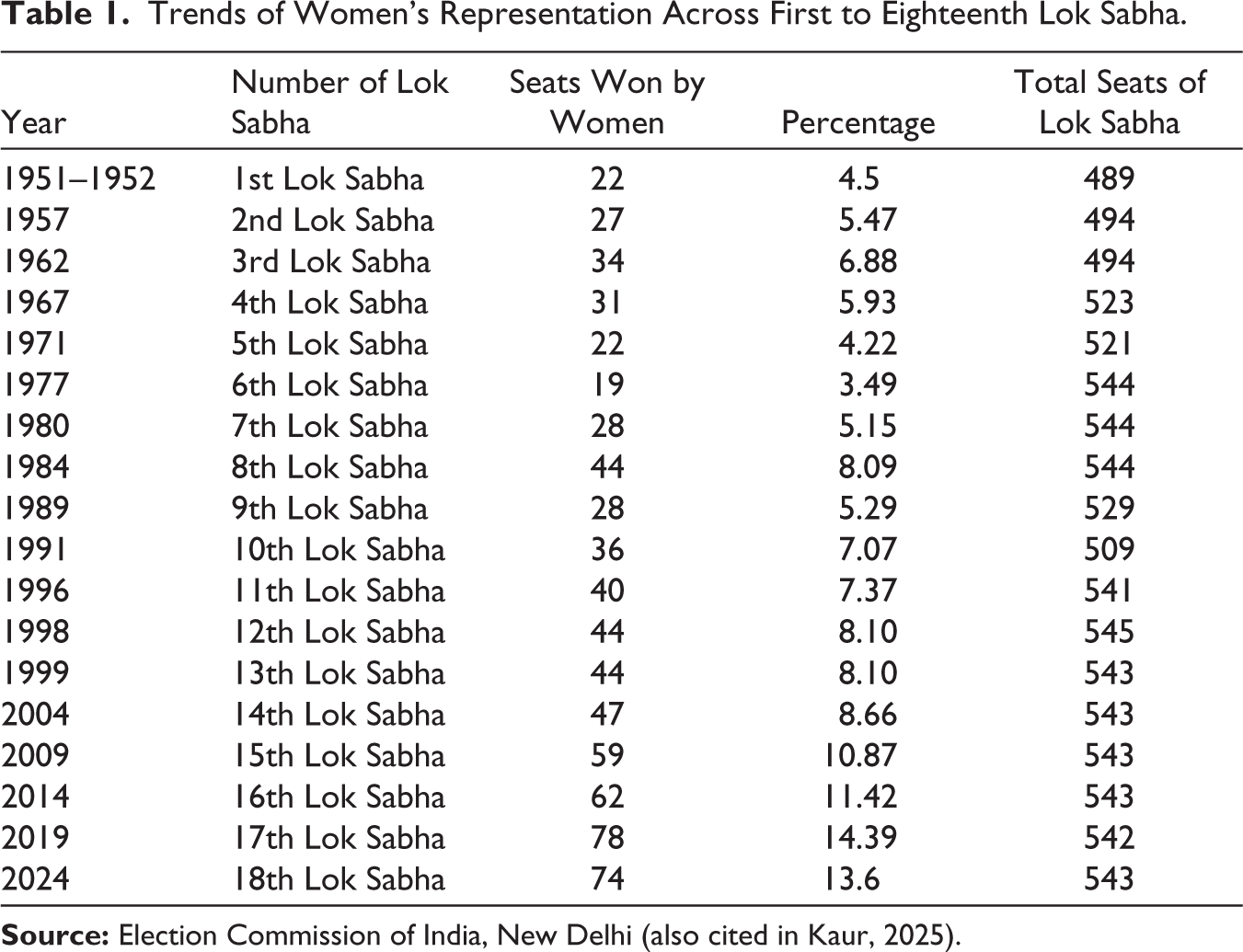
As per PRS legislative research, 15 per cent of the MPs of the seventeenth Lok Sabha and 13 per cent of the Rajya Sabha MPs are women. It was merely 4.4 per cent (twenty two out of 499 seats) in the first Lok Sabha elections (Basu, 2013). Needless to say, the increase from 4.4 per cent to 15 per cent in the Lok Sabha (as indicated in Table 1) is a significant improvement but not a sufficient one, considering the contemporary discourse on women’s empowerment and the relevant global scenario. For example, 46 per cent of the MPs in South Africa and 35 per cent in the United Kingdom are women members (PRS Legislative Research, 2024). Again, in the eighteenth Lok Sabha, there was no increase in women legislators (in fact, there was a decrease in women legislators) even after the Bill was passed by parliament, signifying the absence of a moral push from the political parties to increase women representatives in the parliament. There were seventy-four elected Members of Parliament in the eighteenth Lok Sabha against seventy-eight elected in the seventeenth Lok Sabha in 2019 (PRS Legislative Research, 2024). The situation was worse at the state level as, on average, only 9 per cent of the women members were in state Legislative Assemblies (Chakrabarty, 2023). No state legislative assembly had more than 20 per cent of women’s representation; the highest representation of women MLAs has been 18 per cent in Chhattisgarh, while Mizoram has had no woman representative at all (Mallick & Dutta Choudhury, 2023). The low representation of women in the legislative bodies has large implications in policy-making in the country. It also makes one wonder about the reason for abysmally low representation in the legislative bodies.
Trends of Women’s Representation Across First to Eighteenth Lok Sabha.
Despite the limited presence of women representatives in legislative bodies, women’s movements play an important role in the matter of gender equality. In her assessment of women’s movement, Basu hails the roles of numerous feminist organisations inter alia Samata Manch, Stree Sangharsh Samiti, Stree Mukti Sangathan, Feminist Network Collective, Purogami Sangathan, Saheli and Kali for Women, that were primarily concerned about violence against women and gender equality, but were also keen on staying away from the electoral domain and retaining autonomy from political parties (Basu, 2013). However, by the second half of the 1990s, perceptions changed, and the call for women’s representation in decision-making bodies became louder. Now, a near consensus is present among the women’s groups regarding quotas in legislatures as well as political parties (Rai, 1999) by virtue of the renewed gender perspective on representation in these bodies. The change in perception may also be related to the 73rd and 74th Amendments that delineated clear principles for reserving of 33 per cent seats in local bodies. As such, the demand now has instant electoral buyers as both the Congress and BJP made women’s representation in parliament a core issue of their respective election manifestos, more particularly after 1996.
Subsequently, women members in the legislative bodies have increased over the years. However, the number of women contesting for the legislative bodies and getting elected is significantly lower compared to some active democracies. In such a context, the successful passage of the 106th Constitutional Amendment provides revolutionary scope for socio-political transformation by providing space to women in legislation. From here, substantive transformation in electoral democracy is required to render the legislative bodies more representative by making the presence of a significant number of women a reality.
The formal existence of the right to vote proved to be inadequate in providing equal and commensurate voice to politically disenfranchised groups like women, SCs, and STs, thereby marking the necessity of political reservations for these groups in making our electoral democracy more substantively representative (Editorial, 2023, p. 8).
As such, this Act may well be considered a revolutionary attempt, but the goodwill of the stakeholders is of utmost necessity for women in their long struggle to get adequate representation in the legislative bodies.
Panchayat to Parliament: Getting Women’s Voices Heard
On a historical note, it took three decades to draw a consensus on the issue of women’s reservation in parliament and legislative bodies, while the same had been achieved in the self-governing bodies at the local level in 1993 (through the 73rd and 74th Constitutional Amendments). The failure to extend reservation for women representatives from the local bodies to the higher-level legislative institutions shows that the two connote different degrees of transformation, considering the level of women’s empowerment. This insinuates the structural resistance at the highest and intermediate levels, as well as the unsettling and diffident attitude of the patriarchs within prominent political parties.
One could speculate why leadership has been more reluctant regarding similar legislation at the parliamentary level. Could it be that enhanced representation of women in the national parliament spells a far greater and immediate challenge to the gendered status quo within the party-political system? The panchayats, while symbolic of grass-roots democracy in India, have never been resourced well enough to be important to the political processes in Indian politics. Or is it that the pattern of quota systems in India has shown that elite-based strategies of empowerment are less helpful to groups seeking greater recognition than those based upon grassroots institutions? (Rai, 1999, p. 88)
Even the nature of women’s representation in the different tiers of legislative bodies is different considering the character of the institutions. The entry of women representatives into the legislative bodies can have more empowering implications as it entails their role in policy formulation that can have a socio-structural role in the long run, in contrast to the significance of women at the Panchayati Raj Institutions (PRIs) in the ‘distribution of public goods at the grassroots level’.
The basic difference in the representation of women at the parliamentary and state assembly level versus at the PRI level is that the former is associated with policy framing while the latter is expected to focus on the equitable distribution of public goods at the grassroots, keeping in mind the interests of rural women (Bhowmick, 2023, p. 43).
Having said this, it cannot be denied that women’s reservation in local bodies essentially has the possibility of revolutionary transformation at the grassroots level.
Decentralisation reforms have opened local political institutions as a pathway to power. Yet gendered inequalities make these institutions an unequal pathway to power. There exists a stark gender gap in career progression in India. Women are also less likely to recontest state elections. At the same time, women’s greater presence in local politics can help lower these disparities. Women have advanced their political ambitions by taking advantage of the opportunities to organise in grassroots politics that have opened due to a greater presence of women in local party structures (Goyal, 2024, p. 13).
However, understanding the working of panchayats and the nature of decision-making often unfolds with a gloomy reality. As a matter of fact, the nomenclature ‘Panchayat Pati’ 6 has become commonplace in Indian politics over the years, reflecting how the decisions of the women members of the panchayat are often shaped and moulded by their husbands or male relatives. Such developments necessitate questioning whether women are proxy representatives of the strong local leaders in the panchayats.
Drawing from the experience of the PRIs, it is pertinent to critically examine the incorporation of women’s voices in the higher-level legislative bodies through gendered quotas. We need to ask whether the Nari Shakti Vandan Adhiniyam 2023 will meaningfully make women’s voices heard in the legislation process at those institutions. The patriarchal structure inhibiting women’s voices can be overcome only when the political space is democratic enough to create women leaders with independent voices. Reserving seats is insufficient to empower women without empowering them in the political decision-making. Of course, it requires a significant transformation in people’s attitudes along with equality of opportunities.
The idea of reservation for women in legislatures must not be seen as an end in itself rather as a means to an end. Quantitative representation would be achieved by implementing quotas in legislatures. However, a qualitative difference would not be seen until women politicians handle the mantle and emphasise issues such as violence against women, equality of opportunities, and salary at the workplace (Ojha, 2009; as cited in Bhowmick, 2023, p. 44).
‘Getting women’s voices heard!’ could be a meaningful way to transform our approach to women’s empowerment, which is largely limited within the existing mode of ‘representation’ in political bodies. Instead of engaging with representation merely from a numerical aspect, efforts should be made to create a suitable environment so that women could acquire, exercise and hone their political agency in matters of policy and social justice.
Leadership and Agency for Empowerment: Reservation for Women in Political Parties
A section of feminists who oppose the idea of women’s reservation in legislative bodies as ‘tokenist’ raises concern regarding the elitist character inherent in parliamentary politics and foresaw the danger in inclusion of women into the legislature, which is predominantly a ‘male space’ (Rai, 1999). In spite of the consensus on women’s reservations in the legislative bodies, scholars have valid reservations about considering such policies as the ultimate road to women’s empowerment. They argue that it will not necessarily result in a substantial transformation in the structural position of women. As such, while reservation is seen as a significant representational instrument, its consequence in women representatives exercising their political agency and deciding policy discourse remains a matter of concern. More particularly, working within a patriarchal institutional structure and rigid party norms often requires compliance rather than rational agency.
Arguably, considering the broader meaning entailed in ‘women’s empowerment’, reducing it to mere reservation in legislative bodies will misappropriate gender discourse in the contemporary period.
The attempt has evoked animated discussion on the quantity and quality of women’s participation in parliament and assembly and whether or not reservation will empower women and reduce disparities…. Some question the basic premise that a change in the gender composition will bring something distinctive to these bodies, inspire more women to enter politics, and represent and articulate women’s interests better. These persons do not agree that securing greater representation is a matter of social justice (Sharma, 2000, p. 73).
It will be pertinent to observe how the entry of women in various legislative bodies transforms the nature of debates, making them more representative of the concerns of women. It is so as they can better articulate the women’s travail and propose adequate policy measures, on account of their lived experience or ‘experiential epistemology’ 7 . There appears to be a prevailing sense of indifference towards the issues of women amongst a substantial number of the male members of legislative bodies. As such, they have not acted adequately for women’s reservation in the last three decades (Bhowmick, 2023). Indeed, the earlier attempts at bringing the Bill may also be attributed to the lack of consensus among the political parties and their patriarchs. Now, in the context of changed circumstances, reservations for women will deliver results only when the legislative bodies are metamorphosed into spaces of an ideal and inclusive speech community.
There is no dearth of politically capable women, many of whom are articulate, experienced in political affairs, and knowledgeable about grassroots issues. But either they are not selected as candidates or many do not wish to enter politics under prevailing conditions. The few who have reached parliament are manipulated and obstructed by party imperatives on gender issues (Kasturi, 1998, p. 21).
Women’s empowerment through reservation in legislative bodies is a major challenge and contested idea, as fewer women are present in leadership positions across political parties. The issue also needs to be comprehended in the milieu of women representatives’ political agency, a prerequisite in the direction of their political empowerment. To what extent their access to representative institutions translates to them exercising rational agency independent of patriarchal moral reasoning, will be interesting to examine. Again, it is argued that a gendered quota in legislative bodies comes with a massive challenge since allegations of using money and muscle power (primarily seen as ‘Bahubali’ male traits) to get party tickets have existed in Indian politics for quite some time. To that end, studies in recent periods have shown that money, muscle and crime have emerged as significant elements in the equation of winnability in elections, often giving rise to a ‘Robin Hood’ style of politics in India (Kumar, 2014; Vaishnav, 2017). Indeed, politicians with muscle and money power and criminal backgrounds have emerged as important arbiters in politics, indicating the prevalence of ‘criminal capitalism’ in parliament (Kumar, 2014). Within this existing structure, the question of the representation of women may also get entangled in the reality of political party-based patriarchal clientelism. Within India’s patriarchal social structure, where ascriptive and identity-based markers play a determining role in shaping the socio-political reality, there is a major possibility that such reservations will provide space to women associated with the strong patriarchs.
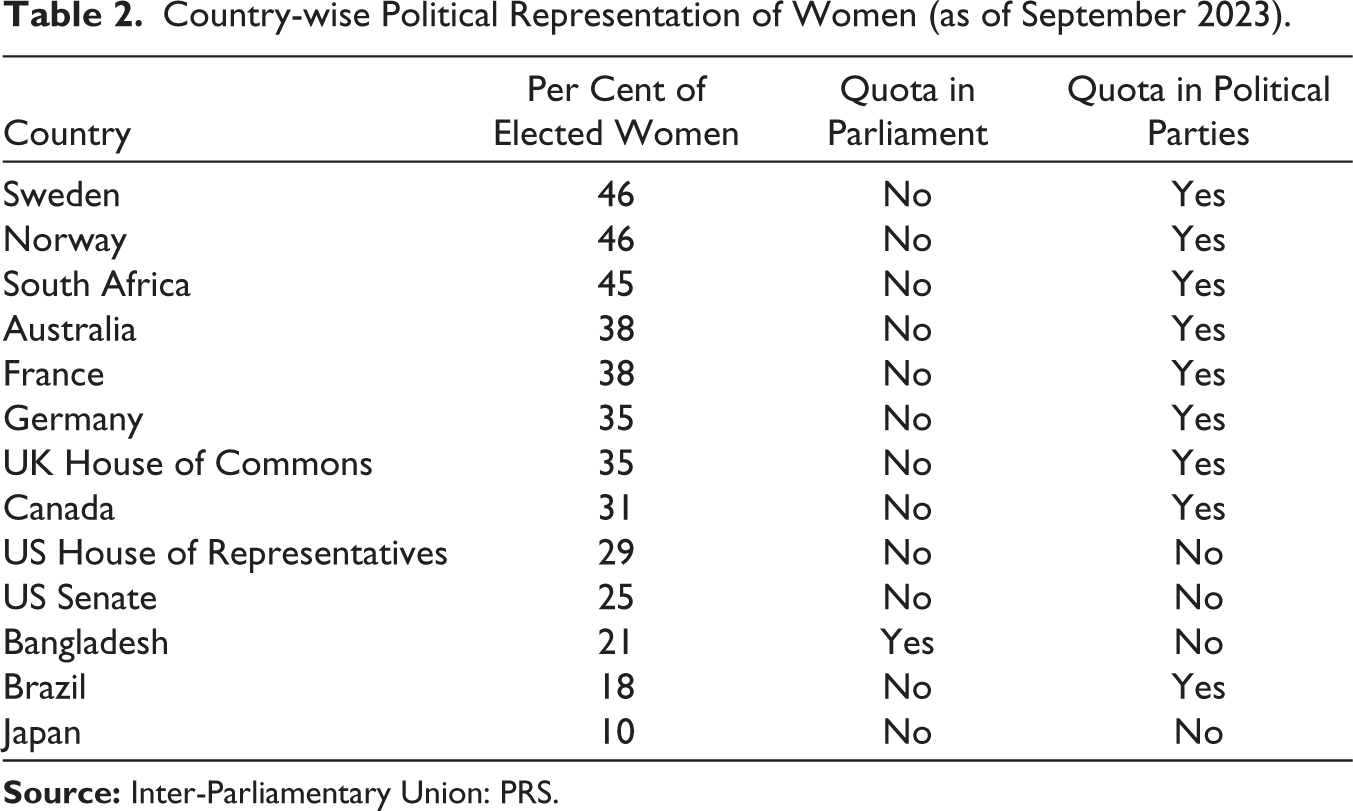
In such a context, political parties can be considered important sites of study vis-à-vis their role as catalysts of women’s empowerment. Some countries that have a significant role in creating women leaders and providing agency reserve seats in political parties. This seems to have had a significant role in women’s election to parliament in those countries. For example, countries (as indicated in Table 2) such as Sweden (46%), Norway (46%), South Africa (45%), Australia (38%), France (38%), Germany (35%), the United Kingdom (House of Commons, 35%) and Canada (31%) have a quota in political parties (not in parliament) and this led to a high percentage of elected women (Chakrabarty, 2023). It reflects a direct causality between the reservation of quotas in political parties and the chances of election of women candidates. The presence of women in the leadership positions of political parties creates leaders with ideology, influences the decision-making process of the parties, and ultimately shapes the active role of women in decision-making.
Country-wise Political Representation of Women (as of September 2023).
As against this, the environment is not conducive in India because the political parties have failed to provide sufficient space to the women members. According to PRS legislative research, 42 per cent of the BJD MPs and 39 per cent of the TMC MPs in the seventeenth Lok Sabha were women. Again, 17 per cent of the INC MPs in the Rajya Sabha are women (Mallick & Dutta Choudhury, 2023). Apparently, the other parties do not seem keen on women’s representation, thereby limiting the growth of women leaders who can independently enter legislative bodies. Indeed, the parties have not had any effective measures to recruit, train and promote women leaders through the ranks of the party.
The absence of women in the internal party hierarchy and the lack of necessary means of facilitating women’s participation in party activities, have led to a great deal of reluctance about accepting the idea of parity and partnership between men and women in politics. This, in turn, is reflected in the small numbers of women in parliament and the state assemblies (Sharma, 2000, p. 77).
Within India’s multi-party democratic political structure, empowering women necessitates structural transformation at the party level for providing agency to women leaders through their induction into the leadership position that trained them in the ideology of the party.
Women’s units within political parties, established in the seventies, are regarded as subsidiary or peripheral to the party structures and their activities are largely confined to social events, campaign work, and mobilising women to support and defend the agenda of the party in power. But, without logistic, financial, and strategic support from the parties, women cannot succeed as candidates in the multi-party democratic system (Sharma, 2000, p. 77).
Such qualitative and quantitative transformation at the level of political parties, which are the structural pillars of electoral democracy, can go a long way in empowering women in the true sense of the term. Of course, it is fascinating to see to what level parties can resist the patriarchal elements that are part of the country’s social structure.
The long and the short of it is that no political party functioning within the Indian political system or elsewhere, can claim to be totally immune from the vestige of patriarchy. Their ideological standpoint, however, in terms of whether they are programmatically committed to women’s empowerment and emancipation or not, is what counts, along with their political positions and day to day practice. And if a political party, or any individual for that matter, is committed to gender equality and women’s empowerment, why prevaricate on supporting the Women’s Reservation Bill? (Bose, 2010, p. 12).
The manifestation of the patriarchal social structure in the context of political leadership in India can be seen from the situation that there are fewer examples of the arrival of women political leaders independent of strong male leaders. 8 The dependence of women political leaders on male leaders and the portrayal of male decision-makers in a government headed by women leaders reflect the necessity of structural transformation where women can emerge as independent decision-makers. The democratic transformation of the parties with respect to women can go a long way in fulfilling this objective.
The internal reform of political parties is also vital. Inner party democracy, a commitment to fair practices in the field, disavowal of corruption and criminalisation, and large-scale recruitment of women at all levels, including the highest party positions, are absolutely essential (Kasturi, 1998, p. 32).
In view of the prevailing circumstances, India should also focus on reservations for women in political parties. This will help not only in creating women leaders but also in shaping their agency. The bottom-up gendered reservation in the political parties is more likely to create women leaders trained in particular ideologies of the parties. That will also enhance the possibility of their election to legislative bodies. The instances of Sweden, Norway, South Africa and Australia given in this article show that gendered quota for women in political parties increases their participation in the decision-making process within parties, and that in turn increases their electability to the parliament. There are relatively fewer chances of these women leaders facing structural impediments towards their entry into legislative bodies, as reflected in the case of India. Hence, this article argues that structural transformation can be initiated by the political parties themselves for creating impeccable women leaders, who would make inroads into parliament, as evidenced by the global data.
Creating women leaders in political parties, along with providing them agency, will have cumulative results in structural transformation at the ground level. The entry of women in the leadership positions of the political parties can be important for allowing the exercise of their agency, which can go a long way in bringing substantial and meaningful changes in the legislative bodies.
The Lalu Story: What Will Happen to the OBCs?
One vociferous section of the male anti-Bill lobby in parliament and outside sees the WRB as an attempt by upper caste “feminists” to muscle their way into the legislatures. A counter demand has been made by this group, on behalf of women from the Other Backward Classes (OBCs) and minority groups, this and other articulate sections, including feminists, have been calling for quotas within the quota for women. The argument is that since women are not a homogeneous mass, sub-quotas could meaningfully include the more disadvantaged among women (Kasturi, 1998, p. 28).
Post-Mandal Commission transformation in Indian politics has brought the reservation question of OBCs to the centre of the debate. While the Nari Shakti Vandan Adhiniyam 2023 has the option of reservation of women from the SCs and STs categories, there is no reservation specified for women from OBCs. This was why Mulayam Singh Yadav and Lalu Prasad Yadav vehemently opposed the earlier versions.
They refused to let the Bill be introduced in parliament unless it provides for 20 per cent sub-quota within the 33 percent, for women of backward castes. Without a sub-quota, they argue, the reserved seats will be appropriated by “women of the elite class” who will not promote the interests of the lower classes/castes (whose female literacy and economic indices are lower). This argument raises three questions:
Will reservations be an effective means of promoting affirmative action for gender equity? Does gender divide (on the basis of class-and-caste, as the Yadavs claim) or does gender unite women as a group, across class-caste divisions? In a country officially sworn to women’s advancement, how is a small coterie of male detractors able to stall the Bill? (Narasimhan, 2002, p. 184).
Lalu Prasad Yadav’s criticism of the earlier versions of the Bill has relied on the possibility of entry of women from upper-class and upper-caste backgrounds. The scope for entry of women from upper socio-economic profiles in the highly unequal social context of India is a massive possibility. When the election in India is associated with high financial costs,
9
it will provide limited scope for women of low economic backgrounds to dream of parliament. The question of women from marginalised communities needs immediate attention, along with women from economically weaker and rural backgrounds. Even among the STs and SCs, women are not economically homogeneous, thereby providing minimal possibility for women from economically weak and rural backgrounds. While discussing the election of women from marginalised socio-economic backgrounds on the earlier versions of the Bill, Bose (2010) observes:
The opposition to the Women’s Reservation Bill today is couched in three distinct but inter-related threads…. The most vocal and stead-fast opponents of the Bill have said that it is against the interests of the backward classes (OBCs), Dalits and Muslims. They have demanded sub-quotas for these sections within the larger quota for women (Bose, 2010, p. 10).
Hence, one of the major criticisms of the Act is the absence of specific reservation norms for women from OBCs or minority categories (Kidwai, 2023). Although the Act provides for the reservation for SCs and STs women, it does not mention other marginalised groups, including minorities. The fresh Amendment Act reaffirms the apprehensions of parties like the RJD to the earlier versions of the Bill. The allegation of massive monetary involvement in the election processes in India is not new, and, as such, the Act is silent about the economically weaker women from rural areas. As stated by Hanumantha Rao, caution should be observed; otherwise the Act will benefit only the upper-class women. He said:
along with women, SCs and STs representation will be discussed. OBCs representations too, should also be discussed in this meeting. Otherwise, all upper-class ladies will come. People below the poverty line, like the OBCs, should get into the parliament and the assembly also. Their share should be there (Asianet News Central, 2026).
In such a context, it is important to consider the internal social diversity within women to comprehend their participation and representation in legislative bodies from a broader perspective. Women’s participation in the legislative bodies will be more meaningful when they can represent the different socio-economic subcategories within the Indian social milieu.
Dual-member Constituency: Thinking of an Alternative
While reservation for women in legislative bodies is a necessity, and political and public discourse is aligned with this thought, political party-based gendered quota in leadership positions and dual-member constituencies may prove to be important alternatives. Women leaders from political parties need not struggle to get tickets in the presence of a dual-member constituency. While such a provision will receive less structural resistance, it requires creating strong women leaders from the political parties so that male members do not control their decisions. Further, dual-member constituencies will not deprive members of particular gender in getting elected to the legislative bodies. In the context of the deadlock over the earlier versions of the Bill, it was stated:
The new proposal for converting one-third Lok Sabha constituencies into dual-member constituencies assuring men their existing share of the pie seemingly holds a much-needed promise for resolving the deadlock over women’s reservation. Converting all constituencies into dual-member constituencies would have been a logical option, albeit with severe financial implications. The new proposal has yet another advantage: that of increasing the number of representatives without lifting the freeze on delimitation (Nanivadekar, 2003, pp. 4509–4510).
Turning one-third of the seats of the Lok Sabha and Legislative Assemblies into dual-member constituencies will solve the concern of the existing members of the constituencies regarding the possible loss of the constituency during the reservation for women. This may also be expected to remedy the issue of the rotational method of constituency reservation. The rotational method creates unease and political insecurity among male representatives of particular constituencies and may not allow women members an extended period of representation to mature politically, thereby creating hurdles for both. Also, dual-member constituency implies that there would be no restriction of choice for the electorate, and, as such, it comes with no additional cost for existing and prospective male candidates.
As a matter of fact, India is not unfamiliar with the idea, since the dual-member constituency had been operating in India until 1961, which included an SC/ST member in particular constituencies marked for the purpose in pursuance of Articles 330 and 332 of the Constitution (PRS Legislative Research, 2023). However, consequent upon criticisms coming from different quarters, the provision was abolished in 1961 through the Two-Member Constituencies (Abolition) Act, 1961. Now, in view of a greater concern for social justice and representation, this method of dual-member constituency may prove a productive political experiment. The benefits of the dual-member constituencies lie in having continued democratic choice of voters, which will not discriminate against the male candidates. Further, nurturing of the constituencies will be easier for the members where there is a large population of 2.5 million (Chakrabarty, 2023). But the disadvantage lies in the fact that women members might become secondary where the sitting members have to divide the political base due to dual-member constituencies. Further, the increased number of members in the parliament (as dual-member constituencies will increase the number of members in parliament approximately by 50%) might make deliberations in parliament difficult (Chakrabarty, 2023).
Implementation of the Act and the ‘Waiting’ Women Leaders
The journey from universal adult franchise to women’s reservation in higher-level legislative bodies has been long and challenging, with resistance at multiple levels. The struggle does not instantly end with the enactment of the Nari Shakti Vandan Adhiniyam 2023, as the Act will come into force subsequent to the delimitation process. This implies that women leaders may have to wait for some time to get their entry into legislative bodies under this Act. Further, the implementation, to a large extent, depends on the political interest of the legislators and the existing gender discourse in the country.
However, in view of the recent cabinet approval of the Amendment to the Act and the scheduled special parliamentary session, one may expect early implementation of the Act. It still is a matter of optimism despite the overall failure to get the reservation implemented by breaking the structural constraints of patriarchy. The Union Cabinet approved the draft Amendment on 8 April 2026, which proposed to raise the number of seats in the Lok Sabha from 543 to 816. This will be done after a delimitation exercise based on the 2011 Census rather than waiting for the Census data of 2027, so that women’s reservation can be operationalised by the 2029 Lok Sabha election itself. Further, there was an extension of the Budget Session from 16 to 18 April 2026 for debating the proposed Amendment (The Hindu Bureau, 2026). Although the Amendment is aimed at early operationalisation of the Act, the increase in the number of LS seats so that existing seats are not affected has triggered some suspicion. It clearly reflects the failure to come out of the structural constraints of patriarchal ideology. Further, there are also allegations of using reservations as a political tool for delimitation, which may have a negative impact on the states of South and Northeast India (The Hindu Bureau, 2026).
Conclusion
The Constitutional Amendment for women’s reservation in the legislature and parliament is a path-breaking step towards their empowerment, provided it is aligned with creating women’s leadership and helps them exercise political agency in the true sense. The structural constraints emanating from the prevalent patriarchal value paradigm, along with deep-rooted social inequalities, must be dealt with seriously so that the Act becomes meaningful and revolutionary. Global and historical data show the ‘women’s empowerment incentive’ embedded in a bottom-up approach, structured through party lines. The political parties in India could inculcate party structure-based altruism for women’s empowerment. For effective implementation of the Act, the intersectionality of class and gender-based inequality in society must also be critically looked into. As argued, ‘from descriptive representation through reservation for women to substantive representation requires changing attitudes of the people’ (Bhowmick, 2023).
The Way Forward
The discourse on women’s reservation in law-making bodies has come a long way, both at the ideational level and in the domain of decision-making institutions. In its run-up to fruition, the trajectory of the Bill has been uneven, readily drawing the consent of some and the wrath of others. As expected, the Bill triggered resistance for the existing structure of patriarchy in the highest-level law-making bodies. Notwithstanding the opposition surrounding the Bill, the epoch-making moment has come with the Bill securing parliamentary approval. This may be expected to expedite a more engaging and meaningful role of the women representatives in matters of public policy and social justice in the country. Now, it is time to shift focus from numerical and procedural representation to the issue of meaningful and judicious use of the political agency of women representatives. Meaningful parliamentary engagement by women may also help in the much-needed redemption of our representative institutions from the vices of criminalisation of politics and dominance of Bahubali and money-minded politicians. Further, there are certain notes of caution.
Using a fast-track method and reserving seats for women is a top-down approach, which might not be effective in India given the patriarchal nature of society and abysmally low female literacy rates. Such an approach would be mere tokenism and women would continue to remain in the marginal periphery of the political system of India. Such women members of legislatures would be mere puppets and would not possess actual power and decision-making authority (Bhowmick, 2023, p. 44).
It is observed that the women’s reservation in the Lok Sabha and legislative bodies is a top-down process with its own share of challenges and limitations. A bottom-up approach with emphasis on structural transformation in the patriarchal socio-political structure will be a positive move in that direction. We need leaders possessing agency, and women’s reservation in leadership positions in political parties can create women leaders trained in their ideology at different levels. Such transformations will automatically bring in sufficient women legislators, independent of the ambit of the Women’s Reservation Act. As such, parity measures need to be taken at the lowest strata of the socio-economic hierarchy, and a bottom-up approach will impact the current state of women (Bhowmick, 2023, p. 46).
Another cause for concern is the proposed rotational character of assigning reservations to certain constituencies. As per the Act, reserved constituencies will be rotated consequent upon every Census, which will be followed by a process of delimitation. While the rotation rule will allow women from more constituencies to be protected by representational safeguards, it misses out on creating a continuous opportunity for continuous and long-term exposure for the maturation of women’s leadership. In that case, the Act may give access to the decision-making sphere, but may fall short of creating ground for mature female leaders in a substantial manner. It goes without saying that continuous and longer tenure may be expected to help particular women leaders become visionary and successful lawmakers.
A careful reading of the Act and its possible impact would help one speculate on what lies ahead vis-à-vis its impact on the performance of the legislative bodies. Numerous studies based on a functional approach in recent decades have rued the evident ‘decline of the Indian parliament’ 10 from a functional productivity point of view. As against that, there are social scientists who tend to assess the same as a transitory symptom indicating ‘deepening of democracy’ 11 in parliament, with more and more social groups making their way into the institution in the last few decades. With the implementation of the Women’s Reservation Act, the debate on the declining functional productivity of parliament may resurface. Under those circumstances, simply denouncing the Act from an elitist functional assessment criterion would be misleading. Rather, we need patience, and the focus should be on making the legislative bodies more inclusive and attentive to the course of gender justice. A more representative and inclusive decision-making body will essentially pay democratic dividends beyond the transitory period.
Footnotes
Declaration of Conflicting Interests
The authors declared no potential conflicts of interest with respect to the research, authorship and/or publication of this article.
Funding
The authors received no financial support for the research, authorship and/or publication of this article.