






Abstract
The authors investigate the relationship between market transition and work hours in urban China. Regression analysis of data from the 2006 Chinese General Social Survey reveals a negative relationship between economic marketization, measured at the province level, and the likelihood that an employee works standard hours. Standard hours are less common among those working for smaller employers, which are less subject to outside scrutiny. This relationship between employer size and standard hours is stronger in more marketized regions. These findings support the authors’ argument that standard work hours are deinstitutionalized as employers strive for low cost and flexibility in China’s increasingly marketized but poorly regulated economy. Comparisons of the Chinese experience with recent trends in the United States reveal remarkable similarities in the weakening of social employment contracts precipitated by the ascendency of markets and the systematic disempowering of labor.
Work hours represent one of the most important aspects of employment relations in modern societies. For employers, work hours are vital to workplace safety, productivity, flexibility, and business competitiveness. For employees, work hours have direct implications for their income, job satisfaction, career development, and life quality. Whereas long hours can cause burnout and are detrimental to both the employee’s health and the well-being of the family, shorter hours entail limited earning and career opportunities and are frequently associated with precarious work (i.e., nonstandard, unstable, low wage, and unprotected), which has become prevalent in many countries (Kalleberg 2009). Important exceptions and cross-cultural variations notwithstanding, the standard 8-hour workday and 40-hour workweek remain the most balanced, if not most preferred, time arrangement for a majority of workers.
In this article we examine the fate of standard work hours in China’s transitional economy. In the heyday of China’s state socialism, normal work hours for those in urban areas were eight hours a day for six days a week. These standards were subsequently modified and formalized in the post-1978 reform period. In particular, the Labor Law enacted in 1995 capped working time to eight hours per day and required that workers be given at least one day off each week. Yet, in the past decade and a half, studies suggest that violations of these standards have become rampant. For example, field researchers routinely report long hours as one of the sweatshop conditions in the emerging private sector; shorter, irregular hours are also common among those who seek a living in the shadow of the formal economy (Park and Cai 2011). While the existence of such violations is beyond dispute, the driving forces behind the erosion of standard hours remain unclear and have yet to be subjected to in-depth investigation.
We begin to fill this gap by examining how economic marketization as a macro-institutional process reshapes work hours in urban China. Economic marketization refers to, among other things, privileging market relations in structuring other social and economic relations. The literature on work hours in the United States has revealed a clear departure from the standard 8-hour workday and 40-hour workweek. The institutionalization of standard hours was an important component of the social employment contract that accompanied the routinization of labor relations in industrial capitalism. Its breakdown, or deinstitutionalization, signals the end of that social contract. We argue that a similar process of deinstitutionalization is also taking place in China. More specifically, we argue that China’s state-led reform campaign to institute a market economy creates strong incentives for employers to adopt nonstandard work hours to reduce costs and to promote flexibility. Despite their counternormative nature, nonstandard work hours proliferate in China due to the absence of independent unions and the state’s colossal failure in labor law enforcement.
Our empirical analysis uses nationally representative data collected in the 2006 Chinese General Social Survey to examine work hours in urban China. We take advantage of the regional variations in China’s market reform progress and use a well-developed marketization index to gauge this important feature of the institutional environment at the provincial level. The central objective here is to ascertain whether or not marketization is indeed positively associated with nonstandard work hours as suggested by our theoretical argument. Aside from this objective, our analysis also seeks to shed light on how organizational characteristics moderate the effect of marketization of working conditions.
By linking work hours to China’s changing institutional environment, our study contributes to two important literatures. The first is the literature on China’s post-socialist transition. While much research has been conducted on the impacts of market transition on the lives of individuals through the lenses of income distribution, job mobility, and personal health, systematic research on workers’ experience of work hours and work intensity remains undeveloped. This limitation is critical, given the strong implications of these issues for individual well-being and family life. Moreover, it also makes it difficult to put other changes into perspective. For instance, several studies point to emerging patterns of income inequality during the market reform era, but it is often unclear to what extent these changes reflect new allocative principles and to what extent they may have resulted from uneven changes in paid hours across sectors, occupations, and demographic categories (Zhou 2000; Cao and Nee 2005).
Our study also contributes to the literature on working time. Already voluminous and still expanding, this literature is dominated by research focusing on Western societies. We know much less about important issues such as long hours, hour mismatches, and flexible scheduling in developing countries. By focusing on China, one of the largest and fastest-growing economies in the world, our study not only takes a step to address this imbalance but also provides another reference frame for understanding how institutional change impacts working conditions and restructures employment relations. Relating the Chinese experience to what has taken place in the United States during the past few decades, we highlight a common theme where the deinstitutionalization of the standard work hours in both countries results ultimately from the ascendency of market forces and the systematic disempowering of labor.
Deinstitutionalization of Standard Work Hours in the United States
In the United States, as in many of the industrializing capitalist countries in the west, central to rationalizing employment relations was developing and institutionalizing standard employment practices and hours (Thompson 1967) particularly the idea of a “standard workday.” The Industrial Labor Organization (ILO), established in 1919, has identified work hours as one of the fundamental determinants of the quality of working conditions. At that time, 1919, the ILO established work hour standards in much of the industrializing world (Nolte and Ghosheh 2010). The United States was a somewhat late adopter and did not establish standard work hours and work hour limits until after considerable pressure from unions. Those standards were then institutionalized in the Fair Labor Standards Act (FLSA) of 1938 that contributed to the standardization of work in the 20th-century U.S. economy.
The FLSA established a “floor below which workers should not fall” (Gould 1982). That floor provided both minimum wages and maximum hours because, historically, workers’ concerns were with a protracted working day devoid of breaks. In 1890, for example, the average worker worked for 11.4 hours and in some industries for as much as 12 or more hours a day (Friedman 1973: 485). The FLSA established a legal structure that standardized the workday and required employers to pay overtime when they required workers to work beyond 40 hours a week. These standards contributed to the increased security that characterized work not only in unionized sectors of the economy but also in some nonunionized sectors as these practices diffused throughout much of the economy.
Just as wage structures spilled over to nonunion workplaces (often as employers sought to forestall further unionization), so too did conceptions of a “normal” or “standard” workday. Thus, this legal structure diffused to a much broader normative structure. In the U.S. case, a standard workday and workweek centered around the hours of nine to five, Monday through Friday. For both unionized workers and nonunionized, non-exempt workers, for example, working outside of these hours entailed extra (overtime) pay. This normative understanding was so well institutionalized that it has become part of the national accounting of work hours. Thus, whether legislated or not, the idea of a standard workday was deeply embedded in workplace norms; while the specifics of those hours vary, the normative base of a standard workday has diffused throughout the global economy to varying degrees (although consideration is beyond the scope of this article).
The embedding is evident in national accounting practices such as the Bureau of Labor Statistics (BLS) that began collecting data on work schedules in the 1980s. The BLS defines work schedules in a way that presumes a normative workday; for example, a “fixed day: at least half of the hours worked most days in the prior week fell between 8:00 a.m. and 4:00 p.m.” (Presser 2003:14). The BLS also defines “fixed evening,” “fixed night,” “rotating,” and “hours vary” schedules. For many researchers, nonstandard hours are work hours that occur “other than fixed-day schedules the previous week, and as working non-day hours, when they worked evenings, nights, or rotating schedules.” Likewise, nonstandard days are working Saturday and/or Sunday (Presser 2003:14-15; Fuchs-Epstein and Kalleberg 2004). Despite this normative structuring, recent economic shifts have contributed to the deinstitutionalization of these standards.
The past several decades have been characterized by a widespread dismantling of the previous industrial employment contract and growing precarity for workers (Kalleberg 2012). De-unionization, deregulated workplaces, and the dismantling of legal protections around the rights of workers have contributed to de-standardizing the normal working day (Rubin 2007; Bernhardt, Boushey, Dresser, and Tilly 2008). Employers, seeking to maximize profits and avoid high labor costs have, according to some, “abandoned the normative structure” (Bernhardt et al. 2008: 5).
In the United States, the deregulation of work hours has, for example, allowed employers to substitute part-time, temporary, and contingent employees for long-term stable employees. Thus the deinstitutionalization of the standard workday contributes to the deinstitutionalization of the standard (normative) employment contract (Rubin 1996, 2012) and creates increasing precarity for employees. This retreat from full-time employment returned many workers to piece-rate rather than salaried compensation and to uncertain rather than predictable work hours (Bernhardt et al.: 2008). Such workers are increasingly likely to work nonstandard schedules over which they have little control and that are “mismatched,” requiring either more or far fewer hours than is their ideal (Reynolds and Aletraris 2006; Kalleberg 2007; Bernhardt et al. 2008). The instability of work hours results in a variety of negative outcomes for employees, including greater work-family imbalance, stress, and lowered organizational commitment (Hinrichs, Roche, and Sirianni 1991; Moen 2003; Presser 2003; Fuchs-Epstein and Kalleberg 2004; Rubin 2007).
A variety of workplace changes contribute to these shifting temporalities. The growth of the service sector means that increased numbers of service workers, typically unprotected by union work rules, have nonstandard schedules. Similarly, work that is restructured around tasks rather than set hours often requires employees to work nights, weekends, and other previously protected times to complete assigned tasks regardless of the hour. Likewise, researchers note an increase in violations of overtime law accompanied by decreased penalties for those violations (Bernhardt et al. 2008). The dual erosion of standard working hours and a standard workweek have, then, contributed to the 24/7 deployment of labor and the degradation of working conditions. For example, an increasing proportion of the working male population in the United States works 50+ hours a week (what Jacobs and Gerson [1998] call “long hours”).
A combination of factors has contributed to a deinstitutionalization of the standard workday and -week: in the U.S. case, weak unions and the lack of political consensus undermined efforts to protect the standard workweek. At the same time, in the United States and elsewhere, globalization and the need for more flexible organizations of production and distribution, in conjunction with weakened unions, demographic shifts (more women with young children employed full-time), and the shift to service sector employment have all contributed to deinstitutionalizing the 8-hour workday and the 40-hour workweek. We see many of these same mechanisms driving change in post-socialist China.
Deinstitutionalization of Standard Work Hours in Post-Socialist China
Established under Mao and recodified in China’s first labor law in 1995, standard work hours are also a defining feature of formal employment for Chinese workers. Yet, as we later contend, market reform in the post-socialist era ushered in a new type of social contract that erodes the basis of this standard work arrangement. On the one hand, the emergence of market institutions in China has recommodified time and fundamentally altered the incentive structure for employers. As in the United States, flexible hours and informal employment have become increasingly prevalent as ways to reduce cost and enhance flexibility. On the other hand, the Chinese government so far has failed to enact effective measures to curb labor rights violations. While recent legislative efforts have indeed delineated a basic set of labor rights, their enforcement is far from satisfactory due to the government’s development strategy and the absence of independent unions. Together these conditions lead to the deinstitutionalization of the standard workday.
As in the United States, the standard workday in China (biaozhun gongzuo ri) refers to the normative arrangement where employees work no more than 8 hours a day. This norm dates back to 1922 when the Chinese Communist Party and labor activists organized China’s first National Labor Congress (Guangzhou Daily 2012). This Congress passed 10 resolutions, one of which called for 8-hour workdays. In 1952, three years after the Communist Party came to power, the government issued a policy (the Resolution on Labor and Employment Problems [guanyu laodong jiuye wenti de jueding]) pushing for 8- to 10-hour workdays nationwide and 8-hour days in large enterprises. In the ensuing decades, as the government strived hard to provide permanent employment for a growing urban labor force (Whyte and Parish 1984: 27–56), working time became standardized: 8 hours a day for 6 days a week. While state media frequently exalted “model workers” who volunteered to work extra hours, overtime was not the norm except among those seeking political favors or fast-track career advancement (Walder 1986). Self-employed and part-time workers were rare because these forms of employment conflicted with the official socialist ideology emphasizing public ownership and egalitarianism (Whyte and Parish 1984; Bian 1994).
Even in the reform period (1978 to the present) the Chinese government has continued to reaffirm the 8-hour workday as part of the standard working conditions. The labor law passed in 1994 and put into effect in 1995, stipulates that regular daily working time cannot exceed 8 hours and average weekly working time cannot exceed 44 hours (Clause 36). Employees are entitled to at least one day off per week as well as several national holidays (Clause 38, 40). Overtime is allowed but must be compensated at 150–300% of the regular wage rate (Clause 44). Under normal circumstances, overtime cannot exceed one hour per day and must be pre-negotiated with the trade union and the employee (Clause 41). For workers under a piece-rate scheme, employers are required to set workload and wage rate in accordance with the 8-hour daily limit and 44-hour weekly average (Clause 37). With these clauses the labor law establishes clear limits on daily working hours and weekly workdays that are highly consistent with preexisting practices.
It is important to note that these working time standards were not just abstract notions or legal stipulations that existed only on paper; they were in practice in most urban organizations. According to data from the 1995 Chinese Household Income Project, a large-scale national survey funded by the World Bank, 88% of the 11,880 working adults in the urban sample reported working 7–9 hours a day, 93% of them reported working 5 or 6 days a week, and more than 75% reported working 40–48 hours per week (see Table A.1 in the Appendix for more details and Griffin and Zhao 1993). These statistics are not surprising because, as of 1995, public ownership remained dominant in the urban economy and labor reform had yet to gain momentum. Most labor force participants were still employed in public enterprises, state-owned nonprofits, and governmental agencies. Strong state control combined with organizational inertia to perpetuate standard work hours along with other pre-reform employment practices.
More recent evidence, however, suggests a growing number of exceptions. For example, labor scholars frequently cite long hours and forced overtime in sweatshops in the fast-growing export-oriented manufacturing sector (Chan 2001; Choi 2003; Li and Edwards 2008). Likewise, management scholars and industrial-organizational psychologists report 10–15 hours of overtime per week among many white-collar employees (Fiksenbaum, Jeng, Koyuncu, and Burke 2010; Houdmont, Zhou, and Hassard 2011). But overall the literature on work hours in China remains fragmented and suffers from two major limitations. First, researchers have relied on either qualitative fieldwork or survey data from a small number of firms clustered in a single city or region. It is impossible to tell to what extent their findings are generalizable across firm scales, industries, and geographic locations. Second, most of these studies are either descriptive or focused on the consequences of long hours. As such, they offer little insight into the causes of deviations from standard work hours. 1
Our study draws inspiration from the literature on the United States but underscores a different set of structural conditions leading to increasingly diverse and fluid work arrangements in post-socialist China. As we will contend, the deinstitutionalization of the standard workday is a product of China’s unique reform approach where fundamental changes in economic institutions continue side-by-side with the one-party political system that seeks to balance economic development and regime legitimacy. The China case echoes, however, themes from the United States: deregulated employment practices, flexibilization, weakened labor, and, more broadly, a shifting social employment contract.
Market Transition and Changing Employer Incentives
The market transition literature pioneered by Nee’s 1989 seminal article on stratification in rural China conceptualizes the institutional change in post-socialist countries as first and foremost a shift from a socialist planned economy to a market economy. This line of research draws on Polanyi’s typology of different modes of economic coordination (1944) and underscores the roles of competitive markets, the decline of state control over economic activities, and the influence of global capitalism as the driving forces behind changes in the stratification order (Cao and Nee 2000; Nee and Cao 2005). Outside of the market transition literature, others have discussed this process in similar terms such as marketization and economic liberalization. Some labor scholars point to growing managerial autonomy and labor flexibility, and others trace changes in the stratification structure to the rapid decline of public ownership precipitated in part by the influx of foreign capital (Lee 1999; Gallagher 2004, 2005a). Focusing more specifically on the lives of individuals, Tang and Parish describe China’s transformation as “a redefinition of the social contract” (2000: 3). Whereas the socialist social contract promised job security, basic living standards, and egalitarianism in exchange for political obedience and reduced consumption, the new market-based social contract eliminates these promises to allow for greater individual aspiration and economic dynamism. Despite subtle disagreements among scholars, there is little doubt that the Chinese economy has moved decisively away from state planning and toward markets.
This process of economic liberalization has direct implications for Chinese employers’ incentive structures. Whereas previously most Chinese organizations were publicly owned, operated under soft budget constraints, and performed a host of economic, political, and social welfare functions (Walder 1986), the reform era has witnessed a proliferation of nonpublic ownership forms but converging orientations toward efficiency and profits. In 1991, state- and collective-owned organizations still accounted for 93.7% of China’s urban employment (National Bureau of Statistics of China 1996). By 2006, the same figure had declined to 25.4% (National Bureau of Statistics of China 2007). On the rise are private firms, foreign-invested companies, and tens of millions of small businesses whose livelihoods depend critically on success in market competition. Even within the state and collective sectors, a series of reform policies dating back to the 1980s coupled with growing competition from foreign-invested companies and private firms have subjected public enterprises to considerable market discipline (Gallagher 2005a). Studies abound showing widespread adoptions of market-oriented practices such as performance-based wage systems, merit-based promotions, diversification strategies, and Western-style human resource management structures (Guthrie 1997, 2001; Cao 2001, 2004; Keister 2002a). The tendency is particularly strong in export-oriented manufacturing industries where the labor-intensive nature of these industries combined with fierce competition in the global market lead many employers to resort to extreme, sometimes abusive, measures to reduce labor costs and to maximize productivity (Chan 2001; Choi 2003; Li and Edwards 2008).
Since the very beginning, market reform has promoted an economic orientation to time, that is, an equation of time with money. In 1981, an industrial district in Shenzhen, a city at the frontier of China’s market reform, put forth the now-famous slogan “time is money, efficiency is life” (Liberation Daily 2008). It later received the endorsement of Deng Xiaoping himself and was widely adopted by companies across the country (Gallagher 2004). This economic orientation to time became even more salient as subsequent reform policies dismantled the socialist labor regime and recommodified labor. Established in the Maoist era, the socialist labor regime entailed lifetime employment and imposed comprehensive state control over job allocation, compensation, and welfare provision through the “work unit” (or danwei in Chinese) system (Bian 1994). Whereas labor reform during the 1980s remained tentative and limited, changes began to accelerate after Deng Xiaoping’s south tour speech in 1992. A central component of labor reform was the replacement of lifetime employment with labor contracts. By 1994, 26% of the labor force and more than 40% of those in the manufacturing sector were placed on fixed-term labor contracts (Guthrie 1998: 468). During this period, the state took steps to reform the pension, housing, and medical systems, substantially reduced its role in job provision, and encouraged workers to use market channels to secure employment (Tang and Parish 2000; Nee and Cao 2005). Whereas the 1995 Labor Law was widely seen as a milestone legislation that established a comprehensive legal basis for labor markets, China’s actual transformation toward a capitalistic employment system culminated in the subsequent five-year period when tens of millions of workers were laid off by public enterprises in an apparent attempt to permanently reduce labor redundancy and to promote competitiveness (Keister 2002b).
The commodification of labor—hence time—paved the way for new types of workplace temporalities. As China has moved toward a market economy and participates in global competition, adhering to traditional work hour standards has become economically disadvantageous for many employers. There are at least three reasons for this shift: first, flexibility; second, cost advantages; and third, contextual factors in China.
Flexible hours give employers the ability to readily expand and reduce the scale of production without resizing their workforce. Whereas in the pre-reform era the state issued definitive plans for public enterprises to follow, in the reform period firms must respond to uncertain market conditions. One way to cope with such uncertainty is the so-called breathing factories—factories that constantly adjust their workforce based on changing market demands and factor costs. For example, a study by Li and Edwards (2008) found strong seasonal fluctuations in small clothing factories where workers alternated between working nearly 12 hours a day in the busy months and only 3 to 4 hours or none at all when orders tapered off. Recent scholarship further articulates a trend of informalization whereby more and more workers take on casual or temporary employment, usually without any formal contract or documentation (Friedman and Lee 2010; Park and Cai 2011). Such employment arrangements bear remarkable resemblance to what is known as precarious work in the Western world both in form and in essence (Kalleberg 2009; Gallagher, Lee, and Kuruvilla 2011).
Second, even under stable market conditions, firms may still derive some degree of cost advantage by requiring existing workers to work longer hours. Compared to the alternative of employing more workers to work standard hours, the long-hours strategy can lead to considerable savings in recruitment, training, managerial oversight, and fringe benefits. Chan and Siu (2010) surveyed 88 workers in nine factories in Shenzhen. Respondents in their sample worked an average of 302 hours per month, or about 70.5 hours per week. It is noteworthy that all nine factories Chan and Siu surveyed produced for Wal-Mart, the retail giant infamous for strong-arming suppliers into price concessions. Another study by Houdmont, Zhou, and Hassard (2011), using data from an international information, communication, and technology (ICT) company’s Chinese branch, showed an average of 14.2 hours of overtime per week for its full-time employees, most of whom were professionals. This finding suggests that long hours are not limited to manufacturing workers or casual laborers.
Third, the erosion of standard work hours is likely facilitated by several unique features of the socioeconomic context in China. In the United States, long hours have been known to cause issues such as burnout, turnover, and work-family conflict, making it difficult to sustain a stable, productive workforce (Kalleberg 2007; Jacobs and Gerson 1998). Similar issues also exist in China (Fiksenbaum et al. 2010; Houdmont, Zhou, and Hassard 2011), but they tend to be of less concern for Chinese employers. One reason is that, given China’s huge labor supply and its relative concentration in industries with low skill requirements, employees are more easily replaceable. Employee burnout and turnover are not as costly to Chinese employers as they are for those in developed countries such as the United States. Likewise, extended families and strong kinship ties in China can alleviate role conflicts for parents who are required to work long or irregular hours (Spector et al. 2004).
As argued earlier, the ultimate impetus for nonstandard work hours stems from growing firm autonomy and market discipline. We therefore hypothesize that, all else being equal,
The Rule of Law, Organizational Size, and Institutional Conformity
China’s transition from a socialist labor regime to market-based employment has not been smooth and has led to significant labor conflict (Lee 2007). In the state sector, massive layoffs, managerial malfeasance, and employer defaults on welfare obligations triggered widespread protests and resentment during the late 1990s and early 2000s (Lee 2000; Cai 2002). These problems were particularly serious in the northern “rustbelt” provinces that were once dominated by traditional heavy industries. In the southern “sunbelt” region, private firms and foreign-invested companies employ millions of migrant workers from the countryside to staff their manufacturing plants, often under appalling work conditions. In response to rampant abuses and intensified conflicts, the Chinese government has opted for a strategy whereby laws and regulations—rather than organized labor—are promoted as means to safeguard workers’ interests. The hope is that by better regulating employer practices and providing workers with legal recourse, the state will be able to appease the increasingly disenchanted working class and thereby to maintain its regime legitimacy (Gallagher 2005b: 57). As Lee (2002: 196) put it, “[i]nstead of neo-traditional authority exercised by the party apparatus within the enterprise through its patron-client networks, employment practices and relations are now to be regulated by an external bureaucratic system based on universalistic, abstract legal norms.”
One of the most significant events in this transition toward the “rule of law” was the passage of China’s first labor law in 1994. 2 This law provided the first comprehensive legal framework that not only institutionalized market-based employment but also delineated a basic set of rights for Chinese workers. Under this law, provincial governments are required to establish minimum wage standards for their jurisdictions. Employers are not allowed to arbitrarily dock wages, dismiss workers, administer corporal punishment, or subject workers to physical or health risks. As in the United States, a central component of standardizing a social employment contract rests on standardizing “normal” work hours. On this account, as described earlier, the Chinese Labor Law establishes clear guidelines that limit regular working time to eight hours a day and no more than six days a week.
Enforcement of these legal mandates, however, remains far from satisfactory. One major reason for this failure, according to Friedman and Lee (2010: 513), is that “local governments—supposedly responsible for the implementation of national labour laws—are frequently much more concerned with capital accumulation than with law enforcement, a state of affairs that is tolerated by the central government.” This problem is especially serious in non-state sectors because local officials “benefit collectively and individually from the management fees and taxation levied from private and foreign firms” (Lee 2002: 200). Friedman and Lee conclude that “labour and legal rights violations cannot be attributed to the activity of a few ‘bad apples,’ but rather are a fundamental feature of the model of development that the Chinese state has pursued over the past 30 years” (2010: 513). This model is firmly anchored in the promotion of export-oriented labor-intensive manufacturing (Lin, Cai, and Li 2008), the use of foreign capital (Gallagher 2005a), and the decentralization of power and fiscal responsibilities within the state hierarchy (Qian and Roland 1998; Lin and Liu 2000).
Another reason for China’s poor labor law enforcement is the absence of independent unions. In fear of jeopardizing political stability, the Chinese government has maintained a strict ban on organized labor. Instead of allowing workers to form their own organizations, the Chinese law postulates that companies with 25 or more employees must establish a trade union. The trade union is a chapter-like affiliate of the All-China Federation of Trade Unions, a national organization of quasi-government stature. In the reform era, the trade union has become increasingly dependent—both financially and organizationally—on management (Chen 2003; Clarke 2005). Because its leadership positions are monopolized by managers, some experts regard the trade union as a formal structure performing human resource management functions (Zheng, Morrison, and O’Neill 2006). Subtle differences notwithstanding, there is a strong consensus among China scholars that trade unions have not played any considerable role in representing workers’ interests (Chen 2003; Taylor and Li 2007; Friedman and Lee 2010). Whereas in Western societies labor unions and the legal system have served as two powerful institutional pillars buttressing the norm of standard work hours, the unique political dynamics in China’s one-party regime is the ultimate cause that has prevented the emergence of independent unions and forestalled a meaningful transition to the rule of law.
While poor labor law enforcement is clearly one reason for the prevalence of long hours and precarious work, not all Chinese employers are equally free from state oversight and public scrutiny. According to the new institutional theory of organizations (Powell and DiMaggio 1991), larger organizations tend to be more visible to external constituencies and are subject to stronger pressure to conform to legal and normative institutions (Goodstein 1994: 356). Nonconformity, if detected, risks losing legitimacy and undermines external support. Consistent with this idea, studies of organizations in Western countries have found size to be a positive predictor for the adoption of formal personnel structures, family-friendly programs, and trendy business strategies (Bridges and Villemez 1991; Goodstein 1994; Budros 1997). In the case of China, researchers have not yet tested the causal linkage between organizational size and labor law compliance. It is, however, interesting to observe that whereas labor scholars studying small- and medium-sized firms almost invariably found long hours along with other abusive practices (Choi 2003; Li and Edwards 2008; Chan and Siu 2010), Frenkel’s case study (2001) reported standard work hours in three of the four firms he studied, all of which employed thousands of workers. Small, marginal firms also command less market power and are less likely to benefit from economies of scale. Cost reduction and flexibility thus become all the more important for their survival. Based on these considerations, we hypothesize that, all else being equal,
The effect of organizational size on standard work hours is likely to depend on the level of marketization. In a less marketized environment, employers face relatively weak incentives to strive for low cost and flexibility. Therefore, even though small firms do tend to be less visible and command less market power, their owners may or may not be sufficiently motivated to engage in illegitimate labor practices. By contrast, a more marketized environment subjects employers to stronger market discipline, making them highly sensitive to labor costs and fluctuating market conditions. These employers thus should be more likely to take advantage of the blind spots in state oversight and implement nonstandard hours whenever they perceive a chance of immunity. This logic leads us to predict that, all else being equal,
Data and Measurement
Our empirical analysis employs data collected in the 2006 Chinese General Social Survey (CGSS). Inspired by the General Social Survey in the United States, the CGSS began in 2003 and has been conducted on an annual to biannual basis since then. For each wave, the CGSS researchers used a multistage stratified sampling method to draw a national sample of 5,000–10,000 individuals. The researchers then conducted a household survey to collect information on demographic characteristics, family background, job history, current employment, and opinions and attitudes from each respondent. The sample size for the 2006 wave was 10,151, representing 125 cities and counties in 28 of the 31 provinces in China. After excluding the rural portion of the sample (N = 4,138), those who were not working at the time of the survey (N = 2,904), and cases with missing values (N = 57), we obtained an effective sample of 3,052 active, urban labor force participants. The CGSS data also include a sampling weight that we apply in all of our analyses to ensure that the sample is representative of the entire urban population.
Our dependent variable is based on the respondent’s answer to the following question: “Approximately, how many hours do you spend on your job weekly?” Figure 1 presents the frequency distribution of this variable. The average weekly working time is 51.11 hours, and the median is 48. Given China’s legal mandate of an 8-hour workday and the longstanding tradition of a 6-day workweek, we consider 40–48 hours as standard work hours. 3 Our dependent variable has three categories: working standard hours (40–48), short hours (<40), and long hours (>48). 4 According to this operational definition, only 46% of the 2006 CGSS sample worked standard hours (see Figure 1). About 10% of the sample reported working fewer than 40 hours, and the remaining 44% reported working more than 48 hours.
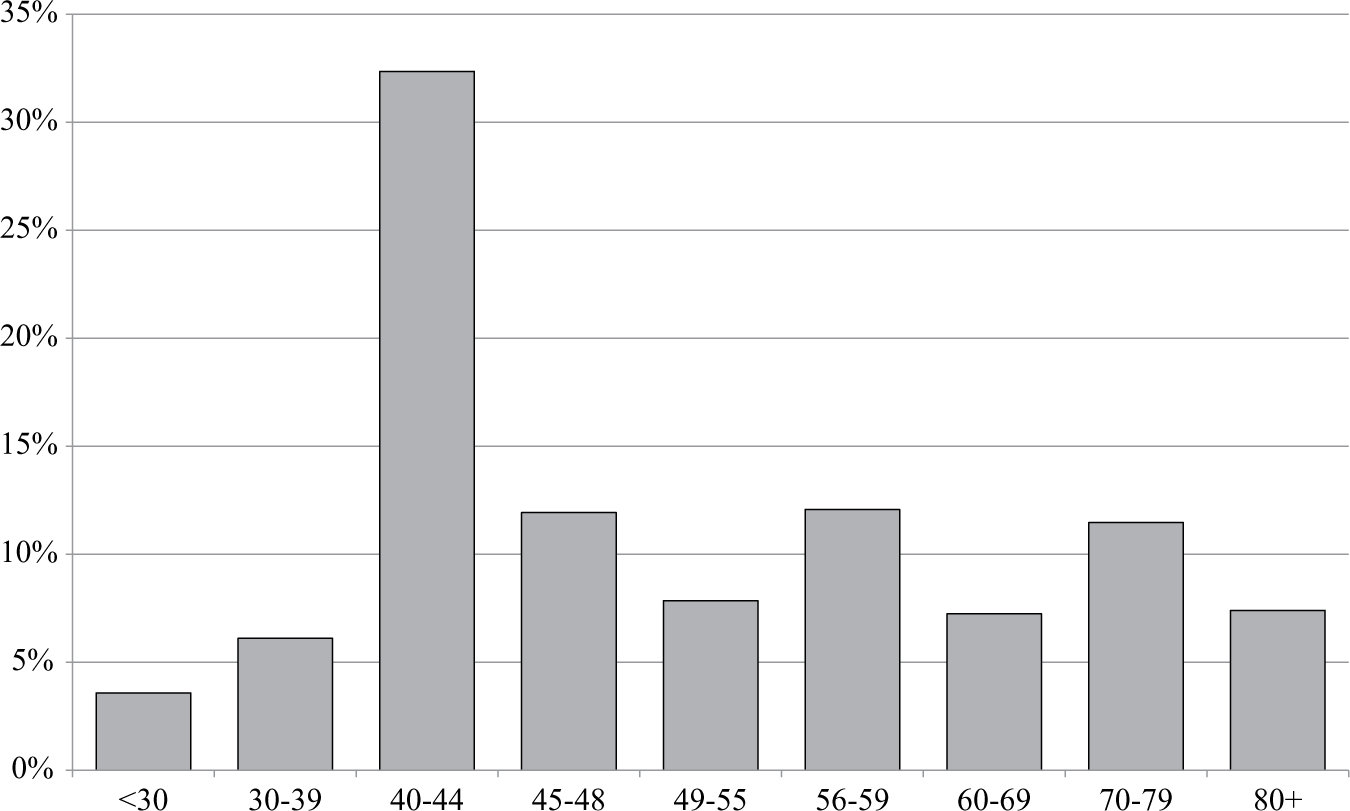
Percentage of Urban Chinese Workers, By Weekly Work Hours, 2006
We measure economic marketization at the provincial level using the marketization index designed by Chinese economist Gang Fan and his collaborators (Fan, Wang, and Zhu 2010). This index is based on 23 provincial-level indicators corresponding to five dimensions of market institutional development: government-market relations, growth of non-state economy, product market development, factor market development, and development of market intermediaries. 5 Because more marketized provinces also tend to have a higher level of economic development, we control for the province’s gross domestic product (GDP) per capita to avoid confounding the effect of marketization with that of development. We also control for the unemployment rate in each province. This information is obtained from the 2007 Chinese Statistical Yearbook (National Bureau of Statistics of China 2007).
Table 1 reports the descriptive statistics for all variables. At the individual level, we control for main demographic characteristics such as gender, age, education, marital status, and number of children under age 18 in the household. We also include a dummy variable for Communist Party membership to explore whether or not political credential confers any advantage in working time. Household registration status has three categories: urban, rural, and temporary. Based on field researchers’ findings of despotic labor regimes in factories employing migrant workers, we expect respondents with rural and temporary household registration status to work substantially longer hours. Occupation is measured with a series of dummy variables corresponding to state officials and administrators, managers, individual business operators (getihu), professionals, clerical workers, service workers, and manual workers.
Descriptive Statistics of Urban Sample
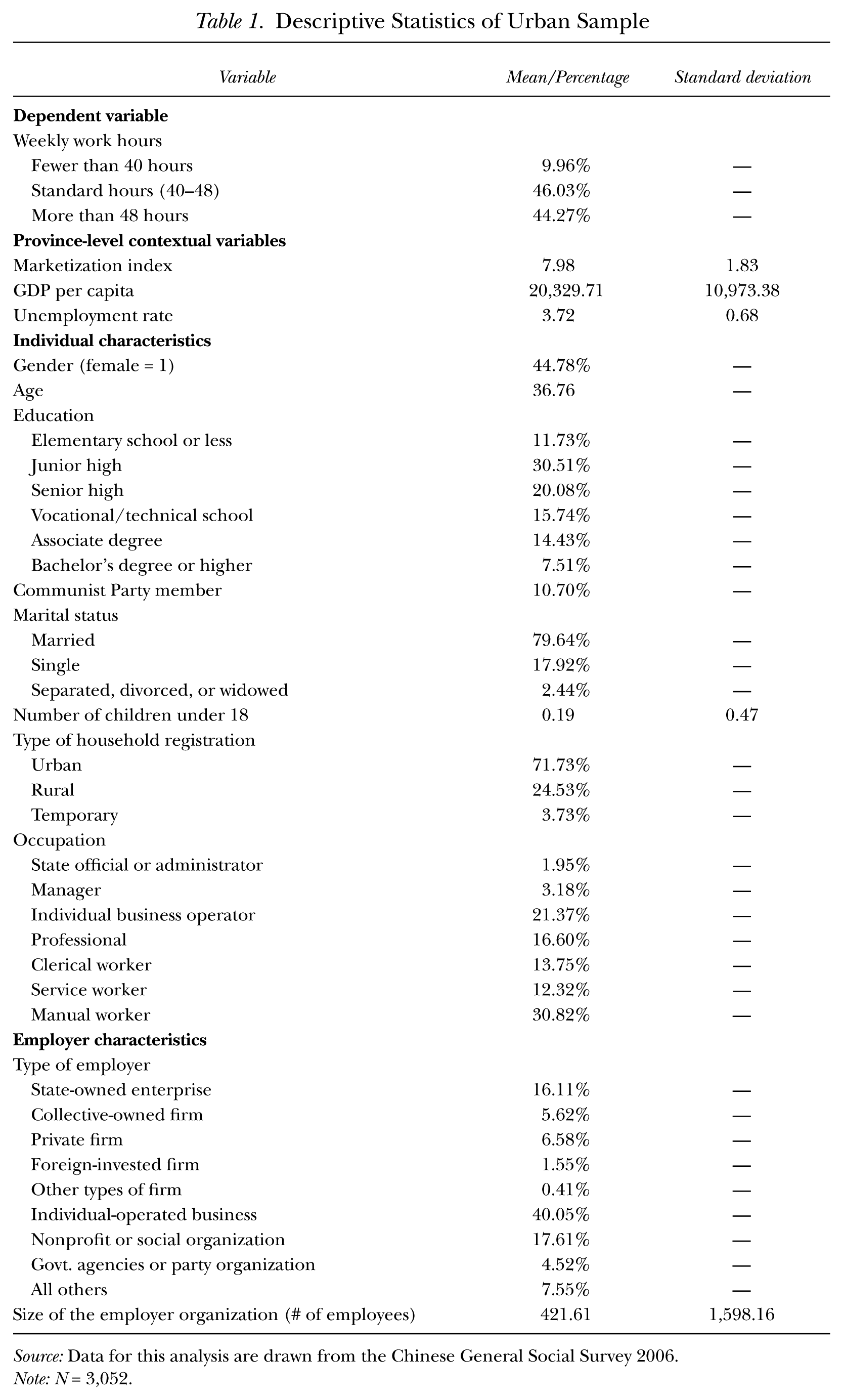
Source: Data for this analysis are drawn from the Chinese General Social Survey 2006.
Note: N = 3,052.
The CGSS also asked the respondents to report basic characteristics of their employers such as ownership, sector, and organizational size. We use the ownership and sector information to cross-classify the employer into the following types: state-owned enterprises (which account for 16.1% of the respondents in our sample), collective-owned firms (5.6%), private firms (6.6%), foreign-invested firms (1.6%), other types of firms (0.4%), individual-operated businesses (40.1%), nonprofit and social organizations (17.6%), government agencies and party organizations (4.5%), and a residual category that includes all other types of employers (7.6%). The distribution of this variable is consistent with the trend of growing casual employment (Park and Cai 2011), particularly in small business establishments. Following the convention in organizational research, we use the number of employees to measure the size of the employer organization. Larger organizations tend to be more visible to external parties and should be less likely to deviate from standard work arrangements. The average employer size for this sample is 422. Because of its skewed distribution, we use the natural logarithm transformation in all regression models.
To better understand what it means to work standard, short, or long hours in urban China, we plot in Figure 2a whether the respondent expected to get paid for overtime work and in Figure 2b the frequency of heavy physical labor at work. Figure 2a shows a clear pattern where the further away the respondent is from standard work hours (40–44 and 45–48), the less likely that s/he expects to receive overtime pay. Standard hours are also associated with greater certainty on the part of the respondent regarding overtime pay. Likewise, Figure 2b shows that those working long hours (more than 48) and those working the shortest hours (less than 30) perform heavy physical labor at higher frequencies than those working standard hours. Those working long hours are not likely to be motivated by overtime pay, and nonstandard hours also appear to be associated with more physically demanding work. Together, these patterns suggest that standard work hours signal more formalized and fairer employment relations.
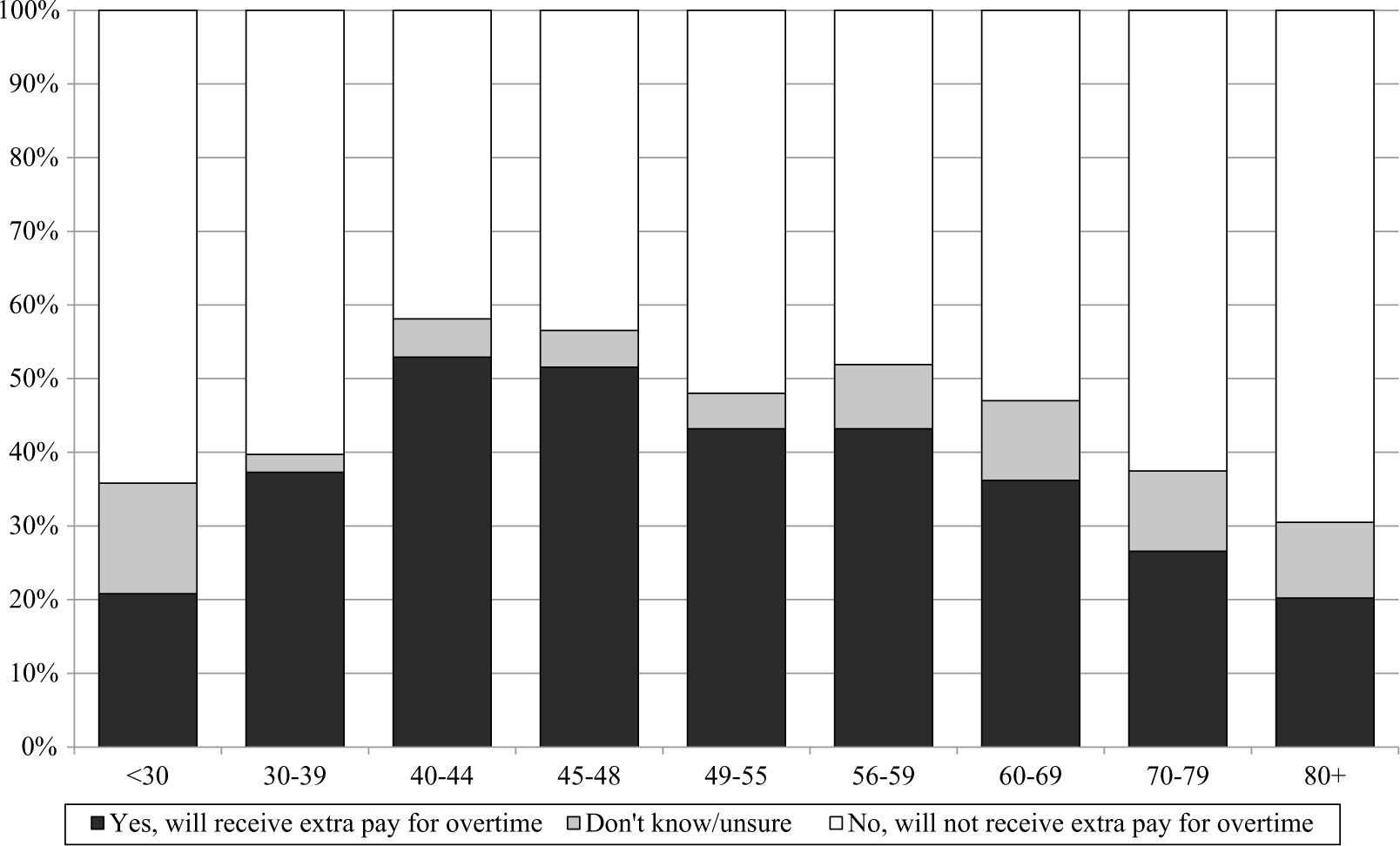
Percentage of Workers Expecting Overtime Pay, By Weekly Work Hours, 2006
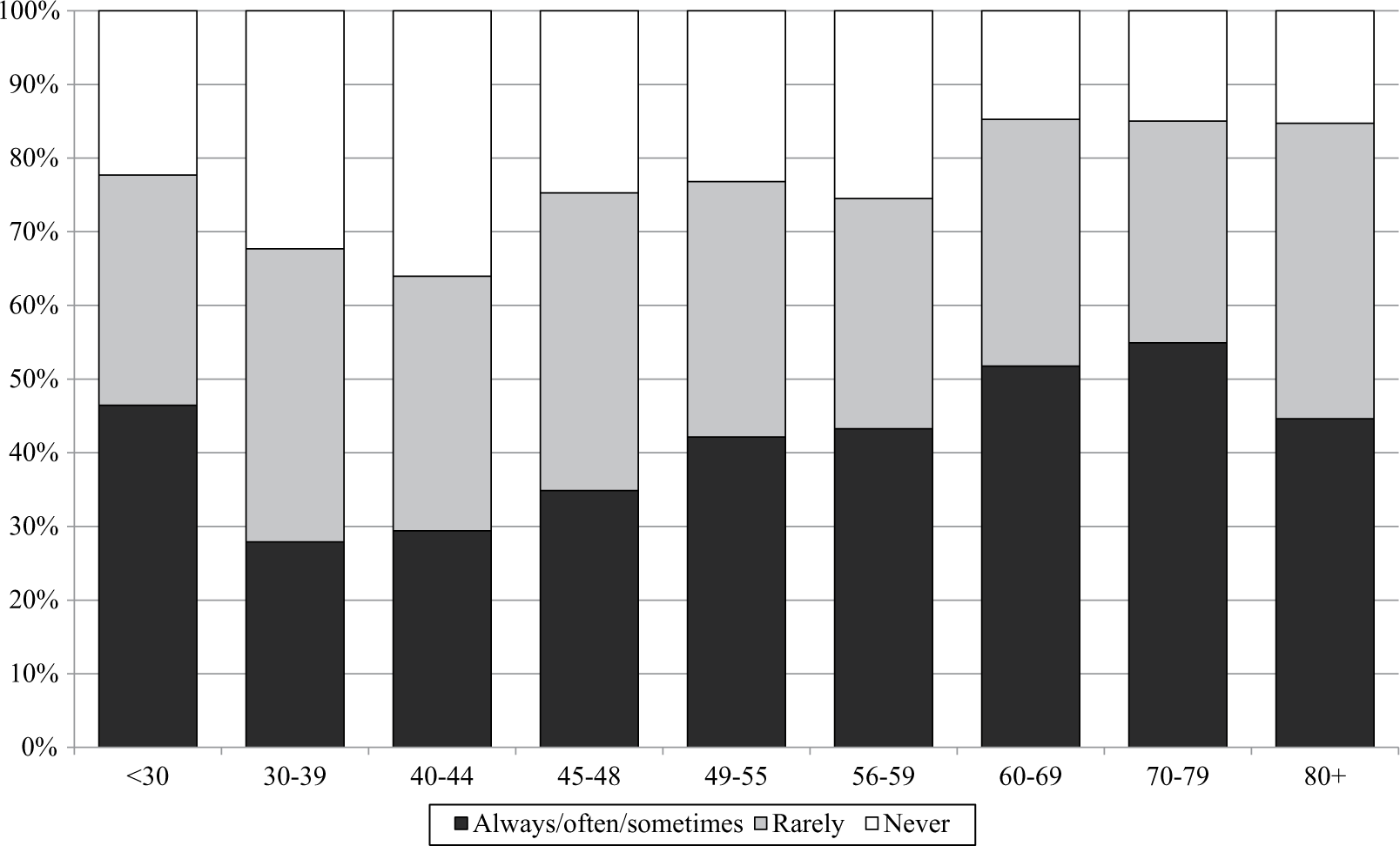
Percentage of Workers Performing Heavy Labor, By Weekly Work Hours, 2006
Regression Analysis
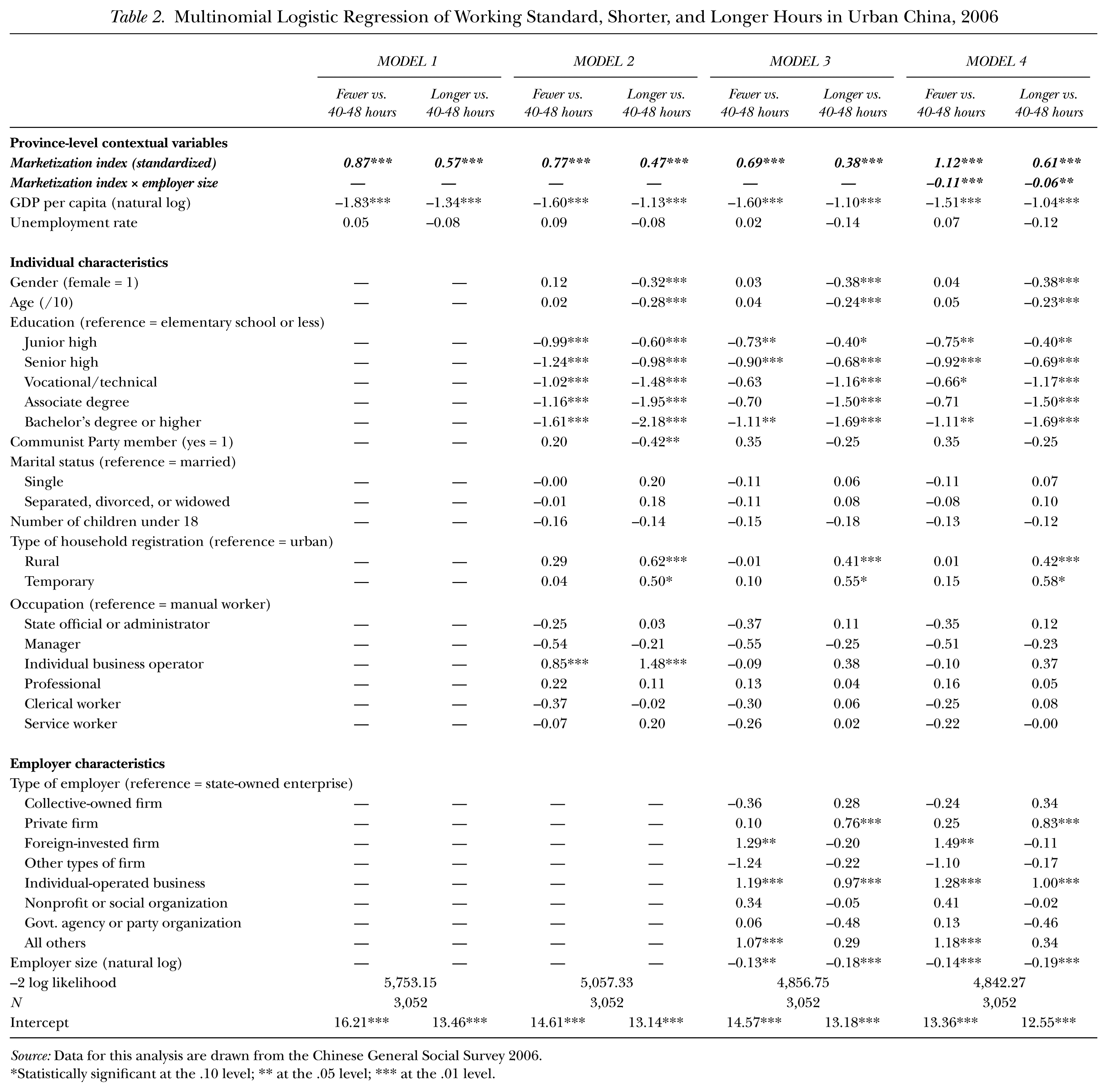
To test the relationship between economic marketization and standard work hours, we estimate a sequence of multinomial logistic regression models. 6 The results are presented in Table 2. Because the dependent variable—hours spent on job weekly—has three categories, we report in each model two sets of coefficients, one comparing short hours with standard hours and one comparing long hours with standard hours. 7 A positive regression coefficient indicates a positive effect on the likelihood that the respondent reports either short or long hours, as opposed to standard hours. Our key independent variable—marketization index—is standardized in all models. The regression coefficient for this variable thus indicates change in log-odds associated with one standard deviation increase in the level of marketization as measured by this index.
Multinomial Logistic Regression of Working Standard, Shorter, and Longer Hours in Urban China, 2006
Source: Data for this analysis are drawn from the Chinese General Social Survey 2006.
Statistically significant at the .10 level; ** at the .05 level; *** at the .01 level.
Model 1 includes only the three province-level contextual variables. As expected, controlling for GDP per capita and unemployment rate, respondents in more marketized provinces are significantly more likely to report both short and long hours, as opposed to standard hours. This finding supports our first hypothesis. While the regression coefficient for short hours is larger than that for long hours, this difference is not statistically significant. The difference is also not significant in Models 2, 3, and 4. The two coefficients for GDP per capita are both negative and statistically significant, indicating that those in more developed provinces are less likely to work nonstandard hours. We are unable to ascertain, however, whether this result reflects a societal trend of modernization or other regional differences, such as those in economic structure, that are likely correlated with economic development. The unemployment rate is not a significant predictor of either short or long hours. This result is not surprising because, like many other official Chinese statistics, the unemployment rate is often distorted and does not accurately reflect labor market conditions.
Model 2 incorporates variables measuring individual characteristics. It once again lends strong support to our first hypothesis. The effects of marketization on short and long hours both remain positive and significant at the 0.01 level. Both coefficient estimates decrease somewhat from Model 1, but the effect sizes remain remarkable. For each one standard deviation increase in the level of marketization, the odds of working short hours instead of standard hours increase by 116% (e0.77 = 2.16), and the odds of working long hours instead of standard hours increase by 60% (e0.47 = 1.60).
Model 2 also shows that women, older workers, and members of the Communist Party are no more likely to work short hours, but they are significantly less likely to work long hours. Education has a strong negative effect on both short and long hours. This finding is consistent with our assumption that standard work hours represent a preferred work arrangement in that they are more common among individuals commanding greater human capital. Marital status has no discernible effect. Respondents with more children are more likely to report standard hours as opposed to either long or short hours, but this effect is not significant even at the 0.10 level. Consistent with labor scholars’ accounts of long hours and “breathing factories” in emerging sectors, Model 2 shows that migrant workers are significantly more likely to work long rather than standard hours. Rural household registration also appears to increase the chance of working short hours, though this effect is not statistically significant. Variations across occupational categories are generally insignificant. The only exception is individual business operators. For this group we find a substantially higher chance of working both short and long hours. This finding supports the recent discussion in the broader literature of labor informalization (Park and Cai 2011).
Model 3 incorporates employer characteristics. As expected, individuals employed in larger organizations are less likely to work either short or long hours. Put differently, standard hours are indeed more common among those working for larger employers than those working for smaller ones. This finding supports our second hypothesis predicting a positive association between organizational size and standard work hours. Both regression coefficients of the marketization variable decrease again from the previous model, but both remain positive and highly significant as predicted in our first hypothesis.
Model 3 also shows that private firm employees are more likely to report long hours and that those working for individual-operated businesses are more likely to report both short and long hours. These findings are generally consistent with the existing literature. Meanwhile, employees in foreign-invested firms are more likely to work short rather than standard hours, but they are no more likely to work long hours. While the first result could be interpreted as a sign of flexible hours, the second result appears to contradict earlier studies suggesting long hours and frequent overtime in foreign-invested firms. Together these results call for more in-depth and more nuanced analysis of working time in this important sector of the Chinese economy. Within the state sector, we find no significant variation in work hours between state-owned enterprises, nonprofit/social organizations, and government agencies and party organizations. Finally, in Model 3 Communist Party membership is no longer a significant (negative) predictor of long hours. It appears that the advantage to Communist Party members in avoiding long hours found in the previous model is partly due to their relative concentration in large, formal organizations (as opposed to private firms and individually operated businesses).
Model 4 tests the interaction effect between the marketization index and employer size. The coefficient for the interaction term is negative and statistically significant for both short and long hours. This finding suggests that whereas employees of larger organizations are less likely to work either short or long hours, the (negative) effect of employer size is significantly stronger in more marketized provinces. This finding thus supports our third hypothesis.
To better illustrate the joint influences of marketization and employer size on work hours, we use coefficient estimates in Model 4 to calculate predicted probabilities for hypothetical individuals. These hypothetical individuals are otherwise identical: they are male, 37 years old, high school graduates, not members of the Communist Party, with urban household registration, in a manual occupation, and employed in a state-owned enterprise. GDP per capita is imputed at 15,000 yuan, which is close to the median level for all 31 Chinese provinces in 2006. They differ from each other in two dimensions: employer size and marketization index for the province. Allowing employer size to vary widely (from 10 to 2,560), we choose two levels of marketization: 6.15, which is one standard deviation below the sample mean; and 9.81, which is one standard deviation above the sample mean. 8 The predicted probabilities are plotted in Figure 3. In this figure, the two solid lines near the top of the chart indicate predicted probabilities of working standard hours in such provinces; the two dashed lines in the middle indicate probabilities of working long hours; and the two dotted lines near the bottom indicate probabilities of working short hours.
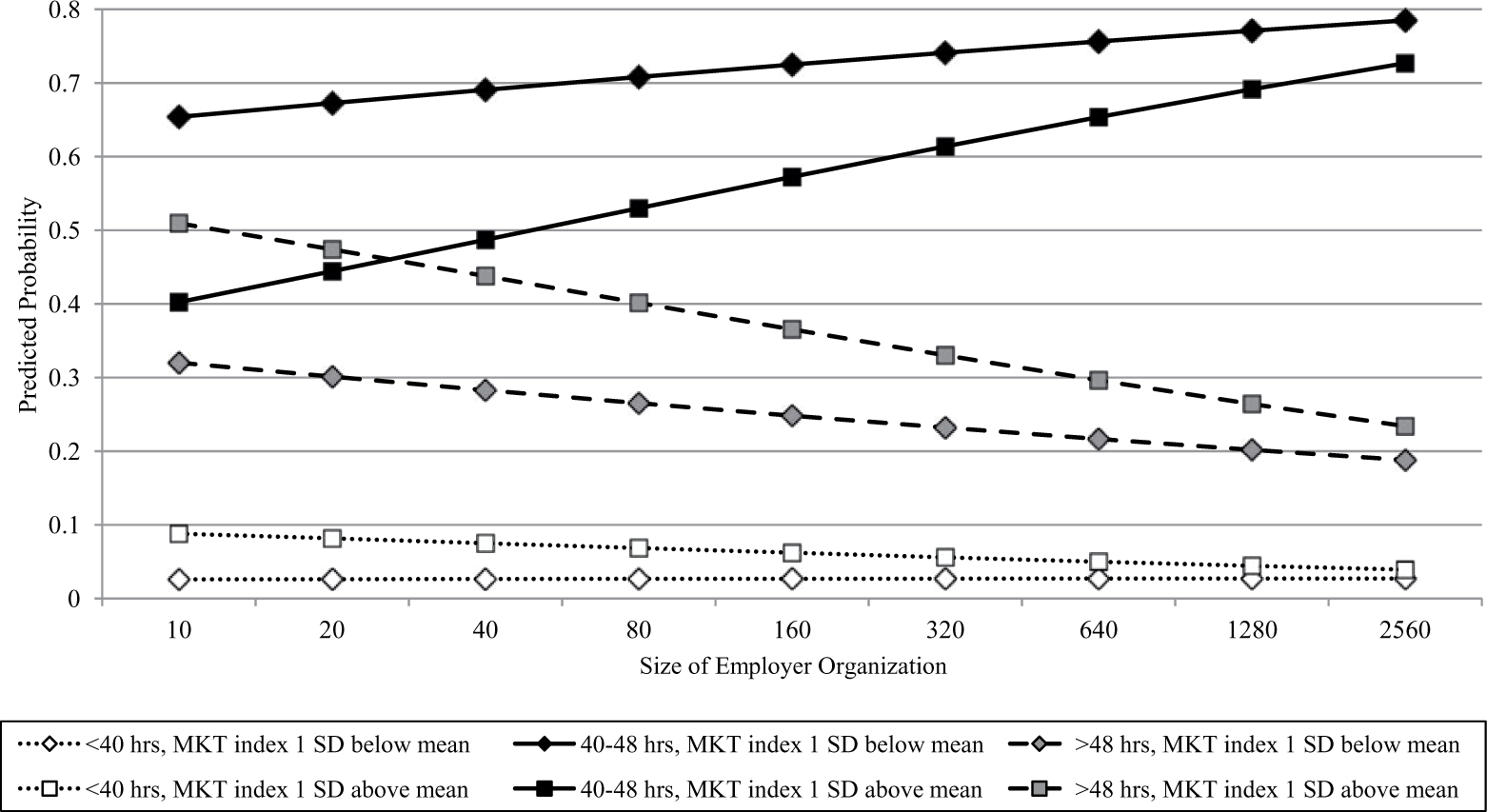
Predicted Probabilities of Short, Standard, and Long Hours in Urban China, 2006
Figure 3 reveals three important patterns. First, regardless of employer size, hypothetical individuals in the less marketized province are consistently more likely to work standard hours and less likely to work either long or short hours than their counterparts in the more marketized province. This is the pattern predicted by our first hypothesis. Second, regardless of the level of marketization, those working for larger employers are consistently more likely to work standard hours and less likely to work either long or short hours than those working for smaller employers. This is the pattern predicted by our second hypothesis. Third, for each of the three categories of work hours, the slope of the line, which corresponds to the marginal effect of employer size, is consistently steeper for the more marketized province than it is for the less marketized one. This is the pattern predicted by our third hypothesis. These three patterns are especially strong in the cases of standard and long hours. Overall, they provide strong affirmation for our theoretical argument of the deinstitutionalization of standard work hours as a result of market transition and the state’s failure in labor law enforcement.
Conclusion
A remarkable convergence in the weakening of the social employment contract and the collective voice of labor has occurred across the United States, Western Europe, and, we argue here, even China. Most apparent in the U.S. case is the trend of widespread and accelerating de-unionization. In Western Europe, the failure of Social Democratic, Socialist, and other labor-based parties to privilege the economic well-being of employees over banks and financial actors (as in the U.S. case) contributes to the persistent unraveling of the prior social contract to a blatant market-based exchange relationship. Even where collective voice was more ideologically rather than empirically apparent, as in China—that is, while deeply embedded in the ideology, Chinese workers have not truly had or been able to exercise collective voice—the current period is one in which even the appearance of collective labor strength is scant. The dominant driver of this convergent weakening of labor is the marketization of social and economic life in the global economy.
Indicators of this weakness vary depending on institutional context. Our interest here is in work hours as an indicator of the weakness of labor and the dominance of a market logic. In the United States, the changing social contract prompted by globalization, flexible production, and union decline has created new orders of workplace temporality. In China, we observe a similar trend of deinstitutionalization of standard work hours even though a different set of structural factors serve as its immediate drivers. More specifically, we argue that this trend of deinstitutionalization is the result of China’s unique approach to reform that combines fundamental changes in economic institutions with the lack of change in the political domain. As market reform has redefined the rules of the game and re-commodified labor, Chinese employers have faced strong incentives to impose new work arrangements in favor of efficiency and profits, often at the expense of workers. Meanwhile, the Chinese government has failed to effectively curb labor rights violations. While the immediate cause of this failure can be traced to the state’s inability to translate law on record into law in action, it is ultimately—as Friedman and Lee (2010) argue—rooted in the contradiction between the Communist Party’s need for regime legitimacy and its developmental strategy that has delivered spectacular growth for thirty years. Our study thus provides an additional, and informative, angle for understanding the driving forces of social change in post-socialist China.
On the empirical front, our analysis of nationally representative data reveals clear regional variations in the norm of standard work hours in association with the transition to markets. Our study thus complements existing literature that relies largely on either qualitative fieldwork or data collected from a single location or company, by providing systematic evidence on the macro-institutional determinants of workplace temporality. We also find that standard work hours are more prevalent in larger organizations and that the effect of organizational size is particularly strong in highly marketized provinces. These findings have direct relevance to both organizational research and the literature on post-socialist transition.
Footnotes
Appendix
Work Hours among Working Adults in Urban China, 1995
| Variable | Frequency | Percentage (%) |
|---|---|---|
| Number of hours worked per day | ||
| 6 or less | 1,031 | 8.68 |
| 7–9 | 10,408 | 87.61 |
| 10 or more | 441 | 3.71 |
| Number of days worked per week | ||
| 1–4 | 141 | 1.19 |
| 5–6 | 11,049 | 93.01 |
| 7 | 690 | 5.81 |
| Number of hours worked per week | ||
| <40 | 1,946 | 16.38 |
| 40–48 | 9,045 | 76.14 |
| 49 or more | 889 | 7.48 |
| Total | 11,880 | 100.00 |
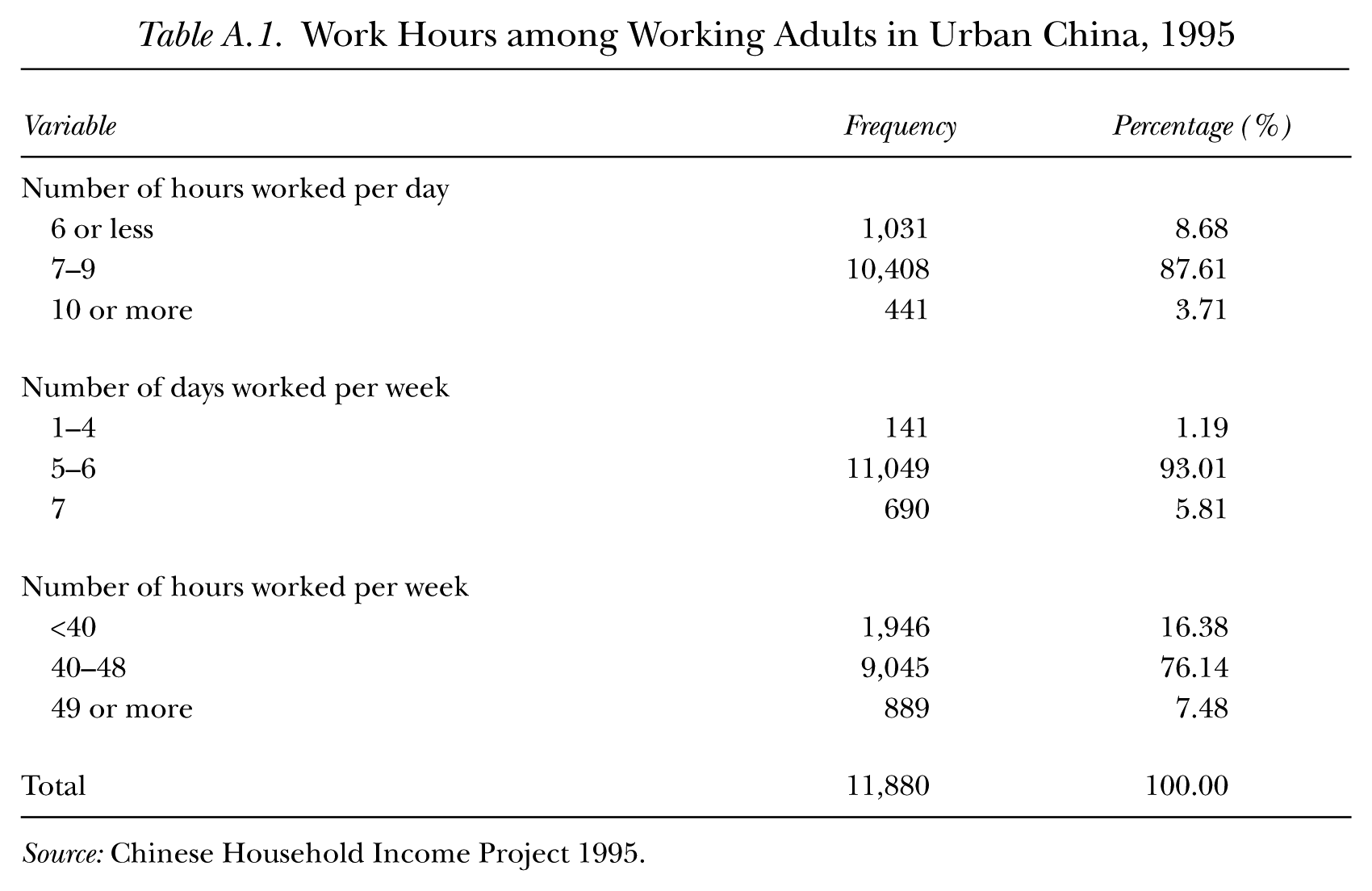
Source: Chinese Household Income Project 1995.
Acknowledgements
The authors thank the conference organizers, participants, and ILRReview reviewers for their insightful comments and suggestions.
The two authors contributed equally and are listed in alphabetical order.
An early version of this paper was presented at the conference on International Comparison of Work Time, University of Montreal, April 18–19, 2012.
A data appendix with additional results, and copies of computer programs used to generate the results presented in the article, are available from the author(s) at
1
One of the few exceptions is Perlow’s (2001) comparative case study. In it she shows that software engineers at a U.S. multinational company’s Chinese branch worked standard hours and rarely had to put in overtime. Contrasting it with different temporal patterns in other countries, Perlow suggests that long hours for software engineers as often reported in the United States ( ) are not an inherent feature of the work but are shaped by how technological interdependence is coordinated. It remains unclear, however, why there are such variations in the mode of project coordination.
2
This law, Labour Law of the People’s Republic of China, while passed in 1994, took effect in 1995 and has since been updated twice, in 2005 and 2010. Another major legislation was the Labor Contract Law, which took effect in 2008. The Labor Contract Law was enacted to better regulate labor contracts and to address legal loopholes that had been widely exploited by unscrupulous employers.
3
The 48-hour workweek was the norm in pre-reform China. Although the current Labor Law requires that working time should not exceed 44 hours per week, its allowance of overtime makes it possible for a person to work 48 hours a week on a frequent basis.
4
In the United States, long hours are typically defined as 50 or more per week. Our definition of more than 48 is in effect the same because only a handful of respondents in our sample reported working 49 hours a week.
5
Indicators for government-market relations include proportion of resources allocated through market, reduction in government interference in enterprises, and reduction in government size. Indicators for non-state sector growth are proportion of non-state industrial sales, non-state sector fixed-asset investment, and proportion of non-state sector employment. Indicators for product market development are market determination of price and reduction in local protectionism. Indicators for factor market development include financial market development, foreign investment, labor mobility, and market for technological products. Indicators for market intermediaries include availability of market services (e.g., legal and accounting), producer rights protection, and intellectual rights protection. Fan and his associates report that these indicators produce highly consistent results regardless of if or how they are weighted. Also known as the NERI index, this index has been widely used by Chinese economists and other social scientists (e.g., Li, Yue, and Zhao 2009; ).
6
These models are estimated with SAS’s surveylogistic procedure. This procedure allows us to account for the multistage sampling design of the CGSS and the sampling weight mentioned earlier. Ideally the effect of marketization as a provincial-level contextual variable should be examined with a hierarchical model because it corrects for clustering within provinces and provides unbiased standard errors. We experimented with hierarchical multinomial logistic regression, but unfortunately the model could not converge even when we included a single independent variable. Following , we created two subsamples, one including all respondents working either short or standard hours and the other including all respondents working either long or standard hours. We then estimated a series of hierarchical binary logistic regression models with each subsample. Comparing these results with those from ordinary binary logistic regressions, we found minimum difference in either effect sizes or significance levels. It appears that correcting for clustering with province-level random effects has no appreciable impact on the results. In this article we choose to present results from ordinary multinomial logistic regression. Those from all other models are available on request.
7
We estimated two additional sets of models. The first set uses work hours as the dependent variable and treats it as a continuous outcome. In these models the marketization index is not a significant predictor of work hours. This is not unexpected because our theoretical argument suggests that marketization is associated with both short and long hours. The second set of models uses a binary dependent variable indicating whether or not the respondent works more than 48 hours. These models show a positive relationship between marketization and long hours but fail to capture the interaction between marketization and employer size.
8
The provinces whose marketization indices are the closest to these values are Guangxi (6.12) and Jiangsu (9.80), respectively.