






Abstract
The existence of working-time accounts played an important role in overcoming the negative effects of the Great Recession in Germany. The authors’ analysis of data on establishments with a works council and at least 20 employees from the WSI Works Council Survey shows that the presence and influence of trade unions and the direct impact of the economic crisis are factors that increased the probability of reducing time credits, or building up time deficits on working-time accounts, to safeguard employment. Individual characteristics, such as the proportion of female workers or the proportion of highly qualified employees, had a negative impact on the ability to use working-time accounts. No significant differences were found between the general use of working-time accounts and their use in consequence of the economic crisis. This could be an indication that working-time accounts need to be well established in order to be useful for safeguarding jobs during an economic crisis.
The German economy was severely hit by the Great Recession, the global financial and economic crisis of 2008/2009. In particular, export-dependent industrial firms were badly hurt. In 2009, Germany’s gross domestic product shrank by more than 5%. Economic forecasters predicted an increase in unemployment of more than 1.4 million people from 2008 to 2010 (Projektgruppe Gemeinschaftsdiagnose 2009). The repercussions of the economic slump for the labor market were surprisingly modest, however, and total employment even increased slightly. Paul Krugman (2009) wrote in his column in the New York Times about “Germany’s jobs miracle.” This remarkable development is attributable to companies’ extensive use of instruments of internal flexibility and strategies of labor hoarding to protect and retain firm-specific human capital. To achieve labor hoarding, companies can either (temporarily) reduce working hours or decrease work intensity and hence labor productivity.
In Germany, working-time reductions played an important role during the Great Recession. Calculations of the Institute for Employment Research (IAB) show that the average annual number of working hours per employee was reduced by 44.5 hours (3.3%) in 2009 in comparison to 2008. In addition to the temporary reductions in standard working hours (–12.6 hours), short-time work (–10.9 hours) (the short-time work scheme is a wage subsidy to workers for the regular hours not worked in case of a temporary reduction in the normal workweek due to economic difficulties), and reduction in overtime (–8.6 hours), “working-time accounts” (WTA) played an important role. In contrast to previous economic crises, WTA were used for the first time extensively to safeguard employment during the Great Recession, with the reduction of formerly accumulated WTA hours accounting for 8.0 hours (18%) of the overall working-time reduction per employee. This remarkable way of safeguarding employment was possible because large numbers of working hours had been accumulated during the economic boom preceding the Great Recession.
Despite establishments’ general use of WTA, however, the determinants and motives of its use to safeguard employment, in general, and in consequence of the Great Recession, more specifically, have so far not been analyzed. Based on the limited theoretical and empirical literature on the general use of WTA in business establishments we provide the first analysis of its use to safeguard employment during the Great Recession. In this analysis we address five questions relating to the possible impact of four groups of factors: What influence do economic factors, such as the direct impact of an economic crisis or establishments’ export dependence, have on the use of WTA to safeguard employment? What is the role of labor relations factors, such as a trade union’s organizational strength, on the use of WTA to safeguard employment? Are there differences among the various trade union jurisdictions, or is a good working relationship between management and a works council important in using WTAs to safeguard employment? What role do employment-contract characteristics, including the contractually agreed on number of working hours or the type of employment contract, play? Are the unique characteristics of an establishment’s workforce, such as gender and educational attainment, crucial determinants for using WTA to safeguard employment?
We provide answers to these questions by using unique data from a representative survey of more than 1,700 works councils in German establishments that were interviewed during the 2008–09 economic crisis. These data provide crucial information about the effects of the Great Recession on establishments and their options and reactions. We examine empirically the determinants of the use of WTA to safeguard employment in general and in consequence of the Great Recession. Therefore, we present six hypotheses and test them with the help of binary logistic regressions.
We contribute to the literature by providing the first empirical study concerning the determinants of the use of WTA to safeguard employment in general and in consequence of the Great Recession. Our results present major insights on one of the important instruments of internal-numerical flexibility in German establishments that contributed to the safeguarding of jobs, which eased the negative employment effects of the Great Recession. These results are a piece of the jigsaw puzzle that helps us to better understand the remarkable German labor market performance during the Great Recession.
Internal-Numerical Flexibility through WTA
Businesses have to be able to adjust their production to external factors such as cyclical variations in product demand or long-term changes in economic trends. The need for flexibility with respect to the use of labor as a factor of production is especially important. From an analytical perspective we can distinguish between internal-numerical flexibility and external-numerical flexibility (Keller and Seifert 2007). Internal-numerical flexibility refers to the internal adjustment of the amount of labor input used in an establishment’s production process without recourse to the external labor market. This flexibility is achieved through using a variety of working-time arrangements. In contrast, external-numerical flexibility is defined as adjusting an establishment’s use of labor through hiring and firing, temporary employment, or fixed-term contracts. Economists have mostly focused on external-numerical flexibility. Our focus here, however, is on internal-numerical flexibility, also called working-time flexibility, which had been largely neglected in the German debate before the Great Recession.
During the Great Recession, various instruments of internal-numerical flexibility and their combinations played a crucial role in saving employment and, hence, contributed to the “German jobs miracle” (Herzog-Stein and Seifert 2010; Möller 2010a, 2010b). Establishments often used these instruments in a certain order and combinations. At first, overtime hours were reduced, and then accumulated WTA hours were used up. Following that, standard working hours were temporarily reduced and short-time work was introduced to adjust the total number of working hours. Furthermore, part-time workers increased in number when full-time employees had their working hours reduced. Reducing overtime, reducing standard working hours, and short-time work are long and well-established instruments for adjusting the amount of labor input to a changed economic environment, and their application has a certain tradition in Germany. A comparison of the Great Recession with the economic crisis of 1973–75, the most severe economic slump before the Great Recession, shows that in both crises the temporary reduction of standard working hours and increase in short-time work were important measures taken to cope with the situation. While the quantitative importance of the reduction of overtime hours declined over time, WTA as an alternative to the use of overtime work gained in importance (Herzog-Stein and Seifert 2010). During the Great Recession, WTA were used extensively for two major reasons. First, WTA had become more widespread since the previous crisis. Second, large numbers of working hours had been accumulated in the economic upswing preceding the Great Recession. According to Zapf and Brehmer (2010), employees had on average 72 credit hours in their WTA, which were available to use during the economic slump.
Definition and Institutional Context
WTA are a type of time management that aims to organize and regulate variable distributions of hours worked by an establishment’s employees over a certain period of time. Deviations from regular or collectively agreed on working hours lead to savings or deficits on WTA. Thus, if employees work more than a contractually agreed 40-hour workweek, they can bank the overtime hours in their WTA and use them in the future to get paid a normal wage when their workweek hours fall below 40. Alternatively, employees working fewer than the contractually agreed 40 hours per week are paid the normal wage in the present but run a deficit on the their WTA and have to work extra hours in the future to balance it out. Thus, employees may have a credit or debit of hours on their accounts (Bauer, Groß, Lehmann, and Munz 2004; Gerner 2010). In Germany, WTA are regulated by collective agreements at the industry level as well as at the company level and not by government legislation. Collective agreements, which are negotiated between employers’ associations and unions, set the framework conditions for the use of WTA. These regulations cover employees with and without union membership. Their actual organization at the establishment level is then part of the negotiations between management and works councils, which is regulated by the German Works Constitution Act (BetrVG) (Section 87) (Bispinck 1998; Esser 2007). As WTA are negotiated between management and works councils, both parties have to make compromises to meet the interests of employers and employees.
During the last decade, WTA became widespread. According to Zapf and Brehmer (2010), 51% of all employees had WTA in 2009 as compared to around 35% in 1999. Earlier studies obtained comparable results for the distribution of WTA (Bauer et al. 2004; Groß and Schwarz 2006; Groß and Schwarz 2008). The first types of WTA were developed in the 1960s to reduce rush hour commuting times of employees by varying the beginning and ending of the workday (Seifert 2001). Of great importance for the development of working-time flexibility and the use of WTA was the 1984 collective agreement in the metal industry. After nearly seven weeks of industrial action, a compromise between employers’ associations and the trade union IG Metall, was reached in which weekly working time was reduced in exchange for more working-time flexibility at the level of individual plants. According to Müller-Jentsch (2011: 126), this compromise “marked the birth” of working-time flexibilization in Germany. Subsequent agreements in the metalworking industry in 1987 and 1990 provided a model for German firms to achieve flexibility and gain efficiency. This led to the emergence of a variety of working-time flexibility models in sectoral and company agreements throughout the whole economy (Berg 2008). The prevalence of WTA varies between economic sectors as well as between establishments of various sizes. WTA are more common in the industrial sector and in larger establishments than in the service sector or in smaller firms (Groß and Schwarz 2008).
Forms and Functions
The design and configuration of WTA vary a lot. Therefore, workers can have very different types of WTA. They depend mainly on the establishment-specific working-time models and on the context in which WTA are used in an establishment (Bundesmann-Jansen, Groß, and Munz 2000). Overall, different forms of WTA exist with respect to the upper and lower limits of working hours; that is, workers are not allowed to save more hours than an agreed on or negotiated maximum number of hours nor to build up more deficit hours than an agreed on minimum number. Compensation periods also vary. The compensation period specifies the maximum number of weeks within which any credit or debit on WTA must be balanced, so that the actual average weekly hours worked during the compensation period are in conformance with the contractually agreed number of working hours (Seifert 2008). Thus, during the maximum number of weeks specified by the compensation period, employees either spend the extra work hours on their WTA by taking leave time or balance out their deficits by working longer. If employees are unable to reduce their credit hours within the compensation period to zero, then they are either recompensed monetarily, the credit hours are transferred to long-time accounts, or, according to Seifert (2008), in some cases they lose them. Debit hours normally do not lapse, however. According to Groß (2009), in 2007 the upper limit for the number of hours saved was on average 103 hours, the lower limit was equal to 63 hours of debit, and the average compensation period was 38 weeks. The upper and lower limits are larger and the compensation period is longer in the industrial sector than in the service sector, as in general the demand for industrial goods is more volatile than the demand for services; therefore, there is a greater need in the industrial sector for regulated working-time flexibility since, for example, part-time work is less common in that sector. The relatively large span between the maximum credit and debit hours offers businesses and workers considerable working-time flexibility, especially in the industrial sector. If we assume that at the outbreak of the 2008 economic crisis WTA would have been on average completely filled, then according to the results in Groß (2009) the range between the average upper and lower limits would have allowed for temporary working-time reduction with the help of WTA of at most 166 hours. This corresponds to more than 10% of the average number of hours worked per employee in 2007. Moreover, it is reasonable to expect that at the establishment level considerable flexibility is possible in dealing with these regulations (and limits); for example, the compensation period could be extended temporarily if necessary. This is especially true for difficult circumstances such as the Great Recession as long as management and works councils agree on how to handle it.
Despite the existence of numerous variants of WTA and the difficulty in agreeing on one definition that covers all types, theoretically four basic forms can be distinguished (Seifert 2001; 2004): flextime models, overtime accounts, “range” models, and “savings” models. Flextime models allow savings as well as the buildup of time deficits; that is, workers can bank hours they have worked beyond their normal workweek as well as accrue time deficits when working less than a normal workweek. In the latter case, they owe the company work hours for which they have already been paid. Overtime accounts, in contrast, only allow for savings. Employees are not allowed to build up time deficits. “Range” models are comparable to flextime models in that employees can bank working hours and build up time deficits, but the upper and lower limits for the number of hours are larger and the compensation period is longer than in the flextime model. Therefore “range” models grant more flexibility to employees and establishments. “Savings” models are comparable to overtime accounts as they allow only savings, but the maximum number of saved working hours is higher and the compensation period is longer. Flextime models, overtime accounts, and “range” models can be classified as short-time accounts with a compensation period of normally up to one year or less, whereas “savings” models are long-term accounts with a compensation period of more than one year. In recent years, long-time and the so-called lifetime accounts, a special form of long-time accounts, have been gaining in importance. Their use and availability, however, are still very limited (Hildebrandt et al. 2009).
Short-time accounts are particularly used in establishments to adjust the working time of employees to variations in production and to deal with seasonal or cyclical fluctuations in demand. In the construction industry a collective agreement on the use of WTA was set up to deal with those seasonal fluctuations. Here, the loss of working hours caused by bad weather needs to be at least partially compensated by hours accumulated in WTA during good weather such as in the summer months. If not enough hours are accumulated, then the Federal Employment Agency (BA) provides compensation payments.
Overall, in case of a cyclical negative-demand shock, the using up of accumulated hours or the buildup of time deficits on WTA helps to prevent layoffs and to safeguard employment, at least in the short run. In contrast, in boom periods employees can accumulate hours by working longer. During the Great Recession, WTA were used together with other measures of internal-numerical flexibility as an alternative to measures of external-numerical flexibility, and thus the loss of (firm-specific) human capital was prevented in many business establishments (Bundesmann-Jansen et al. 2000; Seifert 2005; Gerner 2010). WTA can also be a (temporary) alternative to the implementation of short-time work. Regulations of the Federal Employment Agency (BA) require that credits on WTA have to be used up before short-time work can be granted (BMAS 2009).
In addition to safeguarding employment, WTA can help establishments reduce idle time, use labor more efficiently, and increase productivity (Munz, Bauer, and Groß 2002). Establishments also obtain substantial cost advantages, as overtime premiums are reduced or completely avoided and hence unit labor costs are reduced. Through the improved capacity utilization establishments can reduce their unit capital costs; by synchronizing working hours and the use of labor-input storage, costs can be further reduced (Seifert 2001). WTA also decouple working time and wages; that is, wages stay constant even though working time varies. Nevertheless, establishments have to take the cost of the introduction and regulation of WTA into account. For workers, short-time accounts may improve their short-run time sovereignty; that is, workers can change the length of their working time according to their own needs and better fit familial or social time requirements into their daily working schedules. Yet, in most cases, variation in individual working time must be in accordance with the employer’s and/or other employees’ needs (Gerner 2010). An accumulation or reduction of hours is often driven by company interests leading to a limitation of employees’ working-time sovereignty and a higher dependency on employers (Bundesmann-Jansen et al. 2000). Furthermore, if accumulated hours on WTA cannot be reduced during the compensation period, employees work in fact longer without receiving extra pay and thus perform unpaid overtime hours (Bauer, Groß, Munz, and Sayin 2002).
The main objective of long-time accounts is to accumulate working hours for specific purposes, such as for a sabbatical or further training. They are designed to offer workers increased long-term time sovereignty during their working life without a pay loss, as wages remain constant during nonworking periods. Nevertheless, some regulations at the establishment level also imply the use of long-time accounts to deal with cyclical variations in demand. In this case, the main purpose of long-time accounts to increase long-term time sovereignty of employees becomes superfluous, and long-time accounts then have the same function as short-time accounts to safeguard employment. In contrast, lifetime accounts have the aim of arranging the termination of an employment relationship at the end of a working life via early retirement. In this case, employees have to accumulate a high amount of time savings to use them for an earlier retirement without pay losses. Furthermore, these accounts provide a contribution to occupational pension schemes if the accumulated hours are converted into money (Hildebrandt 2007). Thus, these lifetime accounts cannot be used to safeguard employment during an economic crisis.
Research Strategy
Literature Review
Many studies analyze various aspects of WTA in Germany. Yet most of them focus on the spread as well as on regulations and arrangements (Groß, Munz, and Seifert 2000; Seifert 2001; Bellmann and Gewiese 2004; Seifert 2005; Groß 2009; Groß and Schwarz 2010). Some analyses concentrate on flexible working-time arrangements in the context of WTA (Seifert 2003; Kleinhenz, Franz, and Gerlach 2004; Bosch, Schief, and Schietinger 2005), and the potential of long-time accounts has become a focus of discussion (Hildebrandt 2007; Hildebrandt et al. 2009). So far, the determinants of the general use of WTA in establishments have not received much attention. One notable exception is Ludewig’s 2001 study that used a cost-minimization approach with respect to an establishments’ use of WTA as an instrument of working-time flexibility. He identified five important factors that might have an impact on the use of WTA and investigated their influence empirically with the help of various explanatory variables: for example, the importance of human capital as measured by the proportion of qualified employees and the existence of further training; the integration into the traditional system of industrial relations (variables such as, e.g., the existence of a works council); the intensity of international competition (variables such as, e.g., the export share); the establishment size; and the proportion of female workers. The regression analyses showed that establishment size, further training, the proportion of qualified employees, and the existence of a works council were positively correlated with the use of WTA, whereas a high-export share was positively correlated only in western Germany and a high proportion of female workers was negatively correlated only in eastern Germany.
Furthermore, Bellmann and Gewiese (2004) investigated the introduction of WTA in establishments. According to their analysis, six groups of factors influenced the introduction of WTA. They investigated their influence empirically through various explanatory variables: the personnel and qualification structure (variables such as, e.g., the proportion of female workers, the proportion of apprentices); establishment characteristics (variables such as, e.g., establishment size); labor relations factors (variables such as, e.g., the existence of a works council or a collective agreement); the degree of exclusiveness of an internal labor market (e.g., the proportion of workers with fixed-term contracts or paid and unpaid overtime work); the general state of the external labor market (variables such as, e.g., the regional unemployment rate); and complementary systems of WTA (variables such as, e.g., internal qualification). In their regression analyses they found a positive effect of the proportion of apprentices, establishment size, further training, the existence of a works council, and collective agreements on the introduction of short-time accounts, whereas the proportion of female workers, unpaid overtime hours, and a very high regional unemployment rate in eastern Germany had a negative effect. They did not find an effect of the proportion of workers with a fixed-term contract.
In the context of the Great Recession, several studies have examined the remarkable German labor market performance from a macroeconomic perspective (Herzog-Stein, Lindner, Sturn, and van Treeck 2010; Herzog-Stein and Seifert 2010; Möller 2010a, 2010b; Burda and Hunt 2011; Dietz, Stops, and Walwei 2011). There is a general consensus that short-time work was one of the key elements that counteracted the adverse effects. A number of studies show that, as in previous economic slumps, many establishments used short-time work to finance the costs of labor hoarding, at least partially (Bach, Crimmann, Spitznagel, and Wießner 2009; Bach and Spitznagel 2009; Bogedan 2010; Brautzsch and Will 2010; Crimmann, Wießner, and Bellmann 2010; Boeri and Bruecker 2011). In contrast to past experiences, in 2008–09 WTA also played an important role. According to Bogedan, Brehmer, and Herzog-Stein (2009), the most common instrument used to safeguard employment in establishments with a works council and at least 20 employees was the WTA. Zapf and Brehmer (2010) showed that 34% of all establishments used WTA to safeguard employment. On average, the time deposits were reduced by around 45 hours per worker, and in six out of ten establishments more than 60% of all employees were affected by this reduction. Zapf and Herzog-Stein (2011) identified three types of business establishments that used WTA with respect to extent and timing of the usage: long-time users, early short-time users, and late users. Establishments were described as long-time users if time credits were reduced or time deficits were built up by their employees between the third quarter of 2008 and the first quarter of 2010. Early short-time users only reduced time credits or built up time deficits between the third quarter of 2008 and the third quarter of 2009, and late users only between the third quarter of 2009 and the first quarter of 2010. Their results are only of a descriptive nature, however. Gerner (2012) analyzed the productivity development and the role of WTA in the context of the Great Recession. In Boeri and Bruecker’s (2011) study of the use of short-time work as well as in Bellmann, Gerner, and Upward’s (2012) analysis of the crisis response of German establishments in terms of job and worker flows, the general use of WTA was addressed, but only in a minor way. Since the data in these studies do not provide any information about the reasons why WTA were used in establishments, they do not provide an analysis of the use of WTA to safeguard employment and its determining factors. So far no empirical studies have been undertaken concerning the determinants of the use of WTA to safeguard employment during the Great Recession.
Factors Influencing Use of Working-Time Accounts
The studies of Bellmann and Gewiese (2004) and Ludewig (2001) on the determinants of the introduction and general use of WTA in establishments provide ample guidance for the selection of factors that might have an important impact on the use of WTA to safeguard employment in the Great Recession. We partly refer to the same factors as they have used in their analyses. But we especially take the economic situation of the establishments into account, as this is of major importance in the context of the Great Recession.
More specifically, we analyze four groups of factors that might have had a crucial impact on the use of WTA to safeguard employment during the Great Recession. The first group are economic factors such as the direct impact of the crisis on an establishment or establishment’s export dependence. Labor relations factors such as the organizational strength of a trade union, trade union jurisdiction, and the working relationship between management and a works council make up the second group. Another group of important factors are employment-contract characteristics such as the agreed on number of working hours and the type of employment contract. The final group of influential factors are individual characteristics of an establishment’s workforce such as gender and educational attainment.
Economic Factors
Various economic factors might have influenced the use of WTA to safeguard employment. First, the global financial and economic crisis had a major impact in the German economy, resulting in a drastic decline in the number of orders and in revenue (“turnover” in European parlance). Especially, foreign demand for German products declined dramatically. But, in contrast to predictions, total employment increased slightly during the Great Recession. In industrial sectors, such as car manufacturing, jobs were lost but to a lesser extent than expected. One reason for this surprising outcome is that a large number of establishments used measures of internal-numerical flexibility in response to the drop in the demand for their products (Bogedan et al. 2009).
Another factor is that international trade increases economic volatility. Businesses with a high degree of export dependence confront more volatility than other types of business establishments (Vannoorenberghe 2012). Hence, in general, such establishments need instruments to respond to changes in the demand for their products. They need the ability to adjust production to variations in their environment. The more volatile their environment and the demand, the more desirable is the use of measures of internal-numerical flexibility, given that external-numerical flexibility involves many additional costs such as those involved in layoffs, searching for workers, hiring, and training.
Labor Relations Factors
Several labor relations aspects might be crucial for using WTA to safeguard employment. In Germany, trade unions and their organizational strength, as well as the working relationship between management and works council, might be such important factors. To understand the possible influence and impact of trade unions on the regulations and applications of WTA, it is necessary to take the specifics of the German model of industrial relations into account. German trade unions are industry based and represent the interests of workers in those sectors that belong to their organizational jurisdiction. In general, collective agreements apply to workers with and without union membership because employers extend them to all workers. Furthermore, works councils are elected by the overall workforce and thus represent more than just trade union members. Hence, trade unions are faced, on the one hand, with a free-rider problem while, on the other hand, collective agreements cover not only trade union members. Moreover, trade unions exert additional influence through works council members at the establishment level.
In this context trade unions have a direct impact on WTA, given that design, rules, and regulations are based on collective agreements between employers’ organizations and unions. They also have an indirect influence by way of unionized members of works councils, as works councils play crucial roles in the practical running and design of WTA at the business establishment level. Although trade unions express concern that often the use of WTA, and more specifically the use of time deposits, are dominated by business interests (Hamm 2008; Lindecke 2008), they are supportive of the idea of using them to prevent job losses during an economic slump.
Given these described preferences with respect to WTA, it can be expected that the stronger a trade union is in an establishment the more influential it will be with respect to dealings at the establishment level and the more likely it is that WTA will be used to prevent job losses. One crucial factor for a trade union’s strength in an establishment is the size of its membership base among the workforce, as union membership is not obligatory even in a unionized company. Therefore, if a trade union has been successful in recruiting a lot of members in a company it indicates that the trade union has a strong bargaining position in this company.
Union jurisdictions differ in the degree to which they use WTA, which is the result of various factors. First, the importance of internal-numerical flexibility differs especially in relation to external-numerical flexibility. For instance, in German manufacturing, firm-specific human capital is of great importance, and hence external-numerical flexibility might be less important than internal-numerical flexibility. In the service sector employment fluctuations are larger, and firm-specific human capital is less crucial. Second, different forms of internal-numerical flexibility may be advantageous in different industries. In German manufacturing, most employees work full-time, and therefore overtime and WTA are suitable instruments for varying working hours. In contrast, many service industries have a high proportion of part-time workers, and hence working-time flexibility might be easier and better obtained by varying the regular working hours of part-timers. Third, in the organizational jurisdictions of the industrial unions, working-time flexibility via collectively agreed on instruments plays a more important role than it does in the service industries for historical reasons. In the 1980s, the conflict between trade unions and employers’ organizations over general reductions in regular working hours was partly solved, among other things, by introducing shorter working weeks in exchange for increases in working-time flexibility, at first in the manufacturing sector. Since then, working-time flexibility has been a topic of many negotiations over new collective agreements. Last, the strength and influence of trade unions varies considerably among industries. Traditionally, in Germany industrial unions have a stronger bargaining position than unions in service industries, and thus they are more likely to be able to implement preferred instruments such as WTA.
Furthermore, in establishments with a good collaboration between management and a works council it can be assumed that both parties work closely together with decisions often made jointly and in cooperation. In these circumstances, the management will also incorporate a works council’s interest for safeguarding employment in its decision making, and both partners will likely focus on a strategy to protect jobs in an economic downturn by using WTA. In case of a bad collaboration it might be less likely that a job-protecting strategy is adopted. In such cases, WTA are used to a smaller degree to safeguard employment or, in extreme cases, not at all.
Employment-Contract Characteristics
A third group of factors that might have had an impact on the use of WTA to safeguard employment are specific characteristics of the employment contract. First, the contractually agreed on number of working hours might have influenced the existence and use of WTA. There might have been differences between full-time and part-time workers with respect to the use of WTA. Schank and Schnabel (2004) found that the proportion of part-time workers has a negative effect on the incidence and amount of (paid) overtime. In addition, according to Brautzsch, Drechsel, and Schultz (2012), part-timers work fewer transitory overtime hours than full-time workers. As the accumulation of hours on WTA are transitory overtime hours that are compensated by taking leave time later, we argue that the proportion of part-time workers also has a negative effect on the use of WTA. As women often work part-time, we also want to make sure to distinguish between the gender argument and a possible part-time effect.
Second, the type of employment contract might also crucially influence the existence and use of WTA. Fixed-term contracts are, as a measure of external-numerical flexibility, an alternative to WTA for organizing the use of labor in a more flexible way. Due to limited duration of fixed-term contracts, however, it might be more difficult to make use of WTA. Additionally, without a long-term working relationship, workers with fixed-term contracts might be less willing to accumulate hour deposits that might be used to support an employer financially.
Individual Characteristics
At the establishment level individual characteristics of employees can limit the use of WTA in safeguarding employment. The use of time credits and the buildup of time deficits depend crucially on an individual worker’s ability to accumulate working hours or to “repay” the time deficit by working longer.
In this context, we first expect differences between men and women, as women still mostly care for children and manage households (Wanger 2011). They experience an external restriction in their ability to accumulate a high amount of savings on WTA through working more over a longer time period. Instead, women need more day-to-day flexibility resulting in a variation of daily working time in order to combine work and family. The need to balance work and family obligations, however, runs counter to an establishment’s interest in creating a system of comprehensive employee availability (Hildebrandt 2006) in which hours accumulated on WTA during boom periods are used up in times of a negative demand shock and thus safeguard employment. Ludewig (2001) found that the proportion of female workers has a negative effect on the probability of the use of WTA, and Bellmann and Gewiese (2004) found a negative effect on the probability of the introduction of WTA.
Second, workers’ highest level of educational attainment and the skill requirements of jobs are other influential factors. Studies show that the proportion of employees with WTA is lower among highly qualified employees than among less qualified ones in Germany (Bauer et al. 2004). Furthermore, contractual regulations and organization of working time is different for highly skilled and educated workers than for those with a lower qualification level. So-called trust-based working hours (Vertrauensarbeitszeit) are more common among highly qualified employees, meaning that employers do not control the working hours but only a worker’s output. Highly qualified employees are also often contractually obliged to work a certain amount of unpaid and unregistered overtime hours, and hence these hours cannot be saved. Such workers are also more often found in administrational jobs or in research and development, which are to a lesser extent driven by fluctuations in demand. Workers with a lower or medium level of educational attainment work more often in production, which is more directly influenced by variations in demand. As some German establishments complained about a lack of qualified workers before the economic crisis, and hence were interested in stable employment of those workers, the proportion of qualified workers (Facharbeiter) might have an influence on WTA, too. But our sample does not include the data to control additionally for the proportion of qualified workers. Therefore we have to restrict our analysis to the effect of the proportion of highly qualified employees.
Data and Sample
The analyzed data are from the Works Council Survey of the Institute of Economic and Social Research at the Hans-Böckler-Foundation (WSI), which is a regular survey of works councils in German establishments that have a works council and 20 or more employees. Since 1997, the WSI has conducted regular surveys and special surveys that focus on current issues and topics in German works councils. Between July and September 2009 a special survey focusing on the economic crisis and the measures taken at the establishment to safeguard employment was conducted. Between January and April 2010 the questionnaire of the special survey was included in the regular survey. The aim of the two surveys was to collect information for the analysis of the economic crisis and its effects on businesses and employees as well as options and reactions during the period of the Great Recession. The surveys were conducted as a computer-aided telephone survey by infas, one of the major German polling institutes. Respondents, mostly the heads of the local works councils, were asked to answer the questions on behalf of the entire council. The sample used in each survey is representative of the population of German establishments with a works council and 20 or more employees. For further details on the construction of the sample see, for example, Behrens (2008).
In this analysis we used a sample of about 1,700 works councils that participated both in the 2009 special survey as well as in the 2010 regular survey. The data of the two surveys were matched for all these establishments in order to obtain information about the situation of the establishments and reactions over the course of the economic crisis. In 2010, about 1.4% of all employees in the whole economy were employed in these establishments. Overall, of all establishments with 20 or more employees in the private sector in Germany around one-third of them have a works council. The workforce of these establishments with a works council makes up around 60% of total employment of establishments with 20 or more employees. In general it can be assumed that in establishments with a works council the coverage by collective agreements is far above average, and therefore the use of WTA to safeguard employment could be much greater than in establishments without a works council. As a consequence, relative to all establishments with 20 or more employees, it is probable that in those with 20 or more employees and a works council, and hence in our sample, a higher proportion used WTA to safeguard employment.
The variables used in the following analysis are from the 2010 survey, except the two dependent variables about the use of WTA to safeguard employment (in consequence of the actual economic crisis) as well as the independent variables based on establishments’ revenue, order position (that is the number of orders for goods or services of an establishment), export dependence, and the control variable if an establishment was affected by an economic crisis other than the Great Recession.
Since we are interested in the use of WTA to safeguard employment over the whole period of the economic crisis, we used the information from both the 2009 and 2010 surveys for the creation of the dependent variable. Information about revenue and order position are used from both surveys to see changes over the course of the Great Recession. Furthermore, by using information from both surveys, we are able to control for the whole time period if an establishment was affected by an economic crisis that was independent of the Great Recession. The question about an establishment’s export dependence was only asked in the 2009 special survey, however.
Dependent Variables
At the center of this analysis is the question of which factors influenced the use of WTA to safeguard employment at the establishment level during the period of the Great Recession. We use two dependent variables. First, the works council was asked whether time credits were reduced or time deficits were accumulated on WTA to safeguard employment. The question was: “Which of the following measures to safeguard employment are conducted in your establishment since July 2008 or are planned?” [. . .] “Is there a reduction of time credits or an accumulation of time deficits on WTA to safeguard employment?” This question is coded as a single dummy variable that indicates whether in the time period between the third quarter of 2008 and the first quarter of 2010 time credits were reduced or time deficits built up to safeguard employment. Second, all works councils that answered affirmatively that they used WTA to safeguard employment were additionally asked in a second question whether this use of WTA took place in consequence of the actual economic crisis. Here, the question was: “Did the reduction of time credits take place in consequence of the economic crisis since July 2008?” Hence, an alternative dependent dummy variable is introduced to indicate whether the use was in consequence of the actual economic crisis.
At first glance both dependent variables look very similar. However, only the second one deals with WTA were used to safeguard employment as a consequence of the Great Recession. In the first case, although WTA are used to safeguard employment, the reasons for it are not specified and are varied. One possibility is the existence of a pact of employment and competitiveness determining the variation of working hours via WTA to safeguard employment in exchange for formal job guarantees (Seifert and Massa-Wirth 2005). In such a situation WTA may be linked as a regular instrument with the safeguarding of employment without any job-threatening economic crisis.
Independent Variables
Economic Factors
Two groups of variables are used as indicators for the direct impact of the crisis on an establishment: revenue and order position. The first group is based on information about the establishment’s revenue in 2009. The first dummy variable Revenue2009_1 indicates whether the revenue in the first half of 2009 was worse than in the first half of 2008. The second dummy variable Revenue2009_2 is equal to one if the revenue in the second half of 2009 was worse than in the first half of 2009. The reference unit for both dummy variables is a constant or increasing revenue.
The second group of variables is based on information about the establishments’ order position. Orders2009 indicates whether an establishment’s order position at the time of the first survey in the summer of 2009 was worse than in July 2008. Orders2010 is a dummy variable taking the value of one if an establishment’s order position at the beginning of 2010 was worse than at the time of the first survey. In both cases the reference unit is a constant or improving order position.
The works councils were also asked about the degree of the establishment’s Export Dependency. A dummy variable was created that is equal to one if an establishment exhibits a medium to high degree of export dependency and zero otherwise (reference unit: a low degree of export dependency).
Labor Relations Factors
Three groups of variables were used to control for the influence of labor relations factors such as the organizational strength of trade unions, trade union jurisdictions, and the working relationship between management and works councils. To capture the idea that a trade union’s influence depends on its strength in an establishment, we used the variable Union Density—that is, the percentage of trade union members among an establishment’s workforce. In this analysis trade union members were defined as workers who were members of one of the seven trade unions affiliated with the German Confederation of Trade Unions (DGB) that are active in the private sector of the German economy or who were members of another trade union. The trade union for police officers (GdP) is excluded here because no members worked in the establishments included in the WSI Works Council Survey.
To take account of possible differences with respect to WTA in the different trade union jurisdictions we created a series of eight dummy variables. Six dummy variables represent the various trade union jurisdictions; we chose the service sector union (Ver.di) as the reference unit. There is one additional dummy variable that represents those establishments in which the workers were predominantly organized by another trade union not affiliated with the DGB. Moreover, a dummy variable was included for those establishments where no trade union represented the workforce.
Furthermore, the internal cooperation between management and the workforce was included in the analysis by using a dummy variable taking the value of one if the employer behavior in providing information to its works council was poor—that is, the works council had to ask the employer multiple times for information. The reference category is good information behavior—that is, the works council obtained information at the first request or by the employer’s own accord.
Employment-Contract Characteristics
We used three variables related to employment-contract characteristics in the regression analysis. To investigate a possible part-time effect the Proportion of Part-Time Workers and the Proportion of Workers in Marginal Employment were used as covariates. In Germany there exists a special additional form of part-time employment called marginal employment, which is exempted from social security contributions and payroll tax and is characterized by fewer than 13 working hours per week on average (see Voss and Weinkopf 2012: 6). In our analysis we especially account for both forms of part-time employment by differentiating between marginal employment and traditional part-time employment. Additionally, an establishment’s Proportion of Workers with a Fixed-Term Contract is also used as an explanatory variable.
Individual Characteristics
Two variables are used as indicators for the composition of the establishment’s workforce that take into account individual characteristics of employees. First, the Proportion of Female Workers in an establishment is used as an explanatory variable. Second, the Proportion of High-Skilled Workers—that is, workers with a university degree or a degree from a university of applied sciences—is used as an independent variable.
Control Variables
The model controls for a variety of factors that are widely regarded as having an influence on the existence and the use of WTA. First, eight dummy variables representing eight economic sectors are included. The economic sector Transport and Communication is used as a reference group. Second, Establishment Size—that is, the logarithm of the number of employees—is included too. Third, a dummy variable indicating whether the establishment is located in Eastern Germany is included. Finally, in Model 1a and Model 1b two dummy variables are included indicating whether the establishment was affected by an economic crisis other than the Great Recession. The first dummy variable, Crisis1, covers the time period between July 2008 and the time of the first survey in the summer of 2009. The second dummy variable, Crisis2, covers the time period between the time of the first survey and the time of the second survey. For both variables the reference category is that the establishment was not confronted with an economic crisis that was independent of the Great Recession.
Results
Sample means, proportions, and variable ranges are reported in Table 1. A Variable Correlations matrix table is provided in the Appendix. In around 46% of all establishments time credits were reduced or time deficits were accumulated in WTA to safeguard employment in the time period between the third quarter of 2008 and the first quarter of 2010. More than half of these users of WTA utilized them over the whole time period under consideration.
Descriptive Statistics
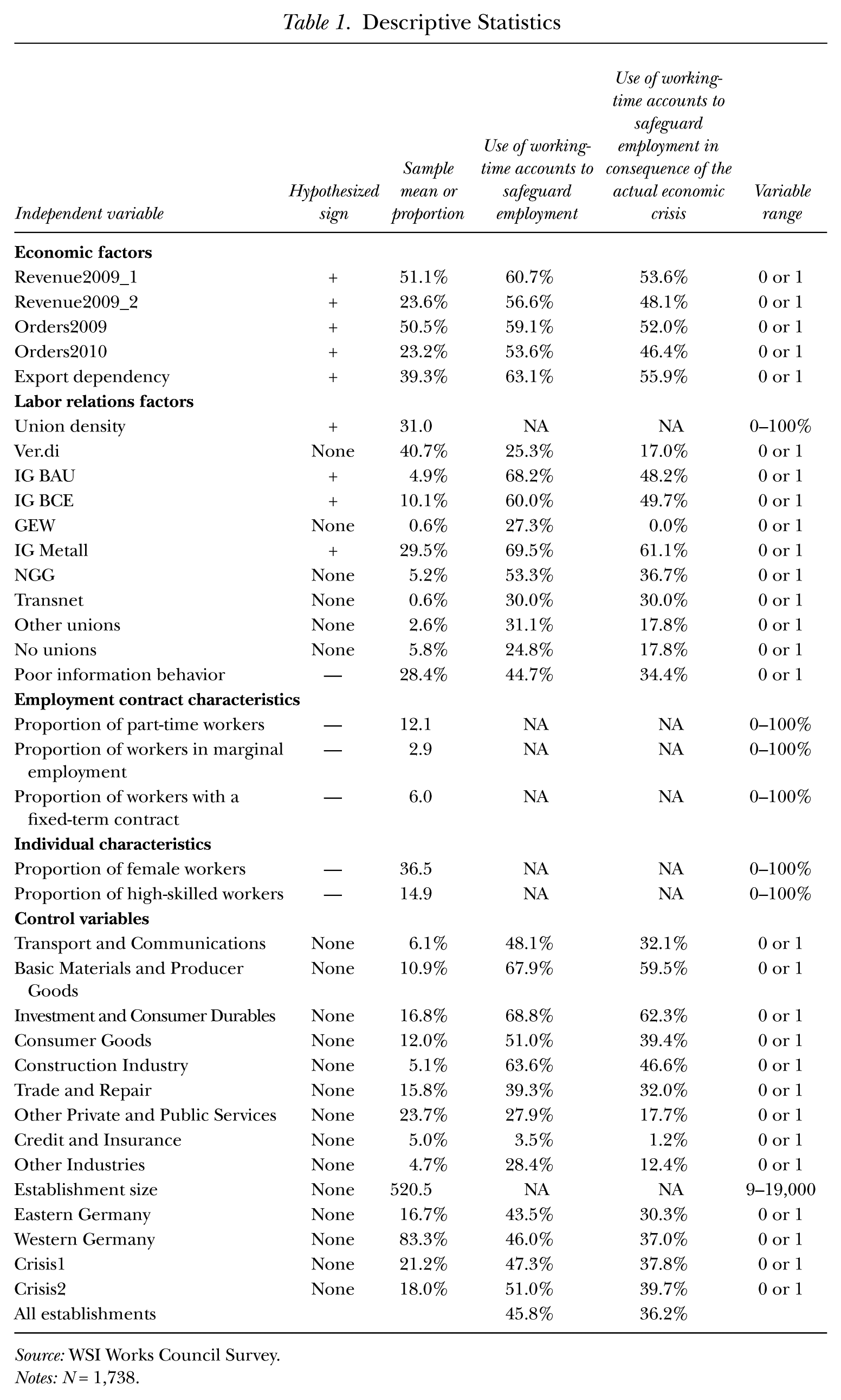
Source: WSI Works Council Survey.
Notes: N = 1,738.
In total, around 68% of all establishments were affected by the economic crisis. In 36% of all establishments WTA were used to safeguard employment as a consequence of the economic crisis. Nearly half of the establishments (46%) indicated that they used them over the whole time period under consideration due to the economic crisis.
Considerable differences occur among the economic sectors. The use of WTA to safeguard employment was most common in the investment and consumer durables industry. Around 69% of establishments used them. The use of WTA to safeguard employment was least common in the credit and insurance sector (4%). The use of WTA due to the economic crisis was again most common in the investment and consumer durables industry (62%), whereas in the credit and insurance sector the use was nearly nonexistent (1%). Although the Great Recession had its origin in the credit and insurance sector, the use of WTA did not play a role at all. Initially, this result might be surprising, but data from the German national accounts show that, in contrast to other sectors in which output declined considerably during the Great Recession, in the credit and insurance sector output stayed roughly constant and employment even increased slightly between 2008 and 2010. Hence, safeguarding jobs via measures of internal-numerical flexibility was unnecessary.
The size of an establishment was also an important factor. In establishments with 200 to 499 employees more than half used WTA to safeguard employment. In establishments with 49 or fewer employees only 41% used them. These differences are also observable in so far as the use of WTA due to the economic crisis is concerned (43% versus 31%).
No differences are obvious in the general use of WTA to safeguard employment with respect to eastern or western Germany (44% versus 46%). The use of WTA to safeguard employment in consequence of the economic crisis was, however, more common in western Germany (37% versus 30%).
Finally, for all regression equations presented below the independent variables were tested for multicollinearity. Neither the variance inflation factors of the independent variables used nor the condition number test indicated a problem with multicollinearity in our models. To take into consideration the likely sectoral influence on the economic variables as well as on the trade union jurisdiction variable, initially, in a first step, these variables were not included in the regression models. In a second step the regressions were repeated with all the explanatory variables. With the help of goodness-of-fit indices we can then throw some light on the additional explanatory power brought by the economic variables and the trade union jurisdiction variable on top of the sector dummies.
Regression Results
The regression results are presented in Tables 2 and 3. Model 1a and Model 1b investigate the general use of WTA to safeguard employment between the third quarter of 2008 and the first quarter of 2010. Model 2a and Model 2b examine the use of WTA to safeguard employment in consequence of the economic crisis during the same time period. Therefore, logistic regressions were estimated with dichotomous variables indicating whether WTA were used or not. Both Model 1a and Model 2a do not include the independent variables related to the economic factors nor the trade union jurisdiction variable. Both Model 1b and Model 2b do include all independent variables described above. With respect to these independent variables Model 1b and Model 2b are identical with the exception of the variable GEW. In the jurisdiction of the union for education and science (GEW) there was not enough variation with respect to the dependent variable to include GEW in Model 2b. As mentioned above, the dummy variables Crisis1 and Crisis2, indicating whether an establishment was affected by an economic crisis other than the Great Recession, are only included in Model 1a and Model 1b but not in Model 2a and Model 2b.With the help of estimating Model 1a and Model 2a for both models we can take into account the possible problem of multicollinearity between the sector dummies and the economic factors as well as the trade union jurisdiction and thus shed some light on the question of whether these controls provide additional explanatory power beyond that of the sector dummies. A comparison of all four models shows that the addition of the four further independent variables markedly improves the explanatory power of the two models (Model 1b and Model 2b) according to the various goodness-of-fit indices. With respect to the explanatory variables related to the hypotheses, all variables that are statistically significant in Model 1a and Model 2a are also significant in Model 1b and Model 2b except for the proportion of part-time workers, which is only significant in Model 1a and Model 2a (p <0.1 and p <0.05, respectively). Also, in all cases the sign of the coefficients is the same and the magnitude of the effects of the main variables of interest is of similar magnitude between the two model versions.
Use of Working-Time Accounts to Safeguard Employment: Binary Logistic Regression
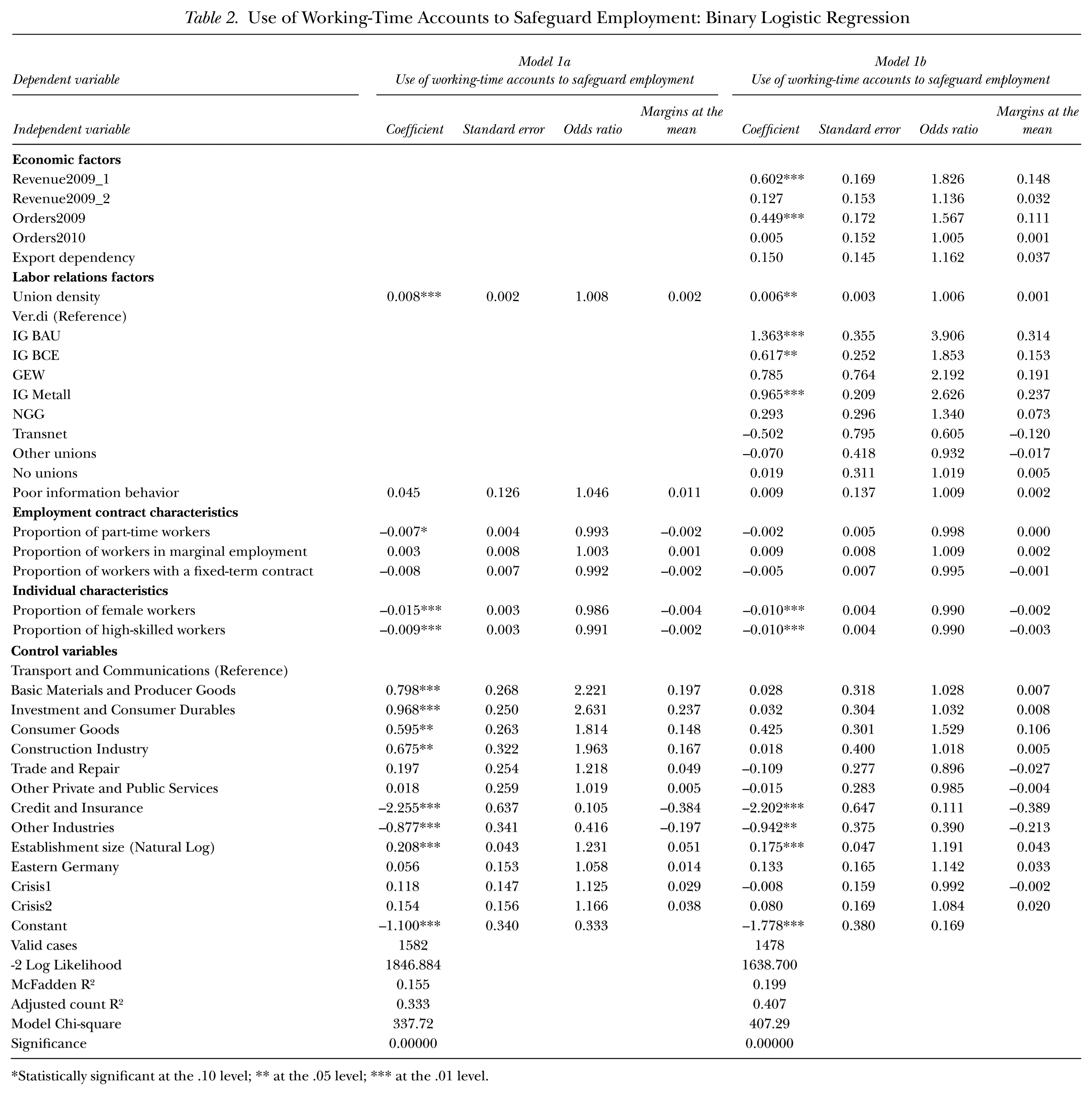
Statistically significant at the .10 level; ** at the .05 level; *** at the .01 level.
Use of Working-Time Accounts to Safeguard Employment in Consequence of the Actual Economic Crisis: Binary Logistic Regression
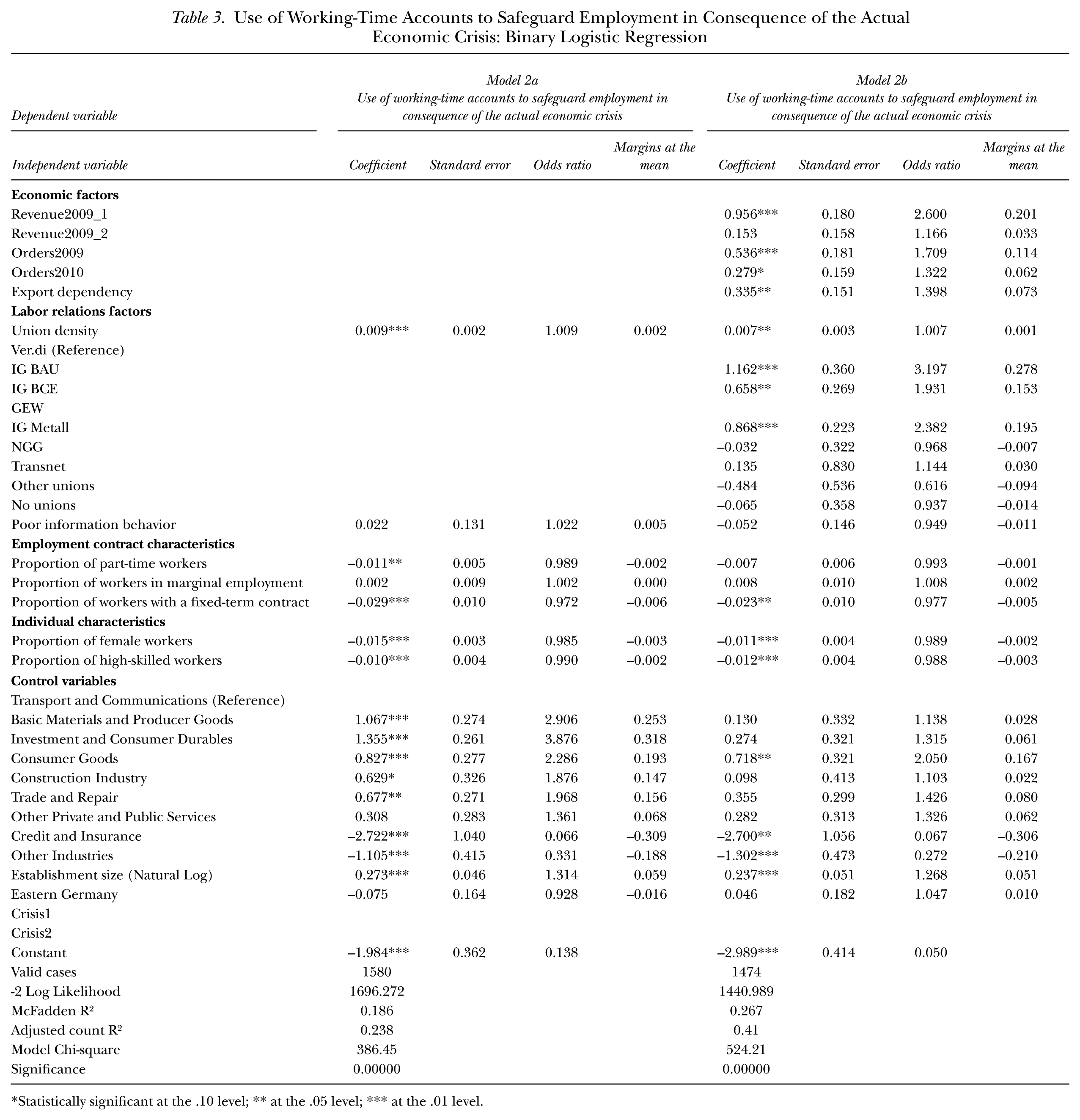
Statistically significant at the .10 level; ** at the .05 level; *** at the .01 level.
Now, we are ready to examine in detail the regression results with respect to the six hypotheses.
Economic Factors
The first two hypotheses are concerned with economic factors influencing the use of WTA. The first hypothesis predicts a positive correlation between being directly affected by the economic crisis and the use of WTA to safeguard employment. With respect to revenue and order position, in Model 1b and Model 2b the variables Revenue2009_1 and Orders2009 (p <0.01 in both models) have a statistically significant, positive effect. Hence, revenue in the first half of 2009 that was worse than revenue in the first half of 2008 or an order position in the summer of 2009 that was worse than in July 2008 both are positively associated with the use of WTA to safeguard employment (in consequence of the economic crisis). Additionally, Orders2010 has a statistically significant and positive effect (p <0.1) only in Model 2b. The fact that only the crisis variables referring to the early period of the Great Recession are highly significant is in line with the already mentioned fact that establishments often use different instruments of internal-numerical flexibility in a certain order and that the use of WTA to safeguard employment is one of the instruments used early during an economic downturn.
The second hypothesis states that the higher the degree of export dependence the more likely the use of WTA to safeguard employment. There is a statistically significant positive association (p <0.05) between high export dependence and the use of WTA to safeguard employment in consequence of the economic crisis (Model 2b). The chance that WTA were used in export-dependent establishments was around 1.4 times greater than in nondependent ones. In Model 1b there was no significant positive association.
Labor Relations Factors
The next two hypotheses address the influence of labor relations factors on the use of WTA. The third hypothesis suggests, first, a positive relationship between a trade union’s strength in an establishment and the use of WTA to safeguard employment and, second, that the use of WTA to safeguard employment was more likely in jurisdictions of industrial unions. A significant (p <0.01 and p <0.05, respectively) positive relationship was found between Union Density and WTA use to safeguard employment in general (Model 1a and Model 1b) and in consequence of the economic crisis (Model 2a and Model 2b). The marginal effects at the mean (MEM) are in all models of an approximately similar order and show that a 1 percentage point increase in union density increases the probability of WTA use to safeguard employment by 0.2 (Model 1a and Model 2a) and 0.1 percentage points (Model 1b and Model 2b). The industrial-union dummies IG BAU (p <0.01), IG BCE (p <0.05), and IG Metall (p <0.01) had a significant positive impact on the probability of the use of WTA to safeguard employment (in consequence of the economic crisis) in Model 1b and Model 2b. The odds ratios show that—in comparison to the service sector union (Ver.di)—the chance that WTA were used to safeguard employment in consequence of the economic crisis is nearly three times larger in the jurisdiction of the construction workers union (IG BAU), around two times larger in the jurisdiction of the chemical and mine workers union (IG BCE), and around 2.5 times larger in the jurisdiction of the metal workers union (IG Metall).
The fourth hypothesis proposes that a poor working relationship between management and a works council was negatively correlated with the use of WTA to safeguard employment. A variable indicating a poor information behavior from an employer to the works council was, however, statistically insignificant in all four models. In so far as an employer’s poor information behavior was an indication of a poor working relationship, the results do not support the fourth hypothesis.
Employment-Contract Characteristics
The fifth hypothesis deals with the influence of some employment-contract characteristics on the use of WTA to safeguard employment. The evidence for a possible part-time effect is rather weak. Only in Model 1a and Model 2a was the Proportion of Part-Time Workers statistically significant (p <0.1 and p <0.05, respectively). When the economic factors and the dummies for the trade union jurisdictions were added then the proportion of part-time workers as an explanatory variable became insignificant. The Proportion of Workers in Marginal Employment was insignificant in all models. In Model 2a and Model 2b a significant (p <0.01 and p <0.05) negative relationship was found between the Proportion of Workers with a Fixed-Term Contract and the use of WTA to safeguard employment in consequence of the economic crisis. The MEM indicates that a 1 percentage point larger proportion of workers with fixed-term contracts reduces the probability of WTA use in consequence of the economic crisis by around half a percentage point.
Individual Characteristics
The sixth hypothesis deals with the influence of individual characteristics on the use of WTA to safeguard employment. It predicts a negative correlation with the proportion of female workers as well as the share of highly qualified employees. With respect to the Proportion of Female Workers there was a negative and statistically significant effect (p <0.01) in all models. According to the MEM, a 1 percentage point increase in the proportion of female workers reduced the probability of WTA use to safeguard employment (in consequence of the economic crisis) by 0.2 percentage points in Model 1b and Model 2b, in which all the explanatory variables were included. The proportion of highly qualified employees was statistically significant (p <0.01) in all models and negatively associated with the use of WTA to safeguard employment (in consequence of the economic crisis).
Other Explanatory Variables
The economic sectors Credit and Insurance as well as Other Industries had a statistically significant negative impact on the probability that WTA were used to safeguard employment in all models. There were major differences between Model 1a and Model 2a, on the one hand, and Model 1b and Model 2b, on the other hand, with respect to the other dummy variables controlling for the economic sector that the establishment belonged to. In Model 1a and Model 2a all four sector dummies that were related to industrial sectors as well as the control variable Trade and Repair in Model 2a were statistically significant, but they were not significant in the corresponding Model 1b and Model 2b. When the economic factors and the trade union jurisdictions are included in the regressions, then in Model 1b all these industry dummies became insignificant and in Model 2b only the Consumer Goods industry remained statistically significant. Thus, in Model 1a and Model 2a without the explanatory variables of interest, it seems not too surprising that the sector dummies took up some of the effects of the omitted economic variables as well as the trade union jurisdiction variable. As expected, an increasing Establishment Size had a statistically significant positive association with the use of WTA to safeguard employment (in consequence of the economic crisis) in all models (p <0.01), since WTA are more common in larger establishments. There is no statistically significant difference between eastern and western Germany in any of the models. Finally, in Model 1a and Model 1b two variables that take into account the possibility of establishment-specific economic crises independent of the Great Recession also had no statistically significant impact on the probability of using WTA to safeguard employment.
Discussion
During the Great Recession WTA were one of the important measures of internal-numerical flexibility used to safeguard employment in Germany. Nearly half of the establishments that used WTA applied them over the whole time period under consideration—that is, from the second half of 2008 to the beginning of 2010. According to Zapf and Herzog-Stein (2011), those establishments can be described as “long-time users,” and this type of user was the largest group of all WTA users investigated in our analysis.
Overall, the above regression analyses provided statistical support for most of our hypotheses. Economic factors influenced the use of WTA to safeguard employment. Establishments with deteriorated revenue or order positions were more likely to use WTA to safeguard employment in general as well as in consequence of the economic crisis. A high degree of export dependence was positively correlated with the use of WTA to safeguard employment in consequence of the economic crisis, but not with the use of WTA to safeguard employment in general.
The regression analysis provides evidence that labor relation factors, such as the strength of a trade union or differences in trade union jurisdictions, are important determinants of the use of WTA to safeguard employment. In all models the regression results support the hypothesis that the strength of a trade union in an establishment had a positive effect on the use of WTA to safeguard employment (in consequence of the economic crisis). Furthermore, we found strong evidence that in the jurisdictions of the industrial unions there was a higher probability of WTA use. We found no evidence for a negative influence of a poor working relationship between management and works council on the use of WTA to safeguard employment in general or specific to the Great Recession. We were only able to test this indirectly, however, with the help of a variable involving behavior in providing information.
The evidence with respect to the influence of employment-contract characteristics on the use of WTA to safeguard employment is mixed but provides some interesting insights. We found only weak evidence for a possible part-time effect in Model 1a and Model 2a. We found evidence, however, for a negative impact of the proportion of workers with fixed-term contracts on the use of WTA in consequence of the economic crisis but not on the general use. Although the negative effect was small, it was not negligible. A 10 percentage points larger proportion of workers with fixed-term contracts reduced the probability that WTA were used to safeguard employment during the Great Recession by 5 percentage points. Furthermore, since fixed-term contracts are a measure of external-numerical flexibility, this finding can be interpreted as evidence for some trade-off between internal-numerical and external-numerical flexibility in the context of the Great Recession; that is, in establishments with a higher proportion of fixed-term contracts, and therefore a higher degree of external-numerical flexibility, the use of internal-numerical flexibility in the form of WTA to safeguard employment was less likely in regard to the Great Recession. At first this result might seem surprising, since, for example, the descriptive analysis of Bogedan et al. (2009) showed that during the Great Recession there was no exclusive use of either instruments of internal-numerical or external-numerical flexibility. Rather, business establishments responded to the economic crisis with a combination of both internal-numerical and external-numerical flexibility, and often they used them at the same time. On further reflection, however, one finds no contradiction between these two findings. Bogedan et al. showed only that there was no either-or decision between internal-numerical and external-numerical flexibility at the establishment level. Our results, however, point more specifically toward a trade-off at the establishment level such that the use of an internal-numerical instrument like WTA might be less likely if external-numerical instruments like fixed-term contracts are used a lot. The use of WTA as well as the use of fixed-term contracts are both relatively easy ways for a company to flexibly adjust its workforce to a changed economic environment. Hence, it is very likely that, in general, companies use WTA and fixed-term contracts at the same time. Our results indicates that the more widespread fixed-term contracts are among an establishment’s workforce, the less likely it is that WTA are used to safeguard jobs during an economic crisis. This could point toward an interpretation that WTA were often used to safeguard jobs and to reduce the labor input of a company’s core workforce while at the same time fixed-term contracts were used as an instrument to adjust the labor input of noncore employees.
Finally, we found strong evidence for the importance of the influence of some individual characteristics of the workforce. Thus, all other things being equal, a higher proportion of female workers or a higher proportion of highly qualified employees reduced the probability of the use of WTA to safeguard employment (in consequence of the economic crisis).
Conclusion
Our investigation of the determinants of the use of WTA to safeguard employment at the establishment level showed that there were no striking differences between the use of WTA to safeguard employment in general and in consequence of the Great Recession. Important factors for the use of WTA to safeguard employment in establishments were the integration into the German system of industrial relations and the firm’s economic environment such as its business situation and its export dependency. In contrast, specific employment contracts or individual characteristics of the workforce, such as a greater importance of nonstandard work arrangements in the form of fixed-term contracts, a higher proportion of female workers, or a higher intensity of human capital, limited the use of WTA. All in all, our analysis showed that the factors that drove the use of WTA to safeguard employment in general also dominated the use of WTA during the Great Recession.
One possible explanation for the similar results and implications of these findings is that WTA are not a quick instrument that can be easily created and implemented during an economic crisis to safeguard employment. WTA have to be already installed and in use before they can become powerful tools to safeguard employment. They require some organizational and bureaucratic efforts from management and a works council. In that sense they are more comparable to labor market institutions. Once they are established they are very important for the production process and functioning (labor) market processes.
But WTA, as any other instrument of working-time flexibility, should not be seen in isolation. Many instruments of internal-numerical flexibility exist in Germany. As part of their overall working-time arrangements most establishments have several of these instruments available to respond to changes in the economic environment, and often they are used simultaneously or in certain combinations. Furthermore, when discussing WTA, possible conflicts with external-numerical flexibility have to be taken into account. A high degree of internal-numerical flexibility probably requires some limitation of external-numerical flexibility to work properly. This is especially true for WTA with their organizational and bureaucratic efforts, since, for example, WTA are unlikely to work without a certain minimum degree of employment protection. Additionally, WTA are an instrument overwhelmingly based on and regulated by collective agreements and governed at the establishment level often with the help of works councils. This construction, in the tradition of the German system of industrial relations, provides WTA with an extra degree of flexibility in its practical application that is hard to imagine functioning if WTA were introduced in a legalistic way.
Overall, the employment success during the Great Recession cannot be attributed to one instrument alone. Rather, it was the result of a combined effort of the social partners and the government, based on the use of various instruments within the German system of industrial relations along with an active countercyclical macroeconomic policy. WTA were one of several important instruments of internal-numerical flexibility successfully used during the economic crisis. These instruments could only temporarily prevent job losses in consequence of a business-cycle shock. In an ideal situation they can buy enough time until the economy recovers. Fortunately, the Great Recession was severe but short. If the recession had been deeper and longer it cannot be excluded that German establishments would have used external-numerical flexibility on a much larger scale. Nevertheless, the German experience during the Great Recession shows that working-time flexibility in general and WTA can be important measures to help deal with cyclical economic fluctuations and temporary changes in demand.
In conclusion, WTA are an interesting instrument in the toolkit of German businesses. They are not, however, a simple instrument that can easily be transferred to other countries without taking the German context into account. Countries that are inspired by the German labor market success during the Great Recession and want to foster internal-numerical flexibility by introducing WTA should take that context into account. A successful implementation of WTA requires patience and the cultural willingness of management and workers’ representatives to give internal-numerical flexibility a chance. Furthermore, it may be necessary to limit the magnitude of external-numerical flexibility if internal-numerical flexibility is to flourish.
Footnotes
Appendix
Variable Correlations
| Independent variable | 1 | 2 | 3 | 4 | 5 | 6 | 7 | 8 | 9 | 10 | 11 | 12 | 13 | 14 | 15 | 16 | 17 |
|---|---|---|---|---|---|---|---|---|---|---|---|---|---|---|---|---|---|
| 1 Revenue2009_1 | 1.000 | ||||||||||||||||
| 2 Revenue2009_2 | 0.230 | 1.000 | |||||||||||||||
| 3 Orders2009 | 0.712 | 0.277 | 1.000 | ||||||||||||||
| 4 Orders2010 | 0.110 | 0.354 | 0.138 | 1.000 | |||||||||||||
| 5 Export Dependency | 0.314 | 0.095 | 0.287 | 0.023 | 1.000 | ||||||||||||
| 6 Union Density | 0.142 | 0.023 | 0.088 | 0.041 | 0.192 | 1.000 | |||||||||||
| 7 Ver.di | −0.217 | −0.048 | −0.201 | −0.049 | −0.386 | −0.217 | 1.000 | ||||||||||
| 8 IG BAU | −0.029 | −0.030 | −0.021 | 0.041 | −0.094 | −0.019 | −0.180 | 1.000 | |||||||||
| 9 IG BCE | 0.039 | −0.040 | 0.042 | −0.090 | 0.174 | 0.148 | −0.272 | −0.077 | 1.000 | ||||||||
| 10 GEW | −0.049 | −0.025 | −0.047 | −0.003 | −0.066 | −0.058 | −0.062 | −0.018 | −0.027 | 1.000 | |||||||
| 11 IG Metall | 0.250 | 0.113 | 0.255 | 0.090 | 0.365 | 0.258 | −0.539 | −0.153 | −0.232 | −0.053 | 1.000 | ||||||
| 12 NGG | −0.035 | −0.031 | −0.098 | 0.036 | −0.006 | 0.060 | −0.192 | −0.055 | −0.083 | −0.019 | −0.164 | 1.000 | |||||
| 13 Transnet | 0.003 | −0.005 | 0.006 | −0.044 | −0.048 | 0.060 | −0.062 | −0.018 | −0.027 | −0.006 | −0.053 | −0.019 | 1.000 | ||||
| 14 Other unions | −0.020 | −0.037 | −0.042 | −0.065 | −0.001 | −0.032 | −0.122 | −0.035 | −0.052 | −0.012 | −0.104 | −0.037 | −0.012 | 1.000 | |||
| 15 No unions | −0.005 | 0.020 | 0.015 | 0.026 | −0.019 | −0.286 | −0.190 | −0.054 | −0.082 | −0.019 | −0.162 | −0.058 | −0.019 | −0.037 | 1.000 | ||
| 16 Poor information behavior | −0.010 | 0.043 | −0.015 | 0.045 | −0.033 | 0.002 | 0.017 | 0.004 | −0.029 | 0.028 | 0.021 | 0.011 | 0.009 | −0.026 | −0.051 | 1.000 | |
| 17 Proportion of part-time workers | −0.164 | −0.051 | −0.150 | −0.028 | −0.205 | −0.146 | 0.385 | −0.073 | −0.116 | 0.038 | −0.282 | −0.065 | 0.016 | 0.014 | 0.015 | 0.047 | 1.000 |
| 18 Proportion of workers in marginal employment | −0.109 | −0.004 | −0.122 | −0.013 | −0.113 | −0.080 | 0.187 | −0.057 | −0.087 | 0.022 | −0.158 | 0.022 | −0.006 | 0.063 | 0.025 | 0.001 | 0.182 |
| 19 Proportion of workers with a fixed-term contract | −0.144 | −0.015 | −0.127 | −0.030 | −0.141 | −0.161 | 0.182 | −0.028 | −0.041 | 0.061 | −0.203 | 0.008 | −0.014 | 0.047 | 0.051 | 0.045 | 0.278 |
| 20 Proportion of female workers | −0.212 | −0.042 | −0.188 | −0.088 | −0.255 | −0.318 | 0.480 | −0.153 | −0.110 | 0.037 | −0.389 | −0.031 | −0.006 | 0.059 | 0.040 | 0.036 | 0.569 |
| 21 Proportion of high-skilled workers | −0.077 | 0.007 | −0.015 | −0.022 | −0.102 | −0.265 | 0.007 | −0.009 | −0.024 | 0.091 | −0.059 | −0.105 | −0.008 | 0.046 | 0.195 | 0.000 | 0.035 |
| 22 Transport and Communications | 0.011 | −0.021 | −0.002 | −0.022 | −0.040 | 0.110 | 0.182 | −0.022 | −0.046 | −0.021 | −0.133 | −0.028 | 0.190 | −0.004 | −0.063 | −0.027 | −0.023 |
| 23 Basic Materials and Producer Goods | 0.164 | 0.033 | 0.172 | −0.047 | 0.256 | 0.157 | −0.271 | 0.046 | 0.434 | −0.028 | 0.049 | −0.088 | −0.028 | 0.015 | −0.049 | −0.018 | −0.152 |
| 24 Investment and Consumer Durables | 0.209 | 0.083 | 0.207 | 0.079 | 0.344 | 0.144 | −0.366 | −0.084 | −0.118 | −0.037 | 0.582 | −0.116 | −0.037 | −0.062 | 0.016 | −0.013 | −0.193 |
| 25 Consumer Goods | 0.017 | 0.010 | −0.050 | 0.038 | 0.008 | 0.024 | −0.044 | −0.084 | −0.039 | −0.029 | −0.127 | 0.490 | −0.029 | 0.068 | −0.034 | 0.033 | −0.056 |
| 26 Construction Industry | −0.051 | −0.047 | −0.057 | −0.020 | −0.108 | 0.028 | −0.163 | 0.546 | −0.034 | −0.017 | −0.012 | −0.054 | 0.024 | −0.034 | −0.025 | 0.032 | −0.102 |
| 27 Trade and Repair | −0.052 | 0.019 | −0.063 | 0.047 | −0.053 | −0.088 | 0.149 | −0.090 | −0.059 | −0.034 | −0.070 | −0.001 | −0.034 | −0.030 | 0.034 | 0.011 | 0.136 |
| 28 Other Private and Public Services | −0.209 | −0.054 | −0.171 | −0.031 | −0.288 | −0.214 | 0.250 | −0.042 | −0.099 | 0.149 | −0.208 | −0.113 | −0.020 | 0.062 | 0.092 | 0.045 | 0.285 |
| 29 Credit and Insurance | −0.072 | −0.056 | −0.018 | −0.067 | −0.147 | −0.194 | 0.236 | −0.048 | −0.073 | −0.017 | −0.145 | −0.052 | 0.026 | −0.033 | 0.007 | −0.076 | 0.060 |
| 30 Other Industries | −0.055 | −0.020 | −0.048 | −0.045 | −0.089 | 0.063 | 0.131 | −0.018 | 0.076 | −0.017 | −0.118 | −0.052 | −0.017 | −0.011 | −0.052 | −0.034 | −0.050 |
| 31 Establishment Size (Natural Log) | 0.033 | −0.024 | 0.047 | −0.096 | 0.155 | 0.097 | −0.006 | −0.061 | 0.125 | −0.047 | 0.009 | −0.009 | 0.042 | −0.028 | −0.088 | −0.130 | 0.071 |
| 32 Eastern Germany | −0.085 | −0.011 | −0.088 | 0.013 | −0.075 | −0.052 | −0.025 | 0.026 | 0.038 | 0.035 | −0.028 | −0.005 | 0.012 | −0.008 | 0.030 | −0.010 | −0.044 |
| 33 Crisis1 | 0.080 | 0.040 | 0.071 | 0.002 | −0.039 | 0.036 | 0.044 | −0.002 | 0.034 | 0.045 | −0.045 | 0.005 | 0.002 | −0.024 | −0.051 | 0.052 | 0.083 |
| 34 Crisis2 | 0.092 | 0.142 | 0.097 | 0.098 | 0.036 | 0.044 | −0.014 | 0.018 | −0.009 | −0.014 | 0.023 | 0.027 | −0.014 | 0.000 | −0.041 | 0.119 | 0.010 |
| Independent variable | 18 | 19 | 20 | 21 | 22 | 23 | 24 | 25 | 26 | 27 | 28 | 29 | 30 | 31 | 32 | 33 | 34 |
| 1 Revenue2009_1 | |||||||||||||||||
| 2 Revenue2009_2 | |||||||||||||||||
| 3 Orders2009 | |||||||||||||||||
| 4 Orders2010 | |||||||||||||||||
| 5 Export dependency | |||||||||||||||||
| 6 Union density | |||||||||||||||||
| 7 Ver.di | |||||||||||||||||
| 8 IG BAU | |||||||||||||||||
| 9 IG BCE | |||||||||||||||||
| 10 GEW | |||||||||||||||||
| 11 IG Metall | |||||||||||||||||
| 12 NGG | |||||||||||||||||
| 13 Transnet | |||||||||||||||||
| 14 Other unions | |||||||||||||||||
| 15 No unions | |||||||||||||||||
| 16 Poor information behavior | |||||||||||||||||
| 17 Proportion of part-time workers | |||||||||||||||||
| 18 Proportion of workers in marginal employment | 1.000 | ||||||||||||||||
| 19 Proportion of workers with a fixed-term contract | 0.138 | 1.000 | |||||||||||||||
| 20 Proportion of female workers | 0.254 | 0.325 | 1.000 | ||||||||||||||
| 21 Proportion of high-skilled workers | −0.059 | 0.085 | 0.088 | 1.000 | |||||||||||||
| 22 Transport and Communications | 0.007 | −0.049 | −0.075 | −0.094 | 1.000 | ||||||||||||
| 23 Basic Materials and Producer Goods | −0.090 | −0.100 | −0.197 | −0.107 | −0.096 | 1.000 | |||||||||||
| 24 Investment and Consumer Durables | −0.122 | −0.143 | −0.294 | −0.016 | −0.127 | −0.174 | 1.000 | ||||||||||
| 25 Consumer Goods | 0.076 | −0.023 | 0.025 | −0.073 | −0.098 | −0.134 | −0.178 | 1.000 | |||||||||
| 26 Construction Industry | −0.068 | −0.053 | −0.179 | −0.022 | −0.059 | −0.080 | −0.106 | −0.082 | 1.000 | ||||||||
| 27 Trade and Repair | 0.103 | 0.020 | 0.153 | −0.145 | −0.116 | −0.158 | −0.209 | −0.162 | −0.097 | 1.000 | |||||||
| 28 Other Private and Public Services | 0.118 | 0.285 | 0.363 | 0.351 | −0.139 | −0.190 | −0.251 | −0.195 | −0.116 | −0.229 | 1.000 | ||||||
| 29 Credit and Insurance | −0.044 | −0.030 | 0.174 | 0.021 | −0.057 | −0.078 | −0.103 | −0.079 | −0.047 | −0.094 | −0.113 | 1.000 | |||||
| 30 Other Industries | −0.063 | 0.000 | −0.076 | −0.016 | −0.057 | −0.078 | −0.103 | −0.080 | −0.048 | −0.094 | −0.113 | −0.046 | 1.000 | ||||
| 31 Establishment size (Natural Log) | −0.080 | 0.113 | 0.033 | −0.004 | 0.087 | 0.109 | −0.002 | −0.109 | −0.040 | −0.069 | −0.029 | 0.073 | 0.051 | 1.000 | |||
| 32 Eastern Germany | −0.034 | 0.027 | 0.064 | 0.075 | 0.022 | −0.014 | −0.031 | −0.059 | 0.014 | −0.006 | 0.075 | −0.051 | 0.045 | −0.041 | 1.000 | ||
| 33 Crisis1 | 0.005 | 0.012 | 0.088 | −0.020 | −0.037 | 0.034 | −0.048 | 0.057 | −0.036 | −0.014 | 0.070 | −0.063 | −0.024 | 0.053 | −0.026 | 1.000 | |
| 34 Crisis2 | −0.034 | −0.012 | 0.012 | 0.031 | −0.030 | 0.036 | 0.023 | 0.050 | −0.002 | −0.010 | −0.016 | −0.065 | −0.023 | 0.019 | 0.002 | 0.322 | 1.000 |
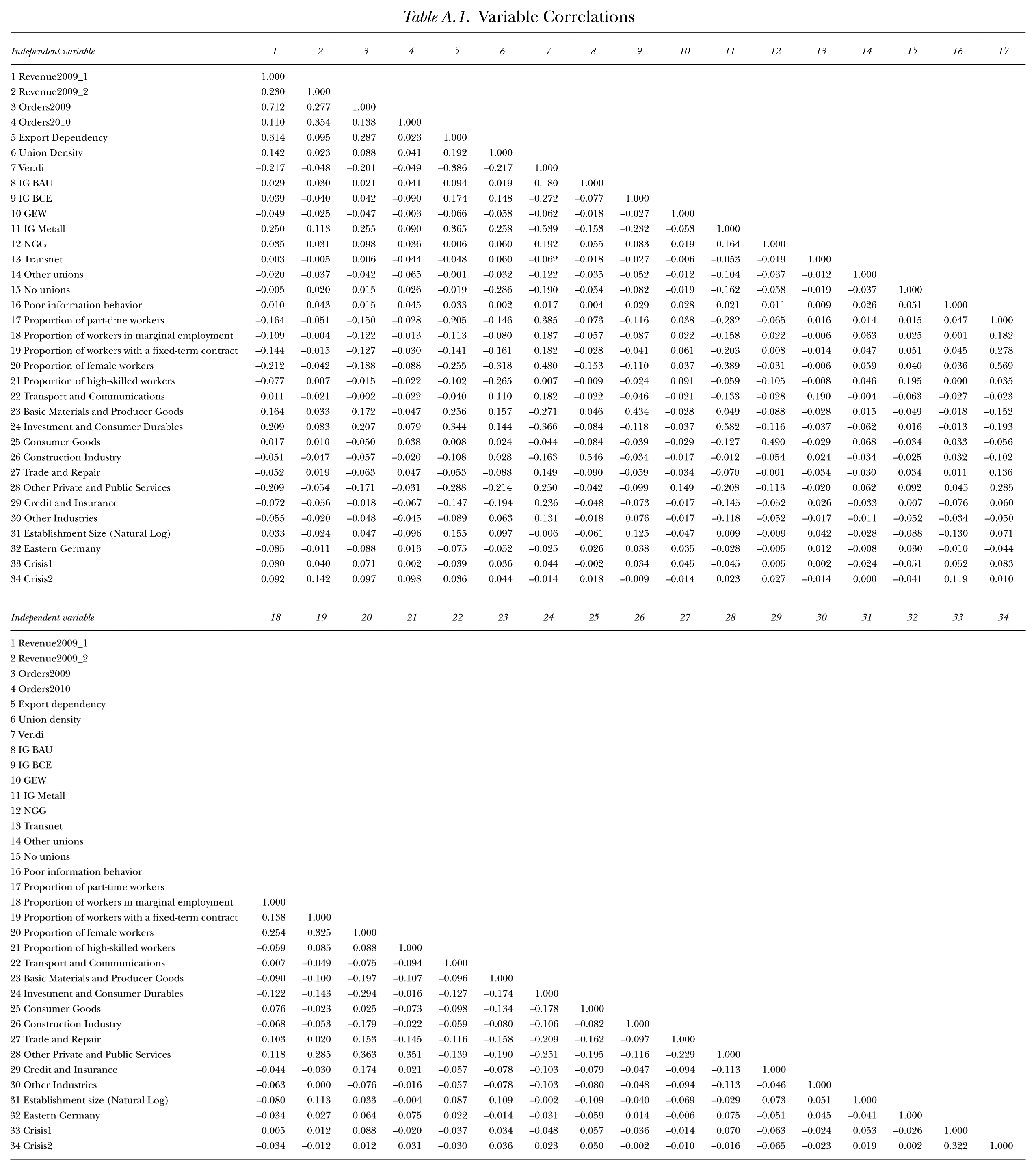
Acknowledgements
The authors received helpful comments on earlier drafts from two anonymous referees, the editors, and the special issue coordinators, as well as from the participants in the international conference titled Working Time at the University of Montreal in April 2012—especially Susan Lambert and François Rycx. We also thank Martin Behrens, Hans-Dieter Gerner, Sabine Klinger, and Enzo Weber for helpful comments, and Wolfram Brehmer for providing support with the data set.
This article is part of an ongoing project between IAB, IMK, and the Institute of Economic and Social Research (WSI) at the Hans Böckler Foundation.
A data appendix with additional results, and copies of the computer programs used to generate the results presented in this article, are available from the first author at IMK at the Hans-Böckler-Foundation,