







Abstract
This study contributes new evidence to the literature on multinational corporation (MNC) behavior by exploring three related questions: 1) Do MNCs comply with local employment laws in a developed country? 2) To the extent that compliance varies across MNCs, what factors are important in shaping compliance? 3) Is there a “foreignness” effect for MNCs operating in developed countries, and does this effect vary according to country-of-origin and/or union status? To investigate these questions, the authors compiled unique firm-level administrative data on MNC compliance with regulatory and quasi-regulatory employment practices during mass layoffs in Ontario, Canada. Adopting a research design that uses the behavior of Canadian MNCs as the comparison group, their key findings suggest that unions are a very robust predictor of compliance across all foreign MNCs and systematic country-of-origin effects on MNC compliance are present only in non-unionized workplaces.
Keywords
Reports about multinational companies (MNCs) violating labor and employment laws are common, particularly in developing countries, and a well-developed academic literature on regulation and enforcement of labor and employment standards in MNC supply chains in these countries exists. Less attention, however, has focused on MNC compliance with employment laws in developed countries, even though high-profile cases suggest that MNCs violate these laws in developed countries as well. For instance, Coca-Cola settled one of the largest racial discrimination cases in the United States, and Walmart has been regularly accused of noncompliance with employment and labor laws in both its home and host developed countries.
Given that developed countries should be able to set and enforce legal standards through established institutions that may elude developing countries, systematic research on MNC compliance with employment standards in developed countries is necessary to determine if noncompliance is the exception rather than the norm, and if not, what factors shape compliance. Although an assumption in the new institutional literature is that MNCs will comply with the law in highly institutionalized host environments due to a liability of foreignness (Kostova, Roth, and Dacin 2008), case studies of foreign MNCs operating in places such as Canada suggest otherwise (Godard 2013).
We explore three related questions: 1) Do MNCs comply with local employment laws in a developed country? 2) To the extent that compliance varies across MNCs, what factors are important in shaping compliance? 3) Is there a “foreignness” effect for MNCs operating in developed countries, and does this effect vary according to country-of-origin and/or union status? Our study makes several contributions to the literature on MNC behaviors.
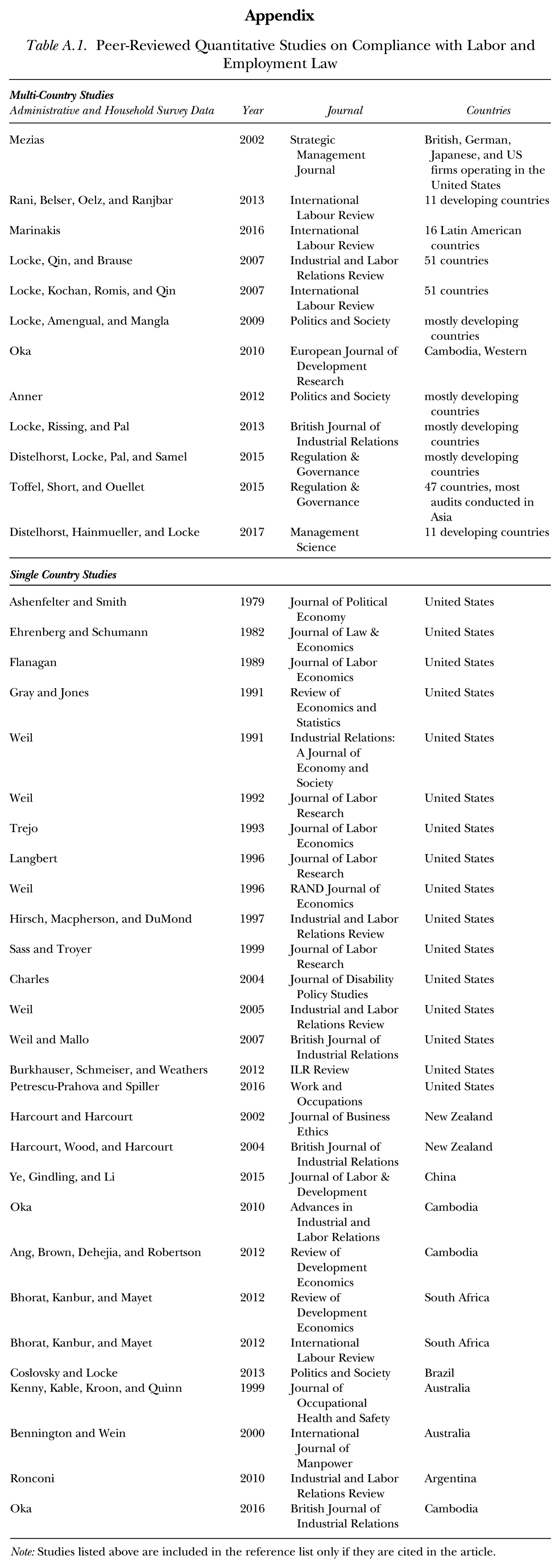
First, although numerous studies provide substantive insights about the factors that affect MNC employment practices, a review yields relatively few peer-reviewed quantitative studies that examine the factors that affect MNC compliance with employment laws in developed countries. Appendix Table A.1 summarizes, to the best of our knowledge, the peer-reviewed quantitative studies that attempt to measure both MNC and non-MNC compliance with employment laws; only one specifically focuses on MNC compliance with employment laws in a developed country (Mezias 2002). Moreover, although the table also highlights quantitative studies that investigate the union effect on organizational compliance with employment laws, none of the studies focus on the effect unions have on the compliance behaviors of foreign MNCs operating in developed countries.
Second, compliance data are very difficult to access from governments because of confidential record-keeping and disclosure practices, and data collected from other sources can be subject to selection bias (Oka 2016)—including worker and firm reticence in reporting noncompliance or lack of awareness of the law itself (Bernhardt et al. 2009). Studies that infer firm compliance from microdata and household surveys suffer from imprecise measurement and lack information on firm-level characteristics (e.g., Rani, Belser, Oelz, and Ranjbar 2013; Marinakis 2016). More-detailed firm-level compliance studies usually rely on internal MNC audits of supply chain factories (e.g., Locke, Rissing, and Pal 2013; Distelhorst, Locke, Pal, and Samel 2015), or on random audits by third-parties and NGOs (e.g., Oka 2016) in developing countries, which may be easily manipulated depending on the particular monitoring procedures (Egels-Zandén 2007). Moreover, many private regulation studies rely on data from a single firm (e.g., Locke, Kochan, Romis, and Qin 2007) or a single industry (e.g., Oka 2010).
Third, although numerous studies survey MNC managers about a range of firm- and workplace-level employment practices across different countries (T. Edwards, Marginson, and Ferner 2013)—and third-party data sets have been compiled to compare social (ir)responsibility and labor rights metrics at both firm and state levels (e.g., MSCI’s environmental, social, and governance (ESG) ratings; Mosley-Uno measure)—studies using these designs and data sets are either divorced from detailed information about the institutional context or they do not provide measures of MNC compliance with specific employment law(s). Case studies of MNC employment practices provide more detail about the institutional context (e.g., Aguzzoli and Geary 2014); however, a need remains for quantitative research to enable systematic empirical tests of the factors that shape legal compliance at the firm level.
Finally, scholars have criticized approaches to the study of MNC behavior that narrowly focus on any one set of factors (e.g., economic, institutional, strategic, firm, workplace, and so on) at the expense of others, resulting in a “constraining dualism” that undermines theoretical advancement in this area (T. Edwards et al. 2013: 548). Others have criticized organizational scholarship more broadly for being primarily concerned with the “entertainment value of theories [rather] than . . . with their scientific rigor or real-world value” (Mathieu 2016: 1132). Scholars have proposed that the development of more-rigorous empirical designs is required to advance theory on organizational behavior (Cucina and McDaniel 2016).
Our study is aimed at addressing some of these limitations through the creation of a unique data set—using administrative data from government records—on organizational compliance with employment laws during mass layoffs in Ontario, Canada, from 2004 to 2015. We chose this setting and research design for three reasons.
First, given that we are able to compare the compliance behaviors of MNCs from various foreign countries to the compliance behaviors of domestic MNCs, our research design offers a methodological improvement over prior studies of MNC behaviors in host countries that either compare 1) foreign MNCs to domestic MNCs and domestic non-MNCs (Mezias 2002) or 2) foreign MNCs to each other (Surroca, Tribó, and Zahra 2013). Denk, Kaufmann, and Roesch (2012: 330) recently called for MNC scholars to more “clearly indicate their selected reference point” and to discuss what impact the design has on the set of insights that can be gleaned. We outline how our design provides a more rigorous test of the liability of foreignness in the Discussion and Conclusion section.
Second, in accordance with the Ontario Employment Standards Act (ESA: Government of Ontario 2000), the Ontario Ministry of Labour (OML) compiles and verifies basic firm-level information on compliance with specific employment laws during mass layoffs. Administrative data on specific compliance outcomes are thus available over time in a jurisdiction with variation in domestic and foreign MNC investment. Access to such data on the population of organizations engaging in mass layoffs reduces concerns about selection bias.
Finally, the organizations were identified, enabling us to augment the original OML data with our own data collection efforts to examine the influence of multiple economic, institutional, organizational, and strategic factors in the same study. Specifically, we compiled information on organizational compliance during mass layoffs with 1) a regulation to provide a pre-specified amount of notice/severance to employees and 2) a quasi-regulatory practice to provide adjustment, outplacement, and/or re-training efforts to assist employees with the transition. 1 We also compiled information on MNC status, country-of-origin, union presence, and strategic and economic circumstances surrounding the layoffs, in addition to a number of control variables. Our two key findings are that 1) unions are a very robust predictor of compliance across all foreign MNCs and 2) systematic country-of-origin effects on foreign MNC compliance are evident in non-unionized workplaces.
MNC Literature
An ILR Review special issue (May 2013, 66(3)) on MNCs examined the factors that affect MNC employment practices by determining the extent to which MNCs deploy a set of global HR best practices, or if they are more influenced by their country-of-origin, local institutions, or firm characteristics (T. Edwards et al. 2013; Ferner et al. 2013; Lamare, Gunnigle, Marginson, and Murray 2013; Marginson et al. 2013). Although not focused on compliance, these studies highlighted important interdependencies between global and local institutions, firm characteristics, and strategic actions in shaping MNC behaviors. Our study follows in the conceptual tradition established by these scholars by investigating the effects of multiple factors (i.e., country-of-origin, MNC strategic actions, unions, and economic circumstances) in shaping foreign MNC compliance with employment laws.
Country-of-Origin Effects
New Institutional Theory
New institutionalists propose that organizational legitimacy—the acceptance of organizational actions by key stakeholders—is critical for organizational survival because it provides access to necessary resources (Deephouse 1996). Organizations achieve legitimacy by adopting practices that mirror those of other organizations in the same space. This isomorphic process is a result of different types of institutional pressures facing organizations (DiMaggio and Powell 1983). Scholars have proposed that foreign MNCs face the same institutional pressures as domestic firms, but they are also subject to an additional liability of foreignness (Zaheer 1995) over domestic firms in their host country operations that could undermine their legitimacy.
Research highlights that foreign MNCs can overcome this liability and generate legitimacy with local stakeholders by adopting host country practices (Salomon and Wu 2012; Thite, Wilkinson, and Shaw 2012). Early new institutional research on MNC employment practices showed that foreign MNCs indeed adopted local practices, especially when the practices were more likely to have been mandated by law or were highly visible to local stakeholders (Rosenzweig and Nohria 1994).
Recent contributions are more nuanced, acknowledging that foreign MNCs may not automatically conform to host country practices (Kostova et al. 2008). Research suggests that the institutional distance—that is, the divergence of institutional arrangements between the MNC’s home and host countries—also has an impact on MNC practices (Berry, Guillen, and Zhou 2010; Campbell, Eden and Miller 2012). With some exceptions (e.g., Salomon and Wu 2012), institutional distance theorists propose that the greater the similarities (differences) between the economic, political, social, cultural, and legal institutions of an MNC’s home and host countries, the easier (harder) it is for a foreign MNC to adapt to local host country practices (Phillips, Tracey, and Karra 2009).
Even new institutional scholars who acknowledge heterogeneity in foreign MNC adoption of host country practices generally agree, however, that MNCs tend to comply with local laws when they operate in developed countries with stable institutional environments. For instance, Kostova et al. (2008: 999) argued that “[the] expectation for [MNC compliance with local practices will] be limited to the regulatory and legal domains,” and Phillips et al. (2009: 344) proposed that MNCs operating in countries with a high degree of institutional stability will adapt their practices to be consistent with local regulations or will “[lobby] policy-makers” if major differences between the home and host country regulations would negatively impact the MNC. To summarize, new institutionalists would predict MNCs will comply with local employment laws when operating in a developed country with a stable institutional environment such as Canada.
Historical-Comparative Institutionalism
The historical-comparative institutionalism literature also examines how MNC behavior is constrained and enabled by its home country history, culture, institutions, and business systems (Ferner 1997; Tüselmann, McDonald, and Heise 2003; Morgan and Kristensen 2006; Meardi et al. 2009; Lamare et al. 2013). However, numerous qualitative case studies in this tradition suggest that foreign MNCs may transfer home country practices to their host country subsidiaries, even when the host country is a stable institutional environment with laws and practices that may differ from the home country (e.g., Geppert, Williams, and Matten 2003; Morgan, Kelly, Sharpe, and Whitley 2003; Whitley, Morgan, Kelly, and Sharpe 2003). Given the extensive variation across country-level institutions, comparative institutional scholars anticipate fundamental differences in MNC behaviors based on country-of-origin.
For instance, the varieties of capitalism thesis (Hall and Soskice 2001) highlights differences in firms’ business and human resources strategies in coordinated market economies (CMEs; e.g., Germany, Sweden, France) compared to liberal market economies (LMEs; e.g., United States, Canada, United Kingdom). Relative to LMEs, CMEs have been characterized by greater legislative requirements for the employment relationship, including greater non-market arrangements; strategic interaction between institutional actors, including Works Councils in many European countries; industry-level bargaining over employment; high unionization rates; and government policies generally supportive of monitoring and sanctions for noncompliance. CMEs have also generally been associated with greater normative expectations about equitable treatment of workers than have LMEs (Doellgast 2012).
Other comparative research points to variation within these classifications. For instance, among LMEs, research confirms similarity in regulatory institutions across Canada, the United Kingdom, and Ireland, but documents a divergence between these countries and the United States; the United States now appears to have the lowest level of employment regulations and support for labor rights among the LME countries (Colvin and Darbishire 2013).
To summarize, differing perspectives in historical-comparative institutionalism suggest a need for nuanced predictions about MNC employment practices based on country-of-origin or group classification. At minimum, however, comparative scholars would agree that 1) MNC behavior is both constrained and enabled by home country history, cultures, institutions, and national business systems; 2) history, cultures, institutions, and national business systems vary across countries; and therefore 3) country-of-origin should have some influence on MNC employment practices more broadly, and on compliance with employment laws in particular.
MNC Strategic Actions and State Legal Enforcement
MNCs are widely considered to be both constrained and enabled by host and home country institutions. Many scholars coming from within and outside the foregoing institutional perspectives, however, propose that MNCs are also highly strategic actors. For example, Kostova et al. (2008) offered a number of challenges to new institutional theory in explaining MNC behavior in host countries. One of their key arguments is that the traditional process of isomorphism—foreign MNC convergence with the practices of local firms—may not hold:
MNCs enjoy a rich institutional landscape, being exposed to a multitude of diverse practices and patterns of activity. This allows them the discretion to choose patterns that they think fit them best. In their international operations they may decide to follow local practices or to borrow from any other institutional model they are aware of. Thus, similarity among firms may be observed. However, it is the result of choices firms make rather than compliance with external isomorphic pressures. (Kostova et al. 2008: 999)
Some MNC scholars have further argued for incorporation of power, interests, and competing values into institutional analyses of MNC behaviors (see Dörrenbächer and Geppert 2011; Ferner, Edwards, and Tempel 2012; Bélanger, Lévesque, Jalette, and Murray 2013). This argument is consistent with studies that suggest MNCs engage in institutional arbitrage by choosing to offshore or outsource activities to take advantage of lower regulations or enforcement abroad or to avoid stakeholder pressures to engage in socially responsible behaviors at home (Surroca et al. 2013). It is also consistent with concerns raised by legal scholars that MNCs are more likely to escape sanctions for their actions because of the lack of an extraterritorial regulatory framework (Deva 2004).
Concerns about institutional arbitrage and lack of regulatory frameworks have more often been applied to understanding noncompliance with employment laws for organizations operating in developing countries (Ronconi 2010; Coslovsky and Locke 2013; Ye, Gindling, and Li 2015; Oka 2016) and less to understanding compliance in developed countries, even though noncompliance may still be a serious problem in the latter. Interviews of American workers suggest that organizational compliance with basic employment laws, such as minimum wages, overtime pay, workers’ compensation, and breaks, is low (Bernhardt et al. 2009). Indeed, various studies—mostly US-based (see Appendix Table A.1)—have documented variation in compliance with minimum wages (Ashenfelter and Smith 1979), workers’ compensation (Hirsch, Macpherson, and DuMond 1997), occupational health and safety (Weil 1991), labor standards (Trejo 1993), and workers’ freedom of association (Compa and Feinstein 2012). More recent studies also exist in Canada (Vosko, Tucker, Gellatly, and Thomas 2011; Banks 2015); New Zealand (Harcourt, Wood, and Harcourt 2004); South Africa (Bhorat, Kanbur, and Mayet 2012); and Australia (Bennington and Wein 2000). None of these studies model differences between foreign and domestic MNCs.
The foregoing research highlights that organizations are not necessarily captive to their regulatory institutional environments, even in developed countries, and they face a number of competing incentives and constraints at any given time. Relevant to our study, organizations may choose to engage in layoffs for a variety of reasons: cost reduction, corporate re-structuring, mergers/acquisitions, sale of part or all of the business, and union or strike avoidance. Specific factors that affect MNC compliance with employment laws when engaging in mass layoffs could include a lack of firm awareness of regulations (e.g., Agocs and Osborne 2009) and/or a lack of local agency enforcement frequency or efficacy (e.g., Potoski and Prakash 2005). With regard to the latter, enforcement and compliance may be low because 1) of a lack of funding for enforcement (Wood and Waterman 1993; Carpenter 1996); 2) the state is engaged in a “race to the bottom” to attract foreign investment (Blanton and Blanton 2012); and/or 3) the penalties imposed by the state for noncompliance are not substantial enough for the costs to outweigh the benefits (Becker 1968). We would thus expect lower compliance if the penalties imposed by the state are either remedial or nonexistent. Scholars have suggested this is indeed the case for many areas of employment law noncompliance in Canada (Vosko et al. 2011; Banks 2015).
Beyond the State: The Role of Unions
The state is not the only actor that may contribute to enforcement. Other third-party actors can respond to MNC strategic actions and may be able to raise the cost of noncompliance if they possess knowledge of the MNC’s employment practices and have the ability to threaten the MNC’s reputation or to withhold access to resources. These actors can be found in either the broader institutional context or inside the MNC itself.
One of these actors, the Organisation for Economic Co-operation and Development (OECD), developed a set of guidelines in 1976, updated in 2011, that outline the expectations for adhering governments—consisting of both OECD and non-OECD member countries—to ensure the responsible conduct of business within their borders (Trade Union Advisory Committee to the OECD [TUAC] 2016). The guidelines make recommendations to governments and to MNCs about standards for employment practices, industrial relations, and human rights—including one standard that specifically states that MNCs are expected to provide reasonable notice of firm restructuring to workers and to work with local governments to mitigate adverse effects of layoffs on workers. Note that the second-largest source of complaints under these guidelines are associated with MNC restructurings (TUAC 2016). Although these guidelines are considered “soft-law” and often are not enforceable, NGOs are commonly used to promote and monitor international standards, though more so in developing countries than in developed ones (e.g., Surroca et al. 2013; Oka 2016).
Many Canadian jurisdictions have incorporated these guidelines into their own employment laws. In developed countries where the state adopts international principles in their own legal statutes, NGOs often play a less critical role, even if state enforcement is uneven. Unions, however, may play a more effective enforcer role than either the state or NGOs. Unions have been shown to affect employer compliance with human rights laws in New Zealand and Australia (Harcourt et al. 2004) and in a broad range of employment laws in the United States (Weil 1991; Trejo 1993; Hirsch et al. 1997). Indeed, recent studies have shown that trade unions are a “key part of the institutional context” that affects MNC behavior in Canada (P. Edwards et al. 2013: 608). In liberal market countries such as Canada, where union organizing and collective bargaining are mostly decentralized, substantial variation occurs in union presence across workplaces. Where unions are present, we would expect them to be effective at monitoring the employment practices of MNCs; enforcement and compliance with local employment laws would be higher than in workplaces that are not unionized. Even if MNC noncompliance is less insidious—for instance, because of a lack of awareness of the law—unions may be an important source of information for the MNC about local employment regulations, similar to the facilitation effect of unions described elsewhere (Budd and McCall 1997; Hirsch et al. 1997). Beyond strict legal compliance (i.e., paying required notice/severance), unions may also force MNCs to provide greater consideration for employee welfare when downsizing.
Economic Circumstances
MNCs may engage in layoffs for a variety of strategic reasons such as the sale of the business, corporate restructuring, or union/strike avoidance. MNCs may also lay off workers in response to changing external conditions beyond firm control, such as changes in input prices, a major industry shock, a rising currency valuation in an export-dependent country, or the loss of a major contract. Many layoffs are not the result of competitive business decisions, but are instead reactions to macroeconomic conditions affecting demand for a firm’s products or services and the inability of firms to carry labor costs throughout an economic slowdown. In extreme cases, a firm may even file for bankruptcy. We would expect that the type of economic circumstances surrounding the layoff may have an impact on MNC compliance. Specifically, if the layoff is attributable to circumstances beyond the MNC’s control, as opposed to a strategic decision, the MNC may be less able to provide required notice or transition support to employees.
Empirical Context
Our initial sample was the population of all organizations (with 50 or more employees) that engaged in mass layoffs from 2004 to 2015 in Ontario, Canada. Although it is not representative of all Canadian jurisdictions, Ontario is the largest province in the country (approximately 40% of the population) and is an important setting in which to study MNC behavior because of the high number of domestic and foreign MNCs that operate there (Breau and Brown 2011). Ontario also provides a stable institutional context for MNC operation in a highly industrialized setting. The unionization rate in the province was 27% in 2012, a number that declined from almost 34% in the early 1980s, but has remained stable since 1999 (Galarneau and Sohn 2016). With the exception of a few sectors/industries, employment regulation in Canada falls under provincial jurisdiction.
Whereas Canada overall is a liberal market economy with a decentralized labor market, the province of Ontario has well-defined legislation regulating employment practices in mass layoffs, which are outlined in the ESA (Government of Ontario 2000: Part XV, Section 58). Mass layoffs are defined as 50 or more employees laid off within a four-week period. The ESA has established advance notice or severance in lieu of notice requirements during mass layoffs, consistent with international OECD standards for MNC practices (TUAC 2016). Firms must provide advance notice of layoff of an amount that varies with the number of affected employees, or alternatively, provide severance in lieu of notice.
Also consistent with international standards, firms are encouraged to work with the government through the Ministry of Training, Colleges, and Universities (MTCU) and the Ontario Ministry of Labour (OML) during the layoff process to help displaced employees. The ESA explicitly indicates that firms may be required to provide information to the OML about any proposed adjustment measures; however, it is not a strict regulatory requirement to establish these measures. Firms have some discretion to work with the government to help displaced workers, to provide their own outplacement assistance, or to do nothing at all.
If the firm establishes a formal adjustment committee, it is often set up under the Ontario government’s Adjustment Advisory Program (AAP). The AAP brings employers and employees together to jointly deal with major changes that affect the workplace, with a primary aim to help workers displaced in layoffs. Firms have incentive to use the AAP since the costs of establishing adjustment committees and providing outplacement assistance are subsidized by the MTCU through assistance provided by designated government staff. We consider the establishment of an adjustment committee a quasi-regulatory practice because though it is not strictly required by law, it is strongly encouraged and subsidized by the government, and it is mentioned in the ESA. Moreover, firms that do not establish adjustment committees and instead provide their own outplacement assistance generally report on these practices as well. In December 2011, the MTCU eliminated the classification for AAP Advisory staff (Ontario Federation of Labour 2017). Establishment of adjustment committees noticeably declined in the latter years of our 2004 to 2015 data—likely a result of the change.
Mechanisms have been developed to monitor compliance with these regulatory requirements and adjustment measures. Firms with layoffs of 50 or more employees are required to file an administrative form with the OML known as “Form 1” (Government of Ontario 2009). These forms collect enough information to establish whether the legally required notice or severance was given to employees by providing the official date of notice (i.e., the date the Form 1 is received by the OML), layoff dates by number and type of employees, and any alternatives discussed or implemented (i.e., whether severance was paid in lieu of notice). The form also asks about any adjustment measures that were proposed or implemented. Additional information on the Form 1 includes the size of the workforce at the location (broken down by type of worker), whether the workforce was unionized and by which union, and the circumstances surrounding the layoff. 2
Based on our conversations with OML staff and other researchers who study regulatory compliance issues in Ontario, the government adopts a strategy to work with firms in noncompliance with employment laws to rectify the issue. Thus, there is little incentive for firms to hide noncompliance. Penalties are mostly remedial, which is commonplace for employment law enforcement in Canada (Banks 2015). 3
Data Sources
For the years 2004 to 2015, we compiled a database on the population of mass layoffs from information obtained on the original Form 1s (the unit of analysis for each layoff is the establishment level). We compiled institutional information from OML staff and documents. We compiled MNC status and country-of-origin variables through online searches of media releases, company records, and websites. We also had access to a linked Form 1–employee survey data set from 1991 that we used to conduct various robustness checks of our main results. For brevity, we highlight these analyses in footnotes and provide more detail in a supplemental Online Appendix. 4
Variables
Required Notice/Severance and Adjustment Measures
Our key dependent variables of interest are legal compliance with required notice/severance provisions (Compliance) and provision of an adjustment committee or other outplacement measures to help employees with the transition (Adjustment). For our analysis, Compliance equals 1 if the firm provided the required amount of notice or paid severance in lieu of notice, and equals 0 if they did neither. This compliance variable was constructed using a series of questions from the Form 1 including the date(s) of the layoff, number of employees affected, the official date of layoff notification (the Form 1–received date), and a question specifically asking about alternatives. The ESA clearly indicates that firms must provide advance notice of layoff (the timing of which varies with the number of affected employees), or, alternatively, provide severance in lieu of notice. Specifically, employers must give 8 weeks of notice (or 8 weeks of severance in lieu of notice) if terminating 50 to 199 employees, 12 weeks of notice if terminating 200 to 499 employees, and 16 weeks of notice for 500 or more employees. 5
The variable for adoption of adjustment measures in the 2004 to 2015 data is coded based on the question on the original Form 1: “Has the employer implemented or proposed any adjustment measures with employees (or their agent)?” The variable equals 1 if the employer responded in the affirmative and equals 0 if they responded in the negative (responses left blank were coded as missing). As a robustness check, we also coded Adjustment to include only assistance specifically described as part of the Government of Ontario’s AAP. The overall conclusions of our study do not change, though the small sample sizes for certain countries make some of the country-of-origin coefficients less robust to measurement of the Adjustment variable. We chose to report the set of results that coded Adjustment = 1 more broadly.
Country-of-Origin
We initially identified country-of-origin using the address listed on the Form 1 records, but it became apparent in data cleaning that the address usually given on the form was for the Canadian subsidiary headquarters, making it appear as though there were more domestic MNCs in our sample than there were in reality. We therefore created our own MNC status and country-of-origin variables by searching through company websites, annual reports, and press releases for every company name in the data. We also made attempts to verify company history (including takeovers) over the years. We were unable to find any information on approximately 6% of the firms in the original sample. We omit these observations, as most are likely small Canadian domestic firms, and so for the purposes of our study would be excluded anyway. Our final sample includes MNCs from 17 countries.
Union Status
The union local was listed in the Form 1 records (Union = 1). We also collected additional union certification information from the Ontario Labour Relations Board to determine if the classic union endogeneity concerns were problematic; for instance, there may be a concern that employees chose unionization because of MNC lack of compliance with employment regulations. For the years of data we had available and were able to match with the Ontario Labour Relations Board data, the unionized firms were certified many years prior to our 2004 to 2015 sample, thus reducing concerns about this particular form of bias.
Rationale for the Layoff
Based on additional qualitative information provided on the Form 1, we were able to code a set of proxies for the circumstances leading to the layoff, as virtually all firms provided a fairly detailed rationale. Some of the rationales indicated that the decision was in response to a strategic business decision on the part of the MNC, and other rationales indicated reasons that were beyond the immediate control of the firm. All of these choice variables are mutually exclusive. We do not have the circumstances surrounding layoffs from 2013 to 2015; we currently have access to those years in summary form only, thus we present two sets of results—2004 to 2015 without the layoff circumstances and 2004 to 2013 with the layoff circumstances.
Specifically, we were able to code for whether the layoff was an attempt to avoid or control costs due to a union certification or strike (Strike), or a corporate restructuring (Restructure), as well as if the layoffs were caused by sale of the business (Sale). We consider these layoffs to be primarily a result of strategic business decisions. Layoffs attributable to any of the following reasons are considered to be beyond the immediate control of the firm: 1) declining demand for products due to the recession, changing external conditions (such as currency fluctuations; in particular when the Canadian dollar rose substantially against the US dollar), or seasonal fluctuations (Market); 2) cancellation/loss of a major contract (Contract); or 3) bankruptcy (Bankrupt). Market is the omitted category.
Control Variables
The majority of the layoffs in our main sample were partial layoffs (approximately 70%) rather than complete closures (Complete = 1), and this variable was calculated from subtracting the number of employees who were laid off from the total number of employees. Random data quality checks confirmed that our coding of complete closures was consistent with other qualitative information provided on the Form 1. A number of other control variables are included in our models. We controlled for the size of the workplace using the log of total employees (LogEmp), the geographic location of the workplace in a rural or urban location (Urban), if the workforce subject to the layoff consisted of salaried workers only rather than a mix of salary, hourly, and other (Salary), and a mutually exclusive set of dummy variables that control for the structure of the layoffs—that is, whether the layoff was staggered in one location (Staggered), occurred in multiple locations (Multiple), or occurred at a single location all at once (Single). We also include a time trend to control for seasonality and other unobserved factors correlated with layoff year and broader macroeconomic conditions; we adopt a linear time trend as this fit the data better than did a quadratic time trend. As a robustness check, we compiled an industry variable for a subsample of the 2004 to 2015 data and the findings are unchanged. The majority of firms in the sample are in the manufacturing sector.
Research Design
We are interested in estimating a credible effect of foreignness on MNC behavior. The challenge for research designs in the MNC literature is to establish the appropriate comparison group for foreign MNCs’ behavior in host countries. Some studies use a sample of only foreign MNCs; the comparison is thus different (foreign) countries relative to each other and there is no comparison group that can inform us about the outcome for domestic firms. The other approach in the literature is to compare foreign MNCs to domestic firms. In this case, a clear comparison group exists (i.e., domestic firms); however, the MNC literature suggests that non-MNCs systematically differ from MNCs in a variety of ways that may be difficult to observe in the data. If the comparison group includes domestic non-MNCs, estimates would likely be biased due to unobserved factors that are correlated with both compliance and MNC status. We address this possibility by using Canadian MNCs’ compliance behavior domestically as the comparison group (rather than all domestic firms). The firms in our comparison group are thus not subject to a liability of foreignness, but represent a reasonable counterfactual as they are all multinationals. Although this research design remains non-experimental (and so may not yield unbiased estimates), it heeds recent calls by MNC scholars to explicitly clarify the comparator group(s) being used in MNC studies and to show how these choices affect the insights and particular set of conclusions that can be drawn from the results (Denk et al. 2012).
The two outcome variables are binary; we thus use the logit model for all specifications and present the calculated marginal effects below the logit coefficients in the tables. We also estimated linear probability models, which are available in the Online Appendix. The choice of statistical model does not affect the overall interpretation of the results. Note that logistic regression omits variables and drops observations when a covariate perfectly predicts compliance/adjustment or in cases of zero observations in a cell. We clearly indicate which observations are omitted in all models, and for what reason. For these variables, the descriptive statistics in Table 1 provide more useful information, for instance, about the general levels of noncompliance in Chinese and Mexican firms and the high levels of compliance in MNCs from certain European countries.
Compliance and Adjustment Rates for Study Variables
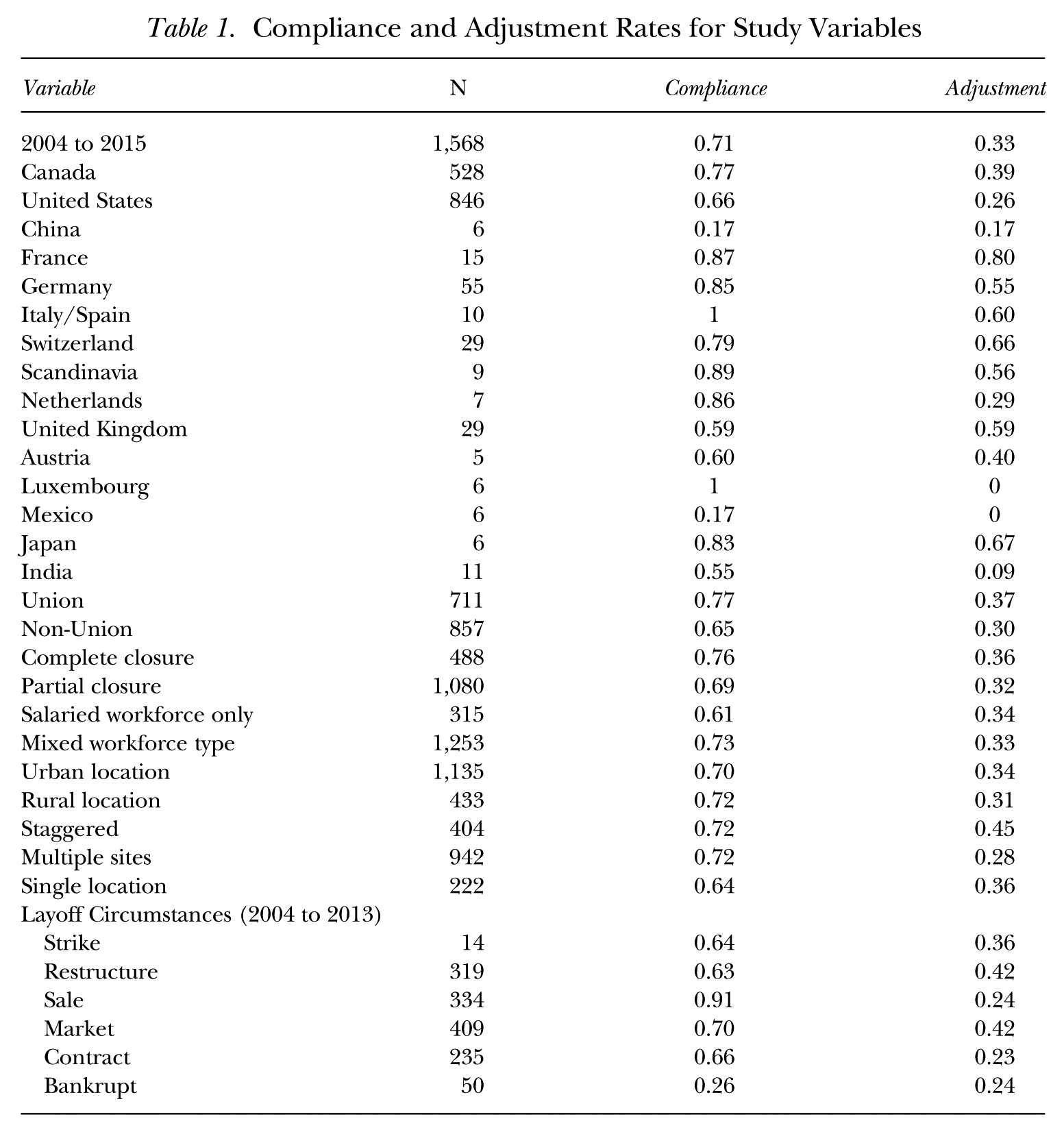
Because of small numbers of observations for Italy and Denmark—four for each—for analytic purposes we group Denmark with Sweden and group Italy with Spain. We dropped six countries that had only one observation (Malta, Korea, Poland, Singapore, Brazil, and South Africa) and dropped all observations with missing responses. 6
Results
For 2004 to 2015, we provide detailed summary statistics on rates of compliance and adjustment across countries, as well as the majority of our explanatory variables (Table 1). The overall compliance rate (i.e., required notice/severance) is 71%; the overall adjustment rate is 33%. Compliance rates are higher than average for Canadian MNCs and MNCs from most of the European countries, with the exception of the United Kingdom and Austria. Compliance rates are lower than average for Mexican and Asian firms (with the exception of Japan). The pattern differs only slightly across countries-of-origin for the provision of adjustment measures. Unionized workplaces also have higher-than-average rates of compliance and adjustment.
Firms have much higher-than-average compliance rates when the rationale for the layoff is sale of the business and slightly lower-than-average compliance when the firm’s rationale is either union/strike avoidance or a corporate restructuring. Perhaps unsurprisingly, firms have very low compliance when layoffs are attributable to a bankruptcy.
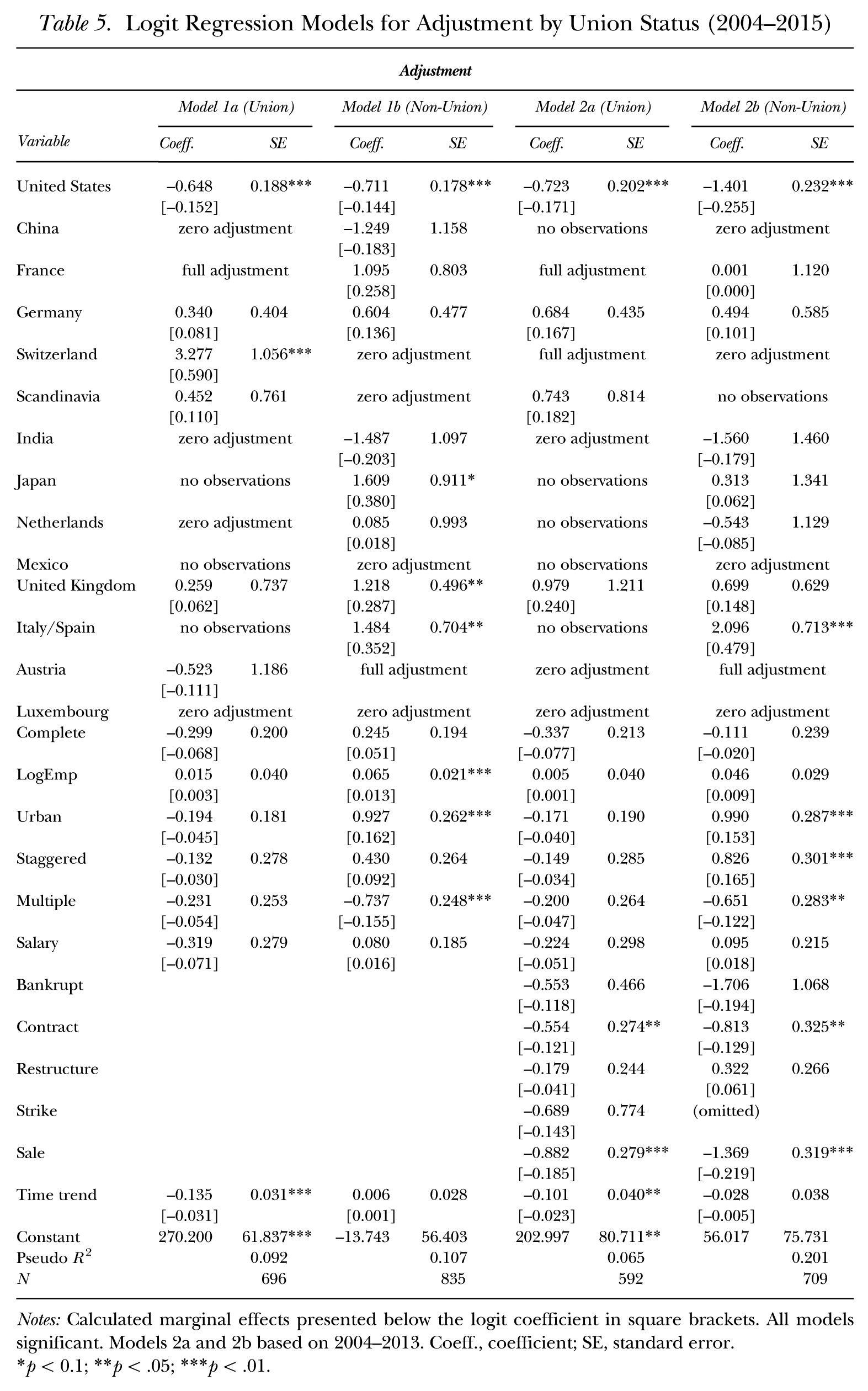
Tables 2 and 3 each present four logit regression models for compliance and adjustment, respectively, to highlight the effect of each set of variables: model 1 includes only the country variables, model 2 adds the union effect, model 3 adds the controls, and model 4 uses the reduced sample that controls for layoff circumstances. 7 We observe a fairly robust set of negative effects for compliance in MNCs from the United States, the United Kingdom, Mexico, China, and India. The practical interpretation of the results for US MNCs is that compliance is 12 percentage points lower in US MNCs than in Canadian MNCs (Table 2, model 3), and 6.5 percentage points lower in the sample that controls for the layoff rationales (Table 2, model 4). The effect for US MNCs is even larger for adjustment, at almost 24 percentage points lower, than for Canadian MNCs (Table 3, model 4). Considering that these numbers are relative to a sample mean of 0.71 and 0.33 for compliance and adjustment, respectively, the results are both statistically and practically significant. Although coefficients for MNCs from Europe are less precise due to small sample sizes, the coefficients for France, Germany, Switzerland, and Scandinavia are mostly positive. Italy is positive and mostly significant across models for adjustment (and even though Italy/Spain is omitted for compliance, this is because Italian/Spanish MNCs have 100% compliance; see Table 1). Of interest, foreign MNCs from the United Kingdom are more likely to provide adjustment committees than are Canadian MNCs (Table 3).
We also note a strong, positive, and robust union effect across both measures and all models. The magnitude of the union effect for compliance is sizeable—about 12 to 14 percentage points (relative to a mean of 0.71; Table 2, models 2–4). For adjustment, the effect is 7 to 10 percentage points (relative to a mean of 0.33, Table 3, models 2–4). The results from the pooled samples mask differences between union and non-union firms, however, so we conduct an analysis that examines compliance separately by union versus non-union workplaces. As revealed in Tables 4 and 5, the pattern of results varies greatly. We opted for this approach to investigating the union effect rather than simply interacting each country-of-origin with the union measure because it eases interpretation and allows all coefficients to vary between the union and non-union sample. 8
Logit Regression Models for Compliance (2004–2015)
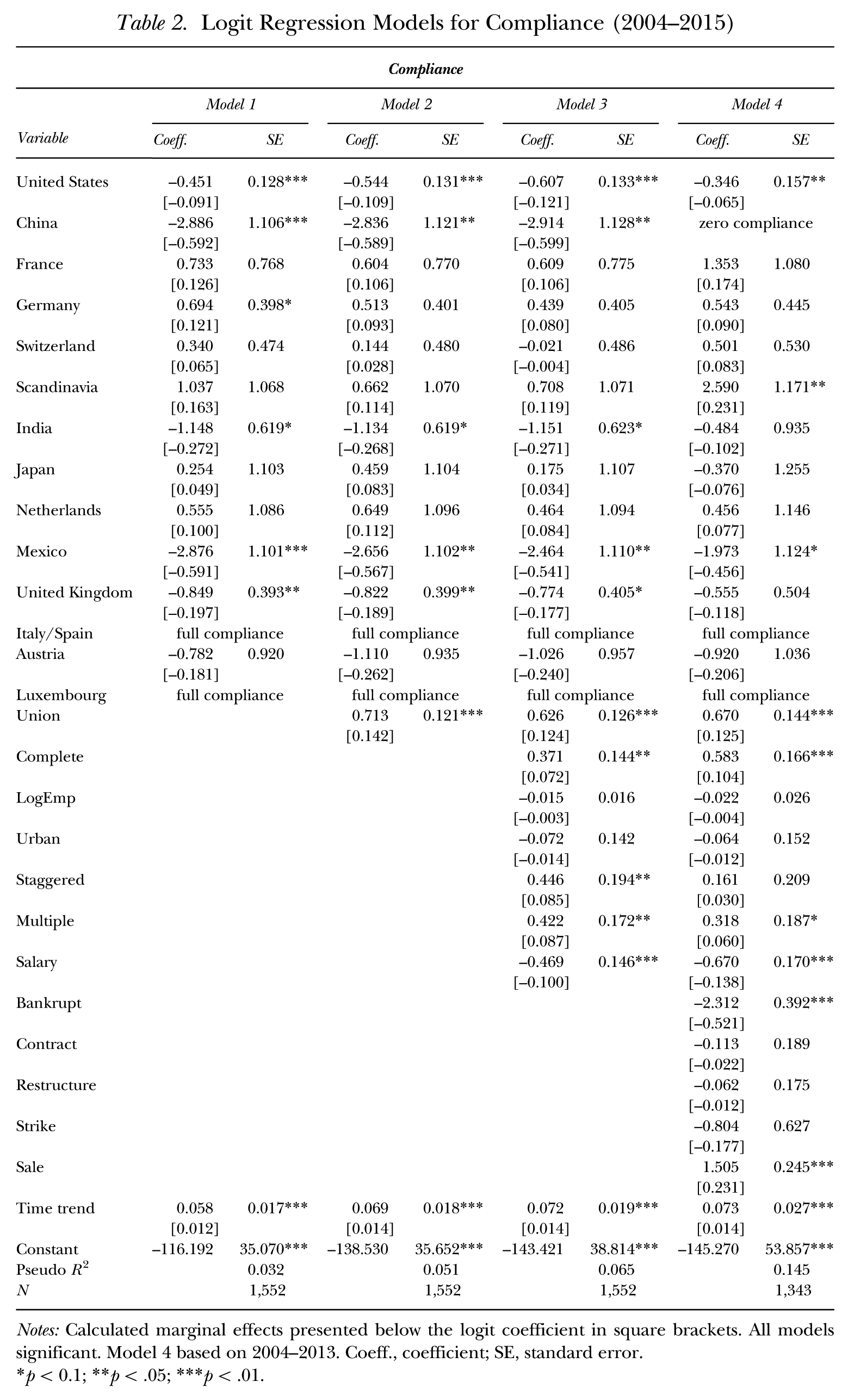
Notes: Calculated marginal effects presented below the logit coefficient in square brackets. All models significant. Model 4 based on 2004–2013. Coeff., coefficient; SE, standard error.
p < 0.1; **p < .05; ***p < .01.
Logit Regression Models for Adjustment (2004–2015)
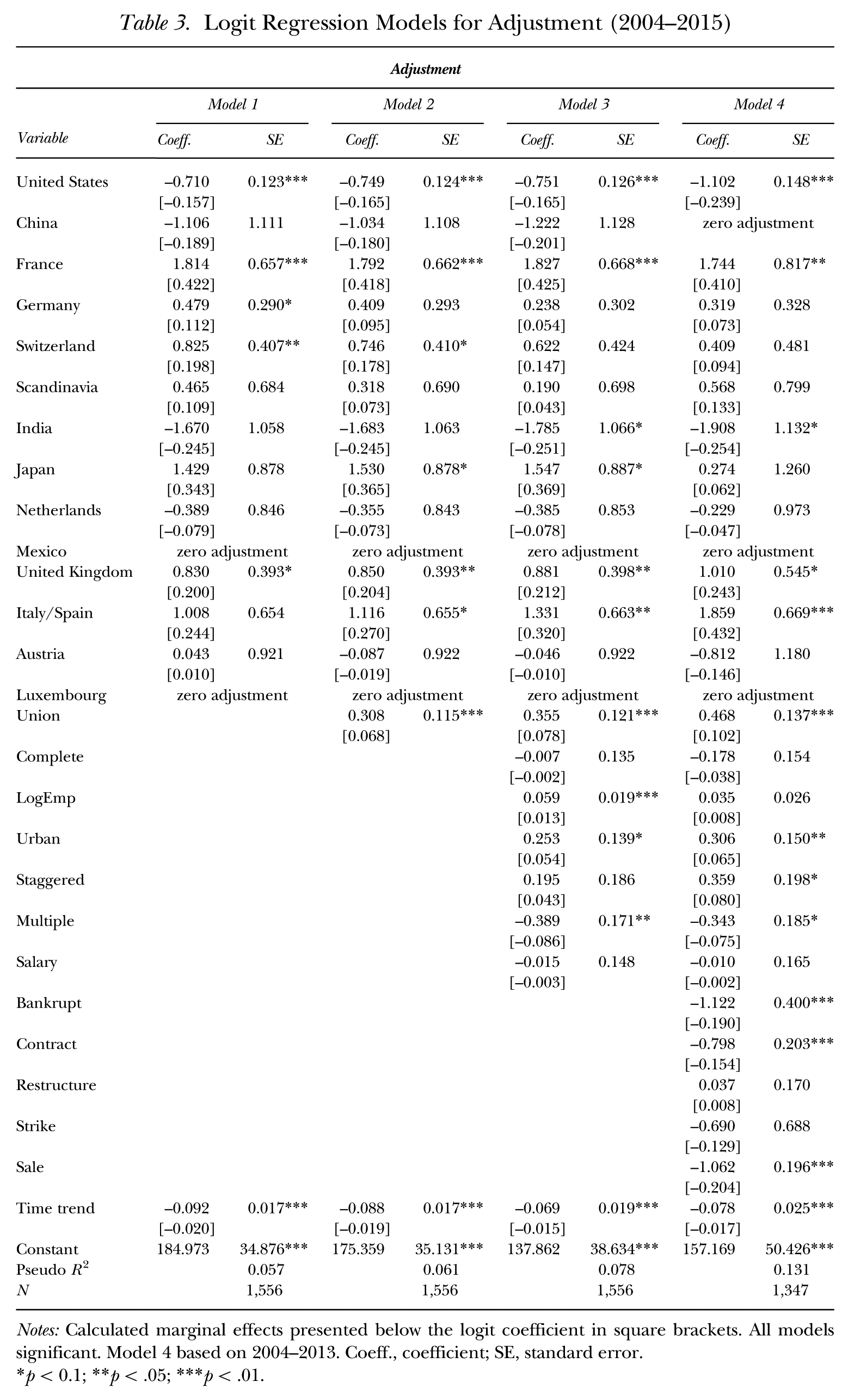
Notes: Calculated marginal effects presented below the logit coefficient in square brackets. All models significant. Model 4 based on 2004–2013. Coeff., coefficient; SE, standard error.
p < 0.1; **p < .05; ***p < .01.
Logit Regression Models for Compliance by Union Status (2004–2015)
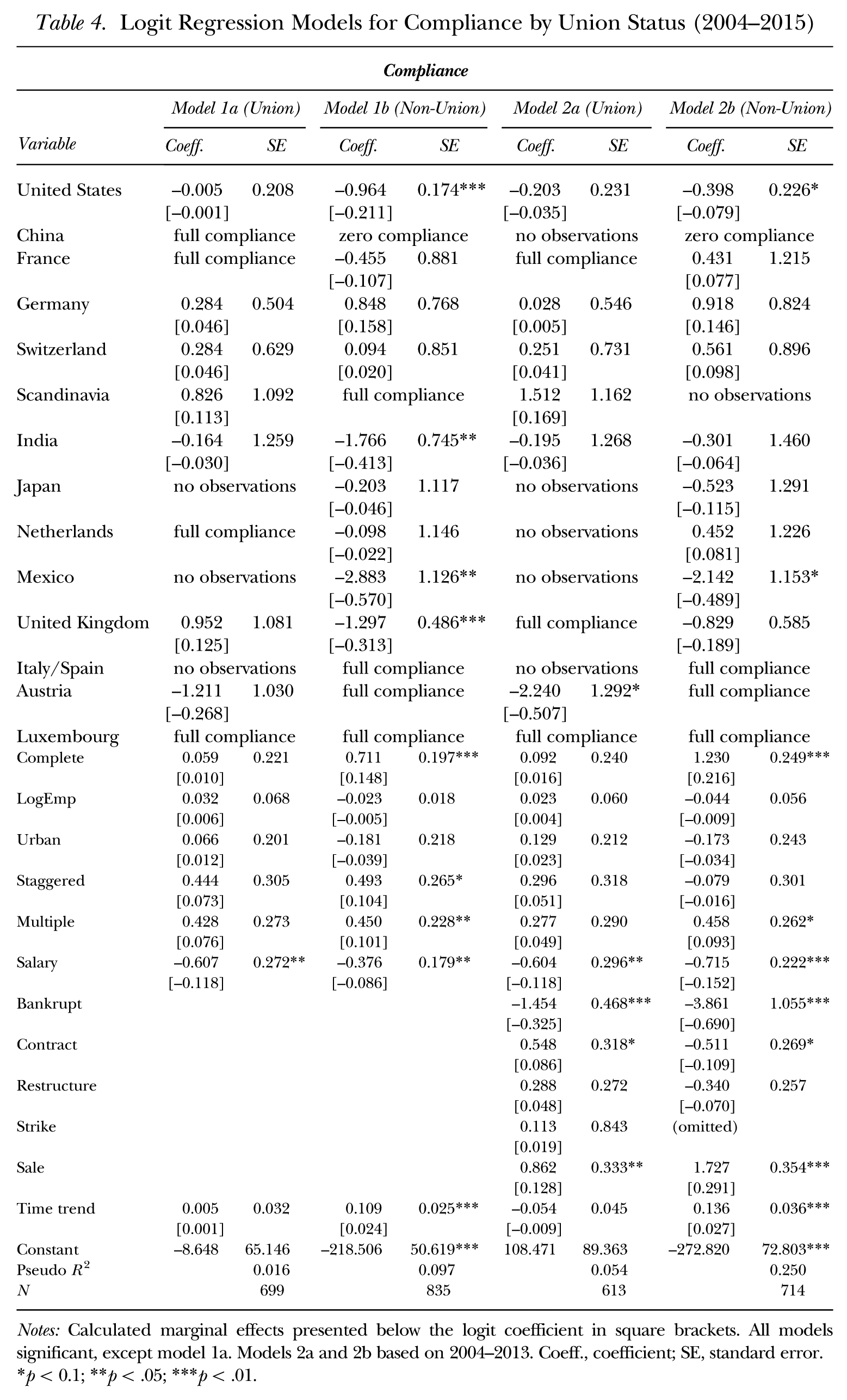
Notes: Calculated marginal effects presented below the logit coefficient in square brackets. All models significant, except model 1a. Models 2a and 2b based on 2004–2013. Coeff., coefficient; SE, standard error.
p < 0.1; **p < .05; ***p < .01.
Logit Regression Models for Adjustment by Union Status (2004–2015)
Notes: Calculated marginal effects presented below the logit coefficient in square brackets. All models significant. Models 2a and 2b based on 2004–2013. Coeff., coefficient; SE, standard error.
p < 0.1; **p < .05; ***p < .01.
Table 4 shows few significant differences in compliance across country-of-origin for MNCs within unionized establishments. For adjustment, shown in Table 5, only unionized Swiss MNCs are more likely than unionized Canadian MNCs to provide an adjustment committee (Table 5, model 1a). Presence of a union does not appear to have much effect in US MNCs when it comes to the provision of adjustment committees—union and non-union US workplaces’ adjustment measures both are 14 to 15 percentage points lower than in union and non-union Canadian MNCs (Table 5, models 1a and 1b).
In summary, most of the differences in compliance across country-of-origin are coming from variation within non-union firms. In other words, the country-of-origin effects noted in the pooled samples (Tables 2 and 3) are being masked by the convergence of compliance in union firms. The country-of-origin and union effects appear to be fairly robust to the addition of the firm-level controls, but some country-of-origin effects are more sensitive to the addition of the variables on the layoff circumstances. 9
Discussion and Conclusion
Our study makes a few key contributions to the literature on MNC compliance with employment law. First, a multidisciplinary review of the MNC literature yields conflicting theories and evidence about whether foreign MNCs face greater pressure than domestic firms face to conform to host country regulations because of a liability of foreignness, particularly in developed host countries. Our results suggest foreign MNCs’ compliance with employment law in Canada varies by country-of-origin, but mostly in non-unionized workplaces. Essentially, in unionized workplaces, compliance is high across the board and thus has little variation across any characteristic, whereas in non-union workplaces compliance varies considerably, particularly by MNC country-of-origin. In non-union workplaces, compliance is generally high among MNCs from Western Europe and low among MNCs from the United States, the United Kingdom, Mexico, and Asia (with the exception of Japan). This finding is consistent with the varieties of capitalism thesis, which proposes that firms from LMEs will be less socialized toward complying with extensive legislative requirements than will firms from CMEs.
For the provision of adjustment measures to assist affected workers, the interaction between country-of-origin and unionization was not as strong as it was for compliance. Given that the provision of adjustment measures is not a strict regulatory requirement (i.e., only reporting on it is required), it may be better to view the adjustment measure as a local custom or normative employment practice, strongly encouraged and subsidized by the state. For this practice, there is still a robust main union effect, but the presence of a union does not completely mitigate the country-of-origin effects, particularly for US firms. This finding is consistent with the increased divergence between the United States and other liberal market countries with respect to employment laws (Colvin and Darbishire 2013) and the effect of US-style employment policies and practices that are more hostile toward trade unions (Compa 2014).
Overall, we found greater heterogeneity in foreign MNC compliance behaviors in a developed country (i.e., Canada) than new institutional theory would predict. The results provide more support for the varieties of capitalism framework and for approaches to studying MNC behaviors that pay greater attention to the role of internal actors. The robust union effect we discovered has implications for long-standing debates over what unions do—our research suggests that in addition to their monopoly and voice roles (Freeman and Medoff 1984), unions also serve important enforcement and facilitative roles in obtaining justice for workers by securing their statutory rights.
Our second key contribution is the development of a research design that allows country-of-origin effects to be evaluated relative to a comparison group in a manner that 1) yields a clear interpretation, and 2) we believe allows for a more credible estimate of the foreignness effect. In particular, by using Canadian MNCs operating in Canada as our comparison group, we argue that our design provides a more credible estimate of foreignness relative to previous studies because each foreign MNC group is being compared to a reference group comprising MNCs that operate at home, and thus are not subject to a liability of foreignness. Our approach is more likely to isolate any foreignness effect rather than contaminating a foreignness effect with a multinational effect (as MNCs may be different from non-MNCs along a variety of dimensions that are difficult to observe in the data). Put another way, our design allows the country-of-origin effects to be analyzed relative to a comparison group that yields a clear interpretation about the foreignness effect. We acknowledge that our study is non-experimental (i.e., nonrandomized), but our approach still heeds calls (i.e., Denk et al. 2012) for MNC scholars to better interpret the country-of-origin coefficients relative to the chosen comparison group and to demonstrate how that comparison group credibly tests proposed mechanisms.
In addition to these theoretical and methodological contributions, we also make a few key contributions to regulatory policy. Our results suggest that the presence of an actor with countervailing power inside the workplace is more effective in ensuring compliance than the state, even in a highly advanced, industrialized nation. This finding is important for two reasons.
First, the proliferation of studies about MNC compliance in developing countries, and the lack of MNC compliance studies conducted in developed countries, may lead to the perception that MNCs are highly likely to comply with the law in countries with stable institutional contexts, and thus fewer resources are put into enforcement. If countries such as Canada have a difficult time ensuring compliance with state-sanctioned employment laws, both developing countries and other developed countries—particularly countries with lower unionization—may be subject to even greater noncompliance than scholars have been able to observe to date.
Second, our results support a particular perspective on the regulation of work in a globalized economy that highlights the importance of allowing multiple avenues for standards and enforcement to emerge, that is, public labor standards, private regulation, and strong unions. Indeed, these avenues should be seen as necessary complements, rather than substitutes (Locke, Qin, and Brause 2007; Locke 2013). The Ontario government has begun to realize that this type of approach is necessary to regulate work in the current environment and is undertaking an extensive review of its employment and labor legislation and enforcement approaches; legislative and policy reviews have also occurred in other Canadian provinces over the past few years in this domain. Our study is thus timely from a policy perspective, and it provides guidance for regulators about the types of MNCs they should carefully monitor for compliance.
Our study also highlights several possible areas for further research. First, our results suggest that foreign MNCs from developing countries do not face a greater liability compared to foreign MNCs from highly industrialized countries, as has been proposed elsewhere (Chang, Mellahi, and Wilkinson 2009); or, if they do, it does not appear to affect their compliance behavior in Canada. For instance, MNCs from Mexico, China, and India were less likely to comply with employment regulations in Canada than were Canadian MNCs; however, the sample size from each of these countries was small. Thus, future research should attempt to gain access to larger samples of foreign MNCs from developing home countries operating in developed host countries.
Second, our results suggest that firms from CMEs (e.g., Western Europe and Scandinavia) have adapted to greater government regulation and worker protections and that MNCs from these countries may also be more accustomed to undertaking extensive employee consultations than are firms from LMEs. With few exceptions, our results show that firms from CMEs are as likely or more likely to comply with employment laws as are firms from LMEs. Our results also suggest that most European/Scandinavian firms are as likely or more likely than are firms from other countries to provide greater normative considerations for workers during layoffs through the provision of adjustment measures. We also observed a robust union effect that mitigated many of these country-of-origin effects. Future research should investigate if these interactions hold for other employment regulations and domains of law.
Finally, our results provide support for previous research that shows unions have a major effect on compliance and other firm employment practices, particularly in the Canadian context (Pohler and Luchak 2014). It is unclear if unions would have this effect in all host countries; for instance, Compa (2014) found that foreign MNCs operating in the United States often adopt US-style policies and practices that are more hostile toward trade unions. Clearly, it would be useful for future research to replicate our design to examine compliance in other developed host countries.
Footnotes
Appendix
Peer-Reviewed Quantitative Studies on Compliance with Labor and Employment Law
| Year | Journal | Countries | |
|---|---|---|---|
| Mezias | 2002 | Strategic Management Journal | British, German, Japanese, and US firms operating in the United States |
| Rani, Belser, Oelz, and Ranjbar | 2013 | International Labour Review | 11 developing countries |
| Marinakis | 2016 | International Labour Review | 16 Latin American countries |
| Year | Journal | Countries | |
| Locke, Qin, and Brause | 2007 | Industrial and Labor Relations Review | 51 countries |
| Locke, Kochan, Romis, and Qin | 2007 | International Labour Review | 51 countries |
| Locke, Amengual, and Mangla | 2009 | Politics and Society | mostly developing countries |
| Oka | 2010 | European Journal of Development Research | Cambodia, Western |
| Anner | 2012 | Politics and Society | mostly developing countries |
| Locke, Rissing, and Pal | 2013 | British Journal of Industrial Relations | mostly developing countries |
| Distelhorst, Locke, Pal, and Samel | 2015 | Regulation & Governance | mostly developing countries |
| Toffel, Short, and Ouellet | 2015 | Regulation & Governance | 47 countries, most audits conducted in Asia |
| Distelhorst, Hainmueller, and Locke | 2017 | Management Science | 11 developing countries |
| Single Country Studies | |||
| Ashenfelter and Smith | 1979 | Journal of Political Economy | United States |
| Ehrenberg and Schumann | 1982 | Journal of Law & Economics | United States |
| Flanagan | 1989 | Journal of Labor Economics | United States |
| Gray and Jones | 1991 | Review of Economics and Statistics | United States |
| Weil | 1991 | Industrial Relations: A Journal of Economy and Society | United States |
| Weil | 1992 | Journal of Labor Research | United States |
| Trejo | 1993 | Journal of Labor Economics | United States |
| Langbert | 1996 | Journal of Labor Research | United States |
| Weil | 1996 | RAND Journal of Economics | United States |
| Hirsch, Macpherson, and DuMond | 1997 | Industrial and Labor Relations Review | United States |
| Sass and Troyer | 1999 | Journal of Labor Research | United States |
| Charles | 2004 | Journal of Disability Policy Studies | United States |
| Weil | 2005 | Industrial and Labor Relations Review | United States |
| Weil and Mallo | 2007 | British Journal of Industrial Relations | United States |
| Burkhauser, Schmeiser, and Weathers | 2012 | ILR Review | United States |
| Petrescu-Prahova and Spiller | 2016 | Work and Occupations | United States |
| Harcourt and Harcourt | 2002 | Journal of Business Ethics | New Zealand |
| Harcourt, Wood, and Harcourt | 2004 | British Journal of Industrial Relations | New Zealand |
| Ye, Gindling, and Li | 2015 | Journal of Labor & Development | China |
| Oka | 2010 | Advances in Industrial and Labor Relations | Cambodia |
| Ang, Brown, Dehejia, and Robertson | 2012 | Review of Development Economics | Cambodia |
| Bhorat, Kanbur, and Mayet | 2012 | Review of Development Economics | South Africa |
| Bhorat, Kanbur, and Mayet | 2012 | International Labour Review | South Africa |
| Coslovsky and Locke | 2013 | Politics and Society | Brazil |
| Kenny, Kable, Kroon, and Quinn | 1999 | Journal of Occupational Health and Safety | Australia |
| Bennington and Wein | 2000 | International Journal of Manpower | Australia |
| Ronconi | 2010 | Industrial and Labor Relations Review | Argentina |
| Oka | 2016 | British Journal of Industrial Relations | Cambodia |
Note: Studies listed above are included in the reference list only if they are cited in the article.
Acknowledgements
The authors gratefully acknowledge assistance from the Social Sciences and Humanities Research Council of Canada.
For information regarding the data and/or computer programs utilized for this study, please address correspondence to the authors at
1
We label this a quasi-regulatory practice because firms are not strictly compelled to establish an adjustment committee; however, the Employment Standards Act states that employers may have to report on any proposed adjustment measures (e.g., outplacement assistance, re-training, and so on). We describe this measure in more detail later.
2
Another possible form of noncompliance would be firms failing to submit a Form 1, which would create a sample selection bias. Based on our conversations with relevant government staff, the OML adopted strategies such as monitoring employee complaints, news articles, and press releases to gather information about the occurrence of mass layoffs and notice provided. Mass layoffs are difficult for firms to hide.
3
It is unclear how successful this strategy has been for improving compliance rates after initial noncompliance, as we do not have data on this particular issue. However, conversations with OML staff suggest that it is difficult for the OML to work with MNCs to rectify compliance issues for cases in which the MNC is closing all operations in the province. We take this into account by controlling for whether the layoff was a complete or partial closure.
4
Only summary administrative files exist for 1991, as original Form 1s prior to June 2004 have been destroyed based on standard OML record-keeping practices. In 1991, however, the OML also conducted an employee survey that was linked to the Form 1 summary administrative data. The employees surveyed were drawn from firms that had submitted a Form 1, and the MNCs are almost entirely US-based. Thus, the 1991 data have the majority of the firm- and workplace-level information available in our 2004 to 2015 sample, in addition to a richer set of employee-level data and controls.
5
Although the qualitative information collected on the Form 1 indicates if the firm paid severance in lieu of notice, we have no official record in the 2004 to 2015 data of whether the severance was actually received by employees. Similarly, notice received is based on the official date the Form 1 was received at the OML; whether this notification was actually executed within the plant is unknown. Based on conversations with OML staff, they have developed internal procedures to monitor the accuracy of the submitted information. We also undertook a robustness check using the 1991 administrative-employee data to examine if what employers say they did is similar to what employees say they received, which we were able to confirm.
6
The Online Appendix also presents results with larger groupings. Given the small sample sizes of some countries, these results are more robust to alternative specifications and inclusion of controls.
7
Note that logistic regression omits variables and drops observations when there is either complete or quasi-complete separation—that is, when the covariates perfectly predict compliance/adjustment and/or when there are no observations in a particular cell; however, these omitted coefficients still convey important information. For instance, some countries, such as China (Table 2, model 4) and Mexico (Table 3, all models), are omitted in certain models because the MNCs had zero compliance. Italy/Spain was omitted in Table 2 because these MNCs were in full compliance. In other cases, there were simply no observations, for example, there were no Mexican unionized firms ( , models 1a and 2a). This outcome is particularly the case when we subsampled by unionized versus non-unionized firms since we further restricted the sample size, and also in the models that control for layoff circumstances, since these models use two fewer years of data. We identify these differences across omitted coefficients using relevant labels in our results tables.
8
We do not run separate models for any of the other explanatory variables, given the extremely limited number of observations across the cells for different countries.
9
The 1991 data set allows for robustness checks on three issues: 1) if the results are similar at a very different point in time; 2) if the findings are affected by employee composition of the firm; and 3) varying approaches to measuring severance and overall compliance. Using the 1991 employee-reported question on severance yields approximately the same fraction of firms paying severance in lieu of notice as we find in the early 2000s based on the administrative records, which gives us confidence in the accuracy of firm reporting if they paid severance in lieu of notice. The pattern of results is also similar to our main data as foreign (US) firms are approximately 20 percentage points less likely to comply than are Canadian firms, and union firms are 21 percentage points more likely to comply relative to non-union firms. The results hold with additional employee and firm-level controls, as well as with two separate measures of compliance (see Online Appendix).