







Abstract
The authors cast entrepreneurship as one of three career choices—remaining with one’s employer, changing employers, or engaging in entrepreneurship—and theorize how the likelihood of entrepreneurship evolves over one’s career. They empirically demonstrate an inverted U-shaped relationship between accumulated experience and entrepreneurship across various industries and jobs. The authors highlight the difficulty of inferring the mechanism underlying the observed relationship, despite detailed career history data and job displacement shocks that eliminate the current employer choice. These analyses motivate a formal career transitions model in which employer-specific and general skills accumulate with experience but potential employers observe only total skill. Results from the model presented here are that entrepreneurial career transitions vary with two relative costs: 1) the cost to an individual to form a business and 2) the cost to a potential employer to utilize the individual’s employer-specific skills. The authors discuss how this model contributes new insights into an entrepreneurial career.
Entrepreneurs often work for other organizations before engaging in entrepreneurial activity and many who become entrepreneurs re-enter paid employment. How and when individuals transition between employment and entrepreneurship over the course of their careers are, therefore, vibrant research areas. This careers perspective explicitly situates entrepreneurship within a set of employment alternatives that includes organizational employment and unemployment. For example, employees are more likely to enter entrepreneurship when opportunities for advancing with their employer become limited or otherwise unappealing (e.g., Kacperczyk 2012; Sørensen and Sharkey 2014).
Career mobility research suggests that individuals evaluate entrepreneurial career options relative to not only their current positions but also to positions with other employers. In contrast to the internal labor markets era, modern careers commonly span multiple organizations. A careers perspective on entrepreneurship therefore accounts for three possible choices that individuals face during their careers: 1) enter entrepreneurship, 2) continue to work for current employer, or 3) change employers. We apply this mobility perspective to understand how the appeal of entrepreneurship evolves—relative to these alternatives—as one accumulates work experience, thereby revealing several empirical challenges and promising directions for future research.
Work experience is a key determinant of entrepreneurial transition, and evidence on the relationship between experience and entrepreneurship features in many entrepreneurship studies. Yet, the precise nature of this effect is unclear, as empirical findings are decidedly mixed (e.g., Parker 2004, 2009). Using the careers perspective, we revisit the experience–entrepreneurship relationship in an attempt to reconcile the mixed evidence with a compelling theoretical explanation. Our approach has several advantages. First, we hold many factors other than experience constant in examining the relationship between experience and entrepreneurship across various employment arrangements (e.g., industry, role). Second, we build on work that considers how human capital accumulated with experience shapes one’s future prospects for employment versus entrepreneurship by explicitly considering the relative value of human capital for each. Third, we disentangle preferences for organizational employment from career transition costs. We do so by considering three career choices and by studying individuals who leave their jobs both voluntarily and involuntarily. In combination, these factors enable clearer empirical inferences about the relationship between accumulated experience and employment but also reveal theoretical questions.
Our approach is unconventional but reflects the development of our ideas. We present three sections in which we document an empirical regularity, probe plausible explanations for it, and then develop a formal theoretical model capable of generating predictions consistent with the observations. Empirically, we use two data sets—one industry-specific and one multi-industry—to examine the relationship between accumulated experience and entrepreneurial career transitions. In both our industry-specific and multi-industry analyses, we test no formal hypotheses. Instead, we demonstrate several key challenges in estimating the functional form of the experience–entrepreneurship relationship and in identifying a mechanism underlying that relationship. In short, we rule out several plausible mechanisms but are unable to identify the one we consider most plausible.
Analyzing multi-industry, nationally comprehensive data enables us to address many, but not all, of the challenges revealed in the single-industry analysis. We narrow down the set of plausible explanations for the observed experience–entrepreneurship relationship with many control variables and fixed effects. In doing so, we de-sensitize our empirical inferences to the idiosyncratic characteristics of the single-industry setting. Although this approach enables us to establish a clear functional form, what we view as the most compelling theoretical explanation for the observed relationship cannot be tested directly with the data available to us. This challenge motivates our development of a formal theoretical model that can account for the relationship between experience and entrepreneurship across a wide variety of settings.
Our key contribution to the literature on entrepreneurship is a formal theoretical model that proposes experience-based differences between two costs associated with leaving one’s current job. The first is the cost an individual incurs to start a business (i.e., a business formation cost). For example, individuals might need to accumulate initial capital to pursue new business ideas. The second is the cost a potential employer incurs to employ an individual who has accumulated skills specific to other employers (i.e., a skill-absorption cost). For example, the employer might need to pay a premium for external hires even though they tend to underperform internal promotions in the near term (Bidwell 2011). The relative magnitude of these two costs is theorized to account for variation in individuals’ propensities to engage in entrepreneurial activity or to change employers over the course of their careers. The model’s key insight is that one’s choice between employment and entrepreneurship varies with 1) the difference between individual and employer information on the general and employer-specific skills that the individual accumulates with experience, and 2) the difference between the individual’s business formation cost and the potential employer’s absorption cost.
Our model predicts that, conditional on mobility, moderately experienced individuals are most likely to make entrepreneurial career transitions because their willingness to incur the business formation cost exceeds the willingness of employers to incur the absorption cost. Conversely, at both high and low levels of experience, individuals tend to choose wage work because business formation costs are relatively high at low experience levels and because absorption costs are relatively low at high experience levels. Consequently, an inverted U-shaped relationship between experience and the rate of entrepreneurship is expected among those who leave their employer (“movers”).
These model-derived predictions are consistent with the results of our industry-specific analysis of US attorneys displaced by several law firm dissolutions. These predictions are also consistent with results from our multi-industry, longitudinal sample of Swedish workers that includes both displaced workers and those who change jobs voluntarily. The results from both analyses imply greater consistency with the theoretical argument motivating our model than with other intuitively appealing alternative explanations.
We attribute, at least partially, the mixed evidence on the experience–entrepreneurship relationship to the difficulty of measuring absorption costs but also propose that the feasibility of measuring variation in business formation costs renders the model useful for future researchers. We therefore discuss our model’s implications for studies of career transitions into entrepreneurship and employment with another organization. Below, we review prior work on experience and entrepreneurship and the growing literature on inter-organizational careers before presenting our empirical analyses and the formal model.
Literature Review
Prior Experience and Entrepreneurship
Prior to engaging in entrepreneurship, individuals often accumulate experience with employers that alters their propensities to engage in entrepreneurship or remain in organizational employment (Burton, Sørensen, and Dobrev 2016). Parker (2004, 2009) reviewed numerous theoretical accounts of entrepreneurship and the empirical evidence supporting those accounts. More specifically, Parker (2004: 70–72) discussed how human and social capital accumulate with work experience (and age), how market opportunities present themselves, and how one’s preferences are learned over time. Parker (2004: 72) concluded that “experience captures most accurately the impact of human capital” and concluded that a “consistent positive relationship between experience (defined quite broadly) and entrepreneurship” occurs (Parker 2009: 115). He also noted, however, that the widely presumed positive influence of human capital on entrepreneurship might be counterbalanced by other factors that are also associated with aging (Parker 2004: 70). Thus, evidence on the empirical relationship between accumulated experience and entrepreneurial activity is decidedly mixed.
Some studies document a monotonic relationship between experience and entrepreneurship. For example, a study of Danish citizens found that the rate of entrepreneurial transitions decreased with one’s experience at their current employer (Sørensen 2007). Similar results were obtained from a study of mutual fund managers (Kacperczyk 2012, 2013). Other studies document a non-monotonic relationship between experience and entrepreneurship. For example, one study of MBA graduates documented that the relationship between employment tenure and entrepreneurship changed direction twice over the experience distribution (Dobrev and Barnett 2005). Last, a study of lawyers found an inverted U-shaped relationship between experience and the rate at which lawyers departed their employer to found a new firm (Campbell, Ganco, Franco, and Agarwal 2012). In short, there is no consensus on the functional form of the experience–entrepreneurship relationship.
One way to reconcile these mixed results is to acknowledge—as Parker (2004, 2009) does—differences in measurement and context across studies. Perhaps idiosyncratic research designs contribute to the mixed findings. Differences in context or measurement might also produce variation across samples in the costs associated with the modeled career choices. For example, experience might facilitate the acquisition of entrepreneurial knowledge and increase entrepreneurial performance (e.g., Agarwal, Echambadi, Franco, and Sarkar 2004) but also increase the opportunity costs associated with abandoning wage work.
Extended employment spells might also indicate an individual’s innate preference for organizational employment, as opposed to self-employment or to founding or joining a new venture. Variations across individuals in their general preferences for employment at established organizations (Sørensen 2007; Elfenbein, Hamilton, and Zenger 2010; Sørensen and Phillips 2011) or for their current employer (Jovanovic 1979a, 1979b) are a form of unobserved heterogeneity that is difficult to account for in analyses of archival data (Åstebro and Thompson 2011).
Given these mixed findings, we propose that additional insight can be gained by considering entrepreneurship within a broader set of career choices and also by considering the influence of costs that are typically unobserved in empirical studies (and might indeed be unobservable).
Inter-Organizational Careers
Prior studies cast entrepreneurship as a dichotomous career choice between employment and entrepreneurship. Although remaining with one’s current employer might be the most plausible alternative to entrepreneurship, a growing body of research on career mobility suggests that changing employers is an increasingly common career experience. This work demonstrates that, relative to the internal labor markets era (Doeringer and Piore 1971), modern careers are much more likely to span multiple organizations (Cappelli 1999; Bidwell and Briscoe 2010; Rider and Tan 2015). Moreover, many jobs are considered appealing not for their internal advancement prospects but rather for their propensity to open up external career advancement opportunities (e.g., Tan and Rider 2017). This work suggests that would-be entrepreneurs weigh entrepreneurial career options not only against their current position but also against positions with other employers. The decision to become an entrepreneur is therefore intertwined with a broader set of career choices, including staying in the current position and changing employers.
Although we acknowledge that prior work varies in measurement and important contextual factors, we also believe that much can be gained by considering how the appeal of entrepreneurship varies relative to the appeal of working for another employer, as experience accumulates. In other words, our ideal thought experiment is to consider how the choice between entrepreneurship and employment would vary with experience if one were to separate the choice to leave one’s current employer from the choice between the remaining two career options (i.e., entrepreneurship or employment elsewhere). Our empirical analyses approximate the next-best alternative to this ideal, and our formal theoretical model aims to close the gap between ideal and actual.
Analytical Approach
Single-Industry Setting
Acknowledging that experimentally displacing individuals from employment is neither feasible nor desirable, we attempt to estimate the effect of experience on the choice between employment and entrepreneurship in a single-industry setting in which the choice to separate from an employer is absent. When and where mobility is induced by unexpected events, such as a sudden employer failure, unobserved individual preferences for current employment cannot drive occupational choices.
Motivated by this insight, we first situate our analysis in the context of six large US law firm dissolutions that displaced more than 1,400 lawyers in 2008–2009. These dissolutions were sudden, unanticipated, and largely attributable to industry conditions so that displacement does not reflect negatively upon individual ability (Gibbons and Katz 1991; Rider and Negro 2015; Kacperczyk and Marx 2016). We track the lawyers’ post-dissolution labor market outcomes in order to evaluate the effect of accumulated legal experience on their rates of entrepreneurial activity (self-employment, founding or joining a new firm), as opposed to regaining employment with an established organization.
Although useful for simplifying the focal individual’s career choice, the single-industry setting poses several challenges that render conclusive inferences infeasible. An important concern is that a mobility shock imposed by firm dissolution might not justify the limits on generalizability imposed by a single industry and profession—even one in which entrepreneurship is common (Campbell et al. 2012). In subsequent analyses, we therefore examine the relationship between experience and entrepreneurship across many industries and professions.
Multiple-Industry Setting
Using nationally representative registry data from Sweden, we then analyze the experience–entrepreneurship relationship for workers who depart their employers voluntarily and for those displaced by employer closures. These longitudinal employment data cover most of Sweden’s workforce from 2001 to 2007. Most employed individuals in this analysis are at simultaneous risk of making three distinct career choices: 1) remaining with their current employer, 2) transitioning to another employer, or 3) engaging in entrepreneurship. We therefore analyze separation from one’s employer as the primary outcome and then, conditional on job separation, we analyze entrepreneurial transitions for individuals who depart their employers as a secondary outcome. We also analyze choices made by a subsample of workers displaced by firm failures (e.g., bankruptcies).
This analysis demonstrates that the functional form of the experience–entrepreneurship relationship documented in our single-industry analysis is not idiosyncratic to that context, even when controlling for a much wider range of alternative explanations. Yet, as we consider the potential explanations for this key relationship that can and cannot be ruled out, an appealing alternative that cannot be tested emerges.
Formal Theoretical Model
Our empirical analyses inform our subsequent development of a model of occupational choice. We discuss the difficulty of inferring a mechanism underlying the observed empirical relationship. We attempt to integrate the insights of prior work to develop a formal theoretical model that is built on the assumption that employees develop both employer-specific and general skills as they accumulate experience but that employers can observe only total skill (i.e., the sum of these two skill components). We assume that the general component can be utilized by all employers and that employer-specific skill can be utilized only by employers that pay an absorption cost. Prior work suggests that employers incur absorption costs by paying a premium for external hires—newcomers tend to underperform internal promotions in the short run because of the difficulty of transferring skills (Bidwell 2011). As an alternative to employment, we also assume that an individual can incur a business formation cost to found an organization that fully utilizes their skills.
The key insight of the model is that the individual choice between organizational employment and entrepreneurship varies with 1) the difference between individual and employer information on the general and employer-specific skills that the individual accumulates with experience and 2) the difference between the individual’s business formation cost and the potential employer’s absorption cost.
Evidence from Law Firm Dissolutions
Sample
We first analyze a large sample of lawyers who were forced to make occupational choices after the unexpected dissolutions of their employers. For several reasons, the US legal services industry is an appealing context for our analysis. First, human capital associated with accumulated work experience influences law firm personnel decisions and, by implication, lawyers’ careers (e.g., Garicano and Hubbard 2009). Second, lawyers regularly depart their employers to found new firms or to join established ones (e.g., Campbell et al. 2012; Rider and Tan 2015; Tan and Rider 2017).
The sample used in this section was constructed for Rider (2016), which examined the impact of law school alumni networks on hiring and individual career attainment. The sample consists of 1,426 lawyers previously employed in six large US firms; all were forced to seek alternative employment after their employers dissolved. As documented below, an analytically appealing aspect of these data is that each firm’s dissolution was fairly rapid, thereby ameliorating selection issues arising from the greater propensity of employees with relatively better labor market opportunities to anticipate firm failure and to depart prior to dissolution. The Appendix found at the end of the article briefly describes each firm and details the dissolutions.
Sample Construction
Biographies of lawyers were extracted from the law firms’ websites soon after the firm’s dissolution was announced. These biographies were supplemented with information taken from various law directories and the Internet Archive. Data for each individual at the time of employer dissolution include some demographic information, the lawyer’s level (e.g., associate, partner), area(s) of practice, office location, law school attended, and the year they passed the bar exam. Subsequent employment outcomes were identified using searches of other firms’ websites, the online version of Martindale-Hubbell, individuals’ LinkedIn profiles, ZoomInfo, and other Internet resources. A total of 1,248 employment outcomes were identified, accounting for 88% of the original sample (see Rider, Sterling, and Tan 2016 for an analysis of sample selection). Online Appendix Table A.1 and Table A.2 summarize the distribution of observations across firms and rank. 1
Data and Measurement
We analyze only the sample of 1,248 lawyers for whom post-dissolution labor market outcomes were identified. In some of our analyses, we include the inverse Mills ratio (the reciprocal of the predicted probability that a lawyer was employed and located by the sampling methods) in the specification to account for sample selection bias. But note that we acknowledge we are unable to account for endogeneity and therefore do not interpret the experience–entrepreneurship relationship estimated in these analyses as causal. Rather, we use these analyses to structure our consideration of what governs the entrepreneurship–experience relationship.
Dependent Variable
We measure a lawyer’s transition to entrepreneurship by coding an indicator variable as 1 if immediately after dissolution the lawyer founds a company, joins a newly founded company, or enters self-employment (i.e., a solo practitioner) and as 0 otherwise. In our sample, 28 lawyers found or co-found a new company and an additional 12 lawyers join one of these companies so the sample’s rate of entrepreneurial transition is approximately 3%.
Regressors
Legal experience for each lawyer was calculated by subtracting the year in which the lawyer was first admitted to a state bar from 2008. We utilize a piecewise scheme to estimate the partial correlations between experience and the rate of entrepreneurial transition. Specifically, we split the experience variable into dichotomous quintile indicator variables based on the observed distribution of experience within the sample (0–4 years, 5–10 years, 11–18 years, 19–28 years, and 29+ years). Our empirical specification excludes the middle quintile indicator.
To account for heterogeneity by dissolved firm, geographic location, and practice area, we rely on fixed effects. We include unreported fixed effects for the six dissolved firms (Heller, Thelen, Thacher, WolfBlock, Dreier, and Morgan & Finnegan); office location fixed effects for Los Angeles, Northern New Jersey, New York, Philadelphia (including suburban areas in southern New Jersey), San Francisco, Silicon Valley, Washington, and “All Other” (Anchorage, Boston, Harrisburg, Hartford, Madison, San Diego, Seattle, Stamford, and Wilmington); and practice area fixed effects for Litigation, Bankruptcy and Restructuring, Corporate Law, Corporate Finance, Intellectual Property, Securities, Real Estate, International Law, Labor and Employment, Technology, and “All Other.”
Gender was coded by five trained analysts who reviewed lawyer names, photos, and/or biographies. The “Female” variable takes a value of 1 if most of the five analysts identified the lawyer as female and 0 otherwise. Using the same data, the analysts also classified each lawyer’s race or ethnicity according to the US Census Bureau’s racial and ethnic classifications. More than 86% of the lawyers in the full sample were identified as “white,” and “black” was the next most common category (3.5%). Therefore, we coded two variables that equal 1 if the majority of the five coders coded an individual as “white” or “black,” respectively, and 0 otherwise. The omitted category includes lawyers classified primarily as Arab, Asian, Indian, Hispanic, Latino, or Middle Eastern; insufficient observations in these other categories exclude them from the specification.
To account for geographic variance in access to law school alumni networks, we included a variable for each lawyer that is the percentage of all National Law Journal 250 (an annual ranking of the 250 largest US law firms) lawyers within the lawyer’s metropolitan area who graduated from the focal lawyer’s law school. We also included the numerical rank of each lawyer’s law school in the 2008 U.S. News & World Report “Best Law School” rankings to proxy for legal ability. Unranked schools were assigned a rank of 120, the lowest ranked school in the rankings. A partner indicator variable was coded 1 if a lawyer was a partner at their prior (dissolved) firm and 0 if the lawyer was an associate, counsel, or another title. In all specifications, observations are clustered by firm to produce robust standard errors.
Summary Statistics
The sample is divided almost evenly between partners (41.5%) and associates (45.8%), with lawyers in other types of positions (e.g., of counsel or contract attorneys) accounting for the remaining 12.7%. Mean legal experience is approximately 12 years. We found relatively few strong correlations across the variables, with the obvious exception that legal experience is strongly associated with being a partner. Overall, approximately 3% of the sample entered entrepreneurship as opposed to joining an established firm. The correlations between the entrepreneurship indicator and other variables fail to reveal any notable monotonic relationships in the raw data. Table 1 presents summary statistics for the lawyers sample. More sample details are available in the Online Appendix.
Summary Statistics and Correlations
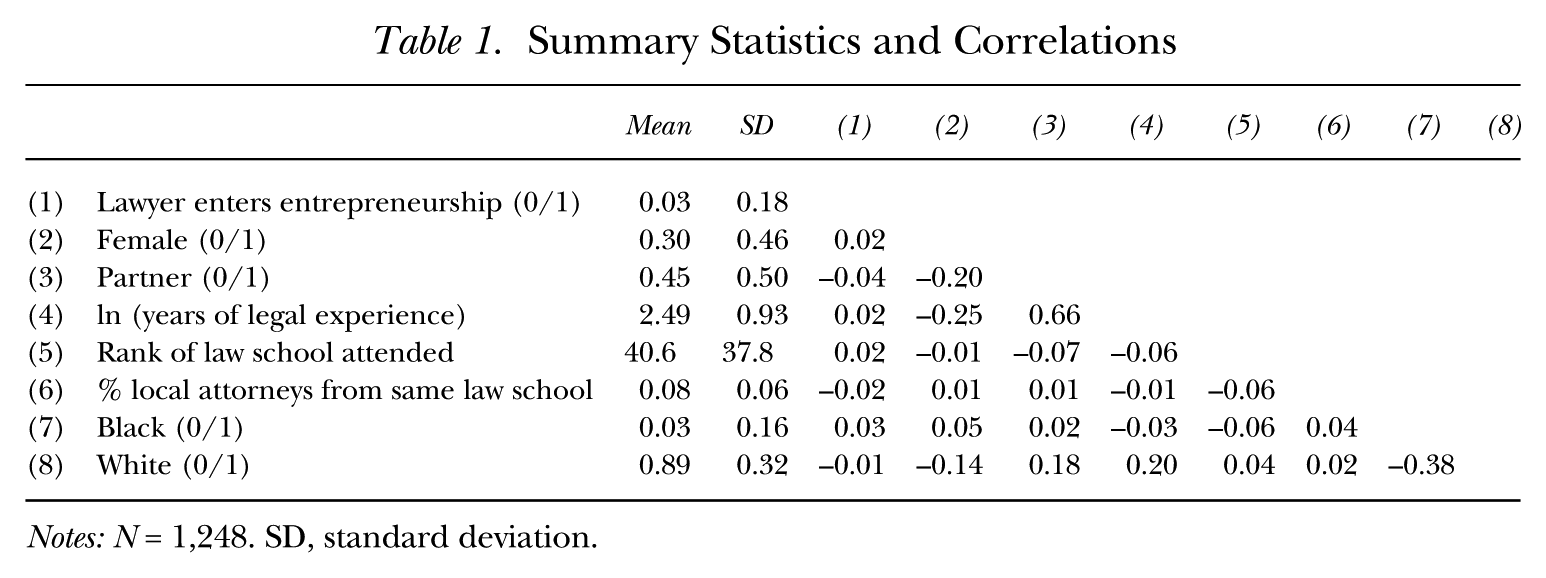
Notes: N = 1,248. SD, standard deviation.
The Probability of Entrepreneurship
Calculating raw rates of entrepreneurship by quintile of legal experience for all 1,248 lawyers in the sample reveals an inverted U-shaped association between experience and entry into entrepreneurship (Figure A.1). Fewer than 2% of the least-experienced displaced lawyers chose entrepreneurship over joining an incumbent firm; the rate was three times greater for the third quintile, before falling to about 2.5% among the most experienced. Associates are concentrated in the lowest three quintiles, so for them the rate of entrepreneurship is generally rising with experience. The reverse is true for partners. In sum, the peak rate of entrepreneurship is found among the most experienced associates and the least experienced partners. This descriptive pattern might be explained in several ways. We probe the possibilities we can below and delay discussion of others until presenting our multiple-industry analyses.
Analysis
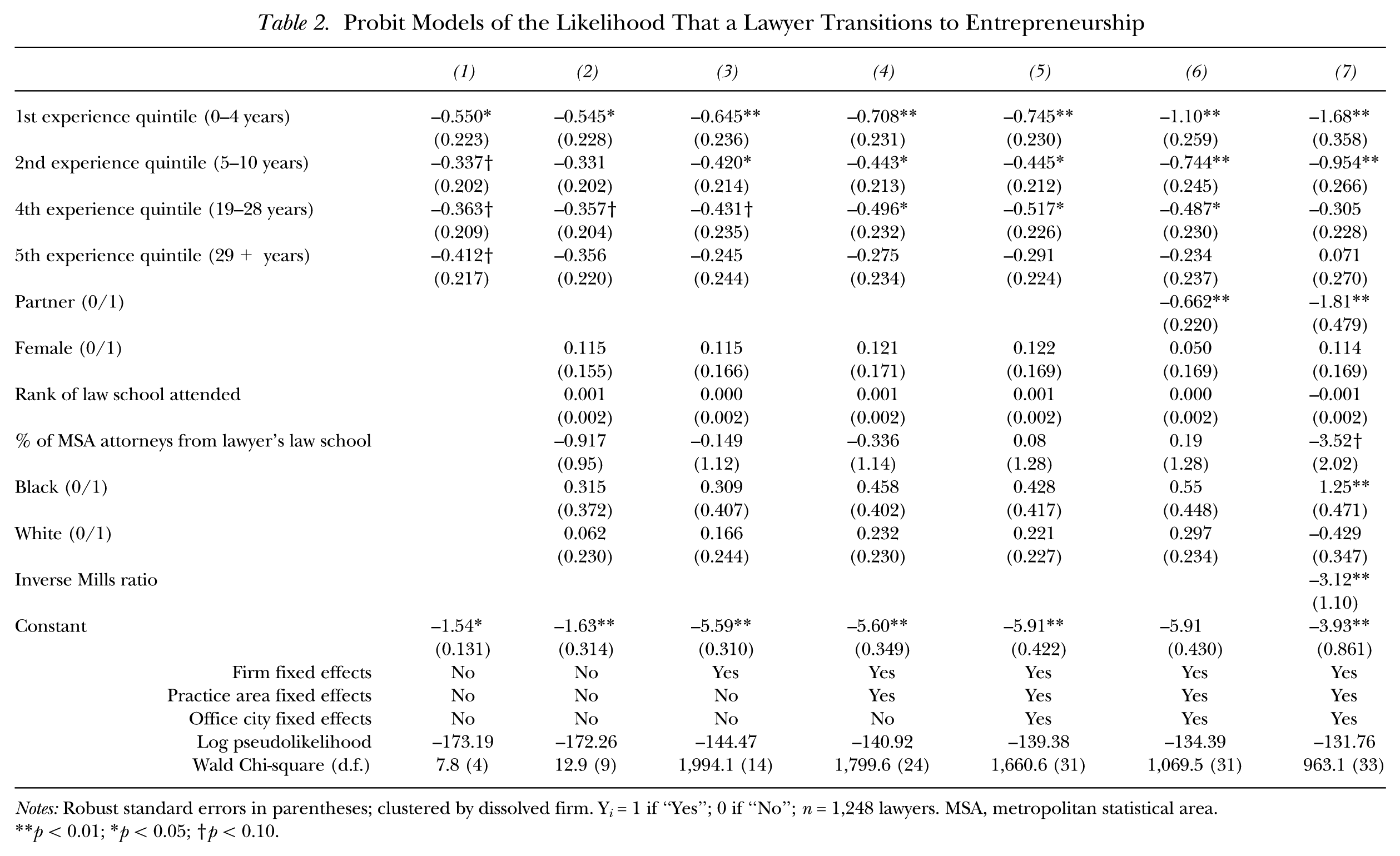
Table 2 reports the results of probit regressions that assess whether the raw patterns described above are robust to conditioning on control variables. The specifications from one column to the next progressively add more control variables to the specification. Model 1 includes the basic regression specification with only the experience quintile indicators. Model 2 controls for demographics (gender, race), rank of law school, and the size of a lawyer’s local professional network. Models 3, 4, and 5 add controls for firm, practice area, and city, respectively. Model 6 controls for “rank” (i.e., partner).
Probit Models of the Likelihood That a Lawyer Transitions to Entrepreneurship
Notes: Robust standard errors in parentheses; clustered by dissolved firm. Y i = 1 if “Yes”; 0 if “No”; n = 1,248 lawyers. MSA, metropolitan statistical area.
p < 0.01; *p < 0.05; †p < 0.10.
Model 1 reveals that the empirical association between experience and entrepreneurship is non-monotonic, exhibiting an inverted U-shape in which the likelihood is maximized within the middle quintile of experience. But, the statistical significance is only marginal (p < 0.10). The addition of demographic controls (model 2) and firm fixed effects (model 3) does not attenuate the significance of this U-shaped effect. It is, however, important to bear in mind that the fifth quintile includes lawyers who vary greatly in experience (29–59 years). This inverted U-shaped relationship persists in the remaining specifications at similarly marginal levels of statistical significance.
Model 6 shows that partners are substantially less likely than other lawyers to become entrepreneurs (p < 0.01). The rate of entrepreneurship increases with legal experience up until the 11th year (the third quintile). Given that the mean level of partner experience is 24.8 years (s.d. = 9.9 years), these results indicate that the likelihood of entrepreneurship is decreasing with experience among partners and increasing with experience among associates. However, the functional form is difficult to specify precisely given the positive correlation between experience and attaining a partner position (pairwise correlation = 0.6). Note that splitting experience into terciles or quartiles yields a similar functional form but also larger standard errors on the coefficients. Quintiles provide the best model fit.
We gauge the sensitivity of the estimated functional form to accounting for sample selection bias. In model 7, we include the inverse Mills ratio (the reciprocal of the predicted probability that a lawyer was employed and located by the sampling methods) as a covariate. We obtain similar results, suggesting that our analyses are not obviously biased by the fact that not all of the displaced lawyers were located by our search methods.
In summary, accounting for relevant covariates dilutes the statistical significance of the inverted U-shaped relationship between experience and entrepreneurship but the functional form is consistently observed.
Interpretation
The descriptive inverted U-shaped relationship between experience and the rate of entrepreneurship is most sensitive to including lawyer rank as a covariate in the regression specification. The most experienced associates and the least experienced partners are the lawyers most likely to enter entrepreneurship and, overall, partners are much less likely than associates to become entrepreneurs. 2 What do we infer from this evidence?
The specification we use can rule out several, but not all, potential explanations for the experience–entrepreneurship association. For example, the inclusion of individual-level controls implies that the association is not specific to any one demographic group of lawyers. The inclusion of practice, office, and firm fixed effects suggests that the observed relationship likely generalizes to the US legal profession. But, the career progression of the typical lawyer in our sample differs notably from other US workers. In the absence of a promotion-to-partner tournament (Galanter and Palay 1991), we might not observe the partial correlation between the likelihood of engaging in entrepreneurial activity and the experience quartiles that we observe here.
Our favored post hoc interpretation acknowledges this distinct feature of careers in US legal services. A reduced probability of entrepreneurship after promotion to partner and the increasing effect of experience up until the experience level at which most lawyers attain a partner position reflects the public information that promotion conveys about an individual’s ability.
Consider first the level effect of rank. Associates are employed for a fixed probationary term, at the end of which they are evaluated by firm partners based not only on their abilities to perform legal work but also to recruit, retain, and relate to clients (Galanter and Palay 1991: 28–30). Associates who are deemed capable of developing and maintaining sufficiently profitable client relationships are promoted to partner and those who are not are dismissed or, occasionally, retained as permanent associates. When the skills valued by a newly promoted partner’s current firm are transferable, promotion to another firm conveys information to other potential employers, who are then more likely to make attractive employment offers.
In the canonical economic model of promotion (Waldman 1984), the current employer prevents the newly promoted workers from being bid away by other employers by granting large wage increases to those it promotes. 3 The higher wage discourages movement both to other incumbent firms and to entrepreneurship. In our setting, where the current employers have been dissolved, pre-emptive wage increases are of course moot. It then seems plausible that potential employers of displaced lawyers are more likely to make attractive offers to partners than they are to otherwise observationally equivalent associates. In turn, partners are more likely to accept the offers they receive and, consequently, are less likely to become entrepreneurs.
How might informational frictions about ability explain the disparate relationships pre- and post-promotion between experience and entrepreneurship? In the canonical model, employee ability is entirely unobservable to outside firms, yet it is assumed to grow deterministically; the only uncertainty is the rate at which an individual’s ability grows (e.g., DeVaro and Waldman 2012). This does not seem sufficient to explain our results: The only source of information is the promotion event, and the amount of experience an individual has provides no additional information.
We propose the following explanation. The lawyer’s ability consists of two parts, a firm-specific component and a freely transferrable component, each of which accumulates stochastically. Total ability is, at least up to a degree, observable (for example, their clients can be observed and letters of reference can be obtained), but outside firms can never be certain about the fraction of this ability that is firm-specific. That is, they do not know how many clients a lawyer will be able to retain through an employment transition, and they are equally unsure how much of a lawyer’s previous success with these clients was specific to the previous employer.
In this setting, extensive experience induces a presumption on the part of incumbent employers that the lawyer has sufficient transferable ability to merit an attractive offer, so few of those with the most extensive experience find entrepreneurship attractive. But there are also less experienced lawyers who, having accumulated experience more rapidly than average, are capable of performing successfully at a new employer but cannot convince them. These lawyers opt for entrepreneurship, where they can make use of their extensive skills.
We will show later in this article that this framework can generate the empirical pattern observed in Table 2, even when controlling for additional confounding factors as we do in the multiple-industry setting. Before introducing a mathematical model that formalizes this idea, we first ensure that the inverted U-shaped relationship that is (weakly) documented in the legal services context does indeed generalize to other industries and professions in which one separates from their employer voluntarily.
Note that the single-industry analysis does not necessarily justify development of a formal theoretical model. We need to establish if the descriptive relationship is not significant in the regression output because of small numbers, idiosyncratic aspects of the occupation (e.g., many lawyers work as sole proprietors yet few of the lawyers in our sample do so post-dissolution), idiosyncratic aspects of the six dissolved firms, or because of factors correlated with both experience and entrepreneurship. We attempt to separate empirical regularity from noise in a multi-industry setting in which statistical power will not be limited and in which we can observe the functional form of the experience–entrepreneurship relationship across many industries and occupations.
Evidence from the Swedish Labor Market
Sample
So far, we have documented an inverted U-shaped relationship between experience and entrepreneurship among lawyers who were forced to seek new employment. Does the functional form hold across multiple industries and ranks? It is not obvious that it will, because the existing empirical evidence has long documented a negative correlation between separation rates and job tenure (e.g., Akerlof and Main 1981), except perhaps in a short period after hiring when the hazard of job separation first rises (Black, Moffitt, and Warner 1990; Farber 1994). 4 We, therefore, examine the experience–entrepreneurship relationship among employees of continuing firms using a large sample constructed from a Swedish registry matched employer–employee panel data set. The Swedish registry data have been widely used to study entrepreneurship, and prior research suggests that the environment for new firm formation in Sweden is not markedly different from other countries, such as the United States, Brazil, or Denmark (Andersson and Klepper 2013). Similarly, the Swedish labor market is comparable to labor markets in other OECD countries (Tåg, Åstebro, and Thompson 2016), mitigating any concerns about the external validity of our findings.
Data and Measurement
The Swedish sample comes from the Longitudinal Integration Database for Health Insurance and Labour Market Studies (LISA), which draws on several individual-level Statistics Sweden registry databases of the entire Swedish population. The LISA database yields information on an individual’s employers, occupational choices, rank, income, and many other individual characteristics. We use observations for the period 2001–2007, and we restrict the sample to workers between the ages of 20 and 55 (to rule out retirement transitions, which typically happen at ages 65–67 in Sweden); workers in firms with more than five employees; workers in the private sector (we drop firms active in the health, education, agriculture, and fishing industries and in the public sector); and workers in firms with sufficient occupation data on their employees and with non-missing information on key control variables (see Tåg, Åstebro, and Thompson 2016). Our sample includes, on average, more than one million observations per year, yielding a total of 7.64 million observations with ample information for our regression analysis. We report conventional standard errors; results are similar with robust standard errors or clustering on individual, occupation, or industry.
Dependent Variables
Our dependent variables are dummies indicating whether an individual changed his or her primary employer in any given year or created a new business. Job switching between incumbent firms are straightforward to identify in the data. Transitions into entrepreneurship are identified when three criteria are simultaneously satisfied: 1) the individual is working in her own company in the current year but had not been in the previous year, 2) the establishment of her work is different from the previous year, and 3) no other individuals in the sample had worked for the new firm in the previous year. Our identification of transitions into entrepreneurship is expressly designed to avoid including individuals who purchase a (possibly minority) stake in an existing business. 5
Regressors
The main explanatory variable is an individual’s work experience measured in years since graduation. This corresponds to the experience measure used in the lawyer sample (years since bar exam). For comparability purposes, we use the same experience intervals as in the lawyer sample. The regressions we report below also include a number of controls. We include basic demographic variables for employees, such as gender, education, and marital status (married, divorced, or single). We measure an employee’s wage in recognition of the well-documented negative association between current wages and job separations of all kinds (Evans and Jovanovic 1989). We also include a set of dummy variables to indicate an employee’s rank, which comes from occupational classifications used in the LISA database, and year dummies. 6
Our controls for firm characteristics are a set of dummies to indicate size, which is measured using the number of employees, 43 industry classification dummies, and 21 county dummies based on the location of the current employer. Substantial evidence suggests that workers in small firms are more likely to separate from their employers (Lazear and Shaw 2008), and that movers from small firms are more likely to become entrepreneurs (Elfenbein, Hamilton, and Zenger 2010; Kacperczyk 2012; Tåg et al. 2016). Elfenbein et al. (2010) showed that these small-firm effects reflect not only differences across firms that influence mobility of employees of a given type but also selection of individuals by type into firms of different sizes. Thus, firm size in part controls for unobserved employee characteristics that affect subsequent occupational choices.
Summary Statistics
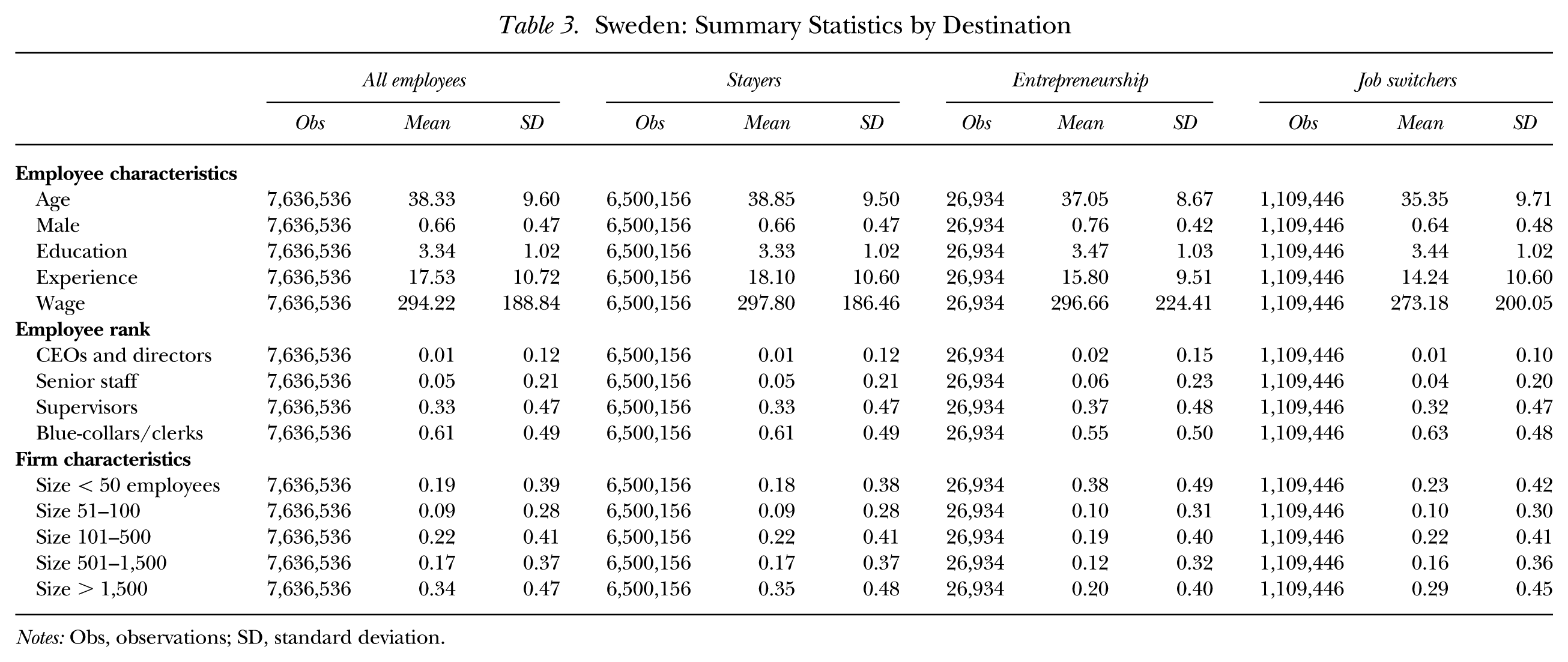
Table 3 demonstrates that our Swedish sample possesses properties familiar from previous studies of occupational mobility. First, staying with one’s current employer is far more common than separation: Stayers account for 86% of the observations. Second, entrepreneurship, which accounts for 2.4% of the occupational choices of movers, is far less common than switching between established employers. Stayers have longer tenure with their employer (4.82 years) than do those switching employers (2.78 years) or entering entrepreneurship (3.26 years); and these individuals earned more despite having less education. These observations imply that job-matching plays a significant role in mobility (Evans and Jovanovic 1989).
Sweden: Summary Statistics by Destination
Notes: Obs, observations; SD, standard deviation.
Analysis
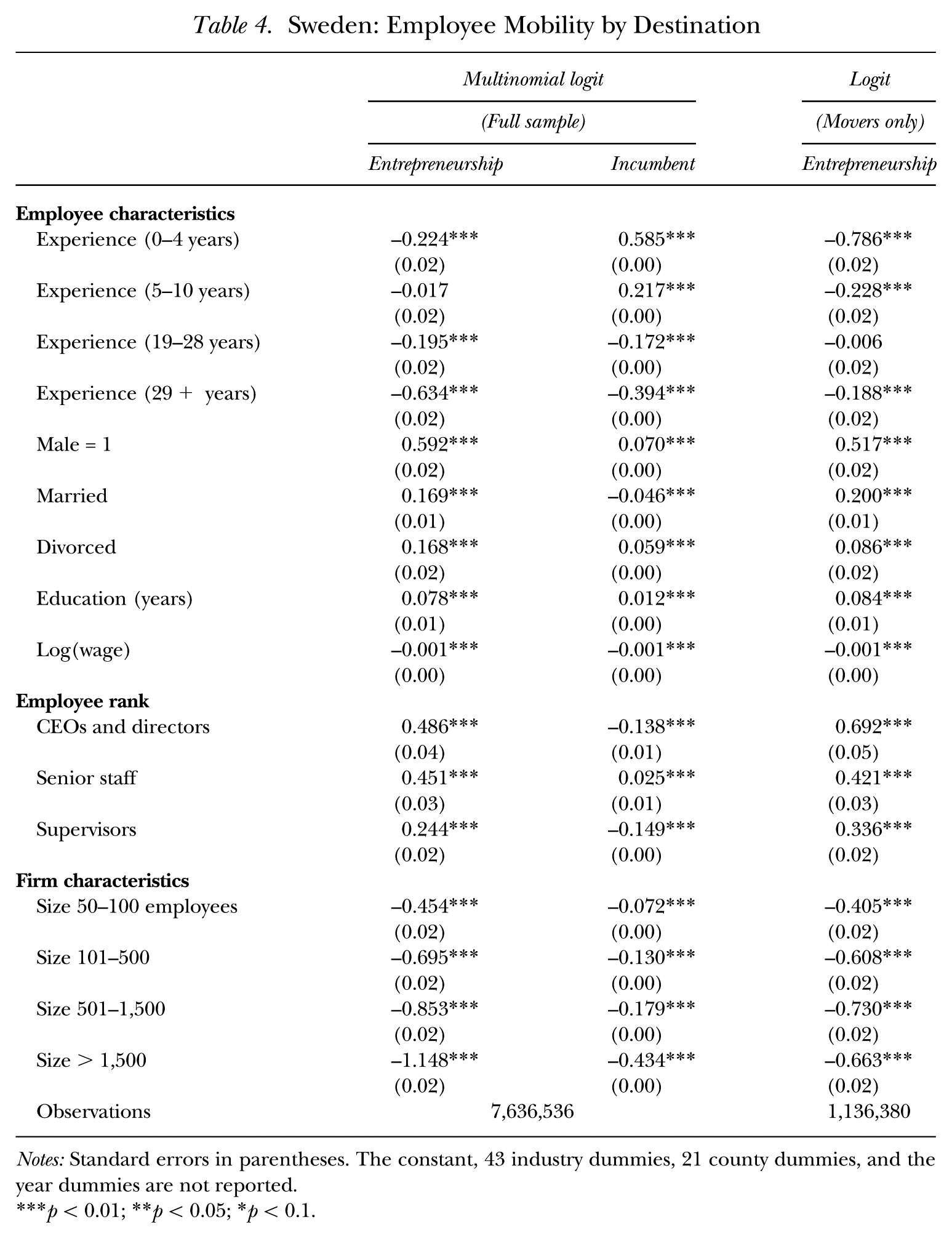
Table 4 reports a multinomial logit regression of job transitions for the full sample and a logit regression for entrepreneurship among movers. The multinomial logit model records three possible outcomes: remain with the current employer (the omitted category), transition into entrepreneurship, or switch to another incumbent employer. The logit model admits only the latter two outcomes, with the dependent variable equal to 1 if the outcome is entrepreneurship.
Sweden: Employee Mobility by Destination
Notes: Standard errors in parentheses. The constant, 43 industry dummies, 21 county dummies, and the year dummies are not reported.
p < 0.01; **p < 0.05; *p < 0.1.
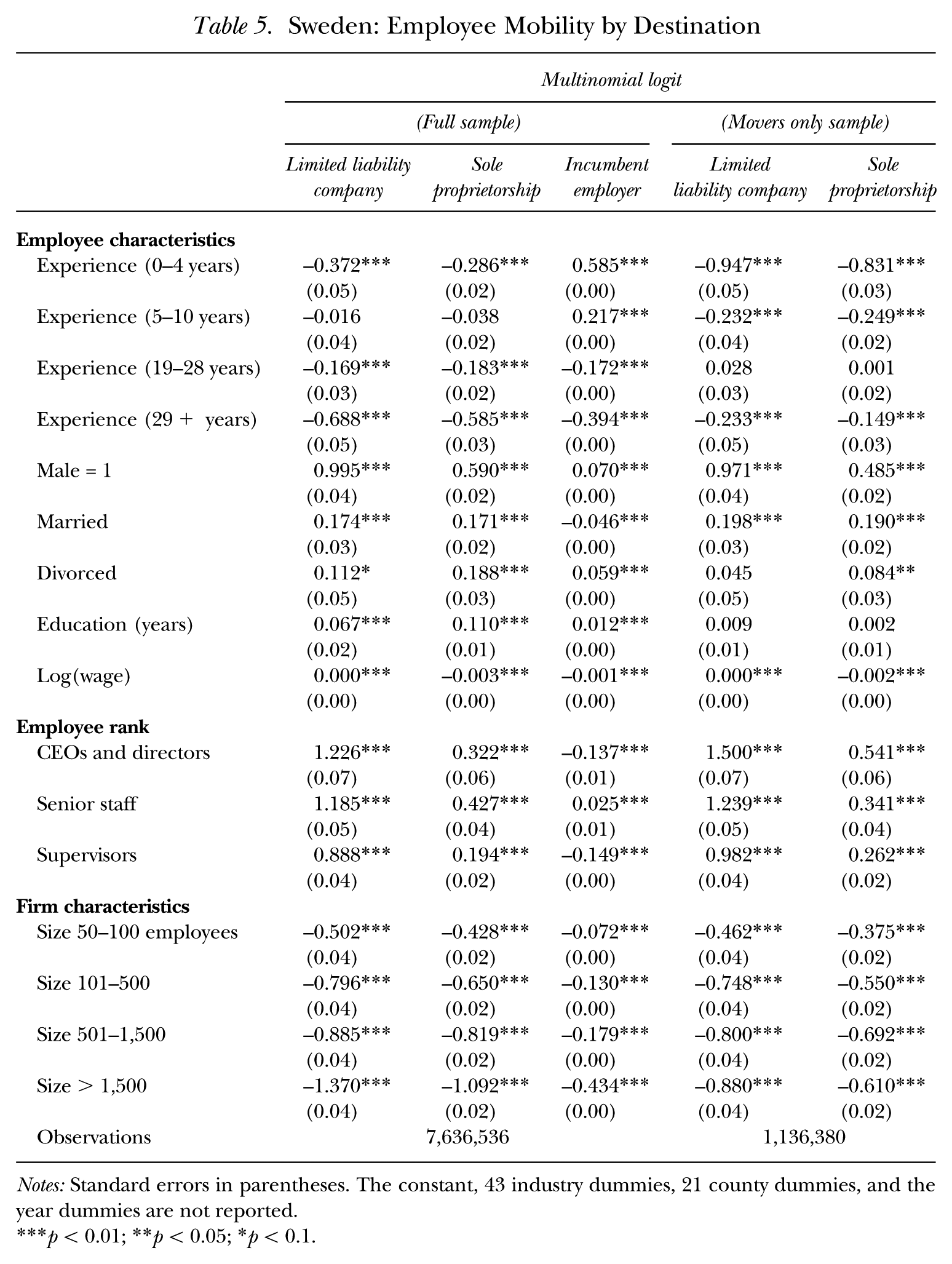
The results for the control variables are consistent with previous findings across a wide variety of settings; they indicate, as did the summary statistics, that nothing is obviously unusual about our sample. We focus on the relationship between experience and mobility. The results from the multinomial logit regression are consistent with the lawyer sample: We again see an inverted U-shaped relationship between experience and the rate of entrepreneurship. However, we also see that more experienced workers are less likely to move between incumbent employers.
In Tables 5 and 6, we repeat the analyses of Table 4, but with three slight variations. In Table 5, we divide business creation into two constituent parts. As in most large samples, much of the measured entrepreneurship is in fact entry into self-employment, and it is quite possible that determinants of entry into self-employment might be substantially different from determinants of the creation of growth-oriented businesses typically associated with the term entrepreneurship (e.g., Åstebro and Tåg 2017). Statistics Sweden divides entrepreneurs into those with sole proprietorships and those with limited liability companies, which therefore allows us to examine whether this is the case. Our findings on the effects experience on business creation hold whether we consider the creation of a limited liability company or self-employment as our entrepreneurial outcome. We again do not find a similar relationship between experience and moving to another employer.
Sweden: Employee Mobility by Destination
Notes: Standard errors in parentheses. The constant, 43 industry dummies, 21 county dummies, and the year dummies are not reported.
p < 0.01; **p < 0.05; *p < 0.1.
Sweden: Employee Mobility from Bankruptcy by Destination
Notes: Standard errors in parentheses. The constant, 43 industry dummies, 21 county dummies, and the year dummies are not reported.
p < 0.01; **p < 0.05; *p < 0.1.
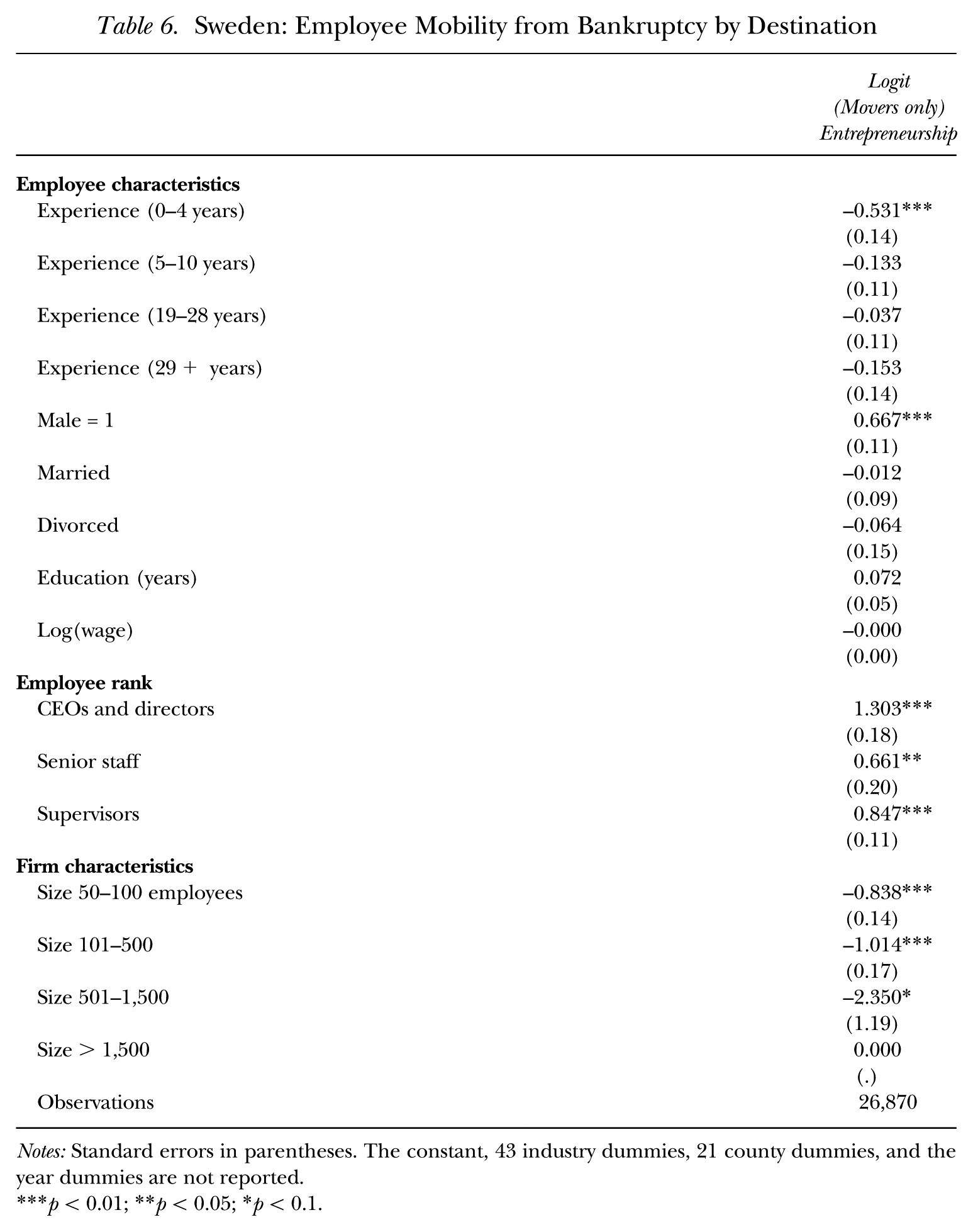
In Table 6, we analyze only the subsample of employees who are employed in firms that filed for bankruptcy or liquidation in the focal year or the following year because this subsample is akin to the law firm dissolution sample. Our results for this subsample are similar to the results in the law firm dissolution sample, but because the sample size is smaller, not all coefficients are statistically significant at conventional levels. In Table A.3, we expand the possible mobility choices to also account for moving to unemployment or outside the labor force and find similar results. Table A.4 shows similar results when using an LPM model instead of a multinomial logit, and Table A.5 shows the familiar inverted U-shaped relationship in the movers sample using exact years of experience dummies (now omitting zero years of experience).
Interpretation
If Swedish workers are similar to displaced lawyers with respect to their human capital consisting of two parts, a firm-specific component and a freely transferrable component, then potential employers will be uncertain about the fraction that is firm-specific. Therefore, we cannot infer the relative appeal of changing employers versus entering entrepreneurship for Swedish workers any more than we can for displaced lawyers. Yet, doing so is central to evaluating the entrepreneurial career choice that individuals face.
This analysis of a multi-industry, nationally comprehensive data set has enabled us to address many, but not all, challenges revealed in the single-industry analysis. We have narrowed down the set of plausible explanations for the observed experience–entrepreneurship relationship with many control variables and fixed effects. Findings from the Swedish context also enhance the external validity of our claims, because the data spans many industries and occupations. Although this helps reconcile prior mixed evidence and establish a clear functional form, what we view as the most compelling theoretical explanation for the observed relationship cannot be tested directly with the data available to us. This challenge motivates our development of a formal theoretical model in the next section that can account for the relationship between experience and entrepreneurship across a wide variety of settings.
A Model of Information Frictions
The key results from the previous sections are 1) the rate of job separation in general and the rates of job separation by destination all decline with tenure; 2) among movers, an inverted U-shaped relationship occurs between tenure and entrepreneurship, and between experience and entrepreneurship. These patterns hold when entrepreneurship is decomposed into its constituent parts of self-employment and the creation of a limited liability company and when we consider only individuals who are displaced by the closure of their employer.
In this section, we attempt to formalize, in a manner that might be applicable in varied contexts, the notion that the choice between employment at an incumbent firm and entrepreneurship is a result of information frictions that concern an individual’s human capital and its value in different uses (e.g., self-employment, firm founding, work for a potential employer). With this in mind, we develop a formal model in which separations of agents (individuals) from employers (firms) are forced by the dissolution of the current employer. The model is extended below to allow for voluntary separations from continuing firms.
Involuntary Separation
An agent currently employed in a firm, with work experience t, is endowed with two skills, X and Y, whose current values are x(t) and y(t). Skill Y is general and can be freely exploited by any firm for which the agent works. Skill X is specific to the current employer, but it can be exploited by other firms upon payment of an absorption cost, c.
7
The total value of the agent’s output at the firm is the sum,
Both skills are accumulated over time, consistent with earnings rising with tenure and experience. We suppose that

where z(t) is a standard Wiener process with independent increments. Similarly,

where ζ(t) is a standard Wiener process. Because X is skill accumulated only on the job, we set
The agent knows the current values of X and Y. However, potential outside employers can only observe the agent’s prior job performance, v(t), and they must make inferences about x(t) from observation of the pair
After the agent begins work at the new firm, x(t) and y(t) are immediately observable. However, the value of x(t) is irrevocably lost to the new employer if it did not pay the absorption cost at the time of hiring. It then follows that the wage earned in the new firm is given by

Let
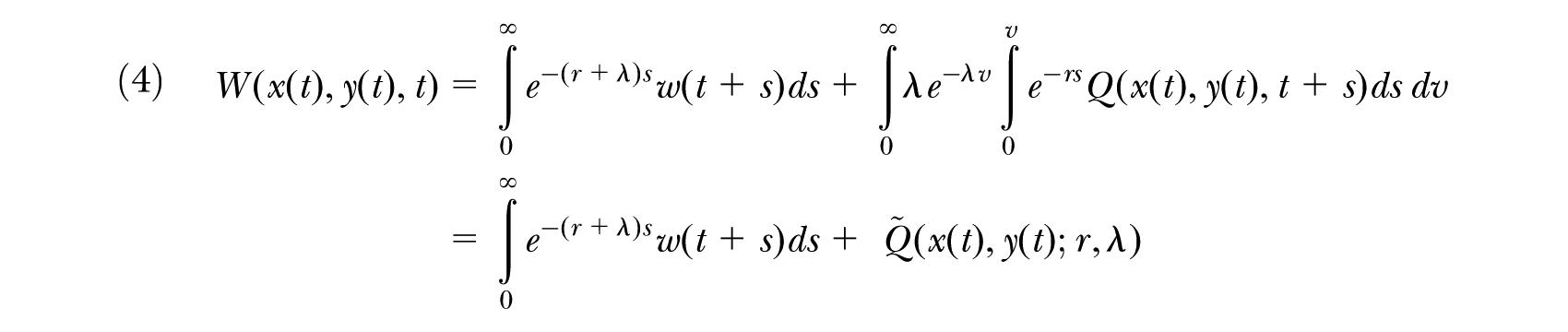
where
The agent may also choose to found his own start-up. If he does, he is able to exploit his firm-specific knowledge by establishing a firm designed to make use of all his skills. Firm creation costs

The agent will choose to found his own start-up if
Online Appendix Figure A.2 illustrates the stochastic process underlying Proposition 1. Independent sample paths for x(t) and y(t) are sketched; they are drawn excessively smoothly for visual clarity. The subjective mean,
Figure A.3 provides some numerical plots of (8) (articulated below) for different trend growth rates of x(t). As
In this subsection, we have assumed that total productivity (and earnings) are the sum of job-specific and general human capital. Alternative interpretations of the formal model are of course possible, some of which do not insist on the existence of job-specific human capital. For example, suppose that outside firms are able to observe the wage, and the wage is equal to y(t) plus noise. The outside firm may hire the agent and exploit his general skills upon payment of an absorption cost, c; it may also hire the agent but assign him to an unskilled position at no cost. It remains the case that the probability that y(t) is sufficient to justify the payment of the business start-up cost k while the outside firm is not willing to pay c, exhibits an inverted U-shape with respect to experience. 10
Match Quality and Voluntary Separations
Suppose now that an agent’s payoff at his initial employer is given by

where the wage component is, as before,

with
Let
We proceed by considering the choice of a myopic agent who considers only the instantaneous flows of net benefits. That is, we suppose the agent makes the choice that yields the highest available payoff out of the list

where the last option is available only if
Which, if any, of these switches are made depends on the sample paths of the triplet
Among the most important influences on outcomes are the values of the trend growth rates of firm-specific skill, µx, and match quality, µm. We shall suppose throughout that
The addition of the match quality to our model is conceptually straightforward, but it converts the analytically straightforward one-dimensional first-passage problem (albeit a multivariate problem) into a two-dimensional problem that does not have explicit solutions for the first-passage times. However, although we cannot derive the hazards of job switching analytically, our qualitative discussion of the model so far allows us to characterize them quite well. Figure A.6 sketches the evolution of hazard rates over time for the case
Concluding Discussion
Many entrepreneurs acquire experience at established organizations prior to engaging in entrepreneurial activity, but the empirical relationship between accumulated experience and the rate of entrepreneurship is unclear (Parker 2004, 2009). We revisit this complex association by analyzing the role of experience in transition into entrepreneurship from the careers perspective. This approach acknowledges that the option to change employers influences the transition into entrepreneurship—even though it is rarely considered by entrepreneurship researchers.
Our analyses and formal model directly address the three-choice issue by theorizing the relative costs of forming a business and working for another employer. We began with observations from law firm dissolutions so that we could examine the experience–entrepreneurship association in a setting where separation was induced but not as a negative signal of individual ability (Gibbons and Katz 1991). We found an inverted U-shaped relationship between experience and the rate of entry into entrepreneurship. But, this single-industry analysis raised more questions than it answered. Specifically, marginal statistical significance raises questions about whether our estimates differed from the descriptive statistics because of the structure of partial correlations, because of idiosyncratic aspects of legal services, or simply because of a case of small numbers (i.e., a 3% rate of entrepreneurial career transitions).
We found some reassuring evidence in the multi-industry analysis in which we documented a similarly shaped but statistically significant experience–entrepreneurship relationship among both voluntary and involuntary movers in a large sample of Swedish workers. Yet, even this analysis raised questions about the underlying mechanisms. Even in the extensive, nationally representative microdata, we are unable to observe the mechanisms that we believe drive the key results.
Because our intuition regarding mechanisms cannot be directly tested in either the single-industry or the multiple-industry settings, we developed and presented a formal theoretical model that can generate the inverted-U relationship. In this model, potential employers have imperfect information about the transferability of an employee’s skill but must incur costs to utilize it. In combination, both business formation costs to the individual and human capital absorption costs to potential employers can account for the observed empirical relationship between experience and entrepreneurial career transitions. Together, our theoretical model and empirical analyses support the contention that individuals of moderate experience are most likely to transition to entrepreneurship.
Experience is an admittedly crude, but reasonable, proxy for the extent to which potential employers can observe an individual’s human capital. Experience, therefore, is instructive for alternative explanations of the key result. One intuitively appealing explanation is that the accumulation of experience coincides with the accumulation of wealth. If so, then the inverted U-shaped relationship between experience and entrepreneurship might be interpreted as an interaction between rising wealth, which makes entrepreneurship more feasible with age, and evolving preferences that make entrepreneurship less attractive as people age.
Lévesque and Minniti (2006), for example, have suggested that increasing age may be associated with increasing risk aversion, a shortening of the planning horizon, and an increasing preference for leisure. Our empirical analyses of Swedish employees control specifically for wages and employee rank. We find that high-wage employees are, conditional on separation, more likely to form a limited liability company than a sole proprietorship, whereas low-wage employees are more likely to form a sole proprietorship than a limited liability company. Nonetheless, the inverted U-shaped relationship between experience and entrepreneurship is observed independently of these divergent wage effects. We therefore believe that our interpretation of the experience effect is robust to explanations related to liquidity or risk, both of which are likely functions of one’s wage.
There are, of course, contexts in which we would not expect to see the inverted U-shaped relationship between experience and entrepreneurship that we have documented, and in which our explanation cannot be correct if we do see it. For example, we do not expect to observe it in settings where all accumulated skill is firm-specific, or in settings where all skill is not firm-specific: In both cases, no important informational asymmetries occur between individuals and potential employers that might drive people into entrepreneurship. Similarly, we do not expect to see the relationship in settings where firm-specific skill is completely employer-specific, because in this case entrepreneurship cannot provide an outlet for individuals to utilize the firm-specific skills acquired at their previous job. Finally, it seems likely that the functional form of the empirical relationship would be stronger in knowledge-intensive industries such as professional services than in capital-intensive industries such as manufacturing. Also, in contexts where learning-by-hiring is the key motivation behind employee mobility, the absorption costs will need to be evaluated against the benefits of employee-knowledge transfer. Future research would certainly enhance our knowledge of the experience–entrepreneurship relationship by measuring absorption costs and business formation costs directly and by examining the consistency of the inverted U-shaped relationship across settings.
Supplemental Material
ILRR852919_Supplemental_Online_Appendices – Supplemental material for Experience and Entrepreneurship: A Career Transition Perspective
Supplemental material, ILRR852919_Supplemental_Online_Appendices for Experience and Entrepreneurship: A Career Transition Perspective by Christopher I. Rider, Peter Thompson, Aleksandra Kacperczyk and Joacim Tåg in ILR Review
Footnotes
Appendix
Acknowledgements
We are grateful to Christine Beckman and audience members at the ILR Review Conference on the Labor Market and Human Resource Management Implications of Entrepreneurship for helpful comments.
Rider acknowledges support from the Ewing M. Kauffman Foundation and the Law School Admission Council. Tåg acknowledges financial support from the Jan Wallander and Tom Hedelius Foundation, the Marianne and Marcus Wallenberg Foundation, the Torsten Söderberg Foundation (E31/18), and Vinnova.
For information regarding the data and/or computer programs used for this study, please address correspondence to the lead author at
2
Recalling the sample’s high correlation between experience and the partner rank (0.66), the dissimilar effects of experience among partners and associates are consistent with the inverted U-shaped relationship.
3
4
Black et al. (1990) found that that among some, but not all, groups of federal employees, quit rates rise between the first and second year of service before declining monotonically over the next nine years.  analysis of NLSY data reported that the hazard rises before it falls, reaching a peak at about three months of tenure.
5
Statistics Sweden defines an individual as being employed in her own company in a given year if her total income from her own company (labor and capital income) is greater than 62.5% of all other labor income from possible other sources generated in the same year. “Own company” refers to a company in which the individual works and owns a substantial equity or controlling stake.
6
Education is on a scale from 1–6 corresponding to: 6. Postgraduate education; 5. Post-secondary education, two years or longer; 4. Post-secondary education, less than two years; 3. Upper secondary education; 2. Primary and lower secondary education, nine or ten years; and 1. Primary and lower secondary education, less than nine years. Wage is an individual’s total annual gross labor income. Tåg (2013) and have documented how the occupational classifications we use provide meaningful measures of rank and how they influence job mobility.
7
The absorption cost may be interpreted in a number of ways. First, a firm might adapt its practices. Second, c might represent the present value of the part of a new employee’s firm-specific skills that are not transferable under any circumstances. Third, c may represent the additional search cost borne by an agent committed to finding a firm that can use her firm-specific skills.
8
Heterogeneity in preferences for entrepreneurship can be modeled as variations across individuals in start-up costs: that is, if z is the non-pecuniary benefit of owning one’s own business per unit of time, then the annualized cost net of non-pecuniary benefits can be written as (r+λ)k−z.
9
We have written the expected present value of business closure,
10
Indeed, if one makes the plausible assumption that the noise is itself a Wiener process (so that the variance of the noise is proportional to the expectation of y(t)), then the model as written applies without substantive change to this alternative interpretation.
11
While match quality is commonly assumed to be trendless, we can envisage circumstances in which both positive and negative trends arise. On the one hand, personal circumstances, such as spousal employment, having children in school, and home ownership, may cause a rise over time in match quality relative to alternatives that may be located elsewhere. On the other hand, agents may join a firm precisely because the match is good, but then turnover of colleagues and changes in firm direction or ownership may cause the match quality to deteriorate over time.
12
If
13
Size rankings are by the National Law Journal. Current rankings can be found at http://www.law.com/jsp/nlj/PubArticleNLJ.jsp?id=1202548639714&The_NLJ_350.
References
Supplementary Material
Please find the following supplemental material available below.
For Open Access articles published under a Creative Commons License, all supplemental material carries the same license as the article it is associated with.
For non-Open Access articles published, all supplemental material carries a non-exclusive license, and permission requests for re-use of supplemental material or any part of supplemental material shall be sent directly to the copyright owner as specified in the copyright notice associated with the article.
