







Abstract
Understanding hiring difficulties and the nature of hiring frictions that employers face is important for the promotion of economic growth and the individual success of both firms and workers. This study sheds light on this issue by presenting evidence from an original, nationally representative survey of information technology (IT) helpdesks that contains detailed measurements of skill requirements, organizational characteristics, and market structure. The results indicate that the incidence of persistent hiring difficulties is modest, and that measures of technology and technical skill demands are not associated with greater hiring problems. Organizational attributes and market structure are generally more predictive of hiring frictions than are skill requirements. Human resource practices, management strategy, and labor-market monopsony power all play key roles. These results cast doubt on simple stories about technology-driven hiring problems and point to the importance of examining a broader range of organizational and market factors when addressing workforce challenges.
The degree of difficulty employers face in hiring workers, and the nature of these challenges, are constant sources of debate. Many politicians, business leaders, and analysts point to workforce skill deficiencies as the central problem (Accenture 2013; Portman 2013; Umoh 2017; Lee 2019). While claims are made regarding many distinct industries and skill sets, one primary contention is that inadequate skills are a major economic barrier because they are concentrated in occupations and sectors that most heavily use the new technologies that drive productivity growth (Bessen 2014; Rothwell 2014). As a result, assertions about skill deficiencies often center on information technology (IT) and technical skills (HDI/Robert Half 2012; CompTIA 2014).
Despite their ubiquity, many of these claims rely on evidence that is derived from nonrepresentative surveys or highly aggregated data. At the same time, research on organizational characteristics, management quality, and high-performance work systems (HPWS) has established the importance of factors that that go beyond skill requirements in determining economic and labor-market outcomes (Huselid 1995; Bloom and Van Reenen 2007; Batt and Colvin 2011; Brown, Setren, and Topa 2016). Market structure—including the presence of monopsony—has also recently gained attention as an important consideration in assessing labor-market outcomes (Webber 2015; Azar, Marinescu, and Steinbaum 2019).
Understanding the relative prominence of various factors associated with hiring frictions is an important topic: Ensuring a smooth connection between employers and skilled workers is essential for general economic growth as well as the individual success of workers and firms. To the extent that hiring problems are primarily related to skill demands, appropriate policy interventions involve increased levels of training and education for workers. By contrast, if problems are connected to the amount of resources an organization devotes to recruiting or to the attractiveness of its job design, then remedies must focus on changes in firm behavior. If employer market power is an important factor, then it is appropriate to shift attention to the rules and institutions that govern labor-market competition and structure. Because of data limitations, researchers have often not been able to investigate employer-side hiring challenges, and they have generally not been able to investigate relevant factors simultaneously at the establishment level.
To shed light on this topic, this study uses a unique, nationally representative data set focused on IT helpdesks in order to address the following overarching questions: 1) How common are persistent hiring difficulties? and 2) What establishment-level characteristics are associated with hiring frictions? As an occupation, IT helpdesk technician is a good target for this inquiry. It is the second largest detailed computer-related occupation in the Bureau of Labor Statistics’ Standard Occupational Classification (SOC) system and is thus pertinent to a conversation about hiring frictions that has implications for national aggregates. To the best of my knowledge, no other nationally representative data set provides measurement of detailed employer skill demands, organizational characteristics, market structure, and hiring outcomes for a large-scale IT occupation at the establishment level.
The data from the original survey underlying these results are uniquely detailed. At the same time, it is worth noting that the data are cross-sectional, and thus this study does not establish definitive causal mechanisms. Rather, this study establishes nationally representative patterns that are unavailable from any other source and that have implications for competing explanations regarding hiring difficulties.
Potential Explanations for Hiring Frictions: Hypotheses
Various factors account for the existence of hiring frictions. I will discuss three general categories: supply-side factors (worker skills), demand-side factors (organizational characteristics and management strategy), and market factors (monopsony and market density).
Supply-Side Factors: Worker Skills
A common assertion regarding hiring challenges is that the problems are caused by skill deficiencies in the workforce (Carnevale, Smith, and Strohl 2010; Rothwell 2014; Restuccia, Taska, and Bittle 2018). One contention is that computer technology has rapidly diffused through a wide range of industries, raising demand for science, technology, engineering, and mathematics (STEM) skills and lowering demand for skills connected to routine tasks for which computers substitute. To the extent that skills in a given occupation are complementary with a new technology, demand will increase for workers with these skills. If, for some reason, the supply of workers with these skills does not respond adequately, then adjustment must occur along some other margin. Much of the skill-biased technical change (SBTC) literature has argued that the run-up in income inequality that has occurred over the past 40 years has been the result of just such an adjustment in wages (Autor, Katz, and Kearney 2008; Van Reenen 2011). Likewise, a number of studies have documented a decline in job-matching efficiency (i.e., adjustment via excess vacancies and unemployment) and pointed to skill mismatch as one explanation (Sahin, Song, Topa, and Violante 2014; Bonthuis, Jarvis, and Vanhala 2016; Bova, Jalles, and Kolerus 2016).
While the evidence indicates that technology and evolving skill dynamics have had a substantial impact on the labor market, available data often paint a complex, and sometimes contradictory, picture regarding the nature of this impact. Beaudry, Green, and Sand (2016) have shown that demand for high-level cognitive skills has actually declined since the year 2000. Wages have recently been flat for workers with just a college degree, a skilled minority of the population that should theoretically be experiencing wage increases due to excess skill demand (Mishel and Shierholz 2013; Hobijn and Bengali 2014). Furthermore, historical analysis reveals that many prior assertions that the quality of labor supply was fundamentally inadequate either were inaccurate or overlooked the importance of key factors beyond technical skill supply (Franke and Sobel 1970; Teitelbaum 2014; Green 2016).
At a minimum, it is important to rigorously test skill-based claims using microdata. It is also necessary to test whether any skill-related hiring problems observed in the data are actually associated with STEM skill demands. An alternative human capital literature has found that soft skills play a vital role in labor-market outcomes (Liu and Grusky 2013). Deming (2017) showed that over the past few decades, the wage returns to social skills have increased while those to cognitive skills have declined. Heckman and Kautz (2012) argued that non-cognitive skills are more predictive of successful economic outcomes than cognitive skills for high school and GED graduates in the United States. Based on this discussion, we can formulate the following hypotheses:
Demand-Side Factors: Organizational Characteristics and Management Strategy
Although both academic and popular accounts of hiring frictions have tended to emphasize the role of supply-side workforce factors, a rich literature demonstrates the importance of organizational structures and management strategies in determining various economic outcomes (Appelbaum, Bailey, Berg, and Kalleberg 2000; Combs, Liu, Hall, and Ketchen 2006; Bloom and Van Reenen 2007). For the purpose of this study, the key question is whether establishment-level hiring frictions vary systematically with these organizational factors.
With regard to human resource–related management practices, it is essential to make distinctions among different approaches and different types of practices. Although researchers often create an index to represent a bundle of practices, Batt, Colvin, and Keefe (2002) argued convincingly that the heterogeneous effects of practices that are often labeled as HPWS highlight the importance of examining disaggregated behaviors and strategies. In particular, some practices are designed to involve and empower workers (commitment practices), whereas others are more oriented toward standardizing or intensifying work (intensification practices) (Ramsay, Scholarios, and Harley 2000; Godard 2004). On the commitment side, I investigate training, high-discretion job design, participatory management, and total investment of resources in recruiting. On the intensification side, I investigate use of a formal management system (e.g., Lean or Six Sigma) and the volume of customers per helpdesk technician. I will discuss theories and hypotheses for each of these in turn.
One question that arises is whether firms are exacerbating their own labor-market difficulties by failing to provide sufficient training in order to produce the skilled workforce they desire. Firms generally face a choice about whether to make or buy the skills that they require (Andersson et al. 2008; Bellmann, Grunau, Troltsch, and Walden 2014), and these choices may affect recruitment times. Establishments that choose to rely more heavily on market hiring rather than internal training are arguably relying on fewer channels of talent supply and under certain labor-market conditions are more exposed to long-term hiring delays. We can thus hypothesize:
Job design and participatory management are two other organizational choices often included in HPWS-type programs. The evidence indicates considerable variation in how organizations design and implement production and human resource processes (Hambrick and Abrahamson 1995; Batt and Colvin 2011; Lopez-Cotarelo 2018). One choice facing managers is how much discretion to allow workers in a given occupation. Although scripted, low-discretion job designs offer the benefit of consistency; allowing employee discretion in carrying out job tasks may increase productivity and facilitate effective service delivery (Green 2008; Bartling, Fehr, and Schmidt 2012). By the same token, organizations can choose whether to foster worker–management collaboration by including workers in participatory teams and problem-solving committees. Doing so may also increase performance (Batt and Colvin 2011; Litwin 2011). Regardless of the effect on performance, autonomy and participation may have effects on an organization’s hiring success through a couple of potential mechanisms. On the one hand, evidence suggests that higher levels of discretion and participation are associated with greater worker satisfaction and lower turnover (Avgar, Pandey, and Kwon 2012; Jensen, Patel, and Messersmith 2013). Workers may more readily apply to positions that offer these features, thus reducing hiring times. On the other hand, these attributes may be a sign of organizations that exhibit managerial competence (Bloom and Van Reenen 2010). Such organizations might also be more skilled at recruitment, thus also reducing the probability of long-term vacancies.
In contrast to the above-described commitment practices, some strategic management choices are more oriented toward standardization and intensification of work. For example, some organizations choose to use formal systems such as Lean, Six Sigma, or the IT-specific Information Technology Infrastructure Library (ITIL) in their production processes. Such systems may also be associated with variations in hiring outcomes. As with discretion and participation, establishments that employ formal management systems may be more competent or organized, thus attaining greater levels of hiring success (Bloom and Van Reenen 2010; Negrao, Filho, and Marodin 2017). However, these systems could have a negative effect on workforce supply. Although the evidence is mixed, a number of studies have found that these systems are associated with intensified work procedures and decreased employee satisfaction (Sparham and Sung 2007; Jensen et al. 2013; Bamber, Stanton, Bartram, and Ballardie 2014). If the presence of these systems implies lower job quality that is not offset by compensation, then the likelihood of extended hiring difficulties would increase.
We can formulate an additional hypothesis regarding the resources an organization devotes to recruiting. Existing research shows considerable variation in hiring strategies and investment in recruitment efforts, and various strategies are associated with differing vacancy durations (Barron, Berger, and Black 1997; DeVaro 2005). Net of controls for skill requirements and market conditions (as with the empirical specifications below), we would expect that organizations that choose to invest lower resources in recruitment functions experience greater hiring difficulties. The IT Helpdesk Skill Survey (ITHSS) contains a variable measuring whether the IT helpdesk manager (survey respondent) reports that the organization has devoted insufficient resources to recruiting with regard to previous vacancies. I use this variable as a proxy for persistent organizational behavior patterns.
Following management practices, another important organizational dimension involves technology and innovation. Pundits and business leaders have frequently asserted over the past few decades that economic growth has been held back because high-tech employers have encountered labor-market difficulties (Kaplan 1999; Nash 2016; Gale 2019). Using the data in this study, we can test whether business units with higher levels of technology and innovation experience greater hiring problems. Note that I will test a portion of this hypothesis by examining the association between technical skill demands (discussed above in the Worker Skills subsection) and hiring frictions. Also worth exploring, however, is how hiring frictions relate to technology/innovation measures net of key STEM-skill requirements. Despite the inclusion of explicit technical skills in the empirical specifications below, it is always possible that high-technology status involves unmeasured skill demands that are problematic for hiring. Based on this discussion, we can put forth the following hypotheses:
Market Factors: Monopsony and Market Density
Studies of labor-market outcomes have tended to focus on human capital or, alternatively, firm behavior. Only recently has more attention been devoted to issues relating to market structure (Webber 2015; Azar et al. 2019). I will focus on the roles of labor-market competition and market density.
Recent evidence indicates that monopsony, once thought to be rare, is prevalent in some labor markets (Manning 2003; Staiger, Spetz, and Phibbs 2010; Dube, Manning, and Naidu 2018). The relationship between a firm’s market power and particular hiring outcomes, such as vacancies, is complex. Traditional models predict that monopsonistic employers will experience large amounts of vacancies because wages are set below marginal product (Boal and Ransom 1997). By the same token, we would expect that competitive, non-monopsonistic markets in which, say, an occupational cluster exists, would be the most efficient at quickly filling vacancies. Manning (2003), however, argued that from an empirical standpoint, monopsonistic employers are unlikely to post vacancies that they know will not be filled. Furthermore, some theories of monopsony predict that employers with market power should experience fewer rather than more vacancies. Acemoglu and Pischke (1998) proposed a model in which firms have superior information about their workers’ productive capabilities that in turn generates monopsonistic power. This monopsony power results in equilibria that involve low quit rates, longer job tenure, and stable employment relationships. In this world, firms with monopsony power will likely have fewer vacancies than firms in a more competitive environment. 1 At the same time, employers in competitive or dense labor markets with many disaggregated actors may experience communication or coordination failures that inhibit efficient skill production or matching (Weaver and Osterman 2017). I refer to this approach to monopsony and market coordination as the “stable” monopsony theory (as opposed to “traditional” monopsony theory). Based on the above, we can hypothesize:
Labor-market density is also a critical factor to consider when analyzing hiring processes and outcomes. Dense labor markets that have greater relative concentrations of particular types of skilled workers should, in theory, make it easier for employers to hire these worker types. In particular, evidence shows that labor markets with denser concentrations of STEM workers facilitate more successful matching of workers with job opportunities (Wright, Ellis, and Townley 2016). We can thus formulate a hypothesis based on occupational concentration:
By simultaneously testing the relationship between all of the above factors and hiring frictions, we can empirically establish the relative prominence of skills, organizational characteristics, and market factors in a nationally representative cross-section of establishments with IT helpdesks.
Background on IT Helpdesk Technicians
IT helpdesk technician is an entry-level information technology position that focuses on functions related to the interaction between computer users and computer hardware and software systems. These functions include providing technical assistance to solve various computer problems, planning and managing installation of updated IT capabilities, monitoring system utilization, and conducting training on effective use of computer applications, among other tasks. Individuals in this role are also referred to by a range of other titles, including service desk technician and IT support technician. Although it is the most entry-level of the computer occupations tracked by the Bureau of Labor Statistics (BLS), the job carries substantial skill requirements. From a technical standpoint, computer user support specialists (CUSS), as the BLS refers to the occupation, typically need to have a detailed understanding of one or more operating systems, including Microsoft Windows, Mac OS X, or Linux. Increasingly, many helpdesk workers must have knowledge of mobile operating systems and the workings of mobile devices. In addition, understanding of network systems and processes is generally required. Beyond technical skill requirements, CUSS workers need to have good diagnostic and critical thinking skills, effective oral and written communication skills, and effective customer service skills.
Within the helpdesk technician occupation are several distinct skill categorizations, which the industry refers to as tiers (or levels). A tier-1 helpdesk technician is a frontline worker who fields general calls and works on basic problems such as password resets. A tier-2 worker is more of a technical specialist who is able to address the root causes of computer-related problems. A tier-3 worker is a higher-level technical specialist who has either deep knowledge of particular software applications or network structures, or who is generally able to solve problems above the level of a tier-1 or tier-2 technician (Dooley 2018).
IT helpdesk technicians are more educated than the average American worker, although the profession exhibits a range of educational attainment. On average in the three years preceding the ITHSS, 47% of helpdesk technicians had a bachelor’s degree or greater, 28% had some college but no degree, and 16% had an associate degree. 2
The CUSS job classification is a large one, with approximately 585,000 workers in 2015. 3 The occupation has grown steadily over the past two decades. Despite a definitional change by the BLS in 2010, we can roughly estimate that employment rose by an average annual rate of 1.6% from 1999 to 2015 (Figure 1). Average hourly wages were $25.21 in 2015. 4 The trend in real wages—again a rough estimate given small definitional changes—showed a modest decline during the 1999 to 2015 period, with average annual growth of −0.1% (Figure 1).
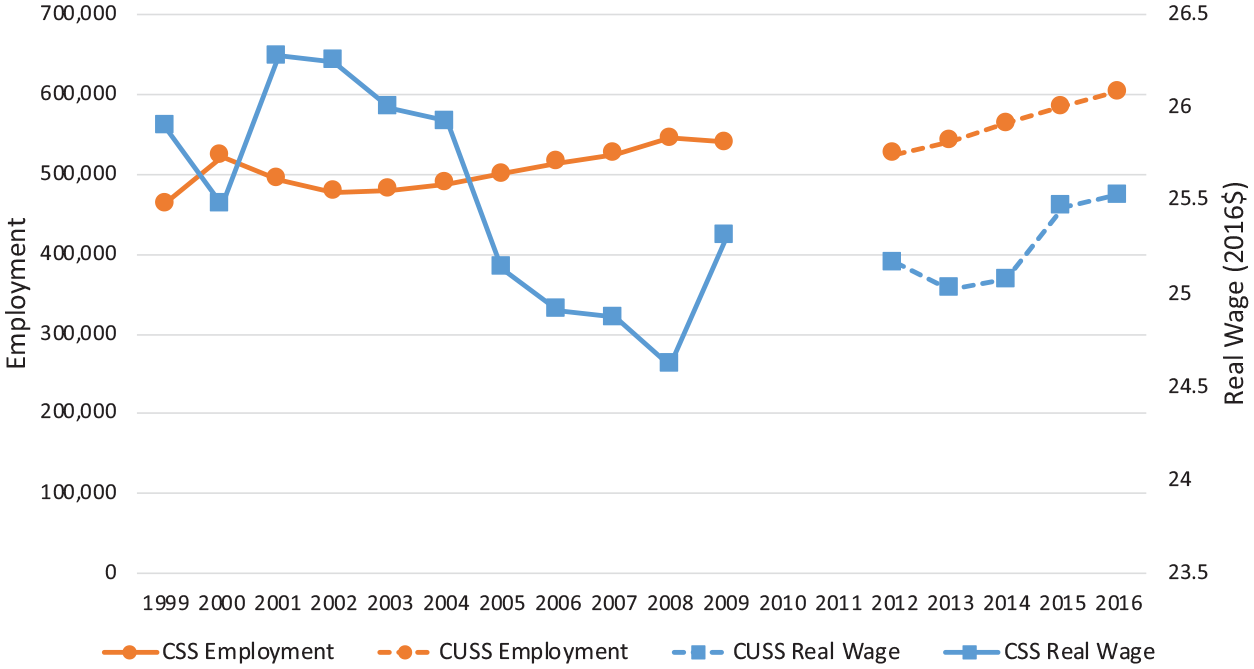
Computer Support Specialist Wage and Employment Trends
Survey Methodology and Validation
The ITHSS was designed to gather detailed, nationally representative information about skill demands, organizational characteristics, and hiring outcomes at the establishment level. The methodology is inspired by a growing list of cross-sectional employer surveys focused on workplace practices (Batt et al. 2002; Bloom et al. 2016; Handel 2016; Weaver and Osterman 2017). The target respondents were the managers of IT helpdesks/service desks who had responsibility for both hiring helpdesk technicians and managing helpdesk operations. To ensure precision regarding skill demands and hiring outcomes, the ITHSS instructed respondents to base their answers on the largest tier of helpdesk employees. Thus, if an establishment employed more tier-2 workers than tier-1 or tier-3 workers, the survey responses would target tier-2 workers. The survey captures the target tier for each response. I refer to the target tier workers as core employees.
Unlike most detailed occupational surveys, which typically rely on nonrepresentative trade association membership lists, the ITHSS is based on a randomly drawn sample of business establishments from the Dun & Bradstreet database (see Online Appendix A for a detailed discussion of survey methodology and characteristics). After eliminating sites without helpdesks, as well as bad addresses and establishments that had gone out of business, the final sample was 1,485 establishments. Physical surveys were mailed in May and June of 2015. In addition to a $10 incentive, the physical surveys contained a link to a web-based version for respondents who preferred electronic submission. Reminder phone calls, emails, and postcards were delivered through February 2016. The completed sample contained 403 respondents, yielding a response rate of 27%. This figure is far above the single-digit response rates that employer surveys typically yield (Bloom et al. 2016).
Overall, the ITHSS yielded data that are representative of the target occupation. Online Appendix B contains the results of a validation analysis that establishes the representativeness of the data by comparison with national data from the BLS and the US Census Bureau. As an example, ITHSS data indicate that the average wage for helpdesk technicians is $24.38, the average female percentage is 25.6, and the average percentage of workers 30 years old or younger is 27.8. The comparable wage figure for the BLS Occupational Employment Statistics (OES) is $25.21, and the comparable female and age demographic percentages from the US Census Bureau American Community Survey are 25.1 and 27.0, respectively (these differences are not significant).
Empirical Approach
The goal of this study is to measure predictors of cross-sectional variation in hiring frictions at the establishment level. The primary dependent variable that I employ is a binary indicator for the presence of one or more long-term vacancies in an IT helpdesk (measured at the establishment level). Following Weaver and Osterman (2017), I define a long-term vacancy as a vacancy that has persisted for three months or more. The purpose of this approach is to identify problems with the hiring process for particular business establishments. Ordinary vacancies are an inadequate measure of hiring frictions because many of them simply represent the healthy flow of job openings in a labor market. By contrast, vacancies that linger for an extended period of time are much more likely to represent a persistent inability to hire. 5 The ITHSS data allow me to make this critical distinction.
Table 1 contains the definitions and descriptive statistics for the variables that operationalize the above-described hypotheses. The descriptive means are weighted to be nationally representative based on the ITHSS survey design.
Variable Definitions and Descriptive Statistics
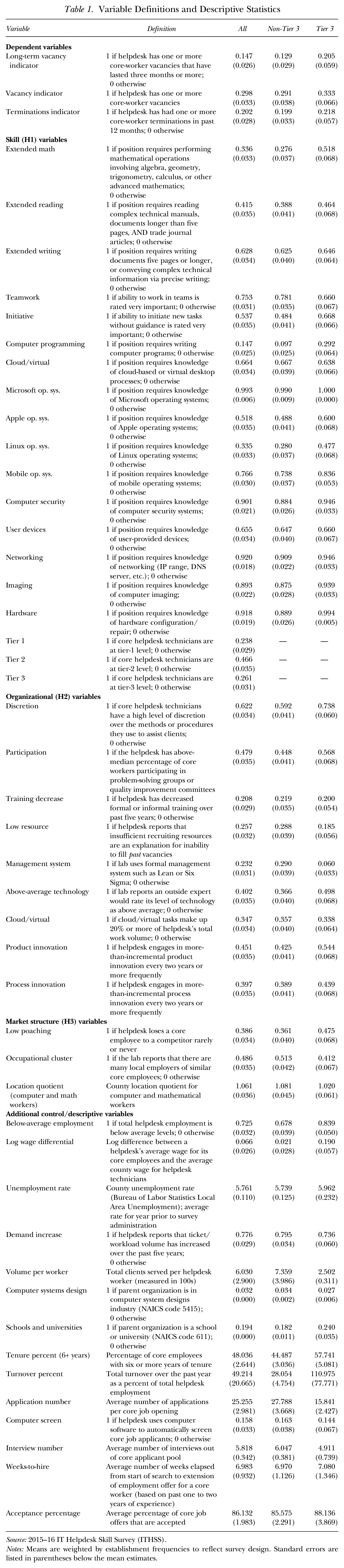
Source: 2015–16 IT Helpdesk Skill Survey (ITHSS).
Notes: Means are weighted by establishment frequencies to reflect survey design. Standard errors are listed in parentheses below the mean estimates.
I use two reduced-form models to test the various hypotheses. Given that academic studies and the public debate both have focused heavily on skills as an explanation for hiring difficulties, the first model (Equation (1)) focuses on skill requirements, coupled with a vector of basic controls (X) for establishment size, average establishment wage levels for IT helpdesk technicians, the local (county) unemployment rate, and an indicator for increasing demand for the establishment’s helpdesk services. The first model, for establishment i is:

To jointly test the proposed hypotheses, I then use a reduced-form model with regressors representing skill requirements, organizational characteristics, and market factors (Equation (2)). 6 Given sample size restrictions, and in order to make the model somewhat more parsimonious, I use a binary indicator for tier-3 helpdesk technicians (the highest skill category) in place of most of the detailed skills from the prior model (Table 1 breaks out descriptive statistics by tier-3 status). I do, however, continue to individually include indicators for the skill demands with significant marginal effects from Equation (1), as well as the indicator for required computer programming skills. I include the same vector of additional controls described above.

I employ logistic regression in all of the estimations. The regression tables all report marginal effects. One important issue to address in the context of maximum likelihood (ML) models is heteroskedasticity. Unlike linear regression, in which heteroskedasticity yields only inefficiency, heteroskedasticity in ML models can result in inconsistent estimates (Yatchew and Griliches 1985). I specifically tested for heteroskedasticity by industry and establishment size. The results of the test, conducted via Richard William’s Stata Ordinal Generalized Linear Models (OGLM) module (Williams 2010), indicate that the skills-only models (Equation (1)) show significant levels of heteroskedasticity by industry, whereas the full models (Equation (2)) do not. As a result, I have employed heteroskedasticity-corrected logit models for the Equation (1) estimations and conventional unadjusted logit models for the Equation (2) estimations.
The Hiring Process and the Incidence of Long-Term Hiring Frictions: Descriptive Statistics
The ITHSS collected data on the hiring process and hiring outcomes for IT helpdesk technicians. On average, IT helpdesks receive 25 applicants for one position. Out of total applicants, IT helpdesks interview an average of six candidates. The average employer search time until an offer is made is seven weeks. The median time-to-hire is an even more modest four weeks. On average, 86% of offers are accepted.
The ITHSS results indicate that signs of hiring frictions for IT helpdesk technicians were modest in 2015-16. Figure 2 presents the distribution of vacancies as a percentage of total helpdesk employment at an establishment. Overall, 70% of US IT helpdesks had no vacancies, and 85% had no long-term vacancies. At the other end of the spectrum, 11% of helpdesks report a level of core technician long-term vacancies that amounts to 10% or more of the establishment’s total helpdesk employment. Note that individual helpdesks tend to be small—the average helpdesk has seven employees—so for many helpdesks a single vacancy will constitute a substantial percentage of total staff. Nevertheless, these results present a picture that differs from the occasionally alarmist rhetoric (based on nonrandom surveys and other anecdotal data) that often appears in trade association documents or media accounts. For example, a 2012 report conducted by Robert Half and the trade association HDI asserted that 47% of surveyed helpdesks struggled to access frontline (tier-1) technicians, and 62% had difficulty hiring tier-2 and tier-3 workers (HDI/Robert Half 2012). Based on the nationally representative ITHSS results, a more appropriate estimate for 2015–16 would be that 11 to 15% of US IT helpdesks desks show long-term vacancy patterns that might be consistent with some type of persistent hiring friction. 7 We can now explore the question of what establishment-level skill demands, organizational characteristics, and market factors, if any, are associated with these long-term vacancies.
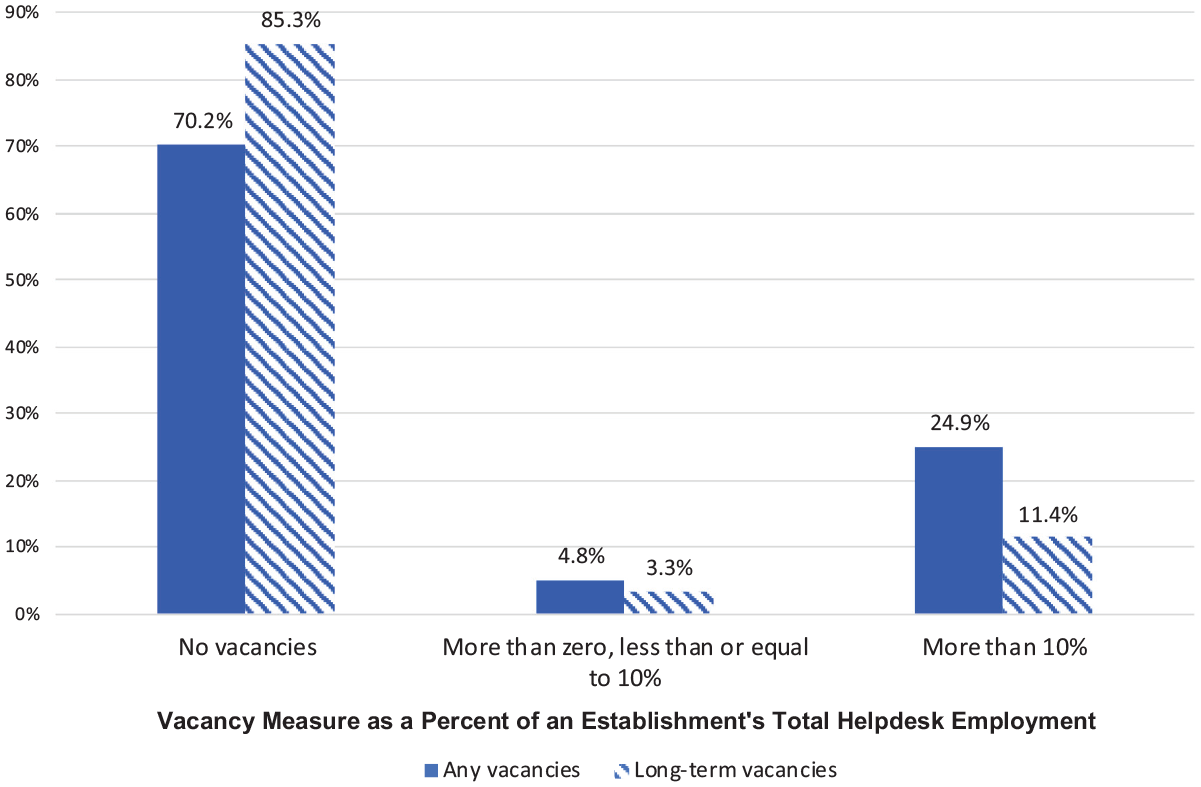
IT Helpdesk Technician Vacancies
Results
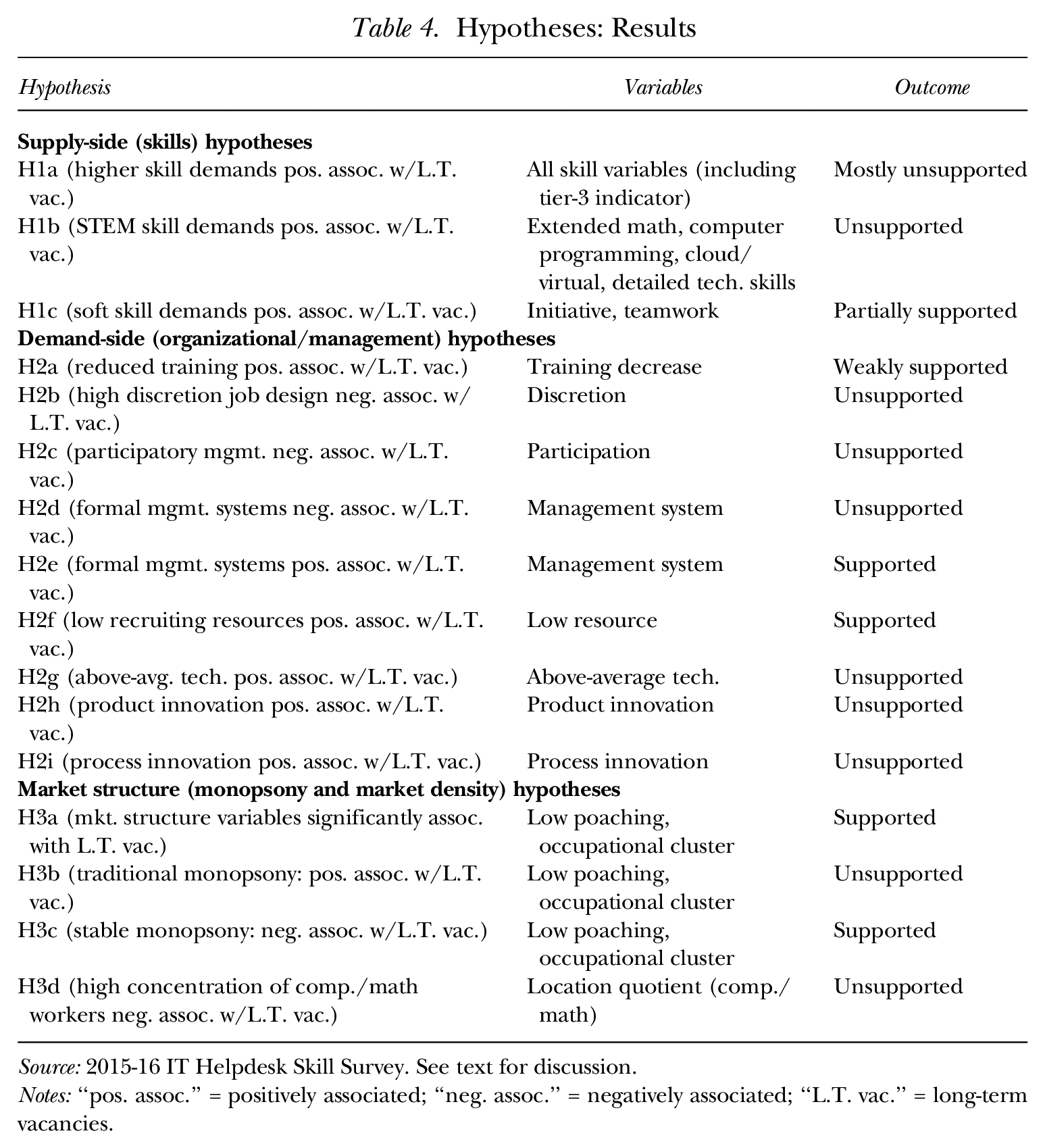
I first test the skill-related hypotheses using Equation (1). Table 2 contains the empirical results for these initial specifications. (Table 4 descriptively lists the results associated with all the hypotheses.) The first specification includes a detailed set of skill variables (general academic skills, “hard” computer skills, and soft skills) while controlling only for employment size. The second specification adds controls for wages (log difference from average county IT helpdesk technician wage), local unemployment rate, increases in demand, and total ticket volume per worker. The third specification includes a heteroskedasticity adjustment for the two largest industry groups.
Hiring Frictions and Skill Requirements
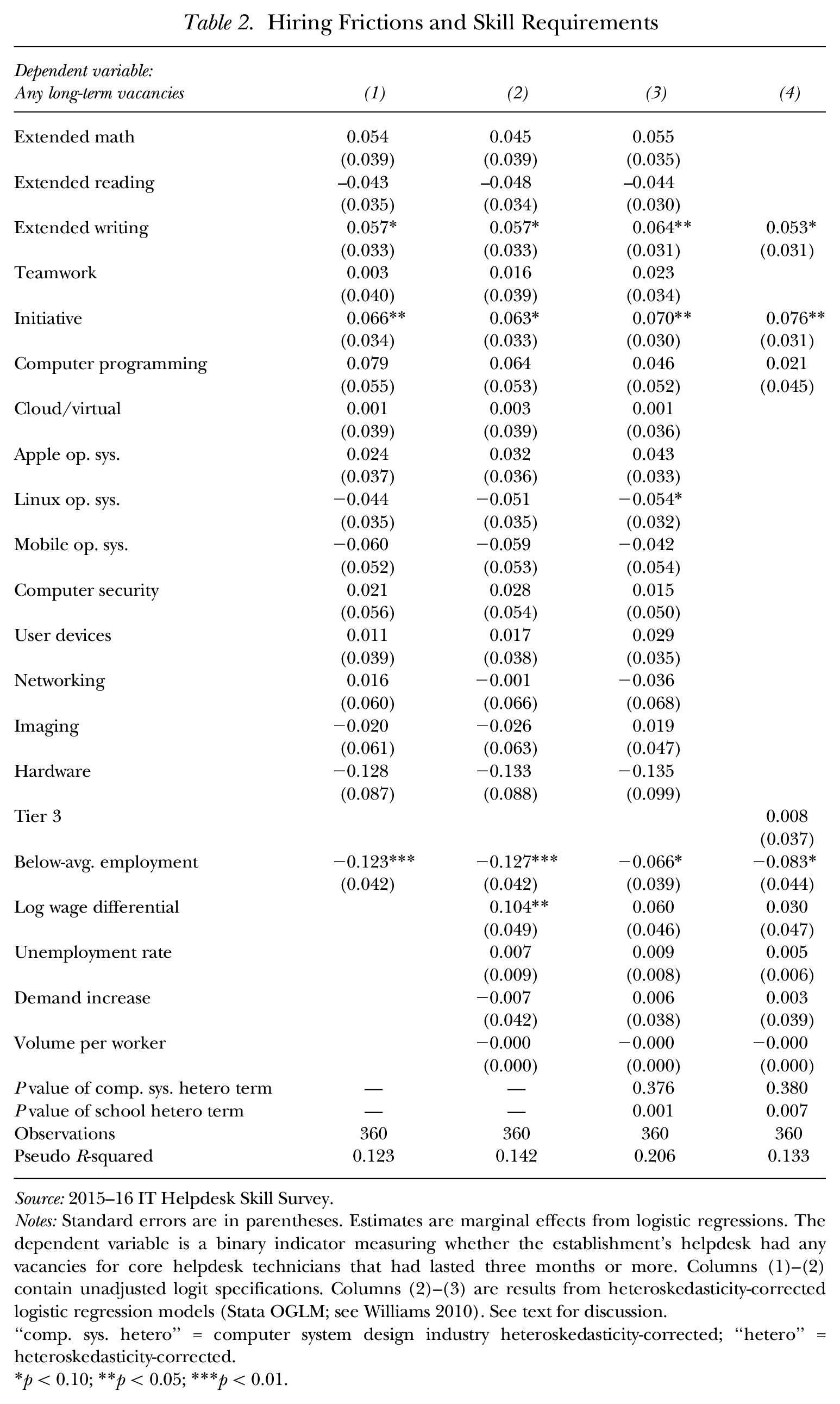
Source: 2015–16 IT Helpdesk Skill Survey.
Notes: Standard errors are in parentheses. Estimates are marginal effects from logistic regressions. The dependent variable is a binary indicator measuring whether the establishment’s helpdesk had any vacancies for core helpdesk technicians that had lasted three months or more. Columns (1)–(2) contain unadjusted logit specifications. Columns (2)–(3) are results from heteroskedasticity-corrected logistic regression models (Stata OGLM; see Williams 2010). See text for discussion.
“comp. sys. hetero” = computer system design industry heteroskedasticity-corrected; “hetero” = heteroskedasticity-corrected.
p < 0.10; **p < 0.05; ***p < 0.01.
The results of all of these estimations are consistent. No STEM skills or hard skills show significant associations with long-term vacancies. One soft skill (initiative) and one academic skill (extended writing) show significant relationships. IT helpdesks that require technicians to initiate new tasks without guidance from management are 7 percentage points more likely to experience a prolonged vacancy (Table 2, column (3)). Helpdesks that require higher-level writing skills are 6.4 percentage points more likely to show signs of persistent difficulties. 8
In column (4) I introduce a parsimonious model in which an indicator for whether the helpdesk’s core employees are at the tier-3 level is included in lieu of the detailed skill indicators. I continue to include initiative and writing as separate skills, and I include the indicator for whether a helpdesk requires computer programming as well. Although this latter variable is not a significant predictor of hiring difficulties, it represents a technical skill that is central to the debate over hiring problems (only 15% of helpdesks require computer programming, so it is a high-end skill that could in theory be difficult to secure). Initiative remains significant at the 95% level, while writing falls to marginal significance.
Ultimately, for most skill requirements, these results do not support the hypothesis that higher skill demands will be associated with greater hiring difficulties (H1a). The results of the heteroskedasticity-corrected model (column (3)) provide evidence of a significant relationship for higher-level writing, but not for reading, math, computer programming, or detailed technical requirements such as knowledge of cloud/virtual processes or problem-solving with user-provided devices. Thus the technical skills that dominate public discussion about hiring challenges are not significant predictors (H1b is not supported). Furthermore, as shown later, the writing result is not robust to the inclusion of organizational and market variables. The results support H1c for one soft skill, but not for other soft skills such as teamwork. (In results not shown, other soft skills such as calmness under pressure and time-management did not show significant positive associations with long-term vacancies.)
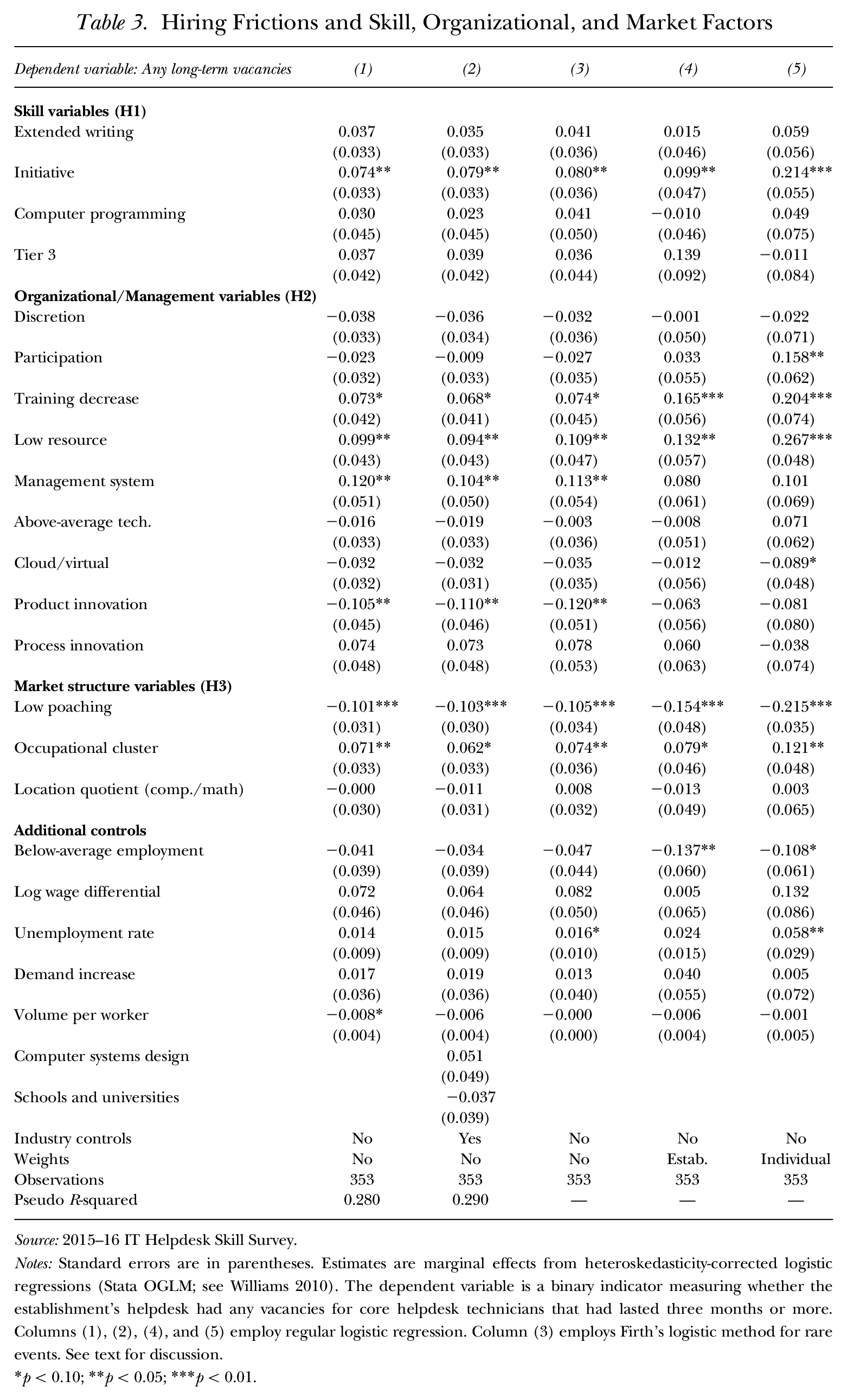
The next set of specifications jointly test the skill, organizational, and market structure hypotheses using Equation (2) (Table 3). The specification in column (1) combines the parsimonious skill variables with variables representing organizational/management characteristics (H2a–H2i) and variables measuring market structure (H3a–H3c). The dependent variable remains an indicator for the presence of long-term vacancies at the establishment level. The first column presents the marginal effects from a logistic regression. In terms of skill variables, initiative continues to show a significant relationship with hiring difficulties, but writing, computer programming, and the indicator for tier-3 status are all insignificant.
Hiring Frictions and Skill, Organizational, and Market Factors
Source: 2015–16 IT Helpdesk Skill Survey.
Notes: Standard errors are in parentheses. Estimates are marginal effects from heteroskedasticity-corrected logistic regressions (Stata OGLM; see Williams 2010). The dependent variable is a binary indicator measuring whether the establishment’s helpdesk had any vacancies for core helpdesk technicians that had lasted three months or more. Columns (1), (2), (4), and (5) employ regular logistic regression. Column (3) employs Firth’s logistic method for rare events. See text for discussion.
p < 0.10; **p < 0.05; ***p < 0.01.
Hypotheses: Results
Source: 2015-16 IT Helpdesk Skill Survey. See text for discussion.
Notes:“pos. assoc.” = positively associated; “neg. assoc.” = negatively associated; “L.T. vac.” = long-term vacancies.
The results relating to the organizational/management hypotheses are varied. High-performance work variables, such as high-discretion job design and participatory management, show no significant association with extended hiring frictions (H2b and H2c are not supported). Reductions in establishment training over the prior five years, however, are marginally associated with a greater likelihood of experiencing long-term vacancies (H2a is weakly supported). Furthermore, the indicator for underinvestment in past recruiting efforts is significantly associated with a greater probability of hiring frictions (H2f is supported). Helpdesks with this characteristic are 9.9 percentage points more likely to experience a long-term vacancy (p < 0.05). Although I have used a retrospective measure of underinvestment to minimize contemporaneous endogeneity, one could clearly tell a story in which this variable is endogenous to some omitted factor. The key point is that this significant correlation is a sign of some persistent demand-side dynamic that constrains organizational resources; it is not reflective of supply-side skill deficiencies in the workforce.
The use of formal management systems is strongly associated with greater hiring frictions. Helpdesks that use a system such as Lean, Six Sigma, or the IT-specific ITIL system have a 12 percentage point greater likelihood of experiencing long-term vacancies (p < 0.05). This positive association is not consistent with the hypothesis concerning efficient human-resource efforts and management quality (H2d is not supported). On the contrary, it is consistent with the hypothesis that use of these systems may reduce labor supply to the establishment as a result of intensified work and lower job quality (H2e is supported).
None of the popular contentions that hiring difficulties are concentrated in establishments that are at the technology frontier are supported (H2g, H2h, and H2i are all unsupported). Helpdesks that report above-average levels of technology, and establishments that perform high proportions of cutting-edge (cloud/virtual) work both show insignificantly lower levels of long-term vacancies. Frequent product innovation is actually associated with a significant 10.5 percentage point reduction in the probability of prolonged hiring difficulties. Process innovation is the only technology-related variable that shows a positive correlation with hiring challenges, but it is consistently insignificant. Combined with the fact that none of the STEM-skill measures are correlated with extended hiring frictions, these results should at a minimum cause us to be cautious regarding simple stories in which technological changes lead to hiring difficulties in entry-level IT occupations.
The final set of variables relates to the market-structure hypotheses. Monopsony has historically been difficult to measure because of multiple distinct sources of monopsony power and limited data on these different sources (Boal and Ransom 1997; Webber 2015). In this study, I use two measures that are indicative of varying levels of labor-market competition. The low-poaching variable is an indicator that equals 1 if a respondent reports that the helpdesk rarely or never loses a technician to a competitor (thus implying lower labor-market competition). The occupational cluster variable is an indicator that equals 1 if a respondent reports a large number of area firms that employ similar helpdesk technicians (thus implying greater labor-market competition). Taken together, these variables provide useful information about the level of labor-market competition. 9 We would expect that a monopsonist would tend to show signs of low-poaching and/or a lack of an occupational cluster.
I also include a variable measuring the labor-market density of computer and mathematical workers. This location-quotient variable is calculated as the ratio of the local computer and mathematical workforce percentage to the national computer and mathematical workforce percentage (based on occupational data from the 2012–2015 US Census Bureau American Community Surveys). This variable allows us to control for the effect of relatively greater technical skill supply and thus focus on the market-structure aspects of the poaching and cluster variables.
The low-poaching marginal effect is large and significantly negative. That is, establishments that rarely experience poaching have a 10 percentage-point lower likelihood of prolonged hiring frictions. Consistent with this result, location in an occupational cluster is associated with a significant 7 percentage-point increase in the probability of long-term vacancies. Before turning to interpretation, the fact that these measures of market competition show significant relationships supports the hypothesis that market structure is an important factor in analyzing hiring frictions (H3a is supported). Note that these variables show significant relationships net of controls for both establishment-level skill requirements and regional technical skill supply. We can thus have confidence that these proxies for labor-market competition are not simply picking up effects associated with more- or less-sophisticated skill demands.
The implication of these results is that establishments in labor markets with indicators of lower competition experience lower levels of long-term vacancies, and vice versa. In other words, the conditions that are associated with employer monopsony power are correlated with a lower incidence of extended hiring frictions. This result contravenes the predictions of traditional monopsony models but is consistent with stable-monopsony theories (H3b is not supported; H3c is supported). The location-quotient variable representing relatively greater supply of computer and mathematical workers has a small and insignificant marginal effect (H3d is not supported). Note that, consistent with the STEM skill results, greater technical labor supply does not seem to be associated with variations in prolonged hiring difficulties.
Robustness
I first discuss challenges to the market structure results, followed by more general explorations of specifications and estimation strategies. One question to ask is: Do the results show any patterns that are specific to monopsony models? Again, it is important to note that the baseline empirical specification controls for the direct effects of both the county-level unemployment rate (average monthly rate measured for the 12 months prior to the administration of the survey) and the presence of establishment-level increases in demand for helpdesk services. To the extent that the market-structure variables are simply picking up the strength of the local economy, we would expect that all interactions with explanatory variables and the unemployment rate will predict a relatively lower incidence of long-term vacancies when unemployment is high. This expectation is based on the negative relationship between vacancies and unemployment as depicted in the Beveridge curve (Elsby, Michaels, and Ratner 2015).
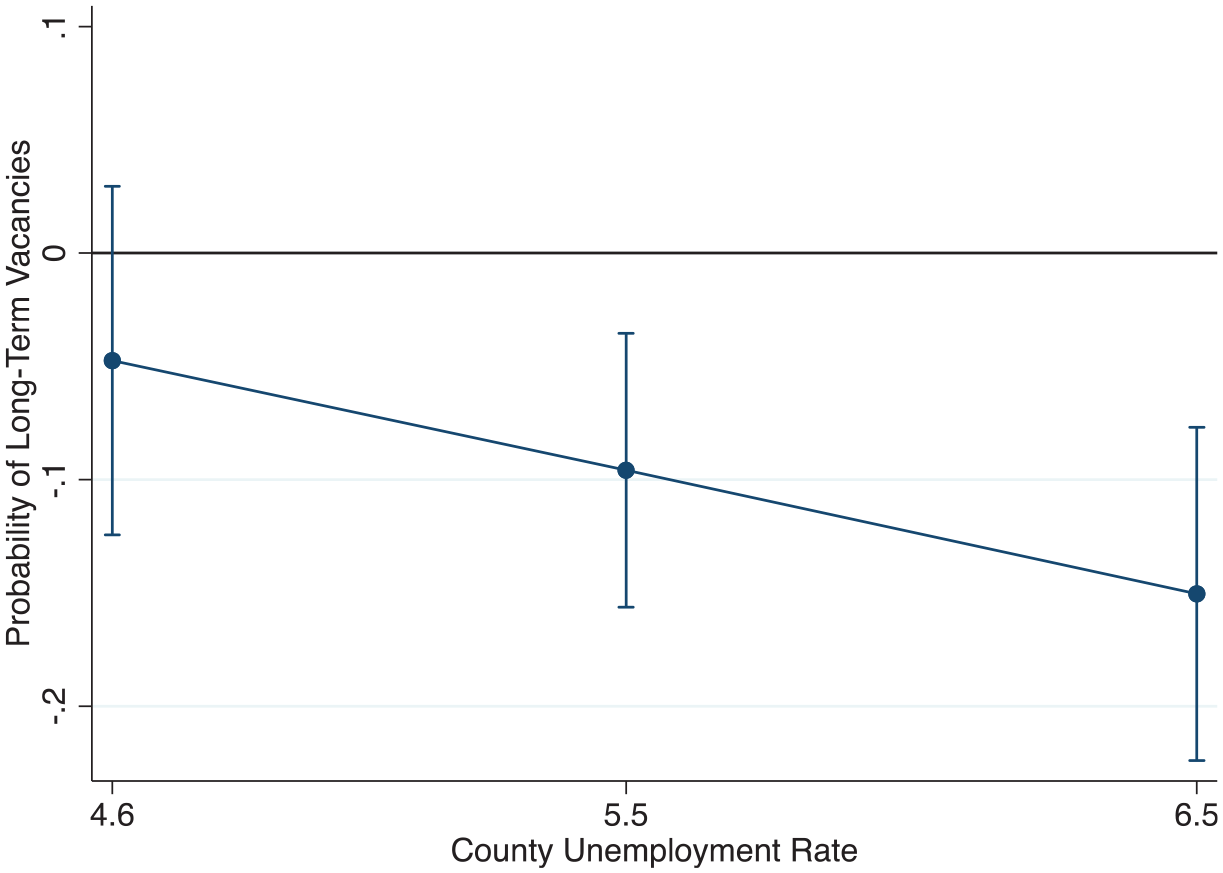
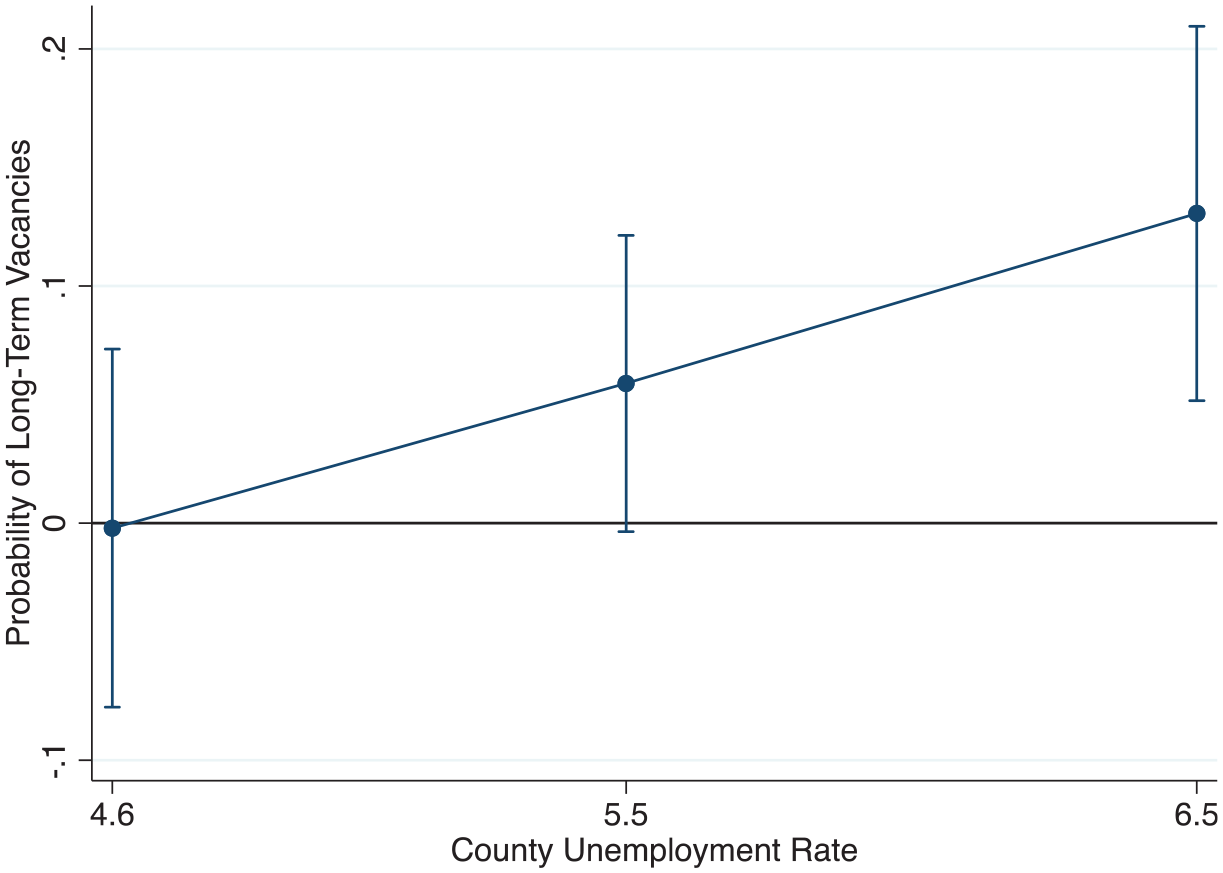
By contrast, monopsony models make a more detailed prediction. Recent evidence shows that firms have greater levels of market power in the presence of more depressed economic conditions and slack labor markets (Depew and Sorensen 2013; Hirsch, Jahn, and Schnabel 2018). In addition, Hirsch (2010) demonstrated that variation in monopsony power based on differing levels of local competitiveness exists regionally in the cross-section, not just longitudinally with the business cycle. Combining these insights, we would expect the relationship between monopsony indicators and hiring frictions to be more pronounced (i.e., to have a larger absolute value of effect size) in high-unemployment-rate conditions. In particular, based on the stable-monopsony results above, we expect establishments in low-competition environments (measured by low poaching) to experience a significantly lower incidence of long-term vacancies when higher unemployment rates prevail, while we expect establishments in high-competition environments (measured by occupational cluster) to experience a significantly higher incidence. The general idea is that at low unemployment rates, workers have considerable bargaining power that reduces market power even for employers who otherwise show signs of potential monopsony. At high unemployment rates, however, the differences in market structure (level of labor-market competition) become salient and relative effects become more pronounced. Note that while many factors predict the presence of fewer vacancies as unemployment rises—this relationship is the essence of the Beveridge curve—the expectation that measures of high and low labor-market competition will move in opposite directions in high-unemployment environments—and particularly that the measure of greater labor-market competition will actually be associated with relatively more extended vacancies—is a distinguishing, non-obvious prediction that is consistent with monopsony but not with more general regional variation.
Figures 3 and 4 depict the differing marginal effects associated with these unemployment-rate interactions. In line with the predictions of (stable) monopsony models, the marginal effect of low-poaching becomes substantially more negative in high-unemployment-rate environments, and the marginal effect of occupational cluster becomes substantially more positive. The left-most and right-most unemployment rates on the y-axes represent the 25th and 75th percentiles of the survey sample’s unemployment-rate distribution, respectively. The difference in marginal effects between these percentiles is large and significant for both the poaching (p < 0.05) and cluster variables (p < 0.01). The results thus support the idea that market structure and monopsony power are important factors to include when analyzing hiring frictions. 10
Low-Poaching Marginal Effects by Unemployment Rate
Occupational Cluster Marginal Effects by Unemployment Rate
Columns (2) through (5) of Table 3 present additional specifications exploring the robustness of the above results. Column (2) tests whether controlling for the largest industry sectors in the helpdesk occupation affects results, and column (3) uses penalized maximum likelihood (Firth 1993) to test whether the results are biased away from zero because of the infrequency of the dependent variable. Columns (4) and (5) investigate the impact of weighting by establishment and employment, respectively. See Online Appendix C for a more extended discussion. The key results are similar in sign, magnitude, and significance for these alternate specifications.
Conclusion
The incidence of hiring difficulties and the characteristics associated with these difficulties are important topics for businesses, policymakers, and workers. Despite frequent claims to the contrary, the evidence indicates that the incidence of prolonged hiring difficulties, as measured by long-term vacancies, is modest, with only 11 to 15% of US helpdesks showing vacancy patterns that might be consistent with some type of persistent hiring friction. Among the helpdesks that do show signs of hiring difficulties, the factors that are associated with these challenges depart from conventional wisdom. The evidence suggests that hiring problems are not connected to technology-driven skill demands or other technological factors. Neither STEM-skill demands nor indicators for more sophisticated across-the-board skill levels are predictive. Helpdesks that engage in more frequent product innovation actually show lower signs of hiring distress. The skill requirements that most strongly predict hiring difficulties are higher-level writing and a particular soft skill: the ability to initiate new tasks without guidance from management.
Several organizational factors are associated with hiring frictions. Establishments that have recently decreased job training or that have a history of underinvestment in past recruitment efforts are more likely to report persistent unfilled vacancies. In addition, helpdesks that have implemented formal management systems—perhaps implying intensification of work and a challenging job environment—also show a higher incidence of long-term vacancies in some specifications.
One of the most robust—and perhaps surprising—findings is that market structure has a strong association with hiring frictions. Helpdesks that show signs of market power over their workers have significantly fewer extended hiring difficulties, whereas helpdesks in more competitive labor markets show greater signs of hiring frictions. This counterintuitive result is consistent with models of monopsony that posit low turnover and workforce stability for monopsonistic employers. This result also could imply that employers in more competitive markets with many disaggregated actors face communication or coordination failures of the type discussed in Weaver and Osterman (2017).
Although much work remains to tease out the nature of these relationships, these results cast considerable doubt on simplistic stories about technology-driven skill gaps, as well as on analytical frameworks that focus primarily on deficiencies in labor supply. From a policy standpoint, the data imply that an overly narrow focus on STEM skills may not be the most appropriate strategy for improving labor-market outcomes. Instead, the results point toward the importance of human resource practices, management strategy, and labor-market structure. Skills are critical for workers and employers, but it is only by taking all of these factors into account that we can arrive at an accurate picture of the nature of hiring frictions and labor-market challenges.
Supplemental Material
sj-docx-1-ilr-10.1177_0019793920985261 – Supplemental material for Who Has Trouble Hiring? Evidence from a National IT Survey
Supplemental material, sj-docx-1-ilr-10.1177_0019793920985261 for Who Has Trouble Hiring? Evidence from a National IT Survey by Andrew Weaver in ILR Review
Footnotes
Acknowledgements
I thank the Smith Richardson Foundation for generous support. For helpful comments, I also thank participants at the Allied Social Science Association Conference, the Labor and Employment Relations Association Conference, the Industry Studies Association Conference, the University of Wisconsin, and National Taiwan University.
Computer programs associated with the empirical portions of this study are available by contacting the author at
1
See Boal and Ransom (1997) and  for other models in which monopsonists may experience lower vacancies as a result of workforce stability (specifically, reduced quit rates and longer job tenure).
2
3
5
There is no exact threshold at which a normal vacancy becomes a sign of problematic hiring frictions. In field interviews, IT managers were generally not troubled by hiring processes that lasted four to seven weeks. Selecting a cutoff shorter than three months would carry the risk that nonproblematic hiring processes would be labeled as potential signs of skill mismatch. At the same time, setting a longer cutoff—for instance, six months—carries the risk of understating labor-related hardships. Three months represents a practical compromise. In addition, maintaining the three-month threshold facilitates comparisons with other occupational surveys that have adopted the same measure (see ).
6
As a cross-sectional survey, the ITHSS does not contain a longitudinal measure of an establishment’s hiring intentions. Although this study’s measure of hiring frictions involves vacancies that were initiated in the past, it is not possible to limit the comparison group to helpdesks that have posted vacancies over the past few months. In addition, such a restriction is not desirable when testing for effects associated with many organizational characteristics (establishments with high-road employment practices are likely to have lower turnover and thus fewer vacancies and less chance of incurring a long-term vacancy). The empirical specifications thus estimate the characteristics that are associated with the unconditional incidence of hiring difficulties. The full specifications do contain retrospective indicators for increasing (compared with stagnant) demand, thus controlling for low hiring due to limited demand.
7
This level of prolonged vacancies is substantially lower than the equivalent incidence for manufacturing production workers reported in , despite the fact that the labor market was tighter in 2015–16 than in 2012–13 (when Weaver and Osterman conducted their survey) and the fact that helpdesk technician is an occupation that typically requires more education and training than manufacturing production worker.
8
The null result regarding skills is not simply the result of collinearity. In parsimonious models that enter target variables singly, no skill variable demonstrates a significantly positive association with hiring difficulties that did not show such an effect in full specifications.
9
These variables capture distinct dynamics (the bivariate correlation is 0.01). Many helpdesks not located in occupational clusters nevertheless report substantial poaching, and many clustered helpdesks report infrequent poaching. This latter condition is consistent with modern research on monopsony that demonstrates that monopsony can exist even in dense labor markets ().
10
One of the only other explanations for the pattern of unemployment-related outcomes described above is the payment of efficiency wages. Similar to monopsony, efficiency wage effects are predicted to be more pronounced in high-unemployment-rate environments. Several points are worth making, however. First, whereas low-poaching effects could be explained by either low labor-market competition or relatively more attractive job quality (higher relative wages and/or non-pecuniary benefits in an efficiency-wage model), the effects associated with more competitive occupational-cluster environments are more consistent with monopsony than with efficiency wage models. Second, a number of researchers have pointed out that these theories are complements rather than substitutes (Manning 2003; Schlicht 2016). In other words, efficiency wage models do not necessarily imply wages above the competitive level. Rather, efficiency wages can exist when an employer chooses to exploit less than 100% of her market power (that is, the employer pays wages higher than the minimum necessary to induce the worker to take the job but below the worker’s marginal product). Indeed, recent evidence establishing widespread monopsony shows that employers do not fully exploit their relative wage-setting advantage (). Finally, the key point of this portion of the analysis is that extended hiring frictions appear to be significantly correlated with deviations from competitive market structure. Monopsony is the explanation that best fits the results in this study, but the presence of efficiency wages would likewise point to the importance of market structure.
References
Supplementary Material
Please find the following supplemental material available below.
For Open Access articles published under a Creative Commons License, all supplemental material carries the same license as the article it is associated with.
For non-Open Access articles published, all supplemental material carries a non-exclusive license, and permission requests for re-use of supplemental material or any part of supplemental material shall be sent directly to the copyright owner as specified in the copyright notice associated with the article.
