







Abstract
Although women earn approximately 50% of science, technology, engineering, and math (STEM) bachelor’s degrees, more than 70% of scientists and engineers are men. The authors explore a potential determinant of this STEM gender gap using newly collected data on the career trajectories of United States Air Force Academy students. Specifically, they examine the effects of being assigned female math and science professors on occupation choice and postgraduate education. The results indicate that, among high-ability female students, being assigned a female professor leads to substantial increases in the probability of working in a STEM occupation and the probability of receiving a STEM master’s degree.
Women are underrepresented in the science and engineering workforce. In 2015, the most recent year for which data are available, only 28% of employed scientists and engineers were women. 1 One reason for this substantial gender gap is that, up until the late 1990s, the majority of all science, technology, engineering, and math (STEM) bachelor’s degrees were earned by men (National Science Foundation 2017). Another contributing factor is that women who earn STEM degrees are more likely than their male counterparts to pursue careers in education or health care as opposed to science or engineering (Beede et al. 2011: 6). 2
Interventions intended to address the STEM gender gap are often predicated on the assumption that female students who are interested in math and science suffer from a lack of same-gender role models (e.g., Handelsman et al. 2005). In fact, several studies provide evidence that exposure to female math and science professors encourages female college students to pursue STEM degrees (Rask and Bailey 2002; Bettinger and Long 2005; Carrell, Page, and West 2010). Much less, however, is known about the relationship between professor gender and longer-run postgraduation outcomes.
Using newly collected data on the career trajectories of United States Air Force Academy (USAFA) students who graduated during the period 2004 to 2008, we examine the impact of professor gender in freshman-year math and science courses on postgraduation outcomes. Information on these outcomes was obtained from the Air Force Personnel Center for the period 2004 to 2016, so we are able to follow students for a minimum of eight years after graduation, provided they remained in the Air Force. One of the advantages of using data from the USAFA is that students there are quasi-randomly assigned to freshman-year math and science classes, which are mandatory.
Non-economists have proposed a variety of interventions aimed at encouraging women to choose STEM majors and careers (Cronin and Roger 1999; Blickenstaff 2005; Lagesen 2007; Redden 2007; Bilimoria, Joy, and Liang 2008; Dworkin, Kwolek-Folland, Maurer, and Schipani 2008; Mavriplis et al. 2010). These interventions include ensuring students have equal access to classroom resources (Blickenstaff 2005), promoting a more inclusive workplace culture (Cronin and Roger 1999), and providing more networking opportunities for women working in STEM fields (Mavriplis et al. 2010). Economists have, by and large, focused on increasing the supply of female professors in mathematics and the hard sciences. Increasing the supply of female professors is often justified on the grounds that female students interested in STEM lack role models, but can also be justified on the grounds that they simply learn more from female professors, perhaps as a result of gender-based differences in teaching style or expectations about academic performance (Carrell et al. 2010: 1103). It is also possible that professors influence the career choices of STEM students through providing emotional support, encouragement, and networking opportunities (Carlone and Johnson 2007; Johnson 2007; Thiry, Laursen, and Hunter 2011).
Literature and Data
Previous Studies
Only a handful of studies have examined the relationship between professor gender and postgraduation outcomes. For instance, Rothstein (1995) found a positive correlation between the fraction of female faculty and the likelihood that female undergraduates would go on to obtain an advanced degree, while Kofoed and McGovney (2019) found that quasi-random assignment to a female mentor at the U.S. Military Academy led to an increase in the probability that female cadets chose their mentor’s occupation. Jagsi, Griffith, DeCastro, and Ubel (2014), who examined data on US medical school graduates for the period 2006 to 2008, found no evidence that specialty choice was related to the fraction of full-time faculty who were female. 3
By contrast, researchers have expended considerable effort exploring how instructor (i.e., teacher or professor) gender affects academic outcomes such as test scores, grades, and choice of major. Previous studies in this area include Canes and Rosen (1995), Neumark and Gardecki (1998), Bettinger and Long (2005), Hoffman and Oreopoulos (2009), Carrell et al. (2010), Fairlie, Hoffmann, and Oreopoulos (2014), Muralidharan and Sheth (2016), Kato and Song (2018), Canaan and Mouganie (2019), and Lim and Meer (2019). However, with some notable exceptions (Carrell et al. 2010; Muralidharan and Sheth 2016; Kato and Song 2018; Canaan and Mouganie 2019; Lim and Meer 2019), the results of these studies should be viewed with some skepticism given that students are not typically assigned to their instructors at random.
One of the best-known (and most often cited) studies in this literature is by Carrell et al. (2010). These authors used detailed data on students from the USAFA to examine the effects of professor gender on academic performance and major choice. They found that female students who were assigned to a female professor received higher grades in freshman-year math and science classes than their counterparts who were assigned to a male professor. Among high-ability female students (as measured by math SAT scores), assignment to female professors was also associated with an increase in the likelihood of graduating from the USAFA with a STEM degree. We begin our empirical analysis, below, by examining the effects of being assigned a female professor on the same outcomes as were used by Carrell et al. (2010).
The USAFA and Its Students
The students and academic curriculum at the USAFA are similar in many respects to other selective liberal arts colleges, with an emphasis on balancing “Science, Technology, Engineering, and Mathematics (STEM) with the arts and humanities” (USAFA, n.d.). Students complete a fully accredited academic program that offers 27 majors and 4 minors, and graduates earn a bachelor’s of science degree along with a commission in the U.S. Air Force. The average SAT math and verbal scores of entering students are 672 and 642, respectively, and the admission rate is 13%. A regimented daily schedule includes military training and athletics in addition to approximately 8 hours of dedicated academic time for a typical student. Students at the USAFA are required to take a series of core courses, totaling approximately 85 semester hours, in the basic sciences, engineering, social sciences, and humanities. 4
Course scheduling is completed in a centralized process that amounts to quasi-random assignment of students to professors. Courses are offered in multiple sections usually containing no more than 24 students. Each section may be offered in any of approximately 14 designated time slots, called “periods,” and the first-year mandatory math and science courses that are the focus of this study generally have sufficiently high enrollment so that multiple sections are offered in each period. Students register for courses (but not sections or periods) before the start of each semester, and then the registrar assigns students to sections in a two-step process. First, students are assigned to periods by an algorithm that seeks to minimize scheduling conflicts, for example, due to sports practice; students are then randomly assigned to a section within their assigned period.
The scheduling process results in two primary sources of variation in professor gender. First, although the assignment of students to periods gives no weight to student preferences, some students (e.g., intercollegiate athletes) are more likely to be assigned to certain periods based on scheduling constraints, and female (or male) professors may prefer teaching in these same periods. While this process could produce systematic relationships between unobservable student and professor characteristics, we expect that any such relationships are far weaker and more idiosyncratic than in a typical scheduling system in which students choose sections based on personal preference and knowledge of professors. Second, assignment of students to sections within each period is randomized by a computer algorithm, ensuring that observable and unobservable student and professor characteristics are uncorrelated within periods.
USAFA Data
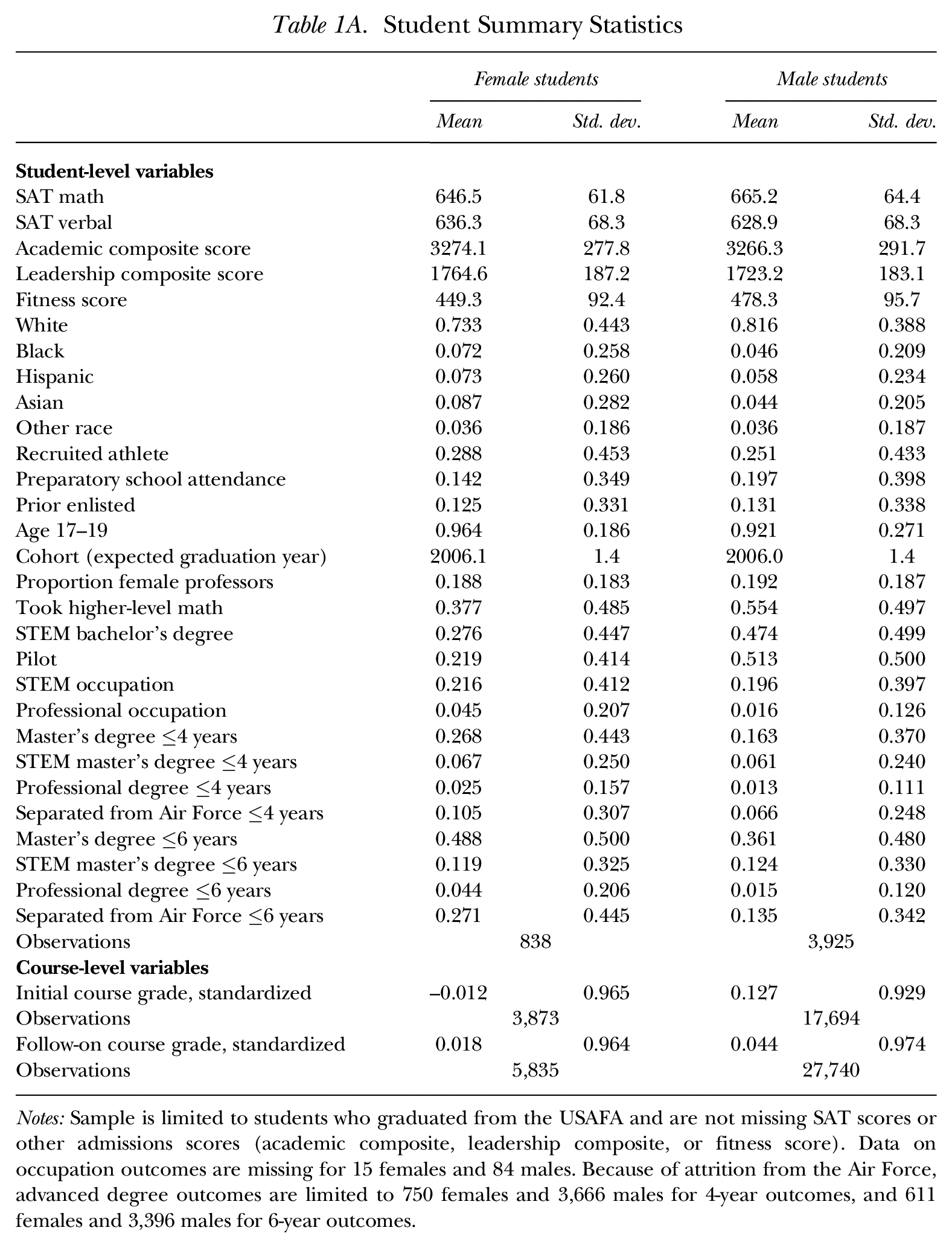
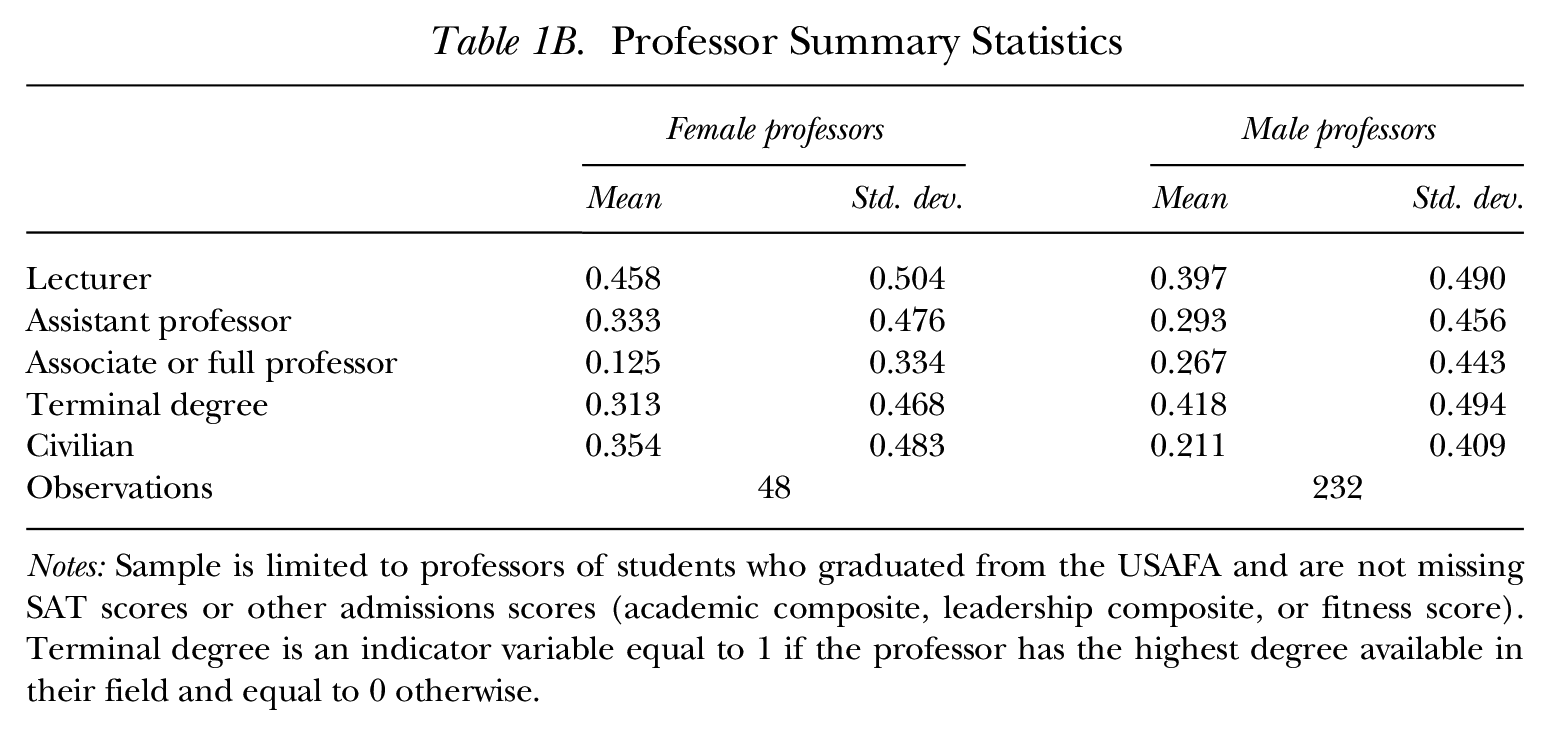
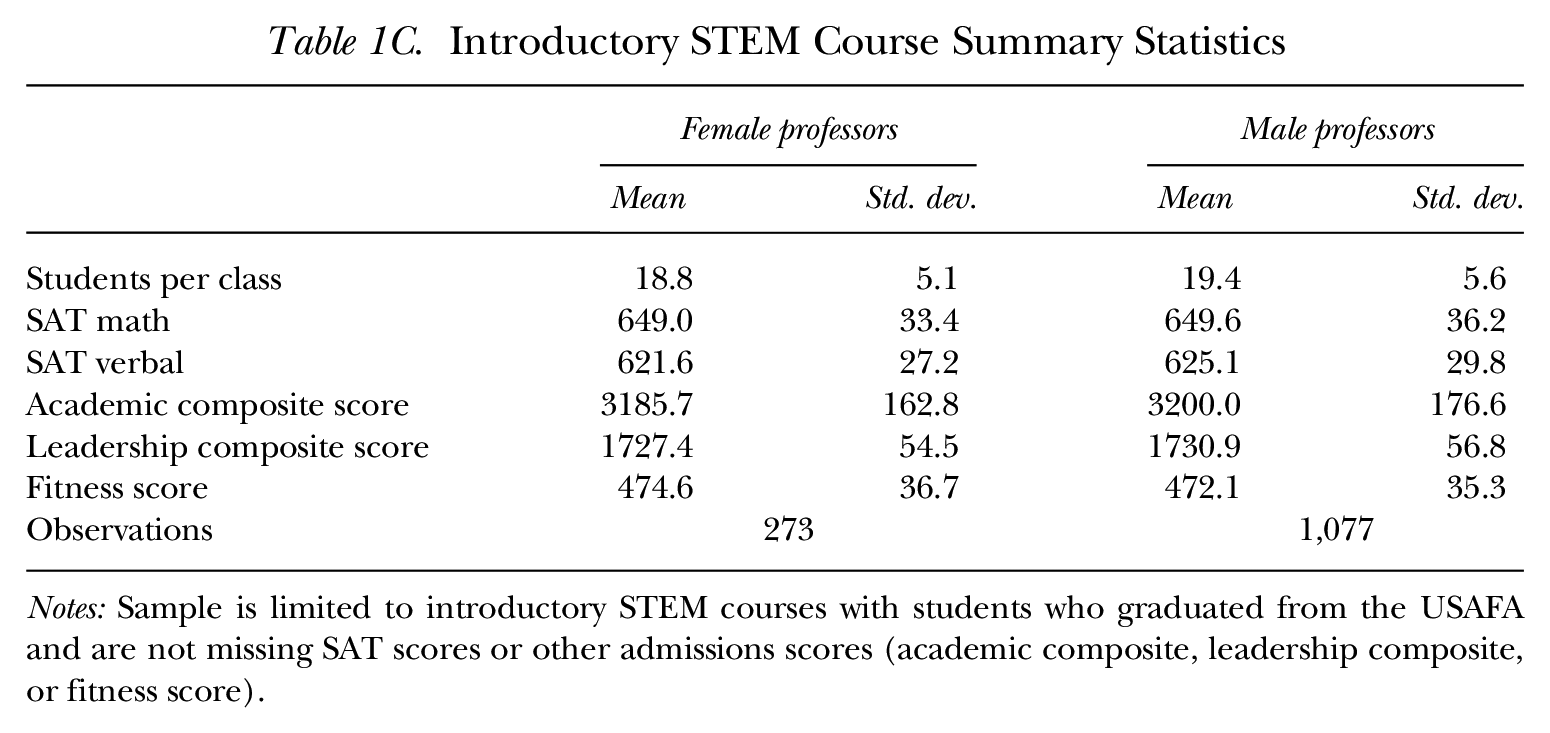
Our analysis draws upon longitudinal data for 838 female and 3,925 male students who graduated from the USAFA between 2004 and 2008. Because of missing data, 42 students who graduated during this period were excluded from the analysis. We merged academic records with information on postgraduation outcomes obtained from the Air Force Personnel Center (AFPC) for the period 2004 to 2016. Table 1A provides summary statistics pertaining to the students who contributed data to the analysis. Summary statistics for their USAFA professors are reported in Table 1B, and introductory STEM courses are summarized in Table 1C.
Student Summary Statistics
Notes: Sample is limited to students who graduated from the USAFA and are not missing SAT scores or other admissions scores (academic composite, leadership composite, or fitness score). Data on occupation outcomes are missing for 15 females and 84 males. Because of attrition from the Air Force, advanced degree outcomes are limited to 750 females and 3,666 males for 4-year outcomes, and 611 females and 3,396 males for 6-year outcomes.
Professor Summary Statistics
Notes: Sample is limited to professors of students who graduated from the USAFA and are not missing SAT scores or other admissions scores (academic composite, leadership composite, or fitness score). Terminal degree is an indicator variable equal to 1 if the professor has the highest degree available in their field and equal to 0 otherwise.
Introductory STEM Course Summary Statistics
Notes: Sample is limited to introductory STEM courses with students who graduated from the USAFA and are not missing SAT scores or other admissions scores (academic composite, leadership composite, or fitness score).
Throughout the analysis, student pretreatment characteristics are used as controls. Information from the USAFA registrar’s office allowed us to create indicators for attending a preparatory school, enlistment in the military prior to entering the USAFA, having been recruited as an intercollegiate athlete, gender, race, and age. We also use three numerical scores created by the USAFA admissions office to describe a candidate’s academic, leadership, and athletic potential. 5 On average, female students entered the USAFA with better academic and leadership composite scores than their male counterparts, whereas male students entered with better fitness test scores (Table 1A).
We linked every freshman-year math and science course taught at the USAFA to its professor using records from the registrar’s office and the USAFA’s historical archives. We obtained information on 280 professors (48 female and 232 male) who taught introductory math and science courses during the academic years 2000 to 2006. Female professors taught approximately 19% of the 1,350 first-year math and science sections (Tables 1A and 1C).
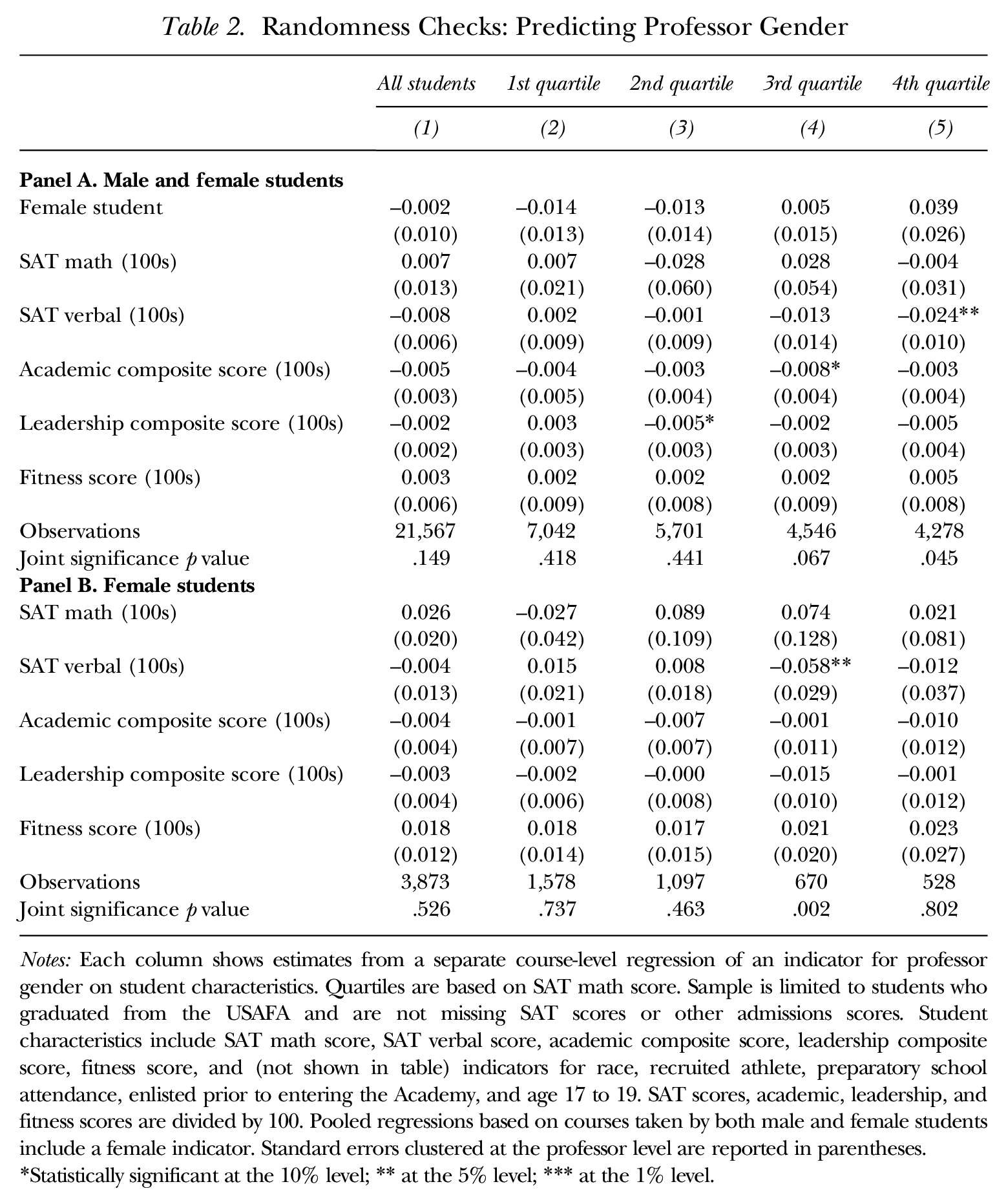
Classroom and student characteristics by professor gender are reported in Table 1C. Male professors, on average, taught slightly larger classes than their female counterparts (19.35 versus 18.83 students per class). The other characteristics, however, are quite similar across the genders. As a formal test of whether course assignment can be thought of as random, we regress faculty gender on the pre-enrollment characteristics (e.g., math and verbal SAT scores, academic score, leadership score, and fitness score). The results of this exercise, which are reported in Table 2, provide no evidence of a systematic relationship between pre-enrollment characteristics and professor gender in the full sample. Even when the sample is broken into quartiles based on math SAT scores, only 1 out of the 24 estimated coefficients are significant at conventional levels (panel A). A similar pattern of results is obtained when the sample is restricted to female students (panel B).
Randomness Checks: Predicting Professor Gender
Notes: Each column shows estimates from a separate course-level regression of an indicator for professor gender on student characteristics. Quartiles are based on SAT math score. Sample is limited to students who graduated from the USAFA and are not missing SAT scores or other admissions scores. Student characteristics include SAT math score, SAT verbal score, academic composite score, leadership composite score, fitness score, and (not shown in table) indicators for race, recruited athlete, preparatory school attendance, enlisted prior to entering the Academy, and age 17 to 19. SAT scores, academic, leadership, and fitness scores are divided by 100. Pooled regressions based on courses taken by both male and female students include a female indicator. Standard errors clustered at the professor level are reported in parentheses.
Postgraduation Outcomes
The primary source for occupation and other postgraduation outcomes of USAFA students is the AFPC. During their senior year, USAFA students are assigned to a job in a three-step process. First, students decide whether they wish to pursue one of approximately four rated occupations (which primarily involve piloting aircraft) or whether they wish to pursue a non-rated occupation such as intelligence, developmental engineer, or scientist. 6 Second, students submit their top six occupation choices to the AFPC, along with a relative weight for each choice. Finally, using these choices and weights, an algorithm matches USAFA graduates with their first job. 7 This initial assignment may not correspond to the occupation into which the graduate eventually settles, however. Graduates have ample opportunities to switch jobs and the initial assignments include “graduate study,” which we code as non-STEM despite the fact that graduate school may prepare students for a STEM career. 8 Of the 4,311 USAFA graduates in our sample whose occupation history is observed, 3,673 were initially assigned to a non-STEM occupation (including pilot and graduate student). Two years after graduation, 160 had switched from a non-STEM to a STEM occupation; four years after graduation, 182 had switched from a non-STEM to a STEM occupation. Of the 1,036 high-ability students (i.e., those with math SAT scores in the top quartile) with occupation history, 846 were assigned to a non-STEM occupation upon graduation. Two years after graduation, 53 had switched from a non-STEM to a STEM occupation; four years after graduation, 64 had switched from a non-STEM to a STEM occupation.
We report the percentage of USAFA graduates in our sample who worked in a STEM occupation by gender in Table 1A. Any USAFA graduate who held a STEM-related job before 2016 (or before leaving the Air Force) is counted as having worked in a STEM occupation. Female graduates were more likely to have worked in a STEM occupation than their male counterparts (22% compared to 20%), but they were less likely to have been a pilot (22% compared to 51%) and more likely to have worked in what we describe as a “professional occupation” (5% compared to 2%). Specifically, this category includes chaplain, dentist, general practice physician, judge advocate, lawyer, and surgeon. Approximately 28% of female students obtained a STEM bachelor’s degree but, of those who obtained a STEM bachelor’s degree, only 42% went on to work in a STEM occupation. 9 Approximately 1% of female students who obtained a STEM bachelor’s degree went on to work in a professional occupation.
In addition to occupation, we observe receipt of a master’s degree, receipt of STEM master’s degree, and receipt of a professional degree (e.g., a medical, dental, or law degree). Graduates of the USAFA are not expected to obtain a graduate or professional degree unless they are assigned to an occupation that requires it. Although a graduate degree is required for advancement in some occupations (e.g., operations research analyst, scientist, or academic instructor), whether and when to pursue additional education is ultimately the individual’s choice. 10
Female USAFA graduates were more likely to earn a master’s degree within six years (49% compared to 36%), and were equally likely to earn a STEM master’s degree within six years (12%). Among female graduates with a STEM bachelor’s degree, 33% went on to earn a STEM master’s degree within six years. Slightly less than 2% (1.7%) of female graduates with a STEM bachelor’s degree earned a professional degree within six years.
Statistical Methods
We begin by examining the effects of being assigned a female professor on the academic outcomes used by Carrell et al. (2010). Following these authors, we estimate:

where Y icsjt is the normalized grade for student i in freshman math/science course c and section s taught by professor j in semester t. 11 Fi is an indicator equal to 1 if student i was female and equal to 0 otherwise. Fj is an indicator equal to 1 if professor j was female and equal to 0 otherwise. The coefficient β1 represents the mean difference in performance between male and female students when they are assigned to a male professor, β2 represents the effect of being taught by a female professor on the grades of male students, and β3 represents the effect of assignment to a female professor on the grades of female students (relative to those of male students). Because freshman-year math and science courses are mandatory, and because assignment to sections is quasi-random, the estimate of β3 can be given a causal interpretation.
The vector of controls,
We use a modified version of Equation (1) to examine academic outcomes in follow-on STEM courses:

where Y
ic′s′t′
is the normalized grade for student i in the follow-on course c′, section s′, and semester t′.
We use a modified version of Equation (2) to examine whether student i took an advanced math course, whether student i graduated with a STEM degree, and whether student i left the USAFA without graduating:

where D i is one of the three outcomes described above. Again, β2 is the effect of having more female professors on the outcomes of male students and β3 is the effect of having more female professors on the outcomes of female students relative to their male counterparts. Equation (3) is also used to examine the effects of professor gender on several postgraduation outcomes, including working in a STEM occupation, receipt of a master’s degree, receipt of a STEM master’s degree, receipt of a professional degree, and separation from the Air Force.
Results
Effects of Professor Gender on Academic Outcomes
Estimates of Equations (1) and (2) for the full sample are reported in the top panel (panel A) of Table 3. Although the estimates of β3 (i.e., the relative effect for female students) are positive, they are, without exception, generally small and statistically indistinguishable from zero at conventional levels.
Professor Gender and Undergraduate Outcomes
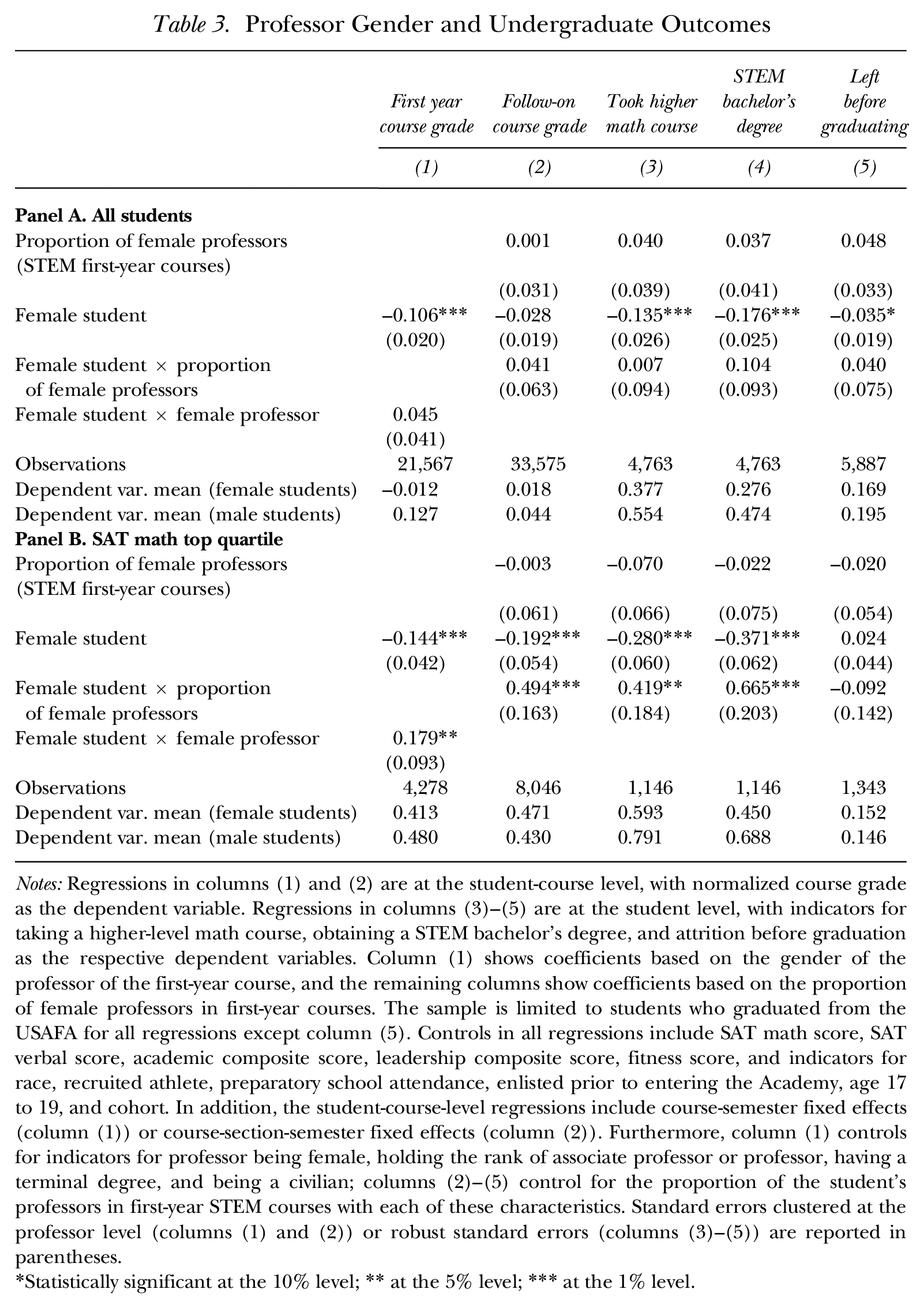
Notes: Regressions in columns (1) and (2) are at the student-course level, with normalized course grade as the dependent variable. Regressions in columns (3)–(5) are at the student level, with indicators for taking a higher-level math course, obtaining a STEM bachelor’s degree, and attrition before graduation as the respective dependent variables. Column (1) shows coefficients based on the gender of the professor of the first-year course, and the remaining columns show coefficients based on the proportion of female professors in first-year courses. The sample is limited to students who graduated from the USAFA for all regressions except column (5). Controls in all regressions include SAT math score, SAT verbal score, academic composite score, leadership composite score, fitness score, and indicators for race, recruited athlete, preparatory school attendance, enlisted prior to entering the Academy, age 17 to 19, and cohort. In addition, the student-course-level regressions include course-semester fixed effects (column (1)) or course-section-semester fixed effects (column (2)). Furthermore, column (1) controls for indicators for professor being female, holding the rank of associate professor or professor, having a terminal degree, and being a civilian; columns (2)–(5) control for the proportion of the student’s professors in first-year STEM courses with each of these characteristics. Standard errors clustered at the professor level (columns (1) and (2)) or robust standard errors (columns (3)–(5)) are reported in parentheses.
Statistically significant at the 10% level; ** at the 5% level; *** at the 1% level.
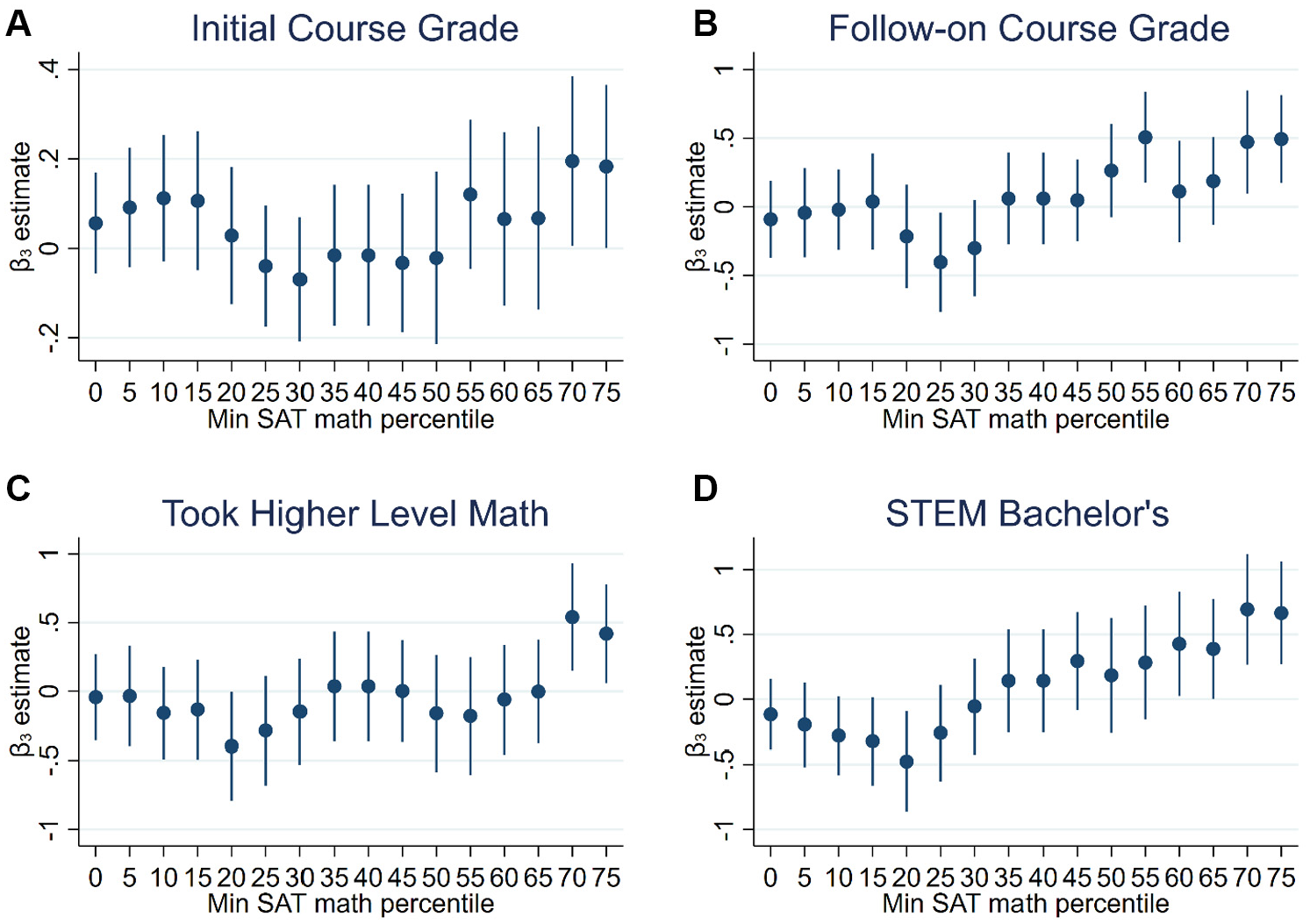
In Figure 1, we explore the role of pretreatment ability as measured by math SAT scores. Specifically, we report estimates of β3 restricting the sample to different ranges of the SAT math distribution. The outcomes correspond to those reported in columns (1)–(4) of Table 3.
SAT Math Cutoff Sensitivity, Academic Outcomes
Consistent with the results of Carrell et al. (2010), our evidence suggests that professor gender matters most among high-ability students. The estimates of β3 are small and statistically insignificant when the sample is restricted to students in the bottom quartile of the ability distribution. Likewise, when the sample is restricted to students between the 5th and 30th, the 10th and 35th, or the 15th and 40th percentiles of the ability distribution, the estimates of β3 are small and insignificant. In fact, it is not until the sample is restricted to students between the 70th and 95th percentiles of the ability distribution that we consistently observe positive and significant estimates of β3 for all academic outcomes. Based on the estimates of β3 reported in Figure 1, we focus on students in the top quartile of ability distribution for the remainder of our analysis. On average, these students received higher grades in their first-year STEM courses, were more likely to graduate with a STEM degree, and were more likely to work in a STEM occupation as compared to their lower-ability counterparts. 12 As noted by Carrell et al. (2010: 1104), women in the top quintile of the ability distribution are arguably “most suited for entering science and engineering careers.”
Among female students in the upper quartile of the ability distribution, it is clear that assignment to female professors improves relative academic performance (Table 3, panel B). For instance, high-ability female students, on average, score 14.4% of a standard deviation lower than their male counterparts when assigned to a male professor. When they are assigned to a female professor, however, their performance in first-year math and science courses improves dramatically. This pattern of results is consistent with a gender-based teaching style mechanism, which may also explain why previous studies have found that male students give their female instructors systematically lower teaching evaluations. See, for instance, Boring (2017) and Mengel, Sauermann, and Zölitz (2019).
Assignment to female professors also increases the relative probability of graduating with a STEM degree. Female students in the upper quartile of the ability distribution are, on average, 37.1 percentage points less likely to graduate with a STEM degree than their male counterparts if all of their first-year math and science courses are taught by male professors (Table 3, panel B), but increasing the fraction of first-year classes taught by female professors from 0 to 20% is associated with more than a one-third reduction in this gap. 13
Carrell et al. (2010: 1127) estimated a positive but smaller interaction effect for STEM degree completion (0.258 versus 0.665) in the top quartile, but these authors had three additional years of data that we did not have access to, and they used a narrower definition of first-year math and science courses. Consistent with the results of Carrell et al. (2010), we find no evidence that the fraction of first-year female professors in math and science classes is associated with leaving the USAFA without graduating.
Effects of Professor Gender on Occupation
Our principal interest is in the relationship between professor gender and postgraduation outcomes, beginning with occupation. Only about a quarter of US women who earn a bachelor’s degree in math, science, or engineering go on to work in a STEM occupation (Beede et al. 2011: 6), but this figure is much higher among the USAFA graduates: In fact, 42.4% of female students in our sample who earned a STEM bachelor’s degree from the USAFA went on to work in a STEM occupation at some point during their Air Force career.
In Table 4, we report ordinary least squares (OLS) estimates of Equation (3). Specifically, we examine three dichotomous outcomes: whether a USAFA graduate became a pilot, whether he or she worked in a STEM occupation, and whether he or she worked in a professional occupation. These occupational categories (pilot, STEM, and professional) are not mutually exclusive. If, for example, a USAFA graduate started her career as a pilot and then went on to work in a STEM occupation before 2016 (or before leaving the Air Force), then she was counted as having worked in both occupational categories.
Professor Gender and Career Outcomes
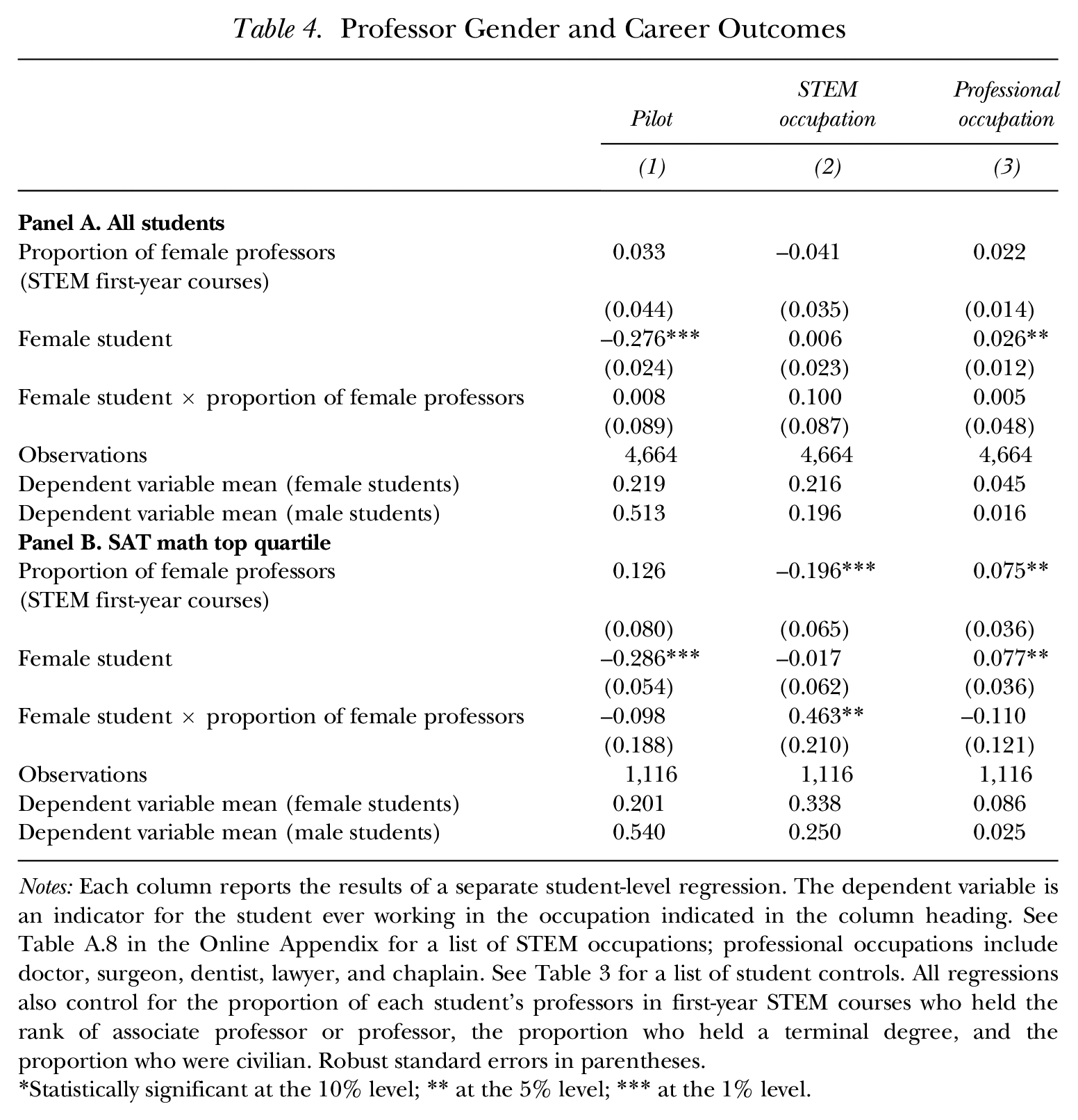
Notes: Each column reports the results of a separate student-level regression. The dependent variable is an indicator for the student ever working in the occupation indicated in the column heading. See Table A.8 in the Online Appendix for a list of STEM occupations; professional occupations include doctor, surgeon, dentist, lawyer, and chaplain. See Table 3 for a list of student controls. All regressions also control for the proportion of each student’s professors in first-year STEM courses who held the rank of associate professor or professor, the proportion who held a terminal degree, and the proportion who were civilian. Robust standard errors in parentheses.
Statistically significant at the 10% level; ** at the 5% level; *** at the 1% level.
In the full sample, we found little evidence that being assigned to female first-year STEM professors affects whether female graduates work in a STEM occupation (second column of Table 4, panel A). When the sample is restricted to students in the top quartile of the ability distribution as measured by math SAT scores, however, the estimates of β2 and β3 are clearly distinguishable from zero in a statistical sense. 14 These estimates suggest that, by doubling the fraction of first-year math and science classes taught by female faculty (from 20 to 40%), the USAFA could increase the probability of high-ability female students working in STEM by 0.053, which represents a 14% increase relative to the sample mean (0.338). 15 At the same time, doubling the fraction of first-year math and science classes taught by female faculty would reduce the probability of high-ability male students working in STEM by 0.039 (0.2×–0.196), or 16% of their mean (0.250).
In Appendix Table A.1 (all Appendix Tables are presented online), we examine whether the relationship between assignment to first-year female STEM professors and the probability of female graduates working in STEM is mediated by academic performance or major choice. Controlling for the student’s average grades across first-year STEM courses (column (2)) does not change the estimate of β3. However, adding a control for graduating with a STEM bachelor’s degree (column (3)) reduces the estimate of β3 by about a third (to 0.309). We interpret this pattern of results as suggestive evidence that major choice mediates the effect of professor gender on the likelihood of working in a STEM occupation.
As noted above, USAFA students submit their top six occupation choices to the AFPC in their senior year. In Appendix Table A.2, we explore whether professor gender in first year STEM courses affects these choices, but our estimates are small and statistically insignificant. Specifically, we used the following indicators on the left side of Equation (3): whether the student’s first job choice was to become a pilot, whether their first job choice was in a STEM-related occupation, whether their first or second job choice was in a STEM-related occupation, and whether any of their six job choices were in a STEM-related occupation. The estimate of β3 was positive and sizable among high-ability students for whether any job choice was in STEM, but not statistically significant at conventional levels.
Evidence suggests, however, that being assigned female professors in freshman-year math and science courses encourages high-ability female students to switch from non-STEM to STEM occupations within two, four, and six years of graduating (Appendix Table A.3). 16 For example, by doubling the fraction of first-year math and science classes taught by female faculty (from 20 to 40%), the USAFA could increase the probability of high-ability female students working in STEM within six years of graduating by 0.089 (0.2×(–0.177 + 0.620)), which represents a 28% increase relative to the sample mean (0.323). Doubling the fraction of first-year math and science classes taught by female faculty would come at the cost of decreasing the probability of high-ability male students working in STEM within 6 years of graduating by 0.035 (0.2×–0.177) = −0.035.
In the military, earnings are based on time served and rank, not occupation. To gauge the return to being taught by a female professor and taking a STEM job outside the military, we used predicted earnings as an outcome. Specifically, we predicted the earnings of USAFA graduates after six years using data from the American Community Survey (ACS). USAFA graduates were matched with ACS respondents based on personal characteristics, work schedules, and occupations. 17 The results of this exercise, reported in Appendix Table A.4, are consistent with those reported in Table 4 and Appendix Table A.3: Being assigned female professors is associated with an increase in the relative earnings of high-ability female USAFA students. It should be noted, however, that the estimates of β3 reported in Appendix Table A.4 are only marginally significant (p-values = 0.101 and 0.110 for the linear and semi-log models, respectively).
Up to this point in the analysis, we have assumed that the effects of professor gender on our outcomes are linear. In Appendix Table A.5, we relax that assumption for STEM occupation by estimating a more flexible model that allows for nonlinear effects. Although the coefficient estimates are a bit noisy, they do not appear to indicate a clear nonlinear pattern. Finally, at the USAFA, female professors are less likely to have the rank of associate or full professor and more likely to be civilian (Table 1B). Interacting professor gender with the proportion of assistant professors, proportion of associate/full professors, proportion of professors with a terminal degree, and proportion of professors who are civilian in Equation (3) has little impact on the main results reported in Tables 3 through 5 (Appendix Table A.6).
Effects of Professor Gender on the Receipt of Advanced Degrees
Upon graduating from the USAFA, students typically begin their occupation training immediately. The length of this training varies from less than a year (aircraft maintenance officers, intelligence officers, space and missiles officers) to multiple years (pilots, medical doctors, and surgeons). After completing occupation training, students may choose to pursue a master’s degree, although it should be noted that, if a student is assigned to a professional occupation (e.g., lawyer, medical doctor, or chaplain), earning a professional degree is usually considered part of the formal occupation training process. In addition, the Air Force offers several programs through which officers can receive monetary support to obtain advanced degrees. These programs include tuition assistance for degrees completed concurrent with another assignment and sponsorships for full-time study.
Of the 4,416 students who graduated the USAFA between 2004 and 2008 (and who served in the Air Force at least four years after graduation), 800 received a master’s degree, 274 received a master’s degree in a STEM field, and 65 received a professional degree. In panels A and C of Table 5, we report the estimates of the relationship between professor gender and the probability of pursuing an advanced degree within 4 years of graduating from the USAFA. In panels B and D of Table 5, we explore the relationship between professor gender and receipt of an advanced degree within six, as opposed to four, years of graduation.
Professor Gender and Graduate Degrees, Separation from Air Force
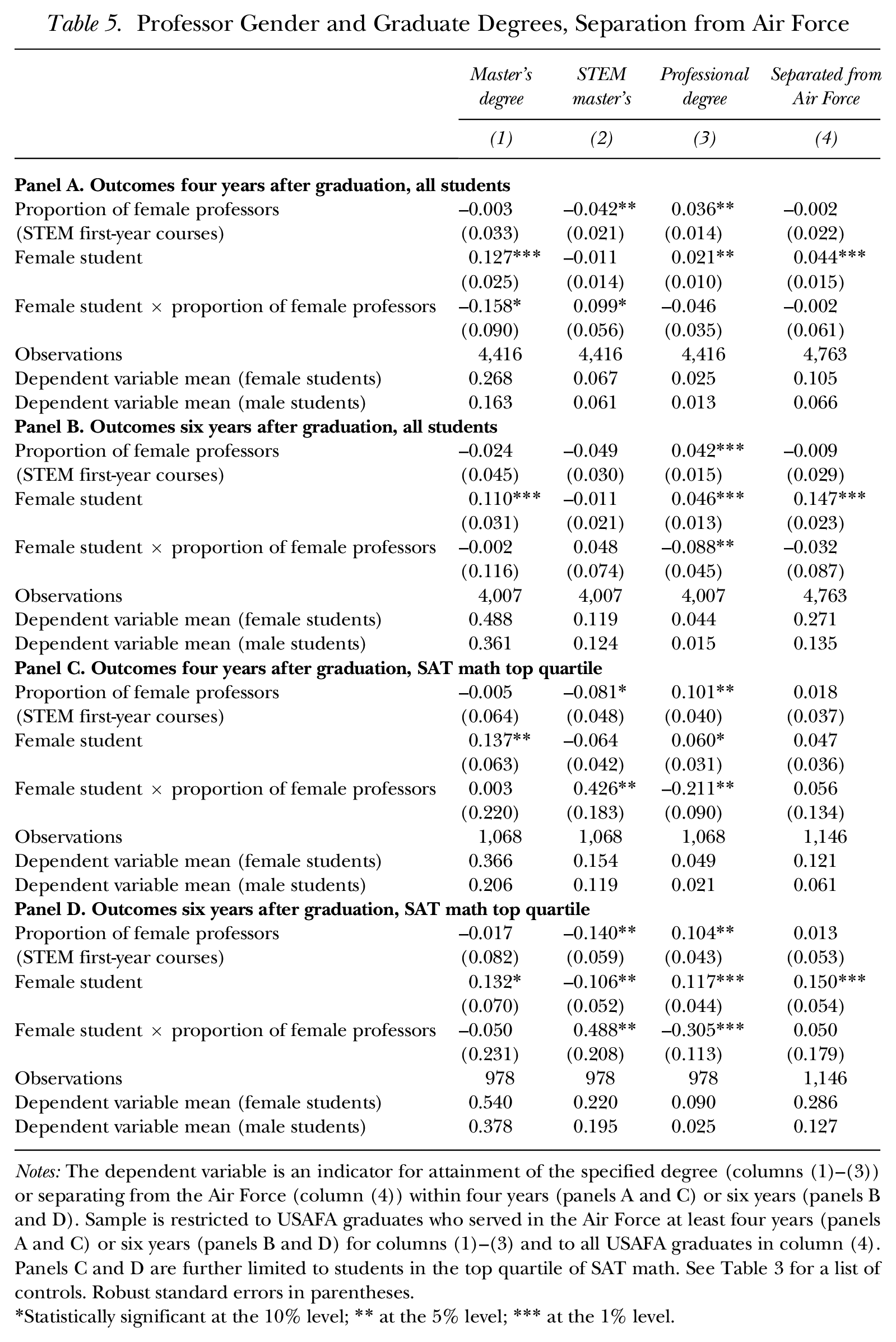
Notes: The dependent variable is an indicator for attainment of the specified degree (columns (1)–(3)) or separating from the Air Force (column (4)) within four years (panels A and C) or six years (panels B and D). Sample is restricted to USAFA graduates who served in the Air Force at least four years (panels A and C) or six years (panels B and D) for columns (1)–(3) and to all USAFA graduates in column (4). Panels C and D are further limited to students in the top quartile of SAT math. See Table 3 for a list of controls. Robust standard errors in parentheses.
Statistically significant at the 10% level; ** at the 5% level; *** at the 1% level.
The results suggest that the effects of professor gender are not limited to occupation. 18 For instance, our estimates of β2 and β3 suggest that by doubling the fraction of first-year math and science classes taught by female faculty (from 20 to 40%), the USAFA could increase the probability of high-ability female students obtaining a STEM master’s degree within six years of graduation by 0.070 (0.2×(–0.140 + 0.488)). Doubling the fraction of first-year math and science classes taught by female faculty would also decrease the probability of high-ability male students obtaining STEM master’s degree within six years of graduation by 0.028 (0.2×–0.140). In Appendix Table A.5, we estimate a more flexible model that allows for nonlinear effects on educational attainment outcomes. The results do not indicate a clear nonlinear pattern of relative effects.
As we noted earlier, women who earn STEM degrees are less likely than their male counterparts to work as a scientist or engineer but are more likely to pursue careers in education or health care (Beede et al. 2011: 6). Estimates of β2 and β3 reported in Table 5 suggest that any tendency among female undergraduates to obtain a professional degree may be counteracted by assignment to female professors. Specifically, increasing the fraction of female professors in first-year math and science courses from 0 to 100% is associated with a 0.110 decrease in the probability that high-ability female students receive a professional degree within four years of graduation (panel C) and a 0.201 decrease in the probability that high-ability female students receive a professional degree within six years of graduation (panel D). 19
Effects of Professor Gender on Separation from the Air Force
Students are contractually obligated to serve as an active-duty commissioned officer in the Air Force for a minimum of five years after graduating from the USAFA. However, approximately 11% of female students and 7% of male students in our sample left the Air Force within four years of graduation. 20
Separation from the Air Force could have been nonvoluntary, although some graduates likely voluntarily transferred to reserve or guard positions. Once a USAFA graduate separates from the active duty Air Force, we have no method of tracking their career trajectories. If separation were related to professor gender and the outcomes under study, our inability to track graduates could produce biased, and even misleading, estimates of β1 through β3.
In Table 5, we report estimates of the relationship between professor gender and the probability of separating from the Air Force within four years of graduating from the USAFA. Female graduates of the USAFA are 4.4 percentage points more likely to separate from the Air Force than their male counterparts, but there is no evidence that professor gender affects this gap: the estimate of β3 is small and statistically insignificant (panel A). Likewise, there is no evidence that professor gender affects separations within four years among high-ability students (panel C).
Finally, in panels B and D of Table 5, we report estimates of the relationship between professor gender and the probability of separating from the Air Force within six years of graduating from the USAFA, an outcome that captures the behavior of students who completed their obligatory five years of postgraduation service. Again, professor gender does not appear to influence whether USAFA graduates left the Air Force.
Conclusion
Researchers and policymakers alike have searched for effective methods of increasing the representation of women in STEM occupations. Economists have focused much of their attention on evaluating efforts to provide young women with STEM role models by, for instance, assigning them to female math and science professors (Rask and Bailey 2002; Bettinger and Long 2005; Carrell et al. 2010). There is a dearth of evidence, however, with regard to whether the effects of such efforts persist after graduation.
Using newly collected data on the academic outcomes and career trajectories of students from the USAFA who graduated during the period 2004 to 2008, we examine the effects of being assigned female math and science professors as a freshman on a variety of outcomes. One of the advantages of using data from the USAFA is that students there are quasi-randomly assigned to first-year math and science classes. We find evidence that, among high-ability female students, being assigned female professors increases the likelihood of working in STEM and increases the likelihood of receiving a STEM master’s degree. By contrast, being assigned female professors decreases the likelihood that high-ability male students work in STEM and decreases the likelihood that they receive a STEM master’s degree. This pattern of results suggests that a policy aimed at increasing the supply of female STEM workers could have the unintended effect of discouraging male students from entering STEM.
Our results mirror and extend those of Carrell et al. (2010). These authors, who also used USAFA data, found that high-ability female students who were assigned female math and science professors did better in follow-on math courses and were more likely to choose a STEM major. They concluded that, “something about the classroom environment created by female math and science professors has a powerful effect on the performance of women with very strong math skills” (p. 1123). Our findings, which are not explained by attrition from military service, suggest that actively recruiting more female math and science professors could have long-lasting effects on the career trajectories of these very same students.
Future research might fruitfully explore why professor gender appears to be such an important determinant of choosing STEM majors and occupations. While gender-based teaching styles may affect student academic performance, the postgraduation effects we find are also consistent with the argument that female professors serve as role models whose influence extends past graduation; therefore, it is possible that interventions aimed at encouraging female professors to interact with and mentor their female students could, over time, substantially narrow the STEM gender gap.
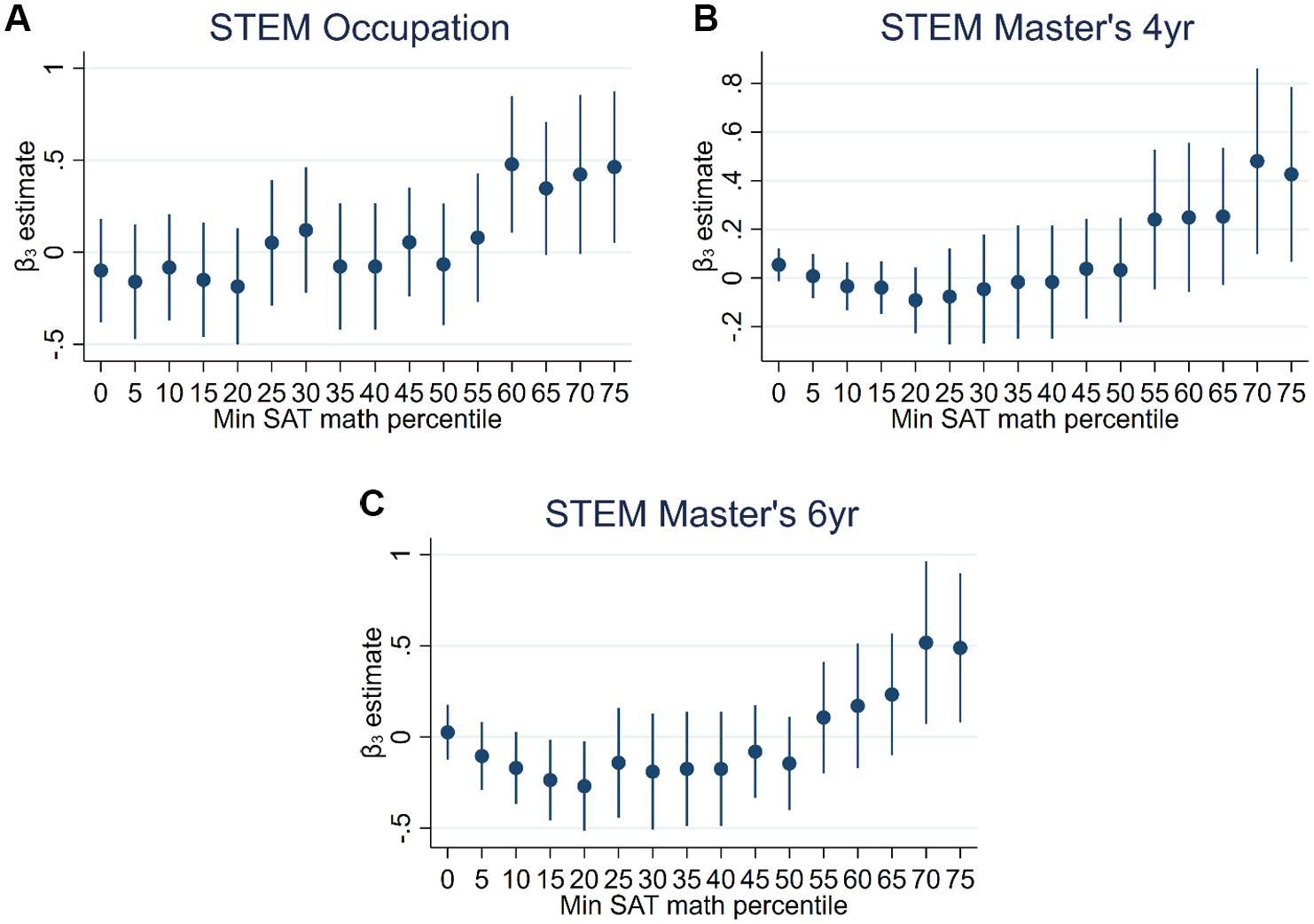
SAT Math Cutoff Sensitivity, Postgraduation Outcomes
Supplemental Material
sj-pdf-1-ilr-10.1177_0019793921994832 – Supplemental material for The Effects of Professor Gender on the Postgraduation Outcomes of Female Students
Supplemental material, sj-pdf-1-ilr-10.1177_0019793921994832 for The Effects of Professor Gender on the Postgraduation Outcomes of Female Students by Hani Mansour, Daniel I. Rees, Bryson M. Rintala and Nathan N. Wozny in ILR Review
Footnotes
Acknowledgements
We thank Bill Bremer and Beth Wilson for their assistance in obtaining the data for this project. We also thank the participants of the Association for Public Policy Analysis and Management 2018 Fall Research Conference and the second IZA Workshop on Gender and Family Economics for helpful comments and suggestions. The views expressed are those of the authors and do not necessarily reflect the official policy or position of the U.S. Air Force Academy, the U.S. Air Force, the Department of Defense, or the U.S. Government. PA#: USAFA-DF-2020-44.
For information regarding the data and/or computer programs used for this study, please address correspondence to the lead author at
1
2
3
See also Gaule and Piacentini (2018), who found that female PhD candidates who worked with female advisors were more likely to pursue an academic career, and  , who found that random assignment to a Black teacher increased the likelihood of Black students graduating from high school and enrolling in college.
4
5
The academic composite score is a weighted average of two academic performance factors: 1) prior academic record (PAR) and 2) college admission test scores. The PAR is a measure of academic performance based on a combination of high school class rank, high school grade point average (GPA), and the quality of the high school attended. College admission test scores include the scores earned on either the SAT reasoning test (verbal and math) or the ACT test (English, reading, math, and science reasoning). The leadership composite score is computed by the USAFA admissions office and measures high school leadership activities such as student council offices, Eagle Scout participation, and captaining a sports team. The fitness score is from a fitness assessment required of all students prior to admittance. See Carrell et al. (2010) or for more details on the academic composite, leadership composite, and fitness test scores.
6
Rated occupations include pilot (both conventional and unmanned), navigator, combat systems operator, and air battle manager. Hereafter, we refer to all rated occupations as “pilots.”
7
The matching algorithm has the joint objectives of satisfying Air Force staffing needs, ensuring the student is qualified for the job to which he or she is assigned, and meeting student preferences. Students must satisfy eligibility requirements for an occupation before listing it. While many occupations are open to all students, some require a specific academic degree (e.g., listing “physicist/nuclear engineer” requires a bachelor’s degree in physics, astronomy, astrophysics, engineering physics, or nuclear physics). lists all the occupations observed in our data. Of the 178 distinct occupations listed, 9 are defined as STEM and 169 (including pilot) are defined as non-STEM. The algorithm gives more weight to the occupational preferences of the highest-ranked students within a graduating class. Class rank is primarily determined by GPA.
8
In the data, 84 students have an initial occupational assignment coded as “graduate study,” out of which 80 were awarded a graduate degree. Although we do not observe their field of study, we can infer that 57 were awarded a STEM graduate degree. As we report in , the results do not significantly change if we instead classify “graduate study” as STEM or if we classify the initial assignment as STEM for the 57 students who earned a STEM graduate degree.
9
10
Even though pursuing an advanced degree is not typically required of USAFA graduates, it does increase the likelihood of promotion. See Switzer (2011) and the Air Force Times () for more information detailing the Air Force policies towards the obtainment of advanced academic degrees.
11
The USAFA school year comprises three semesters (spring, summer, and fall) and our data on academic outcomes cover five years, or 15 semesters (t = 1,2,3…15).
12
For instance, 26% of high-ability students went on to work in a STEM occupation as compared to 18% of students in the bottom quartile of the ability distribution. In the middle two quartiles of the ability distribution, 16% and 18% of students went on to work in a STEM occupation.
13
β3 represents the effect of increasing the fraction of first-year female professors from 0 to 100% for female students relative to their male counterparts. The estimated effect of increasing the fraction of first-year female professors by 20 percentage points is 0.2 × 0.665 = 0.133, which is 36% of the 0.371 gap.
14
15
β2+β3 represents the effect of increasing the fraction of first-year female professors from 0 to 100% on the probability that female students worked in STEM. The estimated effect of increasing the fraction of first-year female professors by 20 percentage points is 0.2 × (–0.196 + 0.463) = 0.053.
16
The estimate of β3 in column (1) of Appendix Table A.3 shows that professor gender does not affect the likelihood that high-ability female students start their career in a STEM occupation. In the next two columns of Appendix Table A.3, we experiment with different definitions of starting in a STEM occupation. Specifically, in column (2) we change the initial assignment of 84 students from “graduate study” to “STEM occupation” irrespective of the degree earned. In column (3) we change the initial assignment of 57 students from “graduate study” to “STEM occupation” based on the graduate degree they obtained. Although the estimates of β3 increase, they remain statistically insignificant. In the remaining columns of , we examine the relationship between professor gender and working in a STEM occupation within two, four, and six years of graduating.
17
To predict earnings, we used data from the ACS for the years 2014 to 2017 and limited the sample to respondents ages 25 to 31 who had completed at least a bachelor’s degree. We excluded respondents employed by the US military and part-time workers. Part-time employment was defined as working 26 or fewer weeks per year. In addition, we dropped respondents who reported usually working less than 30 hours per week or more than 75 hours per week. Finally, workers who reported less than $2,000 in earnings or more than $180,000 in earnings were excluded from the analysis. Predicted earnings were calculated at the 3-digit SOC occupation code level and by highest completed degree (i.e., BA, MA, or above).
18
19
Controlling for academic performance and graduating with a STEM bachelor’s degree reduces the estimate of β3 from 0.426 to 0.270 (). We interpret this result as suggestive evidence that academic performance and major choice mediate the effect of professor gender on the receipt of STEM graduate degrees.
20
The 5-year active-duty service commitment is for non-pilot occupations. Pilots have a 10-year active-duty service commitment after successful completion of pilot training. The mean years of active-duty service in our sample was 8.5.
References
Supplementary Material
Please find the following supplemental material available below.
For Open Access articles published under a Creative Commons License, all supplemental material carries the same license as the article it is associated with.
For non-Open Access articles published, all supplemental material carries a non-exclusive license, and permission requests for re-use of supplemental material or any part of supplemental material shall be sent directly to the copyright owner as specified in the copyright notice associated with the article.
