







Abstract
Industrial relations (IR) scholars emphasize the strategic choices of industrial relations actors to explain IR processes and outcomes. This article asserts that union member satisfaction is critical to realize unions’ objectives and that the local union and work context shapes satisfaction. The authors study the 2019 national UAW strike against General Motors in two, at first sight, very similar union locals. Union members of one local approved the agreement while the other local rejected the agreement. Through quantitative and qualitative analysis, the authors explain the different outcomes. Their analysis of a unique worker survey conducted during the strike shows that general member satisfaction was an important dimension for supporting the union’s strategic choices. Qualitative case studies of the two locals highlight the importance of shares of transfer workers—“invisible divides”—when examining member satisfaction. Broadly, findings contribute to the strategic choice literature and emphasize the local union context as a key locus for producing successful outcomes.
Keywords
According to the strategic choice literature (Kochan, McKersie, and Cappelli 1984), actors at different levels make strategic choices that shape industrial relations processes and outcomes. Although strategic choice scholars initially focused on the active role played by management, subsequent studies have emphasized the strategic choices of unions (e.g., Weil 2005; Boxall 2008). This literature has tried to show how the strategic choices—under the right conditions—can lead to beneficial outcomes for workers. Two conditions are critical when trying to predict successful strategic outcomes: the external context and the internal organizational capacity (Weil 2005). In this article, we build on the strategic choice framework and emphasize the importance of general member satisfaction, specifically by examining the local union–member relations and local work context. In essence, we conduct an in-depth and multi-method comparative case study of the 2019 strike at General Motors (GM) focusing on two—at first sight—very similar, large United Automobile, Aerospace and Agricultural Implement Workers of America (UAW) union locals in Lansing, Michigan.
In the 2019 negotiations, the UAW at the international level made a strategic choice to demand an end to the two-tiered compensation system and the extensive use of temporary workers, and on September 15, 2019, approximately 48,000 UAW members walked off the job at 50 GM plants across the United States. Among UAW’s other demands were general improvements of the wage structure and health care benefits, changes to GM’s investments, and the reversal of decisions to un-allocate plants. The strike was meant to put maximum pressure on the employer during a time of great profitability for GM. After 40 days on strike, a new four-year contract was ratified on October 25, 2019, with 57% of workers voting in favor and 43% voting against the contract. At that time this was the longest nationwide UAW strike against GM since 1970 and the first national strike since 2007.
Notably, the members of one Lansing, Michigan, local voted in favor of the contract, while the members of the other Lansing local rejected the contract. We ask, therefore, what explains this difference in member voting behavior across these two very similar locals. This question is critical as it can shed light on important but perhaps not immediately visible differences in the relationship between the strategic choice of the international union leadership, worker support for these choices at the local level, and—ultimately—the likelihood of strategic success.
We obtained unique access to multiple types of data on the two locals during and after the strike. First, the locals allowed us to conduct a survey of UAW workers during the GM–UAW strike. The survey provided quantitative evidence on the extent to which the workers were generally satisfied with their local union and how satisfaction affects the workers’ perceptions on the unions’ key strategic objectives in the negotiations. Next, we conducted qualitative case studies of the two locals based on leadership interviews and archival data to examine the differences across the two unions. In the course of our case study, we paid attention to the local work context when examining member satisfaction, more specifically the varying number and composition of transfer workers across the two locals.
We make three important contributions. First, we add general member satisfaction to the strategic choice literature. Members’ priorities usually enter in the strategy formulation stage of unions (Weil 2005: 330). In the strategic choice literature—and labor negotiations literature more generally (Walton and McKersie 1965; Kochan 1992)—there is a reasonable assumption that alignment between member priorities and union strategic choices can lead to a mutually reinforcing relationship between members’ support for these choices and a likelihood that these strategies will prevail. For example, in a strike, union leaders engage in intraorganizational bargaining (Walton and McKersie 1965) with members to foster satisfaction with bargaining objectives. Higher satisfaction, in turn, can strengthen workers’ resolve on the picket line and force employers to cede to their demands. In addition, we show that general member satisfaction by itself, that is, independent of bargaining objectives, may be an important organizational resource for strategic success. Making or keeping members satisfied in a general sense should be an independent strategic objective that will help the union realize other objectives, for example, in collective bargaining.
Second, leveraging the distinct voting patterns in the two locals and using a deep historical analysis, we show the importance of the local work context in producing general membership satisfaction and, relatedly, unions’ ability to achieve their strategic objectives. Specifically, we were able to collect unique transfer data across the two locals and identify the importance of transfer workers, or workers relocated from other plants to the GM plants in Lansing, and the challenges these “invisible divides” within the workplace create to achieve member satisfaction. This important contextual factor is often overlooked in studies on membership satisfaction.
Finally, we contribute to the strategic choice literature by articulating the link between levels in the theory. While the strategic choice framework could be used for any type of day-to-day decision-making, it becomes especially pertinent when analyzing a strike. When union leadership at the highest level makes the strategic decision to go on strike, it is one of the most radical actions within their repertoire to achieve their key objectives. The context of the GM–UAW strike therefore allows us to link the strategic choice of the national union to their key objectives and, especially, to capture how general member satisfaction at a local level inhibits or enables the realization of the union’s strategy at the national level.
Trade Unions and the Strategic Choice Framework
Given the changes that occurred during the 1980s across the US economy as well as at the workplace level, Kochan et al. (1984) re-examined the prevailing industrial relations paradigm of that time. They famously argued that the environment, bargaining structures, and organizational characteristics could only partially explain the dynamics within our industrial relations system (e.g., why did unions decline over time?). Instead, it is important to focus on the strategy or the strategic choices of the industrial relations actors across the various levels of decision-making. According to the authors, these choices might be made at one level (e.g., macro level), with the effect appearing at other levels (e.g., micro levels). While Kochan et al. (1984) focused mainly on the strategic choice of management, other scholars started to build on their framework to show how unions can regain power and influence (e.g., Weil 2005; Boxall 2008).
In essence, unions will make choices and develop strategies that advance their central objectives. These objectives are likely formed around meeting their members’ interests and priorities, maintaining and potentially expanding their membership, as well as gaining bargaining power vis-à-vis external actors to meet those interests and demands (Katz, Batt, and Keefe 2003). According to industrial relations scholars, two important dimensions, however, will shape the strategies.
First, scholars have illustrated the importance of the external environment. In other words, unions will develop strategies that fit the environmental conditions they face to reach their core objectives (Katz et al. 2003). A hostile external environment will make it much harder for unions to reach their strategic objectives successfully, whereas a benign environment might make it easier. Moreover, the external environment consists of the structure of the industry, the labor market, and the regulation that is in effect.
In highly unionized environments and where bargaining historically has been centralized, such as the auto industry, unions have to a certain extent been powerful to reach their objectives and influence corporate strategic decision-making (Kochan et al. 1984; Katz and Colvin 2021). Even as competition from foreign cars increased and labor costs became an important issue, the Big Three (Ford, Chrysler [now Stellantis], and General Motors) companies were not able to set up non-union auto plants in the US South because of bargaining arrangements that granted voluntary union recognition in any new auto plant. That said, however, over time these unions were confronted with structural challenges. For example, the industry is seeing significant growth of non-union employment, while at the same time, facing shrinking employment within the Big Three, the threat of outsourcing, and intensified competition from transplants (Katz, MacDuffie, and Pil 2013). As a result, the strategies to reach their objectives might not always lead to positive outcomes or might have shifted (see, for example, Dupuis and Greer [2021], which focuses on the union strategy of insourcing as a means to secure work and investment for autoworkers).
Second, beyond the external environment, scholars have pointed to internal factors or the organizational capacity of the unions in reaching their objectives. For example, Weil (2005) argued that unions with high internal organizational capacity are more likely to reach their objectives successfully than those with low organizational capacity (especially when combined with a relatively stable external environment). The author specifically refers to the unions’ internal organizational structure or how the union commits its resources toward its objectives, the union’s own human resources system, and its reporting relationships with its elected representatives and staff. For example, the Teamsters’ successful strike against UPS in 1997 was the result of their high internal organizational capacity, consisting of a yearlong, intense internal organizing among their members prior to the strike, as well as framing the strike in an effective way (Greenhouse 1997; Weil 2005).
Note, however, that although scholars have highlighted that members’ interests and priorities are channeled into the strategy of unions—a strategy that might occur at the higher levels (e.g., Weil 2005)—the strategic choice framework does not address the role members at a local level actually play in enabling or blocking the realization of the key objectives. This role becomes especially pertinent during a strike as members can vote in favor or reject the proposed agreement. In other words, within the strategic choice literature, besides the external environment and internal organizational capacity, it becomes important to understand the overall member satisfaction with the local union, or more specifically, the local work context and union–member relations, as this might enable or inhibit the union to realize its objectives.
Union Satisfaction and the Local Work Context
The strategic choices to call a strike and to settle on a contract to end the strike take place at the national UAW level. However, support for the strike, the contract, and ultimately the contract ratification takes place in a local context and is influenced by the general member satisfaction locally. Our argument about the main constructs linking strategic choices at the national level with general member satisfaction at the local level is illustrated in Figure 1.
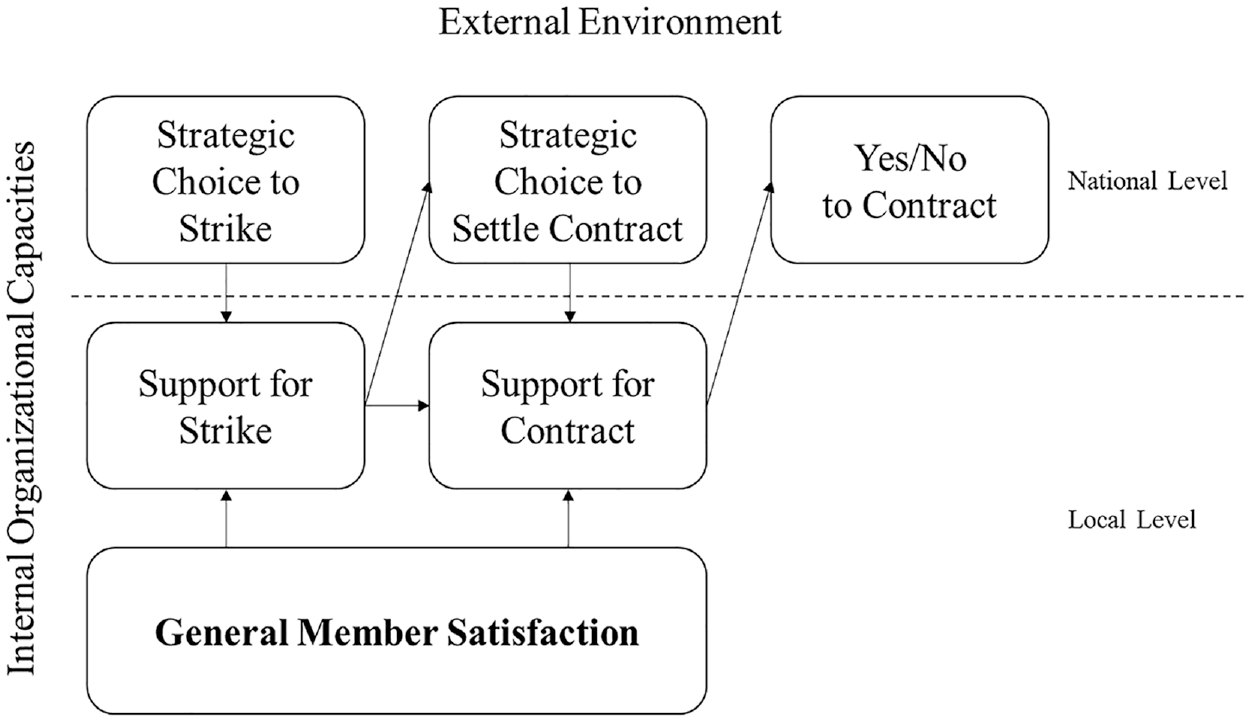
Strategic Choices and Member Satisfaction at National and Local Levels
A vast literature examines union satisfaction (Fiorito, Gallagher, and Fukami 1988; Jarley, Kuruvilla, and Casteel 1990; Lévesque, Murray, and Queux 2005), with scholars using various definitions to describe this concept. Some have focused on an interest-based approach toward union satisfaction, referring to the extent of alignment between union member expectations and perceived outcomes or union performance (e.g., Fiorito et al. 1988). Here, researchers often point toward union performance around specific issues (e.g., bread-and-butter issues) and the members’ expectations as well as the perceived outcomes with regard to these issues (e.g., Fiorito et al. 1988). Others have used a more general sense of union satisfaction and consider the concept as “the overall affective orientation of individual union members toward the union to which they belong” (Leicht 1989; italics added). Lysgaard ([1961] 2001), for example, showed that the existence of strong collectivism among co-workers could be an important resource of unions, even though the collectivism existed independently of the union. This perspective means that regardless of unions’ specific choices and strategies, workers feel a sense of satisfaction and loyalty and thus might follow the union even in situations or on topics that do not concern them or might go against their own interests. In this article, analytically as well as empirically, we follow the latter more general definition of union satisfaction.
The union itself can be a “loyalty-producing” mechanism that affects union satisfaction (Leicht 1989). Scholars have often highlighted two main dimensions: union–member relations and worker’s bread-and-butter issues. First, union–member relations have been considered a major determinant of satisfaction with union representation (Jarley et al. 1990). This concept covers issues such as union leadership, union–member communication, and the extent to which members can have a voice in how the union is run, and is closely related to union democracy or unions being responsive and accountable to their members (e.g., Lipset, Trow, and Coleman 1956; Lévesque et al. 2005). Internal political practices such as high levels of voter turnout emphasize rank-and-file voice and indicate internal democracy (Levi, Olson, Agnone, and Kelly 2009).
Along similar lines, scholars have argued that democratic constitutional procedures by themselves do not necessarily guarantee union democracy (Voss 2010). Instead, they have emphasized behavioral indicators such as the presence of contested elections or institutional opposition (Lipset et al. 1956) or the turnover of union officials (Edelstein and Warner 1976) as better indicators for union democracy and thus membership satisfaction. Specifically, within a GM–UAW context, workers are likely to have been dissatisfied with the UAW following the corruption scandal that broke in 2017, and mistrust toward union leadership might have deepened within the union membership (e.g., Slaughter 2019; Feliz Leon and Slaughter 2023).
Second, scholars have showed how individual workers’ wages, benefits, and job security affect whether workers feel satisfied about the union (Fiorito et al. 1988). In other words, if workers perceive their wages and benefits inferior, or feel job insecure, they might feel their union is not doing enough and thus feel dissatisfied. For example, a long-standing bread-and-butter issue in the case of autoworkers has been the two-tiered compensation system introduced in 2007, which has likely led to union dissatisfaction (e.g., Bradbury 2015).
In addition, scholars have pointed toward the work context or the specific work setting that produces an allegiance (or not) to the union as well as feelings of loyalty (or not) toward the union, which are important components of union commitment and satisfaction (Leicht 1989). In general, workers who are not happy with their job or co-workers tend to be dissatisfied with their union (Barling, Fullagar, Kelloway, and McElvie 1992). In other words, unions are being blamed for unsatisfying working experiences and therefore union satisfaction declines. In this sense, organizational characteristics that help or hinder interaction between workers as well as the extent of integration in the work setting can increase or reduce union satisfaction. Studies have shown, for example, that the presence of quality circles might increase worker integration and communication, while plant size and excessive levels of bureaucratization might decrease union satisfaction (Edwards 1979; Leicht 1989).
Little attention has been given to possible differences in worker composition, however, specifically between groups of union members within a workplace setting. Most studies involve full-time employed union members, and just a few have focused on a potential difference in union attitudes between full-time and part-time members. Here the results are mixed. Some scholars found no significant difference between full-timers and part-timers (Goslinga and Sverke 2003), while others found that full-timers exhibited a higher level of union commitment (Gallagher, Tansky, and Wetzel 1997).
Within the auto industry specifically, a less visible difference between union members is their transfer status. Studies on transfer workers have shown the negative effects of a relocation on workers in terms of their psychological and physical well-being (Moyle and Parkes 1999). Furthermore, a relocation could be considered a breach in the workers’ psychological contract, leading to emotional exhaustion and job dissatisfaction (Gakovic and Tetrick 2003). In line with the psychological contract literature (Guest 2004), the perception of what the employees owe to the employer and the employer to them—for example, hard work in return for loyalty—is now being undermined by altering the employment relationship (Robinson 1996) which, in turn, could reduce satisfaction with the union (Barling et al. 1992). Furthermore, scholars have also examined how these psychological effects spill over in their next employment and might lead to higher voluntary turnover as employees have fewer expectations toward their new employer regarding their reciprocal obligations (e.g., Davis, Feng, and Trevor 2013; Davis, Trevor, and Feng 2015).
Relocation could also lead to feelings of alienation (Nair and Vohra 2012; de Jong et al. 2016). Relocated employees find themselves in a new environment in which they experience their work as separate from the rest of their existence (Marx [1844] 1969). In other words, workers feel powerless as they do not have control over the work they do; they might feel their work is meaningless, and therefore might feel self-estranged because their work is not self-fulfilling (Bamberger et al. 2012; Nair and Vohra 2012). As scholars have shown, work alienation likely leads to low levels of job satisfaction and organizational commitment (Guest 2004). Notably, transfer practices could be considered “estranging processes” or work conditions that induce alienation (Sarros et al. 2002).
Finally, some scholars have studied the effect of transfer workers toward union commitment more specifically (Phillips, Curtiss, and Lundskow 2010, 2014). These studies, focusing on relocations within the auto industry, showed that relocated workers tend to be less satisfied and involved in their union than workers who did not transfer. Because of the transfer, the relocation likely disrupted their working and living conditions. These workers were not able to keep their original jobs and might not have the job they wanted in their new workplace. As a result, they perceive the union as ineffective, which contributes to lower levels of satisfaction (Barling et al. 1992). Figure 2 summarizes the many factors that may affect general member satisfaction at the local level.
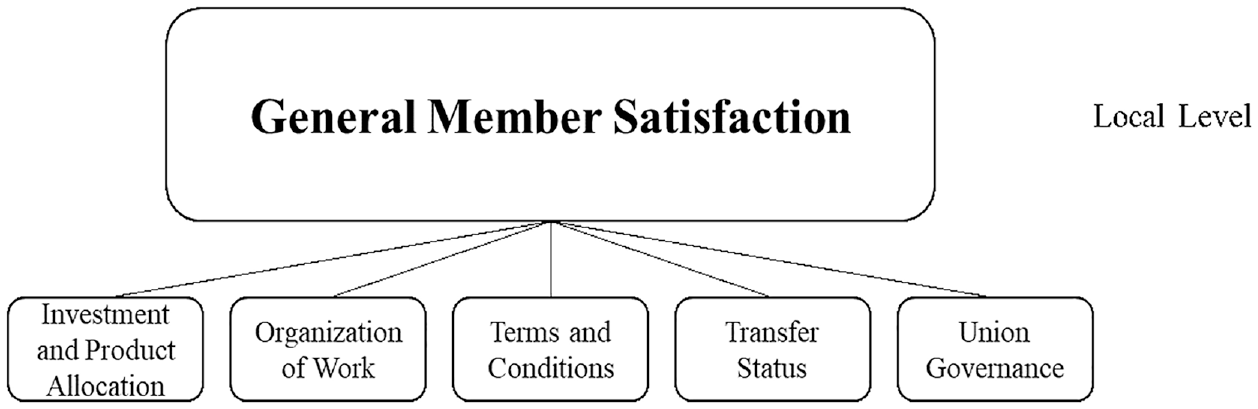
Local-Level Factors Influencing General Member Satisfaction
In sum, scholars have emphasized the importance of industrial relations actors and their strategic choice in reaching their objectives. They have also shown how the strategic choice is shaped by the external environment and the internal organizational capacity. An overlooked dimension, however, is how general member satisfaction at the local level lends support to the union’s objectives. We argue that union satisfaction is partially determined by union–member ties, which are set within a specific local context. This means we need to pay attention to certain structural elements in this context that influence satisfaction levels. When focusing on the auto industry specifically, the presence of transfer workers is one of these structural elements that is often overlooked. In other words, this becomes an often invisible part of the context that affects union–member ties and therefore general union satisfaction. Next, we describe our research context and spell out our quantitative and qualitative analyses.
Research Context and Puzzle
This study focuses on the 2019 GM–UAW strike and particularly on two local unions, both located in Lansing, Michigan. The UAW Local 652 at the Lansing Grand River Assembly (LGRA) and stamping plant represents approximately 1,500 assembly line and skilled trades workers. LGRA was constructed in 1999 and is GM’s second-newest US assembly plant. The UAW Local 602 at the Lansing Delta Township (LDT) plant represents approximately 2,200 assembly line and skilled trades workers. LDT opened in 2006 and is GM’s newest plant in the United States. These two locals have a long history and were both chartered in 1939. Their union halls are less than one mile apart on the west side of Lansing, Michigan. Beginning in November 2008, two years after LDT began production, both plants were overseen by the same plant manager. This arrangement ended in June 2016 (Wieland 2008; Alusheff 2016). Furthermore, as our survey data will show, both plants have a very similar demographic membership composition in terms of workers’ average tenure, age, gender, and race.
Despite the two locals’ geographical proximity and to a certain extent similar economic conditions (e.g., the locals did not face different economic stressors in terms of potential disinvestment), when voting whether to ratify the 2019 GM–UAW Agreement, a majority (approximately 59%) of the workers at Local 602 voted “no,” whereas a majority (about 75%) of the workers at Local 652 voted “yes.”
Before we discuss our quantitative and qualitative analyses to better understand this outcome, we provide a broader background picture that shows how the two locals have often fared differently in terms of support to the strategic choices of the UAW. 1
Background: History of Collective Bargaining in Two Locals
Historically, the UAW International bargains national contracts with the Big Three automakers every four years. Since World War II, the UAW International has used pattern bargaining as their strategy in the auto industry. The UAW usually selects one company on which to concentrate their efforts, and the agreement with the designated company will set the pattern for the other two automakers. 2
To understand the history of the GM–UAW collective bargaining agreements, it is helpful to review the national contract negotiations beginning in 2007. The 2007 agreement was reached after UAW workers nationwide went on strike against GM for two days. The union at the international level faced a strategic choice between ensuring job security and growing wages. They chose the former, but in order for GM to agree to keep work at GM–UAW plants, the union agreed to a heavily reduced wage and benefit structure for entry-level employees. After the tentative agreement was reached, both sides believed they had solved several difficult problems.
Only one year later, however, all the problems that the UAW and GM thought were solved at the bargaining table were replaced by a crisis that threatened the very survival of the company. In September 2008, the auto industry was crippled as sales dropped to a 40-year low. The UAW and GM were forced back to the bargaining table and it was obvious from the beginning of the negotiations that if the parties failed to reach an agreement, it would spell the end of General Motors. The plan included the closing of 13 US plants, and 22,500 GM employees lost their jobs. Despite all the cuts, the agreement was approved by a 74% “yes” vote (Higgens and Hyde 2009). One other legacy clause that was part of the modifications would play a very important role in the 2011 negotiations: binding arbitration.
In essence, with the binding arbitration clause in place, there could not be a strike against GM during the 2011 negotiations. Thus, the ability of the union negotiators to win back any of the cuts that were made during the bankruptcy process was severely limited. Instead, the UAW focused on improving the profit-sharing formula, getting GM to commit to more investment in US facilities, and attempting to reduce the gap between entry level and traditional employee wages. The 2011 agreement was ratified with a 64% “yes” vote. The contract was rejected by only two UAW chapters: Local 602 from Lansing, and a small local from Indianapolis that was shutting down later that year (Bunkley 2011).
The 2015 national negotiations opened with the hope that the negotiations would return to normal after eight years of tumultuous changes. Chrysler (as Fiat Chrysler Automobiles [FCA]) was selected as the target company. A tentative agreement was reached and included the first wage increases for traditional workers since 2007. The agreement also put entry-level workers on a path to near wage parity and improved their benefit package. On October 1, 2015, however, the UAW announced the rejection of the tentative agreement with 65% voting “no” (Priddle, Gardner, and Snavely 2015). This was the first rejection of a national auto agreement since 1982. The union took a number of steps, including hiring a public relations firm, to better explain what was in the contract to local union leadership and the rank and file, and the agreement passed on October 22 with 77% voting “yes” (Priddle and Snavely 2015).
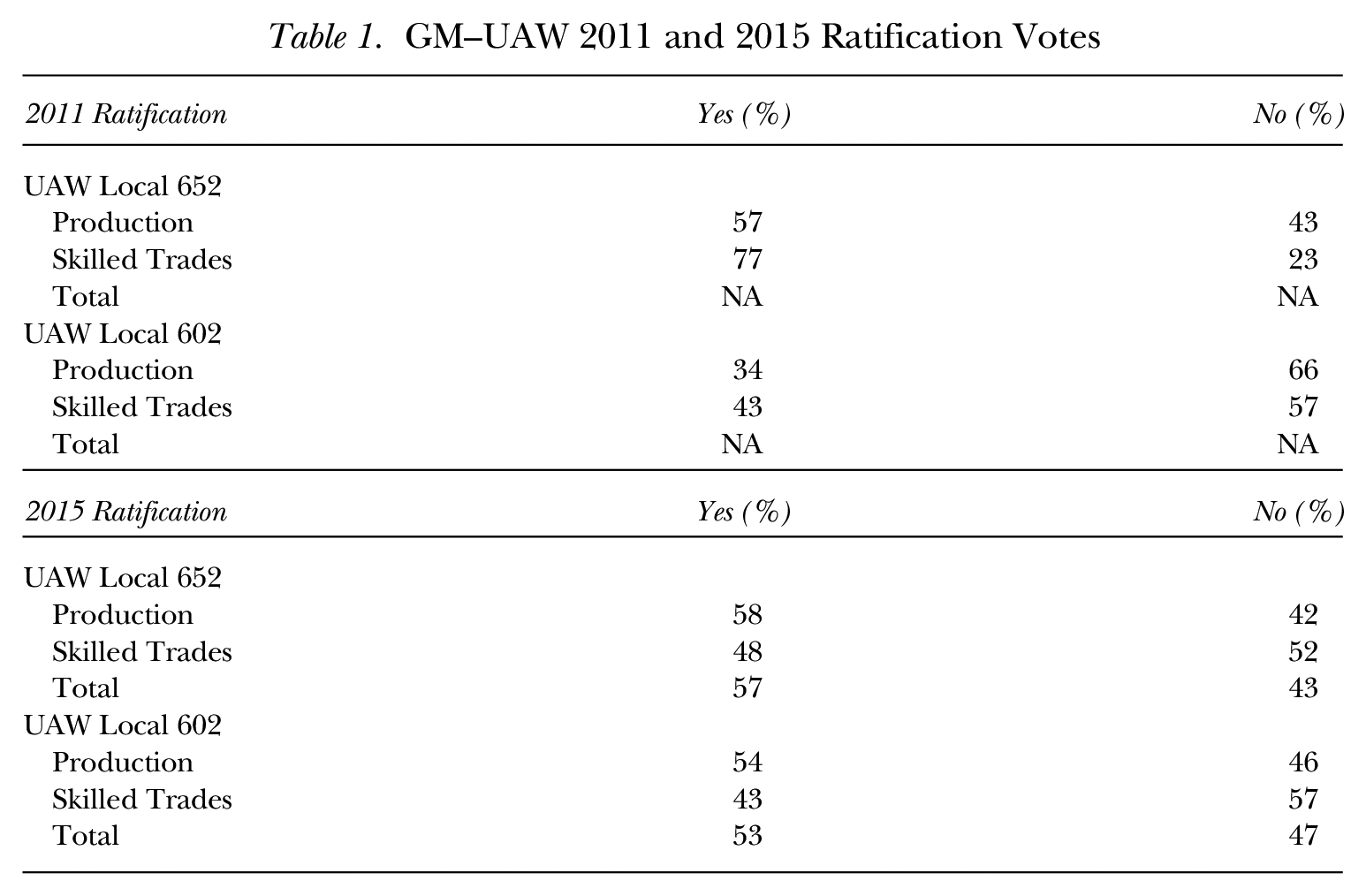
Normally, after the first agreement is settled, the other two auto contracts are concluded in short order. In 2015, however, this was not the case. GM was the next company and a tentative agreement was announced on October 25. On November 6, the vote was announced and it was a split decision with 55% of production workers voting for the agreement, but 60% of the skilled trades voting “no” (Burden 2015). At the UAW Local 602, 54% of the production workers approved the agreement but the skilled trades rejected the agreement with 57% voting “no” (Burden and Wayland 2015). At Local 652, 58% of the production workers voted “yes,” whereas 52% of skilled trades voted against the agreement (GM Authority Staff 2015). The UAW International Executive Board went through a three-step process to determine what the reasons were for the rejection and their legitimacy. After going through the process, the UAW International declared that the GM–UAW agreement was ratified on November 20 without another vote (see Table 1). 3
GM–UAW 2011 and 2015 Ratification Votes
In the summer of 2017, federal indictments of UAW Chrysler officials and their management counterparts were announced. This scandal spread to GM and set the stage for further worker discontent. At the same time, GM was making large profits again but wanted to cut its health care costs and hire more temporary workers. Together, these elements played a big factor for the 40-day nationwide strike in 2019 (Slaughter and Brooks 2019).
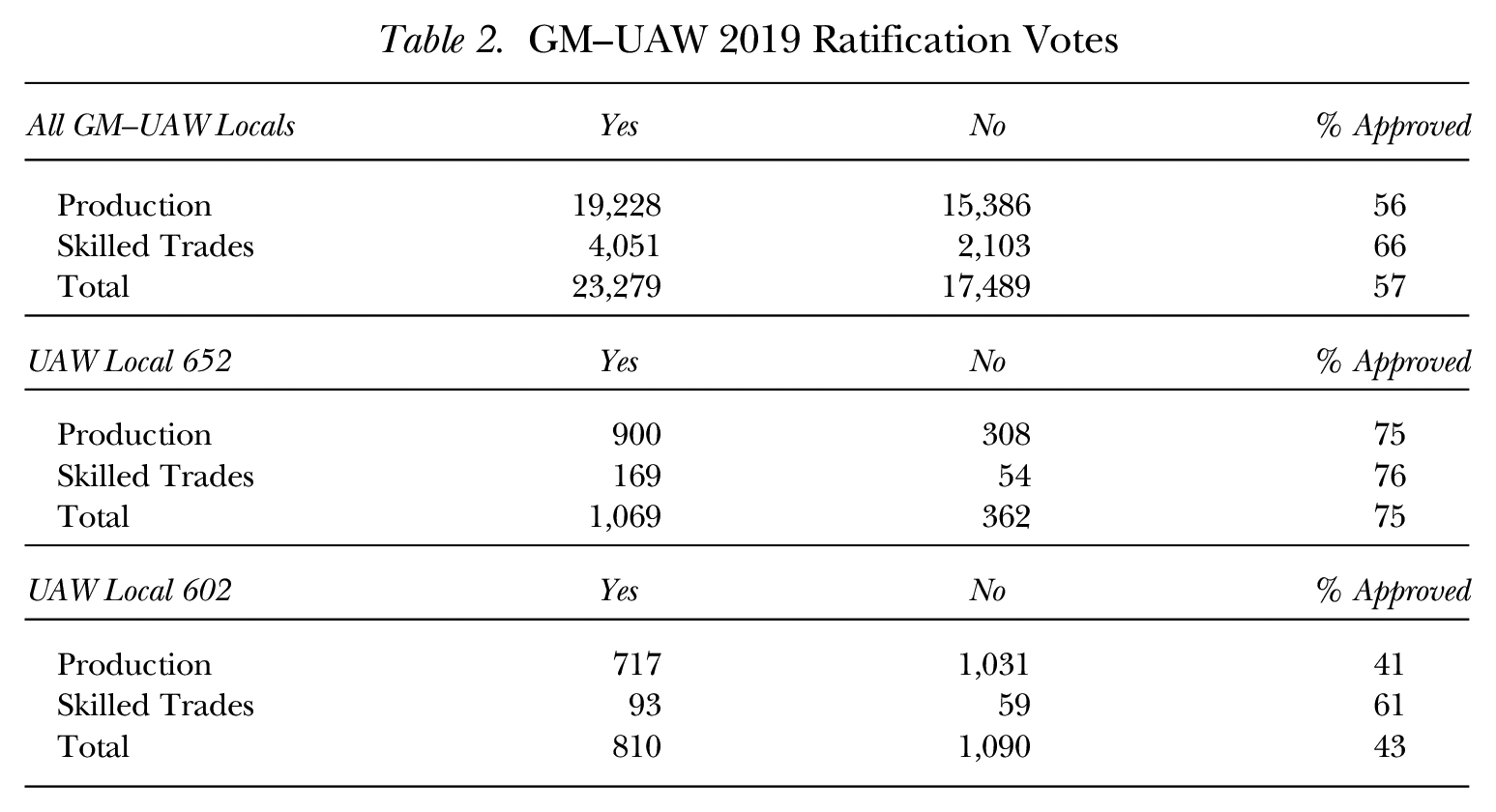
Finally, the ratification vote for the 2019 GM–UAW National Agreement marked another contract that Local 602 voted against. Overall, 16 locals passed the 2019 National Agreement while 12 locals voted it down. Although no single reason for this division among locals has been identified, scholars have argued that some of the “no” votes were driven by the lack of clear investment by GM and workers’ fear of being closed down (Elk 2019; LaReau 2019), workers holding out for more, such as saving shut-down US plants or bringing back production from Mexico to the United States (Lutz and Martinez 2019; Wall Howard and LaReau 2019), or wanting greater protection for temporary workers (LaReau 2019). Interestingly, however, others have mentioned that locals that have large numbers of transfer workers, for example, coming from Lordstown, Ohio, might have been another potential reason for a negative vote (Lawrence 2019). At the same time, they mentioned their surprise that Local 602 rejected the agreement given that this plant was offered specific product allocation (LaReau 2019). In fact, as shown in Table 2, 59% of Local 602 production workers voted “no” while 61% of the skilled trades voted “yes,” for a total vote of 57% “no.” Local 652 stands in contrast, with a total of 75% voting “yes” (Autonews 2019).
GM–UAW 2019 Ratification Votes
Historically, for the past three bargaining rounds—2011, 2015, and 2019—Local 602 has faced significant groups of workers rejecting the agreement, whereas workers at Local 652 have mostly accepted the agreements despite their seemingly similar economic conditions. To understand this puzzle, we engaged in quantitative and qualitative analyses. First, we analyze our unique survey data from the 2019 strike showing how different levels of union satisfaction in the two locals are main drivers of support for the strategic choices in collective bargaining. Second, through qualitative analysis, we provide a historical examination of the Lansing plants and trace the development of invisible divides related to sourcing of work to the two locals. Here we obtained access to another unique form of data of each local, specifically, the transfer worker data. We show that transfer or relocated workers are an important factor that is part of the local union context partially explaining different levels of local members’ satisfaction.
Quantitative Analysis: The GM–UAW 2019 Strike Survey
As the strike began, we visited the picket lines three or four times a week and talked with the workers as well as the union leadership of both Lansing locals to understand the members’ attitudes toward the strike. We were fortunate and able to build a relationship with the union representatives who allowed us to come in their union hall, where workers picked up their strike check, and distribute our survey. We collected data utilizing an in-person, paper-based survey. Between October 15 and 17, 2019, we administered the survey at the two local union halls (UAW Local 652 and UAW Local 602) participating in the strike. In this survey, we collected data on views on the strike, satisfaction with the UAW, co-workers and management, job type, and demographics. The sample size was 1,545 (44% response rate), and the locals resembled each other in terms of key demographics. The sample was 75.1% White, 14.1% Black, 7.84% Hispanic/Latino, 0.59% Asian, 1.4% Native American, and 0.07% Pacific Islander. Participants identified as 26.31% female and 73.69% as male. The age of participants ranged from 19 to 89 years, but we included an age restriction of 70 years to exclude retirees who might have filled in the survey. This approach resulted in an average age of 45.98 years (SD = 11.44) for our participants. The tenure of participants ranged from 0 to 50 years (M = 16.92, SD = 12.40).
Measures and Methods
We include three dependent variables in our study. We selected the first two dependent variables—bread-and-butter and temporary workers’ conditions—because they were the most salient claims of the UAW in bargaining (LaReau 2019). The former is a latent factor using multiple survey items, whereas the latter is a single-time variable. We selected the third dependent variable—negative reasons for being on strike—to show the mirror image of support for the bargaining strategies of the union (e.g., when members reported to be on strike because they felt forced).
Bread-and-butter reasons: We used three items to account for bread-and-butter reasons for being on strike: wage structure, GM’s investment in my workplace, and health care benefits. All items were measured on a Likert scale ranging from 1 (“Strongly disagree”) to 5 (“Strongly agree”). A sample item for bread-and-butter reasons for being on strike is, “I personally continue to be on strike because of GM’s investments in my plant.” Participants in the sample had the following average scores: wage structure (M = 4.18, SD = 0.99); GM’s investment (M = 3.95, SD = 1.09); and health care benefits (M = 4.33, SD = 1.00).
Temporary workers’ conditions reason: We used one item to measure if members were on strike because of the conditions of temporary workers. The item was measured on a Likert scale ranging from 1 (“Strongly disagree”) to 5 (“Strongly agree”). The item read, “I personally continue to be on strike because of the conditions of temporary workers.” Participants in the sample had an average score of M = 4.29, SD = 1.03.
Negative reasons: We used four items to account for negative reasons for being on strike: co-worker pressure, union pressure, no choice, and worries about disappointing others. All items were measured on a Likert scale ranging from 1 (“Strongly disagree”) to 5 (“Strongly agree”). A sample item for negatives reasons for being on strike is, “I personally continue to be on strike because of pressures from co-workers.” Participants in the sample had the following average scores: co-worker pressure (M = 1.71, SD = 1.03); union pressure (M = 1.74, SD = 1.06); no choice (M = 2.06, SD = 1.35); and worries about disappointing others (M = 1.77, SD = 1.15).
We include two focal independent variables: union satisfaction and belonging to either Local 652 or Local 602. The former is a latent factor variable. The latter is a single-item variable.
Union satisfaction: We used three survey items to account for union satisfaction: satisfaction with your UAW local, satisfaction with the UAW International, and satisfaction with your co-workers. All items were measured on a Likert scale ranging from 1 (“Strongly dissatisfied”) to 5 (“Strongly satisfied”). A sample item for Union satisfaction is, “Before the strike, I have been satisfied with my Local UAW.” Here, we take a broader view pertaining to the overall satisfaction with the union, to distinguish it from the specific bargaining goals or specific strategic choices of the union, and its ability to achieve these. Moreover, we include the item about co-workers to reflect the sense of belonging to a local worker collective (Lysgaard [1961] 2001). Participants in the sample had the following average satisfaction scores: UAW local (M = 3.65, SD = 1.11); UAW International (M = 3.12, SD = 1.18); and co-workers (M = 3.99, SD = 0.90).
Local union membership: We measured local union membership using a dummy-coded variable, coded as 1 for membership to local union 652, and 0 for local union 602. Local 652 accounts for 51.1% of the sample, even though it is smaller.
Control variables: We controlled for participants’ job tier (“traditional,”“mix of traditional and in-progression,”“in-progression,” and “does not apply to me”) by using a dummy-coded variable (1 = traditional, 0 = non-traditional; M = 0.58, SD 0.49). We controlled for participants’ race/ethnicity (“Asian,”“Black,”“Hispanic/Latino,”“Native American,”“Pacific Islander,” and “White”). Because of small numbers in many of the categories, we recoded the variable to a dummy (1 = white, 0 = non-white; M = 0.75, SD = 0.43). We controlled for participants’ gender using a dummy-coded variable (1 = male, 0 = female; M = 0.74; SD = 0.44). We controlled for tenure measured in years worked at GM (M = 16.925, SD = 12.40). We controlled for job category (i.e., production worker, skilled trades, temporary worker, or apprentice) via three dummy-coded variables with apprentice as the reference group. Finally, we controlled for satisfaction with local GM management using a single item measured on a 5-point Likert scale similar to that used for our measure of union satisfaction (M = 2.42; SD = 1.12).
Findings
We report descriptives and correlations in Table 3. We used structural equation modeling (SEM) in Mplus 8.10 to analyze the association between locals, union satisfaction, and support for bargaining strategies of the UAW. We chose this method for two reasons. First, it allowed us to test direct and indirect effects of satisfaction and locals, respectively. We wanted to know to what extent the levels of satisfaction mediated the effect of being in a particular local on the strategic objectives of the UAW. Second, SEM allows us to account for measurement error in the survey items by creating latent factors for union satisfaction and two of our dependent variables (bread-and-butter reasons and negative reasons).
Descriptives and Correlations
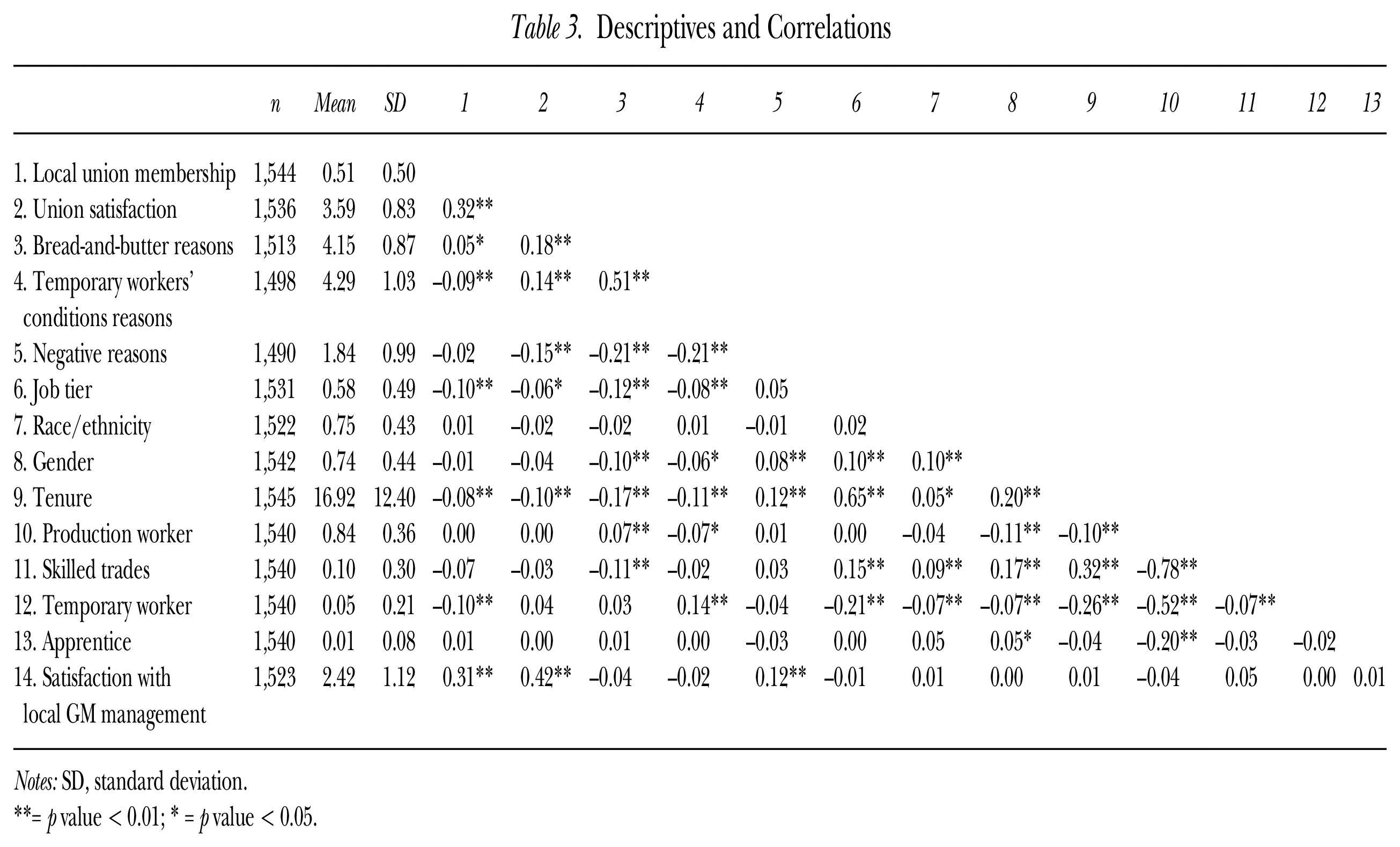
Notes: SD, standard deviation.
= p value < 0.01; * = p value < 0.05.
We first used SEM to test the fit of our measurement model, which included the latent factors for union satisfaction, bread-and-butter reasons, and negative reasons as well as the observed variables for local union membership and the temporary workers’ condition reason. In SEM, a measurement or structural model is compared against observed data, with several fit indices used to evaluate the model’s adequacy (Hu and Bentler 1999; Kline 2015). The chi-square test of model fit is a statistical assessment that tests the null hypothesis that the model’s estimated covariance matrix is not significantly different from the observed covariance matrix. A good fit is indicated when the chi-square value is low and the corresponding p value is high, suggesting that the model adequately represents the observed data. This test is highly sensitive to sample size, however, with larger samples often leading to significant chi-square values even for minor model misspecifications, making it less reliable in such cases. Our measurement model had a statistically significant value (p < 0.001) for the chi-square test, which was likely attributable to our large sample size. Thus, we used indices to further determine model fit. The comparative fit index (CFI) measures the model’s fit relative to a null model, with values closer to 1 indicating a better fit and values above 0.90 typically considered good. The Tucker-Lewis index (TLI), akin to CFI, also compares the model fit to a baseline model but penalizes model complexity, with values above 0.90 generally signaling a good fit. The root mean square error of approximation (RMSEA) evaluates fit per degree of freedom, accounting for model complexity, with values less than 0.05 suggesting a close fit and values up to 0.08 a reasonable error of approximation. The standardized root mean square residual (SRMR) represents the average discrepancy between observed and predicted correlations, with values below 0.08 indicating a good fit, and those below 0.05 representing a particularly strong fit. For our measurement model, these additional indices (CFI = 0.95, TLI = 0.93, RMSEA = 0.07, SRMR = 0.05) were within the thresholds that indicate a good fit.
Next, we analyzed our structural model estimates which included union satisfaction, local union membership, all three dependent variables, and our control variables. Overall, fit indices (χ2 = 598.65, df = 123, p < 0.01; CFI = 0.93; TLI = 0.91; RMSEA = 0.05; SRMR = 0.05) indicated a good fit. For all analyses, we used full information maximum likelihood (FIML) to estimate the missing data based on the data that was present (Newman 2014). FIML computes a likelihood function based on the variables that are present for a specific case to provide conditional estimates for missing scores. We used this process to account for missing data, as data were missing on some but not all variables. Finally, we use bootstrapping to test the indirect effects of local union membership on our three dependent variables (Preacher, Zyphur, and Zhang 2010; Preacher, Zhang, and Zyphur 2016). As a first indication of how the locals are an important context in shaping union satisfaction and, in turn, for the support of strategic objectives, Table 4 shows the results of t-tests comparing average scores for each union satisfaction item and overall union satisfaction between Local 652 and Local 602. These results suggest that the average union satisfaction score for Local 652 was 15.7% higher than the average union satisfaction score for Local 602.
Results of t-Tests of Union Satisfaction by Local Union Membership
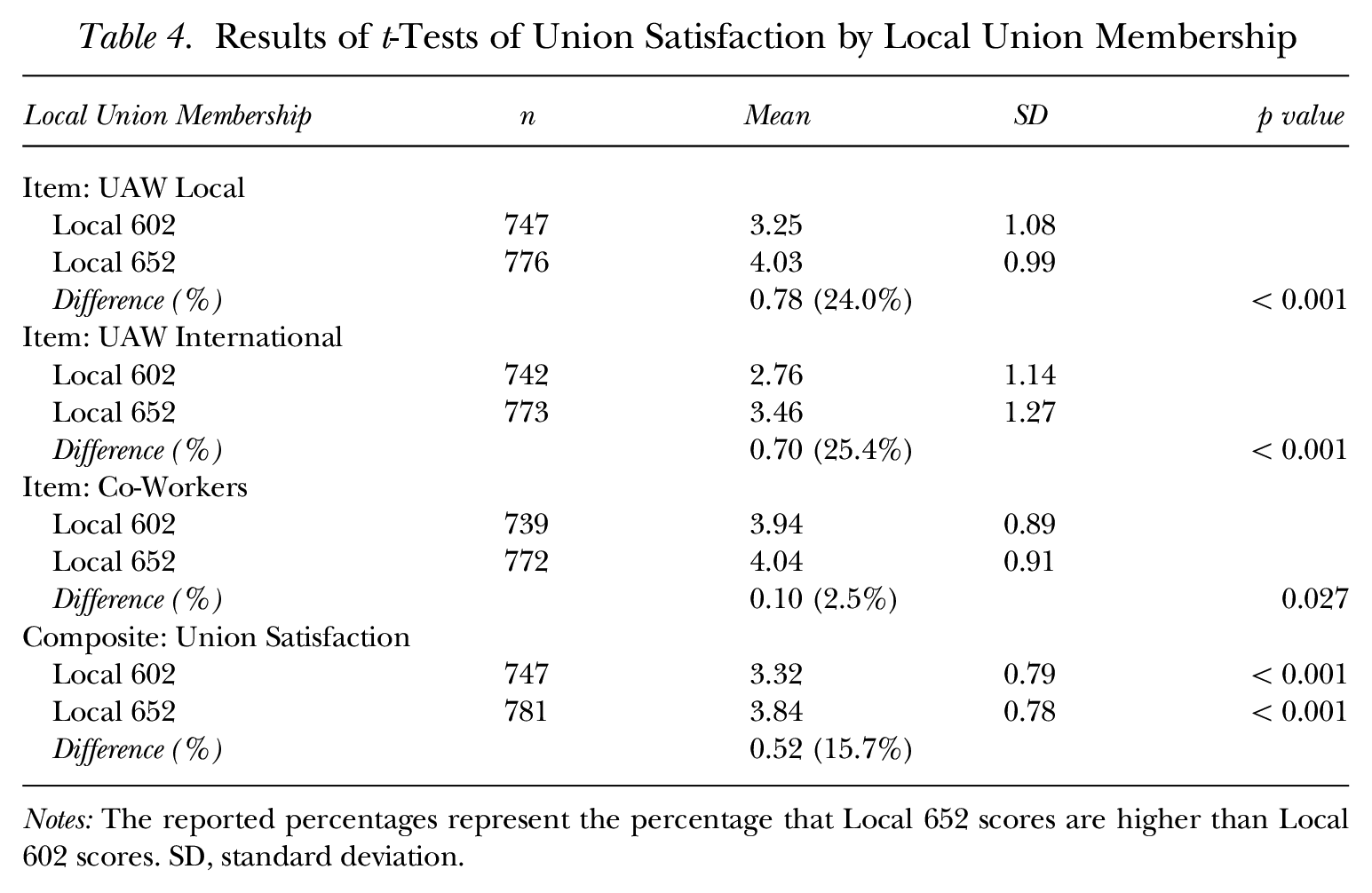
Notes: The reported percentages represent the percentage that Local 652 scores are higher than Local 602 scores. SD, standard deviation.
We now turn to the findings of the SEM analyses. Figure 3 represents our model including independent and dependent variables, but not control variables. Rectangle boxes represent observed variables; ovals represent latent factor variables. Solid lines depict direct effects and dashed lines depict indirect effects of local union membership through union satisfaction. All reported estimates in the figure were standardized estimates and statistically significant with p values less than 0.01.
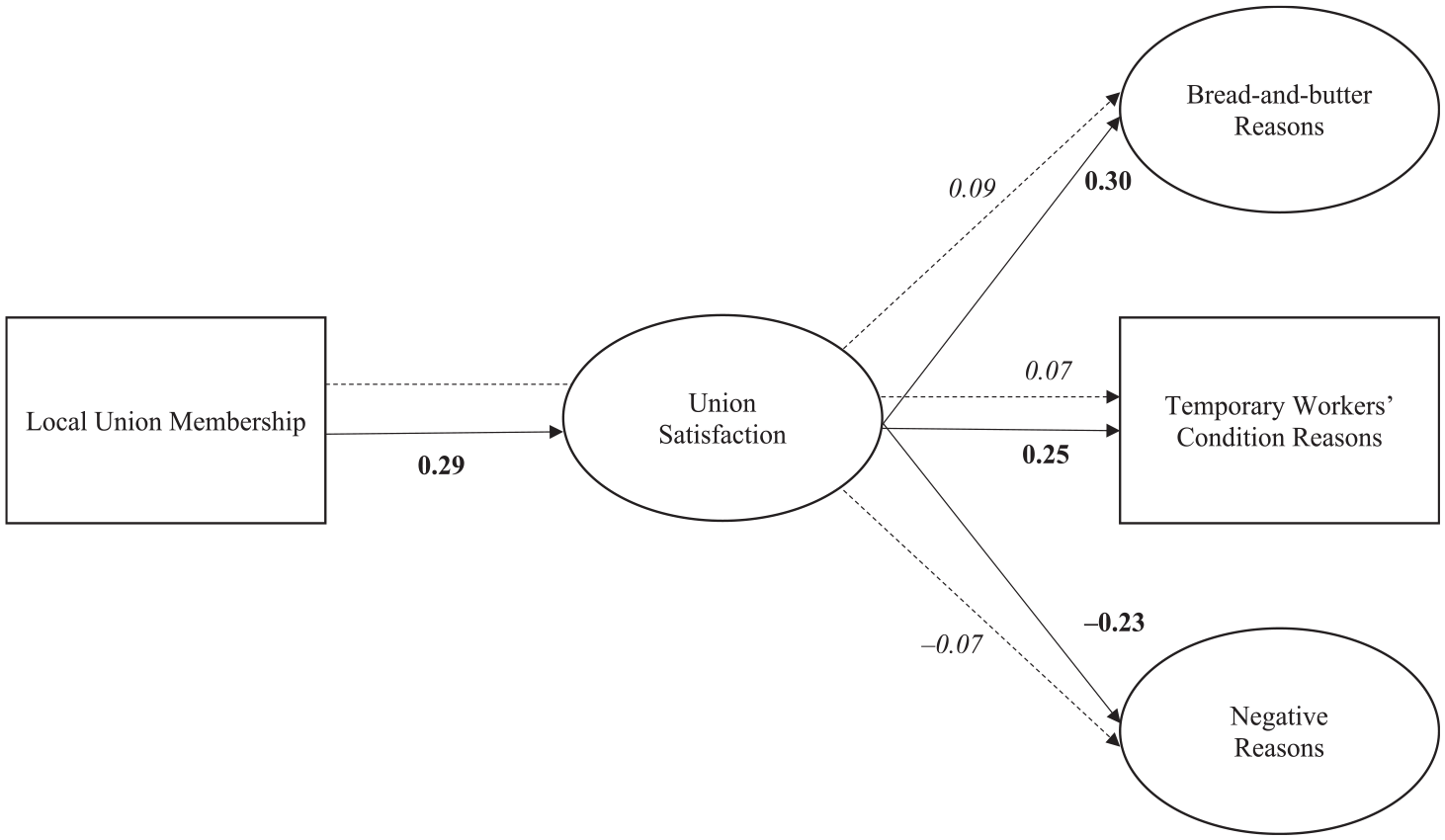
Model of Workers’ Reasons for Being on Strike
We report results from our main analysis in Table 5. Participants who were missing data on all independent and control variables were not included in our main analysis, resulting in a sample size of 1,461. Our results show that belonging to Local 652 (as opposed to belonging to Local 602) is positively associated with union satisfaction (β = 0.29, p < 0.001). Likewise, union satisfaction is positively associated with bread-and-butter reasons (β = 0.30, p < 0.001) and temporary workers’ conditions reasons (β = 0.25, p < 0.001). Results also indicated union satisfaction was negatively related to negative reasons for striking (β = −0.23, p < 0.001). Overall, these results suggest union satisfaction played a key role in our model as it was directly related to local union membership as well as all three categories of reasons for workers being on strike.
Results of SEM Analysis
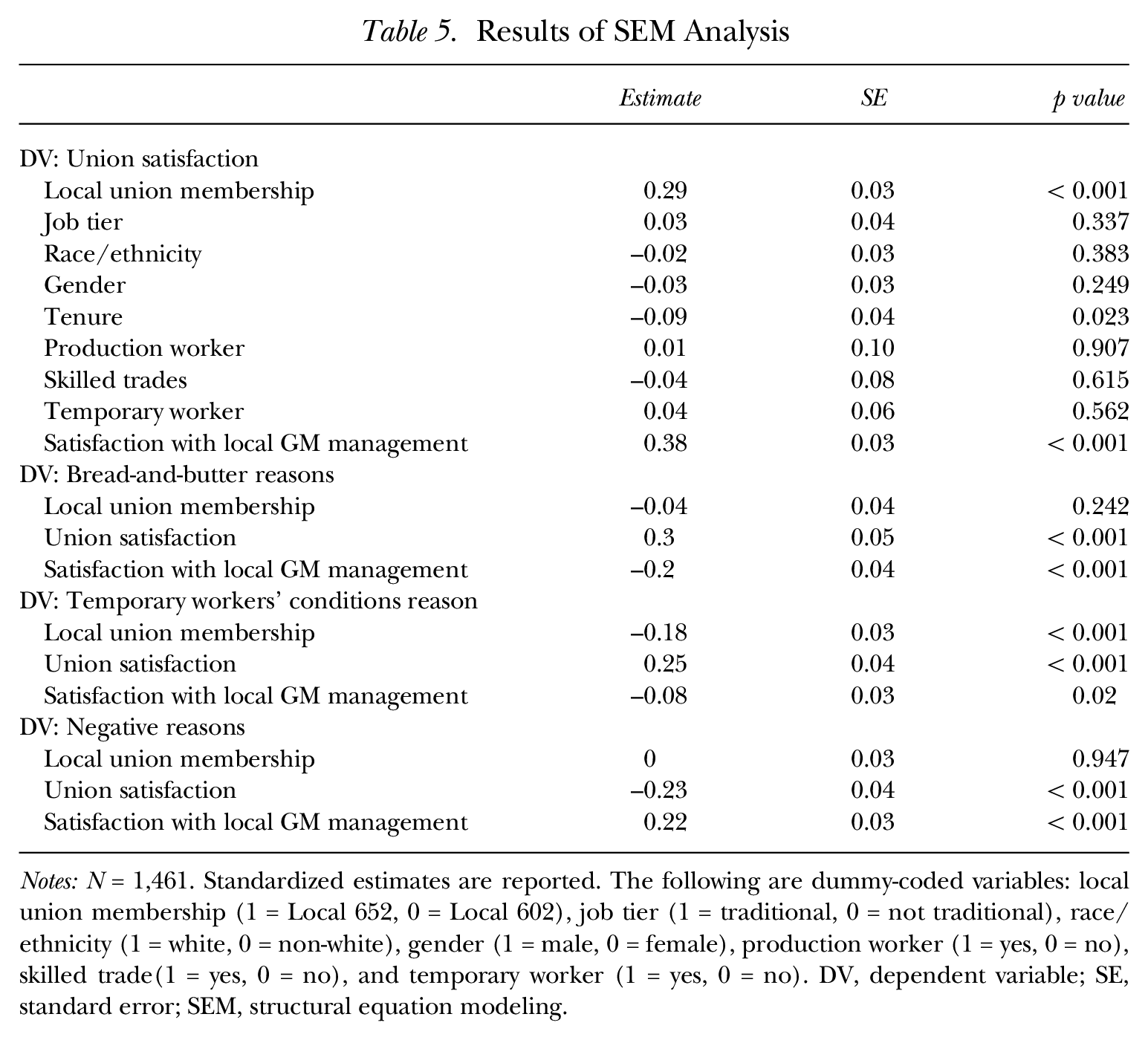
Notes: N = 1,461. Standardized estimates are reported. The following are dummy-coded variables: local union membership (1 = Local 652, 0 = Local 602), job tier (1 = traditional, 0 = not traditional), race/ethnicity (1 = white, 0 = non-white), gender (1 = male, 0 = female), production worker (1 = yes, 0 = no), skilled trade(1 = yes, 0 = no), and temporary worker (1 = yes, 0 = no). DV, dependent variable; SE, standard error; SEM, structural equation modeling.
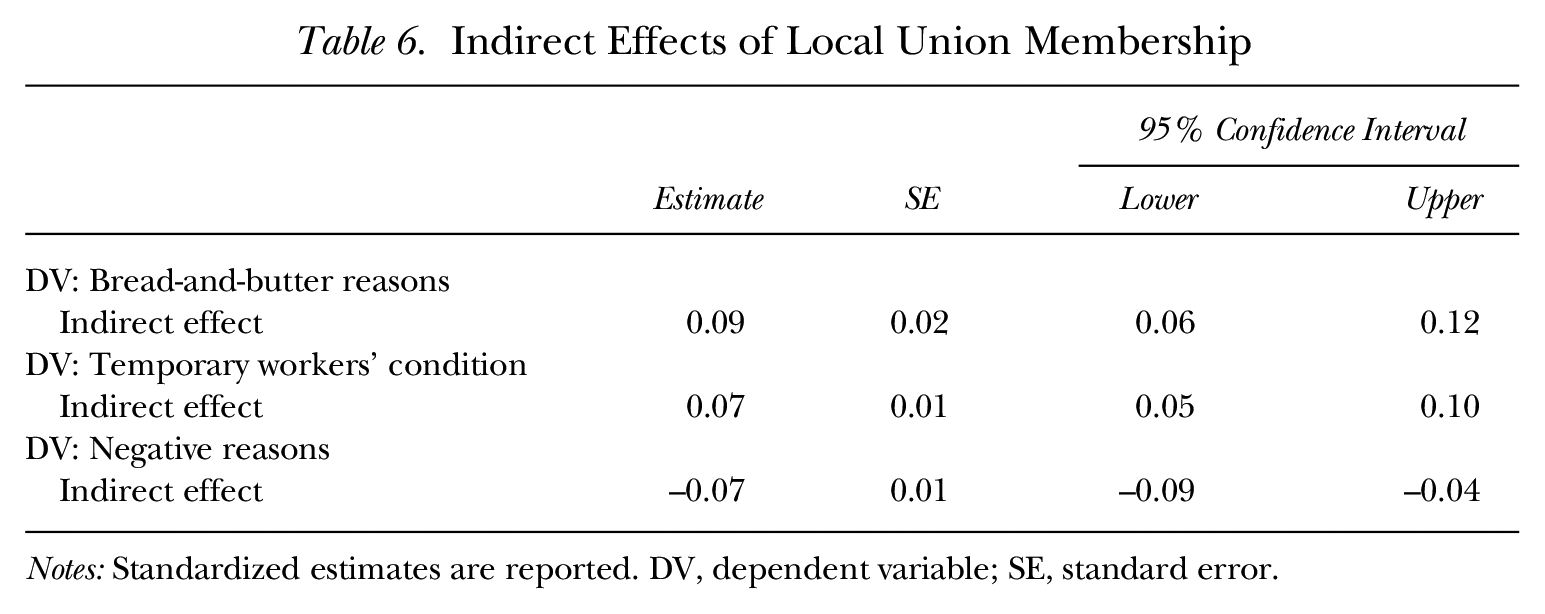
Table 6 reports the results of our mediation tests for the indirect effects of local union membership on our three categories of strike reasons, including 95% confidence intervals (C.I.) for the estimated effects. Results suggest that union satisfaction mediates the relationships of local union membership with each of the three dependent variables. Specifically, results indicated positive indirect effects of local union membership on bread-and-butter reasons (C.I., 0.06 to 0.12) and temporary worker conditions (C.I., 0.05 to 0.10). The indirect effect of local union membership on negative reasons for being on strike was negative (−0.09 to −0.04). A practical interpretation of these results is that workers’ support for the different reasons for striking did not depend solely on their union satisfaction but also on which union they belonged to since local membership relates to union satisfaction.
Indirect Effects of Local Union Membership
Notes: Standardized estimates are reported. DV, dependent variable; SE, standard error.
For all three reasons for being on strike, our results showed the relevance and importance of union satisfaction. For the two positive strategic objectives in bargaining—bread-and-butter issues and temporary worker conditions—union satisfaction mediated the effect of belonging to Local 652, which eventually voted to approve the contract. Indeed, belonging to Local 652 was negatively associated to the latter reason, but higher union satisfaction may have produced support for this strategic objective even though the members of the local were lukewarm about this issue. Finally, union satisfaction was negatively associated with negative reasons for being on strike. The analyses thus lend support to our argument that membership satisfaction is critical to realize the union’s objectives and that local union contexts shape satisfaction levels.
Qualitative Analysis: The Development of Invisible Divides in Two Locals
To understand the local union context, we conducted qualitative case studies of the two locals based on leadership interviews, archival data on the history of the locals, and membership data on transfers. In the interviews, we asked leaders about their views on the member–leader relations and about drivers of satisfaction levels. We conducted formal interviews with the president of each local and had many informal conversations on the picket line, in the union halls, and during union meetings with other union representatives (e.g., the vice presidents, shop chairs, and recording secretaries) and members. Through our formal interviews as well as informal conversations with UAW leadership and members, we understood that UAW Local 602 was a melting pot of UAW members from other locals whereas UAW Local 652’s membership was mostly from the Michigan (or even Lansing) area. Building on this information, we received unique access to the union membership physical documents and the transfer cards at both locals. We received permission to enter data from the file providing that we omitted personal information about the transferees (such as their names or social security number). For an example of a transfer card see Figure 4.
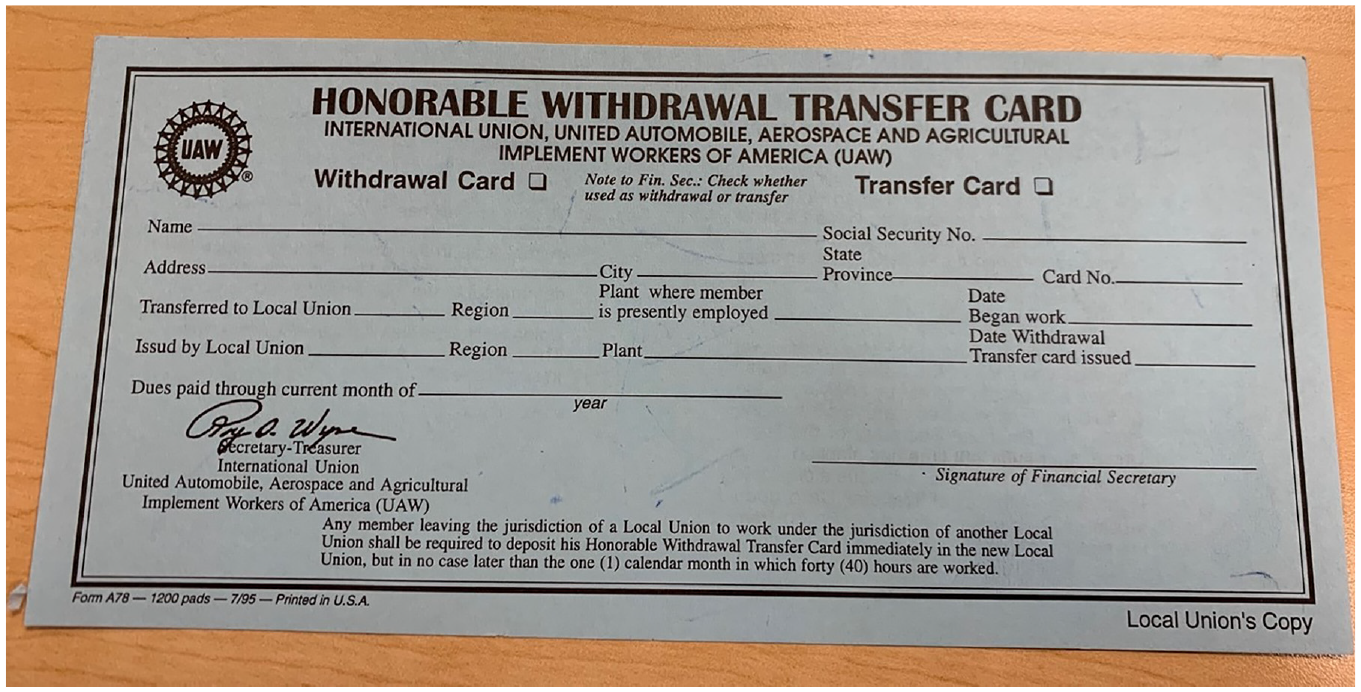
Union Transfer Data Card
For privacy reasons, we were not allowed to take the cards with us but were allowed to visit the union hall and enter the data there. Both Locals gave us large boxes that contained thousands of transfer cards going back to the early 2000s. As a result, we were able to create a database that showed the local the workers transferred from and the date the transfer occurred. This gave us a picture of the waves of transferred workers who worked at the Lansing plants from the plants’ start up in 2000 (for LGRA – Local 652) and 2005 (for LDT – Local 602) through 2019.
Given that transfer or relocated workers are not actively tracked and they blend in with the workforce, we refer to this phenomenon as “invisible divides.” We trace the development of these invisible divides related to sourcing of work to the two locals. In LGRA (Local 652), the workforce has been relatively stable, albeit shrinking over the years. By contrast, LDT (Local 602) grew and became a hub for numerous transferees from other plants. We argue that the different sourcing histories and different levels of transferees have produced significantly different levels of union satisfaction in the two locals.
History of Invisible Divides in Lansing’s Automobile Industry
Lansing, Michigan, has a long history of manufacturing that began at the end of the 19th century. The auto industry, specifically, grew and provided substantial employment there. Lansing’s first gasoline automobile was produced by Ransom E. Olds in 1896. In 1908, Oldsmobile was purchased by General Motors. As General Motors (GM) grew into one of the largest industrial companies in the United States, Oldsmobile and Lansing flourished especially in the post–World War II period (Fine 2004).
From the 1980s onward, however, US automakers such as GM faced a declining market share and began to put pressure on local plants and unions to negotiate concessions to work rules and make changes necessary to adopt lean production. As GM started to close factories, a growing number of workers, so-called “GM gypsies,” 4 transferred to new locations as a way to maintain their employment with the automaker. As scholars have highlighted, GM workers had to uproot and take a job often hundreds of miles away from their family and home, and in many cases face hardships (Phillips et al. 2010). This process led to deep resentment not just against the company but also the local union (Rothstein 2016), because although these transferred workers would keep their corporate seniority, they would come in without plant seniority. This meant they might not be able to hold a day-shift, and as some workers mentioned, they felt like “lower-class members” or “second-class citizens” (High 2019).
In 1996, GM announced that Oldsmobile would be moved to Detroit and GM would leave Lansing. The loss of more than 15,000 GM jobs would have been devastating to the area. Eventually, by wooing GM’s top executives, key Lansing actors, such as then Mayor Hollister and others, were successful in keeping GM and getting GM to build two new assembly plants in Lansing. GM invested $2.5 billion in the two assembly plants that secured Lansing’s role in the American automobile industry for the beginning of the 21st century (for more details see, for example, the documentary film Second Shift [2015]).
The future looked bright, as Lansing had managed to attract investment for not one, but two assembly plants, LGRA and LDT. However, the pressure on making sure GM keeps investing in the Lansing plants is still felt today by our current interviewees: Stability is very varied . . . [it’s] difficult . . . for us to be able to say the company’s going to invest in another vehicle and have a third product here for what we hope is a long time. That [investment and stability] is a great thing. That’s a big deal. Product allocation is the reason I wake up every day, keep people working at 652.
To address fluctuations at work or to avoid job losses due to plant closures, GM often transfers employees to other GM plants across the United States. As we show next, although both Local 602 and Local 652 received many transfer workers, we note an important difference in that Local 602 received significantly more transfer workers over time, as well as transfer workers from other plants outside of Michigan.
Analysis of Transfer Data
We found that 3,363 UAW members had transferred to Local 602 between 2005 and 2019 (see Figure 5). 5 Over that time frame, out of 3,363 transfer workers, 1,230 workers (or approximately 36%) came specifically from Local 652; that said, approximately 593 workers (or 17%) came from outside the state of Michigan (with the largest group, in this case 523 workers [or about 88%] coming from Spring Hill, Tennessee). Leadership in 602 was conscious about what the effect of being uprooted had on membership satisfaction.
So right now, we have people who had more than twenty years had to uproot and come here and work. And, some of them are obviously not happy about the situation, but they're glad they have a place to go.
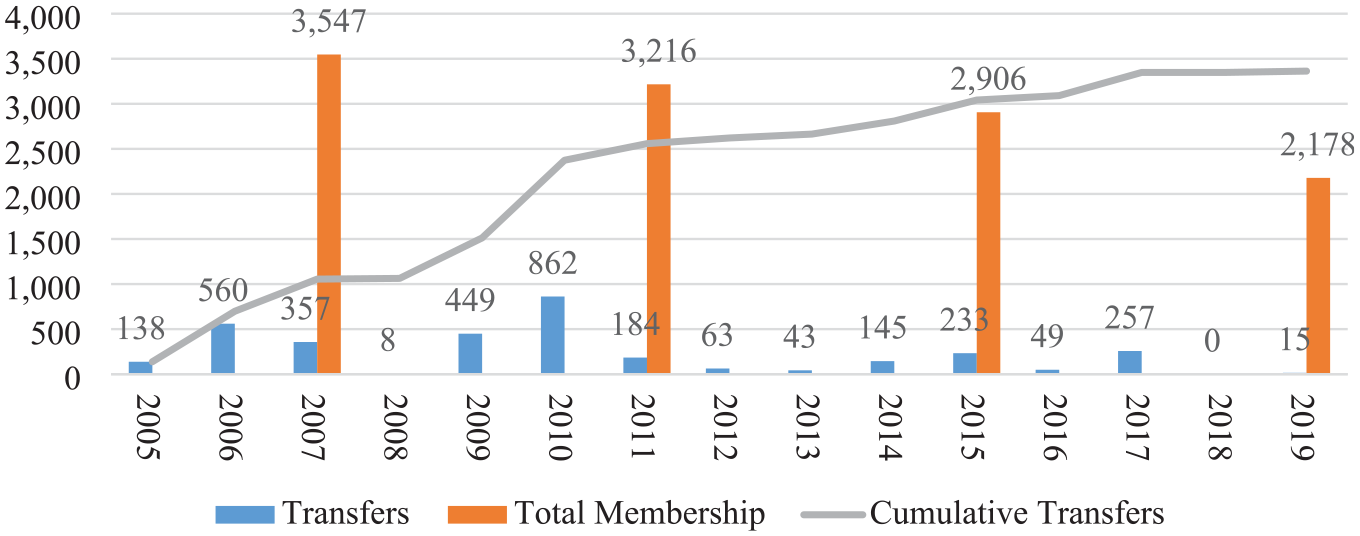
Transfers to Local 602, Total Membership in Contract Years, Cumulative Transfers
The initial transfers began as the Lansing Delta Township (LDT) plant was beginning regular production in the fall of 2006. There were not enough Local 602 members to staff the new assembly plant on three shifts, so the local began transferring workers in to fill the openings. Laid-off GM–UAW workers from Flint, Saginaw, and Pontiac, Michigan, as well as places such as Spring Hill, Tennessee, signed up to work at the LDT plant. This meant that the workforce was not the Lansing workforce that the company thought they were getting. As former UAW Local 602 VP Steve Delaney stated when commenting about the LDT plant’s mission statement, “Everyone knows what that heritage is, that pride and workmanship that started with Oldsmobile is still here” (VanHulle 2014). While that statement was definitely true at Lansing Grand River Assembly (LGRA), it was going to be more challenging at Local 602 as more Lansing UAW workers retired and were replaced by GM workers from other facilities. There is a clear difference between being a transferee from another Lansing facility and being a transferee from a facility in another state, as reflected in the quote below: When we complain about . . . having to go across [to 652], it makes me shake my head sometimes because our folks from Spring Hill would gladly lecture those folks about uprooting to be able to continue working.
By contrast, we found that only 1,178 UAW members had transferred to Local 652 between 2000 and 2019 (see Figure 6). Over that time frame, out of 1,178 transfer workers, 696 workers (or approximately 60%) came specifically from Local 602. Only about 134 workers (or 11%) came from outside the state of Michigan (with the largest group, in this case, 30 workers [or about 22%] coming from the state of Indiana). Indeed, when LGRA began production in 2001, the plant was almost fully staffed with UAW Local 652 members.
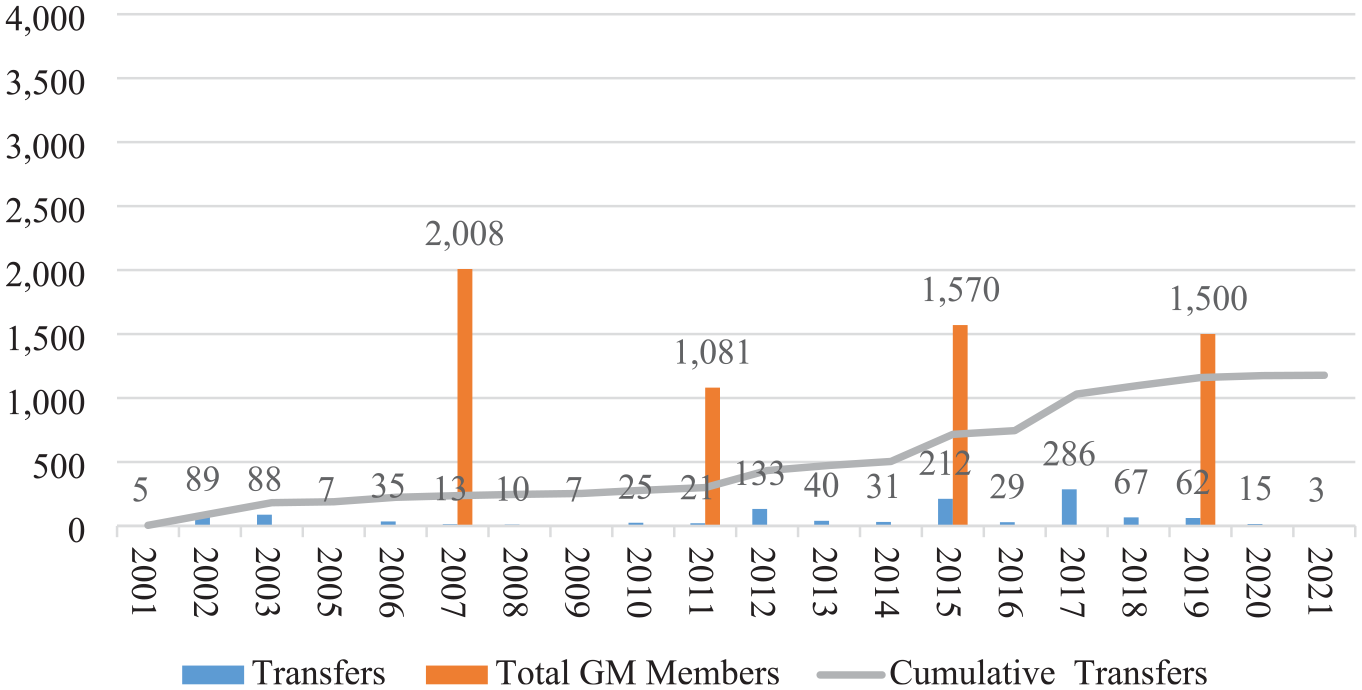
Transfers to Local 652, Total Membership in Contract Years, Cumulative Transfers
During the first 11 years of operation (2000–2011), LGRA (Local 652) received 300 transfers, or on average approximately 27 people per year. LGRA’s largest wave of transfer workers came only later on during 2015–2017 when about 44% (n = 527) of transfer workers came to the plant. Note, however, that 99% of these transfer workers came from Michigan (the vast majority or 80% came from Local 602; approximately 20% came from two locals in Flint). By contrast, at LDT, there were not enough Local 602 members to initially staff the LDT plant. Thus, more than 1,000 UAW members transferred to LDT in the first 22 months as the plant attempted to build three new vehicles on three shifts in a newly built assembly plant. During its initial years, between 2005 and 2011, more than 2,550 workers transferred into Local 602, or on average approximately 425 workers per year.
In line with the current scholarship on transferees within the auto industry (Phillips et al. 2010, 2014), we argue that one important reason for varying levels of union satisfaction is the different levels in transfer workers. The difference in terms of the sheer number of transfer workers as well as the locations they come from (within or outside of Michigan) and statements by leadership suggest the divides might be much deeper at Local 602 than at Local 652. Indeed, at Local 602 many more workers have come from other plants, in addition from plants outside of Michigan, leading to lower levels of union commitment and satisfaction in comparison to the membership at Local 652. In turn, the support for UAW bargaining strategies has suffered in 602 relative to 652.
Discussion of Results against Alternative Explanations
Finally, we discuss alternative explanations (see Figure 2 above) that could account for the differences in union membership satisfaction across the local unions: investment and plant’s product allocation linked to members’ perceived job security, organization of work, terms and conditions, and union democracy and its leadership. Table 7 summarizes differences and similarities across the two locals.
Similarities and Differences between Locals 652 and 602
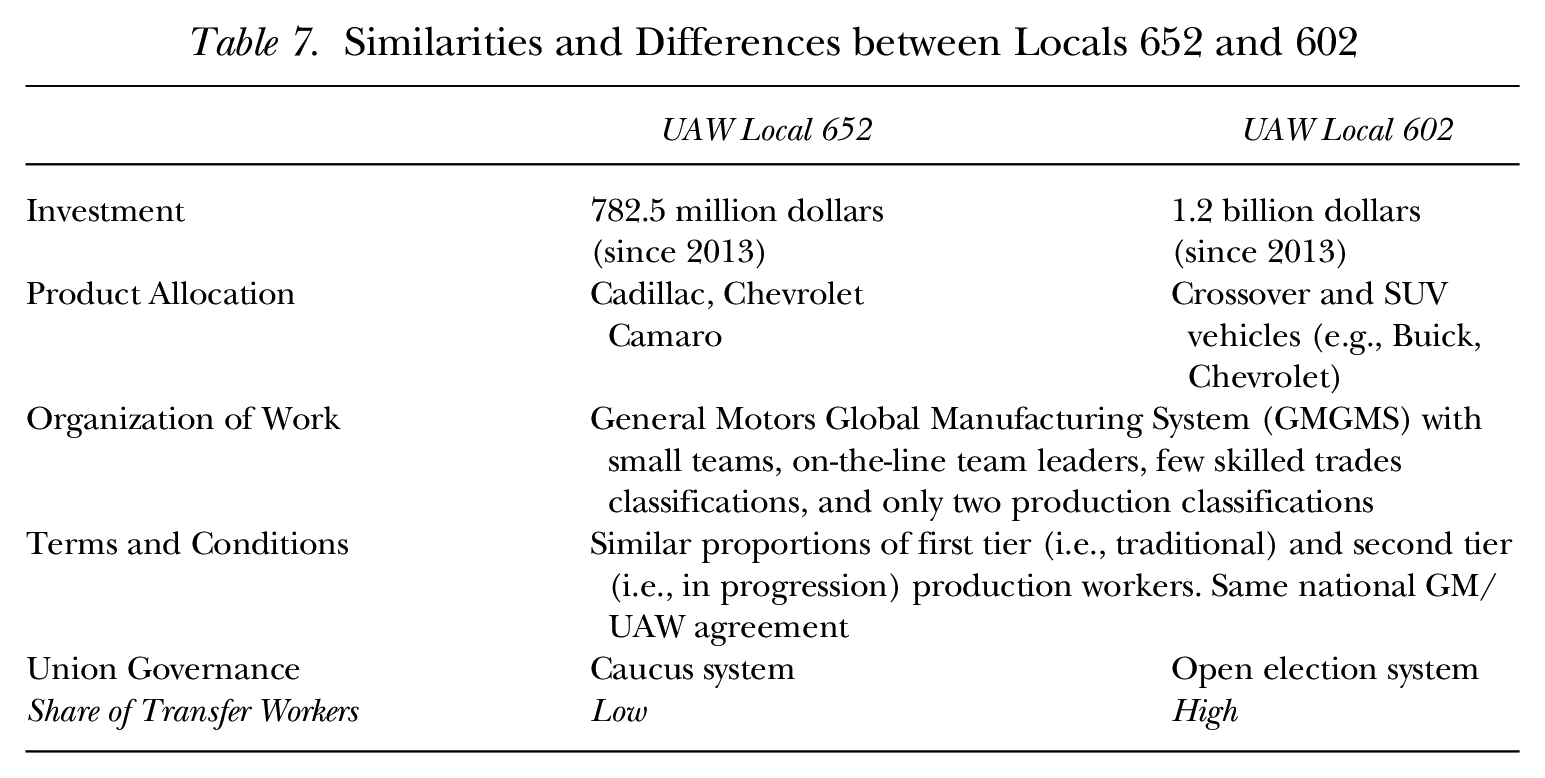
First, GM has made significant investment in both plants. Contrary to what one might expect, however, Local 602 has actually seen more investment going into its plant. Since 2013, GM has invested 782.5 million dollars in the LGRA facility (Local 652) (GM 2023a) and 1.2 billion dollars in LDT (Local 602) (GM 2023b). Turning to product allocation, UAW locals who represent workers at GM assembly plants want to build trucks, SUVs, or crossover vehicles because they are high profit and receive better marketing and engineering support. They want to avoid cars because of the intense competition and declining numbers of cars that are sold in the United States. The plants built diverse vehicles. LGRA built several Cadillac models as well as the Chevrolet Camaro. LDT produced various crossover and SUV vehicles for Chevrolet, Buick, GMC, and Saturn.
In essence, Local 602 received better products to build than did Local 652. Furthermore, the 2019 agreement contained specific language regarding future investment for Local 602 (LaReau 2019; GM–UAW Agreement 2019). It mentions, specifically, for LDT: Next Generation Midsize SUV, $1 billion, and 5,000 jobs (GM–UAW Agreement 2019). Indeed, over the past 10 years, GM’s investment in LDT (Local 602) has far exceeded their investment in LGRA (Local 652) (GM 2023a, 2023b). In other words, looking at product allocation and GM’s investment, and thus perceived job security, we would predict that Local 652 would score lower than Local 602 on the satisfaction scale, but this has not been the case.
Finally, however, it is important to note that product allocation and job security can also be linked to the issue of transfer workers. Specifically, transfer workers can be disillusioned with the lack of future investment in their previous plant and therefore see their chances of going back to their original place diminishing. This again potentially leads to negativity toward the contract, the union, and the company. For example, UAW workers from Lordstown, Ohio, working at LDT (Local 602) mentioned a fear of job security because of the lack of specific product allocation in the agreement (see also LaReau 2019; Lawrence 2019). As one of the Lordstown transfer workers from Local 602 said, “My biggest disappointment is there was no product to restart Lordstown” (cited in LaReau 2019).
Second, the organization of work in the two plants are quite similar. The plants were built in the 1990s and the early 2000s, and the local contract at 602 was nearly identical to the agreement reached earlier at 652. It was an agreement that was consistent with GM’s version of lean production, General Motors Global Manufacturing System (GMGMS). The new agreements outlined major changes in the way work was organized at the new plants with small teams, on-the-line team leaders, few skilled trades classifications, and only two production classifications, Team Leader and Team Member. Thus, both locals were facing the same challenges as the memberships had to adapt to new rules governing how vehicles were assembled.
Third, as shown above, the plants have similar proportions of first tier (i.e., traditional) and second tier (i.e., in progression) production workers. Adhering to the national GM–UAW contract, the wages and benefits across the two locals are, therefore, very similar. That said, while the wages and benefits are very similar across the two locals, there might be a difference in perceived job security, which we cannot rule out as an explanation for lower satisfaction in Local 602.
Finally, the locals differ on union governance. While the corruption scandal that broke in 2017 and mistrust toward union leadership might have deepened within the union membership (e.g., Slaughter 2019; Feliz Leon and Slaughter 2023), it seems unlikely that the scandal’s negative effects on satisfaction would differ across locals. Rather, the internal union governance in the locals is more relevant. Specifically, between 2002 and 2020, Local 652 had three presidents (UAW Local 652 2023) while Local 602 had twice as many. Furthermore, we observe very different leadership structures in Local 602 versus 652. Whereas Local 602 relies on an open election system that has often been very contested (e.g., the most recent local union president won the election by a very slim margin), Local 652 consists of a caucus system, which tends to be much less contested and results in a closed type of election. The caucus decides who will run, who serves on committees, who is electable, and so on. These conditions mean that based on the local union election system as well as union leadership turnover (Lipset et al. 1956; Lévesque et al. 2005; Voss 2010), a strong internal democracy can be observed at Local 602 in comparison to Local 652, yet this difference has not led to higher membership satisfaction.
Implications
Based on our findings, we draw the following implications. First, our research points to the importance of the local work context and general member satisfaction when trying to explain successful union strategies. In essence, the strategic choice framework focuses on how unions make strategic choices to reach particular objectives (Kochan et al. 1984; Weil 2005), but there is little mention of the union members themselves and how they can inhibit or enable the union from reaching their objectives. When union members vote down a contract proposal, it might mean not only that members believe the contract is too weak but also that a disconnect is present between the union leadership and the members. In other words, it tells us something about the union–member relations at the shop floor. Inversely, when union members vote in favor of an agreement, it might mean that the members are not only in support of the contract content but also feel general satisfaction with the union leadership, which encourages members to get on board.
Second, our study shows the importance for unions to consider invisible divides such as the GM transfer workers, as it likely affects union satisfaction and thus the union’s ability to successfully reach their objectives. While scholars and pundits have pointed to the challenges of the two-tiered wage system in the auto industry and highlighted how this creates political tensions on the shop floor (Katz et al. 2013; Bradbury 2015), other dimensions, such as the presence of transfer workers, matter as well. It is unclear to what extent unions (or management) keep track of transfer workers and consider the hardships of these workers within their decision-making processes.
The GM transfers are often referred to as “GM gypsies” because they have experienced multiple plant closures. Between 1990 and 2005, for example, an estimated 80,000 GM production workers (at least) transferred and had to move at least 300 miles to take a new job at another GM plant (Geller 2006). This situation likely leads many of the transfer workers to become alienated from their local community, their workplace, and their local union (Sarros et al. 2002). In essence, workers might perceive this as a breach in their psychological contract with GM, which would lead not only to job dissatisfaction but also union dissatisfaction (Leicht 1989; Robinson 1996).
By keeping track of and taking into account the interests of the transfer workers (and, thus their hardships), unions (and management) can create a context in which members are more satisfied at work. In other words, actors have control over the local work context. The union leadership across the two locals also conveyed these sentiments to us as we showed them our research results. While it might not be in their immediate repertoire of actions, they talked about taking proactive measures—such as helping with housing allocations, facilitating the onboarding process, or setting up mentorship networks between members from the different locals—as important processes that could help shape the local shop-floor context. Creating a positive local union context thus becomes important as it affects whether the industrial relations actors can actually realize their objectives.
Finally, we see the importance of transfer workers coming up again in the 2023 GM–UAW agreement (GM–UAW Agreement 2023). The 2023 agreement is novel in that it includes “the right-to-return following a plant closure” (Hall and Grzelewski 2023). Specifically, it permits the Lordstown workers who were working at the plant when the shutdown was announced in November 2018 to return to the new Ultium Cells (UC) plant, which was opened jointly by GM and LG. The agreement states that the returning workers would “retain their current wages, benefits and seniority” (Hall and Grzelewski 2023). According to UAW President Shawn Fain, “over the last 20 years, GM has closed nearly twice the number of plants as Ford and Stellantis combined,” making this issue of particular importance to GM workers (LaReau 2023).
Conclusion
In this article, we focused on two, at first sight, very similar local unions in Lansing, Michigan, and asked why the members voted differently on the 2019 GM ratification agreement. One local rejected the agreement while the other local voted in favor.
We built on strategic choice theory and examined to what extent unions’ strategic choices can successfully realize their strategic objectives of building and representing their membership. Going on strike is an important choice to gain certain objectives such as higher wages and better benefits for the members. While the external context and internal union capacity are important, we highlight the significance of general union satisfaction to realizing the union’s objectives and show how this is shaped by the local work context. Finally, we pay attention to an often forgotten membership group, the relocated GM workers as a critical factor in shaping the local work context.
One important limitation of this article concerns capturing the transfer workers. We did not have questions about transfer workers on our survey as the issue came to our attention only later through interviews. That said, we have gone back to the two locals and asked them for the data. We were able to collect comprehensive data on transfer workers from both locals, which indicate a significant difference in terms of the size and geographic location of the transfer workers. Based on theory and previous studies, we suggest this difference partially explains the variance in local union context and union solidarity.
Furthermore, while we focused on transfer workers as one dimension that likely affects local union satisfaction and therefore the union’s ability to successfully reach their strategic objectives, there could be other elements at play that explain this outcome. For example, workers at Local 602 might feel they want to hold out for more and expect more from the company and thus, also, the union; they might have particularly strained relations with their local management; they might feel that some of the specific issues in the agreement have not been adequately addressed (e.g., the issue of temporary workers); or they might still have a larger fear of plant closings and a dissatisfaction with the current allocation language in the agreement. These hypotheses go beyond the scope of this article but are important to uncover going forward.
Future research would benefit from focusing on the links between the invisible divides in membership, union strategy, and local union–management relations. Union members live and work in particular geographical locations and can be uprooted by corporate decisions to transfer the work to other locations. Studying these disruptive events for members and how they may undermine union satisfaction and internal unity seems particularly important in a world of work replete with fragmentations. They can highlight important differences that are not always immediately visible but that can have large implications when it comes to, for example, ratifying a contract. It would be good to see whether any demographic differences exist among the people who are relocated and whether they affect more than voting behavior within union local contexts. More in-depth interviews with transfer workers and better understanding the meaning of their experiences as transfer workers might be one way to capture these differences (see, for example, the work by Chen [2015] or Mrozowicki and Trappmann [2021] on understanding the experiences among unemployment or precariously employed workers).
Footnotes
This article is part of a set of papers from a Festschrift honoring Thomas Kochan.
For general information or data and/or computer programs, please contact the corresponding author, Maite Tapia, at
1
When discussing the strategic choice of going on strike we refer to the UAW or the union at the international level, as this choice happened at the macro-level or tier one. At the same time, we show how the local union context (micro-level or tier two) is an important factor in enabling or impeding the success of reaching the strategic objectives.
2
3
Production workers and skilled trades ratify the agreement separately. If the skilled trades reject the agreement, the UAW can overrule this rejection if they find that the skilled trades voted against the deal due to other monetary issues instead of issues unique to the skilled trades. Furthermore, given that there are exponentially fewer skilled trades than production workers, the UAW can point out that the total “yes” vote still outnumbers the “no” vote (see also  ).
).
4
5
Because of data limitations, we can report only the cumulative number of transferees and not how many transfer workers there are in the plant on a yearly basis. We know when people transferred in, but we do not know when people retired, quit, or moved.