






Abstract
This paper proposes a dual-event-triggered adaptive neural-network control strategy for pose regulation of resource-constrained quadrotor unmanned aerial vehicles (UAVs). The proposed method addresses the difficulty of compensating for model uncertainties and external disturbances while optimizing communication and computational resources under limited bandwidth and onboard processing capability. In the developed framework, state information is transmitted from the UAV to the controller only when the prescribed triggering conditions are violated, and control commands are updated only when their deviation from the previously transmitted commands exceeds a prescribed threshold. This dual-event-triggered framework reduces communication and computation from both the state-transmission and control-update channels. In addition, a trigger-interval-weighted neural-network updating law is introduced to improve the applicability of the adaptive mechanism under different operating conditions. Based on Lyapunov stability theory, it is shown that all signals in the closed-loop system are uniformly ultimately bounded and that Zeno behavior is excluded. Simulations under both constant and time-varying reference signals verify the effectiveness of the proposed method in terms of control performance and communication–computation trade-off.
Keywords
Introduction
Quadrotor unmanned aerial vehicles (UAVs), owing to their simple structure and high maneuverability, have been widely employed in moving-target tracking, logistics delivery, power-line inspection, and image-based transmission-line defect detection tasks.1–6 As mission environments become increasingly complex, control accuracy and resource efficiency have become two key concerns in practical UAV applications. In real-world deployments, however, onboard computation, communication bandwidth, and energy resources are inherently limited. Under these constraints, frequent state transmission and control updating may impose a heavy burden on both communication and computation. Therefore, it is practically important to develop a quadrotor UAV control framework that preserves satisfactory pose-regulation performance while reducing unnecessary system updates. 7
Event-triggered control provides an effective way to reduce resource consumption by updating control actions only when prescribed triggering conditions are satisfied. Its effectiveness has been demonstrated in uncertain nonlinear systems, mechatronic systems, robotic manipulators, and nonlinear multi-agent systems.8–12 Recent studies have further extended event-triggered ideas to broader control architectures and application scenarios. For instance, data-driven adaptive event-triggered terminal sliding mode control, two-stage event-triggered model predictive control, and fuzzy event-triggered security control have been developed for nonlinear systems, EV charging stations, and networked systems under cyber-attacks, respectively.13–15 These results show that event-triggered control is no longer limited to conventional periodic or single-loop update strategies.
A more recent trend is the transition from single-channel event-triggered updating to dual-channel information scheduling. In a networked control loop, the sensor-to-controller channel determines when state or measurement information is transmitted to the controller, whereas the controller-to-actuator channel determines when newly computed control commands are delivered to the plant. Separate scheduling of these two channels is especially relevant when sensing, communication, computation, and actuation are all resource constrained. Along this line, Chen and Dong 16 designed a dual-channel dynamic event-triggered mechanism for discrete-time nonlinear systems. Zhang et al. 17 proposed a global dual-channel dynamic event-triggered control method for uncertain nonlinear strict-feedback systems with prescribed transient performance, where both the sensor-to-controller and controller-to-actuator channels are incorporated into the design. Zhao et al. 18 integrated a dual-triggered mechanism with adaptive neural control for MIMO nonlinear switched systems subject to sensor and actuator attacks.
Dual-channel and event-sampled designs have also been reported in vehicle-control systems, particularly in networked marine vehicles. For maritime autonomous surface ships, event-sampled adaptive fuzzy output-feedback control was developed using intermittent position data, where an event-sampled adaptive fuzzy state observer reconstructs the untransmitted velocity and a dynamic event-triggering mechanism is established in the controller-to-actuator channel. 19 For autonomous underwater vehicles, adaptive dual-channel event-triggered fuzzy control was proposed for formation tracking and obstacle avoidance under limited communication resources, with event-triggering mechanisms designed in both the sensor-to-controller and controller-to-actuator channels. 20 For networked unmanned surface vehicles under dual-channel malicious attacks, adaptive neural output-feedback security control was developed, where an event-sampled mechanism in the sensor-control channel handles intermittent transmissions caused by DoS attacks, and a self-triggering mechanism in the control-actuator channel reduces command transmissions. 21 Beyond vehicle-control applications, dynamic event-triggered adaptive neural practical predefined-time control has also been investigated for uncertain nonlinear systems with unknown control directions, where the control command is transmitted through a dynamically scheduled controller-to-actuator channel. 22 Taken together, these studies show that event-triggered designs have evolved from reducing a single control-update process to coordinating sensing-side transmission and actuation-side updating in networked systems, and have also been combined with adaptive learning mechanisms for uncertain nonlinear systems.
In parallel, neural-network-based and adaptive methods have played an important role in compensating unknown nonlinear dynamics and external disturbances. In the UAV domain, adaptive neural-network techniques have been applied to attitude tracking of small unmanned helicopters, quadrotor hovering control, adaptive quadrotor control with experimental validation, fixed-wing UAV tracking under switching disturbances, quadrotor-slung-load fault-tolerant control, UAV aerial-recovery docking, and neural-enhanced trajectory tracking.23–29 More generally, neural-network-based adaptive control has shown strong uncertainty-compensation capability in nonlinear systems with complex coupling effects. 30 Event-triggered guaranteed-performance control based on intermittent information utilization also suggests the potential of reducing update activity under constrained resources. 31 Nevertheless, most UAV-oriented neural control designs mainly focus on uncertainty compensation, tracking performance, or fault tolerance. Existing dual-channel event-triggered studies, on the other hand, are mostly developed for general nonlinear systems, marine vehicles, security control, or predefined-time stabilization. The coordinated design of asynchronous state-channel triggering, control-channel triggering, and demand-driven neural learning for quadrotor UAV pose regulation under resource constraints has received less attention.
Motivated by the above observations, this paper proposes a dual-event-triggered adaptive neural-network control scheme for resource-constrained quadrotor UAV pose regulation. Specifically, state information is transmitted from the UAV to the controller only when the associated triggering conditions are violated, whereas newly generated control commands are delivered to the UAV only when their deviation from the previously transmitted commands exceeds a prescribed threshold. The proposed framework reduces unnecessary communication and computation through the coordinated design of the state-transmission channel and the control-update channel. In addition, the full pose dynamics of the quadrotor are considered, and the translational virtual inputs are converted into the total thrust and desired attitude commands through the quadrotor kinematic relations. A trigger-interval-weighted neural-network updating law is further introduced to improve the applicability of the adaptive mechanism under different operating conditions while reducing online computational burden.
The main contributions of this paper are summarized as follows:
A dual-channel event-triggered framework is developed for quadrotor UAV pose regulation, in which the state-transmission channel and the control-update channel are triggered asynchronously, thereby avoiding unnecessary updates and reducing the overall system update frequency. A trigger-interval-weighted neural-network updating law is designed, so that the adaptive mechanism exhibits stronger applicability under different operating conditions while reducing unnecessary online computation. Under the coexistence of event-triggering and intermittent learning, the boundedness of the closed-loop system is analyzed, and the trade-off between control performance and resource consumption is verified.
Kinematic and dynamic models of quadrotor
In UAV control, accurate kinematic and dynamic modeling is essential for controller design. The quadrotor considered in this paper adopts an “X” configuration, and its motion model is established on the basis of the Newton–Euler equations. Two coordinate frames are used, as shown in Figure 1:
the earth-fixed inertial reference frame the body-fixed reference frame
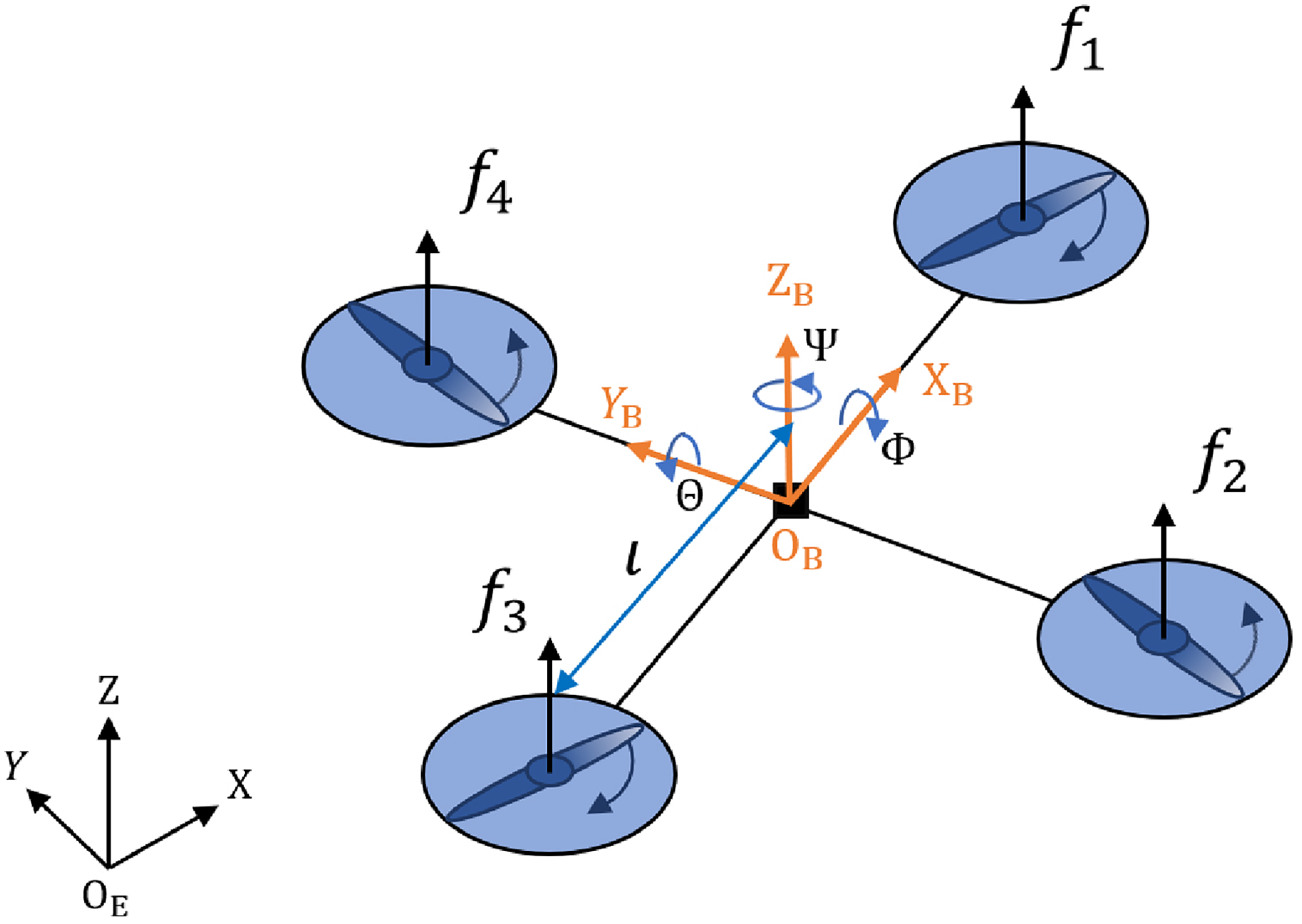
Model and frame of the quadrotor.
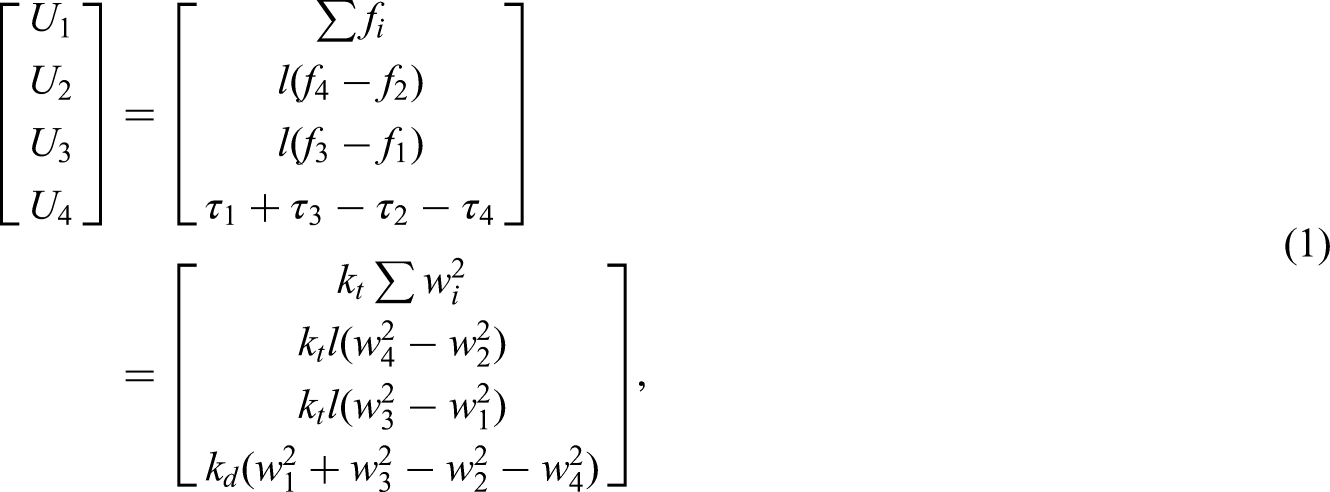
Quadrotor motion is generated mainly by the aerodynamic lift
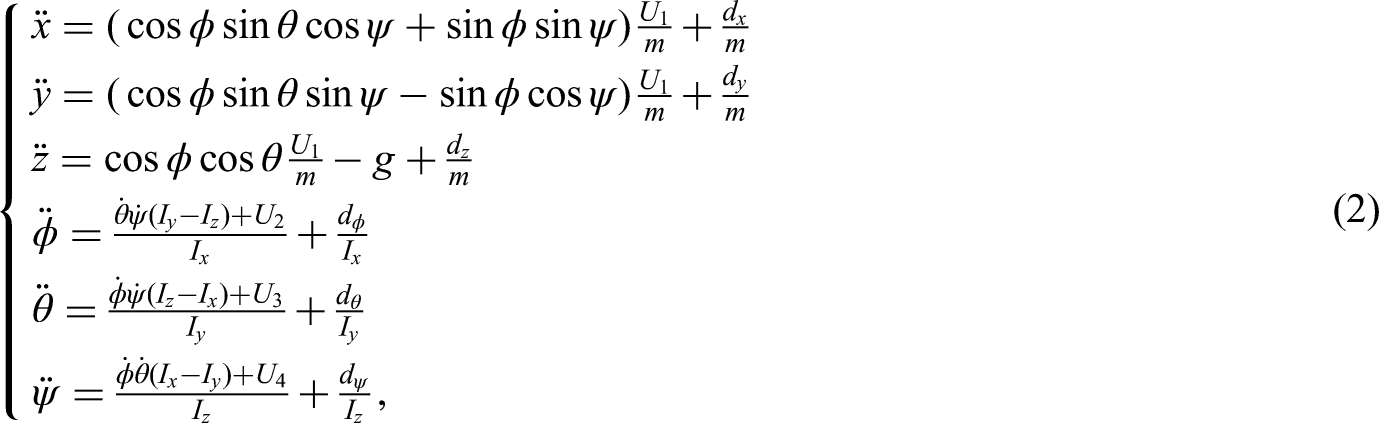
The full pose regulation problem of the quadrotor UAV is considered in this work. Accordingly, the six-degree-of-freedom nonlinear dynamics of the quadrotor UAV are described as follows:
To facilitate subsequent controller design, the state variables are defined as follows:

It is evident that the translational dynamics are coupled with the attitude variables. To address the underactuation in the translational motion and facilitate the subsequent controller design, the virtual control inputs

The quadrotor UAV is an underactuated and strongly coupled system with four control inputs and six outputs. For controller synthesis, the overall dynamics are decomposed into an attitude subsystem and a position subsystem. The outer-loop controller generates the virtual translational inputs
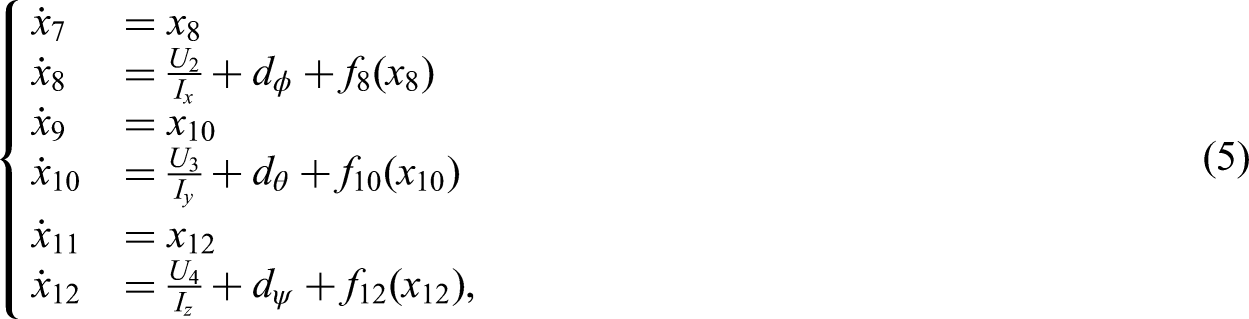
The attitude subsystem is as follows:
The position subsystem is as follows:
By performing inverse kinematics from the virtual translational inputs

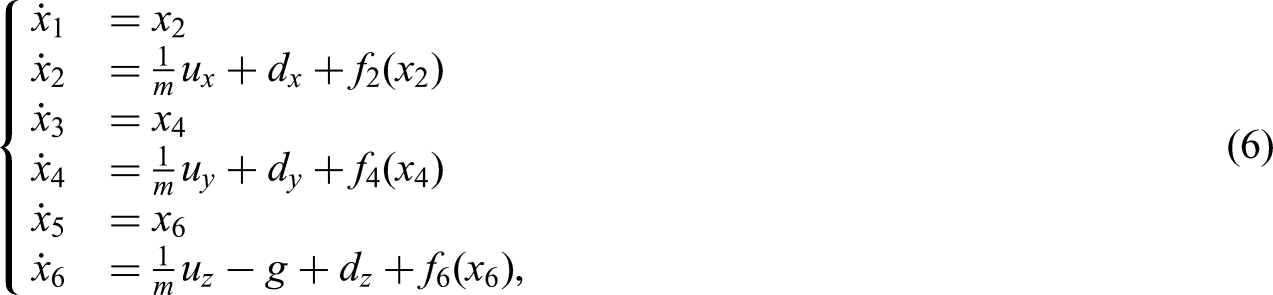
For compact representation, the above quadrotor pose dynamics can be further described by six second-order subsystems, corresponding to the translational coordinates

Ge and Wang
32
For each continuous nonlinear function


Tong et al.
33
The basis function vector
Main result
This section starts with some notations. Let
For
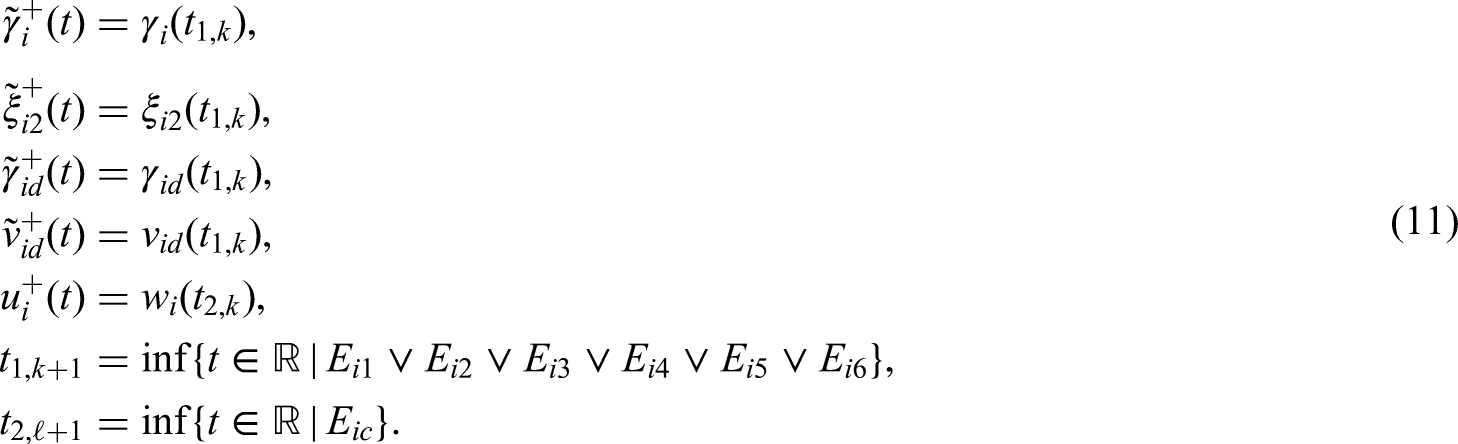
The triggering conditions
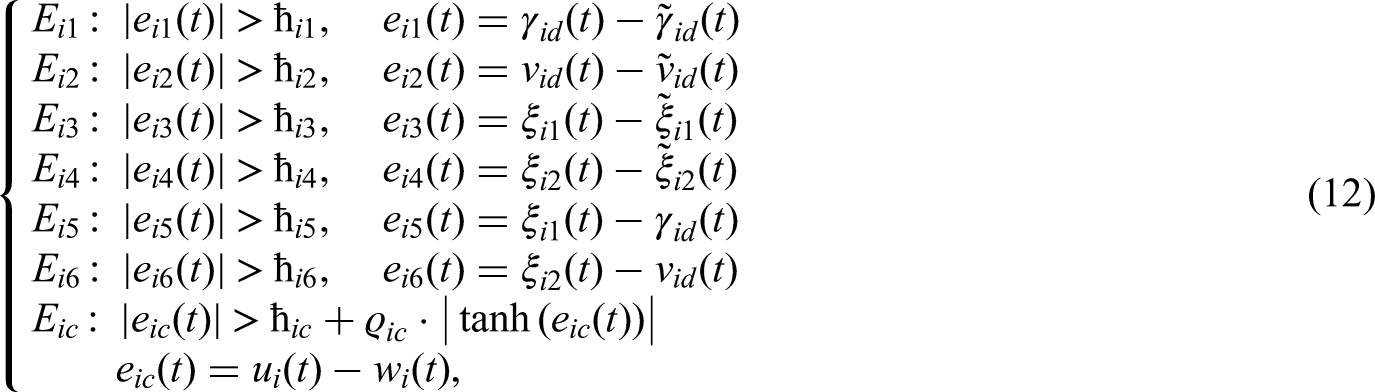
The overall structure of the dual-event-triggered networked control system is illustrated in Figure 2. Under the proposed framework, the state channel and the control channel are triggered asynchronously. Specifically, the state-channel triggers
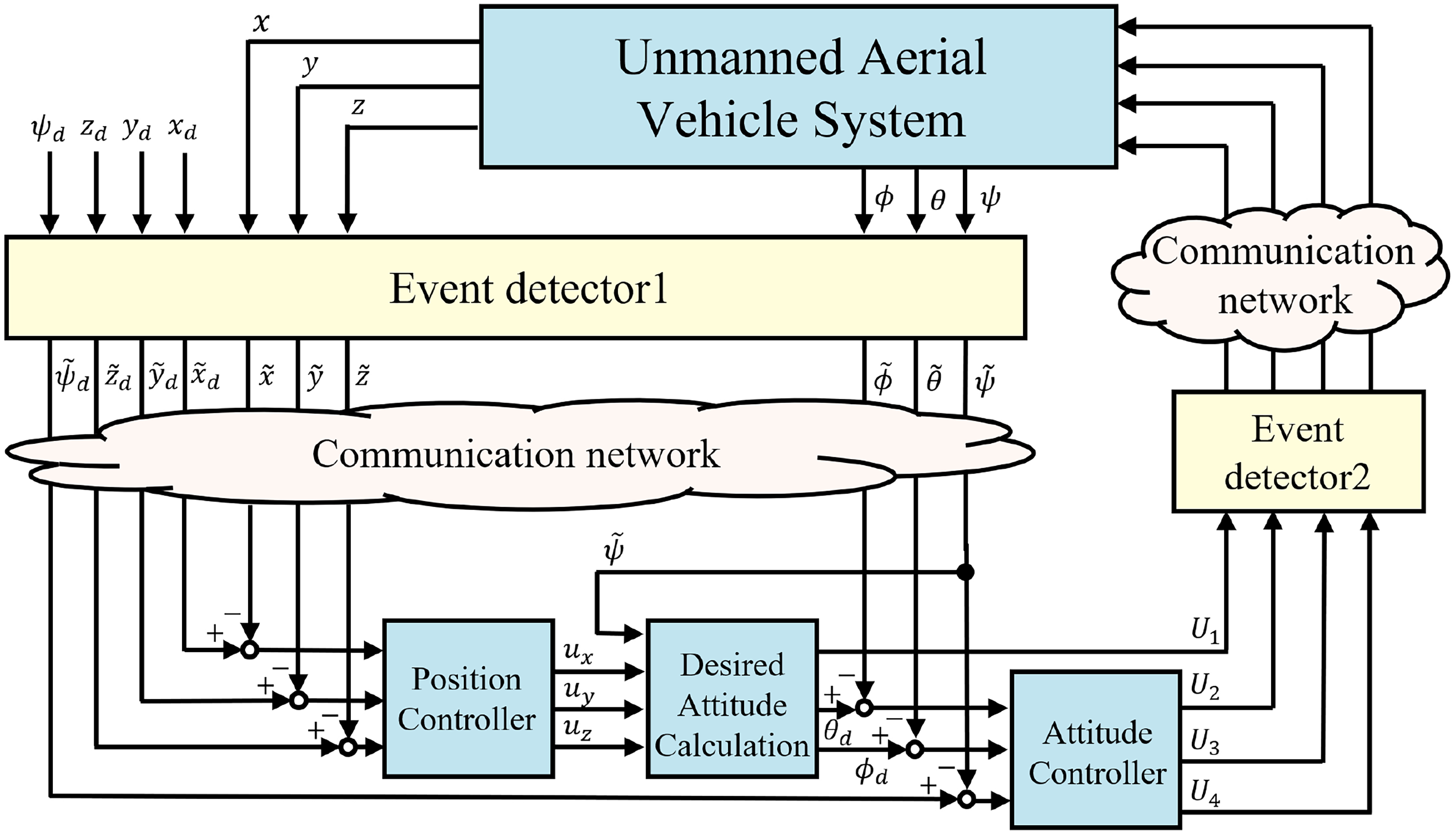
Structure of the dual-event-triggered UAV networked control system.
Design of dual-event-triggered adaptive neural network control
In the context of the second-order system (8) for the


The filter error is defined as
The practical virtual control law



Under the interval-weighted event-triggered neural updating law (17), assume that the state-triggering intervals satisfy
Liu et al.
34
Under the designed event-triggered control scheme and the first-order filter dynamics approximating the discontinuous virtual control signal
Consider the six second-order subsystems of the quadrotor (8). Under the proposed event-triggered control framework comprising the triggering conditions (12), first-order filters (14), practical virtual control laws (15), and the backstepping-based adaptive neural controller (16) with updated parameters
Stability analysis
1) Proof of Lemma 3: For (17),

Define the weight estimation error as

(i) Flow periods (
(ii) Jumping instants (

Let

Since

Summarizing the above two cases, it is ensured that
The proposed neural-network updating law is an interval-weighted event-triggered mechanism, where each weight correction is scaled by the corresponding inter-event interval. Under this scheme, the neural weights are updated only at triggering instants. When the inter-event interval is relatively long, the weights remain unchanged, which may temporarily weaken the approximation of time-varying uncertainties. The resulting approximation error can then be treated as a bounded time-varying disturbance, whose bound depends on the state evolution and the current inter-event interval. Hence, the closed-loop system still preserves uniform ultimate boundedness. Once the approximation error grows enough to violate the triggering condition, the interval-weighted law is reactivated and the neural correction is adjusted according to the actual triggering interval, thereby restoring the approximation capability in an on-demand manner.
2) Proof of Lemma 4: In event-triggered controllers with discontinuous virtual controls, an explicit bound on the filter error
To assess the boundedness of the filter-induced error, a first-order filter is introduced for each virtual-control component,

Differentiation of
(i) Flow set (
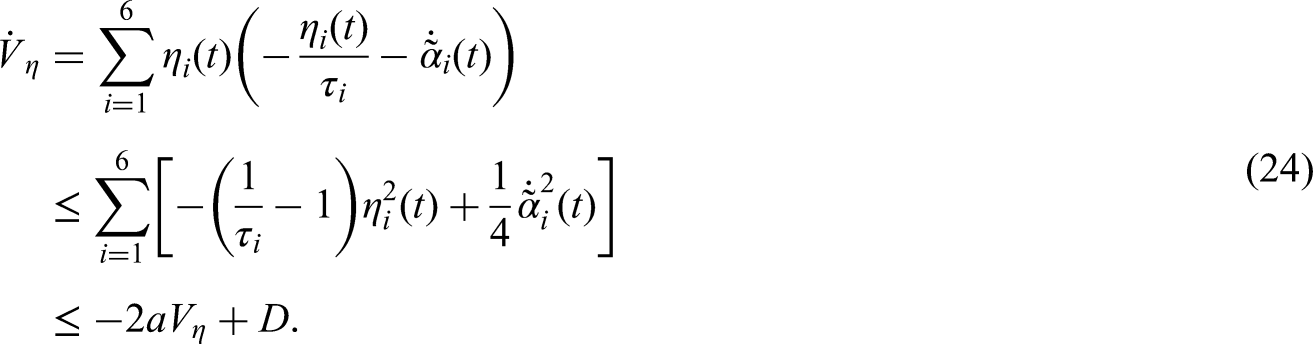
(ii) Jump set (
The jump increment of the Lyapunov function satisfies

By Young’s inequality, for any

During the interval between two consecutive triggering instants, the Lyapunov function

Under the designed event-triggered mechanism, there exists a positive constant

Furthermore, the flow-phase comparison bound implies that the boundedness also holds for all
Thus, the filter error
3) Proof of Theorem 1: For the second-order quadrotor UAV subsystems with external disturbances, neural networks are used to compensate for the unknown disturbance-related dynamics. Since only triggered signals are available to the controller, the closed-loop system contains discontinuous virtual controls and sample-and-hold inputs. More importantly, the asynchronous state-triggering instants
Let

Differentiating
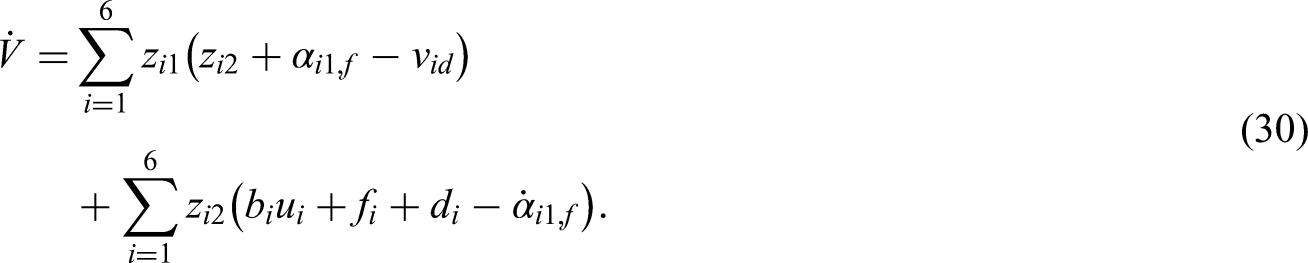
To separate the nominal stabilizing part from the errors induced by triggering, introduce the auxiliary virtual control and the corresponding continuous control input as
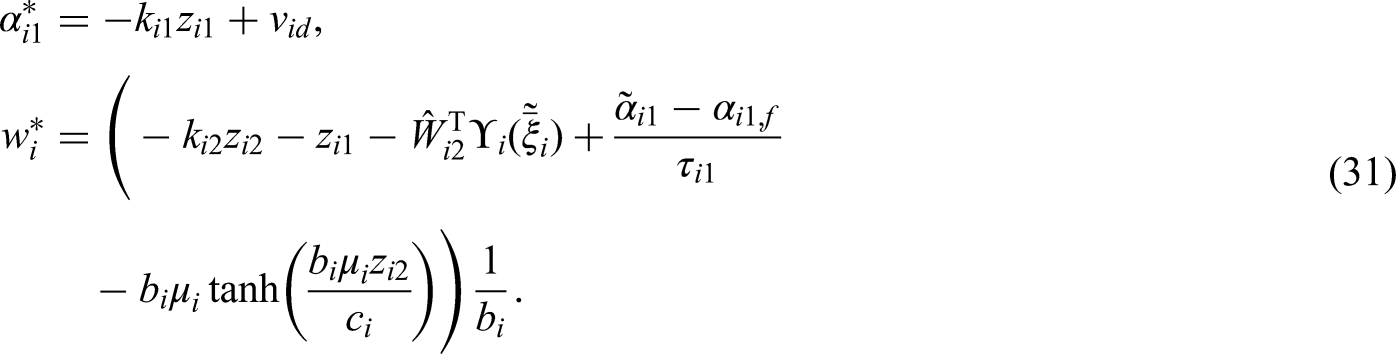
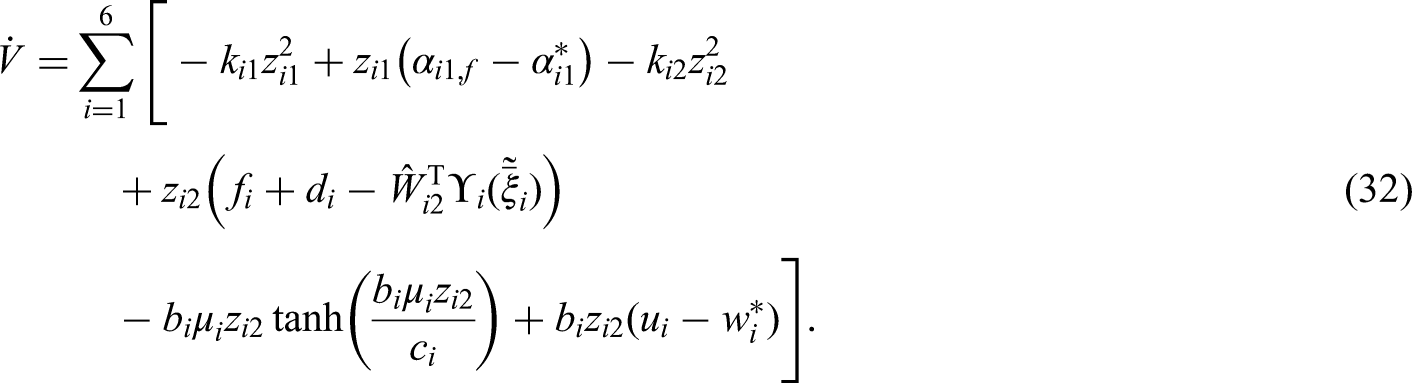
According to Lemma 1, Lemma 2, and Lemma 3, for each subsystem, there exist an ideal weight vector
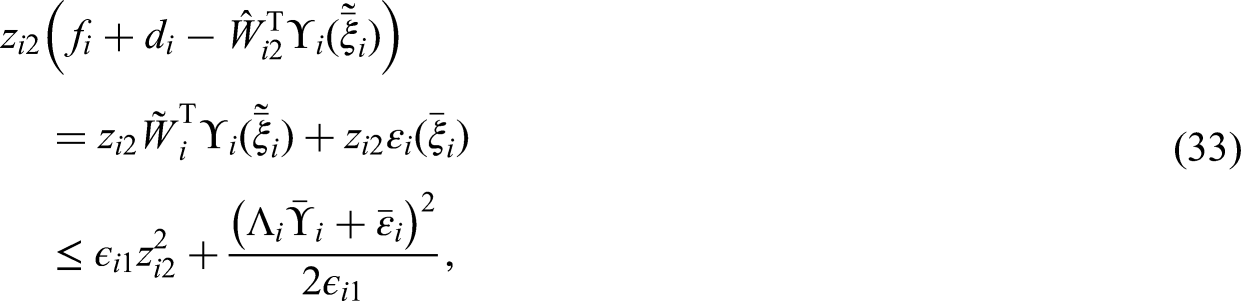
Next, the virtual-control deviation is estimated directly. Since

The last term in (32) contains the main effect of asynchronous dual-channel triggering. To distinguish the two triggering-induced errors, define
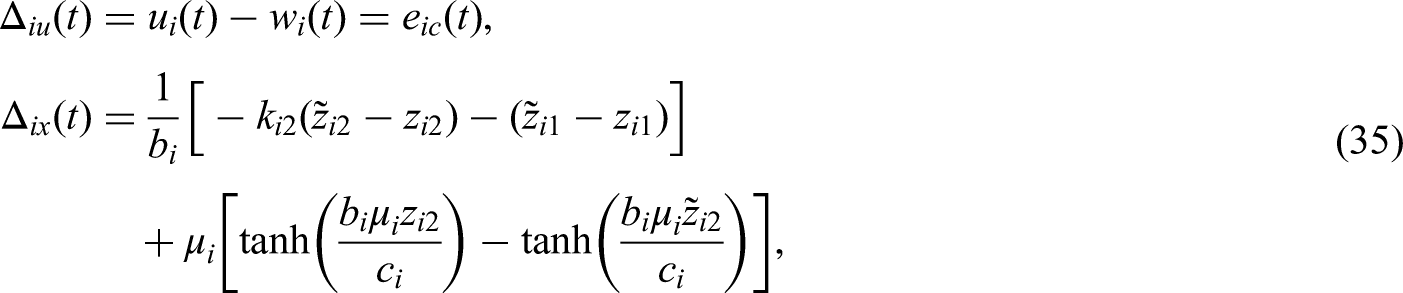

This decomposition shows that the control deviation is affected by both the control-update channel and the state-transmission channel. By applying Young’s inequality to the coupled term

Therefore, the asynchronous control-deviation term is bounded as

For the robust hyperbolic-tangent term, let

Substituting (33), (34), (38), and (39) into (32), the derivative of
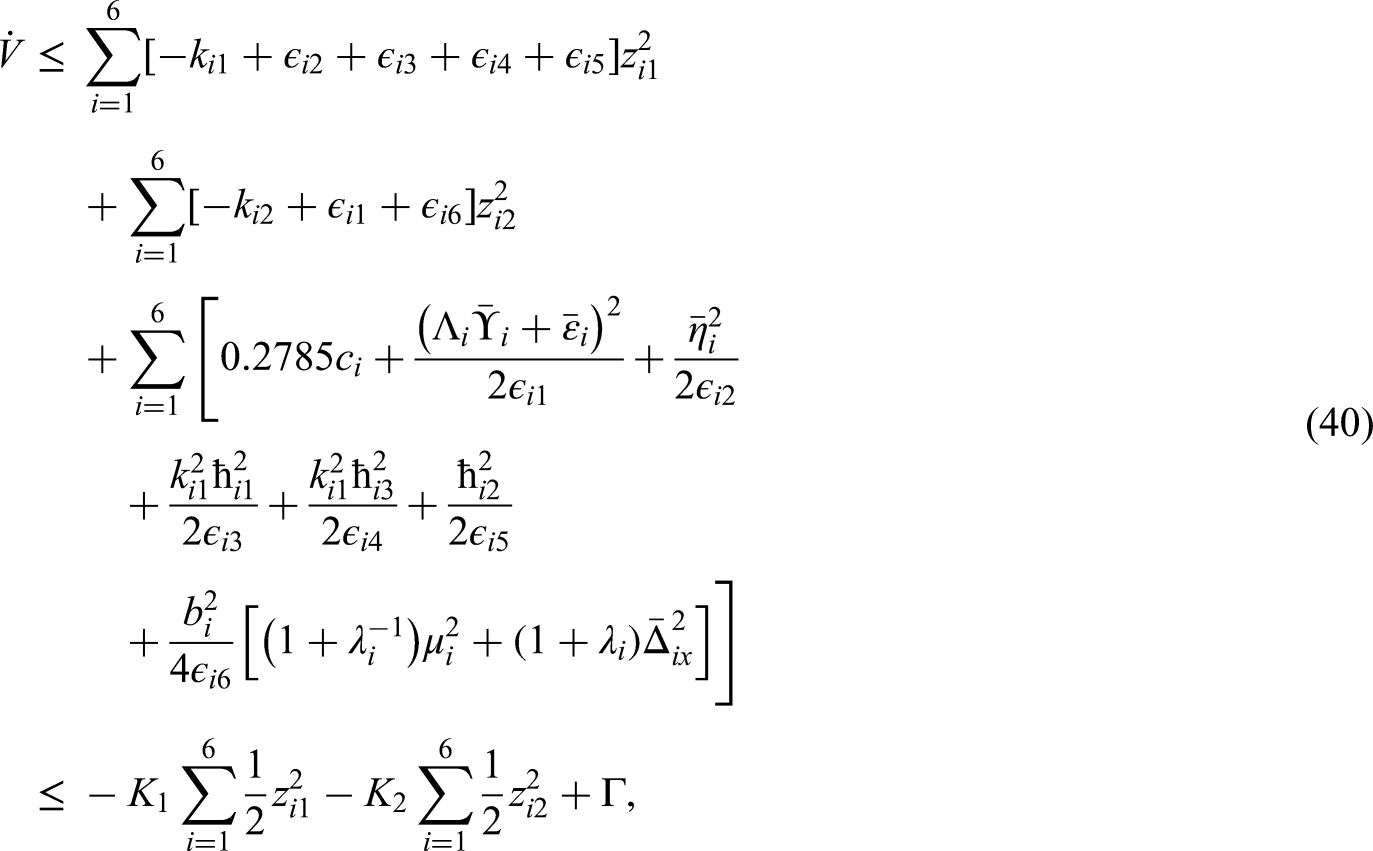
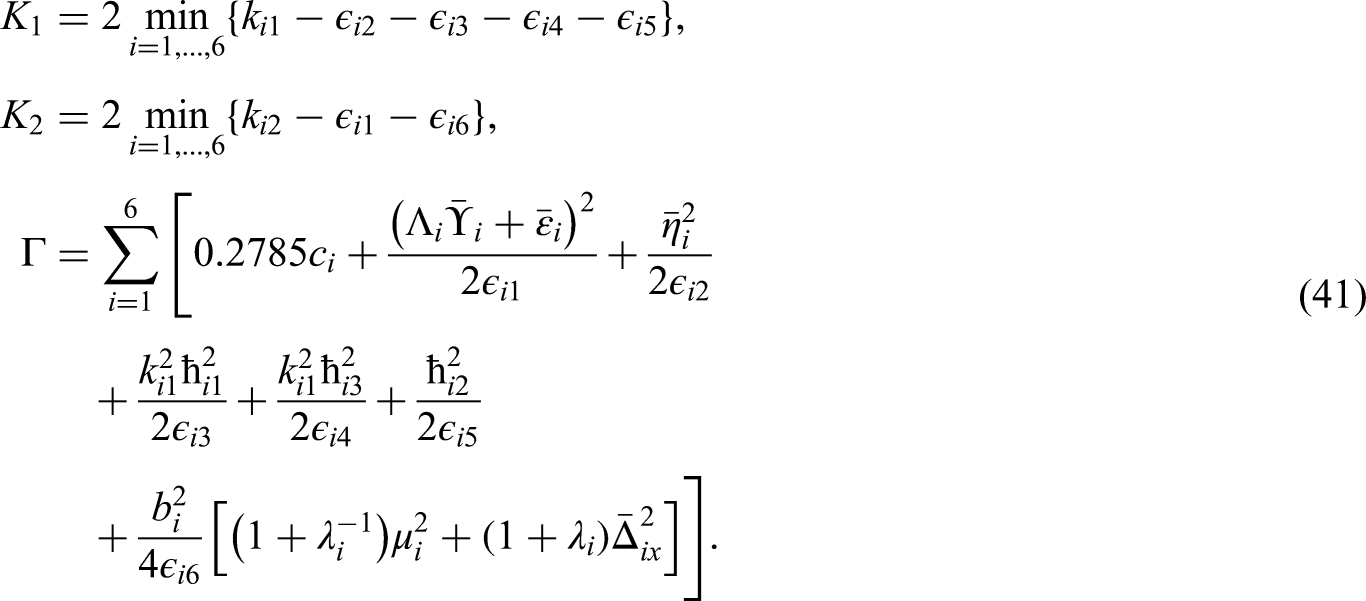
Since
Next, to avert the Zeno phenomenon, it is necessary to prove that there exists a positive constant
The triggering errors are defined as
Due to the boundedness of closed-loop signals, there exist positive constants
By combining the fixed thresholds
The control triggering error is
Thus, it can be shown that Zeno phenomenon cannot happen.
Simulation
In this section, two sets of simulation studies are carried out under constant and time-varying reference signals to evaluate the tracking performance and communication–computation efficiency of the proposed method. Three schemes are considered for comparison, namely, DET
Basic parameters of the quadrotor UAV.
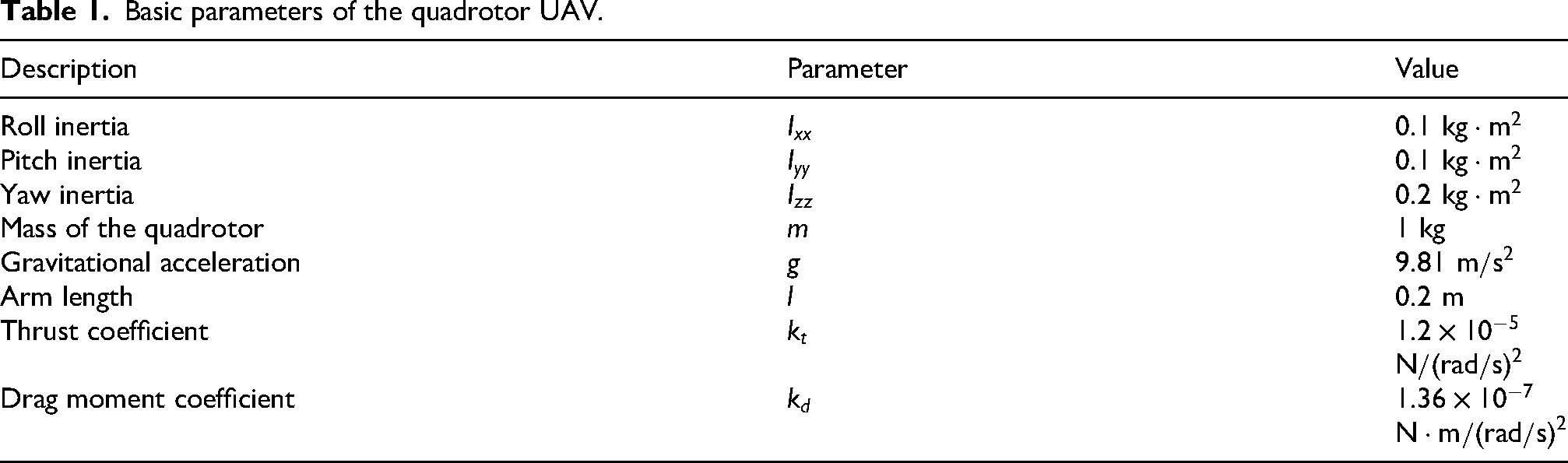
Simulation 1
This set of simulations compares the performance of DET
The reference trajectory is specified as
For DET
The triggering parameters are set to
The simulation results under constant reference inputs are shown in Figures 3 to 17. Figures 3 to 5 show that all three schemes achieve stable tracking of the constant reference signals in the X-, Y-, and Z-axes. Under the same dual-trigger framework, DET
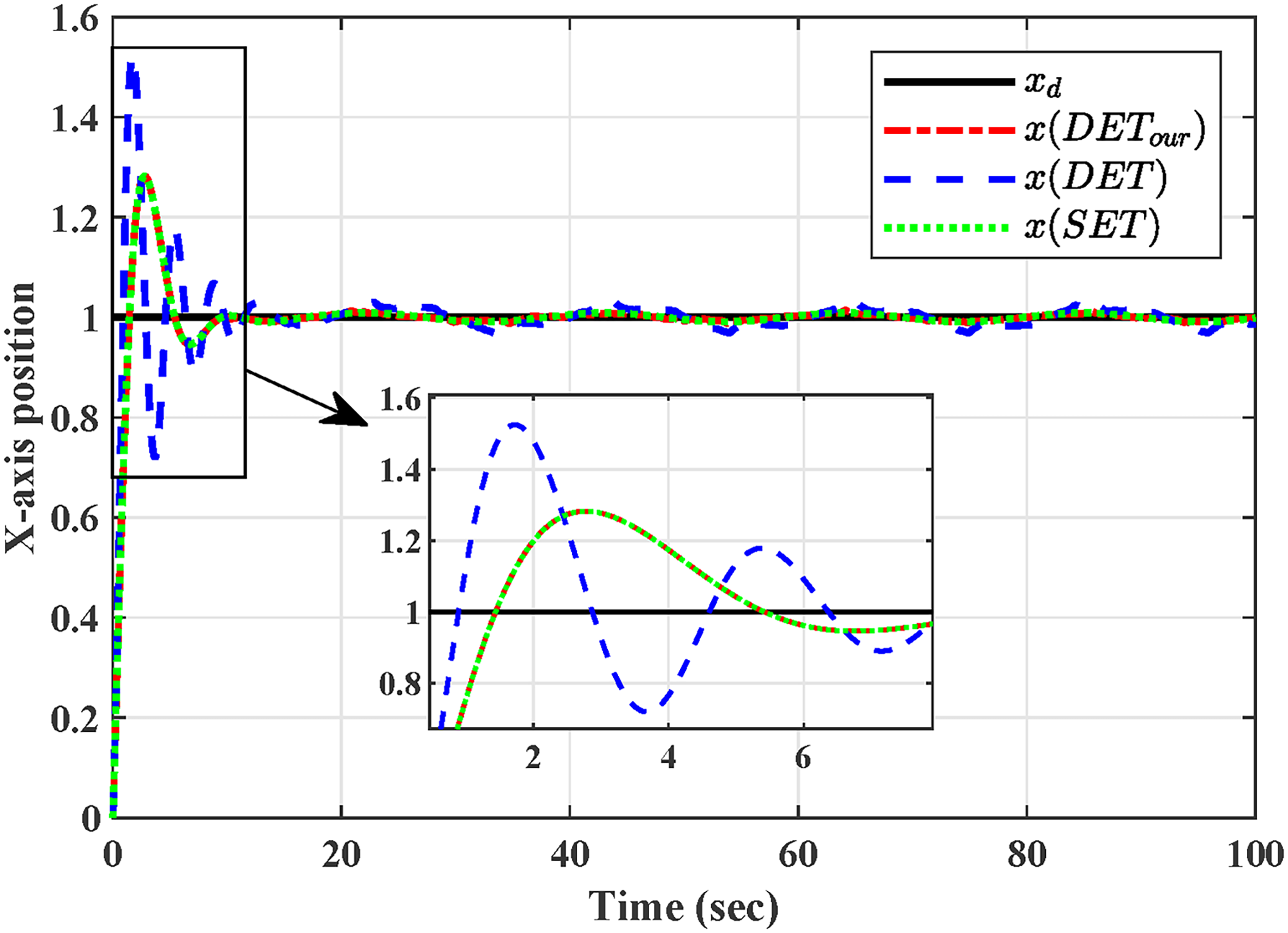
Position tracking responses in the X-axis under DET
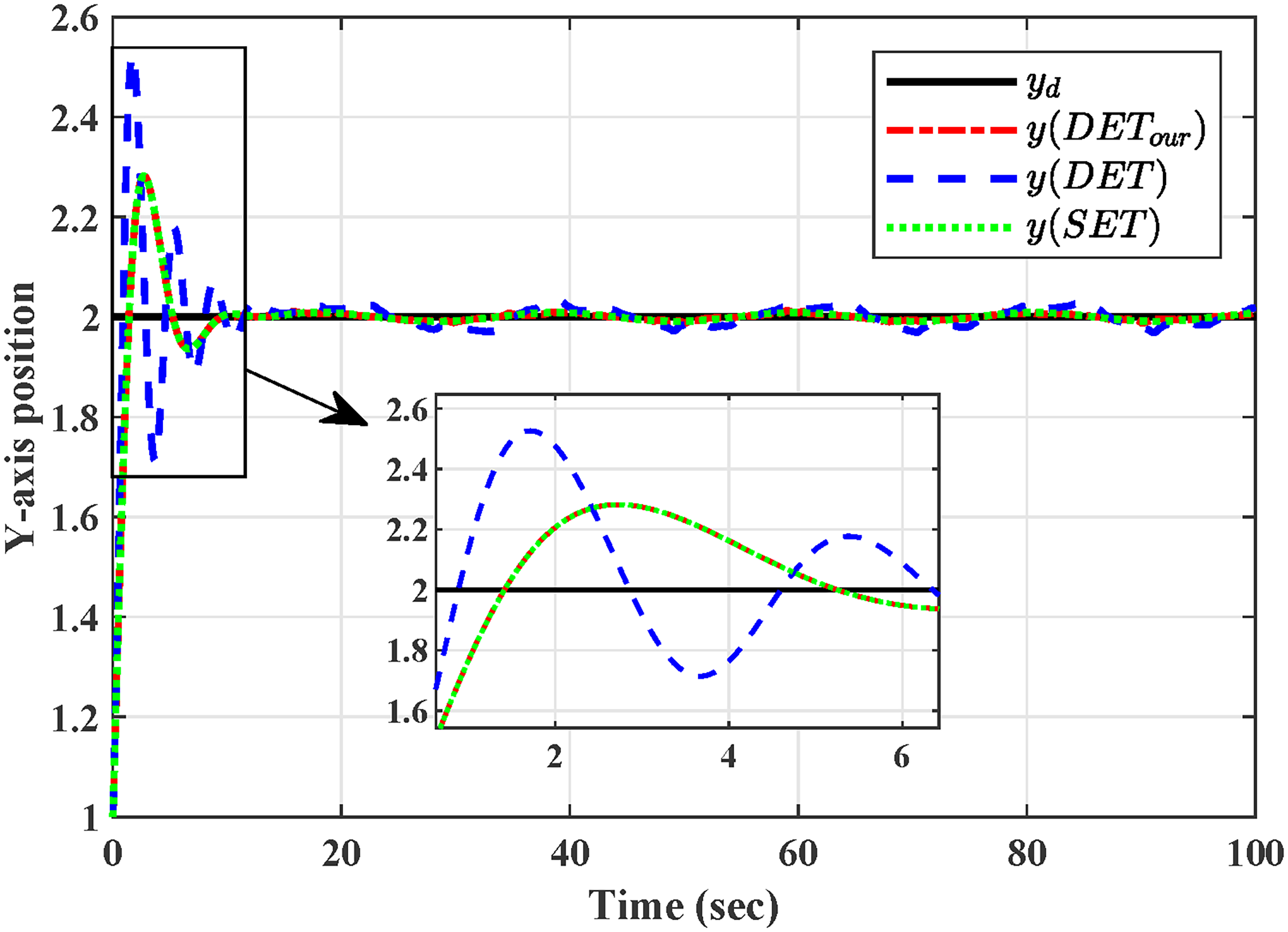
Position tracking responses in the Y-axis under DET
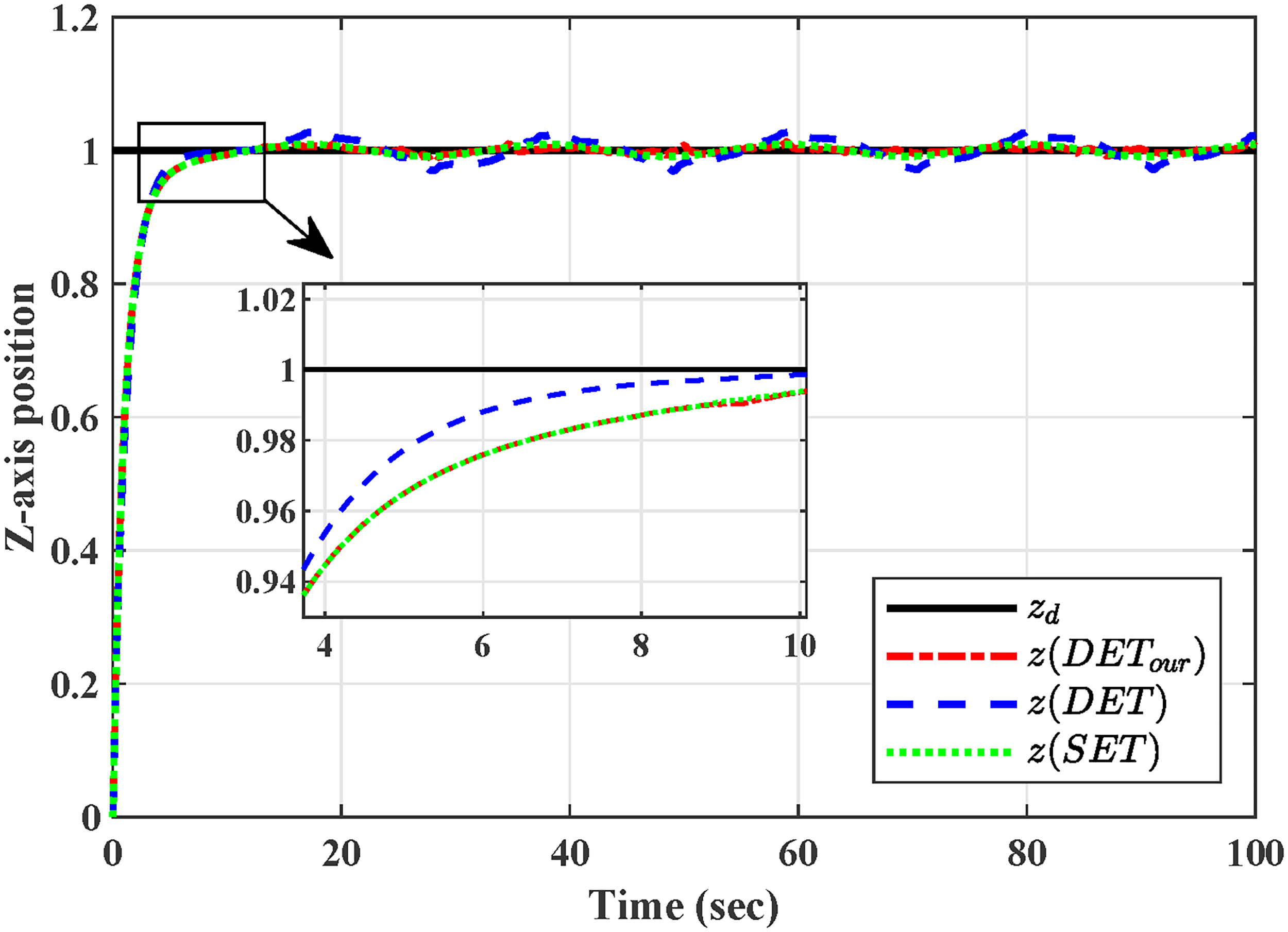
Position tracking responses in the Z-axis under DET
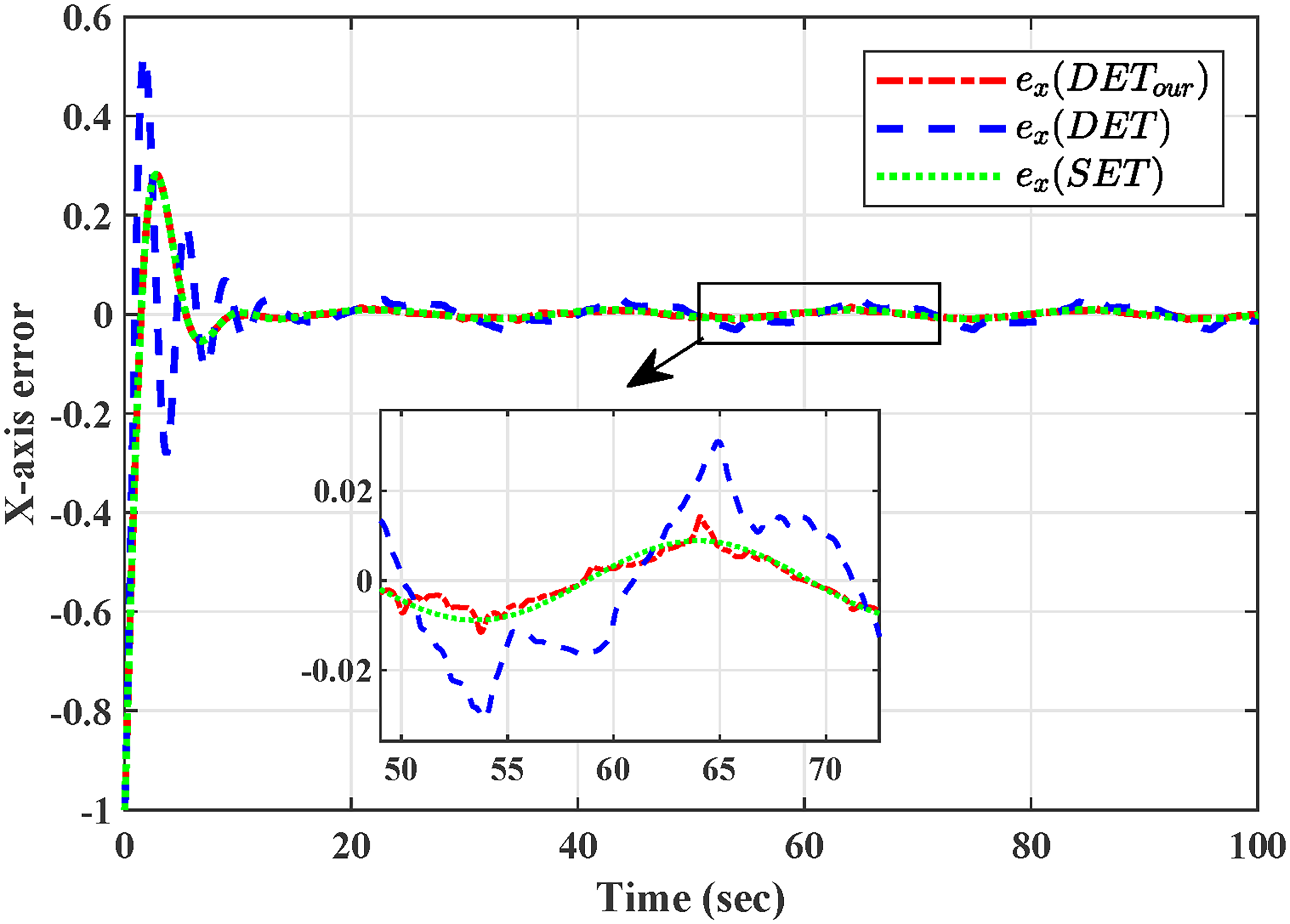
Position tracking errors in the X-axis under DET
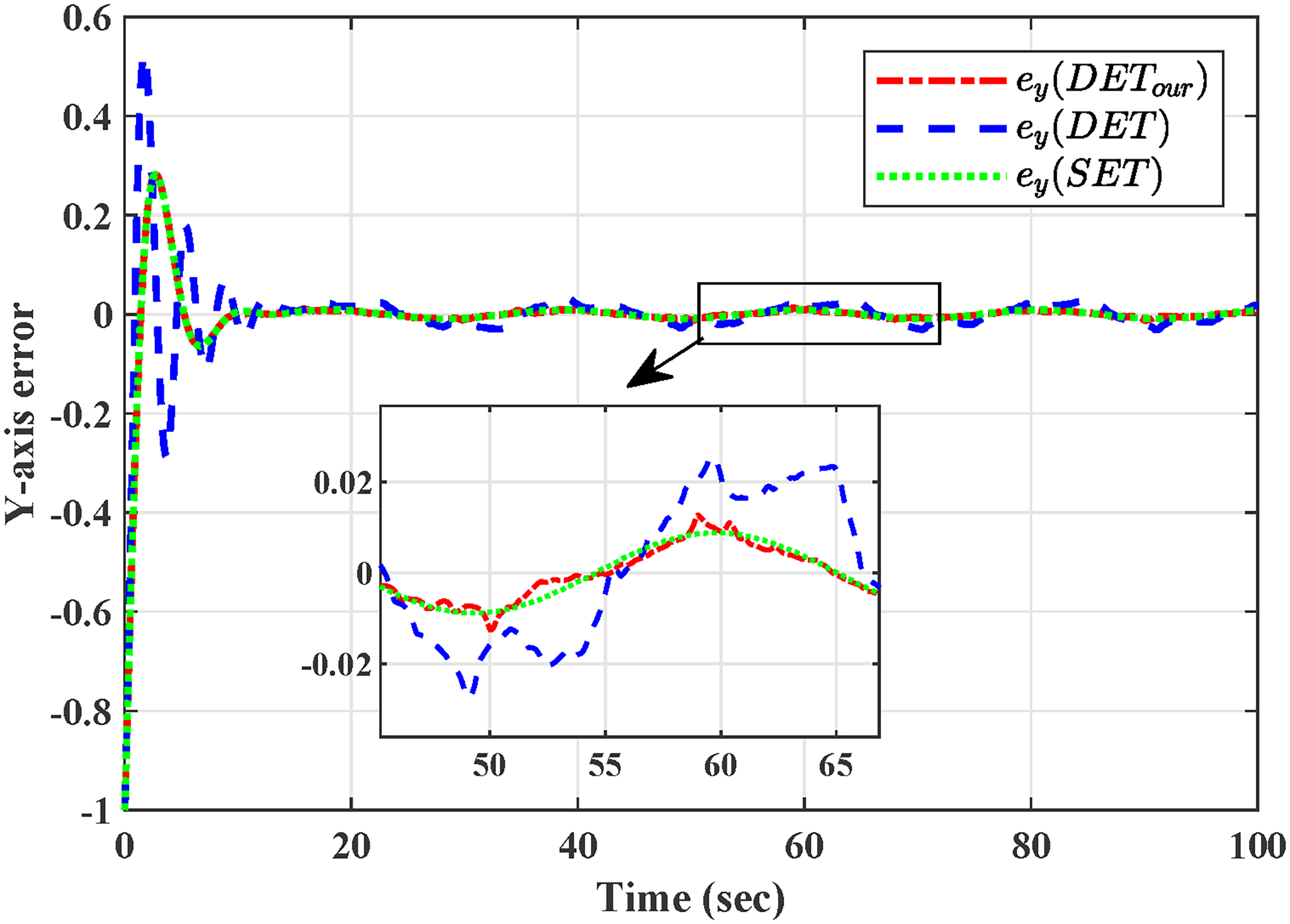
Position tracking errors in the Y-axis under DET
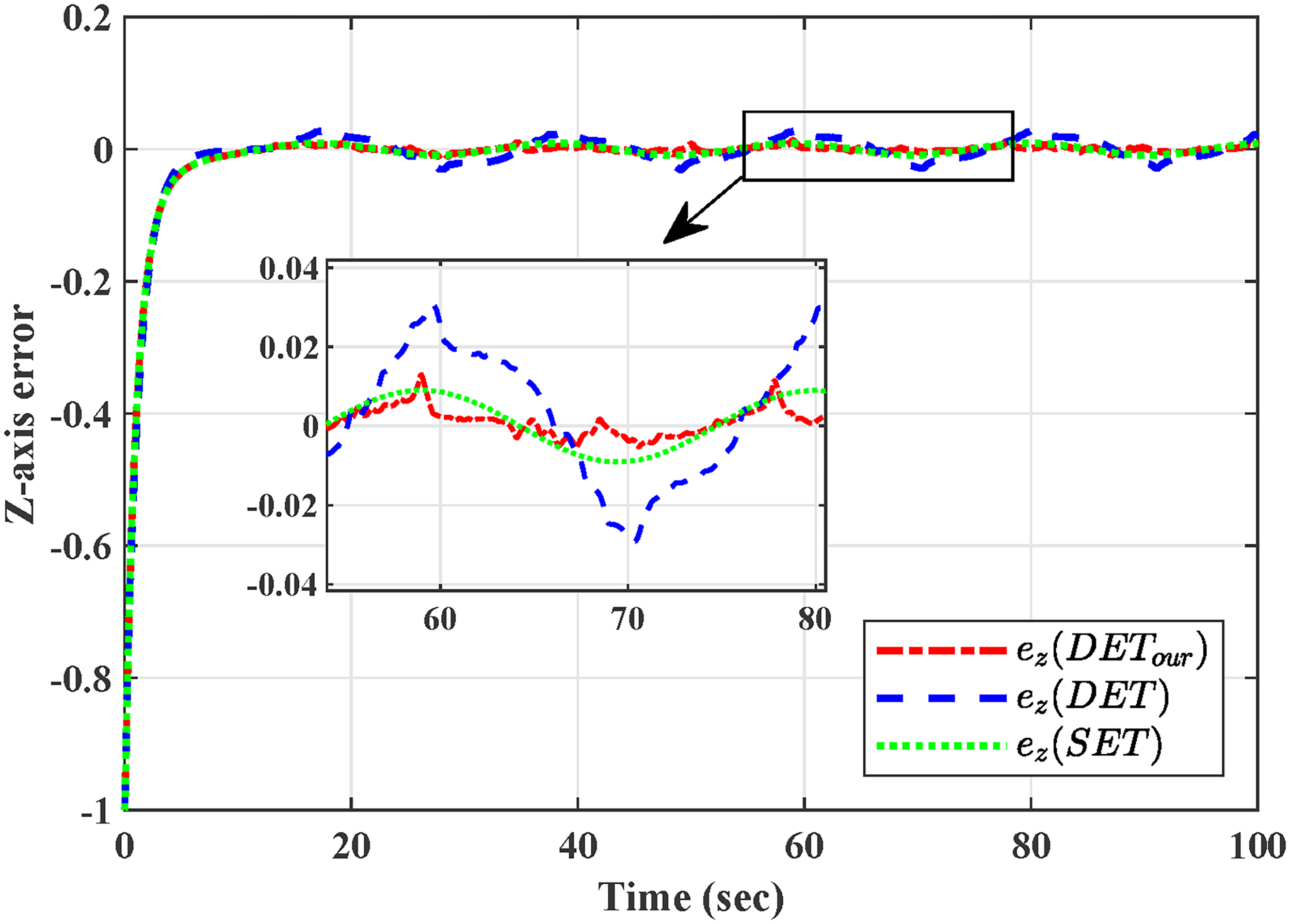
Position tracking errors in the Z-axis under DET
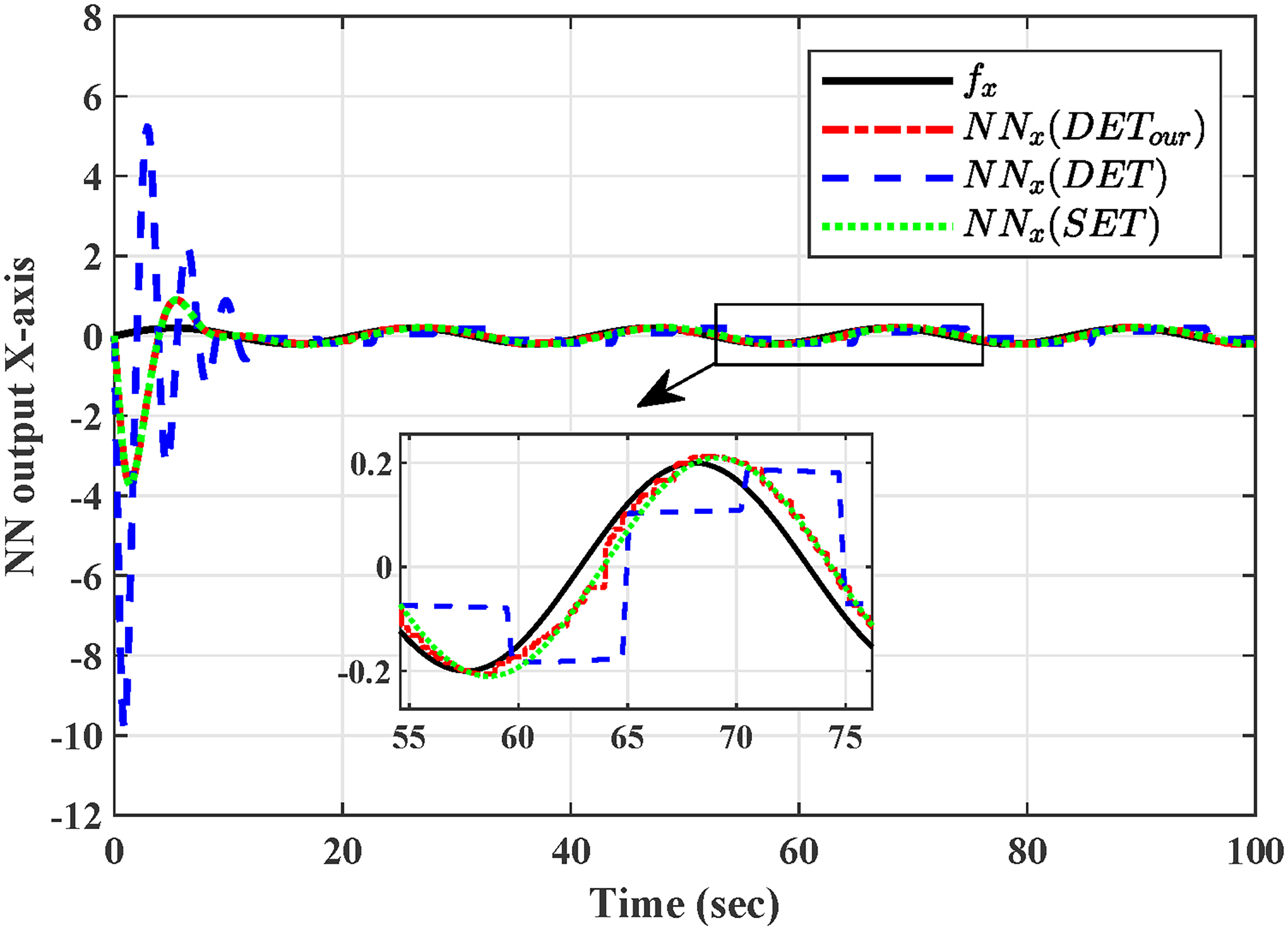
Neural network outputs in the X-axis under DET
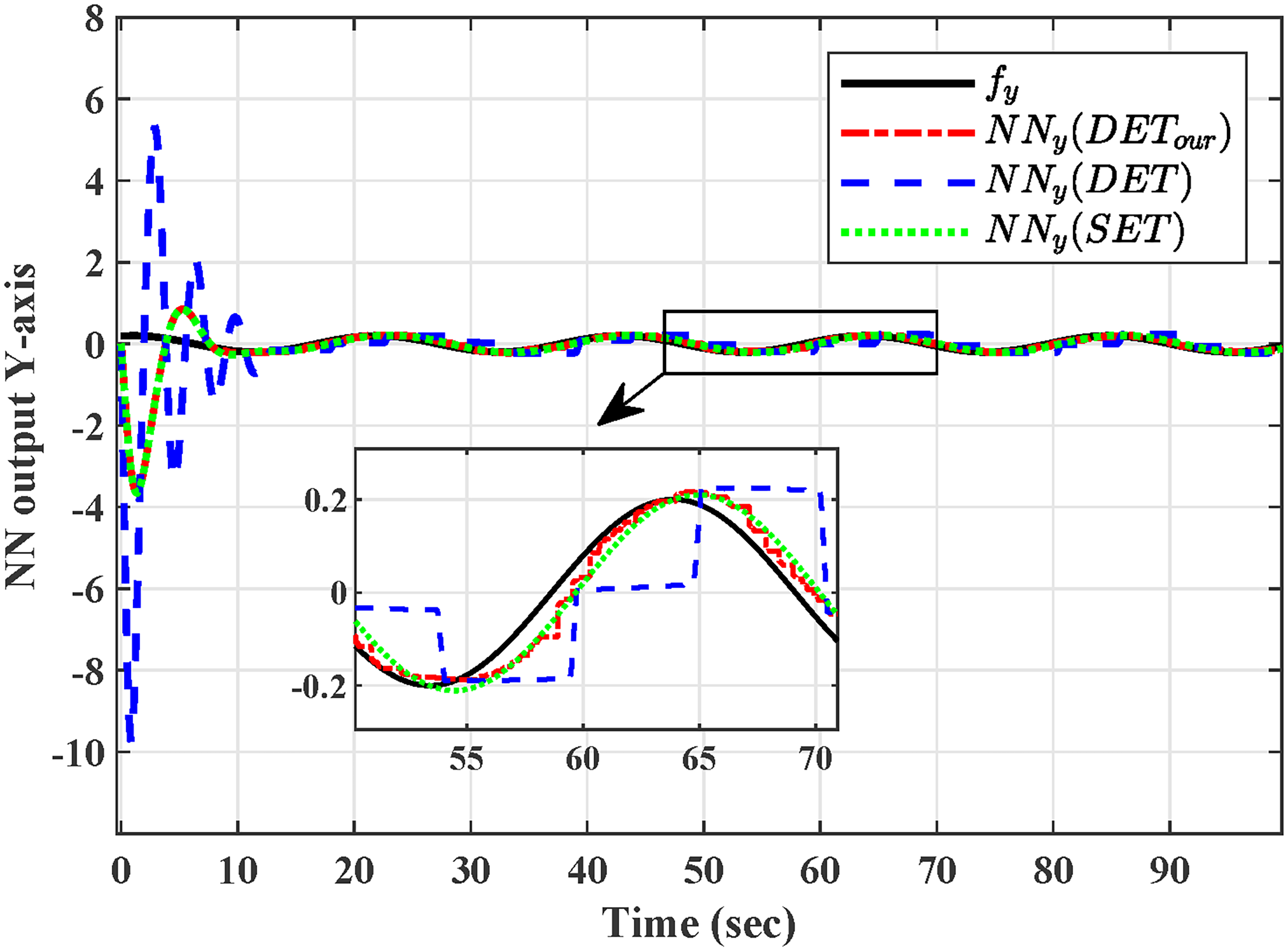
Neural network outputs in the Y-axis under DET
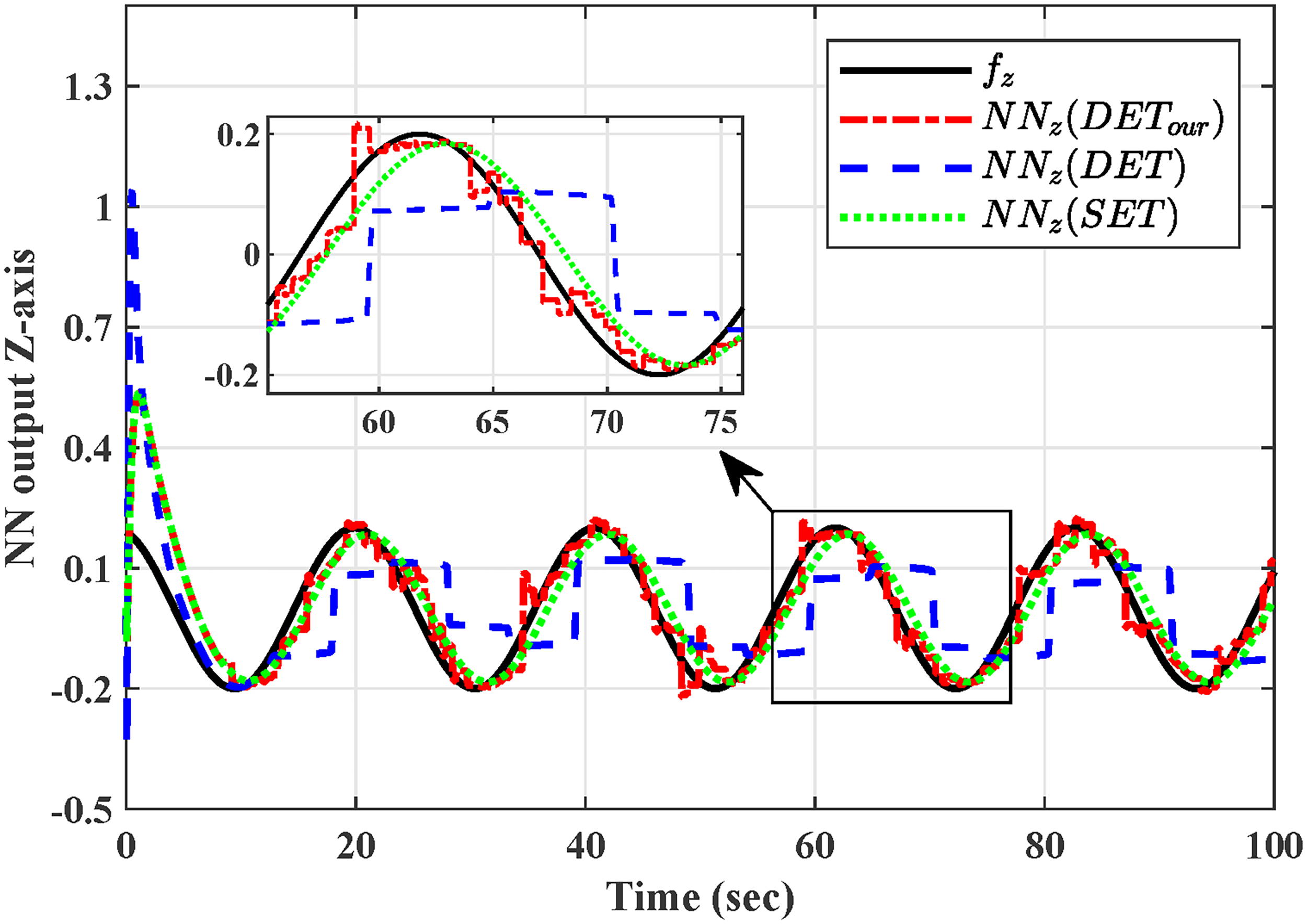
Neural network outputs in the Z-axis under DET
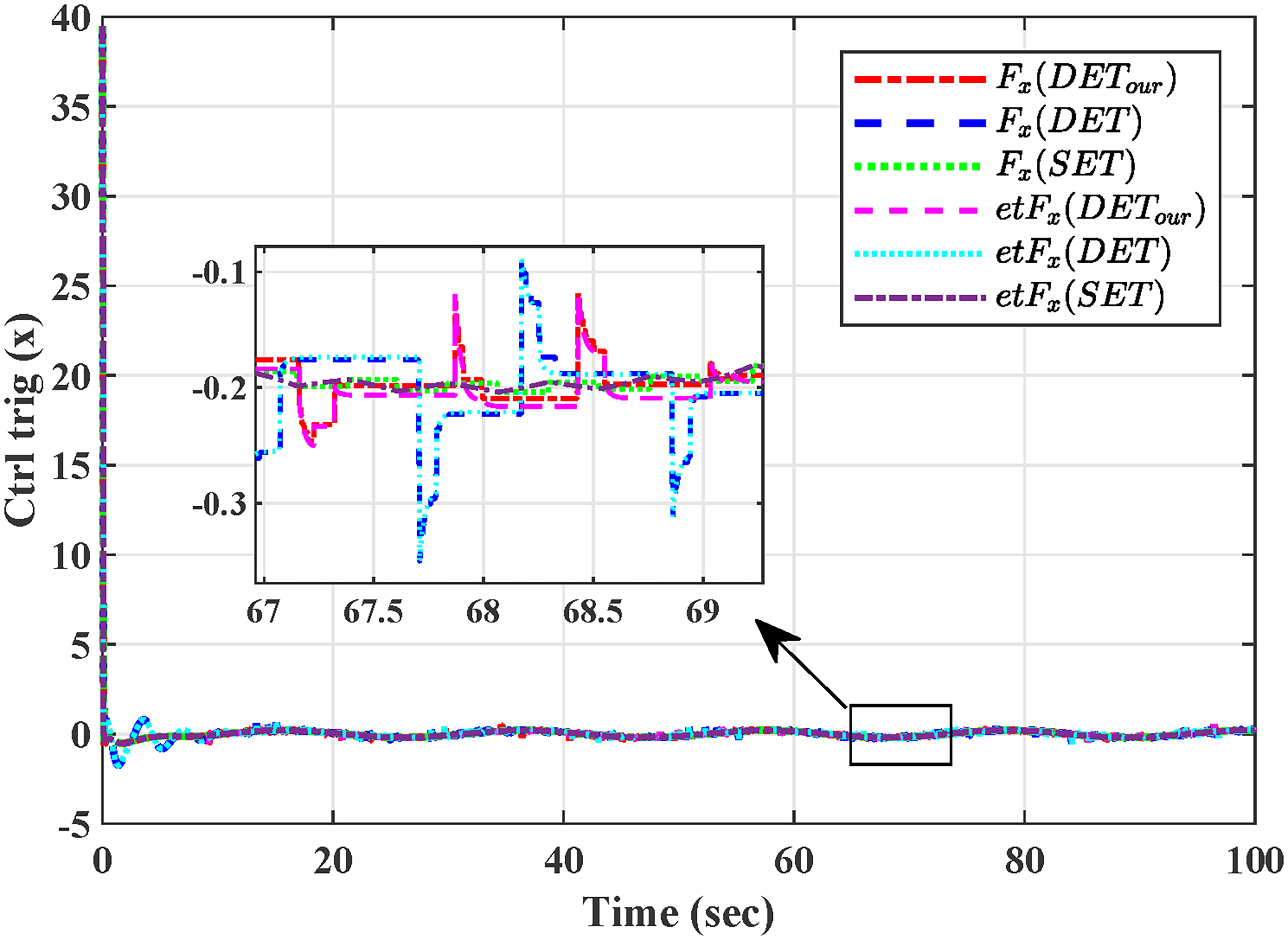
Controller outputs and triggering instants in the X-axis under DET
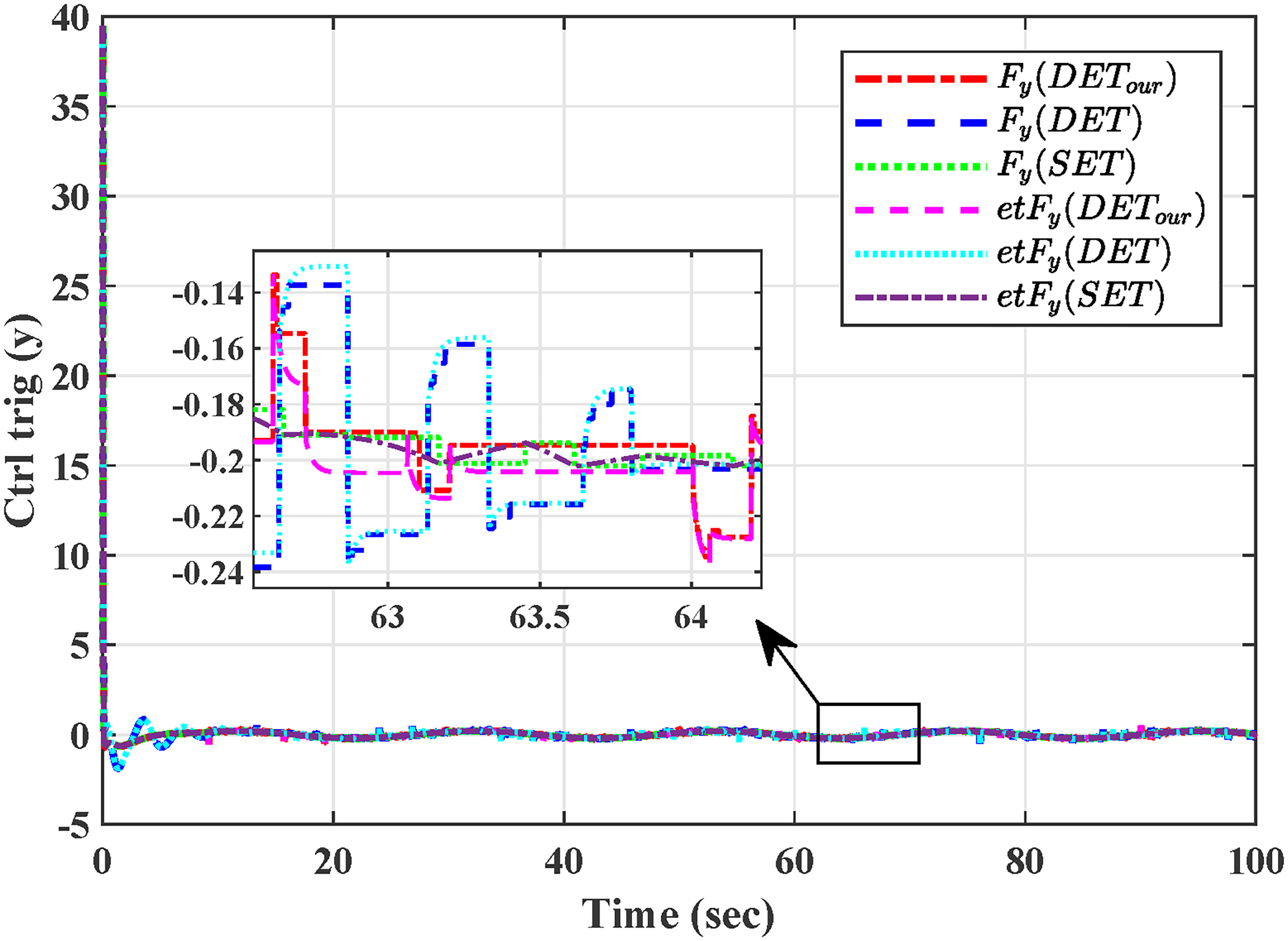
Controller outputs and triggering instants in the Y-axis under DET
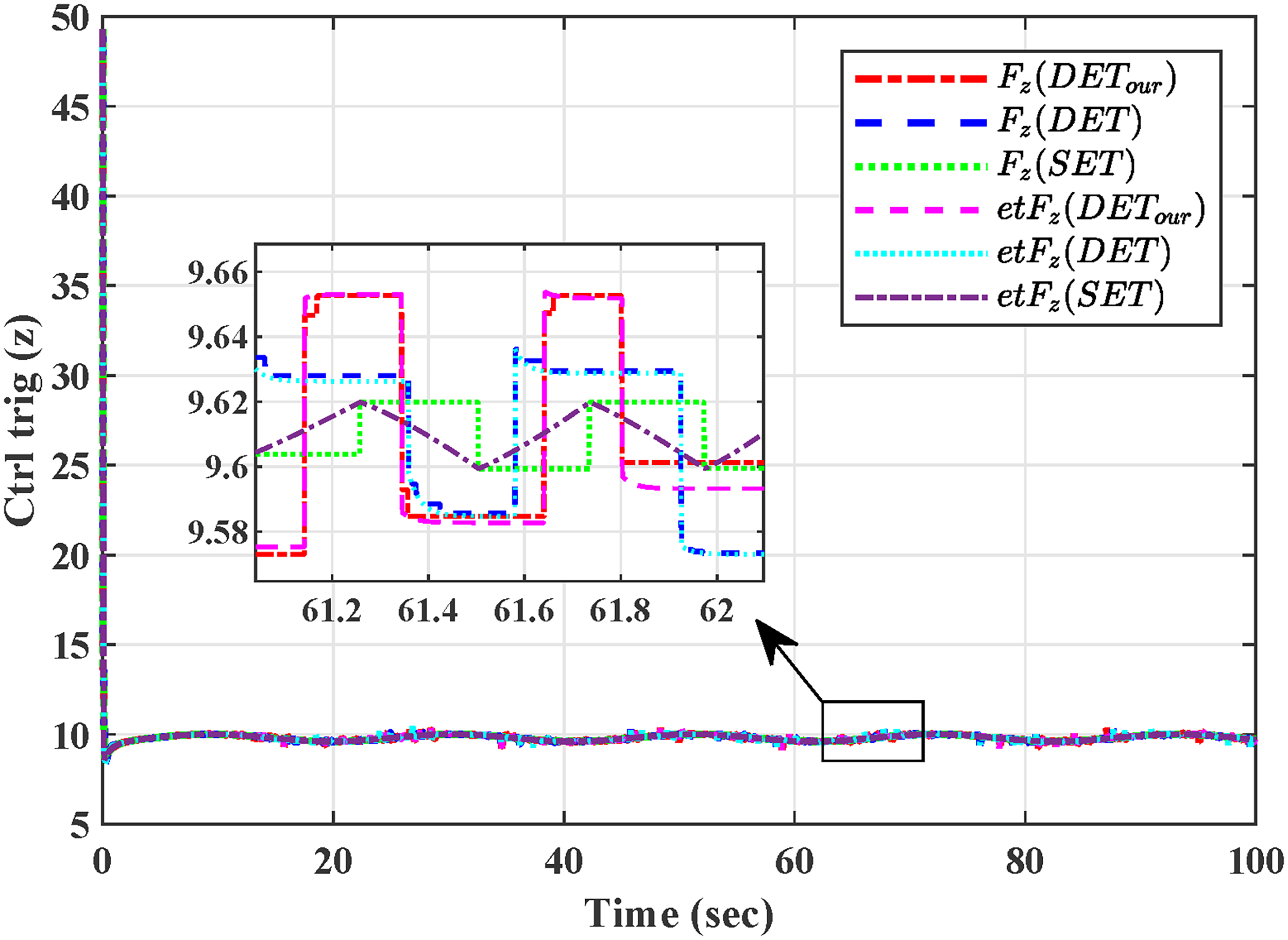
Controller outputs and triggering instants in the Z-axis under DET
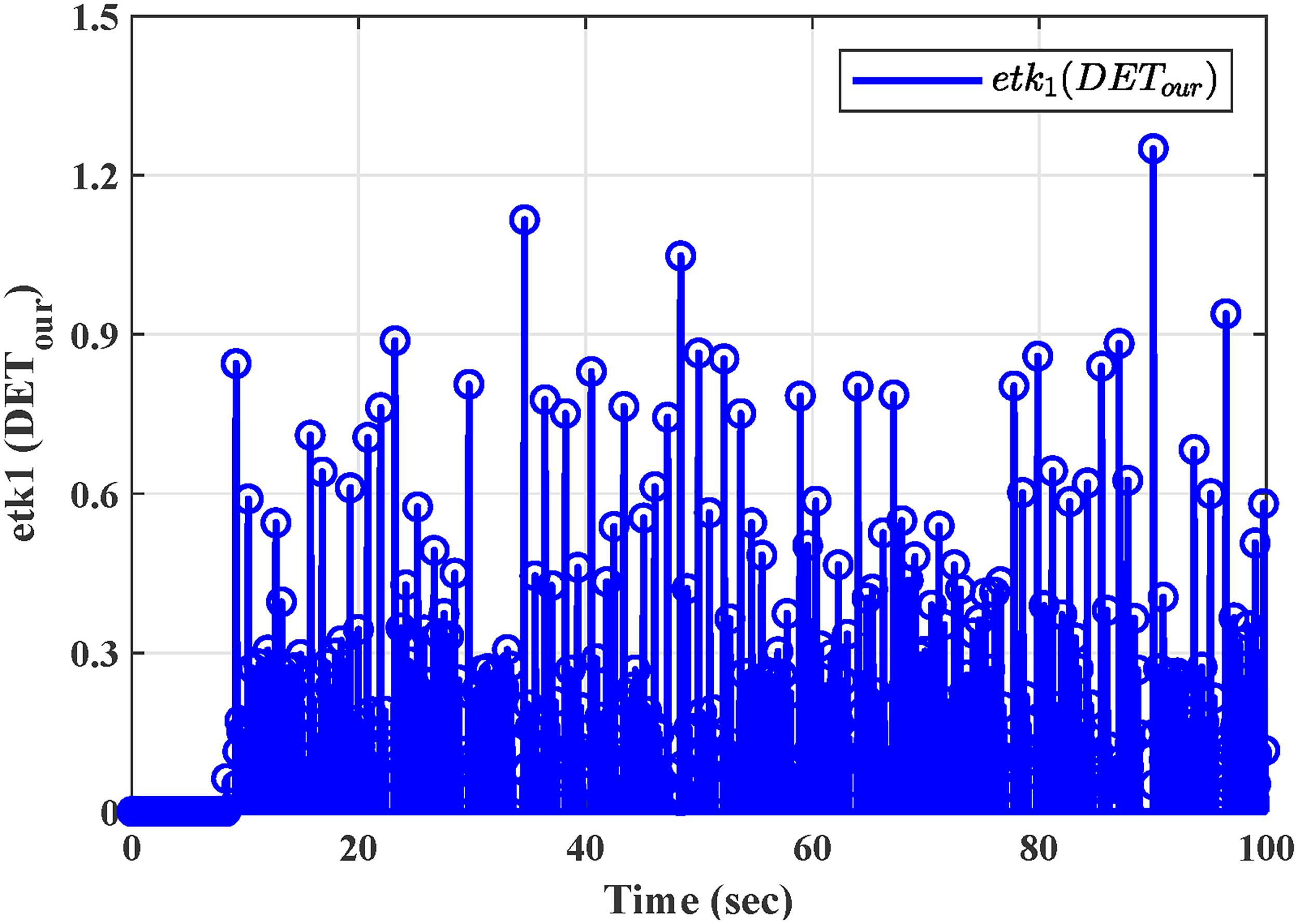
State-triggering intervals under DET
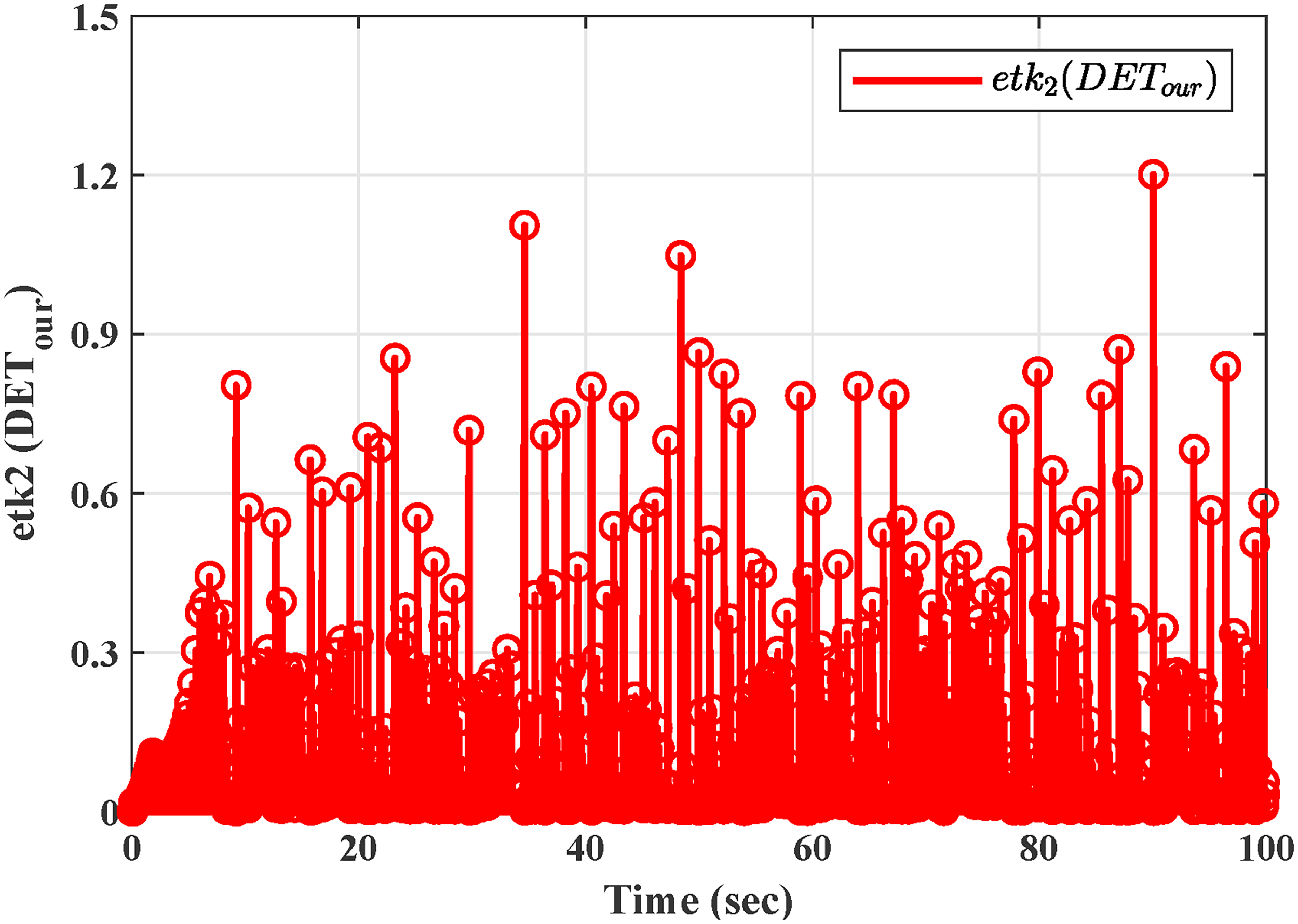
Control-triggering intervals under DET
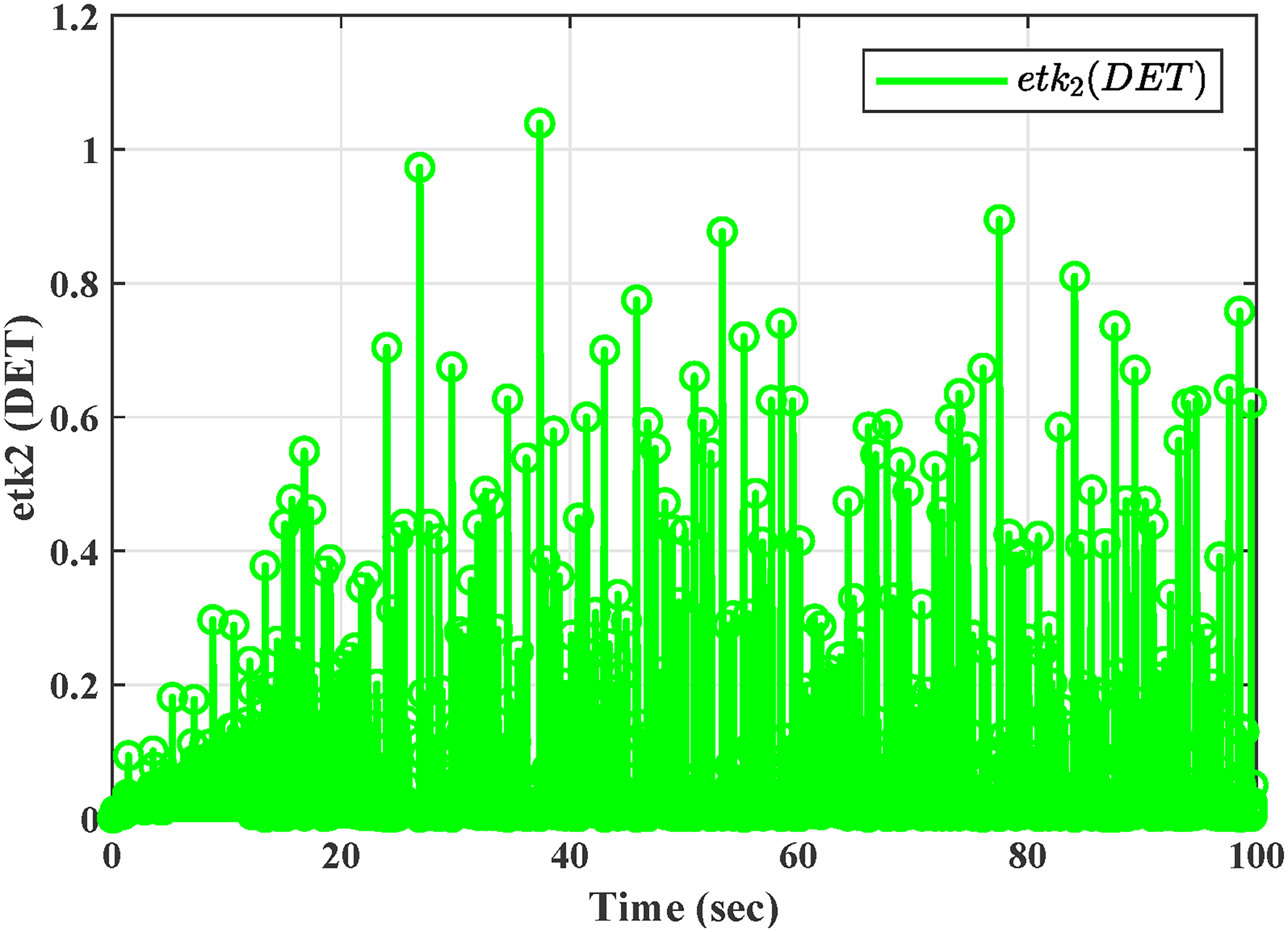
Control-triggering intervals under DET.
Table 2 compares the communication and update counts under constant reference signals. For the proposed DET
Triggering counts under constant signals.

Simulation 2
This set of simulations evaluates the performance differences under time-varying reference signals among the proposed dual-event-triggered strategy DET
The reference three-dimensional trajectory is defined as
The simulation results of the quadrotor UAV under time-varying reference inputs and external disturbances are shown in Figures 18 to 33. Figure 18 shows that all three schemes are able to follow the desired three-dimensional path, while DET
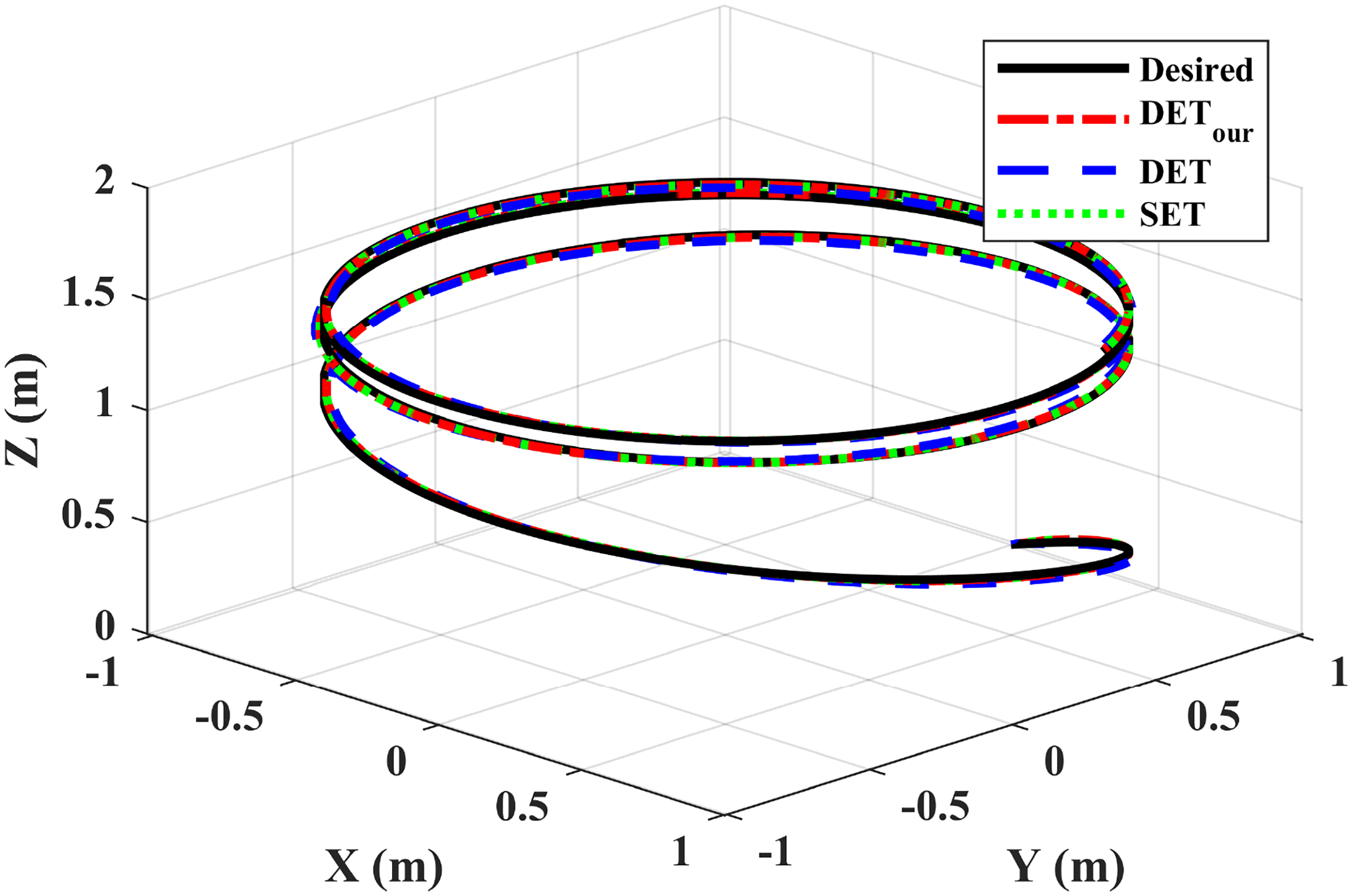
Three-dimensional translational trajectories under DET
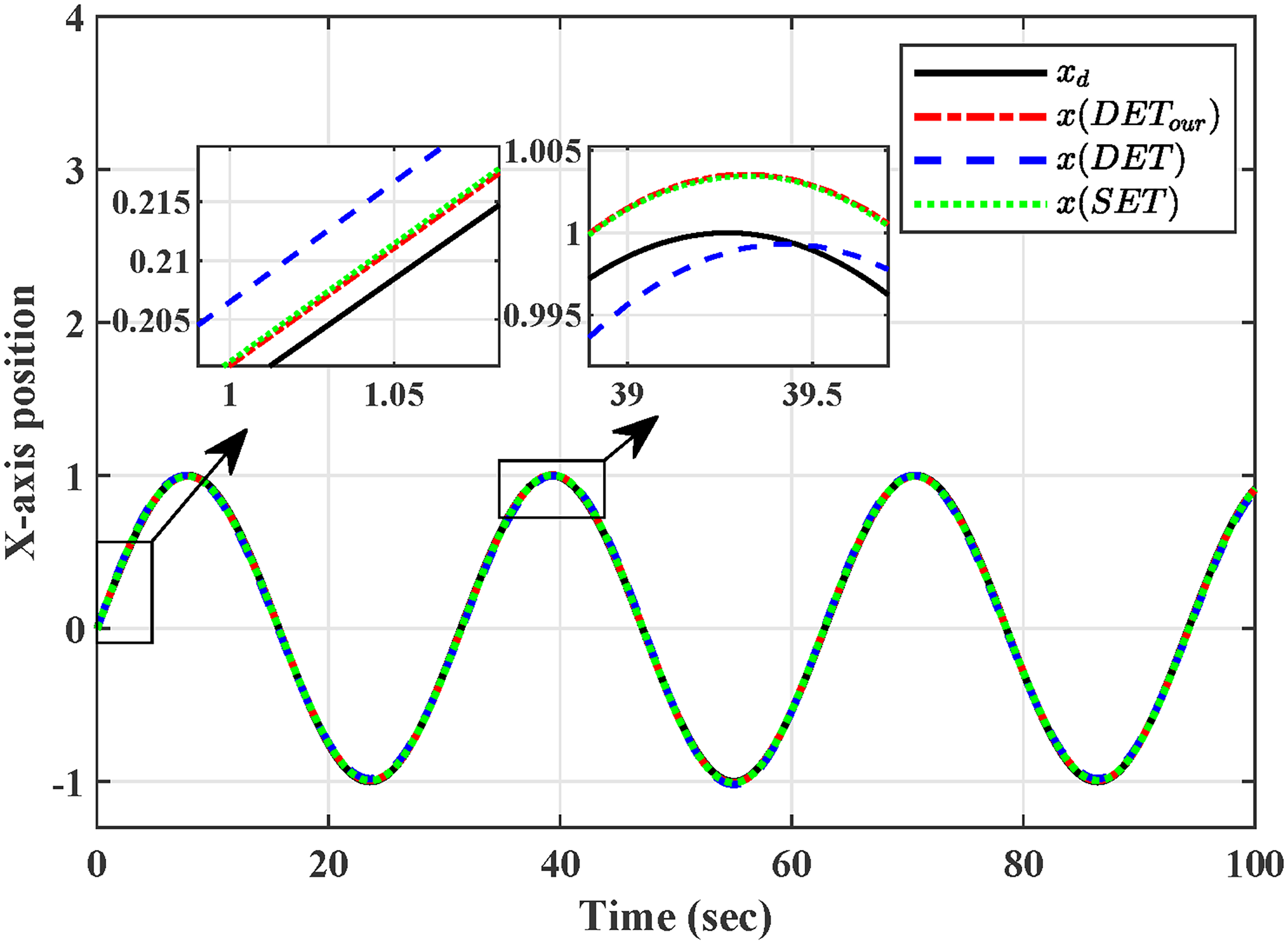
Position tracking responses in the X-axis under DET
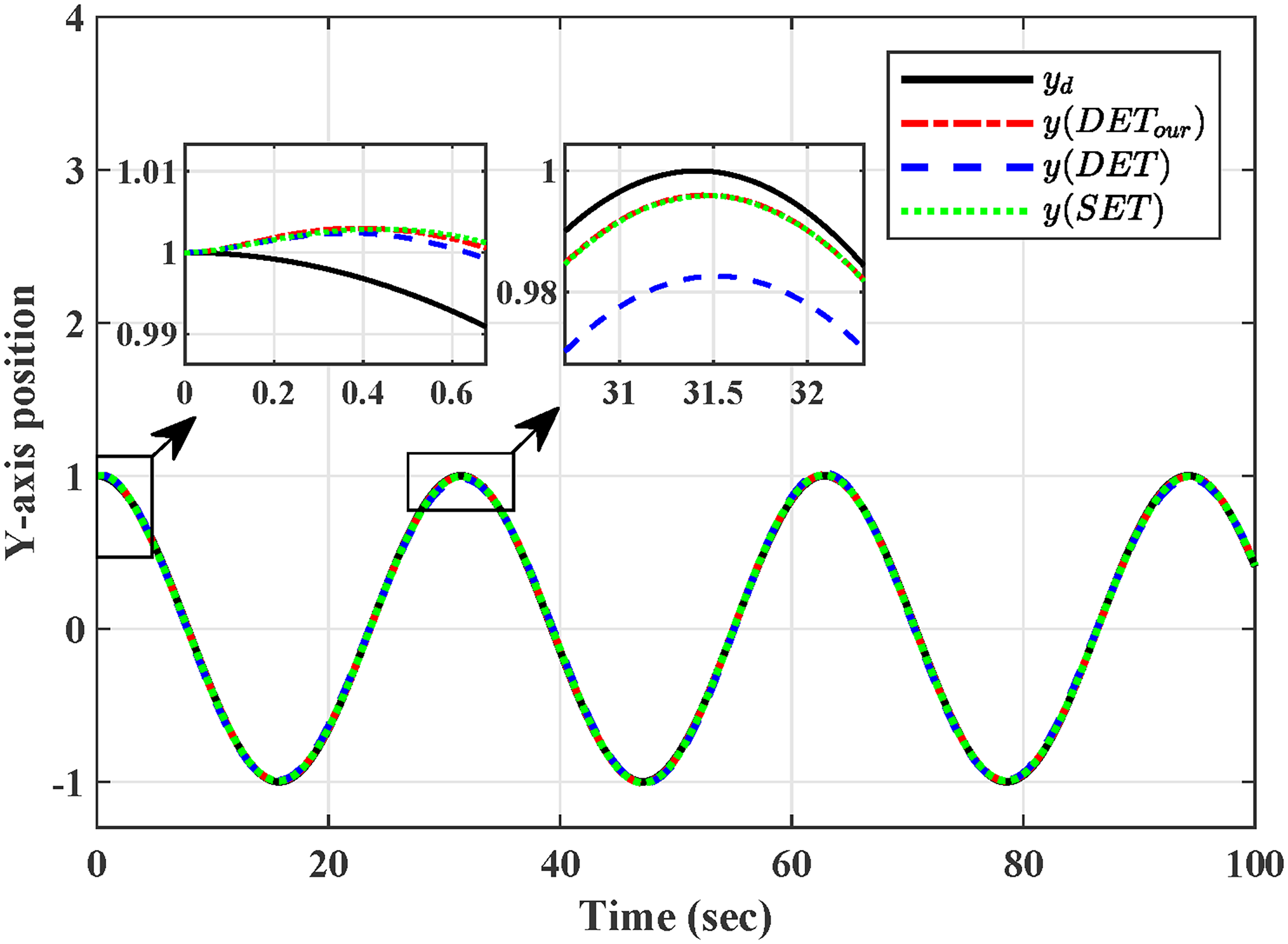
Position tracking responses in the Y-axis under DET
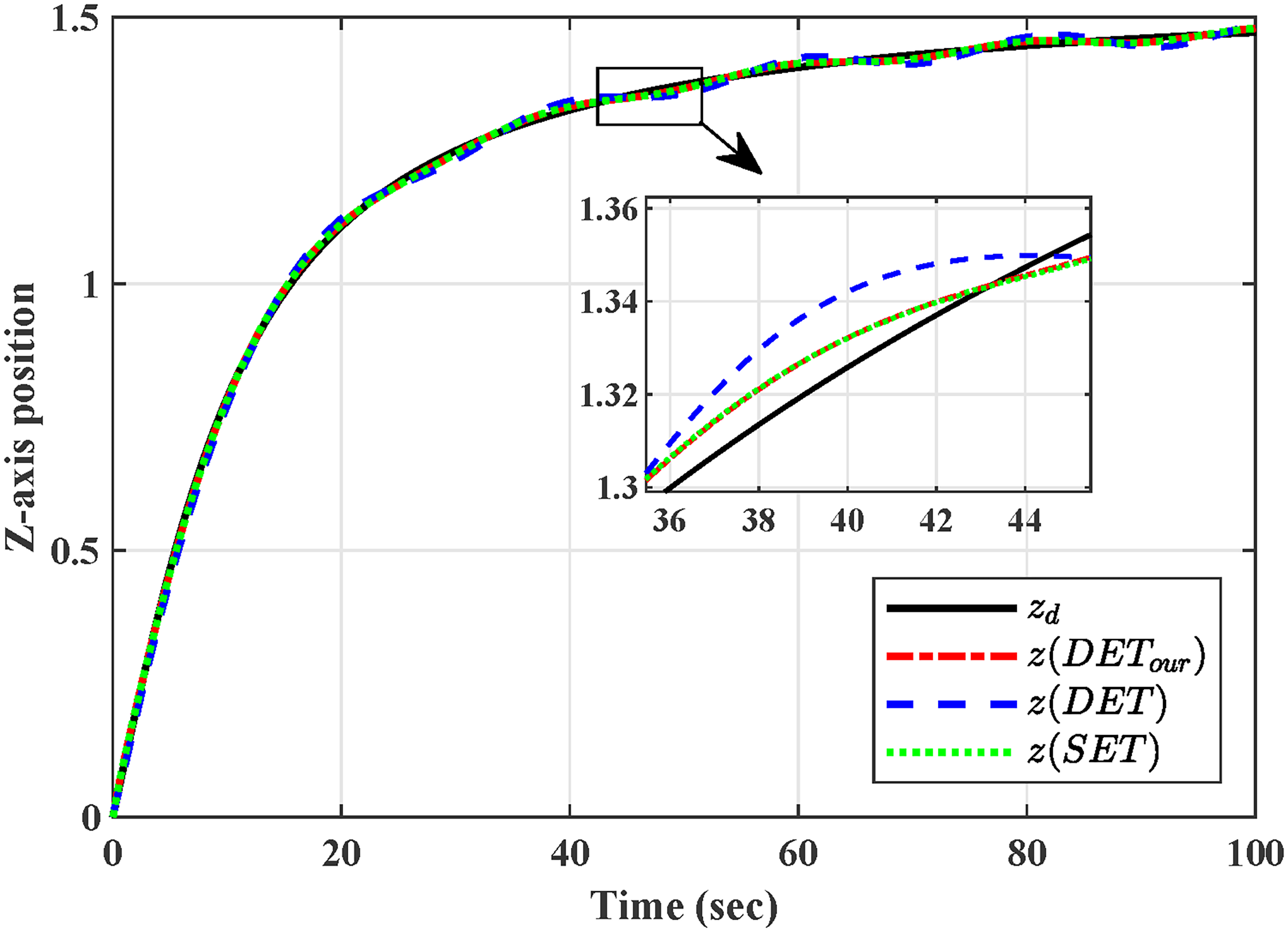
Position tracking responses in the Z-axis under DET
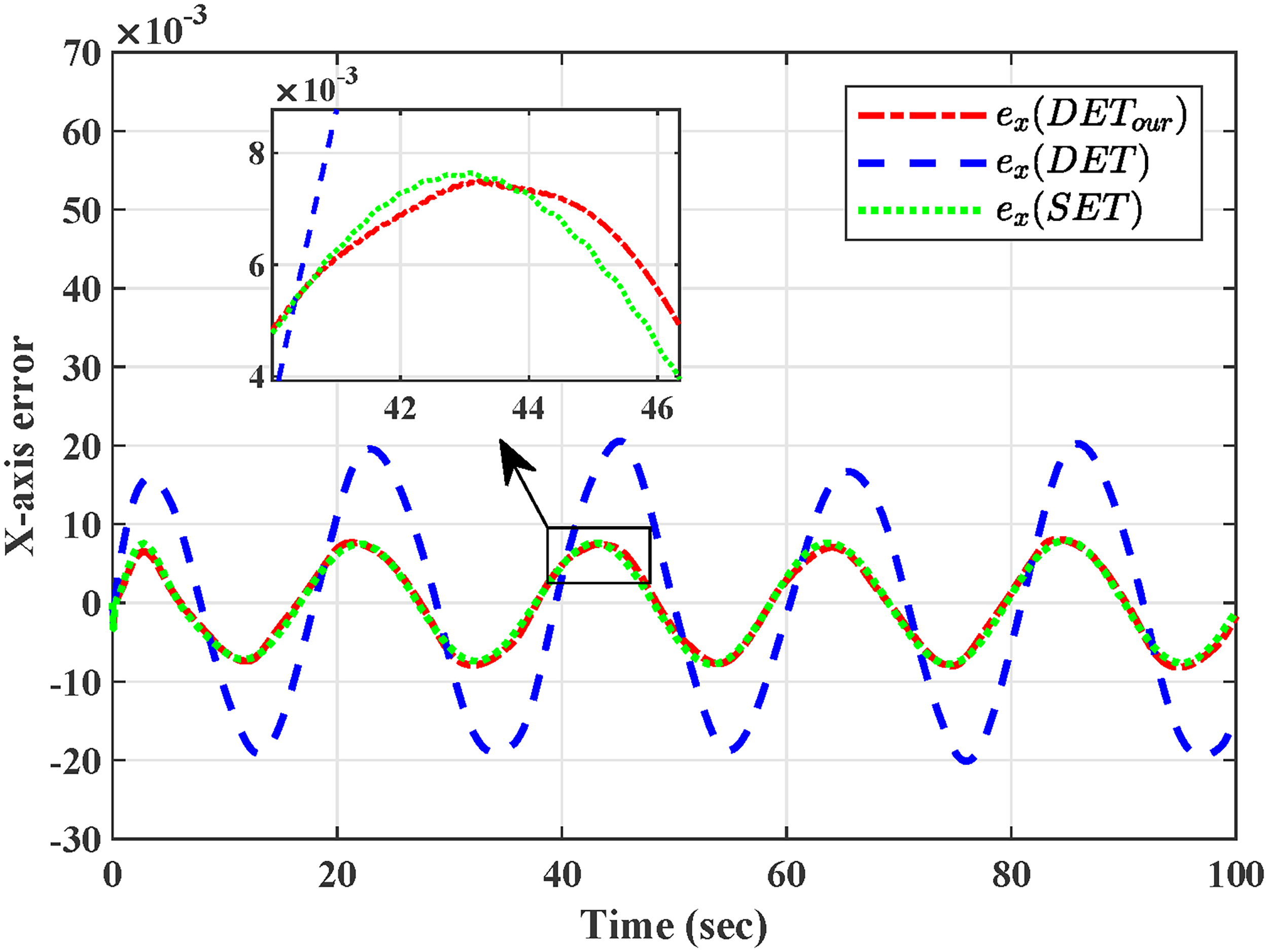
Position tracking errors in the X-axis under DET
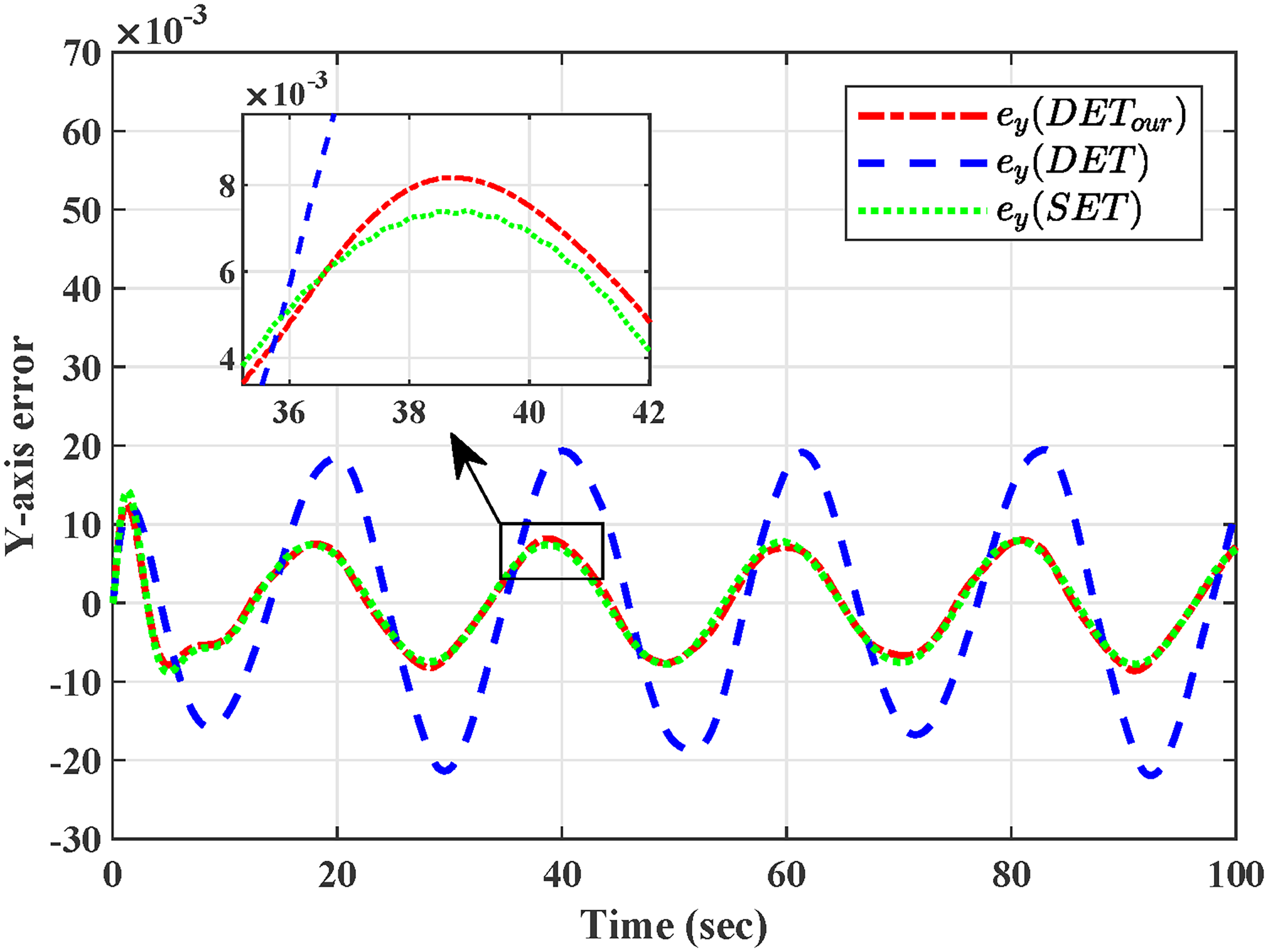
Position tracking errors in the Y-axis under DET
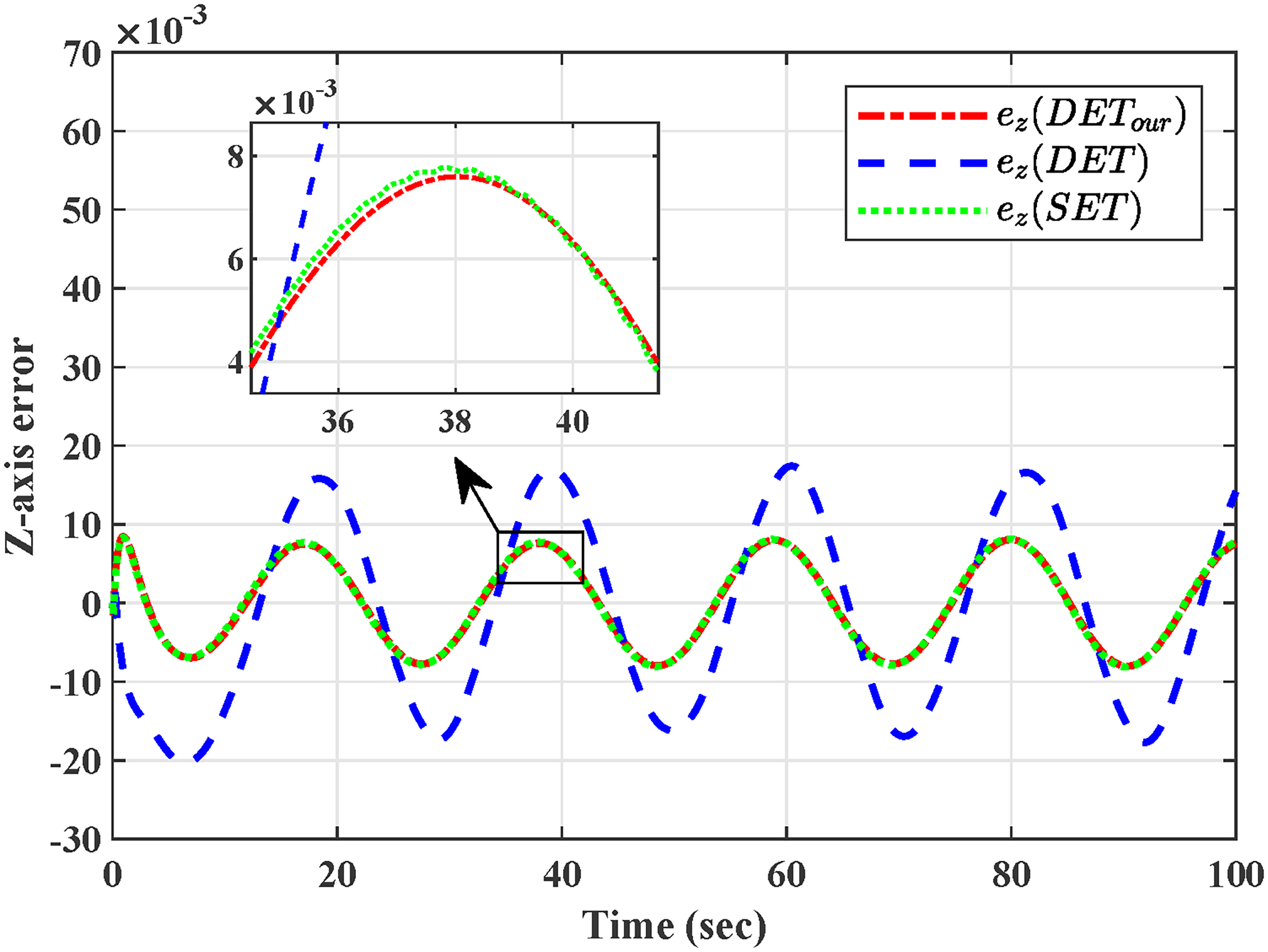
Position tracking errors in the Z-axis under DET
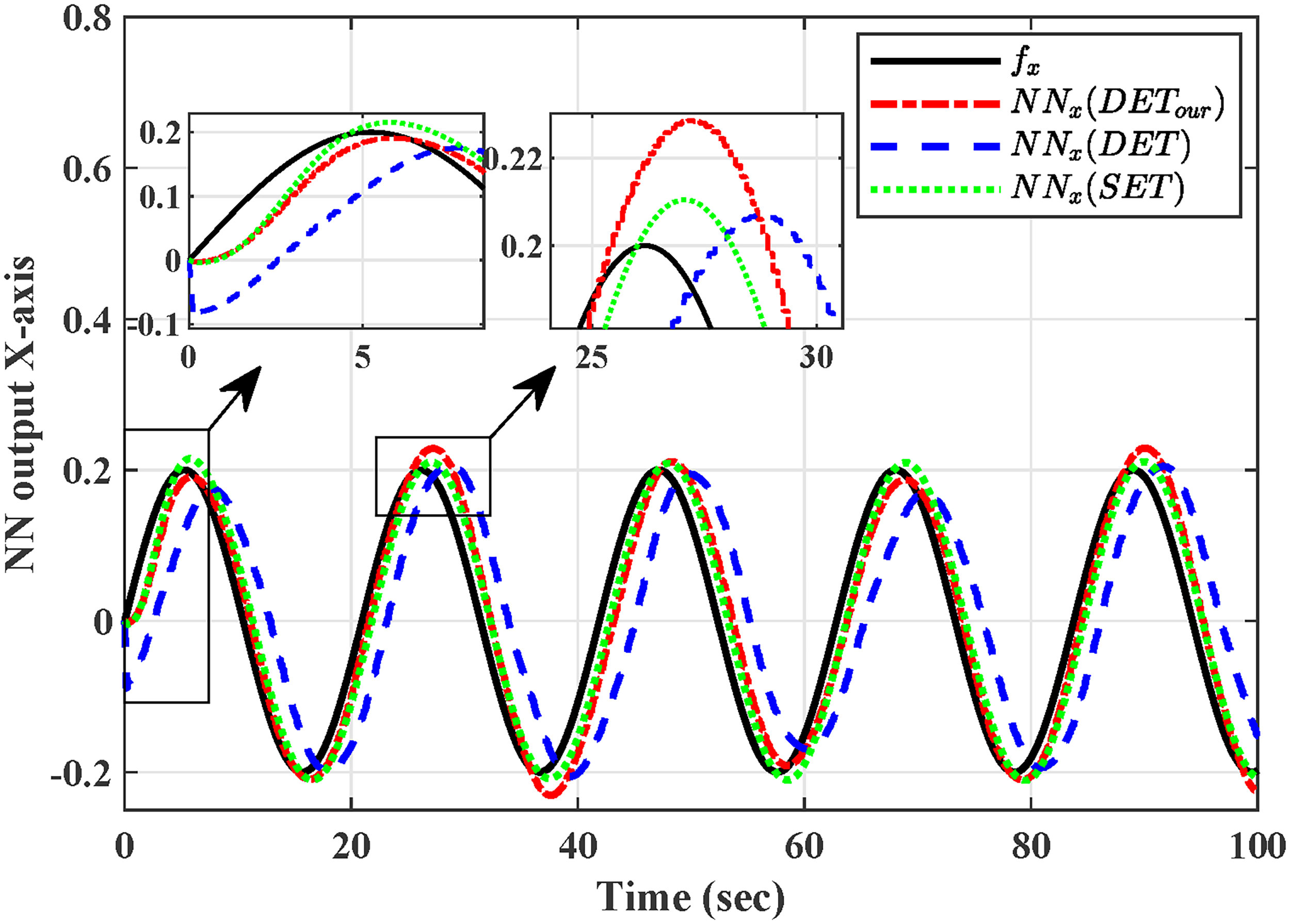
Neural network outputs in the X-axis under DET
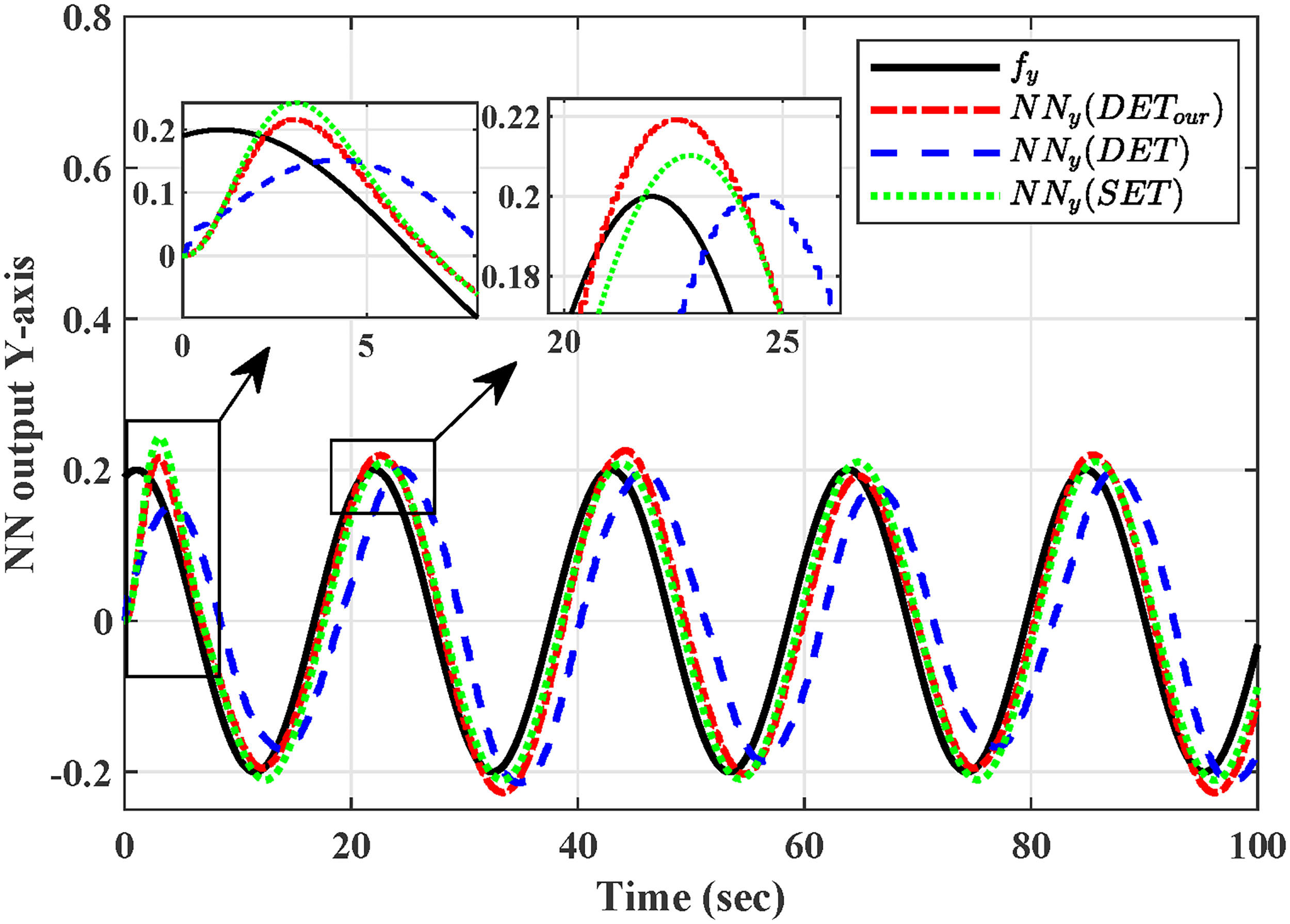
Neural network outputs in the Y-axis under DET
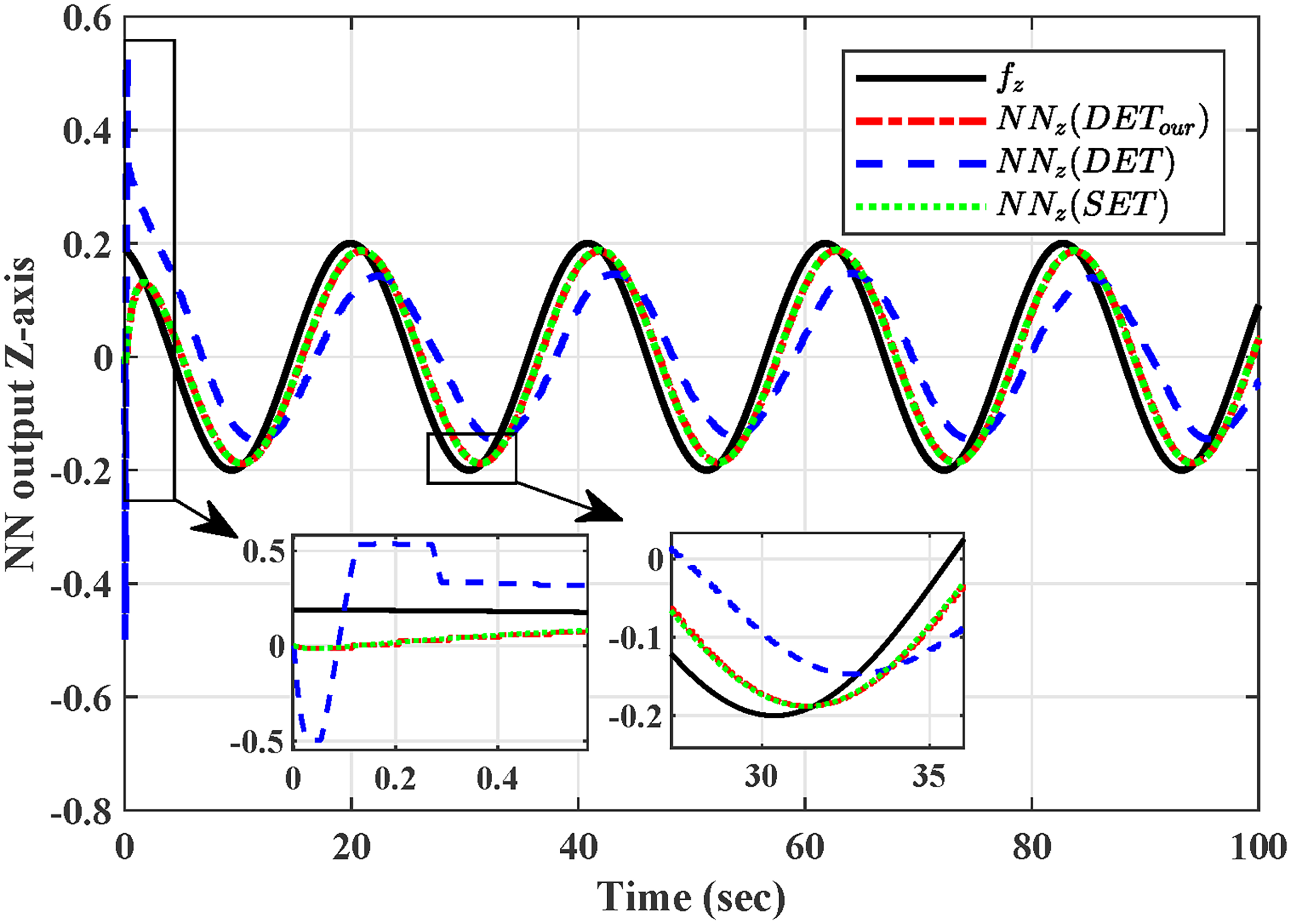
Neural network outputs in the Z-axis under DET
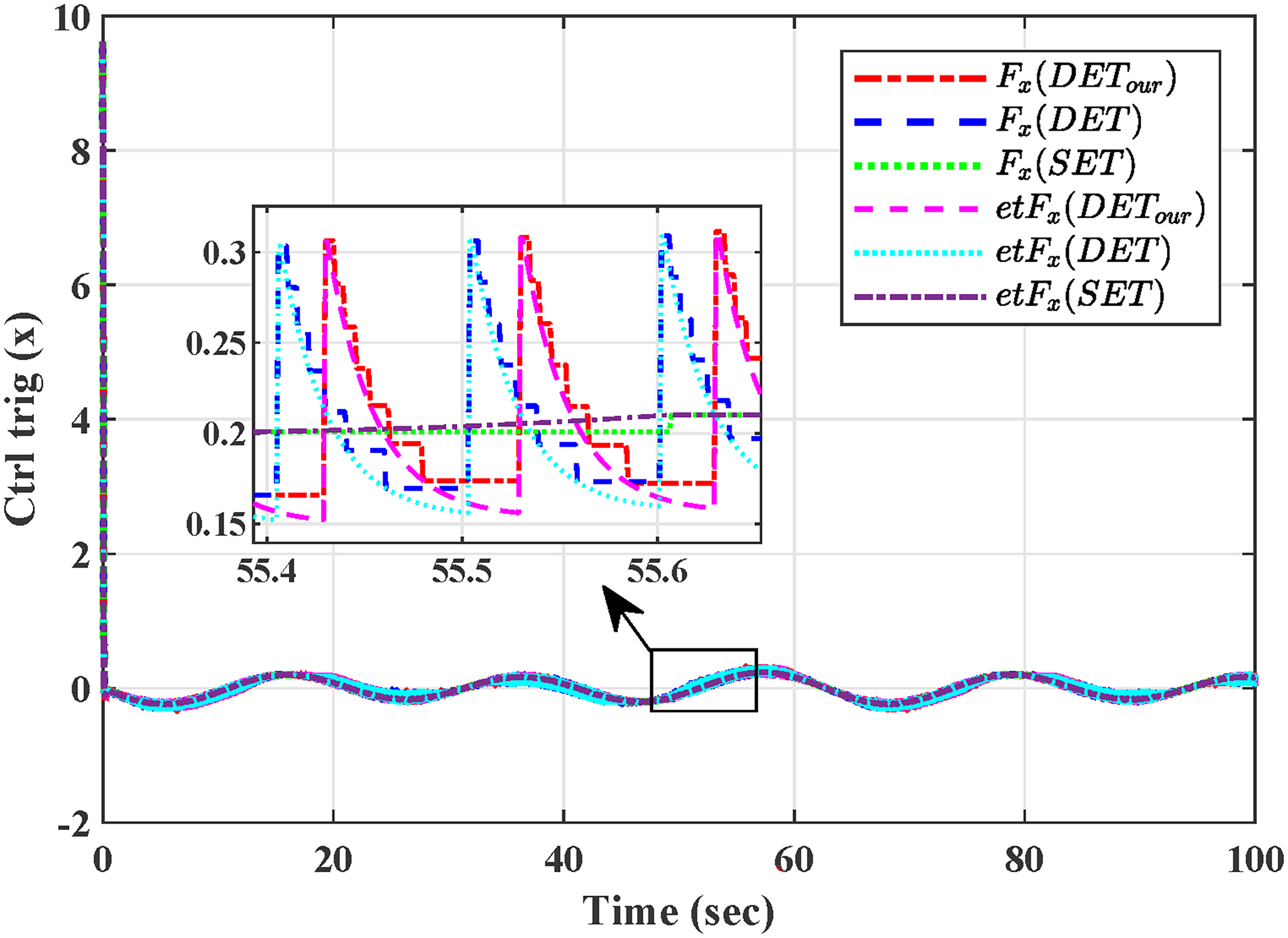
Controller outputs and triggering instants in the X-axis under DET
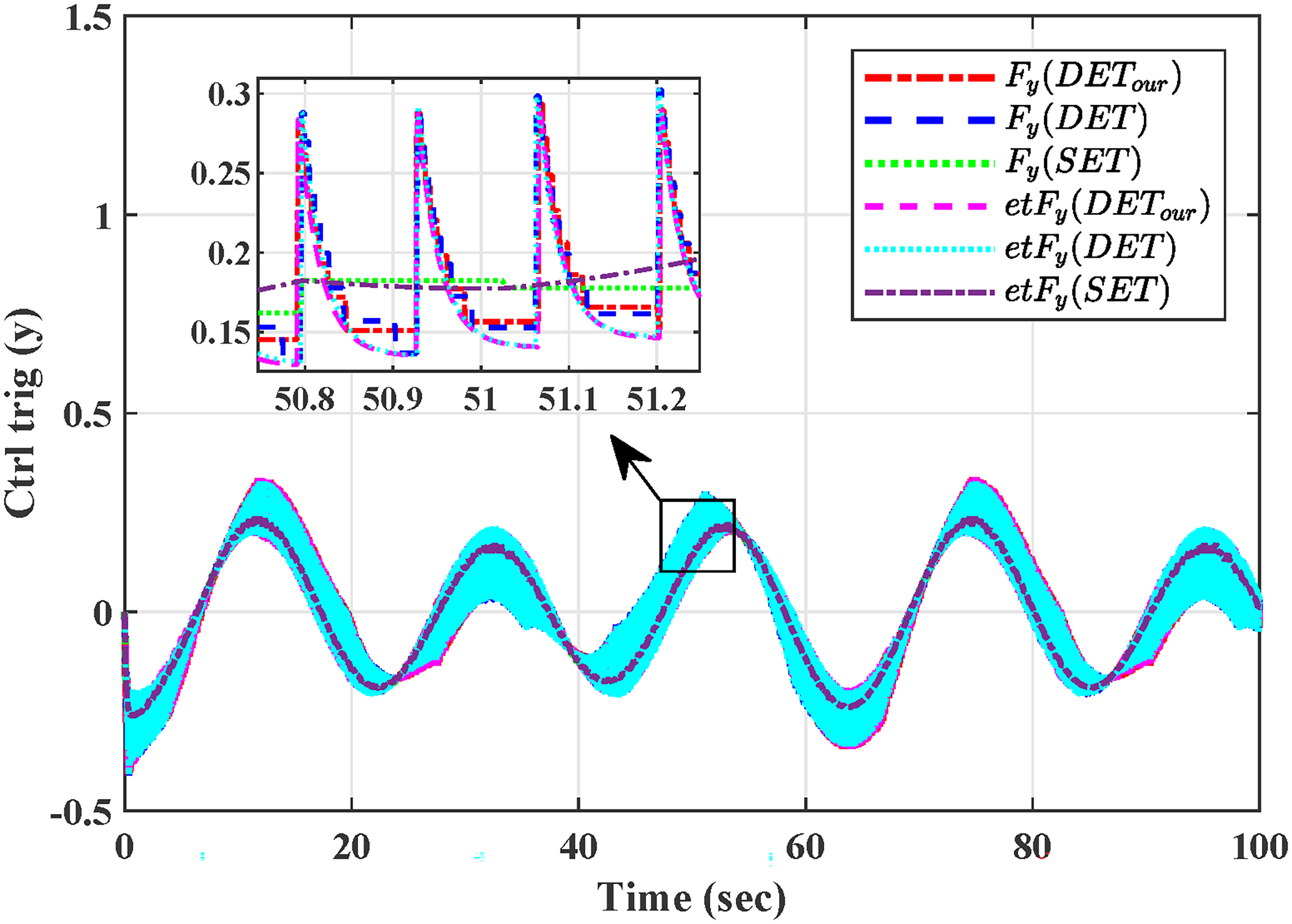
Controller outputs and triggering instants in the Y-axis under DET
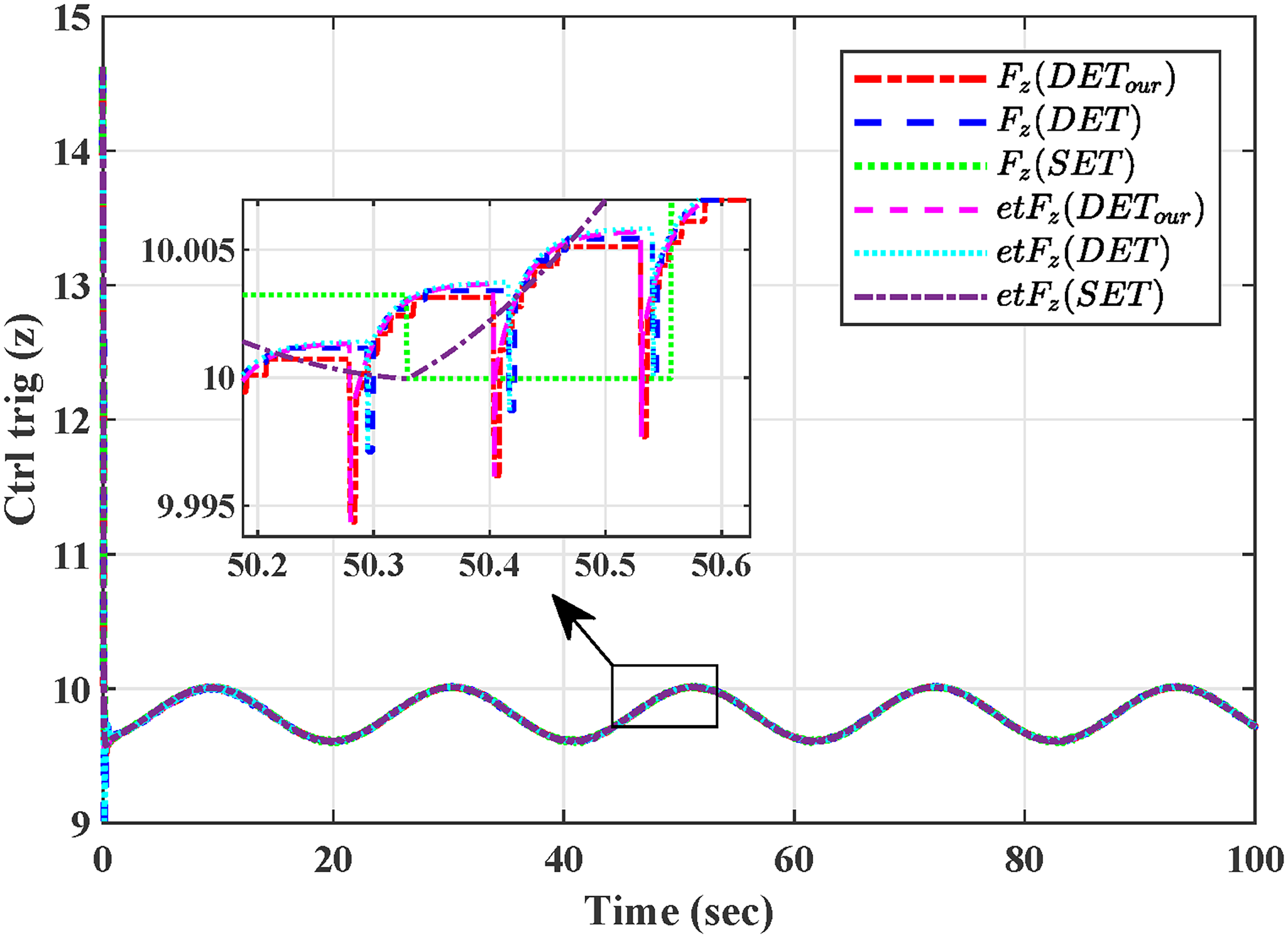
Controller outputs and triggering instants in the Z-axis under DET
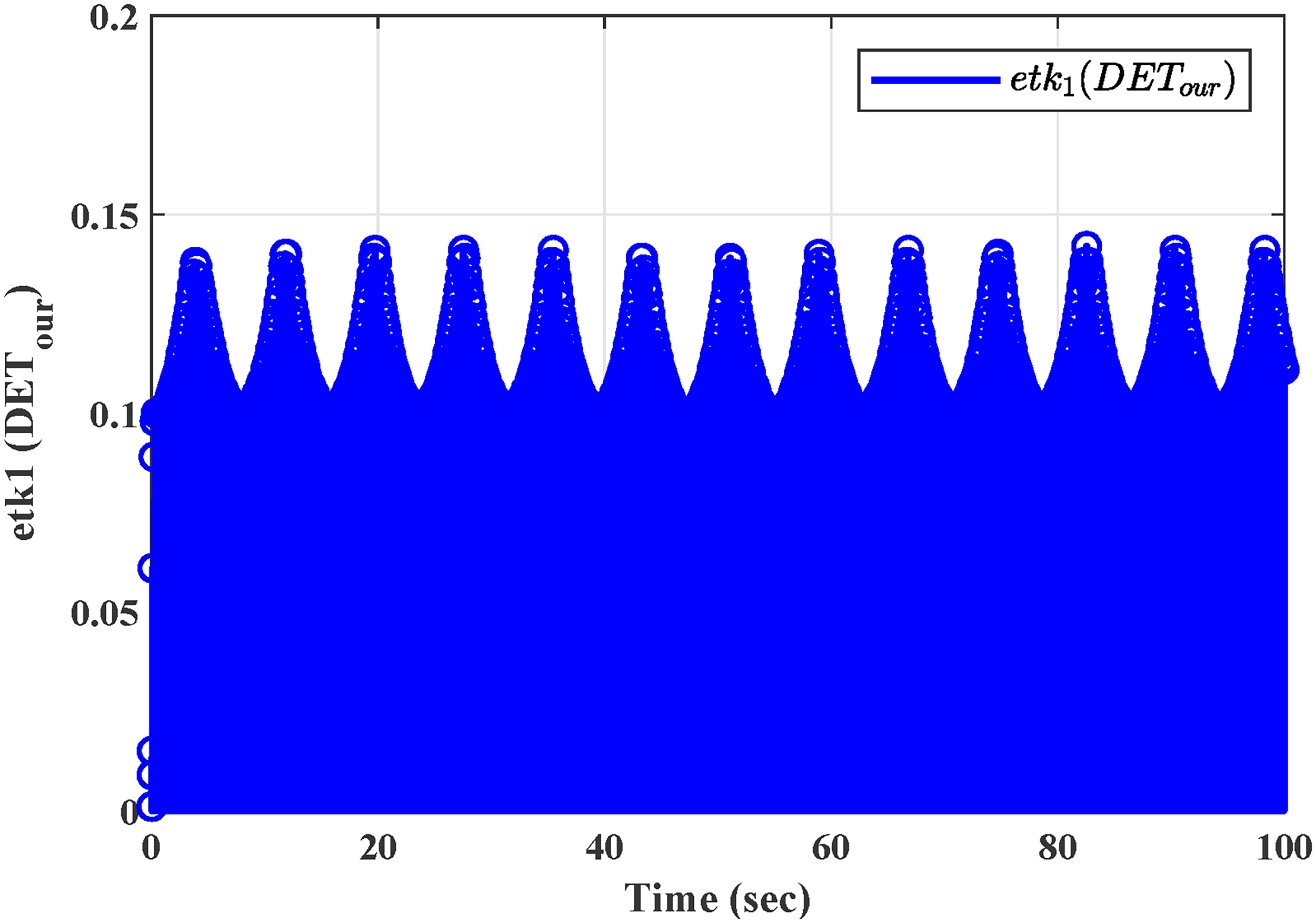
State-triggering intervals under DET
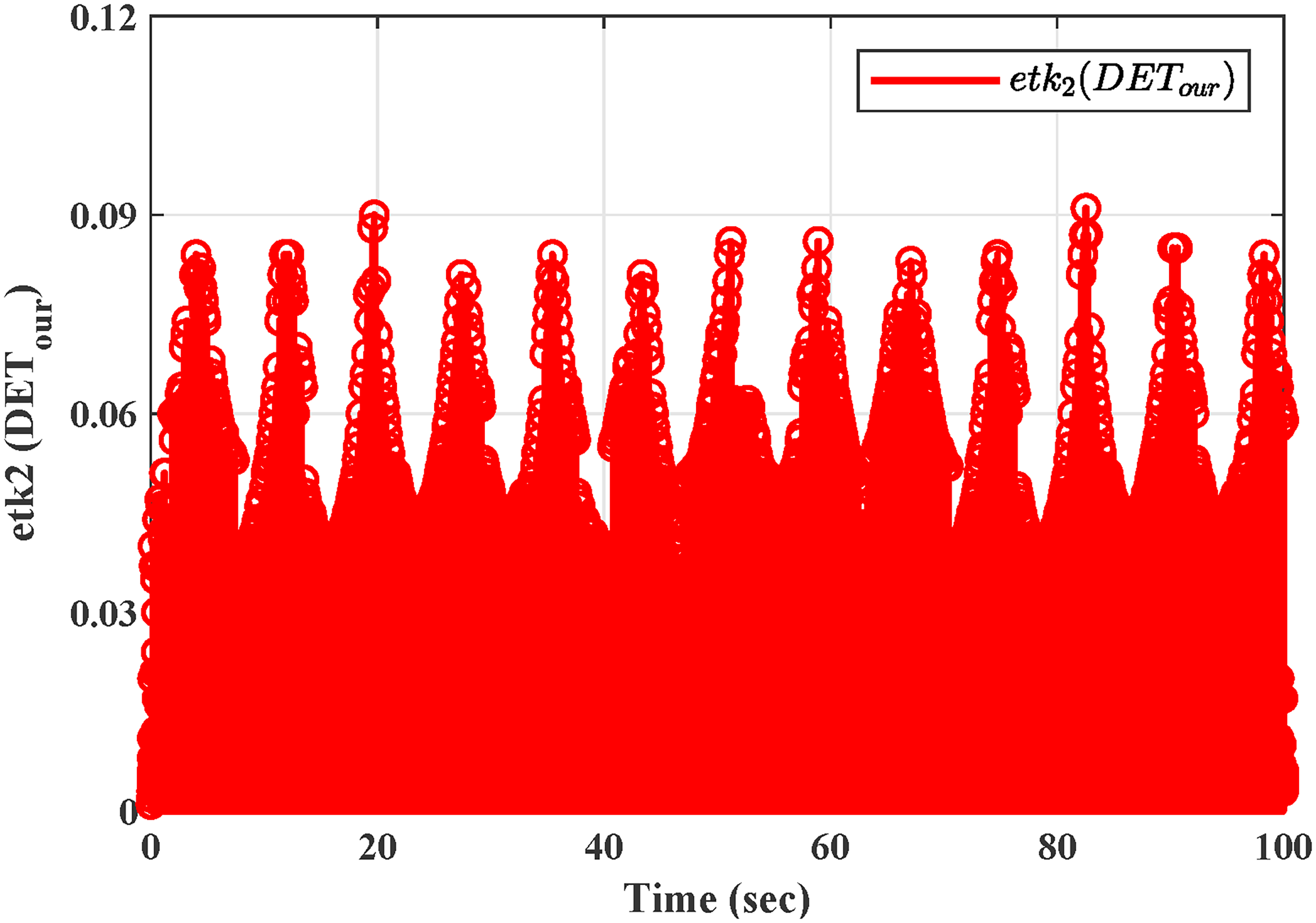
Control-triggering intervals under DET
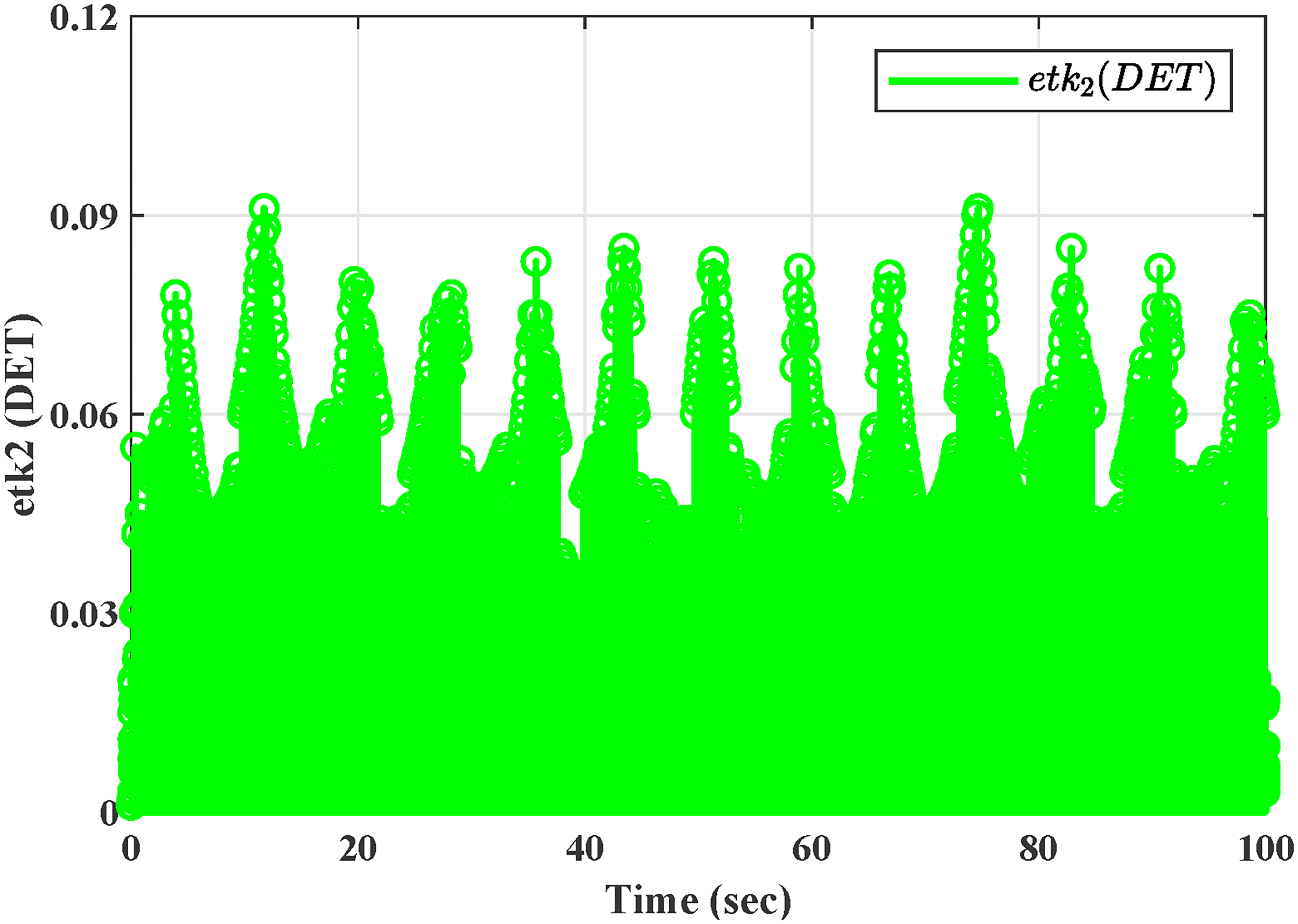
Control-triggering intervals under DET.
Table 3 summarizes the communication and update counts under time-varying reference signals. Under DET
Triggering counts under time-varying signals.

Conclusion
This paper proposes a dual-event-triggered adaptive neural-network control strategy for resource-constrained quadrotor UAV control. By incorporating asynchronous event-triggering at both the state-transmission and control-update levels, the scheme reduces unnecessary updates and lowers the overall communication–computation burden while preserving closed-loop stability. Moreover, a trigger-interval-weighted neural-network updating law has been introduced to improve the applicability of the adaptive mechanism under different operating conditions while reducing unnecessary online computation. Rigorous Lyapunov-based analysis has established the uniform ultimate boundedness of all closed-loop signals and strictly excluded Zeno behavior. Both theoretical analysis and numerical simulations have verified the effectiveness of the proposed method and the trade-off between control performance and resource consumption for resource-constrained UAV systems. Future research will extend this framework to cooperative multi-UAV systems and investigate more flexible event-triggered mechanisms, such as dynamic thresholds and data-driven strategies, to further enhance system adaptability and robustness.
Footnotes

Ethical considerations
This study does not involve human participants, human data, human tissue, or animals. Therefore, ethical approval was not required.
Consent to participate
Not applicable.
Consent for publication
Not applicable.
Funding
The authors received no financial support for the research, authorship, and/or publication of this article.
Declaration of conflicting interests
The authors declared no potential conflicts of interest with respect to the research, authorship, and/or publication of this article.
Data availability statement
Not applicable.