







Abstract
Much of the literature on casualty sensitivity suggests that there is an inverse correlation between casualty levels and public support for war. It also suggests that a public will be more sensitive to local casualties. This article tests these pre-existing theses using data from Canada's participation in the war in southern Afghanistan between February 2006 and 2011. Studying the impact of both provincial and nationwide casualties, it finds no evidence to support these assumptions. Instead, this study finds strong indications that nationwide casualties led to a short-term increase in public support for the Afghan mission. This result is attributed to the sunk cost effect.
Introduction
In democratic states, the extent to which the public is willing to tolerate the human and material costs of war plays a significant role in the state’s ability to sustain military operations until victory is achieved. Despite their tremendous military advantages in both capabilities and resources, three of the most powerful democratic states in the international system have chosen to terminate almost 40 percent of their military operations since 1945 before attaining their objectives, as the cost of victory seemingly began to exceed the price the public was willing to pay. 1 Scholars and policymakers alike have therefore generally maintained that public support for military engagements declines as the human and material costs of war increase. The results presented in this article call into question that assumption, using Canada’s involvement in the province of Kandahar, Afghanistan as a case study.
Canada’s engagement in Kandahar between February 2006 and December 2012 resulted in great losses, both monetary and human, with 149 members of the Canadian Forces killed in the country’s most significant military undertaking since the Korean War. 2 Given the historical uniqueness of Canada’s experience in Kandahar, its participation in combat operations since 2006 presents an appropriate case study of the Canadian public’s response to military losses. This is a particularly relevant issue, as the lack of public support for Canada’s involvement in Kandahar has often been correlated with the mounting military casualties in that conflict. 3
This article examines the impact of Canadian casualties suffered in southern Afghanistan on public opinion of the war. Was the Canadian public influenced by these military losses? If so, to what degree, and what are the implications? Although conventional wisdom asserts that Canadians were particularly sensitive to losses in Afghanistan and that support for the mission was anemic for that reason, this article finds no evidence of a direct correlation between the declining public support for the mission and the mounting Canadian casualties incurred in it. To the contrary, this study finds evidence of a sunk cost effect, in which casualties led to a short-term increase in public support.
Also, by utilizing disaggregated data to reflect disparities in provincial public support for the Afghan mission, this article tests the notion that regional proximity to casualties had a significant impact on public support for the military conflict. My findings demonstrate that while Quebecers displayed the lowest level of support for the Afghan mission, they nonetheless reacted to casualties similarly to the rest of Canadians.
Review of theory and literature
The analysis presented in this study is based on three principal assumptions drawn from the relevant scholarly literature. First, support for military operations is the product of a rational cost/benefit analysis. Accordingly, war casualties are the main indicators of war costs. Second, this rational-benefit analysis may be affected by psychological elements such as the sunk cost effect. Third, as the rate of casualty accumulation changes, so will the impact of casualties on opinion in various regions; therefore, the factors of regional and temporal proximity matter. This section reviews the scholarly literature and anecdotal evidence pertaining to these assumptions in order to assess the correlation between public support and casualties in the Canadian context.
Casualty sensitivity
Recent research has adopted a rationalist perspective on the determinants of public support for a military operation. Although there is some disagreement about which factor is most important, scholars have found considerable evidence that support for military operations resembles a rational cost/benefit analysis in which individuals consider the perceived benefits of the intervention, the prospects of success, the changing expectations and leadership, and the estimated costs of the military effort. 4 Akin to rational consumers who seek to maximize utility with respect to budgetary constraints, poll respondents compute the perceived cost and benefits of war and express an opinion based on this calculation. While war expenses undoubtedly include spending on military operations, current and future costs of medical care for the wounded, and many other expenses, combat casualties are the most obvious and systematic measure of a war’s cost. It is therefore expected that a change in the number or rate of casualties incurred would generate comparatively large changes in attitudes toward the conflict. 5
In Canada, the actions of the Harper government in response to mounting casualties in Afghanistan seem to give credence to the notion of an inverse correlation between casualties and public support. In spring 2006, amid the growing movement of corpses on overpasses along the Highway of Heroes, the federal government announced a ban on media coverage of the repatriation ceremonies at CFB Trenton. It also discontinued the practice of flying the flag at half-mast on all government buildings whenever a Canadian soldier was killed in Afghanistan. The political scientist, Kim Richard Nossal remarked that these policy measures were “widely interpreted as having been imposed so that Canadians would not be exposed to the sight of flag-covered coffins returning from Afghanistan.” 6 The adoption of these policies seems to indicate that the political leadership was apprehensive of the influence these casualties may have on the public’s support for the Afghan deployment.
Sunk cost effect
Quite apart from the aforementioned literature on the determinants of public support for war, there is a largely separate and distinct literature on the sunk cost effect. This research has been mostly conducted in the decision-making and managerial behaviour literature, which has been concerned with the psychological processes by which people remain committed to a previous decision. More specifically, the sunk cost effect can generally be seen as a tendency for people to remain committed to a decision on the grounds that they have already “invested too much to quit.” Individuals will often try to avoid “wasting money” by consuming food they dislike, watching movies they find uninteresting, or wearing expensive clothing that no longer fits. 7 This decisional pathology can be explained by the general desire to avoid losses; ironically, individuals and groups will often risk greater losses to avoid or recoup smaller ones, even when the probability of success is fading—hence the expression, “throwing good money after bad.” 8
While rationalists assume that the public does not consider sunk costs when weighing the cost benefit of continuing a military engagement, psychologists argue that commitment to a course of action often rises as the emotional or tangible sacrifices increase. 9 Thus, citizens may perceive the lives sacrificed in the conflict not only as costs, but also as investments that can be redeemed if the nation prevails. Louis Kriesberg summarizes this notion: “Having sunk resources into a fight, sinking more and more resources seems justified in order to attain the goal of the struggle and so justify what has already been expended in money, honor or blood. This ever-increasing commitment and allocation of resources may go beyond the ordinal value of the goal, but the combatants are trapped into continuing and even escalating the struggle.” 10 In other words, casualties may increase public support for the war as a consequence of the sunk cost effect; citizens may seek to give meaning to the loss of life suffered by their armed forces by supporting the mission, thus forestalling a belief that those who have lost their lives did so in vain or for naught. In Canada, the Manley panel, an independent, non-partisan panel reviewing Canada’s mission and future role in Afghanistan, chaired by the former Liberal cabinet minister, John Manley, exhibited this effect. The panel’s report claimed that Canadian interests, values, and lives were now invested in Afghanistan. The sacrifices made there by Canadians and their families had to be respected. 11
Regional and temporal proximity
Despite speculation regarding the impact of Canadian casualties on declining public support for the Kandahar mission, there has been relatively little empirical research to support the existence of such a correlation. In fact, Jean-Christophe Boucher’s 2011 study constitutes the only comprehensive attempt to determine whether the casualties suffered by the Canadian Forces in southern Afghanistan increased public opposition for the mission. 12 Boucher analyzed 24 surveys evaluating Canadians’ commitment to the mission in Kandahar and found that in Ontario, the Atlantic provinces, and Manitoba and Saskatchewan, casualties were a factor in determining whether respondents disagreed with the decision to participate in combat operations in Afghanistan. On the other hand, increasing numbers of fatalities did not influence Quebec and Alberta’s opposition. For this article, the data analyzed by Boucher were examined in light of regional disparities. This methodology rests on the contention that respondents are more aware of and, therefore, more influenced by casualties originating from a region close in proximity to their own.
The importance of regional proximity to opinion formation has long been assumed and documented. Having examined both the Korean and Vietnam wars, Gartner and Segura found that respondents were indeed influenced by the deaths of soldiers from their geographical regions, and further argued that proximate casualties can be used to predict a respondent’s feelings about a given war. 13 A citizen assessing a war and its costs to society, they argue, cannot help but weigh proximate experiences more heavily, if for no other reason than that this information is readily accessible. As such, respondents evaluate a war based on an assessment of societal costs that is heavily influenced by their proximate information. In other words, respondents from communities with low casualty rates are less likely to be influenced by casualties than are citizens from communities that have suffered considerable loss of life in the war, particularly in the immediate timeframe after which such information becomes available.
Hypotheses
With regard to Canada, Boucher argues that the factor of geographical proximity is amplified by the country’s various regions with their distinct cultural, linguistic, and sociological traditions. In fact, as Jean-Sébastien Rioux notes, “conventional wisdom holds that English and French-Canadians have differing views on security and defence issues, with French-Canadians being more dovish, isolationist, and antimilitaristic than their Anglo counterparts.” 14
In July 2007, in the wake of the largest overseas deployment of Quebec-based troops since the Korean War, many feared that mounting casualties would strengthen Quebec’s opposition to military operations in Afghanistan and strain national unity. 15 For example, columnist Alec Castonguay expressed concern that strong reactions in Quebec to the death of soldiers named “Tremblay,” “Gagnon,” or “Potvin,” for example, would increase Quebec opposition to the war. 16 In September 2006 members of the Bloc Québécois called for urgent debate and withdrawal from the mission as it “strayed from Canada’s historical position of ‘mediation and balance’” and from the “major values of the Québécois…which are…resolutely peaceful.” 17 Accordingly, one could hypothesize that Quebec residents would be more sensitive to casualties than would residents of other provinces. While assumptions that high casualty sensitivity and strong antimilitaristic tendencies correlate in Quebec are largely supported by a wealth of anecdotal evidence, few studies have tackled these issues empirically.
Given the plurality of Canadian society, it is reasonable to expect that regional disparities will account for distinct levels of casualty sensitivity across the provinces. The following hypotheses are therefore presented: Hypothesis 1: Canadian casualty levels are negatively correlated to public support for Canada’s combat role in southern Afghanistan.
Hypothesis 1 requires a systematic statistical test to examine the question of whether casualties are a war cost that erodes public support for war. It was expected that an inverse correlation between casualties and public support would be found, as a rational cost/benefit analysis of casualty levels where casualties represent a significant cost would lead to a relative decrease in perceived net benefits.
Alternatively, is it feasible that a casualty increase would solidify public support as per the sunk cost effect, as the public attempts to recoup its losses by “staying the course.” Hypothesis 2: Sensitivity to casualties is conditioned on regional specificities and proximity to fallen soldiers’ regions of origin; within a province, the public will be more sensitive to casualties of its own than to casualties of others.
Research design
The data for this study are classified into two categories—public opinion poll data between February 2006 and February 2011, and Canadian casualty data for the same period of time.
Public opinion
Angus-Reid Strategies and Ipsos Reid provided the data used in this study on Canadian attitudes towards the mission in Afghanistan. Between February 2006 and late February 2011—10 months before the end of the Canadian Forces combat mission—the two polling agencies sporadically tracked the net levels support for the mission in Afghanistan. Twenty surveys from Angus-Reid Strategies and 13 from Ipsos Reid, totalling 33, were analyzed for this study. This study therefore represents nine more observations than Boucher used previously. It is anticipated that the addition of these nine observations, which consider a greater period of Canada’s engagement in Kandahar, will lead to a stronger degree of accuracy.
This study shares two interrelated limitations with Boucher’s work. First, no polling organization analyzed the full period under review, and polls were conducted sporadically. Consequently, it was necessary to combine the results from different polling firms in order to have a full overview of the evolution of Canada’s public opinion for the complete period of Canada’s involvement in Kandahar. Second, the two polling organizations utilized different wording across the period under study. While such limitations pose methodological problems and weaken the results, to rule out these surveys would severely impair this study. 19
Despite these limitations, surveys from the two polling organizations share several advantages. First, the polls were commissioned nationwide. Second, respondents were randomly selected adults. Third, the polling firms used the same six regional categories (British Columbia, Alberta, Manitoba and Saskatchewan, Ontario, Quebec, and Atlantic Canada); thus it is possible to conduct a longitudinal comparative study.
Casualties
Data on the Canadian Forces personnel killed in Afghanistan between February 2006 and late February 2011 was obtained from the Department of National Defence’s website. 20 This database contains information about each casualty, including name, province of residence, unit and regimental affiliation, date of death, and cause of death (if known). Using this information, a database that contained the number of deaths in each region between February 2006 and February 2011 was created.
Remaining true to Boucher’s methodology, accidents resulting in death and suicide were included in this study; however, injured soldiers were not included, as neither the Department of National Defence nor the media systematically published the number of soldiers injured during the Canadian mission in Kandahar. As such, it is unclear whether Canadians were aware of the scope of Canadian soldiers wounded and, therefore, could properly quantify these associated costs. Finally, this study did not take into account casualties suffered by Canada’s allies and foes in Afghanistan, nor did it take into account civilian casualties.
This database was then merged into the survey data file, producing a variable for each survey qualifying how many soldiers from the region were killed between the date the poll was taken and the 30 days prior. For example, prior to the 10–12 July 2007 survey, there had been one death from British Columbia. This independent variable was named “regional casualties.” In addition, using the same procedure, a variable was created that quantified the number of casualties suffered by soldiers from all other provincial categories during the same period of time. Using the aforementioned example, during the 30 days prior to the 10–12 July 2007 survey, there had been seven deaths from provinces other than British Columbia. This independent variable was named “other national casualties.” Once again keeping true to Boucher’s methodology, these results were organized by the province of origin, as indicated by the Department of National Defence.
Analysis and discussion
Policymakers and scholars have widely accepted the theory that the public’s support for military conflict is inversely correlated with the number of domestic military casualties suffered in that conflict. John E. Mueller first introduced this theory in his book, War, Presidents and Public Opinion, by analyzing public opinion polls for the Korean and Vietnam wars in relation to the wars’ respective casualty rates. Mueller contended that public support dropped in proportion to the number of American casualties. More specifically, using the “log of cumulative casualties” as an explanatory variable, Mueller argued that whenever American military casualties increased tenfold (e.g. from 100 to 1000), support for the war decreased by approximately 15 percent, thus suggesting a strong and direct link between casualties and public opinion. 21 Mueller’s “log of cumulative casualties” became the dominant measure of wartime human cost in the literature.
As can be observed in Figure 1, the trajectory of Canadian public support for the Kandahar mission in each region does not conform to the picture of a sharp drop followed by a more moderate decline thereafter, as Mueller’s model predicts. Rather, there is a steady moderate decline in the first 1000 days of the mission, followed by a modest increase, before a sharp decline. Accordingly, Mueller’s use of cumulative casualties cannot be used to positively ascertain whether there is a correlation between casualties and public opinion. This is most likely due to the small number of casualties in this case study compared with the significant losses suffered by the United States during the Korean and Vietnam wars.
Regional public support for the war in Afghanistan (2006–2011).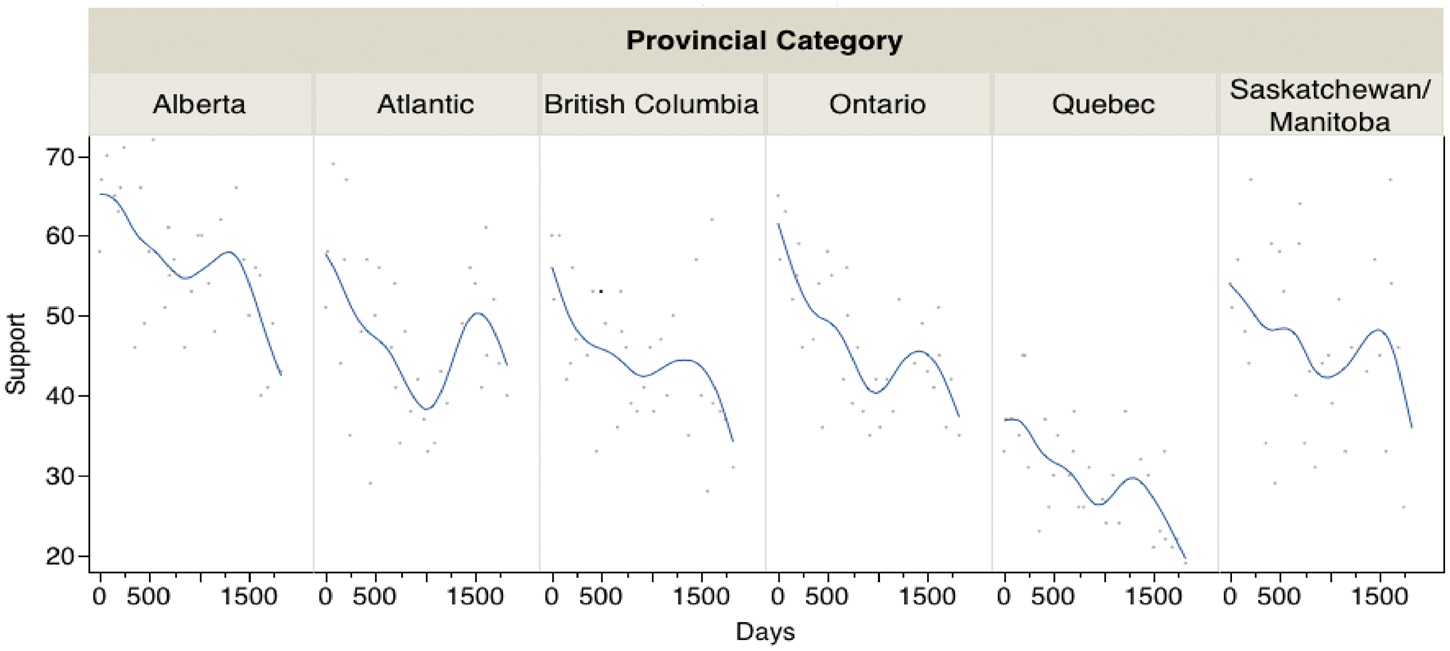
Gartner and Segura extended Mueller’s bivariate model by adding a marginal casualty measure. With Mueller’s data, Gartner and Segura found that marginal casualties better captured the effect of key events in war than did Mueller’s “log of cumulative casualties.” According to Gartner and Segura, their approach has three methodological advantages. First, “[marginal] casualties are more reflective of the information environment in which opinion is formed.” 22 Recent pieces of information have a larger impact and hence a stronger effect on the evaluative process than does older information. Second, “marginal casualties are not correlated with time.” 23 As such, the effect of casualties can be estimated without fear of contamination by other causal factors correlated with time, such as a decline in support as a result of war weariness or, alternatively, an early increase in support from the “rally around the flag” effect. Moreover, since public opinion changes are not necessarily monotonic, opinion can theoretically shift spasmodically, rather than at a steady or constant rate, when not correlated with time. Third, “marginal casualties capture the importance of crucial, highly salient events in a war and thus are better able to account for the subsequent response in opinion.” 24 This method allows one to more accurately capture the effects on public opinion of a sudden increase in casualties during a brief period of time, such as an in response to an offensive or exceptionally tragic event. This third methodological advantage is particularly important when analyzing Canada’s engagement in Afghanistan, as casualties tended to increase during the comparatively warmer months of the year, dubbed the “fighting season.”
Canadian marginal casualties and support for the war in Afghanistan (2006–2011).
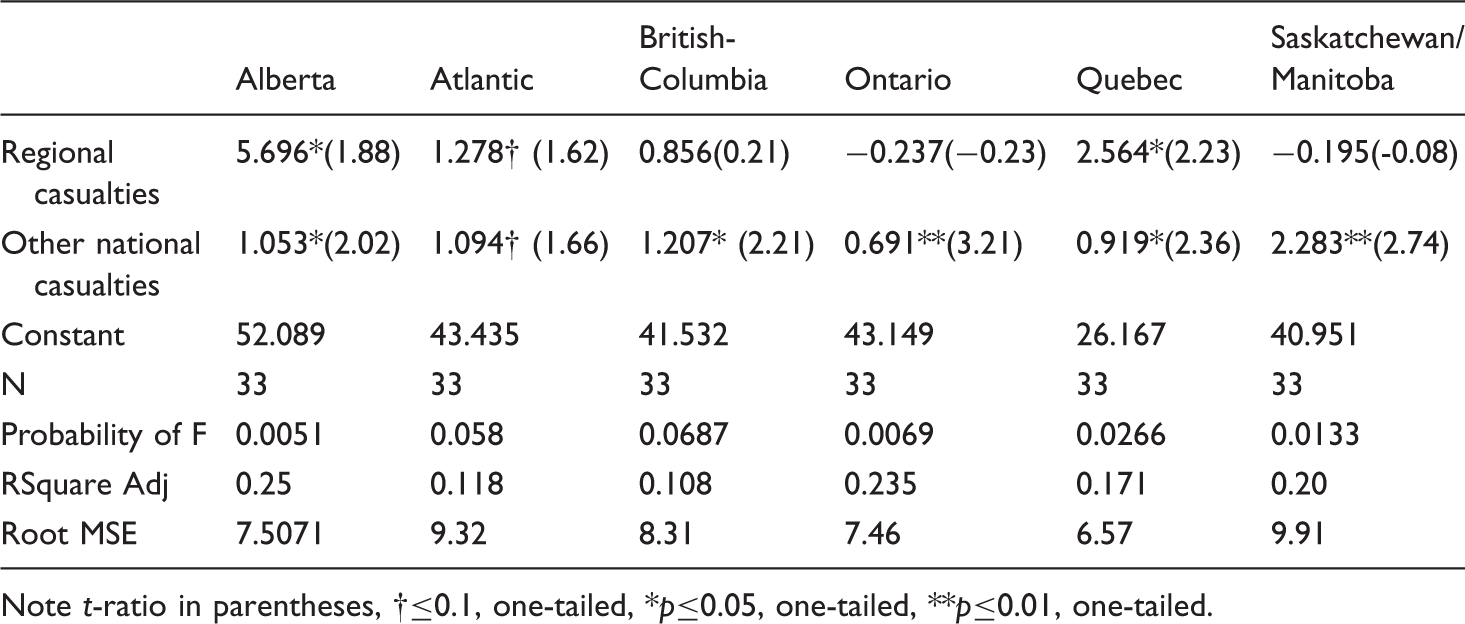
Note t-ratio in parentheses, †≤0.1, one-tailed, *p≤0.05, one-tailed, **p≤0.01, one-tailed.
Table 1 expresses the results of analyzing hypotheses 1 and 2. When observing the impact of regional casualties and other national casualties across provincial categories, hypothesis 1 is not supported; there does not seem to exist an inverse correlation between casualties and public support for Canada’s mission in southern Afghanistan. To the contrary, the results indicate that public support for the Kandahar mission benefited from a short-term increase as a result of the casualties suffered nationwide. This increase in support is short lived, however, as extending the value of marginal casualties to include a period longer than 30 days flattens out the statistical significance of the results. That being said, this research demonstrates that the observed decline in support for the Kandahar mission was not the product of casualty sensitivity, contrary to prevailing notions.
In the Canadian context, these results conform to other recent work in the field of political psychology, and are in accordance with two studies recently conducted on Canadian support for the Afghan mission. Joseph Fletcher and Jennifer Hove conducted two separate but identical experiments in their study on support for the mission. In each study, a group of individuals was presented with a picture of Canadian flag-draped coffins. Another group was presented with an image meant to evoke patriotism, while a third group was shown a picture of a soldier helping an Afghan child. In both experiments, support for the war was highest among the group randomly assigned a picture of a Canadian war casualty. As a result, Fletcher and Hove argued that images of war deaths produce an emotional response, combining sadness and pride, which increases support for the mission. 25 Similarly, Peter Loewan and Daniel Rubenson examined the effects of local war deaths on incumbent support using data from the 2006–2008 Canadian Election Study and found evidence at both the individual and district levels that support for Conservative Party candidates—the stronger political proponents of the Afghan mission—was higher in districts that experienced war deaths. 26 The results presented in this paper seem to give credence to the aforementioned studies.
Hypothesis 2 questioned whether members of the public would be more sensitive to casualties from their own province than to casualties from elsewhere in Canada. Overall, the data seemed to run contrary to the regional proximity thesis. As one can observe, public opinion in all provinces except Quebec and Alberta remained uninfluenced by that province’s fatalities. Nationwide casualties in Kandahar also impacted public support in all provinces. As a measure of comparison, other national casualties accounted for a 25 percent variation in support for the Kandahar mission since 2006 in Alberta, 11 percent in British Columbia, 24 percent in Ontario, 17 percent in Quebec, and 20 percent in Saskatchewan and Manitoba. While this evidence supports Boucher’s hypothesis that military losses suffered by the Canadian Forces in Afghanistan since 2006 constitute a more or less appreciable factor in explaining these regions’ public opinions of Canada’s participation, this study’s results suggest that regional proximity did not influence public opinion, except in Quebec and Alberta.
Alberta and Quebec present some of the most interesting results. As can be observed, all provinces—including Alberta and Quebec—have publics that were clearly aware of the costs and sacrifices made by all Canadian soldiers during the Afghan mission. Only in Alberta and Quebec did regional casualties have a statistically significant impact on public support for the war. Indeed, these two provinces were outliers, as their support levels started at different points and decline over time at different rates, relative to other provinces and Canada as a whole. Albertans and Quebecers were the only provinces sensitive to regional casualties, namely the deaths of their provincial soldiers. Most interestingly, in this study the two provinces displayed a positive correlation between casualties and support, with Alberta being twice as supportive per marginal regional casualty. Moreover, both were more sensitive to regional casualties than to national casualties when compared with all other provinces, which suggests that, as expected, there exists a distinct pattern in Quebec’s attitude towards local casualties and that a similar pattern of attitude also exists in Alberta. As observed above, Quebec’s support for the war is crystallized by the presence of casualties from other Canadian regions. This conclusion undermines the notion that Quebecers are dovish, isolationist, and antimilitaristic.
Conclusion
This study has attempted to evaluate the claim that the 149 casualties suffered by the Canadian Forces in southern Afghanistan between February 2006 and February 2011 influenced public support for the war. Although previous research held that war casualties affect public support negatively, this study found no evidence of a direct correlation between declining public support for the mission and the mounting Canadian casualties during Canada’s participation in Kandahar. To the contrary, this study found evidence of a sunk cost effect, in which casualties led to a short-term increase in public support for the war.
Moreover, this study examined whether the public was more sensitive to casualties from its own province than to casualties from elsewhere in Canada. The results suggest that regional proximity did not influence public opinion in any provinces except Alberta and Quebec. This study found that, contrary to the regional proximity thesis, public opinion in all provinces except Quebec and Alberta remained uninfluenced by regionally proximate fatality levels. Instead, casualties from other provinces impacted public support for the Kandahar mission. These results indicate that respondents in each province were clearly aware of the costs and sacrifices made by other Canadian soldiers during the Afghan mission and that regional casualties had a statistically significant impact on public support in Alberta and Quebec but no impact in other regions.
The findings reported in this paper present an empirical puzzle in two senses. First, this study has found that, while support for the Kandahar mission increased in each province as a result of casualties suffered in other provinces, the overall level of support throughout the mission in Afghanistan declined. As such, it seems that factors other than casualty levels had a detrimental effect on public support. Second, the Canadian results presented here are inconsistent with those found in similar studies of the United States. As such, further research must be devoted to exploring the mechanisms behind these results and identifying the factors that led to the decline in public support for the war. Finally, further research should ask what it is about Canadians that distinguishes this case study from previous American studies on the same topic.
Footnotes
1
Patricia Sullivan, “War aims and war outcomes: Why powerful states lose limited wars,” Journal of Conflict Resolution 51, no. 3 (1997): 498.
2
Janice Stein and Eugene Lang, The Unexpected War (Toronto: Viking, 2007), 244–245.
3
See, for example, Charles Letourneau and Justin Massie, “L’Afghanistan: Archetype d’une nouvelle politique étrangère canadienne?” Options Politiques December 2006/January 2007, 28–34; Joseph Jockel and Joel Sokolsky, “Canada and NATO: Keeping Ottawa in, expenses down, criticism out… and the country secure,” International Journal 64, no. 2 (spring 2009): 334; and John Kirton, “Two Solitudes, One War: Public Opinion, National Unity and Canada’s War in Afghanistan,” paper presented at the Université de Québec à Montréal, 5–6 October 2007,  (accessed 3 May 2013).
4
See, among others, R. C. Eichenberg, “Victory has many friends – US public opinion and the use of military force, 1981–2005,” International Security 30, no. 1 (2005): 140–177; Peter D. Feaver and Christopher Gelpi, Choosing Your Battles: American civil–military relations and the use of force (Princeton: Princeton University Press, 2004); Bruce W. Jentleson, “The pretty prudent public: Post post-Vietnam American opinion on the use of military force,” International Studies Quarterly 36 (1992): 49–74; Bruce W. Jentleson and Rebecca L. Britton, “Still pretty prudent: Post-Cold War American public opinion on the use of military force,” Journal of Conflict Resolution 42, no. 4 (1998): 395–417; Scott Sigmund Gartner and Gary M. Segura, “War, casualties, and public opinion,” Journal of Conflict Resolution 42, no. 3 (1998): 278–300; Christopher Gelpi, Peter Feaver, and Jason Reifler, “Success matters: Casualty sensitivity and the war in Iraq,” International Security 30, no. 3 (2005): 7–46; Eric V. Larson and Bogdan Savych, American Support for U.S. Military Operations from Mogadishu to Baghdad (Santa Monica: RAND, 2005); and Scott Sigmund Gartner and Gary M. Segura, “Race, casualties, and opinion in the Vietnam War,” Journal of Politics 62, no. 1 (2000): 115–146.
5
The literature is somewhat more nuanced, as other factors, such as the likelihood of a successful outcome or the perceived national interest, can also determine public support for war. In fact, the latest studies have argued that the public’s willingness to tolerate the human costs of war is conditional on individual perceptions of the importance of the issues at stake or contextual information like the number of enemy casualties. Gelpi, Feaver, and Reifler conclude that casualty tolerance is positively correlated with an individual’s belief in the importance and potential success of a military mission. Gelpi, Feaver, and Reifler, “Success Matters,” 7–46. Larson and Savych report that belief in the relative importance of the issues at stake is the most significant predictor of support for military operations. Larson and Savych, American Support for U.S. Military Operations, xvii–xviii. For a critique of this literature, see Hugh Smith, “What costs will democracies bear? A review of popular theories of casualty aversion,” Armed Forces & Society 31, no. 4 (2005): 487–512.
6
Kim Richard Nossal, “The unavoidable shadow of past wars: Obsequies for casualties of the Afghanistan mission in Australia and Canada,” Australasian Canadian Studies 26, no. 1 (2008): 102.
7
William A. Boettcher and Michael D. Cobb, “‘Don’t let them die in vain’: Casualty frames and public tolerance for escalating commitment in Iraq,” Journal of Conflict Resolution 53, no. 5 (2009): 680.
8
J.S. Hammond, R.L. Keeney and H. Raiffa, “The hidden traps in decision making,” Harvard Business Review 76, no. 5 (1998): 122.
9
See, among others, J.W. Brehm and A.R. Cohen, Explorations in Cognitive Dissonance (New York: Wiley, 1962); R. Brown, Social Psychology (New York: Free Press, 1965); and L. Festinger, A Theory of Cognitive Dissonance (Stanford: Stanford University Press, 1957).
10
Louis Kriesberg, Constructive Conflicts: From escalation to resolution (Lanham, MD: Rowman and Littlefield, 2003), 161.
11
J. Manley, D.H. Burney, J. Epp, P. Tellier, and P. Wallin, “Independent Panel on Canada’s Future Role in Afghanistan: Final Report,” Ottawa, 2008, 32.
12
Jean-Christophe Boucher, “Evaluating the ‘Trenton effect’: Canadian public opinion and military casualties in Afghanistan,” American Review of Canadian Studies 40, no. 2 (2010): 237–258.
13
Gartner and Segura, “Opinion in the Vietnam War,” 115–146.
14
Jean-Sebastien Rioux, “Two solitudes: Quebecers’ attitudes regarding Canadian security and defence policy,” paper prepared for the Canadian Defence and Foreign Affairs Institute’s Research Paper Series, Calgary, 2005, 5.
15
See, among others, Létourneau and Massie, “L’Afghanistan: Archétype d’une nouvelle politique étrangère canadienne?”; J. L. Granatstein, Whose War it is? How Canada can Survive the Post-9/11 World (Toronto: Harper Collins, 2007); and Vincent Marissal “Réaction prévisible, problème tenace,” La Presse, 22 August 2007, A11.
16
Alec Castonguay, “Combattre en Afghanistan après 2009? C’est non, affirme Harper,” Le Devoir, 17 July 2007, A1.
17
Steven Chase, “Bloc wants urgent debate on foreign file,” Globe and Mail, 5 September 2006, A9.
18
Patricia Turner, I Heard It Through the Grapevine: Rumor in African-American culture (Berkeley: University of California Press, 1993).
19
For a more in-depth discussion of the specific methodological problems associated with this different wording, see Boucher, “Trenton Effect,” 243–245.
20
21
John E. Mueller War, Presidents and Public Opinion (New York: John Wiley & Sons, 1973), 60–63.
22
Scott Sigmund Gartner, and Gary M. Segura, “War, Casualties, and Public Opinion,” Journal of Conflict Resolution 42, no. 3 (1998): 283.
23
Ibid., 284.
24
Ibid.
25
Joseph Fletcher and Jennifer Hove “Emotional determinants of support for the Canadian mission in Afghanistan: A view from the bridge,” Canadian Journal of Political Science 45, no. 1 (2010): 33–62.
26
Peter Loewen and Daniel Rubenson, “Canadian war death in Afghanistan: Replication and a British extension,” University of Toronto Working Paper, Toronto, 2012.
Author biography
Yannick Veilleux-Lepage holds an MA in International Affairs from Carleton University. He has had a long interest in civil-military relations, the study of political violence and terrorism, and the application of coercive violence for political purposes. He would like to thank Kaila Morin and Serge Goussev for their guidance, advice and encouragement, as well as Ipsos Reid and Angus-Reid Strategies for their assistance in obtaining the data required to conduct this study.