







Abstract
In the wake of the Canadian government’s pledge for a renewed role at the United Nations (UN) notably by reengaging in peacekeeping activities, this special issue focuses on Canada’s added value to peace operations. Our aim is to identify the goals, challenges, and stakes for Canada’s reengagement in peace operations as a central component of foreign and defence policy. One of the first questions to ask is how can Canada contribute to peace operations which are now characterized by more complex security environments, in a way that is consistent with its interests, resources, and capacity? The second question relates to Canada’s engagement in peace missions in the context of a continuously evolving technological landscape. Finally, we address defence planning, equipping the Canadian Armed Forces, and managing personnel, as they relate to UN operations. The time is ripe to revitalize the debate on peace operations and analyze Canada’s capacity in this area.
Keywords
The nature and mandate of United Nations (UN) peace operations are such that their implementation and evolution take place in dynamic and asymmetric security contexts. Peacekeepers are deployed to areas characterized by state capture, the repression of civilians, high levels of criminality and, increasingly, the rise of radicalization and extremist violence. These security challenges are compounded by both national and transnational factors, such as increased numbers of internally displaced persons and refugees. Furthermore, geophysical constraints related to terrain and weather can impede access to certain communities, as well as the mobility of troops and equipment.
In the wake of the Canadian government’s pledge for a renewed role at the UN, notably by deploying helicopters and troops to support UN peacekeeping activities in Mali, this special issue focuses on Canada’s role in peace operations. In light of this commitment, 1 our aim is to identify the goals, challenges, and stakes for Canada’s reengagement in peace operations as a central component of foreign and defence policy.
The first cardinal question is to ask how Canada can contribute to peace operations which are now characterized by more complex security environments, in a way that is consistent with its interests, resources, and capacity. UN peacekeeping missions are set in highly volatile settings where local, national, regional, and international security interests overlap. The rise of competing terrorist networks in these environments further fuels conflicts, with tangible ramifications for peace operations. How can the Department of National Defence (DND) and the Canadian Armed Forces (CAF) best collaborate with key stakeholders and partners (such as, but not limited to, the UN, the North Atlantic Treaty Organization [NATO], and the African Union) to address economic, technological, and geopolitical developments that impact peacekeeping missions?
The second question to raise relates to Canada’s renewed engagement in peace missions in the context of a continuously evolving technological landscape. The Final Report of the Expert Panel on Technology and Innovation in UN Peacekeeping, published in June 2015, highlighted ways in which technology and innovation could be leveraged to increase the effectiveness and efficiency of peacekeeping. How can Canada develop, provide, and support technologies in peacekeeping operations to gather information and enhance the protection of civilians?
Finally, this special issue addresses defence planning, equipping the CAF, and managing personnel, as they relate to UN peace operations. Peace operations entail a wide range of tasks (demobilization and reintegration of combatants, refugee repatriation, political transition, security sector reform, humanitarian assistance, conflict-sensitive development, human rights protection, justice, and reconciliation) and involve a wide range of actors and organizations, such as the UN, regional organizations, and diverse coalitions. What are the main challenges faced in the field? What are best and worst practices? And what could be solutions going forward? With regards to training, how can linkages be tightened between policy, operational requirements, and training delivery at the tactical levels?
Through the collection of articles in this issue, we seek to revitalize the debate on peace operations and analyze Canada’s capacity with these questions in mind.
Themes in the peacekeeping literature
In surveying the literature that is pertinent to assess Canada’s contribution to peace operations, we delve into the objectives to be pursued, the number and types of troops to be deployed, and the extent to which technology should be mobilized.
General objectives for Canada’s reengagement in UN peacekeeping
Given the insecurity and complexity of peacekeeping settings, a crucial question to ask is whether UN peacekeeping has any chance to work, and, if so, what contributes to its success. Fortna, Bellamy and Williams, Howard, and Martin-Brûlé established that when peacekeeping did in fact work, different ingredients were necessary to achieve positive mission outcomes. 2 The types of strategies adopted, the actors involved, their behaviours and resources, as well as the timing and length of peacekeeping operations were identified as key factors in the successful implementation of UN mandates.
In 2015, the High-Level Independent Panel on Peace Operations (HIPPO) report recommended a fourfold shift to improve peace operations: prioritizing political solutions before military and technical engagements; adapting responses to the complexity and specificity of the environments where peacekeepers operate; privileging collaborative interventions and partnerships among civilian, police, and military interveners as well as with other entities, national, regional and international; and focusing both on the field mission and on the protection of the people. 3
How can Canada best contribute in light of these stated priorities? In his review of DND’s public consultations on Canada’s defence policy, Prieur argues that Canada has comparative advantages which can boost the value of its involvement at the UN. 4 Dorn articulates the Canadian offer in terms of a “multicultural mosaic, a bilingual civil service, minority rights protection, the rule of law and long-standing … service to UN causes,” in addition to a well-trained military. 5 For Moens, these niche skills should also be combined with partnership building, mainly in Africa. 6 This analysis is echoed by Tieku, who adds that a diversity of reengagement might be preferable, meaning not exclusively tying Canada to the UN, to allow for security arrangements that are regional in scope. 7
For Carroll, the main challenge is to calibrate and manage Canada’s expectations toward its reengagement in UN peacekeeping. 8 Paris, for his part, warns against ambitions to replicate liberal models elsewhere without taking into account the specificities of various national contexts. 9 In other words, if Canada is to intervene, the objective should be to strengthen local institutional authority, rather than seeking to replicate Canadian values and institutions abroad.
Troops: Not just a numbers game
The number and origins of troops needed for successful peace operations are widely debated in the peacekeeping literature. 10 The discussion is fuelled by the persistent power asymmetry between the “Pen-holders,” the member states writing the resolutions and mandates of UN peace missions, and the top troop-contributing countries (TCCs), which provide the bulk of the man(woman)power to implement them. 11 The disproportionate number of troops coming from poorer states translates to more boots on the ground, but less influence over mandates and resolutions driving the activities of these troops. The literature thus raises the issue of what could be an optimal burden-sharing arrangement between those who have the resources but face low risks (by providing financial contributions and/or technology), and states with fewer financial/technological resources, but that are contributing more troops and hence facing a higher human security risk. 12
In their cutting-edge work, Bellamy and Williams present a framework to explain the incentives for states to provide troops to peacekeeping missions through political, security, normative, economic, and institutional rationales. 13 Evan Cinq-Mars explains that political, security, and normative rationales most significantly drive Canada’s will to send troops to peacekeeping missions. He summarizes the political incentives for Canada as both a commitment “to maintaining global peace and security” and a will to participate in more balanced “burden-sharing with allies and partners.” The security rationale is explained in terms of Canada’s will to participate in the global effort “to respond to complex and interconnected violent conflict, and to contribute to regional and international security and stability.” In terms of norms, peacekeeping is portrayed as shaping Canadian identity at home and abroad, supported by the legacy of former prime minister Lester B. Pearson, who established the first UN peace operation. 14
Beyond the national incentives for intervention, scholars widely discuss the effects that the deployment of Canadian troops could have on UN missions and in influencing the participation of other likeminded and similarly equipped states in UN endeavours. In this context, the literature in favour of Canada’s deployment under UN auspices points to a much-needed rebalancing between contributing countries. Ward and Dorussen highlight the significant “network effect” of states sending troops to peacekeeping operations. In this vein, Canada’s contribution to UN peace missions could encourage other states to boost their participation in such missions. 15 Sending troops to missions would thus reinforce alliance networks and contribute to a rebalancing of troops coming from wealthier countries. This analysis is shared by Rikhy and Skjelsbaek, for whom enlarging the number of troop-contributing states like Canada and Norway, while minding the interoperability of the different contingents, are key to the success of UN peace missions. 16 The question is then, how much would be enough?
The number of Canadian troops and types of troops (police or military, regular forces or special operations forces) to be contributed to UN missions is also examined in the literature. 17 Coleman highlights the added benefits of token troops, both from the perspective of TCCs and host countries. Others, like Cunliffe or Koops and Tercovich, argue that numbers do matter and call for greater focus on one location in order to maximize their impact. 18 Saideman articulates key lessons learned from Canada’s experience in Afghanistan, and flags the importance of devoting adequate support and resources to the troops sent abroad. 19 In sum, Canada should put in the necessary effort and resources to align itself with UN norms and expectations, in addition to asserting its impartiality in a UN context. 20 Gilmour insists on the necessity to engage troops in UN interventions, remaining cognizant that certain missions entail complex risks, including non-state threats to Canadians both at home and abroad that can result from a more active role within peace operations. 21
The use of technology
Authors like Dorn and Axworthy have highlighted how the use of technology can boost the efficiency of peace operations while enhancing protection of both civilians and mission personnel. 22 Canada can assist peace missions with strategic and tactical airlift through fleets of aircraft that can also be employed for intelligence, surveillance, and reconnaissance in the context of peacekeeping missions. Tactical helicopters can also transport personnel and material, and are high-demand assets in peace operations. 23 Four main challenges are associated with the role of technology: adapting its use to specific needs in the field, gauging its collateral effects, involving the locals, and carefully assessing the costs and benefits of various technologies.
Some member states are reluctant to use sophisticated technologies in peacekeeping settings due to costs and the possibility of clandestine use—for example, if a state were to gather intelligence for purposes outside of the mission’s mandate in pursuit of its own interests. Sophisticated technology requires specialized personnel for its handling and maintenance. Moreover, it necessitates specialized training, which adds to the costs of the intervention. From there flows the question about the need for interveners to be precise with regards to the use of technology, and the sustainability of its use, maintenance, and even development by local populations. 24 Beyond monetary costs, the human and environmental impact of technology must also be taken into account, making sure that the employment of these tools does not result in long-term environmental consequences which could further strain the host country. 25
There are also a number of benefits to consider, but they must be assessed against the potential risks. As peacekeeping activities happen in remote and difficult terrain and challenging weather conditions, technology can boost an operation’s efficiency by providing imagery to better target the needs of remote communities, to assist in the delivery of humanitarian aid, to plan the movements of peacekeepers, et cetera. The images and the information collected must thus be safely secured to protect these communities from being further targeted by parties to conflict. Information that is acquired through this technology and the UN information stocking and sharing system must be secure to help mitigate those risks.
The safe use of technology is also linked to the physical protection of civilian populations and mission personnel. The associated issues are twofold: the necessity to clarify the accountability of the peacekeepers using technology, and to make sure that technology is not employed to the detriment of a more politically focused intervention. 26 The literature also highlights that the provision of technology by certain member states such as Canada does not act as a disincentive for sending boots on the ground. Finally, the literature connects gender and technology, highlighting how it can contribute to boosting peacekeepers’ performance, and to achieving better self-protection of women and girls, who are disproportionally targeted during intra-state wars.
Decision-making factors
National Decision-Making Factors in UN Deployment
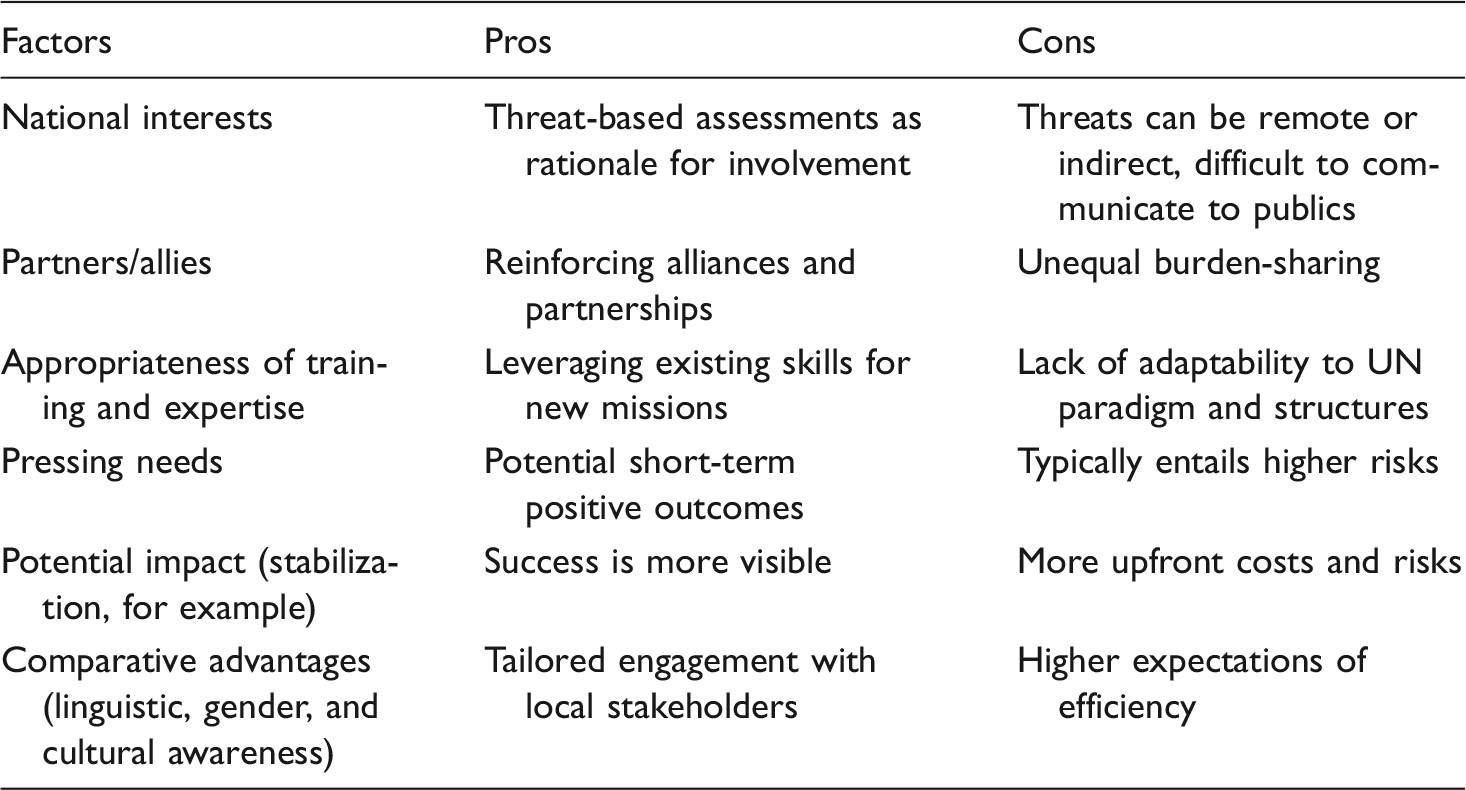
For Canada’s renewed commitment to UN peacekeeping operations to be sustainable, it must be somewhat aligned with the pursuit of its national interests. In this context, the challenge is to offer a clear rationale for the involvement of Canadian troops and resources in a peace operation which most often occurs in remote settings, which are not directly linked to Canadian security back home.
The second factor is how this reengagement positions Canada with regards to its partners and allies. As Western countries are wealthier yet contribute smaller numbers of troops, there is an opportunity for Canada to lead the way in promoting more equal burden-sharing at the UN in terms of sending boots on the ground, thus balancing risk-taking and influence over the mission’s mandates.
For its impact to be optimal, Canada must provide the appropriate training, resources, and expertise for its troops to be attuned with specific UN practices and objectives. Though Canada has significant experience in intervening abroad through coalitions or NATO, practices need to be converted and adapted to current UN norms and expectations.
The situations in Central African Republic (CAR), the Democratic Republic of Congo (DRC), Mali, and South Sudan remain volatile, and the dynamics of such settings are calling for prompt investment and engagement from multiple contributing member states. An increased Canadian involvement would likely produce short-term positive outcomes, welcomed visibility, and rewarding feedback from other member states and host governments. Yet, pressing needs flow from high insecurity, which should be interpreted to mean significant risks for interveners. Canada should thus be aware of the costs and enhanced risks, both at home and abroad, of its engagement in demanding security environments.
Canada must thus calibrate its ambitions in terms of short- and long-term consequences of its engagement in peace missions. The UN involves “193 Member-States,” translating to multinational contingents, unequally trained and equipped, with a variety of working cultures and norms. Engaging in high-risk environments in multinational civilian-led missions entails costly and comprehensive adaptation.
Consistent with what the contributors in this special issue have argued in their own research, Canada presents unique characteristics and comparative advantages in terms of language (bilingual troops), gender and cultural awareness, and technological contribution capacity (notably in terms of engineering expertise, aircraft fleets, and helicopters). If it makes it easier for Canada to tailor its engagement to international and local settings and stakeholders, it does raise expectations of greater efficiency, thereby possibly entailing higher political costs.
Featured contributions
The two first articles featured in this issue grapple with the implications of the changing security environment, focusing on professional military education, training, and recent operational experience from a Canadian and US perspective respectively. Howard Coombs starts by assessing the lessons learned from the peace operations of the early 1990s, citing some of the challenges the CAF faced in Somalia, the former Yugoslavia, and Rwanda. In so doing, Coombs problematizes the concept of “soldiers first”: the idea that, first and foremost, service members should be fit for general-purpose combat, to be ready for deployment in a range of operations. This approach leads to questions about whether or not specialized training is needed for peace support operations or whether the “soldiers first” model is still relevant. More specifically, the article asks what types of military skills are required for participation in modern peacekeeping. The answer is that, while nixing the “soldiers first” approach might be unnecessary, education and training tools must adapt to the new realities of peace operations. In practical terms, this means updating the curriculum of military academies, offering varied training in peace support, from cultural awareness to specialized medical skills, and finally, seeing to continuous updates to the CAF doctrine on peace operations. Coombs seems to indicate the CAF is on the right path but might need to adjust existing models in order to fulfill the peacekeeping commitments promised by the Trudeau government.
Hans Christian Breede delves deeper in the reflection on Canada’s specific contribution, with an unprecedented discussion on the unique role Canadian special operations forces (SOF) could play in UN peace operations. He puts forward SOF’s threefold assets: working well with others while being autonomous and able to carry out a wide variety of tasks. Breede acknowledges that SOF are only one aspect of military power in peace missions, and convincingly demonstrates how the civilian fundamentals of the mission are still compatible with the use of SOF’s unique skills. He articulates how the Canadian Special Operations Regiment, in particular, would be best suited to support peace operations in tune with the recommendations of the UN SOF Manual. Breede concludes by stressing that SOF are best used in instances of military assistance, and should be relied on for specific and deliberate missions to make the most of their unique training for tasks requiring precision, discretion, and involving very high degrees of political and strategic risk.
Gaëlle Rivard Piché’s innovative article underlines key issues pertaining to interoperability across civilian and military partnerships in peace operations. She highlights why interoperability is important for the success of missions in complex settings. She identifies the specific challenges related to UN peace operations as civilian-led enterprises with encompassing mandates, including the stabilization of the security environment, the protection of civilians, electoral assistance, the restoration and extension of state authority, and security sector reform. In light of her extensive field experience in Haiti, she identifies confusion over mandates and objectives, turf wars, and “know best” tendency as the key sources of tension between civilian, police, and military players, hindering effective collaborative work towards common goals. Rivard Piché concludes with clear recommendations for best practices fostering a collaborative culture, such as enhancing training, promoting strong leadership, and cultivating cooperation channels at all levels of peace operations in order to facilitate interoperability in these missions.
Walter Dorn and Joshua Libben unveil the decline of Canada’s investment in the training for peace operations over the past two decades, while putting forward the importance of a Canadian reengagement in the UN. Their extensive review of training institutions’ curricula from 2000 to the present shows a shift in focus by military centres previously responsible for training Canadian peacekeepers at home and abroad. Dorn and Libben debunk three myths about peacekeeping: one that regards peace operations as low-intensity and low-level operations; another that considers traditional combat training as sufficient and a third that the training need is low since Canada has a low engagement in peacekeeping operations. Dorn and Libben conclude with recommendations on how Canadian investment in peacekeeping should relate to its national interest, while also reaffirming the need for a Canadian commitment to international security and peace.
Additional topics to consider
The previous section offered an overview of the different theoretical and empirical perspectives offered in this special issue. In this section, we have identified two additional themes which deserve attention as part of scholarly and policy debates on peace support operations and Canada’s reengagement in UN peacekeeping space.
Gender and peace support operations
A stated priority for both the UN and Canada has been to put greater emphasis on gender considerations in conflict management approaches. At the UN, this gender-focused approach was operationalized in a series of resolutions, starting with UN Security Council Resolution (UNSCR) 1325 in 2000. 27 This resolution sought to increase the participation of women in peace processes, acknowledge sexual and gender-based violence as an important part of today’s conflict dynamics, and, through all activities, use a gendered lens to plan and carry out missions, to understand the differentiated needs and experiences of women, men, boys, and girls in conflict. As apparent with Canada’s adoption of a national action plan on Women, Peace and Security in 2010, 28 and updated in 2017, national governments have followed suit by monitoring the implementation of those resolutions across their international policies. Under the Trudeau government, the national action plan model was revised after a series of public consultations, but already in the June 2017 defence policy, we witnessed a greater emphasis on the inclusion of a gender perspective for operational planning and missions. During the Defence Ministerial in Vancouver, held in November of 2017, Prime Minister Trudeau also announced the Elsie Initiative for women in peace operations, which is meant to increase the meaningful participation of women in UN peace operations. 29 Some of the key changes that had already been undertaken, prior to the release of the defence policy and the more recent peacekeeping commitments, were the appointment of three gender advisors to support the Canadian Joint Operations Command, the Strategic Joint Staff, and the Canadian Special Operations Forces respectively, and the adoption of the CAF Diversity Strategy. The CAF have also encouraged their members to take the Status of Women Canada’s GBA+ training, which is an online training module that teaches gender-based analysis and is meant for government employees.
While this gender turn in operations is in full swing, there are implementation challenges and a lot of criticism coming from observers who are dissatisfied with how the Women, Peace and Security agenda has been carried out. 30 To better understand this normative shift and how it is impacting the design and conduct of peace support operations, a short overview of the scholarly literature is presented here. 31 Two main themes emerge: the presence of women in UN operations, and the integration of gender perspectives in conflict management. While not addressed separately here, sexual violence as a conflict dynamic is present in both bodies of research.
On the presence of female peacekeepers, what is noteworthy is that, while women still make up fewer than 5 percent of deployed personnel, more and more countries are now integrating women in peacekeeping forces. 32 Case study research is now available detailing how all-female or mixed units, whether police or military, have been deployed in UN missions. 33 More interestingly, some scholars have examined how the presence of peacekeeping can improve operational outcomes. Research by Julia Bleckner, for example, finds that all-female units are associated with greater gender awareness when carrying out missions, leading to more effective action in addressing sexual exploitation and abuse conflict areas. 34
The second theme, focused on the gender perspective, is about how interveners are leveraging gender expertise to guide operational planning and better design missions and success metrics. To this end, many scholars comment on the lack of gender awareness, namely that proper training is maladapted to empower UN or national actors to incorporate gender perspectives into policy or operational work. 35 At the UN, studies show that gender language has been mainstreamed within peacekeeping mandates, but unevenly so, with higher prevalence for conflicts where sexual violence is a salient issue. 36 But application of UNSCR 1325 principles ought to be more universally applied for more lasting political and operational outcomes. Olsson and Gizelis perhaps put it best, highlighting the “need for more systematic knowledge about how we can create a more equal peace for men and women[.]” 37
Peacekeeping intelligence
The second issue we want to shed light on is how peacekeeping intelligence contributes to mission outcomes. In 2006, the UN created the Joint Mission Analysis Center (JMAC), composed of military, police, and civilians. JMACs are now key mission assets, providing information and analysis to support critical senior-level decision-making and strategic planning.
Eleven years later, in May 2017, the first Peacekeeping Intelligence Policy was adopted by the UN member states in response to the 2015 HIPPO report titled the Future of Peace Operations which recommended “more effective information management and significantly enhanced analytical capacities.” 38 The report identified that “an effective system for the acquisition, analysis and operationalization of information for peace operations in complex environments is lacking.” The biggest challenge for the UN is to secure, clear, and standardize procedures to efficiently acquire, analyze, and share information in order to support the implementation of peace missions’ mandates.
Multidimensional, integrated stabilization missions, akin to the ones in CAR, Mali, the DRC, and South Sudan must adapt to harsh conditions by focusing on logistical mobilization in collaboration with local and regional stakeholders, and by assuming a militarily and politically robust posture. Investing in intelligence and information units as core components of peace missions will enhance the UN capacity to identify the most pressing crises and corresponding needs from the field. This kind of information analysis maximizes the operational efficiency and responsiveness of missions. The intelligence cycle within UN operations must be highly integrated, emphasizing the importance of the flow of information between field offices and headquarters. The continuous acquisition, analysis, and dissemination of key information must be processed to enable efficient and timely UN responses to risks, threats and crises, both on the ground and in policy; as well as to be more accountable, flexible, and straightforward.
Canada could thus invest in the training of UN information analysts, notably by supporting courses akin to the one provided by the Norwegian Defence International Centre (NODEFIC) in Oslo. Such training is central to understanding how intelligence analysts acquire a similar UN intelligence culture. Not only must actors be able to participate in identifying relevant information, analyzing the facts, and sharing their understanding, they must also develop common approaches to identify which situations should be perceived as key in the implementation of UN peacekeeping mandates. 39
Moreover, Canada should commit to longer-term deployment of its military personnel in JMAC and JMAC-like structures at the UN. The problem with most military personnel deployed in JMAC is the six-month frequency of their rotation. Such a short turnover is insufficient for the analysts to develop the necessary understanding of the specific context and mandate of peace missions. If Canada wanted to maximize its involvement in the intelligence structure of peacekeeping missions, a deployment of a minimum of one year of its military personnel amidst JMAC would improve its impact on the ground. It would also lead the way by signalling a significant commitment to supporting intelligence structures and cycles within UN missions.
The next section connects the main themes discussed thus far to more recent developments and opportunities. We focus on how the 2017 defence policy can impact peacekeeping debates, and offer some policy recommendations for the short to medium term.
Recommendations post-defence policy review
When Canada’s new defence policy was announced in June 2017, observers were expecting some clarity on peace support operations. 40 While the Trudeau government has committed to deploy helicopters and supporting troops to the UN operation in Mali, the specifics with regards to the CAF's role remain unknown. As previously mentioned, there are considerable gaps between the level of involvement and types of contributions from different member states: states that contribute financially and states that contribute troops; states that advocate for more robust missions, and those paying the price of forceful strategies; and finally, between those that are the “Pen-holders”—deciding upon mandates and resolutions relative to the missions—and those that provide the operational means.
Canada has not been a salient player in UN peacekeeping, ranking quite low amongst TCCs, so reengaging with the institutional complexity and the diplomacy of the UN will imply a steep re-learning curve, as the scope of the commitment, at least on paper, has increased exponentially. 41
Even with this bolstered commitment, how are national contributions assessed by other states? Even with 500 troops deployed in UN operations, Canada does not even come close to the top twenty TCCs. 42 Canada is no stranger to debates on burden-sharing within the NATO context, but how do these play out in the UN context? And what happens when members are not able to generate sufficient troops and equipment to meet the mission requirements? The UN can address these gaps by adjusting its interventions to result in mandates that are more closely aligned with its means, and encourage a fairer sharing of the burden between member states. But more important still, the UN should strive to reaffirm civilian leadership at the core of its missions, in order to maintain a clear distinction with more militarized NATO missions, which is the risk that comes with unspecified military commitments like the one Canada is making.
Canada is well positioned to address the UN’s most pressing needs in the context of peace support operations. The current gaps that have been identified by UN stakeholders are related to capabilities and personnel. In terms of capabilities, priority needs include helicopters, surveillance technology, intelligence collection technology, encryption devices, and communications technology. The CAF is in possession of these required technologies, and has trained personnel who are capable of operating them during missions abroad. In terms of personnel requirements, Canada can increase its participation in UN missions by providing additional police, military, and civilian personnel. More specifically, there is a considerable gap in internal UN policing capabilities. Peace operations would therefore benefit from an increased military police (MP) presence, which Canada would be well suited to fill, given that CAF MPs have considerable experience both at home and in various deployments abroad—including in peacekeeping contexts, such as Haiti. The CAF is also well suited to support specific tasks such as night patrolling and civil military operations, both necessary in the context of peacekeeping missions’ complex security settings. The CAF could also contribute to the efficiency of peace operations by devising mechanisms to enhance early warning assessments and the deployment of rapid first response capabilities.
In addition to providing equipment and military personnel, the CAF has the potential to become an international leader in peacekeeping training by providing specialized courses to military, civilian, and police personnel from other member states. As mentioned in the articles by Howard Coombs and the ones by Walter Dorn and Josh Libben, the Peace Support Training Centre (PSTC) has developed expertise in this domain and supports training of both Canadian and foreign forces. However, if Canada is to ramp up its peacekeeping activities, the PSTC will need to acquire more trainers to meet the demand of an increased operational tempo.
As alluded to in many of the contributions to this special issue, specialized training and education for military and civilian personnel are important to ensure that all personnel understand UN objectives and practices, in addition to the operational environment. Training approaches can be updated by paying attention to three specific issues: interoperability, knowledge sharing, and greater social awareness.
First, there needs to be greater interoperability between uniformed and un-uniformed personnel, and between multinational contingents. The recommendations offered by Rivard Piché are instructive in this respect. Military personnel deployed on operations must recognize that their activities are in support of their civilian partners and designed to fulfil humanitarian objectives first and foremost. Stronger partnerships with NGOs and community-based organizations should also be pursued. As Howard Coombs mentions, peace support operations should adopt the comprehensive approach, involving stakeholders from different professional sectors. Moreover, troops must be trained to operate alongside, and in partnership with, contingents with various levels of preparedness, skills, and quality of equipment. Peacekeeping contingents are multinational in terms of their composition, and not all militaries have the same level of professionalism.
Second, Canada has the ability to reinforce an international network of training experts. These international training resources are important to tap into for the development of best practices, and to promote a higher level of standardized training between Canada and other troop-contributing states. States that have developed and invested in peace operations training for many years should be sources of knowledge and instruction for Canada as it furthers its commitment to peace operations.
Third, gender and cultural awareness should be at the forefront of training during all phases of peace operations. Peace operations are facing two main gender issues: the underrepresentation of women in missions, and instances of sexual exploitation and abuse perpetrated by peacekeepers toward the population and amongst interveners. Since gender and cultural understanding go hand-in-hand, training should be tailored to local contexts and support the development of evidence-based course material.
Finally, the UN is dependent on its members for funding, equipment, and troops. Canada should initiate a diplomatic push to advocate for greater involvement in peacekeeping by other developed countries (read: wealthier countries). To be truly influential in this regard, Canada must increase its presence at higher levels of the UN (diplomats and military advisors), but also lead by example by allocating more troops on the ground to peace missions. The commitment of helicopters and 500 supporting troops to the UN mission in Mali represents a modest step in this regard.
Conclusion
This introduction has sought to demonstrate that UN peace missions are dependent on the involvement and contributions of member states, and, thus, UN forces must adapt to contexts with the limited means allocated to them. In so doing, we also discussed why and how states participate in peace operations in an evolving security environment, where the role of peacekeepers is constantly changing.
The contributions included in this special issue offer a coherent appraisal of how peace operations have evolved over time, drawing from the Canadian experience and beyond. In addition to better understanding key changes in the international security environment, the authors have commented more specifically on how peace operations doctrine should be adapted, what type of personnel should be deployed and what kind of skills are considered essential to support peace operations. This critical assessment of peace operations is timely, given the Canadian government’s commitment to reengaging in UN operations. Following Canada’s hosting of the international peacekeeping summit in Vancouver in November 2017, the Trudeau government announced in March 2018 Canada’s engagement with the UN peace mission in Mali. If Canada committed helicopters and support troops, the extent and means of CAF participation remain unclear.
Finally, while the authors in this special issue have provided a comprehensive overview of the main trends to consider and a critical assessment of how the UN has adapted the peacekeeping model, we have identified two key themes in this introduction that deserve some attention. The first one is gender, as it is a cross-cutting issue that has increased in salience since the adoption of UNSCR 1325. The resolution and follow-on resolutions insist on the necessity of applying a gender perspective to conflict management, to understand the differentiated experiences of women, men, boys, and girls in conflict situations. The resolutions also call for greater participation of women in UN operations, both in terms of key leader engagement in host countries, but also for the deployed forces. To this end, the UN has established a link between the presence of women and more positive and lasting outcomes on the ground, an approach which has been validated by scholarly work. 43 The second theme relates to intelligence and how information is acquired, analyzed, and shared in the UN system for the planning and implementation of peace missions’ mandates. For this second theme, we outlined the process by which this is currently done, and identified some impediments to more effective intelligence sharing, an improvement we deem to be key for improving UN peacekeeping operational effectiveness.
We hope that these scholarly and policy debates can motivate a new wave of Canadian scholarship on peace support operations. Pointing to avenues of future research, we believe there is much work to be done to better understand how the peace operations model can be adapted to different contexts, including the intersection of multiple conflict dynamics. For example, some of the riskiest UN missions, such as the mission in Mali, are seeing traditional intrastate conflict dynamics mixing with violent extremism. Understanding the multiplicity of actors, interests, and strategies involved in the ecosystem of peace support operations is key to informing sound decision-making on the part of troop-contributing countries that aspire to make a meaningful impact in today’s most pressing conflicts.
Footnotes
Acknowledgements
Special thanks to Meaghan Shoemaker and Lindsay Coombs for their research assistance. This collection of essays benefited greatly from a workshop held at the Peace Support Training Centre in Kingston, organized with the help of Maureen Bartram from the Centre for International and Defence Policy and Marissa Young.
Declaration of Conflicting Interests
The author(s) declared no potential conflicts of interest with respect to the research, authorship, and/or publication of this article.
Funding
The author(s) disclosed receipt of the following financial support for the research, authorship, and/or publication of this article: Funding provided by the Department of National Defence Defence Engagement Program.
1
Department of National Defence (DND) and the Canadian Armed Forces (CAF), Strong, Secure, Engaged: Canada’s Defence Policy, Ottawa, 2017, 14.
2
Virginia Page Fortna, Does Peacekeeping Work? Shaping Belligerents’ Choices After Civil War (Princeton, NJ: Princeton University Press, 2008); Alex J. Bellamy and Paul D. Williams, Understanding Peacekeeping (Malden, MA; Cambridge, UK: Polity, 2010); Lise Morjé Howard, UN Peacekeeping in Civil Wars (New York: Cambridge University Press, 2007); Sarah-Myriam Martin-Brûlé, Evaluating Peacekeeping Missions: A Typology of Success and Failure in International Interventions (London, UK: Taylor & Francis, 2017).
3
“Uniting our strengths for peace – Politics, partnership and people,” High-Level Independent Panel on United Nations Peace Operations, 2015, viii.
4
Alex Prieur, “Canada’s defence policy consultations & Africa: What did the ‘experts’ say?” Journal of Military and Strategic Studies 17, no. 2 (2016): 107–116.
5
6
7
“It is essential that DND and the CAF develop a strong footprint in regional security institutions such as the African Union that are at the forefront of the new multicultural security innovations.” Thomas K. Tieku, “Canadian national defence policy review roundtable,” Defence Policy Review, 20 May 2016, 2,  (accessed 11 June 2018).
8
“The idea that Canada is—or perhaps more appropriately was—a peacekeeping nation par excellence resonates deeply. Yet, however good this myth has made Canadians feel about themselves and their international contributions, it has ultimately done a disservice, leading to unrealistic expectations about what Canada and the blue berets could accomplish on the world stage.” Michael K. Carroll, “Peacekeeping: Canada’s past, but not its present and future?” International Journal, 71, no. 1 (2016): 167.
9
Roland Paris, “Saving liberal peacebuilding,” Review of International Studies 36, no. 2 (2010): 337–365.
10
Jacob D. Kathman and Molly M. Melin, “Who keeps the peace? Understanding state contributions to UN peacekeeping operations,” International Studies Quarterly 61, no. 1 (2017): 150–162; Lisa Hultman, Jacob Kathman, and Megan Shannon, “Beyond keeping peace: United Nations effectiveness in the midst of fighting,” American Political Science Review 108, no. 4 (2014): 737–753.
11
John Karlsrud, “The UN at war: Examining the consequences of peace-enforcement mandates for the UN peacekeeping operations in the CAR, the DRC and Mali,” Third World Quarterly 36, no. 1 (2015): 40–54.
12
Todd Sandler, “International peacekeeping operations: Burden sharing and effectiveness,” Journal of Conflict Resolution 61, no. 9 (2017): 1875–1897; Martin-Brûlé, Evaluating Peacekeeping Missions.
13
Bellamy and Williams, Understanding Peacekeeping.
14
Evan Cinq-Mars, “Contributor profile: Canada,” Center for Civilians in Conflict, 2017, 4.
15
Hugh Ward and Han Dorussen, “Standing alongside your friends: Network centrality and providing troops to UN peacekeeping operations,” Journal of Peace Research 53, no. 3 (2016): 392–408.
16
Indar Jit Rikhye and Kjell Skjelsbaek, eds., The United Nations and Peacekeeping: Results, Limitations and Prospects—The Lessons of 40 Years of Experience (London, UK: Springer, 2016).
17
Bellamy and Williams, Understanding Peacekeeping.
18
Katharina P. Coleman, “The political economy of UN peacekeeping: Incentivizing effective participation,” International Peace Institute (2013): 1–33; Joachim A. Koops and Giulia Tercovich, “A European return to United Nations peacekeeping? Opportunities, challenges and ways ahead,” International Peacekeeping 23, no. 5 (2016): 597–609; Philip Cunliffe, Legions of Peace: UN Peacekeepers from the Global South (London: Hurst, 2013).
19
“There is a larger lesson that can be learned but will probably not lead to new behaviour: politicians will ask the military to do a great deal on a shoestring budget.” Stephen M. Saideman, “What the Afghanistan mission teaches Canada,” International Journal 72, no. 1 (2017): 131–141.
20
Emily Paddon Rhoads, Taking Sides in Peacekeeping: Impartiality and the Future of the United Nations (New York: Oxford University Press, 2016).
21
Jeff G. Gilmour, “Canada’s new “peace operations” in Africa,” Journal of Military and Strategic Studies 17, no. 2 (2016): 1–6.
22
A. Walter Dorn, “Smart peacekeeping: Toward tech-enabled UN operations,” International Peace Institute (2016): 1–28; Lloyd Axworthy and A. Walter Dorn, “New technology for peace & protection: Expanding the R2P toolbox,” Daedalus 145, no. 4 (2016): 88–100.
23
Cinq-Mars, “Contributor profile: Canada,” 7.
24
Andrea Ruggeri, Han Dorussen, and Theodora-Ismene Gizelis, “Winning the peace locally: UN peacekeeping and local conflict,” International Organization 71, no. 1 (2016): 163–185.
25
Touko Piiparinen, “Intervening to strengthen sovereignty: The lessons of the UN Intervention Brigade for Global Peacekeeping,” International Relations 30, no. 2 (2016): 154–175; Sarah B. K. von Billerbeck, Whose Peace? Local Ownership and United Nations Peacekeeping (Oxford: Oxford University Press, 2017).
26
Mateja Peter, “Between doctrine and practice: The UN peacekeeping dilemma,” Global Governance: A Review of Multilateralism and International Organizations 21, no. 3 (2015): 351–370.
27
Resolution 1325, United Nations Security Council, 2000, S/RES/1325.
28
Women, Peace and Security: Canada Moves Forward to Increase Women’s Engagement, Standing Senate Committee on Human Rights, 2010, https://sencanada.ca/content/sen/committee/403/huma/rep/rep05nov10-e.pdf (accessed 12 June 2018). The 2017 version can be found here: (accessed 12 June 2018).
30
Helena Carreiras, “Women and peace operations,” in Maria Grazia Galantino and Maria Raque Freire, eds., Managing Crises, Making Peace: Towards a Strategic EU Vision for Security and Defence (London: Palgrave Macmillan, 2015), 69–90.
31
For a general guide on the topic, see Jill Steans and Daniela Tepe, eds., Handbook on Gender in World Politics (Northampton, Massachusetts: Edward Elgar Publishing, 2016).
32
For a study on the UN’s gender imbalance in peace operations, see Kerry F. Crawford, James H. Lebovic and Julia M. MacDonald, “Explaining the variation in gender composition of personnel contributions to UN peacekeeping operations,” Armed Forces & Society 41, no. 2 (2015): 257–281.
33
Lesley J. Pruitt, The Women in Blue Helmets: Gender, Policing, and the UN’s First All-Female Peacekeeping Unit (Oakland, California: University of California Press, 2016).
34
Julia Bleckner, “From rhetoric to reality: A pragmatic analysis of the integration of women into UN peacekeeping operations,” Journal of International Peacekeeping 17 (2013): 337–360.
35
Lisa Carson, “Pre-deployment ‘gender’ training and the lack thereof for Australian peacekeepers,” Australian Journal of International Affairs 70, no. 3 (2016): 275–292.
36
Anne-Kathrin Kreft, “The gender mainstreaming gap: Security Council Resolution 1325 and UN peacekeeping mandates,” International Peacekeeping 24, no.1 (2017): 1–27.
37
Louise Olsson and Theodora-Ismene Gizelis, “UN Resolution 1325 at 15: Understanding gender and peacekeeping,” RSIS Commentaries 276 (2015): 2.
38
The Future of United Nations Peace Operations: Implementation of the Recommendations of the High-Level Independent Panel on Peace Operations, United Nations General Assembly Security Council, 2 September 2015, A/70/357–S/2015/682.
39
Philip Davies, “Ideas of intelligence: Divergent national concepts and institutions,” Harvard International Review 24, no. 3 (2002): 62–66.
40
DND and CAF, Strong, Secure, Engaged.
41
42
43
Sarah Hewitt, “Overcoming the gender gap: The possibilities of alignment between the Responsibility to Protect and the Women, Peace and Security Agenda,” Global Responsibility to Protect 8 (2016): 3–28.
Author Biographies
A Ph.D. from the Department of Political Science at McGill University, Dr. Sarah-Myriam Martin-Brûlé is Associate Professor in the Department of Politics and International Studies at Bishop's University. She is Deputy Director of the Réseau de recherche sur les opérations de la paix (ROP), associate faculty member of the Center for International Peace and Security Studies (CIPSS) and of the Montreal Center for International Studies (CERIUM). She works as a consultant for the International Peace Institute (IPI) and for the United Nations Operation Crisis Center (UNOCC). Her book, Evaluating Peacekeeping Missions: A Typology of Success and Failure in International Interventions (Routledge 2017), strives to understand the conditions under which peace operations succeeded or failed. She studied the cases of Somalia, Liberia and Sierra Leone. Her current research focuses on intelligence in United Nations peace operations. Co-author of the first United Nations Field Handbook on Joint Mission Analysis Centres (United Nations, 2018), she recently conducted fieldwork at the MINUSCA (Central African Republic), MINUSMA (Mali), MONUSCO (Democratic Republic of Congo), UNOCI (Côte d'Ivoire) and UNMISS (South Sudan).
Stéfanie von Hlatky is an associate professor of Political Studies at Queen’s University, and the former director of the Queen’s Centre for International and Defence Policy (CIDP). She received her PhD in Political Science from Université de Montréal in 2010, where she was also executive director for the Centre for International Peace and Security Studies. Prior to joining Queen’s, she held positions at Georgetown University’s Center for Peace and Security Studies, the Woodrow Wilson International Center for Scholars in Washington, DC, Dartmouth College’s Dickey Center for International Understanding, and the Center for Security Studies at ETH Zurich. She has published in the Canadian Journal of Political Science, International Journal, European Security, Asian Security, as well as the Journal of Transatlantic Studies, and has a book with Oxford University Press entitled American Allies in Times of War: The Great Asymmetry (2013). Her most recent book, Going to War? Trends in Military Interventions (co-edited with H. Christian Breede), investigates the reasons why countries enter conflicts (McGill-Queen’s University Press, 2016). She is the founder of Women in International Security Canada and is currently chair of the board. Her research is funded by NATO, the Canadian Department of National Defence, the Social Sciences and Humanities Research Council of Canada, the Government of Ontario’s Ministry of Research, and Innovation and Fulbright Canada.