







Abstract
Systematic research on world cities neglects immigration, despite its significance to world city formation. In this article, we test a foundational, but untested, premise of world cities research: that global centrality in the world urban system is associated with larger, more diverse immigrant populations. Using an international sample of cities, we conduct multivariate regressions of Benton-Short et al.’s Urban Immigrant Index on the Globalization and World City Network measure of advanced producer service firm centrality and two other measures of global urban centrality, controlling for competing explanations of international migration. Our findings reveal that cities that are more central to the network of advanced producer service firms have larger, more diverse immigrant populations than less-central cities. World cities are thus not only key sites for corporate control of the world economy, but they are also central in international flows of immigrant labor, as Sassen hypothesized nearly 30 years ago.
Introduction
At the most fundamental level, the geographic diversification and intensification of capital and labor flows across places produces globalization (Dicken, 2011; Held et al., 1999; Sassen, 1988). Urban scholars recognized early on that capital and labor flows shape the formation of world cities – distinctive places characterized by their central, organizing role in a broader world urban system (Friedmann, 1986; Friedmann and Wolff, 1982; Sassen, [1991] 2001). Capital flows, and the networks of transnational corporations from which they emerge, were given prominence over labor flows in explanations of world city formation. Transnational capital flows stimulate migrations of people from origin sites (Sanderson and Kentor, 2008, 2009; Sassen, 1988; Van der Waal, 2013) and encourage movements to specific destination sites (Sassen, 1988). As transnational capital became concentrated in world cities (Sassen, [1991] 2001), investments from corporations sited in world cities became the basis for immigration (Sassen, 1988, [1991] 2001). Thus, because they are strategic sites for transnational capital, and more central to the world urban system, world cities may be characterized by larger, more diverse immigrant populations compared to less-central places (Friedmann, 1986; Friedmann and Wolff, 1982; Sassen, 1988, 1996a, [1991] 2001, 2006, 2008; Sassen-Koob, 1985).
The relationship between centrality in the world urban system and immigration into world cities is an important part of much of the research on world cities over the past 35 years. Surprisingly, however, the relationship is not systematically tested across an international array of cities. As a result, the world city-immigration relationship remains more of an anecdotal premise rather than an established empirical regularity on which to base future research. In this article, we test this basic premise of world cities research: is global centrality in the world urban system associated with larger, more diverse, immigrant populations?
We begin with an attempt to bring migration back in to our understanding of world city formation by reviewing early seminal writings by Friedmann and Sassen. We recognize that there is a growing, increasingly diverse literature on immigration in world cities (see, for example, Beaverstock and Smith, 1996; Beaverstock, 2005; Burgers and Engbersen, 1996; Malecki and Ewers, 2007; Tyner, 2000; Van der Waal, 2013). Because our primary goal is to test a basic, organizing premise of world cities research, we focus our discussion more exclusively on foundational works by Friedmann and Sassen and subsequent extensions of their work in studies of global centrality and immigration. Next, we broaden the scope of the discussion to review three other structural explanations of immigration into world cities: foreign direct investment (FDI), immigrant networks, and national immigration policies. Then, we empirically test the relationship between global centrality and immigration.
Back to the beginning: immigration in world cities
Immigration is prominent in early conceptions of world cities and the world urban system. Indeed, the foundational pieces by Friedmann and Wolff (1982), Friedmann (1986), and Sassen (1988), ([1991] 2001) all consider labor migration a key element in the formation, geography, composition, and evolution of world cities and the world urban system.
Friedmann’s (1986) formal elaboration of the world city hypothesis identifies the relationship between labor migration and world city formation in one of his seven theses: ‘World cities are points of destination for large numbers of both domestic and/or international migrants’ (p. 75). Friedmann’s formulation of the world city hypothesis, however, views the role of labor migration in world city formation as even more profound than this interpretation alludes. Friedmann and Wolff’s (1982) initial study of world city formation includes labor migration in each of the forms of restructuring that characterized world cities: physical, economic, and social. Migration is the primary source of physical restructuring by expanding populations in world cities: ‘By the end of the century, the typical world city will have 10 million people or more. Much of the increase will have come from migration’ (Friedmann and Wolff, 1982: 323). These large influxes of cheap, flexible migrant labor spur economic restructuring in the manufacturing sectors and give impetus to burgeoning informal sectors, both of which are seen as hallmarks of world cities. Economic and physical forms of restructuring are associated with social restructuring, as world cities are defined by polarized, or dual, class structures comprised of ‘transnational elites’ and a ‘permanent underclass’ (Friedmann and Wolff, 1982: 322). Immigrants comprise a large and significant component of the ‘permanent underclass’ in these new class structures: Many, though not all, of the underclass are of different ethnic origin than the ruling strata; often, they have a different skin color as well, or speak a different dialect or language. These immigrant workers give to many world cities a distinctly ‘third world’ aspect: Puerto Ricans and Haitians in New York, Mexicans in Los Angeles and San Francisco, barefoot Indians in Mexico City, ‘nordestinos’ in Sao Paulo, Jamaicans in London, Algerians in Paris, Turks in Frankfurt, Malays in Singapore. (Friedmann and Wolff, 1982: 322–323)
Labor migration is also essential to Sassen’s (1988) conceptualizations of global city formation. For Sassen, capital accumulation requires inflows of cheap, flexible labor: ‘A central precondition for the realization of the surplus-generating possibilities of a geographic location is the formation of a politically and economically suitable labor supply’ (p. 26). Global cities emerged as strategic sites, or nodes, of capital accumulation in the world-economy and, thus, they are also key points of destination for immigrants.
Sassen (1988) conceptualizes the international division of labor in terms of circuits of capital and labor flows. Global cities are key spaces where capital and labor flows intersect (Sassen, [1991] 2001). As firms disperse economic production globally, their capital investments mobilize labor migration streams from less-developed countries (Sassen, 1988). Control over these dispersed operations is concentrated among firms headquartered in global cities, where new agglomerations of advanced producer services (e.g. finance, accounting, real estate, insurance, advertising, etc.) develop to service the global operations of these firms (Sassen, [1991] 2001). Expansion in these leading industries restructures labor markets. Employment growth in the high-income sectors generates employment growth in the low-wage sectors and labor markets become more polarized. These new labor markets generate demand for immigrant labor. Thus, for Sassen-Koob (1985), labor migration is profoundly implicated in global city formation: (N)ew forms of capital mobility are directly and indirectly inducing new labor migrations … major locations for this interaction between capital and labor mobility are … large cities which centralize the management and new kinds of production needed for the operation of the world economic system … immigrant labor can be seen as having a distinct role in this reorganization. (p. 265)
Prior research on global centrality
Despite its significance to world city formation, immigration is relatively neglected in systematic research on world cities (Samers, 2002). This neglect is most apparent in one of the most vibrant strands of inquiry in world city research, which consists of efforts to empirically map the structure of the world urban system. This work is based conceptually on the assumption that global inter-city flows of commodities, people (e.g. labor), capital, and information/control create linkages that define a network of cities, with each city being more or less central to the overall network of flows. This conceptualization led to network analytic approaches that empirically specify these networks on the basis of data on inter-city flows or transnational corporation-city networks, with cities being more globally important to the extent they are more central to these networks.
Empirical efforts to locate the world’s cities in these hierarchical networks were for many years limited by the dearth of data on international city-to-city connections. The first efforts to identify the relative prominence of cities relied on comparisons of attributes of cities, such as population size (Chase-Dunn, 1985) or the number of headquarters of Fortune 500 corporations (Cohen, 1981) and assumed that larger size or more headquarters meant greater centrality within the network. Since the mid-1990s, scholars were able to assemble measures of cities’ global centrality based in city-to-city linkages and flows, but to the best of our knowledge none include human migration.
Over the past two decades, there were different attempts to systematically gauge the global centrality of cities. In their initial discussion of the empirical mapping of the world-system’s city system, Smith and Timberlake (1995) presented a data wish list for studying cities in global matrices. They distinguished between four different functions (economic, political, cultural, social reproduction) and three different forms (material, human, information). Cross classifying these forms and functions yields 12 categories of flows which provide a sensible way to focus a search for data on theoretically significant inter-city global flows. For example, the short-term migration patterns (travel) of managers and other business professionals is an example of economic flows embodied in the movement of humans from one city (e.g. corporate headquarters) to other cities (e.g. back offices). Cities’ ‘centrality’ will differ based on the form(s) and function(s) that are being highlighted, as well as the wider analytic strategy to assess a city’s position in these flows. The inter-city flows of remittances from labor immigrants would likely produce different estimates of particular cities’ centrality in the global city system than the flows of business class air passengers.
Two separate and distinctive approaches are predominant in empirical research on the global centrality of cities (Derudder, 2006): (1) analyses of the position of cities in worldwide corporate networks and (2) analyses of the position of cities in the infrastructure networks that enabled corporations to go global. Both approaches can be said to transcend the ‘data wish list’ identified by Smith and Timberlake (1995), as they squarely incorporate dimensions of the different forms and functions. However, while the data based on passenger flows and corporations are widely acknowledged in this literature, there are several other promising approaches as well. For example, Carroll (2007; see also Kentor et al., 2011) estimates cities’ relative global prominence on the basis of network analysis of interlocking directorates of top corporations. Others explored cities’ relative positions in Internet backbone networks (Malecki, 2011; Tranos, 2011; Tranos et al., 2014; Vinciguerra et al., 2010), while Matthiessen et al. (2010) analyzed the changing network of cities identified on the basis of scientific collaborations.
In addition to ongoing developments in terms of data sources, world city network researchers also explored using different centrality measures to capture a city’s structural position in the network. World city network research is premised on the application of fairly standard network-analytical tools such as eigenvalue centrality (Smith and Timberlake, 2002) and the triad of degree, betweenness and closeness centrality (Alderson and Beckfield, 2004). Recently, more advanced techniques such as Bonacich’s power were applied (Choi et al., 2006), while Neal (2011) devised tailored notions of centrality and power as tools for describing cities’ position or status in the system. A recent debate between Boyd et al. (2013) and Neal (2013b) shows the vibrancy of the discussion on the remit of different centrality measures. There are a wide variety of measures available now, each capturing different dimensions of ‘centrality’ in a global urban network. Importantly, these different dimensions are associated with different rankings bearing the analytical strengths and weaknesses of the measures underlying them. For instance, while a city’s degree centrality – defined as the number of links incident upon that city – is easy to compute and interpret, it only captures a limited and very specific dimension of what makes a city central in the overall network. The relevance of different measures is explicitly recognized in Alderson and Beckfield (2004), as they calculate rankings for different centrality measures and subsequently interpret cities’ positions according to the specific analytical construct captured by these measures. Finally, and related to the use of different measures, recent research comparing the remit of an ‘inter-city connection’ in the world city network shows that the network itself can also be specified in different ways (Beckfield and Alderson, 2006; Liu and Derudder, 2012; Neal, 2013a, 2014; Taylor, 2006), which adds a further layer of complexity and richness to this literature.
Measures of global centrality
The mushrooming of data sources, network specifications, and centrality measures in world city network research implies that researchers face a difficult choice of selecting appropriate measurements of global centrality. In this article, we acknowledge the diversity in this literature by using measures drawn from three different empirical approaches. We discuss each of these measures in turn.
First, we use one of Alderson and Beckfield’s (2004) estimates of global centrality, which is based on a specification of a city network consisting of interactions between headquarters and subsidiaries of Fortune magazine’s Global 500 in 2000. In practice, the authors identified the locations of headquarters and subsidiaries of 466 of these 500 firms, allowing them to produce a directional, valued data matrix connecting 3692 cities. Using formal network analysis, they generate a number of standard network measures. Here we draw on their betweenness centrality measure, which is arguably one of the most meaningful measures of a node’s structural position in a network. A city’s betweenness centrality equals the number of shortest paths from all nodes to all other nodes that pass through that city, so that – in the specification of Alderson and Beckfield (2004) – a city with high betweenness centrality strongly influences the transfer of ‘command’ through the network (under the assumption that the transfer of command follows the shortest paths).
Second, we use Derudder and Witlox’s (2005) data on airline passenger flows between cities in 2001 to derive betweenness centrality. Results are based on data from the Marketing Information Data Transfer (MIDT) database, which provides passenger flow data based on passenger reservations indicating city of origin and city of final destination. We applied betweenness centrality analysis to the data presented in their work to produce a ranking of cities’ integrative positions in the global city system at large. In this case, a city with high betweenness centrality strongly influences network integration, as other nodes use it to inter-connect.
Third and finally, we use the connectivity of cities in the office networks of globalized producer services firms. Globalization and World City Network (GaWC) uses a methodology based on standardized scores for the office locations and the office functions of 100 major producer services firms across 315 major cities in 2000 (Taylor et al., 2002). Each city accrues a ‘service value’ for each firm based on the relative importance of that firm’s offices in that city, from 0 (no offices in a given city) to 5 (headquarters located in a city). These scores are then used as the input to the ‘interlocking network model’ (Taylor, 2001), which essentially gauges the potential ‘service quality’ of the interaction between a pair of cities for each firm. Aggregating these interactions across all firms and cities yields an overall measure of centrality: a city’s ‘global network connectivity’. In network-analytical terms, GaWC’s measure is a measure of degree centrality. As noted, degree centrality is conceptually the simplest measure of centrality, as it is simply defined as the number of links incident upon a node (i.e. a city’s total number of potential business linkages). Although there are recent efforts to analyze GaWC data with other types of centrality analysis (e.g. Hennemann and Derudder, 2014), here we use the measure of centrality most commonly reported in most GaWC publications: the total volume of knowledge and information flows associated with a city in the networks of service firms.
The three rankings reflect very different approaches to measuring cities’ nodal centrality in the global urban system. First, they present a different perspective on the form/function dimensions highlighted by Smith and Timberlake (1995): while airline connections encompass dimensions of social reproduction (e.g. visiting friends and relatives) and economic exchange (e.g. business travel), firm networks more narrowly focus on the economic dimensions. Second, in spite of addressing the same type of form/function, the GaWC and the Alderson and Beckfield (2004) measures are very different in that they focus on a different selection of firms (producer services firms versus ‘large’ multinational enterprises per se). Third, and partly related to the differences in network specification, the rankings also reflect the different measures of network centrality. Each of these approaches was refined and extended longitudinally in recent years (cf. Alderson et al., 2010; Derudder et al., 2010; Mahutga et al., 2010), but here we will focus on their initial elaborations.
Global centrality and immigration
Attempts to link global centrality in the world urban system with immigration are noticeably absent despite a strong theoretical rationale supporting the expectation that international migration flows should correspond to the maps researchers produced of the world urban system. Migration data are a key limitation: data on inter-city migration flows for multiple cities worldwide are not available. As a result, the vast majority of prior studies of immigration in world cities utilizes case study designs (e.g. Beaverstock and Smith, 1996; Beaverstock,1996; Malecki and Ewers, 2007; Tyner, 2000) or otherwise employs comparative methods to investigate a set of cities in a single country (e.g. Timberlake et al., 2012; Van der Waal, 2013). This research is especially useful for deepening our knowledge of the multiple and varied ways in which immigration is implicated in the world cities context. Yet, these designs are limited in their ability to systematically establish whether centrality is related to immigration in the world urban system, beyond any one case.
In this respect, Benton-Short et al. (2005) make an especially valuable contribution. They developed an Urban Immigrant Index comprised of four city-level indicators that captured the size, density, and diversity of the immigrant population for an international array of cities. Cities were then ranked according to their immigration densities, which were one component of the index, and their weighted scores on the overall urban immigrant index, in order to identify a world urban system of ‘global immigrant cities’ (Benton-Short et al., 2005).
In the first attempt to empirically assess the relationship between global centrality and immigration, Benton-Short et al. (2005) compared rankings on the Urban Immigrant Index with the GaWC roster of world cities (Beaverstock et al., 1999). The comparisons were revealing. There was some overlap between the GaWC ranking and the urban immigrant index ranking, but mainly at the very top of the world urban system. New York and London, for example, were both important economic centers (first tier or ‘Alpha cities’) and important destinations for immigrants. However, even at the top, there were many discrepancies between the two hierarchies. Most notably, Tokyo, which is commonly ranked at the top of the world urban hierarchy when it is conceptualized in economic terms, ranked 92nd in terms of immigrant density and does not appear as even a third-tier, ‘Gamma’-level global immigrant city. Other first-tier, ‘Alpha’ cities in the GaWC roster, including Chicago, Frankfurt, Milan, Singapore, Hong Kong, and Paris, did not appear in ‘Alpha’ tier of the global immigrant cities ranking. On the other hand, several first-tier ‘Alpha’ global immigrant cities, such as Toronto, Dubai, Sydney, Miami, and Vancouver, were not considered ‘Alpha’ cities in the GaWC ranking.
Benton-Short et al.’s (2005) work is a crucial step toward bringing migration back in to the study of world cities and the world urban system. Of the three measures of global centrality, the GaWC measure seems the most justifiable theoretically when examining immigration because the data source is explicitly based on Sassen’s core theoretical proposition: that agglomeration of producer service firms is key to understanding global city formation and concomitant dynamics, including immigration.
Producer services centrality may stimulate both high- and low-skilled immigration. Polarization in Sassen’s global cities is linked with the decline of industrial, middle-class jobs and the emergence of service industry employment forms that are on average higher income, such as managers, consultants, executives, and lower income, such as restaurant workers, cashiers, cleaning personnel, jobs that cater to a large extent to workers and their lifestyles in the expanding higher-income service sector. The resulting division of labor within these global city service economies is often a migrant division of labor (May et al., 2007), as for various reasons, these jobs are often taken by foreigners. At the upper end of the service sector, the global dispersal of manufacturing and service sectors increased demand for highly skilled international migrants in global cities, where producer service firms cluster (Beaverstock, 2004; Faulconbridge, 2008). Advanced producer service firms are involved in knowledge-intensive production where professionals are expected to ‘deliver intelligence, skills, and knowledge at the point of demand’ (Beaverstock, 2005: 246), making being physically present exceptionally important for the work. At the same time, mobility is important, as these firms require professionals that are embedded within transnational exchanges and cosmopolitan cultures (Beaverstock, 2007). Thus, expatriation within and between firms is an organizational strategy for advanced producer service firms and this strategy manifests spatially as the agglomeration in global cities of firms staffed by high-skilled international migrants (Faulconbridge, 2008).
Foreign-born workers also supply expanding labor market demand in lower-skill service sector jobs in global cities. The clustering of advanced producer service firms in global cities stimulates demand for low-skill employees both directly and indirectly: ‘directly, through the structure of the work process, and indirectly, through the structure of the high-income lifestyles of those therein employed’ (Sassen-Koob, 1986: 99). Example of low-skill jobs directly linked to advanced producer service firms include clerks, administrative assistants, and couriers, but these firms also stimulate indirectly demand for low-skill jobs that cater to the lifestyles of high-skill employees, including dog walkers, French hand launderers, and domestic workers. Because of the low prestige and low wages, low-skill immigrants supply the vast majority of these jobs. Indeed, employers in the low-skill service sectors of global cities tend to prefer immigrants for these jobs (Model, 2002; Sassen, [1991] 2001; Wills et al., 2009). Thus, as advanced producer service firms become more central to the labor markets and economies of global cities, there is demand for immigrant labor at both the upper and lower ends of the skill spectrum. We test the association between advanced producer service firm centrality and immigration below. Before doing so, however, we review three other important structural explanations of international migration that may impinge upon the relationship between global centrality and immigration in world cities: FDI, immigrant networks, and migration policies in receiving countries.
Beyond global centrality: alternative structural explanations
At the cross-national level, the broad and deep literature linking structural factors to migration includes, most prominently: FDI (see, e.g., Ricketts, 1987; Sanderson and Kentor, 2008, 2009; Sanderson and Utz, 2009; Sassen, 1988; Van der Waal, 2013; Yang, 1998), immigrant networks and migratory social capital (see, for example, Curran et al., 2005; Garip, 2008; Massey, 1990; Massey and Espana, 1987; Palloni et al., 2001; Poros, 2001; Tilly and Brown, 1967), and state policy (Beine et al., 2015; Boucher and Gest, 2015; Castles, 2004; Cornelius and Rosenblum, 2005; Freeman, 2011; Messina, 2009; Sassen, 1996b; Zolberg, 1999). FDI is an especially important driver of international migration. On the push side, foreign investment disrupts ‘traditional work structures’, uprooting larger segments of the population and increasing emigration from less-developed countries (Sassen, 1988: 97). On the one hand, foreign investment in export agriculture increases capital-intensive production methods and displaces labor. Displaced labor is either transformed directly into wage-labor in commercial agriculture, or indirectly into wage-labor to be employed in the industrializing cities (Sassen, 1988). On the other hand, foreign investment in the export manufacturing sector tends to expand employment because it is usually directed toward labor-intensive industries such as textile and garment or electronics production. Rising employment in the export manufacturing sector, however, does not necessarily provide employment for labor displaced by agricultural commercialization. Instead, development of the export manufacturing sector incorporates new labor into the workforce, particularly women’s labor, which is considered to be more amenable to the type of work characterized by export manufacturing (Sassen, 1988: 107). Women comprise an increasing share of the migration stream in developing less-developed countries (LDCs) with industrializing urban export manufacturing sectors. Thus, the disruptive effects of foreign investment on traditional work structures are twofold: ‘young men are left without mates and partners, (and) the households are left without a key labor factor’ (Sassen, 1988: 97). Without viable employment opportunities in the industrializing urban areas, men displaced from rural regions are therefore compelled to search for work abroad.
Concomitant with the breakdown of traditional work structures, foreign investment creates material and cultural–ideological linkages with the source country and these linkages encourage emigration to the source country (Sassen, 1988). As a fixed capital investment, foreign investment typically develops transportation and communication infrastructures. While built to move goods, capital, and information, these infrastructures also facilitate the movement of people. The material linkage between countries is clear where transportation infrastructures cross-national boundaries, as in the case of railroads and highways that link Mexican communities to the United States, for example. However, roads connecting manufacturing plants to seaports and rail lines linking mineral mines in remote interior areas to urban areas provide similar linkages with developed countries, making emigration from less-developed countries more likely than would be the case in their absence.
Foreign investment also has a ‘westernizing effect’ that can stimulate emigration to the source country: These workers are using their labor power in the production of goods or services demanded by people and firms in the U.S. or any other highly developed country. The distance between a job in the offshore plant or office and in the on-shore plant or office is subjectively reduced. Under these conditions emigration may begin to emerge as an option actually felt by individuals. (Sassen, 1988: 19–20)
Cultural, or ideological, linkages connect the relatively small portion of the populace that works in foreign investment-sponsored facilities to developed countries. However, the effects of such linkages on emigration are broader, as such individuals also create a ‘linkage for potential migrants’ through social networks (Sassen, 1988: 20).
The relationship between foreign investment and migration relationship is ‘highly-mediated’, but is vital for understanding migration: ‘In an “isolated” country, that is one lacking extensive direct foreign investment, emigration would be quite unlikely to emerge as an option’ (Sassen, 1988: 20). There is strong empirical support for the hypothesis that FDI is associated with emigration from less-developed countries (Sassen, 1988; Sanderson and Kentor, 2008, 2009; Sanderson and Utz, 2009; Ricketts, 1987; Yang, 1998; Van der Waal, 2013).
Foreign investment, then, not only stimulates migration on the ‘push’ side by displacing, disrupting, and uprooting populations, but it also serves as a ‘pull’ factor by creating material and cultural linkages that encourage migration into the source country. Within the source country, global cities are principle immigrant-receiving sites because their labor markets, shaped by the agglomeration of advanced producer service firms, have robust demand for both high- and low-skill immigrant labor.
Global cities are central nodes in various networks of flows and exchanges. Immigrant networks are among these. Indeed, immigrant networks themselves can be an important explanation of the magnitude and spatial orientation of immigration flows. Once initiated, migration can become internally motivated through a process of cumulative causation (Massey, 1990). As early migrants become more established in the destination, they learn about housing and labor market opportunities and gain familiarity with the culture. This information lowers the costs and risks of migrating for future migrants. As migrants share this information with friends and family in the origin country, the effective ‘costs’ of migration decline relative to the expected ‘benefits’ of migration with each additional migration. Thus, as immigrant networks expand in size and density, the networks themselves become important explanations of migration, over and above the factors that motivated the early migrants to move (Massey et al., 1993).
Work-based networks are especially important for understanding the magnitude and orientation of migration flows. At work, individuals gain access to social networks that facilitate the ability to migrate and direct migrants to specific jobs and sites in the destination country. Poros (2001) provides a nuanced understanding of how occupational networks channel migration in a study of Indian immigrants in the global cities of New York City and London. Historical–structural linkages between the United States and India, and the United Kingdom and India, created the contexts in which labor markets for Indian immigrant labor were formed and subsequently integrated. Within this general context, transnational employment recruitment networks developed that supplied the demand for specific forms of Indian immigrant labor in New York City and London. These networks provided valuable information and resources that matched jobs in the United States and the United Kingdom with Indian immigrants holding the requisite skills and training for the jobs. As they developed, these networks decreased the costs and risks for both future Indian migrants, who were subsequently better positioned to find work in the United States and the United Kingdom, and for US and UK employers, who were assured a more stable supply of qualified, yet flexible immigrant labor. Thus, once established, occupations served as channels along which migrants moved into specific forms of employment in New York and London. Notably, Poros (2001) found that occupational networks operated similarly in different destination contexts, lending credence to the argument that work-based networks may not be context-specific, but instead are applicable beyond the case of Indian immigration in the United States and the United Kingdom. Indeed, subsequent research found evidence of the importance of work-based networks for Mexican migration into all major sectors of the US labor market (Sanderson, 2014a, 2014b; Sanderson and Painter, 2011). To the extent then that global cities’ labor markets demand immigrant labor, there are also places where immigrant networks are based, and these networks can motivate immigration into global cities (Sassen, 1988, [1991] 2001).
One of the major advances of world cities research was to shift attention away from the nation-state toward alternative units of analysis for understanding globalization, that is, toward firms and cities and their networks. Yet cities remain embedded within nation-states, and nation-states remain important for understanding immigration. There is, however, substantial debate about the degree to which states matter for immigration (Messina, 2009) and still today, robust theories of how the state relates to immigration and migration politics are lacking (Freeman, 2011).
States are the only actors that can enforce national boundaries, and confer or restrict membership and belonging by granting citizenship or residency (Zolberg, 1999). States do not completely control migration inflows, as the correlation between state policies and immigration is usually weak (Castles, 2004; Sassen, 1996b). Even if states are not completely capable of regulating migration inflows, however, they retain the ability to ‘perfectly define the conditions of migration … policy choices determine the rights each class of migrant enjoys, as well as how aggressively those rights are enforced’ (Cornelius and Rosenblum, 2005: 112). In this sense, immigration policies are themselves a ‘pull’ factor for immigration. If immigrants are aware of more favorable conditions in Country A than Country B, then Country A would be expected to have higher levels of immigration, all other things being equal. It is possible, then, that global cities located within states that grant more favorable conditions for integration and inclusion will experience higher levels of immigration than global cities located in states with more restrictive immigration policies for citizenship and residency. Toronto and Tokyo are illustrative in this regard, as both are upper-tier global cities on several measures, but Canada’s multicultural policies are associated with a larger and much more diverse immigrant population in Toronto compared to Tokyo, which exists in the context of Japan’s much more restrictive policies.
On the other hand, growing migrant transnationalism may attenuate any ‘pull’ effect of immigration policies. Advances in communication and transportation allow migrants more of a choice in identifying ‘home’, resulting in ‘enhanced bifocality’ and the reformation of identities and understandings of belongingness (Vertovec, 2004: 971). To the extent that maintaining long-distance social networks reduces immigrants’ sense of integration and belonging in the destination place (Guarnizo, Portes, and Haller, 2003), transnationalism may limit the ability of states to more effectively influence immigration through integration policies. This is, too, of course, an empirical question that we address in the analysis below, as we test global centrality against alternative explanations of immigration at the city-level.
Analytic strategy
Our analysis centers on ordinary least squares (OLS) regressions of Benton-Short et al.’s (2005) Urban Immigrant Index and index components, on the GaWC measure of producer service firm centrality and the two other measures of global urban centrality. The use of OLS in models that include network-derived variables can present problems for the estimation of standard errors and the subsequent construction of confidence intervals, most notably because observations are not independent (i.e. changes in a cities’ network centrality engender changes in other cities’ network centrality as well). This violates a key OLS assumption, and we therefore employ bootstrapping for assigning measures of accuracy to regression estimates. Bootstrapping is essentially a resampling method that allows estimating properties of an estimator (such as its variance) by simply measuring those properties when sampling from an approximating distribution, most commonly the empirical distribution of the observed data. This approach is often used as an alternative to inference based on parametric assumptions when those assumptions are in doubt (as is the case here). Our estimations of the standard errors for the coefficients are based upon 10,000 replications to estimate standard errors for the coefficients and subsequently calculate confidence intervals.
Dependent variables
Benton-Short et al. (2005) compiled a unique, international, city-level data set for cities on the GaWC’s roster of world cities (Beaverstock et al., 1999) by gathering data housed at the US Census International Program Center Library in Washington, DC, along with the United Nations’ Population Division databases, and official government websites. Using these data, they developed an ‘Urban Immigrant Index’ (Benton-Short et al., 2005): the only extant measure available to analyze migration at the city level of analysis across an international array of cities. The only other sources of international data on migration are collected at the national level.
The Urban Immigrant Index is a composite measure comprised of four weighted 1 indicators, each measured around the year 2000: total percentage of immigrants in the city (40%), total number of immigrants in the city (30%), percentage of immigrants in a city that are not from a neighboring country (15%), and a dummy variable indicating whether one group of immigrants represented more than 25 percent of the total immigrant stock in the city (15%). The index thus captures the most important dimensions of immigration at the city-level, including respectively the density of the immigrant population, the absolute size of the immigrant population, the geographic ‘pull’ of a city, and the diversity of the immigrant population. The index was constructed by calculating z-scores on the indicators for each city, weighting the z-scores, and then summing together the weighted z-scores.
The Urban Immigrant Index is designed as an alternative way to measure the ‘globalness’ of cities: ‘The goal of this research is to expand the range of criteria used to assess the “globalness” of cities’ (Benton-Short et al., 2005: 945). Ranking cities by their index scores provides a novel indicator of the world urban hierarchy according to cities’ importance as immigrant destinations. Cities at the very top of the urban hierarchy generally have a combination of higher proportions of immigrants, larger numbers of immigrants, more migrants from non-neighboring countries, and more diverse immigrant populations.
Because it is multidimensional, the Urban Immigrant Index allows the most comprehensive test of the relationship between immigration and global centrality. Indices are commonly used as meaningful indicators of underlying constructs in cross-national research, especially where the research considers complex, multidimensional processes. Take the issue of ‘development’, for example, which was measured only in terms of per capita incomes for decades, but is now more commonly measured using the United Nations’ Human Development Index, a multidimensional construct comprised of incomes (gross domestic product (GDP) per capita), life expectancies, and education levels. Global city formation is also a multidimensional process, one that involves more than just economic centrality; indeed, this is the Benton-Short et al.’s (2005) rationale for developing the Urban Immigrant Index. However, as a robustness test, we also regress the two largest components of the index, by weights, on global centrality: total percentage of immigrants in the city and total number of immigrants in the city.
Independent variables
We investigate the extent to which cities’ rankings on the world urban immigrant hierarchy are associated with estimates of their global centrality. We use three measures of economic centrality in the world urban hierarchy, each measured in the year 2000 and developed by Taylor (e.g. Taylor et al., 2002) and his associates in the GaWC, Alderson and Beckfield (2004), and Derudder and Witlox (2005). These measures indicate global centrality in terms of networks of producer services firm networks, Fortune 500 firm office networks, and air passenger travel connections, respectively. As indicated above, researchers developed other ways to estimate cities’ global centrality on the basis of network properties. However, these are three of the most widely used measures, and they are each available for the appropriate time period.
We focus on the GaWC measure, which most closely measures theoretical propositions derived from the world cities literature. The GaWC measure uses a methodology based on scores of 315 major cities in terms of their importance as sites for the top 100 producer services firms in the world. Each city accrues ‘points’ for each firm according to the relative importance of that firm’s offices in that city, from 0 (no offices in a given city) to 5 (headquarters located in a city). Cities with higher scores are sites of more top producer services firms’ offices, and more of these offices are relatively more important to each firm’s overall operations.
Alderson and Beckfield’s estimate of global centrality is based on a city network defined on the basis of headquarter-subsidiary locations of Fortune magazine’s Global 500. They identified the locations of headquarters and subsidiaries of 466 of these 500 firms, allowing them to produce ‘a directional, valued data matrix’ of 3692 cities (Alderson and Beckfield, 2004: 820). Using formal network analysis, they generated a number of standard network measures, including ‘betweenness’, a measure of each city’s degree of centrality to the overall network.
Derudder and Witlox’s measure of global centrality is also network betweenness, but rather than being based on the locations of firms and their corporate connections, it is based on airline passenger flows between cities that define this global network. This measure is based on data from the MIDT database, which provides passenger flow data based on passenger reservations indicating city of origin and city of final destination. Derudder and Witlox apply formal network analysis to these data to produce a representation of the global city hierarchy.
All three measures are logarithmically transformed to correct for skewed distributions. Of the 116 cities for which we have a measure of the urban immigrant index, we have a measure of economic centrality for between 69 and 80, depending on which measure is used.
The analysis includes controls for other national-level variables that may affect a city’s score on the Urban Immigrant Index. We include two measures that assess different aspects of immigration policy. First, we include a dummy variable indicating whether the city is within a nation-state in the Schengen Area, a group of European countries with a common visa policy allowing freedom of movement across borders. The Schengen Agreement potentially makes it easier for migrants to enter cities located in the Schengen area, as it allows freedom of movement between countries, and cities, within the area. All else equal, for example, the Schengen may make it more likely that migrants move to Paris (in the Schengen area) than London (not in the Schengen area). We include the Schengen measure to control for this possibility, which is rather unique in the world. The North American Free Trade Agreement (NAFTA), for example, is not equivalent to the Schengen Agreement with respect to migration; NAFTA does not allow anyone in Mexico or Canada to move to the United States without restrictions. Second, we use the Multiculturalism Policy Index (MCPI, 2014) in 2000, which is produced by Queen’s University, Canada. The MCPI measures state–minority relations in 21 Western democracies. There is no cross-national, comparative index of migration entry policies for the cities/states included in our analysis. However, it is reasonable to believe that a country’s policies toward immigrants are correlated to some degree with the country’s entry policies. In this regard, we use the MCPI as a proxy for a country’s policy orientation vis-à-vis foreigners, which may influence the size of immigration inflows into the country and cities within the country. The index is a summary composite score comprised of eight discrete indicators with values of 0, 0.5, or 1, including constitutional, legislative, or parliamentary affirmation of multiculturalism at the central, regional, or municipal levels; adoption of multiculturalism in school curriculum; inclusion of ethnic representation in the mandate of public media; exemptions from dress codes; allowing dual citizenship; funding of ethnic group organizations or activities; funding of bilingual education; and affirmative action for disadvantaged immigrant groups.
To test for the effect of foreign investment, the models include outward stocks of foreign direct investment (UNCTAD, 2014). FDI is a directional measure. Outward stocks measure the total dollars invested by source-country firms in foreign countries. Thus, we use outward stocks, rather than inward stocks, because outward stocks are a closer test of the theory relating foreign investment to immigration. We use outward stocks in 1990 following prior research specifying a 10-year lag between foreign investment and migration (Sanderson and Kentor, 2008, 2009).
We control for the potential effect of migrant networks by including a measure of the total size of the immigrant population in the country in 1995 (World Bank, 2014). This variable captures the accumulation of past migration inflows, and thus proxies for the maximum size of immigrant networks at the national level. Because countries with higher average incomes generally draw higher levels of immigration, we control for the country’s level of GDP per capita. Geographical location may also play an important role in international migration by facilitating or limiting ease of movement. To assess this possibility, the analysis includes a dummy variable indicating whether the city is located in a country that is landlocked.
Results
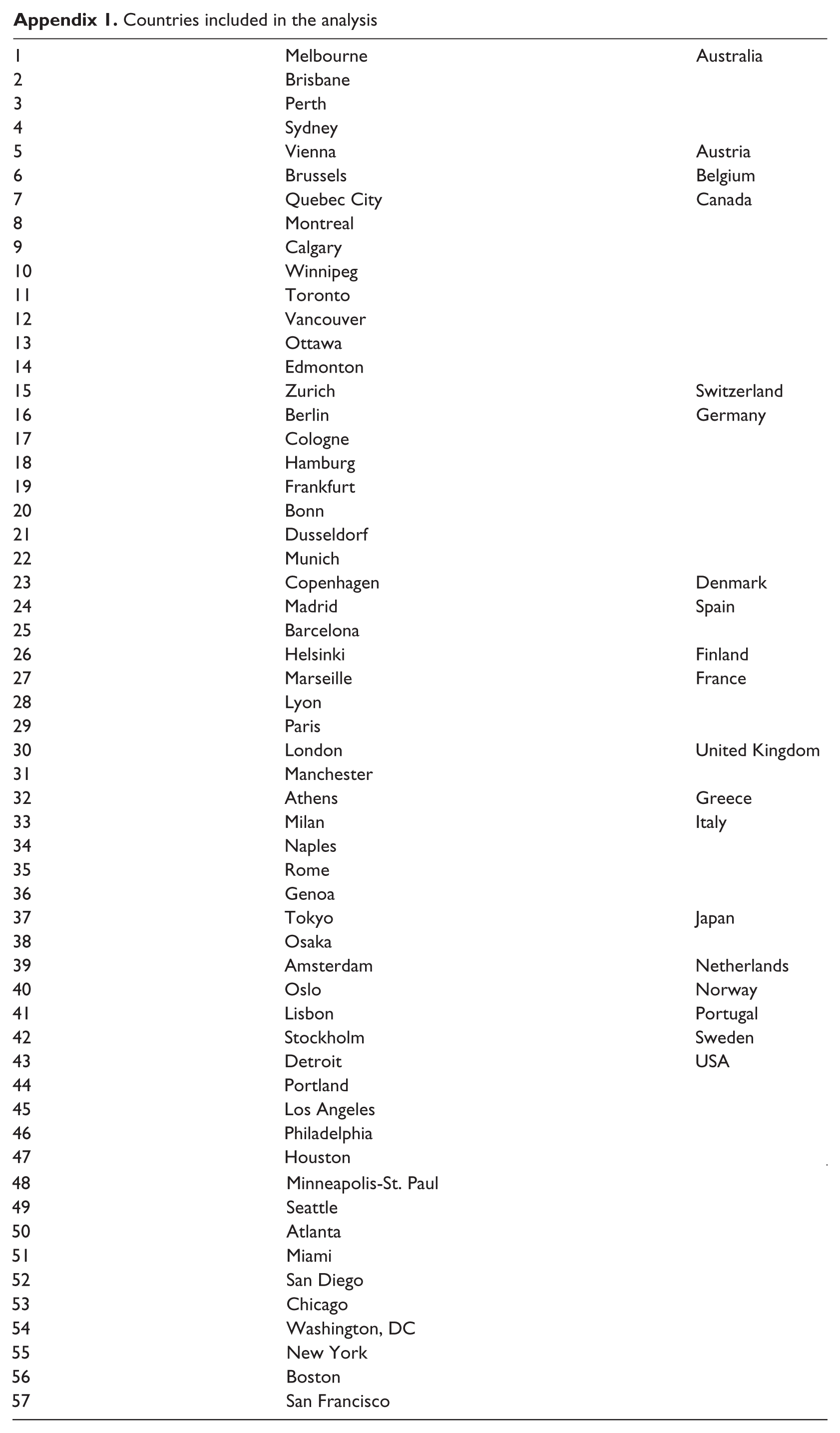
Table 1 presents the zero-order correlation matrix for all of the variables. The cities included in the analysis had complete information on all of the variables in the models. Appendix 1 lists the cities included in the analysis (n = 57). Cities are included in the analysis based on data availability. Only cities that had complete information on all of the variables in the models are included.
Zero-order correlations.
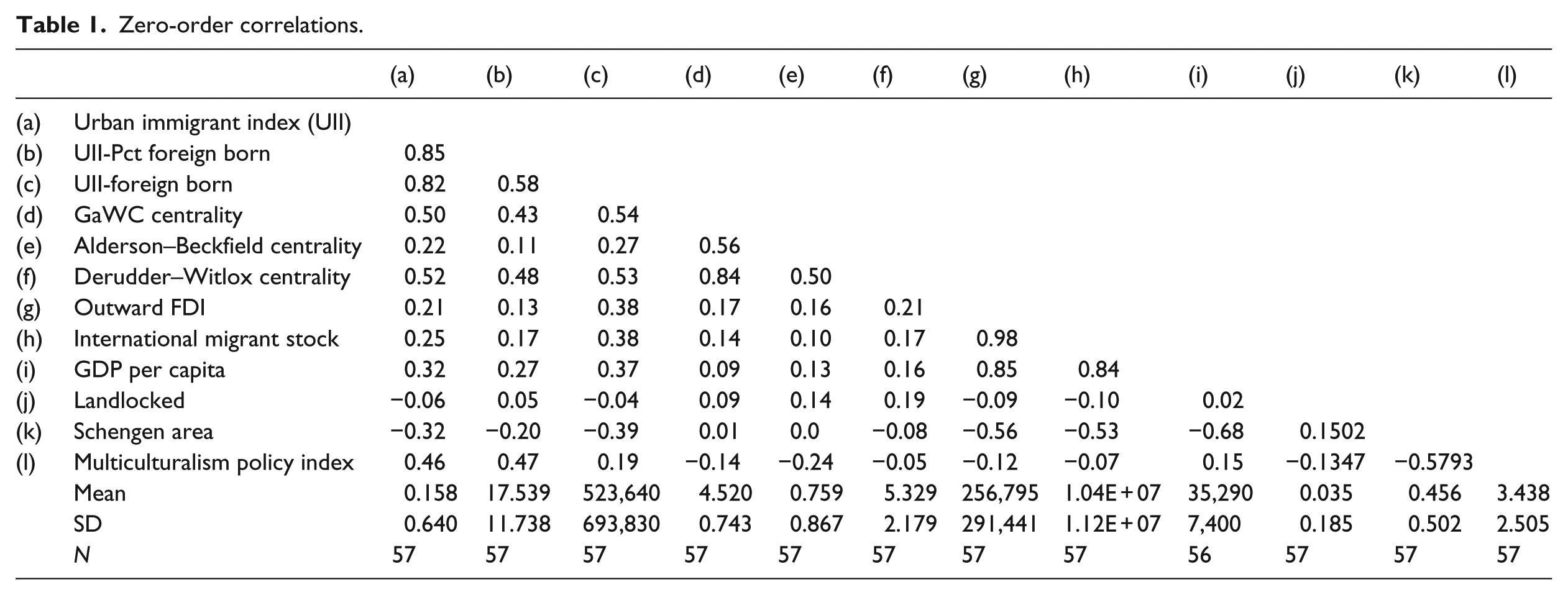
There are four key descriptive findings. First, the GaWC measure of global centrality is rather strongly positively correlated with the Urban Immigrant Index (r = 0.50) and with the two components of the index: percentage foreign born (r = 0.43) and total foreign born (r = 0.54). Cities that score higher on advanced producer service firm centrality tend to score higher on the Urban Immigrant Index. Second, of the three measures of centrality, the Global 500 firm measure is most weakly correlated (r = 0.22), but all three measures are in the hypothesized direction. Third, the three measures of global centrality have moderately strong, positive relationships with each other, but with the exception of the relationship between the GaWC producer services measure and the airline passenger measure (r = 0.85), they are far from perfectly correlated. Thus, it appears that these measures generally capture different aspects of world urban economic centrality. Fourth, the alternative structural explanations are all in the hypothesized directions: cities in countries with more accommodative multicultural policies score higher on the Urban Immigrant Index (r = 0.46); FDI is positively associated with the Urban Immigrant Index (r = 0.21), and cities in countries with larger maximum sizes of immigrant networks also score higher on the Urban Immigrant Index (r = 0.25). We further explore these relationships in a multivariate context below.
Tables 2 to 4 present results from the multivariate analyses. The most important finding across all of the models is that the GaWC measure of producer service firm centrality has a consistent, positive relationship with city-level immigration, whether measured as the Urban Immigrant Index, percentage of foreign born in the city, or total number of foreign born in the city. This finding is robust to all controls. Notably, when the three measures of centrality are included in the same model, only the GaWC measure is statistically significant in any of the models. As hypothesized by Sassen and others, cities that are more central to the world urban system, as defined by advanced producer service firm centrality, have larger, more diverse immigrant populations than less-central cities.
OLS regression of urban immigrant index on GaWC centrality.
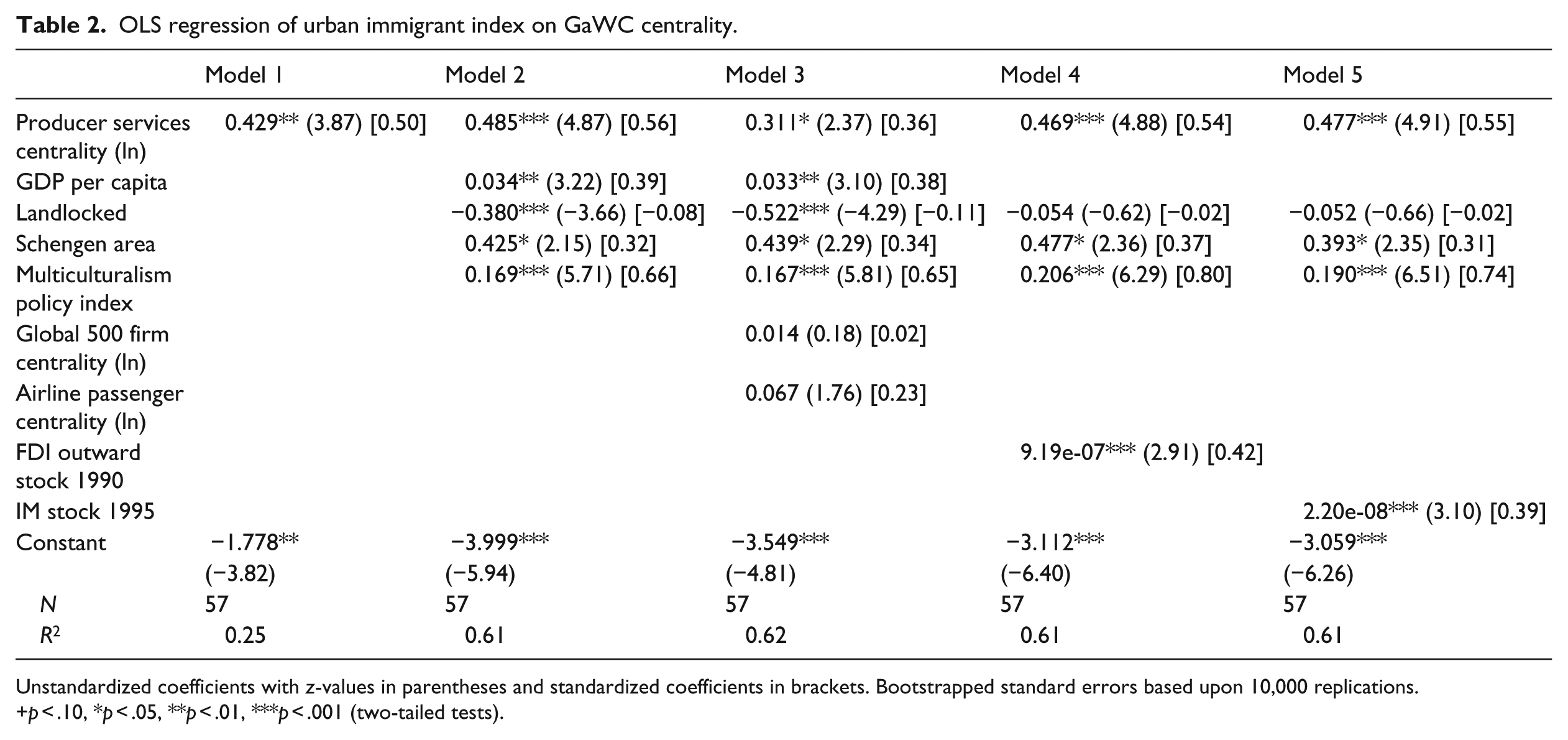
Unstandardized coefficients with z-values in parentheses and standardized coefficients in brackets. Bootstrapped standard errors based upon 10,000 replications.
p < .10, *p < .05, **p < .01, ***p < .001 (two-tailed tests).
OLS regression of percentage foreign born on GaWC centrality.
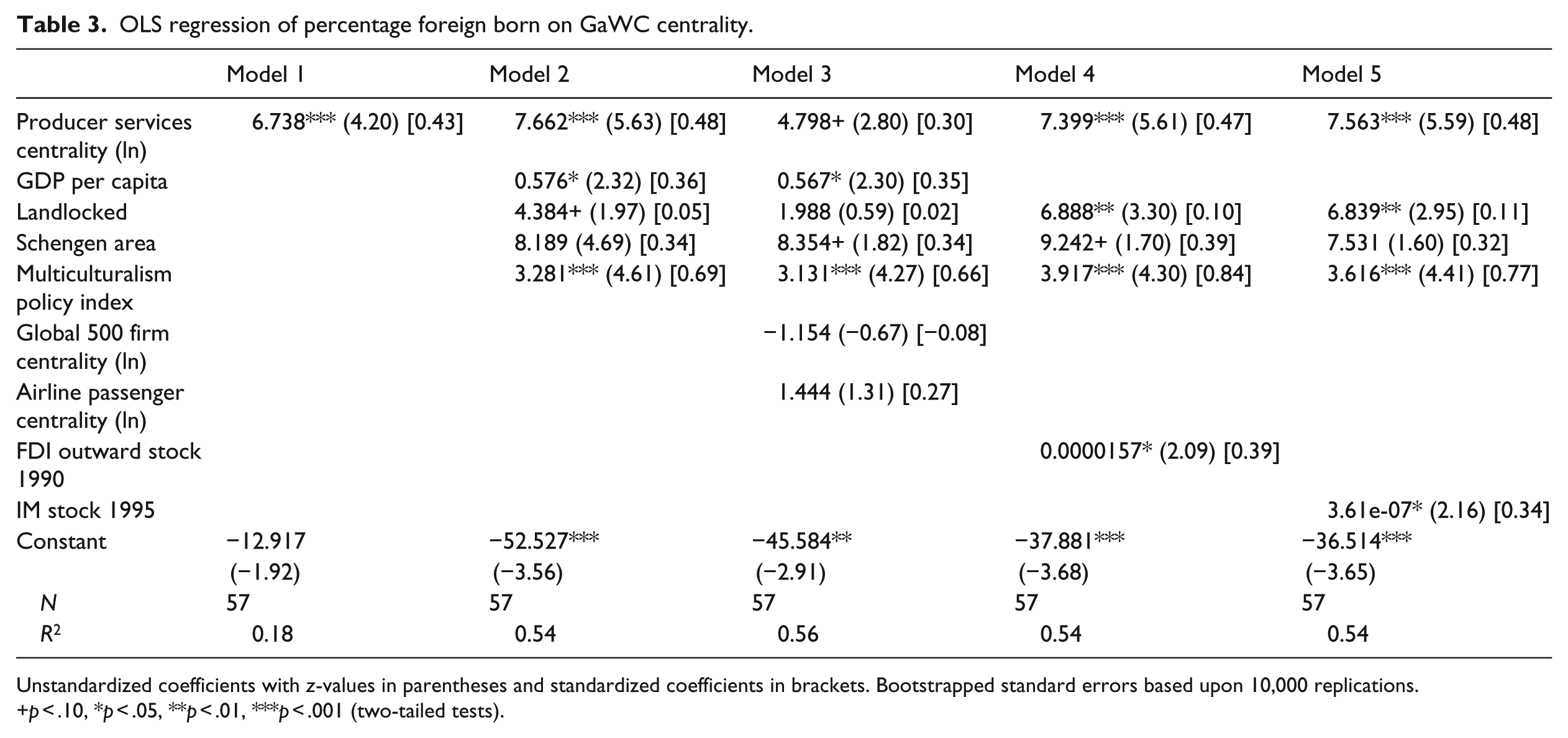
Unstandardized coefficients with z-values in parentheses and standardized coefficients in brackets. Bootstrapped standard errors based upon 10,000 replications.
p < .10, *p < .05, **p < .01, ***p < .001 (two-tailed tests).
OLS regression of total foreign born population (ln) on GaWC centrality.
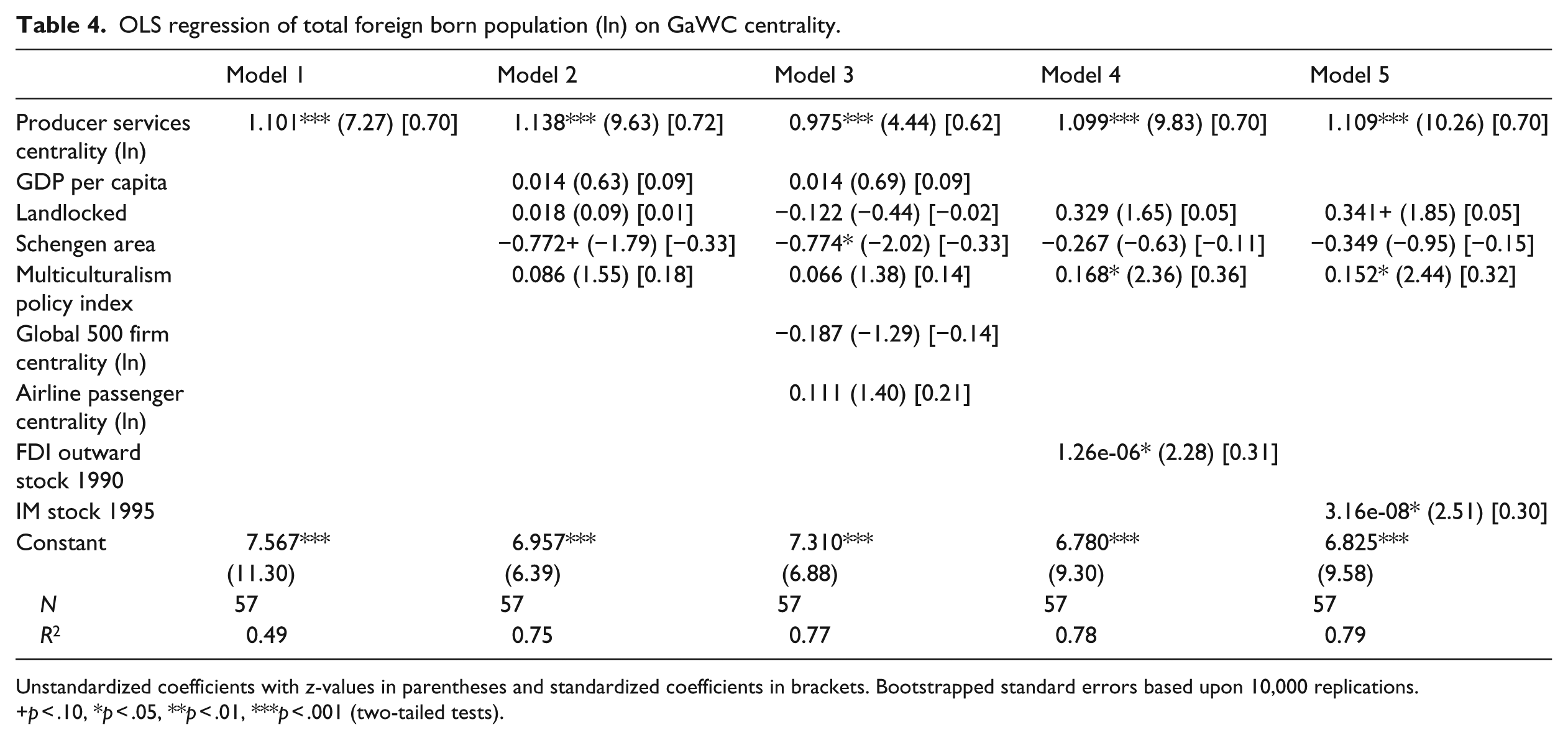
Unstandardized coefficients with z-values in parentheses and standardized coefficients in brackets. Bootstrapped standard errors based upon 10,000 replications.
p < .10, *p < .05, **p < .01, ***p < .001 (two-tailed tests).
Some other findings are noteworthy. Multicultural policies are important for understanding immigration in global cities. Indeed, the standardized coefficients indicate that national policies are the strongest explanation immigration into global cities. Cities in countries with stronger multicultural policies score higher on the Urban Immigrant Index and have higher percentages of foreign born in their populations. There is also some evidence that stronger multicultural policies are associated with larger foreign-born populations, but the coefficient for the multicultural policy index is significant only in two of the models. Overall, however, the findings suggest that national policies do matter for understanding immigration in global cities.
The two other structural explanations of migration also seem to play important roles. As hypothesized, FDI is positively associated with the Urban Immigrant Index, the percentage of foreign-born persons, and the total number of foreign-born persons in cities. Cities located in countries with larger outward stocks of FDI have higher levels of immigration. This is an especially interesting finding in light of prior research on the foreign investment–migration nexus, which only investigated the effects of inward foreign investment on the outflow of people from less-developed countries. To our knowledge, this analysis provides the first results that support the theory from the opposite perspective, that of host, or destination, countries. Past research finds that FDI stocks in less-developed countries are associated with higher levels of emigration from those countries. Here, however, the flip side of the relationship is evident: FDI stocks from wealthier countries are associated with higher levels of immigration into these countries in a ‘boomerang’ effect, just as hypothesized by the world cities literature (Sassen, 1988).
The findings also lend credence to the importance of immigrant networks and national incomes for immigration. As expected, both higher national average incomes and larger stocks of immigrants in the country are positively associated with the Urban Immigrant Index, although the coefficients for national income are not significant in the models of the total foreign-born population.
Discussion
Labor migration is a central component of the early, seminal treatises on world city formation and the world urban system (e.g. Friedmann, 1986; Friedmann and Wolff, 1982; Sassen, 1988, [1991] 2001). This body of work clearly argues that immigration provides a nearly inexhaustible supply of cheap, flexible labor that is crucial for capital accumulation centered in world cities and that immigration also produces the multicultural milieu that is distinctive to world cities. Over the past 30 years, however, migration was sidelined as a burgeoning world cities literature focused more intensively on empirically identifying and mapping the world urban system.
Benton-Short et al. (2005) made the initial empirical attempt to reinvigorate the study of migration in the world cities literature. Their Urban Immigrant Index provided the first empirical illustration of the world urban hierarchy using immigration as the criteria for ranking cities. In this article, we take an important step in the ongoing effort to bring migration back into the study of world cities. We move beyond descriptive rankings of the world urban hierarchy toward a statistical explanation of immigration based on global centrality. Our analysis provided strong evidence that centrality in the network of advanced producer services firms is closely associated with larger and more diverse immigrant populations. The relationship between the command and control functions of global cities and influxes of immigrant labor is central to Sassen’s theorizations about both global city formation and the social dynamics that characterize, and indeed set apart, these places in the urban hierarchy. Our analyses thus provide what we believe is the first systematic, empirical evidence supporting this relationship in a cross-city, international study. The results clearly demonstrate that world cities are not only key sites for corporate control of the world economy and for business and tourist flows, but they are also central in global flows of immigrant labor.
That the two other measures of global centrality – Global 500 firm centrality and airline passenger centrality – are not strong explanations of labor immigration in global cities does not necessarily suggest that they are not important for understanding migration patterns in the world urban system. Rather, our findings simply indicate that the GaWC measure is a much stronger and more consistent explanation of immigration. Theoretically, of course, the hypothesized links between global centrality and immigration are most clearly specified in the work of Sassen, and those building upon her core arguments, and our study lends further credence to these arguments.
There are two key limitations to the study. First, states’ entry policies affect the timing and magnitude of immigration flows, and thus the size and composition of the foreign-born population in world cities. Our models could not include a measure indicating immigrant entry policies because as of this writing, there is no cross-national, comparative measure. This is a key limitation, given the importance of immigration policy. Future studies should assess the impact of world city status net of immigration policies when measures of immigration policy become available. Second, and related to the first point, the immigration data we analyzed could not differentiate between high-skilled and low-skilled immigration. This, too, is an important limitation of the study, especially if global centrality has different effects on different types of immigrants. This issue merits future research pending the availability of migration data disaggregated by skill level across cities. Third, because our analysis is limited to the year 2000, it cannot address several interesting questions about the world city–migration nexus that occurred since the turn of the century, including among others the securitization of migration in a post-9/11 world and the effects of the Great Recession (post-2008). These are certainly questions worth pursuing if city-level migration data become available for more recent years. Our analysis provides, in this respect, an initial test of the world city-migration hypothesis, based at a particular point in time, which can serve as the basis for future longitudinal and comparative research.
The findings presented here can inform other future studies investigating two important questions: the tension in ‘the global’ and ‘the national’ binary as spaces within which globalization processes are produced (Sassen, 2006). We found that centrality in the city-level network of advanced producer services firms is a robust explanation of city-level immigration patterns, even after controlling for other key structural drivers measured at the national level, including FDI, immigrant networks, and national-level immigration policies. In this sense, our findings challenge the state-centric study of globalization by suggesting that ‘the global’ is produced, in large part, within ‘the national’, or within sub-national spaces (i.e. cities) connected to each other trans-nationally through corporate networks and labor flows. It is important to note, however, that our findings do not necessarily demonstrate that cities are de-linking, or becoming more autonomous, from their national contexts. A city’s position in networks of advanced producer services firms is indeed closely associated with the size and diversity of its immigrant population. But state-level policies also seem to be an important explanation of immigration at the city-level. Our study cannot resolve this debate, of course, but it does add nuance to more simple binary, or state-centric, discussions about the production and reproduction, of global processes and dynamics.
Footnotes
Appendix
Countries included in the analysis
| 1 | Melbourne | Australia |
| 2 | Brisbane | |
| 3 | Perth | |
| 4 | Sydney | |
| 5 | Vienna | Austria |
| 6 | Brussels | Belgium |
| 7 | Quebec City | Canada |
| 8 | Montreal | |
| 9 | Calgary | |
| 10 | Winnipeg | |
| 11 | Toronto | |
| 12 | Vancouver | |
| 13 | Ottawa | |
| 14 | Edmonton | |
| 15 | Zurich | Switzerland |
| 16 | Berlin | Germany |
| 17 | Cologne | |
| 18 | Hamburg | |
| 19 | Frankfurt | |
| 20 | Bonn | |
| 21 | Dusseldorf | |
| 22 | Munich | |
| 23 | Copenhagen | Denmark |
| 24 | Madrid | Spain |
| 25 | Barcelona | |
| 26 | Helsinki | Finland |
| 27 | Marseille | France |
| 28 | Lyon | |
| 29 | Paris | |
| 30 | London | United Kingdom |
| 31 | Manchester | |
| 32 | Athens | Greece |
| 33 | Milan | Italy |
| 34 | Naples | |
| 35 | Rome | |
| 36 | Genoa | |
| 37 | Tokyo | Japan |
| 38 | Osaka | |
| 39 | Amsterdam | Netherlands |
| 40 | Oslo | Norway |
| 41 | Lisbon | Portugal |
| 42 | Stockholm | Sweden |
| 43 | Detroit | USA |
| 44 | Portland | |
| 45 | Los Angeles | |
| 46 | Philadelphia | |
| 47 | Houston | |
| 48 | Minneapolis-St. Paul | |
| 49 | Seattle | |
| 50 | Atlanta | |
| 51 | Miami | |
| 52 | San Diego | |
| 53 | Chicago | |
| 54 | Washington, DC | |
| 55 | New York | |
| 56 | Boston | |
| 57 | San Francisco |
Declaration of Conflicting Interests
The author(s) declared no potential conflicts of interest with respect to the research, authorship, and/or publication of this article.
Funding
The author(s) received no financial support for the research, authorship, and/or publication of this article.