







Abstract
This article investigates how economic modernization affects normative regulation by spurring formal social control in the political, economic, and private spheres as well as anomie. Multilevel negative binomial regression modeling, using World Values Survey and country-level data from 2005, predicts individual-level anomie using country-level formal-social-control indicators as well as individual-level controls. Such control variables include education, survey interest, gender, age, income, collectivism, nihilism, fatalism, and the diversity of information consumption. This work argues for and implements a ‘don’t know anomie’ (DKA) index, the sum of ‘don’t know’ responses in relation to 15 attitudinal questions, as a more direct measure of individual-level anomie. Findings indicate that, when controlling for all factors, a country’s level of formal social control in the political sphere, measured as low levels of perceived government corruption, reduces anomie. In addition, country-level formal social control in the private sphere, operationalized as a society where individuals are not primarily striving to meet their parents’ expectations, enhances anomie.
Keywords
Introduction
Can the formalization of social control predict anomie? Anomie refers to uncertainty in social norms and social roles. For individuals, it signifies the lack of a frame to understand what happens and should happen in their society. Rapid social change may spur anomie and its consequences, such as crime and suicide (Durkheim, 1966; Galtung, 1996; Savelsberg, 2002). However, contemporary research does not appreciate how anomie intersects with changes in social control.
Social control – the means by which social norms influence people’s behavior – becomes more formal with modernization. People’s behavior becomes more governed by abstract codified rules, bureaucratic procedures, and the court systems and police power that ultimately back them up. In the meantime, they become less controlled by embeddedness in close interpersonal relationships (see Hirschi, 1969). This formalization occurs in different spheres, each with different outcomes in relation to anomie. I suggest that formal social control in the private sphere leads to anomie, but formal control in politics and economics partially counteracts this. This means that modernization undermines the normative salience of close face-to-face relationships as people come to devalue them and become more differentiated from one another. Yet new economic and political institutions may at least partially fill this gap through abstractly influencing individual behavior through rules and rationality rather than through moral convictions and emotions linked to intimate others.
As an example, contemporary Russia modernized to the extent that its private sphere became more formal; it is no longer a purely traditional society based on thick family ties. At the same time, its political and economic institutions have not yet formalized enough to become fully transparent, less nepotistic, and characterized by the rule of law. As a result, Russians should feel more uncertainty in relation to their society’s norms (i.e. anomie).
Using cross-sectional data, I show how country-level differences in formal social control in economics, politics, and the private sphere predict individual-level anomie, the dependent variable. In addition, I control for a number of individual-level variables’ impacts on anomie, to include the diversity of media consumption, values of collectivism, nihilism, and fatalism, as well as age, gender, survey interest, education, and income.
I proceed by describing the concepts of formality of social control and anomie and how they interrelate. The theoretical focus on anomie as individual uncertainty and disorientation is argued for in-depth. I then explain how anomie and social control intertwine during modernization and how this depends upon the sphere under observation. Next, the ‘Methods’ section describes the analysis strategy and operationalizations, including how anomie is measured through ‘don’t know’ (‘DK’) responses, which indicate the same uncertainty that underlies the anomie concept. Finally, I report findings based on multilevel negative binomial regression modeling and discuss them.
Theory
Introduction
Contemporary modernization literature neglects the crucial interaction between the formality of social control and anomie. I claim that how normative regulation is exerted on individuals explains whether they find social norms to be unclear. For example, in societies where the private sphere is formally socially controlled, people’s everyday behavior is abstractly influenced by codified laws rather than directly influenced through their close relationships. In such settings, people behave according to their own goals while being impacted by their diffuse connection to the law and other abstract media, but they are not heavily integrated by the transmission of norms via binding face-to-face interpersonal ties. As a result, they may feel more uncertainty in relation to societal norms.
Informal social control – which most effectively controls individual behavior – means that norms reach people through their close personal ties and people’s high valuations of them. In formal social control, norms are imparted through abstract and rational codified rules, laws, and the institutions and motives that back them up (Hirschi, 1969; see also Ellickson, 1991; Habermas, 1985). Social control is about how norms are imparted to individuals.
In contrast, anomie refers to uncertainty in moral standards both at the societal and individual levels. When norms are clear, individuals perceive a wide variety of them, which are high in specificity and cover diverse areas of social life, so that individuals know how they ‘should’ behave. In anomic contexts, individuals feel unsure.
Anomie as individual uncertainty about social norms
I define anomie as an individual-level uncertainty, lack of clarity, concerning social norms.
One can characterize the much discussed macro-level of anomie in very different ways. It may signify normative heterogeneity, norm clashes, or the low density of norms (i.e. approaching ‘normlessness’). Despite difficulties in pinning down the anomie concept (Bjarnason, 2009; Orrù, 1987: 136), especially on the macro-level, the individual-level manifestations of anomie are clear in their regulatory consequences: a person’s lack of certainty in relation to collective norms. 1 This lack ‘of anything to which one might conform’ constitutes a core thrust within anomie theory (Bjarnason, 2009; citing ‘exteriority’ in Durkheim, 1966; Hilbert, 1986; see also Hövermann et al., 2015: 217; Mcclosky and Schaar, 1965; Zhao and Cao, 2010: 1210–1211).
Durkheim (1996) himself describes how, in an anomic setting, where ‘all regulation is lacking for a time’, the ‘respective values are unknown’ that set the limits ‘between the possible and the impossible, what is just and what is unjust, legitimate claims and hopes and those which are immoderate’ (emphasis added, pp. 252–253). As ‘coercive’ traditional rules lose their authority, ‘not knowing’ is the result for individuals, one that clearly reveals the lack of this collective yoke among people ‘without adequate ethical guidance as to their conduct’ (Morrison, 2001: 10; Orrù, 1987: 106–107; Durkheim, 1966: 247, 252, 357). 2 The ‘Methods’ section below explains that individual uncertainty is the basis of my operationalization of anomie.
What causes anomie?
Modernization results in social control becoming more formal, based on abstract rational rules rather than personal ties. How this impacts individual-level anomie depends on the sphere of analysis. As Figure 1 illustrates, modernization results in formal social control in the private, economic, and political spheres of societies. The shifts in economics and politics should reduce individuals’ anomie (H2, H3), but formal social control in the private sphere should enhance anomie (H1).
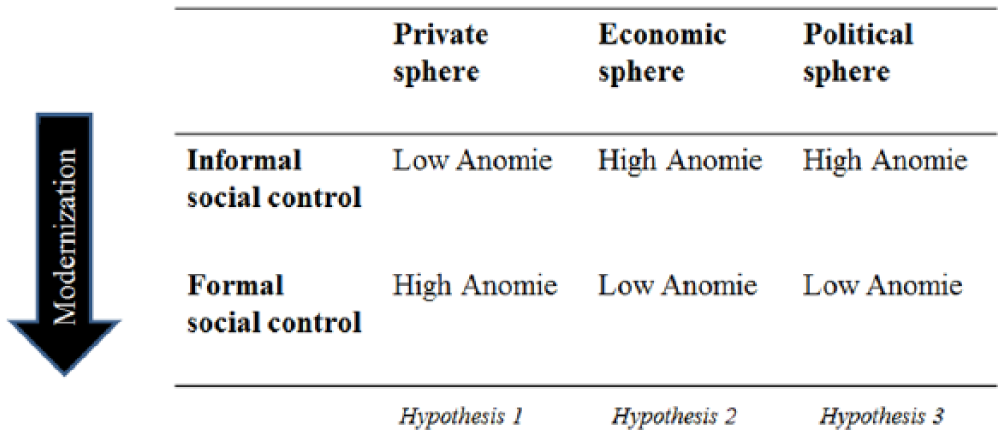
Conceptual model of anomie in relation to the formalization of social control in different spheres.
To briefly explain, modernization is both destructive and constructive in terms of norms, corresponding to the twin aspects of economic change and economic accumulation. Rapid economic change undermines previous forms of normative integration that are based on informal social control before new ones can arise (Durkheim, 1966: 254–255), but long-term accumulated economic development may lead to new, more formal, normative orders (Durkheim, 1966, 1997: 252). Modernization, therefore, connects to anomie through the mechanism of the formalization of social control. However, different societal spheres (see Aliyev, 2015; Savelsberg, 2002) have different anomie implications when they are formalized.
As the private sphere, in particular, becomes more formally controlled – as people’s daily behavior becomes less determined by their face-to-face bonds – the informal social control (Hirschi, 1969) that was rooted in such relationships weakens (Horwitz, 1990: 5, 7, 241; see also Bjarnason, 2009; Chriss, 2007: 110; Coleman, 1986; Durkheim, 1997; Hilbert, 1986; Tönnies, 1988). For this reason, I hypothesize that the macro-level formalization of the private sphere should be associated with enhanced individual-level anomie (Hypothesis 1).
The formalization of control in the economic sphere – as economic activity becomes governed more by laws and rational-formal institutions than by interpersonal ties – provides long-term optimism that new modern forms of solidarity (Durkheim, 1997) will take hold and stave off anomie. 3 Thus, I expect that the macro-level formalization of the economic sphere results in reduced individual-level anomie (Hypothesis 2).
Political formalization – as governments become characterized more by the rule of law, bureaucratic rationality, and transparency than by interpersonal ties and nepotism – should also stave off anomie. Norbert Elias (2000) links the growth of centralized state power to enhanced personal self-control and normative regulation covering proper and peaceful behavior in front of others (see also Hobbes, 1996). Moreover, political formality may reduce corruption and nepotism, with a resulting reduction in anomie in the population (Caiden and Caiden, 1977). Therefore, macro-level formalization of the political sphere should result in reduced individual-level anomie (Hypothesis 3).
Recent related work on anomie
Two articles recently used multilevel modeling to predict anomie. Zhao and Cao (2010) assessed the effects of democratic transition and individual socio-economic status on anomie in 30 countries using 1995 World Values Survey (‘WVS’) data. Another article by Hövermann et al. (2016) employed a 25-country analysis of the 2010 wave of the European Social Survey to predict anomie through the dominance of the economic sphere coupled with a ‘marketized mentality’ and enhanced individualism.
In terms of methods, my 45-country sample is larger and more diverse than these studies. Moreover, although they depict uncertainty as central to their anomie concepts (see also Hövermann et al., 2015: 222), they do not directly measure uncertainty. The Zhao and Cao operationalization involves possible anomie consequences (deviance justifiability), and Hövermann et al. use ‘marketized mentality’ as a proxy for anomie, although this is actually a correlate or potential cause of anomie.
Concerning theory, both Hövermann et al.’s ‘marketized mentality’ and my approach recognize the importance of economic change and individualism (see the ‘capitalist personality’ in Swader, 2013), as inspired by both Polanyi (2001) and Durkheim (1966: 255). In contrast, Zhao and Cao assume that post-socialist communist societies are anomic because of democratic transition, not economic change. Moreover, I suggest that Hövermann et al.’s (2016) ‘economic dominance’ leads to anomie because it undermines the informal social control under the spotlight within my study (see Note 3).
Relevant controls when predicting anomie
At the country level, in addition to economic growth and long-term economic accumulation, ‘country type’ should correlate with anomie because of its link to the formality of social control. Organisation for Economic Co-operation and Development (OECD) members should have the lowest levels of anomie because of their established formal institutions, while post-communist (‘PC’) societies should have the highest levels because of their recent ideological and structural collapses. Developing societies should have high anomie (although lower than PC countries), corresponding to the breakdown of informal social control without the compensation of strong formal political and economic institutions.
At the individual level, I control for age because older generations may be more out of touch with new norms amid rapid social change. Alternatively, younger generations may lack normative foundations because of the fluctuating nature of their society (supported by Zhao and Cao, 2010). In addition, females may be more anomic because they benefit less from the prevailing social order, but research shows women to be more law abiding, which may correspond to less anomie (supported by Zhao and Cao, 2010). In addition, high socioeconomic status should align with less anomie, because the economically powerful form the social order and directly benefit from it.
I control for three individual-level values because of their potential links to anomie. Collectivism, the inverse of individualism, indicates whether people are other-centered, focusing on goals and interdependence with their in-groups, particularly the family (Triandis, 2001). This concept implies a high degree of informal social control, because ties transmit norms, so collectivism should diminish anomie (see Swader, 2011).
Nihilism manifests a modern, ‘disenchanted’ (Weber, 1946) mind-set whereby an individual rejects overarching forms of meaning and morality (Crosby, 1988; Jahangiri and Ghareh, 2015; see also ‘disintegrative individualism’ in Messner et al., 2008: 174). Nihilistic people may be more anomic because they dismiss normative frameworks altogether and/or lack a normative grounding needed to compare and evaluate them.
I also consider whether an individual expresses fatalism, claiming an inability to influence one’s own life. A fatalistic person might reject or be desensitized toward normative structures because this person might, in any case, not expect to successfully steer his or her own life.
Access to information may also impact anomie. A person who consumes a wider diversity of media may better orient himself or herself toward or against prevailing norms, thereby reducing anomie. Alternatively, such information could overstimulate and confuse, thereby enhancing anomie.
As addressed in the section below, I control for survey interest and education level for methodological reasons.
Methods
I predict individual-level anomie while accounting for both macro-level formal social control and individual-level predictors. Data from the WVS 2005 wave (WVS Association, 2015) and other sources are analyzed through multilevel negative binomial regression models, with individuals nested within countries. Multilevel models allow for effects at different levels, take into account that individual anomie scores tend to cluster according to country differences, and allow for the simultaneous measurement of multiple country-level effects on anomie (Hövermann et al., 2016; Teymoori et al., 2016).
This section proceeds by introducing my operationalizations, followed by the sample, type of analysis, and modeling.
Operationalizations
Dependent variable: anomie
Despite the relevance of the concept also at the macro-level, anomie is most measurable as it emerges at the individual level in the form of ‘moral groundlessness’ and the ‘withdrawal of anything to conform to’ (Hilbert, 1986: 15). Although uncertainty in relation to societal norms lies at the theoretical core of the anomie concept at the individual level, common operationalizations do not reflect this.
Scholars employed four approaches for measuring anomie. The first uses indirect macro-indicators (e.g. Bjerregaard and Cochran, 2008). The second approach involves survey questions about the consequences of anomie or about general anti-social attitudes and behaviors (Hövermann et al., 2016; Huschka and Mau, 2005; Zhao and Cao, 2010: 1217). The third deals with the gap between ‘is’ and ‘ought’ in specific realms (Arts et al., 1995). The fourth approach looks at people’s perceptions of social disorder (Teymoori et al., 2016).
Of these, the first approach allows for the measurement of economic pressures, for example, but ignores important subjective aspects of anomie. The second captures human attitudes but confounds anomie with its consequences (see Teymoori et al., 2016) and correlates. The third provides an opportunity to study the gap between means and ends, but this approach aligns with Mertonian rather than Durkheimian anomie.
The fourth class of approaches comes only somewhat closer to a direct measure of Durkheimian anomie through asking individuals about their ‘sense’ (Mcclosky and Schaar, 1965: 14) or perception of social anomie, as found, for example, in Teymoori et al.’s (2016: 2) anomie as ‘a perception of the state of society’ or within Bjarnason’s (2009: 146) statements designed to measure exteriority (e.g. ‘It is difficult to trust anything because everything changes’). However, perceiving the society as disorganized or unregulated differs crucially from personally lacking a normative frame in relation to society (see also Hilbert, 1986: 17). Thus, a person’s perception of anomie in their society only indirectly measures anomie.
DK responses more directly measure individual-level anomie. 4 DK responses to opinion and attitudinal questions signify the individual uncertainty in relation to social norms that is central to individual-level anomie, and scholars have used them before to indicate uncertainty.
The core meaning of DK responses is uncertainty, although people answer ‘don’t know’ within surveys for various reasons. When respondents answer knowledge questions with DK, this may often signify ignorance of the correct answer (Sanchez and Morchio, 1992). For questions of an attitudinal or opinion nature, DK may indicate uncertainty, indecision, or ignorance (Sanchez and Morchio, 1992), but the dominant interpretation of DK answers is that they indicate actual uncertainty (Coombs and Coombs, 1976; Hawkins and Coney, 1981; Iannario et al., 2016; Manisera and Zuccolotto, 2014; Young, 2012).
Previous use of DK responses as individual uncertainty
There are precedents for interpreting DK responses as having a substantive empirical meaning related to uncertainty in respondents. As early as 1952, aggregate DK responses were used to indicate the underlying stability in a group’s responses to a set of questions: ‘A high percentage of don’t knows is a symptom of an ill-structured or undecided opinion. Ill-structured opinions will shift with time and its intervening stimuli more than well-structured opinions’ (Dodd and Svalastoga, 1952: 470). As such, DK responses show that the percentage who ‘don’t know’ at one given time point predicts the percentage of temporal change in the public’s opinion on an issue.
More recently, Converse (2006) interprets people’s uncertainty and confusion in answering political questions as the lack of a coherent belief system; this parallels my use of individual DK answers to indicate individual uncertainty in relation to the wider social normative structure. Similarly, Meulemann (2004) uses DK responses to two religious questions to indicate religious uncertainty, and Pearce-Morris et al. (2014) employ a substantive, uncertainty-related interpretation of DK responses on questions related to family experiences. Most recently, Manisera and colleagues systematically used DK responses as indicative of respondents’ ‘state of mind’ to supplement their interpretation of measurement scales and even argued that scholars should not treat DK responses as missing values (Manisera and Zuccolotto, 2016, see also 2014; Iannario et al., 2016).
I operationalize individual-level anomie as a 15-point ‘Don’t-Know Anomie’ (‘DKA’) index, the summed number of ‘don’t know’ and ‘no answer’ responses of a given individual to 15 questions across three spheres: politics, economics, and the private-sphere. 5 I distinguish DK answers from ‘not applicable’, ‘missing; unknown’, or ‘not asked in survey’ responses, which remain counted as missing data. DK answers are coded as ‘1’ while any concrete (non-missing) answer to these questions is coded with ‘0’. Equal weight is assigned to political, economic, and private-sphere DK responses in order to achieve a broad and balanced measure of anomie.
The following items were chosen because they represent more general attitudes, opinions toward these spheres and appear together in the same survey (variable names are in parentheses, WVS Association, 2015):
Political sphere
The government should take more responsibility to ensure that everyone is provided for (e037). On the whole, men make better political leaders than women do (d059). People sometimes talk about what the aims of this country should be for the next 10 years. Would you please say which one of these you, yourself, consider the most important? (e001). Which of these things is most important for this country? (e005). How important is it for you to live in a country that is governed democratically? (e235).
Economic sphere
Your views on whether wealth can grow so that there’s enough for everyone (e041). How much confidence do you have in major companies? (e069_13). Your views on whether incomes should be made more equal (e035). Your views on whether, in the long run, hard work usually brings a better life (e040). Your views on whether competition is good. ‘It stimulates people to work hard and develop new ideas’ (e039).
Private sphere
How important is family in your life? (a001). How important are friends in your life? (a002). How important is leisure time in your life? (a003). How much freedom of choice and control do you feel you have over the way your life turns out? (a173). Being a housewife is just as fulfilling as working for pay (a057).
I tested a variety of items and found that the choice of specific questions does not significantly impact the DKA index, so long as the questions are (a) diverse, tapping different areas of the given sphere; (b) primarily opinion/attitudinal; and (c) asked in all country samples. 6
This index is reliable: its items correlate strongly with one another, have a high internal consistency (Cronbach’s alpha is .797), and also emerge together underneath the same, main dimension in a factor analysis.
Validity of DKA
I use controls in order to account for other factors that may contribute to patterned DK responses. The education level of the respondent can partially account for the lack of understanding or other cognitive inability to answer questions. I also control for respondents’ interest in taking the survey in order to address a respondent’s wanting to avoid the work of answering (‘satisficing’, see Krosnick et al., 2002) or lack of interest.
The DKA index’s correspondence to theoretical expectations regarding anomie demonstrates its validity. Successful predictions of DKA in ways that make theoretical sense would be extraordinarily unlikely to be reached by chance if the index were invalid. 7
Country-level independent variables. 8
At the country level, I operationalize formal social control across three spheres, which indicates the extent to which that sphere is governed more by rational codified rules than interpersonal ties. I measure economic formality using the inverse of the size of a country’s shadow economy according to the World Bank (Schneider et al., 2010), averaged between 2001 and 2005. A society with a small shadow economy has an economic sector largely within the bounds of modern bureaucratic-rational control and hence ‘formal’, rather than being primarily steered by personal relationships and loyalties. An economically formal society is one where most economic activity is taxed and controlled by legal and regulatory structures, rather than occurring ‘under the table’.
‘Political formality’ is measured by the inverse of a society’s perceived government corruption in 2005 (Transparency International, 2005). 9 A low level of corruption signifies a formal political system controlled more by modern bureaucratic state ideals and the rule of law than by close interpersonal relationships. In contrast, ‘politically informal’ authoritarian states are often ruled via charismatic principles, with under-developed institutions, nepotistic power circles, and transfers of power based on selection of trusted elites based on personal ties.
Formality of private-sphere control is operationalized as the inverse of a society’s average of a 2005 WVS item inquiring whether, for respondents, ‘one of my main goals in life has been to make my parents proud’ (used in this way in Swader, 2011: 72–73). When many members of a society answer negatively to this question, this indicates ‘private-sphere formality’, equivalent to both diminished informal social control and individualist values, whereby people are more oriented on their own goals than in fulfilling the expectations of family. Societies with private spheres that are more formally socially controlled have populations that are more independent, creative, and tend to steer their own life-paths, in contrast to being locked into ascribed status and thick family ties that determine their behavior (Beck and Beck-Gernsheim, 2001).
I operationalize accumulated economic development as a country’s average gross domestic product (GDP) per capita between 2001 and 2005, 10 and economic growth as the average country GDP yearly growth rate between 2001 and 2005 (The World Bank, 2016).
‘Country type’ classifies societies as OECD, PC, or developing. ‘Developing’ societies involve a wide spectrum of levels of development, but they differ from OECD societies in terms of economic development and from PC societies in terms of the latters’ recent systemic transformations and ideological-normative collapses.
Individual-level independent variables. 11
Education is measured through the variable ‘Highest education level attained’. I measure survey interest as the interviewer’s assessment of the respondent’s interest in the survey.
Empirically, the data reveal a linear age effect; anomie rises steadily with each older cohort. Therefore, I control for age as a simple continuous variable. For gender, I use a respondent’s self-reported binary sex. Socioeconomic status is tapped using income rather than social class because of income’s stronger empirical link to anomie and greater comparability (as deciles) across cultures.
Collectivism is measured according to whether individuals strive to make their parents proud, which also constitutes an individual-level measure of informal social control (Swader, 2011). Nihilism is operationalized through the proxy of individuals rarely or never thinking about the ‘meaning of life’. Although thinking about the meaning of life and believing that life has meaning are different things, the two overlap enough for the first to serve as a proxy for the second. In particular, this proxy can represent the ‘amoralist’ and ‘moral subjectivist’ varieties of moral nihilism (Jahangiri and Ghareh, 2015: 19, citing Crosby, 1988). 12 Fatalism is indicated by the extent to which a person answers little to ‘no choice’ to the question, ‘how much freedom of choice and control you feel you have over the way your life turns out?’ Fatalism here is the inverse of a feeling of agency.
‘Information multiplicity’ is measured with a 0 to 7 index, whereby 7 indicates that an individual used each of the following as information sources in the past week: daily newspaper, radio or TV news broadcasts, printed magazines, in-depth radio or TV news reports, books, the Internet, or talking with friends or colleagues. While this index cannot capture the quality of consumed information, it assesses the diversity of sources. In the case where someone takes in diverse information from a single source, this results in the index being biased downward. A higher number on the index will always represent more diverse information consumption.
Sample
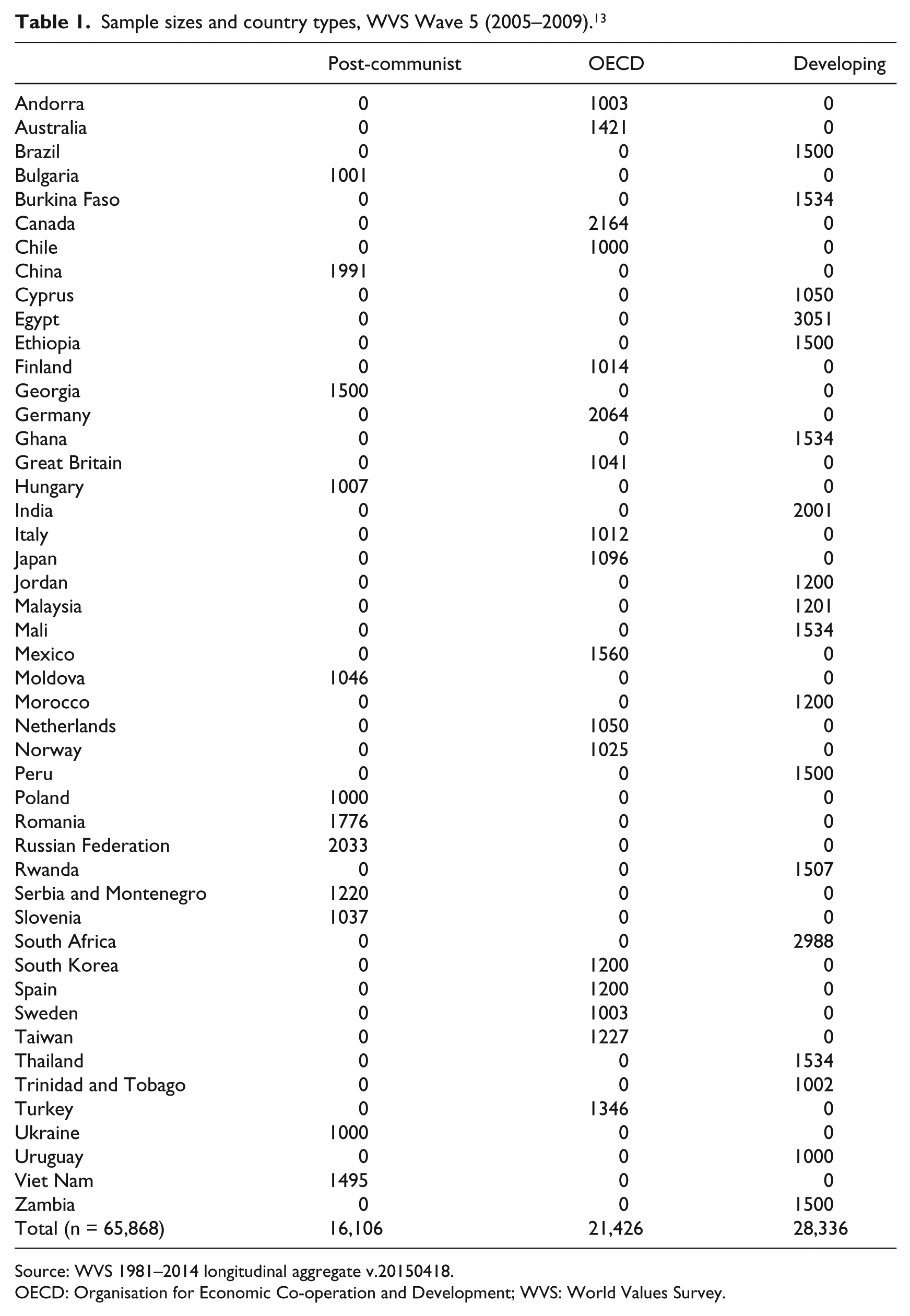
The latest wave 6 (2010–2014) of the WVS was unsuitable for this study because many countries lack some of the DKA index items and other variables used here. Wave 5 (2005–2009) includes a much wider body of countries with the full array of diverse questions for the DKA index. I display the 47 countries represented in the total sample, their sample sizes, and country-types in Table 1. Country-level economic data (taken as an average of 2001 to 2005) temporally match this WVS 2005 sample.
Sample sizes and country types, WVS Wave 5 (2005–2009). 13
Source: WVS 1981–2014 longitudinal aggregate v.20150418.
OECD: Organisation for Economic Co-operation and Development; WVS: World Values Survey.
Analysis
Bivariate analyses first provide simple baseline macro- and individual-level correlations for the more complex analysis. I then address the three hypotheses using multilevel regression modeling.
Within the regressions, the dependent variable DKA has an abnormal distribution with many zeroes, which is typical of rare events and deviant behavior (see Figure 2). In such a case, either Poisson or negative binomial regression could be appropriate, but I rule out Poisson regression because of DKA’s over-dispersion (its variance is much higher than its mean). In addition, the fact that anomie events are not seen as independent from one another makes negative binomial analysis the better choice. I conducted the multilevel analysis using MLwiN (2.32) software. The main dispersion parameter, alpha, is significantly greater than zero, indicating that the negative binomial is the correct type of model to use. I tested an additional over-dispersion parameter, but this did not yield a superior model.
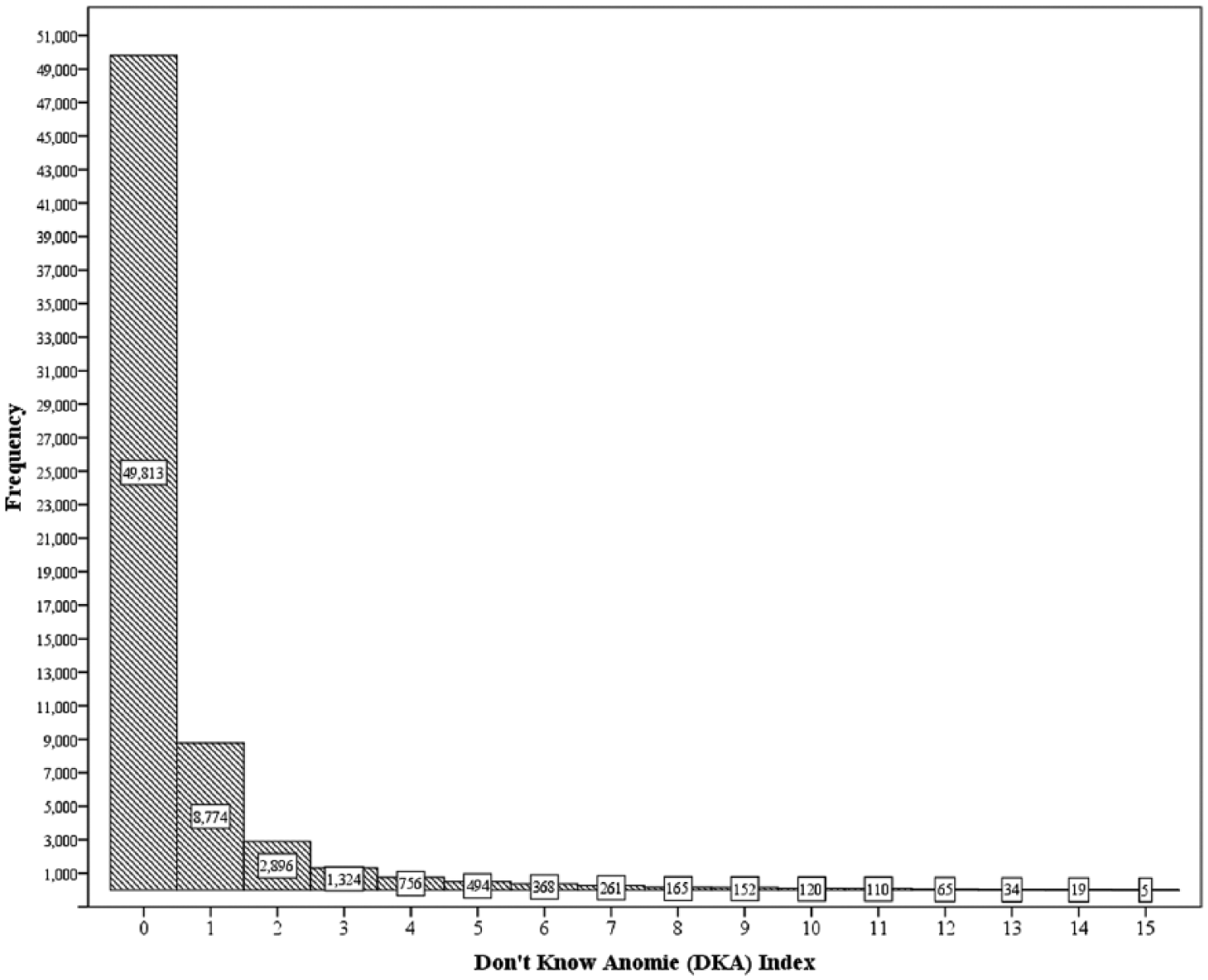
Distribution of ‘don’t know anomie’ (DKA) index.
Comparing the fit of various model specifications and the robustness of independent variable effects is tricky within multilevel negative binomial regression. MLwiN cannot generate log-likelihood results for such models, and Wald Tests are inappropriate for comparing un-nested models. Instead, I use a form of bootstrapping. While rotating out a wide range of country-level effects with one another, I observe the stability of the remaining indicators in these varying conditions.
I report on three main model stages. Model 1 involves only individual-level indicators, namely, information multiplicity, age, gender, income, survey disinterest, education, as well as the values of collectivism, nihilism, and fatalism. Model 2 examines country-level economic, political, and private-sphere formality in addition to individual-level indicators.
I arrive at Model 3 as a result of testing all possible combinations of country-level variables (the three formality indicators, country-types, and GDP per capita and GDP growth) and observing the stabilities of coefficients. 14 Model 3 thereby includes the two most stable and theoretically useful country-level effects: political and private-sphere formality.
Results
Descriptive statistics
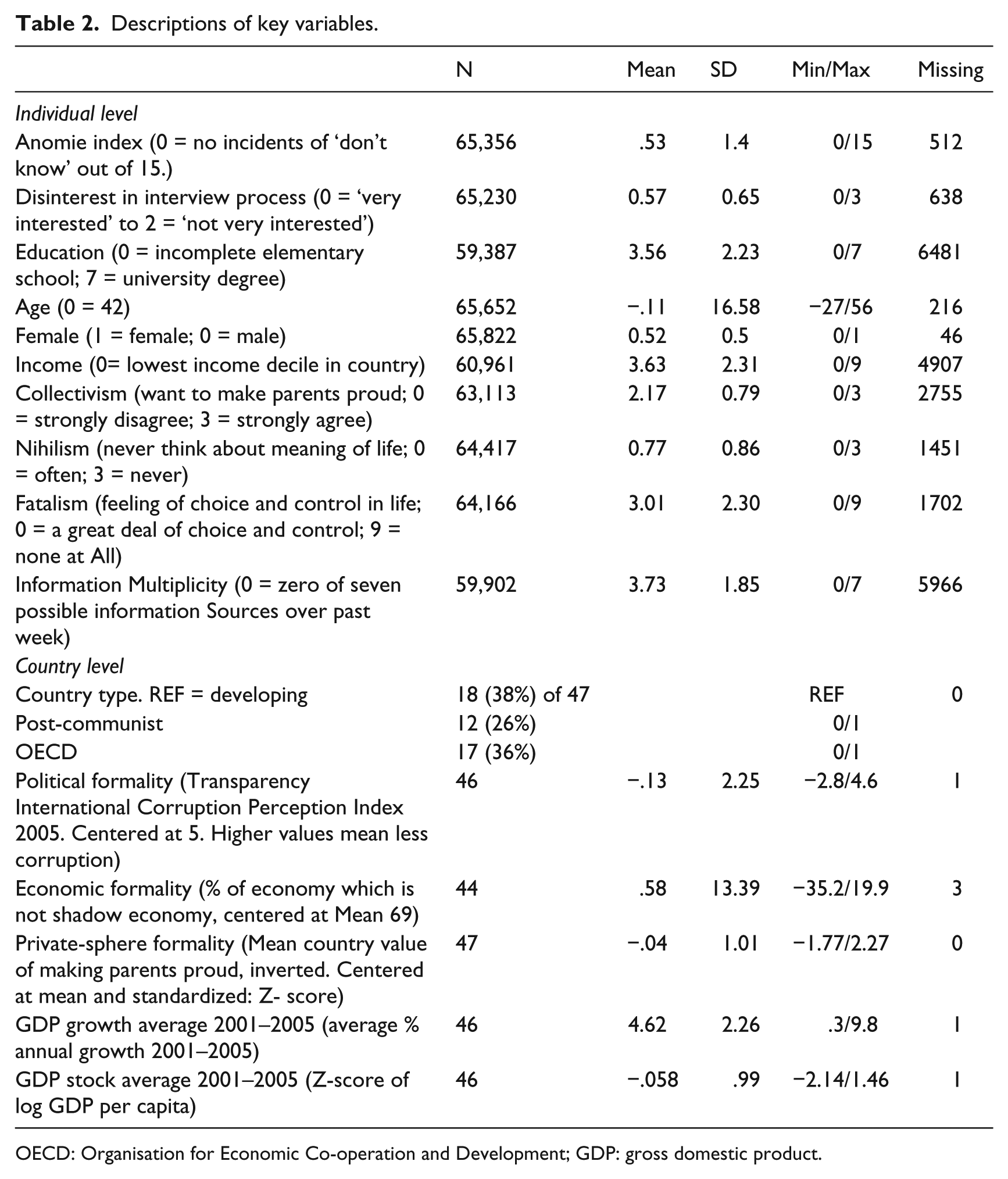
Table 2 presents all variables used in this article, including their centering, key value labels, means, standard deviations, observed ranges, and, if categorical, frequencies.
Descriptions of key variables.
OECD: Organisation for Economic Co-operation and Development; GDP: gross domestic product.
Bivariate analysis
Individual-level variable correlations with the DKA index provide a baseline for how the variable relationships develop as the analysis becomes multivariate and multilevel. The strongest associations, only moderate in strength, are that higher anomie correlates somewhat with lower information multiplicity (–.24; each correlation coefficient listed here is statistically significant), low income (–.14), survey disinterest (.16), nihilism (.13), low education (–.11), older age (.10), fatalism (.09), female gender (.06), and low collectivism (–.02).
Country-level bivariate analysis offers initial clues on the macro-level. To begin, in harmony with modernization literature, modernization indicators correlate strongly with one another. For instance, there are strong correlations between GDP growth and GDP per capita (–.66), country type and GDP growth and GDP per capita (coefficient magnitudes between .20 to .75), political formality and low GDP growth (–.69) and high GDP per capita (.88), GDP per capita and economic formality (.59), and political formality and economic formality (.67).
However, I emphasize two findings: the correlation between political and economic formality with private-sphere formality, and the connection between economic modernization and anomie. First, I find a strong bivariate link between GDP per capita and private-sphere formality (coefficient .73) (see Figure 3) on par with GDP per capita’s correlation with economic and political formality. Also, the three types of country-level formality directly correlate with one another: private-sphere formality correlates with political formality (.67) and economic formality (.46). In other words, cumulative economic modernization ties in with not only the formalization of government rule and the economy but also strongly with the formalization of control of the private-sphere, so that individuals are less influenced by their intimate ties.
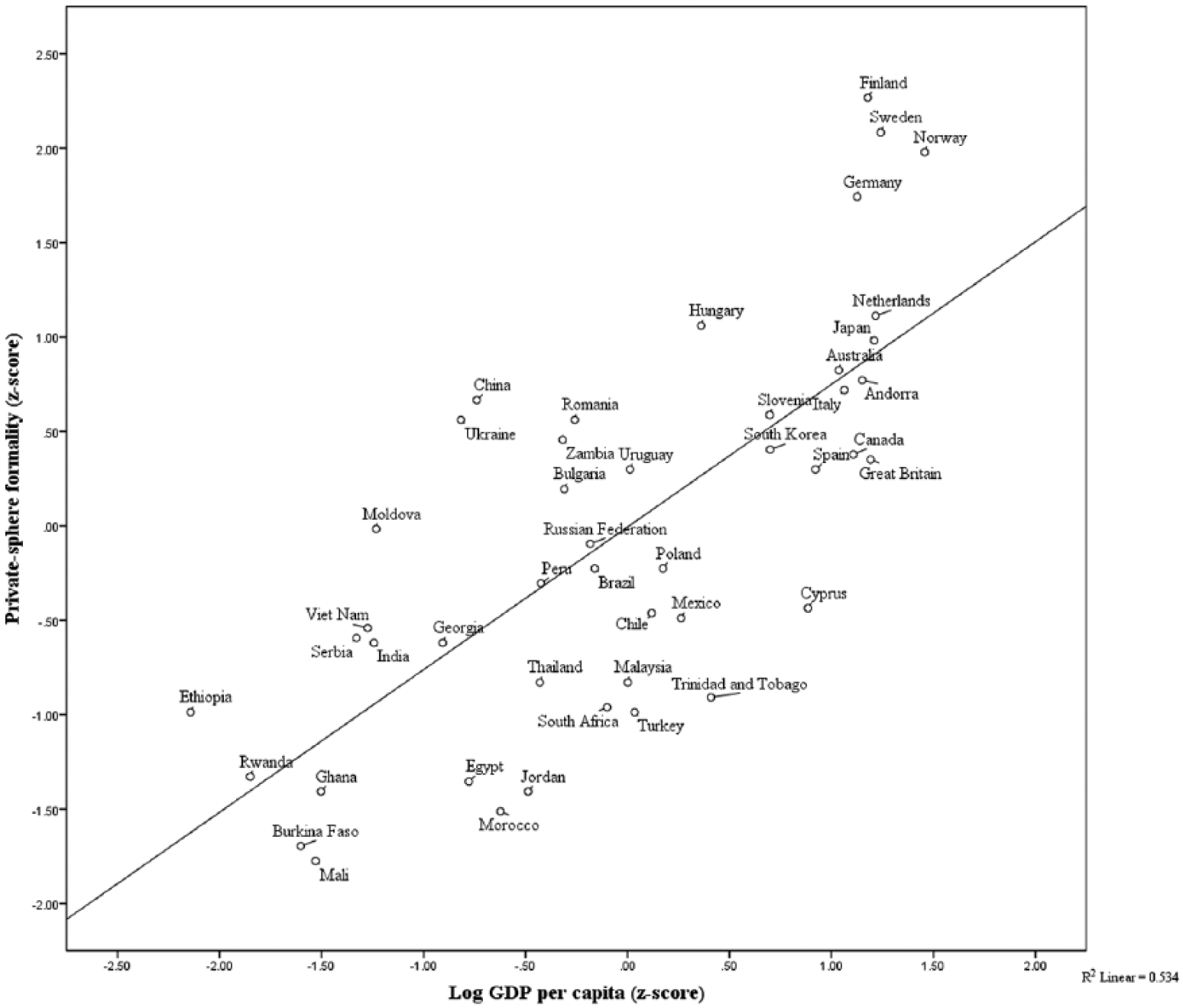
Private-sphere formality by log GDP per capita.
In terms of anomie, the country-level anomie average correlates moderately with high GDP growth (coefficient .32) as well as with post-communism (.31) but not with either GDP per capita or with country-level formal social control in any sphere. The bivariate analysis suggests that the process of becoming modern, represented by GDP growth, may spur anomie, even though stable modern societies with high GDP per capita and formal institutions do not have significantly lower average levels of anomie. However, adjusting the analysis in the next section so that it is multilevel and predicting individual-level anomie reveals a more precise finding. Formalization of the society’s private-sphere so that individuals are less controlled by parental expectations increases individuals’ anomie, while political formalization – measured as the reduction of government corruption – reduces it.
Multivariate analysis
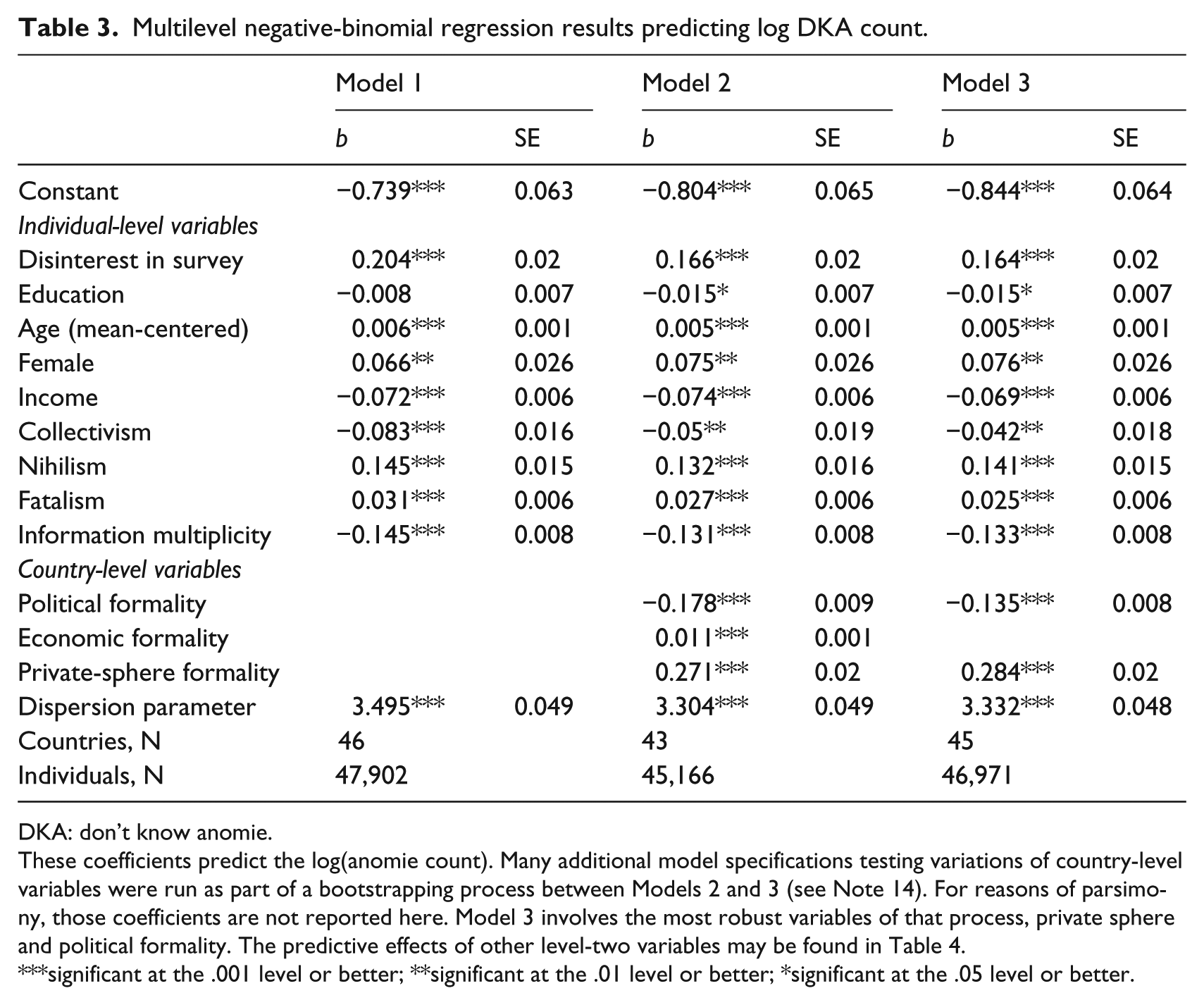
A multilevel regression analysis addresses this study’s three hypotheses. This section describes the modeling progression as well as results for the main Model 3 (see Table 3).
Multilevel negative-binomial regression results predicting log DKA count.
DKA: don’t know anomie.
These coefficients predict the log(anomie count). Many additional model specifications testing variations of country-level variables were run as part of a bootstrapping process between Models 2 and 3 (see Note 14). For reasons of parsimony, those coefficients are not reported here. Model 3 involves the most robust variables of that process, private sphere and political formality. The predictive effects of other level-two variables may be found in Table 4.
significant at the .001 level or better; **significant at the .01 level or better; *significant at the .05 level or better.
Model 1 (see Table 3) illustrates the effects of individual-level information resources, values, and socio-demographic controls on anomie. Model 2 (see Table 3) introduces the three indicators for country-level political, economic, and private-sphere formality. Thereafter, I check for robustness by swapping out the country-level formality variables with one another and also with GDP per capita, GDP growth, and country types to be sure of the advantage of accounting for formality indicators. The economic formality effect – measured as a having a small shadow economy proportion – disappears entirely when not paired with the others, and its effect size 15 is the smallest of the three formality indicators. I therefore remove it, assessing a lack of robust support for Hypothesis 2. Moreover, the effects of private sphere and political formality appear to magnify one another especially in combination and also remain strong when separately measured. Private-sphere formality’s impact, living in a society where people are less driven by parental expectations, is particularly strong and robust. It is stable alone, in combination with either of the country-level economic variables, and with political formality. The same can be said of political formality – represented as societies with low perceived government corruption – albeit with a smaller effect size.
The final Model 3 (see Table 3) therefore combines individual traits with country-level political and private-sphere formality. 16 When taking all relevant factors into account, this model shows the control variable of survey disinterest at the individual level to be significant and of moderate power for predicting the dependent variable. This is expected, as I control for this as an alternative cause for DK responses. However, education only reduces anomie by a very small margin. Females still have higher anomie, although the effect size is small. Higher income and younger age correlate moderately with less anomie. In terms of values, personal collectivism, when individuals strive to make their parents’ proud, decreases anomie by a small amount. Moreover, nihilists who think less about the meaning of life and fatalists who express the inability to steer their own life both have moderately enhanced anomie. In addition, consumption of a wide variety of information sources remains a strong predictor of diminished anomie. Most importantly, Model 3 confirms that societal private-sphere formality correlates strongly with more anomie, while political formality reduces anomie (Hypotheses 1 and 3 are supported). In terms of measures, this means that living in an individualist society where people’s behavior is driven less by a desire to please their parents enhances anomie, while low perceived government corruption reduces it. I also examined a number of country-level interactions, but these did not explain more than this model.
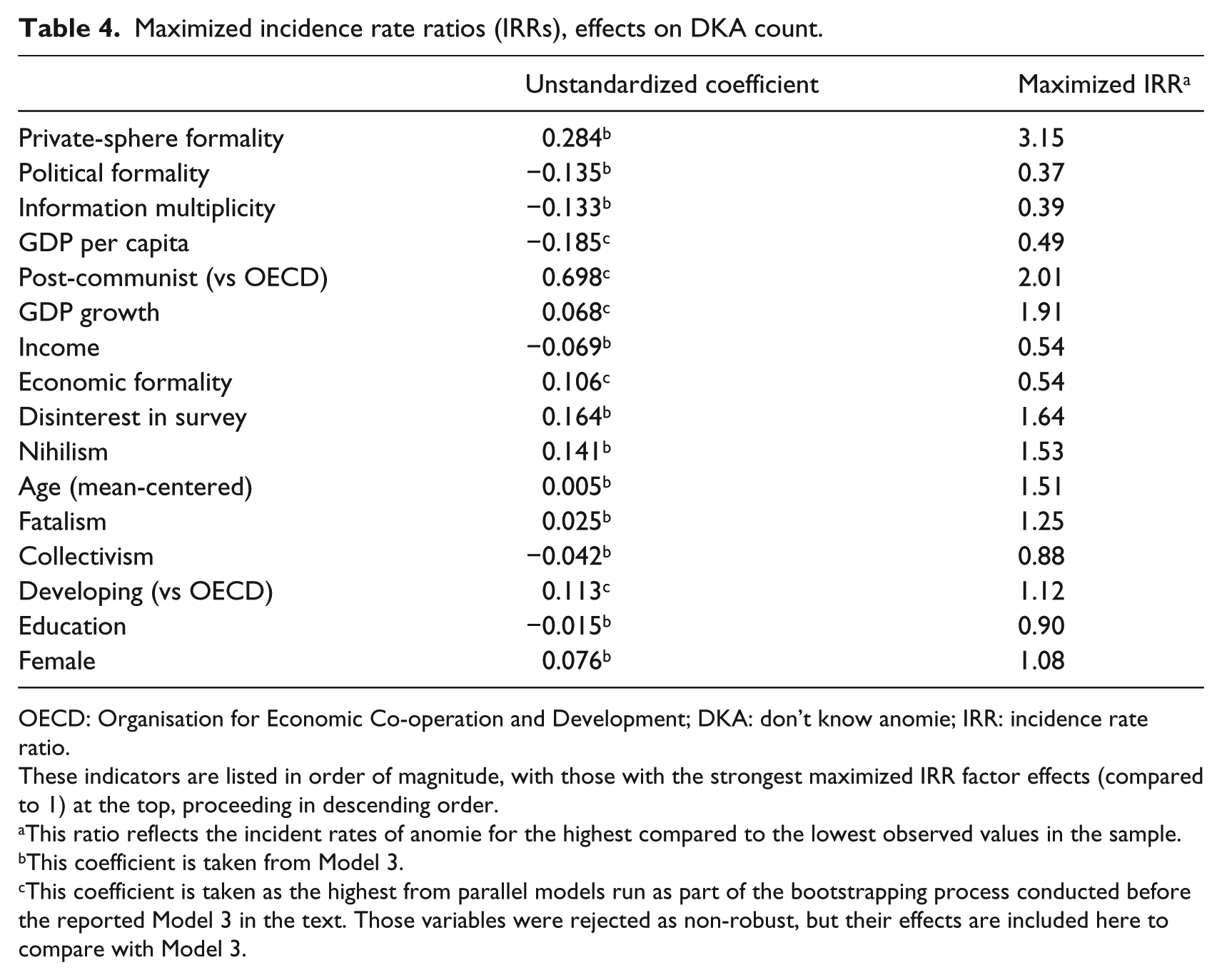
These results can be seen most vividly by examining the maximum impact of each independent variable upon anomie rates. Table 4 illustrates the maximized incidence rate ratio (‘IRR’) for anomie for each independent variable. This ratio compares the predicted anomie counts of the variable’s highest compared to lowest observed values while holding all other factors constant. These ratios can be directly compared and indicate each variable’s maximum possible effect strength. As an illustration, the maximized IRR of private-sphere formality represents the ratio of anomie incidents for someone from the society with the most formal (Finland) compared with the least formal (Mali) private sphere in the sample, while holding all other variables constant. In this case, the model predicts Finns, living in the society with the lowest average importance of fulfilling one’s parents’ expectations, to experience 3.15 times higher rates of anomie compared to respondents from Mali when accounting for this variable on its own while holding other factors constant.
Maximized incidence rate ratios (IRRs), effects on DKA count.
OECD: Organisation for Economic Co-operation and Development; DKA: don’t know anomie; IRR: incidence rate ratio.
These indicators are listed in order of magnitude, with those with the strongest maximized IRR factor effects (compared to 1) at the top, proceeding in descending order.
This ratio reflects the incident rates of anomie for the highest compared to the lowest observed values in the sample.
This coefficient is taken from Model 3.
This coefficient is taken as the highest from parallel models run as part of the bootstrapping process conducted before the reported Model 3 in the text. Those variables were rejected as non-robust, but their effects are included here to compare with Model 3.
These results reveal a country’s private-sphere formality as having the highest degree of relative strength, followed by political formality, information multiplicity, GDP per capita, PC, GDP growth, income, and remaining variables. These data demonstrate the importance of country-level effects over individual effects and highlight that the formality variables predict more than country types, GDP growth, or GDP per capita.
Discussion
The medium of social control in societies – whether or not various social spheres are primarily governed by informal relationships or by formal, codified rules – can predict whether individuals exhibit uncertainty in relation to social norms, defined as anomie. First, this study’s bivariate analysis suggests that accumulated economic modernization, measured by GDP per capita, does not directly impact anomie but rather does so through the mechanism of formal social control. Multilevel negative binomial regression findings strongly reinforce this suggestion, showing that formal social control in the private sphere – the extent to which a society’s members steer their lives independently rather than trying to fulfill parental expectations – robustly equates with enhanced individual-level anomie (Hypothesis 1 supported), while formal social control in politics, measured as societies with low government corruption, correlates with reduced anomie (Hypothesis 3 supported). I find no significant effects from formal social control in the economic sphere upon anomie (Hypothesis 2 not supported), when economic formality is measured as a society’s small proportion of shadow economy.
That modernization intertwines with both economic and political formal social control is not a surprise. However, it also spurs formal social control in the private sphere, individualizing people so that they are less influenced by their intimate relationships. The political and private-sphere effects in tandem lead to ambivalent results for anomie. Informal social control in the private sphere erodes as a more individualized population devalues the thick, dependent relationships that mediate it. However, the establishment of a rational, transparent, and democratic political system may partially counter-balance this trend. This may occur because political formalization reduces nepotism and cronyism, leading to more stable and rationally governed states, which results in more enduring and transparent social norms.
These findings echo the importance of primary face-to-face ties, and the normative dependency attached to them, among theorists such as Tönnies (1988; see also Galtung, 1996). Yet the fact that modern institutions have some possibility to offset diminished informal social control parallels Durkheim’s (1997) more optimistic account, although the cousin to his organic solidarity for which I find evidence is political rather than economic in nature (see assumption by Zhao and Cao, 2010). This finding complements a Habermasian picture in which the colonization of the lifeworld may undermine normative integration, but where also the formalization of politics, when this embodies the emergence of a discursive and transparent public sphere, can provide a form of normative stability (Habermas, 1985, 1992)
My explanation for anomie is more theoretically useful and empirically supported than alternative factors, whether involving country-types, GDP growth, or GDP per capita. The political and private-sphere social-control formalizations in focus here explain why country types and economic modernization predict anomie in the first place.
Personal characteristics also predict anomie. Especially a high diversity of consumed media, high income, a lack of nihilism, younger age, 17 and low fatalism correlate with less anomie when controlling for all factors. However, the degree of formal social control in one’s society’s political and private spheres matters more.
Limitations
Methodologically, this article demonstrates the efficacy of using a ‘DKA’ index to measure anomie. The DKA index measures anomie more directly than either anomie perceptions or anomie correlates and consequences. Nonetheless, the inability to answer a question may also reflect a lack of linguistic, cultural, or educational understanding beyond uncertainty toward a normative interpretive framework. There is a need to employ controls (e.g. survey interest and education) when using such data, and DKA should be validated through matching it to theoretically connected causes and effects. In other words, DKA should ‘make sense’. These results attest that DKA patterns in theoretically meaningful and interpretable ways.
Future data collection efforts should take care to distinguish between types of missing data (e.g. refusals to answer vs ‘don’t know’ responses) and systematically consider these as potentially useful for exploring a variety of questions. One fruitful direction for anomie research would be to explore the relationship between DKA and societal rates of suicide and crime, as well as individual deviance propensities.
Furthermore, theory suggests a time lag whereby modernization triggers a private-sphere normative breakdown before formal social control in politics emerges to compensate for it. Yet, the cross-sectional data at hand cannot confirm causal relationships or the temporality of such arguments. Longitudinal individual-level data could provide more solid evidence for the time-lag and whether macro-level shifts in the formality of social control indeed resulted in enhanced anomie among concrete individuals.
This work sheds only limited light, empirically and theoretically, on anomie at the macro-level. By focusing on individual-level anomie as uncertainty, I cut to the core of the issue for individuals. Questions about the nature of macro-level anomie beyond its link to modernization and the formalization of social control are unresolved. Still unclear is whether macro-level anomie is characterized by normlessness, normative heterogeneity, normative clashes, or some combination of these.
This contribution takes needed theoretical, methodological, and empirical steps in formulating the complex relationship between modernization and multiple dimensions of normative regulation, to include both how norms are communicated and also their perceived clarity, a particularly important area of research both for rapidly changing and modern societies. Researching other aspects of normative regulation in relation to modernization, such as compliance to and the enforcement/reinforcement of norms, would require separate analytical steps, but these would be fully worthwhile.
Footnotes
Acknowledgements
I thank Pavel Gladkov, Ekaterina Lytkina, and Sofia Rukhin for their assistance in country-level data gathering. Comments from Alexey Bessudnov, Vadim Radaev, Eduard Ponarin, Christian Welzel, Ronald Inglehart, and Andreas Hövermann were particularly helpful for the development of the manuscript. Leon Kosals made important early contributions to the project, including the suggestion that ‘don’t know’ responses may measure anomie. Anonymous reviewers and the journal editor provided substantial feedback to aid the development of this article.
Funding
The author(s) disclosed receipt of the following financial support for the research, authorship, and/or publication of this article: Earliest stages of this work were supported by the Laboratory for Comparative Social Research of the National Research University – Higher School of Economics (Russian Government Grant No. 11.G34.31.0024 from 28 November 2010).