







Abstract
Existing research on transnationalization of labor documents split labor markets between less-skilled (im)migrant workers and native workers in the host countries. But there is little research on how labor relations take shape when relatively skilled workers migrate from more developed countries to work temporarily in less-developed countries in the Global South. Based on ethnographic research on a Chinese state-sponsored construction project in Ecuador, this article explicates an understudied case. Although the temporary migrant Chinese workers come from a more developed country and hold higher status jobs, they are compensated at a lower rate and have fewer labor rights compared to their lower status Ecuadorian counterparts. By comparatively examining workers’ everyday interactions and boundary-making practices, this study develops a twofold argument. First, the development strategies and political interests of the home and host states interact to shape divergent recruitment processes and labor policies, which gives rise to disparate working conditions and labor rights between migrant and native workers. Second, the foreign migrant and native workers cope with labor disparities by invoking national stereotypes to draw social boundaries, which exacerbates their labor market splits. This analysis has theoretical implications for understanding labor relations under transnational state capitalism, workers’ strategies against labor control, and the future of labor solidarity in the Global South.
Keywords
In this era of rapid globalization, capitalist accumulation increasingly relies on temporary migrant workers as a source of flexible and cheap labor (Munck et al., 2011). The movement of these workers across national borders influences labor relations in both the migrant-sending and -receiving countries. Scholarship made strides in examining how working-class migrants from underdeveloped to more developed nations impact the labor market of the receiving country. Research identifies that racial and linguistic differences (Ribas, 2016), inequalities in socioeconomic capital (Hall and Farkas, 2008), and migrants’ home country characteristics (Ewers et al., 2021) tend to map onto their labor market experiences. Consequently, (im)migrant workers in the host countries often suffer from lower statuses and barriers to job mobility while enduring worse working conditions than their native coworkers. By contrast, there is little research on how labor relations take shape when relatively skilled workers migrate from more developed countries to work temporarily in less-developed countries in the Global South.
This type of transnational migrant labor is perhaps nowhere more prominent than that accompanying China’s growing state-sponsored foreign investments and infrastructural projects, especially since its adoption of the “going out” economic policy in 2002. These foreign direct investments (FDI) and overseas projects prompted a sharp increase in the number of temporary workers dispatched to staff overseas projects in Africa, Asia, and Latin America (Zhang, 2019). In 2013, China’s government launched the “Belt and Road Initiative” and expanded overseas infrastructural investments to better access resources in the Global South and to serve its developmental needs. Chinese FDI, infrastructure projects, and temporary labor migration witnessed the fastest growth in Latin America (Chen and Ludeña, 2013; González, 2018).
In light of growing Chinese investments and projects in Latin America, this article examines the understudied temporary labor migration of Chinese construction engineers and skilled workers through a case study in Ecuador, where they work with local workers on large-scale infrastructure projects funded and sponsored by China. I develop a twofold argument that integrates analyses of macro-structural factors in both home and host countries and the micro-level lived experiences of migrant and native workers. In so doing, this study illuminates how everyday interactions of temporary migrant workers and native workers influence labor relations as they navigate the complex social and political structures undergirding the transnational workplace.
The socio-political structures I identify in this study include state development strategies, labor politics, and company management that emerge from state-driven transnational capitals and labor export into the Global South nations. In Latin America, China’s state investments, which concentrate on infrastructure and energy development projects, expanded to 32 countries and totaled approximately US$140 billion as of 2019 (Gallagher and Myers, 2021; National Bureau of Statistics of China, 2020).
This study focuses on Ecuador, the third-largest recipient country of China’s investments in Latin America. Under left-leaning former president Rafael Correa, Ecuador increasingly relied on China’s state capital to achieve its development goals (Escribano, 2013). Meanwhile, Ecuador also saw a dramatic growth of infrastructure projects contracted to Chinese transnational state-owned enterprises (TSOEs) in such key economic sectors as oil, mining, and hydropower (Escribano, 2013). China’s state-owned construction companies bring Chinese engineers, technicians, and workers to work in less-developed host countries like Ecuador. They also recruit Ecuadorian workers to boost local employment and train them. At the time of this research (2013–2014), Ecuador had 7150 temporary migrant Chinese workers on Chinese-owned projects. This accounted for 27 percent of all Chinese workers dispatched to Latin America (National Bureau of Statistics of China, 2015).
The dominant research on China’s investments and labor flows to Latin America focuses on broad political-economic structures (see Armony and Strauss, 2012; Gallagher, 2016). This macro-level research argues that China’s state investments entered Ecuador to secure access to resources, assist in building infrastructure, and cement political ties (Escribano, 2013). The existing research, however, pays insufficient attention to micro-level experiences in negotiating structural forces and how such experiences are mediated by concrete rules and resources in entities such as China’s TSOEs. To address this gap, I conducted ethnographic research on the Chinese state-sponsored Simon Bolivar Hydroelectric Project (SBHP) in Ecuador. I use “employees” to refer to the general population of Chinese and Ecuadorian workers hired to work at the SBHP to emphasize the organizational context of their work.
By comparatively examining these employees’ everyday interactions and boundary-making practices, I develop a twofold argument. First, the development strategies and political interests of the home and host states interact to structure divergent recruitment processes and labor policies, which gives rise to disparate working conditions and labor rights between the Chinese and Ecuadorian employees. As employers in the host country, China’s TSOEs recruit the Chinese and Ecuadorian employees from two respective national labor markets. The employers observe the labor laws of the worker’s origin country when regulating the workplace and enforcing labor control. Such divergent recruitment processes and labor politics shape the inequalities in treatment and labor rights. Although the temporary migrant Chinese workers come from a more developed country and hold higher status jobs, they are compensated at a lower rate and have fewer labor rights compared to their lower status Ecuadorian counterparts.
Second, in their everyday interactions, the Chinese and Ecuadorian employees cope with labor disparities by invoking national stereotypes to draw social boundaries, which exacerbates their labor market splits. The Chinese and Ecuadorian employees draw on company rules and deploy their respective state’s discourses about development to construct distinct worker identities. The Ecuadorian employees invoked Ecuador’s Labor Code to present themselves as workers protected by the law to ensure adequate labor rights. The Chinese employees tried to embody the “tough hydro-workers” to gain symbolic capital for bargaining and to maintain their dignity when there was little possibility to improve their working conditions. In their everyday interactions, they further used stereotyped notions about the other group’s work ethic to enforce social boundaries and claim their moral worth for garnering resources. Such boundaries and stereotypes deepened the labor market splits the migrant Chinese workers and native Ecuadorian coworkers experienced.
State-driven transnational capitalism and migratory labor relations in the era of globalization
As capitalist development increasingly relies on migrant labor to drive down costs and extract surplus value, researchers mainly focus on migrant labor from less-developed nations to industrialized nations to examine its impact on labor relations in the host country. From a macro-structural perspective, early research on migration regimes theorizes how industrialized nations deploy immigration controls to take advantage of price differentials and staff sectors where the native population are unwilling to work due to bad working conditions (Piore, 1979); reduce shortages and improve profitability in labor-intensive service economies (Stahl, 1982); and eschew the costs of educating, training, and properly protecting that labor (Stahl, 1995). Recent studies (AlShehabi, 2021; Anderson, 2010; Fudge and MacPhail, 2009) chart how immigration controls and labor policies contribute to the low-wage, hyperflexible, and unprotected jobs dominated by immigrants in the secondary labor market, shaping precarious labor relations between immigrants and employers. This literature helps explain how globalization and the receiving state’s political and economic structures shape labor market splits and affect immigrants’ work experiences.
But studies rarely examined the impacts of such transnational capital and labor flows by considering political-economic structures from the perspective of labor export countries. China’s overseas investments and dispatch of migrant workers into the Global South are the largest around the globe, which features the powerful presence of the home state. This characteristic provides empirical settings for examining how political-economic processes in both home and host countries interact to shape changing forms of migratory labor relations. To begin with, in Chinese state-sponsored overseas projects, the political missions—securing resource access, demonstrating capability, and building strategic partnerships (see Lee, 2017)—constantly condition labor relations and workers’ experiences in host countries. More directly, Chinese TSOEs not only recruit and dispatch Chinese workers abroad but also utilize their overseas branches to act as the employer to control their everyday labor processes. Meanwhile, due to FDI negotiations with many host governments in Latin America, Chinese TSOEs are increasingly required to sign contracts that stipulate responsibilities for technological transfer by hiring and training local workers (see, for example, Russel and Berger, 2019). Thus, more transnational workplaces are emerging now staffed by both Chinese and local employees.
Therefore, I build on the meso-level studies which further disaggregate socio-political structures into concreted sets of “rules” and “resources” within transnational work organizations (Goss and Lindquist, 1995). To date, most research in this area focuses on how employers of the host countries set the rules and allocate resources to enforce labor control in the workplace. These studies find that employers manipulate immigration and citizenship statuses to reinforce ethnic and national divisions (Muñoz, 2008), legitimate workplace hierarchies (Hossfeld, 1990), and relegate immigrant or undocumented workers to precarious labor tasks (Goldring and Landolt, 2011). Thus, the steadily growing international labor migration into industrialized nations reinforces the segmented and precarious labor markets. Moreover, the influx of immigrant workers gives rise to split labor market practices that pay native and immigrant workers different wages and provide disparate working conditions for the same work. Employers increasingly seek to enhance capital accumulation by manipulating national and citizenship statuses to align national origins, racial groups, socioeconomic status, and immigration status with compensation and treatment at work (Bonacich et al., 2008; Goss and Lindquist, 2000). The inferior status and treatment of (im)migrant workers from lower income countries thus become the hallmark of split labor markets in the host countries.
China’s dispatch of workers to less-developed countries on contracted projects represents an undertheorized trend: Public state agencies, the Chinese TSOEs, directly recruit, transplant, and employ Chinese workers on overseas projects while also hiring and managing local workers, thus prominently shaping the labor relations and foreign-native worker interactions. Existing research on this phenomenon examines how China’s state-owned enterprises (SOEs) operate as employers in African countries. The focus remains predominantly on the interactions between the Chinese managers and local workers (e.g. Lee, 2009; Sautman and Yan, 2016). For example, Lee (2009) notes that different labor histories and labor relations shape how Chinese managers respond to Zambian mine workers versus Tanzanian mill workers who mobilize against labor casualization in Chinese-owned companies. As China’s state-sponsored investments and worker populations increase in Latin America, researchers begin to observe from the outside the lack of labor rights among Chinese workers apparent in their living situations and intense pressure to finish projects quickly (Green, 2017).
The shifting context of globalization and transnationalization of labor, thus, form new rules and resources that can constrain and enable the actions of foreign and native workers as they navigate the complexities of labor relations under global capitalism (Ewers et al., 2021). To enrich our understanding of workers’ interactions and agency, I now take stock of studies that examine how (im)migrant workers construct identities and draw social boundaries in response to labor market structures.
In many industrialized nations, scholars find that immigration controls (e.g. Anderson, 2010), racial biases, and language barriers (e.g. Ribas, 2016) continue to undergird split labor markets where immigrant and native workers experience different compensation and labor discipline. When foreign migrant workers come from less-developed countries and work with better-off native workers, researchers observe that migrant workers experience racialized biases and exclusions based on citizenship and immigration status and are relegated to segregated and precarious work assignments (Goldring and Landolt, 2011; Muñoz, 2008). In response, many immigrant workers construct identities to draw social boundaries with the native “others,” which undermines labor solidarity against workplace exploitation (Ribas, 2016). A few US-based studies also document immigrant workers’ cross-racial organizing strategies which center their shared experiences of racial and class oppression (Jung, 2003). Some organizing efforts to include immigrant workers successfully transformed the symbolic boundaries of race, language, and culture and improved workers’ collective access to resources and opportunities (Foerster, 2004).
In the emerging trends of transnational labor migration, however, the balance of power among states, capital, labor is shifting compared to those in existing research. In the case of China’s overseas development projects, although the temporary migrant Chinese workers come from a more developed country and hold higher status jobs, they often have fewer legal protections and receive lower compensation for the same type of work compared to the native workers.
A burgeoning literature on China’s overseas investments and projects provides illuminating examples of this kind of labor market splits that temporary migrant Chinese workers and local workers are subject to. Franceschini’s (2020) study on Chinese-owned construction projects in Cambodia documents that the Chinese employers establish a “labor force dualism” by paying the migrant Chinese workers and local workers different wages to draw social boundaries. Language barriers, housing segregation, and weak legal institutions prevent worker solidarity and worsen workplace exploitation. Many researchers find migrant Chinese workers extremely vulnerable in the host countries (Halegua, 2020; Zhang, 2018). For example, Chen’s (2020) study in Laos further details that when China’s policy banks fail to disburse capital to private Chinese subcontractors on TSOE-sponsored projects, the subcontractors delay or deny wage payments to Laos and Chinese workers. But while the local workers effectively organize their communities to get back wages and eventually quit their jobs, temporary Chinese workers lack social or legal means to bargain and remain vulnerable to workplace exploitation. These studies show how state labor policies and workplace hierarchies delimit social boundaries and produce labor market splits between migrant Chinese workers and local workers. Yet, there are still limited investigations into how everyday interactions between migrant workers and native workers influence their social boundaries and labor conditions.
To achieve an integrated understanding of the interplay between socio-political structures and workers’ boundary-making practices in transnational workplaces, this article draws on Wimmer’s (2008) multilevel process theory of ethnic boundary-making to explain the labor market splits and boundaries that migrant Chinese workers and local workers experience. Wimmer contends that the “institutional framework” determines which type of boundaries can be meaningfully drawn. Thus, the logic of nation-states provides the incentives to pursue ethnic boundary-making (Wimmer, 2008: 993). He further argues that actors, situated in a hierarchy of power, choose the “level of ethnic distinction,” and I add, the form of differentiation that “will best support their claims to prestige, moral worth, and political power” (Wimmer, 2008: 1007).
In this study, we can think analogously by first illustrating how the Chinese state’s discourses around its investments and projects in Ecuador make nationality, skill, and technology proficiency prominent markers of distinction. Furthermore, I show that the development objectives and labor politics at the encounter between China and Ecuador determine the power hierarchy and labor relations in the transnational workplace. Most importantly, I focus on how, confronting a high level of labor disparities, the Chinese and Ecuadorian employees deploy national development discourses and stereotypes for constructing social boundaries around work ethic and worker identities. In so doing, I argue, the native workers can appeal to labor laws and ensure adequate labor rights, while the foreign migrant workers can strengthen their claims to moral worth to gain symbolic capital for bargaining. The workers’ actions and interactions, in turn, reflect and provide an index to state development strategies, labor politics, and work organizations that regulate capital flows and labor relations in the Global South.
Context: The role of China in Ecuador’s development
China’s expanding international footprint
After decades of unprecedented economic growth, China emerged as a fledgling player in the international trade and development arena historically dominated by Western countries. China’s economic development enabled its SOEs to master advanced technologies and develop excess capacity, especially in the large-scale infrastructure-building sector (Kong, 2021). Since the 1980s, China’s government encouraged its SOEs to “go out” and channel state investments to contracted projects in the developing world. Currently, China’s economy experiences a rising need for primary resources and new markets for its manufactured goods. The Chinese government expressly wants to increase its presence in international development and reshape the world order. China started coordinating overseas investments and projects in other developing countries under its “Belt and Road Initiative.” In resource-rich Latin American countries, China imports primary products while positioning its SOEs to export technologies, engineering capacity, and support services for building infrastructure projects (Avendano et al., 2017).
The economic priorities and political ambition around international development shape China’s labor politics and the quotidian organization of work for Chinese employees on its overseas projects. China has long relied on large-scale labor casualization to maintain relatively low labor costs and a competitive advantage in the construction industry (Lee, 2017). To maintain optimal performance, high work intensity, and safety during Chinese employees’ stay in Ecuador, the Chinese TSOEs follow the socialist work-unit tradition by providing for all their material needs and organizing their social lives, making them highly dependent on the employer (see Dong, 2020 for a similar discussion). The managers rely on a culture of obedience to authority, loyalty, and integrity characteristic of its pre-reform Chinese work units to maintain labor discipline (Frazier, 2002). As China’s global financial capital grows in tandem with the expanding operations of its large TSOEs, China continues to push for the idealized representation of its capital and projects in the Global South as “mutually beneficial” and “equitable” (Jilberto and Hogenboom, 2010). But this picture ignores the power hierarchies and inequalities China’s capital investments create on the ground.
My analysis reveals how the Chinese state, through its TSOEs, adopts unique practices to recruit Chinese employees, restrict their mobility, and organize their daily work and lives. In a foreign country, the temporary migrant Chinese workers find themselves working in a state of liminal legality (see also Zhang, 2018). They have no recourse to defend their working conditions under the jurisdiction of either China’s laws or host country laws. My observations of the micro-level interactions show that China uses its idealized self-representation and the TSOE’s labor control practices to pressure its Chinese employees to embody the collective beliefs of self-sacrifice and dedication. This becomes a rule that the Chinese employees draw on to gain symbolic capital to improve their working conditions and preserve their sense of dignity when there is little possibility for improvement.
Ecuador’s post-neoliberal development
As China’s state investments in Ecuador steadily grow, contested national discourses about development and debt emerge. The foundation of Ecuador’s development discourse has always been natural resource governance, particularly regarding oil. In the 1970s, Ecuador’s government used its oil revenues to finance population development (Rosales, 2017); but by the 1990s, forceful state control over natural resources and development plans gave way to privatization, deregulation, and reduced public spending (Silva, 2016). When Rafael Correa became Ecuador’s president in 2006, he vowed to promote sustainable resource development and progressive protections for workers under the new Labor Code (Caria and Domínguez, 2016; Hawkins, 2011; Silva, 2016). Accordingly, his leftist government adopted policies, including defaulting on its foreign debt, increasing its share of petroleum profits, and promoting sustainable energy projects (Silva, 2016).
As his new development model inevitably confronted severe capital shortages, Correa’s government increasingly turned to state investments and loans from China to fund its resource extraction sector. Ecuador receives its largest source of FDI from China’s state policy banks in the form of government loans that totaled US$19 billion in 2019 (Gallagher and Myers, 2021). Ecuador’s debt to China stood at 38.7 percent of its GDP in 2017 (Koening, 2017). When Ecuador invited Chinese state-owned companies to construct a series of sustainable energy projects, many influential social movement leaders and intellectuals criticized the government’s reliance on Chinese capital and debt for resource extraction as reproducing the neoliberal development model (Purcell and Martinez, 2018). In response, the Ecuadorian government increased oversight to protect workers’ rights and benefits as a means of justifying its legitimacy (Hawkins, 2011). Still, Ecuador’s environmental and labor activists leveraged criticisms against Chinese loans to challenge the legitimacy of Chinese-sponsored projects.
The SBHP was Ecuador’s largest infrastructure-building project. It was funded by a US$1.7 billion Chinese government loan which Ecuador agreed to pay back with oil exports (Escribano, 2013). The SBHP was contracted to China Hydroelectric Corporation (CHC), a Chinese TSOE, making it the crown jewel of the rapidly expanding transnational projects that China funded and sponsored in Ecuador. Because of the project’s economic and political significance, the contested national discourses regarding development-with-Chinese-loans created political openings for Ecuadorian employees to assert and defend their labor rights.
The Ecuadorian state directly influenced labor relations at the SBHP by emphasizing its leftist development discourses framed by its progressive Labor Code and increased institutional oversight of labor protections. The native Ecuadorian employees, in turn, leveraged these political openings as resources in their negotiations with company management for enhanced working conditions. In their daily interactions, the Ecuadorian employees actively constructed identities around these labor protections and used them to mark and maintain social boundaries with their Chinese counterparts.
Methods and data
This research draws on 4 months of participant observation and in-depth interviews I conducted in 2013 and 2014 at the SBHP construction site in eastern Ecuador. In 2013, during my first visit to Ecuador, a colleague introduced me to a Chinese manager in charge of the CHC’s construction projects in Ecuador. Being a Chinese person and a graduate from a renowned university helped me gain permission to conduct research at the main project camp at the SBHP. I arrived at the camp on a project vehicle that transported Chinese employees between Quito and the project site. I was myself a Chinese person fluent in Spanish. Although I introduced myself as a researcher learning about the organization of work, people at the project thought I was a newly hired Chinese interpreter. Because the project had a severe shortage of interpreters, both Chinese and Ecuadorian employees often asked for my help with translation and interpretation in their daily work and personal interactions. The Ecuadorians treated other Chinese interpreters and me as friends because of the specific role interpreters fulfilled. In an environment where mutual understanding was at best a challenge, my linguistic ability and efforts to facilitate communication between the Chinese and Ecuadorian employees also allowed me to closely observe their everyday interactions.
My positionality as a young Chinese female researcher with the company’s approval to conduct research, however, limited my ability to build deep trust with my participants. While the Chinese people shared cultural proximity and tended to trust me, the Ecuadorians might withhold their opinions and feelings about the company and Chinese employees. I tried to address this limitation by sharing my own experiences and feelings to build rapport. But I also used this awareness of gender and power relations to sharpen my observation of how the participants monitor and regulate their languages and behaviors when interacting with each other and me.
During work hours, I rotated among 4 department offices. I observed their daily work routines, went on 5 inspection trips to four different construction sites with Chinese and Ecuadorian engineers, and observed two Company Committee (El Comite de Empresa) meetings organized by the Ecuadorian human resources managers at the main project camp. During off-work hours, I befriended many Chinese and Ecuadorian employees by playing sports, cooking, and hiking with them. In all, I conducted over 300 hours of participant observations with both Chinese and Ecuadorian employees (see Figure 1). During participant observation, I wrote brief notes about the activities and conversations I observed and later developed these into extensive fieldnotes. After staying for more than a month in the camp learning about people’s work routines, I directly recruited Chinese and Ecuadorian employees for interviews.
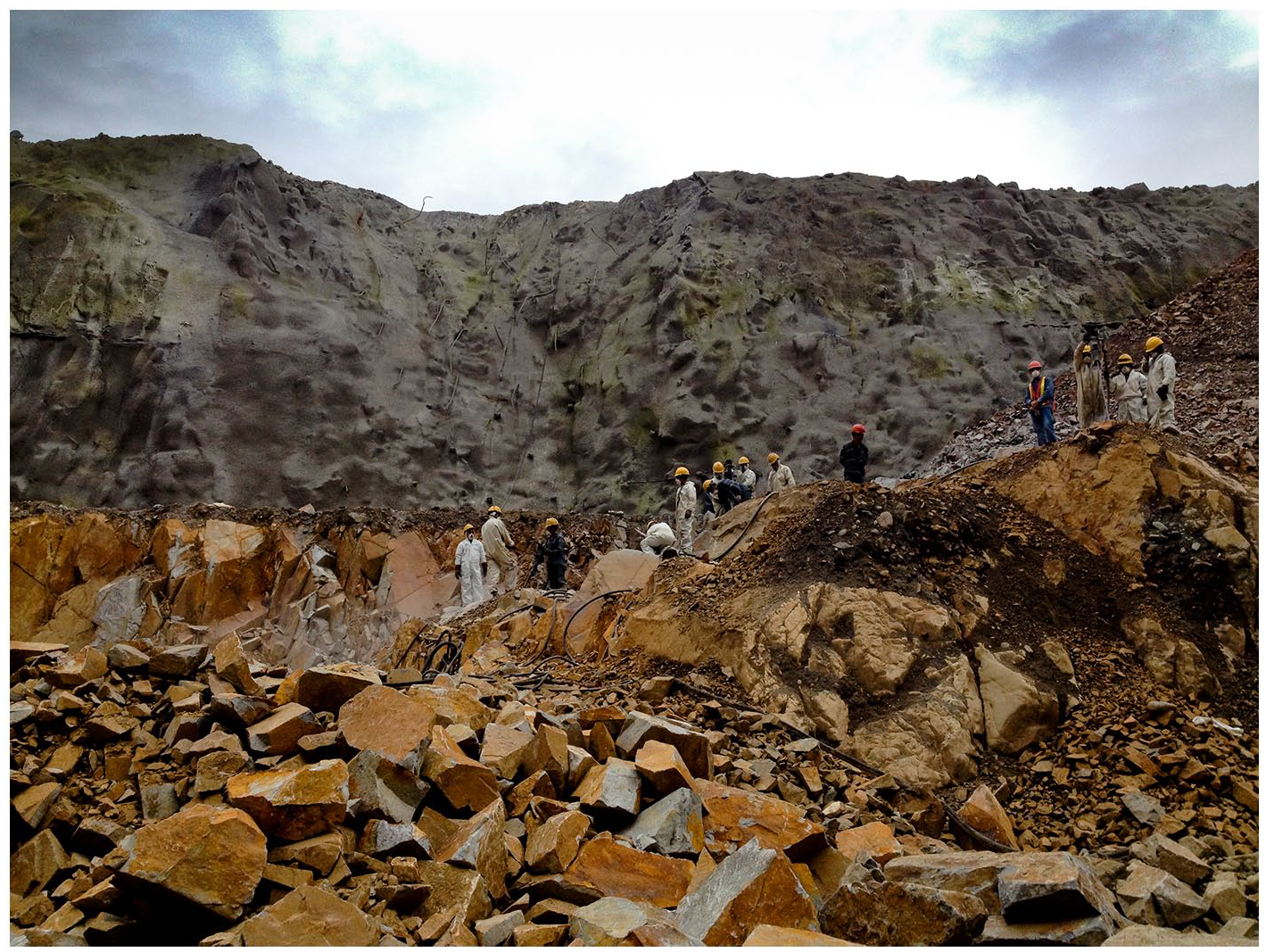
Chinese and Ecuadorian workers on the construction site.
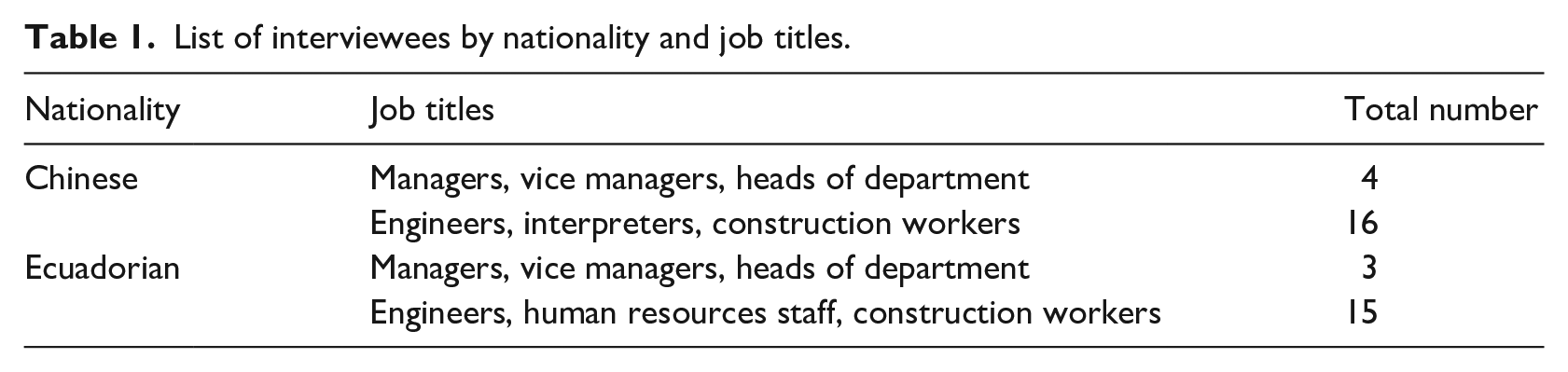
The interviewees varied by nationality and job title (see Table 1) because these factors influence their experiences with the social organization of work. I conducted semi-structured, one-on-one interviews with the Chinese and Ecuadorian employees using Mandarin Chinese or Spanish. Although there were more Ecuadorian employees than Chinese, I interviewed about an equal number of Chinese and Ecuadorian employees in each job category to sharpen my focus on their respective construction of moral identities and boundary-making practices. To better understand the labor relations and employees’ perceptions of work at the SBHP site, I asked questions about their work history, work routines, interactions with coworkers, evaluations and opinions of work, life, and the workplace, and how they dealt with challenges. I conducted and recorded 38 in-depth interviews, each lasting between 45 minutes and 2 hours.
List of interviewees by nationality and job titles.
I used the qualitative analysis software MAXQDA to analyze my fieldnotes and interview transcripts. For the coding process, I used the grounded theory approach (Charmaz, 2008). It allows me to summarize the rules and resources of the workplace and how the employees invoke them in their daily interactions. I use these patterns to reflect the larger social and political structures of the transnational workplace. In the first round, I identified and consolidated the themes reflected in both my fieldnotes and interviews. These themes include the pervasive use of stereotypes, understanding of their work, and strategies for negotiating working conditions with the company. Second, I utilized discourse analysis to identify and recode the layers of meanings embedded in the interviews (Pugh, 2013). A discourse analytical approach posits that languages do not reflect the “real world” but instead comprise socially constructed meanings that create and recreate understandings of realities (Gill, 2000). I use this approach to delve into the layered meanings and deconstruct the frames and logics my participants use to talk about their lives and present themselves. To protect the research participants, I use pseudonyms for the company, construction project, and individuals mentioned in this study.
Structures and practices of labor recruitment and control
The CHC was contracted to build the SBHP. Since the loan agreements between China and Ecuador stipulate that the CHC hire 80 percent of all its employees (around 4000 people) from Ecuador according to local labor laws, the company recruited Chinese and Ecuadorian employees from their respective internal labor markets. The CHC hired the vast majority of construction workers from young Ecuadorian men from local and neighboring provinces. They had been peasants, workers with temporary service jobs, or workers in the local industry. Most of them had less than 2 years of construction experience. Ecuadorian professionals, totaling around 20 people at the main camp, were middle-aged men (and a handful of women) with college degrees and more work experience. They had higher socioeconomic status than the construction workers. They took most of the positions in the business, operations, human resources, environmental, and quality control departments that demanded close interface with Ecuadorian companies or the government.
The CHC recruited the rest of its employees from China by bringing in around 1000 Chinese employees from its state-owned branch in China under Chinese labor laws and regulations. Most Chinese engineers, technicians, and skilled workers at the SBHP were middle-aged men with at least 10 years of work experience at the CHC’s branch in Yunnan, a less-developed southwestern province. They had worked on many challenging tunnel and dam engineering projects in China’s mountainous regions. But China’s construction industry experienced shrinking profit margins and an acute casualization of labor. The precarity and low compensations of construction work relegated construction workers and technicians to the lower rungs of China’s rapidly stratifying class structure. Based on their work experience and working-class positions in Chinese society, many Chinese employees identified themselves as “hydro-workers.” They considered overseas work as a way to gain upward social mobility and earn more money to better support their families. The Chinese business staff and interpreters at the SBHP were a small group (around 20 people) of young professionals who accepted overseas work as career development opportunities to improve wages and benefits upon returning to China. At the main project camp, fewer than 10 Chinese women worked as interpreters, accountants, and technicians.
Due to the CHC’s bi-partite recruitment structure, significant differences in status, compensation, and labor rights emerged between the two groups of employees. Because China supplied finance and technologies and acted as the employer on this project, the CHC structured differential status for employees based on their professional experience. Since the Chinese employees were more experienced in building hydroelectric dams, they were branded as more skilled and assigned higher professional status as team leaders or managers. Meanwhile, most Ecuadorian employees were new to large-scale construction work, so they were labeled as low-skilled and assigned a lower status. In terms of the daily organization of work, the Ecuadorian construction workers were subordinate and trained under experienced Chinese team leaders. And similarly, the Ecuadorian professionals reported to the Chinese managers in charge of their respective departments. They referred to almost all the Chinese employees as jefes (bosses).
Surprisingly, however, the compensation levels were not commensurate with professional status and, by extension, work experience. Rather, the CHC determined the employees’ compensation levels according to the prevailing wages in their respective labor markets. Although China had a more developed economic profile than Ecuador, Ecuador offered its workers a higher prevailing wage (Jilberto and Hogenboom, 2010; Lall and Weiss, 2004) than China did. Therefore, the presumably “lower-skilled” Ecuadorian employees earned higher average wages than the Chinese employees of the same professional rank. Based on a standard 8-hour shift, an Ecuadorian construction worker at the SBHP received a minimum monthly salary of US$488 plus overtime and health and loss of employment insurance. An Ecuadorian engineer enjoyed the same benefits and earned a monthly salary of between US$2000 and US$10,000 according to engineering experience.
The Chinese employees earned less than the Ecuadorians who held comparable organizational positions and professional status. A Chinese lead construction worker made only 7000 RMB to 8000 RMB a month (US$1129 to US$1290), lower than the salary of a similarly experienced Ecuadorian professional. An experienced Chinese engineer made 10,000 RMB to 30,000 RMB a month (US$1613 to US$4839), lower than or equal to a less experienced Ecuadorian engineer. Moreover, the Chinese employees worked longer hours than the Ecuadorians but without overtime compensation. Even so, the Chinese employees were earning two to three times more than working on a construction project inside China where lead workers received about 4000 RMB and engineers about 6000 RMB in monthly salaries.
Closely related to the structures of status and compensation, there was a significant difference in labor protections which the native Ecuadorian workers had access to while the migrant Chinese workers did not. The home and host states’ involvement in managing China’s infrastructure projects and the recruitment processes contributed to the variances in workers’ bargaining power in the transnational workplace.
Faced with criticism of its growing reliance on Chinese loans and expanding Chinese-sponsored projects, the Ecuadorian government strengthened the enforcement of protective labor laws to ensure native workers’ rights as a way to boost its legitimacy. Thus, instead of undermining their rights, the presence of migrant Chinese laborers on Chinese-sponsored projects unexpectedly contributed to improved protections for the native workers, which contributed to the split in the labor rights available to the two groups of employees.
Van, an Ecuadorian man in his 40s, was the human resources manager at the SBHP in charge of Ecuadorian personnel management. He informed me that Ecuador’s Ministry of Labor (MOL) supervised the establishment of streamlined procedures to administer employment and leave procedures, employees’ wages, and other benefits. The MOL required the Department of Human Resources to use an online system, La RED Socio Empleo, which reinforced the institutional procedures and oversight mandated by the Labor Code. As I shadowed Van’s work, he explained to me how these procedures and rules effectively conveyed workers’ rights stipulated in Ecuador’s Labor Code: At the beginning of the project, many Ecuadorian workers filed complaints directly with the Ministry of Labor, which resulted in investigations and fines to the CHC. There were several protests in the other camp when Ecuadorian workers demanded better food quality and safety measures. After we established the Company Committee, the Ecuadorian employees could communicate directly with their representatives to demand improvements; if they decided to quit, they had immediate access to streamlined administrative procedures to receive the benefits and compensation.
As further mandated in the Labor Code, the CHC established the Company Committee to function as a platform, nominally for both Chinese and Ecuadorian worker representatives, to negotiate with management and keep the company informed regarding independent union activities. The Ecuadorian human resources manager invited me to attend two Company Committee meetings. I observed how the Ecuadorian worker representatives were much more active and effective in making their demands and ensuring that the company met them. In contrast, the Chinese employees did not have effective representation on the Company Committee, an institutional arrangement that weakened their bargaining power.
At one Company Committee meeting in June of 2014, the Ecuadorian worker representatives from four different construction sites presented their complaints from workers to the chief human resources manager, an Ecuadorian woman named Maria. In her 50s, Maria was a middle-class woman who lived in Quito and previously worked for a multi-national corporation. The first representative complained on behalf of a welder who was dissatisfied with work injury settlements and the responses from the Chinese managers regarding safety and quality control. During their heated discussion, another worker representative jumped in to point out that “Whenever there was an accident, the Chinese managers arbitrarily changed the rules and standards for compensation” to evade responsibility for paying it. Maria immediately walked up to one Chinese manager and made him sign an agreement to address the workers’ grievances adequately. Toward the end of the meeting, the sole Chinese representative, a young woman named Hua, spoke up for the first time to propose activities for the annual company party.
The Ecuadorian employees mobilized their knowledge of their labor rights and access to the Company Committee, independent unions, and government agencies to effectively negotiate with the company for better treatment. By contrast, China’s strategy of going global to access increased international market share and natural resources in developing countries motivated the TSOEs to recruit the most experienced engineers and technicians and transplant them in a “point-to-point” manner (Xiang, 2012) in host countries.
Instead of using private agencies for recruitment and relocation, the TSOEs like the CHC flexibly draw on labor policies, regulations, and development discourses to mold and justify their labor recruitment and control practices. For recruitment, the CHC’s Ecuadorian branch coordinated with its Yunnan branch to internally select experienced engineers and technicians to work in Ecuador. The CHC Yunnan branch encouraged employees to work abroad by framing dispatched work as an opportunity to earn higher salaries and represent the nation in transferring technologies to less-developed nations. The company then continued with the typical practices of SOEs in managing the export of temporary migrant workers. First, the CHC applied for public passports on behalf of the dispatched employees. Unlike personal passports, public passports are issued to government staff and SOEs employees to strictly regulate their international travel and overseas activities according to their administrative ranks, rendering them “first and foremost political subjects of the Chinese state” (Xiang, 2007). The CHC centrally controlled these passports to ensure that the employees complied with the laws of host countries and returned home directly once they finished their work. Furthermore, the CHC arranged the scheduling and escorting of employees for their arrival in and departure from the host country based on project progress, an employee’s rank, and specific work assignments.
Once in Ecuador, the Chinese employees were subject to more company rules to ensure that they focused on their work and effectively carried out their responsibilities. Upon arrival in Quito, the CHC Ecuadorian branch placed Chinese employees into several rental villas which provided temporary accommodations before sending them to different project sites. During my brief stay in one of the villas, I observed how the company arranged for heavy security to ensure the safety of its employees. Local workers drove company vans to transport Chinese employees between company headquarters, the airport, and the project sites.
After the Chinese employees started working on their assigned projects, the CHC closely controlled their finances. The company directly deposited salaries into their Chinese bank accounts managed by employees’ family members back in China (see Lee, 2017 for similar practices in Africa). While the CHC provided free meals for the Chinese employees, it dispensed a quarterly allowance of US$100 to each Chinese employee for miscellaneous expenses. A Chinese project manager justified such financial control by citing that it was necessary to ensure Chinese employees’ safety from armed robbers targeting Chinese people overseas.
The CHC also mandated the Chinese employees to work and live in the dormitory-style company compound without family brought along with them. In contrast, most Ecuadorian employees commuted to their residences in nearby towns (except for a dozen or so from other provinces) and returned to family life after work. After dinner, I often stayed in the office with many Chinese engineers and administrative staff. I learned that they were not staying in the office only to work. Huang, a 26-year-old male process engineer, frankly said, There is not much to do in the camp ... The Internet is only available in the office. Work is the most important thing we can do here ... With the Internet in the office, I also often chat with my parents.
Such arrangements illustrate a key component of the labor control over migrant Chinese workers in the transnational workplace—the blurring of work and non-work spheres based on a systematic deprivation of social and family ties. As a result, Chinese employees are structurally disadvantaged and more vulnerable to workplace exploitation. Since the Chinese employees stayed longer in the office to access better amenities and spend some time with their families, they also tended to extend their work beyond regular hours.
In an interview, Manager Hu, the Chinese manager of quality control transferred from the Yunnan branch, gave voice to the party line. He justified the rigorous recruitment and labor control processes the company espoused to ensure that the migrant Chinese workers performed fast-paced and effective work: The Chinese employees went through a highly rigorous selection process based on skill qualifications to represent China in overseas projects. Therefore, the Chinese people on this project are tough hydro-workers, hard-working men who can conquer the harsh natural environment and accomplish difficult hydroelectric engineering tasks through hard work, self-sacrifice, and technical excellence. They are able to “chi ku” [eat bitterness] to get this project done and fulfill China’s promise to bring advanced technologies to developing countries.
In sum, the CHC continued to subscribe to Chinese SOEs’ passport, travel, and financial control rules to accomplish the “point-to-point” transplant of temporary migrant workers. These measures imbued the overseas work of these Chinese employees with a political significance and made them dependent on the company for virtually all aspects of their stay. Recruited in this way and under tight company control, these Chinese employees were deprived of practical access to China’s domestic labor laws while working abroad. As I show, they had no institutional channels to independent unions or effective representation on the Company Committee to seek better protections while working in Ecuador.
Worker identity construction and negotiation
Confronting the bi-partite recruitment processes and labor policies based on two national labor markets, the Ecuadorian and Chinese employees tried to make sense of their differential treatment and labor protections by invoking rules and garnering resources to justify or disrupt workplace hierarchies and labor relations in nuanced ways. This section focuses on how the two groups of employees leveraged regulations that govern labor relations at the SBHP to articulate their respective moral worker identities while navigating the social and political structures at the Chinese-owned transnational workplace.
Ecuadorians: “We know our labor code”
Based on their knowledge of Ecuador’s Labor Code, the Ecuadorian employees leveraged the leftist government’s avowed commitments to labor rights to bolster their self-identity. For example, Antonio, a male Ecuadorian welder in his 30s, used to be a local tourist guide earning an unstable income. In a conversation, he made the new Labor Code central while explaining his decision to work at the SBHP: Three years ago, when I started working here, I went through the formal contracting process through the Socio-Empleo system. I knew the new Labor Code would protect my wages and rights ... The Human Resources Department is very knowledgeable and provides much information on worker rights and protections ... I expect to continue working with this company on other projects in Ecuador to help with my family’s economic circumstances.
When clashes between work norms arose, the Ecuadorian employees drew upon the Labor Code and progressive labor protections in Ecuador’s development framing to support their claims. When Pedro, a 29-year-old Ecuadorian construction worker, refused to work without protective gloves, his Chinese supervisor filed a complaint against him. Pedro invoked the Labor Code to justify his refusal: The Labor Code stipulates that you must wear gloves to protect your hands. I cannot go to work without gloves ... Through an interpreter, I talked with my supervisor. I told him, both Chinese and Ecuadorian people are company employees. We should all fulfill our duties and enjoy our labor rights.
As these examples show, by appealing to Ecuador’s commitments to labor protections and discourses for a progressive development model, the Ecuadorian employees implicitly distinguished themselves from the Chinese employees who lacked such legal protections. Since many Ecuadorian employees feared growing Chinese investments and an influx of migrant Chinese workers would eventually erode local labor standards and undermine native workers’ labor rights and collective bargaining, they invoked the Labor Code to hold the company responsible for providing labor protections. In so doing, the Ecuadorian employees also became empowered to forge an identity as socially conscious workers who knew their labor rights.
On a collective level, the Ecuadorian employees strategically presented themselves as respecting the Labor Code to resist the rules the CHC tried to implement to ensure sufficient work hours and higher productivity. At a Company Committee meeting I attended, the Ecuadorian worker representatives challenged a ban on strikes during working hours that company management wanted to implement. A male Ecuadorian representative from the business department articulated his objections: We organized strikes that paralyzed project operations at the beginning ... These strikes [led by independent unions] were useful and important because it was in the middle of these strikes that the company agreed to offer two meals and transportation subsidies. It is against the Labor Code if the company requires workers to hold strikes after work hours.
His remarks reminded everyone that strikes were an effective way to get the CHC to improve the Ecuadorian employees’ working conditions and benefits. This reminder resonated with Ecuadorian employees who were well aware of the long work hours and lack of collective efforts among the Chinese employees.
In summary, Ecuador’s progressive labor policies, strong worker representation in the Company Committee, and the presence of independent unions together created favorable conditions for Ecuadorian employees’ collective bargaining. They mobilized these pro-labor policies embedded in Ecuador’s national development discourse to articulate a coherent worker identity, consistently framing themselves as committed to family values, the rule of law, and individual rights. Yet even with these progressive labor laws, Ecuador still has a rigid class hierarchy (Milanovic, 2016). No matter how diligently individual workers do their work, they have few opportunities for upward mobility. Thus, the Ecuadorian employees deployed this self-presentation as an effective way to justify their approach to work, while pushing for more labor protections.
Chinese: “We are tough hydro-workers”
Most Chinese employees I encountered in Ecuador come from working-class backgrounds and have prior experience working under harsh conditions on challenging hydroelectric projects. As they navigated the lack of legal labor protections and strict labor control at the SBHP, the Chinese employees drew on the Chinese state’s idealized portrayal of them as “tough hydro-workers” to reinforce their claims to moral worth.
In our interview, Zhonghao, a 26-year-old male contract specialist, explained the rationale for this self-identification: When we encounter problems, we most likely choose to endure instead of asking for improvements. Chinese people know that the company must meet the locals’ demands because they are protected under the law. But when we have needs, we feel that management is unresponsive. After all, we must first consider our ranks ... The lower in the ranks you go, the less effective your demands are. We’ve become comfortable in calling ourselves “tough hydro-workers.” I take great pride in this work. When we can no longer stand certain situations, the mid-rank leaders will see our dedication and address these issues, even if only symbolically.
Because of the rigid hierarchical structures and distribution of authority in the CHC, many Chinese employees believed that embodying the “tough hydro-worker” identity and enduring harsh working conditions was the only way for the lowest ranking employees to get management’s approval and improved working conditions. This idealized worker identity was a crucial source of symbolic capital the Chinese employees could leverage to enhance their bargaining power.
Since higher professional rank allowed one to access better working conditions, the Chinese employees also readily identified with the “tough hydro-worker” to demonstrate their hard work and extraordinary skills so they could potentially get promotions and acquire more resources.
Datong, a staff geologist in his 40s, was among the earliest employees sent to the SBHP. He chose to work overseas to earn more money for his family. He identified with the “tough hydro-worker” ideal when discussing intolerable working conditions: As a hydro-worker, I knew the environment would be harsh. When I started working here in 2010, one camp didn’t have running water or electricity. We drank water that smelled of decaying leaves while the Ecuadorian workers had bottled water. The salary was less than one-third of what I currently make ... But there is no shortage of Chinese workers. The older hydro-workers used to work in China for much lower salaries, so I felt I had to endure like these tough workers to get more experience and earn more money to support my family.
After enduring such difficult circumstances, Datong was promoted to a senior-level position and enjoyed three times more salary than when he started the job.
As such, the Chinese employees at the SBHP were under intense pressure to embody the “tough hydro-worker” identity and live up to that idealized public image by working harder, making extraordinary self-sacrifices, and demonstrating exceptional skills.
Jianshe, a 27-year-old male civil engineer, came from a working-class background in southwest China. He chose overseas work to earn money to buy an apartment and obtain the opportunity to be transferred to the company branch in Beijing with hukou benefits. In his interview, he invoked the hydro-worker image to present himself as hard-working and worthy of promotions: We work here to represent China’s expertise. If I watch TV or play games after talking to my family in the office, I quickly feel guilty. It’s a waste of time. Instead, at night, I make myself continue working on the designs that I didn’t finish during the day. I would read books to enhance my managerial skills and technical knowledge.
In a hierarchical workplace, many Chinese employees also identified themselves as tough hydro-workers to explain why they did not express discontent or make demands. Consider, for example, the comments of Xiaoming, a male civil engineer and new college graduate on the lowest professional rank: I seldom approach my supervisors with complaints unless the problems [with work and living arrangements] are grave. I feel, as a hydro-worker, we should be able to eat bitterness [chi ku]. If you complain too much, you leave them [managers] the wrong impression that you are too fainthearted to fulfill your mission.
Facing this dilemma, Xiaoming emphasized his identity as “tough hydro-workers” to preserve his dignity and a sense of purpose on the job.
Drawing social boundaries with stereotypes
In their everyday interactions at the workplace, the Chinese and Ecuadorian employees need to negotiate their differential status, treatment, and labor rights. Building on strong notions of their respective moral worker identities, the two groups developed a stereotyped understanding of the others’ work ethic to preserve their limited resources and bargaining power. This section examines how these interactions further entrenched social boundaries and reinforced the split labor market.
From the Chinese employees’ perspective: “Lazy and calculating” Ecuadorians
In my daily interactions and interviews with Chinese employees, the topic that elicited the most comments and discussions was the sharp contrast between how the two groups worked. For instance, Dequan, a male Chinese mechanical technician in his 50s, contrasted the Ecuadorian and Chinese workers in his comment: The Ecuadorians never work extra hours even if they receive overtime compensation. Instead, they strictly observe an eight-hour work schedule. They lack a good work ethic and are lazy ... We [Chinese] work hard and never demand payment for working overtime.
Another material technician in her mid-40s, Chenyi, tried to rationalize why most Ecuadorian employees still declined to work overtime even when guaranteed proper compensation. After acknowledging the initial mistrust of the Chinese management system, she attributed their unwillingness to work overtime to the Ecuadorians being “too calculating and demanding.”
The Chinese employees were aware that the Ecuadorians had access to labor protections that allowed them to work only for 8 hours and collectively negotiate improved working conditions. Nevertheless, working under liminal legality in a foreign country, they resorted to routine stereotyping of the Ecuadorian employees by calling them “lazy,” “calculating,” and “demanding” when the latter failed to meet work expectations. In doing so, the Chinese employees emphasized their own dedication as “tough hydro-workers” to maintain their higher professional status and gain management recognition.
The stereotypical portrayal obscured such alternative causes as the language barrier and lack of interpreters which posed significant obstacles to cooperation and interaction between the Chinese and Ecuadorian employees. These obstacles were evident in this anecdote a lead Chinese tunnel technician shared, Once, when a truck was coming at us, a Chinese worker didn’t know how to speak Spanish to alert an Ecuadorian coworker. He instead reached out to pull him aside. The Ecuadorian worker thought he was being physically abused.
Such misunderstandings might have worsened due to the Yunnan dialect the Chinese employees spoke, which has a tone that can cause listeners to perceive the speakers as being rude and aggressive.
These stereotypes about work ethic were further reinforced by Ecuadorian worker representatives’ frequent attempts to make demands at Company Committee meetings. After one meeting, Lei, a Chinese material engineer, dismissed the Ecuadorians in an interview: The Ecuadorians are calculating enough to frequently use the Committee, but it won’t work for us Chinese to demand legal protections or better working conditions ... Here it is the same as construction projects inside China—the higher-ranking employees get better treatment and more power to demand changes. The hard-working employees, not the troublemakers, get more attention from their leaders for addressing any difficulties they experience.
As temporary migrant workers in Ecuador, the Chinese employees had neither recourse to labor protection under Chinese labor laws nor institutionalized protection under Ecuador’s labor regulation. Instead of engaging in bottom-up bargaining, the Chinese employees reinforced the social boundaries with the Ecuadorians to show they were superior and self-sacrificing workers who deserved better treatment. The social boundaries also helped them come to terms with their lack of labor rights.
From the Ecuadorian employees’ perspective: “Workaholic and model-worker” Chinese
When the Ecuadorian employees talked about their interactions with their Chinese counterparts, they primarily cited the Chinese employees’ prolonged work hours. For instance, Roberto, a 29-year-old Ecuadorian engineer, claimed that he would not work overtime, even though his Chinese supervisor often complained about his lack of work motivation: I don’t want to make Chinese supervisors think that we will work overtime due to pressures from above, like my workaholic Chinese colleagues. The Chinese work all day long in the office. Construction projects like this one always have tight timelines and high pressures, but we [Ecuadorians] have standard work hours protected by law.
Roberto emphasized the Ecuadorian employees’ legal protections as a reference point to contrast the Chinese counterparts’ lack of rights. He distanced himself from the way the Chinese employees worked by labeling them as “workaholics.” This depiction of the Chinese refracted long-standing tropes about Chinese laborers in Latin America and contemporary media portrayals of disciplined and compliant Chinese workers under global capitalism (Green, 2017).
The Ecuadorian employees also relied on stereotypes to denounce uncompensated overtime. Amanda, an Ecuadorian woman from a neighboring town, was on the human resources staff. In a conversation, she remarked, Many Ecuadorian workers think Chinese people are very aggressive and only care about their work. They [Chinese] are very responsible and hard-working. But we Ecuadorians are not like this. We are more tranquilo [calm] and relaxed, and we do not work in an aggressive way as our Chinese counterparts do.
Such comments pointed to the Chinese counterparts’ essential aptitude for enduring long work hours, hard labor, and absence of family to contrast with the Ecuadorians’ “tranquilo and relaxed” approach to work. Perceiving the difficulties in achieving upward mobility at the workplace and in society, the Ecuadorian employees focused on using their limited resources—claims to the protective labor laws and family commitments—to justify their work approach.
At a deeper level, the Ecuadorian employees felt threatened by the potential erosion of native workers’ rights the Chinese operations posed. They resorted to stereotyping to distinguish their work approach and mark social boundaries. For example, in a conversation, Jacinto, an Ecuadorian worker representative, remarked, We Ecuadorians hold regular meetings to discuss complaints and how we could address them. But the Chinese employees, I know their working conditions are worse than ours—they work overtime with no compensation and live in overcrowded dormitories with many other workers. But they accept bad conditions and don’t use the Committee to improve their treatment or protest in other ways. I think this is because they are trying to be model workers.
Despite knowing that the Chinese employees were not protected by Ecuador’s labor laws, many Ecuadorian employees like Jacinto repeatedly invoked the “model worker” trope to rebuke how the Chinese submissively endured their lack of labor rights rather than organizing to demand better working conditions. They used these stereotypes to convey that, unlike their Chinese counterparts, they actively defended their rights to resist labor exploitation.
Conclusion
In this era of intensifying globalization, transnational capitalism and the accompanying labor migration are engendering new forms of labor relations, especially in the exchanges between Global South nations. By examining the case of the largest state-driven capital and labor flows from China to less-developed nations, this study explicates how political-economic conditions of the home and host states interact to influence migratory labor relations. Moreover, the study delves into the understudied micro-level interactions between the foreign migrant and native workers to show how they negotiate institutionally split practices of labor control and labor rights at the transnational workplace. In so doing, this study leverages the workers’ everyday interactions to reveal the complex social and political structures shaping split labor market under state-sponsored transnational capitalism and infrastructural development in the Global South.
This integrated account of China’s state capital and labor exports to Ecuador thus advances two theoretical implications. First, while previous research mainly focuses on host countries’ immigration controls and labor incorporation, this study shows that interactions between the home and host countries’ development strategies, political interests, and labor politics give rise to divergent recruitment processes and labor policies. Specifically, I show the utilities of examining state-sponsored transnational corporations and their interactions with labor politics in the host countries. When such transnational corporations tap the labor force from both home and host countries to drive down labor costs, they confront the need to deal with differences in wages and rights between the two countries. In addition to cost calculations, this kind of state capital often bears the mission to maintain political rapport and legitimacy in order to secure market share and resource access. These structural conditions engender the split labor market along national and ethnic lines, shaping disparate treatment and labor rights between the foreign migrant and native workers. Yet, even though the transnational corporations are in structurally advantageous positions to dictate the working conditions and enforce strict labor control over temporary migrant workers brought along from the home countries, they still face pressure to conform to the host country’s labor laws and respond to local workers’ collective demands. As this study reveals, pro-labor policies and government oversight in the host country can help maintain labor protections and local workers’ labor rights, albeit at the cost of increasing inequality in the transnational workplace.
These dynamics demonstrate that shifting power balances between the host and home states, transnational capital, and labor produce changing patterns of split labor market along the lines of nationality, ethnicity, race, gender, or other dimensions of social differences. My study highlights that the strength of the legal institutions and organized labor in the host country plays a key role in influencing labor disparities between native and foreign migrant workers. Existing studies of different varieties of capitals and investments in other developing nations lend further evidence to this theoretical insight (Chen, 2020; Franceschini, 2020; Halegua, 2020). For example, researchers observe that both the private and state-owned Chinese companies structure dualist labor regimes in their transnational operations. Whereas in Cambodia, due to weak legal institutions and organized labor, local construction workers endure lower wages and harsher living conditions than the migrant Chinese workers (Franceschini, 2020), local workers in Laos effectively organize their communities to get back wages and resist labor exploitation by quitting their jobs (Chen, 2020). Moreover, compared with SOEs, private companies, and subcontractors pay even lower wages for both local and migrant Chinese workers (Franceschini, 2020), presumably under more pressure to drive down costs and maintain competitiveness. Given these similar findings, I argue, to better comprehend labor relations in transnational workplaces, we can trace how transnational capitalism, mediated by organizational rules and resources, exploits the shifting balances between home and host states, capital, and labor. In other words, we should examine transnational capitals by placing them in a multiscale and relational field of power.
Second, I highlight both migrant and native workers’ identity- and boundary-making practices to center micro-level dynamics and workers’ strategies for navigating power differentials based on their nationality, ethnicity, and professional status. When native workers have access to labor protections, constructing moral identities and maintaining social boundaries aid their bottom-up organizing efforts to resist the encroachment of labor rights. Such acts of resistance challenge the stereotyped assumptions regarding labor politics in developing countries which often portray local workers as marginalized and exploited by powerful foreign investors. As the evidence shows, workers’ organizing efforts and their strategic use of the state’s labor politics and development discourses condition the outcomes of foreign investments. But even in the case of “unorganized” labor, such as the Chinese employees in this study, the choice to embody the moral worker identity and maintain social boundaries serves to increase their symbolic capital and bargaining power to enhance their treatment incrementally within the corporate hierarchy. Although I did not find overt organizing among the temporary migrant workers, when the income and welfare disparities continue to widen, it may be possible for aggrieved migrant workers to demand a collective voice, which may build on a sense of dignity, fairness, and economic justice.
Recognizing temporary migrant and native workers’ lived experiences and interactions thus has key implications for understanding the future of labor solidarity. The pervasive stereotypes and prejudices different groups of workers develop to cope with labor disparities in the transnational workplace pose significant challenges to joint struggles. Similar social patterns are also found in China’s state infrastructural investments in Africa, where high levels of informality, short-term project-based work (Lee, 2017), and rampant racialized prejudices (Sautman and Yan, 2016) undermine labor organizing and worker solidarity. In Ethiopia, status hierarchy, labor disparities, and segregation of migrant Chinese workers and local workers lead to prejudices, which strains workers’ relationships and the possibility for solidarity. While the local workers resort to law and courts to resist Chinese employers’ labor discipline, migrant Chinese workers who embark on overseas work for achieving upward mobility feel stuck, disillusioned, and exploited (Driessen, 2019). However, viewed from another perspective, hidden behind the prejudices and boundaries are demands for fairness and justice from work, which can transform into symbolic leverages that unite the workers and facilitate their collective struggle. As Chun (2008) argues against the usual patterns of exclusionary tensions in a split labor market, structurally marginalized groups of workers can rely on a broad-based understanding of justice to resist their deepening marginality. This study further posits that economic justice and the desire for social mobility might become especially relevant for workers under transnational capitalism because every worker experiences one or more forms of structural marginality along the lines of nationality, ethnicity, gender, skill, status, and so forth. Rooting the basis of worker power in the politics of justice and inclusion can therefore overcome divisions and the deepening of the split labor market.
Moving forward, future research may further investigate how overseas investments by other countries or private capitals exploit shifting power relations to extract labor power, manipulate labor relations, and exercise labor control. It would also be fruitful to trace longer term interactions to specify whether and how foreign migrant workers and native workers develop shared grievances, cross-ethnic organizing capabilities, and the outcomes in the Global South. Hopefully, these insights can enrich our knowledge of how split labor markets and changing labor relations under global capitalism are created, and equally importantly, contested.
Footnotes
Funding
The author disclosed receipt of the following financial support for the research, authorship, and/or publication of this article: This research was supported by the Research Fellowship from the Lozano Long Institute of Latin American Studies at the University of Texas at Austin. The content is solely the responsibility of the author.
