







Abstract
This study analyzes World Values Survey data (individual N = 63,307; country N = 53) to examine individual and national factors that shape attitudinal support toward men’s physical violence against their wives. We assess how the national context conditions direct individual-level effects. Greater national support toward this form of intimate partner violence exerts a positive effect on individuals’ supportive intimate partner violence attitudes. Cultural orientations affect supportive intimate partner violence attitudes, but the direction depends on whether they are measured at the individual (negative effect) or national level (positive effect). Cross-level interactions reveal that national context moderates individual-level effects between cultural orientation and egalitarian gender attitudes with intimate partner violence supportive attitudes.
Keywords
Introduction
Cross-nationally, it is estimated that 30 percent of women have experienced physical or sexual violence by an intimate partner at some point in their life (World Health Organization, 2016) although there is tremendous variability in the prevalence of intimate partner violence (IPV) between nations (Devries et al., 2013). In recent years, greater attention has been paid to the correlates of attitudes toward gender roles (Hammond and Cimpian, 2021; Schroeder and Liben, 2021) and violence against women, inclusive of IPV (Akbary et al., 2020; Ola, 2020; Onayemi and Ogungbemi, 2020). Extant meta-analytic work has identified that attitudes toward IPV—among other factors—may play a central role in the experience of IPV (Stith et al., 2004). Yet, much of this work has been country-specific analyses (Copp et al., 2019; Lawoko, 2006; Speizer, 2010; Stickley et al., 2008). Analyses that have examined cross-national differences in attitudes toward IPV have largely been limited to low-income to lower-middle-income countries (Hayes and Boyd, 2017; Omidakhsh and Heymann, 2020; Pierotti, 2013; Uthman et al., 2009) or member nations of the European Union (Gracia and Herrero, 2006; see Gracia et al., 2020, for a systematic review; see Chon, 2021, for exception across nations ranging from low to high-income).
The relative lack of research in this area is problematic, as nations differ in cultures, economies, and policies that may be important for understanding attitudinal support toward IPV. Indeed, extant scholarship has identified that a nation’s cultural orientation can shape attitudes about other social values (Adamczyk and Pitt, 2009; Inglehart, 2006; Inglehart and Baker, 2000; Inglehart et al., 2002). These differences may be even more pronounced when considering nations across levels of economic development as the broader national context and prevailing societal norms may moderate individual-level associations with attitudinal support toward IPV.
This study uses data from the World Values Survey (WVS) to examine the micro and macro forces that shape individual attitudinal support toward IPV across the world. To be clear, while the WVS included the measure “for a man to beat his wife,” which focuses on a man’s use of severe physical violence against his wife, for brevity, this study uses the term IPV. 1 Largely, this study considers whether the positive association between a person’s beliefs in gender equality and personal autonomy on their attitudinal support for IPV is limited to countries in which the population at large expresses relatively lower levels of support for gender equality and personal autonomy. We do this by estimating a series of cross-level interactions. Understanding the moderating role of national context on individual-level associations can have implications for how countries prevent and respond to IPV while properly considering the nested nature of an individual’s lived experience.
Attitudes toward IPV
A growing body of recent literature has continued earlier efforts that have examined the predictors of attitudes accepting of IPV (e.g. Copp et al., 2019; Li et al., 2020; Zark and Satyen, 2021) and supports the notion that attitudes condoning IPV may be a key risk factor for the perpetration of and responses to IPV (Flood and Pease, 2009; Zark and Satyen, 2021). In this conceptualization, supportive attitudes toward IPV affect future behaviors, making it worthwhile to examine the correlates of these supportive attitudes. 2
The ecological model (Bronfenbrenner, 1981; Heise, 1998; Krug et al., 2002) has provided a useful way of considering the effects of various predictors of IPV based on different ecological levels (i.e. microsystem, mesosystem, exosystem, macrosystem). For the purposes of this study, the individual and national level—where policies are often implemented and individuals reside within geopolitical borders—will be highlighted. 3 Using the ecological model to integrate the extant literature on predictors of IPV, Voith (2019) found that norms surrounding IPV (e.g. appropriateness of intervention, acceptance of IPV) are important for understanding IPV, but cautioned that few studies have included such measures in empirical assessments. Although Voith’s (2019) integrative review was focused at the neighborhood level, the findings have implications for understanding differences across nations (see also Jewkes, 2002). Culture, norms, economics, and policies—all of which vary across nations—not only shape the risk of IPV (Kaya and Cook, 2010) but can also affect attitudes (Sabina, 2013; Waltermaurer, 2012). Still, we know very little about the association of these macro-level factors with individual attitudinal support toward IPV and how they may vary cross-nationally.
One such macro-level factor may be widely held cultural beliefs about the use of violence. According to Durkheim (1951 [1897]), the sui generis effect refers to the phenomenon whereby aggregated attitudes toward a particular social problem are fundamentally different from the individual attitudes that create the macro force. In other words, overall norms cannot be reduced to the individual attitudes that create it. These norms are something entirely different (Heise and Manji, 2016) and can be conceptualized as a culture. Cultural norms about social problems may shape attitudes and behaviors even among those who strongly feel another way because of restrictions on daily routines (Adamczyk and Hayes, 2012). These global norms may provide guidelines for behaviors among citizens (Pierotti, 2013).
Prior scholarship has shown that aggregated norms (i.e. attitudes averaged across respondents) at the neighborhood (Beyer et al., 2015; Pinchevsky and Wright, 2012; Voith, 2019) and national levels (Hayes and Boyd, 2017) affect attitudes toward IPV and experiences of IPV. Indeed, scholarship has shown variation between countries’ acceptance of IPV (Waltermaurer, 2012; Zark and Satyen, 2021) and criminal legal systems’ responses to IPV. However, little attention has been paid to how the broader public—not individuals—views IPV and how public perceptions may shape individual-level perceptions (Waltermaurer, 2012; see Gracia and Herrero, 2006; Hayes and Boyd, 2017; Pierotti, 2013, for exceptions). Aggregated attitudes are one avenue to capture public perceptions that incorporate a distinctly different dimension from formal policies. Methodologically, multi-level modeling allows for empirical assessment of the theoretical micro- and macro-level factors that may be associated with supportive attitudes toward IPV (Hardesty and Ogolsky, 2020; Hayes, 2022).
Individual-level egalitarian gender attitudes
Extant work has demonstrated there is a consistent association between attitudes toward more traditional gender roles and attitudinal support toward IPV (De Judicibus and McCabe, 2001; Truman et al., 1996). Beliefs about IPV, and violence against women more generally, are influenced by broader norms about gender and sexuality (Flood and Pease, 2009). Greater acceptance of traditional gender norms that perpetuate gender inequality between men and women can justify the use of violence in these scenarios, especially when behaviors depart from what are considered appropriate gender roles (Heise, 1998). The process of industrialization has the potential to transform family and gender roles (Rodríguez Martínez and Khalil, 2013). Collectively, attitudes about gender may shape attitudinal support toward IPV.
Self-expressive/survival orientation at the individual and national levels
Extant scholarship has demonstrated that a nation’s level of economic development and extent of industrialization can affect individual attitudes toward social and political values. In their cross-national work, Inglehart and colleagues (Inglehart, 1990, 2006; Inglehart et al., 2002) propose that countries and persons within countries fall along two interrelated, but distinct, cultural dimensions: traditional/secular-rational and self-expressive/survival. 4 According to the self-expressive/survival dimension, which is a continuum, a greater self-expressive orientation will be associated with economic certainty and greater support for values that encourage autonomy and which emphasize and enhance the individual’s quality of life (Inglehart, 1977). On the other hand, a stronger survival orientation will be associated with greater economic insecurity and attitudes that are more supportive of behaviors that do not cause further uncertainty to the day-to-day life (see Appendix 1; Inglehart et al., 2002). Among those with a greater survival orientation, individuals will be more likely to espouse traditional values and condemn alternative behaviors or attitudes (Inglehart et al., 2002). The self-expressive/survival orientation is a comprehensive concept related to economic development, religiosity, and gender equality that is associated with level of support for autonomy or nontraditional values. Prior research has shown that societies with more self-expressive orientations are more accepting of homosexuality (Adamczyk and Pitt, 2009) and prostitution (Stack et al., 2010) and less likely to support child maltreatment (Hayes and O’Neal, 2018).
In more agrarian societies, which likely will have a more survival orientation, day-to-day life is often dependent on the family unit where traditional gender roles likely dominate (Inglehart and Norris, 2003; Rodríguez Martínez and Khalil, 2013). In this instance, individuals with a stronger survival orientation and who reside in a nation with a stronger survival orientation may be more likely to personally support IPV, as traditional gender roles intersect with patriarchal attitudes that justify the use of IPV. During the shift from a greater survival orientation to a more self-expressive orientation, which can be either an individual or national attribute, a sense of agency should increase. Agency and autonomy are key components of a stronger self-expressive orientation, the risk of IPV, and a survivor’s help-seeking behaviors (Campbell and Mannell, 2016). It is theoretically probable that individuals and nations with a more self-expressive orientation perceive that people have their own agency, have greater support for more equitable gender roles, and therefore are more likely to believe that people should not abuse their intimate partners. It is worthwhile to consider how the broader cultural orientation shapes individual perceptions of IPV beyond previously identified correlates. It is also worthwhile to consider the individual dimension of this concept as an individual’s orientation can be distinctly different from their nation’s cultural orientation.
Cross-level interactions
While it is important to consider how national factors independently affect individual attitudes toward IPV, national-level factors may moderate direct individual-level associations. Through the estimation of cross-level interactions, multi-level analyses allow for the empirical examination of whether the national context tempers or exacerbates the association between individual-level factors and attitudinal support toward IPV. Stated differently, the individual-level main effects will not operate the same when examining different nations. As an example, greater decision-making in the couple dyad increases a woman’s risk of IPV in some nations, like Mali (Hayes and van Baak, 2017), but not others, like former nations of the Soviet Union (Hayes and Randa, 2021). Mali has written into legal codes that the man is the head of the household, while, in the latter, communism strongly influenced gender roles (Freedman, 2002). Cross-level interactions through multi-level models allow one to empirically assess whether these national factors significantly condition the direct effects. Significant variation in direct effects across nations has implications for the development of intervention efforts as they may be more or less effective depending on the nation they are implemented in Wilcox et al. (2003) or for whom within the nation they are developed for.
For this reason, we consider whether the positive association between a person’s beliefs in gender equality and personal autonomy on their attitudinal support for IPV is limited to nations that have relatively lower levels of support for gender equality and personal autonomy. That is, we explore how national contexts may moderate the individual-level association between the self-expressive/survival scale and egalitarian gender attitudes with attitudinal support toward IPV. It is possible that individual differences along the self-expressive/survival continuum will matter less in more self-expressive nations and nations that are less supportive of IPV. Stated differently, more self-expressive nations will emphasize values that enhance one’s quality of life regardless of one’s own orientation. The elimination of violence in the home would align with those ideals. In addition, we assess whether the national context moderates the individual-level association between egalitarian gender attitudes and attitudinal support of IPV. Again, individual attitudes about gender roles should matter less in more self-expressive societies and nations that are less supportive of IPV because, collectively, society views the behavior as wrong and, again, values improving overall well-being.
Current study
Overall, this study considers whether the positive association between a person’s beliefs in gender equality and personal autonomy on their attitudinal support at the individual level is moderated by countries that are less supportive of personal autonomy and which have stronger norms of gender inequality. We do this by estimating cross-level interactions to ascertain how the national context may condition the direct effects of individual-level factors.
Materials and methods
Data for this study were drawn from the sixth wave of the WVS (Inglehart et al., 2014). The sixth wave was conducted from 2010 to 2014. In total, the sixth wave of the WVS includes 90,350 respondents who reside in 60 nations. When considering location, 9 nations were located in Africa, 2 were located in North America, 17 were located in Asia, 2 were located in Oceania, 10 were located in Europe, 8 were located in South America, and 5 were considered transcontinental between Europe and Asia. Because the WVS was standardized across nations, it allows for cross-national multi-level analyses. Sampling strategies varied across nations (e.g. full probability sampling; combination of probability and stratified sample), although the WVS required the sample to be representative of all persons aged 18 and older living in the country, and should have resulted in a minimum sample size of 1200 persons. The WVS is the only data collection effort that covers low-income economies to high-income economies. Questions included in analyses—including indicators used to create the self-expressive/survival scale—were systematically missing in some of the nations. As such, data were listwise deleted, resulting in a final sample size of 63,307 respondents in 53 countries. 5
Dependent variable
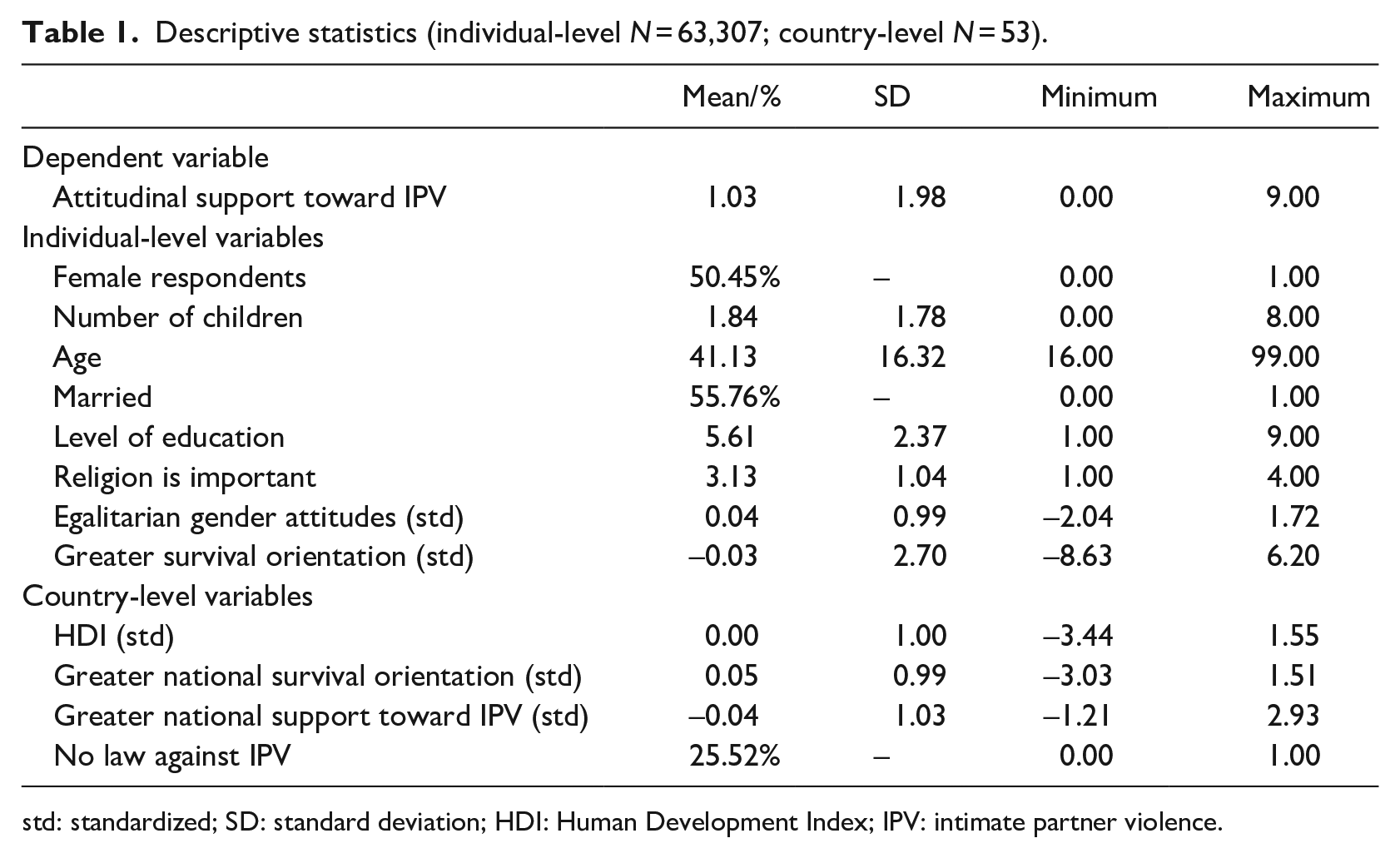
Analyses focused on individual-level support of IPV. Within the WVS, respondents were asked whether it is always or never justified “for a man to beat his wife” on a scale from 1 = never justified to 10 = always justified. This item was recoded so that 0 = never justified to 9 = always justified. Respondents, on average, indicated IPV was almost never justified (mean = 1.03; SD = 1.98; variance = 3.93; range = 0.00–9.00). Descriptive statistics are reported in Table 1.
Descriptive statistics (individual-level N = 63,307; country-level N = 53).
std: standardized; SD: standard deviation; HDI: Human Development Index; IPV: intimate partner violence.
Individual-level independent variables
Self-expressive/survival scale
The self-expressive/survival scale is a theoretically derived index created from five items (Inglehart, 2006; Inglehart and Baker, 2000). The operationalization of the index was consistent with extant research on the WVS that has included it in multi-level analyses (Adamczyk and Pitt, 2009; Boyd and Chung, 2012; Hayes and O’Neal, 2018). 6 The first item centered on whether the individual valued a sense of security above self-expression. Within the WVS, respondents were asked to rank-order two of four options as the most important: (1) “Maintain order in the nation,” (2) “Give people more say,” (3) “Fight raising prices,” and (4) “Freedom of speech.” Respondents who selected “freedom of speech” and “give people more say” as their first and second options (regardless of which of these two came first) were coded “1.” These two options are indicative of a more self-expressive orientation. Individuals who selected “fight raising prices” and “maintain order in the nation” as their first and second choices (again, regardless of which of these two came first) were coded “4.” These option choices are more in line with a greater survival orientation. Respondents who listed one of the self-expressive values first and one of the survival values second were coded “2.” Respondents who listed a survival orientation first and a self-expressive orientation second were coded “3.” The second item included in the index captured the respondent’s overall feelings of happiness (1 = very happy to 4 = not happy at all). The third Likert-type scale item captured political activism, which ranged from “1” to “3” where higher values indicated the respondent would never sign a petition. The fourth item was a dichotomous measure where 1 = respondent believes most people cannot be trusted and 0 = most people can be trusted. The fifth measure represented attitudes toward homosexuality and was reverse coded (1 = always justified to 10 = never justified). All five items were standardized and combined into an index (Inglehart and Baker, 2000). Higher scores are indicative of a more survival orientation (mean = –0.03; SD = 2.70).
Egalitarian gender attitudes
This scalar item was created from three items captured on a 4-point Likert-type scale where 1 = strongly agree and 4 = strongly disagree. The items included: (1) “On the whole, men make better political leaders than women do,”(2) “A university education is more important for a boy than a girl,” and (3) “On the whole, men make better business executives than women.” The three items were added together and then standardized. The scalar item had good reliability (mean = 0.04, SD = 0.99, Cronbach’s alpha = 0.76). Higher scores indicate the respondent has more egalitarian gender attitudes.
Individual-level control variables
Control variables included gender (1 = woman, 0 = man), age (mean = 41.13, SD = 16.32, range = 16.00–99.00), level of education (1 = no formal education to 9 = university degree), marital status (1 = married, 0 = single, divorced, or widowed), respondents’ perception of the importance of religion (1 = not important at all to 4 = religion is very important), and number of children (range = 0.00 children to 8+ children).
Country-level independent variables
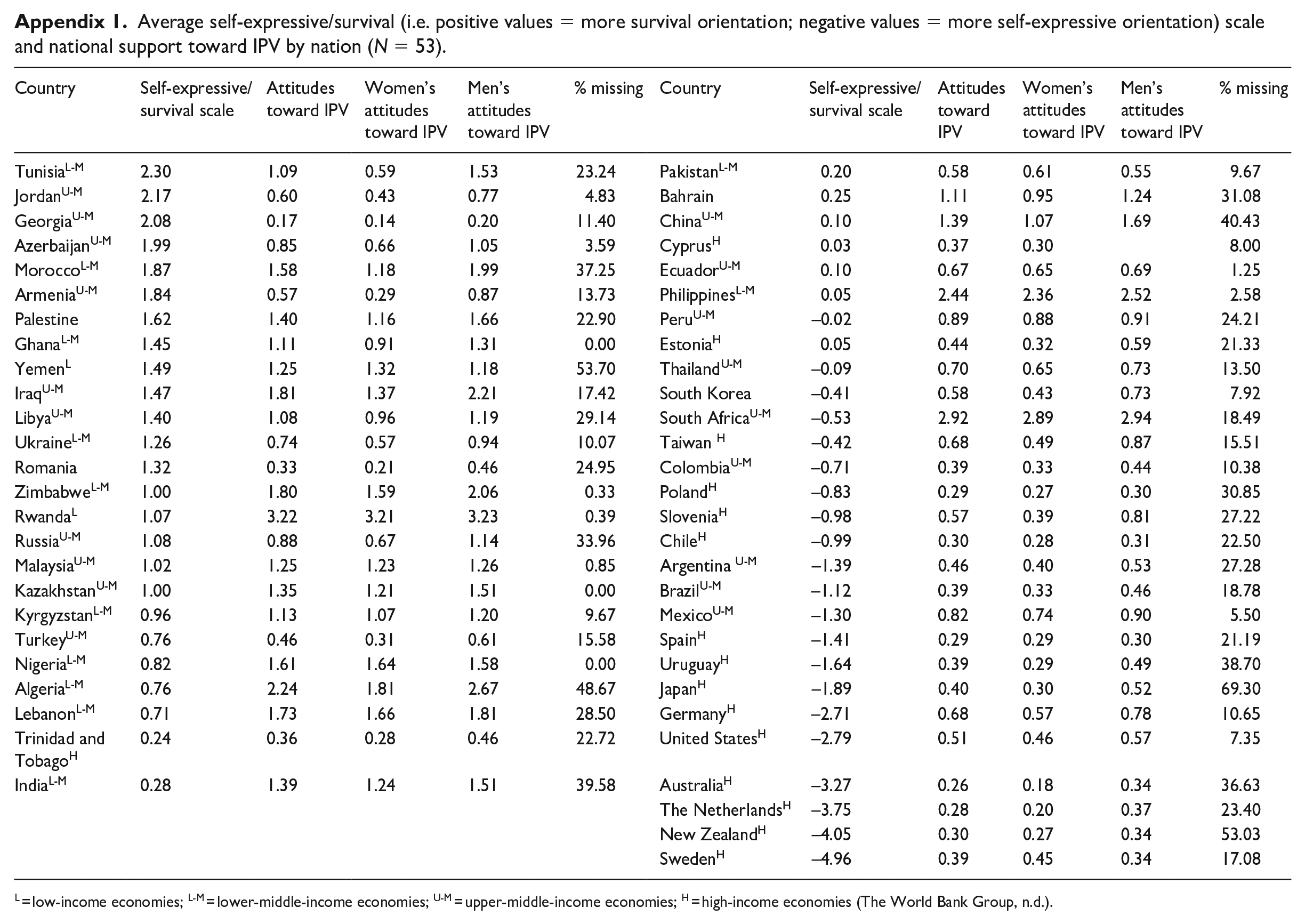
Individual-level attitudinal support toward IPV (full sample prior to listwise deletion) was aggregated to the country level. Higher scores indicate greater national support of IPV (mean = –0.04; SD = 1.03; see also Appendix 1). 7 Similarly, the self-expressive/survival scale was aggregated (full sample prior to listwise deletion) to the country level. Higher scores indicate the nation has a greater survival orientation (mean = 0.05; SD = 0.99). Sweden was the most self-expressive nation included in analyses, while Tunisia had the most survival orientation. Nations that fall in the middle of the continuum include the Philippines, Peru, and Estonia (see Appendix 1). Both aggregated items (national support of IPV and self-expressive/survival scale) were standardized. Again, it is important to reiterate that aggregation of individual-level items can capture group-level dynamics and represents something fundamentally distinct from the individual-level attitudes used to create the measure (Blakely and Woodward, 2000; see also Boyd and Chung, 2012; Hayes and Boyd, 2017). Again, we use the full sample—not only the analytic sample—to create the aggregated measures. Furthermore, although the measure is an aggregate of individual-level data, X does not necessarily have the same meaning or represent the same construct as x̅ (Firebaugh, 1978).
Given the inclusion of low- to high-income nations (The World Bank Group, n.d.), the 2010 Human Development Index (HDI) captured a country’s level of progress on three dimensions—health, knowledge, and standard of living—and ranges from 0.00 to 1.00. The item was standardized for ease of interpretation. Higher scores on the HDI indicate greater development (mean = 0.00; SD = 1.00; see Adamczyk and Hayes, 2012). 8 Finally, to capture the potential difference between norms and policy, a binary measure was included to delineate between those nations that did and did not have a law against IPV (1 = nation did not have a law against IPV; 0 = nation had a law against IPV). This information was drawn from the Organisation for Economic Co-operation and Development’s (OECD) Development Centre (2021) and was supplemented with open-source searches when necessary. A quarter of nations (25.52%) included in the analyses did not have a law against IPV.
Analytic plan
The discrete dependent variable was overdispersed (i.e. variance was greater than the mean). In addition, the responses were highly clustered on a score of 0 (median = 0.00) and the mean was 1.03 (range = 0.00–9.00). For these reasons, multi-level negative binomial regressions were estimated in Stata (Byers et al., 2003). First, all individual-level control items were entered into the model. 9 Then, individual-level egalitarian gender attitudes were included. Following this, the individual-level self-expressive/survival scale was included. Next, all country-level items were included in the model. Because we were interested in whether the national context conditioned individual-level effects, we estimated cross-level interactions between national support toward IPV as well as national cultural orientations and individual-level egalitarian gender attitudes and the individual-level self-expressive/survival scale. Model selection was assessed by including a random slope for the individual-level variable in the cross-level interaction and determining whether the Bayesian information criterion (BIC) for the model with the random slope improved (i.e. lower) compared to the full model (Raftery, 1995). When estimating cross-level interactions, random slopes were included for the lower level variable (Heisig and Schaeffer, 2019; Raftery, 1995). These findings were unpacked by estimating predicted scores.
Data on the self-expressive/survival scale were systematically missing in six nations (Belarus, Kuwait, Qatar, Singapore, Egypt, Uzbekistan). In addition, Hong Kong was systematically missing information on the respondent’s number of children. Multi-level negative binomial regressions cannot be estimated in Stata with imputed data. Given the systematic missingness and estimation processes, the analyses in this study rely on complete cases.
10
The final sample size was 63,307 respondents in 53 countries. Multicollinearity was assessed with variance inflation factor (VIF) and tolerance values, and both were in acceptable ranges (VIF
Results
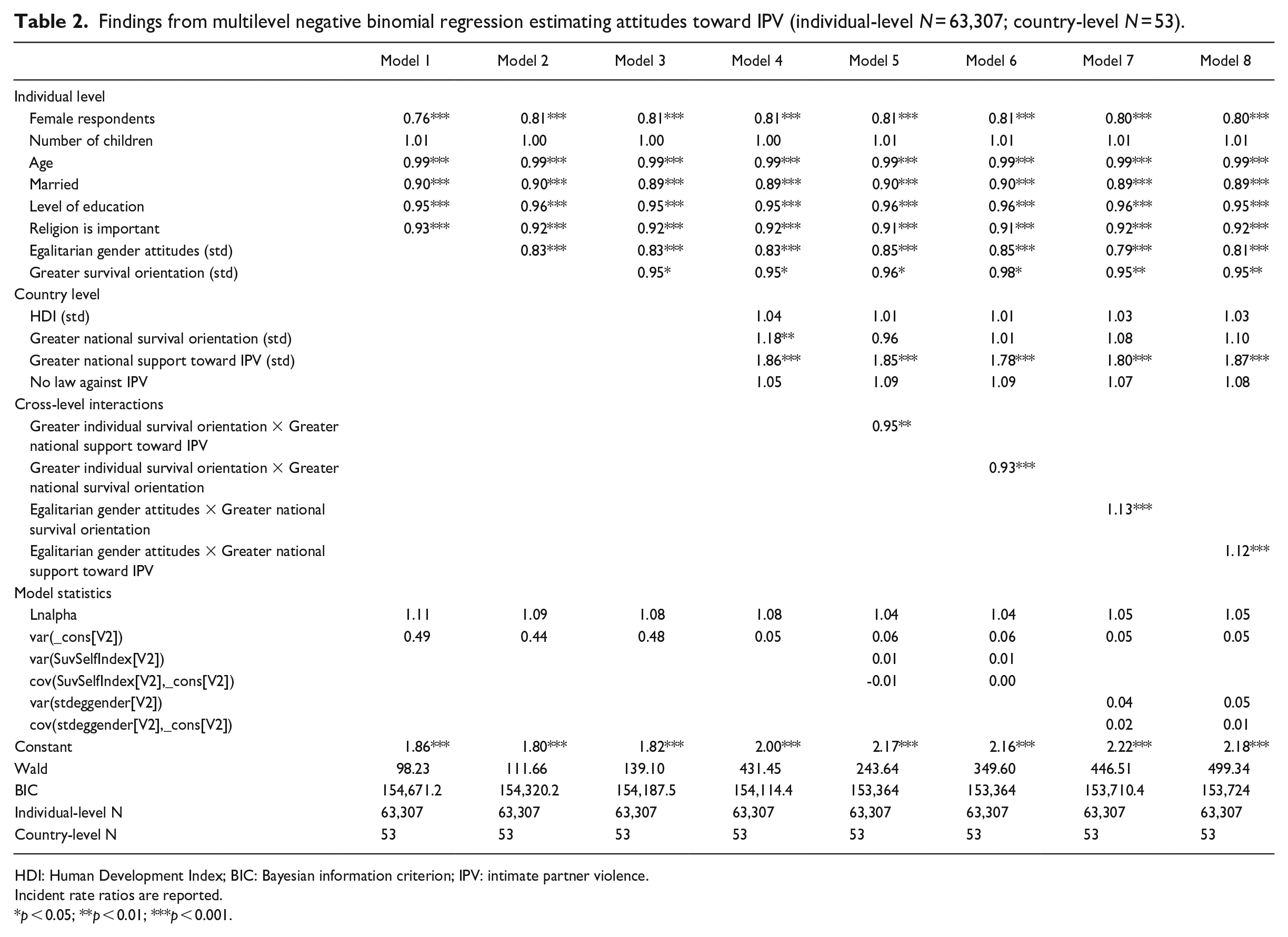
Findings from the multi-level negative binomial regression are in Table 2. Model 1 includes only the individual-level control variables. Women, compared to men, had less supportive attitudes toward IPV (Incidence Rate Ratios [IRR] = 0.76, p
Findings from multilevel negative binomial regression estimating attitudes toward IPV (individual-level N = 63,307; country-level N = 53).
HDI: Human Development Index; BIC: Bayesian information criterion; IPV: intimate partner violence.
Incident rate ratios are reported.
p < 0.05; **p < 0.01; ***p < 0.001.
Model 2 introduces individual-level egalitarian gender attitudes, which were significantly and negatively associated with attitudes toward IPV (IRR = 0.83, p
Model 4 introduces the country-level predictors. The country-level self-expressive/survival scale was significant and positively associated with more supportive attitudes toward IPV (IRR = 1.18, p
Models 5 through 8 present the cross-level interactions. Before we could present these models, we needed to determine whether there was variation in the outcome measure between nations. The inclusion of a random slope for the individual-level self-expressive/survival scale (BIC = 153,384.80) and individual-level egalitarian gender attitudes improved model fit (BIC = 153,723.90) compared to the full model (Model 4 BIC = 154114.40). Therefore, we estimated cross-level interactions.
As recommended by Robson and Pevalin (2016), we plotted cross-level interactions to better interpret the findings. This allows us to ascertain magnitude and substantive significance of the results. For all items, predicted scores were estimated for a respondent who scored 1 SD below the mean, scored at the mean, and scored 1 SD above the mean on the two items included in the cross-level interaction. These predicted scores were based on married, female respondents who scored the mean on all remaining items.
As indicated in Model 5, there was a significant cross-level interaction between the individual-level self-expressive/survival scale and greater national support toward IPV. Findings from Model 5 are presented in Figure 1. There are not many differences in individual’s predicted scores within nations that are less supportive toward IPV. All predicted scores were between 0.38 and 0.40. However, in nations that are more supportive toward IPV, more self-expressive individuals (1 SD below the mean) had greater predicted support for IPV (1.89) than individuals with a more survival orientation (1 SD above the mean; 1.09). There is almost a full point difference in the predicted score. Model 6 and Figure 2 present the significant cross-level interaction between the individual-level self-expressive/survival scale and the country-level self-expressive/survival scale. In more self-expressive countries, individuals with a greater survival orientation (1 SD above the mean) were predicted to have greater support for IPV than individuals with a more self-expressive orientation (0.82 compared to 0.65). However, in countries with more survival orientations, individuals with a more self-expressive orientation (1 SD below the mean) were predicted to have greater support for IPV (1.01) when compared to individuals with a more survival orientation (0.56).
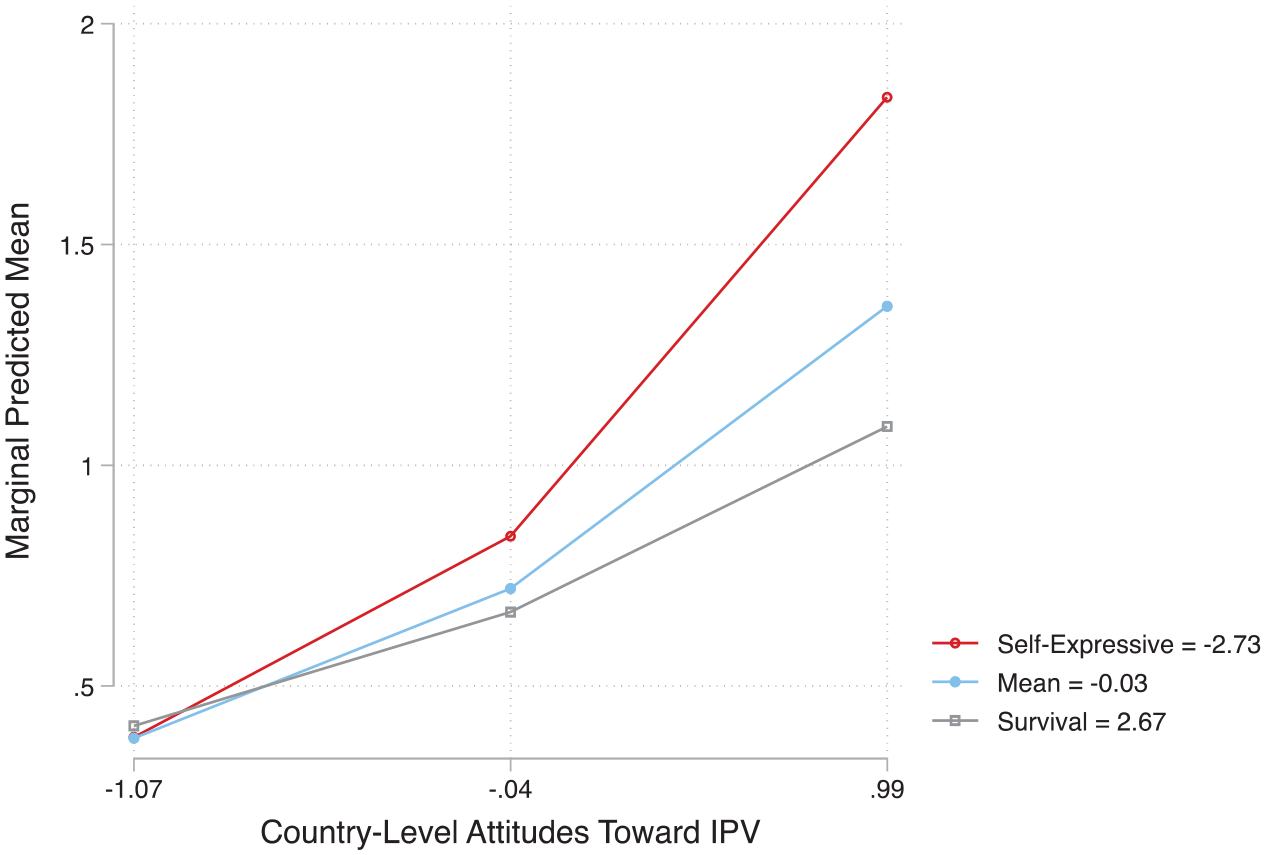
Predicted attitudinal support toward IPV for three different levels of the individual-level self-expressive/survival scale and greater national support toward IPV.
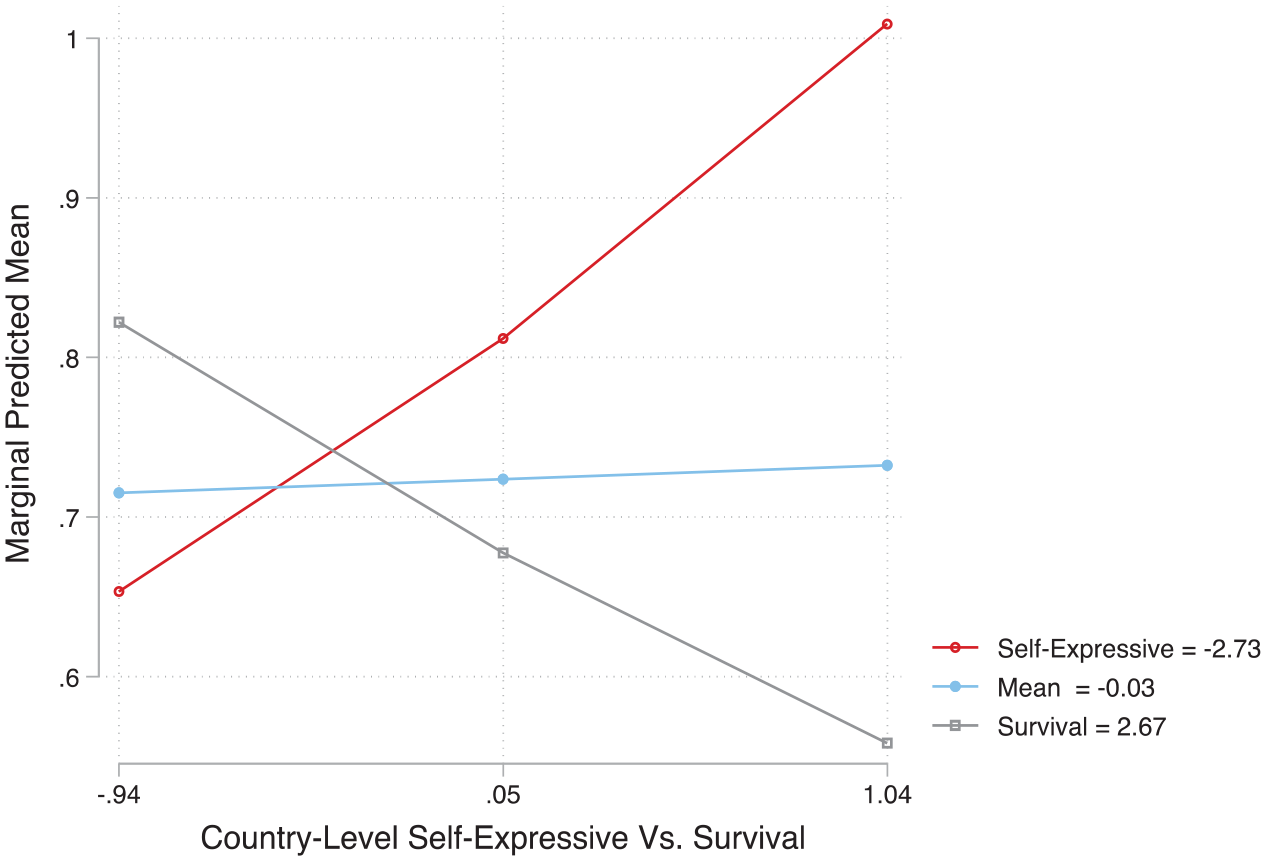
Predicted attitudinal support toward IPV for three different levels of the individual-level self-expressive/survival scale and greater national survival orientation.
Model 7 and Figure 3 present the significant cross-level interaction between egalitarian gender attitudes and the country’s self-expressive/survival scale. In nations that are more self-expressive, those who espouse more egalitarian gender attitudes (1 SD above the mean) had less support for IPV (0.48) than those who were less supportive of egalitarian gender norms (1 SD below the mean; 0.91; difference = 0.43). The gap between predicted scores narrowed in nations with a greater survival orientation (1 SD above mean on egalitarian gender attitudes = 0.72 compared to 1 SD below mean on egalitarian gender attitudes = 0.85; difference = 0.13). Model 8 and Figure 4 present the significant cross-level interaction between individual-level egalitarian gender attitudes and greater national support toward IPV. Once again, the gap between those who espouse more egalitarian gender attitudes and those who were less supportive slightly narrowed in nations with greater support for IPV. While not as drastic as the other cross-level interactions, the findings suggest that the country context moderates the individual-level relationship between egalitarian gender attitudes and attitudinal support toward IPV.
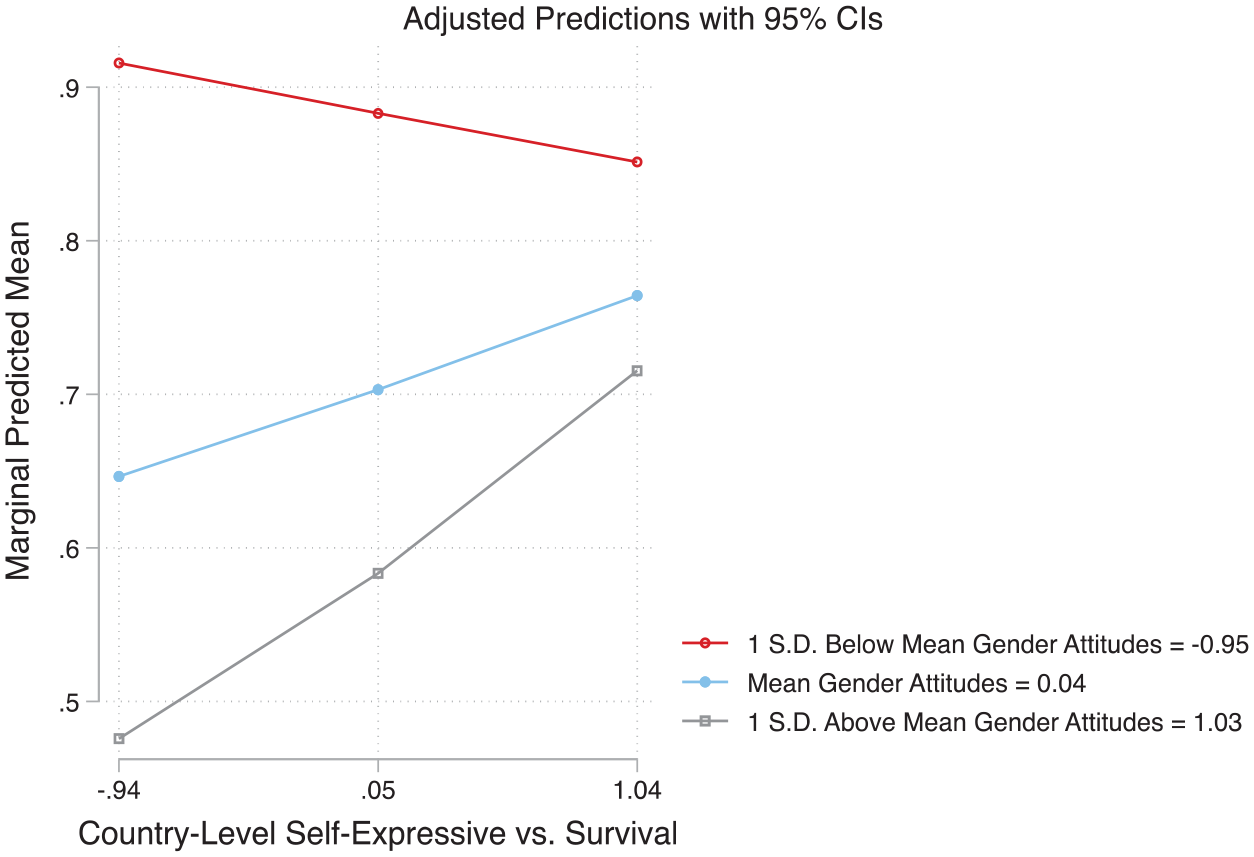
Predicted attitudinal support toward IPV for three different levels of individual-level egalitarian gender attitudes and greater national survival orientation.
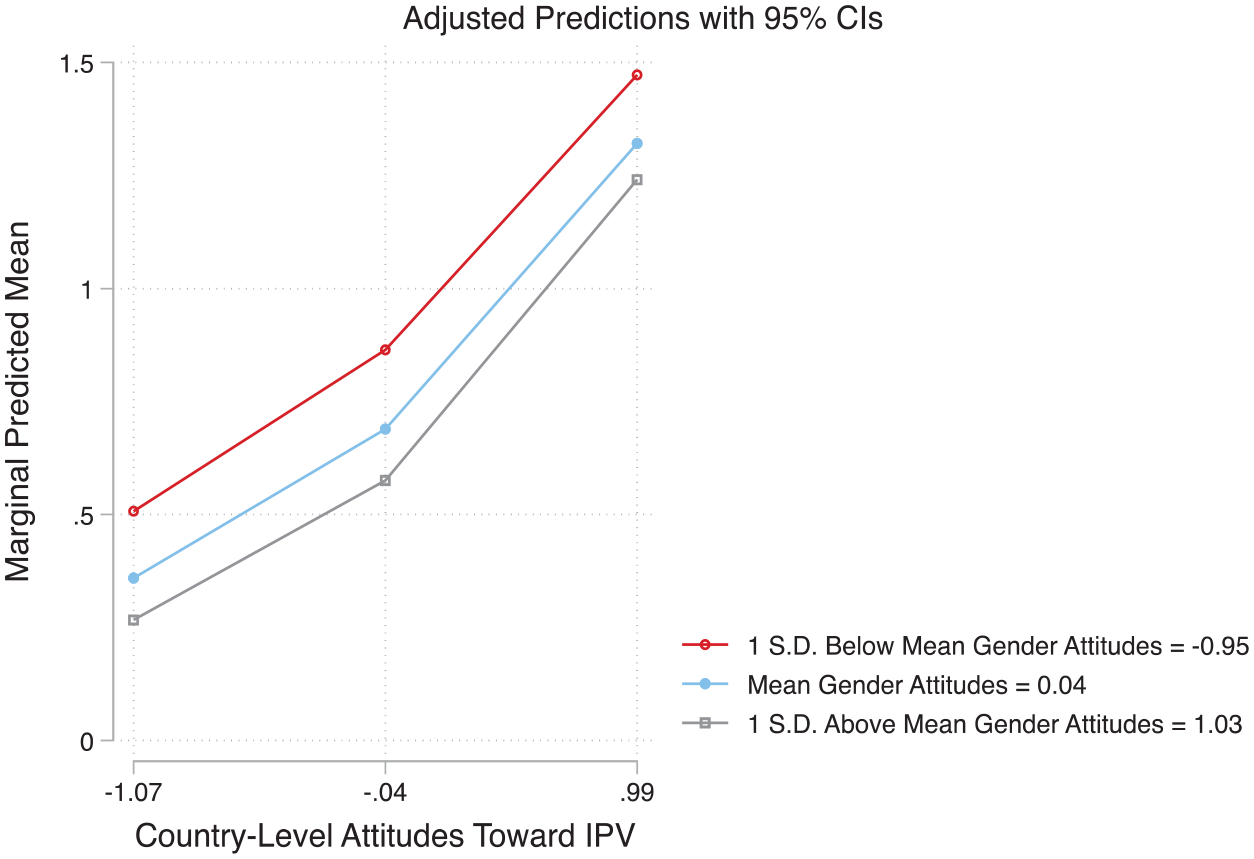
Predicted attitudinal support toward IPV for three different levels of individual-level egalitarian gender attitudes and greater national support toward IPV.
Discussion
This study sought to extend prior literature by considering both micro and macro factors associated with individual attitudinal support for IPV across nations with varying levels of national economic development. In this study, correlates at both the individual and national level were associated with individual attitudinal support toward IPV. Furthermore, findings from this study highlight how the national context conditions individual-level attitudinal support toward IPV. This latter point has substantive implications for how we understand person–context interactions. As we make sense of the findings, we speculate on their implications for the development of country-specific policies and programming for IPV.
To begin, this study demonstrates that greater national support toward IPV shapes individual attitudinal support toward IPV across nations with different levels of national economic development. Furthermore, we found no effect of having a law against IPV on individual attitudinal support toward IPV. While this may be somewhat surprising as one may expect the law to convey public sentiment, 11 as we elaborate below, legislation and sentiment do not always reflect each other at a given time. Together, these findings substantively emphasize the importance of normative context, and that legislation and policies cannot necessarily serve as proxies of public support (or lack thereof) for issues like IPV. We revisit this point below.
Second, extant work and this study demonstrated an association between attitudes toward more traditional gender roles and attitudinal support toward IPV (De Judicibus and McCabe, 2001; Truman et al., 1996). This finding is not particularly novel. The real contribution is that cross-level interactions revealed that country context moderated this association. The gap in predicted attitudinal support toward IPV between those who had more egalitarian gender attitudes and those who were less supportive of equality narrows in nations that have a more survival orientation or nations that have greater support for IPV. This suggests that individual-level egalitarian gender attitudes have more influence in more self-expressive nations and in nations that are less supportive toward IPV. This has implications for how we design and enact policy and programs and reinforces the importance of context.
Third, a greater individual-level self-expressive orientation was positively associated with attitudes supportive of IPV. At the macro level, living in a more self-expressive nation was associated with less support for IPV. The cross-level interaction between the micro and macro self-expressive/survival scale unpacked this unexpected finding at the individual and provides a more meaningful interpretation of the findings. Persons who hold a more survival orientation but live in a more self-expressive context were more supportive of IPV than those with a more self-expressive orientation in a more self-expressive context. However, the opposite pattern emerged in more survival nations. Individuals with a stronger self-expressive orientation who live in more survival nations actually had greater support for IPV (see Figure 2) than individuals with a greater survival orientation in the same context. It is possible that a stronger self-expressive orientation does not orient to the nuances of IPV in a more survival context. Individuals with a greater self-expressive orientation but who live in a nation farther on the survival continuum likely have competing demands that affect their overall attitudes. While such persons are more likely to support autonomy and enhancing one’s quality of life (Inglehart et al., 2002), they are also living in a broader environment where there is greater insecurity. When asked about IPV, more self-expressive individuals in more survival contexts may interpret the question as having autonomy “behind closed doors,” reflective of greater support for IPV. On the other hand, cross-level interactions reveal that differences were less stark in more self-expressive nations (0.17 difference in predicted score compared to 0.45 difference in predicted score in more survival nations) and that individuals with a more survival orientation in this context are more likely to support IPV.
The magnitude of these differences is important and can provide direction for governments in adopting policies and programming. In more self-expressive contexts, programming efforts may be better able to target persons across cultural orientations given the smaller differences between these two groups. On the other hand, in more survival nations, greater outreach by groups might be necessary, but extra efforts may need to be concentrated on those who appear “progressive” as it may not translate into more inclusive options that enhance quality of life. Substantively, this finding suggests campaigns against IPV in nations will need to consider the complexity of this association and the variability within nations. As such, governments need to design programs and policies that recognize the multifaceted dimensions individuals will receive information in. Taken together, these findings reinforce that the same campaign and response to IPV will not work for every nation (MacGregor et al., 2020) and that the campaign might not work for every individual within that nation.
Fourth, while this study focused on attitudes, it has implications for the development of policy and intervention efforts as research suggests attitudes may be a salient risk factor for IPV (Zark and Satyen, 2021). Consistent with the conclusions for this study, scholarship has found that laws are not always associated with attitudes (Adamczyk and Pitt, 2009; Hayes and Boyd, 2017; Hayes and O’Neal, 2018; Roberts, 2000). In fact, these laws may be performative and/or reactionary. To be direct, passing legislation or introducing mandates will likely be ineffective strategies. Given the salience of national support toward IPV, strategies that emphasize cultural shifts will be critical. Assessing change in aggregated attitudes is one way to evaluate such programs (Pierotti, 2013).
In addition, this study has implications for analytic approaches used to assess attitudes toward social issues. Attitudinal support toward IPV was modeled with negative binomial regression as a discrete measure because of overdispersion. In addition, most respondents’ scores clustered at zero. Prior research that has used the WVS to examine attitudes toward IPV (Chon, 2021) and prostitution (Stack et al., 2010) has used binary outcomes to account for skewness in the data. Similarly, Hayes and O’Neal (2018) used a dichotomous measure to better capture those who held extreme views toward child maltreatment. Conversely, Adamczyk and Pitt (2009) retained the original continuous coding in their multi-level analyses of attitudes toward homosexuality. While it is possible to transform data, such interpretations are not always intuitive and there are inherent issues with such approaches (Berry, 1987). This body of work indicates that research questions, in conjunction with a close inspection of the data, should drive analytic decisions in future projects that use the WVS. This is crucial considering, at the time of writing, that multi-level negative binomial analyses in Stata could not be estimated for imputed data.
While this study adds to the body of knowledge on public support of IPV, there are some limitations that merit mention and for which future research can build upon. An inherent limitation of the WVS is that it does not capture IPV victimization or perpetration. While behaviors and attitudes do correlate (Glasman and Albarracín, 2006), they are not deterministic. It is also important to mention that while this study collectively focused on IPV, the question wording is very specific and captured if it is justified for a “man to beat his wife.” There are several victims of partner abuse that this phrase would not recognize or capture—men, individuals in same-gender relationships, individuals in dating relationships, or victims of emotional, sexual, financial, and/or other forms of abuse by an intimate partner that do not amount to physical violence. There is good reason why the WVS and other cross-national data collection efforts use the phrasing about a man beating his wife: These questions must be translated into many languages in ways that retain the original meaning. In addition, these surveys have been ongoing for many years to allow for longitudinal trend analyses (see Pierotti, 2013, for a trend analysis of Demographic and Health Survey data). Nevertheless, the conceptualization of IPV has and continues to evolve. Future designs of cross-national survey efforts should consider the diversity of victimization experiences in IPV. Furthermore, given differences in attitudinal support toward IPV by gender (see Appendix 1), gender-specific models may be worthwhile avenues for future research.
Next, nonresponse bias may be present. There were significant differences between respondents missing data and respondents who were not missing data on all individual-level demographic measures. To appropriately model the distribution of data and account for clustering of observations, final models with imputed data could not be estimated. This issue reinforces the analytic choices researchers must make when working with the WVS data. In addition, the data are cross-sectional. Findings cannot speak to what causes supportive attitudes toward IPV but instead focused on the correlates.
Finally, the alpha value for the self-expressive/survival scale was moderate. It is important to re-emphasize that this was a theoretically driven scale conceptualized and operationalized in line with a body of research (Adamczyk and Pitt, 2009; Boyd and Chung, 2012; Hayes and O’Neal, 2018; Stack et al., 2010). 12 We performed extensive checks on this measure but reiterate and prioritize the theoretical origins of the measure.
Conclusion
Cultural orientation as both a micro and macro force is associated with individual attitudinal support toward IPV (Inglehart, 1990, 2006; Inglehart et al., 2002). Furthermore, national support toward IPV is positively associated with individual-level attitudinal support toward IPV. Findings from this study demonstrate that the national context can shape attitudinal support toward IPV. Furthermore, cross-level interactions demonstrate this macro context can shape individual-level direct relationships in unanticipated ways. Collectively, this work demonstrates the importance of considering more macro-level factors when examining individual attitudes and recognizes that any intervention or prevention effort for IPV needs to involve the citizens who are directly impacted (D’Ignazio and Klein, 2020) as well as the variability between citizens.
Footnotes
Appendix
Average self-expressive/survival (i.e. positive values = more survival orientation; negative values = more self-expressive orientation) scale and national support toward IPV by nation (N = 53).
| Country | Self-expressive/survival scale | Attitudes toward IPV | Women’s attitudes toward IPV | Men’s attitudes toward IPV | % missing | Country | Self-expressive/survival scale | Attitudes toward IPV | Women’s attitudes toward IPV | Men’s attitudes toward IPV | % missing |
|---|---|---|---|---|---|---|---|---|---|---|---|
| Tunisia L-M | 2.30 | 1.09 | 0.59 | 1.53 | 23.24 | Pakistan L-M | 0.20 | 0.58 | 0.61 | 0.55 | 9.67 |
| Jordan U-M | 2.17 | 0.60 | 0.43 | 0.77 | 4.83 | Bahrain | 0.25 | 1.11 | 0.95 | 1.24 | 31.08 |
| Georgia U-M | 2.08 | 0.17 | 0.14 | 0.20 | 11.40 | China U-M | 0.10 | 1.39 | 1.07 | 1.69 | 40.43 |
| Azerbaijan U-M | 1.99 | 0.85 | 0.66 | 1.05 | 3.59 | Cyprus H | 0.03 | 0.37 | 0.30 | 8.00 | |
| Morocco L-M | 1.87 | 1.58 | 1.18 | 1.99 | 37.25 | Ecuador U-M | 0.10 | 0.67 | 0.65 | 0.69 | 1.25 |
| Armenia U-M | 1.84 | 0.57 | 0.29 | 0.87 | 13.73 | Philippines L-M | 0.05 | 2.44 | 2.36 | 2.52 | 2.58 |
| Palestine | 1.62 | 1.40 | 1.16 | 1.66 | 22.90 | Peru U-M | –0.02 | 0.89 | 0.88 | 0.91 | 24.21 |
| Ghana L-M | 1.45 | 1.11 | 0.91 | 1.31 | 0.00 | Estonia H | 0.05 | 0.44 | 0.32 | 0.59 | 21.33 |
| Yemen L | 1.49 | 1.25 | 1.32 | 1.18 | 53.70 | Thailand U-M | –0.09 | 0.70 | 0.65 | 0.73 | 13.50 |
| Iraq U-M | 1.47 | 1.81 | 1.37 | 2.21 | 17.42 | South Korea | –0.41 | 0.58 | 0.43 | 0.73 | 7.92 |
| Libya U-M | 1.40 | 1.08 | 0.96 | 1.19 | 29.14 | South Africa U-M | –0.53 | 2.92 | 2.89 | 2.94 | 18.49 |
| Ukraine L-M | 1.26 | 0.74 | 0.57 | 0.94 | 10.07 | Taiwan H | –0.42 | 0.68 | 0.49 | 0.87 | 15.51 |
| Romania | 1.32 | 0.33 | 0.21 | 0.46 | 24.95 | Colombia U-M | –0.71 | 0.39 | 0.33 | 0.44 | 10.38 |
| Zimbabwe L-M | 1.00 | 1.80 | 1.59 | 2.06 | 0.33 | Poland H | –0.83 | 0.29 | 0.27 | 0.30 | 30.85 |
| Rwanda L | 1.07 | 3.22 | 3.21 | 3.23 | 0.39 | Slovenia H | –0.98 | 0.57 | 0.39 | 0.81 | 27.22 |
| Russia U-M | 1.08 | 0.88 | 0.67 | 1.14 | 33.96 | Chile H | –0.99 | 0.30 | 0.28 | 0.31 | 22.50 |
| Malaysia U-M | 1.02 | 1.25 | 1.23 | 1.26 | 0.85 | Argentina U-M | –1.39 | 0.46 | 0.40 | 0.53 | 27.28 |
| Kazakhstan U-M | 1.00 | 1.35 | 1.21 | 1.51 | 0.00 | Brazil U-M | –1.12 | 0.39 | 0.33 | 0.46 | 18.78 |
| Kyrgyzstan L-M | 0.96 | 1.13 | 1.07 | 1.20 | 9.67 | Mexico U-M | –1.30 | 0.82 | 0.74 | 0.90 | 5.50 |
| Turkey U-M | 0.76 | 0.46 | 0.31 | 0.61 | 15.58 | Spain H | –1.41 | 0.29 | 0.29 | 0.30 | 21.19 |
| Nigeria L-M | 0.82 | 1.61 | 1.64 | 1.58 | 0.00 | Uruguay H | –1.64 | 0.39 | 0.29 | 0.49 | 38.70 |
| Algeria L-M | 0.76 | 2.24 | 1.81 | 2.67 | 48.67 | Japan H | –1.89 | 0.40 | 0.30 | 0.52 | 69.30 |
| Lebanon L-M | 0.71 | 1.73 | 1.66 | 1.81 | 28.50 | Germany H | –2.71 | 0.68 | 0.57 | 0.78 | 10.65 |
| Trinidad and Tobago H | 0.24 | 0.36 | 0.28 | 0.46 | 22.72 | United States H | –2.79 | 0.51 | 0.46 | 0.57 | 7.35 |
| India L-M | 0.28 | 1.39 | 1.24 | 1.51 | 39.58 | Australia H | –3.27 | 0.26 | 0.18 | 0.34 | 36.63 |
| The Netherlands H | –3.75 | 0.28 | 0.20 | 0.37 | 23.40 | ||||||
| New Zealand H | –4.05 | 0.30 | 0.27 | 0.34 | 53.03 | ||||||
| Sweden H | –4.96 | 0.39 | 0.45 | 0.34 | 17.08 |
= low-income economies; L-M = lower-middle-income economies; U-M = upper-middle-income economies; H = high-income economies (The World Bank Group, n.d.).
Funding
The author(s) received no financial support for the research, authorship, and/or publication of this article.
