







Abstract
Trust, the belief that others will fulfill their expected obligations, is of vital importance to social movements. While most research focuses on how trust facilitates protests, this article examines how high-risk activism participants deploy various relational tactics to reduce uncertainties and risks. With an in-depth case study of Hong Kong’s protest movement in 2019–2020, this article finds anonymity, preexisting ties, and bonding are the three common responses. Across various interpersonal settings, participants strategize personal trust or minimize their risk exposure, finding ways to collaborate with strangers or acquaintances. Trust is more than a preexisting resource; it can also be created during movement mobilization. Trust enables protest participation, and it also aids in logistics provisioning, as well as sheltering and aftercare of activists. Finally, government repression has worked in part because it aims to undermine the trust networks built up during the movement.
Social movements are coordinated activities striving for common goals; while participants distrust their opponents or oppressors who have brought about their woes, they have to trust their peers to a certain extent to be able to act together. Despite the shared goals, people in the same disadvantaged positions do not automatically collaborate, because of the difficulties in coordination (Olson, 1968), the deficiency of resources (McCarthy and Zald, 1987), the absence of shared identities (Cohen, 1985), and so on. These deficits are sometimes diagnosed as a lack of trust, where trust can be defined as the willingness “with which people set valued, consequential, long-term resources and enterprises at risk to the malfeasance, mistakes, or failures of others” (Tilly, 2005: 12). If people are not able to form a trust network, their collective action is not likely to take place.
Trust or its absence has been frequently investigated in social movement research. Scholars are interested in how the levels and directions of trust influence protest participation. There is cross-national statistical support for trust and protest behaviors, suggesting participants are anticipating the collaborative responses from others, thus reinforcing their movement commitment (Benson and Rochon, 2004; Suh and Reynolds-Stenson, 2018). However, there are dissenting works that challenge the positive association of trust and protest participation. Scholars also find that among the protesters there are likely to be distrusting citizens because they find it to be a substitute for regular political participation (DiGrazia, 2014; Van Stekelenburg and Klandermans, 2018). The inconsistencies are largely attributed to diverse dimensions of trust (of in-group, out-group, and institutions), as well as different forms of protest participation (conventional and unconventional).
This article contributes to the existing literature from a different approach; instead of seeing trust as a precondition, this article is interested in how movement participants maintain or boost trust by managing their social relationship as well as the state’s repressive strategies aimed at dissolving it. Participants are broadly defined as including activists on the street and supporters behind the scenes. How do they deploy diverse strategies to deal with the issue of trust in high-risk activism? Most existing research works are concerned with society-wide trust, whereas this article focuses on trust within the movement camp. The expectation that others will fulfill their anticipated role is vital to all successful movements. Movement leaders have to demonstrate their genuine commitment to attract followers. Donors and volunteers need the assurance that their contributions will serve no other purpose than the movement’s goals. In short, the mundane activities of social movement organizations tacitly rest upon trust among participants, including activists who join rallies and demonstrations, and supporters who contribute resources (Rossi, 2023). Given that trust undergirds movement activism in many ways, it is to be expected that the authorities would attempt to destroy trust networks in order to undermine the challenge (Sika, 2023).
The trust issue becomes more acute when protests are outlawed by the government, or when protesters face the threat of arrest or violence in cases of “high-risk activism” (McAdam, 1986). Anti-authoritarian struggles are by definition high-risk because participants challenge the very foundations of ruling elites, as seen in the Arab Spring (Gunning and Baron, 2014; Ketchley, 2017; Sika, 2021). In Hong Kong, the prodemocracy movement took the form of massive civil disobedience in the 2014 Umbrella Movement—a 79-day street occupation demanding the genuine democratic election of top leadership, which ended in exhaustion without eliciting positive responses from the authorities (Chan, 2022; Ho, 2020). Despite its failure, the eruption alerted Chinese authorities who attempted to tighten their grip on the former British city, thus stimulating a new round of anti-authoritarian struggle in 2019–2020. In high-risk activism, participants cannot automatically assume fellow citizens on the street are comrades, as they might be agents provocateurs or informants (Marx, 1974). Under such fluid situations, people tend to limit their transactions to within their circle of known acquaintances to minimize the risk. However, there are some protest actions, such as blockading the street, transferring money and other materials, or fleeing from police, which require collaboration with strangers. How will protesters act during these emergency moments when trust is nonexistent?
This article develops the notion of “relational tactics,” or the ensemble of movement practices contingent on the nature of social ties, known or unfamiliar, trustful or not, and so on. While maintaining one’s own safety is the paramount consideration, what participants are willing to do depends on a number of relational characteristics. States are known to apply “relational repression” by targeting family members of dissidents (Deng and O’Brien, 2013). As such, participants also take their relationships into consideration when taking part in a movement. 1
This article analyzes Hong Kong’s 2019–2020 protest movement, a territory-wide resistance to defend the city’s eroding rule-of-law and human rights protection. As the authorities responded with harsh repression, protesters grew more militant by using a mixture of both peaceful and violent acts, thus providing an ideal case to understand how participants manage trust and risk for personal safety. This article finds the following three main relational tactics: (1) anonymity: when having to collaborate with strangers, people limit the scope of interaction making the transaction double-blind to reduce their risk exposure; (2) preexisting ties: people deliberately limit their interactions with known people including their friends, direct or indirect; (3) while the first two tactics are largely defensive, there is another proactive strategy bonding, which involves trust-building by investing personal feelings and sentiments.
Relationship and trust in high-risk activism
In the existing literature on high-risk activism, the following two topics are relevant to the trust issue: (1) recruitment and (2) small-group dynamics. Why some people knowingly take part in dangerous movements while others decide to stay away has been the most important question for scholars. Studies have found certain “biographical availabilities” (youth, childlessness, etc.) and a previous history of activism are associated with involvement in high-risk activism (Gundelach and Toubøl, 2019; McAdam, 1986; Wiltfang and McAdam, 1991). Besides individual characteristics, there are studies that highlight the conducive roles of social ties (family, friends, and colleagues). In her study on Italy’s clandestine political violence, della Porta (1988: 160) finds 46.6 percent of participants were recruited by known persons. Nepstad and Smith (1999: 33) find the presence of social ties is the strongest variable in predicting participation in a US-based peace movement. The importance of preexisting ties for activism has been among the most significant findings in social movement studies (McAdam, 2003: 285). Since people tend to trust their family and friends more than strangers, it is no surprise that they are more likely to join high-risk activism through these interpersonal channels. Since preexisting ties often come with solidarity with a predefined group (Gamson, 1992: 61), they also reinforce in-group trust in protest activities.
High-risk activism by definition requires close collaboration among insiders and maximal insulation from outsiders. Studies have found small-group dynamics is the key mechanism, as evidenced in the Warsaw Ghetto resistance (Einwohner, 2006), Latin American human rights activism (Loveman, 1998), and Palestinian insurgents (Parkinson, 2013). Common to these cases is the need to embed movement connection in everyday networks and to perform arduous identity work for disguise. Repression hardens the life of clandestine participants so that they experience a process of “ideological encapsulation” that disconnects them from mainstream society (della Porta, 2013: 204–234). Similarly, a close-knit structure fortified with religious belief and the provision of family support help sustain participation in high-risk activism (Nepstad, 2004). Withdrawing to small groups composed of mutually trusted participants appears as an imperative for survival.
This article furthers the discussion on trust and high-risk activism in the following aspects. First, most studies presuppose movement activists are a minority who must secure their survival on the margin, often relying on a self-sufficient underground network. What happens when the risky protest is actually supported by the majority and there exists ample chance of securing material and non-material support from those who are not personally involved? Instead of in-group enclosure, activists need to develop tactics to interact with sympathetic strangers, especially when the latter are willing to offer various assistance without jeopardizing personal safety. Previously, scholars have been interested in how the nature of social relations, strong ties or weak ties (Granovetter, 1973), bonding social capitals or bridging social capitals (Putnam, 2000: 23) affect protestparticipation (see the discussion by Walgrave and Ketelaars, 2019). This article extends the existing research to the relationship among strangers by asking how different types of interpersonal relationship shape the tactical choice of participation.
Second, following the research agenda promoted by Snow et al. (1986), existing works typically examine the question of “micromobilization,” or the recruitment process through interpersonal connections (Gould, 1993; Jasper, 1999; Zhao, 1998). Beyond the initial decision to join high-risk activism, research attention can be extended to other dimensions of participation. Participants are likely to be physically injured, materially deprived, arrested, and persecuted, and managing the aftercare of high-risk activism is also an issue to be investigated. They also need material resources that they do not possess. The logistic provisioning for movement activism, especially when the protest has sustained a prolonged standoff with the authorities, should also be taken into consideration. Interpersonal relationships certainly affect how individuals choose to take part initially, and their importance continues as these participants enter into a more enduring collaboration. In other words, the research focus should not be limited to the initial decision to participate only, but needs to include sustained participation and how the ex-ante relationship further involves over the course. This article intends to enrich the discussion of trust by reexamining the various tactics that deploy interpersonal relationship beyond the traditional focus on recruitment.
High-risk activism in Hong Kong
In early 2019, Hong Kong’s government proposed an amendment to legalize the transfer of fugitives to Chinese mainland courts, immediately galvanizing a new round of opposition activism. From June of that year, large-scale demonstrations erupted, attracting more than 2 million participants in a city of 7 million residents. The government met the widespread opposition with intransigence, further fanning the mass discontent. It was estimated between 36.4 percent and 45.6 percent of the city’s citizens had taken to the streets (Cheng et al., 2022: 2).
The government’s escalated use of force antagonized the public. On 12 June, the police shot tear gas and rubber bullets into the crowd besieging the city’s legislature, nearly resulting in a tragedy of human stampedes. To add insult to injury, the government immediately pressed forward with the charge of riot crime punishable by up to 10 years in prison. In the ensuing summer months, the police employed lethal weapons including live ammunition, and pro-regime gangsters assaulted protesters, while the authorities conveniently looked the other way. Starting in August, some protesters began to apply violent means, including throwing petrol bombs, destroying pro-regime storefronts and transport facilities, and attacking policemen and their sympathizers. The movement’s radical turn culminated in two fierce university battles in November. Partly due to the attrition of protesters by arrest, and also because of the COVID-19 outbreak in early 2020, the protest wave declined and was channeled into other safer arenas such as political consumerism. As of June 2020, the first anniversary of the flare-up in anti-extradition protest, 8986 had been arrested and 1808 criminally charged. 2
As the protest evolved into a city-wide resistance, there remained a clear distinction between two types of movement involvement. Militants (yungou), sometimes called “siblings” (saujuk) or “children” (jaineui), were typically young and willing to be present at the scenes of conflict, while moderates (woleifei) were mostly middle-aged, more safety-conscious, and refrained from illegal acts. Militants engaged in a number of activities ranging from throwing petrol bombs, vandalism, barricading, and conducting street reconnaissance. On the scenes of numerous conflicts were those who self-identified as first aiders providing on-site medical care to the injured and social workers who attempted to mediate the protester-police conflicts. The distinction between the latter and the militants themselves was not always clear, as some first aiders were sometimes engaged in the conflict and the police often suspected social workers were protesters in disguise. However, moderates tended to make an appearance in legal rallies only, and they typically donated substantially to frontline protesters mostly because of a deep sense of guilt (Tang and Cheng, 2021). Since supporters were mostly middle-aged, they have often been referred to as “parents” (gajeung).
Henceforth, this article identifies two participant types respectively as “activists” including militants, first aiders, and social workers on the front, and “supporters” who provided resources from behind. While activists incurred greater risks for their direct action, the increasing repressiveness from the regime also made supporters insecure. What was previously tolerated, such as donating, now became an incriminating act, which forced moderate supporters to exercise caution in their actions. Even though militant activists applied violence, their demands still enjoyed popular sympathy and could easily gain material support from those who were not directly involved. Moreover, the 2019–2020 protest wave was primarily motivated by a desire to defend the rule-of-law legacy. The movement was supported by consensual values, narrowing the ideological distance between militants and moderates (Lee, 2019).
Scholars have long maintained that trust is a building block for well-functioning democracies because it facilitates citizens’ participation (Putnam, 2000). As a “social capital,” trust encourages cooperative behaviors and lays the foundation for economic prosperity (Fukuyama, 1995). Inheriting from the British colonial legacy, Hongkongers took pride in their legal system and clean government, even though they never enjoyed full-fledged democracy. A high level of generalized trust undergirded the city as a financial center because international investors knew their money would be in good hands. However, since the 1997 handover to Chinese sovereignty, growing signs indicated that the institutional foundations for generalized trust were being eroded, including press freedom, judicial independence, and professionalism among law enforcers. The 2019–2020 protest evolved into a city-wide uprising precisely because of the perception that the government was deliberately undermining these civil heritages. The specter of extradition to Chinese courts amounted to a dismantling of the integrity of Hong Kong’s common law system. The collusion of Hong Kong’s police with triad members in suppressing protesters dealt a mighty blow to its reputation. It is in this context of trust erosion that Hong Kong’s political struggles were swiftly radicalized.
Research method and data
The research data come from in-depth interviews and documentary sources. From 2019 to 2022, I interviewed 28 activists and eight supporters through snowball sampling. All activists were young; most of them were students, and only seven of them were full-time workers during the protest. My interviewed supporters were significantly senior and economically established, including retirees. Interview questions were primarily about their role in the movement, especially how they managed to secure their own safety. All the interviews were manually transcribed into text, and the files were anonymized in order to protect their identities. As trust is inherently inseparable from participants’ own risk assessment, this study reports the interviewees’ subjective understanding of the evolving situations, which can be biased and prejudiced, and therefore, should not be taken as an objective description of the reality.
The Hong Kong’s protests also spawned intensive media coverage and book publications, which provide a wealth of documentary sources of first-person accounts. Published sources, including journalistic reports, books, and audiovisual materials also offer some insightful stories of how these participants adopted safety strategies. As this study is primarily based on in-depth interview data, these alternative sources can hopefully increase the external validity of research findings.
There is a survey published by Chinese University of Hong Kong that reveals the distribution of activists and supporters identified in this article. The phone survey in November 2019 inquired about involvement in specific activities. Two surveyed activities can be used as proximate estimates. Of the respondents, 32.5 percent “assisted protesters, such as donating, giving materials, or offering a free ride,” and 4.1 percent who “engaged in oral and physical conflicts with the police.” Approximately eight times more Hongkongers were willing to lend assistance (supporters) than be personally engaged (activists). Among the overrepresented in the supporters’ ranks were those with a college level or above education (45.5%), higher occupation status (managerial or executive position (45.5%) and professional and semi-professional position (46.8%)), whereas particularly significant among activists were young (age cohort 15–29 (12.3%)) and students (12.3%; Chinese University Hong Kong Center for Public Communication and Public Opinion Survey, 2020). In short, supporters tended to be older and more economically established, whereas activists were younger and mostly high school and university students. In spite of these demographic, occupational, and educational differences, “activists” and “supporters” are not fixed roles that remain constant throughout the movement, as they are often fluid and situation-based. Some of my interviewed activists acknowledged that they might decide not to engage in street protests when they found it too risky and instead limited their participation strictly within legal boundaries. Understanding the possible role change in each protest event, this article conceptualizes the relational interactions between different roles, not between individuals.
Individual safety strategies
Safety in high-risk activism requires individual effort as well as collaboration. Individual strategies aim to reduce the risk of being identified and arrested by the police. Starting with the June demonstrations, participants wore black shirts in protest, and soon the dress code evolved into black bloc tactics, in which militant participants wore black clothing, face masks, goggles, and helmets to conceal their identities, while at the same time, protecting themselves against pepper spray and tear gas. As the police began to practice a preemptive strategy by intercepting young people in black outfits prior to the rally, protesters had to be prepared in their clothing arrangements. Typically, they wore regular clothing when traveling to and from the gathering destinations and applied the black bloc attic only during protest actions. Changing clothes needed to done in a place without surveillance cameras. Some interviewed participants went to great lengths to put on fake moles on their exposed skin to fool the police. Female participants had more flexibility in changing their look, as they could change from skirts into pants, tie up their hair or let it down, or entirely conceal their feminine features during the conflict.
Hong Kong is a tightly packed city relying on a well-developed network of trains, subways, and buses. Yet, public transportation posed dangers to protesters. Swiping an Octopus Card (Hong Kong’s stored value card) left a digital record; as such, whenever possible, protesters bought single-ride tickets with cash, jumped turnstiles, or simply took a taxi. After leaving conflict scenes, protesters avoided going straight home for fear of being followed and they often made detours, spent a few hours in another place, or stayed in an Airbnb accommodation for the night. Travel to and from protest scenes was made all the more difficult as the authorities curtailed the service hours and routes of public transportation.
Protesters were cautious and selective with their personal belongings. As there were widespread rumors that arrested protesters were sent to the mainland for interrogation, many participants knew they needed to bring their identity cards so that they would not be accused of being illegal immigrants. For militants, who wanted to bring tools and materials to the frontline, careful logistical planning was necessary. Wrenches, screwdrivers, and hammers could be placed in the corners of some back alleys in advance, and some materials such as plastic bands (for barricade construction) were best procured locally so as to minimize the risk of transporting these incriminating materials. Petrol bombs could be produced in advance or in situ; in the latter case, the required components such as fuel, glass, and sugar were to be carried separately.
The advance of digital communication empowers worldwide protesters (Castells, 2012; Gerbaudo, 2012; Shirky, 2011). Hong Kong’s participants relied extensively on their smartphones and social media for mobile communication, with LIHKG (an online chat room) and Telegram emerging as the de facto information centers. Many participants abandoned popular instant messaging platforms for those that incorporated end-to-end encryption. While acknowledging the ubiquitous presence of digital communication in Hong Kong’s protest, my interviewees revealed a narrative of heightened risk consciousness and meticulous care in using their personal devices. Among the common practices were using virtual private networks (VPN) to disguise their Internet protocol (IP) addresses, adding a secondary smartphone with only essential apps installed (so-called “ghost phones”), or installing a single-use SIM card. Some deliberately chose number locks, rather than facial or fingerprint recognition, in case policemen attempted to forcibly unlock their devices in custody. Telegram, with its enhanced security protection features, began to replace Facebook and WhatsApp, two previously popular platforms in Hong Kong during the protest. As Telegram’s public groups and channels were accessible to all subscribers, their admins and users avoided posting incriminating materials, and participants formed private groups for their internal communication instead—a clear case showing that digital communication per se did not generate interpersonal trust.
In short, while protesters benefited from state-of-the-art communication, they were keenly aware of the threat of a “digital Leninism,” in which the Chinese state monitored its citizens through advanced Internet technologies (Wong and Dobson, 2019), and implemented a number of precautionary measures. One episode suffices here to demonstrate such awareness. In August, protesters destroyed several smart lamp posts that contained high-resolution surveillance cameras and dismantled the electronic devices for public display. 3 Although the government claimed the experimental project was only for the purpose of monitoring weather and traffic, protesters remained skeptical.
Relational tactics for collaboration
While the above-mentioned safety tactics could be practiced alone, many high-risk protest activities require collaboration. One interviewed activist explained, When we have two or three people throwing petrol bombs and confronting the police, we need at least three people on the scout. They need to observe the surroundings because frontline fighters are not paying attention to what happens behind or beside them. In case of emergency, these scouts simply yank the fighters away.
Another shared his experience of storefront vandalism, Safety is the priority concern. So if possible, we always destroy CCTVs first . . . We need at least six participants to carry out “renovation” [the code word for “destruction”] because people are needed to hold umbrellas to shield participants from surveillance cameras.
Besides these manifestly violent acts, some peaceful activities also needed teamwork. For instance, “Lennon Walls,” which are displays of posters and hand-written post-it notes in public places, have been a signature repertoire in Hong Kong’s protest (Li and Liu, 2021). Yet, pasting posters could be a risky endeavor because of unexpected police raids and violence from pro-regime mobsters. Consequently, neighborhood Lennon Walls were usually maintained by a group of volunteers who had intimate local knowledge regarding the likely directions of police action and routes for escape. One interviewed participant revealed that they always deployed three sentinels with walkie-talkies when putting up new posters.
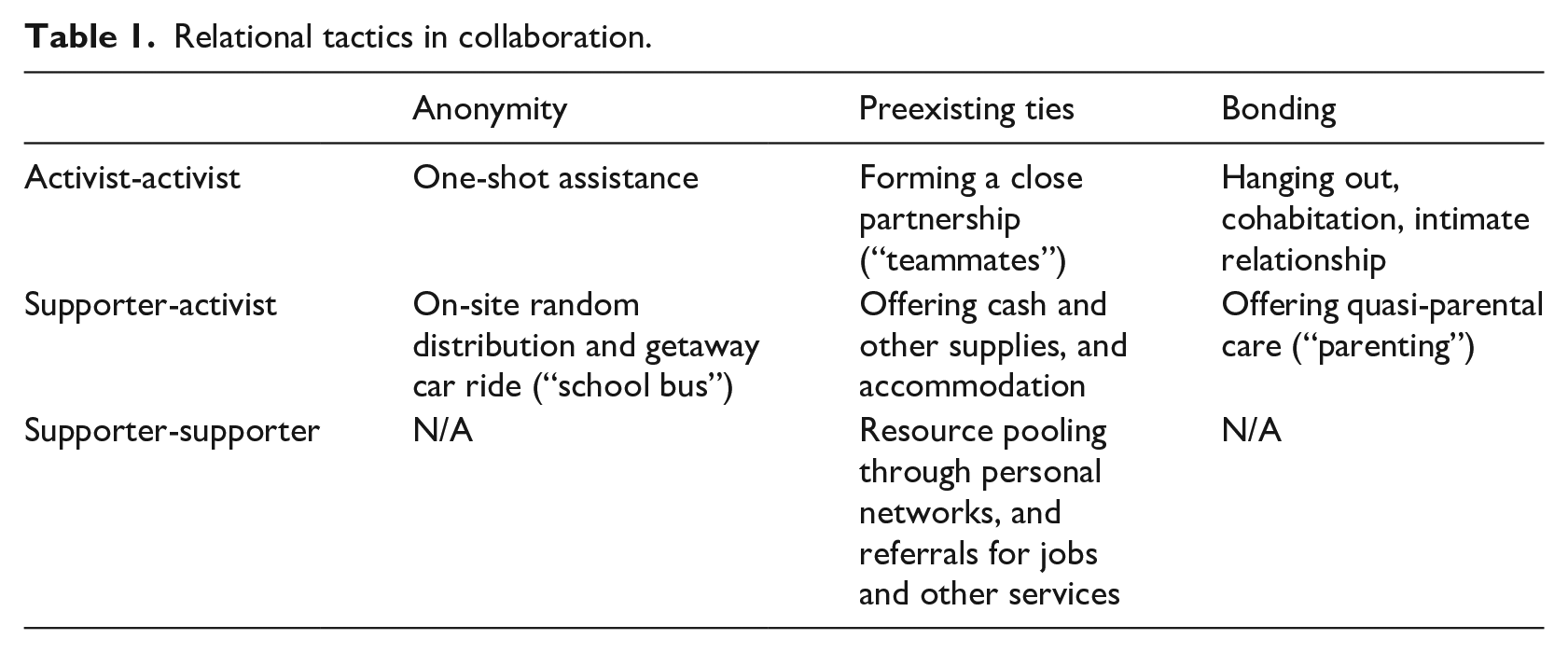
Here I find that three relational tactics of anonymity, preexisting ties, and bonding are common ways to manage one’s interpersonal relationships. When applied across different interpersonal settings, they engender various practices. As mentioned above, “activists” and “supporters” are the two main participant roles in the movement, each with specific tasks to fulfill, namely, confronting the police and resource provisioning, respectively. Hence, we can have the following three dyadic relationships: activist-activist, supporter-activist, and supporter-supporter, in which different relational tactics can be applied. Table 1 maps the known activities from interviewees.
Relational tactics in collaboration.
Anonymity
There are occasions when collaboration is urgently needed among strangers. Under this circumstance, the most frequent coping tactic is to apply anonymity to mutually hide one’s identity by limiting engagement scope. Anonymity is typically used in low-trust situations to reduce risk (Kramer, 2018: 110).
On the frontline, activists rarely worked together with strangers because of the confirmed presence of undercover agents, or the so-called “ghosts” (gwai), who disguised themselves as protesters. The pervasive suspicion limited the scope of collaboration among unknown militants; if it happened, it was often ad hoc and one-shot. Thus, the only anonymous activist-activist interaction involved first aiders, who generally faced lesser legal risk than those involved in direct actions. First aiders always conspicuously showed their role at the conflict zone by wearing yellow vests with the word “medic” or “EMS” (emergency medical services) printed on them, helmets with a red cross sign, or displaying their professional license. This symbolic gesture certainly aimed to send the signal to law enforcers that they were harmless, but also to injured protesters who needed emergency medical care, such as rinsing injuries with normal saline, providing oxygen breathing face masks, and stanching bleeding. Such one-shot assistance still required the willing compliance of those who suffered police violence.
First aiders were likely to form an ad hoc team since their task was relatively standardized and safe. One interviewee shared his experience, On July 21, I first participated in the movement as a first aider. I met other colleagues and then we formed a temporary team. We did not know each other before, and I didn’t want to know their identity and real name. An ad hoc team like this does not even bother to form a Telegram group. After that day, I did not contact them, either . . . I really do not care that much because the goal is to save people.
Anonymous supporter-activist collaboration also needed to deal with the consequence of lack of trust. Since supporters could not be sure their material provisioning and help were delivered to those in need and activists could not fathom the true intention of these good Samaritans, their interaction was inherently fraught with difficulties. As a supporter who frequently donated to pro-movement organizations explained, “I don’t know protesters, and they may see me as a ‘ghost’. And, I want to stay out of unnecessary complications.”
On the rally sites, many supporters simply brought their supplies to distribution booths and left them there for anyone willing to take them. One interviewee remembered receiving boxes of advanced walkie-talkies, expensive gas masks, and filters from strangers. During lulls in the conflict, some supporters would approach the militants and ask if they needed anything sotto voce. These supporters parked their cars in the vicinity with their trunks loaded with helmets, masks, and other logistic supplies. Another activist mentioned the experience of suddenly having valuable coupons thrust upon him by unknown strangers who quickly ran away. In addition, there were often persons who personally distributed food coupons from major food outlets to anyone in need. Such on-site distribution could be extremely wasteful and inefficient because it might not always reach those in need, but it reduced the risk posed to givers and receivers.
Another circumstance where supporter-activist collaboration had to proceed anonymously was for the so-called “school buses,” in which private vehicle drivers volunteered to transport protesters away from the conflict zones. Reliance on public transportation represented a vulnerability for the city’s protesters who often needed a speedy getaway when overwhelmed by the police. Entering a stranger’s car could be risky because undercover agents were known to take protesters directly to the police station with so-called “ghost cars.” Some online channels emerged for matching riders and drivers, and there even emerged a Telegram channel that reported the plate numbers of private vehicles owned by policemen. Some motorists would deliberately display their pro-movement sympathy to alleviate the fear among protesters. One interviewee said he always invited the participation of his wife because protesters would trust more with a female passenger present. Drivers usually provided casual clothing so that protesters would not wear black during the ride. Protester riders rarely disclosed the exact location of their residences, as they preferred to disembark at a well-known destination and then manage to arrive home on their own.
An established interaction protocol emerged on the “school bus.” Supporters and activists mutually felt the obligation to not talk about what had just happened. Most of the ride proceeded in utter silence, with protester riders tapping on their smartphones. Even when they engaged in conversation, the topic was never specific and focused on whether protesters had eaten lately or the general condition of the protest movement. Apparently, the point was to maintain anonymity by minimizing personal exposure. My interviewees described entering a stranger’s car as “taking a leap of faith”—something that they would rather not do in normal times. As such, anonymity became the last resort in urgent situations.
Preexisting ties
Making use of preexisting ties means relying on the trust built up in previous interactions and repurposing them for the movement’s purposes. Forming a team (siudeui) for combat, first aid, and other purposes is a frequent feature among frontline activists. Some teams have become famous for their bravery and were widely reported in the media.
4
Among the 28 interviewed activists, only three claimed to have not joined specific teams; yet, they did not act alone, because they more or less knew fellow activists at the scene. According to one activist, On the frontline, I often met people I knew before and we did not make an appointment. When I was dismantling the curbside railing [to make barricades], I met many acquaintances and we were just like old colleagues . . . We all used many aliases, and when I used a specific name, they instantly knew how we knew each other.
Activists with team affiliation planned ahead and decided on the specific sites and activities with which they would engage. Among the 10 interviewees who provided detailed information, the number of team members ranged from twelve to six, with nine as the average. Teams were usually small in size and made up of mutually known people. On the scene of conflict, teammates worked together with their own division of labor, and most of the time, they did not interact with non-members for the sake of safety. After leaving the scenes, teammates were required to report their safe return in the private chat group, and those who failed to do so would be “bombarded with inquiries” (Cheung, 2022: 93).
Since team members had to face the legal consequences together, trust was the first prerequisite. No wonder then that many teams were made up of friends, classmates, neighbors, and colleagues, and gained new members by insiders’ referral. For instance, a university student chose to join a neighborhood-based seven-person team, composed of former classmates from primary and secondary schools. Shared experiences of activism could also be an interpersonal foundation when forming a team. One interviewee was able to regroup her first aid team formed during the 2014 Umbrella Movement after reactivating a long-abandoned online chat group.
When it comes to supporter-activist ties, the main issue has to do with transferring resources from donors to frontline militants through reliable channels. For instance, a supporter who was well-established in his personal career had a younger cousin active on the frontline. As his cousin and her movement friends were facing financial difficulties because of opposition from their families, the supporter decided to contribute a monthly sum of HK$5000 (US$637) to a fund managed by his cousin, alongside contributions from other supporters. His cousin then could decide how to spend the money among her activist friends. Supporters could also offer accommodation to their known activists. Many young activists incurred strong opposition from their parents, and some were evicted from their homes, or even reported to the police by their family. These temporary shelters for the displaced activists were often offered by supporters on a personal basis.
Supporters who relied on preexisting ties to access activists limited their contact channel to one individual only. Therefore, their teammates usually had limited understanding of their sponsors, as evidenced by one activist’s experience: Our sponsor helped us to find medical doctors through his personal connections, and he gave us financial support. I do not know how we got in contact with this person in the first place, and it was likely that one of us knew him. Sometimes he accompanied us to the protest scene but chose to stand at a distance. Originally I thought he might be an undercover agent, but he really treated us well. He took us to the New Year’s reunion dinner and helped us with academic study. As time passed by, I grew to trust him.
Obviously, the story told of a well-intentioned supporter who relied on personal relationship to connect with a group of activists, and yet the person decided to remain incognito.
In terms of supporter-supporter relationship, preexisting ties were important to pool resources together. An interviewed supporter solicited contributions from her office colleagues, university alumni, and neighborhood residents. Since supporters were older and more established, their referrals came in handy for activists whom they personally knew, and this was especially helpful when it came to the aftercare of protest activism. Frontline activists suffered from physical and mental injuries, and they were afraid of seeking professional help for fear of exposing their involvement. While many free medical services existed on the Internet, supporters helped by circulating information through their personal connections. An interviewed supporter donated a sum of money to a sympathetic acupuncturist who was willing to charge less for injured activists, and he chose to spread this information through activists he knew.
Another business owner was willing to hire activists who lost their jobs due to their movement participation. Yet, he was reluctant to spread the news publicly and preferred to rely on his personal networks for referrals. He was afraid that interviewing those job seekers would land him in legal trouble. In short, supporters who made extensive use of preexisting ties followed the Cantonese saying “gourds and vines are intertwined together” (tanglinggwa, gwalingtang) in the anticipation that personal relationships would eventually connect the dots.
Bonding
While preexisting ties relied on personalized trust, anonymity aimed at reducing the risk. When in face-to-face settings, preexisting ties enabled unrestrained interactions, but anonymity restricted the collaboration in question to be one-shot, random, and distant. Both represented a sort of defensive safety strategy geared toward acquaintances and strangers respectively; nevertheless, another proactive strategy existed that aimed to build trust. Bonding here meant the effort to deepen an existing relationship and to layer it with an affectional dimension. In this way, protest participants were not only united by their movement commitment, but also were drawn closer with personal sentiments.
As outlined earlier, teams usually emerged from among those with preexisting ties. Yet, there was also the possibility that new teams would emerge among people who had been strangers to each other. One activist described how he met his future team members after a round of street fighting, We were spread out and resting in the shopping mall, and people were idly looking at each other. We all wore black and were young. I had the telepathy (samling gamying) that we are all “siblings” and so I began to chat with them and exchanged our Telegram account . . . In the beginning, we used pseudonyms in protest actions, and later on, we went out for fun and started to use our real names.
Trust was minimal in the early stage of the newly formed teams, but with accumulated experiences in risky confrontations with the police, trust was cultivated, and so were the feelings of friendship and comradeship. Bonding often took place among these new teams. My interviewees reported that they often hung out together at Internet cafés, restaurants, pubs, or karaoke parlors with team members. Shared recreational interests, such as online gaming (Lin and Sun, 2022), further solidified their mutual bonds. Clearly, they were making friends at the same time when joining a protest movement.
Living together is another form of bonding. Activists evicted from their homes needed to find new accommodation; while some were taken care of by known supporters, others had to rent an apartment together, often with financial assistance from supporters. In this way, some team members ended up becoming roommates, intermingling their political and private life. Cohabitation was often a temporary expediency since these cash-strapped activists did not have many options. Moreover, it became unavoidable when activists had to flee abroad to escape legal persecution. Unprepared for the sudden exile and unfamiliar with the host countries, escapees usually had to rely on the shelters provided by their overseas sponsors. Thus, at home or abroad, cohabitation strengthened the personal ties among some activists.
Bonding can also take the form of intimate relationship. At least two of my interviewed activists had their boyfriend or girlfriend on the same team. The mixture of romance and activism was apparently well-known, as evidenced by a then popular, albeit sexist saying, “Girls will only marry frontline brothers and boys will only marry logistics sisters” (gamsang jiga chinsinba, gamsai jicheui haukansi). A 17-year-old girl was reported to “collect bail money, find lawyers, and send meals to prison” (To Freedom Committee, 2020: 98) after her boyfriend was caught.
In the existing literature, the involvement of sexual or affectional elements in high-risk activism was said to erode participant solidarity (Goodwin, 1997; McAdam, 1988: 93–96). While the evidence the author collected does not substantiate the negative impacts of sexual jealousy, it is of interest to note that conservatives in Hong Kong attempted to stoke a moral panic about the unsupervised relationships among protester teenagers away from home. A politician asserted that she had evidence indicating that young girls were indoctrinated to serve as “sex slaves to frontline warriors.” 5 Disregarding the intended sensationalism and gender stereotypes, intimate bonding among youthful protesters did certainly take place—an inevitable commingling of the political and the personal.
Bonding also takes place in supporter-activist relationship. As indicated earlier, there were supporters who volunteered to offer protest gear, cash, coupons, jobs, and housing to protesters in need through their personal connections. However, some supporters took this a step further by becoming their surrogate parents. Their involvement became holistic as these supporters cared about more than the safety of activists, but also their wellbeing and future.
The award-winning documentary film Revolution of Our Times (2021) told the story of a “rioter family” composed of a “Daddy,” a “Mommy,” and around 10 younger activists. “Daddy” and “Mommy” were militants themselves and they got to know each other when taking shelter after a nasty fight. They formed a team by taking in stray younger participants. With the growing movement involvement, they began to live together, celebrated the mid-autumn festival (a traditional family reunion day), and held birthday parties. During the fierce clashes at the Polytechnic University in November, many of the family members were injured and subsequently, they decided to flee to Taiwan together. According to “Mommy,” the greatest worry was how to secure visas and jobs for her “children.” And there were moments when “Daddy” thought he might have become too devoted to his fatherly role because he kept reminding his “children” to maintain habits of personal hygiene (The Revolution of Our Times Team, 2022: 117–172). In short, surrogate parent–child relationships formed in street protests could evolve into durable, close, and border-crossing ties that fulfill the functions of a real family.
Finally, bonding rarely takes place among supporters. Since they can always use preexisting ties or impersonal channels (such as donating to pro-movement organizations) to pool together their resources, there appeared to be no need for them to form an emotionally tight community.
Discussion: relational tactics and repression
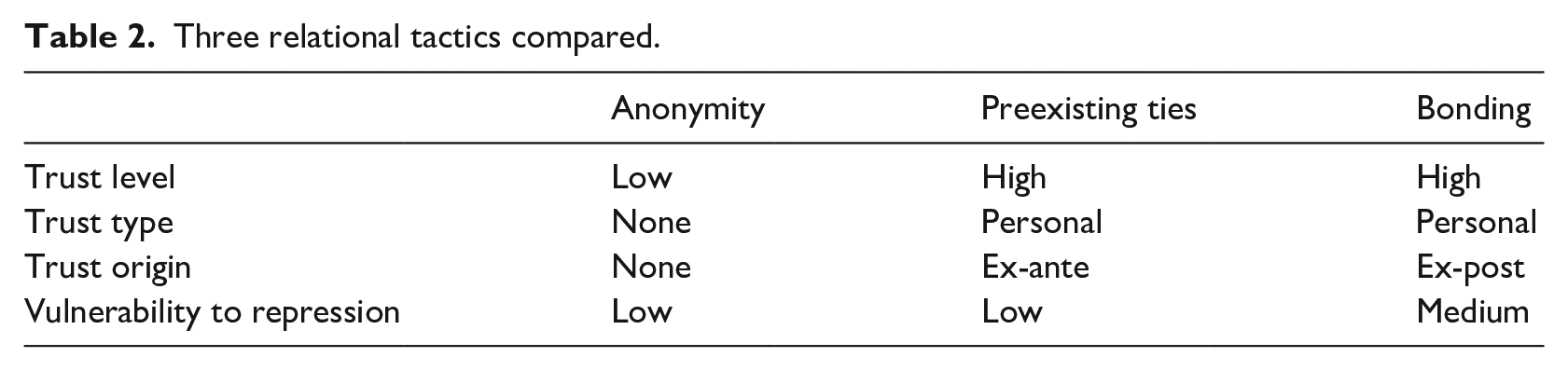
Rather than seeing trust as a determinant of protest behavior, this article focuses on how protesters deploy diverse relational strategies to deal with the issue of trust in high-risk activism. From a closer look at Hong Kong’s protest movement, the three main strategies of preexisting ties, anonymity, and bonding have been identified. Preexisting ties rely on personal trust accrued in previous engagements. Anonymity includes one-shot interactions with first aiders, random on-site distribution, and minimized contact during “school bus” rides, which all aim at reducing one’s risk exposure. Trust and risk are related concepts, and oftentimes distrust originates precisely from the awareness of risk. As a relational tactic, anonymity takes place in the context when participants cannot place sufficient trust in others, but that does not mean the interaction is completely shrouded in distrust. Activists and supporters who practiced this tactic were fully aware that they belonged to the same camp and embraced the identical goal, but both also shared the interest in minimizing the risk.
Preexisting ties rely on ex-ante trust resources, indicating that protest movements always emerge by making creative use of existing connections. The observation here applies to the extreme situation where participants have to “mobilize from scratch”: in the absence of civil-society organizations, they have to make “maximum use of any relationships of trust on which they could pull” (Pearlman, 2021: 1979). Bonding is also based on personal trust; however, while preexisting ties bank on the previous acquaintanceship, bonding further develops friendship, intimate relationship, and quasi-familial ties out of newly formed ties. In other words, while preexisting ties are trust-dependent, bonding is actually trust-enhancing and relationship-making. The peculiarity of bonding serves as an important reminder that movement agency is inherently creative and improvisatory (Polletta, 2002). Most people trust their family and friends only and maintain a distrustful attitude toward strangers, but in the extraordinary situation of high-risk activism, movement participants are likely to alter their original trust/distrust calculus. Camaraderie in street protests generates social bonds that are caring and nurturing. That many evicted activists who were forced to sever preexisting ties with their natal families and found unexpected warmth in newly formed communities speaks volumes about the power of bonding. This article concurs with the insight that social capital should not be seen merely as the requisite for movement activism but also as one of the potential outcomes (Diani, 2001).
While acknowledging the resourcefulness of movement participants to make use of preexisting trust as well as to generate new trust ex-post, we need to recognize that the human capacity to build trust is an inherently finite resource and vulnerable to determined suppression from the authorities. In the wake of COVID-19 and the national security law imposed in July 2020, Hong Kong’s streets were pacified again, leaving scant traces of the yearlong prodemocracy struggles. Facing the higher risks of being arrested and sentenced, both activists and supporters would think twice about continuing their involvement. Among my 36 interviewed activists and supporters, at least six were arrested and two were subsequently sentenced to prison as of June 2022. As such, it is equally important to understand how regime repression dissolves trust among movement participants (Sika, 2019), thereby undermining city-wide protest activism.
Since teams and many supporter-activist relations depend on personal connections, preexisting or newly forged, the suspicion that a person was compromised by becoming an informant would likely lead to the dissolution of teams or relationships. It has been widely circulated that many arrestees were sent to the mainland for interrogation by China’s Ministry of State Security officers. These arrestees were said to be released only on the condition that they would later collaborate by providing information. As such, many teams ceased to operate once any of their members were arrested. Former teammates refrained from further contact with the knowledge that their subsequent interaction would be reported. As an instance of the pervasive fear of arrestee informants, the “rioter family” mentioned earlier was forced to severe contact with two “children” who were arrested and subsequently released (The Revolution of Our Times Team, 2022: 121–123). There is no need to romanticize the quasi-family bonds formed during the high tide of contention because they are also vulnerable to state manipulation.
The draconian national security law clearly aimed at eradicating the sources of the city’s mass uprising, and consequently, the regime aimed at destroying the pro-movement personal trust, as manifested in the tactics of preexisting ties and bonding. As the national security law was to become effective, many prodemocracy Hongkongers shut down or renamed their social media page, not only to disguise their political stand but also to prevent security agents from snooping on their contact lists. Some prominent prodemocracy leaders, like Nathan Law who was exiled in the United Kingdom, quickly announced the “severance of kinship relationship” with his family members in public so as to protect them from state harassment. 6 However, such a disclaimer failed to deter the authorities from applying relational repression. Three years after the national security law, a police dragnet brought up to 22 family members and friends who were related to overseas exiles for interrogation. 7
So what has been left in the wake of the regime’s trust-busting repression? As kinship, friendship, and acquaintanceship with known dissidents are now a target of repression, resource collecting and delivery through these channels has become more difficult, or at least, needs to be proceeded with extra caution. Therefore, the functions of preexisting ties and bonding quickly declined. By contrast, the tactic of anonymity is likely to stay, because it is precisely built on the premise of insufficient trust. For instance, the channels of online crowdfunding and political consumerism (the so-called “yellow economic circle”) will continue because of the lower risks involved. All the crowdfunding platforms are based overseas and so far have not provided user data to the Chinese government. Shopping at pro-movement stores that hire activists who lost their jobs is non-political at its face value. In other words, online platforms and everyday shopping become the remaining avenues for participation because they are safe by anonymizing the participants, and yet, their functions are essentially limited. In short, the swift dwindling of the trust network accompanied the decline of Hong Kong’s protest movement.
The above discussion is summarized in Table 2.
Three relational tactics compared.
Conclusion
Most analysts are interested in how a societal level of trust encourages or discourages participation in social protests. By contrast, this article does not see trust as a given, but rather as an ongoing task to be managed and accomplished during mobilization. In the context of high-risk activism, where agent provocateurs and informants disguise themselves as fellow protesters, to trust or not to trust becomes an urgent issue to cope with. This article discovers that preexisting ties, anonymity, and bonding are the three main relational tactics, and their creative combination helps sustain a prolonged resistance movement against authoritarian rule. Since personal trust is an important driver of the city-wide uprising, it follows that the authorities attempt to suppress an opposition movement by undermining its trust networks.
This article broadens the discussion of trust in social movements in two ways. A large-scale episode of contentious politics like Hong Kong’s prodemocracy movement is necessarily multidimensional and involves diversified actors. Both throwing petrol bombs against policemen and donating money to needed activists are classified as movement participation, and yet they incur different levels of risk and require the trustful collaboration of different degrees. This article examines relational tactics in activist-activist, supporter-activist, and supporter-supporter settings. The upshot is that trust and its corresponding tactics are essentially situation-based and site-specific—a complexity that the movement agency needs to deal with.
Movement participation should not be reduced to street protest only. Particularly in high-risk activism, logistics provisioning, the aftercare of protest actions, and sheltering also require collaboration among acquaintances and strangers. Trust relations also play a vital role even when participants have ceased to be active, and embark on a life of foreign exile.
Finally, compared with other high-risk activisms, Hong Kong’s prodemocracy movement is noteworthy for its mainstream values (rule of law) and the solid support among the citizenry. This explains why activists who engaged in violent acts could tap into widespread sympathy and contributions from those who were not directly involved. If the movement’s goals were less consensual and more radical, or if the movement were less popular and mainstream, one could reasonably expect its participants would have had to face a more hostile environment in dealing with the trust problems. It remains to be seen how safety tactics, preexisting ties, anonymity, and bonding, are deployed in different contexts across the globe.
Footnotes
Acknowledgements
The author thanks for the helpful suggestions from Mario Diani, Nicole Doerr, and Irene Weipert-Fenner as well as the assitance by Chun-hao Huang, Ka Wing Li, Yu-Erh Li, Hawazzi Tsang, Jessie Tse, Ash Wan, and Wei An Chen.
Declaration of conflicting interests
The author(s) declared no potential conflicts of interest with respect to the research, authorship, and/or publication of this article.
Funding
The author(s) disclosed receipt of the following financial support for the research, authorship, and/or publication of this article: This research is financially supported by Taiwan’s National Science and Technology Council (110-2410-H-002-231-MY2) and National Taiwan University (111L891301).
