







Abstract
This study analyses the working conditions of highly educated mobile workers in five major European Union (EU) markets. The study uses the overeducation indicator, analyzing its transformation over the period 2005–2016. Using annual data from the European Union Labour Force Survey, the results reveal very different conditions between home country nationals and mobile workers from newer (enlargement)—EU-13—and older—EU-15—member states from the perspective of successful economic and social integration. The EU enlargement process has not completely removed the penalty for educated workers from EU-13 countries, but it has significantly reduced it, as has the premium received by mobile workers from other EU-15 member states, thus leading to their better integration and greater equality.
Introduction
The free movement of workers within the European Union (EU) is one of its founding principles, as enshrined in the 1957 Treaty of Rome. The way workers are incorporated into other EU labor markets is an indicator of how these are performing, being the key to successful economic and social integration (Favell, 2008, 2014). The study of mobility and the incorporation of highly educated workers is particularly relevant for those agents that have adopted specific measures and policies to promote their movement within the EU (Assirelli et al., 2019). Overeducation in the labor market (i.e. the existence of a mismatch between an individual’s education and the position occupied) leads to a lack of efficiency, and it is also a significant cost for the worker involved in terms of wages and job satisfaction (Lindley, 2009). This mismatch also has a cost for society, as inefficient use is made of the human capital available (Kalfa and Piracha, 2017). Furthermore, from the perspective of the overall integration of the migrant population, economic/workforce integration is a crucial factor in social, cultural, and civic/political engagement (Alba and Nee, 2003; Fajth and Lessard-Phillips, 2023).
The main research question is “What have been the principal effects of the EU enlargement on the employment status of highly educated workers in certain major host countries?” This study compares patterns of overeducation among highly educated host-country nationals (HCNs), and mobile workers from both newer member states (EU-13) and older ones (EU-15) in five EU countries before, during, and after the last financial crisis, a period that overlaps the EU enlargement, and both enriches and complicates the study. This initial goal also constitutes a major indicator of the EU’s performance and its scope for the incorporation/integration of new citizens; the second goal involves understanding the factors underpinning those situations, thereby providing a major tool for adopting measures that favor a similar treatment for all EU workers and greater efficiency in the use of their human capital. The decision to migrate made by workers with a high level of human capital usually involves their greater understanding of the target market. Strictly economic reasons may be less important than others, such as a better quality of life, career opportunities, or gaining experience (Bartolini et al., 2017; Landolt and Thieme, 2018).
The movement of workers within the EU constitutes a particular aspect because crossing borders makes this an international migration, while the recognition of similar labor rights to HCNs grants them internal migratory status. From the perspective of European integration, it is therefore essential to track the jobs they hold compared to HCNs, as well as to all other workers.
Workers’ mobility within the EU and their integration have gained considerable interest because this movement has intensified due not only to the enlargement process (Barrell et al., 2010),bib7 but also to the financial crisis (Castro-Martín and Cortina, 2015). Significant gaps still remain in our knowledge on the specific aspects of the status of EU mobile workers.
First, studies on labor integration/participation patterns have focused mainly on workers’ position in employment, unemployment, and segmentation (Ballarino and Panichella, 2015; Favell, 2008; Fellini, 2018; Kogan, 2006; Reyneri and Fullin, 2011). Workers from new member states are more exposed to the risk of unemployment than HCNs and workers from older EU member states (Fries-Tersch et al., 2018). A significant part of this segment of workers remains over-represented in economic sectors with worse conditions characterized by relatively low-paid, low-skilled, and often temporary jobs (Felbo-Kolding et al., 2019). Less interest has been shown in overeducation, although some analyses have revealed how the qualifications of workers from new member states are downgraded and even experience the “de-qualification” or “devaluation of skills” when they enter the labor market of specific member states (particularly the United Kingdom; see Drinkwater et al., 2009; Johnston et al., 2015; Khattab and Fox, 2016; Voitchovsky, 2014).
Second, few studies have analyzed the possible effects that the financial crisis from 2008 to 2013 had on the integration process of migrant workers, and particularly highly educated ones (Fellini, 2018; Finotelli and Ponzo, 2018; Mooi-Reci and Muñoz-Comet, 2016). Although highly educated migrants are generally more protected from the employment crisis and deteriorating working conditions than other categories of migrants, the downturn in several member states has also affected them (Guetto, 2018; Mooi-Reci and Muñoz-Comet, 2016). The crisis has reduced both job opportunities and working conditions through a lower demand for labor and more restrictive policies (Cerna, 2014; Czaika and Parsons, 2016; Khattab and Fox, 2016).
Third, the recent enlargement and the scarcity of data mean there is a lack of research on the possible effects that the change in legal status has had on working conditions. The freedom of movement of EU workers stratifies migrants’ rights, differentiating between EU and non-EU citizens (Morris, 2003; Snel et al., 2015). Less attention has been paid, nonetheless, to the fact that workers from new member states do not usually acquire full labor rights throughout the EU as soon as their country joins, as existing member states are allowed to restrict access during the so-called transition periods (Holland et al., 2011). The recent incorporation of Central and Eastern European countries (EU-13) has created an interesting scenario for analyzing how their citizens have joined the markets of EU-15 member states compared to both HCNs and citizens from existing member states. Only a handful of studies have reported on the increase in the migratory flow following the EU enlargement and on national differences based on legal status (Snel et al., 2015). Yet neither the impact on working conditions nor the differences between countries have been studied. Few studies have analyzed how the progressive opening of EU labor markets to new member states is reflected in the occupation–education mismatch, and in turn in the process of worker integration.
Based on human capital theory (Becker, 1964), there is a need to discover whether there is a “penalty” or a “premium” in the labor market depending on the position of highly educated EU migrant workers regarding their HCN counterparts. The penalty refers to a greater likelihood of being overeducated, while the premium means the opposite. Labor market status is closely linked to working conditions (e.g. wages, type of contract, and employment rights) and plays a key role in the integration process for the migrant population (Alba and Nee, 2003; Fajth and Lessard-Phillips, 2023).
We have selected Germany, France, United Kingdom, Italy, and Spain, as the five largest labor markets in the EU, thereby providing enough cases for studying the employment status of highly educated HCNs compared to their more mobile counterparts. Moreover, these countries have different regulations and labor market structures, and very different migration experiences (Aleksynska and Tritah, 2013; Ballarino and Panichella, 2015; Esping-Andersen, 1990; Kogan, 2006; Reyneri and Fullin, 2011). The financial crisis has also affected them in different ways in recent years (Aleksynska and Tritah, 2013; Finotelli and Ponzo, 2018; Landolt and Thieme, 2018) and they have adopted different regulations on the free movement of EU workers.
This study makes a significant contribution to the literature on the overeducation of highly educated workers, focusing both on the analysis of differences across member states and on those within them based on the economic and legal changes recorded in the EU.
Theoretical framework and hypotheses
The theoretical framework for overeducation among highly educated workers in the EU rests on three explanatory pillars: (1) differences in the levels of overeducation across countries; (2) differences in levels of overeducation among workers according to their legal status (HCNs, EU-15, and EU-13); and (3) one central to the two previously mentioned, namely, the trend in overeducation during the time of the enlargement and crisis, affecting both countries and workers.
Overeducation among countries
One of the more widely accepted factors for explaining the rate of overeducation is the mismatch in the labor market between labor supply and demand (Verhaest and Van der Velden, 2013). This explanation is applicable to the particular case of highly educated workers. Some studies include structural factors to explain the imbalance between supply and demand and, at the same time, the differences across countries, such as the rate of labor force growth (Groot and van den Brink, 2000), the sharp expansion of education (Hartog, 2000), investment in research and development (Di Pietro, 2002), or the shortcomings in the transition between the education system and the labor market (Di Pietro, 2002; Verhaest and Van der Velden, 2013).
One of the factors with the biggest impact on the relationship between supply and demand involving highly qualified labor is the increase in the level of education across all EU countries in recent decades (Barone and Ortiz, 2011).
The theory of credentialism maintains that an increase in the level of education has prompted a process of inflation among qualifications: jobseekers have an increasingly higher level of studies, yet this has not gone hand-in-hand with the creation of more highly qualified jobs (Mason, 2002). This has led to an increase in the requirements for finding a job and not so much an increase in the level of qualification required (Collins, 1979; Hirsch, 1977). Employers are faced with a large supply of qualified workers willing to take jobs that do not require that level of education. This means more workers are over-qualified for their jobs (Battu et al., 2000; Brynin, 2002), thereby prompting overeducation. Nevertheless, the expansion of graduate employment varies across countries: while the growth of higher education in Nordic and Central European countries has been accompanied by a change in the structure of employment, this has not been the case in Spain or sundry other countries (Barone and Ortiz, 2011). For our case study, this process is compounded by the effect of the mobility of highly educated workers from Eastern Europe toward Western countries following the enlargement (Fassmann et al., 2014; Favell, 2008).
Other studies have included factors of an institutional nature, such as labor market uncertainty, the type of regulation involved, the level of segmentation, education funding mechanisms, and migration (Ghignoni and Verashchagina, 2014). First, and although there is no consensus on their effects regarding policies on labor protection, most studies find that less regulation prompts greater mobility and facilitates the balance between educational level and employment (Gangl, 2004; Stanek et al., 2023; Verhaest and Van der Velden, 2013). Second, it is worth mentioning the specific circumstances brought about by economic crises, whereby qualified workers have been forced to accept jobs below their educational level because of the prevailing risk and uncertainty (Croce and Ghignoni, 2012). Although there is generally a higher rate of overeducation in countries with weaker economies (Borgna et al., 2019), during recessions these rates of overeducation undergo major changes as there may be an increase in the numbers leaving the labor market to become inactive or unemployed and, in turn, there is a change in mobility within the labor market (Borgna et al., 2019). Third, several studies have reported the significant impact that labor market segmentation has on levels of overeducation, and particularly in the case of the migrant population, on its integration and on its labor mobility (Kogan, 2003, 2006; Piore, 1979; Portes, 1998). This approach considers two segments in the labor markets of the most developed countries: a formal, well-regulated primary segment, and an informal secondary segment. Most migrants enter the latter segment, finding it difficult to move between the primary and secondary segments (Piore, 1979).
Considering the structural situation and the institutional factors, we formulate the following hypotheses:
H1. Structure effect: we expect to find a higher rate of overeducation in labor markets that are more strictly regulated, more segmented, and have greater labor uncertainty.
H2. Memoranda and mobility effect: we expect the mobility linked to the end of the enlargement memoranda to increase the rate of overeducation.
H3: Financial crisis effect: we expect a higher rate of overeducation in the countries more affected by the financial crisis.
Overeducation among workers
This initial approach helps us to explain the possible differences in overeducation across countries, but not the differences that may exist within each country between HCNs and foreign workers and between immigrants originating from different countries.
From a micro-perspective, there are numerous theories that seek to explain the state of overeducation among workers. Several theories maintain that overeducation could be a transitory phenomenon due to a lack of information, problems of skill transferability, fields of study, university prestige, legal status, a worker’s strategic behavior and even discrimination, and disassociate it from the labor market’s structural factors.
According to Human Capital Theory (Becker, 1964; Schultz, 1961), a worker acting rationally will seek to maximize their position in the labor market to match their skills, while employers act rationally by recruiting on the basis of academic credentials, as they consider that education is an objective signal of performance (Spence, 1976). From this perspective, a worker will seek to adjust their educational level through a suitable job. Therefore, overeducation constitutes a temporary situation: the Matching Theories of Job Search (Jovanovic, 1979) indicate that overeducation is due to a lack of information, although once a worker has become aware of their situation they seek a job that matches their level of education; the Theory of Career Mobility (Sicherman and Galor, 1990) indicates that the gap between a worker’s qualifications and their job requirements may arise from a strategic decision to acquire training and instruction and subsequently climb up the employment ladder, particularly among highly educated workers and migrants; Job Competition Theory (Thurow, 1975) emphasizes the importance of job characteristics and argues that workers invest in education to keep their place in the job queue. Finally, Assignment Theory (Sattinger, 1993) finds that the importance of maximizing utility by workers in their jobs does not necessarily involve maximizing their income, but instead the utility may lie in other aspects not directly related to their position, which is significant among highly educated workers and migrants.
Studies analyzing the differences in the labor market among workers with higher education highlight the importance of the qualifications received and the corresponding institution’s prestige. On one hand, the differences between the type of education and a job may be explained by the field of study (Barone and Ortiz, 2011; OECD, 2017). Some studies even find that some of the differences between migrants and HCNs in terms of the level of overeducation are explained by differences in the field of study (Montt, 2015), but we do not have this information here. On the other hand, in some cases the academic literature supports a strong correlation between university prestige and an individual’s position in the labor market (Hoekstra, 2009; Rivera, 2015). This correlation may be explained by several factors (Mihut, 2022): (1) Human Capital Theory (Becker, 1964; Schultz, 1961) acknowledges that a university’s greater prestige may entail a better education and skills acquisition that will be rewarded by the labor market; (2) Signaling Theory (Spence, 1973) contends that the labor market impact is informed directly by the name of the university, which an employer associates with a higher performance; (3) the effect of a university’s prestige may be prompted by the social network that students acquire while enrolled. Prestigious universities tend to provide students with better social networks—social capital—that improve an individual’s position in the labor market (Petersen et al., 2000).bib84 This is an especially significant factor for the migrant population, in general, when education is acquired abroad, as its signal value to domestic employers is lower than a qualification obtained at home, which often incurs a penalty in the labor market, with lower wages or higher overeducation, or both at the same time, with this penalty being higher for non-EU workers (Pecoraro and Tani, 2023).
Another relevant factor to explain overeducation among migrants is the imperfect transferability of credentials and skills acquired abroad (Chiswick and Miller, 2008). According to Chiswick and Miller (2008), migrants’ occupation–education mismatch could be explained by the misaligned exchange of human capital between countries due to issues of language, culture, the specific skills needed, or discrimination (Lang and Lehmann, 2012; Nielsen, 2011). The difficulties in recognizing the accumulation of human capital in the country of origin explain the existence of a “U” pattern in the move from a job in the home country to one in the host country (Chiswick, 1978; Chiswick et al., 2005). Migrant workers initially drop down the career ladder, although this “penalty” disappears over time, facilitating upward mobility in the host labor market (Chiswick, 1978). This problem often stems from poor knowledge of foreign educational systems among employers in the host country (Buzdugan and Halli, 2009). Consequently, employers minimize uncertainty by prioritizing workers educated in the home country or by hiring overeducated migrants. This handicap for migrants can be partially reverted by means of foreign credential assessment. In other words, the recognition of foreign credentials might help to avoid or overcome situations of overeducation, particularly for the regulated professions (Pecoraro and Wanner, 2019). Migrants whose credentials are not formally recognized typically cannot work in licensed occupations or credibly signal their skills to native employers, who are often unfamiliar with foreign qualifications (Brücker et al., 2021; Sweetman et al., 2015). The studies by Brücker et al. (2021) on Germany and by Pecoraro and Tani (2023) on Switzerland find that the certification of a migrant’s academic qualifications in the host country leads to higher wages in Germany, while in Switzerland it improves their level of skills utilization in the labor market and places them on the same level as HCNs.
A number of studies, nevertheless, contend that migrant workers’ incorporation and their work trajectories differ across countries due to each labor market’s structural characteristics (Chiswick et al., 2005; Fellini and Guetto, 2019; Kogan, 2006): the closer the similarity between home and host countries, the better the exchange of human capital and, consequently, the better workers’ integration and professional careers will be.
The importance of recognizing foreign academic credentials brings the focus onto a migrant’s legal status as the final aspect to be considered in their situation in the labor market. A lack of legal status restricts the transferability and recognition of migrant workers’ human capital (Brücker et al., 2021; Pecoraro and Tani, 2023), forcing most of them into the informal market and blocking their subsequent labor mobility (Bauder, 2008). The importance of migrants’ legal status and their participation in the labor market, in particular, invoke the concept of “civic stratification” (Morris, 2003; Snel et al., 2015). Morris (2003) contends that the categories of legal status recognized by the EU, such as member state and third-country citizenship, are the most transparent formal markers of inclusion and exclusion regarding fundamental rights, such as job access. Bauder (2008) notes that EU citizens benefit from similar formal access to most occupations across the EU. However, a lack of status denies access to employment in the formal economy, and many migrants are pushed into the informal one. The gradual elimination of labor market restrictions for EU-13 workers is positively related to their mobility (Castro-Martín and Cortina, 2015; Fellini and Guetto, 2022; Snel et al., 2015).
We therefore formulate the following hypotheses regarding the characteristics of highly qualified migrant workers:
H4. HCNs and migrants: we expect to find a higher rate of overeducation among highly educated mobile workers from EU-15 and EU-13 member states than among HCNs due to differences in the recognition of education systems and the transferability of academic credentials.
H5. Enlargement and legal status: we expect the enlargement processes and the end of the moratoria on worker mobility to balance the rate of overeducation between highly educated EU-13 workers and HCNs and EU-15 workers.
H6. Migrants: we can expect to find a higher rate of overeducation among EU-13 workers than among EU-15 workers, largely due to the prestige of the education systems in destination countries.
H7. Period and time: we expect a general improvement in the integration of highly educated mobile workers throughout the different periods studied and during their time in the host countries.
EU labor context: enlargement, market regulation, unemployment, and intra-European mobility
The enlargement, market regulation, the unemployment rate, and the number of foreign nationals living in each one of these five countries are important parameters for analyzing the labor situation of highly educated EU nationals and mobile workers.
Enlargement and market regulation
An initial aspect to be considered in the analysis of the employment status of highly educated workers in the EU involves the application of legislation, both in the recognition of the full European citizenship of workers from new member states and in the regulation of the labor market in each host country, which are crucial for mobility and access to this market, particularly for highly educated workers.
On one hand, the EU has a raft of rules regulating the labor market and the protection of employment (Barbieri and Cutuli, 2016; Cutuli and Guetto, 2013). The countries in the South, such as Italy and Spain, have extensive informal economies, strict regulation of the formal market, and far-reaching workers’ rights, all of which hinder labor mobility; by contrast, countries in Central and Northern Europe have very small informal economies, and their policies on deregulating the labor market have favored worker mobility toward more stable jobs (Barbieri and Cutuli, 2016).
On the other hand, the EU enlargement processes involving Eastern European countries in 2004 (Czech Republic, Estonia, Hungary, Latvia, Lithuania, Poland, Slovakia, Slovenia, Cyprus, and Malta), in 2007 (Romania and Bulgaria), and Croatia in 2013, have prompted a sea change in the pattern of migration and mobility of workers in Europe (Favell, 2008; García-Gómez et al., 2021), although the full recognition of employment and mobility rights in the older EU member states has not been automatic.
The United Kingdom was one of the three member states, together with Sweden and Ireland that immediately opened their borders to incoming labor from the accession states, with instant recognition of workers’ rights. Spain and Italy introduced a brief moratorium on the mobility of these workers that lasted until the middle of 2006, which became minimal for Romanian and Bulgarian nationals in 2007 (Del Boca and Venturini, 2016; Rodríguez-Plana and Farré, 2016). In turn, France maintained its restrictions on labor mobility until mid-2008. Finally, Germany imposed restrictions on the mobility of workers from Eastern European countries until the end of 2011.
Intra-European mobility
A second aspect involves the volume and flows of EU migrants in these five cases. There is a lack of accurate data over the course of the study period for identifying the number of people in each market, and particularly workers by origin or nationality, and even less so their level of education, so we have to rely on estimates reported by other scholars (Barrell et al., 2010).
Using Eurostat and their own estimations, Fassmann et al. (2014) report that the mobility of EU-13 citizens in Western countries rose from 1.5 million in 2004 to 2.9 million in 2007, and to 4.8 million in 2011. In 2007, Spain, the United Kingdom, Germany, and Italy were the main destinations (no data available for France). Until 2011, Germany recorded low growth in migration from EU-13 countries because of the moratorium on labor mobility, so despite the financial crisis, Spain (1.15 million) and Italy (1.15 million) accounted for almost half of these migrants. Generally speaking, the trend in flows from Eastern European countries has been highly influenced by the enlargement process, the application of moratoria on workers’ mobility, and the effects of the crisis, with an ever-greater presence of highly educated workers (Fassmann et al., 2014; Favell, 2008). OECD data (see Figure 1) on the percentage of foreign nationals in each country, and in particular those from EU-28), record an upward trend with certain variations. Since 2013—the most turbulent years of the crisis—Spain has recorded a slight drop in the number of foreign workers, while Germany has recorded sharp growth since 2011. The United Kingdom and Italy have recorded constant growth throughout the entire period, and France has been the one least affected by the influx.
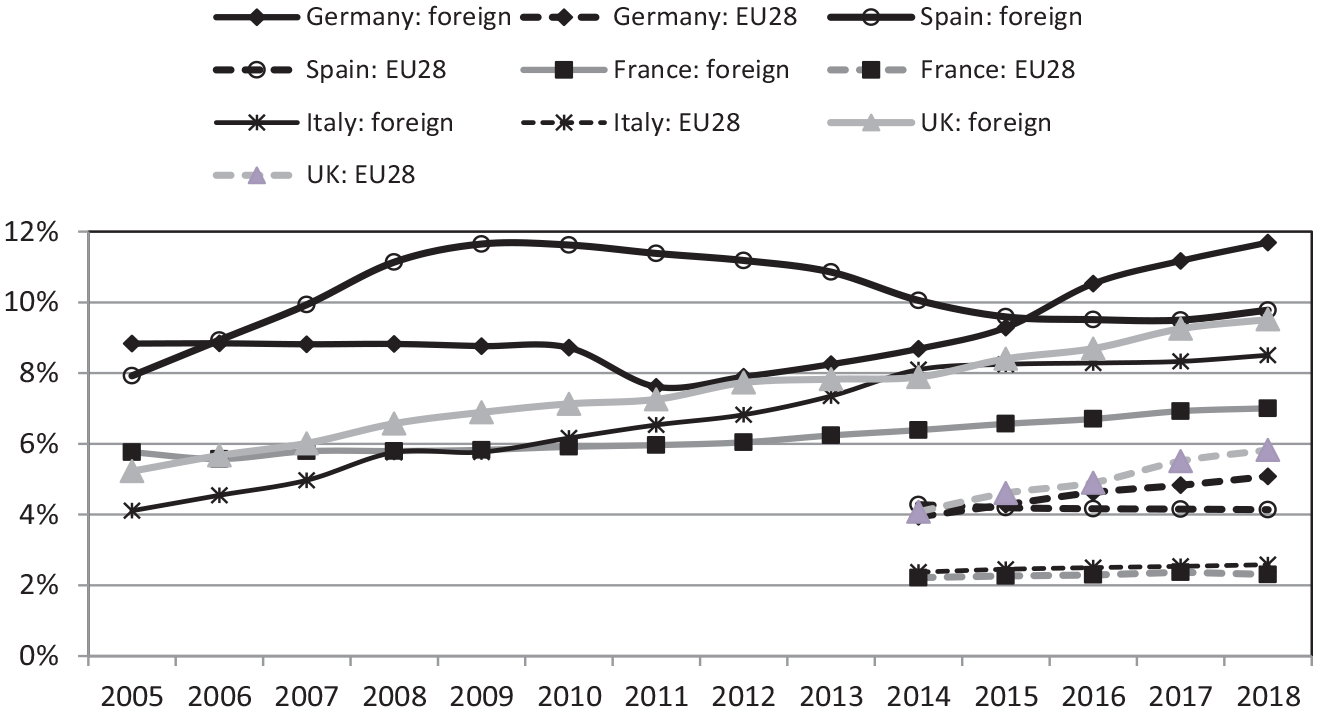
Percentage of foreign population and EU-28 citizens (except reporting country) in selected EU member states, 2005–2018.
Bartolini et al. (2017: 3) estimate that a significant part of the outflux of migrants from the countries most affected by the crisis, Spain and Italy, corresponds to EU migrants returning home or re-emigrating to Northern Europe, thus explaining the migratory flow from Spain and Italy to Germany, for example.
Unemployment
The third aspect to be considered is the unemployment rate in each receiving country. Besides reporting on a country’s economic and employment situation, this variable is closely interconnected with the state of the labor market. Thus, for example, the imbalances between labor supply and demand may lead to adjustments in the unemployment rate and/or in levels of overeducation (Borgna et al., 2019). Figure 2 shows that the unemployment rates for highly educated workers were very similar at the beginning of the observation period. Nevertheless, the crisis radically transformed this situation: countries such as Spain recorded a sharp increase in this rate, peaking at 15 percent, while others, such as Germany and the United Kingdom, recorded the inverse process, with the rate falling as low as 2 percent. In turn, France and Italy recorded intermediate rates, albeit with a modest increase during the recession.
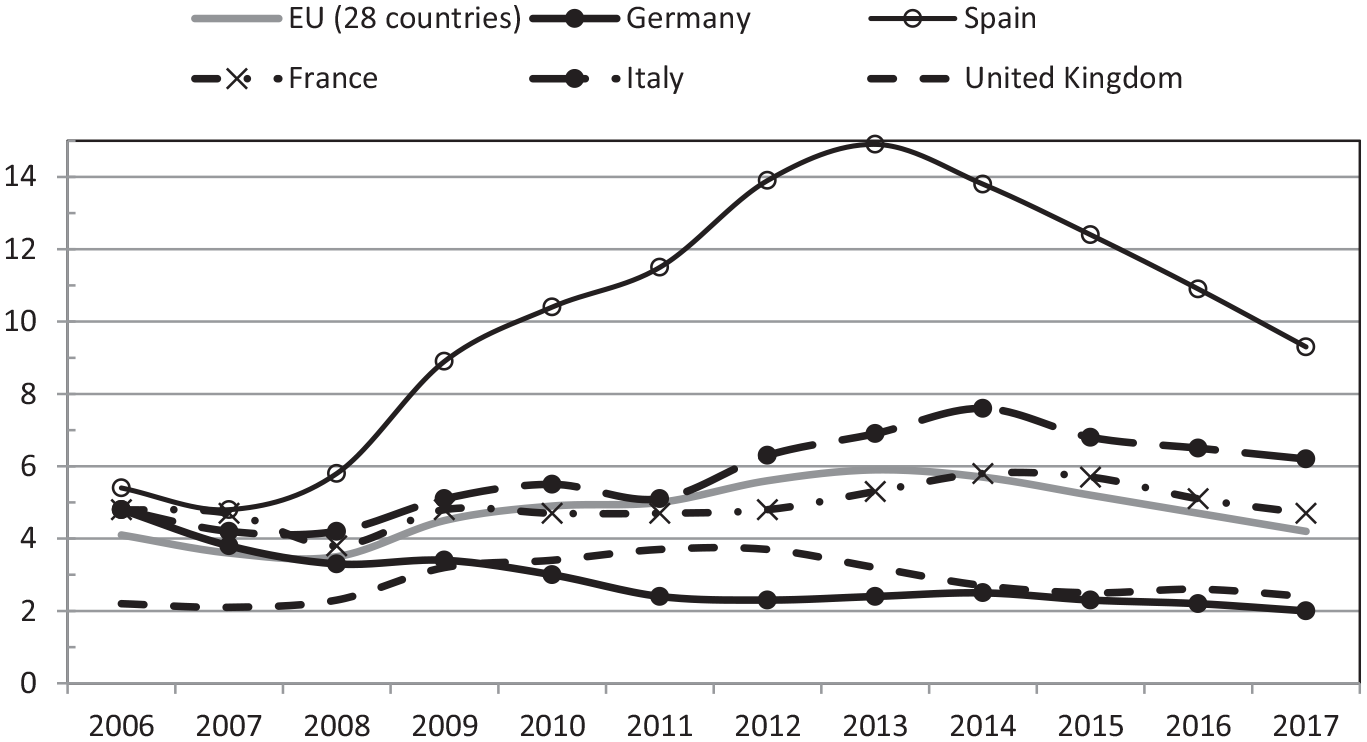
Unemployment rate of the population with tertiary education in selected EU member states, 2006–2017 (% annual average).
Data, variables, and methods
Data
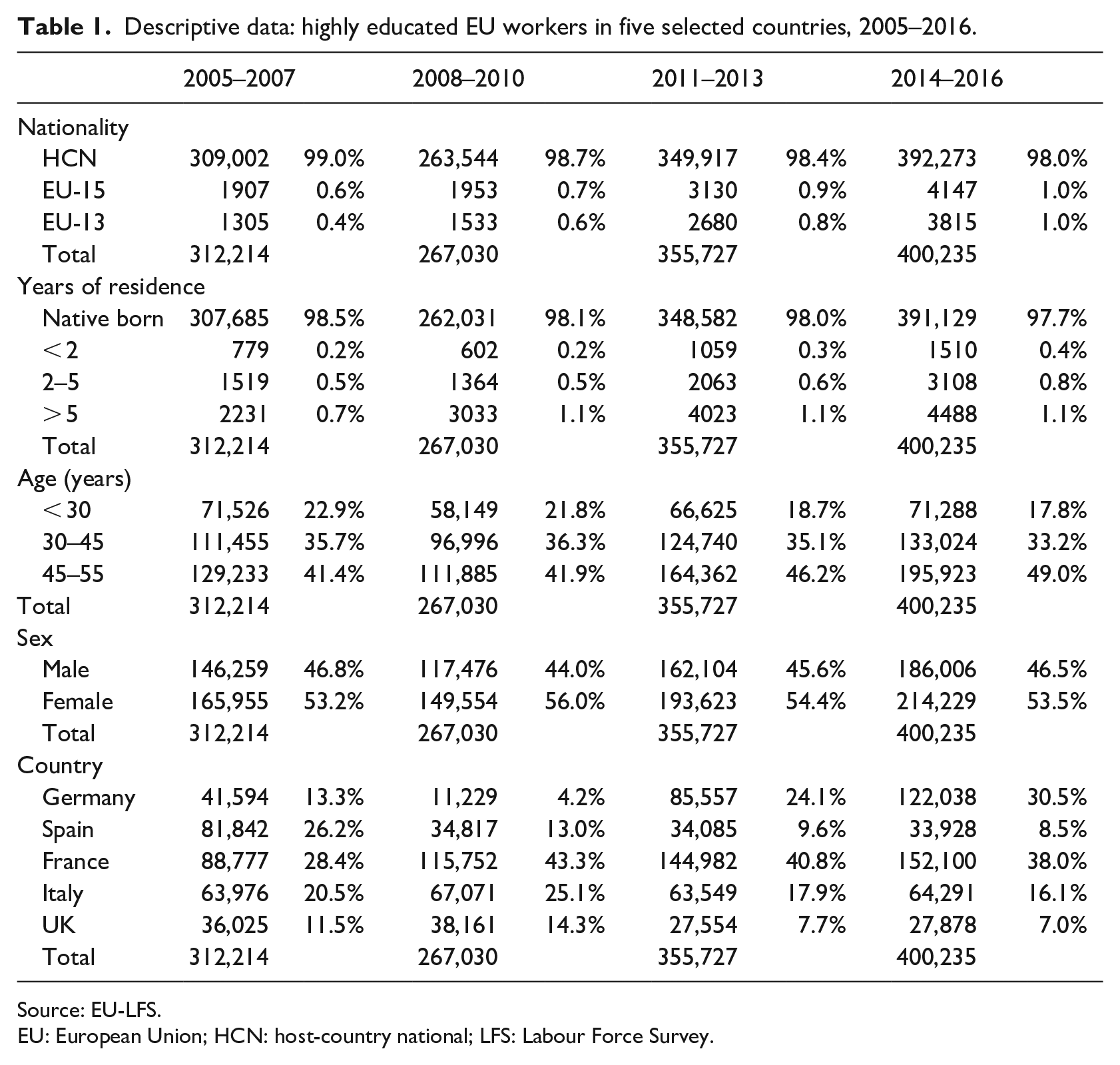
The data source used here involves the annual records from 2005 to 2016 of the European Union Labour Force Survey (EU-LFS) provided by Eurostat for Germany, France, Italy, the United Kingdom, and Spain (see Table 1). These yearly records are constructed from the quarterly data sets based on the panel survey approach.
Descriptive data: highly educated EU workers in five selected countries, 2005–2016.
Source: EU-LFS.
EU: European Union; HCN: host-country national; LFS: Labour Force Survey.
We have selected only the population with tertiary education, under the age of 55, 1 and with a maximum of 10 years’ residence in the country (except for those born there). Within each one of the five countries, we have selected only the nationals of EU-28 member states, establishing the following categories according to the level of separation that the data source allows us: HCNs (reference group); EU-15 citizens, excluding those from each country of reference (Austria, Belgium, Denmark, Finland, France, Germany, Greece, Ireland, Italy, Luxembourg, the Netherlands, Portugal, Spain, Sweden, and the United Kingdom), and the nationals of EU-13 countries (Czech Republic, Estonia, Hungary, Lithuania, Latvia, Poland, Slovakia, Slovenia, Malta, Cyprus, Croatia, Romania, and Bulgaria). Distinguishing by specific country of origin among EU-15 and EU-13 member states, or by university and type of study is impossible, which poses major limitations for the study, as noted in the theoretical framework. Finally, we have excluded self-employed workers due to their peculiar and specific characteristics, especially in certain countries, and because they are not comparable to the rest of the working population (Flisi et al., 2017). This is a major limitation because of the significance of the transition toward self-employment among the migrant population in times of economic crisis, especially in those countries with high rates of unemployment (Fellini and Guetto, 2022; Koehler et al., 2010).
Given the small number of cases for some years and for certain countries, we have merged the records into 3-year periods that are also timeframes with some similarity regarding the legal status of EU-13 workers and the different stages of the recent financial crisis (see Table 1). Nevertheless, there is a certain degree of heterogeneity within EU-13 member states, with some countries joining in 2004, others in 2007, and Croatia in 2013, as well as the various processes of transition adopted by the five host countries, and which need to be considered. During the period 2005–2007, there was a different legal status for access to the labor market between EU-15 and EU-13 citizens (except in the United Kingdom); the period 2008–2010 involves EU accession, and coincides with the onset of the financial crisis; 2011–2013 is the worst stage of the crisis and the end of the transition period for EU-13 workers in Germany; and finally, 2014–2016 is the period of full and equal rights between EU-15 and EU-13 citizens, and the beginning of the economic recovery.
A final aspect of the sample to be considered involves the diversity of occupations held by highly educated workers in each one of the countries under study here (see Figure 3), as well as the difference between those individuals from EU-15 and EU-13 countries (see Figure 4), which is an indicator of the difference in labor markets. The structure of the labor market not only influences the access to employment by highly educated workers, but also their job mobility (Mariscal-de-Gante et al., 2023; Oesch and Rodríguez Menés, 2011).
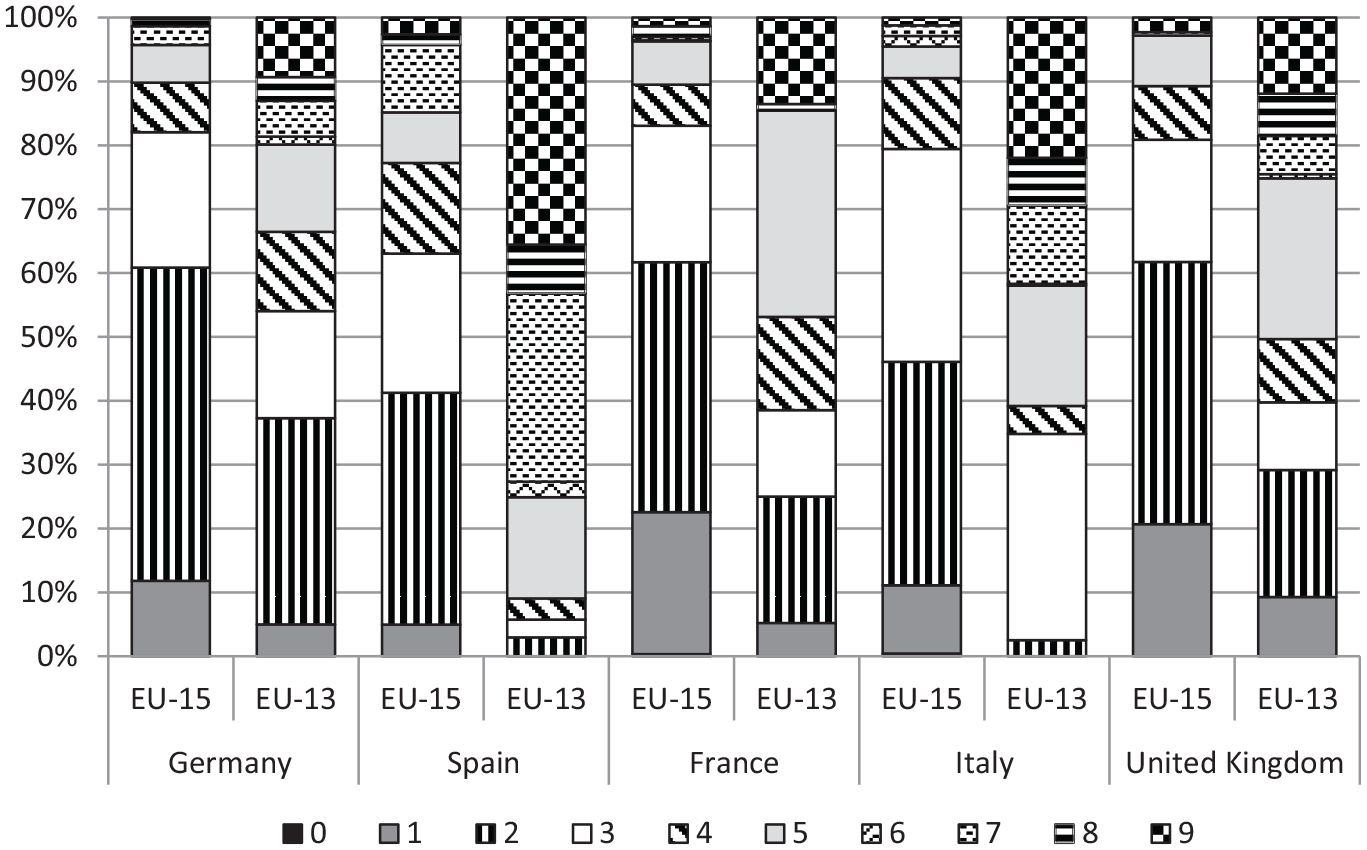
Distribution of the occupations of highly educated workers over the 2005–2007 and 2014–2016 periods in the host countries.
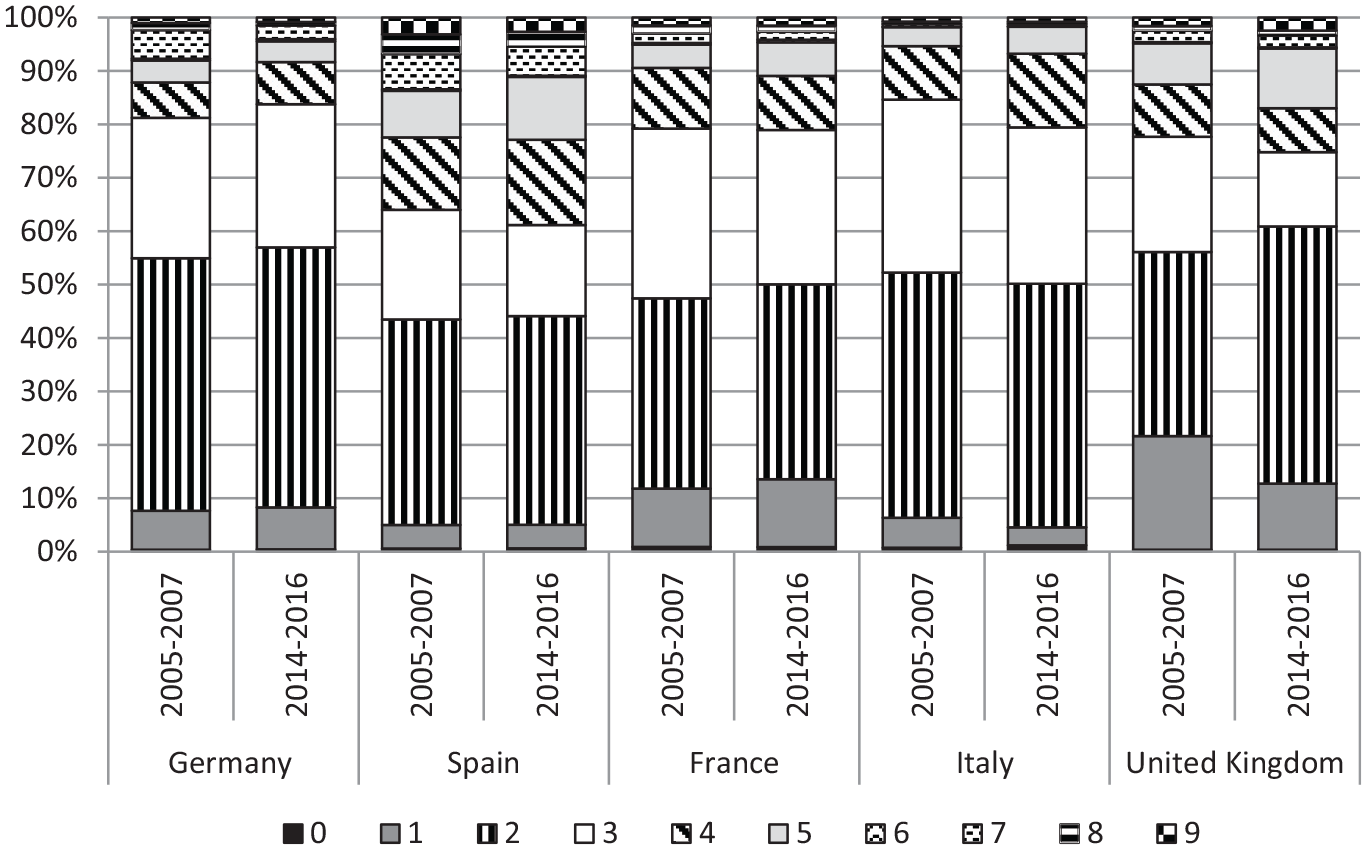
Distribution of the occupations of highly educated workers from EU-15 and EU-13 countries over the 2005–2007 period in the host countries.
We generally find that highly educated workers have professional and technical occupations in all the countries, in both the first and last periods, albeit with certain unique features: professional occupations in Germany and Italy account for almost 50 percent of jobs, which is also the case in the United Kingdom over the 2014–2016 period; in Spain, jobs in clerical support, service, and market sales record high percentages among highly educated workers; in France, besides professional and technical occupations, high figures are recorded for managers and clerks. The United Kingdom records the biggest change in occupations between the first and last periods studied, with a highlight being the increase in professional occupations and the drop in managers and technicians.
The distribution of occupations among highly educated workers from EU-15 and EU-13 countries (see Figure 4) for the period also records major differences, with those from EU-15 being concentrated in professional and technical occupations in the five countries, with those from EU-13 having a scarcer presence. Mobile workers from EU-13 tend to be drawn mainly to elementary occupations in Spain and Italy and to a lesser extent in France and the United Kingdom; those occupations related to craft and related trades in Spain and Italy record some significance, and service and shop and market sales workers are commonplace in France and the United Kingdom, and to a lesser extent in Italy, Spain, and Germany.
Variables
Our dependent variable is overeducation, which can be measured in several ways using objective or subjective indicators. According to Barone and Ortiz (2011: p. 330), “the most accurate objective indicators are compiled by job analysts who report the different types of skills required to optimally perform each occupation and thus declare the level of education optimally required for it,” but these are not available in our case. The temporal and geographical scopes, as well as the availability of the appropriate statistical sources, have required using the Realised Matches method proposed by Verdugo and Verdugo (1989), which has also been successfully applied by other researchers (Aleksynska and Tritah, 2013; Chiswick and Miller, 2010; García-Gómez et al., 2021; Stanek et al., 2023). Regarding other indicators, such as Job Analysis or Worker Self-Assessment, Capsada-Munsech (2019) reports that Realised Matches is useful for exploring an individual’s position relative to all the other workers in an occupation/job, as it caters for easy comparisons across cohorts, time points, or countries, and it can be calculated using the standard indicators of education and occupation contained in most national labor force surveys. According to this methodology, the dependent variable—mismatch or occupation–education mismatch—measures the relationship between a worker’s educational level (xi) and the average level of schooling (
This so-called statistical approach simply considers the distribution of schooling within occupations. No reference is made to their skill requirements: only formal, credential requirements are given consideration. The only feasible way to correct this downward bias is then resorting to subjective indicators. Finally, all measurement approaches discussed so far share the limitation that they ignore the internal differentiation of higher education (Barone and Ortiz, 2011: p. 330).
If a worker’s educational level is above average plus a standard deviation (If xi >
For all other cases, the value of the dependent variable is 0 (If xi ⩽
There are two main explanatory variables in this study. The first is nationality, which is separated into three categories: HCNs (reference category), other EU-15 citizens, and EU-13 citizens. EU-LFS does not allow any further disaggregation of EU-15 and EU-13, which is a major limitation here. The second variable refers to the five host countries or labor markets: Germany, Spain, France, Italy, and the United Kingdom.
At individual level, we include control variables for age (with three age groups: < 30, 30–45, and 46–55), sex (male, female), and period of residence. In addition, given that our data are grouped by year and country, and that workers have faced changing economic conditions, we control for yearly gross domestic product growth (GDPG as national growth rate by period) at national level. 2 Special attention will be paid here to period of residence due to its relevance in human capital transferability theories. The HCN population is the reference category (value 0). The following residence times have been established for nationals born outside the country and for EU-15 and EU-13 citizens: less than 2, 3–5, and 6–10 years, respectively.
Methods
We have used mixed effects logistic regression models because our models include both fixed and random effects, and data are clustered by country and year (Agresti, 2013; Vermunt, 2005). We have estimated the models for the four time periods and the five EU host countries collectively (4 models), as well as for each one of the countries individually (20 models). 3
The mixed-effects logistic regression model is defined as follows:

where
Results
When we consider the five countries collectively, two models have been created for each period of time identified. The first model includes the set of explanatory variables, and the second one includes an interaction between nationality and country of residence.
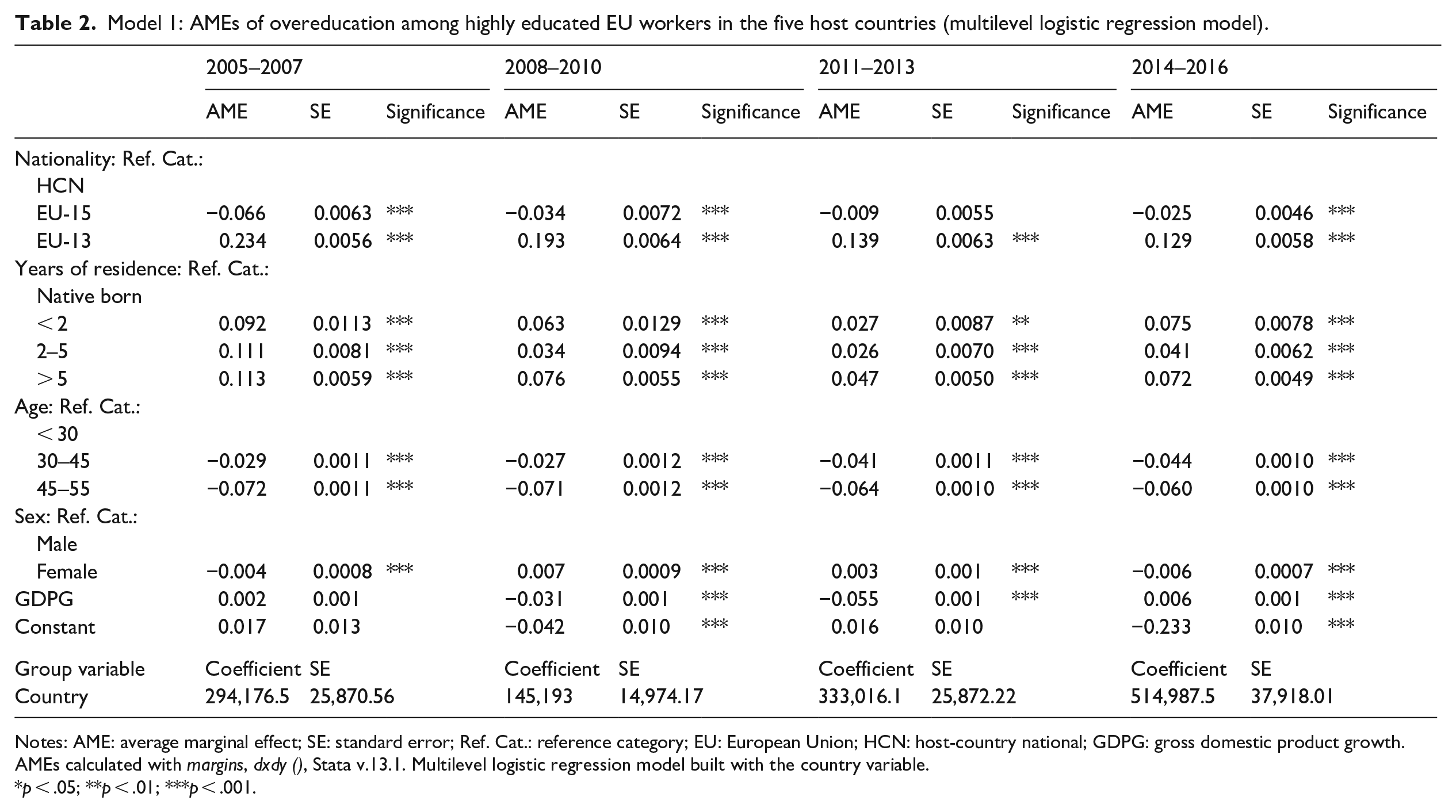
The first model (see Table 2) contains consistent relations in the risk of being overeducated among highly educated EU workers over time.
Model 1: AMEs of overeducation among highly educated EU workers in the five host countries (multilevel logistic regression model).
Notes: AME: average marginal effect; SE: standard error; Ref. Cat.: reference category; EU: European Union; HCN: host-country national; GDPG: gross domestic product growth.
AMEs calculated with margins, dxdy (), Stata v.13.1. Multilevel logistic regression model built with the country variable.
p < .05; **p < .01; ***p < .001.
Highly educated EU-13 workers are at a much greater risk of experiencing overeducation than the HCN population throughout the observation period. By contrast, and contrary to our hypothesis, highly educated EU-15 workers experience the opposite effect (i.e. they have a minor risk of overeducation). In other words, the mobility of highly educated workers from EU-15 countries to Germany, Spain, France, Italy, and the United Kingdom involves a premium with respect to their HCN peers, whereas for EU-13 workers it involves a penalty. According to our hypotheses, the differences between EU-15 and EU-13 might well be due to differences in initial legal status, which in turn facilitates the recognition of credentials for EU-15 workers, as well as the fact they come from similar countries, as this favors the transferability of human capital, and have more prestigious educational systems.
Second, there is no clear relationship between the financial crisis and the employment of highly educated workers. The AME of overeducation fell for EU-15 and EU-13 member states from the 2005–2007 period through to 2015–2016, without registering any impact associated with the financial crisis. During the onset of the crisis in 2008–2010, there was a reduction in EU-15 labor premiums (−6.6 to −3.4% points) and a slight decrease in the penalty for EU-13 workers (23.4–19.3% points). Yet at the height of the crisis, there was a sharp reduction in this penalty and in the premium for EU-13 and EU-15 workers, respectively. In other words, the positive effect produced by legal integration seems to have prevailed over the financial crisis’s negative ramifications.
Third, and related to the financial crisis, the associated effect of GDPG on levels of overeducation shifted from a positive relationship to a negative one during the crisis (2008–2010 and 2011–2013). In other words, the lower GDPG during the financial crisis led to an increase in overeducation among highly educated workers. These results confirm the hypothesis whereby higher economic growth during the crisis led to more overeducation, with the countries most affected by the crisis, ones with lower and negative GDPG, recording the biggest increase in the rate of overeducation, and vice versa. Furthermore, the countries most affected by the crisis recorded a sharp increase in the unemployment rate among highly qualified workers, particularly in Southern European countries (see Figure 2).
Regarding the impact of our control variables, there is no relationship between time of residence and the risk of overeducation, as conversely to the theory of human capital transferability, the level of overeducation does not decrease with time of residence. The highest degree of overeducation before and after the crisis was to be found among mobile workers with longer periods of residence, whereas following the crisis it is similar between those residing for less than 2 years and those that have been in the country for more than 5 years.
Finally, most studies report greater overeducation among women due to educational pre-sorting and occupational post-segregation (Borghans and Groot, 1999). A surprise in our case is that there is a negative effect when there is no crisis and that it becomes positive when there is one. Although we lack precise data on the profile of these highly qualified women for explaining the difference according to gender, the transformation during the crisis may be due to its unequal impact by gender and origin in Southern European countries (Fellini, 2018; Mooi-Reci and Muñoz-Comet, 2016), with men subject to higher unemployment and women exposed to worse working conditions.
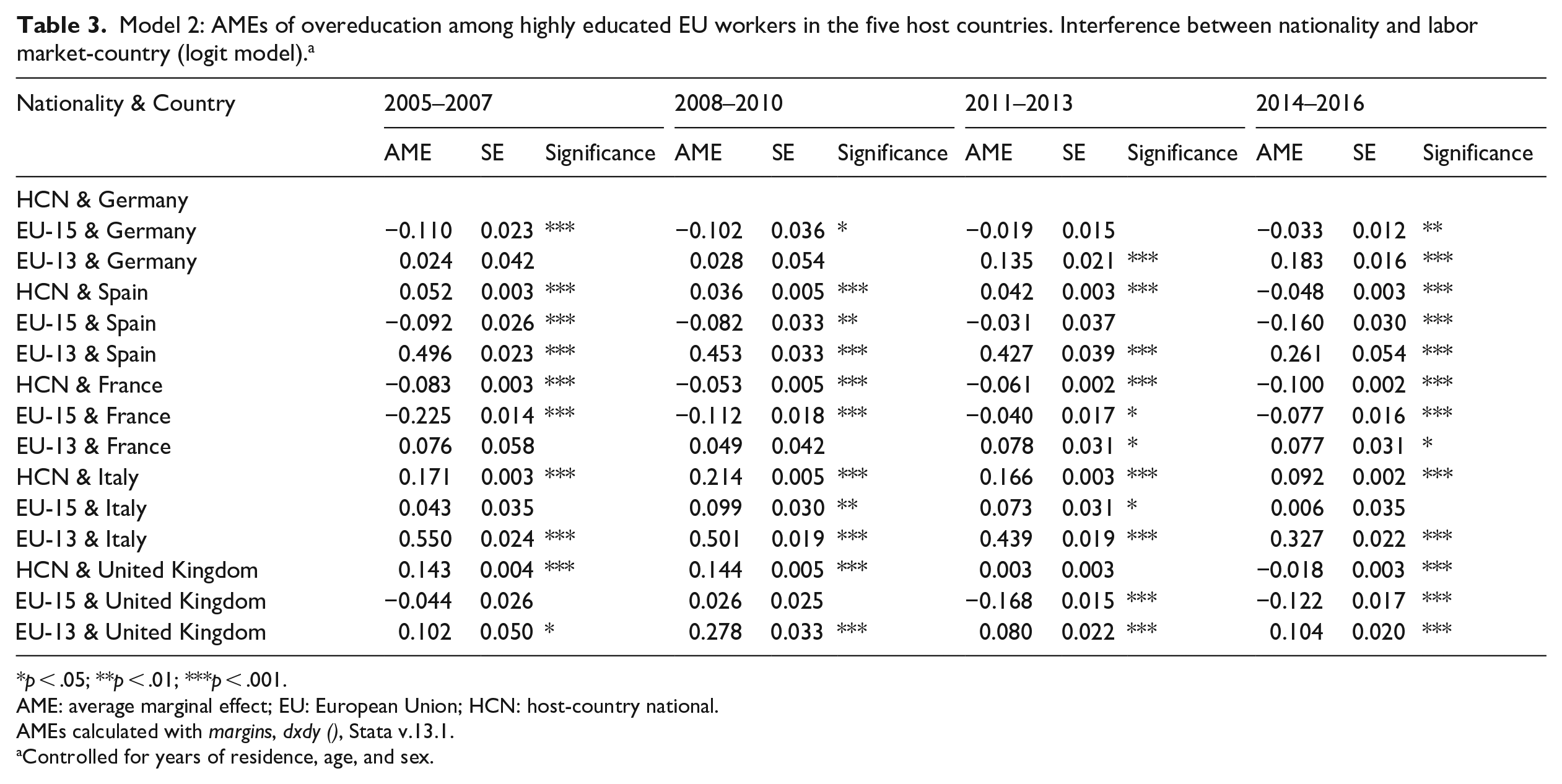
In the second model (see Table 3), there is interaction between the workers’ nationality and their host country. The reference categories of Germany and HCNs reveal that highly educated EU-15 workers in Germany, Spain, and France have a lower risk of overeducation during the four periods (except 2011–2013 in Spain and Germany), and in the case of the United Kingdom, the same situation has been observed since 2011. In other words, highly educated mobile EU-15 workers receive a premium in Germany, Spain, France and, more recently, the United Kingdom compared to the situation of highly educated HCNs in Germany. This premium might also be due to the greater mobility of EU-15 workers than German nationals for exploiting labor opportunities (Dolton and Silles, 2008; Fleming and Kler, 2014) or the greater prestige of their educational systems (Hoekstra, 2009; Rivera, 2015). Although there are no data to confirm this, these differences across countries might also be due to discrepancies between the structures of their labor markets, which affect demand and the profile of highly educated migrant workers and conditions their mobility (Mariscal-de-Gante et al., 2023; Oesch and Rodríguez Menés, 2011).
Model 2: AMEs of overeducation among highly educated EU workers in the five host countries. Interference between nationality and labor market-country (logit model). a
p < .05; **p < .01; ***p < .001.
AME: average marginal effect; EU: European Union; HCN: host-country national.
AMEs calculated with margins, dxdy (), Stata v.13.1.
Controlled for years of residence, age, and sex.
In Italy during the 2008–2013 crisis, workers from EU-15 countries were penalized in terms of overeducation just like all their other highly educated counterparts (HCNs and EU-13 workers), with no significant differences in the first and last period taking HCNs as reference category in Germany. Highly qualified EU-13 workers in France and Germany do not face a penalty until 2010, but they do as from 2011; while there is a significant one in Spain, Italy, and the United Kingdom throughout the entire period. The penalty in Spain has fallen over the observation period from 49.6 (2005–2007) to 26.1 percent (2014–2016), and in Italy from 55 (2005–2007) to 32.7 percent (2014–2016). In the United Kingdom, it was 10 percent in the first and last period (2005–2007), although there was a significant increase (27.8%) over the period 2008–2010. These results could be interpreted as an effect linked to the EU enlargement process and the recognition of the rights of these new workers in the main host countries, Italy and Spain, as there is a reduction in the penalty for overeducation among highly educated EU-13 workers, although these countries are the ones most affected by the financial crisis. It might well be that the reduction of the penalty in these countries is due to the transition to unemployment or/and self-employment among these workers (Koehler et al., 2010; Lofstrom and Wang, 2019). In France, and particularly in Germany, the opposite seems to be the case, as the end of the moratorium on the mobility of EU-13 workers led to the appearance of the penalty. The United Kingdom does not record any clear pattern between the situation of highly educated EU-13 workers in relation to the enlargement process.
Finally, logistic regression models have been estimated for each one of the five countries and the four periods considered. The AAPs have been calculated with the results of the logistic regression models for the nationality variable to summarize the results and allow comparing countries and the different periods. An AAP shows the risk percentage of overeducation among highly educated HCNs, and EU-15 and EU-13 workers.
Figure 5 shows the AAPs obtained from Model 1 for the five countries both collectively and individually (excluding the country variable). Considering first the value of the AAPs for HCNs, there are varying levels of overeducation across countries, with Italy and Spain recording the highest rates, and France and Germany the lowest, with the United Kingdom in an intermediate position. In other words, according to our hypothesis, they are the countries with a more strictly regulated and more segmented labor market, where overeducation is highest. Except for a slight increase in Germany, all the countries record a modest reduction in the overeducation of HCNs, being more pronounced in the United Kingdom, with these trends maintaining a close relationship with the application of enlargement memoranda and our hypothesis.
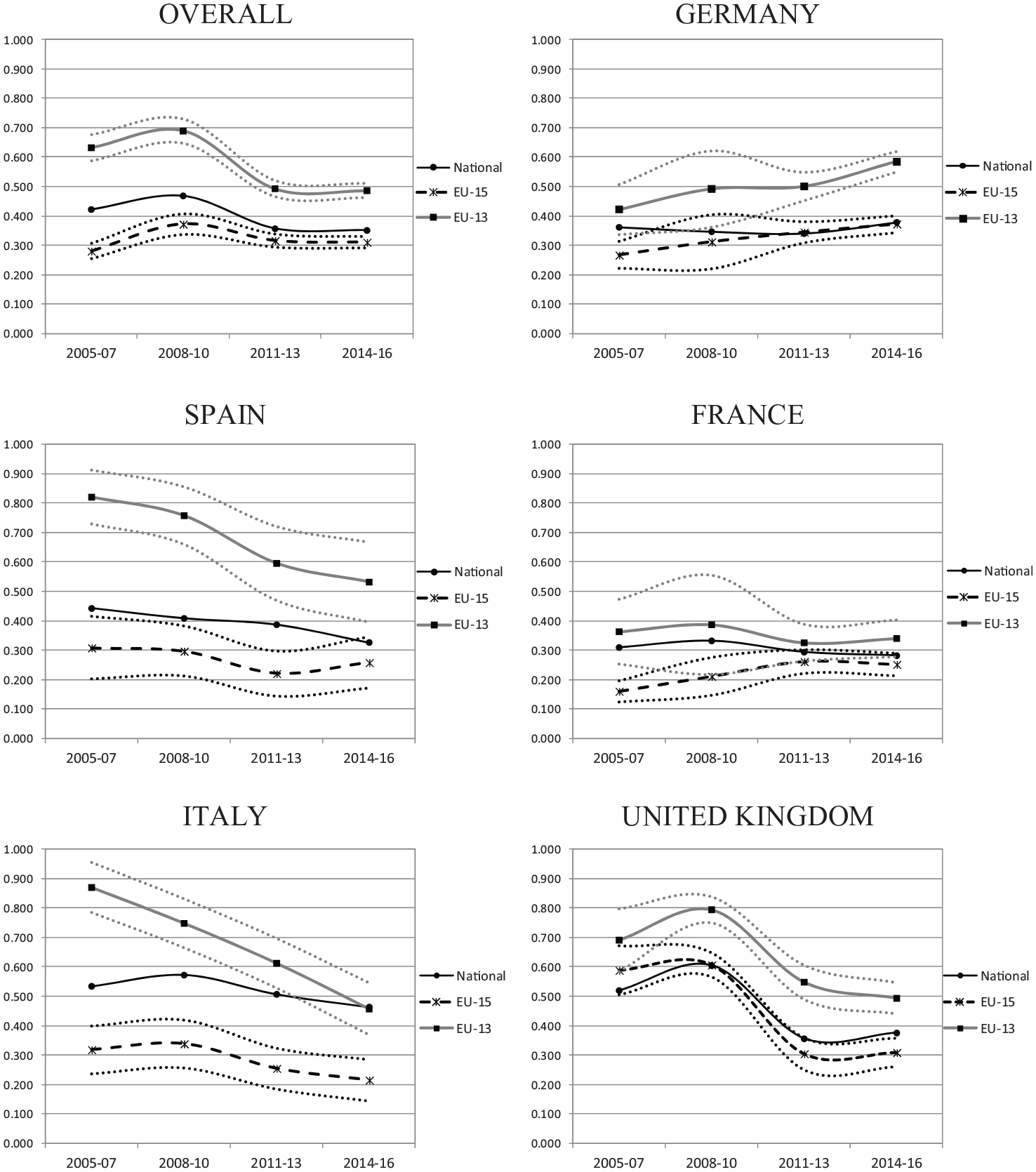
AAPs for HCNs, EU-15 and EU-13 workers in the five host countries both collectively and individually, 2005–2016 (logit model).a
When considering the calculated rate of overeducation among HCNs compared to EU-13 and EU-15 workers, the collective results show a decrease in the penalty for workers from EU-13 countries and a decline in the premium for EU-15 workers over time, that is, there is a process of leveling out in working conditions among mobile workers. Albeit with some delay, access to full citizenship for educated workers from EU-13 states can be linked to the decline in overeducation in the five host markets, even if the penalty appears to hold steady from 2011 onwards. This decrease in the penalty is accompanied by a reduction in the premium for mobile EU-15 workers because of the possible increase in the flow of educated workers from EU-13 countries (Bartolini et al., 2017; Castro-Martín and Cortina, 2015). At the same time, as the EU’s enlargement toward Eastern Europe has improved the lot of highly qualified EU-13 workers by altering their legal status, it has also increased the supply of highly qualified workers that may have affected their counterparts in EU-15 countries.
There are significant differences between the individual markets. Germany has undergone a major transformation in the working conditions of highly educated migrant workers; in the 2005–2007 period, and together with France, highly educated EU-13 workers were not subject to a penalty, while EU-15 workers received a slight premium. However, the premium for EU-15 workers disappeared in 2008–2010, and EU-13 migrants were exposed to a penalty, with a growing trend that would eventually mean that Germany imposed the highest penalty on highly educated workers from EU-13 countries. These transformations are not directly related to changes in the status of EU-13 workers, nor are they related to the effect of the financial crisis in Germany, although they could be related to the significant increase in arrivals as of 2011, both by EU-15 and by EU-13 workers (Elsner and Zimmermann, 2016; Zaiceva and Zimmermann, 2016). According to Kogan (2011), before the enlargement highly educated migrants from Eastern Europe faced serious problems for integrating within the labor market in Germany, and tended to concentrate in the lowest levels, while highly educated migrants from other EU-15 countries received preferential legal treatment and found it easier to have their qualifications recognized because of the greater prestige of the educational systems and the closer proximity between workers.
Over the period 2005–2007, highly educated EU-13 workers in Italy and Spain received a heavy penalty, which has subsequently been sharply reduced. In Spain, EU-15 workers initially received a premium that was maintained during the crisis, although it has recently disappeared. The premium for highly educated EU-15 workers in Italy has remained almost unchanged, and access to full citizenship among EU-13 migrants may have allowed for their better positioning in both countries; the crisis does not seem to have directly affected the situation of highly educated workers in either case.
A more detailed study explains the causes of this transformation, combining both the effects of access to full citizenship by EU-13 workers and the different impact the crisis has had on Southern and Northern Europe. The enlargement meant that Italy and Spain received a large influx of migrants from Eastern Europe, particularly from Romania and Bulgaria, and many with a high educational level, who mostly found low-skilled jobs due to the prevalence of this kind of employment (Del Boca and Venturini, 2016; Fellini, 2018; Mooi-Reci and Muñoz-Comet, 2016). This type of employment was the one most seriously affected by the crisis, which led to their redundancy. In turn, the confluence of the crisis in Southern Europe and the end of the restrictions on mobility in those countries hardly affected by the recession favored migration to other countries, especially to Germany, with few EU-13 workers returning home (Elsner and Zimmermann, 2016; Zaiceva and Zimmermann, 2016). This new migration reduced overeducation in Southern Europe, while increasing it in the North. Therefore, the reduction in the degree of overeducation between EU-13 migrant workers in Southern European countries during the crisis may be a combination of the effects of the enlargement and access to a new legal status, as well as workers transitioning from the labor market into unemployment and self-employment (Koehler et al., 2010; Lofstrom and Wang, 2019). In Spain’s case, on 10 July 2009, the Council of Ministers amended the law to facilitate migrant workers’ access to self-employment, and Italy recorded an increase in the number of migrants applying for self-employed status in 2009 (Koehler et al., 2010).
France is the only country where highly educated workers from EU-13 countries do not incur a penalty with respect to HCN workers, and this situation has not changed over time. However, EU-15 workers have ceased to receive a premium of more than 10 percent compared to HCNs. As far as overeducation is concerned, France is now the only country that does not differentiate between highly qualified workers from EU-13 and EU-15 countries. This particular situation affecting EU-13 workers may be because France has above all attracted migrants with a high educational level and in a much smaller number than Spain, Italy, Germany, and the United Kingdom (Fic et al., 2016), meaning better integration in the labor market; yet in turn it has led to the removal of the premium for EU-15 workers.
Finally, the penalty for EU-13 workers in the United Kingdom has decreased over time. EU-15 workers have gone from a similar position as HCNs to receiving a modest labor premium in the last period. In 2004, the United Kingdom did not impose any restrictions on the mobility of workers from accession countries, thereby favoring a mass influx, particularly from Poland. The crisis between 2008 and 2009 reduced the number of arrivals (Barrell et al., 2010; Clark et al., 2016), although it prompted an increase in workers from Southern Europe and the first arrivals of Romanian and Bulgarian nationals when these countries joined the EU in 2007. This uninterrupted flow throughout the entire period therefore explains the persistence of the penalty among EU-13 workers, as they mostly found work in low-skilled jobs (Clark et al., 2016). The particular nature of the UK market and its high level of specialization could explain the emergence of a premium for highly educated EU-15 workers despite the increase in the numbers of their EU-13 counterparts.
Discussion and conclusions
An analysis of the five countries over the period 2005–2016 provides an interesting framework for studying the situation of highly educated workers in the EU and their integration process, but at the same time it poses a serious challenge, as the transformation of the legal status of workers from EU-13 countries coincided with the financial crisis. Furthermore, the lack of precise data on workers and the differences between the five markets analyzed advises us to be cautious about our findings. The results answer the questions raised at the start; yet at the same time, new questions arise about the effects of the transformations described.
Our main finding is that during the period analyzed, which includes the enlargement and the financial crisis, the working conditions of highly educated HCN and mobile workers in the EU have leveled out, at the same time as there has been a general drop in the levels of overqualification. These results confirm that the EU enlargement process and the accompanying free movement of workers is being a success. Moreover, the improvement in the working conditions of mobile workers plays a vital part in achieving social, cultural, and civic/political integration (Alba and Nee, 2003; Fajth and Lessard-Phillips, 2023). The progress made in the migrant workforce’s integration improves their overall integration, while at the same time confirming that the EU is fulfilling its purpose.
Second, there are major differences across countries in the levels of overeducation among highly educated workers. Those countries with a lower segmentation of the labor market, less regulation, fewer migrant workers, and less affected by the crisis are the ones recording lower levels of overeducation, as reflected in our hypotheses. Along these lines, one should not dismiss either the differences in labor market structures or even the possible existence of diverse profiles among highly educated workers in each country.
Third, we observe different situations between highly educated workers from EU-13 countries and EU-15 nationals, confirming our hypothesis, where there may be interaction between legal status, the transferability of human capital, the prestige of institutions, and even discriminatory practices. The five countries both collectively and individually recorded, and still do, a different employment situation for EU-13 workers compared to EU-15 nationals. Nevertheless, an unexpected finding involves the better situation of EU-15 workers compared to HCNs, which might be explained by their greater mobility or even the greater appreciation of their academic credentials. Nonetheless, there is a process of convergence of working conditions between EU-15 and EU-13 highly educated workers.
Fourth, access to full citizenship for EU-13 workers did not mean the immediate removal of their labor penalty. There is a general tendency in later periods to reduce the risk of overeducation, except in Germany, which has been the last country to lift the restrictions on free movement for EU-13 workers. This positive impact of the enlargement seems to have been partially offset by the negative effect produced by the arrival of more highly qualified migrants. The differences found across countries in the employment of highly educated workers should also consider the divergences in the structures of the labor markets in the host countries (Oesch and Rodríguez Menés, 2011; Spörlein and van Tubergen, 2014) and even the differences or similarities between the home country and migrant populations that may be conditioning the transferability of human capital and which have not been included in the study because of a lack of data.
Fifth, there are different transformations in each one of the five major markets. The tendency to progressively reduce the penalty for highly educated workers from EU-13 member states is accompanied by a decline in the favorable treatment of highly educated EU-15 workers. We cannot dismiss the premise that the penalty reduction for EU-13 workers is related to the decrease in the premium for educated EU-15 workers, as seen from the perspective of the increase in educated labor moving from Eastern to Western Europe (Bartolini et al., 2017; Favell, 2008). This transformation may also be related to a higher appreciation of education among EU-13 workers on the part of employers in the five host countries (Barone and Ortiz, 2011; Hoekstra, 2009; Rivera, 2015).
Sixth, although the relationship between GDPG and the rate of overeducation confirms our hypotheses on the effect of the crisis, it nonetheless appears that the countries most affected by the recession are the ones that have most reduced the penalty for new EU citizens. The explanation for this apparent contradiction lies in the transfer of skilled EU-13 workers from the South to the lesser affected economies in the North (Bartolini et al., 2017; Elsner and Zimmermann, 2016; Zaiceva and Zimmermann, 2016). This could explain the decrease in the penalty in Spain and Italy and, by contrast, the increase in countries such as Germany, as the results show. Furthermore, it is highly likely that the decrease in overeducation in the countries most affected by the crisis is also explained by highly qualified workers transitioning into unemployment and self-employment, as reported elsewhere (Koehler et al., 2010).
Seventh, the temporal perspective on integration reveals some surprising results between period and time variables. On one hand, there is an improvement in the integration process of highly educated mobile workers in the EU in more recent times, which reflects the EU’s success, whereby the benefits of freedom of movement and of equality among workers are becoming a reality. On the other hand, the time spent in the host country has a noticeable lack of impact on their working conditions, which has been widely observed in a broad range of processes involving job mobility (Del Boca and Venturini, 2016; Reyneri and Fullin, 2011). This highlights the unique case of the mobility of the highly educated population, where their labor status is indeed one of the reasons for their migration (Bartolini et al., 2017; Landolt and Thieme, 2018), but not the only one, which helps to explain why the situation of overeducation persists in the labor market as time of residence increases. The lack of precise data on these migrants’ characteristics (e.g. the possibility that there are different fields of study between recent and settled migrants) stops us from providing a more detailed explanation. Yet at the same time, these results refer back to the postulates of Assignment Theory (Sattinger, 1993), according to which certain highly educated migrants will seek the maximum utility outside their jobs, which explains why they are not interested in the removal of their employment penalty.
We cannot rule out the possibility of discriminatory practices and a very different appreciation of human capital depending on the country of origin (Hoekstra, 2009). Neither can we discard the role of workers in accepting different occupations in the labor market due to the possible pay compensation they receive when they access EU-15 markets, nor even the existence of other objectives outside of work, such as quality of life or experience (Landolt and Thieme, 2018). Furthermore, relevant predictors of overeducation, such as the field of study (Ortiz and Kucel, 2008) or work experience during higher education (Passaretta and Triventi, 2015), should be considered in future studies for addressing the causes of the differences observed.
We contribute to the comparative literature on job mobility and its determinants by examining the extent to which they confound or possibly mediate the effect of labor market dynamics on overeducation among highly educated workers in a context that is evolving due to the legal and economic changes taking place in the EU. Second, this study makes a significant contribution to sociological research on the integration of migrants by revealing the particular circumstances of highly educated workers. These educational profiles do not undergo job mobility with time of residence, and not even when they are granted full citizenship, which shows the complexity and the different spheres that may involve mobility and integration. The article’s third contribution to the state-of-the-art is to shed light on the importance of legal status for favoring the labor mobility of highly educated migrant workers, yet at the same time it is insufficient to set migrant workers on an equal footing with HCNs. The fourth relevant contribution involves revealing the diversity of circumstances both across countries and among workers within each country, based on the transformation of migratory flows.
Finally, certain significant limitations need to be mentioned. This article only analyses highly educated migrants in the labor market, but not unemployed, inactive, or self-employed ones. It is very likely that both the EU enlargement process and the recession have had an important impact on the unemployment of these highly educated workers in the different countries considered. In particular, the decrease in overeducation in the main countries affected by the crisis, Spain and Italy, may well be due to overeducated workers’ exclusion from the labor market or their transition to self-employment (Borgna et al., 2019; Koehler et al., 2010). A second major limitation involves the nature of the data. This is a cross-sectional study, which means we cannot analyze how the migrants’ employment changes with time of residence, and we only have the migrants’ situations for certain specific times of residence. A third limitation involves the inability to conduct an individual analysis of each one of the nationalities of workers belonging to EU-13 and EU-15 member states, as well as some of their main characteristics, which would have provided a direct view of each country’s entry into the EU and the particular effects of the crisis on each market in terms of workers’ mobility processes according to certain characteristics. Finally, the lack of longitudinal data on mobile workers during this period and across countries stops us from making a clearer evaluation of the effects of the enlargement process and the financial crisis.
Footnotes
Acknowledgements
Data provided by Eurostat for the research proposal RPP 79/2017-LFS.
Declaration of conflicting interests
The author(s) declared no potential conflicts of interest with respect to the research, authorship, and/or publication of this article.
Funding
The author(s) disclosed receipt of the following financial support for the research, authorship, and/or publication of this article: This work was supported by the Spanish Ministry of Science, Innovation and Universities [Grant PID2021-123875NB-I00 “Analysis of lowest-low fertility through life transitions: emancipation, couple formation and labour trajectory”; Grant RTI2018-098455-A-C22 “Convergences and demographic divergences between natives and immigrants in Spain”].
