







Abstract
How do ideas about democratic backsliding reshape judicial reasoning? This article develops a mid-range theory through the Brazilian Supreme Court’s (STF) doctrinally heterodox rulings against President Jair Bolsonaro’s restructuring of participatory councils—administrative bodies whose restructuring posed no direct threat to the Court itself. We argue that the STF’s adoption of backsliding ideas was a necessary condition: once justices understood democracy as vulnerable to cumulative reforms rather than only to coups, litigants’ arguments framing the council changes as democratic harms became newly resonant, enabling the Court to recognize implied constitutional limits it had previously rejected. Process tracing shows that alternative explanations, including judicial self-interest, are not sufficient to account for the rulings. The theory illuminates both the potential and the risk of backsliding ideas in legal reasoning: they can enable courts to defend democracy, but also create pressure to extend democratic harm framings beyond prototypical cases, potentially obstructing legitimate reforms.
Keywords
Introduction
Growing concern about de-democratization, the various processes by which democratic regimes become non-democracies, has renewed attention to the role of courts in protecting political regimes. De-democratization can occur through abrupt ruptures, such as coups, but it can also unfold gradually, as elected leaders weaken checks and balances through cumulative reforms. This gradual pathway is called democratic backsliding. Because backsliding often begins while an independent judiciary is still in place, courts have a window in which to block such reforms. The idea that courts should defend democracy against internal threats is not new, but had focused through the 20th century on restricting the freedoms of extremist movements—for example, banning neo-Nazi parties (Capoccia, 2013). Unlike those earlier threats, which involved actors openly committed to dismantling constitutional order, recent scholarship addresses a more subtle dynamic: incumbents who entrench their rule without abolishing elections, relying instead on legal reforms to tilt the competitive playing field in their favor. Recognized reforms include serial term limit manipulation and court packing. 1 In response, some legal doctrines urge courts to scrutinize a broader range of measures, even when those measures appear permissible under existing national doctrine and precedent (Castillo-Ortiz and Roznai, 2024; Dixon and Landau, 2015; Ginsburg, 2018; Roznai, 2021).
Few expect courts to halt backsliding on their own. Yet empirical research shows that judiciaries have, at times, imposed meaningful setbacks on it (Gamboa et al., 2024; Garcia-Holgado, 2025; Gibler and Randazzo, 2011; Ginsburg and Huq, 2019; Gloppen and Rakner, 2025; Vieira, 2024: 233–284). The literature, however, leaves a central question open: how do ideas about backsliding—and the legal doctrines built around them—shape judicial reasoning?
We examine this question through a study of the Brazilian Supreme Court (Supremo Tribunal Federal, STF) and its rulings against Jair Bolsonaro’s reforms of participatory councils. Bolsonaro, a far-right president (2019–2022), advanced reforms that appeared to fall within conventional understandings of administrative discretion. Why did the STF strike them down? To answer this question, we developed a theory inductively rather than testing a pre-existing framework, drawing on process tracing to assess the mechanism’s plausibility. Our aim is not to propose a general theory of judicial behavior. Rather, we propose a mid-range, mechanism-based theory about how ideas regarding backsliding can shape judicial reasoning under certain conditions. By analyzing how backsliding ideas informed the justices’ reasoning, we show that litigants who framed reforms as threats to democracy were able to gain unexpected persuasive force and produce doctrinally heterodox outcomes blocking previously acceptable reforms.
Analyzing judicial motivation in decisions against illiberal leaders presents challenges that make our case valuable for theory-building. First, judges may be influenced by backsliding ideas without stating so explicitly. In some legal cultures, courts openly cite social science research; in others, such references are discouraged (Petersen, 2013: 295). Invoking backsliding may also risk confrontation with powerful executives (Roznai, 2021: 358). In the council cases, however, STF justices explicitly discussed backsliding and cited well-known social science. Second, many judicial decisions against illiberal governments can be explained by conventional legal reasoning. Research on autocratic legalism shows that incumbents often frame reforms as legally permissible (Scheppele, 2018: 569). Yet many of their reforms are plainly incompatible with prevailing doctrine (Pirro and Stanley, 2021: 92). In such cases, courts can rule against the government simply by applying existing standards. It may thus be unclear whether backsliding ideas made any difference. The STF’s rulings on participatory councils, however, are difficult to reconcile with established doctrine.
Third, judges often have direct stakes in cases where backsliding ideas might apply. References to such ideas may thus be read as justifications for rulings they would have issued anyway. Judges may be maximizing their individual preferences, whether personal, such as job satisfaction, or organizational, such as preserving judicial independence (Epstein et al., 2021: 705). Even reforms directed at other branches can threaten judicial interests—a captured legislature, for example, may amend the constitution to weaken courts. It thus becomes difficult to determine whether judicial opinions reflect genuine concern about democratic erosion or post hoc rationalization. A well-known example is the Colombian Constitutional Court’s 2010 decision blocking a second presidential re-election. The court reasoned that a third term would allow excessive influence over the composition of independent bodies, including the Constitutional Court itself (Corte Constitucional de Colombia, 2010: 6.3.6.1.1). For Cajas-Sarria (2020), the decision reflected a broader pattern of self-protective rulings in which the court expanded its own authority. Others similarly interpret anti-incumbent decisions across Latin America as motivated by judicial self-empowerment (Zambrano et al., 2024: 131).
By contrast, it is difficult to see how the council reforms threatened the STF itself. This is characteristic of many administrative reforms: even when they arguably contribute to democratic backsliding (Bauer et al., 2021; De Sá e Silva and De Ávila Gomide, 2024), they tend to concentrate authority within the executive branch rather than alter the separation of powers. Participatory councils are public bodies that incorporate selected non-state actors—such as unions, employer associations, non-governmental organizations (NGOs), and social movements—alongside public officials in policy processes. They have existed in several countries (Brugué et al., 2021; Campos and Gonzalez, 1999; Christiansen et al., 2010; Hevia de la Jara and Isunza Vera, 2012). In Brazil, councils have played a significant role since redemocratization in 1985, typically exercising consultative or regulatory authority in specific policy areas. Bolsonaro’s reforms sought to dissolve or restructure these councils to increase executive control over their composition and operation. Other illiberal incumbents have adopted comparable measures (Fink-Hafner and Bauman, 2023: 42; Gerő et al., 2023: 19).
We argue that the STF justices’ adoption of backsliding ideas was a necessary condition for their doctrinally heterodox rulings. Without it, the Court would not have found litigants’ efforts to frame council reforms as democratic harms persuasive, nor would it have treated such harms as implicitly prohibited by the Constitution. Similar administrative changes had long been regarded as routine exercises of executive discretion; backsliding ideas enabled the Court to reinterpret them as constitutionally consequential, particularly against the backdrop of growing concern about the Bolsonaro administration. Interest maximization and political bias may also have played a role, but they do not fully account for the rulings. This matters normatively: if ideas can reshape good-faith interpretation, courts may act on genuine constitutional concern rather than self-interest alone. The risk, however, is that extending the backsliding frame beyond prototypical cases like court packing obstructs legitimate reforms. More empirically grounded research on such non-prototypical cases could help courts and other decision-makers navigate that tension.
The article proceeds in two parts. The first develops a theory of how backsliding ideas can move good-faith legal interpretation away from doctrinal orthodoxy by increasing the resonance of certain arguments. The second applies this framework to the STF’s rulings on participatory councils and considers alternative explanations to argue that the adoption of backsliding ideas was a necessary condition for those outcomes. The conclusion reflects on the normative implications and identifies directions for further research.
Backsliding ideas in legal interpretation
When judges confront reforms that appear legally permissible yet politically troubling, they must decide whether to treat them as routine exercises of government authority or as threats to democracy. We argue that the spread of democratic backsliding ideas changes how judges make that decision.
In our account, the mechanism unfolds in three steps. First, when judges adopt the idea that democracies can erode gradually through cumulative reforms (rather than only through coups), they begin to view reforms differently. A reform that once seemed minor from a doctrinal standpoint—such as restructuring participatory councils—can appear as an unconstitutional part of a broader pattern of democratic decline. Second, this shift makes certain legal arguments more persuasive. Litigants who frame reforms as unconstitutional democratic harms may now resonate with judges concerned with the use of law against democracy. Finally, once such arguments resonate, judges may translate them into doctrine by specifying constitutional limits that, although previously unrecognized or even outright rejected, they argue were implied all along. In the Brazilian case, this meant treating council autonomy as implicitly protected by the Constitution.
Our contribution rests on logical rather than statistical inference (Small, 2009: 22). We do not estimate the predicted average effect of ideas. Instead, we identify a causal logic that can operate in contexts where backsliding discourse circulates within legal communities. Our interdisciplinary argument integrates insights from judicial behavior scholarship, sociological framing theory, cognitive prototype theory, and constitutional interpretation.
Democratic backsliding as a mental model for legal interpretation
Legal interpretation is not an extraction of meaning from legal texts. Because texts consist of symbols, they do not contain ideas in themselves, but can only prompt ideas through interpretation (Elder-Vass, 2012: 43). This is hardly ever simply an exercise in applying dictionary definitions and grammar. To interpret constitutions, statutes, and precedents, judges must rely on practical know-how learned within their communities (Fish, 1980: 167–173). We ask how, within a given community, certain interpretations come to be seen as correct rather than others, not which interpretation actually is correct. For our purposes, two foundations of judicial interpretation are especially relevant: professional commitments and background beliefs. The latter shape judges’ internal representations of reality, while the former guide how those perceptions inform judicial action.
Professional commitments play a central role in ideational accounts of judicial behavior (for a review, see Smith, 2008). Gillman (1999: 79) captures this idea with the concept of a court’s mission: normative visions of a court’s role in society that become internalized and shape judges’ sense of what counts as appropriate decisions. Commitments are conative: they do not describe how reality is understood, but instead orient how judges believe they ought to act within it (Searle, 2010: 15). For example, Gillman (1993) shows that the U.S. Supreme Court’s Lochner-era jurisprudence reflected a commitment to limiting illegitimate state power rather than a simple pro-business bias. Similar arguments have been made about courts that interpret their role as protecting individual rights or constitutional principles against political majorities (Hilbink, 2012; Nunes, 2010).
Background beliefs, by contrast, concern how judges understand the world to work. They are cognitive rather than conative and can therefore be empirically mistaken (Searle, 2010: 15). Although less prominent in ideational theories, background beliefs are well studied in the literature on judicial evidence evaluation, which shows how general assumptions shape legal reasoning under uncertainty. Judges evaluating a particular piece of eyewitness testimony, for instance, inevitably rely on beliefs about the reliability of eyewitness testimony generally (Simon, 2004: 536). Piha’s (2024) study of Finnish rape judgments shows how courts sometimes relied on problematic beliefs about how victims are expected to behave after sexual assault—such as “a real victim of assault would not take too long to report it”—influencing their evaluation of evidence.
Academic theories of democratic backsliding, among other social science insights, may influence judicial interpretation by reshaping this latter category of beliefs. The diffusion of backsliding ideas from academia to judicial communities can occur through various channels: public debate, media commentary, civil society advocacy, and direct engagement with academic work. In the Brazilian case, concepts like democratic backsliding and autocratic legalism circulated widely in public discourse during the Bolsonaro presidency and visibly reached the judiciary prior to the participatory council cases. The empirical sections trace this in detail.
Yet, when social science theories diffuse beyond academia, they rarely enter legal reasoning in their full analytical form. Instead, they operate as mental models: simplified cognitive representations that link events and causal processes, allowing actors to anticipate outcomes (Jacobs, 2009; Markman, 1999). For example, a supply-and-demand schema predicts pricing by linking higher demand to higher prices and lower demand to lower prices. Whereas theories are publicly debated ideas, mental models are psychological representations that affect actors’ behavior. The backsliding model enables actors to imagine how a polity might lose its democratic character without a coup. It links the election of aspiring autocrats to a sequence of incremental reforms whose cumulative effect restricts contestation. To be sure, reforms in even the most resilient democracies have long been criticized as undemocratic, sometimes in courts. But such critiques typically invoke normative standards of democracy. The distinctive feature of the backsliding model lies elsewhere: it encourages judges to evaluate reforms as potential steps within a broader causal chain.
Our theory assumes judges who see defending democracy—or at least preventing de-democratization—as part of their professional commitments, even when this requires opposing elected officials in an anti-majoritarian way. Mental models shape action only when coupled with such a conative element. Judges operating within more formalist legal cultures may define their role more narrowly, such as ensuring legal predictability (Larsen, 2021), and may regard departures from established doctrine as anti-democratic overreach. In such cases, they are unlikely to strike down reforms, even if they recognize that those reforms could contribute to backsliding. By contrast, judges committed to anti-majoritarian safeguarding of democracy are more likely to allow their beliefs about what democratic threats can look like to inform their rulings. This commitment functions as a first scope condition without which the mechanism is unlikely to operate.
In short, we expect that when backsliding ideas circulate within a legal community, judges will adopt them as a mental model for legal interpretation only if they hold an anti-majoritarian professional commitment to democracy. This is the first step of the mechanism, as depicted in Figure 2.
Resonance in the judicialization of allegedly backsliding reforms
Judicial adoption of the backsliding mental model can influence adjudication by shaping whether arguments that frame specific reforms as democratic harms resonate. Courts act only when petitioned, and litigants seek preferred outcomes by framing disputes in particular ways. For example, abortion may be framed as a question of women’s autonomy rather than fetal life, or an administrative reform as harm to democratic structures rather than routine discretion. Framing research shows how such strategies direct attention to certain aspects of events while downplaying others (Benford and Snow, 2000; Campbell, 2002; Cornelissen and Werner, 2014). Yet framing contests are uncertain: arguments that fail to resonate at one moment may gain traction later. This problem of frame resonance focuses on the mechanisms that make a frame persuasive to its audience (Giorgi, 2017: 712). We treat resonance as a two-step process. First, democratic harm frames must align with judges’ background beliefs. Second, they must help judges identify democratic threats under conditions of legal ambiguity.
The first step concerns the fit between litigants’ frames and judges’ background beliefs. Frames resonate not due to intrinsic properties but through their interaction with audiences’ prior assumptions (Benford and Snow, 2000: 620; Ferree, 2003: 310). Judges’ background beliefs filter which claims they treat as credible (Amaya, 2013: 15). Arguments portraying a reform as a step toward de-democratization are unlikely to persuade judges who do not accept that gradual reforms can undermine democracy. Conversely, once judges adopt the backsliding model, frames that previously appeared exaggerated may become plausible. This helps explain why efforts to depict council reforms as democratic harms failed before STF justices embraced the backsliding model. Alignment makes de-democratization-through-reform thinkable.
The second step concerns the problem-solving value of democratic harm frames in identifying backsliding reforms. As McDonnell et al. (2017) argue, competing frames may align equally well with an audience’s beliefs, but only those that help solve concrete problems are likely to resonate (for an application, see Adler, 2021). Even judges who perceive an administration as posing a democratic threat are unlikely to understand every reform it advances as backsliding. For judges who adopt a backsliding mental model, the challenge is classificatory: determining which reforms plausibly constitute threats to democracy. This task is complicated by the inherent vagueness of the backsliding concept, particularly when applied to individual reforms.
We model conceptual vagueness through prototype theory, which holds that people categorize phenomena by comparing them to agreed-upon examples, or “prototypes” (Hampton, 2006; Mahoney, 2021: 51). The prototype anchors the category, but membership is graded rather than binary. Individual instances may approximate the prototype more or less closely, rather than simply qualifying or not. A completely hairless person is clearly bald; a fully haired person is clearly not. Intermediate cases, however, generate uncertainty. Vagueness arises because conceptual boundaries are imprecise and difficult to draw without seeming arbitrary. Experimental evidence shows that the more indeterminate the boundaries, the harder people find it to classify non-prototypical cases (Hampton, 2006: 83; Solt, 2015: 119). Figure 1 illustrates this vagueness: the left diagram depicts a category with clear boundaries, while the right shows vague boundaries that create uncertainty in marginal cases.
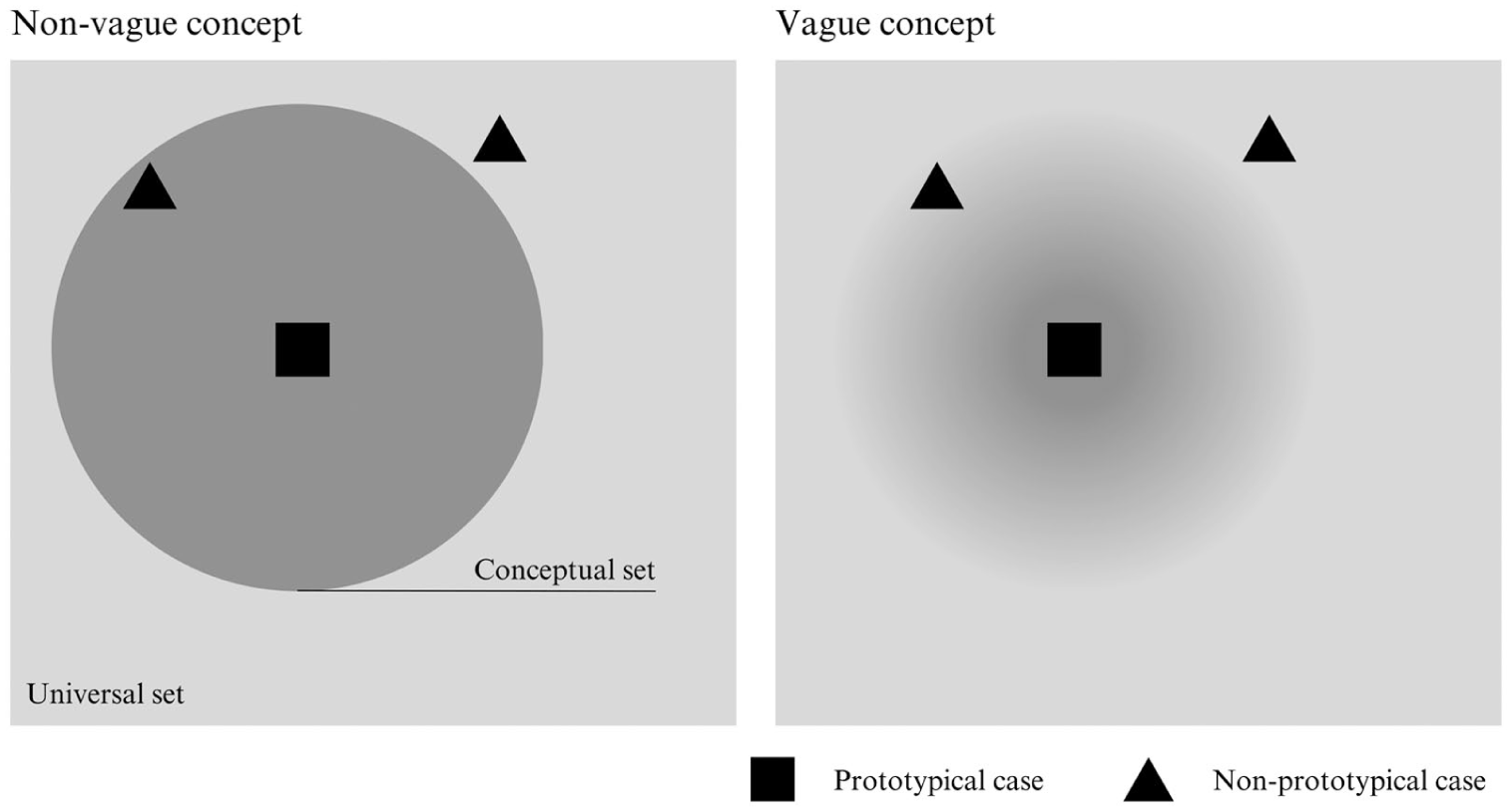
Visual illustration of vague and non-vague concepts.
Although some reforms are readily recognizable as backsliding, the concept’s vagueness beyond a small prototypical core makes categorization difficult. Because the category is defined by its effects—reforms that cumulatively contribute to de-democratization—it provides little guidance ex ante. Certain measures, such as serial term limit manipulation or aggressive court packing, have become familiar entries in the “authoritarian playbook” through repeated observation. Even critics of backsliding concepts often recognize these measures as prototypical within the framework. Outside this core, however, the range of potential backsliding reforms is broader and harder to identify. As Ginsburg and Huq (2019: 45) note, some reforms may appear innocuous until their cumulative effects emerge, much like borderline cases of baldness.
Scholarship on autocratic legalism has intensified this difficulty by arguing that reforms can appear to comply with established doctrine while still undermining democracy. This is because aspiring autocrats have become skilled in presenting their reforms as legally permissible under prevailing standards (Scheppele, 2018). Extending this logic, Vieira et al. (2023) introduce the notion of autocratic infralegalism to describe Bolsonaro’s extensive use of decrees—formally within executive authority but capable of weakening democratic checks. We argue that judges who perceive a particular administration as a potential backsliding threat are therefore placed in a state of vigilance. They must distinguish between innocuous or merely unpopular reforms and those that signal backsliding, often while questioning the adequacy of the legal standards they are used to applying.
Litigants’ democratic harm frames can help judges navigate this vagueness by supplying arguments for classifying non-prototypical cases, such as the council reforms, as instances of backsliding. They do so by emphasizing resemblances to features associated with prototypical cases—such as the concentration of power in the executive or the marginalization of dissenting voices—while downplaying countervailing differences. This is an instance of what Giorgi (2017: 718) terms blending: selectively linking familiar and unfamiliar elements to foster recognition.
Whether a democratic harm frame succeeds in resolving classificatory uncertainty may also depend on whether judges perceive the incumbent administration as posing a systemic backsliding threat—a second scope condition. Judges placed in a state of vigilance by such a perception are more likely to find arguments that classify individual reforms as steps in a broader trajectory of erosion persuasive. Yet perceptions of political reality vary. Research on citizens shows that perceptions of democratic violations depend on political biases and underlying understandings of what democracy is (Krishnarajan, 2023; Wunsch et al., 2025). Judges are not immune to similar perceptual filters, and incumbents may make threatening interpretations more likely. Leaders like Bolsonaro, who openly praised military coups and publicly threatened STF justices, are more likely to trigger a strong judicial alarm than leaders advancing similar reforms with a different rhetoric.
To summarize, we expect that litigants’ democratic harm frames will not resonate unless they help resolve the classificatory uncertainty surrounding backsliding reforms. Litigants can do this by blending features of the contested reform with characteristics associated with prototypical backsliding measures. Judges must also perceive the incumbent administration as posing a systemic backsliding threat. This corresponds to the second step in Figure 2.
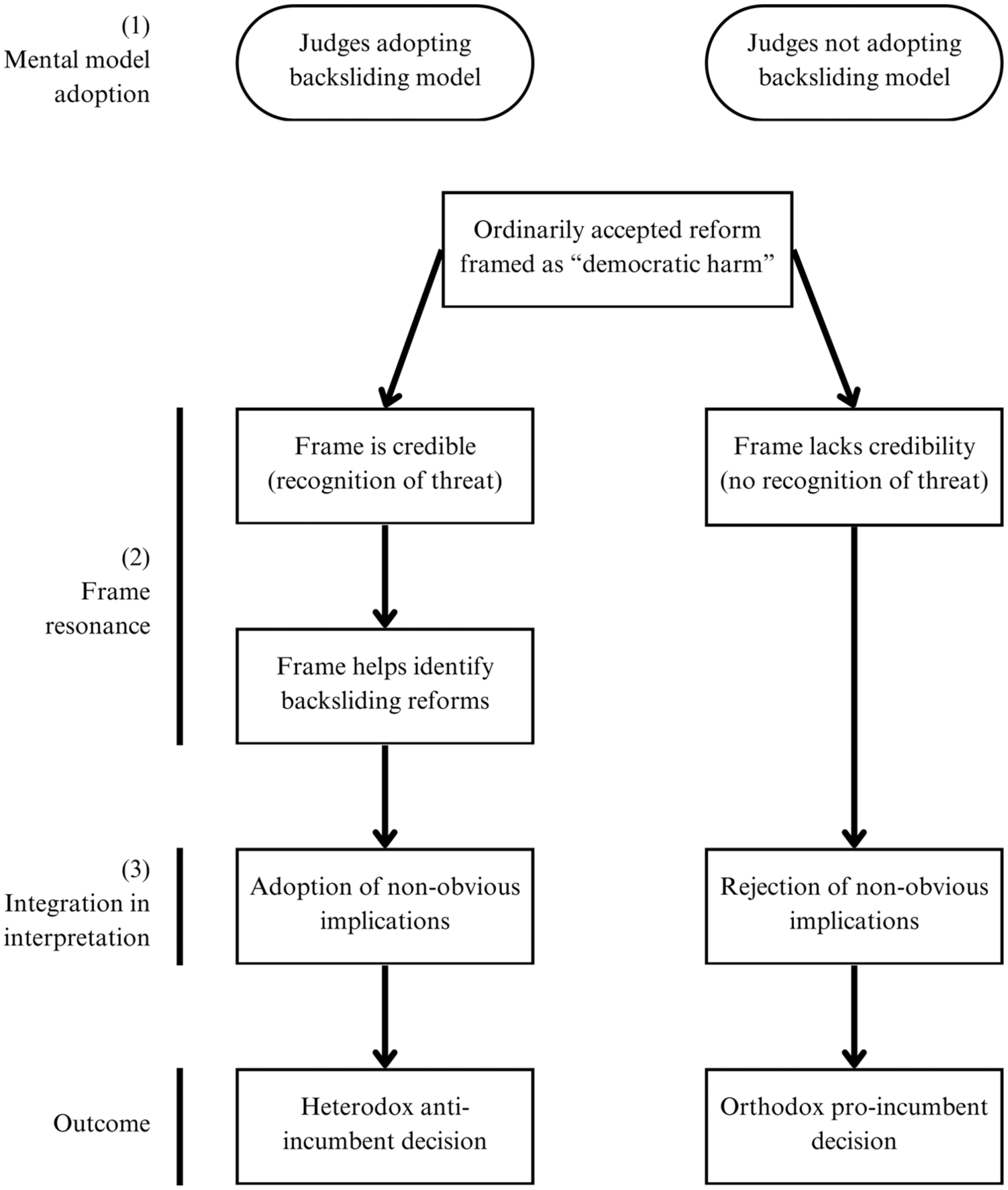
Mechanism illustration.
Incorporating resonant frames through constitutional implications
Even when a democratic harm frame persuades judges about the factual stakes of a case, a further challenge arises: how to translate that assessment into doctrinally defensible legal reasoning. Few legal systems contain provisions that explicitly prohibit “backsliding.” Judges must therefore locate constitutional implications that can sustain intervention.
One way judges respond to the absence of an explicit prohibition on backsliding is by accepting—or formulating, against prevailing doctrine—arguments that the law implies limits on elected officials. The Colombian Constitutional Court did so through the “constitutional replacement” doctrine when reviewing President Álvaro Uribe’s attempt to extend term limits (Bernal, 2013: 344). Although the constitution explicitly authorized only procedural review of amendments, the Court reasoned that Parliament may amend but not replace the constitution. Altering its essential elements, therefore, constituted a replacement, which justified judicial intervention (Bernal, 2013: 342). Similarly, in Brazil, the STF embraced previously rejected arguments that whenever the constitution or ordinary law mandates some kind of participation in policymaking, it implicitly guarantees participatory councils a degree of operational autonomy from the executive. This “autonomy implication” seeks to ensure that participation remains meaningful. Without it, governments could dissolve or restructure councils at will—replacing members and reducing mandated participation to mere window dressing.
Although judges often present democracy-defending implications—such as council autonomy—as meanings already contained in the text, such implications are rarely obvious. An implication is “obvious” when members of an interpretive community find it difficult to contest, which is why it appears to “go without saying” (Goldsworthy, 2018: 135). For example, a rule prohibiting loud conversations in a library does not require an explicit exception for warning of a fire; that exception is self-evidently implicit (Goldsworthy, 2018: 129).
By contrast, the autonomy implication was non-obvious. It departed from prevailing doctrine and had been explicitly rejected by the STF and other tribunals prior to Bolsonaro’s presidency. Non-obvious implications are not illegitimate, but they reveal both the interpretive latitude judges possess and the scope for intelligible disagreement about their rulings. Whether courts are willing to adopt such implications depends in part on legal culture, which both constrains and is reshaped by judicial practice. In Brazil, constitutional adjudication has long been marked by receptiveness to heterodox reasoning and expansive doctrinal innovation (Vieira, 2024: 191), making it more open to democracy-defending implications of this kind. This receptiveness to doctrinal innovation constitutes a third scope condition. It is likely connected to the first: courts that understand their role as actively safeguarding democracy tend also to be more open to departing from established doctrine when they judge it necessary.
We thus expect that, when democratic harm frames resonate, judges will translate them into doctrine by specifying non-obvious constitutional implications that restrict executive authority. This is unlikely, however, without a legal culture historically receptive to heterodox reasoning, representing the third step in Figure 2.
Explaining the STF’s heterodox decisions on council reform
Since the adoption of the 1988 Constitution, the STF has become an increasingly central political actor. Like several high courts in Latin America, it has embraced an expansive understanding of its role in protecting constitutional democracy and has not hesitated to develop innovative doctrines in pursuit of that mandate (Vieira, 2024: 171; Zambrano et al., 2024: 119). This trajectory set the stage for confrontation during Jair Bolsonaro’s presidency (2019–2022). Bolsonaro governed in an openly personalistic and adversarial style, repeatedly attacking the Court and, at times, suggesting that its justices could face arrest. As tensions escalated, the STF entered what many observers described as a posture of organizational self-defense. However, the council reforms concerned administrative bodies that posed no direct threat to the Court’s own powers. Moreover, its rulings involved clear doctrinal innovation and explicitly invoked democratic backsliding ideas to justify that innovation. For these reasons, the council cases provide a particularly useful setting in which to assess whether and how backsliding ideas shaped judicial reasoning.
Our research design relies on Bayesian process tracing to assess the relative plausibility of our theory and alternative accounts by weighing the available evidence (Mahoney, 2021: 186). We hypothesize that the STF justices’ adoption of a backsliding mental model was a necessary condition for the series of rulings that blocked the government’s council reforms. 2 This does not imply that other factors were irrelevant; several may also have been necessary. It means that, absent the uptake of backsliding ideas, the heterodox rulings would not have occurred. Testing this claim entails asking whether competing factors would have been sufficient on their own, or in combination, to produce the same rulings without backsliding ideas. Bayesian inference does not aim to eliminate such possibilities with absolute certainty—an impossible task—but structures how strongly the observed evidence supports one explanation relative to others.
Our evidence base includes legal rules, academic legal doctrine, and news reporting, as well as judicial materials such as petitions, amici curiae briefs, and decisions. Judicial sources are cited by case number, and rules by rule number. They are cited in-text with square brackets, and full references appear in Appendix 1.
Participatory councils in Brazilian legal doctrine and precedent
The STF’s rulings on Bolsonaro’s council reforms were doctrinally heterodox—not in the sense of lacking justification, but in the sense of being surprising given established doctrine and precedent. The Court restricted executive discretion over the rules governing participatory councils even though (1) those rules had been unilaterally set by presidential decree rather than parliamentary statute and (2) the councils themselves were not independent bodies. This was unexpected for two reasons. First, Brazilian administrative law traditionally granted broad discretion to the executive in organizing participatory bodies. Second, earlier presidents had dissolved or restructured councils without judicial intervention. Prior to Bolsonaro’s presidency, arguments portraying council reforms as democratic harms—or claiming that mandated participation implied council autonomy—had been rejected. The rulings are therefore difficult to reconcile with a formalist model of judicial behavior (see Troop, 2018: 433).
Brazilian administrative law universally distinguishes between decentralized and deconcentrated public bodies based on their relationship to higher authorities (De Mello, 2015: 153–187; Medauar, 2018: 59–71; Meirelles, 2015: 437–454). 3 Decentralized entities possess legal personality and their own budgets. They enjoy a degree of autonomy and are subject only to supervisory control to ensure they fulfill their statutory functions. Examples include public corporations and universities, which must be created by statute. Some, such as regulatory agencies, enjoy additional safeguards such as fixed-term directors, protection from dismissal, and parliamentary confirmation of appointments. Deconcentrated bodies, by contrast, lack independent legal personality and budgets. They are treated as internal subdivisions of a higher public body (e.g., a secretariat within a ministry) and are therefore subordinate. Governments are generally assumed to have broad discretion to create, modify, or dissolve such bodies by decree, provided no mandatory expenditures are involved. 4 This discretion is, however, limited. Where statutes regulate aspects of a deconcentrated body, presidential authority is confined to what the statute leaves open (Sundfeld, 1991).
Like ministerial secretariats and departments, participatory councils are classified as deconcentrated bodies, but the extent of their statutory regulation varies (Pompeu et al., 2014: 20). Some councils, such as the National Human Rights Council, have their core features defined by statute, including rules on composition, procedures, and decision-making [Lei 12.986, 2014]. In these cases, non-state members can plausibly claim a degree of operational autonomy from the government, even though the council remains embedded within the executive. Castro (2025: 100) describes this arrangement as “compulsory deliberation.” Councils structured in this way were largely insulated from Bolsonaro’s reforms (De Paiva Bezerra et al., 2024). Other councils, by contrast, exist solely by presidential decree, as in the case of the National Council of Economic and Social Development. These bodies are, in principle, dissolvable at will. Many councils fall between these poles. For example, the National Drug Policy Council is mentioned in statute only by name, while its structure and membership are defined by decree [Lei 11.343, 2006]. In other instances, statutes—or even the Constitution—mandate participation in a policy area without specifying that it must take place through councils; councils are only one of several forms through which participation can be organized (Coutinho et al., 2017). In all such intermediary cases, as well as where councils adopt their own internal bylaws, the governing rules retain decree status and have traditionally been subject to unilateral alteration by the executive.
Bolsonaro was arguably Brazil’s first openly anti-participation president, but his predecessors also exercised broad discretion over participatory councils. The number of national councils expanded steadily after 1985 and grew significantly under the first Workers’ Party governments (2003–2016) (De Paiva Bezerra, 2022). Yet councils were frequently modified. The National Council of Work, for example, operated intermittently depending on whether presidents convened it (Castro, 2025: 102). The Council of the National Environment Fund—later targeted by Bolsonaro—was created by decree in 1989 and restructured four times before 2019 [Decreto 98.161, 1989; Decreto 99.249, 1990; Decreto 1.235, 1994; Decreto 3.524, 2000; Decreto 6.985, 2009]. Bolsonaro’s immediate predecessor, Michel Temer, also reformed multiple councils (Lima, 2020: 55–57), including the National Penitentiary and Criminal Policy Council. These changes prompted member resignations amid concerns that it was being reduced to a “rubber stamp” rather than enabling real participation (Salvador Netto et al., 2017). Temer’s Minister of Justice, Alexandre de Moraes—later appointed to the STF—dismissed the resignations as partisan (Chagas and Brito, 2017).
When Temer’s reforms reached the courts, judges upheld his discretionary authority and rejected both democratic harm frames and claims that legislation implied council autonomy. After Temer prevented Rousseff-appointed members of the National Education Council from taking office, one member petitioned the STF, arguing that the council’s governing statute implied a degree of autonomy necessary for the body to fulfill its mandate of monitoring education policy [MS 34.288, 2016a: 3]. Several amici curiae supported this position [MS 34.288, 2016b: 19; MS 34.288, 2016c: 7], 5 while the government defended its action as an exercise of administrative discretion [MS 34.288, 2016d: 10]. Justice Barroso accepted the government’s reasoning. He held that council members—unlike directors of independent regulatory agencies—did not enjoy protected autonomy and could be dismissed at will, as their appointment never needed parliamentary confirmation. This was even though the council’s governing statute provided 4-year terms [MS 34.288, 2017: 10–12]. A similar outcome followed in a lower court case involving another Temer reform, which likewise treated councils as fully subject to executive discretion [ACP 1011536, 2017: 12, 2018: 4]. These outcomes were consistent with precedent. As Gordilho and Oliveira’s (2014: 86) survey shows, Brazilian courts have long treated councils as “mere administrative deconcentration.”
Bolsonaro’s initial moves occurred in this permissive environment and met little resistance. His first decree dissolved all national participatory councils not created by statute, as well as those mentioned in law but lacking statutory provisions on their functions or membership [Decreto 9.759, 2019]. The STF declared the decree partially unconstitutional later that year. Justices unanimously held that statutory councils could not be unilaterally extinguished, but most agreed that councils created solely by decree could be. Justice Moraes even recalled altering councils as Temer’s Minister of Justice, adding that no president should be bound by their predecessors’ decrees [ADI 6.121, 2019d: 29]. Even the minority who sought to strike down the entire decree, including Justice Barroso [ADI 6.121, 2019d: 48], argued only that the government had failed to provide a list of affected councils—a flaw later remedied [Decreto 9.784, 2019]. Once again, arguments framing council reforms as democratic harms failed to resonate [ADI 6.121, 2019a: 8, 2019b: 9, 2019c: 7]. While this decision aligned with established doctrine, later STF rulings would depart sharply from that baseline.
Bolsonaro’s reforms and the STF’s heterodox responses
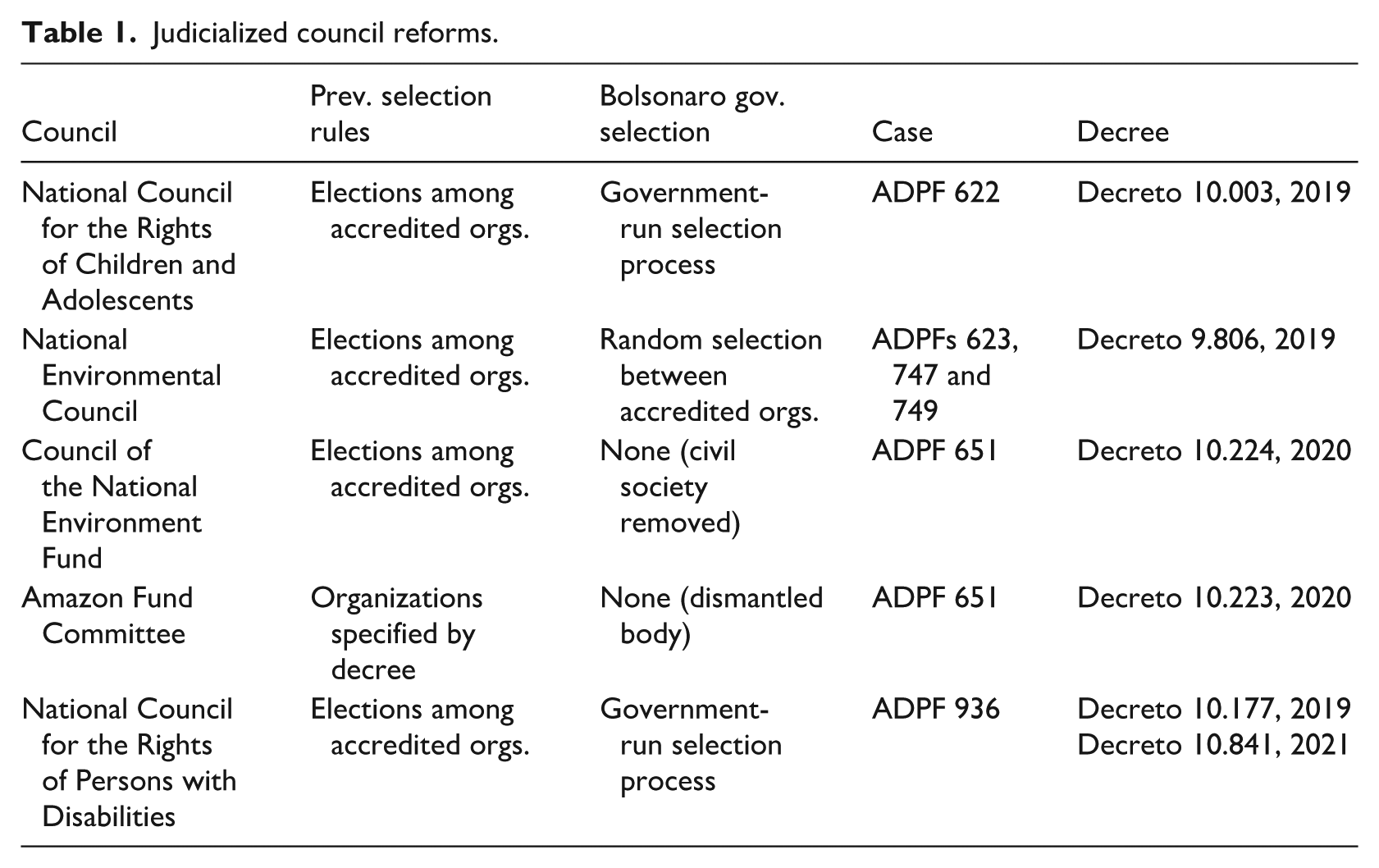
After dissolving as many councils as possible in a single decree, Bolsonaro then individually targeted statutory councils whose defining features were regulated only by decree. His reforms restructured these bodies to concentrate authority in government hands, most visibly by altering selection rules and terminating existing members’ terms. For example, all non-state members of the National Drug Policy Council were removed outright [Decreto 9.926, 2019: art. 3]. The National Council for the Rights of the Elderly, whose non-state members had previously been elected by accredited associations, was shifted to a government-controlled appointment process [Decreto 9.893, 2019: art. 3, IV]. The discussion that follows focuses on councils whose reforms were subsequently reviewed by the STF. Table 1 summarizes these changes: except for the Amazon Fund Committee—a surviving non-statutory council that was dissolved outright—most councils remained formally in place but had their membership reconfigured.
Judicialized council reforms.
Although some of Bolsonaro’s decrees were upheld in part, several reforms were blocked through doctrinal innovations that effectively extended compulsory deliberation to additional councils. The pivotal moment came in 2019, when Justice Barroso issued a temporary injunction (an emergency order preventing certain actions until a final ruling) against reforms to the National Council for the Rights of Children and Adolescents [ADPF 622, 2019c]. The injunction—later confirmed by the full court [ADPF 622, 2021]—introduced two major innovations. First, the government was barred from dismissing members of a non-independent body, with Justice Barroso grounding his decision in the council’s bylaws, which guaranteed 2-year terms, even though those bylaws had decree status. This departed from his own ruling 2 years earlier, which had permitted dismissals despite statutory—and therefore formally stronger—term limits. Second, the government was prohibited from altering a non-independent body’s self-adopted bylaws, including its selection rules. Justice Barroso treated the self-regulatory authority of a deconcentrated body as capable of constraining presidential discretion.
In concluding his opinion, Justice Barroso stated the thesis: “rules that hamper civil society participation under the pretext of regulating it are unconstitutional” [ADPF 622, 2019c: 7]. Barroso’s thesis was cited in subsequent cases, both to block similar reforms [ADPF 936, 2024] and to justify further innovations. A third innovation barred the dissolution of a non-statutory deconcentrated body: although the Amazon Fund Committee lacked a statutory basis, the government could not abolish it by decree [ADPF 651, 2022: 26]. A fourth innovation established general regulatory standards for all councils, including a parity requirement mandating equal representation of government and civil society [ADPF 623, 2023: 45]. The STF proceeded to decide ADPF 623 even after Bolsonaro’s presidency had ended and the relevant decree had been revoked—an unusual step taken to allow it to issue standards with binding and erga omnes effect and effectively legislating over participation.
All of these innovations relied on a notion previously rejected by the Court: that when higher law mandates participation in a policy area, it implicitly guarantees a degree of autonomy to related councils, making them a distinct form of deconcentrated body with limited executive control [ADPF 622, 2021: 11; ADPF 623, 2023: 26; ADPF 936, 2024: 37]. On this view, presidential rule-making authority is constrained when reforms concentrate power in government hands. The same reasoning was extended to non-statutory councils, as the 1988 Constitution itself was interpreted as containing an implicit general principle of participation [ADPF 651, 2022: 40, 33]. In doing so, the Court adopted a non-obvious constitutional implication, thereby reshaping the status of participatory councils. This corresponds to the third step of the mechanism (Figure 2): incorporating a resonant democratic harm frame into doctrine by specifying constitutional limits that, although previously unrecognized or rejected, were argued to have been implied all along.
Having documented the doctrinal outcome, we now trace the conditions that made it possible, working back through the mechanism. Petitions and amicus curiae briefs in these new cases advanced arguments like those that had previously been rejected in orthodox decisions [ADPF 622, 2019a: 11; ADPF 623, 2019: 15; ADPF 936, 2021: 17]. What changed was not the content of these arguments but the way they were received. The second step of the mechanism (Figure 2) concerns how litigants’ democratic harm frames gained force once they aligned with the justices’ background beliefs.
A key factor was how litigants connected their claims to the broader backsliding framework. In the pivotal case resulting in Barroso’s precedent-setting injunction, the Rio de Janeiro Public Defender’s Office submitted a brief comparing Brazil’s situation to Venezuela and Hungary, citing warning signs such as “repression of civil society,” “rejection of democratic rules,” and “concentration of power in the executive.” It argued that the council reform bore “a strong resemblance” to these patterns [ADPF 622, 2019b: 19]. In this view, an apparently routine exercise of administrative discretion was reframed as a façade for democratic subversion, warranting the STF’s counter-majoritarian intervention [ADPF 622, 2019b: 20]. This is an instance of what we described above as blending: selectively linking familiar and unfamiliar elements to foster recognition of the council reform as a case of democratic erosion.
Barroso’s injunction picked up this framing. It opened with a section titled “Abusive Constitutionalism, Autocratic Legalism, and Illiberal Democracy.” Drawing on international legal scholarship (Ginsburg and Huq, 2019; Landau, 2013; Scheppele, 2018), he argued that the contemporary danger to democracy lies in “small legal changes that appear formally valid and, when examined in isolation, may not seem clearly unconstitutional” [ADPF 622, 2019c: 10]. He concluded that “constitutional courts must be attentive to regulatory changes that, under the pretext of realizing the Constitution, are actually part of a broader strategy of concentration of powers, violation of rights, and democratic regression” [ADPF 622, 2019c: 11]. This concern was reflected in his thesis that rules restricting participation under the guise of regulation are unconstitutional. Other justices echoed these points in later opinions [ADPF 623, 2023: 52; ADPF 651, 2022: 130].
The convergence between litigants’ framing and the Court’s reception enabled justices to interpret the reforms as “apparently valid” [ADPF 622, 2019c: 10], “stealthy” [ADPF 623, 2023: 52], and “subtle” [ADPF 651, 2022: 130] threats. In doing so, it provided an interpretive solution to the problem of identifying non-prototypical backsliding reforms in a context in which the utility of traditional doctrine is called into question. Once the first decision recognized a council reform as a backsliding threat, litigants could invoke it as precedent. The government continued to rely on the administrative discretion frame, but its rival now resonated.
The resonance documented above, however, presupposed a prior shift in the justices’ background beliefs: the adoption of the backsliding mental model. This corresponds to the first step of the mechanism (Figure 2). That shift occurred in a context where backsliding ideas had become widely available within Brazilian legal and political discourse. Bolsonaro, an outspoken admirer of Brazil’s military dictatorship, would likely have raised concerns in any context. But his election followed the widely publicized experiences of leaders such as Viktor Orbán and Recep Tayyip Erdoğan, and came amid intensified global debate after Donald Trump’s rise. Works such as How Democracies Die (Levitsky and Ziblatt, 2018) had gained wide readership. A Brazilian edition of the book, released during the 2018 elections, became an instant bestseller (O Globo, 2018) and contributed to shifting the national conversation from the risk of a coup to backsliding. That this perspective took hold was notable in a country with a history of coups, led by a president who was himself a former military officer.
These ideas circulated with intensity within the legal community. In 2019, Brazilian legal scholars launched the international Project on Autocratic Legalism (De Sa e Silva, 2023), in which we participated, bringing concepts such as autocratic legalism and democratic backsliding into direct conversation with legal doctrine. STF justices were well-positioned to absorb this discourse. Many maintain close ties to academic legal circles; Justice Barroso, for instance, wrote the preface to one of Vieira’s (2023) books, and Vieira introduced the concept of autocratic infralegalism in a separate work. Importantly, backsliding ideas had already surfaced in judicial reasoning before the first heterodox council case as a justification for judiciary action, though in a supplementary rather than structurally decisive role [see Justice Mendes’ opinion in ADI 3.446, 2019: 23]. Barroso also discussed them in a working paper published 2 months before his pivotal decision, citing Bolsonaro as one in a global group of “conservative populists” (Barroso, 2019: 22). This suggests that the mental model was in place before litigants invoked it in the council disputes.
How could the backsliding model have not mattered?
Although backsliding rhetoric featured prominently in the Court’s opinions, it could be dismissed as post hoc justification for rulings driven by other motives. One reason to take the ideational account seriously is that the council reforms posed no obvious personal or organizational threat to the justices. Unlike measures affecting judicial tenure, jurisdiction, or budget, these reforms primarily reallocated authority within the executive branch. By contrast, the STF’s contemporaneous and equally heterodox decision to authorize its own investigation into disinformation campaigns against its members—also framed in democracy-defending terms (Vieira, 2024: 268)—clearly advanced the justices’ interests. Still, the absence of direct costs is weaker for an ideational explanation than evidence from cases in which courts act despite tangible risks (e.g., Ingram, 2012: 442). We must therefore consider alternative accounts that interpret the rulings as serving personal or organizational advantage. None, we argue, is sufficient on its own. Although motives are difficult to establish conclusively and evidence is necessarily indirect, competing explanations leave gaps that our mechanism better addresses.
Strategic accounts of judicial behavior are among the most plausible alternatives. These emphasize that judges anticipate the reactions of other actors and adjust their decisions accordingly (Epstein and Weinshall, 2021). The STF frequently acted strategically during Bolsonaro’s presidency. It leveraged public opinion to expand its authority in anti-disinformation measures (Keller and Arguelhes, 2025), engaged in off-bench bargaining with other branches (Bogéa, 2024), avoided rulings it lacked the capacity to enforce (Wang et al., 2023), and refrained from confronting Congress in ways that might undermine broader efforts to contain Bolsonaro (Da Ros and Taylor, 2022). Such behavior is not incompatible with our argument. Principled, idea-driven reasoning does not exclude strategic calculation. A court that adopts a backsliding mental model may still time its interventions carefully, frame them in politically defensible terms, or even refrain from issuing decisions it regards as justified. Judicial outcomes typically reflect the interaction of multiple factors. What our account rejects is the claim that the council rulings were merely strategic instruments serving some separate objective. Strategy may have shaped how and when the Court acted. It does not completely explain why it adopted a heterodox position in the first place.
One strategic variant that directly challenges our account is strategic antagonism: the notion that justices deliberately punished Bolsonaro to assert independence, regardless of whether the council reforms posed any perceptible risk. Although most strategic theories emphasize judicial moderation to avoid retaliation, more confrontational behavior can also be rational under certain conditions (Helmke, 2002). Bolsonaro’s repeated attacks on the Court may even have been intended to intimidate it into compliance (Dugno Chiodi and Bonzanini Bernardi, 2023). Yet empirical evidence cuts against a simple antagonism story. Vieira et al. (2023) show that the STF became more unfavorable to Bolsonaro as hostilities intensified, but the Court did not oppose him uniformly. It ruled in his favor in politically significant cases, including decisions suspending corruption investigations involving him and his family at sensitive moments (Barifouse, 2022). If the justices were primarily motivated by a desire to retaliate, it is unclear why they would unanimously select participatory councils—administrative bodies of limited public salience—as the arena for asserting independence. A more plausible explanation for the pattern of adverse rulings lies in the simultaneous proliferation of decrees that were clearly unlawful, particularly during the COVID-19 pandemic.
Another strategic possibility is coalition-building. Judges might cultivate support from public opinion or specific constituencies capable of shielding the Court from executive retaliation (Frishman, 2017; Garcia-Holgado, 2025). Some scholars argue that the STF is attentive to public opinion in high-salience cases (Mello, 2017; Prado and Machado, 2022). Yet participatory councils were comparatively obscure. During Bolsonaro’s presidency, far more visible disputes—particularly those concerning the pandemic and corruption—dominated public debate. Moreover, councils rarely attracted attention beyond specialized policy communities (Alencar and Ribeiro, 2014). A narrower version of this account would posit that justices sought to consolidate support among those specialized constituencies, especially human rights and environmental organizations that both participated in the councils and filed amicus curiae briefs. But these actors already had strong incentives to defend judicial independence given their long-standing and successful reliance on judicialization (Lehmen, 2021). It is difficult to see how orthodox rulings on council reform would have jeopardized that support; indeed, the STF’s earlier decisions upholding executive discretion in similar cases had not produced observable backlash.
A final strategic explanation is self-empowerment. Courts may adopt doctrines that expand their authority (Tew, 2024; Tommasini, 2024). The STF has a history of jurisdictional expansion since the 1988 Constitution, broadening both its reach and the range of actors entitled to bring cases before it (Arguelhes and Ribeiro, 2016). During Bolsonaro’s presidency, it went further by granting direct access to organizations defending minority rights as litigants—an expansion the justices openly acknowledged would open new areas of adjudication [ADPF 709, 2020: 11]. The council cases, however, offered little comparable opportunity for organizational aggrandizement. They did not enlarge the Court’s jurisdiction, alter procedural rules, or create new channels for litigation. One might argue that restricting executive discretion over administrative organization could generate precedents for future intervention. Yet the STF had already demonstrated its willingness to intervene in highly sensitive administrative matters, including blocking ministerial appointments [MS 34.070, 2016]. Against that background, the council rulings added little to the Court’s capacity for future expansion that it did not already have.
Even if personal or organizational interests are set aside, an attitudinal account would attribute the rulings to the justices’ policy preferences—predicting that judges vote in line with their ideological orientations (Segal and Champlin, 2017). This framework is less predictive in Brazil’s multiparty system than in the bipartisan United States, where the appointing president’s party often serves as a clear proxy for ideology. Nonetheless, Martins (2018: 90) finds modest clustering among Brazilian justices by nominating president, particularly in cases involving executive-sponsored legislation, though the effect is limited. The attitudinal approach, however, struggles to explain two features of the council decisions. First, several justices adopted positions inconsistent with their own recent precedents prior to Bolsonaro’s presidency. Second, the heterodox rulings were unanimous or nearly so—only two fell short by a single vote—despite the Court’s mixed composition and diverse appointing coalitions. An account grounded solely in stable policy preferences would have difficulty explaining both doctrinal reversals and cross-ideological convergence. It is implausible that all justices independently developed a strong substantive preference for preserving participatory councils at the same moment.
Finally, a pure bias account would attribute the council rulings to hostility toward Bolsonaro following his repeated attacks on the Court. On this view, justices sought to defeat him whenever possible. The broader record, however, does not support such a pattern. The STF did not systematically invalidate Bolsonaro’s initiatives; in many instances, it acted cautiously or even deferentially. If bias alone were decisive, one would expect consistent opposition. This perspective also struggles to explain why certain measures were newly characterized as “democratic harms” while others were tolerated. Nor does it account for the Court’s decision to rule on ADPF 623 after Bolsonaro’s presidency had ended. Such a move is difficult to interpret as an attempt to punish a particular incumbent. That said, bias is not entirely incompatible with our argument. As discussed earlier, justices’ perception of Bolsonaro as a potential democratic threat may have been shaped in part by increasingly negative predispositions. Our claim is not that ideas operated in a bias-free vacuum, but that the backsliding model structured how those perceptions were translated into legal reasoning.
Conclusion: Normative implications and future research
By examining the STF’s heterodox rulings on Bolsonaro’s participatory council reforms, we have argued that the adoption of a democratic backsliding mental model can expand the range of reforms judges regard as unlawful. When judges come to view democracy as vulnerable to gradual erosion through traditionally acceptable reforms, they become more receptive to arguments framing reforms as democratic harms and more willing to translate those framings into anti-incumbent doctrinal innovation. Several features may shape how this mechanism operates. Judges who understand their democratic role in anti-majoritarian terms appear more likely to let backsliding ideas reshape their reasoning; where courts define their mission more narrowly around legal predictability, such ideas may circulate without producing doctrinal innovation. Whether judges perceive a particular administration as posing a systemic backsliding threat also seems consequential—the same reform advanced by an apparently less threatening incumbent may not trigger the same response. And legal cultures more receptive to doctrinal innovation create more room for non-obvious implications to take hold.
Rather than treating these features as fixed prerequisites, however, we see them as starting points for inquiry. The mechanism may operate partially or differently where only some are present, and mapping that variation is itself a productive task (Simmons and Smith, 2026). One possibility worth exploring is whether prior receptiveness to doctrinal innovation and an anti-majoritarian commitment are always necessary, or whether repeated exposure to backsliding ideas can itself shift judicial orientations over time—particularly given that legal doctrines inspired by these ideas tend to caution courts against excessive deference to elected officials. A further open question concerns the stakes of judicial intervention. The council cases were relatively low salience and carried limited potential for violent backlash. Whether courts willing to apply the backsliding model would do so when facing higher political risks remains to be seen.
Our findings also carry ambivalent normative implications. On the one hand, they suggest that judicial reliance on backsliding ideas need not be reduced to self-interest. Courts may invoke such ideas in good faith as part of their understanding of constitutional responsibility. On the other hand, extending the backsliding frame to non-prototypical reforms revives a familiar concern: unelected judges may obstruct policies advanced by democratically elected officials. Doctrinal scholarship urging courts to respond to backsliding acknowledges this tension (Castillo-Ortiz and Roznai, 2024: 15; Dixon and Landau, 2015: 622; Ginsburg, 2018: 853; Vieira, 2024: 283). This risk is especially high when courts already have a broad view of their role and are willing to adopt new, less obvious interpretations of the Constitution. Indeed, observers broadly agree that the Brazilian Court has become increasingly interventionist since 1988 (Arantes et al., 2022: 11; Vieira, 2024: 171). A court with superhero syndrome may be no less troubling than one that deploys democratic rhetoric cynically.
Even if one accepts that courts should scrutinize reforms advanced by suspected aspiring autocrats more closely, the scholarship from which judges draw backsliding models offers limited guidance for non-prototypical cases. Litigants bridge this gap by emphasizing resemblances between contested reforms and familiar backsliding measures, but such framing is necessarily strategic. Bolsonaro’s council reforms did concentrate authority in the executive and reduce institutionalized channels for dissenting voices. Yet not every removal of constraints amounts to backsliding (Wolkenstein, 2023: 262), and national councils are not arenas of unmediated popular participation but sites of selective interest group inclusion. The democratic legitimacy of this kind of inclusion remains contested in academia (Miguel, 2011; Papadopoulos, 2003).
We regard Brazil’s councils as an important component of the country’s democratic architecture and have publicly expressed that view, including during Bolsonaro’s administration (Castro et al., 2023). However, it is not unreasonable to ask whether groups incorporated through rules established by prior governments should be able to bind subsequent elected administrations. Bolsonaro portrayed their entrenched presence as democratically suspect. While it is tempting to treat all of his initiatives as authoritarian overreach, even scholars critical of his presidency might question whether these particular reforms plausibly constituted steps toward de-democratization.
Resolving conceptual disputes over prototypical cases may be of greater interest for academics, but such cases are typically recognizable despite imperfections in definition. The more pressing challenge lies with non-prototypical reforms, where classification is uncertain. Greater scholarly attention to these ambiguous cases would therefore have more immediate practical implications for courts and legal actors. They do not need a watertight justification of why prototypical cases count as backsliding, but rather practical guidance on classification. Prototype theory calls into question the practical utility of rigid definitional approaches that attempt to specify categories through universally necessary and sufficient conditions. It may be unrealistic to expect a single necessary feature common to all backsliding reforms. Rather than attempting to specify fixed thresholds, a more productive strategy is empirical: to examine contested reforms in context and weigh the arguments for and against classifying them as backsliding. Such empirical-doctrinal analysis can clarify the conditions under which extending the backsliding frame is justified and when it risks overreach.
Footnotes
Appendix 1
National councils’ native names.
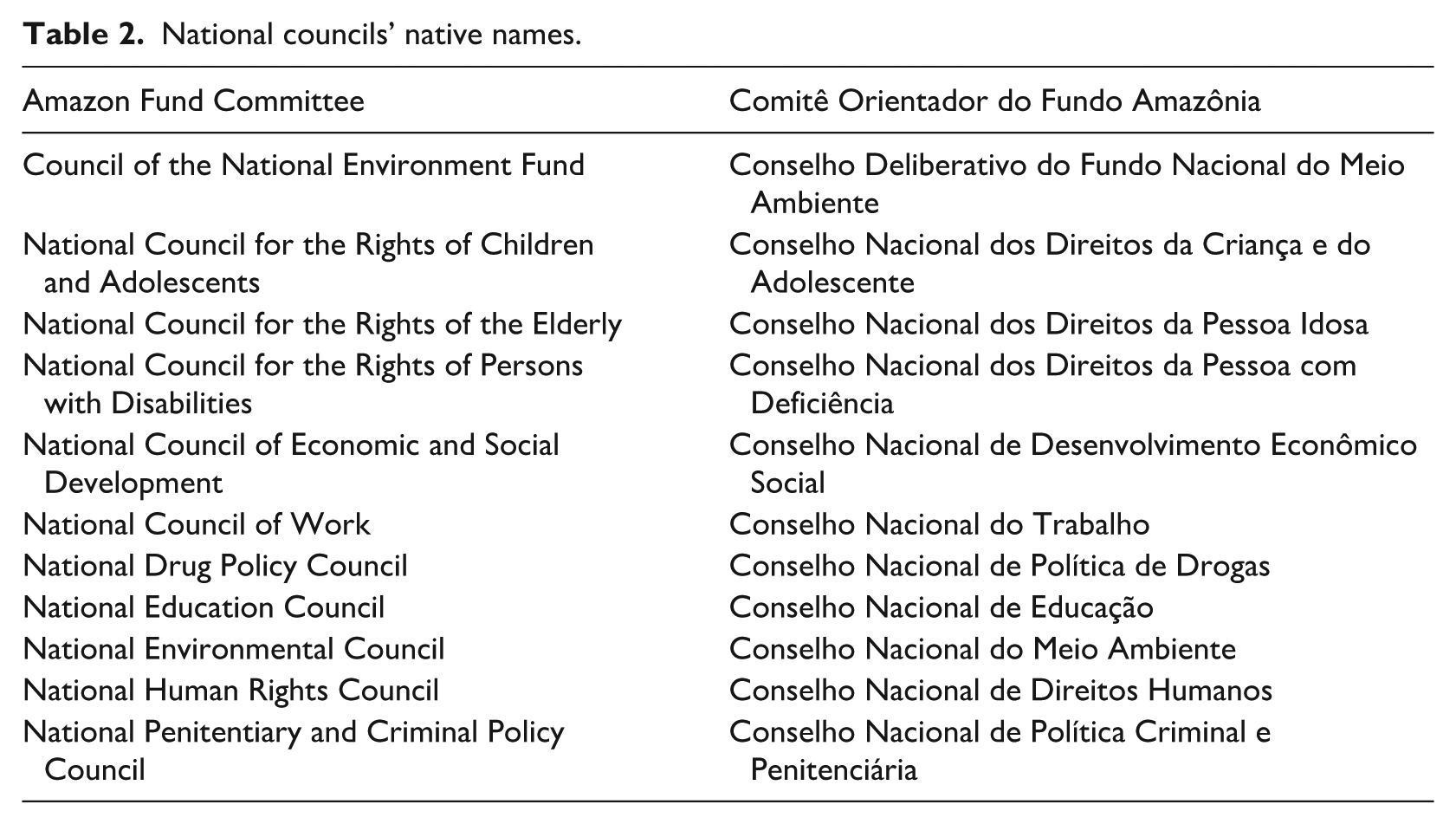
| Amazon Fund Committee | Comitê Orientador do Fundo Amazônia |
|---|---|
| Council of the National Environment Fund | Conselho Deliberativo do Fundo Nacional do Meio Ambiente |
| National Council for the Rights of Children and Adolescents | Conselho Nacional dos Direitos da Criança e do Adolescente |
| National Council for the Rights of the Elderly | Conselho Nacional dos Direitos da Pessoa Idosa |
| National Council for the Rights of Persons with Disabilities | Conselho Nacional dos Direitos da Pessoa com Deficiência |
| National Council of Economic and Social Development | Conselho Nacional de Desenvolvimento Econômico Social |
| National Council of Work | Conselho Nacional do Trabalho |
| National Drug Policy Council | Conselho Nacional de Política de Drogas |
| National Education Council | Conselho Nacional de Educação |
| National Environmental Council | Conselho Nacional do Meio Ambiente |
| National Human Rights Council | Conselho Nacional de Direitos Humanos |
| National Penitentiary and Criminal Policy Council | Conselho Nacional de Política Criminal e Penitenciária |
Acknowledgements
This research was presented at two “Legal Infrastructures and Democracy” conferences held at the Max Planck Institute for Legal History and at a Zukunftskolleg Jour Fixe (University of Konstanz). We would like to thank the participants in each event and the organizers of the former (Antoine Vauchez, Başak Çalı, and Mikael Madsen). We also thank the five anonymous reviewers and the guest editors for their thoughtful comments.

Funding
The authors received no financial support for the research, authorship, and/or publication of this article.
Declaration of conflicting interests
The authors declared no potential conflicts of interest with respect to the research, authorship, and/or publication of this article.