







Abstract
How are decisions about the school curriculum delegated in national education systems? Curricular centralization can shape how students are socialized in school and how educational outcomes are distributed in a country; however, existing research on the topic has been constrained by a lack of systematic longitudinal data for a global set of countries. We draw on newly available data for 130 countries from 1960 to 2020 to explore the country-level factors that shape curricular centralization. Our argument emphasizes the role of political and historical context at the international level in shaping curricular centralization at the national level. Over the postwar period, diffusing norms of national sovereignty, global waves of democratization, and the unexpected fall of the Soviet Union defined the kinds of curricular policies that had political legitimacy. We find that countries that gained independence between 1945 and 1990 are more likely to have more centralized curricula, while more democratic countries and post-Soviet countries are more likely to have less centralized forms of authority over the curriculum. The institutional logic that links these national-level characteristics and a country’s level of curricular centralization is culturally constructed by this evolving international context, rather than a historical inevitability.
Keywords
How are decisions about the school curriculum delegated in national education systems? For nation-states around the world, questions about the governance of education systems and how this shapes what students learn in school can have substantial political implications. For example, political control over the curriculum can determine the ideologies that shape how students are socialized (Morning, 2008; Young, 1971), and some studies suggest that centralized curricular institutions can lead to more equitable outcomes for students (e.g. (Allmendinger, 1989; Bol et al., 2014; Stevenson and Baker, 1991). Curricular centralization is thus a central issue for the sociology of education: not only can it have downstream effects on outcomes like nation-building and educational equality (Channa, 2015; Hannaway and Carnoy, 1993), but it also shapes what counts as legitimate knowledge, what students formally learn in school, and who determines this.
Despite the importance of these questions about political control over the curriculum, only a few studies have examined the wide range of cross-national variation in how centralized the school curriculum is in countries around the world (e.g. Astiz et al., 2002; Hossain, 2024; Ramirez and Rubinson, 1979; Stevenson and Baker, 1991). Most studies on the organization of the curriculum have focused on the trajectories and policies of specific case studies (e.g. Bjork, 2003 on Indonesia; Hanson, 1995 on Colombia; Steiner-Khamsi and Stolpe, 2004 on Mongolia), or they have explored the institutional dynamics of curricular centralization more abstractly through theoretical arguments (e.g. Bray, 2013; Meyer, 2009; Weiler, 1990). The scope of existing research on this topic has been constrained in large part by a lack of systematic longitudinal data for a global sample of countries. However, analyses that are limited to specific countries or time periods may overemphasize the nation- or time-specific processes that shape curricular centralization, and they are also unable to fully examine the macrolevel and historical processes that have shaped the evolution of education systems over the postwar period.
In this article, we explore the country-level factors that shape curricular centralization at the primary and secondary levels across a global sample of countries over the postwar period; we use newly available expert-coded data from the Varieties of Indoctrination project for 130 countries, from 1960 to 2020. Our argument draws on institutional theories of states and organizations that highlight the role of a state’s external environment in shaping what kinds of policies have political legitimacy (Jepperson and Meyer, 2021). In particular, we emphasize the role of international political and historical context in shaping primary/secondary curricular centralization at the national level. Several massive political changes transformed the world over the postwar period: diffusing norms of national sovereignty that led to the rapid creation of many new nation-states around the world, global waves of democratization, and the unexpected but colossal fall of the Soviet Union in the late 1980s and early 1990s. Within this changing historical and political context at the international level, institutional authority over the curriculum evolved to reflect policies that had political legitimacy at the national level. For example, countries that became independent between 1945 and 1990 adopted more centralized curricular institutions at the primary/secondary levels as part of a broader effort to conform to internationally legitimate institutional models of nation-statehood, while democratic and post-Soviet countries both developed less centralized institutional authority over the curriculum in response to globalizing norms of liberal individual rights and equalities.
Our argument draws from research on national education systems, global/transnational sociology, and political sociology to understand how macrolevel political changes have shaped the evolution of curricular centralization. Classic sociological work on national education systems often emphasizes the structural features of countries’ institutions but treats them as given and country-specific, focusing primarily on the effects of these institutions on individual-level outcomes (e.g. inequalities, mobility, or skill formation; Allmendinger, 1989; Kerckhoff, 2001; Pfeffer, 2008; Van de Werfhorst and Mijs, 2010). Yet, a long tradition in political sociology has emphasized that institutions are shaped by macrolevel processes that generate patterns of political order across societies (Amenta and Ramsey, 2010; Jepperson and Meyer, 2021). By drawing these literatures together, we highlight how countries are embedded in an international institutional environment that defines the kinds of curricular institutions countries that have political legitimacy at the national level (cf. Benavot et al., 1992; Meyer et al., 1997; Ramirez and Rubinson, 1979).
Background
Curricular centralization is one of several areas that shape institutional authority in national education systems (other areas include the allocation of funding, the hiring and assignment of teachers, the organization of school governance, and the design of certification and credentialing systems; see Clune, 1993; Ramirez and Rubinson, 1979 for more extended discussions). 1 For our purposes, we define curricular centralization as the extent to which authority over what students formally learn is controlled at the national level, rather than delegated to regional governments, local districts, or individual schools. These decisions shape the formal knowledge students encounter in the classroom, and they influence the degree of uniformity or diversity in instructional content (Stevenson and Baker, 1991). 2
Curricular centralization has long been debated in education policy, with discussions focusing on how best to balance national coherence with local responsiveness. Many have argued that centralization helps to ensure consistent learning standards across a country, especially because curricular inputs come from multiple sources (e.g. textbook publishers, legislation, professional organizations, and local communities) that require coordination by subject-matter experts (see Clune, 1993 for a review). At the same time, critics note that excessive centralization can limit local participation, overlook cultural and historical differences, and make it harder to adapt instruction to the needs of diverse communities (Astiz et al., 2002; Clune, 1993; Weiler, 1990). Beginning in the 1980s, policy discourse shifted toward concerns about accountability and school quality, with decentralization framed as a way to give teachers and local stakeholders more influence over curricular decisions (Astiz et al., 2002). International organizations such as the World Bank further promoted these arguments, contributing to a wave of reforms that sought to expand local autonomy in curriculum design and implementation (Hossain, 2022, 2024).
In our analyses, we focus on two key dimensions of curricular centralization: what level curricular frameworks are formally set at, and whether textbooks require approval by a national body. These indicators reflect key inputs that shape the formal content students learn in schools: however, we also recognize that they do not fully capture the many components of curricular governance. For example, we do not measure variation in assessment testing, exit examinations, or teacher training, although others have discussed these issues in more detail (e.g. Furuta, 2021, 2022). We discuss the implications of this for future research in the conclusion.
Political and historical context after World War II: Decolonization, democratic norms, and the rise and fall of state socialism
Our approach contributes to this literature by focusing on the macrolevel factors that shape why countries adopt more or less centralized authority over the curriculum. We draw on institutional theories of states and organizations, which emphasize how national education systems are cultural constructions that are shaped by a nation-state’s institutional environment (Dimaggio and Powell, 1983; Meyer et al., 1997). From this perspective, state structures reflect norms, institutional models, and cognitive schema from this external environment that define what is rational, modern, or legitimate; states and other actors that operate within the cultural frameworks that shape the institutional environment are seen as legitimate actors, which is crucial for organizational survival (Suchman, 1995). In what follows, we describe three macrolevel political and historical changes that transformed the world over the postwar period, along with their implications for curricular centralization at the national level: diffusing norms of national sovereignty that led to the rapid creation of new nation-states after World War II, global waves of democratization, and the fall of the Soviet Union in the late 1980s and early 1990s.
First, one of the most dramatic world political changes after 1945 was the rapid rate of decolonization and the emergence of independent nation-states in place of former colonized territories (Wimmer and Feinstein, 2010). By some counts, more than 60% of the countries recognized by the UN in 2024 gained independence after 1945. The international system that developed after World War II was constructed around liberal norms of nation-state sovereignty and self-determination that propelled nationalist movements for independence around the world (Strang, 1990). Among these newly independent countries, education was seen as an especially important institution for both establishing a nation-state’s identity in the international sphere and incorporating citizens into the newly constructed polity domestically (Ramirez and Ventresca, 1992). Mass education thus expanded rapidly around the world, along with compulsory education laws and ministries of education (Meyer et al., 1992; Ramirez and Ventresca, 1992).
Our first hypothesis is that countries that gained independence in the immediate decades after World War II will have more centralized institutional authority over the curriculum. Newly independent nation-states after World War II often drew on international institutional models to construct their policies and institutions, including in education (Meyer et al., 1997). These institutional models of the nation-state promoted the development of centrally coordinated state bureaucracies to actively manage and shape mass education (Furuta et al., 2024). As a result, international institutional models of education were often copied by these countries from the top down (Meyer et al., 1993), which often led to more centralized forms of authority over the curriculum. Former French and British colonies, for example, often maintained the centralized examination systems they inherited from their colonizers even long after they became independent (Furuta, 2021). Highly centralized curricula also likely helped newly independent nation-states to create more cohesive national identities (Benavot and Resnik, 2006); more centralized forms of authority allowed these countries to integrate otherwise disparate groups into “imagined communities” through common national histories and languages (Anderson, 1983). Centralized curricular authority thus allowed these newly independent states to project legitimacy, rapidly standardize schooling, and construct cohesive national identities. In Stinchcombe’s (1965) terms, this pattern reflects “imprinting effects,” where curricular authority structures adopted at independence persist long after the founding period (we discuss this in more detail at the end of this section).
A second transformative change over the postwar period was the increasing number of countries that established formally democratic political processes in what is widely characterized as the second and third waves of democratization (Huntington, 1991). By one count, less than 9% of countries could be classified as “democratic” in 1950, but nearly half of the countries in the world were democracies by the year 2000 (Herre et al., 2023).
In a global context, we expect more democratic countries to have lower levels of curricular centralization. Expanding democratic institutions empowered individuals with the rights, capacities, and actorhood to demand accountability, inclusion, and representation in the political process (Meyer and Jepperson, 2000), including in various dimensions of the education system. Democratic norms delegitimate top-down control over contested cultural content, and local publics demand more representation in educational decisions in democratic contexts (e.g. through voting); as a result, political elites typically decentralize curricular institutions in order to be more responsive to multiple constituencies (see Bjork, 2003; Hanson, 1995 as examples). Authoritarian countries, by contrast, face fewer pressures for representation and are more likely to centralize the curriculum to exert ideological or administrative control over state policy, particularly given the importance of schooling in socializing citizens and preventing dissent (Paglayan, 2022). Both of these points thus underscore the importance of political legitimacy: decentralized curricular institutions that encourage local accountability and representation are favored in democratic contexts, while centralized institutions are able to legitimate authoritarian rule.
The last international political change that shapes our argument about curricular centralization is the rapid and unexpected fall of the Soviet Union in the late 1980s and early 1990s. From 1945 to the late 1980s, international politics was dominated by the great power rivalry between the Soviet Union and the United States – and specifically between competing institutional models of liberal capitalism and communism (Westad, 2005). Communism was meant to be an international movement – and its political institutions were adopted in regions as far as Asia, South America, and Africa. State socialist ideology emphasized the merits of centralized planning – social policies were consolidated from the top down throughout the state, and often through one-party systems (Chirot, 1980). Although these ideologies were praised at different points in time for their political advantages, the collapse of the Soviet Union as a global superpower in the late 1980s and early 1990s was abrupt and highly unanticipated, and the ideology of communism as a globally legitimate institutional alternative fell with it (Mann, 2012: Ch 7). The fall of the Soviet Union led to a series of transformative economic and political reforms in former Soviet countries, intended to liberalize their political institutions (Mann, 2012: Ch 7).
We expect communist countries to have higher levels of curricular centralization, while post-Soviet countries should have lower levels of curricular centralization. Education in state socialist countries was often shaped by more collectivist (rather than individualist) ideologies of manpower planning – the view that education should expand to fit the economic needs of the collective society, rather than because it is an individual right (Baker et al., 2007). Communism thus served as an institutional model of statehood that justified centralized authority, ideological coherence, and education policy. This included the school curriculum, in part because state socialist political ideology also emphasized the importance of centralization for creating political equality (Azrael, 1965). 3
After the fall of communism in the 1990s, however, liberal policies that shaped the dominant institutional norms of the global political environment swept through the countries that were previously part of the Soviet Union (Mann, 2012: Ch 7). These more liberal policies included an emphasis on local accountability in education, which states then enacted in order to seek legitimacy in a new institutional environment. For example, Russia adopted a Federal Law on Education in the early 1990s that enabled local and nonstate actors to establish educational institutions (UNESCO, 2006); the Czech Republic also established a Law on State Administration and Self-Government in the Education System in 1990 to increase school/local autonomy over educational decision-making (UNESCO, 2006); and Hungary, which was part of the Soviet Union’s sphere of influence, established an Education Act in the early 1990s that was later amended several times to do away with the state’s monopoly on education and establish education as an individual right (UNESCO, 2006).
Our institutionalist approach emphasizes that the relationships between curricular centralization and each national-level characteristic are defined by an evolving set of political and historical processes at the international level. National-level characteristics like a country’s independence period or level of democratization are not inherently related to higher or lower levels of curricular centralization at all times and places. Instead, these institutional relationships are historically contingent: they are constructed by the dominant institutional norms and models in the global political environment that define the kinds of curricular policies that have legitimacy.
For example, newly independent countries have not centralized their education systems at all times and places historically. 4 Schooling was not always tightly linked to broadly theorized notions of societal progress: prior to the 19th century, for example, schooling was typically more of a private enterprise and linked to religion, rather than a state-driven public good to improve societal development (Furuta et al., 2024; Smith, 2023). In this kind of political context, newly independent countries may not have systematically developed centralized curricular institutions, because cultural assumptions about the role of the state in shaping education and society were not as apparent back then as they were in today’s world; countries like the United States, for example, did not include education in its national constitution upon gaining independence. In the post-World War II context, however, the logic that links national independence and curricular centralization is constructed by this assumption that education is linked to broader notions of societal progress, which shaped how newly independent countries developed their institutions (Benavot and Resnik, 2006; Meyer et al., 1997). In other words, these examples suggest that countries develop institutions that are “imprinted” by their founding conditions (Stinchcombe, 1965).
Similarly, democratic institutions are not inherently incompatible with centralized education systems: consider a country like France, which democratized while maintaining a top-down curriculum through a centralized state and national examinations (Carson, 2007). However, democracies in the context of the postwar period systematically developed less centralized curricular institutions because of the liberal and individualistic character of the norms that diffused around the world during those decades (Meyer and Jepperson, 2000). Post-Soviet countries, finally, did not develop less centralized curricula after the collapse of the Soviet Union through an inherently inevitable process; however, these countries adopted less centralized curricula in this particular historical context because they were embedded in a global political environment where liberal individualism shaped the dominant institutional models at the time (Lerch et al., 2022).
In short, the international political and historical processes we describe above constructs the cultural logic that shapes why national characteristics like a country’s independence period of democracy level are associated with curricular centralization in specific ways. In alternative historical circumstances for each of these different independent variables, we might expect different results constructed by a different cultural logic. As we discuss in more detail below, we also expect these variables to predict a country’s curricular centralization net of a variety of other social processes. In what follows, we describe our data, methods, and several alternative arguments we incorporate into our models.
Data and variables
Dependent variable
Our main dependent variable of interest is a country’s level of curricular centralization, which we draw from the Varieties of Indoctrination dataset (Coppedge et al., 2024; Neundorf et al., 2024). The measure we use as our dependent variable is constructed based on two questions that measure control over the content of education; these questions are fielded through surveys to country experts on education systems around the world. The first question asks country experts to rate whether a country’s curriculum framework is set entirely by local bodies, subnational authorities, or national authorities (as a nominal outcome). The second asks whether textbooks are centrally approved or not by a national authority (as a dichotomous outcome). 5 Coppedge et al. (2024) treat experts’ responses to these questions as manifestations of a latent concept of curricular centralization, and they use V-Dem’s Bayesian item response theory measurement model to convert each question into a single interval variable with values that range from 0 to 1 (for more information on the measurement model, see Pemstein et al., 2020).
The two variables that make up our index capture related but distinct facets of centralization: one captures who sets curricular standards, the other capturing how those standards are enforced. Their moderate correlation reflects that countries can centralize authority and implementation to different degrees. Following Coppedge et al. (2024), we treat them as complementary indicators of a common construct, while acknowledging that they do not capture every dimension of curricular governance (e.g. pedagogy or assessment testing). Both variables are moderately correlated (r = 0.61) and combined by Coppedge et al. (2024) as an average to create a single interval variable of curricular centralization that has a range of values from 0 to 1; at the highest end of the range, a 1 indicates a very centralized curriculum, while a 0 indicates a very decentralized curriculum at the lowest end. 6
The values of this variable can be interpreted as the degree to which a country’s curriculum is nationally controlled, and is measured at the primary and secondary levels of schooling. For example, countries like Canada, the United States, or Australia are widely known to govern education through province- or state-based structures (Vergari, 2013); these are coded as the most decentralized systems in the dataset (with average scores of 0.002, 0.012, and 0.001, respectively, from 1960 to 2013). Countries like Singapore or Cyprus, which are identified as having highly centralized curricula by Astiz et al. (2002), have scores of 0.83 and 0.85 (respectively) in the 1990s. And educational changes in countries like Finland, which had a relatively centralized curriculum before it underwent a series of reforms that gave more curricular authority to teachers and local schools in the 1990s (Mølstad, 2015), are also recorded: Finland has an average score of 0.68 until the 1990s, where it subsequently drops to 0.13.
Independent variables
We measure our key national-level independent variables in the following ways.
First, to test our hypothesis about postwar independence, we measure whether a country was founded between 1945 and 1990 as a dichotomous variable. Our data on national independence come from the Colonial History Dataset through the Issue Correlates of War project (Hensel, 2018).
Second, to capture the relationship between a country’s level of democratization and curricular centralization, we include a variable that captures the extent of liberal democracy in a country from the Varieties of Democracy (V-Dem) dataset. V-Dem builds this variable by using expert-coded assessments of a country’s elections, civil liberties, judicial independence, and checks on executive power. These assessments are converted into an index using a Bayesian item-response model that adjusts for differences in how individual experts rate countries; the liberal democracy index, in particular, combines two variables on electoral democracy and liberal protections into a single summary measure. A 1 indicates high levels of electoral democracy as well as rule of law, checks and balances, and protections of civil liberties, and a 0 indicates low levels (Coppedge et al., 2024).
Third, for our hypothesis on communist and post-Soviet countries, we include a dichotomous variable that indicates whether a country is communist during the time period of our analyses, as well as a dichotomous variable that identifies whether a country was previously part of the Soviet Union’s sphere of influence after its breakdown in the late 1980s and early 1990s. 7
Control variables
We also draw on prior literature to consider a range of other arguments that are associated with curricular centralization and our key independent variables.
First, we measure a country’s level of economic development as its GDP per capita using data from the Penn World Tables (logged to reduce skewness; Feenstra et al., 2015). Economic development has been shown to shape a variety of educational institutions (e.g. Barro and Lee, 2015). On one hand, more developed countries may have more state capacity, which could provide them with the institutional infrastructure necessary to centralize the curriculum and create national curricular frameworks; on the other hand, less centralized education systems might require higher levels of economic development, give that decentralization requires more complex forms of coordination and organizational rationalization in order to be effective.
Second, we include a variable that captures a country’s population size from the World Development Indicators (logged, to reduce skewness) (World Bank, 2023a). On one hand, a country’s population may be negatively associated with its level of curricular centralization: larger countries may have more of a reason to delegate decisions about the curriculum to local communities that have better information about local needs, while smaller countries may have less of a need to decentralize their decisions about the curriculum if the system itself is already small (Bray, 2013; Hannaway and Carnoy, 1993). On the other hand, it is possible that countries with larger populations see curricular centralization as more important for socializing citizens and creating national identity, given that there are more people to incorporate into the nation; in this case, we would expect population size to be positively correlated with curricular centralization.
Third, we include a dichotomous variable indicating whether formal local government authorities exist within a country, based on expert-coded data from the Varieties of Democracy dataset (Coppedge et al., 2024). We conceptualize this variable as capturing subnational administrative capacity. On one hand, this administrative capacity may enable the delegation of curricular authority to lower levels of governance; on the other hand, the presence of local authorities could allow subnational units to implement centralized policies more effectively.
Fourth, we identify whether a country has a ministry of education, using data on founding dates for a country’s ministry of education coded from the Statesman’s Yearbook (various years; see also Furuta et al., 2024). We include this variable to account for differences in state organizational capacity: a ministry of education may provide the organizational infrastructure that allows countries to centralize decisions about the curriculum more easily, even if the existence of a ministry does not automatically imply centralized control. 8 This variable is coded dichotomously to indicate whether a country has a ministry of education; in additional analyses not shown, we also measured this variable as the age of a country’s ministry of education (with similar results).
Fifth, we control for a country’s gross primary enrollment ratio using data from the World Development Indicators (World Bank, 2023a) and other sources described by Meyer et al. (1992). Countries with more expanded mass education systems may have higher levels of curricular centralization: as states with larger primary enrollments develop greater administrative capacities, they may shift their priorities toward improving the quality of instruction, leading to more centralized control over textbook approval and the curriculum.
Sixth, we include a variable that identifies a country’s level of ethnolinguistic fractionalization, drawing on data from the Historical Index of Ethnolinguistic Fractionalization dataset (Drazanova, 2020). Countries with higher levels of ethnic conflict may have lower levels of curricular centralization, given that they are more likely to face political struggles to control the educational process between heterogeneous domestic ethnic groups (Alcorta et al., 2018). This variable is coded as an interval variable, where a 0 indicates low levels of ethnolinguistic fractionalization (i.e. all individuals are members of the same ethnic group) and a 1 indicates highest levels (i.e. each individual in the country belongs to their own ethnic group); data on this variable are available from 1960 to 2013.
Seventh, we include a variable that captures the amount of clientelism in a country at a given point in time. As prior studies suggest, countries with political systems shaped by more pervasive clientelistic relationships (i.e. where resources or jobs are provided through patronage networks or personal relationships in exchange for political support) may have more centralized educational institutions (Hossain, 2024): more centralized institutions could enable political elites to reinforce their political power by rewarding political loyalists and suppress dissenting views. We draw on the Varieties of Democracy dataset’s index of clientelism, which is an interval variable that identifies the extent to which a country’s politics are shaped by clientelistic relationships (Coppedge et al., 2024): a 0 indicates low levels of clientelism, and a 1 identifies high levels.
Finally, we include a variable that identifies the number of World Bank education projects a country has received funding for within a 5-year time interval (World Bank, 2023b). Given that the World Bank has been a strong proponent of curricular decentralization reforms since the 1980s, we might expect countries that receive more funding from the World Bank to be more likely to decentralize their curricula, although prior studies have shown that this association is questionable (Hossain, 2024). To create this variable, we drew on the complete list of World Bank projects related to education from its Projects and Operations website, from 1947 to 2020, and identified the year any project was funded for a given country. We then coded the number of projects a country ever received funding for within the past 5 years of time t, from 1960 to 2020, and we scaled the variable for our analysis by dividing by 10.
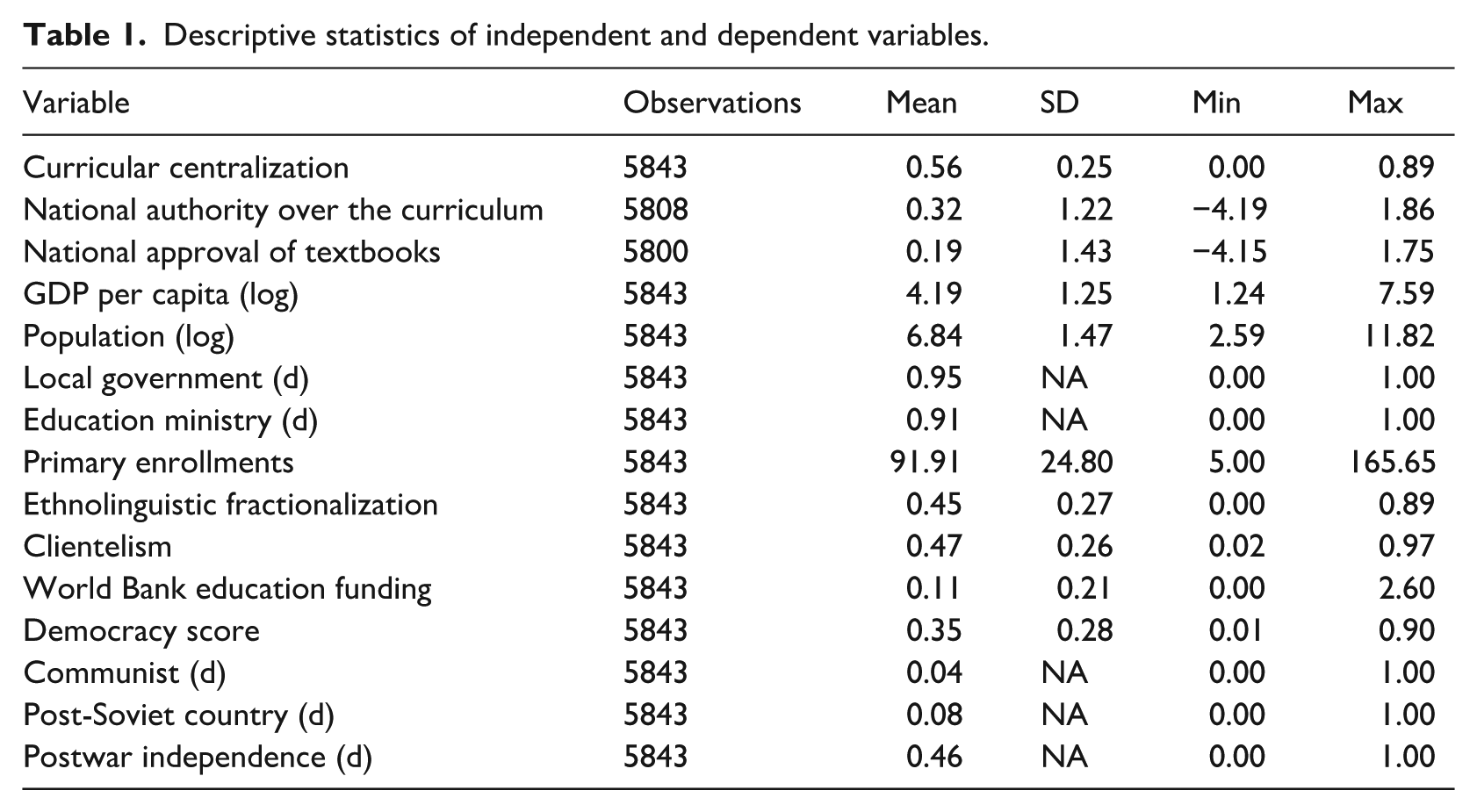
Our final sample in all models is a constant sample of 130 countries from 1960 to 2013, constructed through listwise deletion. Table 1 provides descriptive statistics for all variables used in our analyses, and Appendix 1 provides a correlation matrix. Appendix 2 summarizes the foregoing discussion of our key variables and their sources.
Descriptive statistics of independent and dependent variables.
Methods
To test our hypotheses, we estimate a series of country-level panel regression models with random effects and clustered standard errors (Wooldridge, 2009). Our models take the following form:

Where y is the dependent variable for country in in time t, x is a vector of independent and control variables for country i in time t, α is time-invariant error term for country i, and ε is a time-varying error term for country i in time t (Allison, 2009).
Our theoretical interest is in understanding the substantial degree of cross-national variation in the structure of curricular authority. National education systems are slow-moving structures: as a result, most countries do not change drastically from year to year, but substantial differences in curricular centralization are observed across countries. 9 As we discuss in the introduction, one of our key contributions to existing research on national educational institutions (e.g. Allmendinger, 1989; Kerckhoff, 2001; Pfeffer, 2008) is to shed light on the macrolevel processes that generate patterns in curricular institutions across a global sample of countries. Our argument also emphasizes the importance of time-invariant variables in shaping a country’s curricular centralization score (e.g. post-World War II independence), which cannot be captured by within-country analyses. Given these considerations, we opted to use random effects (instead of fixed effects) models in our analyses, in order to be able to exploit between-country variation in our data and test these arguments. Fixed effects models are better suited for capturing within-country changes in our dependent and independent variables (Allison, 2009), and would also not allow us to test some of our key arguments that rely on time-invariant variables. 10
To ensure that our country-level predictors precede the outcome variable, all independent and control variables are lagged by 1 year; the results are not substantially different with alternative lag times. We also include a variable that identifies a linear time trend from 1960 to 2020 to account for the broad, secular changes in curricular governance over the time period of our analysis. 11 We also control for a country’s geographic region. Given that the results for time and region are not the main focus of our argument, they are not shown in our models.
Results
Descriptive statistics
Figure 1 plots the global average curricular centralization score from 1960 to 2020 for a constant set of countries, and Figure 2 plots the global 5-year average change 12 in curricular centralization. On average, curricular centralization increases gradually around the world over the entire time period of our study. As Figure 2 illustrates more closely, the world average curricular centralization score increased at a faster rate before the 1990s; while the average curricular centralization score continues to increase rather than decrease after the 1990s, the rate of change from one year to the next is much smaller in magnitude during the latter period. Drawing on our argument above, one might speculate that national-level trends toward greater curricular centralization among postwar and state socialist countries over this time period outweighed movements toward decentralization in democratizing countries.
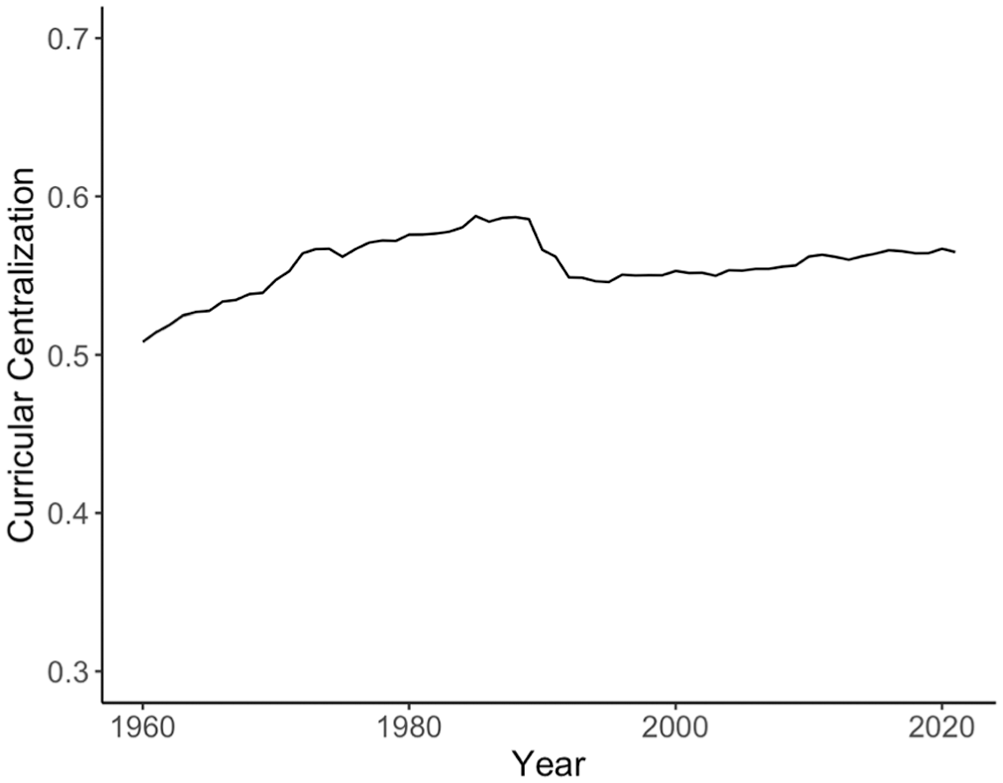
Global average curricular centralization scores, 1960–2021.
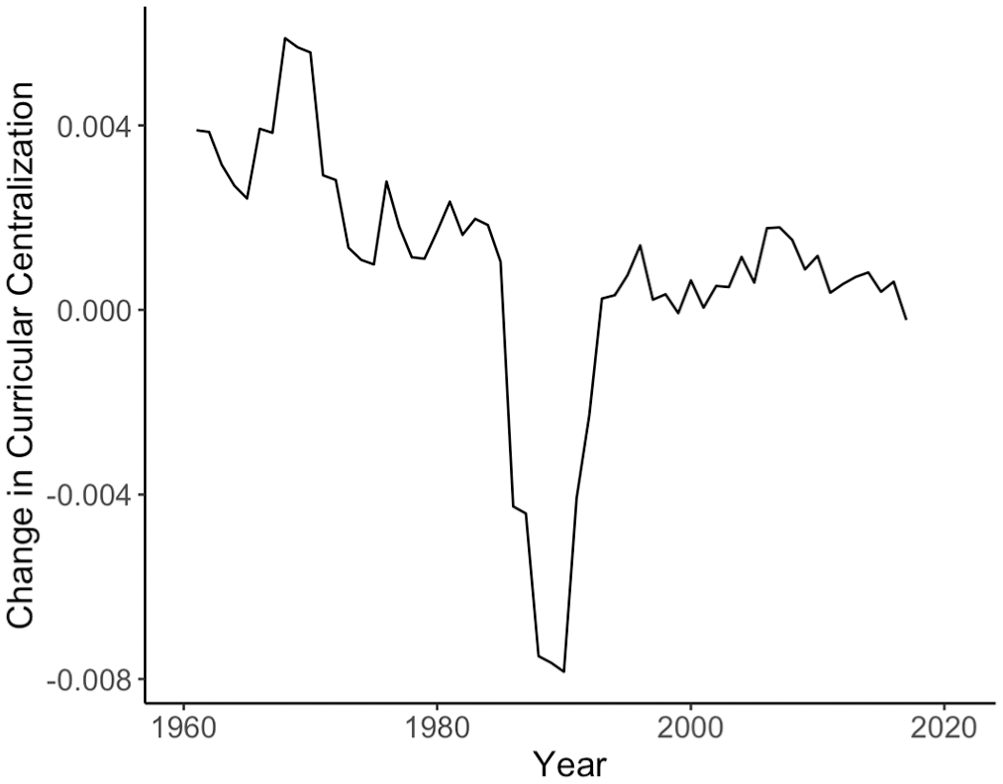
Five-year average changes in centralized curriculum scores, 1960–2021.
As Figures 1 and 2 show, however, there was a sharp drop in global average curricular centralization in the early 1990s. The nature of this change becomes clear in Figure 3, which shows the average centralization score by region, for the same time period. As the descriptive trends in Figure 3 demonstrate, the tremendous drop in the global average curricular centralization score in the 1990s appears to be driven almost entirely by Central/Eastern Europe, where average curricular centralization drops from the highest in the world to near lowest (after the industrialized West). Many of these changes are dramatic: for example, the Czech Republic’s (former Czechoslovakia) curricular centralization score drops from 0.88 in 1989 to 0.44 in 1990, and Russia’s curricular centralization score drops from 0.81 in 1989 to 0.51 by 1992. These trends undoubtedly reflect the fall of the Soviet Union as a centralized political unit in the late 1980s and early 1990s, which set off a wave of liberalizing reforms in those states under the Soviet Union’s sphere of influence. These reforms were intended to both transform the education systems of these states and remove the state’s earlier monopoly on education (see our earlier discussion for examples); the former more centralized curricular institutions with corporatist undertones were replaced with more liberal institutions, given that the ideals of liberalism shaped the dominant institutional norms of the global political environment at that time (Lerch et al., 2022). Besides this, the Middle East (including North Africa) and Asia have the highest average centralization scores after the 1960s, and South/Central America has the lowest average scores outside of the West. These trends fit more general knowledge from past research: South/Central America, for example, were among the hardest hit by neoliberal reforms in the 1980s and 1990s (Mann, 2012: Ch 5), and the Middle East/North Africa and Asia tend to rely on centralized high stakes examinations to structure their curricula (Furuta, 2021; Jackson and Buckner, 2019).
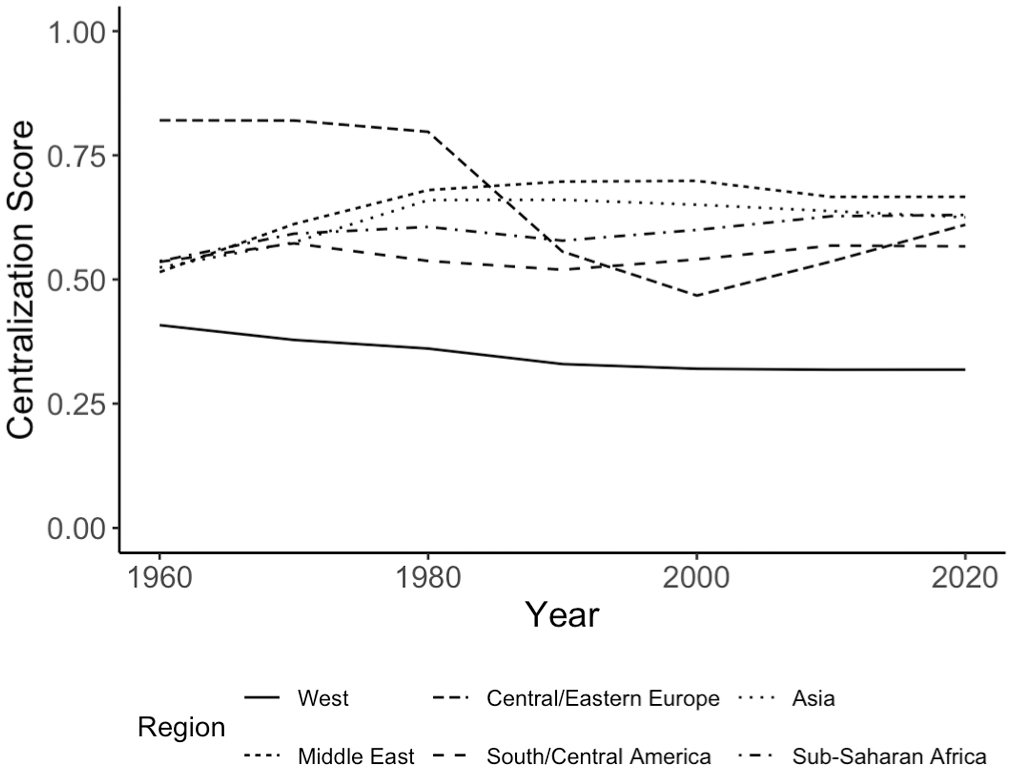
Average curricular centralization scores by region, 1960–2021.
Given that several countries around the world enacted policies to decentralize the curriculum beginning from the 1980s, it is surprising that the overall global average trend in curricular centralization is mostly upward. Even in a region like South/Central America, the overall trend in curricular centralization is upward. It is possible that the ideologies of educational decentralization propagated by international organizations tended to emphasize economic, rather than curricular, decentralization. More generally, however, some commentators have noted that many countries that enacted decentralization reforms (in response to pressures from international institutions) eventually shifted back toward policies to recentralize governance and decision-making in education (e.g. Steiner-Khamsi and Stolpe, 2004; Weiler, 1990). These studies suggest that top-down efforts to decentralize educational institutions often fail because abstract ideologies of decentralization are ill-adapted to local or heterogeneous circumstances (Hossain, 2024). For example, local decision-makers may not implement reforms that are enacted (Bjork, 2003), or decentralized curricula may require levels of administrative coordination across subnational units that lead to reassertions of centralized political control (Lewis, 2014). In a world that increasingly requires knowledge of national (and even international) systems and affairs, good faith efforts to emphasize local contexts or knowledge in the curriculum may also run up against resistance from local populations, who sometimes see national policies as more equalizing (cf. Meyer et al., 1993; Weiler, 1990).
Panel regression results
Table 2 shows the results of our panel regression models, where our dependent variable is a country’s curricular centralization score in a given year. Given data limitations on some of our independent variables (e.g. the index of ethnolinguistic fractionalization is only available until 2013), our models in this table only span the time period from 1960 to 2013; however, when we remove these variables and extend our analyses up to 2020, the empirical findings for our key independent variables remain unchanged. Our results indicate consistent evidence for the role of most of our key independent variables in shaping curricular centralization in countries around the world. Postwar countries are more likely to have higher curricular centralization scores (p < 0.01), while democracies are more likely to have lower curricular centralization scores (p < 0.001). As expected, furthermore, post-Soviet countries are more likely to have less centralized curricula (p < 0.001). Communist countries are more likely to have more centralized curricula over the time period of our analysis, although this coefficient is not statistically significant. It is possible that the explanatory power of this variable is absorbed by our controls for a country’s region, given that many Communist countries are in Eastern Europe.
Random effects panel regression models of curricular centralization on independent and control variables, 1960–2013.
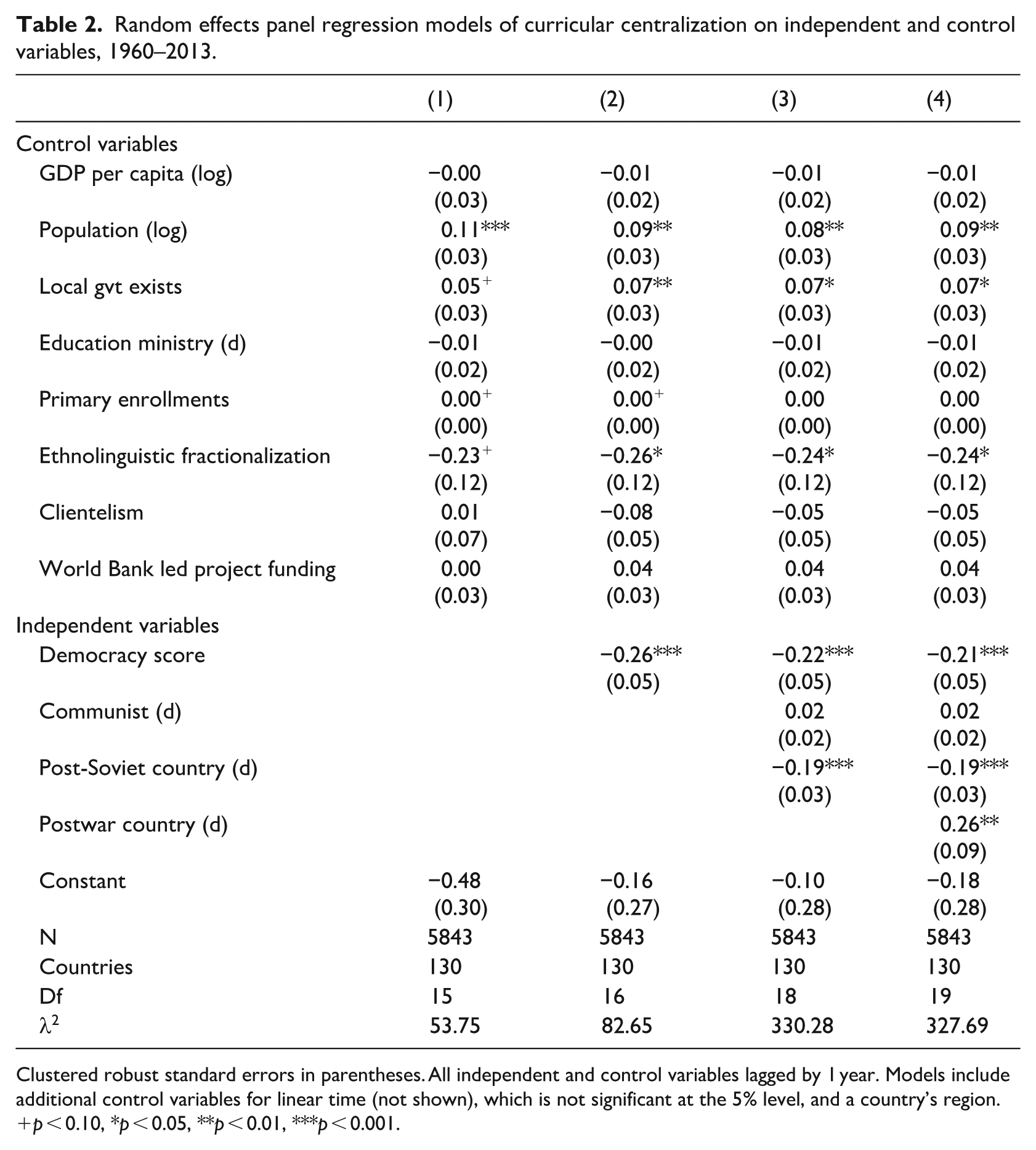
Clustered robust standard errors in parentheses. All independent and control variables lagged by 1 year. Models include additional control variables for linear time (not shown), which is not significant at the 5% level, and a country’s region.
p < 0.10, *p < 0.05, **p < 0.01, ***p < 0.001.
Figure 4 calculates the differences in predicted centralization scores (as average marginal effects) by a country’s independence period and level of democracy, based on model 4 from Table 2. The magnitude of some of these effects is quite large: for example, the predicted curricular centralization score for a postwar country from model 4 is 0.71 (on a scale from 0 to 1), while the predicted centralization score for a non-postwar country is 0.45. A difference of 0.26 in a country’s centralization score is roughly equivalent to the difference between Norway (centralization score = 0.36) and Uganda (centralization score = 0.62), or New Zealand (centralization = 0.29) and Equatorial Guinea (centralization = 0.55), all in 2010. The postwar histories of many of the countries that gained independence during this period of decolonization illustrate these statistical patterns more concretely. For example, countries like Singapore and Malaysia developed relatively centralized curricular structures after gaining independence in order to unify the ethnically and linguistically diverse groups in each country (with centralization scores of 0.71 and 0.58 in 1971; Kurian, 1988). Former French colonies in sub-Saharan Africa, furthermore, are known to have maintained the more centralized curricular structures of the Francophone educational model even after becoming independent (Furuta, 2021; Garnier and Schafer, 2006), rather than developing more decentralized institutions that fit the ethnic and tribal diversity of their local circumstances.
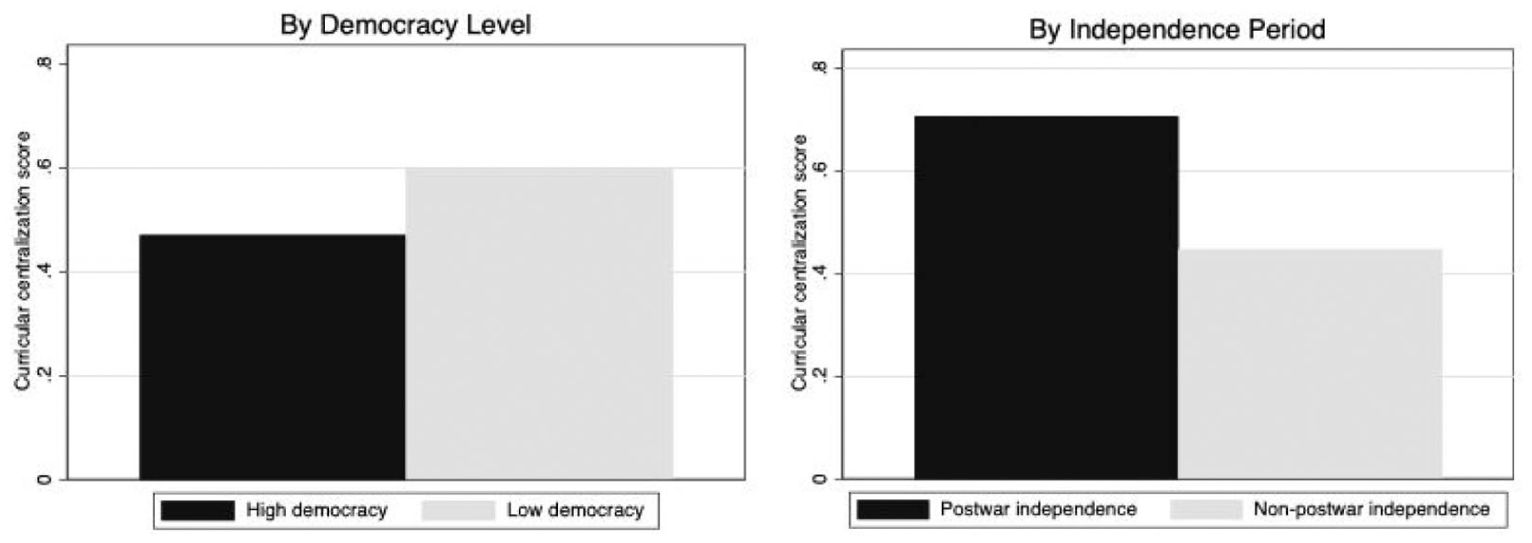
Predicted centralization scores by democracy level and independence period.
The predicted differences in curricular centralization between more and less democratic countries are smaller, but still substantial: a high-democracy country (democracy score = 0.80) has a predicted centralization score of 0.47 (on a scale from 0 to 1), while a low-democracy country (democracy score = 0.20) has a predicted centralization score of 0.60. A difference of 0.13 in a country’s centralization score is roughly equivalent to the difference between South Africa (centralization score = 0.65) and Azerbaijan (centralization score = 0.78), or Peru (centralization = 0.53) and Zimbabwe (centralization = 0.66), all in 2010. Nondemocratic countries routinely shape the curriculum to fit a regime’s political ideology. For example, consider North Korean textbooks: Won and Huntington (2021: 282) note that “students are socialised into accepting the unquestionable state authority based on absolute allegiance to the Kim family”; in more recent periods, state-sanctioned textbooks on Russian history written in 2023 were written to validate the country’s invasion of Ukraine in 2022 (Safronova, 2023).
Our results for the control variables in our models are largely in line with our expectations, or they lack statistical significance. A country’s population size is positively associated with curricular centralization (p < 0.01), which suggests that larger populations face greater difficulties in the nation-building process, and may therefore attempt to diminish local differences in the school curriculum rather than celebrate them. A country’s level of ethnolinguistic fractionalization is negatively associated with curricular centralization, although it is not always significant at the 5% level. Economic development, primary enrollments, clientelism, and funding from the World Bank are not consistently significantly associated with curricular centralization. Our finding on the non-effects of World Bank funding is also somewhat surprising, but consistent with findings from prior research (Hossain, 2024). Our finding that the existence of local government authorities is associated with more, rather than less, centralized curricula is also surprising (p < 0.05 in most models). It is possible that the existence of local government authorities in a country is a proxy for greater state capacity; local authorities might therefore exist to implement centralized policy more effectively, rather than to implement decentralized curricular policies. 13
Additional analyses
In supplementary analyses (available upon request), we explored the robustness of our findings by testing several other control variables suggested in prior literature. For example, some arguments suggest that decentralization is a political ideology associated with conservative political parties that embraced neoliberalism (e.g. Astiz et al., 2002), which implies that countries with more rightward political orientations could be more likely to have decentralized curricula. Other studies suggest that a country’s level of economic globalization reflects commitments to neoliberal ideologies that support decentralizing the curriculum (e.g. Astiz et al., 2002); we might therefore expect a country’s level of economic globalization to be negatively associated with curricular centralization. We tested both of these arguments, drawing on the Inter-American Development Bank’s data on political orientations of the country’s chief executive (Scartascini et al., 2021), and the KOF Globalisation Index project’s measure of economic globalization (Gygli et al., 2019). None of these variables showed significant effects or altered our results, and in some cases including them in our models restricted the sample size of our analyses. Given this, we opted not to include them in our final results.
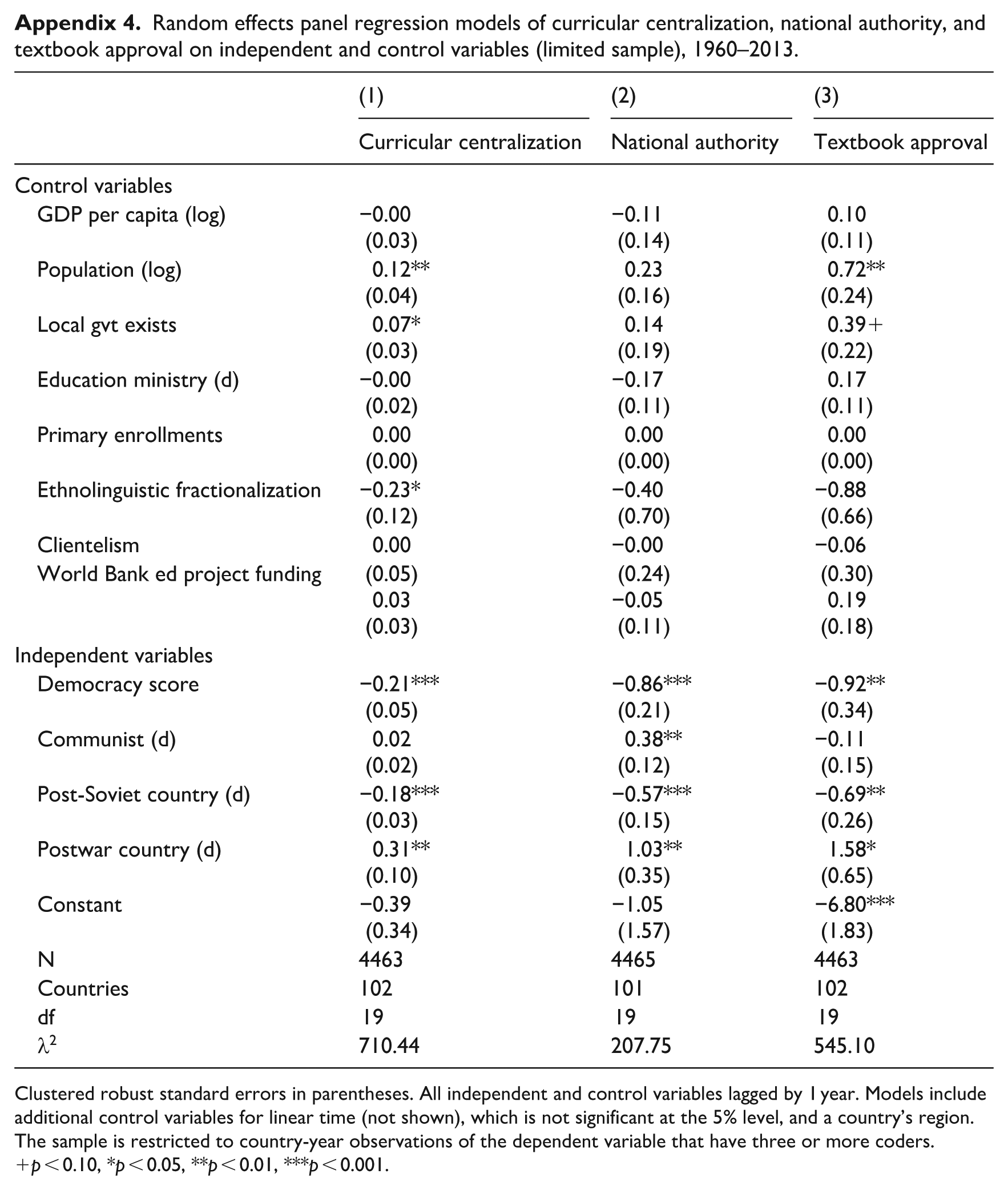
Appendices 3 and 4 report the results of two additional sets of robustness checks. Appendix 3 reports the estimates of our independent variables when the two variables that make up our index of curricular centralization (national authority over curricular decision-making and national approval of textbooks) are disaggregated into separate dependent variables. The coefficients for our key independent variables are somewhat similar for both models; however, the coefficients for communist countries are in opposite directions and not significant at the 5% level for our model. Given that information and the media in communist countries are already tightly controlled by the state and infused with political ideology, it is possible that the overall curricular framework is directed by the state (model 1) while more specific curricular tasks (like textbook approval) are delegated to subnational authorities (model 2). Appendix 4 reports the results of estimates of our independent variables when we remove the observations in our dependent variable that have fewer than three coders; as Neundorf et al. (2024) note about the Varieties of Indoctrination dataset, data with only one or two coders could have higher levels of uncertainty or be less reliable, and they suggest running robustness checks when those countries are removed from the analyses. Restricting our analyses to countries with three or more coders reduces our sample to 101–102 countries, but the results of our key independent variables are also largely similar to the models that include our full sample.
Conclusion
Our contribution in this article is to identify the role of the broader historical and political context at the global level in shaping curricular centralization at the national level. Drawing on newly available data on 130 countries from 1960 to 2020, we show that countries that gained independence after World War II are more likely to have more centralized curricula, while more democratic countries and post-Soviet countries are more likely to have less centralized forms of political authority over the curriculum. Our historical narrative emphasizes the importance of understanding the role of the international political and historical context in shaping the kinds of curricular policies that have political legitimacy at the national level: the logic that links these national-level characteristics and a country’s level of curricular centralization is a cultural construction that is shaped by this evolving global context, rather than an inevitability.
More generally, we contribute to sociological research on education and institutions by examining the macrolevel forces that shape political control over what students learn in school. At its core, education is an institution that transmits values, norms, and skills that teach students how to act as members of society (Paglayan, 2022); but how students are socialized is shaped by the kinds of political institutions that determine the curriculum in a country’s schools. In the United States, for example, many studies have emphasized the significant gaps in what students learn in school by race, class, gender, or geographic area (e.g. Reardon et al., 2019); in cross-national perspective, however, these inequalities may be accentuated by the country’s highly decentralized curricular institutions, which are themselves shaped by the country’s performance of a particular nation-state identity (see Van de Werfhorst and Mijs, 2010 for a similar point). Countries with less centralized curricular institutions may also be more likely to experience contestations over the meaning of national identity. In the United States, for example, recent attempts in Republican-led states to ban books and infuse the public-school curriculum with religious rhetoric are examples of political struggles over what kinds of knowledge are considered legitimate (Cline, 2024; Petri, 2023). Our approach suggests that formal decisions about what students learn in school are rooted in a broader set of macrolevel and international processes that shape curricular centralization at the national level.
To pursue these issues further, we see several possibilities for future research. For example, one might explore how curricular centralization affects educational outcomes at the national level. Our discussion above, as well as some prior research, has suggested that curricular centralization could shape achievement inequalities or other forms of political incorporation (Bol et al., 2014; Ramirez and Rubinson, 1979). The data from the Varieties of Indoctrination project makes it possible to empirically explore these hypotheses, as well as the tradeoffs that may be involved. It is also an open question whether other dimensions of centralization (e.g. funding sources, assessment, or overall political control) evolve in conjunction with curricular centralization, or whether they diverge from each other (Ramirez and Rubinson, 1979). For example, our data show that average levels of curricular centralization have increased over the past several decades, but international pressures and ideologies about decentralization may have had more prominent effects on the centralization of school funding, leading to overall decreases in that dimension of centralization over time. Future research should collect more systematic data on a more expansive concept of educational centralization, in order to develop a more comprehensive understanding of these changes over time across a global sample of countries.
Footnotes
Appendix
Random effects panel regression models of curricular centralization, national authority, and textbook approval on independent and control variables (limited sample), 1960–2013.
| (1) | (2) | (3) | |
|---|---|---|---|
| Curricular centralization | National authority | Textbook approval | |
| Control variables | |||
| GDP per capita (log) | −0.00 (0.03) |
−0.11 (0.14) |
0.10 (0.11) |
| Population (log) | 0.12**
(0.04) |
0.23 (0.16) |
0.72**
(0.24) |
| Local gvt exists | 0.07*
(0.03) |
0.14 (0.19) |
0.39+
(0.22) |
| Education ministry (d) | −0.00 (0.02) |
−0.17 (0.11) |
0.17 (0.11) |
| Primary enrollments | 0.00 (0.00) |
0.00 (0.00) |
0.00 (0.00) |
| Ethnolinguistic fractionalization | −0.23*
(0.12) |
−0.40 (0.70) |
−0.88 (0.66) |
| Clientelism | 0.00 | −0.00 | −0.06 |
| World Bank ed project funding | (0.05) 0.03 (0.03) |
(0.24) −0.05 (0.11) |
(0.30) 0.19 (0.18) |
| Independent variables | |||
| Democracy score | −0.21***
(0.05) |
−0.86***
(0.21) |
−0.92**
(0.34) |
| Communist (d) | 0.02 (0.02) |
0.38**
(0.12) |
−0.11 (0.15) |
| Post-Soviet country (d) | −0.18***
(0.03) |
−0.57***
(0.15) |
−0.69**
(0.26) |
| Postwar country (d) | 0.31**
(0.10) |
1.03**
(0.35) |
1.58*
(0.65) |
| Constant | −0.39 (0.34) |
−1.05 (1.57) |
−6.80***
(1.83) |
| N | 4463 | 4465 | 4463 |
| Countries | 102 | 101 | 102 |
| df | 19 | 19 | 19 |
| λ2 | 710.44 | 207.75 | 545.10 |
Clustered robust standard errors in parentheses. All independent and control variables lagged by 1 year. Models include additional control variables for linear time (not shown), which is not significant at the 5% level, and a country’s region. The sample is restricted to country-year observations of the dependent variable that have three or more coders.
p < 0.10, *p < 0.05, **p < 0.01, ***p < 0.001.
Acknowledgements
The authors thank Patricia Bromley, John Meyer, Francisco Ramirez, members of the Stanford Global Institutional Change Lab, members of the Stanford Comparative Sociology workshop, and the anonymous reviewers for helpful comments on this paper. They also thank Stanford’s Center for Philanthropy and Civil Society for research support throughout the writing of this paper.

Funding
The author(s) disclosed receipt of the following financial support for the research, authorship, and/or publication of this article: Funding support came from the Center on Philanthropy and Civil Society and the Office of the Vice Provost for Graduate Education at Stanford University.
Declaration of conflicting interests
The authors declared no potential conflicts of interest with respect to the research, authorship, and/or publication of this article.
Data availability statement
Data are publicly available from the sources described in the article.