






Abstract
Over the last decade, American political scientists have given increasing attention to the issue of polarization. But among the many books and articles on this phenomenon, until recently, few writers assessed the relative contribution of each of the two main parties to the polarized state of American politics or to the conflicts that polarization brought about. These gaps became more glaring after the second election of President Donald J. Trump in 2024, when his MAGA movement entered the Republican Party and a powerful resistance movement grew up against it. This article focuses on the radicalization of the Republican Party, its merger with Trump’s MAGA movement, and the growing resistance against them. The article closes with a discussion of the threat of Trumpism to American democracy.
Introduction
In their recent book, The Tyranny of the Minority, Steven Levitsky and Daniel Ziblatt wrote that the “threat facing American democracy was never simply a strongman with a cult following. The problems are more endemic than that. In fact, they are deeply rooted in our politics. Until we address those underlying problems, our democracy will remain vulnerable.” (2023: 9)
Levitsky and Ziblatt are under no illusion about where the danger from these endemic problems lies. But they are more concerned with the institutional problems that have encouraged polarization than with the party asymmetry that brought it about or with the resistance to this asymmetry. There had been resistance to Trump’s election following his first inauguration in January 2017 (Fisher, 2019; Meyer and Tarrow, 2018), but it quieted down after his first year in power. Beginning in early 2025, the new anti-Trump resistance was far more durable and more varied. It took three main forms: a national protest wave, the organization of local resistance coalitions to defend immigrants and resist militarization, and legal challenges that began soon after Trump’s inauguration and lasted well into his administration.
In this article, I will examine all three forms of resistance, but first, in Part 2, it will be important to explain what I mean by asymmetric polarization and show how this process opened the Republican Party to the “MAGA” movement, which I will examine in Part 3. In Part 4, following a distinction made by Jacob Hacker and Pierson (2020), I will distinguish between the “populist” and the “plutocratic” components of that movement and why that division is important for the future of American politics. In Part 5, I will turn to the rising conflicts in the MAGA movement that developed during Trump’s second administration. In Part 6, I will turn to the resistance to the Trump presidency. Part 7 assesses how these conflicts affect the process of democratic backsliding represented by Donald Trump and the movement he fostered.
Asymmetric polarization and party movementization
In The Tyranny of the Minority, Levitsky and Ziblatt discussed at length how American constitutional practice has allowed partisan minorities to routinely thwart majorities, and sometimes to dominate them. “Institutions that empower partisan minorities,” they wrote, “can become instruments of minority rule. And they are especially dangerous when they are in the hands of extremist or anti-democratic partisan minorities” (Levitsky and Ziblatt, 2023: 11).
Levitsky and Ziblatt are not wrong about the two-sided nature of American institutions, but they leave out a third factor that has always undergirded but also posed a risk to American democracy: social movements. As two students of American political development wrote in 2022, democracy necessarily involves conflict, most notably in struggles over national identity. But the joining of social activism, executive prerogative and party conflict since the cultural crack-up of the Sixties has eroded many of the norms and institutions that have constrained the most dangerous tendencies of fundamental democratic combat. (King and Milkis, 2022: 292, Italics added)
The struggle between American democratization and its opposite has been, from the beginning, a struggle not only between parties, but also between opposing social movements. This threat has been especially menacing in the second mandate of Donald Trump. But the struggle goes back to the 19th century. In the middle of that century, a movement/party – the “Know-Nothings” – undermined the two-party system, a shift that led to the collapse of the Whig Party, to the rise of the Republican one, and to civil war. When that war ended, the Radical Republicans brought about both the “Reconstruction” of the South and a broadening of American democracy. But this partial democratization led to the rise of a new and more violent anti-democratic movement: the Ku Klux Klan. After forcing the reversal of black rights in the South, that movement also declined, but it was revived in a different form in the 1920s when a new Klan arose in the South and spread across the country.
The great depression and World War Two saw a decline of this movement, but by the end of that war, several new anti-democratic movements had arisen – Father Charles Coughlin’s antisemitic movement and the John Birch Society primary among them. After those movements declined, a new pro-democratic movement, the Civil right movement, arose, triggering an anti-Black reaction in the South. After the failure of Barry Goldwater’s presidential campaign in 1964, a series of New Right groups brought together anti-leftism, ethnic nationalism, conservative Christianity and racial resentment, opening the way for the so-called “Gingrich revolution” in Congress in the 1990s, and then to the Tea Party, and finally to Donald Trump and the MAGA movement. Both the Tea Party and the MAGA movement inserted themselves in the Republican Party, triggering the first anti-Trump Resistance in 2017–2018 (Meyer and Tarrow, 2018), and then a new Resistance in 2025–2026.
This see-saw relationship between anti-democratic and pro-democratic movements was strengthened by a growing blurring between movements and parties (McAdam and Kloos, 2014; Tarrow, 2021). The fact that most of them transitioned from movements to parties convinced many observers that there was an inexorable de-radicalization in American politics. Not so! While some extremist movements eventually fell by the wayside, and others were absorbed by the mainstream parties, still others took over – or profoundly influenced – these parties (Tarrow, 2021). The latter dynamic is what we find in the Republican Party (Hacker and Pierson, 2020).
In her deeply researched article, “Rising Threats to U.S. Democracy”, Theda Skocpol (2025) explained that the Republican Party’s radicalization developed along two main lines – “legal hardball” and “extralegal threats.” By legal hardball, she intended stretching existing laws and rules to disadvantage partisan opponents. By extralegal threats, she meant efforts to target political competitors and government operations with violence or threats of violence. 1 Skocpol identified 17 major cases of the former trend since the turn of the century and seven of the latter, concluding that “the twenty-first century U.S. Republican Party and groups in its orbit have undertaken anti-democratic efforts over many years but have recently accelerated such efforts” (p. 2).
From the 1960s on, there were elements of radicalization in both America’s parties, fortified by the presence of social movements and counter-movements in American society (McAdam and Kloos, 2014). In their richly documented book, Asymmetric Politics, Matt Grossmann and David A. Hopkins (2016) charted the differences in this process between the Democrats – who they described as a coalition of interest groups – and the Republicans – who evolved into an ideologically driven coalition (Grossmann and Hopkins, 2016: 9). From the failed Goldwater campaign of 1964 on, that party was infiltrated by a series of movements combining racial resentment, religious fervor, small-state anti-tax ideology, and an instinct for the jugular.
In their 2020 study, Four Threats, Suzanne Mettler and Robert Lieberman observed that “the Republican Party has abandoned its willingness to protect the pillars of democracy, despite its legacy of having done so in earlier periods” (p. 257). In a related book, written with Kenneth Roberts, these two authors described the party’s “unilateral radicalization,” a process in which it “bundled multiple issues into a form of conservative orthodoxy that gave it the most consistently conservative positions of any party in the world” (Lieberman et al., 2022: 17).
In their book, Grossmann and Hopkins had found sharp differences in the two parties’ styles of campaign rhetoric. Through a content analysis of candidates’ statements from presidential primary debates between 1996 and 2012, they found that “Republican presidential candidates were more than twice as likely than Democrats to mention ideology or principles in their debate statements and were nearly three times as likely to invoke conservative principles.” Table 1 reproduces Grossmann’s and Hopkins’ findings from their analysis of campaign statements from the two parties during this 16-year period.
Rhetorical asymmetry between Republican and Democratic candidates in presidential primary debates, 1996-2012.
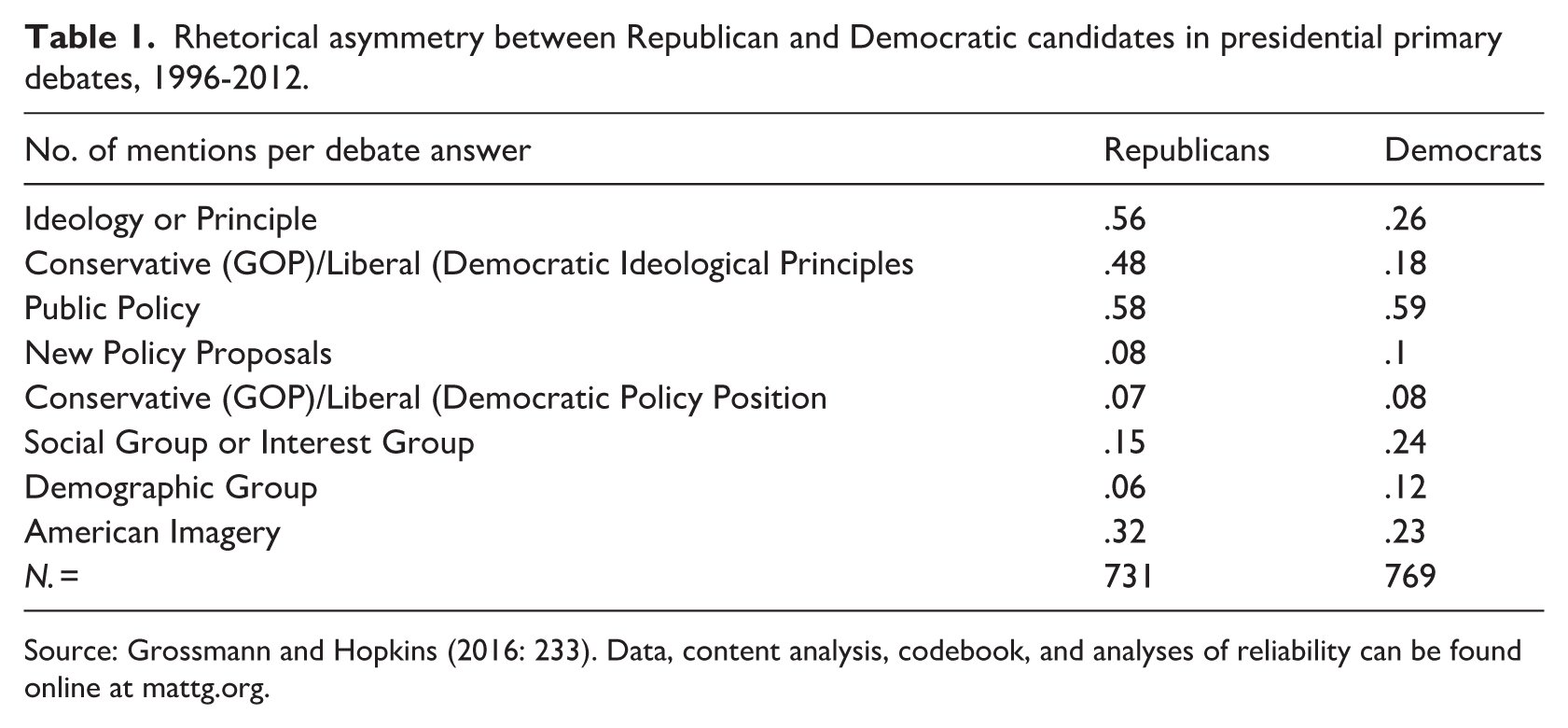
Source: Grossmann and Hopkins (2016: 233). Data, content analysis, codebook, and analyses of reliability can be found online at mattg.org.
These changes were connected to what I have elsewhere called the “movementization” of the party (Tarrow, 2021), which limited its capacity to transact policy compromises with its opponents. Although the process is far more deeply embedded in the Republican Party, it actually began with the absorption of the civil rights movement by the Democratic one in the wake of the 1960s, leading to the transformation of the Republican one. As Doug McAdam and Kariba Kloos wrote in their book, Deeply Divided, [It] was one movement – civil rights – and one powerful countermovement—white resistance or as we prefer, “white backlash,” that began to force the parties to weigh the costs and benefits of appealing to the median voter against the strategic imperative of responding to movement elements at their ideological margins. (pp. 10–11)
In the Republican Party, it was the latter imperative that won out.
Following the Goldwater campaign of 1964, a series of right-wing movements entered that Party, culminating with the Tea Party in the 2010s (Blum, 2020; Rafail and McCarthy, 2024). Once embedded in the party machinery, these groups expanded their activities from primary elections to more general policy interventions, in particular in the decision to merge with the movement against abortion and women’s equal rights. As liberal groups were writing checks and signing petitions to advance “pro-choice” petitions, Christian conservatives used their church networks to demand that local and state officials adopt anti-abortion policies (McCarthy, 1987).
The two movement families that emerged from the 1960s adopted different forms of contention – what Charles Tilly called their “repertoires”. While much of the New Left regarded the Democrats as hopelessly compromised by their association with capitalism, racism, and imperialism (Miller, 1987), their counterparts on the right employed an institutional repertoire that made it easy for them to infiltrate the Republican Party. As William Rusher, publisher of the conservative flagship National Review, once said, “Conservatism is the wine; the GOP is the bottle” (Schlozman and Rosenfeld, 2018, 2024).
Why does it seem important to insist on these differences between the two parties and their respective relationships to social movements? First, while the line between movement and party activists is often blurred, the latter are more willing to engage in the transactional exchanges that are typical of institutional politics, while the former are more likely to challenge the institutional norms of politics. Second, movement activists can serve as a support base for a party’s more extreme policies, while party activists are more likely to engage in institutional politics. Third, movement activists are available as political shock troops ready to challenge activists who dare to disagree with the party leadership.
The radicalization of the Republican Party allowed an ideological adventurer like Donald Trump and the MAGA movement he founded to enter and eventually to take over that party. This produced the challenge for an anti-Trump resistance to form outside the Democratic party. To put this in foreshortened terms: “movementization led to MAGA, and the MAGA-ization of the Republican Party led to the anti-Trump Resistance.”
From movementization to MAGA
In the decades since political scientist David Mayhew wrote about the decline of traditional parties, their organizations began to implode from the base upward. There were several reasons for this development (Katz and Mair, 2009): the greater availability of non-party forms of association and leisure; the rise of a strong central state that substituted a professional civil service for the patronage appointments that had been an important conduit for party activism (Shefter, 1994); and the adoption of the electoral reforms of the 1970s that substituted the direct primary for the “smoke-filled rooms” in which candidates had been chosen in the past (Shafer, 1983).
This process was not only ideological but it was also structural. Between 2001–2002 and 2013–2014, Skocpol and Alexander Hertel-Fernandez found that the resources controlled by “nonparty funders” more than tripled for the Republican Party, while the support for its party committees was almost cut in half. “Crucially,” they concluded, “the resource shifts on the right have largely occurred through the rise of new far-right organizations instituted after 2002, not through increases in the resources controlled by older groups” (Skocpol and Hertel-Fernandez, 2016: 683, Italics added). In their book, Upending American Politics, Skocpol, Caroline Tervo, and their collaborators reinforced this finding by focusing on the external infrastructure that helped propel Donald Trump to victory in 2016 and instill a movement-like logic into the heart of the Republican Party (Skocpol and Tervo, 2020: xviii).
Although the slogan “Make America Great” was first used by Ronald Reagan in the presidential campaign of 1980, it became so closely identified with Trump that the term “MAGA” is used to refer to Trump’s political base, to the rioters who invaded the Capitol to demand that the results of the 2020 election be overturned, and to Republican elites who sniffed the political wind after Trump’s 2016 election win and followed him wherever he would lead them. After his second election to the presidency, it led to the violent tactics of immigration agencies to arrest undocumented immigrants and suppress the activists who arose to protect them.
On its face, “MAGA” was simply an expression of the fierce patriotism of which Trump made himself the tribune. But it also has a more forbidding meaning, especially after being adopted by the candidate’s far-right supporters, who were hell bent on restoring the country’s glory days, when they saw it dominated by a white, largely male Christian majority. 2 Although non-racial on its face, if you wore a MAGA hat, it was a pretty good indication that you shared, admired, or appreciated Trump’s views about Mexicans, Muslims, African Americans, and the border walls he wanted to erect to keep immigrants out (Abcarian, 2019).
The most important accretion into the Republican party before Trump’s 2016 electoral victory came from activists who had been politicized in the Tea Party. In their in-depth study of those activists, sociologists Patrick Rafail and John McCarthy found that, by the time of Trump’s presidential campaign in 2015–2016, a large proportion of these activists had entered the Republican Party, helping to shift its center of gravity further to the right. As Rafail and McCarthy conclude, the Republican Party “has been moving toward the right for some time, and that movement only quickened after the advent of the Tea Party” (Rafail and McCarthy, 2024: 188).
Who were these activists? They were whiter than the general population, older than the typical survey respondent, and substantially better off than most Republican voters. In addition, approximately 44 percent described themselves as “very conservative” and at least 50 percent identified as evangelical Christians (see Figure 4.2 and p. 69 in their book). 3
Scholars like Rory McVeigh and Kevin Estep (2019) and Christopher Parker and Rachel Blum (2025) have argued that “status insecurity” has long contributed to sympathy for the far right. But conjunctural episodes like the COVID-19 pandemic contributed to the embedding of such attitudes in the party’s base. In a 2020 survey of research on the psychological effects of the pandemic, Jiaqui Xiong and her collaborators found a significant increase in social dislocation, psychological stress, and depression associated with COVID-19 (Xiong et al., 2020). More deeply, it was America’s growing inequality that convinced many activists that they had been unfairly discriminated against (Hacker and Pierson, 2020: Ch. 3).
In the months and years after the outbreak of the pandemic, these attitudes radicalized the Republican Party still further in the work by Xiong et al. (2020). As conservative columnist David French observed, for these activists, the “strong men” of the American past had created a glorious and powerful nation. Our peace and prosperity had spawned a weak and feckless generation that had squandered America’s strength and cultural identity, and now, it was time for hard men to arise to reclaim what was lost. This view of America’s glorious past is indispensable to understanding MAGA’s appeal and the extremism of MAGA youth.
4
But it would limit our understanding of the MAGA movement if we ignored the positive emotions that affiliation with the movement and support for its leader stimulated. “Take the Trump rally, the signature event of this political era,” writes French; “If you follow the rallies via Twitter or mainstream newscasts, you see the anger, but you miss the fun. For enthusiasts, Trump rallies aren’t just a way to see a favorite politician up close. They are major life events: festive opportunities to get together with like-minded folks and just go crazy about America and all the winning the Trump administration’s doing.” 5
A substantial proportion of MAGA recruits were primed for violence, a finding that emerged from a 2022 study by the University of California. 6 For example, during the first Trump administration, hate crimes against African Americans, Jews, and other minorities rose to a level not seen since the violence against Muslims in the period following the 9/11 attacks on the World Trade Center and the Pentagon. But the level of hate crime incidents against both African Americans and Jews continued to rise even after the end of Trump’s first administration.
Of course, not all of the violence perpetrated against ethnic and religious minorities was due to Trump’s impetus. But his sympathetic attitude to violence was exposed after the Charlottesville, Virginia conflict between torch-bearing, anti-black, and antisemitic neo-Nazis and an opposing group of progressives, in 2017. In that episode, an anti-fascist demonstrator was killed when a car driven by a pro-fascist activist ran her over. 7 After the riot, when he was questioned about the riot by a journalist, Trump infamously claimed that there were “very fine people on both sides.” 8
In part as the result of its openness to violence, and in part because Trump convinced them that the 2020 election had been “rigged,” the MAGA movement reached a crossroads with the insurrection against the Capitol on 6 January 2021. 9 Within the crowd, there were organized militias, including violent groups like the Proud Boys and the Oath Keepers. 10 But there were also many ordinary MAGA voters who had come to Washington to listen to Trump’s peroration about the “stolen election” and were carried along by the enthusiasm of the organized rightwing activists in their midst to participate in the insurrection.
Pundits and some academic specialists regarded the MAGA movement as predominantly made up of lower-class Americans who were disenchanted with how the American economy had left them behind. But alongside this populist base, Trump enjoyed the at-first-hesitant, and then the enthusiastic support of elements in the business community. This takes us to the growing importance of organized business in Trump’s movement – especially in his second administration.
Populists and plutocrats
Most scholars of what came to be called “populism” tended to identify its social basis in the lower and lower middle-classes. The general logic of this approach, which originated in Cas Mudde, 2007 book, Populist Radical Right-Wing Parties in Europe, had four parts:
First, populism often frames political conflict as a struggle between “the people” and a corrupt elite. This is often accompanied by a strong moralizing streak.
Second, this “us vs them” narrative resonates with many working-class individuals who feel alienated from the establishment and perceive a disconnect between their concerns and the priorities of policymakers.
Third, populist leaders blame specific groups for the economic problems their followers’ experience, thus reinforcing this division.
Fourth, the rise of populism is linked to the decline of traditional political parties, particularly the social democratic parties that historically drew strong support from the working class.
Much of the literature on populism adopted something resembling Mudde’s description. And since right-wing populism came relatively late to the United States, Americanists largely adopted it too. This left unexplained the appeal of right-wing populism to the “plutocracy” characterized by Hacker and Pierson. This appeal was less visible during Trump’s first mandate, when many upper-class individuals, like the billionaire Koch brothers, were cautious about this crude interloper and his willingness to use the state against the free trade economy that they favored.
In 2023 – under the editorship of Magnus Feldmann and Glenn Morgan – a group of European social scientists put together a collective book called Business and Populism: The Odd Couple? based on case studies from a number of western countries. They traced the transnational spread of populism, its relations to trade, and its organizational links to business. They argued that although business is a natural target for populist leaders, right-wing populists are largely committed to the capitalist system, to low taxes, to deregulation, and to easy credit conditions.
The result is that business leaders developed an array of strategies to deal with populism, ranging from “exit” from the fray to “voice” raised in protest at populist excesses, to “loyalty” to populist parties and movements. The latter reaction was marked among American millionaires and billionaires, especially following Trump’s second electoral victory in 2024.
Although he had come out of the business community, Trump did not emerge on the national political scene as a representative of business. On the contrary, in 2016, the leaders of the arch-plutocratic Koch network opposed his candidacy. Yet reflecting the ambivalence of the plutocracy toward Trumpism, a number of deep-pocketed Koch allies found their way into the first Trump administration. 11 Their reservations were quieted by the business-friendly tax reform he signed in 2018. 12 As for the second administration, while the Koch leadership supported the campaign of his opponent, Nikki Haley, and a Koch-funded group eventually sued the new government over Trump’s tariffs, 13 from his inauguration on, Trump surrounded himself with billionaires whose interests intersected poorly with the populism at the base of his movement.
In the 2024 campaign, American economic elites spent a record $1.8 billion to influence the outcome of the election. “This surge in donations,” according to Illuminum Briefings, “reflects the growing wealth gap and the concentration of political influence in the hands of the ultra-wealthy.” 14 It was symbolized at Trump’s second Inauguration by the prominent presence of a phalanx of billionaires on the dais, 15 and by the walloping great financial support he received from business groups. This was most visible in the support of the billionaire CEO of TESLA, Elon Musk, who contributed over $280 million to Trump’s 2024 campaign and was made head of what he called the Department of Government Efficiency (DOGE). This so-called “department” either fired or put thousands of civil servants on administrative leave. It also liquidated the government’s major conduit for foreign aid to poor countries, the USAID. 16
The DOGE experiment was devastating for the administrative state. As a Washington Post article summarized at the end the first year of Trump’s second administration, Nearly 300,000 employees were forced out of the federal workforce. The Trump administration also froze or shut off billions of dollars in scientific research, gutted or eliminated offices and programs dedicated to civil rights and diversity, rewrote the federal hiring system to reward loyalty to the president, and shrank Social Security while installing Immigration and Customs Enforcement agents in hundreds of new offices across the country.
17
At the same time, numerous colleges and universities were subjected to demands from the administration for enormous payments to punish them for suspected antisemitism or “woke” DEI (Diversity, Equity, and Inclusion) educational programs. A few – like Harvard University – had the resources to resist, but others – like Columbia University – gave in to pressure to adjust their programs to government demands. 18
Business support for the new administration was advanced between the end of Trump’s first term and the beginning of the second one by an ingeniously constructed document. In 2022, the right-wing Heritage Foundation put together a set of policy proposals, “Project 2025,” which served as a kind of roadmap for Trump and his supporters when they returned to power. Trump’s support for business was soon evident in the allocation of the tax cuts in the “Big Beautiful Budget Bill” which Congress passed in June, 2025.
19
As the progressive organization, Democracy Forward, described it, Project 2025 Presidential Transition Project is a well-funded (eight-figure) effort of the Heritage Foundation and more than 100 organizations to enable a future anti-democratic presidential administration to take swift, far-right action that would cut wages for working people, dismantle social safety net programs, reverse decades of progress for civil rights, redefine the way our society operates, and undermine our economy.
20
Are business and populism an “odd couple?” as Feldmann and Morgan wondered in their 2023 book? Or do their goals overlap sufficiently for the former to provide financial and political support for leaders like Trump, while the latter supply the shock forces at the base? As Hacker and Pierson explained in their 2020 book, “right-wing populism hasn’t derailed the extreme agenda of reactionary plutocrats. It has enabled it, accelerating the Republican Party’s decades-long transit toward their hard-right priorities (Hacker and Pierson, 2020: 8).”
Conflicts within MAGA
By the end of the first year of Trump’s second administration, a number of cracks began to appear between his plutocratic allies and the MAGA popular base. Many of Trump’s policies hit areas of the country that were more heavily “red” (Republican) than “blue” (Democratic). “What was striking about Trump’s trade wars,” wrote Hacker and Pierson, “wasn’t just the negative impact on the American economy; it was the pain they inflicted on Trump voters.” Foreign retaliation to his tariffs “had the greatest impact in rural areas and small towns – precisely where Trump’s support was strongest” (Hacker and Pierson, 2020: 163). The tariffs hit hardest on small businesses – many of which are heavily dependent on imports of raw materials. 21 The higher tariffs also hit farmers – a key Trump constituency – particularly hard, thousands of whom depended on foreign sale of their crops. To assuage some of their rage, before year’s end, Trump announced $12 billion in subsidies to farm families. 22
The cleavage between Trump’s two main constituencies began to widen as the country approached the 2026 midterm elections. This was most evident in opposition to his draconian policy against undocumented immigrants. As a candidate, Trump had claimed that, if elected, he would eject 12 million “illegals” from the country, a promise that was especially popular among his populist followers. While few believed such an astronomical figure was possible, soon after his inauguration, Trump began sending teams of Immigration and Customs Enforcement (ICE) agents – many of them armed and masked – into farms, restaurants, hotels and onto the streets of Democrat-run cities to sweep up undocumented migrants for deportation. By October 2025, the Department of Homeland Security announced that it had removed two million illegal immigrants from the country, many of them from farms and processing plants that depended on their labor. 23
Trump’s radical anti-immigrant policy soon had a negative effect on the economy. While Trump’s populist followers applauded ICE’s sweeps against immigrants, his plutocratic supporters were worried about their effects on their firms’ labor forces. For example, after two straight months of job declines, the New York Times reported in September 2025 that many wealthy voters blamed Trump’s tariff policies and his anti-immigrant dragnets for declines in employment. The resulting “uncertainty surrounding Mr. Trump’s ever-shifting policies has made corporate executives more cautious about hiring and investing,” wrote the New York Times in September 2025. 24
Due to the brutality of the ICE depredations, to the economic costs of the displacements, and to the underlying cruelty of the policy, public opinion described a dramatic shift on the issue of immigration. In contrast to the anti-immigrant sentiment that had helped Trump to get elected, by July 2025, a record 79 percent of American adults thought immigration was good for the country. And the number of Americans who wanted immigration reduced dropped sharply from 55 to 30 percent, while disapproval of Trump’s immigration machinery outweighed approval by 27 points. 25 When ICE turned brutally on the (mostly white) supporters of besieged immigrants, support for his immigration policy began to plummet – even among his MAGA supporters. 26 This takes us to the rise of a new resistance movement – more widespread and more vigorous than the movement that had followed Trump’s election in 2016.
The rise of the anti-MAGA resistance
Active public protest began to grow soon after Trump’s Inauguration in January 2025. Variously named “the Resistance,” the “No Kings” movement, and the progressive opposition, the movement brought together hundreds of organizations and hundreds of thousands of protesters. Some of these groups – like the “Mothers’ March” – came out of the 2017 “Resistance” but in their quantity and variety, the new movement went well beyond its predecessor, as Erica Chenoweth and her “Crowd Counting Consortium” learned. Figure 1, which extends their findings, traces the rough progress of the two protest waves through the first years of Trump’s two terms in power, demonstrating the quantitative advantage of the more recent one.
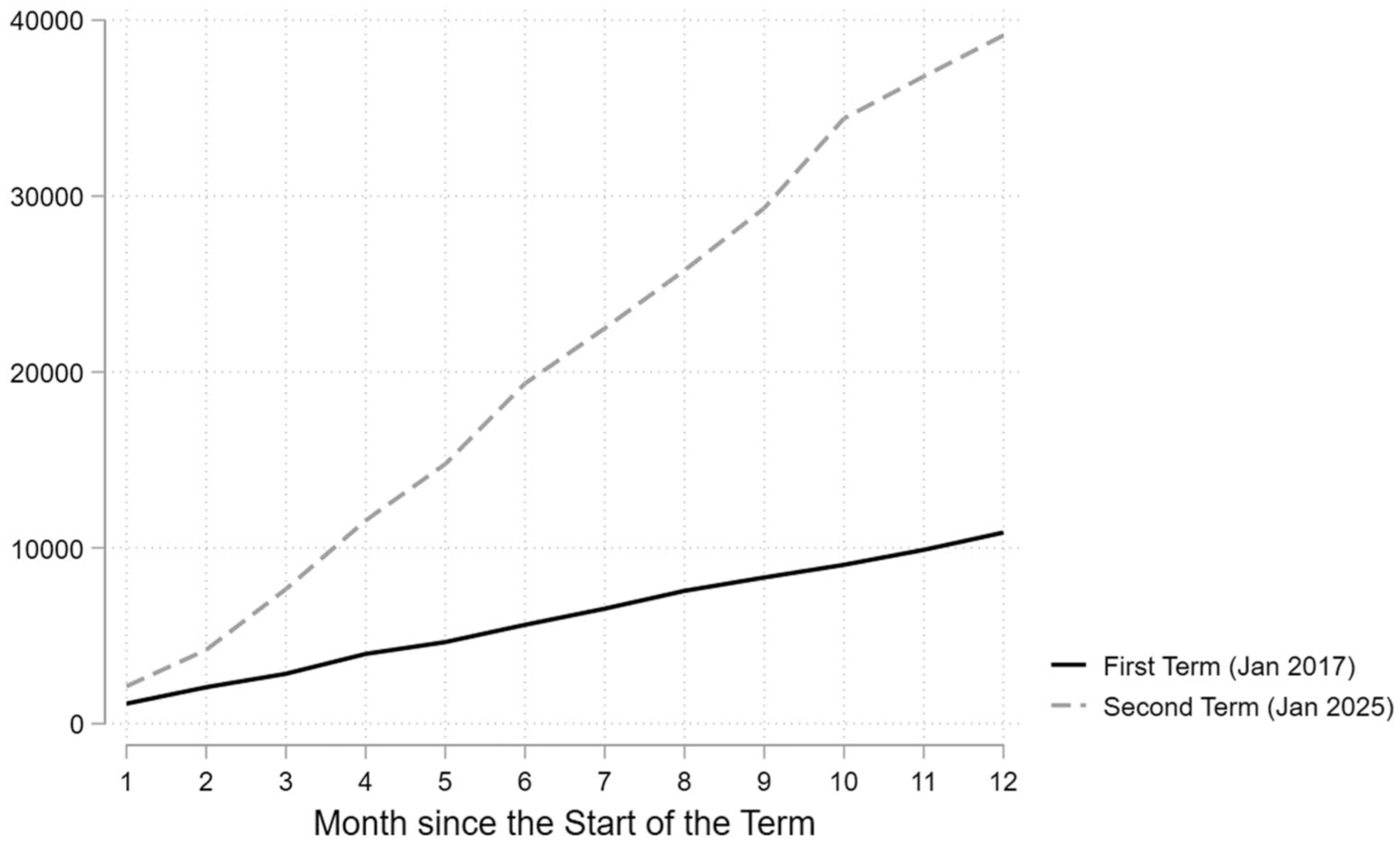
Count of protests during Trump’s first and second terms (stacked).
As Chenoweth and her team wrote soon after the beginning of Trump’s second term, since Jan. 22, we’ve seen more than twice as many street protests than took place during the same period eight years ago . . . In February 2025 alone, we have already tallied over 2,085 protests, which included major protests in support of federal workers, LGBTQ rights, immigrant rights, Palestinian self-determination, Ukraine, and demonstrations against Tesla and Trump’s agenda more generally. This is compared with 937 protests in the United States in February 2017.
27
The crescendo of national protests in 2025 was notable:
On April 5th, a national protest movement calling itself “Hands Off” brought out a reported 1300 protests around the country.
Two weeks later, a larger movement emerged under the broader label “50501,” which stood for “Fifty States, Fifty Protests, One Movement!,” timed to coincide with the 250th anniversary of the American Revolution.
On May 1st, a new series of protests brought together organized workers with activists who had come out of the previous protests. 28
On June 14th, at Trump’s insistence, tanks and troops paraded on the streets of the capital to celebrate both the anniversary of the foundation of the army and the president’s birthday.
On July 4th – America’s founding holiday – a new series of protests under the label “Free America” were organized, mainly by the same groups that had formed in the spring but with the participation of a rejuvenated “Womens’ march. 29
Spurred by the ICE violence against immigrants and activists, a new “No Kings” movement was organized across the country with large protests planned for March, 2026. 30
Protest soon spread to autonomous organizations in local communities. During the summer of 2025, hundreds of local town halls were aimed at Republican members of Congress, many of whom decided not to show up. Local Democrats were quick to sense opportunities from these events by calling their own town halls and placing empty chairs on the stage to symbolize the unwillingness of their competitors to face their constituents.
As ICE roundups of immigrants – and sometimes of citizens – spread across the country, local activists developed new tactics: advising immigrants of their rights, providing them with whistles to warn their neighbors that ICE was in the area, and blocking ICE agents from reaching their targets. In New York City, activists focused on helping the thousands of street vendors who came from immigrant communities. 31 In Los Angeles, protesters threw firecrackers at ICE agents. 32 In Chicago, several groups took part in an “emergency protest,” where throngs of protesters gathered to block Wacker Drive and Michigan Avenue. 33 Even in the conservative state of Oklahoma, protestant ministers held weekly vigils to support immigrants under siege from ICE. 34
Alongside the mass national protest movement and the local actions aimed at ICE, there was growing activism in legal circles at the threat represented by Trump’s growing authoritarianism. By early December 2025, in a “Litigation Tracker,” the liberal legal organ, Just Security, had tracked 577 court cases brought against the administration. A large number of these cases were brought by major law firms, many of them on civil liberties grounds. True, some large law firms supported the administration, but by the summer of 2025, in a sign of the unpopularity of their willingness to bend the knee, they began to experience fewer than average requests for positions from graduating law students.
Particularly active in court was the American Civil Liberties Union (ACLU), whose membership ballooned after Trump’s second election. As the ACLU wrote in its 2025 Annual Report, To date, the ACLU has taken more than 200 legal actions, including filing over 110 lawsuits—53 of them within the first 100 days of the president’s second term. In more than 70 percent of our cases, we’ve successfully defeated, diluted, or delayed President Trump’s unconstitutional agenda. We’re holding the line in courts across the country, forcing this administration to back down when it matters most.
35
What the ACLU feared most from the Trump administration were the attacks on freedom of speech and the conversion of the Department of Justice (DOJ) from an apolitical, highly professional agency to one that acted as the President’s private law firm. This was particularly obvious when the agency indicted several high-ranking opposition figures – like New York Attorney General Letitia James and former FBI head James Comey – against whom Trump held long-standing personal grudges. 36 The politicization of the DOJ led to denunciations from both Democratic and Republican legal figures, who reminded the public that the agency was supposed to be apolitical. 37
Increasingly, independent lawyers’ groups became alarmed at the efforts of the Trump Justice Department to target opponents of the regime. In early 2026, after the DOJ had ignored a number of federal court decisions, The National Association of Criminal Defense Lawyers posted an interactive tracking tool to enable attorneys and citizens to check for some of the controversial, unusual, or unsuccessful attempted prosecutions by the Department. The mapping tool showed the rising number of cases in which grand juries rejected the Justice Department’s attempts to obtain indictments against Trump administration critics, Democratic public officials, or protesters.
Considered on their own, none of these acts of resistance would have been disastrous to the Trump administration or to the MAGA coalition that sustained it. But the fact that they conjoined massive national protests with well-organized local ones and with a campaign of legal action were signals that Americans were growing weary of the excesses of the Trump administration and from the actions of its erratic leader. Increasingly, critics saw the major danger of the second MAGA presidency not from the adoption of any particular policy but from its threat to American democracy, to which we now turn.
The Trumpian erosion of democracy
“Whatever happens,” wrote Jacob Hacker and Paul Pierson (2020), “we run the risk of focusing too much on Trump and too little on the broader forces associated with his party’s long-term transformation. Republican elites and their allies were weakening democracy well before Trump” (p. 191). In Four Threats, Mettler and Lieberman had identified four main threats to American democracy: Political polarization, which they define as an increasing divergence of political attitudes away from the center toward more extreme positions; Conflict over who belongs in the political community; high and growing economic inequality; and excessive executive power. In their reading of American history, these threats reversed previous democratic gains.
Some of these threats were more dramatic than others – like the one that arose in the 1850s, when the bitter conflict over slavery was the prelude to Civil War, or when the Nixon era showed how the misuse of executive power could become a threat to democracy. But other crises were less obvious: in the 1790s, international war heightened the risk that the conflict between the Federalists and the Democratic-Republicans would undermine the newly created constitutional system. The 1930s were a decade when economic inequality spawned a few anti-democratic threats but also the radicalization of the labor movement and Franklin Delano Roosevelt (FDR)’s practice of executive hardball. Table 2 maps the four kinds of threat charted by Mettler and Lieberman in different periods of crisis.
Major threats to democracy by historic period.
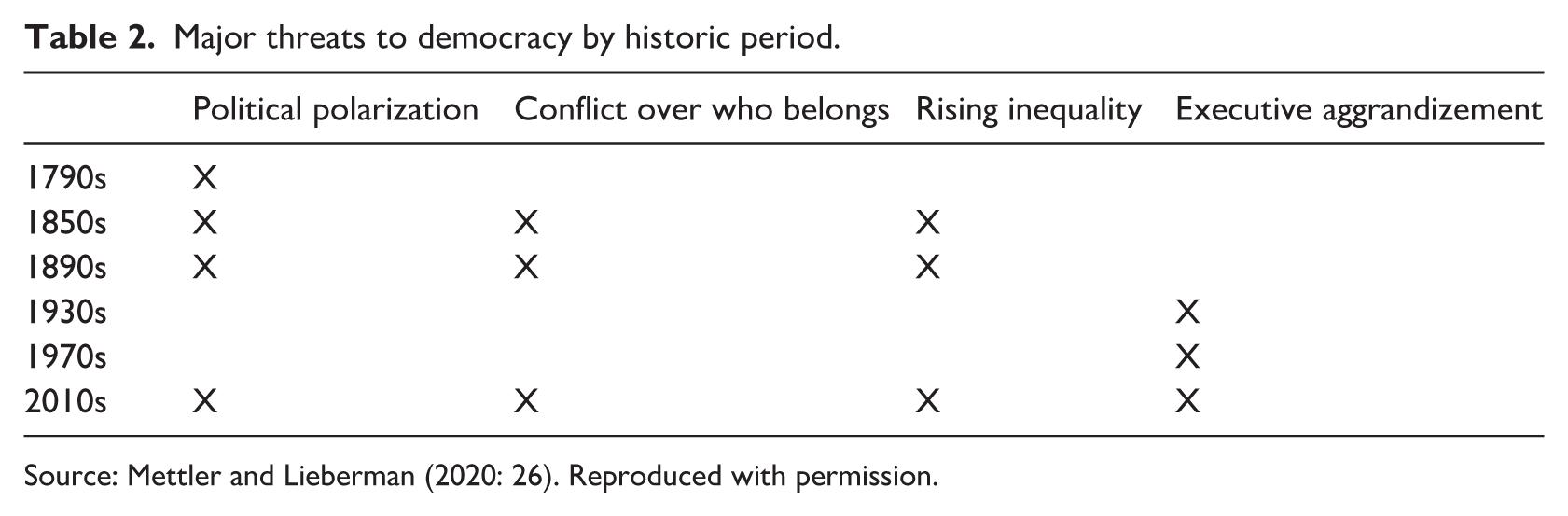
Source: Mettler and Lieberman (2020: 26). Reproduced with permission.
Mettler’s and Lieberman’s major concern was that they saw a convergence of all four threats around the presidency of Donald Trump. They wrote that “among ordinary citizens, polarization has become extreme, prompting a sense of politics as “us versus them,” in which people’s political choices are highly motivated by their hostility toward the opposition. Polarization coincides with a sharp divide between an increasingly strident vision of white dominance in American society, on one side, and an increasingly diverse and inclusive coalition, on the other. Economic inequality has skyrocketed, and wealthy Americans and business leaders are highly motivated and organized to protect their interests and expand their riches, whatever the costs to democracy. And in the face of growing governmental dysfunction and stalemate, a massively powerful presidency has enabled President Trump to pursue much of his agenda by circumventing Congress. In this context of four threats, all the ingredients for democratic backsliding are in place (Mettler and Lieberman, 2020: 27, Italics added).”
Because their book was published in 2020, Mettler and Lieberman could not have predicted how much more threatening Trump’s authoritarian project would become in his second term. In this exacerbation, four main factors converged:
First, in 2024, Trump came to power with a template – “Project 2025” – which laid out a design for stripping away the power of potential opponents and reducing the strength of apolitical civil servants. 38
Second, in the years after his 2020 electoral defeat, Trump assembled a team of advisers and allies who were devoted to his projects and to his person. These contrasted with the “adults in the room” who had put brakes on his most extreme projects during his first term.
Third was Trump’s strategy of “flooding the zone” with right-wing policy initiatives, which left the opposition confused, divided, and – for a time – practically paralyzed.
Fourth, Joseph Biden’s disastrous 2024 electoral campaign and Kamala Harris’ defeat after she replaced him left the Democrats weakened, divided, and confused.
But Mettler’s and Lieberman’s picture of “four threats” leaves something crucial out of the picture: the infiltration of a right-wing social movement into the state. It was this combination that made Trump’s program the most serious threat to American democracy since the civil war. This can best be understood if we return to our original idea of the movementization of the Republican Party, even before Donald Trump appeared on the scene.
In their important book, Rivalry and Reform: Presidents, Social Movements, and the Transformation of American Politics, Sidney Milkis and Daniel Tichenor (2019) saw two intersecting trends in American public life: the strengthening of the executive and the prominence of social movements. From the civil war on, they argued, the presidency became a growing target of movement insurgents. This, in turn, gave presidents the incentive to stay on top of potent movements, to try to control them, and to sometimes partner with them, as Lincoln did with the abolitionist movement in 1861. By the presidency of Lyndon Johnson in the 1960s, presidents were actively cultivating relations with movements. Along the way, write Milkis and Tichenor (2019), the “worlds of movements and the executive increasingly overlapped as the size and scope of presidential power and particular movements grew” (pp. 6–7).
While most of the movement/presidency relations discussed by Milkis and Tichenor were cases of external movements either pressuring or being pressured by presidents, the MAGA movement was the first to enter the very heart of the government. Under his second period in power, Trump’s policies embodied and expanded the process of “regime cleavage” that was the deepest in American politics since the civil war. This was why – from protests against particular policies of the Trump administration – the resistance grew broader and deeper after 2024. By his second year in power, a loosely connected movement had developed in defense of constitutional democracy against Trump’s increasingly naked authoritarianism.
Conclusion
While it is too early to offer an analysis of the implications of the political thunderbolt that hit the United States on 5 November 2024 for the future, it is not too soon to offer some reflections that grow out of the Trumpian threat to democracy and several research questions that follow from it.
First, the MAGA movement’s devotees share a combination of racial nationalism, ethnic prejudice, and resentment at how the economy has treated them. In many of its supporters, racial resentment combines with a narrow form of patriotism that looks back to a supposed golden age when white Christian males ran the country. A comparative research question that follows from this is whether the same motivations can be found in European and Latin American “populist” movements. If so, this represents a transnational – rather than a purely American – threat to democracy.
Second, although he was roundly condemned as being “not very smart” by pundits on the left, Trump was shrewd enough to exploit an anti-immigrant populist mood and meld it with support from his plutocratic supporters. 39 A second research question is whether the anti-immigrant mood has the same roots as the racial resentment that many scholars have found on the American right and whether Trump’s radical anti-immigrant actions have reversed this mood.
Third, none of this analysis has addressed the question of how a candidate who was characterized by his enemies as the leader of an attempted insurrection could have returned to power 4 years later. A complete answer to this question remains for historians to ponder over, but here is a preliminary hypothesis that builds on the analysis in this article: Trump was not only a twice-elected president and the leader of a party, but he was also – and critically – the leader of a movement, one that he founded in 2016 and carefully cultivated over the successive 8 years.
Movements are less dependent on particular policy positions than on the loyalty of followers and activists, some of them almost worshipful (Alberta, 2023). Trump’s personality, his ability to tap into deep nationalist instincts, and his capacity to manipulate the media brought together a powerful populist/plutocratic coalition. A third research question is whether the same media sources that supported Trump’s rise have turned against him following the Minneapolis deaths at the hands of ICE and Trump’s unpopular war in Iran.
By the second year of Trump’s second administration, the MAGA coalition had begun to splinter while a national resistance movement began to challenge it. As Steven Levitsky and his colleagues wrote, at the end of Trump’s first year in office, “the United States has entered an authoritarian moment. But there are multiple legal and peaceful ways out.” A final research question is whether the American institutional structure offers sufficient openings to allow the anti-Trump opposition to effectively contest his supremacy. “The playing field might be uneven,” conclude Levitsky and his colleagues, but “The opposing team remains on the field and, and sometimes it wins.” 40
Footnotes
Acknowledgements

Author’s Note
*This paper draws on two earlier efforts: a book (Movements and Parties: Critical Connections in American Political Development, Cambridge, 2021) and an article (MAGA: “The Trumpist New Right: Its New-Past and its Old-Future” in the Oxford Handbook on the New Right, eds. Manuela Caiani and Jens Rydgren., in preparation). However, it also leans heavily on the teachings of my friends and colleagues, Sidney M. Milkis and Daniel Tichenor and of Robert Lieberman, Suzanne Mettler, and Kenneth Roberts. It also profited from the thoughtful comments of Milkis, Eitan Alimi, Marco Bischnau, Sebastion Koos, Peter Lange, Steven Morgan, Kenneth Roberts, and Theda Skocpol. None of these colleagues is responsible for my reading of American politics and history or for my reading of their work.
Funding
The author received no financial support for the research, authorship, and/or publication of this article.
Declaration of conflicting interests
The author declared no potential conflicts of interest with respect to the research, authorship, and/or publication of this article.