







Abstract
The Department of Electrical and Computer Engineering at The University of the West Indies' (UWI’) St Augustine Trinidad and Tobago Campus conducted a review and revision of its BSc mathematics programming in 2009. The review was framed to take account of strategic as well as operational imperatives of an accredited degree in the context of a number of resource and other constraints typical of small island developing states. Intake, content and delivery were examined and the findings were used to guide the revision exercise. Associated interventions were assessed five years later. This paper provides an account of the considerations and process for the review and revision exercises. It discusses student performance and other indicators before and after the interventions; and examines the new curriculum against fit for purpose criteria alongside programming in best in class institutions and UK-based accreditation reference points. The paper closes with recommendations for ongoing review and revision cycles applicable to the Department at the UWI and other similarly situated institutions.
Introduction
The Electrical and Computer Engineering Department at The University of the West Indies (UWI) in St Augustine, Trinidad and Tobago, offers a BSc degree accredited by the Institution of Engineering and Technology (IET). This three-year undergraduate programme in Electrical and Computer Engineering is delivered over six (6) semesters, with specializations in five thematic areas: communication systems, computer systems engineering, control systems, electronic systems and energy systems. All of the 21 courses delivered in the first two years (Levels 1 and 2) and three of the final year (Level 3) courses, including the independent project, are required of all students, independent of thematic area. The remainder of the final year courses necessary to meet the degree requirements comprises a mix of open electives and those that are mandatory for specialization in one of the five thematic areas.
Increasingly, high failure rates in first year engineering mathematics have been a cause of concern for the Department. Declining performance in mathematics and the struggle to solve complex problems on entry into university have been widely reported in other countries around the world including the UK,1–3 Finland 4 and the US. 5 Larcombe 3 observed that for the case of the United Kingdom, “It is becoming clear that the modern student is all too often entering degree study with an alarming lack of appreciation of what mathematics, as a subject, actually is”. Kitchen 2 reported that anecdotal evidence suggests that the lowering of standards at the General Certificate of Education Advanced Level Examinations (GCEA), the UK’s qualifying examinations for university entrance, is to blame for the “mathematics problem”.
As part of a comprehensive curriculum review exercise conducted in 2009, UWI’s Department of Electrical and Computer Engineering (DECE) undertook a close examination of its mathematics problem. The focus of observation was the preceding five-year period, 2004–2008, in which an alarming number of failures in first year engineering mathematics had been observed. In particular, over that period, the failure rates averaged over 25% for an average Level 1 cohort size of 73 students. The review exercise sought to examine factors at the source as well as the nature of the problem within the BSc programme. The scope of examination included the content, assessment and delivery of the compulsory mathematics curriculum as well as the student intake into the three year undergraduate programme.
The review directed the development of a new mathematics curriculum which was introduced in 2009. This paper describes the review process, the rationale for some of the decisions taken and the results over the five (5) years following the intervention.
Investigating the mathematics problem in UWI’s DECE
The first engineering mathematics course taken by all DECE students up to 2008 was MATH1180 Engineering Mathematics I, delivered in semester 1, Level 1 of the BSc programme. For the period 2004–2008, the failure rate in MATH1180 fluctuated between 16% and an alarming 44%, as shown in Figure 1.
Performance in MATH 1180 for the years 2004–2008.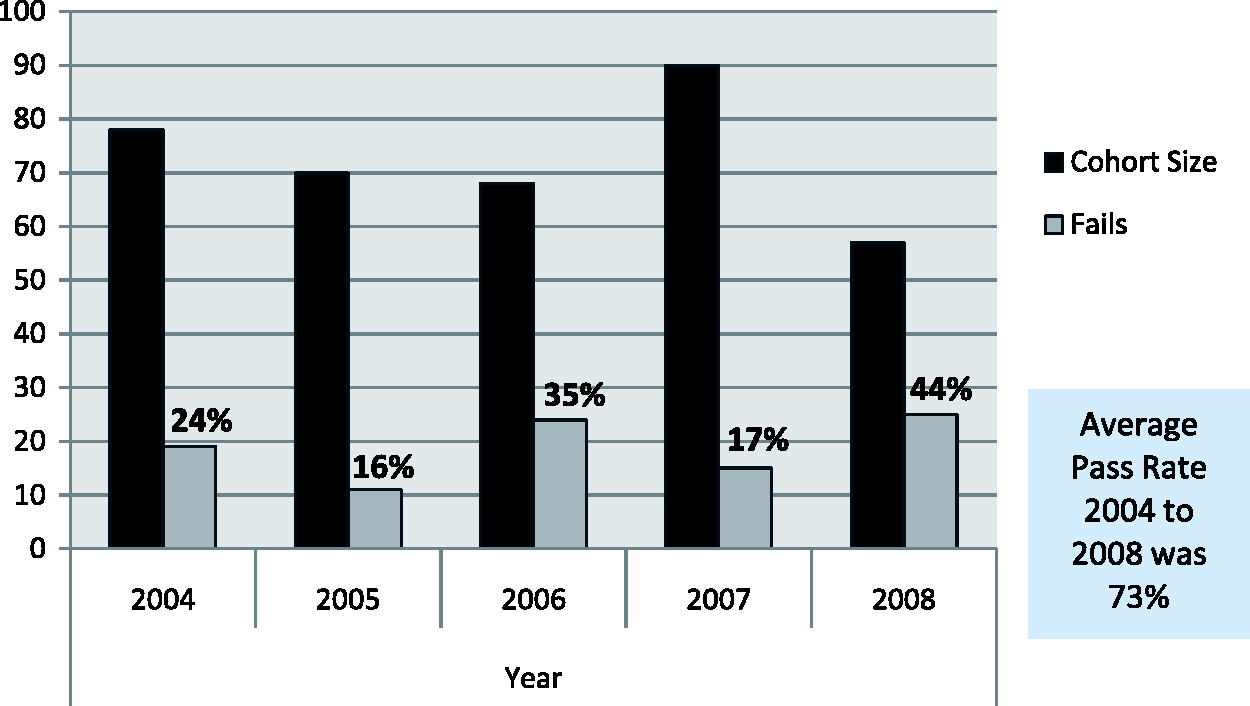
To investigate contributing factors to poor performance, the department examined the profile of the student intake into the programme. It also examined the content of introductory math courses vis a vis applicable pre-university curricula; and various aspects of delivery. Course content was referenced to global norms for benchmarking purposes.
Intake
The first investigation undertaken was the academic profile of the students entering from the secondary school system, with particular emphasis on qualifications in areas relating to mathematics. Admission into UWI’s BSc Electrical and Computer Engineering programme requires specified minimum qualifications in standardised examinations such as the Caribbean Advanced Proficiency Examination (CAPE) administered throughout the English speaking Caribbean by the Caribbean Examinations Council (CXC) and the GCEA offered by the University of Cambridge UK, or in other approved programmes. The BSc Electrical and Computer Engineering intake catchment area comprises 16 Caribbean territories for which GCEA had been, and subsequently CAPE is, the national system of examinations.
The Faculty of Engineering Regulations and Syllabus 2004 to 2006 6 specified minimum entrance requirements of at least a B+ average in GCEA Pure Mathematics and Physics; or at least a B average in GCEA Mathematics and Physics along with one other approved GCEA Level subject. From 2007, the entrance qualifications have been referenced to the CAPE examinations, with a minimum requirement of at least a Grade 2 average in Pure Mathematics and Physics in Units 1 and 2. 7
Figure 2(a) and (b) shows the percentages of admitted students with B+ or better in GCEA Mathematics and Physics and / or Grade 2 or better in CAPE Pure Mathematics and Physics for the years 2004–2008.
(a) Mathematics entrance qualifications for students, 2004–2008; (b) physics entrance qualifications for students, 2004–2008.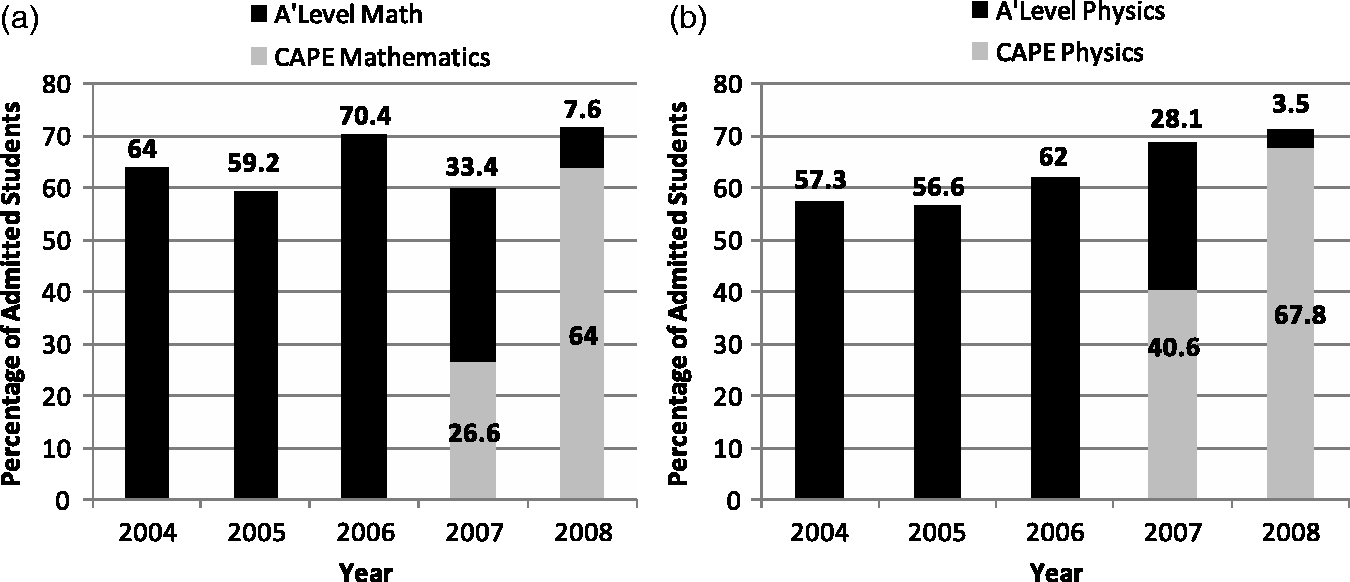
Figure 2(a) shows that for 2004–2008, on average 35% of the accepted applicants failed to meet the (aggregate) benchmark grade of B+ in mathematics, yet were acceptable for entry on the basis of the aggregated average grade with Physics, Figure 2(b).
Pre-university mathematics curriculum
The department scrutinized the two-year CAPE Pure Mathematics Syllabus, structured according to Figure 3(a) and (b) for the period 2004–2007 and 2008–2012 respectively.
(a) CAPE pure mathematics syllabus structure 2004–2007; (b) CAPE pure mathematics syllabus structure 2008–2012.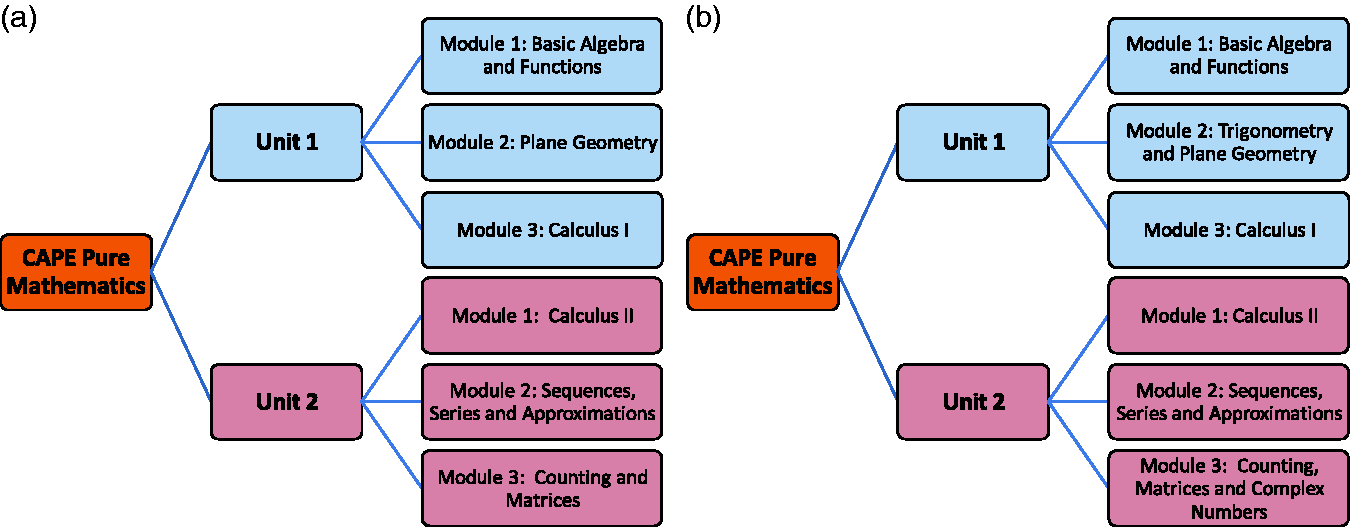
Examination of the scope of the content as well as the assessed skills and abilities, as expressed in the syllabi documents; and samples of past examination papers, revealed that the topic coverage and depth were comprehensive and appropriate for entry level into an accredited undergraduate programme in Electrical and Computer Engineering, for example as documented in the SEFI Mathematics Working Group report. 8 It was observed that the difficulty level had also been relatively consistent over the years under study so there was no evidence that there had been any lowering of the CAPE Pure Mathematics standards which may have accounted for the disappointing performance in Level 1 mathematics over the years.
DECE compulsory mathematics curriculum – Delivery and content
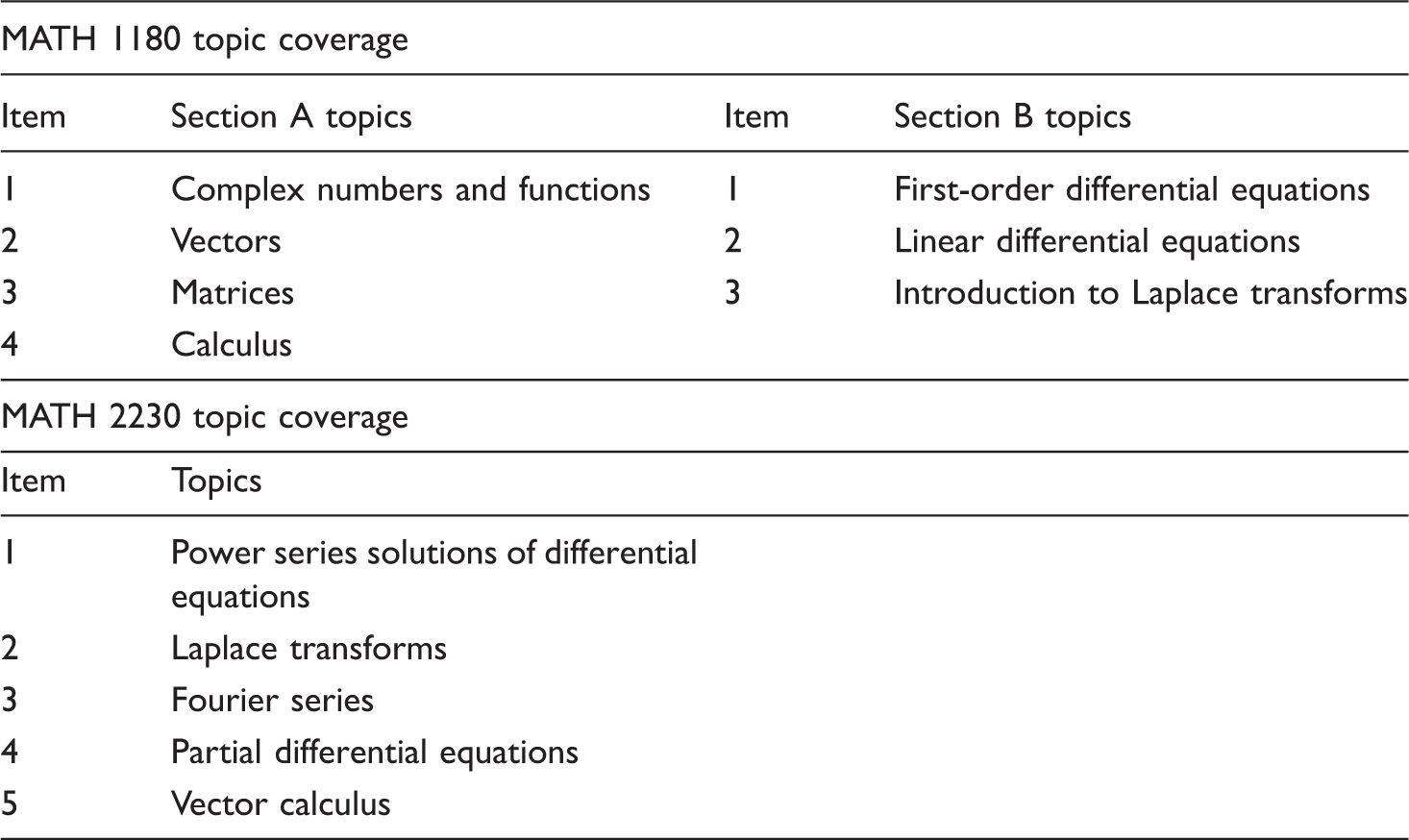
Original math curriculum topic coverage.
DECE compulsory mathematics curriculum – assessment
Faculty-wide delivery of the compulsory math offering for electrical and computer engineering students was fraught with problems. Chief among these was the assessment strategy which allowed students to avoid certain topics all together. In particular, in MATH 1180 (Table 1), students were only required to answer three (3) questions per section in the final examination which comprised eight (8) questions of which three covered differential equations and one covered each of the remaining topics. DECE students, who were required and assumed to have command of all of the topics, were given the opportunity to avoid some entirely without penalty; and consequently disadvantaged as they progressed in the programme. The problem was keenly evident in topics, like Laplace Transform, that were introduced in MATH 1180 and further developed in MATH 2230. DECE students were ill prepared to undertake the advanced treatment in MATH 2230 and in other courses which required a strong foundation in the Laplace Transform, for example ECNG2011 Signals and Systems and ECNG2009 Control Systems. Indeed, Figure 4 shows that failure rates in these Level 2 courses trend with failure rates in Level 1 Math the previous year. They in turn also trend with the mathematics entrance qualifications for student intakes in 2004, 2005, 2006 and 2007, shown in Figure 2. There is little trending similarity with physics entrance qualifications.
Comparison between MATH1180 failure rate and Control Systems and Signals and Systems failure rates the following year.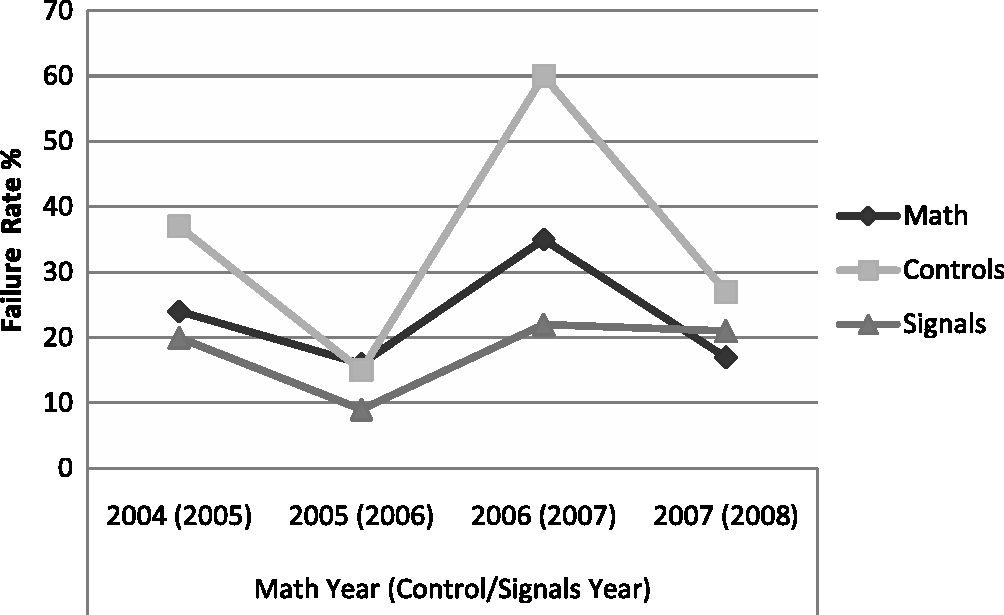
Development of the new mathematics curriculum
The combination of poor student performance and the findings of the Level I curriculum was the starting point for the development of a new mathematics curriculum in the context of comprehensive department-wide curriculum renewal. For this exercise, four fundamental principles were applied:
Application of principle 1: Learning Outcomes strategy
With institutional subventions from several contributing Caribbean governments, the BSc programme is obliged to service the human capacity needs of the region while satisfying standard requirements for entry into international graduate programmes in the discipline. Desired output profiles of the exemplary BSc graduate and the graduate (“at threshold”), deemed to have just satisfied the requirements for graduation, were defined to guide the renewal of the programme’s content and delivery. The general aspects of the Department’s exemplary graduate output profile were formulated to align with the key attributes of a distinctive graduate of UWI.
As illustrated in Figure 5, this base profile was refined for the Department by competencies and characteristics of a graduate in the discipline of electrical and computer engineering according to global best practice, as captured in standard accreditation criteria. These criteria were reviewed and refined taking account of the needs of, and opportunities in, the regional job market into which most of the programme’s graduates would enter on graduation.
Curriculum design: content and delivery drivers.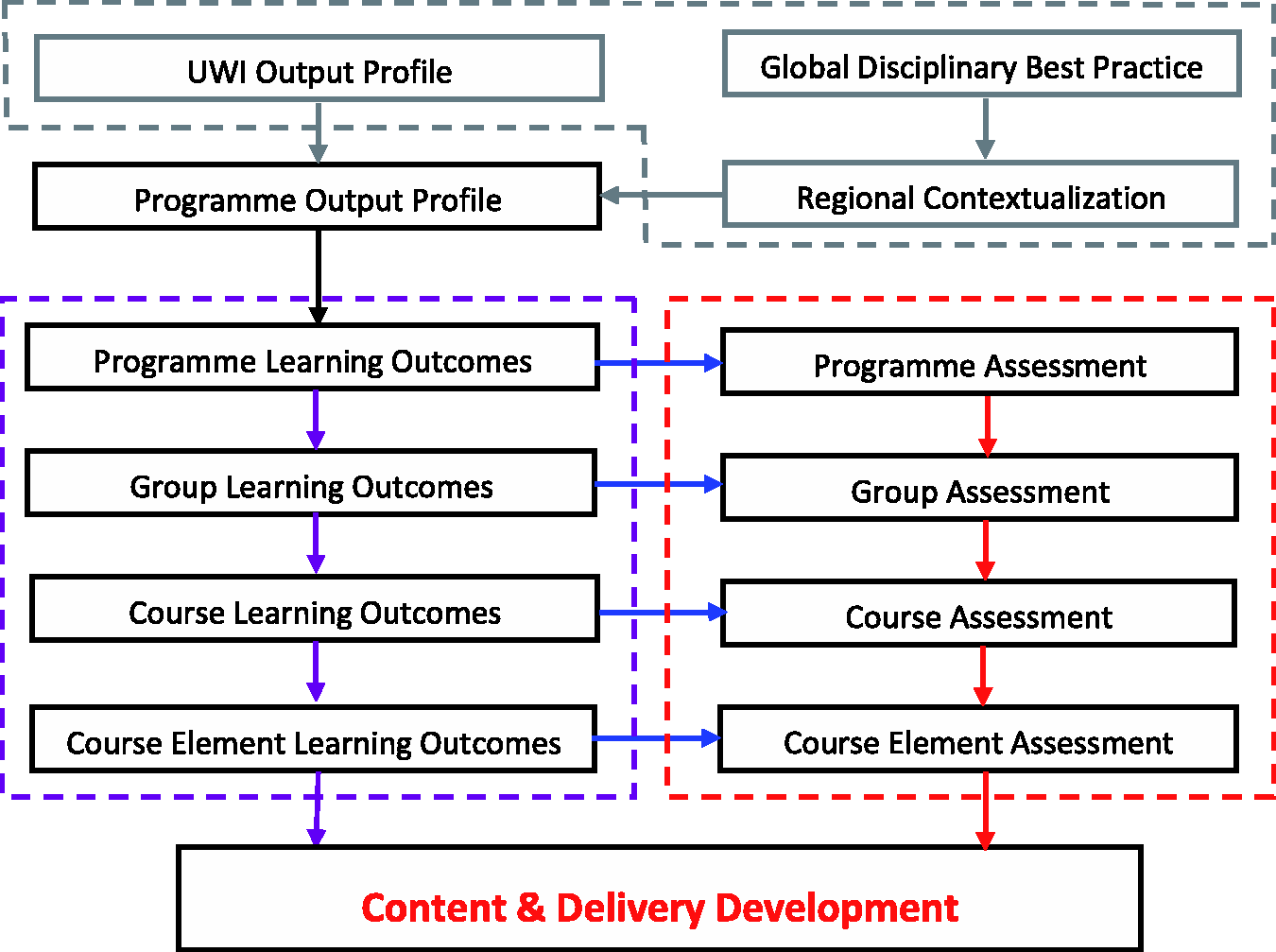
Motivated by the changing requirements of its IET accreditation, the DECE adopted a Learning Outcomes (LO) assessment strategy. The teacher centred, input driven nature of the pre-existing strategy based on course objectives was particularly ill-suited to the Faculty-wide mathematics curriculum, developed and delivered by the DoM to engineering students. The output driven LO approach 9 provided a framework for the specification of demonstrable skills and knowledge, assessable at the end of each course.
The couplet of BSc graduate output profiles, both exemplary and at threshold, was the starting point for establishing the LO and associated assessment strategies at the programme, Group, course and course element levels as shown in Figure 5. All of the Department’s undergraduate courses were reviewed against the expected knowledge and skills of a graduate engineer and appropriate LOs formulated using Bloom's Taxonomy. 10 The Department’s five thematic groups (Communications, Controls, Computer Systems Engineering, Electronics and Energy) and the general Departmental group, which comprised all common courses, were responsible for the specification of LOs as well as the direct management and quality control of the content and delivery.
A gap analysis was conducted across all courses using as reference the IET Handbook of Learning Outcomes for BE and ME Degree Programmes
11
US2 ‘Discipline Specific Exemplars' for knowledge and understanding of mathematical principles. As shown in Figure 6, several courses were found to deliver and assess significant math content.
Programme courses delivering math learning outcomes.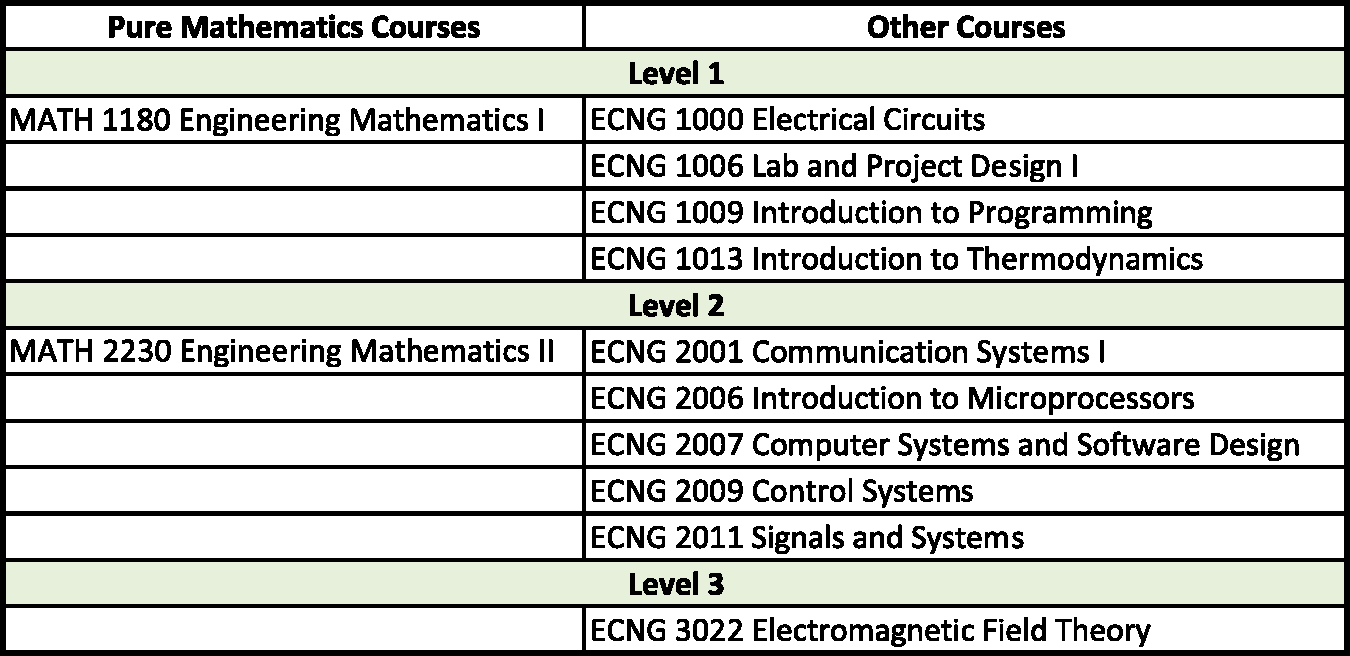
The results of the gap analysis are shown in Figure 7. The ticks identify US2 material covered at the pre-university level or within the ECE programme. Of great significance are the cells marked ‘X'. These identify mathematics topics not covered at all by the end of the degree. This initial examination showed that only 38% of the US2 exemplars were being covered by the existing MATH1180 and MATH 2230 courses.
Old curriculum coverage.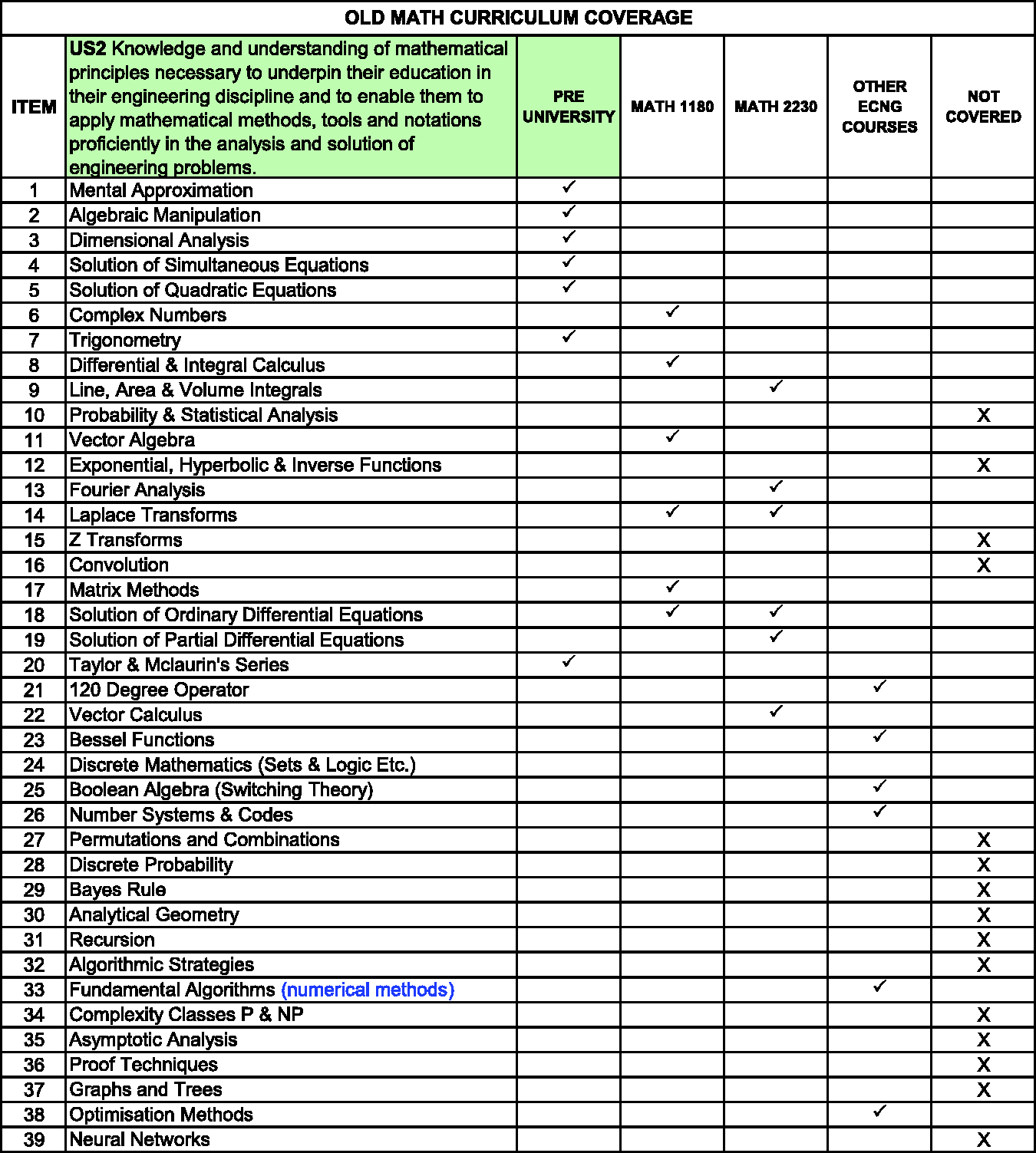
Concurrently with the gap analysis, DECE academic staff were asked to identify the prerequisite mathematics knowledge for each course in the programme; and to provide sample questions and solutions showing how proposed mathematics LOs would be assessed. This analysis helped to identify math topics, for example power series solution of differential equations, which were taught but had minimal or no application in the undergraduate programme. The authors were also able to use this to identify topics, for example statistics, which were essential but not covered anywhere.
Application of principle 2: Departmental ownership of mathematics courses
The second major decision taken in the curriculum review was to take ownership of the mathematics courses. This would enable the DECE to modify and have direct quality oversight over the engineering mathematics courses historically owned, delivered and administered by the DoM. It would address issues of unnecessary topics and inadequate attention to fundamentals, problems Strum and Kirk 12 found when mathematicians teach mathematics to engineering students. After careful examination and deliberation, it was decided that the DECE would specify, develop and manage its own mathematics courses.
Application of principle 3: Mathematics across the curriculum
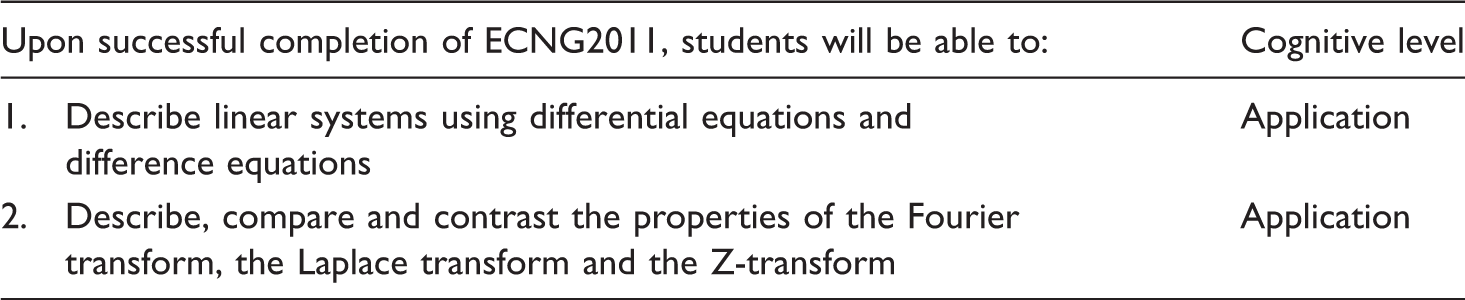
Example of LOs for New Level 1 dedicated mathematics course.

Example of mathematics LOs for sample engineering course.
Application of principle 4: Delivery of all essential mathematics LOs in first two years
As the common courses across all thematic groups in the department are delivered in the first two levels of the undergraduate programme, it was decided that all mandatory Math LOs would be delivered by the end of the Level 2, before students specialise in the final year.
Other philosophical approaches prevail. For example Otung 13 recommend a “minimal mathematics methodology” which provides a soft introduction to engineering mathematics in the early stages of the engineering programme. This equips students with sufficient coverage for standard problem solving while reducing the treatment of abstract mathematics. The DECE review team did not favour this approach as without enough rigour, students who are able to ‘master' problems which have standard solutions, may be ill equipped to tackle more unusual or abstract cases. For example in introductory circuit theory using node equations, minimal mathematics could have the student believing that it is always possible to have a complete set of readily solvable independent equations. The truth is that under certain conditions, depending on how nodes are defined, there may be additional equations which are not independent and therefore cannot be used. In this case, the minimal mathematics approach will not lead to the student being able to identify the minimal set of independent equations.
The new mathematics curriculum
The MatC programme, comprising dedicated mathematics courses and applied mathematics components within other compulsory courses, were purposefully designed to enable students to:
Select appropriate mathematical techniques and tools necessary to realize engineering designs; Apply mathematical principles and techniques necessary to describe and analyze the characteristics and behaviour of electrical systems; and Demonstrate competence with the application of standard analytical tools in engineering solutions.
It comprises the following:
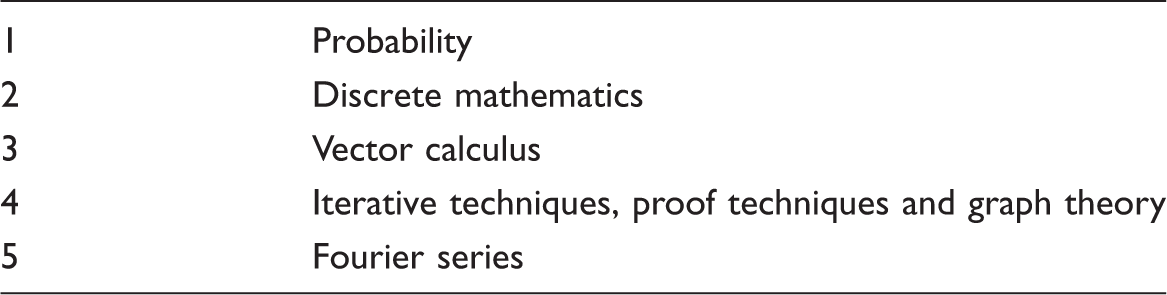
The common semester I Level I engineering mathematics course, MATH 1180 Engineering Mathematics I retained until 2012 (but with the choice of questions option removed for electrical and computer engineering students) when it was replaced by ENGR 1180 owned by the Faculty of Engineering (FOE); Two new mathematics courses developed and owned by the DECE, specifically for electrical engineering students: (i) a one (1) credit course, ECNG 1016 Mathematics for Electrical Engineers I, delivered in semester 2 Level 1 devoted entirely to the Laplace Transform; and (ii) a three (3) credit course, ECNG2013 Mathematics for Electrical Engineers II, in semester 1 Level 2 delivering the topics listed in Table 4. Both of the new mathematics courses are delivered by staff of the FOE. The topic coverage of all three courses mapped against the US2 criteria is shown in Figure 8. An online mathematics support portal which provides lessons, tutorials and quizzes for students was established. This portal is accessible at all times and provides the resources for students to obtain remedial support for any area of mathematics of relevance to the undergraduate curriculum. In addition, for the first two years after implementation, face to face support from tutors is available. Such support was deemed important to compensate for the mix of academic backgrounds of incoming students despite satisfaction of common entrance requirements. This was particularly so as remedial action at the high school level is not a possible intervention strategy to counteract the mathematics problem.
New curriculum coverage. ECNG2013 topic coverage.
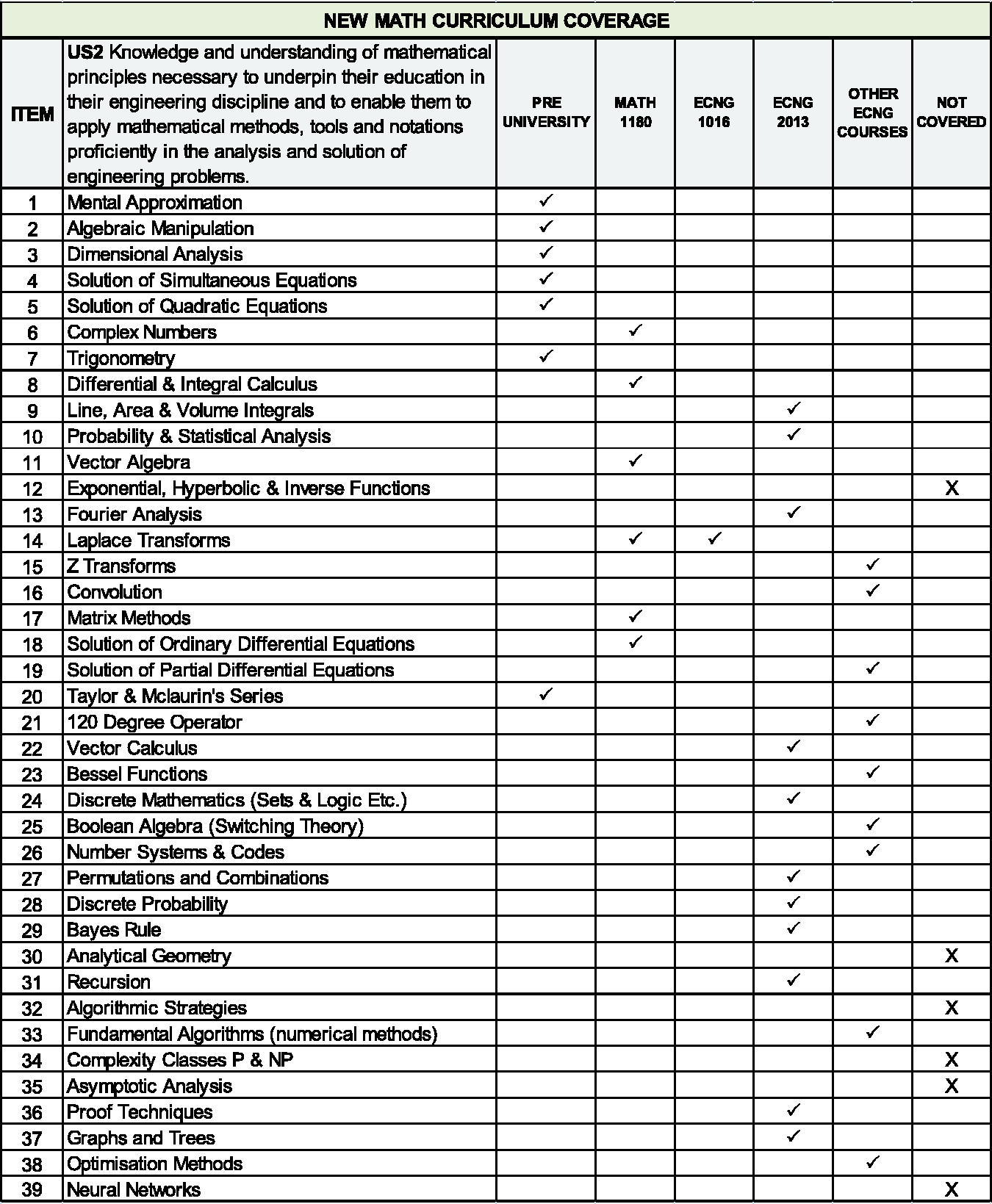
The new curriculum increases coverage of the US2 exemplars to 80%. The 20% of the exemplars which are not covered comprise topics which are very specialised and are needed only in a limited number of applications in the programme and topics which are not required at all in the current undergraduate programme. Those that are required, for example solutions of partial differential equations, are delivered in course as needed. The new curriculum therefore delivers ALL required BSc Math LO by the end of Level 2.
This new course sequence exposes electrical and computer engineering students to three (3) successive semesters of engineering mathematics in their first two years. In addition, the LOs from the mathematics courses in combination with the applied mathematics LOs delivered in Level 1 and 2 engineering courses provide unbroken engineering mathematics in every semester of their first two years.
Figure 9 illustrates the new curriculum and shows the progression of learning from semester 1 Level 1 to semester 2 Level 2, at which point the undergraduate math LOs have been fully delivered.
New undergraduate mathematics structure.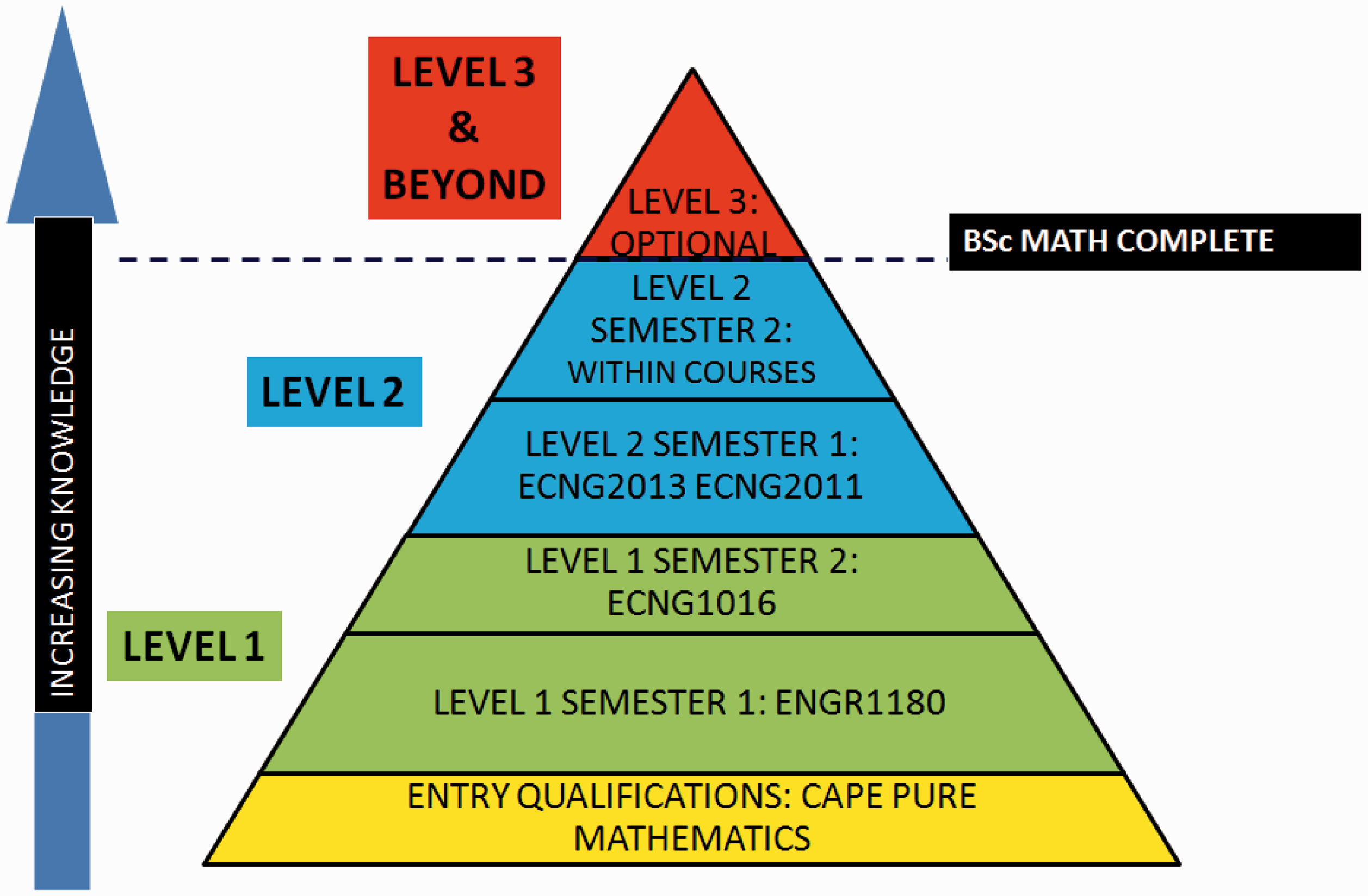
Performance and analysis of the intervention
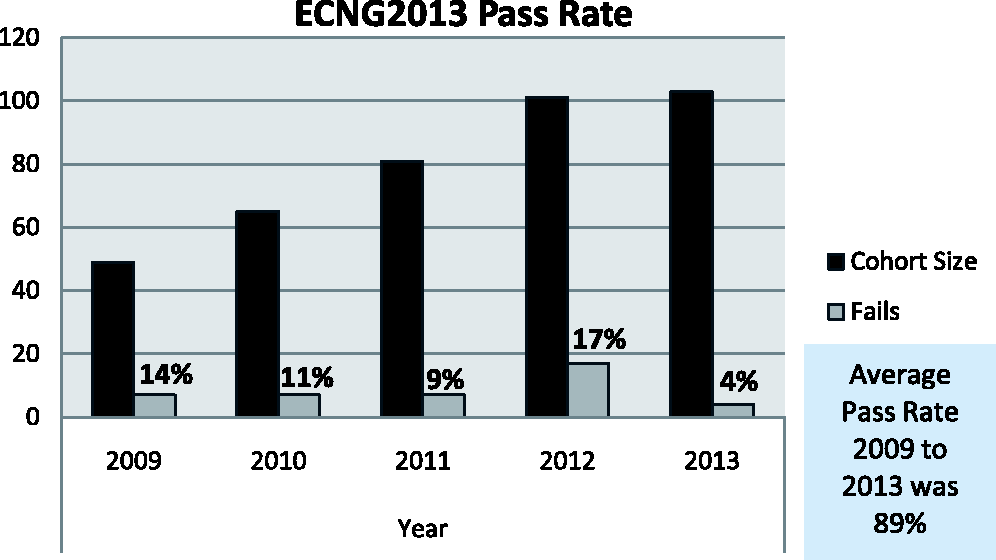
The new mathematics curriculum has now been delivered for five (5) years, 2009–2013. The performance of the cohorts is shown in Figure 10 and Figure 11. The pass rate for ECNG 1016 has averaged 93% over these five years. The pass rate for ECNG2013 for this period has averaged 87% in spite of a doubling in the cohort size since 2009.
ECNG 1016 cohort performance 2009–2013. ECNG2013 cohort performance 2009–2013.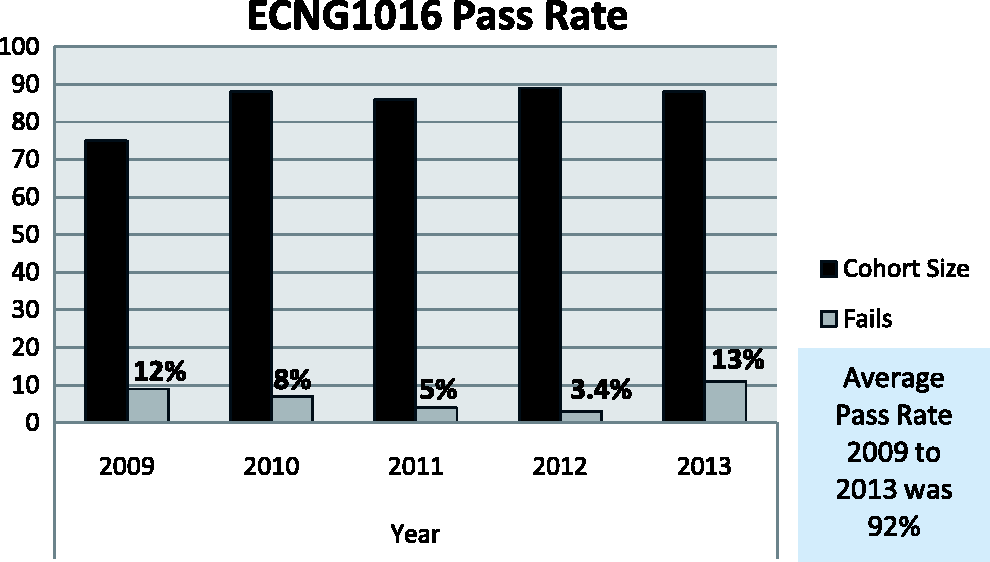
During the period 2009–2011 the results of MATH 1180, the original math course, did not improve noticeably. In 2011 the new ENGR1180 course was introduced as a replacement. It is owned and administered by the FOE and designed to fit the needs of an engineering undergraduate programme by the FOE. It has so far averaged a pass rate of over 83%.
Future work
There are still a number of areas for future work. For example, while we have seen significant improvement in the mathematical performance of the students following specific interventions within the programme, the variability and nature of the overall mathematical competency of the incoming students remain unaddressed. In the former case, the aggregated entry qualification of an overall average grade in Mathematics and Physics does not assure a minimum standard of B+ in mathematics on entry. In the latter case, despite an adequate curriculum, the CAPE Unit 1 and Unit 2 syllabi are normally each delivered and examined over a eight-month period, leaving little or no time for deep reflection. The student training is very concentrated on doing past papers in the prescribed time limit, so that many end up being very good at solving a standard type of question, but largely at a loss otherwise. Of particular concern is the possibility of patterns of rote learning as described for example by Beattie et al. 14 and Hay15 as a result of this. Correcting this would require interventions to be made at the high school system level across the UWI regional catchment area. This is an enormous undertaking since it would involve ministries of education, administrators, teachers, parents, students and the UWI staff. We at the UWI have at least one opportunity, through our Faculties of Science and Education, to begin this intervention as we are the predominant trainer of high school teachers in science and mathematics, in the region. Until we are able to significantly influence the culture of learning and problem solving or the assessment scheme in high school mathematics, online support through the Math Resource Centre will have to continue and remedial support may have to increase. Our experience aligns well with the response to initiatives used in other universities, for example the University of Loughborough, 16 to provide help for first year engineering students.
Students’ interest in and excitement for mathematics are essential for deep learning and performance improvements and the relevance of taught material to practical engineering applications is a hallmark of best in class engineering education. Otung 17 asserts that by putting engineering first and mathematics second, the connection between engineering problems and the mathematics necessary to solve them can be better made. In the DECE this connection is made decisively in the core engineering courses with increasing support of mathematical software such as MATLAB, to visualize, experiment and manipulate mathematical results and theory in a way not possible using pen and paper alone. MATLAB is used extensively in the laboratory exercises and in the more advanced courses in communications, power and control systems. Plans are underway to introduce it earlier and include the software on the freshman booklist. This will require continued modifications to the math curriculum and, alongside strong and growing industry internship programmes which bring engineering practice to life, will ensure an even more relevant, robust and meaningful engineering mathematics program.
Conclusions
The university-level mathematics problem is a vexing one with very many contributing and impact factors that have to do with input qualifications, pedagogy, practice, culture and diversities across students, teachers and jurisdictional education systems. The DECE at UWI has implemented a MatC programme, grounded in four key principles which address specific aspects of the problem identified through a comprehensive review. The new programme was designed to produce graduates who meet the disciplinary requirements of the Caribbean region and of global best practice in engineering education. An assessment of the intervention several years on suggests that the curriculum is keenly relevant to programme needs, satisfies the requirements of international accreditation and promotes significant improvement in student performance. Yet the Department acknowledges that the review was a baseline exercise which must be periodically repeated, each cycle fine tuning previous interventions and placing emphasis on additional dimensions of the mathematics problem.
Footnotes
Declaration of Conflicting Interests
The author(s) declared no potential conflicts of interest with respect to the research, authorship, and/or publication of this article.
Funding
The author(s) received no financial support for the research, authorship, and/or publication of this article.