







Abstract
Abstract
In a deregulated electricity market, it may at times become challenging to swift all the essential power which are obligatory to move along the transmission line due to congestion. This paper primly waltz up the finest allotment of thyristor-controlled series compensator in deregulated capacity setup with wind generator by considering the maximization of social welfare cost as objective function. In this work, hybrid market model has been considered and the hybrid algorithm is used as a tool, in which Gravitational Search Algorithm is used for attaining optimal location of thyristor-controlled series compensator as major issue, though Genetic Algorithm-based top-notch outflow of power minimizes operating cost after incorporating thyristor-controlled series compensator and Wind Generator as sub-optimization problem. The coherence of this prospective has been tested and analyzed on modified IEEE 14-bus system and modified IEEE 118-bus system at different loading conditions. The influences on the locational marginal pricing and system voltage have been also investigated in this work and the obtained results are compared with other globally accepted techniques reported in the literary texts.
Keywords
Introduction
In modern day power system, the demand has increased to an immense extent, though the capability of generation and transmission has been constrained because of inadequate resources and environmental limitations. As a consequence, power system becomes more complex to accomplish and some transmission lines are heavily loaded. In the new competitive electric market, it is now obligatory for the electric utilities to operate such that it makes better utilization of the existing transmission facilities in conjunction with retaining the security, stability and reliability of the supplied power. In the process of better utilization of the existing transmission facilities, the transmission lines tend to get overloaded or congested. Furthermore, the provision of bilateral transaction, that permits Generating Companies (GENCO) and Distribution Companies (DISCO) pairs to negotiate power transactions, has led to uncertainty in the amount and direction of power flows. 1 The clogging in transmission line requires immoderate prompting units. In open trade, this impinges altered locational marginal pricing (LMPs) in both sides. The incongruent in bilateral sides leads to over range of clogging and power dropping on the line. 2 To ensure secure and profitable operation, suitably located and sized flexible ac transmission system (FACTS) controllers offer an effective means mainly in current competitive market environment.3–5 During normal state, they can alleviate congestion, minimize transmission loss, minimize the compensations for generations re-scheduling, minimize the LMPs difference, implying to maximize social welfare (SW).6–8
Rashed et al.9,10 have proposed Differential Evolution(DE), Genetic Algorithm (GA) and Computational Intelligence(CI) techniques to optimal placement and parameter setting of thyristor-controlled series compensator (TCSC) for minimizing the active power losses and enhancing power system security. Further, another algorithm known as Gravitational Search Algorithm (GSA) 11 has been reported. The said algorithm utilizes the concept of the law of gravity, the mass interactions. The GSA method is quite well known and provides better performance while solving the nonlinear functions. Although GSA provides some adequate result for optimizing a problem, it suffers from certain drawbacks like trapping in local optima. To overcome this, hybridization of GSA with other algorithms are presented, such as fuzzy-GSA, 12 hybrid Particle Swarm Optimization and Gravitational Search Algorithm (hPSO-GSA), 13 etc.
Although many researchers have discussed different techniques and correlated issues for placement of either WPG or FACTS separately, very few have addressed both together. In this work, a new hybrid approach by combining GA and GSA algorithm is developed to form a new hybrid algorithm known as hybrid Genetic Algorithm-Gravitational Search Algorithm (hGA-GSA), which can be used to optimally allocate the TCSC in wind-integrated deregulated power system. This algorithm is intended to improve the performance in the exploration and exploitation capabilities of a population-based algorithm, based on gravity rules. Several load and wind generation levels representing distinctive conditions were used in the analysis. The effectiveness of the proposed approach for optimal placement of TCSC has been tested and analyzed on modified IEEE 14-bus and modified IEEE 118-bus systems.
Educational benefits
This can be helpful for the future research for undergraduate and postgraduate students in the areas of congestion management and SW maximization in a transmission system. This research paper aims to provide how to optimally allocate TCSC using hGA-GSA so as to maximize the overall welfare of the deregulated electricity market. This research paper is highly beneficial to the students of power system engineering of electrical engineering curriculum as it imparts complete knowledge on congestion management, optimal allocation of TCSC and hGA-GSA in a transmission network.
Market model
In deregulated electricity market, there are three market models, the first two deal with procuring and trading with patrons. The third model features the combination of the first two – they are: pool model, bilateral model and hybrid model. In this paper, a hybrid market model is considered. During congestion, outburst of transmission lines in thermal limit leads to haste more power from affordable generators and increases the expenditure. It consists of duo valuing schemes: MCP and LMP.
Static model of TCSC
The TCSC is a series compensation component which consists of a series of capacitor banks shunted by a thyristor-controlled reactor as shown in Figure 1.

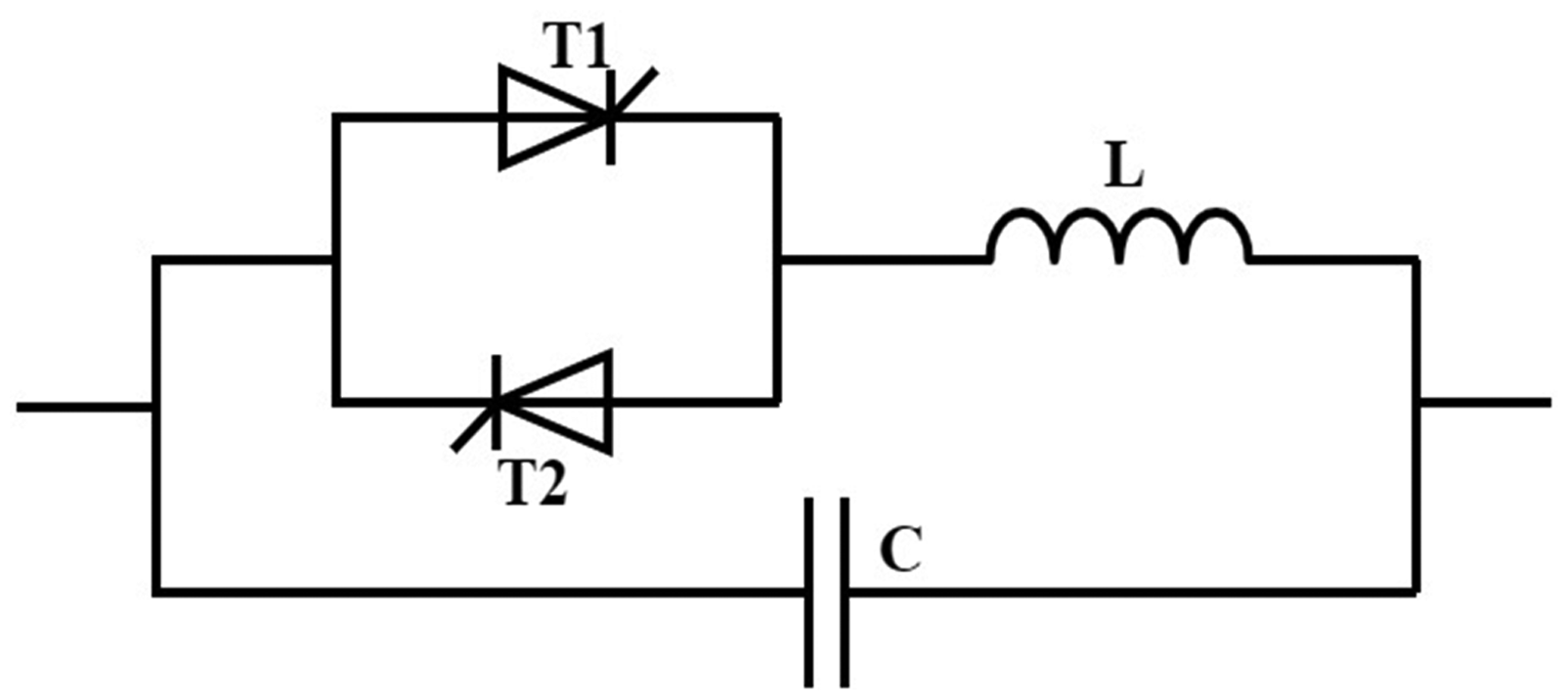
Static model of TCSC.
The range of the compensation level of TCSC considered in this work is −0.7 ≤ KTCSC ≤ 0.2. The working range of reactance of TCSC has been fixed between −0.7Xline and 0.2Xline. 14
Problem formulation
The major intension of the task is to amplify the social interest and to deprecate the generation and investment expense of TCSC along with WPG.
Logical description
Let the logical description is formulated as TB, TG, TD, where TB – total buses, TG – total generators, TD – total loads.
The logical description of presented approach is formulated as shown in equation (2)
Minimize F
TFACTS is the total FACTS devices and TWPG is the total wind alternator.

Expression of SW implies in equation (3)

The alleged formulation charge at the point (pi, gi) is expressed as

The assets of buyers is expressed as
bi is the intercept in $/MWh mg indicates the slope in $/MW2h md indicates the slope in $/MW2h PGi indicates the supply in MW PDj indicates the demand in MW.

Subject to the set of constraints, see below.
Equality constraints
Real power balance


Power flow equations


Bilateral/multilateral power balance

Inequality constraints
Both the discrete and continuous contents are required for system security and operational limits
Voltage magnitude limitation of each PQ bus – the real power (P) and reactive power (Q)
Phase angle limits of voltage of each PQ bus
Mega-Volt Ampere (MVA) limit of lines
Real and reactive power limits at PV buses
TCSC constraint






Expenditure of TCSC
The expenditure of a TCSC (


Overall investment cost ‘ICTCSC’ (in $) is formulated as

The expenditure of annual and hourly investment cost of FACTS devices are
‘ir’ represents the rate of interest LT implies the lifetime of TCSC. ‘HICTCSC’ implies expenditure of TCSC expressed as $/h.


Proposed hGA-GSA
The conscience of this work is to develop a composite principle using the combination of GA and GSA and overall problem is solved using GSA for attaining optimal location of TCSC.
Step 1: Foresee line and bus information along with expenditure and asset factors. Step 2: Accomplish preparatory population (G0, β and N) along with arbitrary pace TCSC’s location and size. Step 3: Assign iter = 0. Step 4: For each agent, update bus data and line data based on its location and setting value. Determine the load level and wind output power. Step 5: Conduct GA-based OPF incorporating TCSC and WPG. Compute the operating cost, TCSC investment cost for required TCSC capacities for each state using equations (4) and (7). Step 6: Assess the rate of fitness function using equation (11). The determined rate is assigned as the fitness value of an agent. Step 7: Update G(t), b(t), w(t) and Mi(t) and it is evaluated using the elementary values G0, t which represents primary value and time t

After evaluating the current population fitness, Mi(t) is calculated as follows:
Step 8: Compute momentum





Each term randj, Mj, ε, Ri,j(t), G(t), kbest in the above equation is enacted as random number, masses of agents, Euclidean distance between two agents, best fitness value is at time t. For k0, N is assigned which diminutions linearly by 1.
Using the law of motion, Step 9: Upgrade agents’ momentum and locus using equations (29) and (30)
Step 10: If the maximum number of iterations is reached, the particle associated with the current Gbest is the optimal solution. Otherwise, set iter = iter + 1 and return to Step 4.



Results and discussion
To investigate the efficacy of prospective sneak up, modified IEEE 14-bus and modified IEEE 118-bus test systems were contemplated as test systems.15
TCSC and WPG installation in modified IEEE 14-bus system
The IEEE 14B accumulates the air of currents at 8B and one-line diagram is shown in Figure 2. The determined optimal location, parameter settings of TCSC and SW costs at different loading conditions are presented in Table 3.
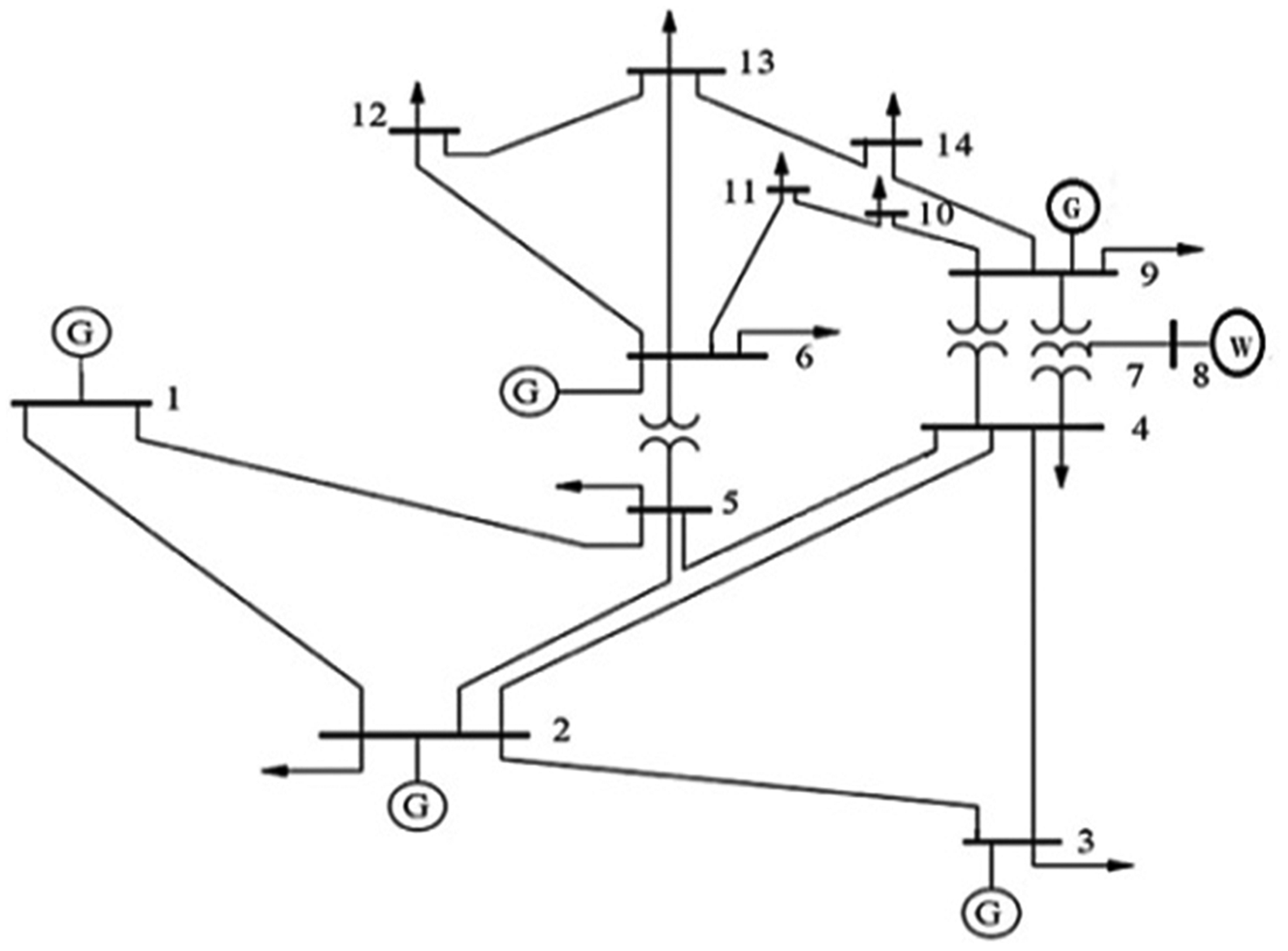
Modified IEEE 14-bus system.
To exemplify the impacts of WPG and TCSC, three cases were explored:
Case 1. SW cost lacking both WPG and TCSC. Case 2. SW cost leading WPG but lacking TCSC. Case 3. SW cost leading both WPG and TCSC.
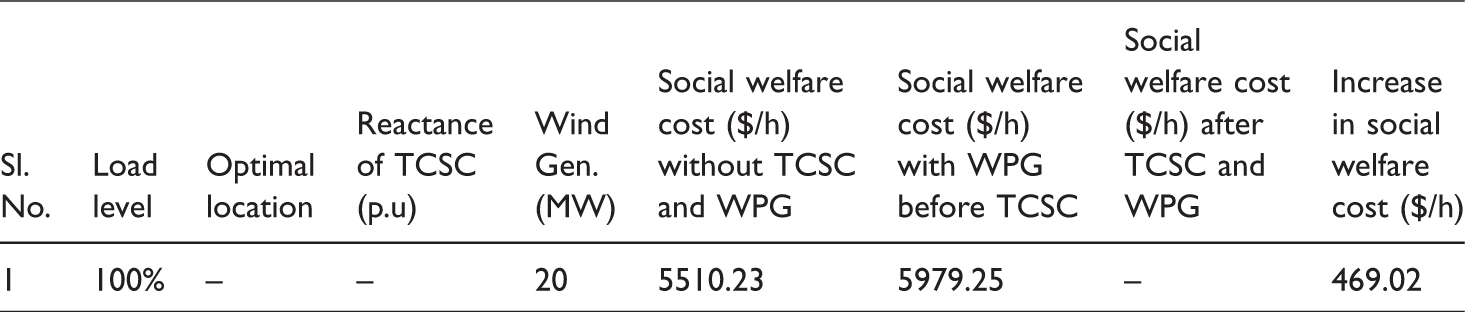
Case 1: Evaluation done in M-IEEE 14, results as 5510.23 $/h as overall expenditure of SW shown in Table 1.
Case 2: Wind power generator of size 20 MW is connected at bus No. 8. Table 2 indicates that after ordination of WPG, SW cost has been increased as 5979.25 $/h.
Social welfare cost without WPG and TCSC.

Social welfare cost with WPG but without TCSC.
Social welfare cost with WPG and optimal location of TCSC.
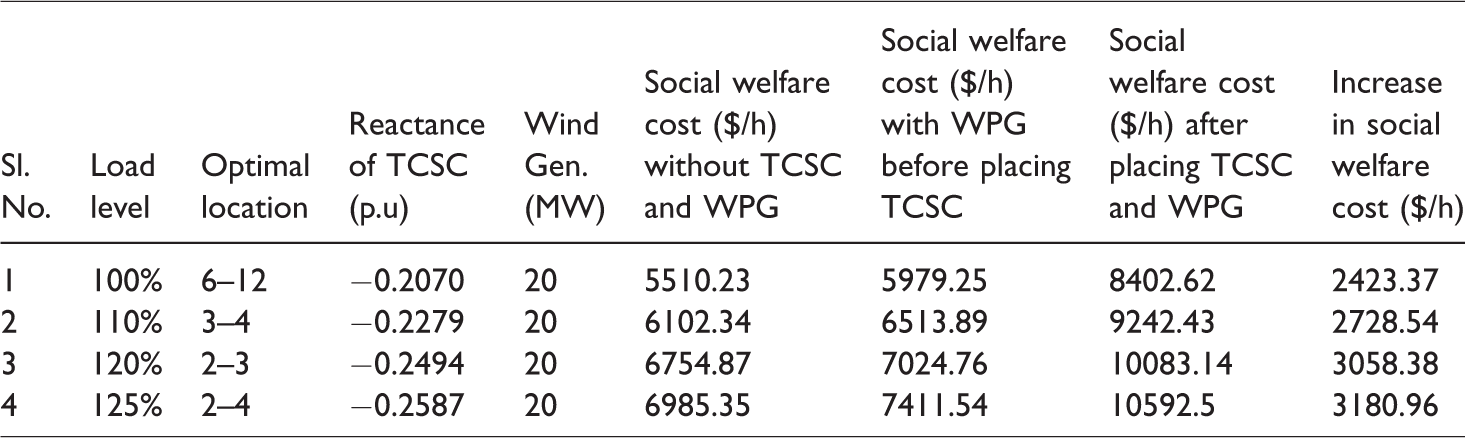
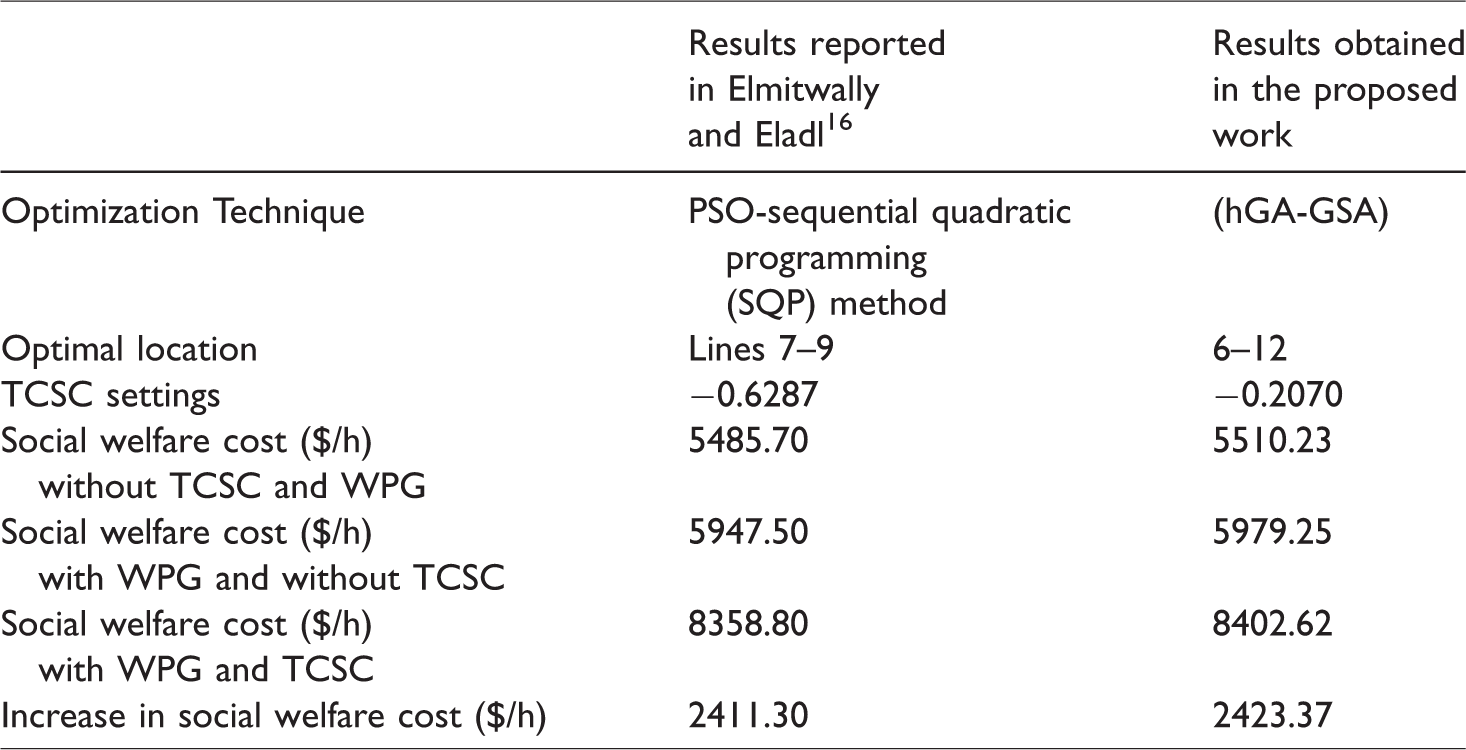
Case 3: In this case, precise allocation of TCSC is measured in the system. Table 3 depicts that installation of TCSC and WPG has increased the SW cost to 8402.62 $/h. So, more profit can be obtained in spite of their high investment cost. The determined optimal location, settings of TCSC and SW costs at different loading conditions are presented in the Table 3.
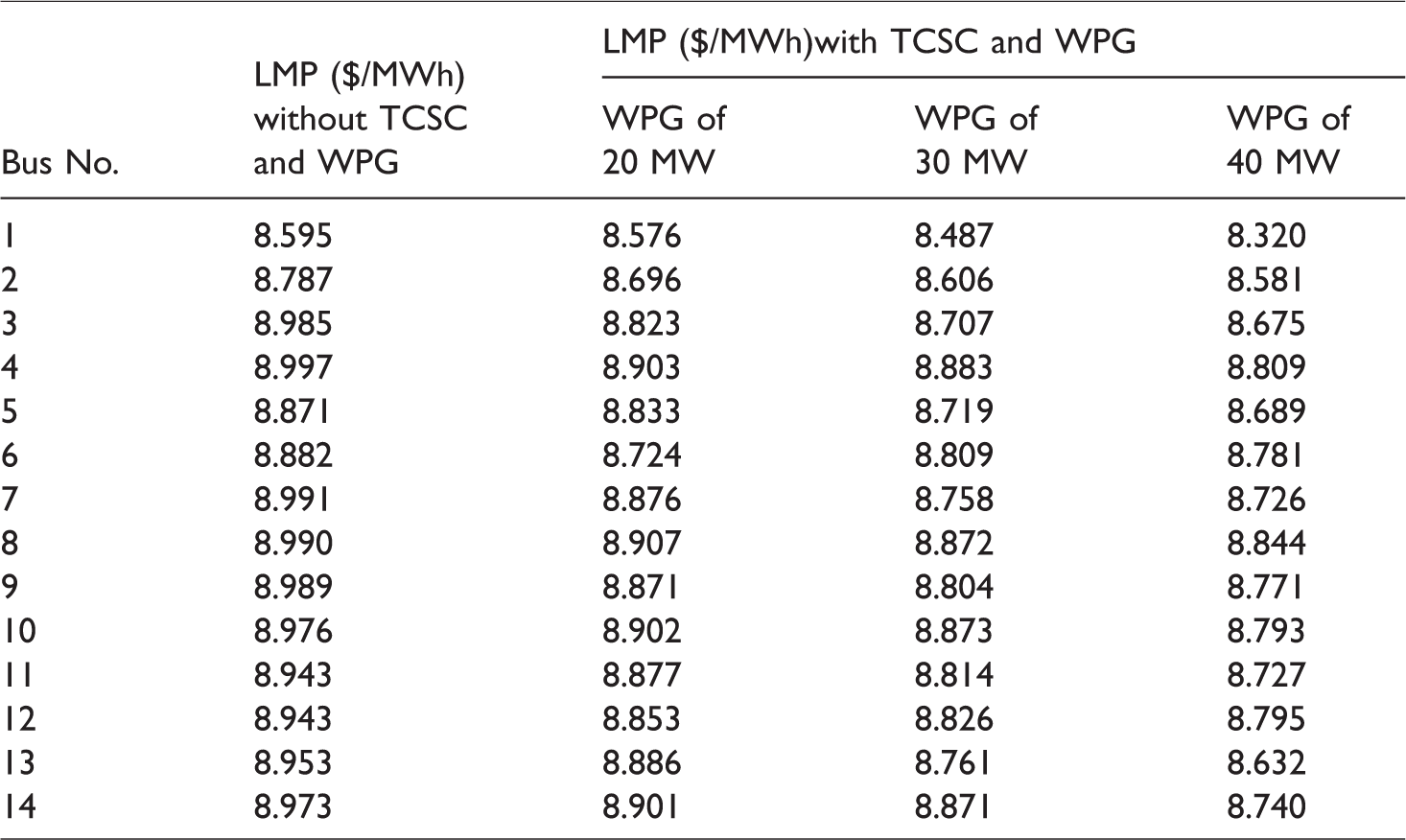
The LMP values with and without WPG and TCSC have been computed and summarized in Table 4, and Figure 3 shows that installation of TCSC enhances system’s LMP significantly. Bus voltage profile with and without TCSC is shown in Figure 4. It explains that proper installation FACTS devices will improve the voltage of all buses. Figure 5 presents that following the installation of TCSC increases the power flow in most transmission lines.
Enhancement of LMP following the appointment of WPG and TCSC.
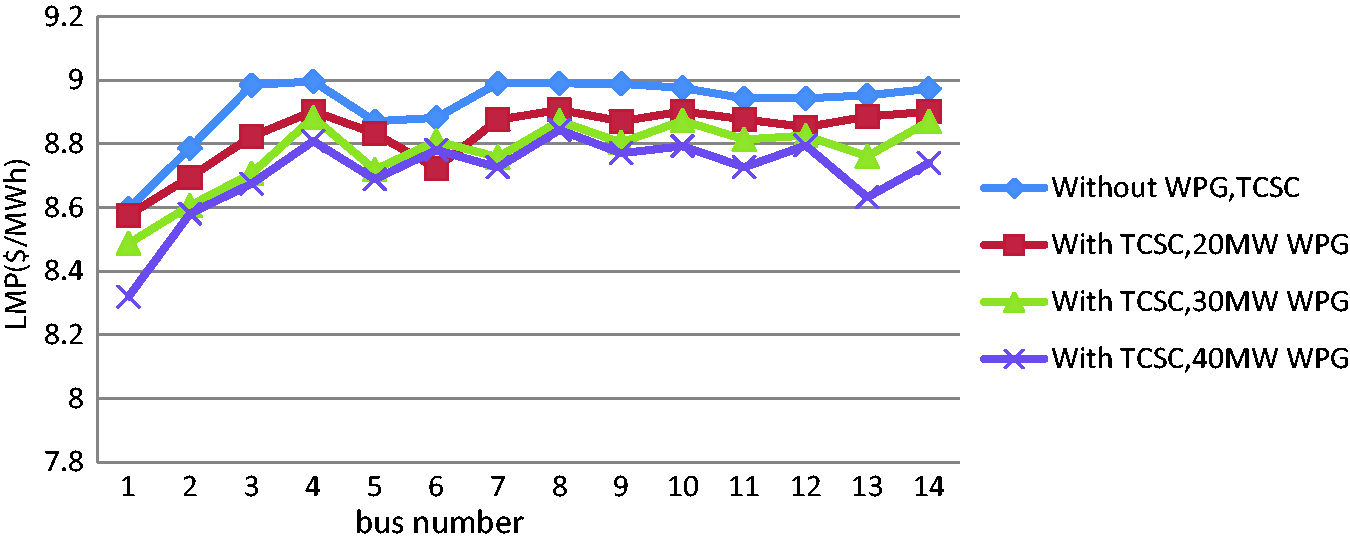
Enhancement of LMP after assigning WPG and TCSC.
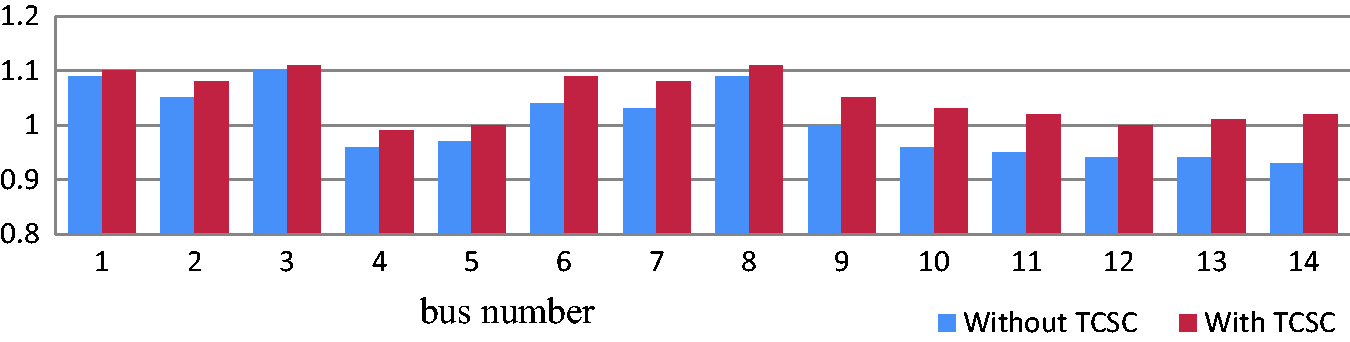
Bus voltage improvement with and without TCSC.
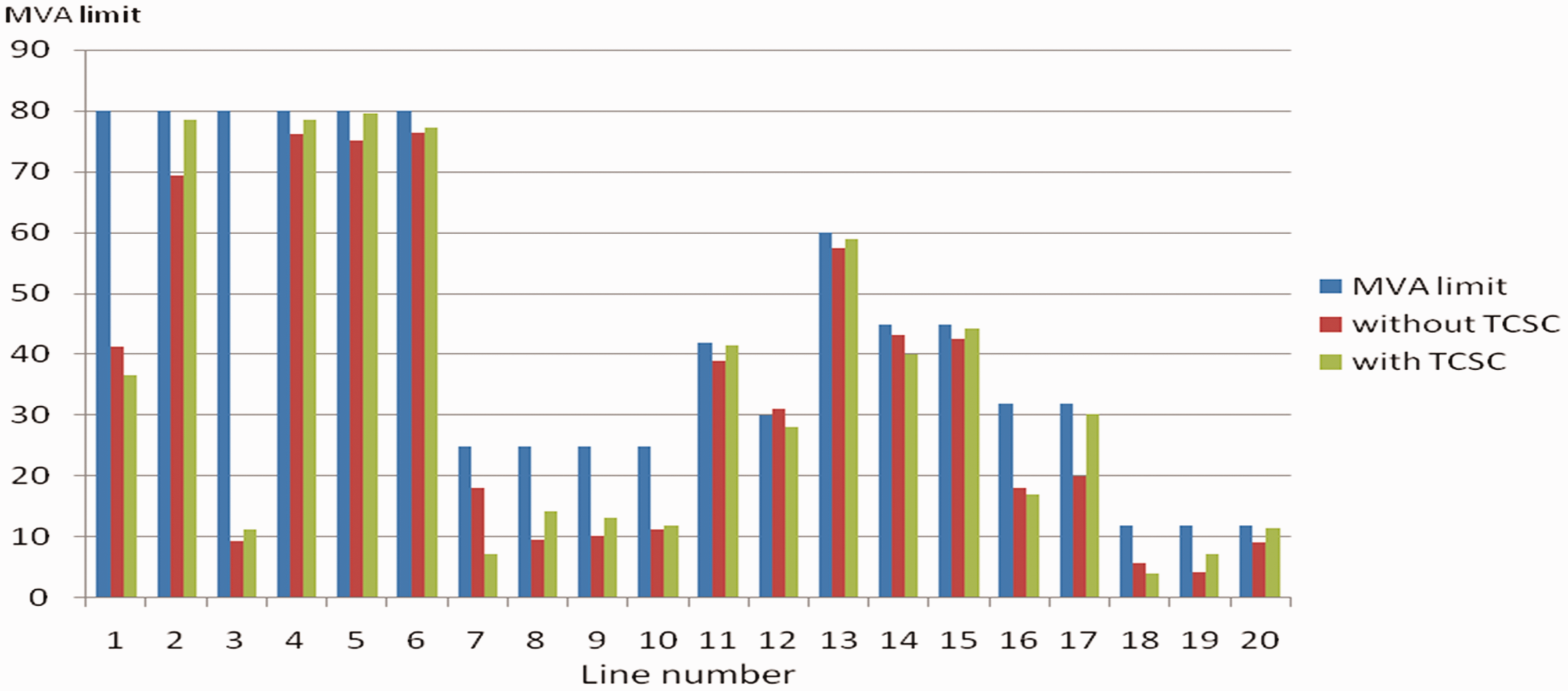
Line power flow with and without TCSC.
TCSC and WPG in modified IEEE 118-bus system
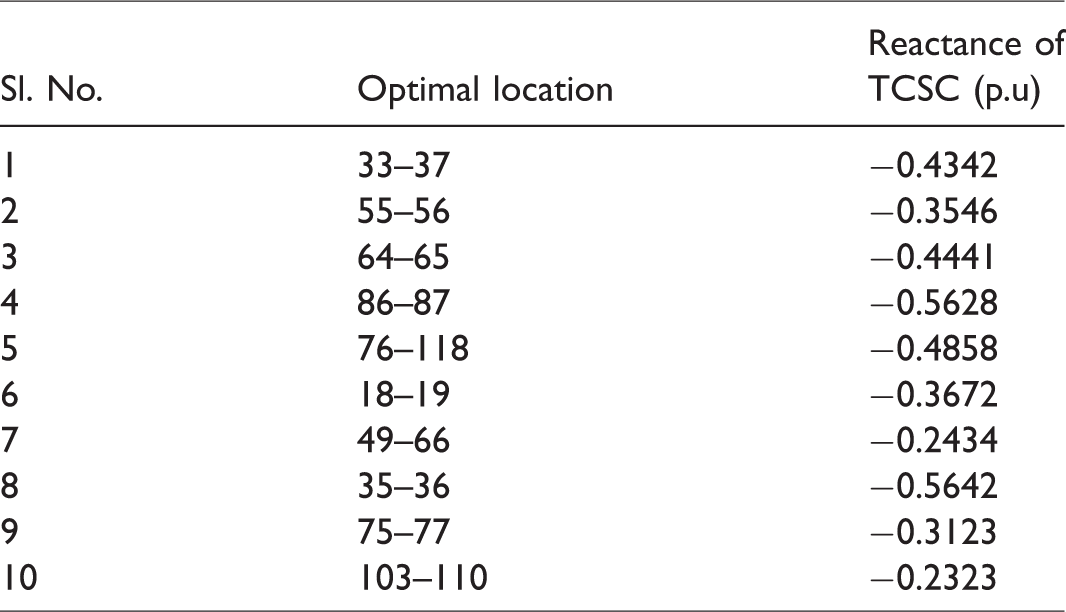
Aiming to depict the relevancy of the proffered principles in broad systems, modified IEEE 118-bus system is accustomed. It is assumed that there are 10 TCSCs placed for the system. Simulations require optimum placement and size of TCSC which are presented in Table 5. SW cost ($/h) is estimated with TCSC and WPG as 23248.41 $/h.
Optimal location and size of TCSC in IEEE 118-bus system.
Outcome of IEEE 14-bus using comparability test setup.
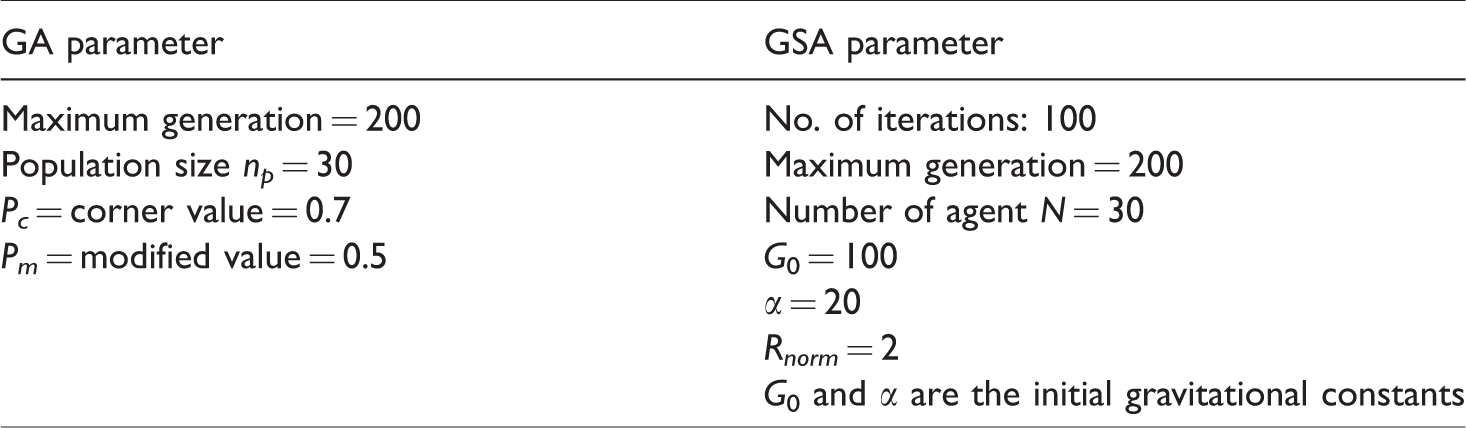
Optimal argument assigning for GA and GSA.
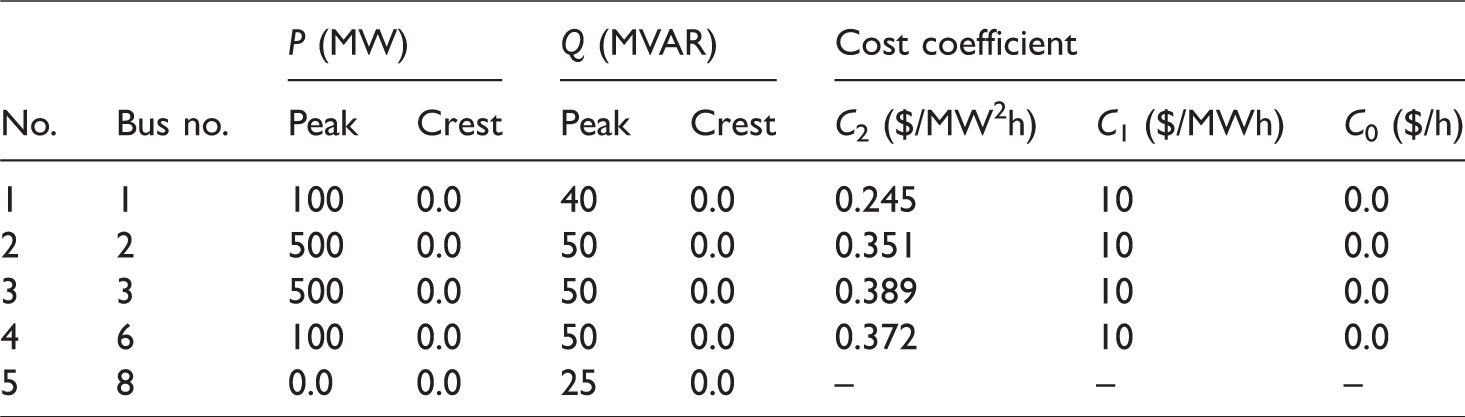
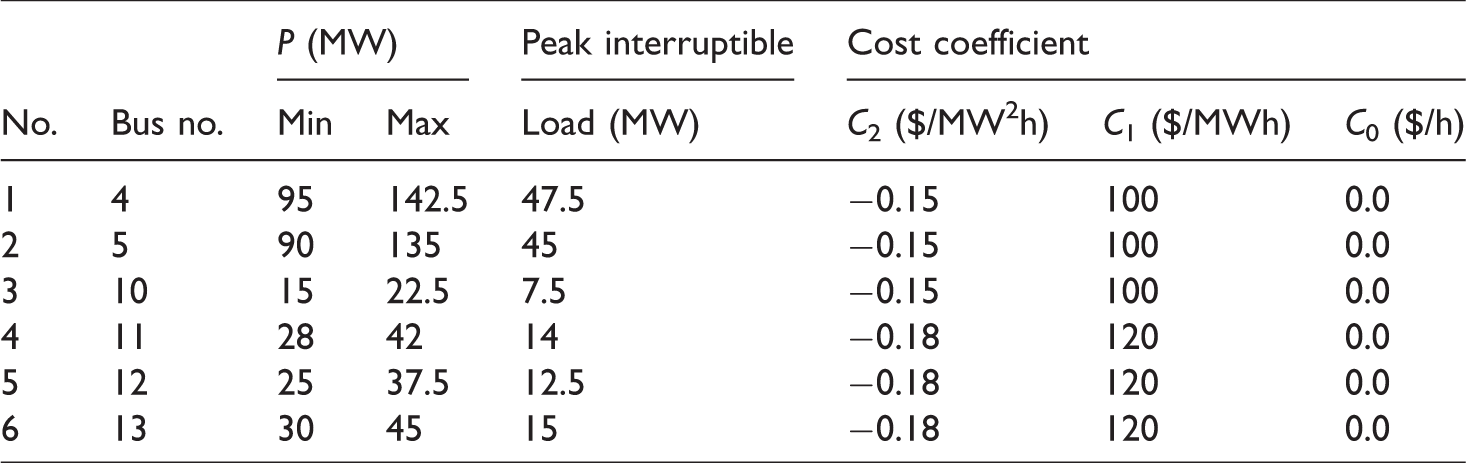
Generator information.
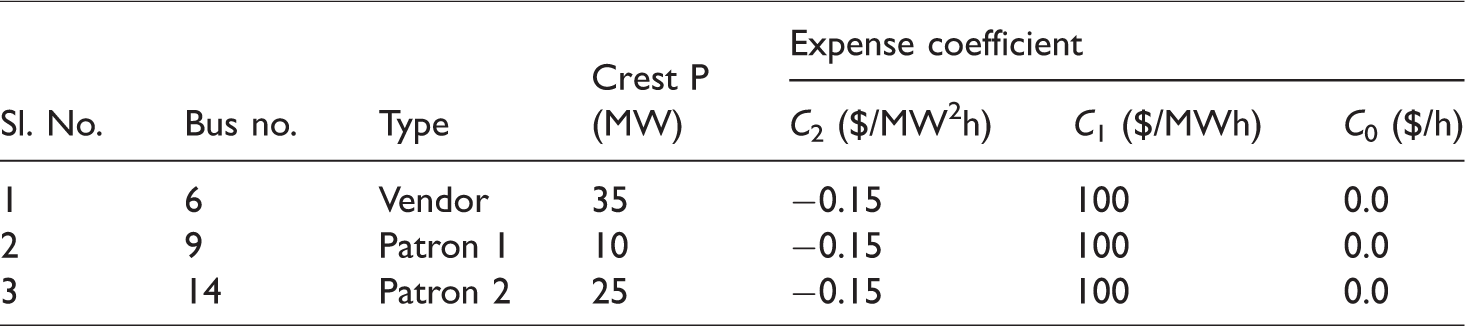
Pool requirement information.
Mutual deal information.
Installation of TCSC and WPG enhances the LMP of modified IEEE 118-bus system considerably, and if large number of FACTS devices are used then LMP may be improved extensively in the whole network.
The results obtained for the IEEE 14-bus test system are reported in Table 6.
It is noted that the increase in SW is 2423.37 $/h, which is greater than that reported 16 after optimal placement of TCSC.Optimal settings for GA and GSA, Data of generators, Pool requirement Data and Mutual Deal Data are given in Tables 7–10, respectively.
Conclusion
This paper presents an approach to optimally locate TCSC in deregulated power market with integrated wind power generators in the system. The proposed approach has been tested and validated on modified IEEE 14-bus and modified IEEE 118-bus test systems and results showed that the effectiveness of the proposed approach. In this work, SW maximization, profit maximization and objective function minimization have been achieved with the cost model of TCSC, wind power generator, and it is observed that SW improves with installation of TCSC in deregulated power market. Furthermore, the effect of wind generation and load growth are addressed. LMP of the system has been reduced considerably by placing TCSC with WPG. This proposed approach is a generalized one which can be applied to any size of system in deregulated power system.
Footnotes
Declaration of conflicting interests
The author(s) declared no potential conflicts of interest with respect to the research, authorship, and/or publication of this article.
Funding
The author(s) received no financial support for the research, authorship, and/or publication of this article.
