







Abstract
In recent years, rare earth compounds with Ce3+ ion have reported as light-emitting materials due to photoluminescence. But Ce3+ ion luminous mechanism has not yet particularly reported until now on account of disparate ligands. In this report, results of study manifested it would possible make complicated, which coordinated by ligands upon π conjugation. In this study, several fluorescent compounds as well as non-fluorescent compounds have synthesized by solution method, which coordinated by common organic ligands with π conjugation, such as acetylacetonato(acac), oxalate(ox), 2,2′-bipyridine(bpy), 1,10-phenanthroline(phen). It have been made clear about Luminous mechanism by means of experimentation compare to molecular orbital method.
Introduction
In recent years, Lanthanide-based materials,1–8 owing to their unique chemical properties originated from the 4f electronic shells, have been extensively applied in optical biomedical and magnetic devices. Rare earth cerium 3+ ion 9 is widely used as luminescence center of inorganic crystal fluorophor, because of its luminescence characteristics. It shows brand fluorescence spectrum based on 4f-5d electron transition.10–12
At present, White-light emitting materials deserve particular attention due to their promising applications, in particular, display interesting optical properties such as sharp and intense luminescence, long lifetime, emission in the primary color range (red, blue and green) that fully spans the entire visible spectrum, thus can be used in designing white-light materials. Inorganic phosphors used to white light LED13–17 with Ce3+ ion18–21 as activator have synthesized successively such as Y3Al5O12: Ce(YAG:Ce) of yellow light, LaPO4:Ce(LAP:Ce) of ultraviolet light, GdBr:Ce of blue light (Figure 1). In other words, it suggests that the emission wavelength of Ce3+ will greatly vary as long as coordination environment changes. The control of the emission wavelength by such specific emission characteristics has been actively carried out at present. As we known.22,23
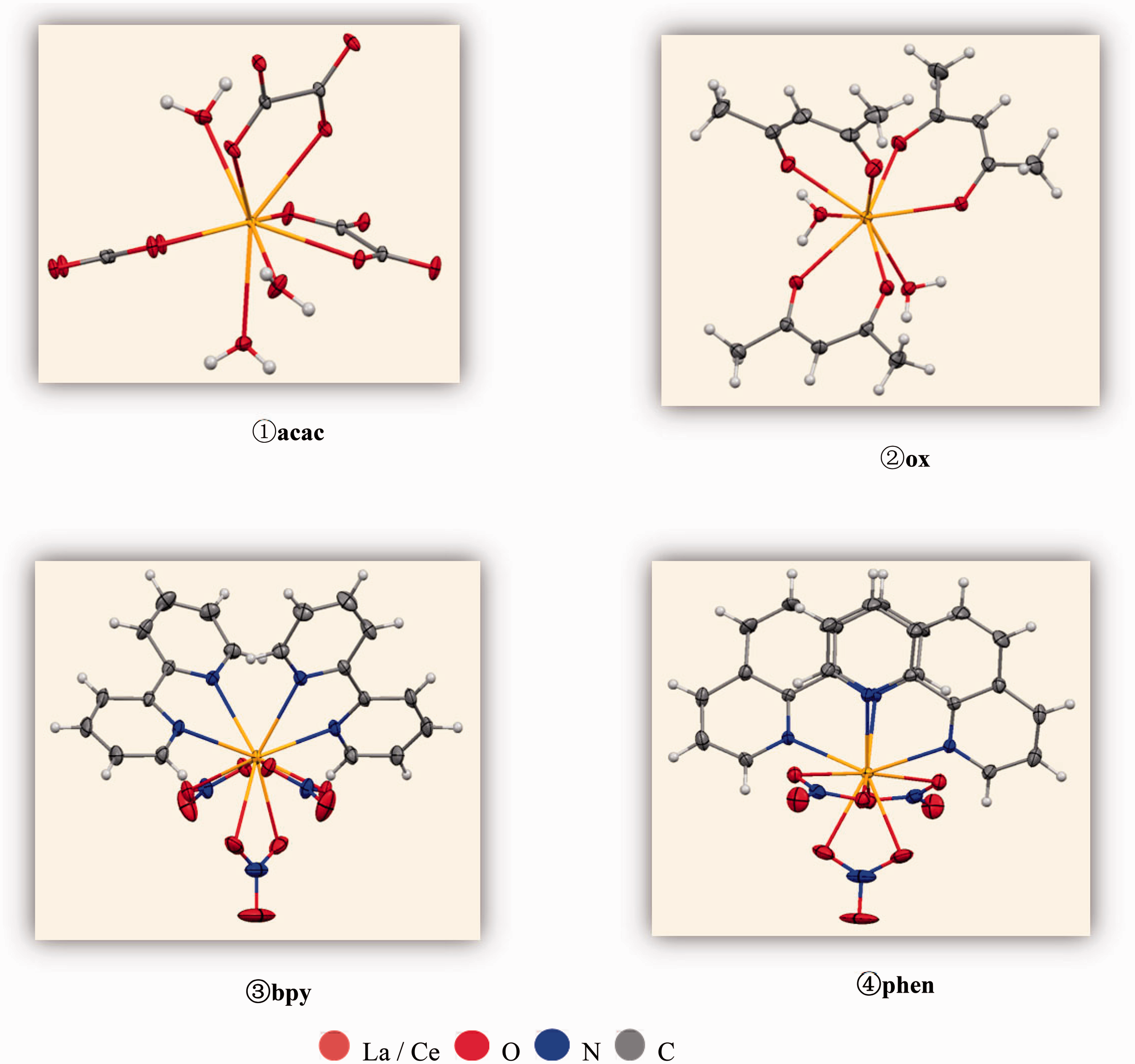
Images of four complexes.① acac. ② ox. ③ bpy. ④ phen.
Besides, the main trend for development of luminous materials24,25 is considered to be hybrid materials coordinated ligands with π conjugation action in the field of inorganic-organic hybrid complex, which ligands of conjugated system possess wide π orbital to easily interact with excitation light. The light energy absorbed by the π conjugated ligand exhibited the forbidden transition to the lanthanide ions existing 4f-4f transition such as Eu3+ or Tb3+, as well as energy transfer from ligands. Emission intensity of these complex will be enhanced by about 100 times 26 of the inorganic crystal phosphor. Even now mass phosphor complexes by luminescence of 4f-4f transition have been reported, there are very few reports of the phosphor complex by 4f-5d transition.
Therefore, it is considered that it is quite important to clarify the light emission mechanism in the combination of the organic ligand increasing the light emission and Ce3+ showing the peculiar emission spectra, which be regarded as a material design guideline for the development of the fluorescent material which can emerge high efficiency luminescence.
Experiment details
Solution method is applied to this study. Ligands: acetylacetone, oxalate, 2,2- bipyridine and 1,10-phenanthroline; rare earth compounds: La(NO3)3 · 6H2O, Ce(NO3)3·6H2O . Reagents were successfully used without further purification (La (ChemPur, 99.9%), Ce (ChemPur, 99.9%). For complex preparation, the chosen amounts of ligands and reagents were combined by the ratio formula, dissolved in beaker at room temperature and stirred about for 2 hours. Colorless microcrystalline complex of La(acac)3 · 2H2O:Ce3+, La2(ox)3·10H2O:Ce3+, La(bpy)2(NO3)3: Ce3+, La(phen)2(NO3)3:Ce3+ have been synthesized. The characteristics of the synthesized samples were characterized by single crystal structure refinement, photoluminescence spectroscopy, diffuse reflectance spectroscopy (DRS). emission mechanism using the first-principles method(DV-Xα) of molecular orbital theory density, we have calculated the electron density of 4f orbits and 5d orbits in the excited state of Ce3+, which is responsible for the emission of light.
Results and discussion
The structures of the compounds have been refined and, Crystallographic data of four complexes were recorded on Rigaku XtaLAB mini four circle X-ray diffractometers (Mo 50 kV/12 mA φ: 0 deg ∼ 360 deg ω: −70 ∼ 120 deg 2θ: 65 deg) at 297 K (as depicted in Table 1). Single crystals of these complexes have been obtained, and their structures determined by X-ray diffraction. In this work structure data of four coordination compounds synthesized are consistent with those reported.
Crystallographic data of four complexes.
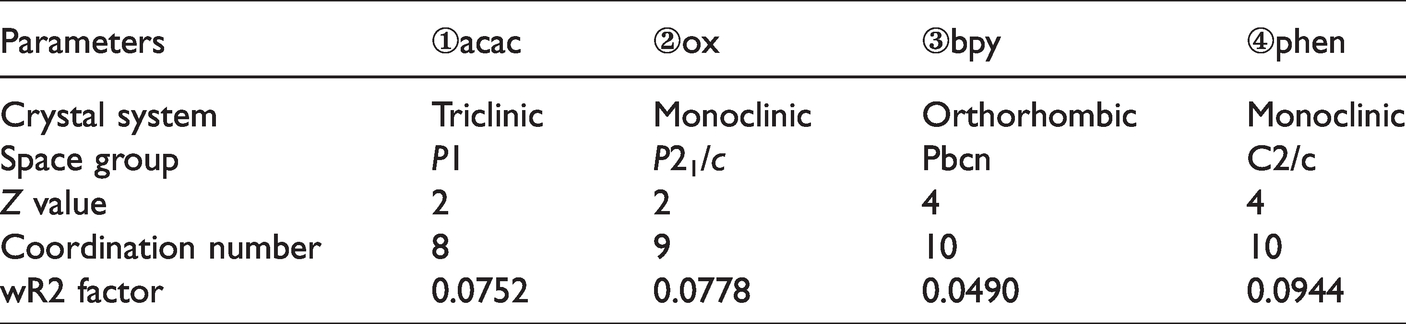
Images of four crystal structures are depicted in Figure 1. It obviously showed that structure of La(acac)3 · 2H2O:Ce3+ is with a coordination number of eight with three chelating ligands (acac is bidentate) and two water molecules, La2(ox)3 · 10H2O:Ce3+ is with a coordination number of nine with three chelating ligands (ox is bidentate) and three water molecules, other water molecules are considered as layer water molecules by TG/DTA measurement. Besides, both La(bpy)2(NO3)3:Ce3+ and La(phen)2(NO3)3:Ce3+ are coordination number of nine with two bidentate ligands (respectively are bpy and phen) and three nitrates(providing six nitrogen atoms) without any water molecule.
In this study, PL measurements revealed no light emission in both the ox and bpy coordination complexes, and green light emission from Ce3+ was found in the La(acac)3·2H2O:Ce3+, and most of the light emission in La(phen)2(NO3)3:Ce3+ was derived from the phen ligand, but also found weak luminescence derived from Ce3+ (as depicted in Figures 2 to 4). As shown in Figure 2 it indicates that coordination complexes with acac ligand have obviously excitation and absorption near 440 nm due to 5d-4f transition of Ce 3 + (as shown in Figure 3), fluorescence spectra with emission peaks near 513 nm were observed. In addition, it also shows there are two split peaks corresponding to transition from 5F5/2 to 2F7/2 in the 4f orbit, which is the ground state from 5d orbit(as depicted in Figure 2 (2)). 1659 cm−1 energy difference of the two excited states does correspond with range of 5d-4f transition energy reported (1600–2300 cm−1).
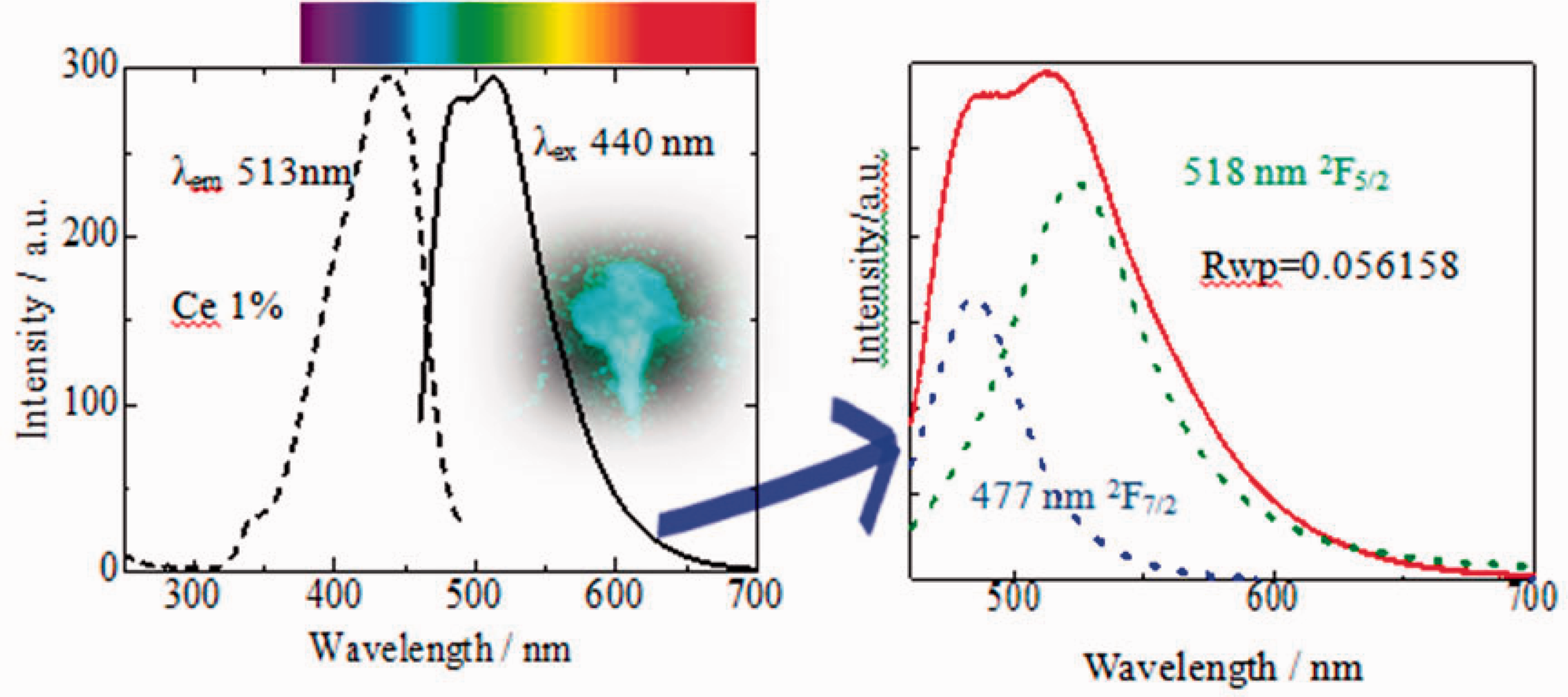
Excitation and emission spectra of acac coordination complex (1), Peak fitting for acac coordination complex of emission spectrum (2) and calculation for energy between 477 nm and 518 nm (3).
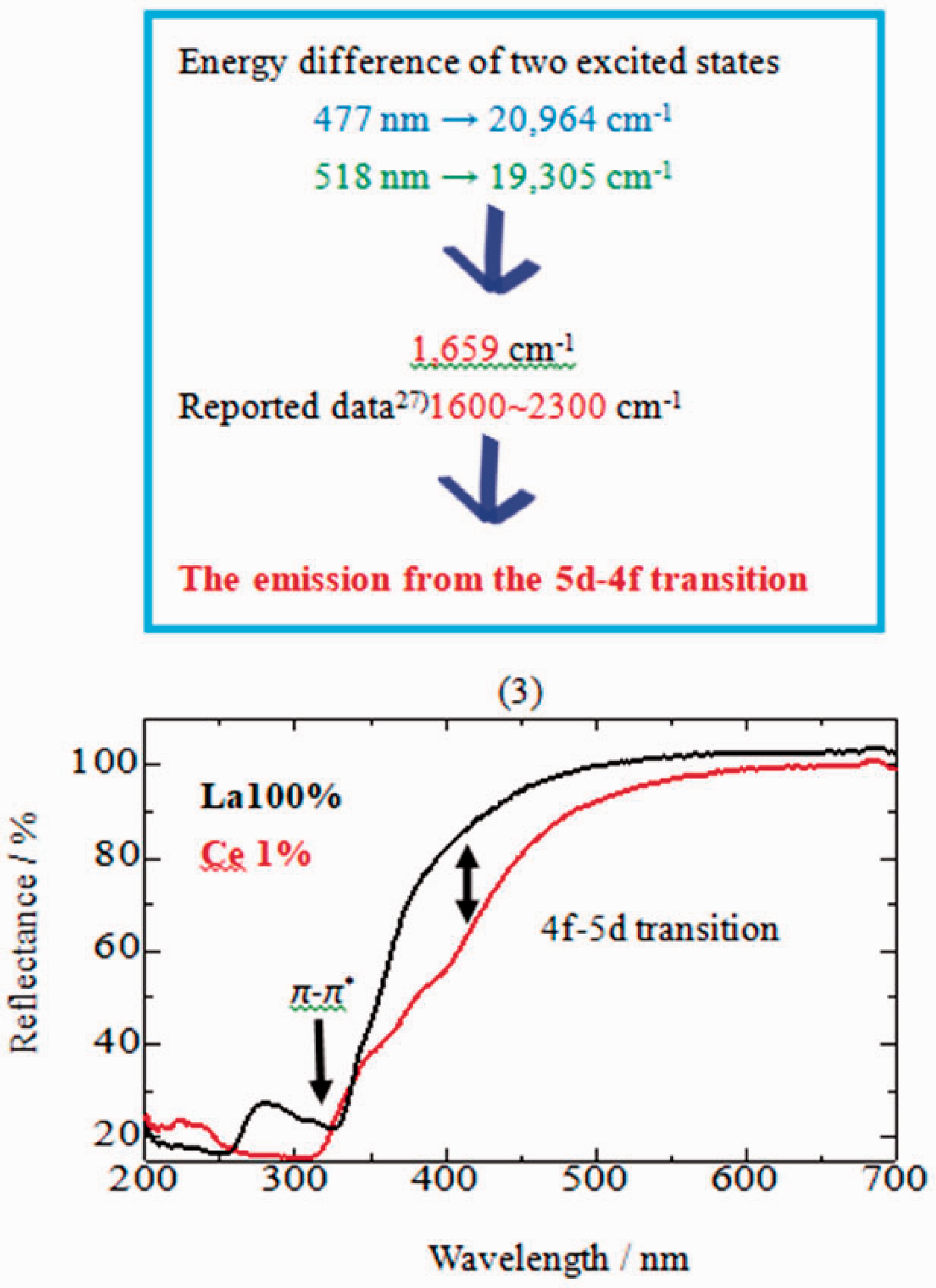
Diffuse reflectance spectra of acac complex.
We also determined PL and diffuse reflectance spectra for both La(bpy)2(NO3)3:Ce3+ and La(phen)2(NO3)3:Ce3+ as demonstrated in Figure 4. Split peak is observed in the PL spectra of La(phen)2(NO3)3:Ce3+, but not be found in the PL spectra of La(bpy)2(NO3)3:Ce3+, of which 5d-4f transition energy is higher over the energy range of luminescence, Comparing to diffuse reflectance spectra among them.
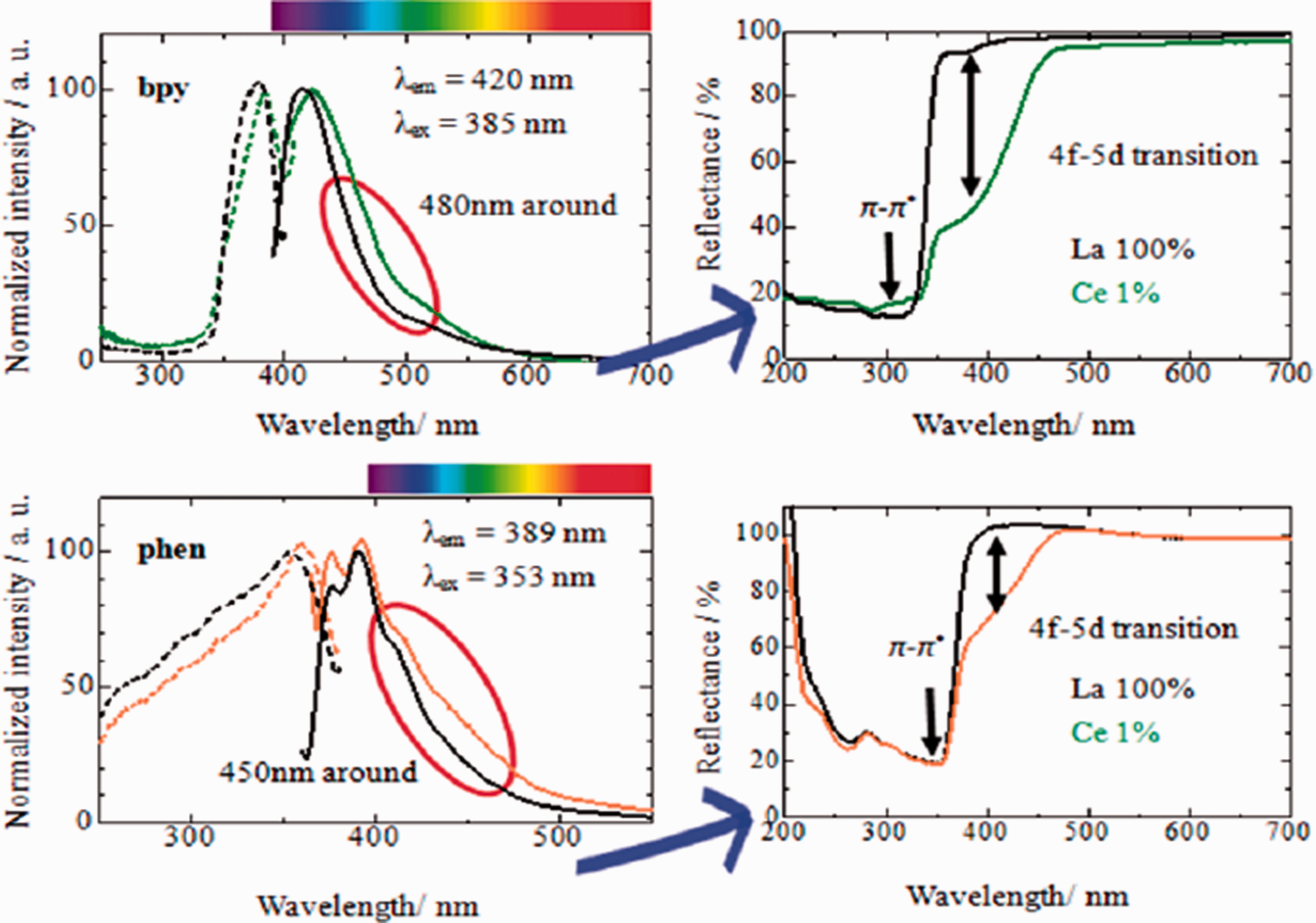
Excitation and emission spectra (above) and diffuse reflectance spectra (under) of bpy and phen complex.
DV-Xα27,28 calculations have been performed on studying electron spectroscopy of compounds synthesized in this report. DV-Xα(Discrete Variational) method is the first principle of molecular orbital theory which can be used to calculate the system of larger molecules and atom clusters. It has been successfully used in the analysis of complexes, clusters, material structures and electronic spectra. The characteristic of this method is considered to use discrete numerical integration method for Hamiltonian and overlapped matrix as following equation (1). Briefly, DV-Xα method is based on the calculation of the electronic orbital energy and transition moment of Slater transition state to analyze electron spectrum.


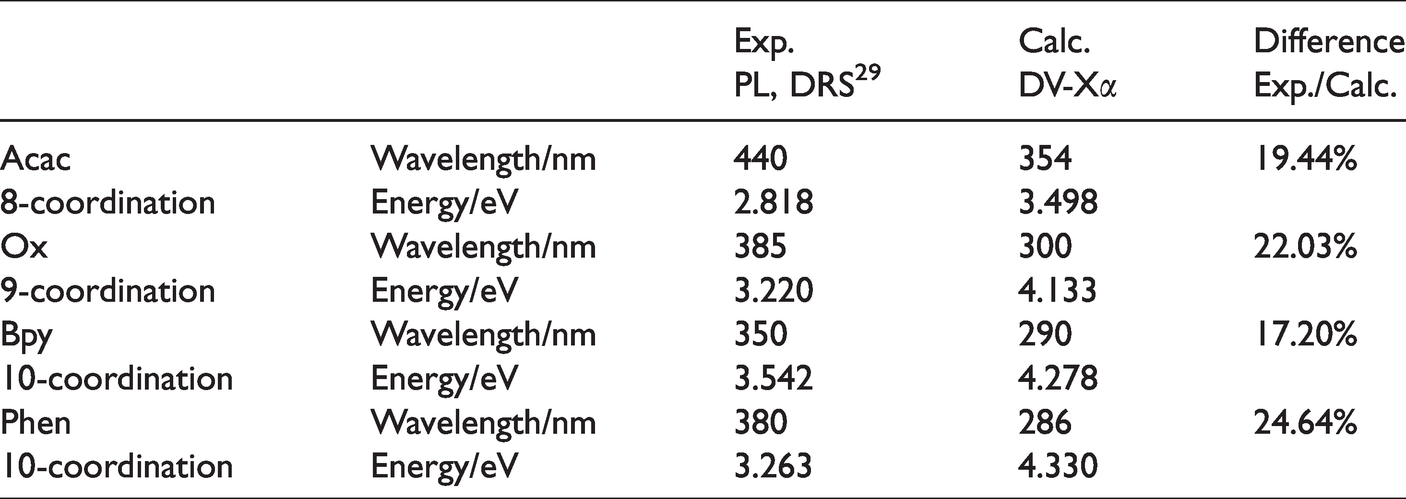
In this study energy difference between transition orbit are discussed by using non-relativistic DV-Xα model cluster calculation. Cluster selection based on the principle of structural unit containing minimum number of atoms, acac-complex cluster is took as an example illustrated in Figure 5. Acac-complex energy-transfer difference among of those complexes whether experimental value 29 or calculated value are the lowest (Table 2). In order to prove relative accuracy of calculation upon DV-Xα method, partial density of state (PDOS)30,31 of four complexes have been calculated on width of 0.5 ev according to the Gaussian program as depicted in Figure 6. Results from PDOS data were consistent with theoretical calculation, hereinto acac-complex appeared distinct split peak and lowest transit-energy.
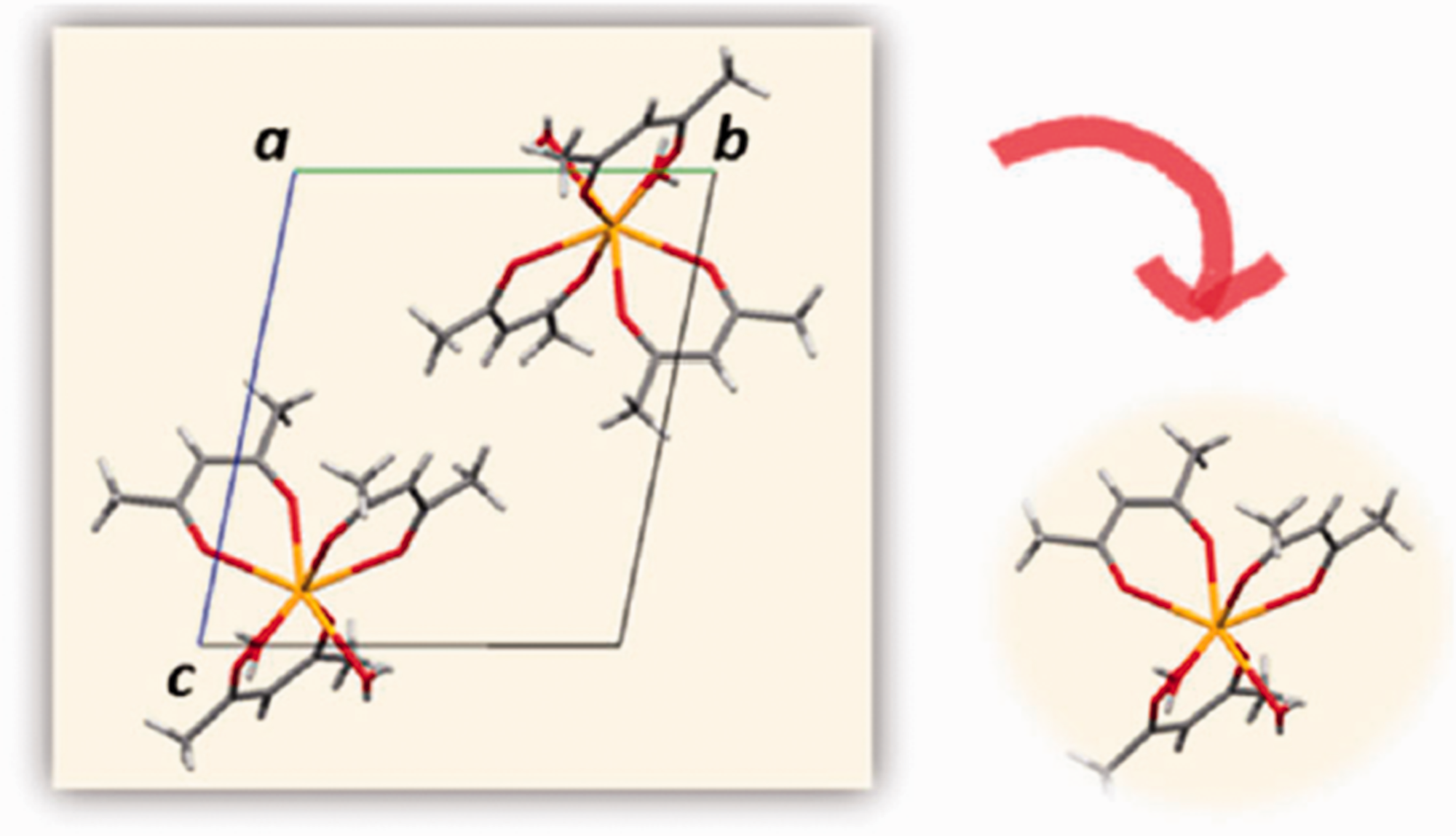
Example of cluster for complex (acac-complex).
Experimental data and calculation value by DV-Xα method.
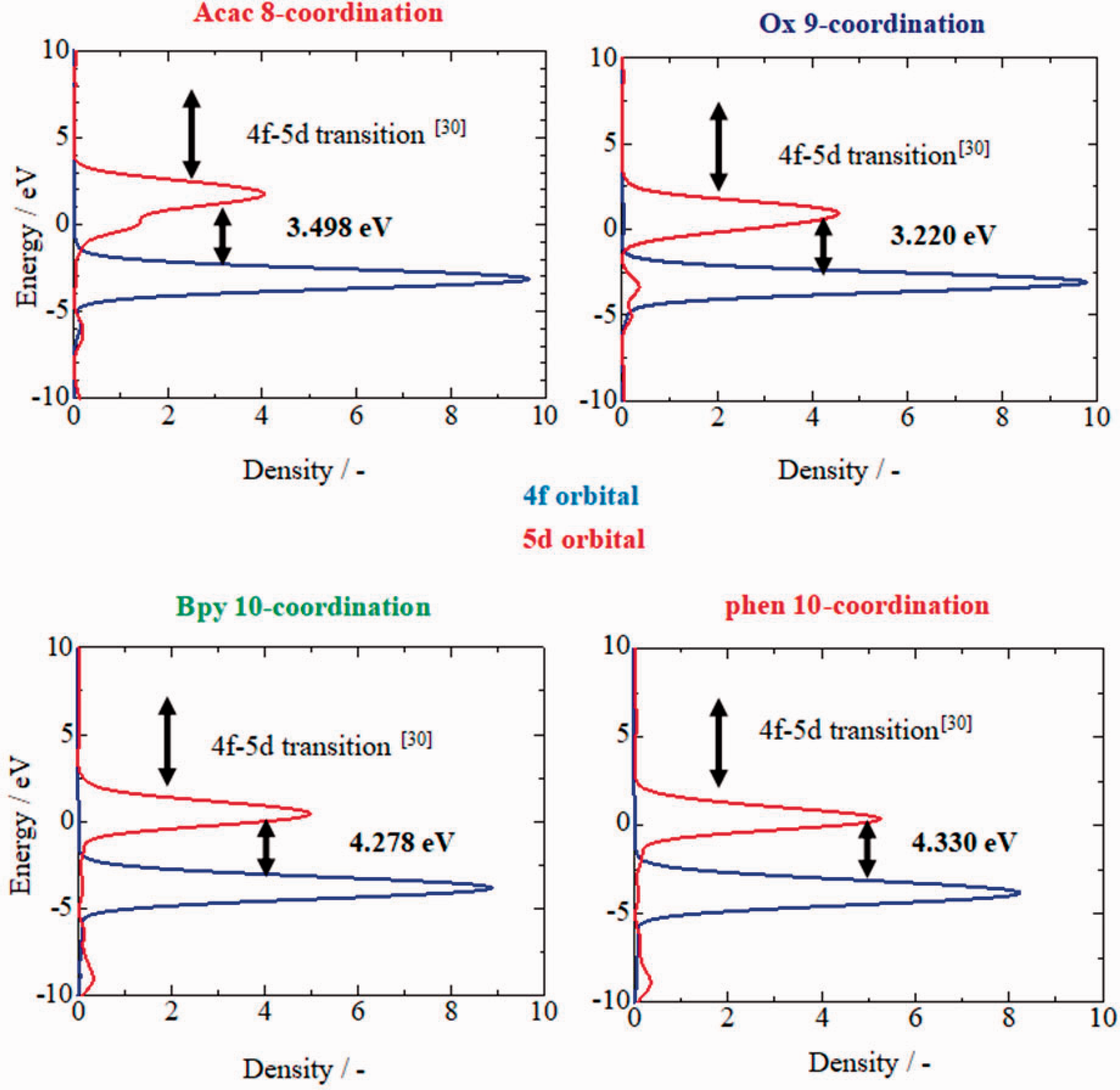
Partial density of state (PDOS) of four complexes.
Conclusions
In this report emission spectra of La(acac)3·2H2O:Ce3+, La2(ox)3·10H2O:Ce3+, La(bpy)2(NO3)3:Ce3+, La(phen)2(NO3)3:Ce3+ have been investigated. Theoretical calculations of transit energy of them for emission were performed by DV-Xα method, which comparing to experimental data. The difference between the two data is consist with 20% relevant reported. The results showed that there is significant difference for 5d orbital split prefer the 8-coordinated acac complex to the others. In other words, it is considered that the acac complex with 8 coordination can form the environment suitable for the light emission due to strong ligand field, thus it shows the relatively long wavelength green emission about 513 nm. In general, this study implied that the luminescence intensity of electronic 4f-5d energy-transit pattern depend on 5d crystal-field splitting observed in the emission spectrum of the complex mentioned above, as well as assignable influence of ligands for which acceptor ions. According to calculation of energy-transfer by DV-Xα method, it is a possible design direction on structural available luminent materials. 31
Footnotes
Acknowledgements
The author would like to thank for the research supported by the Sato and Toda Research Team, Department of Chemistry and Chemical Engineering Faculty of Engineering Niigata University, especially be grateful to Prof. Mineo Sato, Prof. Kenji Toda, Mr. Atsuya Koizumi for their helpful data and discussions.
Declaration of conflicting interests
The author(s) declared no potential conflicts of interest with respect to the research, author- ship, and/or publication of this article.
Funding
The author(s) disclosed receipt of the following financial support for the research, authorship, and/or publication of this article: This work was supported by a grant-in-aid for scientific research from the Heilongjiang Province Education Department Research Program (No.2018KYYWF1289), a part of this work was also supported by the Doctor Initial Capital Program from Heihe University (No.2019KYQDJJYJ07).
