







Abstract
The first satellite which can flash Morse code on orbit is introduced in this paper. The design of the system includes light energy estimation, attitude mode design, elevation angle analysis and flash time design. It is a 100 kg satellite with two LED arrays on 547 km. When it flashes, the satellite points to the observation location. The LED rays flash as the rule of Morse code. The satellite was sent to the orbit in Dec 2018 and the test of flash was completed within one month after then. The photo taken by star sensor can compare the apparent magnitude by the gray level. The results of the analysis show that the satellite can achieve 0 apparent magnitude, which is consistent with the design of the system. As a meaningful scientific experiment, “Ladybeetle-1” links space technology with popular science education and also provides a reference for space applications.
Introduction
The satellite, “LadyBeetle-1”, was launched into space on the 7th December, 2018. The It is used for science popularization of science education by shortening the distance between space technology and the public. It weights 100 kg, containing 6 cameras, 2 LED arrays, and communication payload. In this paper, a scheme of on-orbit flash Morse code is proposed. Equipped with a high-power spotlight array, the satellite can achieve 0 apparent magnitude. By using the principle of Morse code, different meanings are expressed by long and short flashes. The project is designed and configured based on commercial devices. The attitude determination and control system(ADCS) is implemented, also with whole platform including batteries and data storage and transmission system.
One special function of “LadyBeetle-1” is “flash mode”. This paper introduces the design and verification of this mode. The creative idea of the function is originated from the aerospace science fiction enthusiasts. In order to achieve the brightness visible to the naked eyes on the ground, the LED array is designed based on the principles of optics. The ADCS also designs a work-mode named “Earth pointing”. When we want to send messages through the flash of the satellite, the previously prepared tele-control instruction is sent to the satellite. The control instruction includes the location of our ground observation and the time we want to see the flash.
The observation on the ground can verify the correctness and effectiveness of the system design. The flash is not only visible to the naked eyes, but also can be caught by the ordinary household SLR camera to take photos. The star sensor made by TY-space company is also used to take photos. The apparent magnitude of the satellite is calculated to proved that the designed system is effective enough to achieve 0 apparent magnitude.
After on-orbit test, the function of satellile is open to the public. Astrophotographers took a lot of excellent photose of the flash. Observation activities for astrophotographers and astronomers have also attracted educators, and students, as well as many children, who observed the flash of “LadyBeetle-1”. In the announcement of the observation activities, the time, location, azimuth and elevation are predicted, except for the code, which is always kept as secret before the flash. The audience are curious about the code. The satellite has inspired people's interests in the sky. Due to the reflection of sunlight, some other spacecrafts can be seen in the night, such as Iridium and International Space Station. But “LadyBeetle-1” can give people a short sentence by Morse code. The satellite also provides customized services, as people can upload their blessings to it for flash, which may be the most innovative and interesting function of the satellite. When running across the galaxy, “Ladybeelte-1” makes science closer to the public,esp. the sudents and children.
Design of the mission
Light energy estimation
The height of “LadyBeetle-1” is 547 km, and its orbital period is about 95 minutes. The original expectation of the apparent magnitude was set to 0 and close to Vega. The area with a radius <20 km is chosen to watch the flash. According to the duration of satellite passing by the place, the flash time is set to 2 min. The most important mission is to estimate the luminance we need.
The solar illuminance constant (

One of the most important factors is the influence of the atmosphere on the transmittance. The data from simulation shows the transmittance is affected by the latitude and the wavelength. Since “Ladybeetle-1” serves the users in China, we only consider the mid-latitude region and the differences between city and countryside. The urban visibility is 5 km, with the seasons of summer and winter when there is no rain and cloud. The transmittance curve is Figure 1.
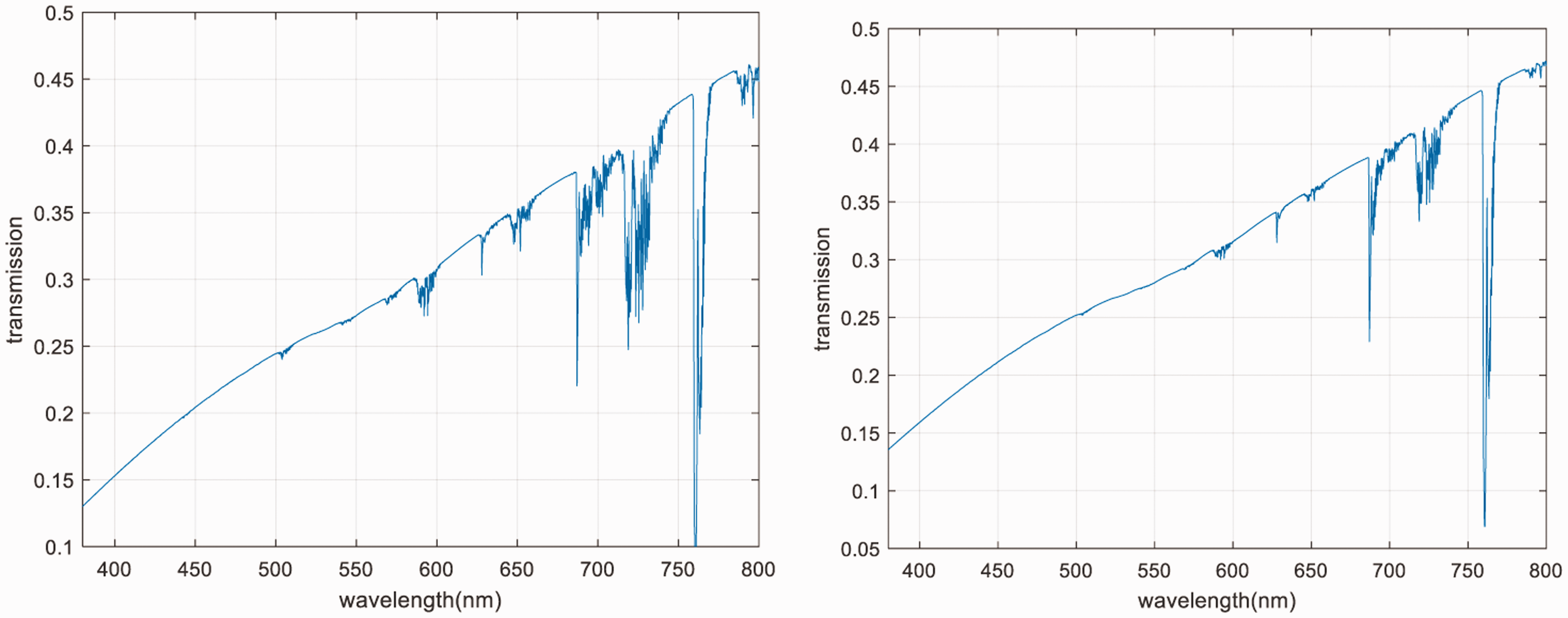
Transmittance curve (Left: summer, urban; Right: winter, urban).
The countryside visibility is 23 km, with the seasons of summer and winter when there is no rain and cloud, the transmittance curve is as Figure 2.
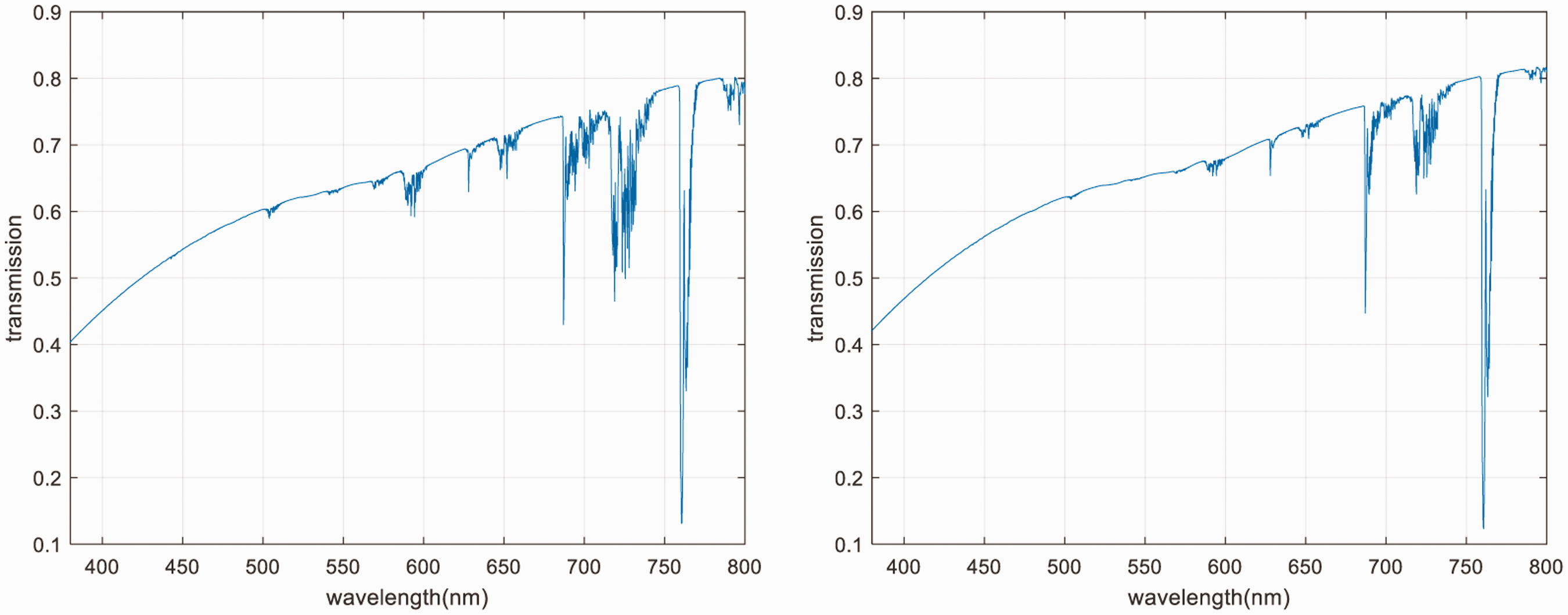
Transmittance curve (Left: summer, countryside; Right: winter, countryside).
Different wavelength of light has different transmittance, and result to the different wavelength sensitivity of the human eyes. From Figures 1 and 2, we know that the transmittance in the contryside in winter is the best. In this situation, the spectrum analysis is shown as Table 1.
Spectrum analysis.

In Table 1, the transmittances of different wavelength are given. Consider the sensitivity of the human eyes to the light, the transmittance can be chosen as 0.6, which is closed to it in the wavelength range of 480–530.
According to the constraint about the weight and power of the satellite, we design two LED arrays and install them on the satellite. The arrays are assembled on the satellite as indicated in the photo below in Figure 3.
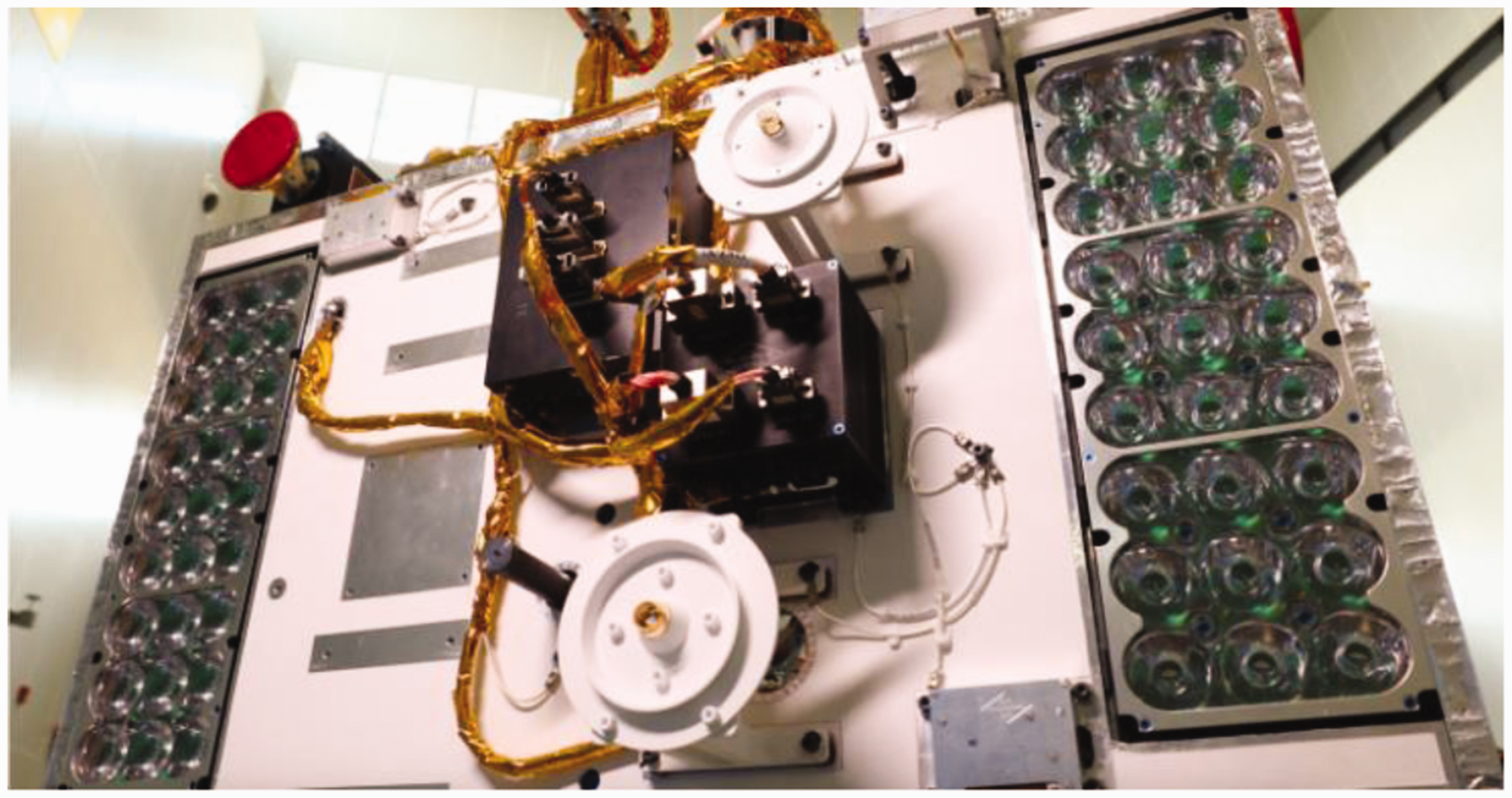
LED arrays on “Ladybeetle-1”.
The luminous flux of the LED arrays can achieve 44000 lm. After the light source simulation, the max light intensity is 
When the transmittance is 0.6, the ground illumination can be calculated as below

The above analysis after equation (1) shows that the illumination of 0 apparent magnitude star is
“Earth pointing” mode design
The ADCS has several modes for different missions and most of them depend on the missions. 4 When the LED array is flashing in the space, the normal of the plane should point to the place to reduce the loss of light intensity. This mode is like the LED gazing into the place where we want to watch the flash.
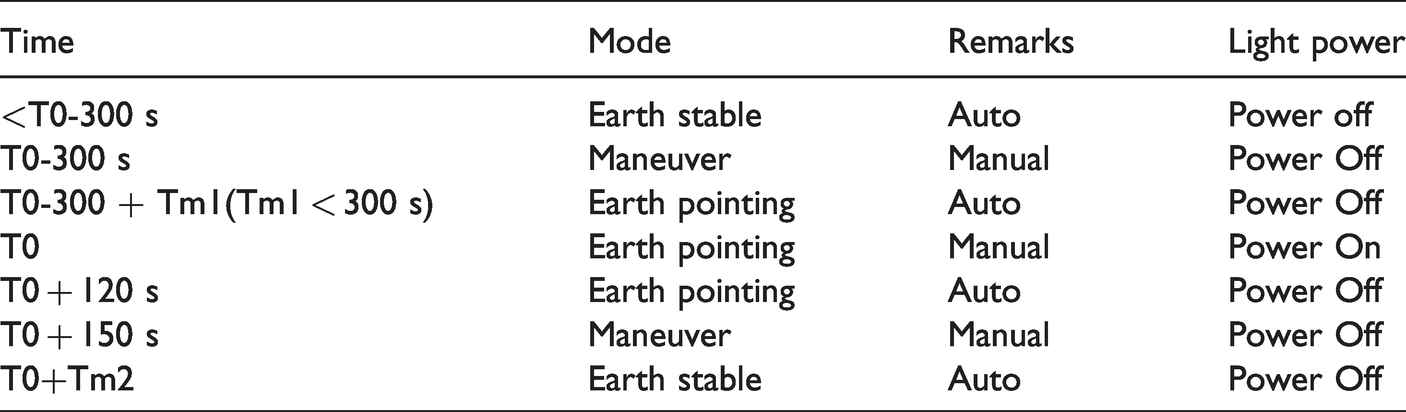
Before the satellite flies into the shadow of the earth, it must collect enough electric power in the attitude mode called “Sun pointing”. 5 The normal mode in the umbra time is “Earth stable” mode, which is designed for the antenna sending data to the ground station. In this mode, the body frame coincides with the orbit frame. Since the orbit of “Ladybeetle-1” is 547 km SSO, it flies from south to the earth in the umbra time. The satellite should maneuver to the “Earth pointing” mode in advance. If the “power on” of the LED time is set to T0, the process of the mission is shown as Table 2.
Process of mode changing in the mission.
We use
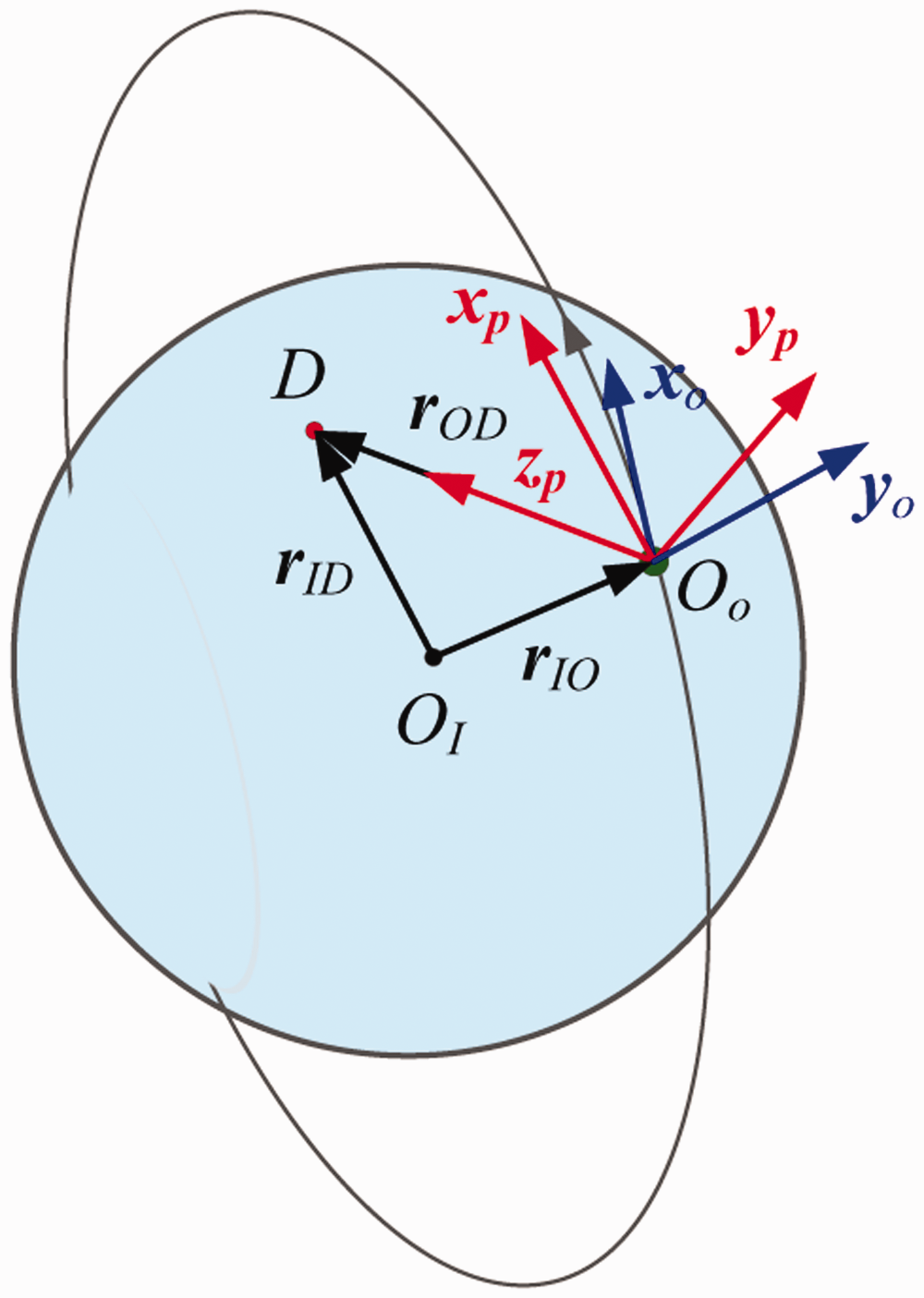
Schematic diagram of the “Earth pointing” mode.
The relation of those three vectors above can be written as


If there is no mission in the umbra time, the default mode of ADCS is “Earth stable” which mean the body frame 

The transform matrix
According to the right hand rule, the 
After getting the three axes of the point frame, we can calculate the transform matrix as

The transform matrix from inertial frame to pointing frame is 


The vector
Observation angle analysis
The attitude pointing accuracy of satellite is 
It is necessary to analyze the effect of elevation angle. The conclusion is shown in Table 3.
Effect of elevation angle.
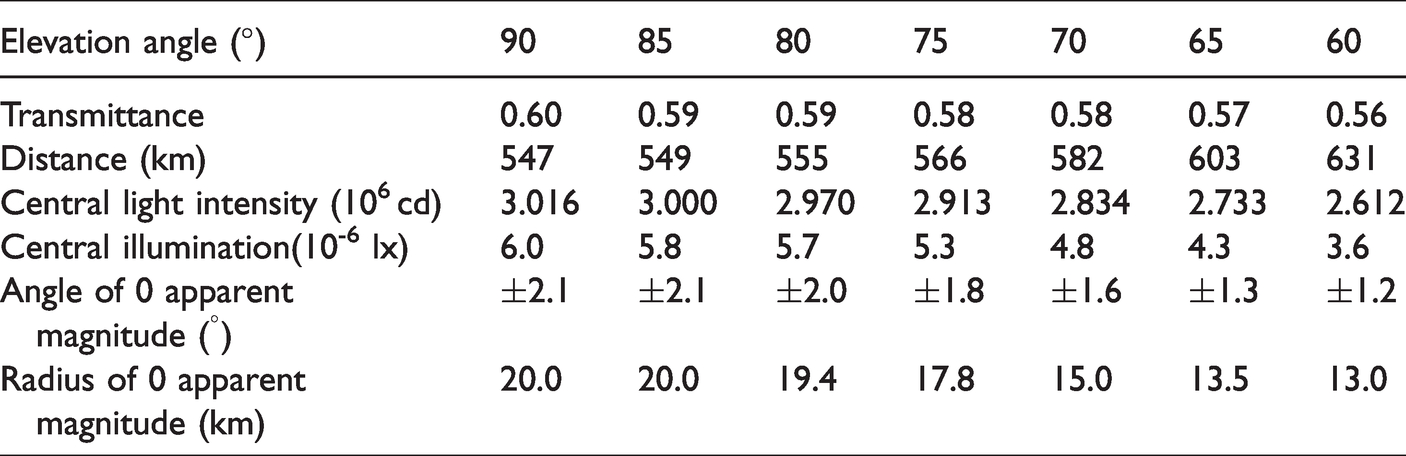
In conclusion, the satellite can achieve 0 apparent magnitude within 13 km when the elevation angle is larger than 60°.
Design of flash time
According to the electrice power of the satellite, the time for flash is set to 2 minutes. Consider the time for observation and the viewing experience, the recommended length is 20 characters. A dot “.” vocalized as “dit”, and a dash “-” as “dah”. For example, the most often used code is “SOS”, which can be written as “…–-…”. The communication protocol of the satellite specifies the time for the “dit” and the “dah” as Table 4.
Time set for Morse code.

Observation results
The flash test has been conducted several times after the satellite launched into the space. The digital SLR camera is used to catch the flash in the sky at the place for observation. But a normal SLR camera always takes overexposed photos. For astrophotography enthusiasts, time-lapse photography is applied to obtain the artistic photos. But those photos cannot be used to analyze the light intensity of the flash.
The camera use for catching the flash of the satellite is PST-3 made by TY-SPACE, which is a micro star sensor. “Ladybeetle-1” also uses PST-3 in ADCS. This star sensor can expose 10 times per second. When it is applied in space, it can output the inertial quaternion. We use the star sensor to take photos during the flash and the algorithm which is applied in the star sensor. The figures after the process is shown below in Figure 5.
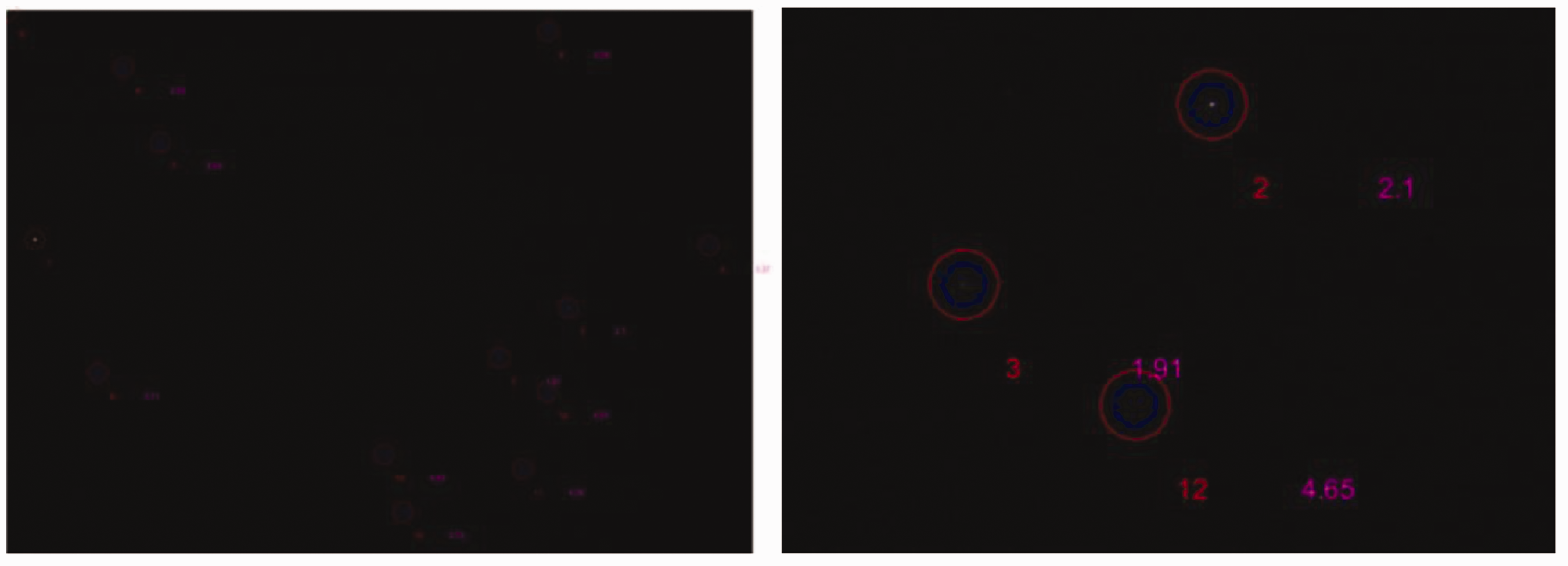
Photo after process of star sensor (right: zoom).
The above photo was taken at 19th December 2018, and it was the first test of flash mission. During the two minutes of the flash, the change of elevation and distance is shown in Table 5. The above photo is taken after the middle time.
Change of elevation and distance.

Where the decimal means the gray level of the star point in the photo, and the number of the star which has been captured is denoted as the integer of the photo. From the photo, we can obtain the X and Y position of the stars. According to the star catalogues, we can find the numbers of those stars and know the apparent magnitude as shown in Table 6.
Gray level and apparent magnitude analysis.
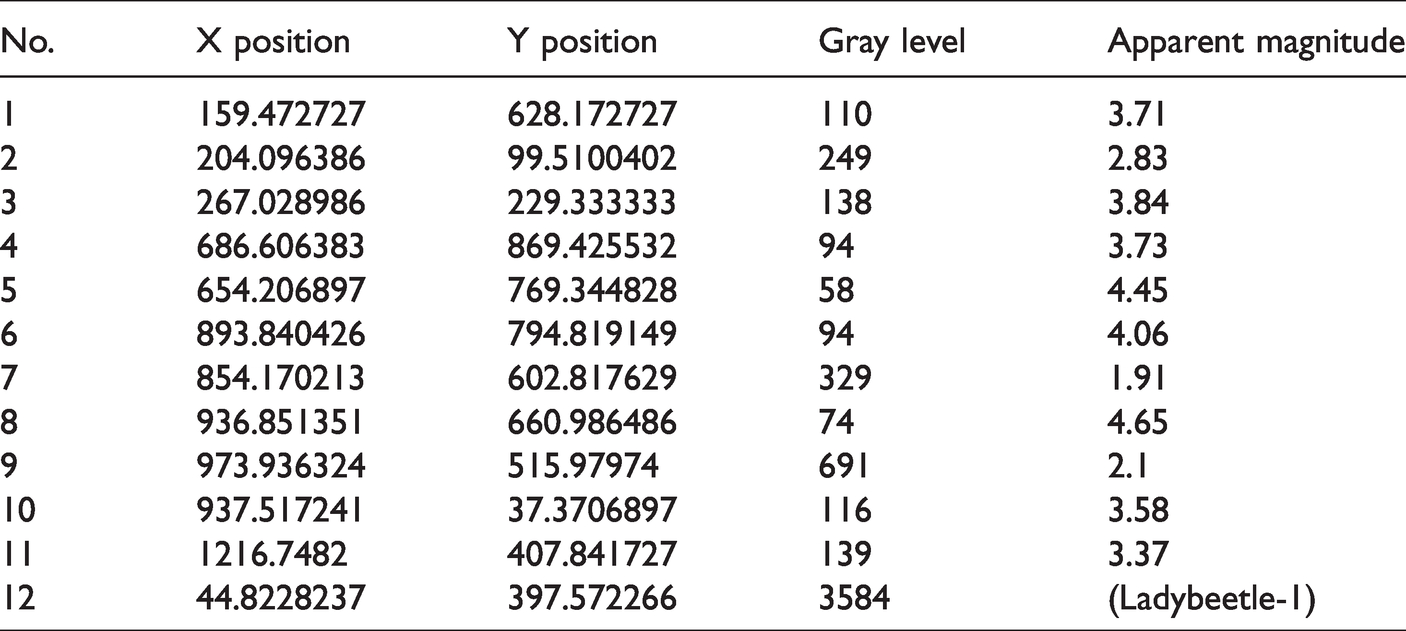
Due to the linear relationship between gray level and light intensity, the above data can be used to compare the light intensity, and then estimate the apparent magnitude of the satellite. The first line in above table, the gray level is 110, and the apparent magnitude is 3.71. The apparent magnitude of the satellite can be written as

Equation (14) means that comparing with the No. 1 star in the photo, the apparent magnitude of the satellite is -0.0724. The data from Table 6 are all used to calculate the apparent magnitude, and the result is shown in Table 7.
Apparent magnitude in comparison with stars.
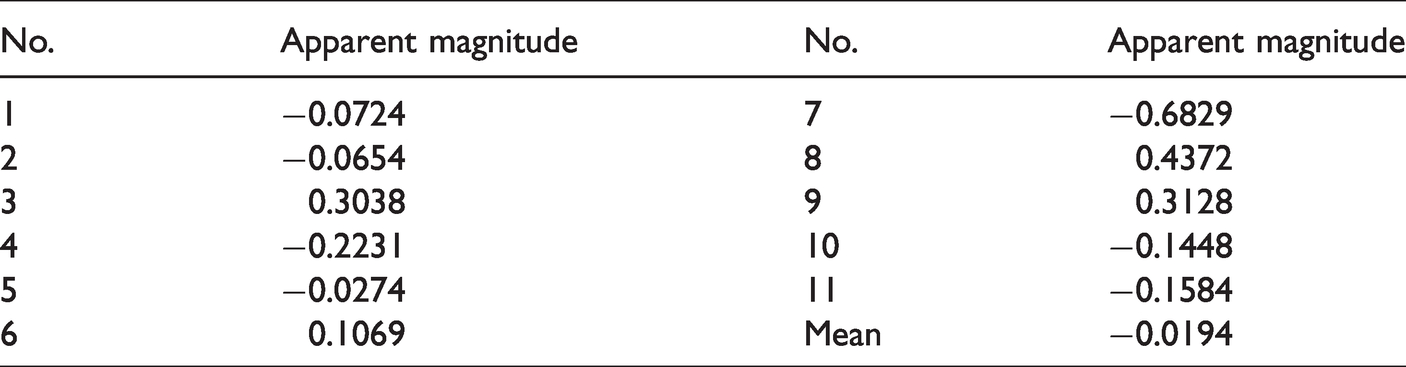
The mean of the calculated apparent magnitude is -0.0194. Then most bright apparent magnitude is -0.6829. The above results can prove that the design of the flash is correct. Figure 5 is the photo by the star sensor. According to the design of the flash mission, the photo taken with long exposure can show the Morse code as Figure 6.
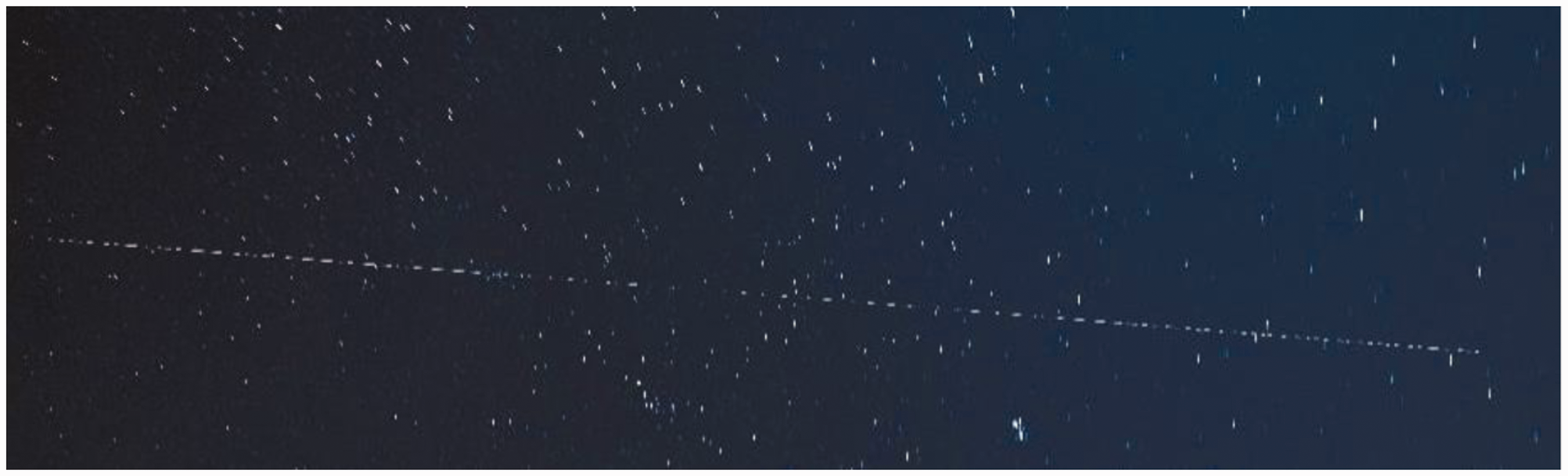
Photo taken with long exposure by SLR camera.
The above figure is taken by NIKON D850 on the 6th December 2019.
Conclusion
As of August 2020, the satellite completed more than 40 times of flash mission. This function of the “Ladybeetle 1” is open to the public. For astrophotography enthusiasts, the activities are more attractive. It is the first time that there is a satellite can send message in this way as shown in Figure 7.
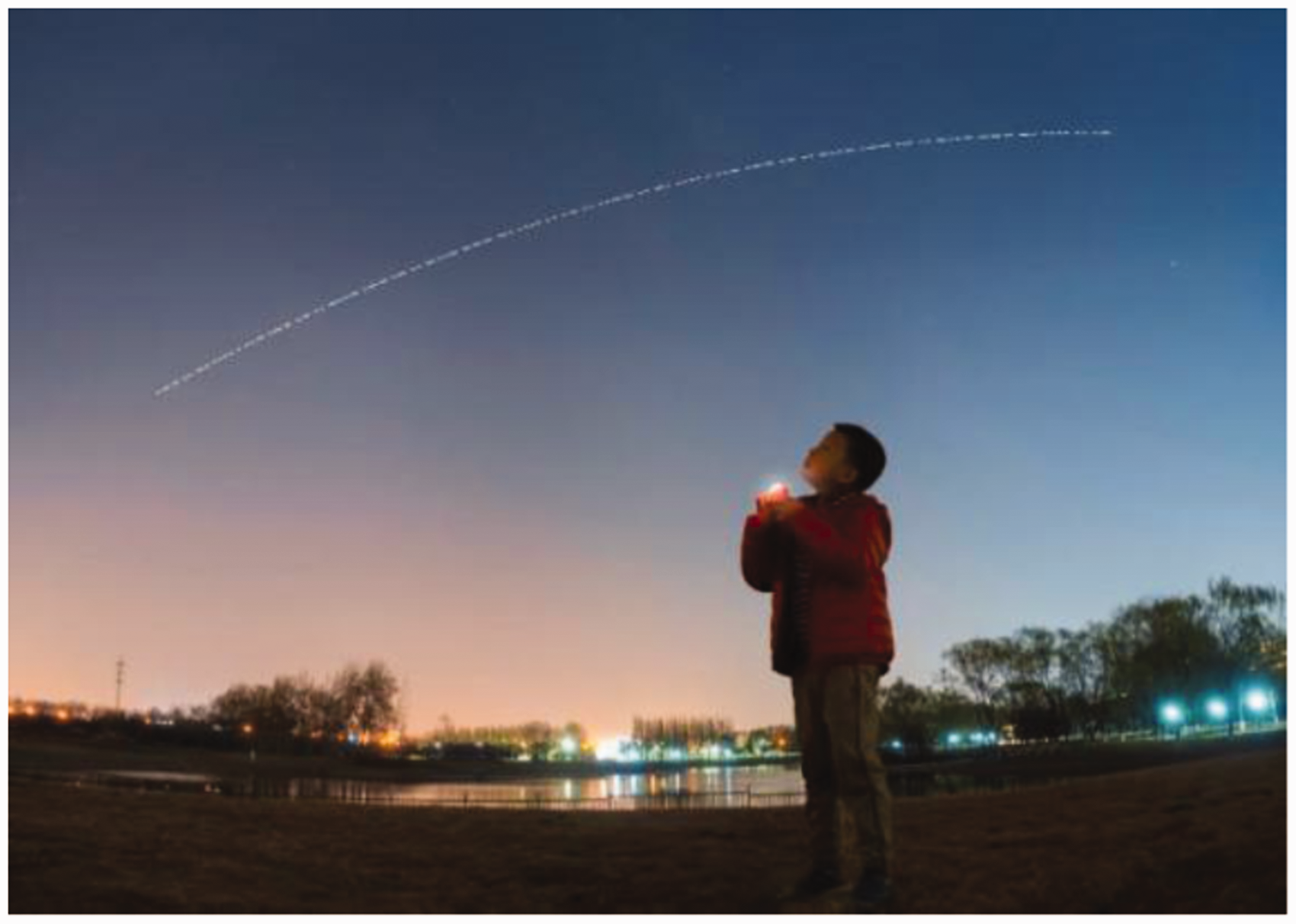
Photo taken on the World Autism Awareness Day 2019.
The photo above is taken on the 2nd April, 2019 which is the World Autism Awareness Day. The Morse code on the photo means “Hello, children of the stars”. This activity was launched to make the public care about the children with autism.
It is a romantic idea for engineers. In this paper, the whole system for this mission is introduced, including the light energy estimation, attitude pointing mode design and observation angle analysis. Then the observation results are given, which can verify the correctness of the design. The satellite can achieve 0 apparent magnitude in the mission. This project links satellite technology to popular science education, and realizes a visible and controllable satellite flash technology for the first time. Meanwhile, its successful implementation provides more reference for satellite application in the future. We believe that the priority of education is to arouse students’ interests in science and engineering. It is inevitable that engineering education may be complex and boring. “Ladybeetle-1” has the normal functions of a satellite, but also proves the most special function for education, as some astronomy fans feel so touched and excited when they see the satellite shining on the vault of heaven. The artificial star is so different from the remote stars and is sure to lighten their passion to explore science. 7
Footnotes
Declaration of conflicting interests
The author(s) declared no potential conflicts of interest with respect to the research, author- ship, and/or publication of this article.
Funding
The author(s) disclosed receipt of the following financial support for the research, authorship, and/or publication of this article: The authors received financial support from Beijing Commsat Technology Development Co., Ltd for the research and authorship.
