







Abstract
Dissemination and communication of research should be considered as an integral part of any research project. Both help in increasing the visibility of research outputs, public engagement in science and innovation, and confidence of society in research. Effective dissemination and communication are vital to ensure that the conducted research has a social, political, or economical impact. They draw attention of governments and stakeholders to research results and conclusions, enhancing their visibility, comprehension, and implementation. In the European project SOPHIE (Evaluating the Impact of Structural Policies on Health Inequalities and Their Social Determinants and Fostering Change), dissemination was an essential component of the project in order to achieve the purpose of fostering policy change based on research findings. Here we provide our experience and make some recommendations based on our learning. A strong use of online communication (website, Twitter, and Slideshare accounts), the production of informative videos, the research partnership with civil society organizations, and the organization of final concluding scientific events, among other instruments, helped to reach a large public within the scientific community, civil society, and the policy making arena and to influence the public view on the impact on health and equity of certain policies.
Keywords
The Importance of Dissemination and Communication in Research Projects
In recent years, the European Commission has increased efforts in promoting accessibility and dissemination of research results from researchers, academics, and professionals from other sectors and policy makers to lay publics. Projects funded by the European Union's 6th and 7th Framework Programme for Research and Technological Development (FP6 and FP7) were encouraged to disseminate their findings as “an essential part of their research” to ensure that the “gained knowledge or exploitable foreground can benefit the whole society.”1,2 The FP7 introduced the idea of fostering public engagement and a sustained two-way dialogue between science and civil society in order to bridge the gap between researchers and the lay public. The current “Science with and for Society” program of the E.U. Research and Innovation program Horizon2020 derives from that purpose and aims to find answers to current and future key societal challenges, promoting partnership between researchers and different societal actors (individuals, nongovernment organizations, policy makers, etc.) to work together for the achievement of common goals. The European Commission also advocates for a broader public engagement in science and innovation to lead to a higher confidence in research. 3 To accomplish those aims, dissemination and communication of objectives, methodologies, and outcomes of research are key points and need to be an integral part of project design and development.
Dissemination is commonly described as the spreading of the outputs of research to potential relevant audiences, such as the academic community or policy makers, often in a one-way process. In addition to the traditional means of disseminating research findings, such as peer-reviewed articles, scientific conferences, workshops, or seminars, other actions can be performed in order to facilitate the access and understanding of research outcomes to non-specialized audiences. Communication of research is defined as the process of interpreting or translating complex research findings into a language, format, and context that non-experts can understand. It implies iteration, interaction, and a multidirectional process that involves a wider range of partners: the researchers themselves, stakeholders, journalists, and lay publics. 4
Effective dissemination and communication of research are vital to ensure that research is taken up and makes a difference (with social, political, or economical impact). It draws attention of governments and stakeholders to research results and conclusions, enhancing their visibility, comprehension, and implementation. Furthermore, it bridges the gap between scientists and the publics and contributes to transparency in research.
In order to have an effective dissemination and communication strategy, researchers need incentives (such as specific funding and academic recognition) and guidance to communicate their research adapting concepts and language used to different audiences and to rely on people with communication expertise (science communicators, journalists, graphic designers, etc.).
The objective of this article is to provide our experience on the communication of the FP7 European project SOPHIE (Evaluating the Impact of Structural Policies on Health Inequalities and Their Social Determinants and Fostering Change) and to make recommendations based on our learning.
The Dissemination and Communication of the SOPHIE Project
SOPHIE was a collaborative project involving 14 institutions of nine countries, funded by the European Commission under the FP7, aimed to generate new evidence on the impact and effectiveness of structural policies in tackling health inequalities and to develop innovative methodologies for the evaluation of these policies in Europe.
In SOPHIE we have reviewed and analyzed the impact on health inequalities of policies in a very diverse range of domains, including macroeconomics (economic cycles, fiscal policies), social protection (unemployment benefits, family policies), labor market (active labor market policies, employment relations), built and social environment (urban renewal, urban planning, neighborhood safety), housing (housing systems, social accommodations, building retrofitting), gender equity, and immigrant integration, trying to consider the differential health impacts by country of residence, gender and socioeconomic position, as well as age, ethnicity, and migrant status when applicable.
Besides the general aim of SOPHIE, another significant and specific objective was the dissemination of results and recommendations on how structural policies reduce health inequalities. From the beginning, we were aware of the importance of dissemination as an essential component of the project (with a work package dedicated exclusively to it) in order to achieve its purpose of fostering policy change based on research findings. Thus, our target audience was wide and diverse, from academic experts, stakeholders, and responsible policy makers to civil society. Furthermore, we tried to engage stakeholders in the research process and results dissemination, partnering with civil society organizations working with vulnerable populations, and collecting primary data in interviews and groups from affected communities.
The Dissemination Plan
First, we designed a dissemination plan to define the general aspects to be taken into account for SOPHIE dissemination activities, the targets, and the tools to be used. We were aware of the importance of addressing our findings beyond the academic audiences. Therefore, our dissemination and communication strategy explored innovative ways to engage, different from the traditional dissemination methods (conference and journal publications). To do that, we used face-to-face and online approaches, platforms, and tools, through the creation of strong public dissemination instruments, especially online, and used them to reach out to our target audiences.
Before starting the project, it is important to determine the people who will be involved in the dissemination and communication of the project (communication professionals, project researchers, or both), as well as human and technical resources to invest in. In SOPHIE, we stored a budget for emerging costs of dissemination activities, the project manager spent part of his time on dissemination activities throughout the whole project duration, and we hired a communication specialist for the last year of the project to boost and enlarge the external communication to multiple audiences and through different channels, especially online.
Some important points should be also planned in the dissemination plan, such as the graphic image of the project (“brand” and “logo,” website design, leaflets, etc.), the dissemination and communication objectives and broad messages, the target audiences, and some of the actions that can be performed throughout the project or in a specific time frame.
We defined a global strategy for disseminating the project as a whole, as well as specific campaigns concentrated on specific topics or subsets of articles, such as those on urban renewal in Barcelona, gender equity, access to housing, and labor market. We considered more effective ways to use both actions in order to engage people throughout the project and with different interests. The dissemination of the specific studies or topics was chosen according to the potential interest of different audiences (policy makers, stakeholders, or general public). For each of them, we performed different actions (public conferences and events for general public) and produced different dissemination materials (infographics or videos, among others), while maintaining the global dissemination of SOPHIE.
Tools Used and Targets
Considering the different target audiences to reach, we developed a multi-channel strategy to distribute the numerous communication materials produced (Figure 1).
Targets, materials, and tools used for the dissemination and communication of the SOPHIE Project. In our communication strategy, we consider all possible targets that could be interested in the project. For each of them, we design specific materials (journal articles, presentations, round tables, workshops, videos, or press releases) and other general materials (website, talks, or newsletters). These materials were distributed through different channels, online and offline.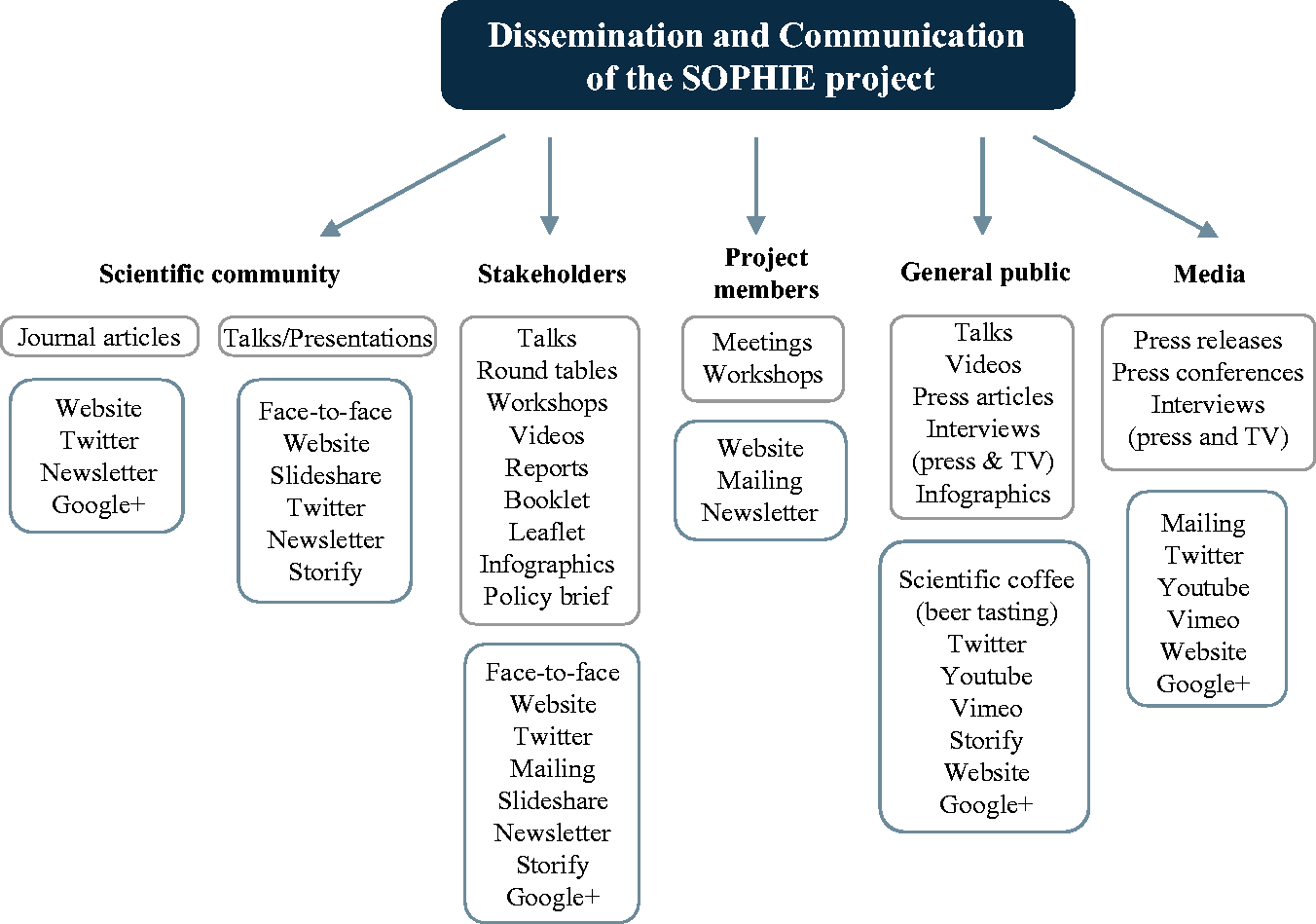
To disseminate documents and materials among the project partners, we implemented several channels of internal communication: mostly email, online calls, and the regular update of shared Dropbox folders with the project documentation, methodological bibliography of interest, and PDFs of all project publications.
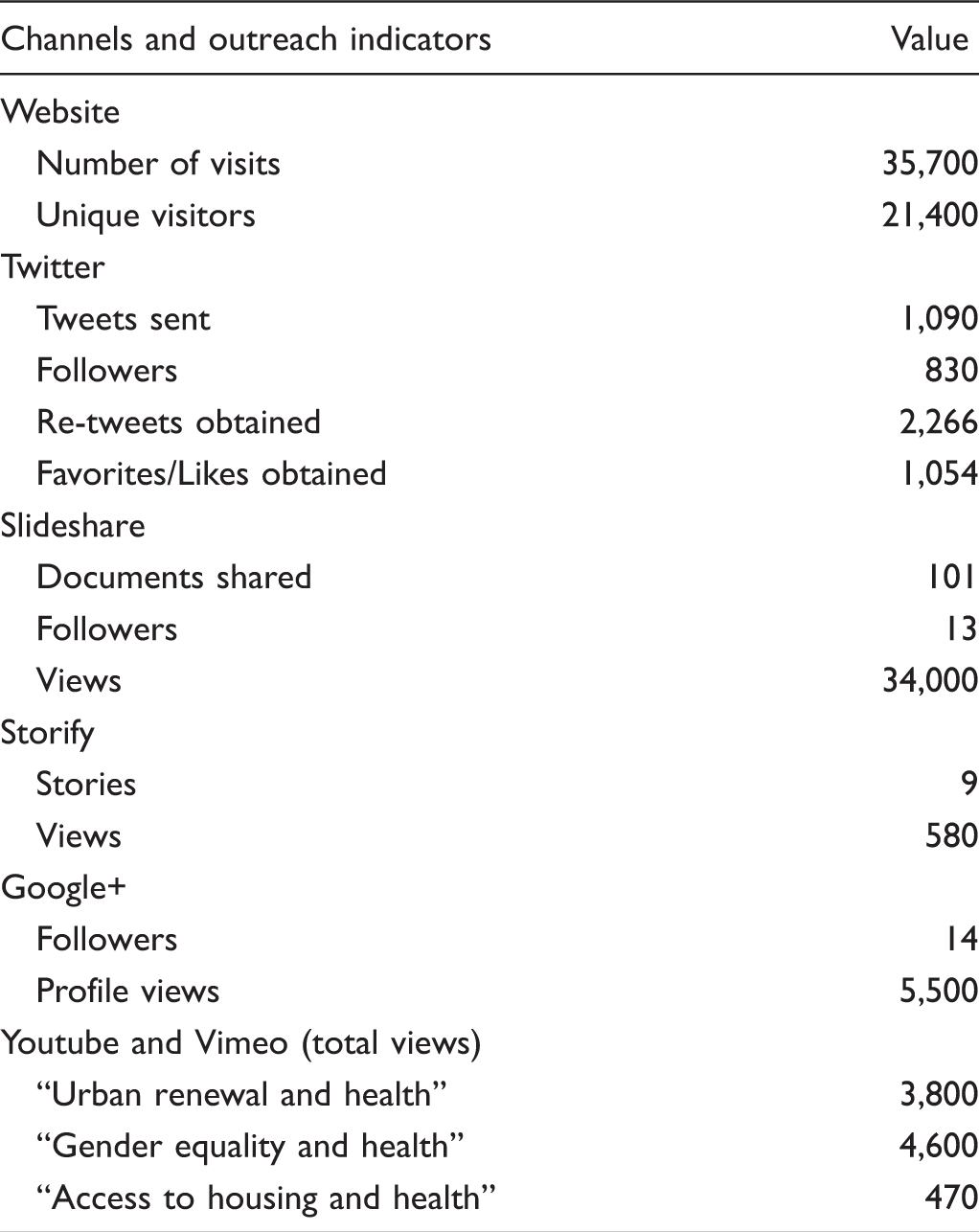
Outreach indicators of the different channels used (website and social media) to disseminate and communicate the SOPHIE project online (data updated on February 2016).
Website and Social Media Sites
SOPHIE Website
The SOPHIE website collected all the information and resources produced during the project. It was addressed, primarily, to partners, other researchers, and stakeholders, although it had a user-friendly design and content that made it suitable for general audiences.
From April 2012 to December 2015, the project website www.sophie-project.eu received more than 35,700 visits from 21,400 unique visitors (in average, more than 795 visits/month and 470 unique visitors/month). We periodically updated and enlarged the website content, creating new sections and keeping the web “alive” to disseminate efficiently our research outcomes; from journal articles and communications in scientific conferences to videos, every material produced by the project members was available from the website. The most remarkable sections are “About SOPHIE,” which collected the general information (objectives and partners) and outputs produced during the project (themes and conclusions), and the section “Resources,” which contains two subsections: “Publications” (a full list of our published articles, reports, and communications in scientific meetings) and “Videos” (a collection of the videos produced by members of the project to communicate our research). In addition, sections such as “Media” (“Press releases” and “SOPHIE in the news”) and “News” (“News,” “Events,” “Newsletters”) were also regularly updated.
The publications section contains a brief summary of all the project articles published. In February 2016 there were almost 60 articles published in peer-reviewed journals, and several more articles are in process. In agreement with the European Commission's policies on open access (OA), which aim to ensure that research results funded by E.U. citizens are available to society for free, 5 we have tried to publish most of our articles in open access journals, or pay OA fees (25 articles). In addition, we have provided access through the project website to post-print versions of accepted manuscripts (i.e., final draft post-refereeing) when appropriate, according to journals' publication policies (11 articles), as well as through full-text links provided to authors (5 articles).
Newsletters
We set up two periodic digital publications, a newsletter (sent once or twice a year), and an electronic bulletin with the latest news and publications of the project.
The SOPHIE newsletter (sophie-project.eu/newsletters) contained a brief summary of the latest news regarding the project and the presentation of new dissemination materials (videos, infographics, etc.) produced to communicate the project, as well as the following sections: “The method” and “Results,” which consist of online presentations useful to other researchers; “People,” where we interviewed two SOPHIE Project members; and “The picture” and “The number,” which represented a current problem or issue related to health inequalities. Also, we suggested some “Readings” and highlighted some of the latest “News” of the project. This newsletter was sent to all our partners and several colleagues, but it was also accessible to other stakeholders by subscription through our website (“Contact us” section). During the project, we launched four newsletters (May 2013, May 2014, December 2014, and May 2015), which reached an audience of more than 200 subscribers. Moreover, these newsletters were completely accessible to other interested members of the public directly from our website.
The electronic bulletin contained a summary of the latest updates in the SOPHIE website content (news, publications [journal articles, reports, and monographs], and communications in scientific conferences). During the last part of the project, this bulletin was sent almost every three months (September 2014, December 2014, March 2015, July 2015) to our subscribers and members of the team.
To disseminate both materials, we used Mailchimp, an online (and free) email marketing tool. It was useful to manage the subscribed contacts and to send our newsletters and bulletins to all SOPHIE partners (both scientific leaders and junior researchers), other colleagues, and stakeholders.
Twitter is a popular online social network that enables users to send 140-character messages (called tweets). Among the potential audience that we were interested to reach, there were politicians, social organizations, stakeholders, journalists, and the general public.
We managed the Twitter account @sophieproject, which has been active since 2012 and currently (February 2016) has around 1,000 tweets published and 830 followers, mainly from Spain (49%), United Kingdom (17%), United States (4%), Belgium (4%), and Canada (4%), but also from Australia (2%) and Colombia (2%). We achieved more than 2,200 re-tweets and 1,054 “favorites” (or “likes” in the current version), which indicates a considerable engagement of our audience in the content published.
This popular social media site is useful to get in touch with several types of worldwide audiences (researchers, policy makers, media, and lay publics). We tweeted in English, Spanish, and Catalan, largely about new publications, sharing links to PowerPoint presentations of scientific conferences and to dissemination materials (videos, infographics, policy briefs, etc.). But, we also shared other relevant resources and articles that we consider interesting to the community looking for information about health inequalities and their social and policy determinants, such as a weekly tweet recommending the “#articleoftheweek.” Through this site, we were in touch with other researchers and organizations that work on the topics covered by SOPHIE (mainly, social determinants of health inequalities).
Slideshare
We used Slideshare, the world's largest community for sharing online presentations and other documents (reports, videos and infographics), to share our academic presentations and reports online, in particular with our partners, other researchers, and stakeholders. This platform allowed us to reach a worldwide audience, amplifying the impact of our works beyond conferences, congresses, or lectures. At the end of the project, on our Slideshare account slideshare.net/sophieproject, we have 92 presentations and 9 documents (posters and reports), all of them available in open access, that have reached more than 34,000 views (February 2016).
YouTube and Vimeo
YouTube and Vimeo are two popular video-sharing websites in which users can upload, share, and view videos. We used both platforms to distribute the three videos produced during the project: “Urban Renewal and Health” (2014), “Gender Equality and Health” (2015), and “Access to Housing and Health” (2016). See below for additional information on these videos.
Storify
Storify is an online resource to find, collect, and share what people are saying all over the web. It is a useful tool to collect tweets generated during an event and join related discussions. We used this tool to collect all the tweets (RT and mentions) generated during the presentation of some of our working sessions and conference presentations and to distribute them online through our Twitter account. On the project's Storify account storify.com/SOPHIEproject, we gathered 9 stories that have reached more than 580 views (May 2014 to February 2016). Through these compilations, one can get a taste of what was presented and of the interests of many online/offline attendants of the event.
Google+
We have maintained a SOPHIE profile and a page in Google + to increase our visibility on this web searcher and facilitate the finding of the SOPHIE website and our online resources. Since June 2014, the profile and the page have reached, in total, more than 5,500 views (February 2016).
Face-To-Face Communication
SOPHIE researchers have presented their work in numerous scientific meetings (more than 20 congresses and conferences). Apart from that direct dissemination of their findings, we implemented other actions to share the SOPHIE results and conclusions with audiences that are difficult to contact online.
Scientific Community
Besides the publication of articles in peer-reviewed journals, SOPHIE researchers presented their work in many national and international conferences and scientific meetings, such as the American Public Health Association annual meeting; European Public Health Conference; Latin-American Congress of Epidemiology and Public Health; IMISCOE Annual Conference; International Labour Process Conference; International Conference on Women's Health and Work; International Conference on Migration, Social Disadvantage and Health; Biennial Conference of the European Society for Health and Medical Sociology; and International Conference on Urban Health, among others.
Besides single-paper presentations, we can highlight two events celebrated in the framework of the European Public Health Conference (2014) co-organized by four E.U. projects (DEMETRIQ, DRIVERS, SILNE, and us): the pre-conference “How to Tackle Health Inequalities? Results from Four EU-Funded Projects” and the plenary session “Inequalities in the Population: Large-Scale Interventions,” which included the joint presentation “How to Tackle Health Inequalities? Recommendations to Government Ministers from Four EU-Funded Projects.”
Targeting Stakeholders and Policy Makers
Charles University in Prague researchers organized in Prague several roundtable meetings with policy makers to present and discuss their findings, as well as a book launch. In Barcelona, Agència de Salut Pública de Barcelona (ASPB) organized four of its official sessions (celebrated monthly and publicly open) around topics covered by SOPHIE (“Urban Renewal and Health,” “Gender and Health,” “Housing and Health,” and “Conclusions of the SOPHIE Project”), combining the presentation of results by SOPHIE researchers with presentations from academics or activists in the sector. Also, two ASPB researchers had a meeting at the Catalan Parliament with two Parliament members representing one of the major political parties in Catalonia, to explain the results of a SOPHIE case study on the effects on health and health inequalities of the interventions within the Neighbourhoods Law in Barcelona. Also in Barcelona, Càritas Diocesana de Barcelona organized a roundtable to present the report on the case study of housing improvements, moderated by a well-known journalist, who subsequently wrote an op-ed on the seminar in a national newspaper. The research findings on integration policies and immigrants' health were presented at a “policy exchange” seminar in Brussels and at meetings of an international COST network of researchers and policy makers on migration and health.
Šafárik University in Slovakia made a special effort to disseminate the report “A Bottom-Up Approach to Employment: An Example of Good Practice,” analyzing possible stakeholders, preparing a list, and sending them the report by email or regular mail, and presenting the results online and in public events and conferences. Finally, groups in the Academic Medical Center and the Università di Torino also organized meetings with local policy makers (city representatives) and scientists to discuss their results on built environment.
To close the project, we organized the final conference “The Impact on Health and Equity of Social and Economic Policies,” which took place in Brussels in September 2015. There, we presented the main findings of the project (with a special focus on urban environment and housing; crisis, austerity, welfare, and employment; and gender) and the most important policy recommendations. Senior staff from three European Commission directorates-general, members of the European Parliament from four groups, and representatives of 5 Brussels-based European nongovernment organizations attended and participated in panel discussions, which was considered a relevant issue for “knowledge transfer.”
Conference and Lectures Addressed to University Students
The conference “How Does Policy Get Under the Skin?,” co-organized by ASPB and Universitat Pompeu Fabra, took place in July 2015, and it was addressed to others researchers and university students. For three days, SOPHIE researchers provided an overview of the project and discussed specific findings and conclusions of several work packages of the project (gender, austerity policies and immigration), with a particular focus on employment polices. In addition, several researchers of the project who teach in undergraduate and graduate courses have explained the project to students and showed the videos in class.
Public Health Technicians
To present our results on housing and built environment to our colleagues and coworkers, we organized the conference “Urban Planning, Housing, and Health Inequalities.” The meeting was mainly addressed to public health technicians and other researchers and stakeholders, and it took place in Barcelona in October 2015. We presented our main papers on urban renewal, fuel poverty and energy efficiency, foreclosures, and housing instability. Speakers were the main authors of the articles and university advisors that collaborated with the studies were invited to discuss the topics.
Activities for General Public
To celebrate the European Researchers' Night, one of our researchers was invited to participate in the public event “Cerveciencia: comunicación en salud,” hold in a museum and organized by the Instituto de Salud Carlos III in Madrid in the framework of the FP7 CommHERE (Communicating Health Research in Europe) project. Addressed to a general public, the event aimed to present current research on health in an informal setting. It included three presentations and a beer tasting for all attendees.
We also collaborated in the production of the exhibition “PisoPiloto” at the Centre of Contemporary Culture of Barcelona. We provided information about housing and health with data of the impacts that inadequate housing conditions or struggling to pay the rent or mortgage have on physical and mental health.
Material Produced to Communicate the SOPHIE Project
Videos
We have produced three videos: (1) “Urban Renewal and Health” (based on the articles6,7), which shows the context, results, and conclusions of our evaluation of the impacts of an urban renewal program on changes in health inequalities in the affected neighborhoods in Barcelona; (2) “Gender Equality and Health” (based on the articles: “The influence of gender equality policies on gender inequalities in health in Europe” and “Contemporary employment arrangements and mental well-being in men and women across Europe: a cross-sectional study” 8,9), which explains how equality-oriented family policy models are related with lower gender inequalities in health in Europe; and (3) “Access to Housing and Health” (based on the studies: “Changes in health following housing improvement in a vulnerable population in Spain, a follow-up study”, “Emergència habitacional a Catalunya. Impacte de la crisi hipotecària en el dret a la salut i els drets dels infants” and “Immigrants' health and health inequality by type of integration policies in European countries”10–12), showing how housing-related problems, such as living in inadequate housing or struggling to pay the rent or mortgage, affect people's health and how interventions that increase housing affordability can improve it.
All three videos were produced in three languages (English, Spanish, and Catalan) to facilitate their distribution. They are available online on YouTube (the most popular video-sharing website) at youtube.com/user/sophieprojectfp7 and Vimeo (professional video-sharing website) at vimeo.com/sophieprojectfp7. In March 2016, considering only the online dissemination of the three videos (in three languages, on YouTube and Vimeo channels of SOPHIE, and on the YouTube channel of the ASPB), “Urban Renewal and Health” has reached more than 3,800 views; “Gender Equality and Health,” 4,900 views; and “Access to Housing and Health,” 700 views. Moreover, these videos have been distributed through other websites (blogs and online newspapers) and presented offline in several events for general public, lectures, and several academic conferences (for instance, the plenary session of the 7th European Public Health Conference, where Carme Borrell, principal investigator of SOPHIE, presented the video “Urban Renewal and Health” to the audience). Thus, the potential audience we could have reached is difficult to estimate, although we believe the videos could have reached more than 10,000 people.
Infographics
Infographics are visual representations of information and data intended to present complex information in a quick and clear way. We used a free online tool (Piktochart) to create infographics that present our results and conclusions in a visual manner. In 2014, we published two infographics, “Immigrants' Health and Integration Policies in Europe” and “Gender Inequalities in Health: A Matter of Policies,” which have been mainly shared through our website and Twitter.
Conclusions Booklet
We created the booklet “Conclusions of the SOPHIE Project: Social and Economic Policies Matter for Health Equity” to summarize the main findings and policy implications of SOPHIE. Each chapter identifies the most relevant results and conclusions of a particular work package of the project, highlighting “why is this important,” “what we did,” and “what we found.” In addition, relevant case studies were described and policy implications were clearly detailed.
We distributed the booklet online through our website and Twitter and through mailing to several civil society organizations. In addition, we provided hard copies to partners' contacts, the advisory board of the project, lead investigators in the field, policy makers, and journalists (specifically the ones that attended our final events).
Policy Brief
In addition to the “full edition” of the booklet, we produced 2-page policy briefs in Spanish and Catalan containing key findings and conclusions. Both versions were distributed online through our website and social media channels.
Previously, during the project, we had tested this format to produce a thematic summary (“Immigrants' Health and Integration Policies in Europe”) based on one of our research articles 13 to highlight the main findings, conclusions, and policy recommendations of the article to policy makers and stakeholders. The document was distributed online through our social media channels.
Media Coverage
We have distributed several press releases throughout the project: at the beginning of the project, to communicate our research articles, to disseminate the conferences organized by our researchers, and, finally, to close the project. All of them were shared, as appropriate, through personal media contacts, local institutional websites, national science news portals, the HorizonHealth web platform, and AlphaGalileo and EurekAlert (online press centers for science news in Europe and the United States). Also, we organized two press conferences to present SOPHIE conclusions in Barcelona to present the results of housing and health, organized, respectively, by Càritas Diocesana de Barcelona and Observatori DESC, a local nongovernment organization in Barcelona.
All these actions helped to spread the dissemination of our research and to reach the general public. As a result, several of our articles had wide coverage by some of the largest newspapers in Spain (El País, La Vanguardia, El Periódico), Belgium (De Staandard), and the Czech Republic (iDNES), and our research has appeared on the news of national TV channels in Spain and the Czech Republic. Moreover, other websites (blogs and science news websites) published articles about our findings or interviews with some of the SOPHIE researchers. In particular, housing0related research on fuel poverty and foreclosures received the highest coverage.
A selection of most relevant impacts is available in the “SOPHIE in the news” section of our website.
Lessons Learned
Currently, dissemination and communication of research results are asked to be an essential part of European research projects. However, both require previous experience or collaboration with communication professionals, dedication (i.e., time), and money. From our experience, we think these investments are affordable in the context of a large project and worth the effort, so we strongly recommend investing time and money in such activities. Bearing in mind the limited public outreach of this kind of research, we should underline a modest but relevant reaching of policy makers and some promising results in reaching general social media. Nevertheless, it is important to be aware of the complexity and difficulties that these activities can involve. Here, we would like to discuss some of the strengths and weaknesses that arose during the communication of the SOPHIE Project.
Strengths
Among the strong points of the dissemination and communication activities carried out, we would like to highlight our “multi-channel” strategy (online, using different platforms and tools, and offline or face-to-face), as well as the combination of a global and specific strategy, based on disseminating the entire project at the same time that we worked on ad hoc campaigns for specific publications or topics. Of course, these special efforts required time and resources, but they have had a positive impact for the project.
Our website contained updated information that facilitated the dissemination of the latest news and articles. Journal articles, scientific presentations, or other materials produced during the project were available online (almost half of our articles are in open access), which also contributed to transparency of research. We also constructed a wide online network community in social media sites such as Twitter. The increase in the use of this kind of social media by members of the academia and civil society during the project lifetime helped us to multiply the outreach of our articles, presentations, and other materials produced.
In addition, taking into consideration different audiences and stakeholders made it possible to integrate them into the research project—for example, the nongovernment organization Plataforma de Afectados por la Hipoteca (Platform for People Affected by Mortgages), which collaborated in one of our studies and in the video whereby we communicated our research findings.
The use of different formats (journal articles, videos, infographics, etc.) and free online tools (social media) has allowed us to improve the dissemination of our research. Consequently, some of our articles have substantially increased their Altmetric scores (a non-traditional metrics proposed as an alternative to more traditional citation impact metrics), being widely shared and commented through social media channels.
The videos produced have had a wide impact in the press. Some newspapers have reproduced the videos on their websites to illustrate news related to our research. Furthermore, some SOPHIE researchers were invited to write opinion editorials in a national digital newspaper and to appear in several TV interviews or at general public events to talk about the project.
In general, the effort to disseminate individual projects, such as Built Environment, Gender, Housing, and Labour Market, has enlarged the general knowledge of the project. This strategy allowed us to reach specific audiences and to disseminate both specific and general materials. Each dissemination campaign was preceded by a press release, the production of a video, and a strong online strategy of dissemination through social media sites (e.g., Twitter). A mainstream press presence and the social media metrics obtained suggest that this strategy of global and specific dissemination was useful for the project.
Weaknesses
We could summarize the weakness points of SOPHIE communication in three main aspects: organization at the European level, a lack of internal communication, and money. Local dissemination and communication of research is a complex task that involved the creation of a network of partners (graphic designers, journalists, event organizers, etc.). In a European project (which included partners overseas), this task is even more complex. Coordination of public activities or dissemination of press releases were usually supervised and managed by local institutions (universities and research centres). Although this facilitated the execution and dissemination at local levels, it also created the risk of losing the SOPHIE brand if coordinators were not aware of a dissemination activity carried out under the initiative of a partner institution's communication office. A problem related to this point was the difficulty of coordinating press releases between institutions. Several research articles were directly disseminated by host institutions, reaching local newspapers without an impact on other countries' press. To avoid that, internal communication between research institutions and the communication managers, as well as all partners' involvement, are essential to maintaining a cohesive dissemination and communication strategy.
In addition, money represents a limitation factor that can determine the actions carried out during the project. A video production can be a relatively time-consuming and expensive way of communicating research results, although, at the same time, it is an excellent way of reaching a massive audience, both online and offline.
One of the main problems in the dissemination of research findings is to get press coverage. Being featured in the press (newspapers, radio, or TV) can be an effective way to share research with general audiences. However, numerous press releases arrive at local and national editorial departments every day, and obtaining coverage is especially difficult for news related to research, which, in some media, does not have a permanent section. Thus, it is laborious to obtain media attention, even when we can contact journalists directly. In many cases, it is necessary to have something more than a press release to catch media attention. In SOPHIE, we found it easier to get impact for studies with a local connection, than for broad cross-national studies.
Besides journalists, policy makers are also a difficult group to reach. One of the project aims was to influence political decisions. It was very difficult to reach politicians in governments, but relatively easier to reach (face-to-face or through social media) parliament members, politicians in the opposition, policy officers, or members of think tanks and influential civil society organizations. All these influences can contribute to future changes in policies. As an example, this year the new government of the Barcelona municipality launched an urban renewal plan mirroring the one that we had positively evaluated and that had been upheld in 2011 by the regional government.
Conclusions and Recommendations
This article has shown an example of communication of a European project beyond scientific articles and conferences aimed at the scientific community. It is essential that the results of a scientific project arrive to other targets, mainly to the general population and the decision makers. Effective dissemination and communication could help to draw the attention of national governments, regional authorities, or the private sector to the research results obtained. If public health researchers aim for a change in public policies, it is important to include all social agents, and dissemination of our findings outside the academia is essential to reach that audiences.
Communication of research is an active work that requires human resources and economic support. It is useful and highly recommended to include in the team a professional communication manager (science communicator or journalist) to develop the communication strategy and the day-to-day tasks. Communication and dissemination of results require more than a press release. They involve day-to-day work to connect to the audience, find ways to engage them, be creative and active, and use different tools to reach different targets (usually, scientific articles are not read outside the academia). Moreover, it is useful to identify colleagues (researchers and communicators), stakeholders, and journalists who can help in the dissemination of the main findings of the project. The benefits of this work include wider media attention; enlarged partnerships with civil organizations, stakeholders, and other researchers; and enhanced reputation and visibility of the project and its members at local, national, and international levels.
From our experience, we would like to share general recommendations that can be adapted to different projects. However, each project is unique. Thus, it is important to consider what is the main question in one's research project (the message), why this research is important to advance in the general knowledge or to generate new evidence on a specific issue (the purpose), to whom this information can be valuable (the target audience), and, finally, how this knowledge can reach such an audience (the method). Some initial questions should be “who is your target audience,” “how to reach them,” “what is the main message you want to transmit,” and “why it is important to them”). These questions should guide the planning of a tweet, a post in a blog, or a video.
In SOPHIE, our main research question was to understand how structural policies (macro-economy, employment, or housing policies, among others) impact the determinants of health inequalities. This knowledge, the generation of new evidences about the mechanisms that impact health inequalities, is useful not only for other researchers in the field, but also for affected communities, social organizations, and responsible policy makers. Hence, our dissemination strategy was driven to communicate our results and conclusions to a wide audience, which included general public, local and international policy makers, local stakeholders, and civil organizations.
Footnotes
Declaration of Conflicting Interests
The authors declared no potential conflicts of interest with respect to the research, authorship, and/or publication of this article.
Funding
The authors disclosed receipt of the following financial support for the research, authorship, and/or publication of this article: This research was supported by the European Community's Seventh Framework Programme (FP7/2007–2013, grant agreement 278173): “Evaluating the Impact of Structural Policies on Health Inequalities and Their Social Determinants and Fostering Change (SOPHIE)” Project.