







Abstract
This article analyses the political changes that have been occurring in the United States (including the elections for the presidency of the country) and their consequences for the health and quality of life of the population. A major thesis of this article is that there is a need to analyse, besides race and gender, other categories of power - such as social class - in order to understand what happens in the country. While the class structure of the United States is similar to that of major Western European countries, the political context is very different. The US political context has resulted in the very limited power of its working class, which explains the scarcity of labor, political and social rights in the country, such as universal access to health care.
The Importance of Social Class for Understanding the United States, its Political Institutions (Including its Federal Elections), and its Health and Quality of Life
Race and Gender: Important Categories for Comprehending the Distribution of Power in the United States
To understand what is happening in the United States, such as the outcome of the US elections this past November, one needs to comprehend the distribution of power in the country. It is widely recognized that white people in the United States have more power than black people and that men have more power than women. Race and gender are thus indeed 2 very important variables for understanding what is happening in US political life. There are many analyses in academic, political, and media forums explaining how racism and sexism operate, function, and are reproduced in the political institutions of the country and how they affect the health and quality of life of its populations. Many articles have also been written on, for example, the role that both sexism and racism have played in the last presidential elections and in the huge mobilization either in favor of or against Trump, who is widely perceived as the leader of the racist and sexist reactionary forces in the United States. And, of course, articles have also appeared on the health policy implications of his defeat in the last election.
Race and Gender, However, are not Enough for Explaining What is Going on in the United States, Including in the Recent US Elections
Many of these studies have done a very good job of explaining the results of the elections, both in 2016 and 2020. But they are insufficient. These 2 variables alone, race and gender, are not enough to explain the results of the last elections. Another variable of power is needed that very rarely appears in the analysis of US political life. This variable is social class, an almost forgotten category in the United States. Indeed, even in academic circles, the concept of social class rarely appears, as though there are no social classes in the United States. But there are indeed social classes, and without understanding how social class operates and is reproduced through the political institutions, you will not be able to fully understand what is going on in the United States. I want to emphasize that race and gender are very important to understand what is happening in the United States. However, I think one needs to understand that social class is also an extremely important variable to comprehend this country. And this is what I will try to do in this article, also explaining its implication on the health and quality of life of the population.
The Class Structure of the United States is not Very Different From That of the Major Countries in Western Europe
Figure 1 (Census 2010) presents the class structure of the United States, prepared from the occupational categories used in the 2010 US census. On the top, there is the corporate class (the owners and managers of the large companies in the United States). It is a very small sector of the population. Joseph Stiglitz, a winner of the Nobel Prize of Economics, has called them the top 1%. This is followed by the middle class, which has different layers. There is the upper-middle class, which can be divided into 2 major groups. One is the professional middle class (professionals with higher education), the majority of whom are men but with a quickly growing female population. The other major component of this upper-middle class is the owners and managers of medium and small enterprises, equivalent to the petit bourgeoisie in the European narrative. A further section of the middle class is the freelance or self-employed, a group that is growing rapidly, and the artisans, shopkeepers, and craftsmen, a group who is declining very quickly.
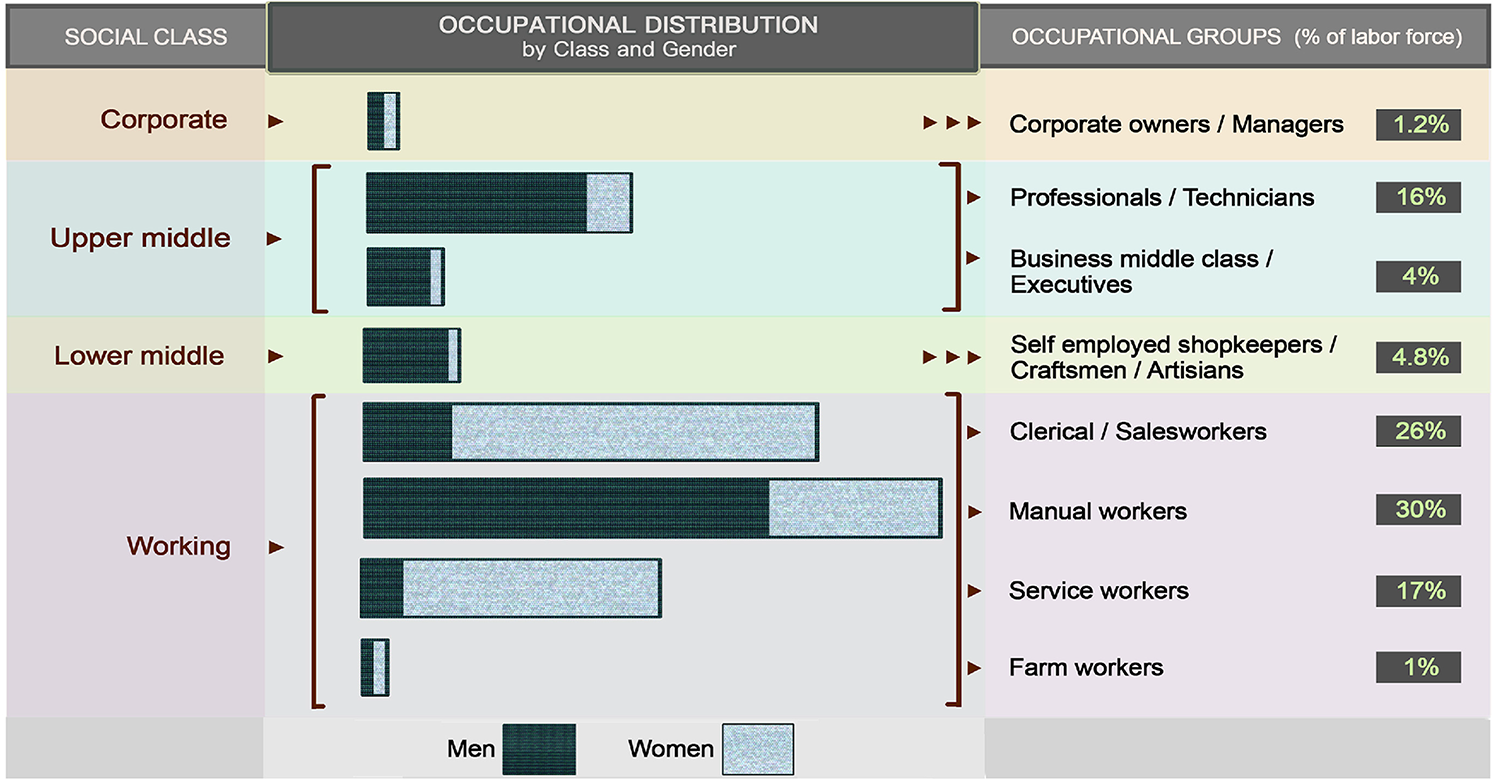
The social structure of the United States. Source: US Census 2010.
Then there is a working class, which is the majority of the population. It has 4 major components: 3 very large and the fourth very small. Those working in administration (people such as my secretary) and commerce (such as my neighbor, working in the supermarket Giants) make up one of the larger components of the working class. The majority of them are women. Another group is that of the industrial workers—also known as blue-collar workers—the majority of whom are men, and the other is service workers who occupy roles in hospitals, medical institutions, social services, transport, post offices, and other essential services, the majority of whom are women. Finally, the agricultural workers are a very small, but extremely important, group. They produce most of the food consumed in the United States.
Figure 1 shows the percentages of each component of the class structure and the percentage that are women. We can see that the United States has a class structure that, incidentally, is very similar to the class structure of most of the major Western European countries. There are, of course, some differences (such as a larger industrial sector in Germany than in the United States), but for the most part, the similarities are larger than the differences.
The Majority of Americans are Aware of the Existence of Social Class in the United States and Define Themselves as Working Class
Figure 2 summarizes the subjective existence of social class. It is important to underline that social class exists not only objectively, but also subjectively, in the United States. This needs to be stressed because the perception widely promoted by the academic and political establishments is that the majority of the United States considers themselves to be middle class. And, indeed, when Americans are asked to define themselves as either upper, middle, or lower class, the majority answers that they are middle class. This is the evidence most frequently shown to support the position that the United States is a middle-class society. In such an argument, no mention is made of how extremely biased the question is: The prevalent classism in the dominant culture does not seem to realize that the term “lower class” is profoundly offensive. It is one thing to refer to a “low-income class” and another to refer to a “lower class.” The first term is not offensive while the second is profoundly offensive. This is the reason people avoid defining themselves as lower class. If, however, Americans were asked if they are members of the upper class, middle class, or working class, there would be more people who define themselves as working class than middle class. The same happens, incidentally, in France, Germany, Italy, and Spain, where such questions have been posed.
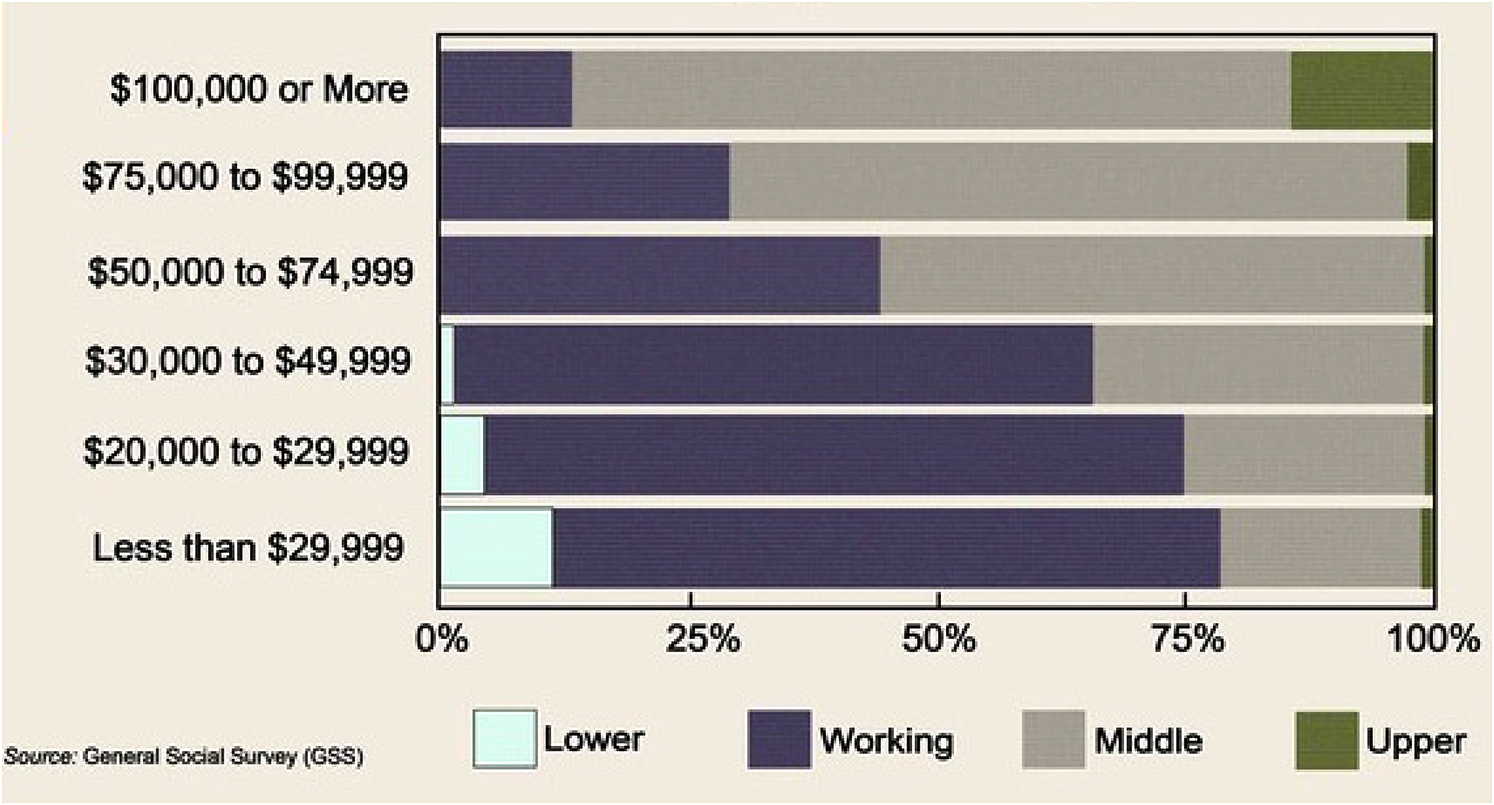
Class identification of employed persons aged 25 years and older, by family income.
Figure 2 shows the results of one of the most detailed studies ever done in the United States on class perceptions, where people were asked which social class they belonged to. They could choose upper, middle, working, or lower class (this last one referring to the unskilled working class). The figure shows how the overwhelming majority of families earning below the median family income (US$62,000) defined themselves as belonging to the working class. In this study, people were asked how they felt about many subjects, from culture and music to their perceptions about what the government should do. It appears clearly that each class, in addition to being aware of the class they belong to, has different views. For example, in Figure 3, one can see that social class has an impact on people's answers to the question of whether taxes on the rich were too low or too high: Answers vary greatly depending on the social class of the respondent. When asked whether taxes for the rich should be increased, the upper class was against, whereas the response was much more positive among the unskilled and skilled working class. The same occurred with several other questions regarding the government's role in redistributing income and related issues. The majority of the working class, for example, is in favor of Medicare for All, the proposal put forward by the socialist Senator Bernie Sanders that would universalize medical care to all citizens of the United States. The upper class is against this.
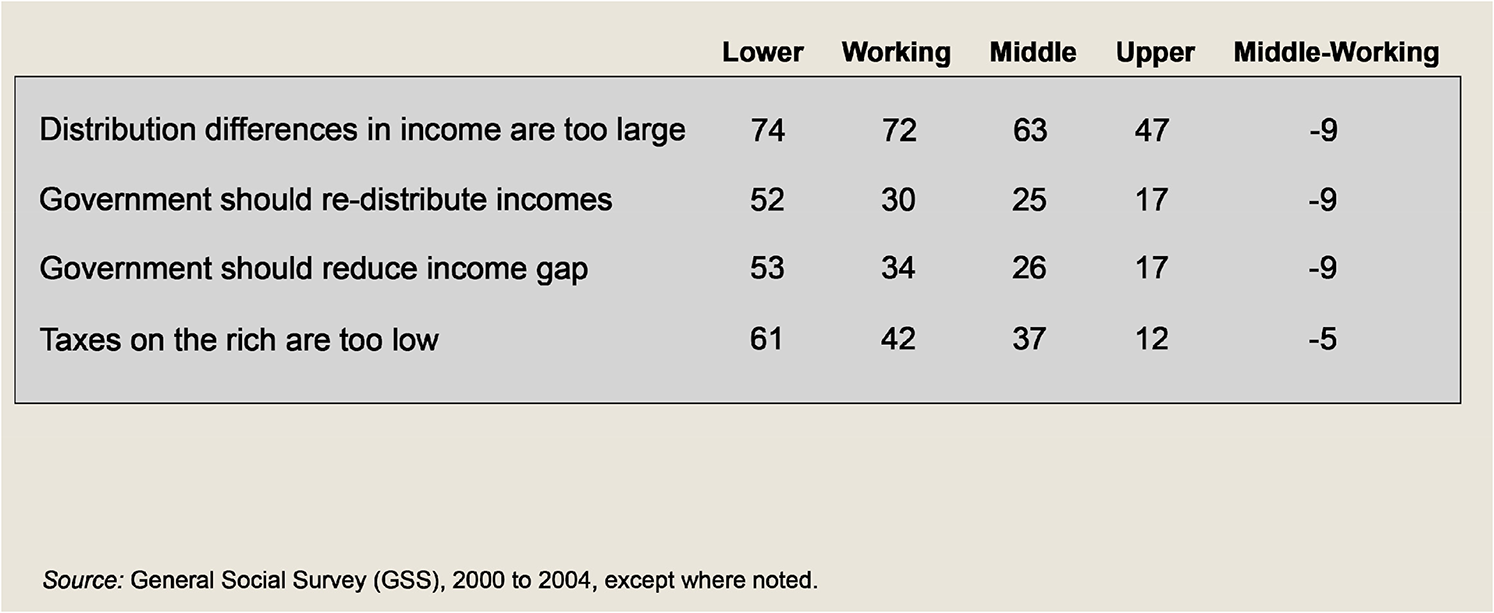
Selected attitudes and behaviors of persons aged 25 and older by subjective social class.
For the most part, the differences between the objective and the subjective class identity are not as large as one would have thought. This is similar in Western Europe. (I have lived in Spain, Sweden, and Great Britain and lecture in many other European countries such as Italy and France as well, and I can testify that this is indeed the case. I have also lived in the United States for half a century and believe I know the country very well.) Of course, there are many differences, but the populations' class self-identification is not so dissimilar between the countries on either side of the North Atlantic. In summary, each class in the United States has different views and perceptions of reality, as is also the case in most Western European countries.
Class Mortality Differentials are Much Larger Than Race or Gender Mortality Differentials
Such similarities between the United States and Western Europe appear not only in how their populations live but also in how they die. Figure 4 shows the mortality rates for heart conditions by social class in the United States. The corporate class is not included, because there are so few, they do not appear in the sample of the population. Notice that the blue-collar worker has a mortality rate for heart conditions double that of the professional class. Mortality differentials by social class are much larger in the United States than in Western Europe. On both sides of the North Atlantic, class mortality differences are larger than race and gender mortality differences.
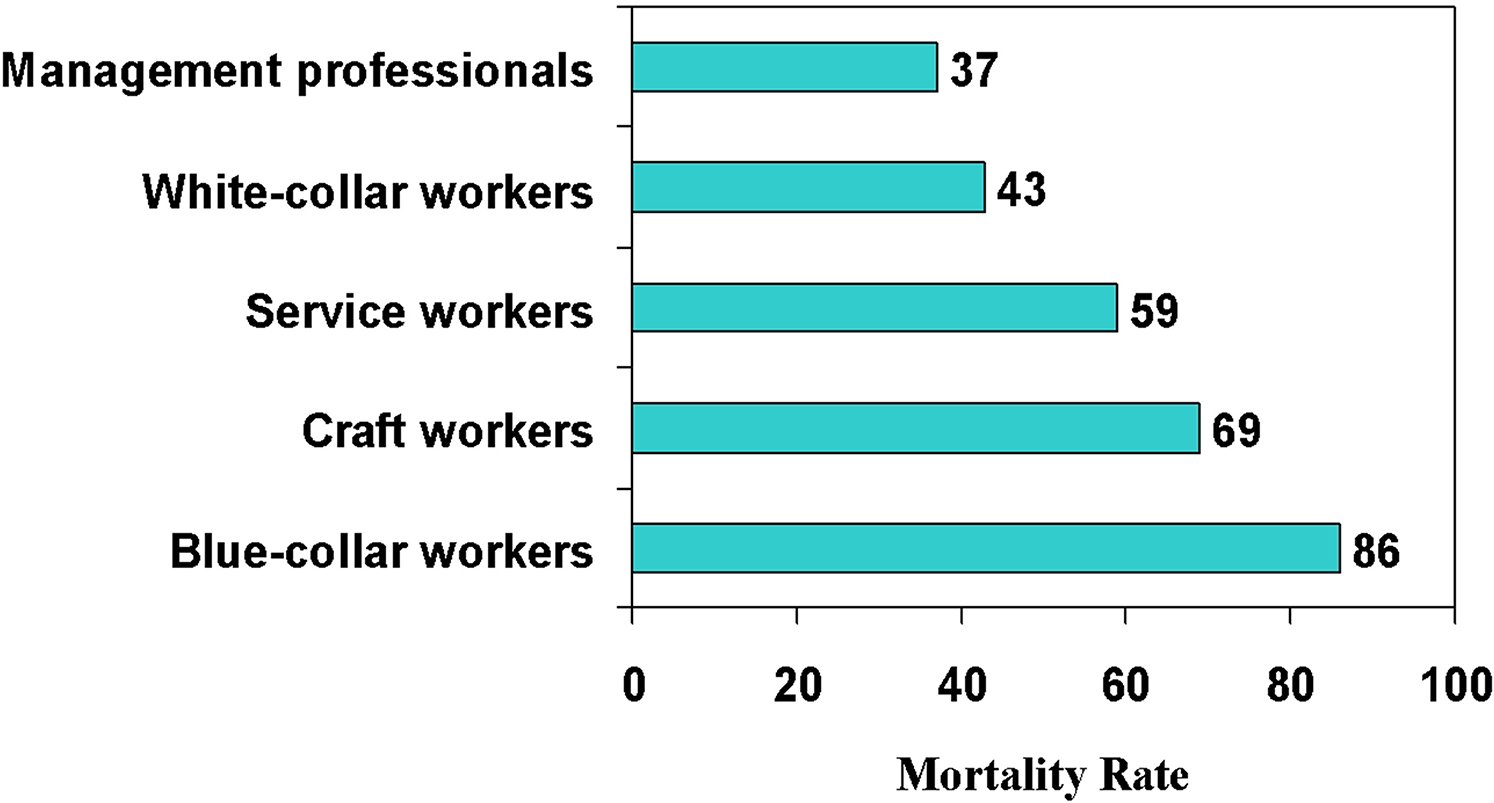
Mortality rate of heart disease (death for 10 000 population). Source: V. Navarro (1990) “Race or class versus race and class: mortality differentials in the United States,” The Lancet.
How Class Power Appears in Political Institutions and its Consequences
Class Discrimination: The Ignored Category of Discrimination in the United States
Figure 5 shows the class configurations of the 3 top federal political institutions during the past 20 years: the Cabinet (in Europe, this would be called the Council of Ministers), the Senate, and the House of Representatives. This graphic shows, on the top, the class structure of the United States (which is similar to the one presented before in Figure 1, yet modified to expand the lower-middle-class section, including the very quickly expanding group of freelancers and self-employers). Figure 5 shows how the majority of the members of these institutions belong to the corporate class, closely followed by the upper-middle-class professionals. The working class does not appear anywhere in the Cabinet or in the Senate and only appears in the House with an extremely limited size: 1.3%.
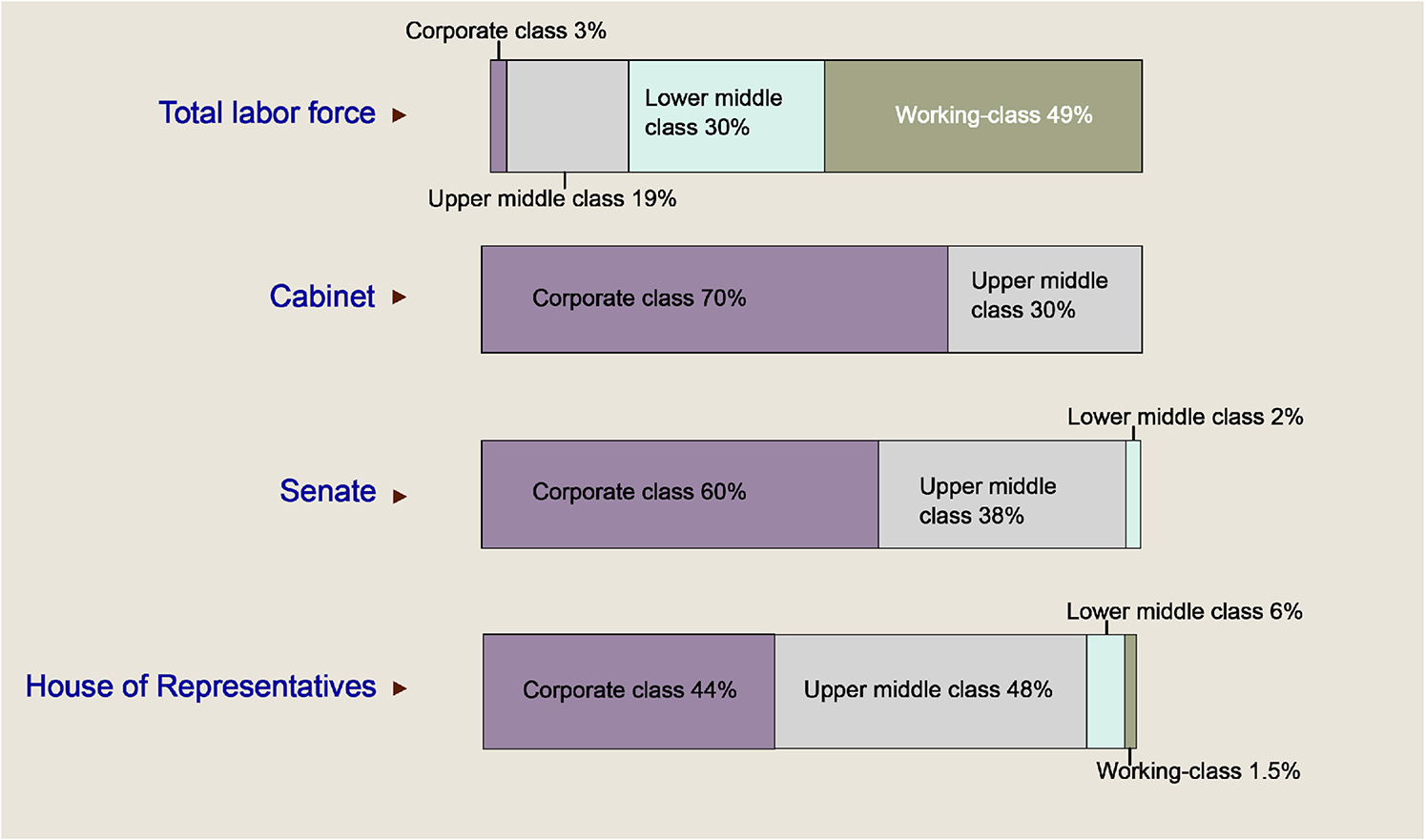
Social class composition of the United States and of the executive and legislative branches of the federal government.
If you are, as you should be, in favor of ending discrimination against black people, you should ask how many members of the Cabinet, of the Senate, and of the House are black; and finding that they are very few, you should denounce the race discrimination that is present. The same should also occur regarding women, since they are also very poorly represented in those bodies. As such, gender-based discrimination should be denounced. But a similar question, that asks how many members of these institutions are members of the working class, would reveal that class discrimination is even more accentuated than race and gender discrimination. In spite of this, such a question is rarely—if ever—asked in the anti-discriminatory literature.
What Are the Consequences of This Discrimination in the Political Representative Institutions? A Very Limited Democracy and Very Insufficient Social Protection
How Class Power is Reproduced in the Representative Institutions
Figure 6 shows that the president of the United States is not chosen directly by the US electorate. On November 3, 2020, the US electorate voted for their 435 representatives in the House of Representatives and for the 100 members of the Senate. This last representative chamber is actually very unrepresentative, as the system used to elect its members is biased and favors small rural and conservative states over large and highly industrialized states (in which the majority of the working class lives). All states, regardless of their demographic size, have 2 senators. A voter in California (which has almost 40 million inhabitants) is much, much less influential than a voter, for example, in Wyoming, which has only half a million inhabitants but also has 2 senators. Small, rural, and conservative states have as much power as the larger states, explaining the conservatism of the Senate, which is very powerful. For example, the Senate, controlled mostly by the Republican Party (which has moved to the ultra-right under the Trump leadership), approves the federal budget, the presidential appointments, including his or her ministers, and the members of the Supreme Court.
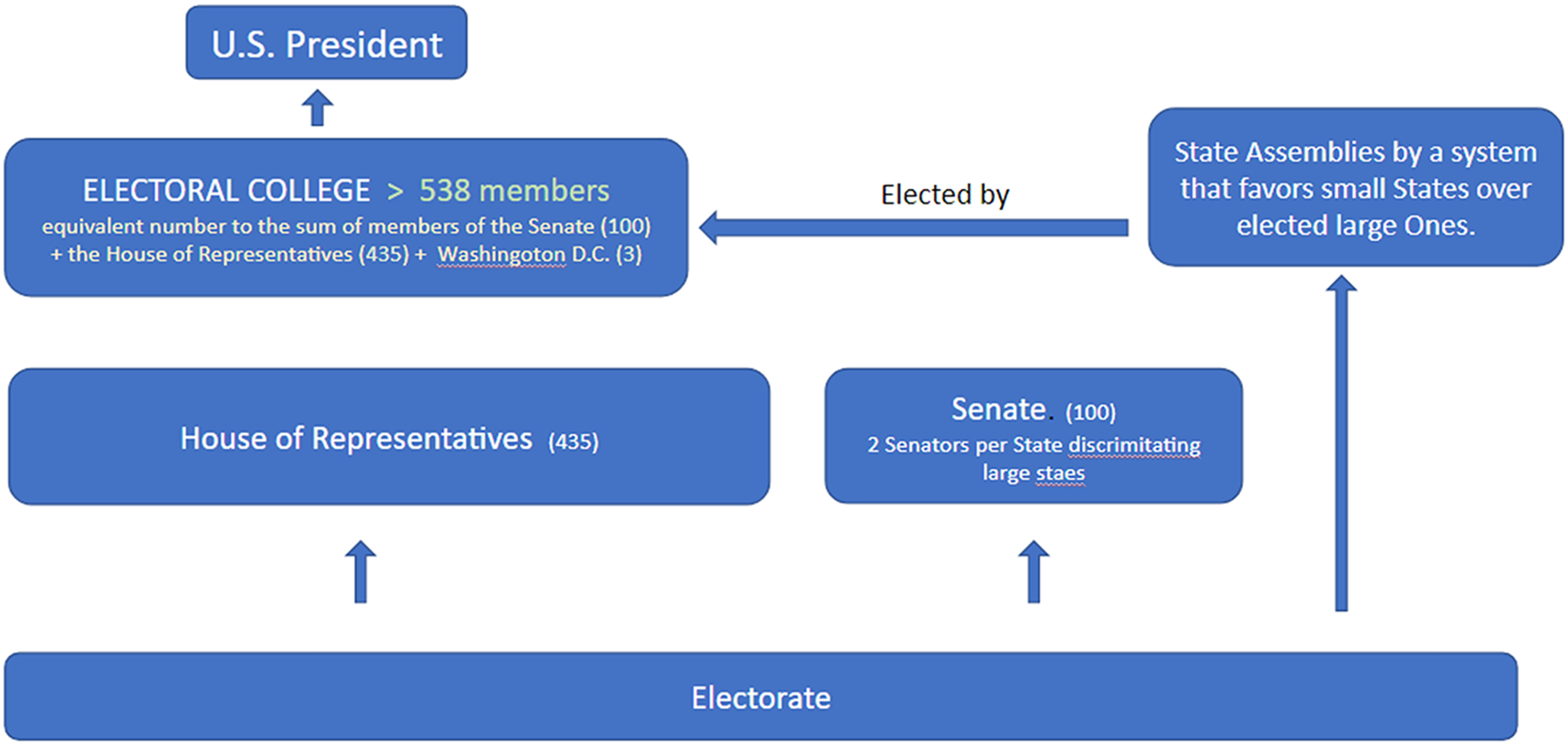
Who chooses the US president?
The Class Bias of the Electoral College, the Body That Chooses the President of the United States
The President of the United States, however, is not elected directly by the House or by the Senate. He is elected by a special chamber—the Electoral College—whose membership is 538, equal to the number of Senators (100), plus members of the House or Representatives (435), plus 3 members from Washington, DC. Its composition is decided by members of State Assemblies, chosen by the electorate via a system that also favors small states over large ones. For example, Wyoming, a Republican state, has only half a million people and has 3 delegates in the Electoral College. If the elections were proportional, California (a Democratic state), with 40 million inhabitants, would have 240 delegates, yet it only has 55. Similarly, Kentucky, a Republican state with 4.4 million inhabitants, has 8 delegates in the Electoral College, while New York, a Democratic state with 19.8 million people, has only 29 delegates, when it should have 35 (if the Electoral College were proportional). Again, South Dakota, a Republican state with 885,000 people, has three delegates, while Illinois with 12.8 million people should have 43 delegates, rather than 20, and so on.
This bias in the composition and membership of the Electoral College explains why, even though in the past 20 years there have been more votes for Democratic Party presidential candidates than for Republican Party candidates (except in 2004), the President of the United States has been a Republican for the majority of these years, although the Democratic candidate has received the majority of the popular votes from the US electorate, as shown in Figure 7 (Popular Votes for Presidential Candidates). In spite of the unpopularity of this body, the chances of its being eliminated are null. It would require the support of two-thirds of the Senate plus ratification for three-quarters of the 50 states.
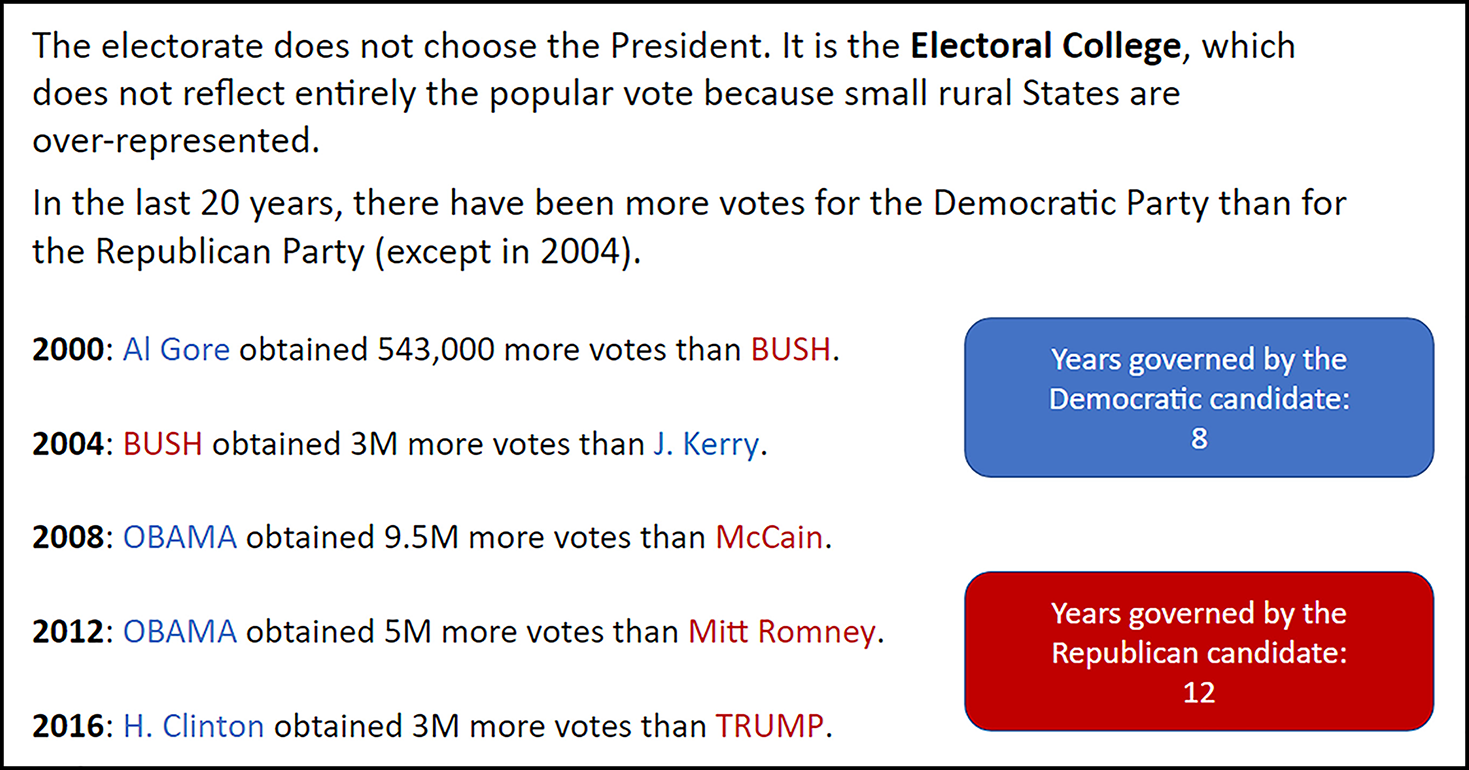
Popular votes for presidential candidates.
The Lack of Proportionality Reproduces a Very Unrepresentative Congress, with the Exclusion of Left-of-center and Left-wing Parties That Tend to be More Sensitive to the Needs of the Working Class Than the Right-wing Parties. Among These Needs are the Establishment of Labor, Civil, and Social Rights
The federal electoral system allows for only 2 parties, both of them right wing: the Republican Party (ultra-right) and the Democratic Party (a liberal party, center-right, an observer to the International Association of Liberal Parties), thus excluding left or left-of-center parties. The electoral process in the United States is not proportional. Proportionality means that a party that obtains 30% of the popular vote has the right to have 30% of the parliamentarians. It is not so in the United States. Unless a party obtains 51% or more of the votes, the party loses, regardless of whether it is losing for receiving 49% or just 1% of the vote. This makes it very difficult for new parties to have a presence in the representative chambers. The only opportunity for individuals from other parties to have a chance to be elected is in the primaries of either of the 2 other parties. This is how a socialist, Bernie Sanders, ran in the primaries of the Democratic Party for the position of President of the United States. He is a well-known independent senator from Vermont, who put forward progressive proposals such as the establishment of a minimum wage (15 $/h), the already cited national health program, and a New Green Deal that became very popular even among conservative voters. But Sanders was clearly marginalized by the apparatus of the Democratic Party in 2016 and again in 2020, making it very difficult—practically impossible—for him to win. It is therefore impossible for a left-wing party to obtain a meaningful political space in either the Senate or the House. This absence and limited influence of left-wing parties in representative US institutions explains the country's very limited labor rights (for example, it is very easy for an employer to fire a worker) and social rights (such as universal access to medical care in times of need).
The Consequences of the Limited Democracy of the US Electoral System: Extremely Insufficient Labor, Political, and Social Rights, Including Health Care Rights
There is a lack of awareness outside of the United States of how limited US democracy is and how limited the social and health care rights are. One indicator of that limitation is that 150 million people have voted for 2 candidates, one Republican (Trump) and another Democrat (Biden), both of whom are explicitly and clearly against the Green New Deal and Medicare for All (I repeat, the call for a national health program that would guarantee the universalization of the right to medical care), proposals that are very popular but were not offered to the electorate in the recent elections. The very limited proportionality of the electoral system and the practical impossibility of third parties to appear as parties in the 2 representative chambers, thus limiting the existence to the 2 right-wing parties—Republican (ultra-right) and Democrat (liberal, center-right)—determines the enormous limitations of that democracy, with a clear impossibility of a left or left-of-center party in the United States. This is the reason for the very poor social protection and medical care coverage that exists in the United States.
The Privatization of the Electoral System and of Medical Care in the United States
A further limitation of US democracy is the privatization of the electoral process (which also explains the privatization of medical care). Most of the funding of elections is private, and there is no limit to how much money can go to the Democratic or Republican Party and/or their candidates. This money is used primarily to buy access to the media (TV and others), which is available to the highest payers—again without any limitations. The contributions from large economic, financial, and professional associations are particularly important before the electoral process starts when the candidate is not yet well-known. Afterward, other contributions are added to that list, including smaller contributions from individual citizens, as was the case with Bernie Sanders. This private funding does play an important role in the electoral process, because it can limit candidates that are unable to obtain as much private funding to support their candidacy. This private funding also appears in some European parties, but for the most part is illegal and can be considered as corruption. In the United States, it is normal, is legal, and is neither perceived nor presented as corruption. Among the important donors in the elections are health insurance companies, corporate medical organizations, hospital interests, and those in the very powerful pharmaceutical industry that contribute exclusively to the funding of the recipients of these funds, who sit in the health-related committees of the House and the Senate.
The Working Class in the United States is Very Weak
This insufficient democracy primarily affects the working class and limits the defense of its interests, including the development of its political instruments, such as left or left-of-center political parties and class-oriented trade unions. The absence of left-wing parties in US representative institutions is accompanied by the limited power that the major trade union associations have—unions such as the American Federation of Labor and Congress of Industrial Organizations that are practically forbidden by the Taft-Hartley Act to act as a class union. Sympathy strikes (meaning a sector of labor supporting another sector), as well as universal or general strikes, are forbidden in the United States. Strikes and collective bargaining agreements are only sectoral and are very decentralized, weakening labor. In reality, US trade unions are expressions of business unionism rather than class unionism. Such weakness of labor is the dream of the liberal parties in Europe, funded and created by the large employer class in the majority of Western Europe. All of the neoliberal public policies implemented in Western European countries (including on many occasions by the Social Democratic ones) are aimed at weakening labor, taking the US liberal model as the model for what they want to have. Their intent was to “Americanize” their labor markets and welfare states, including the health services.
The Large Abstention in the Electorate is Also an Indicator of the Underrepresentation of the Working Class
This situation of powerlessness explains the great distrust and disinterest that the majority of the US working class has in the political process. Due to the fact that only half of the US population votes in the US presidential elections (and much less in congressional elections that do not coincide with presidential ones), and that there is a direct relationship between the level of individual income and electoral participation (the lower the income, the lower the participation), almost half of the population (the one with less income) does not vote. This lower half is the majority of the working class. This means that the majority of the voting population are members of the middle class, upper-middle class (professional classes), and upper class. The reason for the enormous failures of the polling agencies (that predicted a large victory of the Democratic candidate Hillary Clinton in 2016 and of Biden in 2020), when they predicted that both Clinton in 2016 and Biden in 2020 would win by such a large margin over Trump, was because they focused on the voting populations in previous elections without taking into account the behavior of the abstentionists: the majority of the working class. The increased participation of this group compared to previous elections explains the failure of those predictions.
Why did Trump win in 2016 and Mobilize the Largest Vote Ever for the Republican Party in 2020?
The Failure of the Liberal Establishment Explains the Victory of the Ultra-right
Much has been written about this question, attributing the high mobilization and polarization of the electorate in support of Trump to a supposed increase of racism and sexism in the United States (an example is the latest book of Professor Putnam from Harvard University, which points to the growth of racism as largely responsible for this polarization). The primary reason was thus considered a cultural one: The policies of identity seem to have substituted for the policies of redistribution in recent years. Without denying that these cultural themes play an important role, other factors also needed to be considered, besides race and gender. I am referring to class conflict: a conflict that, again, is barely spoken about in the United States.
The victories of Ronald Reagan in the United States and Margaret Thatcher in Western Europe had an important and long-lasting impact. Neoliberalism, promoted by the dominant classes, was their response to the advances of the labor movement on both sides of the North Atlantic during the post-war period (1945-1974, known as “the Golden Age of Capitalism”), and their neoliberal policies significantly weakened labor. Before the neoliberal revolution (that started under President Reagan), the Democratic Party in the United States had continued the New Deal tradition established by President Roosevelt (the most popular president of the United States after World War II and the founder of the US welfare state). The New Deal was followed later by the Great Society that established, under President Johnson, Medicare, a universal health care program for the elderly, and Medicaid, a program for the poor (defined by each state). During all of that period, the Democratic Party, as President Kennedy had once indicated, was not a labor party, but it intended to obtain the labor support. And indeed, although the majority of the working class abstained, those who voted, voted Democrat.
The Democratic Party, however, changed significantly with President Clinton (very representative of the highly educated middle class, or what is called in Europe the illustrated upper middle class or professional classes). After winning his 1992 election (with a fairly progressive platform, borrowed from Jesse Jackson's campaign in 1998, including a call for a national health program), he abandoned such commitments and instead converted to the neoliberal project, adopting major components of neoliberalism such as deregulating the mobility of capital and establishing worldwide free trade agreements, starting with NAFTA (initiated by President Bush) and followed by new treaties favoring the mobility of industries moving out of the United States. In many ways, he inspired Tony Blair in the United Kingdom, becoming a reference for the Third Way (the incorporation of neoliberalism and abandonment of critical elements of social democracy), followed later by Shroeder in Germany, Holland in France, and Zapatero in Spain.
This change affected the working class in the United States very directly. I saw it in Baltimore, the city where I live in the United States and where The Johns Hopkins University exists. Baltimore used to be a steel town. The steel mills, however, left town, going to countries with much lower salaries, which negatively impacted Baltimore. There is a very large neighborhood, Dundalk, where most of the steel workers lived. The majority were well-paid (workers in manufacturing are always among the best paid) and white. When the steel mills left, it caused an enormous amount of harm to the neighborhood, and Dundalk changed dramatically. In 2016, that whole neighborhood voted for Trump, whom they perceived as against the liberal establishment which, they believed, controlled the federal government. They hate the liberal establishment for a number of reasons. First, because they believe the establishment is responsible for what has happened to them. Second, they perceive that the federal government has been helping black people and upper-class women while ignoring them completely. As I mentioned before, the welfare state in the United States is not a universal welfare state but rather a means-tested one. Medical care is not a right for the majority of US citizens and Medicaid is only for the poor, which those in Dundalk wrongly assume to be majority black people (in fact, the majority are white, although the poorest are black). They believe the taxes they pay are to assist the needs of East Baltimore (the neighborhood of the majority unskilled, black, working class), and not for them. This interpretation of fiscal public policies has been clearly promoted by Trump, in both his 2016 and 2020 campaigns, who used the identity policies started primarily by Clinton as a proof of favoritism at their cost. The perception that the federal government supports only minorities and upper-middle-class women with academic degrees played a key role in Trump's campaign. Racism and sexism did play, thus, a major part, but in themselves do not explain why the white working class was mobilized now and not before. Instability, uncertainty, and limited social protection—consequences of the neoliberal policies implemented by Democratic governments, such as degradation of labor markets and worldwide mobility of capitals—generated a lot of anxiety and insecurity, resulting in the rejection of “the other,” either immigrants or minorities. To explain the working-class vote for Trump primarily as due to increased racism and sexism is therefore insufficient, because it ignores the enormous damage that the neoliberal policies have wreaked among the larger sectors of the working class (particularly in the white working class, which went from having a good standard of living to misery in a very short period). The mortality rates among the white working class caused by “diseases of despair” have increased, and life expectancy has declined. To focus only on racism ignores that many of the working class who voted for Trump also voted for Obama in his first run for president.
Trump presented himself as the voice of those who hated the liberal establishment, represented by Hillary Clinton (the candidate of the major feminist movements and, as Secretary of State for the Obama administration, a great promoter of globalization in 2016) and by Biden (a typical representative of the liberal federal establishment, in the Senate for almost 40 years). Forty percent of unionized workers voted for Trump. According to The New York Times, of the 265 counties most dominated by blue-collar and service workers (areas where at least 40% of employed adults have jobs in construction, industry, and non-professional jobs), only 15% voted for Biden. Counties where blue-collar workers represented about 23% of the population voted for Biden. Those with a larger percentage, 31%, voted for Trump. These pro-Trump voters included many industrial countries that had voted for Obama in 2012 and then switched to Trump. Trump presented himself as the voice of the people against the economic and financial establishment, presenting Biden as the voice of the federal establishment. He himself comes from a sector of the corporate class (real estate, private equity, casinos, and speculative services) that is not seen and perceived as a real part of the corporate establishment (although he has had the support of the oil and gas companies, as well as defense constructions, the energy industry, and Big Pharma, the major pharmaceutical corporations). His anti-federal establishment and critical tone toward the liberal establishment and its media explain the enormous loyalty of his supporters, who have become the solid base of the Republican Party. This also explains that, while being the first modern president who never enjoyed a majority approval in national polls, he had the complete loyalty of at least 36% of the eligible voting population.
Trumpism is More Than Populism. It Has Similarities With Ultra-Right Wing Forces in Europe and is Close to Fascism of the 20th Century
It is wrong to interpret Trumpism as a populist movement. Such a reading underestimates the nature of this movement and incorrectly assumes that when the leader disappears, the movement also disappears. Actually, the movement preceded Trump. Such a movement is characterized by an extreme nationalism, with nostalgic remembrance of an idealized imperial past, based on the superiority of the white race and its Christian religions; profound sexism, seeing women primarily as sexual objects, appendices in a man's world, and assigned reproductive roles; prioritization of economic growth before any other consideration; following protectionist policies in support of the economy (understanding economy as the interests of the main economic and financial institutions of the country); and justification of policies to deregulate the labor markets and eliminate social and environmental protection as necessary for the creation of jobs, supposedly his main priority. This movement is profoundly against the federal government, considered to be a mere instrument of the interests of minorities and upper-middle-class women. This ideology is also profoundly authoritarian, caudillist, and antidemocratic, considering democracy as an obstacle to obtaining its ends. It is also a crusade, defending Christianity against maligned religions such as Islam and others. It has very similar features to the majority of ultra-right-wing parties in Western Europe.
The Pandemic and Public Health Crisis Have Accentuated the Class Polarization of the United States
A major intervention applied to control the pandemic has been quarantining the population (primarily the professional middle class and sections of the qualified working class). The majority were non-manual workers, facilitated in such a way that they could work from home. In general, this group has work stability, and thus their primary concern was the pandemic itself. They voted primarily for Biden. Half of the US population, however, could not be quarantined at home. Because of the manual nature of their work and its essential character (needed for the immediate survival and continuity of society), they were forced to keep working. Moreover, because of their very limited job stability (many were women with precarious work) and very limited labor stability and social protection, they needed to work; many voted for Trump because he prioritized the running of the economy and the production of jobs above everything else.
The pandemic clearly showed that there was a working class in the United States who had to continue working to sustain the whole society. It is interesting that the Centers for Disease Control and Prevention, the major public health agency of the federal government, categorized essential workers as not only health and social workers, but also many other kinds of work in food industries, transport, commerce, education, and many others, adding up to almost 70% of the labor force, with frontline workers making up 42% of that last section. The majority of this last group are women and low paid.
Electoral Results: The Continuation of Trumpism
The Republican Party increased its votes by 9 million with Trump, many of them from the abstentionist white working class. The majority of this white working class who voted, voted for Trump. The number of votes he received was the largest ever for the Republican Party: 74 million. Needless to say, many other sectors voted for Trump as well, including the majority of people who earn more than US$100 000 a year, the majority of them white. The majority of Catholics also voted for Trump.
The Democratic Party votes increased by 14 million for Biden, compared to the votes gained by Hillary Clinton. However, the huge mobilization was to stop Trump, rather than to support Biden. The majority of black people, Latinos, and women, as well as the professional middle class and skilled and unionized workers (60% of the latter), voted for Biden. He won 6 million more votes than Trump. Bien received 80 million votes, the most ever received by a presidential candidate. However, in the Electoral College, the difference between candidates was very limited, closer than in previous elections for successful Democratic presidential candidates (Clinton and Obama). The Republican Party has lost its majority in the Senate, even though it gained votes in the House, in which the Democratic Party maintained its majority. It is most likely that Trump will run for president in 2024. The future now looks difficult because Trumpism is very powerful, and the leadership of the Democratic Party is not willing to make the changes in the economic and political institutions, such as Medicare for All, that are required to satisfy the enormous needs of the majority of the US working class (belonging to all races). Needless to say, there is a large mobilization from many different social movements that could add pressure for change; however, the primary condition is to find transversal elements that can unite the different races, genders, and components of the working class and other components of the popular classes. Without such a united political–social movement, it is difficult to foresee a better future for the health and quality of life of the population.
Footnotes
Declaration of Conflicting Interests
The author declared no potential conflicts of interest with respect to the research, authorship, and/or publication of this article.
Funding
The author received no financial support for the research, authorship, and/or publication of this article.
Author Biography
Navarro is the author of 25 books, translated into many different languages, and has written more than 400 scientific articles. He was the founder of the International Association of Health Policy and the International Journal of Health Services, one of the best-known quarterlies in health and social policy. He has been awarded, on several occasions, the Golden Apple award given to the best professor in the graduate program in Public Health at The Johns Hopkins University.