






Abstract
Background:
Mental illness is a significant contributor to global disease burden and this is expected to increase over the coming decades. Traditionally mental illness has not been well understood by the general public, resulting in poor attitudes towards persons with mental illness and stigmatization. Such conditions are common in the Caribbean where less than 5% of the health budget is allocated to mental illness.
Aims:
To assess knowledge and attitudes towards mental illness among college students within the English-speaking Caribbean.
Methods:
A self-report questionnaire was adapted from previous studies designed to measure knowledge and attitudes of mental illness. Students were sampled from the University of the West Indies campuses in Jamaica, Barbados and Trinidad & Tobago.
Results:
Responses were collected from 673 persons with a response rate of 84%. While participants were agreed that particular diseases were mental illnesses, overall knowledge scores were low. Knowledge was higher among those persons who knew someone with a mental illness. Attitude scores were suggestive of stigmatization, with drug abuse and schizophrenia seen in a particularly poor light.
Conclusions:
These results suggest that widespread educational campaigns need to be implemented across the region, designed to both increase knowledge about mental illness and reduce discrimination towards persons suffering with mental illness.
Introduction
Mental illnesses represent approximately 13% of the global disease burden, with an expected increase to 15% by 2020 (Thornicroft & Maingay, 2002). In fact by 2020, using the World Health Organization’s (WHO) Daily Adjusted Life Years measure (DALY), depression by itself is expected to be second only to ischemic heart disease as a contributor to global disease burden. Additionally, the WHO has reported that 450 million people around the world are affected by mental health concerns at any point in time (WHO, 2003). This increasing incidence has been accompanied by worldwide efforts over the past 20 years to educate and increase awareness among the general public about mental illness (Patel & Sartorius, 2008; Evans-Lacko et al., 2010). Such attempts are vital as the lay public is generally not well informed about mental illness and this lack of information often leads to negative attitudes towards persons with mental illness and stigmatization. This in turn impacts upon persons suffering with mental illness, making them less likely to seek help from relevant mental health professionals (Schomerus & Angermeyer, 2008).
Despite increased knowledge and improving attitudes in more developed nations, lower- and middle-income countries have yet to see such shifts (Rahman & Prince, 2009; Eaton et al., 2011). In this respect the English-speaking Caribbean is no different, with a growing population of persons suffering with mental illness, limited infrastructure and appropriately trained personnel, and a general public that lacks knowledge and exhibits negative attitudes towards the mentally ill. For example, a report from Jamaica notes that secondary school students generally desired less contact with teachers who were thought to have a history of mental illness (Jackson & Heatherington, 2006). Similarly, most pre-clinical medical students in Trinidad & Tobago were opposed to a patient with a psychotic illness marrying into their family or teaching their children (Hutchinson et al., 1999). Another small survey of community leaders and members in Dominica reported that the majority of respondents did not identify persons suffering from alcoholism, depression or childhood hyperactivity as having a mental illness. Only psychosis was widely recognized as being a mental illness. It was suggested that the responses of community leaders in particular, a group comprising nurses, teachers and police officers among others, demonstrated a lack of awareness of mental health disorders and of the efficacy of treatment for these illnesses (Kohn et al., 2000). In the aforementioned Trinidad study, psychosis was similarly seen as serious, with a majority of students agreeing that hospitalization was the best means of treating a patient with a mental illness. Despite this, a full quarter of participants believed that mental illness could be caused by supernatural forces (Hutchinson et al., 1999). Coupled with this are the unique challenges facing small-island states within the region. With a population of approximately 8 million persons spread out across 15 plus island nations, political will and coordination designed to implement meaningful solutions to many of the challenges facing global society in the 21st century has been difficult.
Little research has been conducted to date within the region to determine the knowledge and attitudes of persons pertaining to mental illness and to generally raise awareness about these conditions (Razzouck et al., 2008; Sharan et al., 2009). An extensive search on the World Wide Web using PubMed, EBSCOHost and Google revealed few articles over a 25-year period addressing this issue. This lack of empirical data, the increasing burden of mental illness within the region, and the limited public awareness campaigns currently mounted by public and private agencies all highlight the need for an intervention now. We therefore sought to assess societal knowledge and attitudes towards mental illness as a first step in a long process towards significant progress in this arena.
To achieve this we deliberately sampled college students as many mental illnesses have their origin during the adolescent years (Kessler et al., 2005). Also, attitudes towards disease are often cemented during this formative time of development. The impact of personal attitudes and perceptions of college students potentially have far-reaching implications as many of these persons will find themselves in places of leadership and influence in the coming years. This is especially true within the Caribbean region where the movement from graduation to significant influence within the wider society is short due to the small size of the society and the lower percentage of persons with a college education.
It is hoped that the present study will present a clearer picture of knowledge and attitudes towards mental illness in the Caribbean region, stimulate greater public awareness and provide a platform for the development of enhanced public policy.
Methods
This study was designed as a cross-sectional, descriptive survey and was approved by the appropriate ethics committees on the Cave Hill, Barbados, Mona, Jamaica and St Augustine, Trinidad & Tobago campuses of The University of the West Indies. Data were collected from full-time, undergraduate students on these campuses between June and November 2011. This cohort was a readily available target population that represents a wide cross-section of Caribbean society.
Questionnaire
We made use of convenience sampling. Participants were contacted in person in places where students generally congregate when not in class, including cafeterias, libraries and study rooms. All subjects were required to provide informed consent before taking part in the survey. A standardized questionnaire, comprising demographic questions as well as scales adapted from previously published studies, was utilized for this research. Participants’ responses were anonymous but information on age, gender, ethnicity and religion was collected. To ensure confidentiality each questionnaire was assigned a numerical code instead of using names or university identity numbers. Following this, respondents completed the knowledge measure (Wahl et al., 2011) consisting of 17 statements about mental illness with which they had to agree or disagree using a five-point Likert scale: ‘strongly agree’, ‘agree’, ‘neither agree nor disagree’, ‘disagree’, ‘strongly disagree’. In addition, subjects were asked to indicate if they agreed or disagreed that each of six common conditions were indeed a mental illness and also if they knew someone with a mental illness.
The third part of the instrument was the Attitudes to Mental Illness Questionnaire (AMIQ; Luty et al., 2006), which comprised seven short vignettes. Each vignette was a short description of someone and an aspect of their life as it pertained to health. The vignettes depicted schizophrenia, alcohol abuse and recovery, heroin use, diabetes and drug overdose as a result of depression. In addition there were two other vignettes: a positive control (described as a practising Christian) and a negative control (described as a convicted burglar who had spent time in prison). Each vignette was followed by five statements that participants responded to using a five-point Likert scale, ranging from ‘strongly disagree’ to ‘strongly agree’. An example of a vignette and the statements that followed is below:
Tim is depressed and took a paracetamol overdose last month to try and hurt himself.
This will damage Tim’s career.
I would be comfortable if Tim was my colleague at work.
I would be comfortable about inviting Tim to a dinner party.
It is likely that Tim’s wife will leave him.
It is likely that Tim will get in trouble with the law.
Statistical analysis
Consistent with the scoring by Wahl et al. (2011), knowledge was scored 1–5 based on the Likert scale responses with the more accurate knowledge response scoring higher. The 17 items were then summed to yield an overall knowledge score, with a maximum possible score of 85. It should be noted that of the 17 items, eight were reverse-scored. With respect to the AMIQ, responses to each statement were given numerical scores from -2 to +2; the total possible scores for each vignette therefore ranged from -10 to +10. Data were analysed using the statistical software SPSS version 17.0. Descriptive statistics were calculated for each section of the questionnaire (mean ± standard deviation) and differences in means were tested using analysis of variance (ANOVA). Post-hoc analysis was carried out using Tukey’s post-hoc test. The α error was set at p < .05.
Results
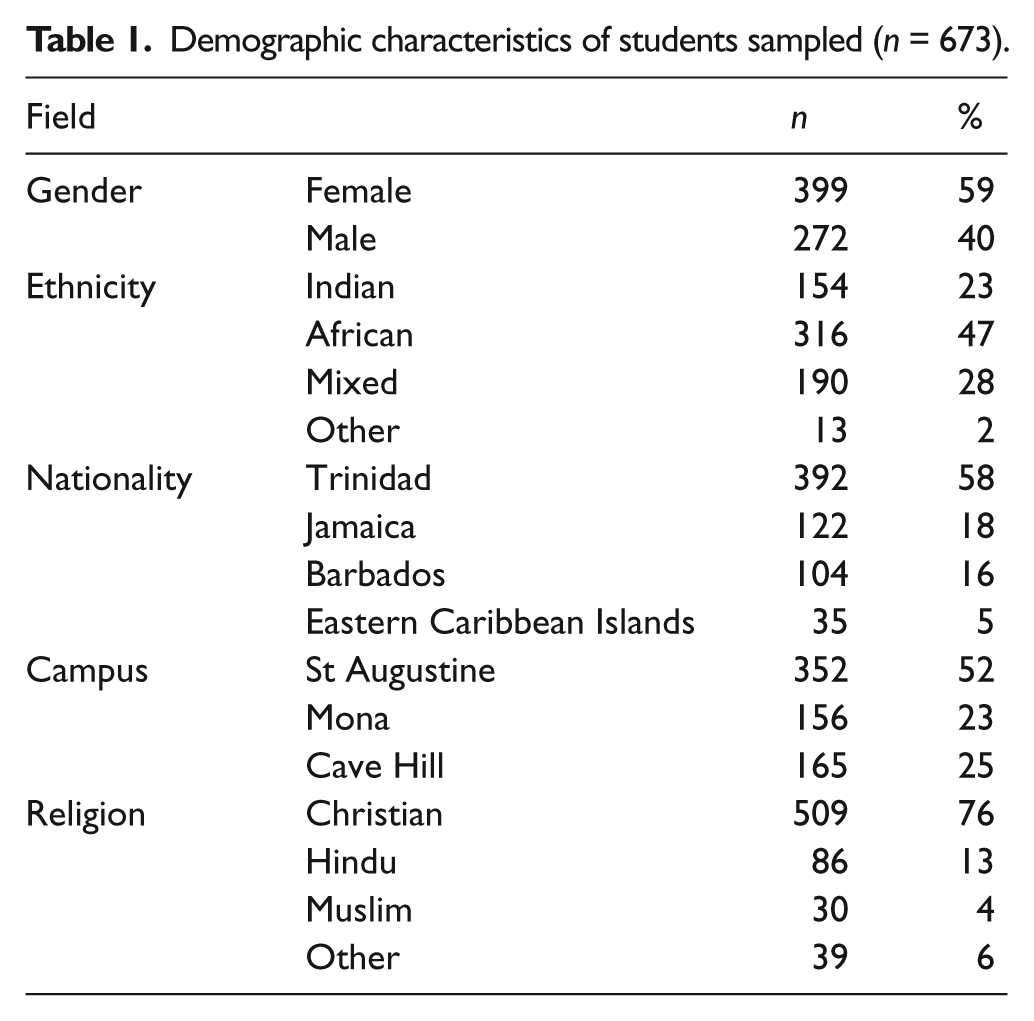
Overall, 810 questionnaires were distributed across the three campuses, with 681 being returned giving a response rate of 84%. Eight questionnaires were not used for the analysis as subjects only completed the demographics section, giving a total sample of 673 completed responses. The average age of those sampled was 20.7 (SD = 3.0, range: 18–56), with 94% of respondents between 18 and 24 years of age. The rest of the demographic information collected is summarized in Table 1. Of the 673 persons sampled, 47% (282) indicated that they knew someone with a mental illness.
Demographic characteristics of students sampled (n = 673).
Subjects’ agreement with which conditions were designated as mental illnesses is summarized in Figure 1. Seventeen questions were used to assess knowledge about mental illnesses. The overall mean knowledge score was 58.1±5.8. Persons who knew someone with a mental illness scored significantly higher on knowledge questions (58.9±5.6 vs 57.6±5.9, p = .006) and females also scored higher (58.7±5.4 vs 57.4±6.2, p = .005). No other significant relationships were noted between total knowledge scores and other demographic variables including ethnicity, religion, citizenship and campus sampled (p > .05).
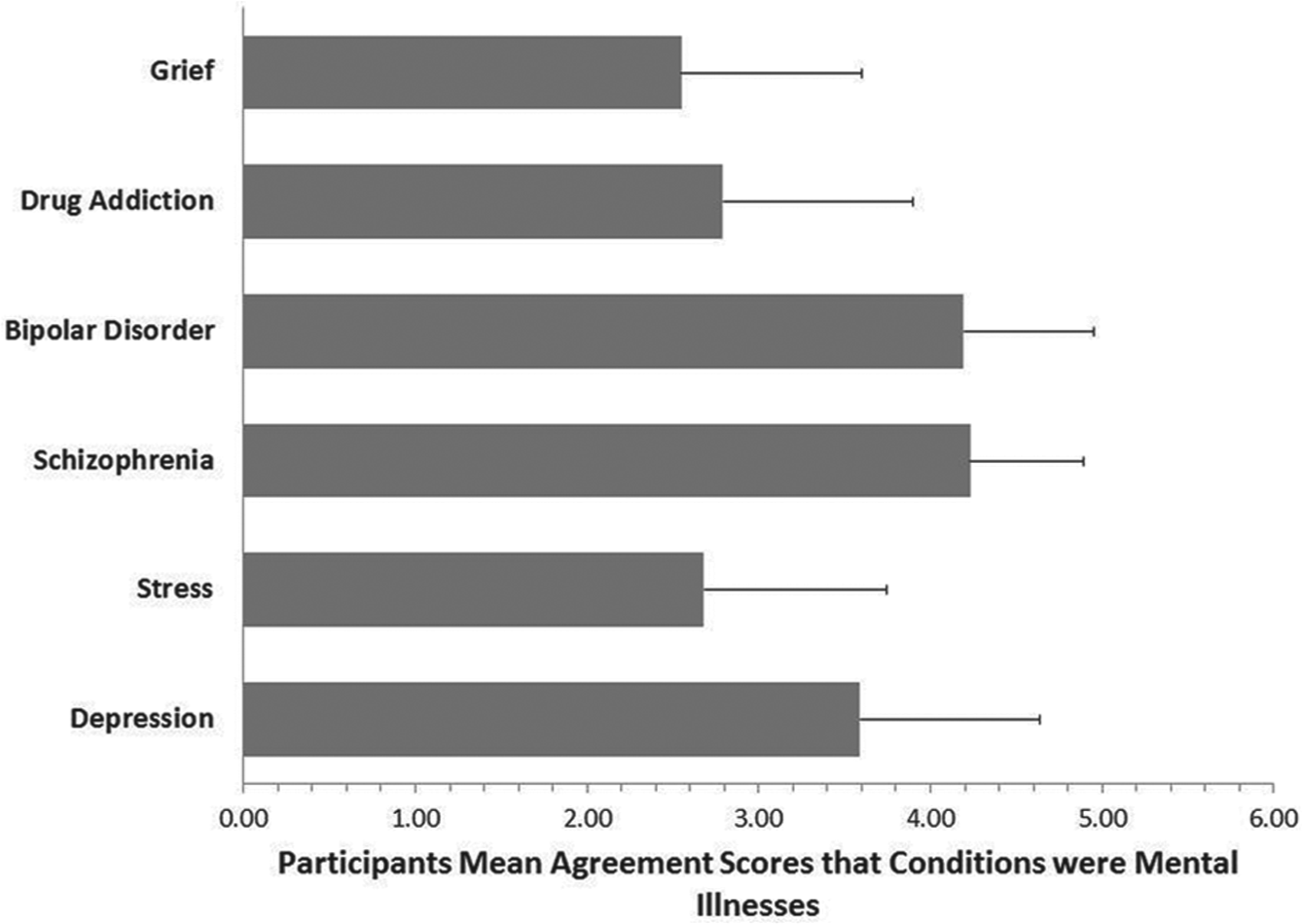
Participants mean agreement scores when asked to identify particular conditions as mental illnesses.
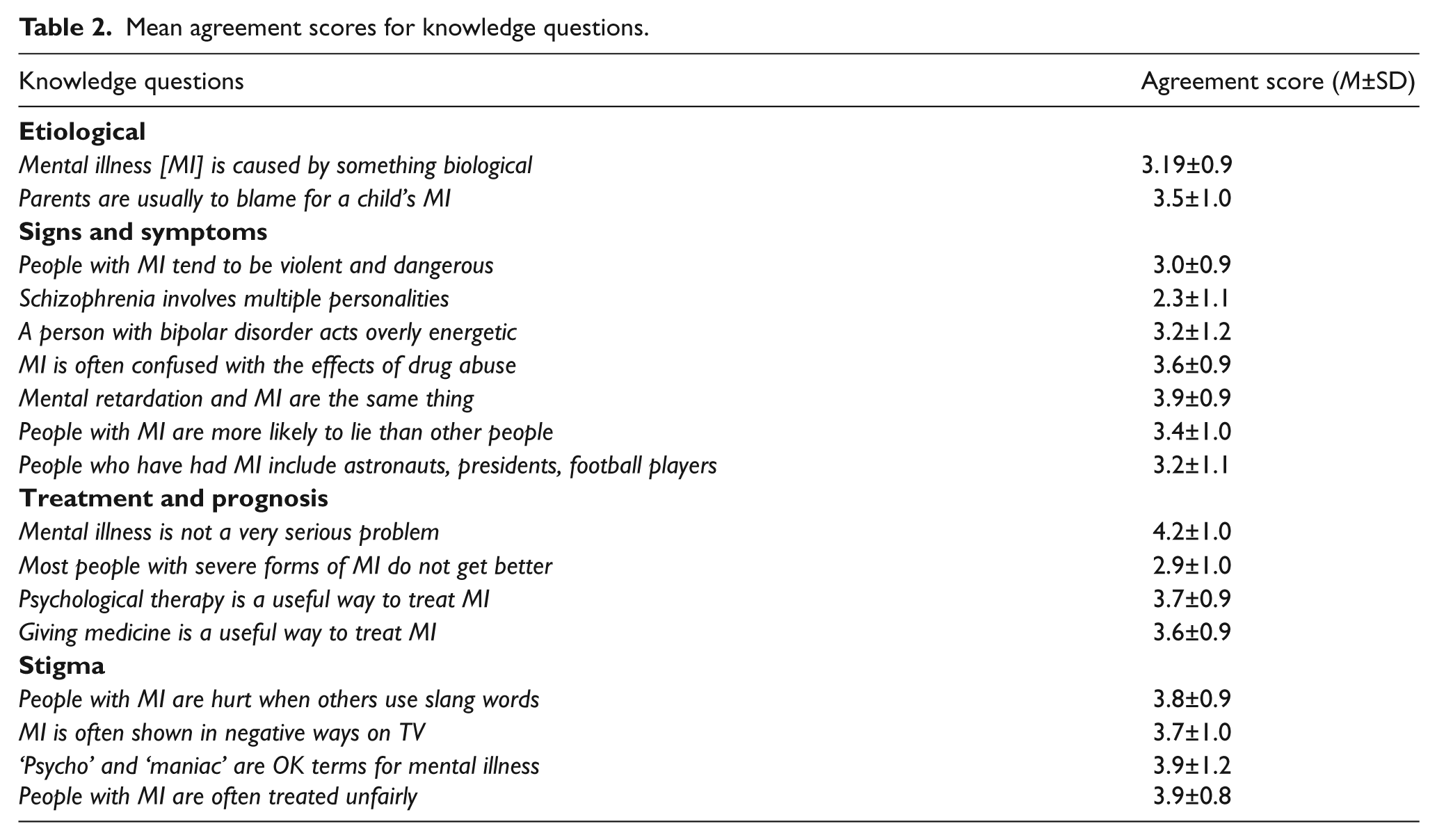
As regards individual questions, items that tested the aetiology of mental illness and symptoms of mental illness demonstrated reduced knowledge scores; the mean score for agreement with the statement ‘mental illness has a biological cause’ was 3.2±0.9, the score for the statement ‘people with mental illness are more likely to lie than other people’ was 3.4±1.0; the score for ‘schizophrenia involves multiple personalities’ was 2.3±1.1 and the score for ‘persons with mental illness were violent and dangerous’ was 3.0±0.9. With respect to prognosis and treatment, there was greater agreement that medicine (3.6±0.9) and psychological therapy (3.7±0.9) are useful, although when asked if persons with mental illness recover even after treatment agreement was lower (2.9±1.9). Generally, participants agreed that persons with mental illness experienced stigmatization. Results for the full list of questions are summarized in Table 2.
Mean agreement scores for knowledge questions.
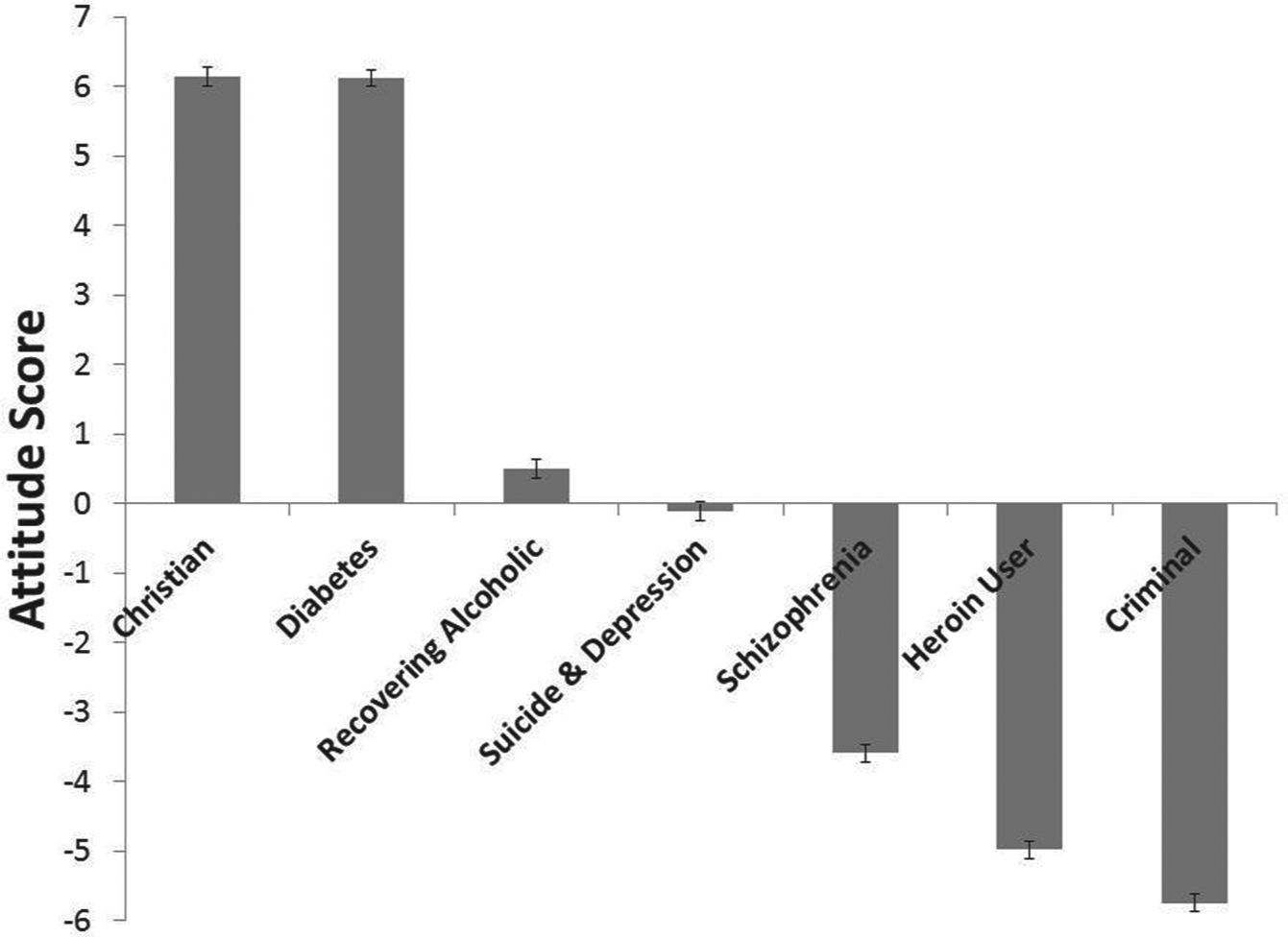
Seven vignettes describing different scenarios were used to assess attitudes towards mental illness and the results are summarized in Figure 2. For the mental illnesses highlighted in the vignettes, knowing someone with a mental illness did not significantly alter the overall attitude (p > .05). Similar results were found for ethnicity and religion (p > .05), although with respect to gender, females demonstrated a more negative attitude to heroin use (-5.2±0.14 vs -4.6±0.2, p = .014) and schizophrenia (-3.8±0.16 vs -3.3±0.22, p = .045) when compared to males.
Discussion
Knowledge
One of the key requirements to improving attitudes towards mental illness and removing stigmatization is the ability of persons to identify a condition as a form of mental illness (Jorm, 2000; Corrigan & Watson, 2002). The majority of participants in our study agreed that schizophrenia, bipolar disorder and depression were mental illnesses, although far fewer persons agreed that drug abuse was a form of mental illness. It should be noted that in our study students had to simply indicate if they agreed that a particular condition was a mental illness, and not recognize the illness based upon symptoms presented in a vignette as is often the case in other studies. These results are in sharp contrast to recent findings from Qatar (Bener & Ghuloum, 2011) and Delhi, India where almost half of the subjects did not recognize mental illness as a disease (Kishore et al., 2011). A possible explanation for this large difference is that the studies from Qatar and India were conducted among the general public and thus one would expect the identification rates to be somewhat lower, although maybe not to the extent observed, than in our study that targeted university students. In support of this, our findings were much more consistent with a similar study among tertiary-level students in Australia (Reavley et al., 2012).
Despite being able to identify mental illnesses, the overall knowledge about mental illness among our university student population can best be described as limited. The average knowledge score was 58 and thus similar to that found in high-school students (lower educational level) in America (Wahl et al., 2011). Our results are similar to a study conducted among students at the University of Zurich (Lauber et al., 2005) who also had difficulty recognizing specific symptoms of schizophrenia and had a number of false beliefs. Students in this Swiss study however scored very highly on recognizing symptoms of depression. Similar gaps in knowledge were found among another study of high-school students in the USA (Wahl et al., 2012) and thus the need for educational intervention starts even earlier than the tertiary level.
Not surprisingly, persons who knew someone with a mental illness scored significantly higher on the knowledge questions, although there were no other relationships with respect to ethnicity, citizenship or religion. Females also scored higher showing greater knowledge accuracy than males, something that has also been seen in other studies among students (Reavley et al., 2012; Lauber et al., 2005). A closer examination of these results demonstrates that knowledge was particularly inaccurate in the area of aetiology, with many participants not recognizing that mental illnesses have an underlying biological cause. It has been thought that if the lay public were educated and understood that mental illness did have an underlying biological cause, it would improve attitudes to these disorders. However, results out of Europe now report otherwise, with some reports even suggesting that this knowledge might increase stigmatization (Jorm et al., 2005; Schnittker, 2008; Angermeyer et al., 2011). These findings are important, as while it may be tempting to create educational campaigns that seek to explain the biogenetic causes of mental illness, given the limited budgets available for such activity in the Caribbean, this money might be more profitably directed into anti-stigmatization strategies.
The challenge associated with education and reducing stigma was also borne out by the fact that subjects viewed persons suffering from mental illness as having little hope of a cure. This is consistent not only with the report from India but also with a recent study from Sweden where mental health literacy is supposedly much higher than in the developing world (Dahlberg et al., 2008). Such data suggest that diagnosis with a mental illness is viewed as a lifelong condition. Thus such a diagnosis becomes a marker of identity and is potentially one of the reasons why persons suffering with mental illness often avoid seeking help or revealing the diagnosis to others (Segal et al., 2005; ten Have et al., 2010).
Participants in our study also scored poorly on questions related to the signs and symptoms of mental illness. Most people felt that persons with a mental illness would be unable to succeed in a range of professional endeavours, and viewed persons with mental illness as violent, dangerous and prone to lying. This probably does not simply reflect a lack of knowledge about mental illness but also stigmatization, which has been demonstrated in the region previously (Eaton et al, 2011). Interestingly, even though our results do suggest potential stigmatization by our subject population, this group also demonstrated a high awareness that stigmatization was an issue for persons with mental health concerns, supporting the fact that persons often view others as more likely to hold such negative attitudes as compared to themselves (Reavley & Jorm, 2011).
Attitude
Attitude was assessed using the AMIQ and our findings suggest attitudes consistent with considerable stigmatization towards persons suffering with mental illness. As with the original study (Luty et al., 2006), persons who experience extreme stigmatization (i.e. a convicted criminal) were scored very poorly and those who experience little or no stigmatization (i.e. Christian) were scored very highly, suggesting good face validity in our population. The vignette that highlighted diabetes was also scored highly and provided a good positive control of a disease with little stigma attached to it. As a whole the four mental illnesses assessed – alcohol abuse, heroin addiction, schizophrenia and depression – were all viewed in negative light but surprisingly this was true whether or not subjects knew someone with a mental illness, although such findings have also been reported elsewhere (Byrne, 2000; Crisp et al., 2005).
With regards to specific mental illnesses, the vignette describing a person suffering with heroin addiction was seen in a particularly poor light and scored the most negatively. This was especially so among females who scored significantly lower for this vignette. This negative attitude, coupled with the fact that many persons did not think that drug addiction was a mental illness, suggests that in our population drug use is seen as a matter of choice and possibly a moral failing. Such attitudes were widespread in developed countries more than 20 years ago but since that time neuroscientists have in many cases classified addiction as a disease, although this is still somewhat controversial (Volkow & Li, 2004; Stanbrook, 2012). This classification seems to have removed the association of addiction with moral failing but still, as discussed above, it has not eradicated stigmatization. The vignette associated with a recovering alcoholic scored much higher than heroin addiction, but still the overall attitude could not be described as positive. Reasons for this higher score are that opiate addiction has traditionally been viewed in a particularly negative light (Luty & Grewal, 2002) and alcohol consumption in the Caribbean is widely accepted as part of the social fabric and is in many cases encouraged (Reid et al., 2012).
Among the other vignettes, the description of schizophrenia was also viewed very unsympathetically, which is consistent with widespread negative stereotypes about persons suffering with schizophrenia (Lysaker et al., 2007; Smith et al., 2011). Potential sources of such attitudes are revealed by the knowledge questions, which demonstrated that most persons thought that schizophrenia was associated with multiple personalities and violence. Compared to schizophrenia, depression was viewed more positively, but again the overall response of participants was suggestive of a poor attitude and stigmatization. There were no other significant relationships between attitude to any of the mental health vignettes and ethnicity, religion or country of origin. The issue of ethnicity is important because previous work originating in the USA has suggested that persons of African American descent were more likely to have negative attitudes towards persons with mental illness (Anglin et al., 2006). Our work highlights that such findings may not be the result of racial differences but other social factors associated with the African American community.
Limitations
Our study was confined to university students as it was felt that this group represented the future policy makers in society and those most likely to effect change in years to come. However, the use of a well-educated population is a limitation of our study, making generalization to the wider population challenging. There is an obvious need for further work among the general populace as lack of knowledge, false beliefs and poor attitudes affect this group and can lead to stigmatization and reduced help-seeking behaviour.
This study was conceived as a regional study and as such sampling was carried out at the three main campuses of the University of the West Indies, each of which enrols students from across the English-speaking Caribbean. However, despite our efforts, the vast majority of subjects came from the host countries of Trinidad & Tobago, Jamaica and Barbados. This highlights the difficulties and challenges with conducting such research across several small-island states. Despite this, our sample is fairly consistent with the demographic profile of the university population across the region.
Given that this was the first study of its kind in the region, we sought to capture subjects’ knowledge and attitudes towards mental illness in general rather than target specific disorders such as schizophrenia or depression. Given the number of clinical conditions encompassed by the term mental illness, our instrument needed to be fairly broad and so was not suited to providing detailed information about any one condition or significantly comparing knowledge and attitudes between the different types of mental illness. To do so would have made the instrument clumsy, time consuming to complete and would have reduced the response rate.
In addition, we recognize the limitations of both the knowledge scale used and the AMIQ. The knowledge scale had one or two questions that may have been somewhat vague, leading to difficulty agreeing or disagreeing. We made use of the answers suggested by Wahl et al. (2011) to define accuracy. The AMIQ is a self-report questionnaire and we recognize that despite our best efforts to assure subjects that confidentiality would be respected and the survey was anonymous, some persons may have answered according to expected social norms.
We also note that although the AMIQ was validated when originally developed, there is no gold standard available for measuring stigma and this is the first time that it was used in our population.
Conclusion
In conclusion, our study is the first to examine knowledge and attitudes towards mental illness across the Caribbean. Our results suggest that knowledge about mental health is limited and persons demonstrate a high level of stigmatization towards mental illness. Given that this study was conducted among university students, supposedly the most well educated in the region, knowledge and attitudes among the general public may be comparable but are in all likelihood significantly worse. Our work thus highlights the dire need for campaigns to improve knowledge and attitudes across the region. However, it is worthwhile noting that despite similar widespread efforts in more developed countries, problems associated with stigmatization still persist (Byrne, 2000; Stilton et al., 2011). It is now being suggested that such campaigns might be more effective, both in terms of results and financial outlay, by using smaller, more targeted approaches, including direct interaction with persons suffering with mental illness with subsequent monitoring of results, utilizing the full range of social media tools now available (Evans-Lacko et al., 2010; Yamaguchi et al., 2011). In addition, these efforts should focus on individual conditions as opposed to broadly targeting mental illness in general (Reavley & Jorm, 2011). Such approaches are ideally suited to the Caribbean region, which comprises small-island states each with their own unique characteristics that would be better served by a smaller more targeted approach to education. It is hoped that this study provides the first small steps in that direction and further initiatives and interventions will go some way to reducing long-held misconceptions about mental illness that ultimately increase the burden upon persons already suffering with mental illness.
Footnotes
Funding
This research received no specific grant from any funding agency in the public, commercial or not-for-profit sectors.