






Abstract
Aims:
This ecological comparison study explored temporal trends since 1985 in age-adjusted suicide and homicide rates for older male adults (over the age of 65) resident in the EU and the Russian Federation.
Methods:
The data were extracted from the World Health Organization’s (WHO) European mortality database.
Results:
Older men resident in the Russian Federation had a higher risk of dying a violent death (by homicide and by suicide) than their younger compatriots (relative risks (RR) ranging from 1.13 to 1.31). Conversely, in the EU, older men had a higher risk of dying from suicide (RRs of 1.52 for men over the age of 65 and 3.27 for men over the age of 75) and a lower risk of being victims of homicide (RRs ranging between 0.84 and 0.89) than their younger compatriots.
Conclusions:
The European region is characterized by great inequalities in rates of violent deaths among the elderly.
Introduction
Unintentional and intentional injuries are major causes of disability and death among older adults. Although older adults die in greater numbers as a result of chronic conditions (such as cardiovascular diseases and cancer), injuries and violence remain important public health issues for this age group. For example, the suicide rate for the elderly in most countries is higher than that of any other age group, with the rates among people over the age of 75 roughly three times that of adolescents (WHO, 1999). In the USA between 1990 and 1996, older adults accounted for approximately 20% of all the suicides, and 5% of all the homicides (Stevens et al., 1999).
Pritchard and Hansen (2005) investigated the differences in international suicide rates by gender and age over a 20-year period (1979–99). The study included Australia, Canada, England and Wales, France, Germany, Italy, the Netherlands, Spain and the USA. The authors reported that the suicide rate of those over the age of 65 had declined in several countries, especially in England and Wales, which had the greatest proportional reduction. However, despite the substantial improvements over the past 20 years, the elderly still remain at the highest risk for suicide.
The perceived risk of being a victim of violence among older adults tends to be greater than the actual risk (Greve, 1998; McCabe & Gregory, 1998; Ortega & Myles, 1987; Warr, 2000). For example, Eilertsen, Lilleng, Mæhle and Morild (2007), investigating a series of medico-legally examined deaths in older people in western Norway that were considered unnatural after forensic examination, reported that homicide is uncommon as a manner of unnatural death among the elderly in their sample. This ‘victimization-fear paradox’ among older adults is related to their perception of having a higher physical vulnerability than younger persons (Stafford & Galle, 1984). Fear of being a victim may limit the quality of life of older adults (Ross, 1993) and their participation in activities outside their homes, as well as their use of and access to health care (Joseph, 1997).
A high level of protection against the risk of illness and dependence is a vital asset for Europe and, while improved health care has contributed to prolongation of the expected lifespan for the European elderly, violent deaths assume increasing importance. Self-inflicted injuries and interpersonal violence can be studied, predicted and prevented. Thus, increased knowledge and insight into this phenomenon has vital meaning for European health policies.
This study describes the pattern of violent deaths (homicide and suicide) among the male elderly population in the European region, comparing the EU and the Russian Federation. These two political entities contain 71% of the 885 million inhabitants of the European region. Mortality trends in the World Health Organization (WHO) Europe have diverged since the late 1960s and worsened after the collapse of the communist system in 1989–91 (Shkolnikov & Mesle, 1996). However, after the admission of several Eastern European countries into the EU, the situation may have become more puzzling, with trends in mortality different for early EU countries, new EU countries and the Russian Federation.
Because the EU underwent important political and border changes in the last decade, we included separate analyses for both early EU members (those countries admitted to the EU before 2004: Austria, Belgium, Denmark, Finland, France, Germany, Greece, Ireland, Italy, Luxembourg, Netherlands, Portugal, Spain, Sweden and the UK) and countries admitted to the EU since 2004 (Bulgaria, Cyprus, Czech Republic, Estonia, Hungary, Latvia, Lithuania, Poland, Slovakia, Slovenia, Malta and Romania). A recent study (Innamorati et al., 2010) analysing differences between early EU members and new members, indicated small but significant differences in age-adjusted suicide rates between early and new members. Men over the age of 65 who were members of the new EU nations were almost 1.03 times as likely to kill themselves as men in the same age group who were members of the early EU nations (z = 15.88, p < .001).
Methods
Data
This ecological comparison study explored temporal trends since 1985 in age-adjusted suicide and homicide rates for men over the age of 65, and men over the age of 75, resident in the EU and the Russian Federation. The Republic of Chechnya was not included in the national mortality and other health statistics for the period 1993–2003. The data were extracted from the WHO’s European mortality database (MDB). The MDB contains exclusively mortality-based indicators and is a supplement to the generic European health-for-all database. The raw mortality data are submitted by the European WHO member states to the WHO Regional Office for Europe or to the WHO Headquarters. The age-adjusted suicide and homicide rates retrieved cover the years 1985–2006.
Statistical analysis
To analyse state-related differences in age-standardized rates of violent deaths for the period 1985–2006, we estimated relative risks (RR) with their 95% confidence interval (95% CI) via Poisson regression with robust error variance and Newton-Raphson’s maximum likelihood optimization technique (Zou, 2004).
To explore trends in age-standardized violent death rates, we used loglinear joinpoint regression models. Joinpoint regression analysis identifies points where a statistically significant change over time in the linear slope of a trend occurred (Kim, Fay, Feuer & Midthune, 2000). We used a grid-search method to fit the regression function with unknown joinpoints assuming constant variance and uncorrelated errors. Then, we set the minimum/maximum number of joinpoints to 0–3 and tested how many joinpoints were statistically significant and should be added to the model. Permutation tests were used to select the best model. In the final model, each joinpoint indicates a statistically significant change in trend. To describe changes in rates, we calculated the annual percentage change (APC). Joinpoint analyses were performed using the Joinpoint Regression Program v. 3.3 of the US National Cancer Institute.
All the analyses were performed with commercial statistical packages (STATA 9.0, SPSS 13.0).
Results
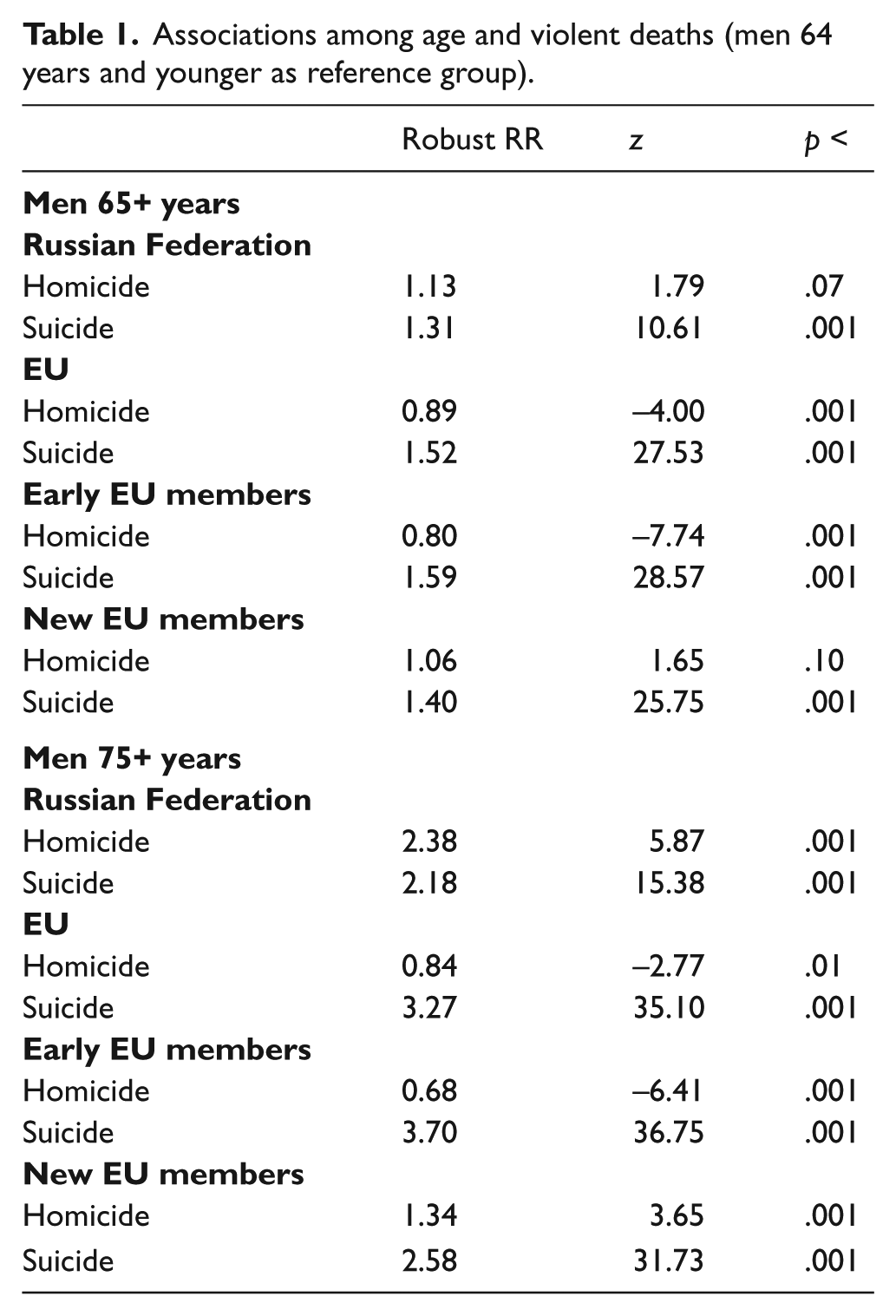
Between 1985 and 2006 Russian men over the age of 65 had a higher risk of dying from a violent death (by homicide and by suicide) than their younger compatriots (RR ranging from 1.13 to 1.31), and the risk was much greater for men over the age of 75 (RR ranging from 2.18 to 2.38) (Table 1). Conversely, in the EU older men had a higher risk of dying from suicide (RRs of 1.52 for men over the age of 65 and 3.27 for men over the age of 75) and a lower risk of being victims of homicide (RRs ranging between 0.84 and 0.89) than their younger compatriots. However, older men living in the new members of the EU had a risk more similar to those in the Russian Federation than those in early EU members (homicide RRs between 1.34 and 1.40; suicide RRs between 1.06 and 2.58).
Associations among age and violent deaths (men 64 years and younger as reference group).
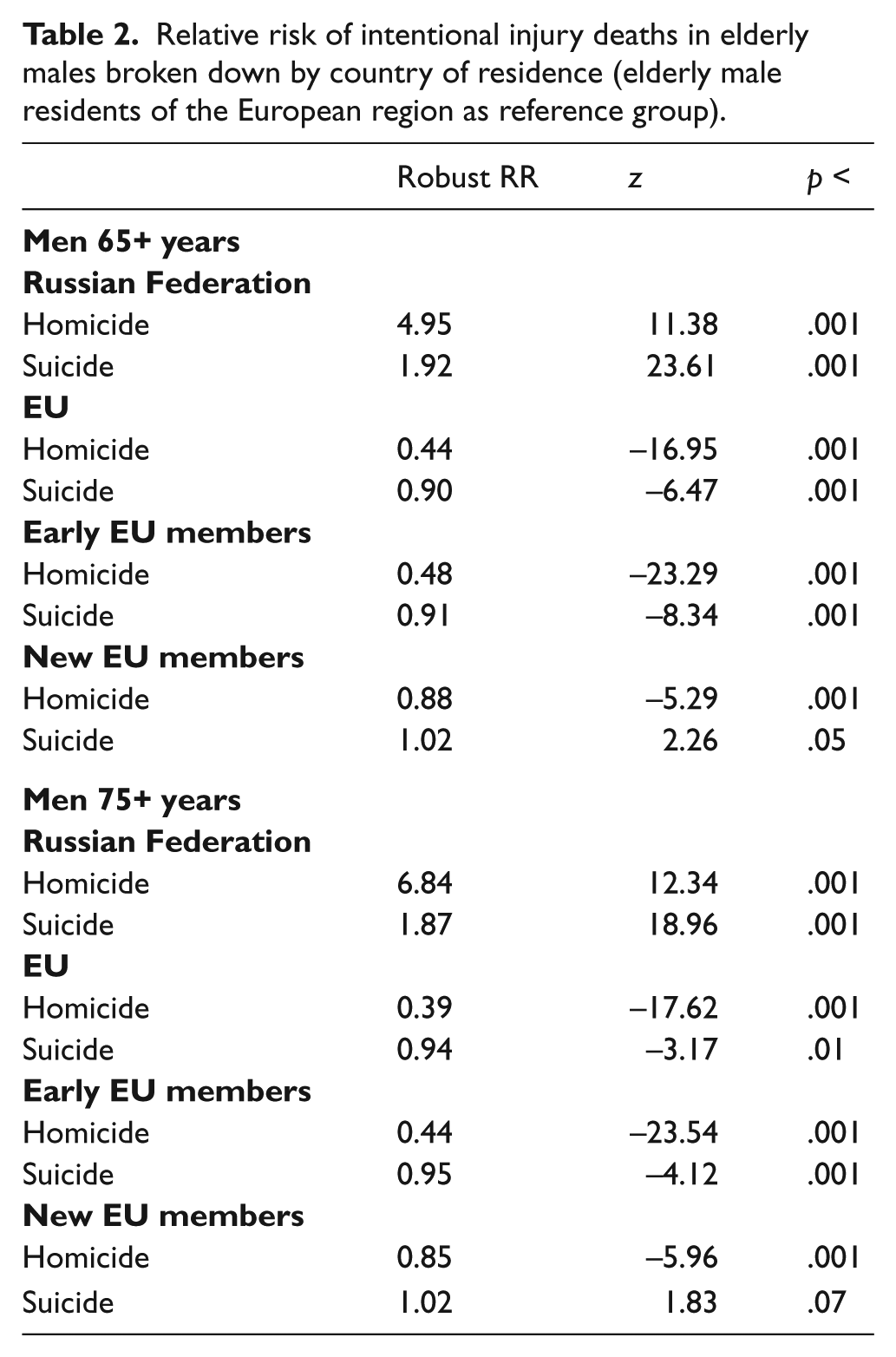
When comparing risk of violent death in older men in the Russian Federation and EU with those of the European region as a whole, the risks were much higher in the Russian Federation (RRs for homicide between 4.95 and 6.84; RRs for suicide between 1.87 and 1.92), and lower in the EU (RRs for homicide between 0.39 and 0.44; RRs for suicide between 0.90 and 0.94) (Table 2). In these comparisons, new EU members had risks between those of early EU members and those of the Russian Federation (RRs for homicide between 0.85 and 0.88; RRs for suicide of 1.02).
Relative risk of intentional injury deaths in elderly males broken down by country of residence (elderly male residents of the European region as reference group).
The current risk of being a victim of a violent death in elderly men in the Russian Federation is a result of a large increase in homicide rates between 1985 and 1994 (APCs between 12.70 and 63.95) and a new rise since 1997 (APC of 4.28, p = n.s.), after a short period of a decrease in homicide rates between 1994 and 1997 (APC of -21.28) (Table 3, Figure 1). In contrast, in the EU homicide rates increased more slowly between 1985 and 1992 (APC of 5.71) and then decreased between 1992 and 2006 with a comparable speed (APC of -4.46). On the other hand, the current situation of new EU members was a result of a large increase in homicide rates between 1988 and 1991 (APC of 24.36). When comparing suicide rates trends with those of homicide rates, the situation was more stable in both the Russian Federation and the EU. In this case, suicide rates in men over the age of 65 decreased during the years investigated both in early EU members (APCs between -1.04 and -2.24) and new EU members (APC of -1.66).
Joinpoint analysis.
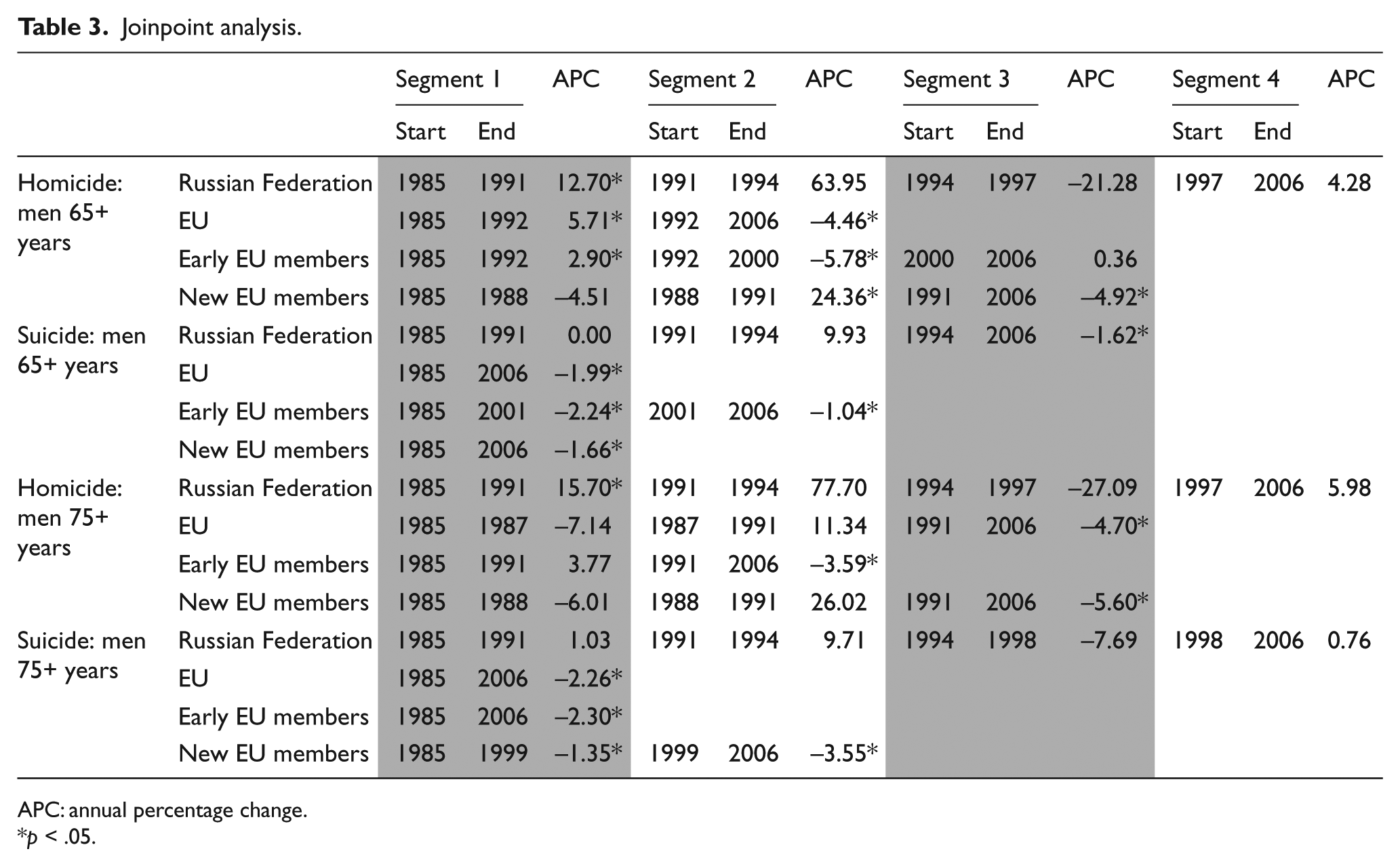
APC: annual percentage change.
p < .05.
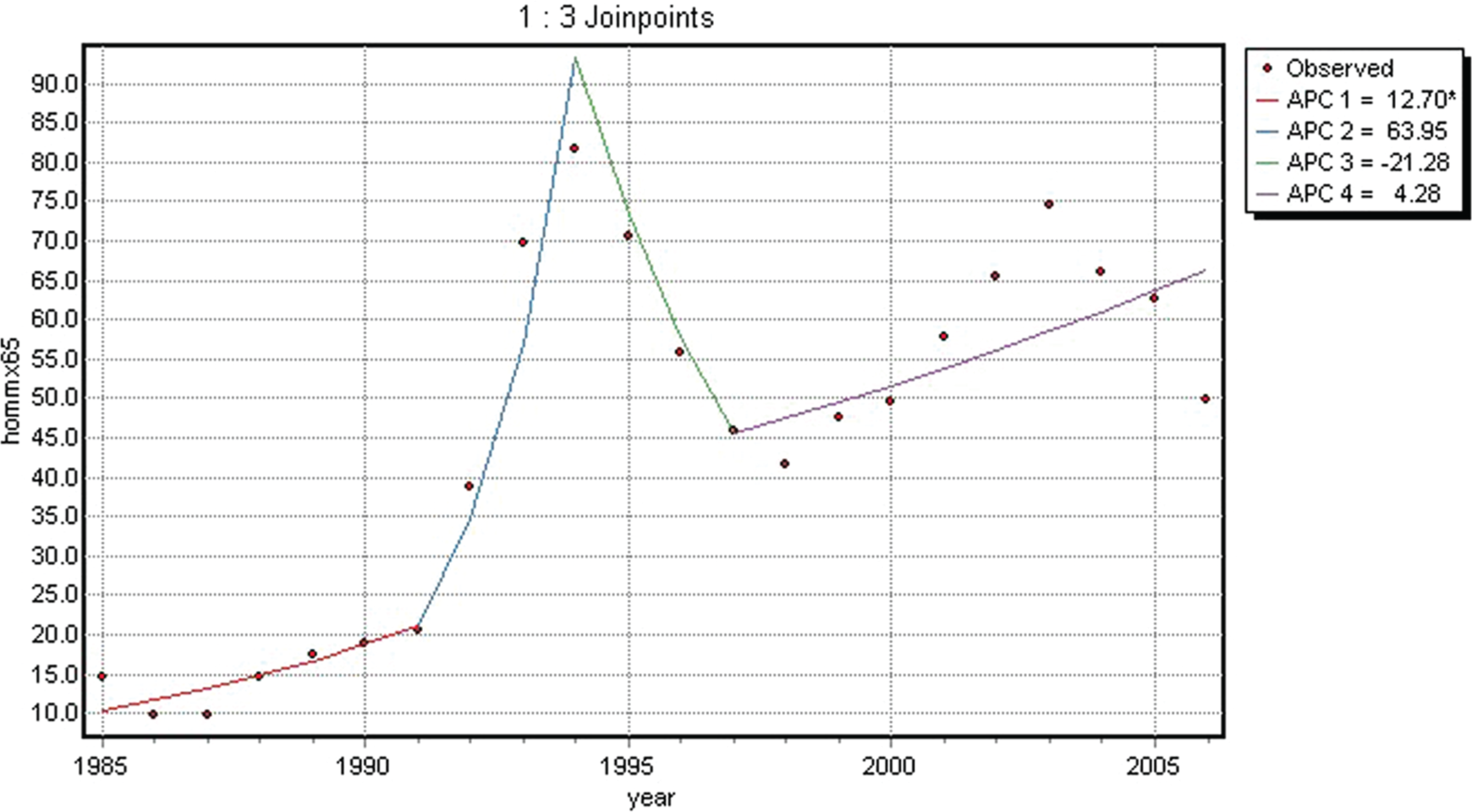
Homicide trend in the Russian federation for men 65+ years.
Discussion
The aims of the present study were to describe the pattern of violent deaths (homicide and suicide) among elderly men in the EU and the Russian Federation, two of the biggest political entities of the region, representing together about 71% of the total inhabitants of Europe.
Our results indicate that older men have a higher risk (from 31% to 270%) of committing suicide than younger men both in the EU and in the Russian Federation. When considering deaths by homicide in elderly men, our results support the conclusions of Eilertsen et al. (2007), indicating that homicide is uncommon as a manner of unnatural death among the elderly. This may be valid for elderly men in the EU countries that joined early (between 1985 and 2006 the average homicide rate was 1.04 per 100,000 per year for adults over the age of 75, and 1.53 for younger men), but less valid for elderly men in the new EU members where the risk of dying from homicide for elderly men is 34% higher than that for younger men (between 1985 and 2006 the average homicide rate was 6.27 per 100,000 per year for adults over the age of 75, and 4.69 for younger men), and not valid for the Russian Federation where the risk of dying from homicide for elderly men is 138% higher than that for younger men (between 1985 and 2006 the average homicide rate was 12.15 per 100,000 per year for adults over the age of 75, and 10.47 for younger men).
Violent deaths among elderly men in the Russian Federation are also more frequent than violent deaths among elderly men in the European region as a whole, while older men in the early EU members are at a lower risk of dying from a violent death than elderly men in the European region as a whole. Older men in the new EU members have a higher risk of dying from a violent death than those in the early EU members and lower than those in the Russian Federation, especially when considering deaths from homicide. The current situation in Russia is due to a large increase in deaths from homicide since 1985. As reported by Brainerd and Cutler (2005), deaths due to external causes rose dramatically in the early 1990s in the Russian Federation, and this change accounted for one-fifth (for women) and one-third (for men) of the total increase in deaths between 1989 and 1994. This situation led to a six-year reduction in male life expectancy at birth in Russia between 1989 and 1994 (Brainerd & Cutler, 2005; Notzon et al., 1998).
Inequalities in the rates of violent death between early EU countries, new EU countries and the Russian Federation may be a result of the structural social disorganization resulting from the widespread social, political and economic change that affected the Russian Federation and the eastern countries of the EU (Gavrilova, Semyonova, Evdokushkina & Gavrilov, 2000; Leon & Shkolnikov, 1998). Some authors have suggested that an increase in the use of alcohol was a mediator in the association between social, political and economic changes following the dissolution of the USSR and the rise in violent deaths (Gavrilova et al., 2000; Pridemore, 2002; WHO ECEH, 2006). However, other factors may be involved and, as Makinen (2000) has indicated, rapid transformations of society do not necessarily result in a higher suicide rate, and those aspects of society that usually change very slowly may buffer the association between violent deaths and rapid societal change.
Our results are in contrast with the results of a study by Gavrilova et al. (2000) who studied mortality in Russia up until 1998 and indicated that, despite the common belief that the elderly are the most vulnerable part of population, there was no significant change in violent mortality for those over the age of 70.
Limitations
There are some limitations to the generalizability of the results of our study. The death rates analysed may be biased at the state or regional level. For example, data may be biased by possible state-level differences in death certification procedures, or certification of unnatural deaths may be under-reported (Atkinson, Kessel & Dalgaard, 1975; Lu, Shaw, Hsu, Chen & Huang, 2008; WHO, 1974), although some authors consider national death statistics such as those for suicide reliable enough to be used in comparative epidemiologic studies (Barraclough, 1973; Sainsbury & Barraclough, 1968; Sainsbury & Jenkins, 1982). Not all countries produced official mortality data for all of the years examined (e.g. several countries did not produce official data for 2006). These factors could falsely exaggerate differences in the suicide and homicide rates among the groups of countries investigated. Finally, statistics for the Russian Federation included all the population of this huge country that extends well beyond the borders of the European continent, despite that fact that around 80% Russian Federation lives in the European part of the country.
Conclusions
In conclusion, the European region is characterized by great inequalities in rates of violent deaths among the elderly. Older men residing in the European region are highly vulnerable to violent death, especially those residing in the Russian Federation who have a greater risk of dying from homicide and self-inflicted death than younger people residing in the same countries or elderly men residing elsewhere in the European region.
Footnotes
Funding
This research received no specific grant from any funding agency in the public, commercial or not-for-profit sectors.