







Abstract
Background:
Gender differences are one of the most important and crucial subjects in evaluating the nursing care as well as mental health care system for psychiatric patients especially patients with schizophrenia.
Aims:
We aimed to identify differences in needs of male and female patients with schizophrenia in psychiatric hospitals in Baghdad city and its relationship with some variables.
Method:
A descriptive, analytical design that was carried out by using Camberwell needs assessment, short appraisal schedule, self-report version (CANSAS-P) after translating to Arabic.
Results:
Results indicated that there were a lot of unmet needs of male and female patients with schizophrenia, according to the entire CANSAS-P domains especially psychological symptoms. Differences were found in types of needs as the majority of men have more social needs while females was found to be more occupied with their fears and need safety.
Conclusion:
there were differences in types of need between male and female patients with schizophrenia; needs were affected by some variables such as educational level, first 10 days of admission and family visiting.
Introduction
Gender differences inpatients with schizophrenia
Gender differences are a major aspect of psychiatric nursing and it is one of the most interesting subjects of Schizophrenia in Men and Schizophrenia in Women. The current research built upon the genetic and hormonal differences between Schizophrenia in Men and Schizophrenia in Women (Abel, Drake, & Goldstein, 2010; Arvidsson, 2010 and Häfner, 2003). Differences in maturation and morphology of the brain of patients with schizophrenia reflects the differences in patients’ behavior and their clinical course (Häfner, 2003; Gur & Johnson, 2006), although some reports in literature about the differences in the characteristics of male and female patients with schizophrenia proposed mainly from differences in social role as antidopaminergic properties of estrogens may be protective in females (Seeman, 1990) and lead to late onset of the disease (Castle & Murray, 1991; Zanelli et al., 2013; but Abel et al. (2010) and Grossman, Harrow, Rosen, Faull & Strauss 2008 reported that estrogen role was not clear and other factors maybe more important in regard to men and women psychoses. The need to address differences in psychiatry and psychological problems and psychopathology between the genders is now widely accepted (Piotrowski, 2005) and mental health professionals from various backgrounds have contributed to the recognition of these differences (Kennedy, 2001; Ramsay, Welch, & Youard, 2001).
Needs assessment of male and female patients with schizophrenia
Needs assessment is the addressing of the gaps between current conditions and what the patients desired or wants.The need can be a desire to improve the current performance or to correct a deficiency (Kizlik, 2010). Needs are defined here as the difference between the optimal and the current state of the patient, in mental health field, and for which there is an effective intervention that could reduce this gap and providing a good psychosocial care (Lavinia et al.2016). The assessment of clients’ needs is the first and the most important integral part of health service planning (Manamela, Ehlers, Van der Merwe & Hattingh, 2003; Torres, Rosales, Moreno, & Jiménez 2000).The clinical and social needs of patients with schizophrenia have been proposed as an essential first step to the planning and implementation of patient-specific care plans (Hansson et al., 2001). Treatment Planning and services for patients with schizophrenia should begin with theidentification of patients’ needs and clear definition of the desired outcomes in order to coordinate the patient specific care. Assessment of need has become an important indicator, it has special relevance in the process of psychiatric treatment reform (Alvarado et al., 2012) and it is considered to be a key element of mental health care (Bellier-Teichmann, Golay, Bonsack, & Pomini, 2016). Health needs assessment is not a process of listening to patients or relying on personal experience it is a systematic method of identifying unmet health and health care needs of a population and making changes to meet these unmet needs (Quality improvement & Inovvation Partnership 2009). In schizophrenia the needs assessment affects its clinical course, be itrelevant in its management and allow for a better design of treatment in order to obtain better therapeutic results and recovery (Jorquera, Alvarado, Libuy, & Angel, 2015). Our main goal formental health care is to improve the quality of life of users. A policy of actively addressing patients rated needs should be implemented (Lasalvia et al., 2005). More research began to evaluate needs by focusing on their existence, and the degree to which they were met.
Differences in needs between male and female patients with schizophrenia
Studies performed in several countries with severe mental disorders individuals. Some of these studies didn’t find differences in the number of needs, but there were differences in the type of needs; women had more unmet clinical needs and men had more unmet social needs (Wiersma, 2006 and Ochoa, Usall, Cobo, Labad, & Kulkarni, 2012). Other studies suggest that gender affect clinician’s diagnostic practice and conformed that schizophrenia dianosos is more often givento a male than female (Høye, Rezvy, Hansen & Olstad, 2006). Unmet needs were associated with only clinical variables while global functioning and severity of clinical symptoms acted indirectly through them (Alvarado et al., 2012). Differences in age of onset and other variables were found; men had an earlier age at onset; women were more likely to be married and live independently and there were more unemployed men. Social functioning was better in women. No differences were found in symptomatology variable or in the type of schizophrenia (Usall et al., 2001). Thornicroft et al. (2002) put forward a need related hypothesis concerning gender and schizophrenia, that men will have more and more unmet needs according to CAN for accommodation, substance misuse, psychotic symptoms, harm to others, sexual expression while women will have more unmet needs in care of the child and safety to self and the result confirmed the hypothesis. Arvidsson (2010) found that the structure of needs differed between men and women; men had more needs concerning functional disability and those needs seemed impossible to be met in the existing service structure. Women needs concerning physical health, information about health and own security seemed to be more difficult to meet. It seems urgent to have gender perspectives in needs-led mental health care services. Hansson et al. (2001), Korkeila et al. (2005) and Andrés, Isabel and López (2011) found that, key workers identified slightly more or different unmet needs than patients do and that related to a number of factors associated with the key worker and patient, they concluded that further research is needed to know the source of this agreement. Bengtsson-Tops and Hansson (1999) reported that the highest unmet needs of patients with schizophrenia were informed; company, intimate relationship physical health, daytime activity and psychological distress and they concluded that further information toward treatment of psychotic symptoms, psychological distress and toward social and occupational situation. Unmet needs associated with poverty, lower education and persistent psychopathology (Ernest, Nagarajan, & Jacob, 2013). Needs were different in chronicstae of patients with schizophrenia and the services should focus on social skills training and psycho-educational approaches (Kallert, Leisse, & Winiecki, 2004). Culture influences the ways individuals communicate and manifest symptoms of mental illness, style of coping, support system, and willingness to seek treatment may be affected as well (Versola-Russo, 2006; W.H.O, 2003).
Differences in needs of patients with schizophrenia in Arab country
Muslims’ culture may differ from other culture, but there are no studies about the needs gender differences in schizophrenia in Arab communities. Such as Aldeham (2009) assess the needs of psychiatric service users among 155 patients at Al-Amal Complex for Mental Health in Riyadh, Saudi Arabia, and the results were found that elderly, poor, and the uneducated are more likely to have a higher total number of needs, Men and women report similar met needs, but women expressed more unmet needs. Douki, Ben Zineb, Nacef and Halbreich (2007) study how the Muslims’ women’s mental health affected by cultural, religion and social issues. Other research studies the differences in neuropsychological profile between women and men in the first episode and the important findings in gender differences in schizophrenia (Ochoa et al., 2012). Bener and Ghuloum (2011) conducts a study on Qatari and other Arab psychiatric patients to determine the gender difference on their satisfaction with psychiatrists and explore their expectation from physicians to mental health care needs and it was found that male had a greater expectation than female. This study is the first study about the differences in needs between male and female patients with schizophrenia conducted in Iraq. Our questions in this research will be: are men have more unmet needs than women and are there any differences in the types or structures of needs between man and women patients with schizophrenia and finely which type of variables increase the patients’ need.
Material and methods
Permission to conduct the present study was issued by Iraqi Ministry of Health/Training & Developing Center and obtained also from the Ministry of Health/Training & Developing section. This is a descriptive correlation analytic design that was used in order to achieve the objectives of the present study.
Sample and sitting of the study
There were 105 patients treated at two psychiatric hospitals in Baghdad city which fit the criteria of inclusion; only 80 patients agree to participate in the study. Researchers took the ethics of research in nursing faculty/ Babylon University and the norms of our society into consideration, only the patients who agreed to participate and give verbal consent were included in the study, the rights of the participant were respected throughout the research process; confidentiality was ensured by not sharing any information with others. The sample selected purposively (non-probability sample) during the period2/3/2015 to 17/5/2015. Inclusion criteria includes: both genders (males and females) patients, adult, diagnosed with schizophrenia by psychiatrist according to ICD-10, Patients who have been diagnose with schizophrenia at least one year after .The study was conducted on patient with schizophrenia attending Ibn-Rushd Psychiatric teaching hospital and Baghdad Teaching Hospital/Medical City Directorate. The two hospitals located in Arusaffa sector of Baghdad Health Directorate. About 100 patients visited the clinic of the two hospitals daily but not all of them were admitted to the hospitals.
Measures
Final draft
The final questionnaire was used by the investigators for the present study includes three parts: first the covering letter which includes two sections: section one a covering letter included all information about how to answer the questionaire and obtained the agreement of patients to participate in the present study. The second section includes patient’s personal characteristics and clinical data. Part two includes the camberwell needs assessment for schizophrenic patients (CANSAS-P) which consist of 25 items; such as accommodation, food, looking after the home, self care, daytime activities, sleeping, physical health, sexual expression, psychotic symptoms, thought problems, medication information, frightened fear, feel sad and low, safety to self, safety to others, alcohol, drugs, intimate relationship, childcare, company, basic education, telephone, transport, money, benefits, the items distributed to four domain as follow: 1-8 physical, 9-17 psychological, 18-20 social and 21-25 cognitive. The data were collected through the utilization of the self administrated questionnaire as a mean of data collection. The decision of insight level was made by the psychiatrist; according to five dimensions which include: the patient’s awareness of mental disorder, awareness of the social consequences of disorder, awareness of the need for treatment, awareness of symptoms and attribution of symptoms of disorder. Most of the respondents were cooperative with the investigator.
Results
Demographic and clinical variables
The results shows that, female were older (43.3± 12.0); and that return to the late onset of disease. Of female patient, (Afifi, 2007; Arvidsson, 2010; Ochoa et al., 2012; Usall et al., 2001; Wiersma, 2006) only (27.5) are still married and the others either divorced or widowed and the higher percentage were single (42.5%)(Table 1). Female have children more than male patients and higher educational level, but they were unemployed. Ayesa-Arriola et al. (2014) found that women in the clinical group were older at illness from the onset and have achieved higher formal education than men. The male patients were younger (40.5 ± 10.6), most of them single, half of them in the primary educational level and they are working till now or previously (Table 1). The duration of the disease of female patient was longer than male patients (57.5%) and the number of admissions to hospital for the two groups was 1-5 times, the men were found more attached to the family; they were brought to the hospital by their family and their family visiting them in the hospital more than the female; but there were no significant differences found between male and female demographic and clinical data.
Patients’ Socio-demographic Characteristics (N = 80).
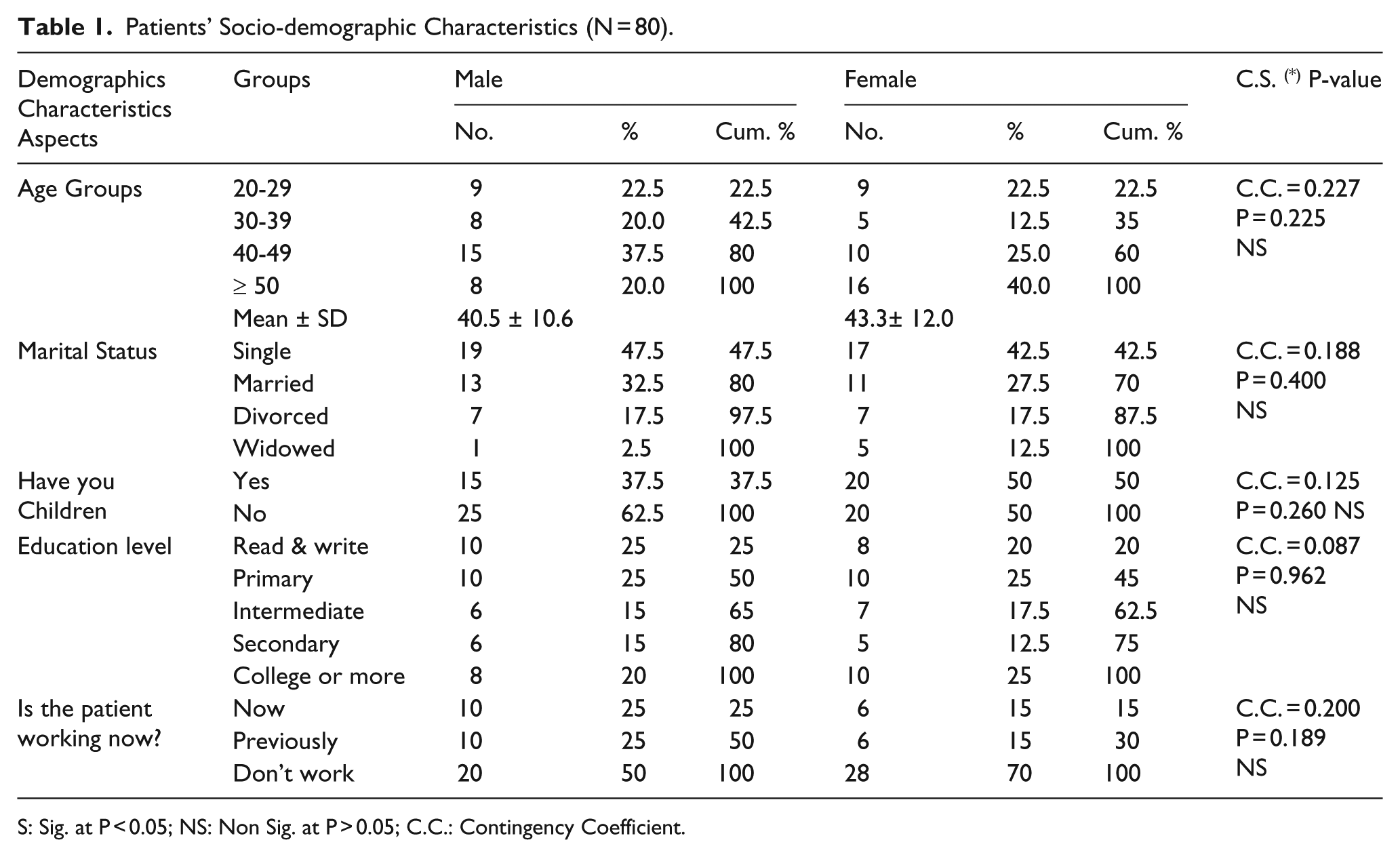
S: Sig. at P < 0.05; NS: Non Sig. at P > 0.05; C.C.: Contingency Coefficient.
The Camberwell assessment of needs
Patientswith schizophreniahave a lot of unmet needs in the entire CANSAS-P items as rated by both male and female, such as psychotic symptoms(90%), problems in thought (92.5%&95%) respectively, feel sad and low(90%&87%) respectively, sleeping(87.5%&82.5%) respectively and sexual expression(62%&50%).
Differences between male and female patients with schizophrenia
Slight differences of needs were found significantly between the two genders. Females were found more occupied and feel frightened than male, while male explained that they need to look after their home, their daytime activity and company. In addition to that, Female showed more unmet needs than male, although it’s not significant such as information on condition and treatment (82.5%), intimate relation (50%) danger to one another (50%) and benefits (60%). About the four domains, there were no differences between male and female in the level of physical, social, and cognitive needs domains, only psychological domain was the higher unmet needs of patients with schizophrenia and it was highly significant at P < 0.01 (Table 2). Which indicated in light of grand mean of scores, that the preceding main domain is representing in the superlative point of needs of male and female patients with schizophrenia. Furthermore, psychological domain responses are accounted failure assessment for male sample and for female, while the leftover main domains are accounted pass assessments. To find out relationship between studied main domain’s responses and gender according to redistribution grand means of score “under/upper” cutoff point, contingency coefficient’s correlation ship are constructed, which shows that Psychological Domain”, contingency coefficient are reported to have strong relationship with significant different at P < 0.05 between male and female responses, as well as odds ratio registered that female sample effected with three and half times increases in contrast of male sample. In terms of simple correlation coefficients, the result shows various significant levels for extracting correlation coefficients among the studied main domains response, and that indicated meaningful interactions (Covariance) are accounted. It was found that cognitive unmet needs associated with patients’ educational level and not affected by age, marital status and working status, and there were no significance. The studied of clinical characteristics aspects, distributed according to gender samples with their comparisons was significant, the results shows significant differences at P < 0.05 which are accounted for between psychological domain and duration of admission, admission route and family visits. Male Needs increased in the first ten days, when brought by their relative and when the family visited them while there was no significance found between clinical characteristic and the other domains.
Summary statistics of comparing needs between male and female schizophrenic patients according to studied main domains.
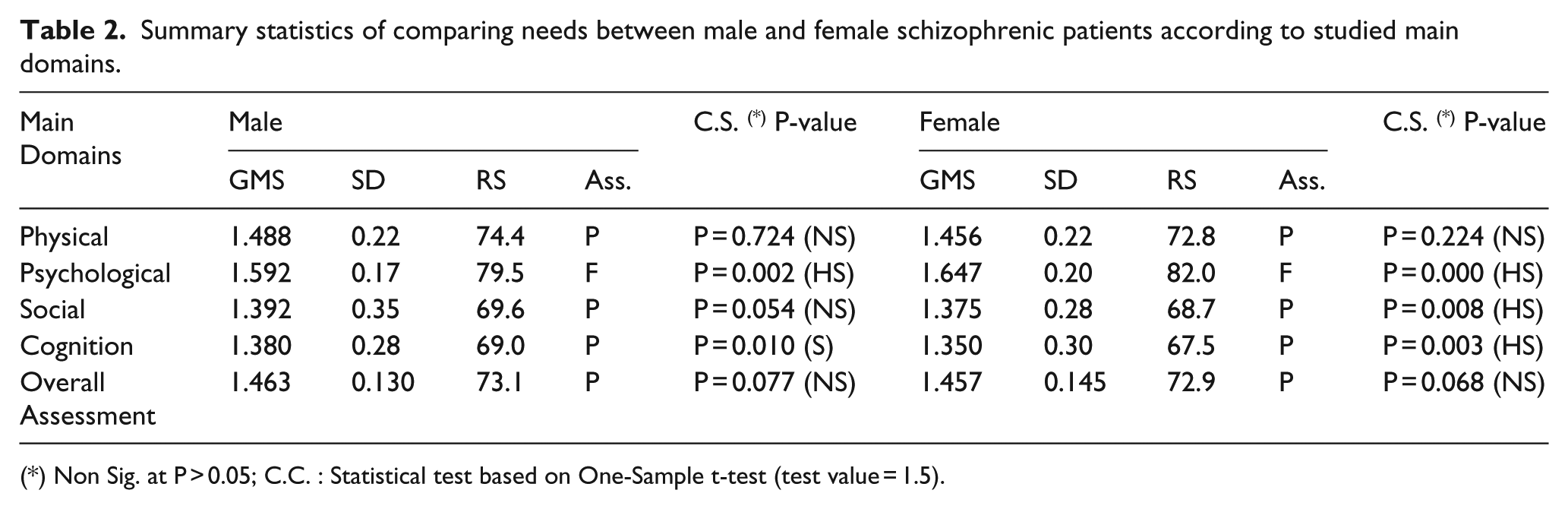
Non Sig. at P > 0.05; C.C. : Statistical test based on One-Sample t-test (test value = 1.5).
Discussion
Differences between genders needs of patients with schizophrenia
This study aimed to identify the needs of male and female patients with schizophrenia, which were admitted to the psychiatric hospitals in Baghdad city and to find the differences between the two genders in their needs. The results show that there were no differences in the number of needs between male and female patients with schizophrenia, according to CAN-P Although female were higher than male but it was not significant. Most of male and female expressed a need in the area of psychotic symptoms, thought disturbance, sad and low mood, sleeping, sexual expression, which can be met by medication and treatment (Iniesta, Ochoa, & Usall, 2012; Ochoa et al., 2003). Arvidsson (2010) and Thornicroft et al., (2002) found a similar result. Many studies search schizophrenic needs and reported that the most frequent need was psychotic symptoms (Jorquera et al., 2015; Ochoa et al., 2003). The result of our study can be explained, because 90% of the patients admitted to the hospital within 10 days and the course of illness appeared active. Differences were found in the type of unmet need between male and female patients with schizophrenia. Similar result was found by Wiersma (2006); male had significant unmet needs which are looking after the home, daytime activity and keeping company which is similar to Popescu & Miclutia, 2009 the result indicated further intervention of social relation for the male patient. Safety to self, spending money needs were found higher for male patients with schizophrenia; social skills training seems to be important for better quality of life for those patients (Lasalvia et al., 2005; Kallert et al., 2004). While the highest significant unmet needs for female were feeling frightened, which is asignificant difference between the two genders and information about medication, intimate relationship, safety for others and benefits also found as a need for female patients but it was not significant. (Arvidsson, 2010; Hansson, 1999) showed similar results and Arvidsson expressed that these needs are difficult to meet, which required having gender differences in our consideration as mental health planners. Another important result was found that females affected were three and a half times higher with psychological symptoms in contrast to male sample. A number of studies have pointed the gender differences, but little studies were found to differentiate the needs differences between the male and female. We also concluded that schizophrenic women have met the social need. And this result is compatible with Usall et al. (2001) who found that schizophrenic women are significantly better in social functioning than men. Another study agrees with our result which is wiersma who found differences in one type of need between men and women; women had clinical unmet needs while men had social unmet needs (Wiersma, 2006).
Sociodemographic characteristics and patient’s needs
About the relation of sociodemographic factors the results show no significant differences at P > 0.05 as accounted between male and female samples, and that is more reliable for this study, since any meaningful deviation may be registered in needs of patients with schizophrenia between the studied samples should be interpreted for gender parameter. Our result indicated that there is no significant relationship between sociodemographic characteristics and patient’s needs, except educational level; it was found that patients with lower educational level had more unmet needs and more need in regards to (basic education, telephone, transport, money, benefits) this result is in agreement with the result of many European and Indian studies (Ernest et al., 2013; Hussein, 2012; Muhammed, 2014; Zahid & Ohaeri, 2013; Varo, González, Castillo, Estévez, & Montes, 2002). The result also showed that the prevalence of unmet needs seems to be related strongly to some of the clinical data such as duration of admission to the hospital, admission rout and family visitation. Alvarado et al. (2012) concluded that only clinical variables were directly associated with unmet needs. The first 10 days, patients who were routed by their families and the one’s family visited were found to be the highest clinical data that increases the psychological unmet needs, while the other clinical characteristics found no significant differences at P < 0.05. Patients think that family wants to punish them when they admitted them to the hospital and this explains why psychological needs increased when they see their family. And this comes because of thought disturbance which is the main symptom of schizophrenia. Using Camberwell –P in this study was effective and successful because it has the ability to detect the met and unmet needs of patients with schizophrenia from the service user’s point of view. It was so sensitive to the patients to talk about their needs and express their perception about their problems. ACN makes it easier for the healthcare providers to identify the needs in more simple and accurate method. The study concluded that there are differences in the type of needs more than the number of needs between male and female patients with schizophrenia. Male patients mainly had more need concerning social functioning and daytime activity while females had more needs about their security. Schizophrenic men and women had a lot of needs, especially in the area of psychotic symptoms which indicated a further intervention. Low educational level, first 10 days of admission, patients routed by their family and family visiting are the main clinical factors that increase the patients’ needs.
Limitations and strengths
The limitation of this study was the small sample of the patients, which may affect the representation of the population because of the difficulty of patients to participate in the study, however, the researcher uses international questionnaire, valid and reliable which enhanced our results and provide opportunities to compare our results with international studies. This is a vital subject that emphasizes the assessment of patient’s needs first; and the only Arabic study that discusses the differences in gender needs in Iraq and reported the type of care that was introduced to patients with schizophrenia in our hospitals. Intervention should be provided for patients with schizophrenia; not only the psychotropic drugs but the psychosocial intervention and social skills training (Singh, Kaloiya, Kumar & Chadda, 2010). Recovery should be both internal conditions experienced by patients and external suchas positive culture of healing and recovery oriented services (Jacobson & Greenley, 2001) which is required to enhance the quality of life for those patients and decrease the time of relapse.
Footnotes
Acknowledgements
We would like to express thanks for all experts for their constructions, doctors and nurses for their cooperation at psychiatric hospitals. A special thanks for people living with schizophrenia, who participates in this study. We hope they get well. I am also grateful for the support and inspiration provided by Dr. Maan H. Ibrahim the department chair of psychiatric and mental health nursing college of nursing/Baghdad University with all respect. Thanks to all members of psychiatric and mental health nursing department.
Conflict of interest
The author(s) declared the following potential conflicts of interest with respect to the research, authorship, and/or publication of this article: There were no conflicts appear in choosing the subject, the subject accepted by ministry of health in Baghdad/Iraq. This topic conducted to see whether gender influence the needs of patients with schizophrenia. The researchers prepared the questioner together and interviewed the participant and collected the data, the researchers analyzed the data and wrote the manuscript to gather.
Funding
The author(s) received no financial support for the research, authorship, and/or publication of this article.