







Abstract
Background:
Despite the lack of attention, suicide is a major public and mental health problem in Indonesia. Research on how Indonesian newspapers portray suicide case has been lacking.
Aim:
To assess the quality of Indonesian online newspaper reporting suicide news and its compliance with the World Health Organization (WHO) mass media reporting guidelines.
Methods:
The content of suicide news reported in online newspapers was searched and scrutinized against the WHO suicide reporting guidelines.
Results:
Within the duration of 6 months, there were 548 suicide news reported. This consisted of 16.8% attempted suicide and 83.2% completed suicide. Approximately 90.3% reported age, 97.3% reported gender and 64.3% reported the marital status of the victims. Furthermore, 68% reported the methods of suicide in headline or title, 40.5% shown the picture of the victims and 56.6% shown illustration only, and 67.2% reported life event related to suicide act.
Conclusion:
The vast majority of online newspapers in Indonesia exaggerate suicide news. They rarely inform the readers that there is hope and help available. The majority also do not conform to the WHO media guidelines.
Introduction
The global incidence of suicides is at a very alarming stage (Fu et al., 2011; Shah et al., 2017). It is estimated that approximately 800,000 people die from suicide every year (World Health Organization [WHO], 2018). The news report of suicide, either in printed or online newspaper, can trigger the readers’ attitude toward suicidal behaviors (Niederkrotenthaler et al., 2009; Pirkis, 2009) or increases people’s desire to die by suicide (Fu et al., 2011; Khan & Reza, 2005; Stack, 2002; Twenge et al., 2018). The Werther effect, the phenomenon where suicide rates increase following the depiction of individual suicide in media, has been found in many countries (Sisask & Varnik, 2012). To anticipate the enormous consequences of the Werther effect, promoting media reporting guidelines to journalists is important as it can alter the way they report suicide news (Fu & Yip, 2008).
There are no national data for suicide rate in Indonesia. However, an average of 24 deaths from suicide per 100,000 population, or 50,000 suicide cases per year, or 1,500 cases per day on average was estimated (Wirasto, 2012). A study among Indonesian students found a lifetime rate of 38% who had at least one intentional self-injury (Tresno et al., 2012). Another study found approximately 4.8% of Indonesian students have ever considered committing suicide while more than half of them (53.5%) made a suicide plan (Lie & Liou, 2012). No further study existed with regard to the epidemiological data of suicide neither among Indonesian adult nor among Indonesian elderly.
In the year 2000, the WHO launched a media guideline for suicide prevention. Several points were raised in this guideline. It encourages media professionals to avoid language that normalizes suicide or considers it as a solution to problems, to avoid prominent placement and excessive repetition stories about suicide, to avoid explicit description of the method used in suicide, to avoid providing detailed information about the site of a suicide, to be careful in using photographs or video footage, to choose the headlines deliberately, to take the chance to educate the readers on suicide, and to provide information about health seeking (WHO, 2008). Nevertheless, this guideline has not seriously been implemented or adopted by Indonesian journalists. Furthermore, the local media guidelines for reporting suicide were unavailable before 2019 in Indonesia. Only in early 2019, the Indonesia press council issued a draft of suicide reporting guidelines for Indonesian journalist (detikcom, 2019). Thus, there was no restriction for the journalist to portray any suicide case in their media. The present study aims to examine the quality of Indonesian online newspaper reporting of suicides and their compliance with the WHO mass media reporting guidelines.
Methods
The suicide news contents were generated from the online newspaper in Indonesia. Using Google news or search function of the online newspapers, the keywords of ‘bunuh diri’ (suicide), ‘melompat’ (jumping), ‘gantung diri’ (hanging self), and ‘minum racun’ (drink poison) were used to search the suicide-related news contents. The duration of news content display was limited to 6 months, started from 1 January to 30 June 2018, considering that the earlier online news might had been removed by the local online medias. The article has to be published in Bahasa Indonesia. Any suicide case related to bombing or terrorism was excluded from analysis.
The contents of each suicide-related news were read by the authors one by one to find whether the intended information is being reported or not in the news contents. The contents searched includes the name or identity of victim, age, gender, location, method of suicide, cause of death by suicide, picture or illustration displayed, live event, effect on family, public reaction, suicide note, information on where to seek help and prevention advice. Those data then entered into PSPP statistics software for further analysis. Newspaper reports analyzed in the present study had been published online and publicly available; thus, no formal ethical clearance was sought.
Results
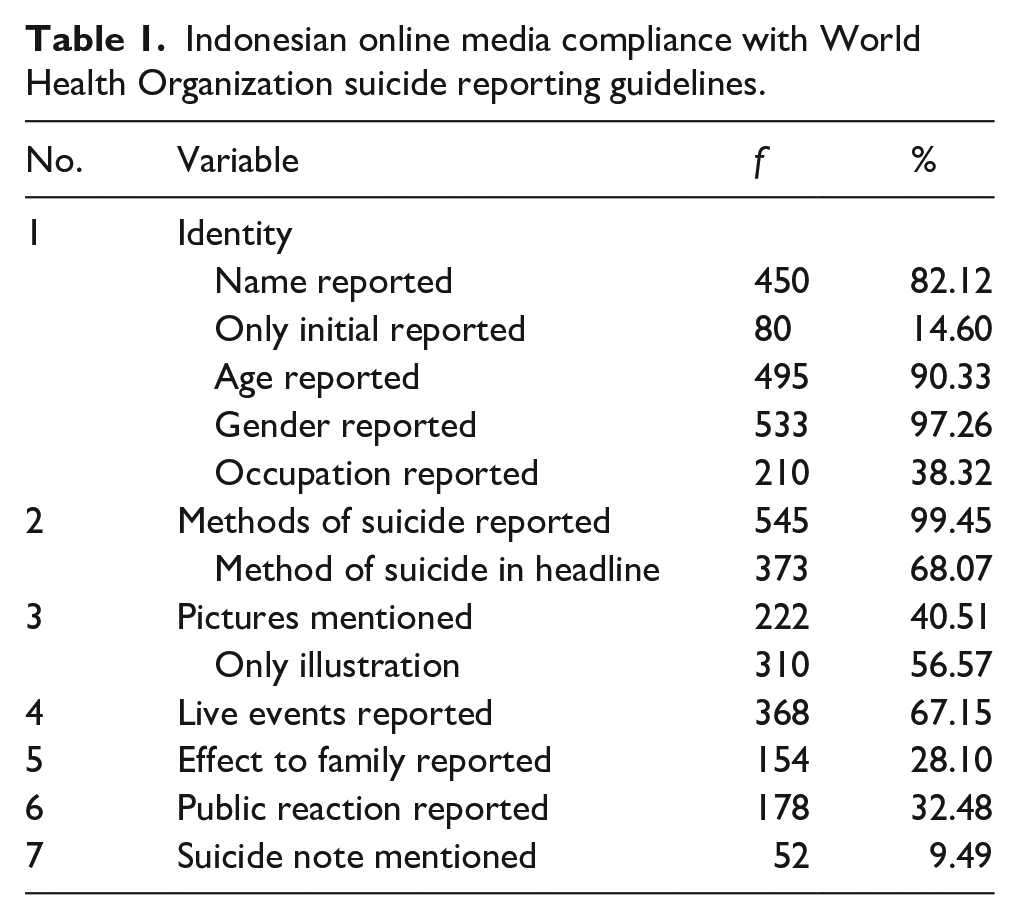
During the 6-month period, a total of 548 suicide-related news was found in 172 online newspapers. The most frequent one posted 36 (6.57%) news on suicide case within 6 months. The majority of the cases (83.21%) were complete suicide while 92 cases (16.79%) were attempted suicide. Furthermore, almost all news (99.45%) mentioned the method of suicide explicitly, either completed or attempted. Some 419 news (76.46%) mentioned the causes of suicidal behavior, where having mental disorder was mentioned as the most common cause of suicide. The majority of the media (82.12%) also mentioned the name of the person who died by suicide while the other 80 news (14.60%) reported only the initial. Some 495 news (90.33%) reported the age of the person who died by suicide and 533 news (97.26%) reported gender. Some 210 news (38.32%) provided the occupation of the person who died by suicide. Furthermore, very few suicide news took the opportunity to educate the people about suicide, provided information on where to seek help or had an expert opinion regarding the case. The Indonesian online media compliance with the WHO media guidelines is detailed in Table 1.
Indonesian online media compliance with World Health Organization suicide reporting guidelines.
Discussion
In the present study, it was found out that the majority of Indonesian online newspapers have a tendency to exaggerate the suicide news. The majority of them also show no compliance with WHO media guidelines for suicide prevention. The fact that the vast majority (99.45%) of Indonesia online media reported the method of suicide explicitly is perhaps among the highest rates ever reported. Earlier studies found approximately 89% (Chandra et al., 2013) and 96% (Arafat et al., 2018) of newspapers reported the method of suicide. Furthermore, the findings of the present study have relatively comparable rates with a previous report from Bangladesh (Chandra et al., 2013). The finding of 82.12% of media reported the name of victims was relatively smaller compared with the report in Bangladesh (90%). Again, 97.25% of Indonesian media reported gender was a little higher than 95% found in Bangladesh. The reporting age of victims was also higher in the present study than the earlier (90.33% vs. 80%).
The Indonesian media usually write the name of the victim, the method of suicide, and the reason for suicide clearly in the title of the news. For example, detik.com, on 4 January 2019, reported, ‘Sudarsi Nekat Gantung Diri Diduga karena Terbelit Masalah Ekonomi’ (Pertana, 2019), which can be translated as ‘Sudarsi Desperate to Hanging Self Allegedly because of Economic (Financial) Problems’. This title of the news includes the information of the name of the victim (Sudarsi), the method of suicide (hanging self), and possible cause (financial problem). Such title is common in both Indonesian online and offline or traditional print newspapers.
Werther effect is existing in some cases. The incidence of suicide increased following the report of another case. Reporting the location of a suicide case also triggered the repetition of a suicide attempt at the exact location only a few days after the first case happened. Glamorizing the place for committing suicide has also been found in previous studies (Chun et al., 2018; Tatum et al., 2010).
Most of the news portray the detailed information about each suicide case, including the picture or the illustration of the person who died by suicide. The media usually mentions the reason why people choose to die by suicide. As for the reason, they usually deduce or abstract the information from interviews with the family, witnesses, or from suicide note.
When describing the methods of suicide, approximately two out of 10 (19%) of media describe the step-by-step process of suicide or suicide attempt. For instance, Okezone.com (Siregar, 2018), on 1 February 2018, reported, Nurhayati bought a detergent at a shop not far from the scene. She initially bought detergents for reasons to wash clothes. After that, she sat on a parked rickshaw. Shortly after climbing onto the rickshaw, the victim then vomited and convulsed with his mouth foaming . . .
In cases of poisoning, some newspapers mentioned the name of the poison, either in the title or in the content of the news. Some newspapers even place hashtag on the suicide methods or the name of poison used to commit suicide along with the main news. Similar URL or backlinks are also sometimes placed along with the main suicide news, expecting the readers to click the hashtags or backlinks for the similar suicide news. The hashtags and the backlinks are usually placed inside, beside or below the main news.
Furthermore, the vast majority of Indonesian online newspaper did not try to educate readers concerning suicide. Very few of them provide information on health-seeking behaviors or encourage the community to avoid copying of suicidal behavior. This is a missed opportunity for media to educate the public given that this has been proven to have positive effects on the individual at risk (Niederkrotenthaler et al., 2014).
Changing the Indonesian media ways of reporting suicide news remains a challenge. Suicide is considered a forbidden act in the legal system and against the culture and religious beliefs of the vast majority of the predominantly Muslim Indonesia. Someone who has such suicidal ideation would rather hide it from public knowledge. Therefore, it requires proper and articulated strategies to solve it. Controlling mass media reportage in reporting suicide is one of the promising approaches of suicidal behavior prevention. Adjustments of reporting suicidal behavior have been proven to decrease suicide incident (Sisask & Varnik, 2012). Furthermore, assuring the more applicable representation of suicide cases in the media (Suryadevara & Tandon, 2018), adding the opinion of the medical experts about the suicidal behavior and how to cope with it, apprehending the understanding of the role of the media in suicidal behavior, entitling and educating the media personnel, communicating with suicidologist (Arafat et al., 2018), and associating its prevention with the positive act should be government agenda in promoting suicide prevention. These approaches should be adopted not only in Indonesia but also in other countries where suicide news tends to be exaggerated by the newspapers.
This study has several limitations. The contents of the news were only investigated from the online newspaper in the span of 6 months. The news posted was deliberately searched using certain keywords, ignoring the possibility of the usage of other local terms in suicide reporting. The follow-up impact of the reported suicide news was also absent. Therefore, further studies need to consider assessing the impact of reporting on Indonesian communities.
Conclusion
The majority of Indonesian online newspapers do not conform to the WHO media guidelines in reporting suicide. Most of the time, they reported the detailed information of the person who died by suicide by mentioning the name, age, gender, occupation and methods of suicide. Following the WHO media guidelines is one approach to decrease the suicide rate and make it less attractive.
