







Abstract
Background:
Many people experiencing homelessness dwell, panhandle, or congregate in public spaces where they frequently cross paths with others. In these spaces, they can be recipients of acts of kindness or emotional and physical insult, but there is little research on the quality, nature, or value of interactions between people living on the street and those who pass them by.
Aim:
This study explored the lived experiences of unhoused people who panhandle and their interactions with passersby in Philadelphia, Pennsylvania.
Methods:
Forty semi-structured interviews were conducted with participants who were approached while panhandling and asked to describe their experiences asking for help in public and accessing homelessness services, as well as what they wished to share with passersby. Interviews were coded and analyzed using a directed content analysis approach.
Results:
Participants described being ignored and subjected to violence, leading them to crave meaningful interaction with passersby. They also described experiences of receiving kindness and support while panhandling. Many shared personal histories of tragedy and called for greater empathy and compassion from passersby, as well as society as a whole, for people experiencing homelessness.
Conclusion:
Participants’ experiences were consistent with loneliness, as characterized in the literature as distress at lack of social connection, and were also notable for the verbal and physical violence endured in public spaces. Social isolation and trauma are detrimental to mental health in this vulnerable group, so interventions to support this population should provide opportunities for consistent, supportive social connections and focus on providing low-barrier, stable housing.
Introduction
Among the potential causes of poor health among people experiencing homelessness are being unsheltered, food insecurity, and facing stigma (Hernandez et al., 2019; Mejia-Lancheros et al., 2021). Although many cities attempt to address homelessness with public shelters and food distribution, these resources may be both inadequate in capacity and underutilized due to safety and sanitary concerns by potential clients. Additionally, many people experiencing homelessness struggle with mental health diagnoses and substance use disorders (SUDs), and may have families or pets to support, but shelter systems do not meet all of their needs (Donley & Wright, 2012; Labrecque & Walsh, 2015). As a result, many people experiencing homelessness dwell, panhandle, or congregate in public spaces where they frequently cross paths with others. Anecdotally, we know unhoused people in these spaces are recipients of not only acts of kindness, but also emotional or physical insult; however, there is little research on the quality, nature, or value of interactions between people living on the street and those who pass them by.
While homelessness is a highly visible crisis in modern cities, individuals experiencing homelessness can feel overlooked. The stress of perceived social isolation, or loneliness, could also worsen mental and physical illness in a population already plagued by such ailments (Abdul Hamid et al., 1993; Watson et al., 2016). Studies have found that unhoused people face stigma and rejection when trying to integrate into their communities, and that the attitudes and actions of domiciled people toward those they encounter on the street can further contribute to feelings of isolation among those experiencing homelessness (Bower et al., 2018; Hodgetts et al., 2011). There is little recent literature on the impact of interactions between these two groups on the well-being of unhoused people. However, stigma, isolation, and threat of violence all negatively impact one’s sense of self, well-being, and ability to navigate the world (Goodman et al., 1991; Roos et al., 2013). This paper discusses the experience of people who self-identify as homeless and who actively attempt to engage passersby through the act of panhandling in Philadelphia, Pennsylvania.
Methods
Context
In July 2018, our research team conducted qualitative interviews with people who were asking for financial or in-kind support, or sharing messages, via handwritten signs across Philadelphia. This study was conducted in collaboration with artist Willie Baronet, who purchased signs from people to populate an art exhibit addressing the dehumanization of people experiencing homelessness. The prices of signs were set at up to $20 by their owners, who were also offered a new piece of cardboard and a marker. Interaction with the artist was followed up with an offer to participate in an interview. People who agreed to be interviewed were compensated a further $10.
Participants
40 individuals agreed to be interviewed. Interview participation was only requested of those who were asking for assistance with a sign in a public space, excluding other people who solicit support in public such as buskers.
Data collection
Interviews were conducted on the ground or benches in public spaces by faculty and students trained in qualitative data collection. The semi-structured interviews, lasting from 5 to 24 minutes, were audio-recorded and transcribed verbatim. Participants were asked their age, self-identified race and gender, and veteran status. An interview guide was used to elicit descriptions of participants’ daily experiences while panhandling. Interviewers asked for descriptions of interactions with passersby while panhandling, accessing public resources, finding places to sleep, and perspectives on how the opioid crisis impacted participants’ experiences while panhandling. Additionally, to be included in the art exhibit, participants were asked what they would like the research team to share with passersby on their behalf. At the end of the interview participants were offered information on support resources. This study was approved by the Institutional Review Board of Thomas Jefferson University in Philadelphia, PA. Verbal consent was obtained from all participants.
Codebook development
Codes were developed in two ways: a priori (informed by the literature and interview guide) and through line-by-line reading of interview transcripts (Hsieh & Shannon, 2005). Each student member of the research team open coded a sample of the transcripts independently. Then, the primary investigator facilitated a meeting where the team discussed the open coding process and put forth coding suggestions. The team reviewed all suggestions, and a final set of codes was selected. Each code was given an explicit definition to ensure coding accuracy and to improve intercoder reliability.
Data and the code book were uploaded into NVivo12 Software (QSR International, Doncaster, Australia). A group coding approach was used with the team of 10 students and the senior author meeting to code the transcripts. Small sub-groups of two to three team members were randomly assigned interview transcripts to code collaboratively. Questions and discrepancies were brought up to the larger group, and all discrepancies were resolved by consensus. All transcripts were coded during this 8-hour coding session.
Codebook development, coding, and analysis were supervised by the senior author, a qualitative research scientist with over 20 years of experience. After coding was complete, the senior author audited the NVivo database to ensure codes were accurately applied. Resultant codes were organized into three separate thematic categories, each with subthemes.
Results
Sample characteristics
17.5% of participants self-identified as female and no participants self-identified as transgender or gender non-conforming. The average participant age was 36.4 years (SD ± 9.3). Two participants (5%) identified their race as Black and 31 (77.5%) identified their race as White. One participant identified as Native American. Five (12.5%) said they were veterans. Sleep was discussed with 37 of 40 participants; at the time of the study all slept outside, known as rough sleeping.
Qualitative results
The analysis revealed three major themes related to human interaction: 1. Invisibility and Dehumanization, 2. Acknowledgement and Material Support, and 3. Susceptibility and Empathy. These themes each had distinct subthemes, which are presented below with interview quotes and author commentary. Lack of visibility and recognition, as well as being victims of violence, were pervasive in discussions of daily experiences while panhandling. Conversely, positive experiences with passersby often included participants feeling recognized and cared for. Participants followed these descriptions with an appeal for empathy. Additionally, we share selected photographs of the signs purchased from participants to add texture to the data.
Invisibility and dehumanization
Participants described being ignored and were also the victims of verbal insults and physical violence, making panhandling a highly isolating experience during which they craved friendly interaction (Figures 1 and 2). They attributed this mistreatment to passersby dehumanizing them, with several participants reactively asserting their personhood through statements such as, ‘you know, I’m a starving human being.’ This poor treatment was often sexualized if the participant identified as female. Participants believed the opioid crisis worsened isolation by discouraging passersby from helping them and was used by passersby to justify their mistreatment.
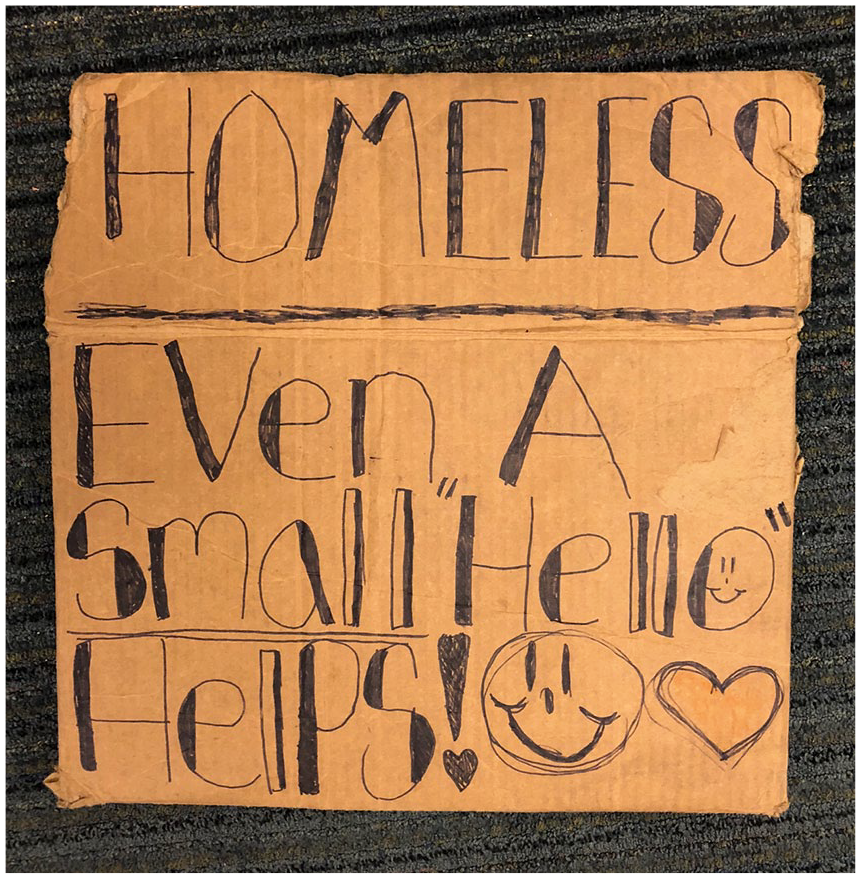
A sign expressing desire for social acknowledgement.
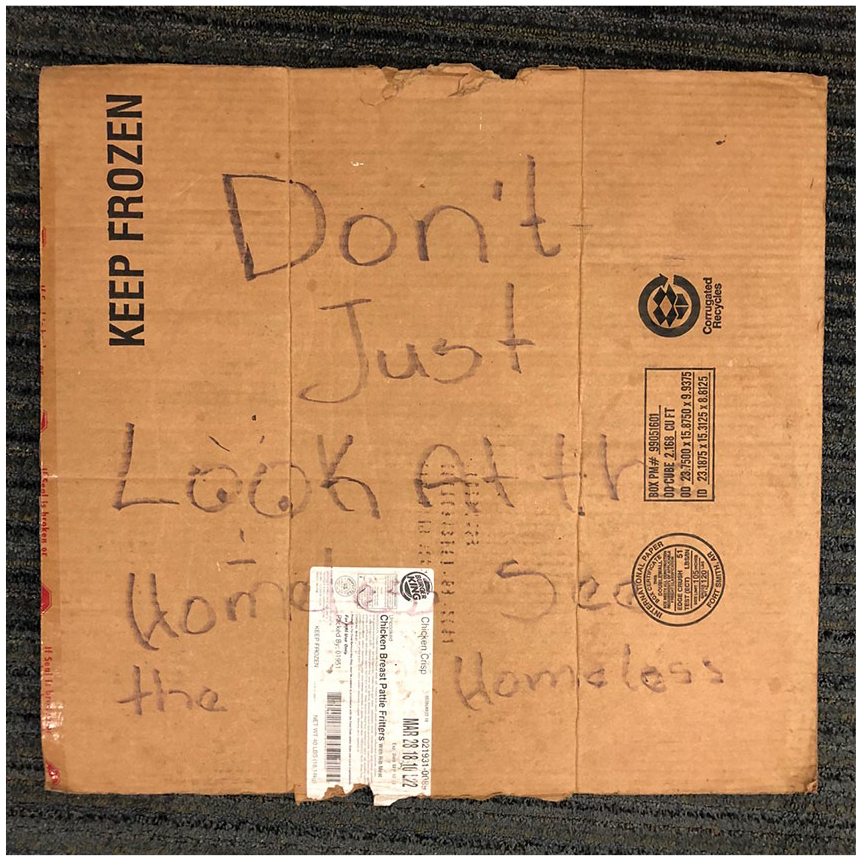
A sign encouraging increased awareness of people experiencing homelessness.
Passive mistreatment: Being ignored
Participants described being ignored while panhandling because of the stigma of homelessness. One participant expressed the paradox of being ignored because they were asking for help:
“They’ll see ya with a sign and won’t say hello to ya – just because you got a sign. Or I don’t look as clean as everybody else does, they treat me different.”
Multiple participants stated they were treated ‘like trash.’ Participants were acutely aware of passersby ignoring them because while panhandling they would ‘study people’, making it more frustrating to be ignored by them. One participant explained:
“This morning between 8 and 9:30 am I said good morning and hello to fifty-six people walking by me. . . How many people do you think replied back to me? 4 out of 56. But you know what, if 15 would have said ‘Good morning. Have a nice day. . . I can’t help you but I see you. . .’ It’s not hard to say!”
Participants contrasted being ignored and mistreated to the courtesy that is expected during interactions among the domiciled and were frustrated because they felt they deserved that courtesy as well:
“The other day I was asleep. A woman walked past and stepped on my leg. I said ‘Miss you gonna say excuse me?’ She was looking at me like I’m crazy.”
“I mean most people they ignore me, even when I, you know, address them and I say, ‘Hi,’ you know, ‘Hello ma’am, would you be able to spare some change for something to eat?’”
Overall, participants implied that passersby felt justified in ignoring them simply because of their homelessness. This trend continued when participants were targets of violence.
Active mistreatment: Insults and physical violence
Verbal insults by passersby were also frequently described by participants. The content of these insults often consisted of name calling, such as being called ‘addicts’ and ‘lazy’, or of stereotypes:
“Well people walk by and they make comments like, ‘these scumbags out here begging,’ and, ‘they can’t afford to get high on their own, they have to ask—beg for money. . .’ They say it as if you’re not there, you know? So, it’s like, extra degrading.”
Many reacted strongly to these insults because, as one participant stated:
“And the fact is that our lives suck already, they don’t have to do anything negative towards us. We already know. We know. We know our lives suck, spitting on us, kicking us in the face isn’t helping us. “
Insults were sometimes coupled with violence. Some participants shared that the most difficult part of panhandling was vulnerability to physical attacks. Several, like the person quoted below, shared that passersby spit on them simply in response to them panhandling:
“Umm I had an incident when I was holding a sign out—like I do—and a guy came by and said, you know, ‘I ain’t helping you, you fuckin’ drug addict,’ and spit on me.”
The violence that female participants experienced was sexualized. They described being groped while sleeping on the streets, and men assuming they would engage in sexual acts for compensation because they were panhandling:
“A lot of the assholes that walk by are guys because to them. . . it’s like ‘why don’t you go prostitute’ – you know what I mean? Or they’ll just walk up to you and be like ‘here, ya tryna make a couple dollars?’ And of course everybody’s like ‘of course, what’s up?’ And they’ll be like ‘Oh, why don’t you, [give] oral sex for this?’ It’s always something.”
Other participants described verbal altercations when they engaged with people who mistreated them:
“A guy came and dropped two pieces of pizza crust in my cup, and I out loud was like, ‘hey you’re real funny.’ Then he says, ‘Oh, I thought you were hungry.’ I said, ‘man, can you just get outta here?’ And he came back and spit in my face.”
Many experienced seemingly unprovoked violence, and explained that at random, people kicked them and threw objects or hot liquids at them. Several participants attributed frequently being the victims of violence to people assigning them a lower status, in a way that echoed their understanding of why they were so often ignored:
“I’m tired of people thinking that they’ve got the right to put their hands on us. Because a lot of people will be having a bad day and they’ll just vent their frustration on us.”
In the context of the opioid crisis
Philadelphia, this study’s setting, has been heavily impacted by the opioid crisis (The Mayor’s Task Force to Combat the Opioid Epidemic in Philadelphia, 2017). Some participants discussed personal drug use. They expressed how public awareness and stigmatization of opioid addiction impacted their interactions with passersby:
“Because just them hearing what’s going on with the opiate crisis and then seeing homeless people and you know how, like, pit bulls have a bad rep? Well now homeless people are gonna get a bad rep, because of the certain few people that do wrong with the money that people give them.”
The above statement highlights the impact of public portrayal of opioid addiction on homelessness and panhandling, as well as the stigma that the participants lived through daily. Many believed the stigma associated with drug use caused people to ‘treat us like crap because they just assume that we get high’. One participant explicitly blamed the media and city leadership for the public regard of homelessness and the opioid crisis:
“The city’s heartless, I’m sorry. Like straight up the mayor has printed in the paper numerous times: ‘don’t help the homeless, don’t give them nothing, don’t do nothing for them, that’s how you help them. . .’ Not everybody is a drug addict or an alcoholic!”
One participant described panhandling as an alternative to crime:
“I had an addiction and I needed to feed it and the only way to feed it without robbing was flying a sign and panhandling.”
Most participants believed that the opioid crisis made passersby less likely to give them money. One person gave an example of how this assumption impacted their interactions, while expressing an understanding of the perspective of the passersby:
“Some people it’s they don’t wanna help you kill yourself. And other people they’re not wasting their money on you to get high. Ya know. There’s a lot of people who will say ‘you need something? I’ll get it for ya. Let’s go to the store.’ They won’t give you cash. Because they don’t want – just in fear of you going to do that.
Acknowledgement and material support
When discussing positive experiences with passersby, participants were grateful for interactions in which they were simply acknowledged. They also shared experiences in which passersby were particularly generous, and in some instances became longer term sources of emotional and material support. These connections served as a reprieve from social isolation.
Conversation
Participants described positive experiences that included passerby simply smiling to acknowledge they had been seen or engaging in conversation. Some expressed that when passersby were unable to help them financially, they appreciated their time and kind words:
“You find nice people. . . Somebody just to talk to, somebody just to, you know, correspond with, that’s not gonna treat you like you’re a piece of shit on the street.”
Others appreciated emotional support:
“Well this lady seen me getting really upset, so she pulled me over, calmed me down, gives me twenty bucks, and told me he ain’t worth it.”
“Um, yeah there was uh there was one Christmas. . . as the parade was going through I was thinking about my family and I got real upset, started crying and stuff and like I said like ninety percent of people just tried to ignore me but there was this one chick, she just stopped and like she didn’t know me. . . and she came and put her arm around me and stuck some money in my hand and like tried to make me feel better, tried to understand, like she didn’t judge me.”
Acts of kindness
Despite enduring abuse while panhandling, a few participants expressed gratitude for those who helped them. As one participant stated:
“A lot of people say humanity, it sucks, but actually there’s a lot of really good people out there.”
Many shared particularly memorable experiences, such as one person giving them a large sum of money, a regular visitor buying them food frequently, or people giving clothes and shoes. One participant shared:
“I had one guy take his shirt right off his back and hand it to me. That was amazing.”
Other stories involved the participant finding that a passerby was willing to commit to supporting them with more than a single donation:
“I put on my sign that one time that you know, like I need work. . . and I actually had a guy go up to me say, ‘Listen, I got like two weeks’ worth of work for ya.’ You know and I was like, ‘Aight,’ you know he’s like—he’s like ‘I’ll pay ya 80 bucks a day,’ you know and it was—it was simple stuff. You know, sweepin’ up. He paid me well over what, you know the—the work was worth.”
Susceptibility and empathy
Participants shared the circumstances that led them to homelessness to discourage mistreatment from passersby: “It doesn’t matter what, who you are, or how much money you have. It doesn’t discriminate, and anybody can end up in [this] situation” (Figure 3).
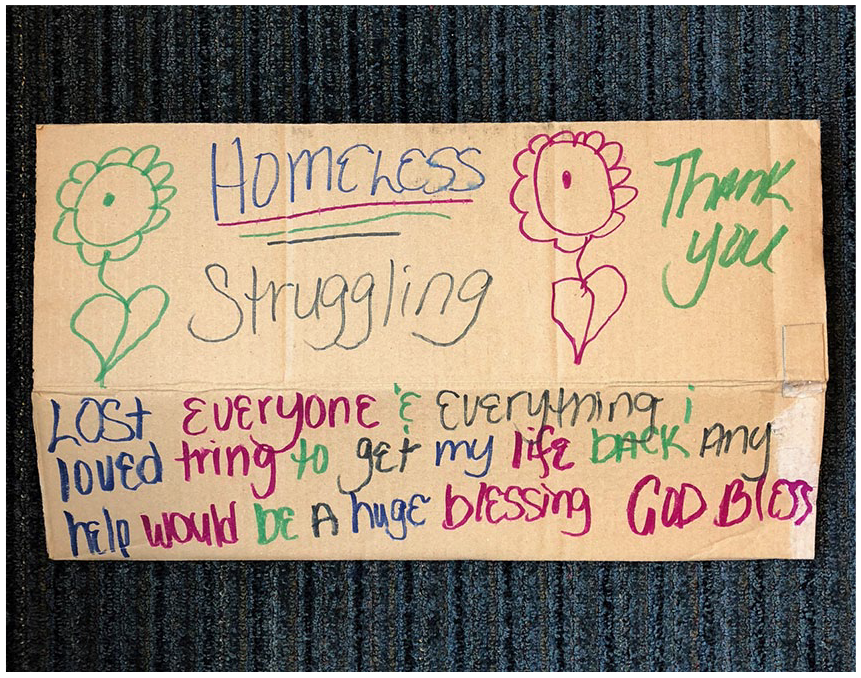
A sign conveying personal tragedy leading to homelessness.
One strategy used to garner compassion and discourage social othering – which participants believed was used to justify actively ignoring or mistreating them – was noting the universality of being vulnerable to tragedy. In their view, this common vulnerability should elicit empathy from passersby, because people may experience homelessness ‘just ‘cause. . . like a roll of the dice in life, you know’ (Figure 4).
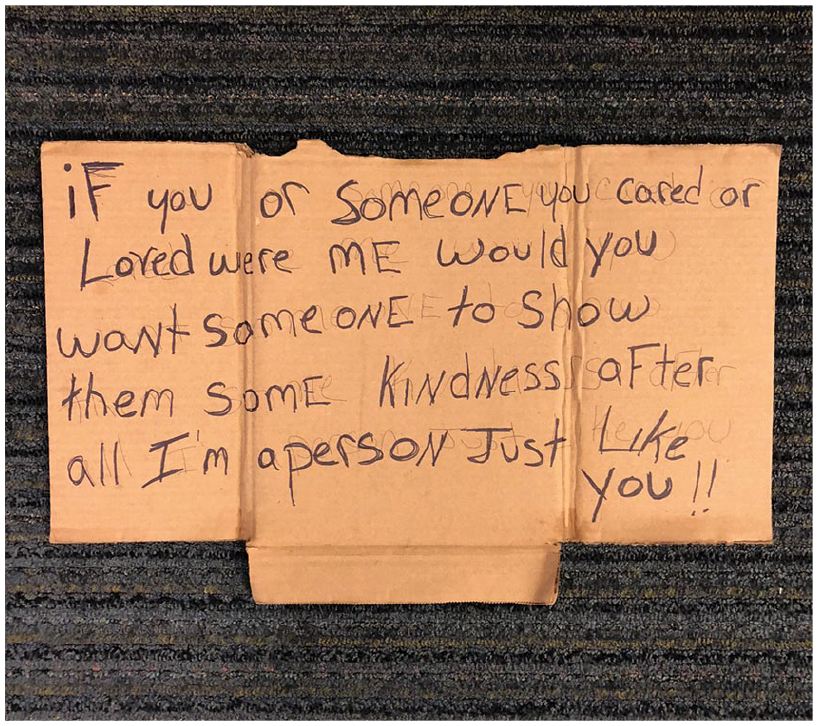
An appeal for empathy.
Events precipitating homelessness
Participants discussed stressful events and mental illness as experiences leading them to homelessness:
“I grew up in a middle class family, I don’t know it just seemed like overnight, everybody died. . .this is why I’m on the streets now. That messed up my head. . . My girlfriend died and a couple of my friends shot theirselves [sic] and then my mother died, I found her dead, and then I found her boyfriend dead 3 months later and I found the dog dead. Then they came and boarded up the house. I mean it was just too much for me to take.”
The above description is seemingly an exceptional case of tragedy, but several other participants described leading stable lives before a precipitating event. For example:
“We’re still people, and this could happen to anybody. I was a stay at home wife with two businesses. I owned a house and two cars. A divorce put me here.”
This feeling of precariousness was expressed by many participants (Figure 5):
“No one has nest eggs no more, because the cost of living and the things that happen, and like I’ve come to realize that everyone out here has had a tragedy in their life and it’s put ‘em in this. Even if it’s drug use, it’s a tragedy.”
“[If] you don’t have no family, no friends, you lose your job, you’ll be out here [too].”
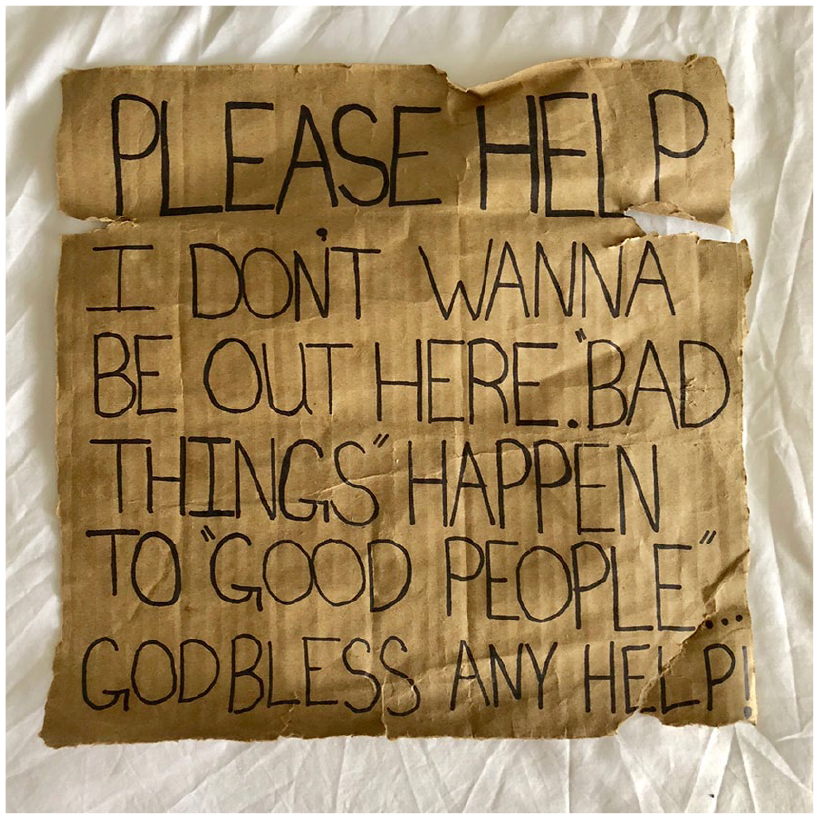
A sign expressing vulnerability to tragedy.
Asking for compassion and empathy
Participants emphasized the importance of being treated with compassion:
“I’m saying like people don’t understand just a smile or hello can make a difference because some people are on the edge of. . . I don’t get high no more and I don’t drink no more.”
The messages they wished to share with passersby were requests to ‘just have a heart, ’ or ‘please don’t look at us like we’re garbage, ’ coupled with asking for empathy for their situation. For example:
“I mean, just put yourself in our shoes. Think about, I mean, actually think about how hard it would be to be out here. . . People don’t think about when it rains. People don’t think about it when it snows. People don’t think about that.”
Some participants built on their request for empathy, explicitly asserting:
“I’m a person too, you know, I have feelings too.”
“You can be a homeless person and. . . you can have dignity, you can have morals.”
One statement summarized this sentiment:
“If they could just understand what it’s like for somebody that’s out here, you know, put themselves in [our] shoes and understand that we’re human. We’re human and we’re not bad people because we’re out here or we’re just less fortunate.”
Discussion
This study explored the interactions between passersby and people who panhandle, an important part of the social realities of people experiencing homelessness. While not all people who experience homelessness panhandle, panhandling is an overt attempt to engage with others. Toolis and Hammack (2015) note that ‘attempts of displaced groups to meet their basic needs in public are not seen as symptomatic of deep underlying social injustice but as the result of deviant behaviors’, which justifies ‘othering, or “defining a group as morally or intellectually inferior”’. Because passersby ‘typically control the interaction given their ability to regard the panhandler as a nonperson’, the onus lies on them to instead engage in a way that acknowledges the humanity of the person panhandling (Lankenau, 1999). According to the participants in this study, passersby frequently neglect this responsibility, leaving respondents with a clear need for acknowledgement and social connectedness, despite their sharing of crowded public spaces.
Mental illness and homelessness frequently co-occur and mental illness can be worsened by isolation associated with life on the street. In particular, the frustration with the lack of human connection described by our participants is consistent with loneliness, defined and studied in psychology literature as the distress experienced when someone feels socially isolated. Cacioppo and Cacioppo (2018) describe loneliness as an adaptation to isolation that can encourage people to seek interaction. Prolonged loneliness is associated with depression, anxiety, mood lability, and impulsivity (Cacioppo et al., 2015). Our participants offered ways to mitigate the effects of isolation with descriptions of passersby who acknowledged their existence, needs, and worth. The emphasis they placed on recognition is significant because it contrasts with the invisibility and isolation they described as a cause of loneliness. Efforts to support unhoused people should consider that addressing their social isolation may represent a strategy to improve their mental health. Formal companion programs have been found effective for addressing loneliness in the elderly, a population highly investigated in the context of social isolation (Price, 2015). A similar attempt to foster experiences of social connection for people experiencing homelessness could be beneficial in mitigating the deleterious impacts of loneliness on their mental health.
Additionally, the physical violence described by our participants is consistent with findings that street-based income generation methods, including panhandling, are independently associated with exposure to violence (Richardson et al., 2015). Taken together, these data warrant mentioning the high rates of traumatic brain injury (TBI) in people experiencing homelessness. The lifetime prevalence of TBI in this population is 53% (vs. an estimated 12-21% in the general population) and is associated with ‘poorer self-reported physical and mental health, higher suicidality and suicide risk, memory concerns, and increased health service use and criminal justice system involvement’ (Stubbs et al., 2020). The relationship between homelessness and TBI is complex, but the violence described in our study suggests that living on the streets could result in vulnerability to such injuries.
The findings of this study lend support to providing stable housing as a strategy to improve the health of those experiencing homelessness. This strategy would remove them from the emotional and physical abuse and social neglect associated with living on the streets, and is well studied in people experiencing homelessness with SUDs who access Housing First (HF) programs. These programs provide long-term housing without sobriety or employment as a prerequisite, in contrast to traditional housing-support programs. Proponents of HF programs suggest that stable housing should be the first step in rehabilitation for people experiencing homelessness with SUDs (Baxter et al., 2019). The experiences of our participants suggest that the well-being of any person living on the street, not just those with SUDs, could be supported with low-barrier housing.
Conclusion
The findings of this study and the literature discussed here suggest that the interactions – positive, negative, or lack of – between unhoused people and passersby in public spaces play a pivotal role in the impact of homelessness on well-being. Interventions to support unhoused people should prioritize the safety and social needs of this community. This work sheds light on the lived experience of those who panhandle and underscores the universal need for safety and meaningful human connection.
Limitations
The major limitation of this study is the participant sample being representative of the population during only 1 week, as well as consisting of mostly white-identifying men. Similar studies focusing on homelessness in people of other races and gender identities will be critical to fostering inclusivity in any interventions targeting homelessness. The limited time frame also prevented the authors from amending the interview guide based on a first round of interviews. Interviews being conducted in a public setting could have limited what participants were willing to share.
Footnotes
Funding
The author(s) disclosed receipt of the following financial support for the research, authorship, and/or publication of this article: This project was supported by the Jefferson College of Population Health and the Office of Student Life and Engagement at Thomas Jefferson University.
