






Abstract
Aim:
The aim of this study is to determine the relationship between nursing students’ future anxiety and awareness of global climate change.
Method:
The population of this correlational descriptive study consisted of nursing students studying at a nursing faculty. Three hundred and thirty nursing students were included in the study. The researcher collected data through google forms using a Descriptive Characteristics Form, the Awareness Scale of University Students About Global Climate Change (ASUSGCC) and the Future Anxiety Scale in University Students (FASUS) between March and May 2024.
Results:
The ASUSGCC total mean score of the nursing students was 3.43 ± 0.88. Their FASUS total mean score was 61.39 ± 12.98. There was a statistically significant positive, weak correlation between their ASUSGCC and FASUS total mean scores (p < .05).
Conclusion:
It was found that the nursing students had a moderate level of awareness about global climate change. It can be asserted that the participants had a moderate level of future anxiety based on their FASUS total mean score. In the study, as their level of awareness about climate change elevated, did so their level of future anxiety.
Introduction
Climate change is associated with increased frequency and severity of extreme weather events and poses various threats to human health, including mental health. It is known that natural disaster-like events induced by climate change may cause mental disorders such as PTSD, depression, anxiety and substance abuse (Clayton, 2020). Negative mental health outcomes associated with climate change include direct experiences as well as associated negative emotional outcomes, even without a specific personal experience (Clayton, 2020; Clayton & Karazsia, 2020). 29% of Americans have stated that they are concerned about global warming and 49% have thought that they will be personally harmed for this problem (Leiserowitz et al., 2018). 20% to 40% of Europeans have reached the threshold of being ‘very concerned’ about climate change (Steentjes et al., 2017). Healthcare professionals who have a higher awareness of climate change may also have higher levels of anxiety compared to the general population. In a study by Fertelli, it was reported that nurses had a moderate level of awareness and anxiety about climate change. In addition, as their scores of climate change awareness increased, their anxiety scores also increased (Fertelli, 2023). The results of a study conducted with nursing students revealed that students who had knowledge about climate change and its effects on health had higher anxiety scores (Mat et al., 2023).
Another anxiety of university students is future anxiety that is defined as the state of perceiving personalised uncertainties and negative expectations covering a wide timeframe as an extreme danger and being uneasy. Future anxiety is a cognitive condition rather than an affective condition. Numerous factors such as hopelessness, perceived stress, and life satisfaction may cause university students to experience anxiety about the future (Geylani & Yıldız, 2022). A comparative study on future anxiety reported that nursing students had higher score of future anxiety compared to the education faculty students (Rabei et al., 2020). It is thought that nursing students’ awareness of climate change may be associated with their level of future anxiety.
In the literature, there are studies examining individually future anxiety and awareness of climate change in nursing students (Mat et al., 2023; Rabei et al., 2020). However, no study examining two concepts together in this population has been found. Investigating future anxiety and awareness of global climate change in nursing students, who can be considered as a risk group for higher anxiety, is thought to be guiding for future interventional studies and contribute to the literature.
Aim of the study
The aim of this study is to determine the relationship between nursing students’ future anxiety and awareness of global climate change.
- What is the nursing students’ level of awareness about global climate change?
- What are the nursing students’ level of future anxiety?
- Is there any correlation between nursing students’ future anxiety and awareness of global climate change?
Participants and methods
Design of the study
The study was conducted with cross-sectional study design.
The population consisted of nursing students studying at Faculty of Nursing at Inonu University.
The sample size was determined as 300 students at a confidence interval of 95%, a margin of error of 0.05, an effect size of 90% and a power to represent the population of 0.95% according to power analysis (based on the independent samples t test). Given that there may be losses in the data, the study was completed with 330 individuals.
Awareness of climate change was taken as the dependent variable and future anxiety and descriptive characteristics were taken as independent variables.
Inclusion criteria
- Being older than 18 years old,
- Being literate,
- Being able to speak Turkish,
- Being open to communication and cooperation.
Exclusion criteria
- Being a member in any environmental non-governmental organisation.
Data collection tools
The data were collected using a Descriptive Characteristics Form, the ASUSGCC, and the FASUS.
The scale was developed by Deniz et al. (2021). This 5-point Likert-type scale consists of 21 items and four subscales (awareness of the effects of global climate change on the natural and human environment, awareness of global organisations and agreements, awareness of the causes of global climate change and awareness of the energy consumption relation of global climate change). The Cronbach’s alpha value of the scale is .826. The scale has no reversed items. All items of the scale can be summed. The highest and lowest scores of the scale are 105 and 21 points, respectively. The mean scores of the scale are interpreted as follows: low level of awareness between 1 and 2.33, medium level of awareness between 2.34 and 3.66, and high level of awareness between 3.67 and 5.00 (Deniz et al., 2021).
-
The scale was developed by Geylani and Yıldız (2022). This 5-point Likert scale consists of 19 items and two factors: ‘Future Fear’ (including items 2, 4, 6, 8, 10 and 12) and ‘Despair of the Future’. Items of the scale are rated as ‘1’ Never, ‘2’ Rarely, ‘3’ Sometimes, ‘4’ Often and ‘5’ Always. Its Cronbach’s alpha coefficient is 0.91. While higher scores signify that future anxiety increases, lower scores indicate that future anxiety decreases (Geylani & Yıldız, 2022).
Data collection
The researcher collected data online between March and May 2024. The Descriptive Characteristics Form, the ASUSGCC and the FASUS were sent to the students via e-mail including a link created from Google Form. It took approximately 15 to 20 minutes to fill out the forms.
Data assessment
The data of the study were evaluated using SPSS 24.0 (Statistical Package for Social Science) software in the computer environment. In the study, p < .05 was accepted as significant. Pearson’s correlation analysis and linear regression analysis were performed after normality distribution test was run. In addition, percentage distribution was analysed for the socio-demographic characteristics of the students and mean, standard deviation and min-max values were analysed for the mean scores of the scales.
Ethical considerations
Before starting the study, approval was obtained from Health Sciences Scientific Research and Publication Ethics Committee of Inonu University and legal permission was obtained from Inonu University, Faculty of Nursing where the study was conducted. The participants were informed about the purpose of the study in the form sent to them and their written consent was obtained.
Results
The mean age of the participants was 20.91 ± 2.40, 73.6% were female, 96.7% were single, 46.1% had an income less than their expenses, 47.3% were the first-year students and 60.9% were living in the city. Of the students, 96.1% stated that they were sensitive to the environment, 70.3% followed the news about the environment, 67.9% stated that the Nursing Education Programme was inadequate in terms of sustainability and 55.2% stated that nurses could transfer sustainability principles into practice (Table 1).
Descriptive characteristics of the nursing students (n = 330).

The lowest score, highest score, and mean score of the participants on the ASUSGCC were 1, 5, and 3.43 ± 0.88, respectively. They had a moderate level of awareness about global climate change (Table 2).
ASUSGCC and FASUS total mean scores of the nursing students (n = 330).

The lowest score, highest score, and mean score of the participants on the FASUS were 19, 95, and 61.39 ± 12.98, respectively. The FASUS total mean score suggested that university students had moderate levels of future anxiety (Table 2).
There was a statistically significant positive weak correlation between the participants’ ASUSGCC and FASUS total mean scores (p < .05). As their level of awareness towards climate change elevated, their level of future anxiety increased (Table 3).
The correlation between ASUSGCC and FASUS total mean scores of the nursing students.
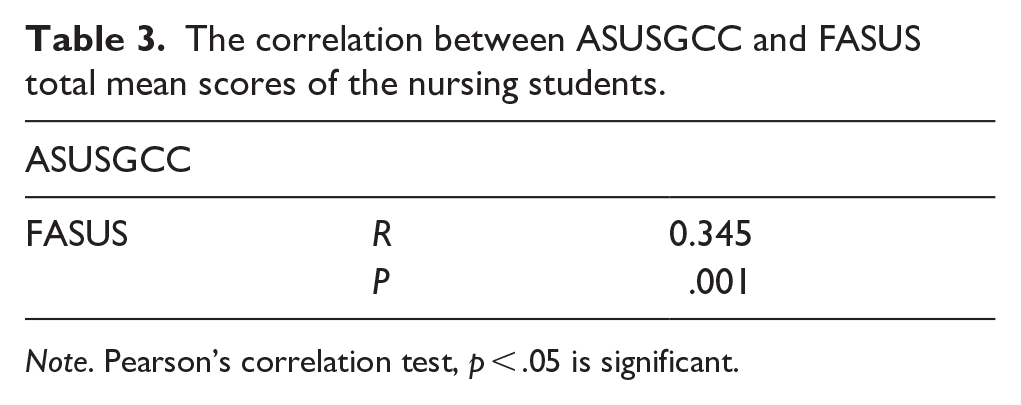
Note. Pearson’s correlation test, p < .05 is significant.
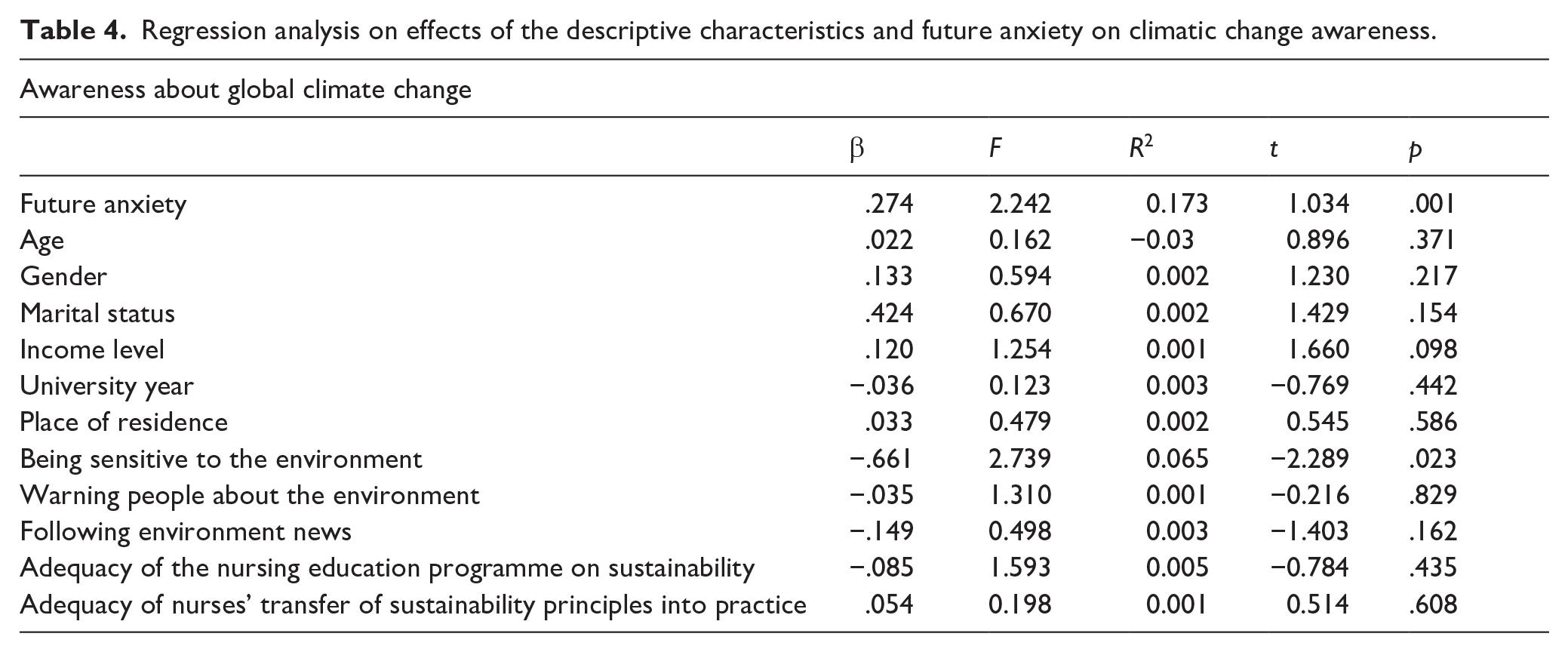
A linear stepwise regression model was used to determine the actual factors affecting awareness on climate change. The results of the regression analysis indicated that the factors of being sensitive to the environment and future anxiety had an effect on awareness of climate change at the rates of 6% and 17%, respectively (p < .05). Total score of future anxiety had the highest effect on awareness of climate change (17%) (Table 4).
Regression analysis on effects of the descriptive characteristics and future anxiety on climatic change awareness.
Discussion
The findings of the present study were discussed in line with the literature.
The present study revealed that the students had a moderate level of awareness about global climate change. A study by Fertelli reported that nurses had a moderate level of awareness of climate change (Fertelli, 2023). In a study conducted with nurses to examine awareness about climate change and health, it was found that the participants had a moderate level of awareness about the effects of climate change on health (Schenk et al., 2021). A study conducted with nursing students on global warming, climate change and the role of public health nurses reported that 87.7% of the students knew the main cause of climate change and they had awareness on this issue (Ergin et al., 2021). In another study conducted by Luque-Alcaraz et al., with nurses, most of the participants had a moderate level of environmental awareness (Luque-Alcaraz et al., 2024). A study on climate change reported that about half of Pakistani nurses were aware of this issue (Buriro et al., 2018). In a study investigating the concepts of awareness, concern and hope on climate change in nursing students, it was found that nursing students had a high level of awareness about climate change (Tümer et al., 2024). The findings of the study are compatible with the literature. It is thought that the inclusion of environmental health, public health and sustainability measures in the nursing education curriculum will have an effect on this awareness.
Considering the FASUS total mean score of the participants, it can be asserted that they had a moderate level of future anxiety. A study conducted with nursing students to investigate the effect of future anxiety on career optimism in nursing reported that students’ future anxiety was at a moderate level (Karaman & Karatepe, 2024). In a comparative study on future anxiety, the researchers stated that the future anxiety score of nursing students was higher than the score of education faculty students (Rabei et al., 2020). Nursing students encounter with critical situations during their education process and have to care for people who are struggling for life. In addition, the globe and Turkiye alike have seen several major disasters (COVID-19 pandemic and February 6 earthquakes) in recent years. In all these disasters, healthcare professionals have been at the forefront due to their social responsibilities. The city where this study was conducted is 1 of 11 cities that suffered drastically from both COVID-19 pandemic and the February 6 earthquakes. That in turn may have caused students to experience many different emotions and thoughts at once. Not only were they victims of those events, their expectations and responsibilities about being future healthcare professionals may cause them to feel self-doubt and anxiety. It is estimated that such situations increase their anxiety about the future.
In the study, it was determined that as the participants’ level of awareness of climate change elevated, their level of future anxiety elevated. A study examining the concepts of awareness, anxiety and hope associated with climate change among nurses reported that as the climate change awareness scores of nurses increased, their anxiety scores also increased (Fertelli, 2023). The results of a study conducted with nursing students revealed that students who had knowledge about climate change and its effects on health had higher anxiety scores (Mat et al., 2023). In their study including nursing students, Tamer et al., found that awareness of climate change increased the related anxiety. It can be asserted that the awareness of nursing students, who can professionally witness the impact of global climate change on the environment and human health, brought along anxiety about this issue. This anxiety may have also increased their anxiety about the future. It is thought that the students’ future anxiety stemmed from their ability to foresee the possible individual harms of climate change as well as their concerns about the profession.
Conclusion and recommendations
Consequently, it was determined that the students had a moderate level of awareness about global climate change and future anxiety. In addition, as their awareness of climate change increased, their future anxiety levels elevated. Having awareness about climate change is one of the important aspects of nursing and thus nursing education. Initiatives to increase awareness of climate change (training programmes, awareness campaigns) can mobilise nursing students and encourage them to fight against climate change. Although their awareness of this issue increases their anxieties about the future, it will enable them to take professional and personal measures in this regard.
Footnotes
Author contributions
Study design: Fatma Melike ERKAN, Funda KAVAK BUDAK; data analyses: Fatma Melike ERKAN, Funda KAVAK BUDAK; manuscript preparation: Fatma Melike ERKAN, Funda KAVAK BUDAK. All authors have read and approved the final manuscript.
Funding
The author(s) received no financial support for the research, authorship and/or publication of this article.
