






Abstract
Since the rise of the narrative on the ‘democratic deficit’, at the beginning of the 1990s, EU governance is expected to be democratic and its executive is expected to be democratically legitimated. Since this issue was forced onto the European agenda, the EU has been in a process of continuous polity building in which the Treaties have been revised every few years by the member states to make – among other things – the holders of political power in the institutions more accountable. This article links the changes in the legal and political framework governing the appointment and tasks of the EU Commission to changes in executive recruitment. It explains how strengthened democratic control and accountability over this part of the EU executive has politicized the selection of EU commissioners. This has become visible in the access and exit procedures of this part of the EU executive, but also in shifts in the demand and supply factors in the process of EU executive recruitment. This change is best characterized as a response and adaptation to the increasingly demanding political environment within which the EU Commission finds itself entrenched – one where the highest political personnel of the EU executive need to address the modern problems of a democratic polity.
Points for practitioners
The expansion of democratic accountability arrangements in the EU has politicized the appointment of EU commissioners in three respects: in the procedures of appointing commissioners; in the composition of the College; and in the career pathways of commissioners. Democratization has meant that representation and political professionalization have become very significant in the selection of the EU executive.
Keywords
The dynamics of executive selection in the EU Commission 1
In February 2010, some weeks late, the Barroso II Commission began its five-year term of office. Jose Manuel Barroso’s proposed new team came under fire during questioning at job interviews at the European Parliament (EP). Members of the European Parliament (MEPs) demanded information on the financial affairs of Bulgaria’s embattled nominee, Rumiana Jeleva, for a post in the new European Commission. There was a worrying precedent for Barroso. Five years earlier, in 2004, the EP made clear that it could not accept the original first team of new commissioners. Then, Barroso agreed to drop two of the original nominees and to reshuffle two other portfolios after a storm of protests from parliament in order to get the formal approval of the European Parliament.
As Barroso was at the start of a second term, the EP again showed its role in the choice of a new Commission. MEPs grilled the Bulgarian candidate during a stormy hearing and had questions both on the transparency of her financial declarations and on her competence to be a commissioner for humanitarian aid. Jeleva finally gave way to her political opponents and abandoned her candidacy. After she stepped aside, and Bulgaria’s new EU commissioner candidate was announced, Barroso’s new line-up could finally be re-elected to lead the EU executive until November 2014.
The incidents in 2004 and 2010 both illustrated how firm the grip of the EP has become in the selection of the EU Commission. The basic framework for the appointment and the functioning of the EU Commission has always been defined in the various treaties establishing the EU. The EU has been in a process of continuous polity building in which the Treaties have been revised every few years by the member states. The call for a strengthening of democratic accountability of European policy-makers since the rise of the narrative on the ‘democratic deficit’ in the EU at the beginning of the 1990s was one of the reasons for revision. EU governance was expected to be democratic as well as its executive being expected to be democratically legitimated. The Maastricht (1993), Amsterdam (1999), Nice (2003) and Lisbon (2009) Treaties have thus given successively more power to the EP over the European executive.
Analyses of treaty revisions and institutional reforms have considerably advanced our understanding of the changing European Commission (Ban, 2010; Bauer, 2007; Cini, 2007; Georgakakis, 2009; Kassim, 2004; Wille, 2010a, 2010b). However, these analyses largely overlook the process of executive selection, an issue intricately tied to the changing institutional context and the functioning of democratic arrangements. How has the process of democratic polity building in the EU affected the selection of commissioners? If the treaty revisions have altered the Commission’s legal and political framework, what have been the consequences for the recruitment and the composition of its College of Commissioners?
Relatively little is known about the impact of these changes on the political personnel of this part of the EU executive branch. Drawing on an analysis of documentary evidence and a secondary analysis of existing material, this article sets out how, as a result of the call for more democracy in the EU, the selection of commissioners has become increasingly politicized.
Democratic control of executive selection
Recruitment in the political marketplace: process, demands and supply
The emergence of a democratic order in the past century has delimited and ‘tamed’ the power of executives at the level of the nation states. Democratization has resulted in the establishment and expansion of democratic institutions (Dahl, 2006; Huntington, 1991). Elections have expanded the ability of citizens to choose, or influence indirectly, who holds (executive) power; and the establishment of parliaments has been accompanied by an increased control over the executive by the legislature (Judge and Earnshaw, 2008: 203; Lijphart, 1984).
Parliamentarians are regarded as the main providers of legitimacy, and executive authority must derive from, and be responsible to, the legislature (Dehousse, 1998: 609). One of the distinguishing characteristics of executives in parliamentary systems of government is, therefore, that ‘in a parliamentary system the chief executive … [is] dependent on the legislature’s confidence and that they can be dismissed from office by a legislative vote of no confidence or censure’ (Lijphart 1984: 68). A variety of mechanisms (ex ante and ex post) has evolved for effective parliamentary control over the executive (Strøm et al., 2010).
The power of selection is a strong instrument of the legislature to control executives. To have the ability to appoint is one of the best ways to gain control over executives. Democratization implies, therefore, a ‘politicization’ of the recruitment of elites. It refers to ‘the substitution of political criteria for merit-based criteria in the selection, retention, promotion, rewards and disciplining’ (Peters and Pierre, 2004: 2) of the members of the executive, and has several repercussions for the appointment process. The development towards representative democracies at the level of the nation states has not only evoked a long-term pattern of politicization in terms of the process and procedures of executive recruitment and removal. It has also manifested itself in the demands of and in the supply of eligible candidates suitable for political office (Best, 2007; Cotta and Best, 2007; Norris, 1997). Developments of democratic governance and a further political professionalization have meant that political qualifications (representation, partisanship, political skills) have become overriding in the selection for political office.
Democratization also had consequences for the tasks of politicians. Political work increased and it became difficult to combine it with any other occupation. As a result, ministers and parliamentarians in Europe became more and more paid politicians; they received a salary comparable to the senior civil service (Cotta and Best, 2007). They became what Weber (1947) called ‘Berufspolitiker’, professionals who effectively ‘live for and off’ politics. The emergence of a broad pool of political professionalized candidates, willing and wishing to pursue and hold political office, had repercussions for the demand and the supply side of political recruitment. This group of political professionals, who tend to go beyond the classical Weberian definition of one who makes a living through politics, distinguished themselves by a vocation for political activity, an extensive political career, resources gained exclusively from the political positions held, and political qualities: a good image, rhetoric skills, ability to negotiate (Dogan, 1999: 171–172; Panebianco, 1988). It is these qualities that became required to make a career and that enhanced the chances of selection.
The selection of political executives for office can, thus, be understood as a political marketplace determined by the rules and procedures that govern the recruitment process; by the demands of the ‘selectors’ or ‘gatekeepers’; and by the supply of candidates that are eligible for executive office (Norris, 1997). Increased democratization and political professionalization have affected the structures of opportunities for selection and political careers at the level of various nation states (Best, 2007; Best and Cotta, 2000; Cotta and Best, 2007). It has led to a change in the nature of political resources that are legitimate and required for political office and has driven the evolution from the prevalence of one type of politician (the noble or the technocrat) to another (the political specialist).
The changing nature of representative democracies has been a driving force behind the transformation of selection of political elites at the national level (Best and Cotta, 2000; Cotta and Best, 2007). But how does this work in an international context? In the evolving polity of the EU, what impact did the call for more democracy have for the recruitment of EU commissioners?
Instituting democracy and accountability around the EU Commission
For many, the European Commission has long been synonymous with a technocratic and impartial body and not with a political executive. To understand this image we have to go back to the origins of the European project and the legacy of Jean Monnet, which bestowed a particular conception that a politicized EU would contain winners and losers and this could undermine rather than reinforce the legitimacy of the EU. The integration and mediating function of the Commission should be guided by the judgement of a technocratic elite rather than by political judgement. The reason is that politicians are bound to be short-sighted and self-seeking, as they are subject to electoral mechanisms. It would make for better governance to take the impartial, the overall and long-term view of the technocrat. Successful integration requires consensus about practical goals and abstaining from power politics, hard political choices and conflict. The Commission’s role as a guardian of the European interest would depend on its expertise and its credibility as an impartial mediator between political views, conflicting national interests and interest group pressures. In the original design of the European Commission, politics was ‘organized out’.
Fears that the European Commission had become too ‘bureaucratic’ opened up a discussion in the early 1990s on the legitimacy and democratic calibre of the EU. Questions relating to the legitimacy of the EU integration process, its governance and its institutions were seriously raised in the discussion that preceded the Maastricht Treaty of 1992 (Tsakatika, 2005: 200–204). Europe was charged with a ‘democratic deficit’ which weighed heavily on its legitimate governance. Severe criticism was levelled at an independent and unaccountable technocratic elite in the Commission being allowed to play a role that was so important. The remedies proposed for this were to bestow on the EP greater supervisory, budgetary and legislative powers.
Since the rise of the deficit narrative at the beginning of the 1990s, the EP in particular has gained considerable powers and influence in the EU policy-making process. With the treaty reforms a range of ex ante incentives and ex post constraints are introduced that may entail a stronger role in the daily policy-making and closer contact between the Commission and Parliament. The EP has become a far more vociferous and demanding interlocutor, and this has contributed to the design of a more politically accountable Commission (Westlake, 2006: 277).
An important step towards greater democracy in the institutions of the EU is the direct influence the EP can have on the Commission’s composition. The EP has, therefore, gained more weight in the EU appointment procedure. Moreover, in a 1999 resolution, the EP advocated a strong link between the preferences expressed by Union citizens in EP elections and the nomination of the College of Commissioners and its programme for the parliamentary term. As a result, the term of office of Colleges has been extended from four to five years so as to bring them into close alignment with the term of the EP elections.
New democratic structures: politicized executive selection?
The evolution towards a more parliament-oriented system in the EU Commission has left its mark on the role of the EU Commission (Judge and Earnshaw 2008). With every treaty revision in recent years the EP has successfully managed to extend its powers and also the accountability of the Commission to the Parliament (Wille, 2010a, 2010b). But what impact did this thickening of democratic structures have on the selection of the Commission’s political leadership? Has it increased the politicization in the recruitment for this branch of the EU executive?
Several studies have focused on the composition of the College of Commissioners over time (Macmullen, 2002) or have looked at the politicization of the college (Magnette, 2005) by showing an increase in the number of commissioners that held (important) political positions (rather than administrative ones) before they entered the Commission (Döring, 2007; Wonka, 2007). This article goes beyond these earlier studies in looking at different levels in which the politicization of executive selection has become visible by linking this transformation to the emergence of democratic governance structures in the EU.
In the exploration that follows I sketch how democratic transformation of the EU has affected the selection of commissioners in the EU Commission by focusing on three elements (Norris, 1997) in which politicization can unfold:
The process of selection (and de-selection) of commissioners: how did the procedures of entrance into and exit from this part of the EU executive change? The demands for candidate-commissioners: did the recruitment process bring a radically different perspective on the qualities required to leading the Commission? How did it change the make-up and profile of the EU executive? The supply of candidates eligible for the office of commissioner: what were the implications of a more democratic EU for the career pathways to executive power in the EU Commission?
Demand and supply factors are treated as distinct elements in this analytical framework, but just as in any other job market they interact in the process of selection (Norris, 1997: 14). The political system of the EU sets the general context, the selection process sets the steps from nomination to actual appointment, while the demands of ‘selectors’ and the supply of candidates determine the composition of the executive. The analysis of this recruitment process and its outcome explains what type of person is simultaneously required and produced by this executive position (Gerth and Wright Mills, 1953). Because elite composition, as Putnam (1975: 166) argues, ‘is more easily observable than are the underlying patterns of social power, it can serve as a kind of seismometer for detecting shifts in the foundation of polities and politics’. The ultimate aim of this exploration is, thus, an increased understanding of the EU executive’s response to the challenges laid down by a more democratic EU.
Selection process: entrance and exit control of the EU-executive
Commissioners-designate, like other political elites, are subjected to formal (and informal) selection procedures. Treaty reforms have changed the selection procedures of the EU Commission and implied an increased control of the EP over the access and the exit of this EU executive. The EP is, however, not the only selector in the process. In the recruitment procedure for commissioners, three actors – the member countries, the Commission President and the European Parliament – each play an important role divided over two stages of political power play; the first, the nomination stage, is behind closed doors; the second, the appointment stage, is more out in the open. Let us see what each of the actor’s role is and if and how it has become more political.
Getting selected: the nomination
In the first stage it is the member states and the Commission President that play a dominant role in the nomination process of the candidate commissioners. In the early years of the EU Commission, there was an intergovernmental approach, and the nomination decisions were set by individual member states, which was crucial in determining the composition of the College. Each commissioner was in effect, independently appointed on the basis of national governmental choice. For member states, the nomination of the commissioners was a useful piece of political patronage. It could be used to reward loyal service to politicians past their best; or to remove some ‘political problems’ from the domestic scene (Macmullen, 2002: 33).
Until the Maastricht Treaty, Presidents of the Commission were not able to control the composition of the Commission. The President-designate had no formal involvement in the nomination process; and the political and social balance of the College was the sum of the member countries’ choices and, consequently, the cohesion of the College was sometimes problematic. As a result of changes in the treaties (Maastricht, Amsterdam), the Commission President now has a greater margin of independence (Nugent, 2001: 82–83) in the selection of candidates. The Commission President is nominated first and then subject to confirmation by a vote of the EP (Judge and Earnshaw, 2008: 204–206; Nugent, 2001: 82; 104–105; Spence, 2006: 36). Nominations are made ‘by common accord’ between the member states and the President. Then the Commission President allocates portfolios, the distribution of which is entirely at his discretion, and puts the new team forward for the approval of the Council of Ministers and the European Parliament.
This means that the Presidential nominee takes part in the nomination of the other commissioners, and is not only consulted as he formerly was. He now has the right to disagree (veto over individuals) and to settle alone the distribution of his team’s portfolios (Spence, 2006: 36). In this way the President can improve the institution’s cohesion and effectiveness; and he can win over the member states to nominate good candidates who can serve the institution’s external and internal needs. Both Prodi and Barroso have taken advantage of this strengthened hand by discussing with national capitals the sort of College they wanted and who they would like to nominate to their colleges. 2
Member states compete for a bigger share of the positions in the Commission, and their influence on the composition of the EU Commission has been weakened. Inevitably, a member state’s individual bargaining power weighs heavily in the jockeying for position. The bigger member states expect to be given the bigger portfolios. Several countries place bids for one of the heavyweight economic posts in the Commission – competition, trade and the internal market, areas where the Commission has strong powers. A second tier of portfolios are prized by some countries because of their impact in particular sectors – environment, information society (which covers telecoms), industry and transport. Governments will do their utmost to get a high-profile post. The more capable the candidates for the Commission post are, the more likely the Commission President will assign them a powerful portfolio. Several countries have decided that the best way of obtaining a heavyweight portfolio is to put forward a heavyweight commissioner or to put up a candidate for a second term.
Getting approved: screening and voting
After the line-up of the new team is presented to parliament, the second stage of the play of power politics begins. It has become the rule that the EP has a vote of confidence in the new Commission. 3 Whereas the first stage in the recruitment process is partly concealed by the seclusion of the back-room where the nominations for appointment are made, much of the second stage, the parliamentary stage, is open to public scrutiny and media attention. The commissioners-designate are subject to hearings at the European Parliament, which will question them and then vote on their suitability as a whole. 4
The synchronization of the Commission’s term of office with that of the EP (Judge and Earnshaw, 2008: 267) has been very relevant. This has enabled the EP to have more influence over access to executive office; and to have a greater influence in the screening and censuring of executive candidates. In the screening stage – the hearings – the credentials and past behaviour of potential office holders are reviewed. The hearings, described by some as ‘job interviews’, give a taste of what the EU could expect from its new ‘employees’. This is also a way to gain information on the views and priorities of future executive officeholders; and it can serve as a benchmark for the commissioner’s subsequent performance (Judge and Earnshaw, 2008: 205). The EP has become able to place greater informal and formal constraints on the selection process.
MEPs can only vote to elect the Commission en masse rather than individually due to a clause barring the European Parliament from singling out any individual commissioner for disapproval. If designate members of the Commission are found to be too inappropriate, the President must then reshuffle the team or request a new candidate from the member state or risk the whole Commission being voted down. Parliament can also express itself on the allocation of portfolio responsibilities. In the end, there is usually a compromise with the Commission President whereby the worst candidates are removed, but minor objections are put aside so the Commission can take office. Once the team is approved by parliament, it is formally put into office by the European Council.
Getting removed: censuring
The political power of the parliament determines how long an executive can be in office. The maximum term of five years limits how long the Commission can serve provided it does not lose the confidence of the legislature. If the EP passes a motion of censure by a two-thirds majority, the members of the Commission must resign. It is important that their tenure be secure enough to diminish the possibility of their being subject to undue pressures – and to protect their independence. But it is also important that their tenure be dependent on their continued suitability for office. Effective accountability requires not only this capacity to control the selection of commissioners but also suitable mechanisms for their removal from office should the need arise (Wood and Waterman, 1991).
The collective responsibility of the EU Commission implies, however, that the EP can only require the resignation of the Commission as a whole. To give the threat of potential sanction more teeth, the Commission and Parliament agreed in 2005 on an important innovation that increased the political responsibility of individual commissioners (Judge and Earnshaw, 2008: 211, 287). This made it possible for the President of the Commission to ask a commissioner in whom the EP has indicated that it has lost confidence to resign. This, indirectly, has contributed to an increase in parliament’s power of dismissal. Embedding both the options for screening and censuring by the EP in the appointment procedure has made the (de)selection process of EU commissioners a more politicized one.
The demand side of executive selection: competencies and composition
There are no rules specifying what sort of people, with what sort of background and experience, should be commissioners. It is entirely up to the multiple ‘gatekeepers’ (member states, commission President, EP). A ‘constant’ factor has been the notion that commissioners should be chosen for their general competence. Yet, executive selection for the EU Commission has become more critical than in the past. Now with the rise of democracy and accountability structures, there are new expectations of the executive. These are not only marked in the process of selection, but are also translated in the composition of the EU Commission. The College profile indicates that the Commission is evolving into a core executive in which the presence of political competences and representation has obviously become relevant.
Political professionals
Previous political experience seems to have become one of the job requirements for becoming a commissioner. Looking at the new Barosso II Commission, we find that 18 out of 27 EU commissioners have held a senior ministerial office at the national level. This ministerial background of commissioners is a significant trend which has manifested itself since the first Commission (Döring, 2007; Macmullen, 2002: 46; Wonka, 2007); it indicates a move away from the more narrowly technical-based roles characteristic of a technocratic institution, towards a broader and more political approach. Wonka (2007) argues that an analysis of Commissioners’ prior jobs in the political arena shows that member states rely extensively on candidates who have high political visibility. Over time the share of Commissioners who previously served as ministers in their member states and who therefore are experienced in exercising political leadership over a large executive bureaucracy has increased. Increasingly the Commission also includes commissioners who have held a senior ministerial office (prime minister, foreign minister, finance minister, interior minister) or led a mainstream political grouping at the national level.
The box plot in Figure 1, based on the data of Holger Döring (2007: 220), provides an indication of how the importance of the previous political positions of commissioners has increased over time. Both the median of the position scores and the highest position held by a commissioner have risen. The frequency of commissioners in the lowest quartile has dropped. In the early years there was a significant group of commissioners with no previous political experience. But the trend shows that more and more powerful political actors are appointed to the College of Commissioners. The smaller member states, in particular, have nominated high profile politicians as commissioners (Döring, 2007: 224).
5
Box plot of former positions (scores) of commissioners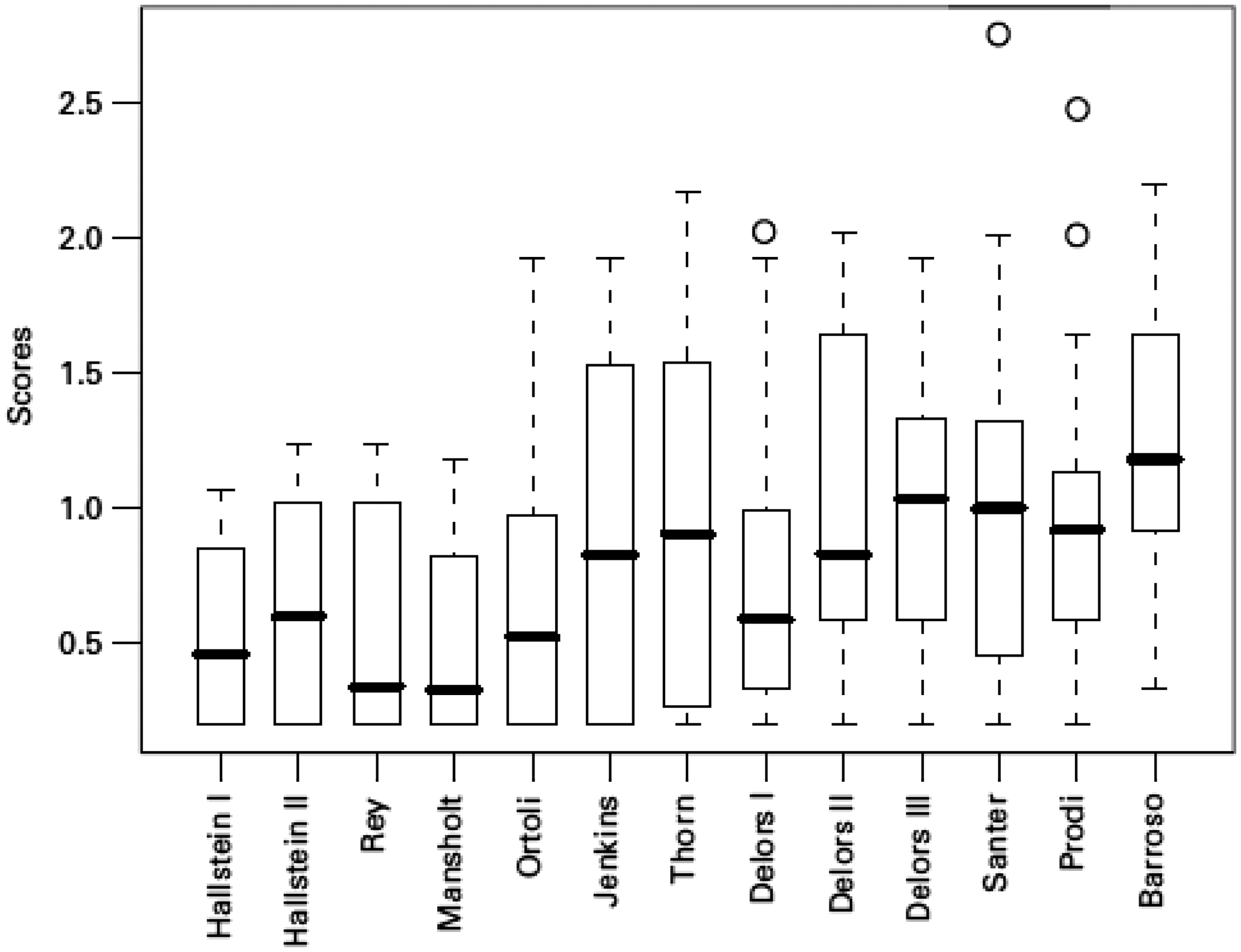
Not only the commissioner’s profile, but also that of the President has changed. A shift in the political accountability arrangements has generated new expectations of the role of the President in the Commission (Wille, 2010a). The Amsterdam Treaty increased the powers of the President over his fellow commissioners by allowing him to decide who receives which portfolio and to reshuffle them during their five-year term of office; he can even request an individual commissioner to resign. The new powers of the President strengthened his role vis-à-vis the individual commissioners and allows him in principle to run the Commission with greater authority. Today it seems accepted that the work of the College of Commissioners shall be subject to his (or her!) political leadership.
Prior positions of Commission Presidents
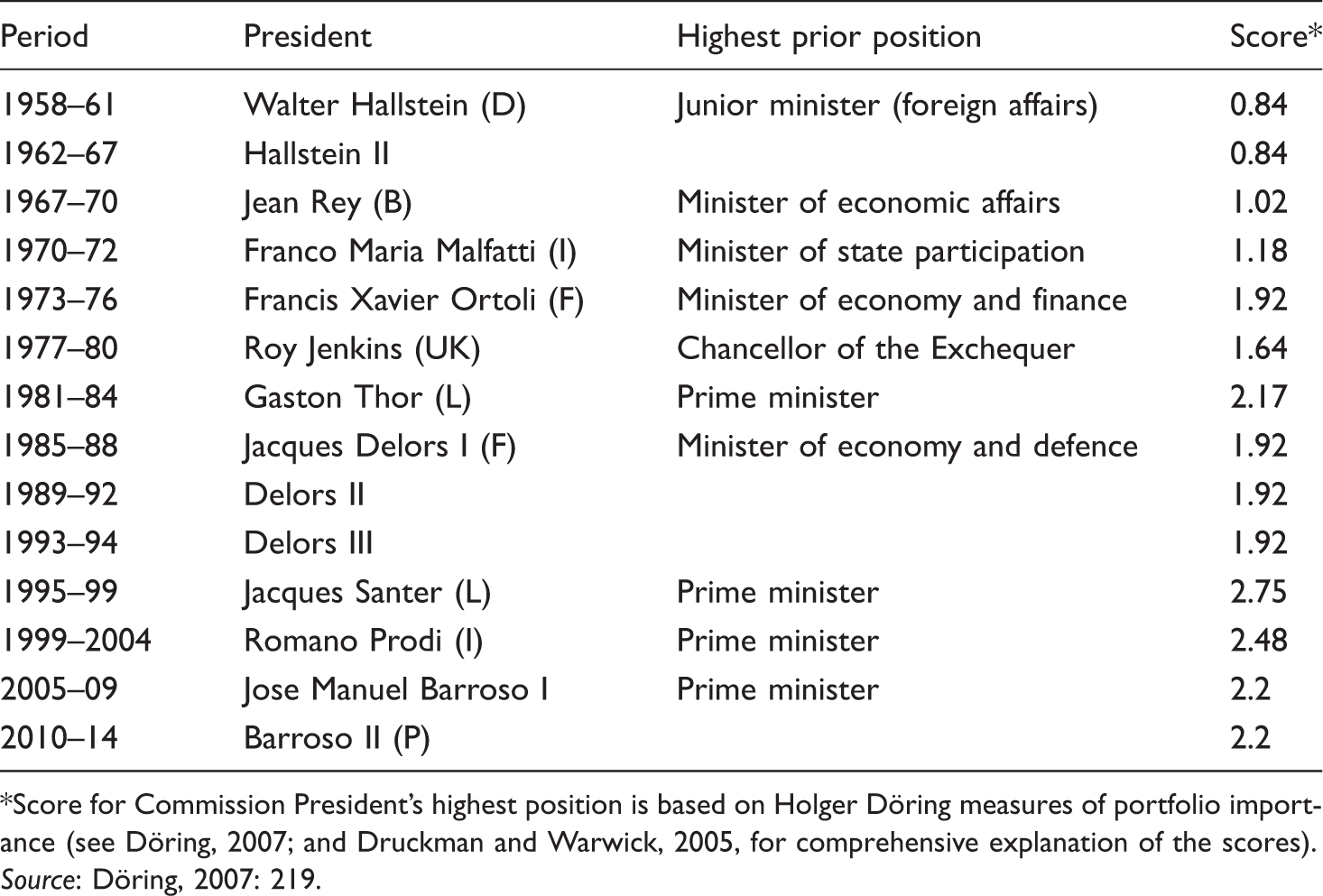
Score for Commission President’s highest position is based on Holger Döring measures of portfolio importance (see Döring, 2007; and Druckman and Warwick, 2005, for comprehensive explanation of the scores).
Source: Döring, 2007: 219.
Partisan representation
Political party representation and political balances are playing an increasing role when constituting the EU executive. Barroso, as a member of the European People’s Party (EPP), was appointed by the European Council in response to the victory of the EPP-ED in the 2004 European elections. This was the first time the Commission President had been appointed according to the results of the latest European Elections. With the Barroso Commission the political centre of gravity changed and became more right-wing than the previous two Commissions; both the Prodi and the Santer Commissions contained narrow left of centre majorities.
This shifting political balance is not simply a function of the changing colour of the member state governments in the Council, but also the result of treaty changes that have turned the EU Commission into a much more ‘majoritarian’ institution (Hix, 2008: 38–39). The introduction of qualified-majority voting (QMV) in the Treaty of Nice implied that a majority in the Council and Parliament is now needed to elect the Commission and that the EU is looking more and more like a ‘quasi-parliamentary system of government’ – where a particular majority chooses to shape the Commission as a ‘coalition’ government with a particular political programme.
An additional reason for a more partisan College is that the Barroso I Commission was the first to be appointed in which each member state had only one commissioner (Hix, 2008). As the size of the body was increasing with enlargement, the larger states lost their second commissioner after the 2004 enlargement, with the new Barroso Commission being appointed under the Treaty of Nice. In the past, the large member states split their representations of two commissioners over the largest domestic party and the opposition party. Now, with the one country-one commissioner rule, most EU governments have selected a politician from their own majority parties to the new EU executive.
When this change in the structure of representation in the Commission is combined with the introduction of qualified-majority voting (QMV) for electing the Commission President and the Commission as a whole, the result is a significantly more partisan Commission: the Commission President can be elected by a smaller political majority, and he is then able to lead a Commission where his political allies are likely to be in the majority. As for the political balance, the EU executive has become a broad coalition. In the cases of the Barroso I and II Commissions, the strong Liberal presence was ensured by a durable degree of political support from the largest parliamentary groups.
Representation: gendering the executive
In a modern executive the choice of ‘representatives’ is also according to what image it wants to transmit to the public in general. Gender balance is, therefore, an issue for the contemporary Commission President. But the EP also pays special attention to the gender balance in the appointment of new Commissioners. One of the challenges for Barroso was to ensure that there were at least as many women in his second team as in the first line-up. For the first 37 years, the College of Commissioners was an exclusively male club, with the first (two) female commissioners – Christiane Scrivener and Vasso Papandreou – not being appointed until the Delors II Commission in 1989. The representation of women dropped to one in 17 in the Delors III Commission before reaching five in 20 in the Santer and the Prodi Commissions (one out of four), and nine in 27 in the Barroso I and II Commission (one out of three).
Representation of nationalities
Commissioners are expected to represent the ‘common interests’ for the specific portfolio of which they are in charge and not to act as the spokespersons of particular countries (Egeberg, 2006: 35). At the start of their tenure, they pledge in their formal oath before the Court of Justice that they will act independently of national governments. At the same time, there is an equal representation of member states in the Commission. With the enlargement of the EU with 10 + 2 new member countries since 2004, the composition of the Commission has increased to the unwieldy size of 27 Commissioners, one for each EU member country. Whereas previously big countries had two and small countries one, each member state now has ‘its’ own commissioner.
According to this new one-country-one-commissioner rule, the presence of a commissioner from each member state increases the representativeness of the College and thus indirectly its legitimacy. Although there is officially no link between commissioners and member countries, they have always functioned as easy and efficient links between the Commission and the national political circuits of the member state governments. At the same time the Commission should not be turned into a body of national representatives. The main loyalty of a commissioner should lie with the Community interests, but ‘political reality teaches that such community interest will be much easier to sell to the member states and its citizens “if they have a man in”’ (Broin and Kaczyński, 2010: 50).
Bit by bit the European Commission is evolving into a political body. The handling of its internal balances – political colours, geographic, new and old member states, new and old Commission members and gender – conveys the message that the ‘political factor’ is increasing in the College of Commissioners, in terms of its internal composition and representation.
The supply side of executive selection: political capital and careers
The profile of the College of Commissioners is not only determined by the qualifications that are seen as appropriate for executive office, but also by the ‘supply’ of potential officeholders: eligible candidates in the member states who can be selected for the job. Looking at the career paths of commissioners gives an indication of the political capital (experiences, abilities and resources) that commissioners bring with them when entering the EU executive. These career paths tell us something about the pool of candidates seeking executive office; and how the job experience in the EU Commission can facilitate a further career.
The career before: pathways to power
The social make-up of the European Commission is not exactly a typical segment from society. The great majority of commissioners are highly educated and enjoy the benefits of university education – often abroad. The ‘resources’ and ‘capital’ which they bring to the Commission job varies with their career path. Three main career paths are prevalent among commissioners in today’s EU Commission; commissioners that have a ‘technocratic career’; commissioners with a ‘political career’; and commissioners that Mattozzi and Merlo (2008) would describe as ‘career politicians’.
Only two out of 27 commissioners in Barosso II come from a ‘technocratic’ background – meaning that they have had no previous experience in political positions. Both commissioners are from the Central Eastern European member states. Most commissioners have a ‘political career’, which means that they have a mixed occupational background. They have functioned, often in several, political positions, but they have work experience in other sectors too. The occupational experiences of this career path are based on work in the public sector or in so-called ‘brokerage’ occupations (Cotta and Best, 2007: 14–15; Ranney, 1965). Like political elites at the national level, they have been university professors, consultants, journalists or lawyers. The conditions in these jobs are favourable to the dedication to a political career (time available, long vacation periods, professional independence, financial security, social networks, status and technical abilities that are useful in public life, good rhetorical abilities, knowledge of legislation, etc.). It is a category of jobs that, in Schumpeter’s (1984: 362) terms, ‘naturally ties itself to politics.’
The route to the highest offices in the Commission seems, however, to be reserved for ‘career politicians’. Commissioners such as Barnier, Dalli, De Gucht, Almunia, Rehn who have spend most of their working life in a political position and have not done much other than politics. Commissioners who followed this career path gained an earlier passage into politics at the level of the member states with a political office or post at the local, regional or national level – as a parliamentarian or minister. The national level offers many possibilities for participation in formal political organizations. Many systems (particularly the unitary states) are, however, characterized by relatively closed political career paths into the higher echelons of power. Clearly demarcated and ‘well trodden ladders’ (from party work to local office, from regional government to parliament, from backbencher to junior minister) have to be climbed to the pinnacles of power (Norris and Lovenduski, 1997). Such a career pathway offers professional and personal resources and political experiences, and can serve as a springboard for launching an international political career.
Previous experience in politics has become an important resource. Access to and performance in the political profession of commissioner requires progressively specific skills and knowledge that is gained primarily by ‘on the job experience’ in other political positions and other political institutions. For the political profession more than for any other occupation it holds, in the words of Borchert and Stolz (2002: 24), that: ‘the whole career represents a kind of on-the-job occupational training and it is during their career paths that politicians acquire the necessary skills and qualifications’. The vertical accumulation of offices across various levels of the political system gives work experience in several political positions and supports a durable professionalization. It is this experience that will serve as ‘competitive advantage’ against less political experienced competitors (Borchert and Stolz, 2002: 23).
Moreover, a sizeable group of commissioners have had previous experience of active participation in international organizations. Increased globalization has brought about the rise of a class of ambitious career politicians ready to function in international governance positions. The growth of European institutions has multiplied the career opportunities for the relatively highly skilled and mobile who have exploited these new career opportunities. This group thus has experience with working in an international environment through living, studying, or working abroad.
Finally, strengthened democratic accountability in the EU also brought a certain level of uncertainty to the job of commissioner – a kind of insecurity (the possibility of political defeat, censure) that applies to the occupational arena of politics at large (Borchert and Stolz, 2002). It requires a greater subjective willingness of aspirant commissioners to assume the uncertain life, the risks and costs of taking on a position within the executive power; and it calls for specific strategies of entering and staying in political positions. To a certain extent, this has also provided incentives for a further political professionalization of commissioners: it has brought in a group of ‘career politicians’; it is indicative for the growing relevance of ‘political capital’ in the EU executive; it points to the diminished transferability of skills between politics and other careers; and it denotes the politicization of the EU Commission.
The career afterwards: the Commission as a springboard
The increased politicization of the Commission manifests itself at two other points in the career path of the commissioner: in the form of ‘early departures’ and in their post-Commission career. The rule of thumb for members of the European Commission was that they were politicians past their best. Twenty years ago membership of the Commission was for two-thirds of the commissioners the last important political position they would occupy (Page and Wouters, 1994: 455). Consequently there was ‘little political incentive for commissioners to identify objectives which could not have emerged from the normal process of politics and to pursue and sustain them since only a minority can seriously expect to be able to use any success in Brussels as collateral for a resumed political career at home’, wrote Page and Wouters (1994: 457). However, for many commissioners today this office is not their last major public position. More and more, a commissionership in Brussels has become another stepping stone within a political career.
Early departures (1958–2010)
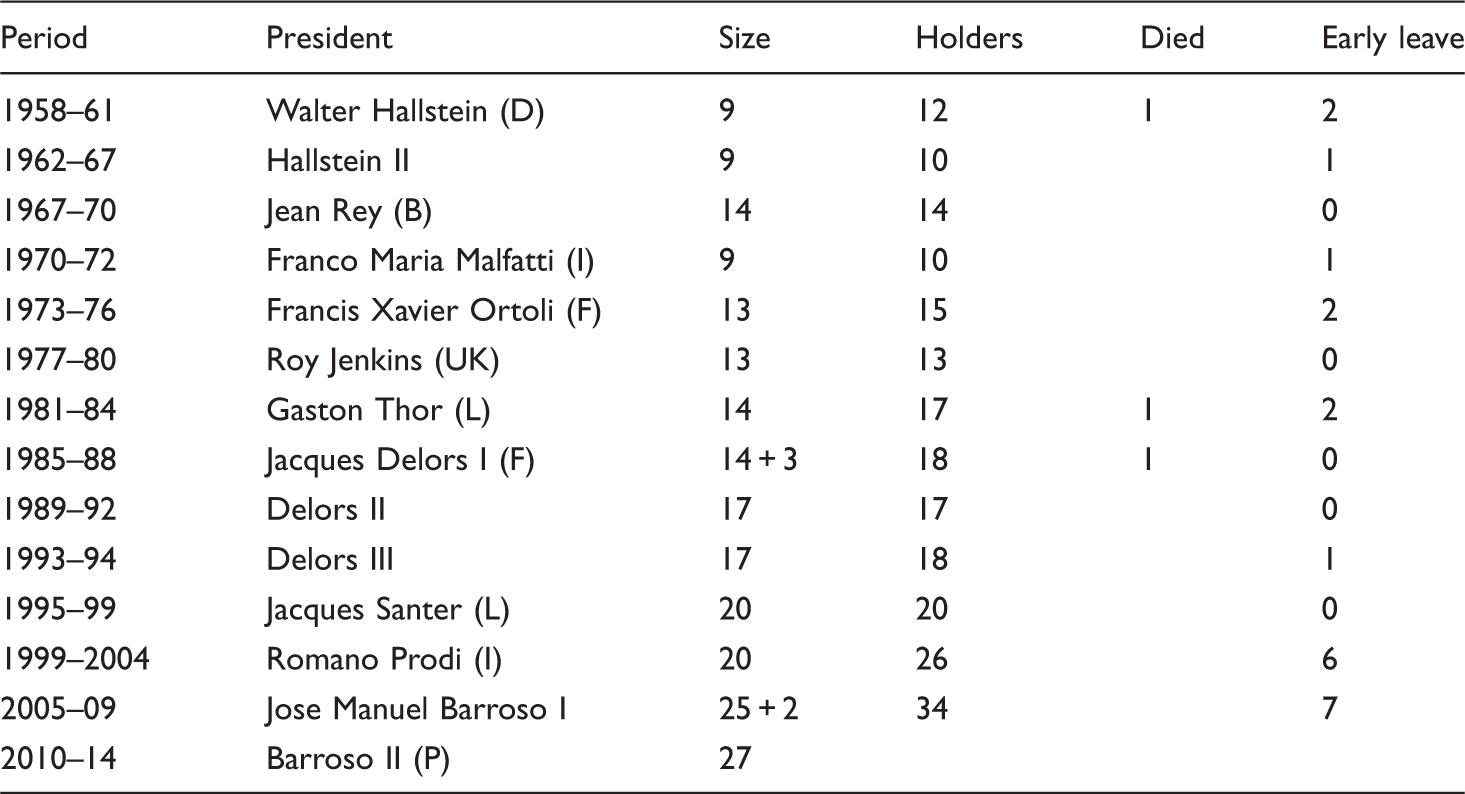
These reshufflings in the College are indicative of the political profile of today’s commissioners. Commissioners are required to remain above national politics while exercising their duties in the Commission in order to maintain independence. However, that requirement has slowly been eroded as the institution has become more politicized. Commissioners no longer cut themselves off from national politics when they move to Brussels. Politics, national and international, is important for political professionals because it provides access to the accumulated resources for a career after their position in the EU Commission. Prodi and Monti both became prime ministers of Italy, Grybauskité became President of Lithuania and Pascal Lamy director-general of the WTO.
For most commissioners the Commission is not their last position in their career. If it is not for a new political post, then ex-commissioners move to lucrative business and commercial positions. They become lobbyists, join pressure groups or take senior positions with lobby firms and think tanks. Their prestige and experience in European politics and their national and international network contacts, and the related political leverage and entree to EU executive, make them today very interesting and valued after their term of office. In return, they also gain the opportunity to earn large sums of money denied to them in their careers in government.
The mobility between political and economic areas has become a normalized career path for politicians at the level of the member states (Kavenagh and Richards, 2003: 192) – but increasingly also for commissioners. Of the 15 outgoing commissioners of the first Barroso Commission, 11 took up a corporate executive position or some other activity in the private sector within six months of leaving their Brussels office. 7 The after careers of contemporary commissioners indicate that years in the EU executive have become a springboard for a next step in a more globalized setting offering new career challenges and opportunities. The connections and political experiences of ex-commissioners have become interesting ‘resources’ for international companies and organizations. Work experience in the private sector may not be helpful to get access to a career inside politics, but the job experience as EU commissioner facilitates a career outside politics.
The politicization of executive selection in the EU
The widening and thickening of democratic accountability arrangements in the EU and the increased powers of the European Parliament have left their mark in a politicization of the selection of EU commissioners. This has become visible in the access and exit procedures of this part of the EU executive, but also in shifts in the demand and supply factors in the process of EU executive recruitment.
First, the increased powers of the European Parliament created a new mix of mechanisms that stressed the political and that heightened the accountability of the Commission to the EP. The investiture procedure of the EP has granted more say to MEPs on the selection of the EU executive and accordingly more legitimacy to the office of commissioner. The establishment of hearings and the approval vote have contributed to a politicization of the selection of EU commissioners. The critical questioning of MEPs, the way commissioners are put under fire, the retake-hearings on a couple of candidates and the pull-out of candidates are all an indication of a power play between the European institutions.
Second, the EU Commission has turned into a genuinely political rather than a technocratic body, something that is reflected in new expectations that have increasingly shaped the executive role of the Commission, but also in its composition. Unlike vacancies in executive management, there are no well-defined job descriptions. Executive selection is a filtering process and the profile of the Commission is indicative for the kind of criteria that have been used in this process. Partisan balance, gender balance and nationality have grown in importance as elements for representation in the Commission’s make-up. The transformation of the EU executive at this point can be understood as the response to democratic demand factors to ‘mirror’ specific elements in the profile of the EU executive.
Third, politicization manifests itself also in the supply side of executive selection. An analysis of the careers of commissioners shows ‘who’ is eligible for executive office. Shifts towards political professionalization have meant that extensive career patterns through political institutions have become the most common route for entering the Commission. Not a technocratic background but political competences have become relevant for holding this office.