







Abstract
Development practitioners still lack a critical mass of empirical evidence that can help identify the set of interventions that are most likely to work, and inform the design and implementation of feasible reforms. This article contributes to filling this gap by looking at the case of the ‘Sierra Leone Pay and Performance Project’, a World Bank-supported initiative to reform the civil service. It analyzes the functional problems characterizing the civil service and discusses what factors account for the observed dysfunctions. The central argument is that the current dysfunctions might be difficult to reverse as they define a sub-optimal equilibrium which serves political purposes (dysfunctions by design). However, politics is not all that matters. This equilibrium is further reinforced by systemic dysfunctions that may not be the consequence of any strategic design or the outcome of elite preferences (dysfunctions by default). This is where there is scope for change, even in the short run. Accordingly, the chances of successful civil service reforms are likely to be maximized if reform initiatives support modest and incremental changes that ‘work with the grain’ of existing incentives and are consistent with government preferences. The Sierra Leone Pay and Performance Project aims to do so by adopting a limited and targeted focus on pay reform, performance management and recruitment and staffing. In addition, the use of the results-based lending instrument is expected to help mitigate the current dysfunctions by aligning the incentives of the various players and, in this way, create the conditions for greater coordination across government agencies. Although the suggested approach is not without risks, recent dynamics suggest that the chances of success are greater today than in the past.
Points for practitioners
The article shows how project design can be improved by identifying the functional problems underlying civil service performance, with a special focus on the interests and purposes that they serve. Such ‘prospective’ political economy analysis can inform Bank efforts to (i) identify the context-appropriate and politically salient reform solutions; (ii) design the critical path for achieving these reform objectives; and, most importantly, (iii) select the appropriate lending instrument. The Sierra Leone example also suggests that results-based lending approaches are more amenable to ‘working with the grain’ and provide a promising way forward on public service reforms in difficult political environments.
Introduction
After more than 30 years of donor-funded Public Sector Management (PSM) reforms, the quality of public service institutions in most sub-Saharan African countries remains poor, seriously undermining governments’ capacity to provide public goods and services to the majority of the poor. A growing consensus has emerged among researchers and development practitioners that past reform efforts have largely failed because they did not take into account the political economy environment and other context-specific constraints that are often binding. Most conventional explanations of failed reform efforts suggest that PSM interventions fail due to lack of ‘ownership’ and ‘political commitment’, over-ambition in the presence of ‘low local implementation capacity’ and ‘inadequate technology’, embedded ‘patrimonial practices’ and other context-specific constraints (Crook, 2010; Evans, 2008; Langseth et al., 1995; Wescott, 1999). Drawing upon this literature and the World Bank’s experience with public service reforms, the 2008 IEG report (Independent Evaluation Group [IEG], 2008) identified a set of guiding principles for better results in civil service and public sector reform, suggesting inter alia that projects should be designed ‘recognizing the complex political and institutional context, as well as the sequencing issues that it takes to achieve results’. These conclusions are largely consistent with the findings of a recent literature review on public sector governance reforms (Scott, 2011), which emphasizes the importance of understanding the incentives that drive politicians and civil servants when identifying feasible reform options. In addition, the World Bank’s new approach to Public Sector Management (World Bank, 2012a) and other recent contributions (Andrews, 2010; Andrews et al., 2012; Grindle, 2004, 2007, 2011) have noted that reliance on ‘isomorphic’ or ‘best practice’ approaches – often based on the historical experience of OECD countries – has often been unsuccessfully imported into developing country contexts.
Despite this general understanding that context and politics matter, there are significant challenges in translating these lessons into operational practice. As Goetz (2007) noted, past reform experiences are so context-sensitive that it remains extremely difficult to identify solutions and reform paths based on these. In addition, as Scott (2011) forcefully argues, the PSM literature has mainly focused on ‘presenting failure’ rather than ‘explaining success’. This is especially the case for most political economy (PE) analysis of public sector management (PSM) reform, which provide ex-post explanations of why reforms failed but fall short of offering ex-ante credible predictions about what operational solutions are likely to work and what specific form donor interventions should take to succeed in achieving the stated reform objectives (World Bank, 2012a). Likewise, the literature on ‘good enough’ PSM reforms offers limited practical guidance beyond the general recommendations that ‘best practice’ solutions based on developed countries’ models are not likely to be appropriate, and that development practitioners need to put ‘less emphasis on reproducing the same reform models and more on better understanding what context-appropriate reforms look like’ (Andrews, 2010). 1 Consequently, practical and context-specific examples of ‘working with the grain’ of African development (Booth, 2009; Kelsall, 2008) are limited, and development practitioners still lack a critical mass of examples that show how political economy analysis can successfully inform the design and implementation of context-appropriate PSM reforms. Such evidence is especially needed in the context of post-conflict and fragile states, whose characteristics often magnify political obstacles to reforms and require ‘good enough’ approaches that are likely to deviate significantly from ‘best practice’ solutions (World Bank, 2011a). With its emphasis on ‘problem solving’, diagnostics, agility and flexibility, the guidance provided by the World Bank’s Public Sector Management Approach 2011–2020 is also consistent with this line of thinking.
In line with the principles outlined in the PSM Approach, this article seeks to contribute to the Bank’s ongoing efforts to build a growing body of comparative evidence on what works in PSM and aims to offer greater operational guidance on the diagnostic processes that help scholars and practitioners to identify the appropriate response for a given problem in a specific context. It does so by looking at the case of the ‘Sierra Leone Pay and Performance Project' (P&PP), 2 a World Bank-supported initiative which supports civil service reform with a limited and targeted focus on pay reform, performance management and recruitment and staffing. The central argument is that some of the structural dysfunctions characterizing the civil service might be difficult to reverse as they define a sub-optimal equilibrium which serves political purposes (dysfunctions by design). However, politics is not all that matters. This equilibrium is further reinforced by systemic dysfunctions that may not be the consequence of any strategic design or the outcome of elite preferences (dysfunctions by default). This is where there is scope for change, even in the short run. The example of the Sierra Leone project is then used to show how a ‘prospective’ Political Economy Analysis can inform efforts to (i) identify context-sensitive and politically salient reform solutions; (ii) design the critical path for achieving these objectives; and (iii) select the lending instrument which is most appropriate to broaden the reform space. Consistent with the principles of the new PSM Approach, the analysis suggests that results-based lending may well provide a promising opportunity for PSM reforms, as it is more likely to ‘work with the grain’ of the country’s institutional and capacity constraints and has the potential for promoting more joined-up working within government, thereby reducing the risk of failure and increasing the chances of achieving the desired results. In addition, the preparation experience from Sierra Leone suggests that a more proactive approach to engaging with the client and stakeholders can indeed broaden the reform space in ways that a more traditional approach may not engender.
The analysis is organized as follows: Section 1 describes the functional problem of the public service in post-conflict Sierra Leone. Section 2 identifies what we see as the most likely reasons that account for the current dysfunctions. These prevailing dysfunctions are most likely the consequence of (i) strategic political choices (dysfunctions by design); and/or (ii) are determined by factors which are not necessarily at odds with politicians’ preferences (dysfunctions by default). The latter probably persist as a result of inertia, distrust, indifference and neglect or are, in some cases, the unintended consequences of previous reform efforts. Section 3 makes the link between the lessons from the prospective PE analysis and the project approach and makes the case for why this is likely to yield more appropriate solutions for civil service reform in Sierra Leone. Section 4 evaluates the risks associated with the approach and also discusses why there are greater chances of success today than in the past. Section 5 concludes by suggesting the implications of the study for ongoing efforts to build a body of comparative evidence on what works in PSM, while recognizing that the nature of the P&PP as a ‘live example’ inevitably challenges the empirical foundations of the analysis and calls for future research to further validate the conclusions presented here.
1. The civil service in Sierra Leone: defining the functional problem
Despite strong economic growth of 4.57 percent between 2008 and 2010, Sierra Leone still faces serious development challenges: over 62 percent of the population lives below the poverty line of $1.25 a day, and almost two-thirds of the population is illiterate. Life expectancy is 49 years, well below the regional average of 54 years across low-income countries. The under-5s mortality rate is 262 deaths for every 1000 live births, more than double the average for low-income countries (126/1000). The performance in critical sectors is equally disappointing: only 7 percent of the population (mainly located in Freetown and the Western Area) has access to power, and there is a road density of 0.22 paved kilometers (km) per 1000 people – the Sub-Saharan African average is 0.79 km/1000 people (World Bank, 2010).
The composition of civil service in Sierra Leone (2008–2011)
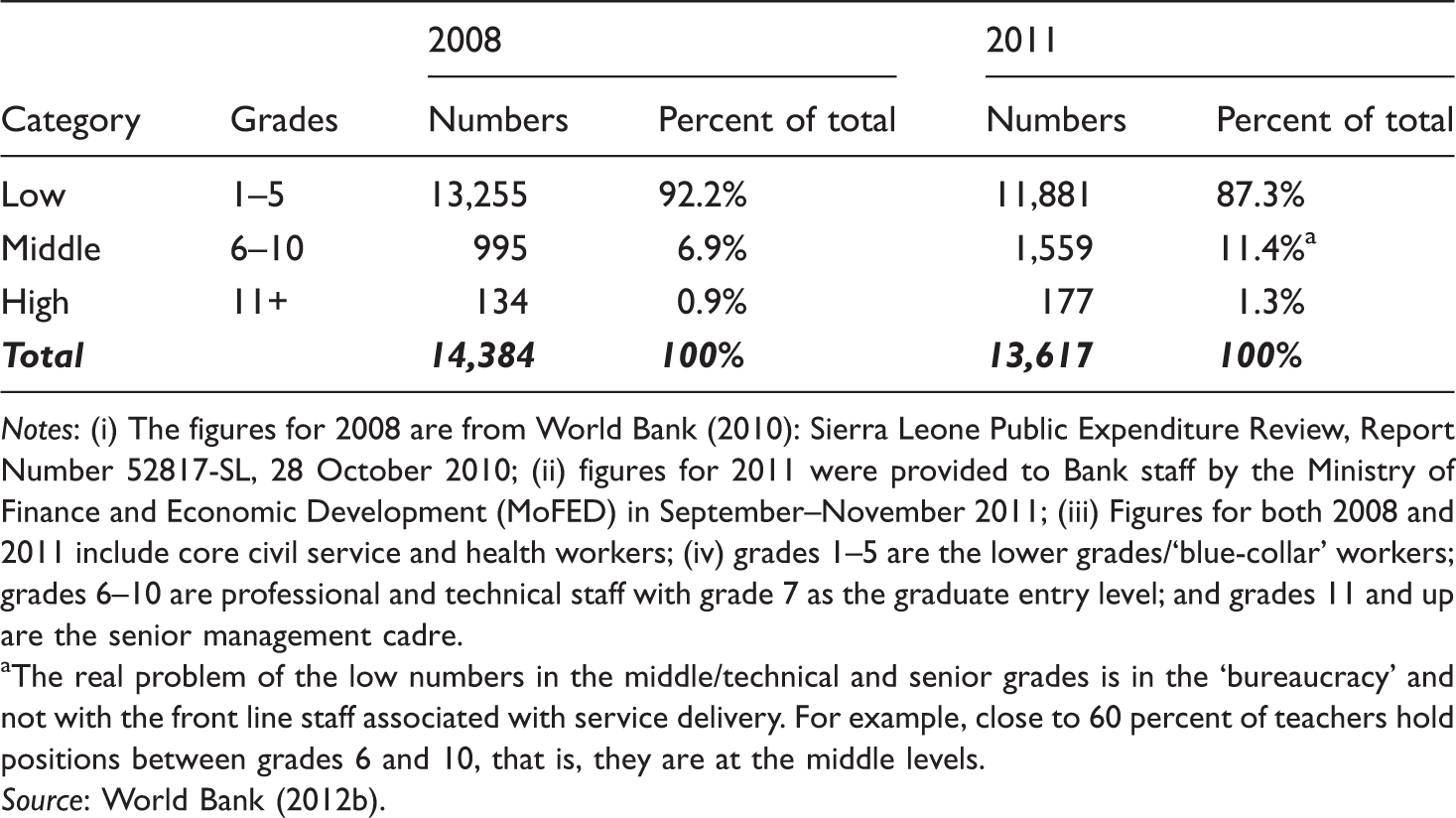
Notes: (i) The figures for 2008 are from World Bank (2010): Sierra Leone Public Expenditure Review, Report Number 52817-SL, 28 October 2010; (ii) figures for 2011 were provided to Bank staff by the Ministry of Finance and Economic Development (MoFED) in September–November 2011; (iii) Figures for both 2008 and 2011 include core civil service and health workers; (iv) grades 1–5 are the lower grades/‘blue-collar’ workers; grades 6–10 are professional and technical staff with grade 7 as the graduate entry level; and grades 11 and up are the senior management cadre.
The real problem of the low numbers in the middle/technical and senior grades is in the ‘bureaucracy’ and not with the front line staff associated with service delivery. For example, close to 60 percent of teachers hold positions between grades 6 and 10, that is, they are at the middle levels.
Source: World Bank (2012b).
Several features characterize the current state of the civil service in Sierra Leone, including: (i) extremely low levels of remuneration that are inadequate for attracting and retaining senior staff; (ii) patronage-based appointments, promotions and remuneration levels; and (iii) the virtual absence of intrinsic or extrinsic incentives for performance. In addition, internal inequities which engender frustration and dissatisfaction are not conducive to establishing an esprit de corps. While it is difficult to disentangle the impact of each of these, it is more than likely that together they act as ‘binding constraints’, the lifting of which would be a necessary (if not sufficient) condition to improve overall civil service performance. We now review these in turn.
1.1 Low remuneration
Low remuneration appears to be one of the major reasons why Sierra Leone’s civil service has not been able to attract and retain suitably qualified technical and professional personnel. One indication that low remuneration is a key constraint to attracting qualified staff is that entry-level personnel recently recruited for certain technical positions (budget officers, procurement specialists, internal auditors) had to be offered an average of US$1000 above the regular civil service wage (approximately $200) to accept these positions. Other indications that low levels of pay are a key constraint to filling technical and managerial positions is the plethora of ‘coping’ arrangements that circumvent the low public pay scale. These include: (i) the relatively well-paid local technical assistants (LTAs) 6 in line positions, often funded by donors; (ii) the prevalence of project implementation/management units (PI/MUs); (iii) donor-funded line agencies such as the Decentralization Secretariat, until recently, the Local Government Finance Department and the Public Financial Management Reform Unit; and (iv) other ad hoc salary top-ups. 7
1.2 Patronage-based appointment and promotion
The quality of staff in the middle and upper grades poses an additional problem as appointments to these positions have often not been made on the basis of merit and competency. Even if these practices were to change, the pool from which promotions to leadership positions can be made is weak. During the civil war, it was generally the most qualified and competent people with marketable skills who left. As noted above, LTAs often fill critical gaps. While, in recent years, the integrity of the lateral entry recruitment process has improved, these new appointees will take a while to make their way through the system even if they were to stay. This has happened for three reasons. Competency-based promotions are a challenge because the appraisal system had fallen into disuse; Permanent Secretary (PS)-level appointments are made by the President; and the Public Service Commission has, in spite of good intentions, lacked the capacity to undertake the necessary selection exercises. Promotion decisions have therefore been effectively made by the senior management of ministries with their ‘recommendations’ simply ratified by the Human Resource Management Office (HRMO) and the PSC. Compounding the selection problem, no training is provided to enable those who have been promoted to perform their new responsibilities because there is no public service management training capacity or tradition of training for senior management.
1.3 Lack of incentives for performance
Finally, the virtual absence of any incentives for performance has led to a lack of accountability and has demoralized and demotivated civil servants. In particular, intrinsic motivation and a ‘public service ethic’ are also largely absent. This ethos is no longer evident in Sierra Leone, where real pay levels (including salaries and benefits) have deteriorated so far that the lack of extrinsic rewards overwhelms any intrinsic factors derived from the work itself. Unfair pay (internal inequity) is also an important demotivating factor. This is especially true in a situation where some civil servants/LTAs are very highly remunerated in a non-transparent way, creating tensions and resentment among staff. 8 Moreover, individuals and jobs are wrongly graded at levels that are higher/lower than they should be. 9 For several years, the government has failed to introduce a pay structure which is based on the relative worth of the job. Instead, ad hoc pay adjustments for a select few have created significant anomalies and distortions which are resented by the majority of civil servants. 10 Donors have also contributed to this problem by adopting short-term solutions to the capacity gaps that aimed to create ‘temporary capacity’ (McKechnie, 2004) by promoting special contract arrangements. 11 Over time, these ‘coping’ arrangements have produced severe negative side-effects for staff motivation, engendering tensions between the regular civil servants and LTAs and undermining team spirit and cohesion within the civil service. Overall, this has had an adverse effect on professional cooperation both within and between functions and departments. 12 In this environment, neither government nor civil service managers have demanded much in the way of performance from civil servants. And the lack of a functioning performance appraisal system has created a culture in which poor performance is tolerated and good performance goes unrewarded.
2. What accounts for the current dysfunctions? Defining the political equilibrium
This section attempts to explain why the current dysfunctions might be difficult to reverse, and why the current sub-optimal equilibrium is stable and makes it difficult to implement reforms. It is argued that two major determinants have shaped politicians' incentives: (i) the resilience of neo-patrimonial practices as a key strategy to access and maintain power; and (ii) the imperfections in the ‘political market’, manifested in this case by ethnically driven political identities and systemic ‘vertical’ information asymmetries between citizens and rulers. Taken together, these determinants undermine the incentives to improve public sector performance and could explain the interest of the political elites in maintaining the status quo and resisting reforms aimed at improving the quality of civil service (dysfunctions by design). However, politics is not all that matters. This equilibrium is further reinforced by systemic dysfunctions that may not be the consequence of any strategic design or the outcome of elite preferences (dysfunctions by default). Examples of such dysfunctions include: (i) lack of trust and poor coordination among (and within) agencies, often magnified by information asymmetries; (ii) marginalization of critical players; and (iii) short-term (and often ad hoc) solutions which circumvent the problem of a poorly performing civil service. We now examine each set of dysfunctions in turn.
2.1 Dysfunctions by design
Since the end of the civil war in 2002, much has changed in Sierra Leone’s political landscape: democracy – at least in its electoral form – is now in place. Three rounds of national elections have taken place (in 2002, 2007 and 2012, respectively). In particular, the 2007 election results led to the first peaceful transition of power in the country’s history since independence. Although cases of ethnic-based electoral violence were reported (ICGR, 2008; NEC, 2008), overall the political leadership and ordinary voters accepted the outcomes and never seriously challenged the democratic process. 13 There have also been three rounds of Local Council elections (2004, 2008 and 2012, respectively) and some degree of fiscal and administrative authority has been granted to sub-national governments, which were re-established in 2004 after 32 years of hyper-centralized and authoritarian rule. These are, indeed, notable achievements in a post-conflict and fragile environment. However, more striking than the changes are, in fact, the continuities with the pre-conflict environment. Despite the formal transition to multiparty politics and ‘electoral democracy’ (Diamond, 1999), informal ‘neo-patrimonial’ 14 practices remain a resilient strategy with which to exercise political power and manage relationships between the state and society. Evidence suggests that politicians continue to have incentives to divert resources to private rents and/or toward targeted provision of private goods (such as jobs, contracts, and political appointments), that are likely to benefit narrow interest groups rather than the broader public interest (Robinson, 2008). In Sierra Leone, patterns of electoral behavior tend to reinforce these practices, as people vote on the basis of ethnic or regional affiliations instead of a given party’s performance. Indeed, when people vote on the basis of fixed characteristics (such as ethnicity), this significantly reduces the extent of political competition – support is guaranteed, regardless of performance – and increases the ability of politicians to gain support in exchange for rewarding targeted groups with jobs and other private goods (Acemoglu and Robinson, 2008; Horowitz, 1985). 15 Evidence that identity politics still plays an important role in Sierra Leone can be found in the reported ‘winner-takes-all’ strategy followed by the ruling party (APC) after its victory in the 2007 elections. According to several sources, the APC administration that took office in 2007 dismissed a number of functionaries from the Southern and Eastern provinces (dominated by the main opposition party – the SLPP) and replaced them with APC-supporting and Temne-dominated northerners, 16 often with little regard for their competence, experience or qualification (Africa Confidential, 2009: 5; Gberie, 2010; ICGR, 2008). These practices are expected to have important implications for the management and performance of civil service. More specifically, this situation creates a classic ‘politician’s dilemma’ (Geddes, 1994) between the goal of improving performance of the bureaucracy and ensuring political survival. In this situation, the imperative of political survival could trump considerations of competence and the efficiency of the public bureaucracy is undermined. From a politician’s perspective, the bureaucracy could represent a potential source of political opposition to patrons, with the consequence that bureaucrats are continually ‘shuffled’ so that they cannot conspire against the rulers, while appointments, promotions and remuneration are based on patronage rather than merit and professional qualifications for the job. The case of Sierra Leone is illustrative of such a dilemma, and suggests that this could create resistance to any reform efforts that aim to change the management of the civil service and insulate the bureaucracy from the discretionary power of patrons and politicians.
‘Political market imperfections’ (Keefer and Khemani, 2004) also influence the extent to which societal groups can collectively mobilize and create political pressures for change. Post-conflict Sierra Leone mirrors the experience of many other developing countries where the information base of the poor might be skewed in a way that detracts from their ability to hold elected officials accountable for the quality of public services. 17 In the absence of any information on public service standards, targets and performance, it is difficult for the citizens to hold the public service accountable for their poor performance. This is especially true in the case of PSM reforms because intermediate improvements in the quality of public management systems are difficult to measure and ‘downstream’ improvements in services and development outcomes take several years, and may not be easily attributed to the reform of ‘upstream’ institutions (World Bank, 2012a). Overall, this makes it difficult to overcome collective action problems and mobilize the potential beneficiaries of PSM reforms. As Heredia and Schneider (2003) argue, beneficiaries of administrative reforms are usually dispersed while opponents are concentrated, to the point that there are few grounds to expect that reform proposals will emerge from electoral campaigns or elected legislatures.
In Sierra Leone, efforts to overcome information asymmetries and collective action problems are further compromised by the resilience of ethnic cleavages and their ‘politicization’ for electoral purposes. This situation undermines the potential effect that electoral competition usually has in mobilizing pressure for reforms. More importantly, if popular support can be safely ensured by ethnic-based distribution of patronage and public resources, establishing a functioning bureaucracy becomes less relevant and money can be diverted elsewhere, for personal or political ends. In fact, a weak and politicized bureaucracy would make it easier to achieve these goals. Keefer and Vlaicu (2008) provide a rigorous empirical test of this argument and demonstrate that sharply different policy choices across democracies can be explained by differences in the ability of political competitors to make credible pre-electoral commitments to voters. According to the authors, in democracies where political competitors can make credible promises to only small segments of the electorate (such as, for instance, their co-ethnics), governments prefer to pursue clientelistic policies, high targeted spending, high rent seeking, and low public goods provision. Existing analysis of national electoral politics in Sierra Leone (Kandeh, 2003, 2008) supports this argument, and might help to explain why the demands for a better performing public sector have been traditionally low.
2.2 Dysfunctions by default
While several public service reform (PSR) initiatives have been tried in the past 20 years, they have largely failed to address the functional problems described above. Since the end of the conflict, successive administrations in Sierra Leone have, at least in their public announcements, identified the resuscitation of the public service as a priority vital for stability, poverty reduction, service delivery and the creation of a capable state. 18 Public sector reform has also been an integral part of the reforms that donors have been trying to achieve through sector investments and the provision of budget support. However, despite this rhetoric, until recently the public service reforms have not been shown to be a priority in the Government of Sierra Leone (GoSL)’s development agenda, with the result that previous reform attempts have been largely donor driven. 19 Partially as a consequence of this, government initiatives have tended to focus around ‘ad hoc’ measures in response to immediate problems and issues, usually in response to pressures from different interests groups, 20 without adequate consideration of the long-term consequences of their actions. For example, the GoSL and its development plans have usually dealt with the ‘capacity gap’ in the civil service by either bypassing government agencies and outsourcing their functions (working with NGOs and other non-state actors) or by creating temporary capacity through the use of donor-funded staff in line positions or even government-funded LTAs. 21 The case of the donor-funded Decentralization Secretariat – an implementing agency established virtually outside the Ministry of Local Government and Rural Development to establish and promote decentralization reforms – provides an example of this approach. More recently, the government decided to grant higher salaries and additional staff and resources to the health sector to implement the Free Health Care Initiative (FHCI). While these short-term solutions or ‘coping arrangements’ seem to have contributed to improved performance within some agencies (Larizza and Glynn, 2011; Viñuela and Barrie, 2011), over time they have also created serious – albeit unintended – systemic complications, including: (i) marginalization of agencies such as the HRMO which should be playing a critical role in designing and implementing reforms; 22 (ii) demotivation for the majority of civil servants who do not have access to contractual benefits, combined with resistance to reform from the minority who benefit from such arrangements; and (iii) fragmented responsibility for public service management and reform, which in turn accounts for information asymmetries and lack of coordination among critical agencies.
This last implication is especially critical from a reform perspective and is worth further elaboration. While the responsibility for public service reform (by its very nature) is fragmented in many countries, in Sierra Leone this fragmentation is extreme and further exacerbates the coordination challenges in a government where coordination and information sharing capacity and traditions are weak. Figure 2 (Appendix 2) presents a graphic characterization of the current institutional arrangements in the public service. According to the Constitution, the Secretary to the President is ‘the principal adviser to the President on Public Service matters’ (Art. 67 (2) a). The Cabinet Secretary is also the Head of the Civil Service and is responsible for ‘coordinating and supervising the work of all administrative heads of ministries and departments in the Public Service’ (Art. 68 (3) c). The PSC has ‘the power to appoint persons to hold or act in offices in the public service (including power to make appointments on promotion and to confirm appointments) and to dismiss and to exercise disciplinary control over persons holding or acting in such offices shall vest in the Public Service Commission’ (Art. 512 (1)). However, for Permanent Secretaries this power is vested in the President ‘acting in consultation with the Public Service Commission’ (Art. 154 (1)). The HRMO has responsibility for HR functions and for leading human resource management reforms. The Strategy and Policy Unit (SPU) in the office of the President has responsibility for performance contracts between the president and the ministers, and reports to the Chief of Staff. In addition, a new Directorate for Performance Management has been established in the HRMO to assess the performance of individual civil servants. Finally, a Public Sector Reform Unit (PSRU) which was essentially a donor creation – located in the Presidency – is responsible for coordinating public sector reforms but has no executive authority and implementation responsibilities.
Expected tax revenues from mineral royalties, 2011–2015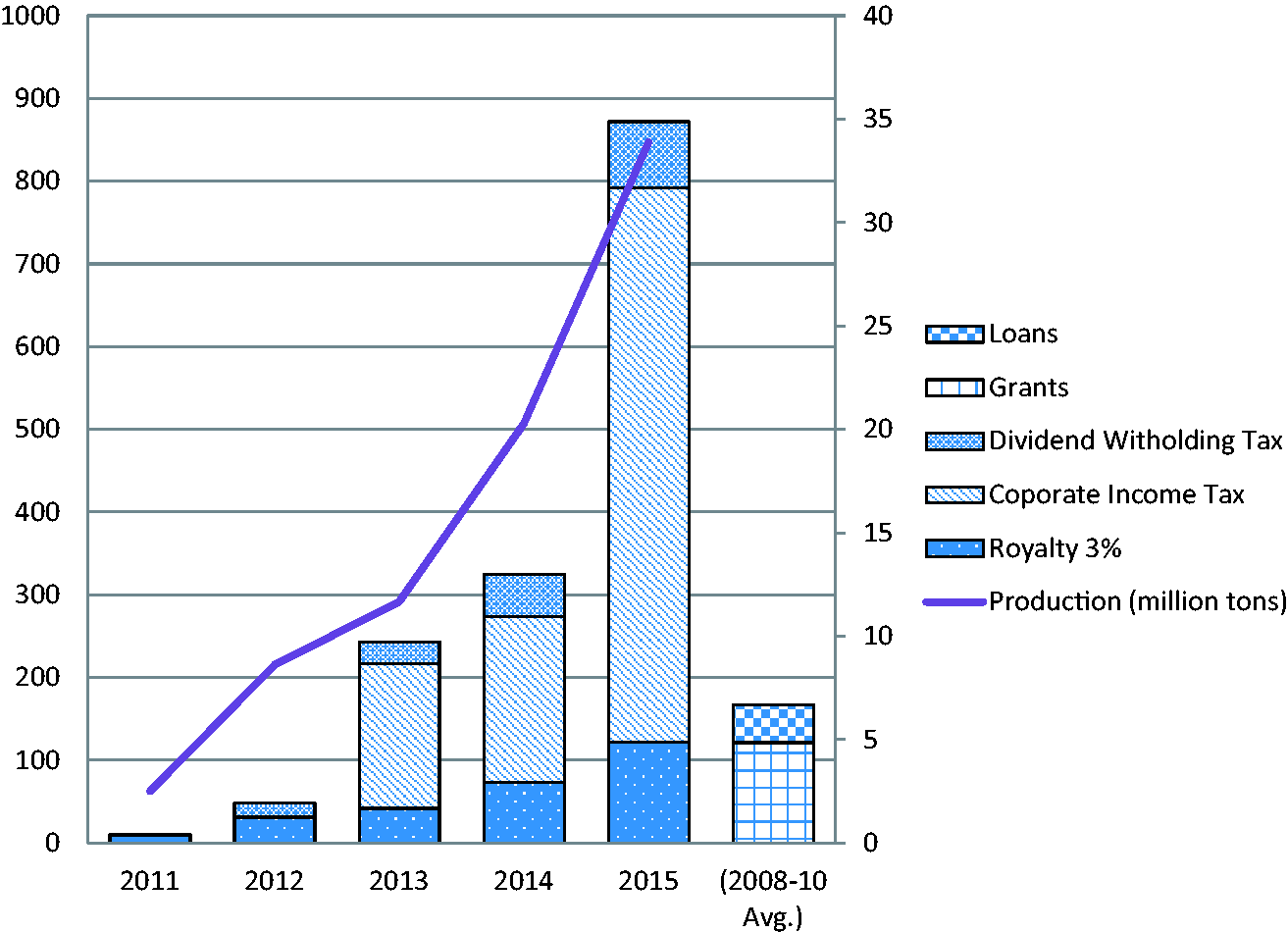
In addition to the high level of fragmentation, long-lasting and persisting mutual distrust between the Ministry of Finance and Economic Development (MoFED) and other ministries, departments and agencies (MDAs) further complicates the coordination problem among key implementing agencies. Taking advantage of its dominant position, MoFED often acts well beyond its mandate and intervenes in areas that are beyond its remit. Such interventions are often justified by the argument that MDAs are non-strategic and prepare ‘laundry lists’ rather than sensible budget proposals supported by strategic plans. The MDAs, on the other hand, often view the MoFED as insensitive to their needs and arbitrary in its resource allocation decisions.
It is very difficult to get any accountability for service delivery and results in a system which is characterized by such deep-rooted levels of mistrust and institutional fragmentation. This further exacerbates information asymmetries between ‘principals’ and ‘agents’ both across and within government agencies. Under those conditions, leadership for change is unlikely to emerge readily. Frustrated by this fragmentation of the reform agenda, both donor and interested government agencies refer to the President as a ‘last-resort solution’ to circumvent the problem and advance the reform agenda. While this approach might produce short-term gains – in a hyper-presidential system like that of Sierra Leone, decisions made at the level of Presidency do get quickly implemented – over the long run this further complicates the problem, with the Presidency supporting ad hoc solutions that often respond to narrow interests and further ‘atomize’ the nature of civil service reforms.
Taken together, many of these dysfunctions are, most likely, not the consequence of a larger political design. While resistant vested interests may have become established for the status quo, it is likely that these dysfunctions persist largely as a result of inertia, neglect and indifference and are, therefore, more amenable to change. 23
3. Working with the grain: key principles in the P&PP design
As discussed earlier, the PSM literature suggests that the chances of successful civil service reform in Sierra Leone are likely to be maximized if reform initiatives support modest and incremental changes that can ‘work with the grain’ (Booth, 2009; Kelsall, 2008) of existing constraints and incentives and are consistent with elite preferences. The P&PP aims to do this by keeping a relatively limited and targeted focus which supports three reform areas (pay reform, recruitment and staffing and performance management) targeted in the GoSL’s flagship public sector reform program (GoSL, 2011). The project’s development objective is to improve competitiveness in pay, performance management and accountability and increase recruitment of middle and senior staff in the civil service in Sierra Leone 24 (World Bank, 2012b). To achieve these goals and support project implementation, a results-based lending instrument is used. Under this approach disbursements are based on the achievement of pre-specified results identified by ‘Disbursement Linked Indicators’ (DLIs) along the agreed reform paths and are not a compensation for expenses incurred. The use of the results-based financing modality puts into practice the emerging lessons from the PE analysis and is expected to ‘work with the grain’ – thereby increasing the chances of success. Specifically, the following principles have informed and defined the project design: (i) (better) aligning the incentives of the various players and, in this way, helping to mitigate the coordination problems; (ii) promoting a modest set of reforms while providing the space to government to develop its own reform paths and, in this way, engender greater government ownership of the reform agenda; (iii) focusing on incentive-compatible reforms, thereby reducing the risks associated with externally driven ‘best-practice’ solutions; and (iv) developing communications strategies and information campaigns, to reduce the risk arising from information asymmetries and support reform-oriented leadership. The paragraphs below illustrate each of these principles in turn.
(i) (Better) aligning incentives: The financing modality is expected to create incentives for greater coordination across agencies, in particular the MoFED and the other agencies associated with the reforms such as the HRMO and the PSC. The disbursements under the project are made against the achievement of DLIs (see Appendix 2 for details) and flow into the consolidated fund/budget and, in this way, help to relieve fiscal constraints at the margin. However, implementing agencies cannot achieve these results if they are not adequately resourced by the MoFED. The MoFED thus has an incentive for adequately resourcing the implementing agencies. This provides some leverage to hitherto marginalized and disgruntled agencies with the MoFED. This mutual dependence and the pressures for ‘joined-up working’ that the approach engenders empower the implementing agencies and could potentially help to reverse some of the prevailing patterns of mistrust and marginalization. Agencies that seldom communicated in the past have the incentive to have relatively more constructive conversations than they have had hitherto. There are several examples of this documented in a companion article (Roseth and Shivastara, 2013). This is not a marginal issue, as is shown by the experience of other countries, public service reform initiatives hosted in one agency could have considerable difficulty extending their reach to those aspects of management that are the concern of others, and can seriously undermine organizational commitment to reform (Polidano, 2001). By providing clear responsibilities to each agency for specific sub-components of the project, this approach is also expected to mitigate the coordination problems that have traditionally affected and undermined previous reform efforts. Moreover, players previously marginalized in the decision-making process (such as the HRMO and the PSC) will be given a leading role in the reform agenda, enhancing a sense of ownership and giving all a stake in the process. 25 (See Figure 3 in Appendix 1 for a visual illustration of the project’s implementing agencies and their respective relationships.)
(ii) Promoting a modest set of reforms: Cognizant of the political and capacity constraints and the other exacerbating factors such as administrative fragmentation and mistrust, the project takes a modest and flexible approach which increases the probability of ‘ownership’ and alignment with the country context. 26 Specifically, the project targets a fairly modest set of reforms that are recognized as critical to relieving the binding constraints to addressing the functional problems discussed above. It is not intended to be ‘transformative’ and it does not adopt a normative approach that implicitly aims to model the Sierra Leone civil service against international ‘best practices’. This incremental approach is expected to create less resistance from vested interests (Robinson, 2007) and allow for a series of sequenced steps that would cumulatively have some observable impact even in the short term. Moreover, the project approach focuses on areas where the solutions are relatively obvious and allows the solutions to come from the government where this is less clear. For instance, it is widely agreed that staffing middle and senior positions is necessary, and that pay reforms to address external competitiveness and internal inequity are needed. However, the precise reform paths, sequencing and phasing are left to the government. It is expected that the supporting dialogue will help to ensure that a government-owned reform plan emerges that is consistent with a sensible set of technical parameters. By not offering predetermined solutions to agreed objectives, the project allows for a significant degree of flexibility and for the emergence of ‘home-grown’ ‘best-fit’ approaches.
(iii) Focusing on incentive-compatible reforms: The project recognizes the need to find reform solutions that are technically sound and, at the same time, compatible with the incentives and preferences of the key actors involved. The design of the project is therefore much better aligned with the government’s own goals and reflects a balance that combines both principles: the reform paths are identified by government, with technical parameters provided by experts. Tactically, the project focuses on issues that the government has shown an interest in addressing and, thus, is likely to take on the default dysfunctions rather than the dysfunctions by design – these being more difficult to address. Specifically, all three areas – pay reform, performance management and recruitment of staff to key positions – targeted by the project were areas in which the government was already engaged. The reform paths and their key milestones and results were identified by the senior staff within government with some support and technical advice from the World Bank team.
Moreover, the flexibility of the approach provides greater space for maneuver for tactical initiatives aiming to address concerns of potential ‘losers’ from reform and avoid direct threats to the vested interests of political actors. For example, the appointments to state-owned agencies and para-statals and the remuneration levels for appointees to these positions are outside the scope of the project, because it is expected that incentives for patronage-based appointment practices will be higher there, hence resistance to reform likely to be stronger. Moreover, the higher pressures against meritocratic appointment are likely to emerge for the senior-level positions. Accordingly, the majority of new recruitments under the project will target the ‘missing middle’. Recent evidence suggests that new recruitment for these categories has been less subject to political capture and clientelism, thereby reducing the risks of opposition to reform. In the case of other potential ‘losers’ such as LTAs, they will be mainstreamed into the civil service but their existing levels of remuneration will not be reduced. Similarly, if jobs are graded downward, it has been agreed that incumbents’ salaries will be protected. On the other hand, if current grades are revised upwards (like in the case of the nurses discussed above), this might provide the government with additional political capital to overcome resistances and support the reform agenda.
(iv) Developing communication strategies and information campaigns
4. Managing risks and incentives: why are the chances of success greater today?
Several challenges remain. While alignment with the GoSL Reform Program is expected to enhance ownership of civil service reform, working through and with the country’s existing institutional arrangements rather than around them might create unexpected costs in terms of effectiveness and compromise the capacity to sustain reform efforts by delivering ‘quick results’ (delays in achieving DLIs would delay/slow down disbursement). Also, critical funding needed to sustain the reform process might not be provided by the MoFED to the implementing entities in a timely manner, undermining implementing agencies’ capacity to achieve reform objectives. As previously noted, however, the project design has the flexibility to make mid-course corrections should unexpected problems arise.
Given these inherent risks, one might question why the chances of successful civil service reform in Sierra Leone should be greater today when other reform efforts have failed to achieve intended objective in the past. To a large extent, the response to this legitimate question is that the project design is tailored to the country context and circumstances and the chances of success are further enhanced by the evidence that the current equilibrium might change in the future. With regard to the latter, recent dynamics provide additional confidence that more favorable conditions for PSM reform might exist today than in the past. These dynamics refer to key determinants of politicians’ incentives, and include the following:
Mounting pressures by ‘swing voters’ residing in urban areas: The behavior of the administration at the time the project was prepared 27 suggested that the elites had learned a key lesson from the 2007 national elections: under conditions of excessive nonperformance, vote buying and old-style patronage is not sufficient to win popular support. 28 In large urban areas (especially Freetown), electoral results showed a tendency on the part of voters to shift party/ethnic loyalty subject to the performance of the incumbent, thus acting as ‘swing voters’ (Kandeh, 2008). A recent empirical analysis provides additional support to this argument, showing the extent to which the decision to ‘cross the party lines’ was also significant during the 2008 local elections (Casey, 2010). The APC government decision to speed up infrastructure projects in 2011 (especially road-building) and the recent emphasis on a ‘better performing civil service’ seem to be consistent with this analysis (EIU, 2011).
The greater time horizon of incumbent political elites: In November 2012, the Presidential and Parliamentary elections resulted in the re-election of the incumbent President Ernest Bai Koroma of the All People’s Congress (APC). The ruling party also won 67 of the 112 elected seats in Parliament. This victory provides reassurance to the current elites that they will be able to reap the benefits of the PSM reforms. This belief might in turn create stronger incentives for a longer-term vision within the current administration, to the point that powerful ruling elites might consider the prospects of a stronger and more efficient bureaucracy as an opportunity to maximize and ‘centralize’ the rents and move toward more ‘developmental’ forms of patrimonialism (Kelsall and Booth, 2010). 29
The diminishing role of civil service as vehicle for rent distribution vis-à-vis other emerging sectors: The potential for rent extraction and patronage from the civil service is decreasing relative to other sectors (mining, infrastructure), which provide greater opportunities for the political survival of the elites. In other words, while the risk of rent-seeking behavior cannot be entirely discounted, in practice there are reasons to believe that crucial rent-seeking opportunities may not be affected by public service reforms. Also, while still present, rent extraction from the core civil service (largely through allocation of private benefits such as recruitment and promotion) is unlikely to represent a large share of the overall ‘rent pie’. Other sectors are likely to be more attractive for patrimonial practices – political appointments in major parastatal agencies provide evidence of this – given the relative ease with which resources can be re-directed from these sectors either for personal gain or, most likely, political ends (Robinson, 2008). Moreover, the prospects of an increase in mineral revenues (Figure 1) imply that the role of the civil service as a means of allocating rents and benefits will be even smaller in the near future. Therefore, PSM reform is not expected to be perceived as a critical threat to rents that are central for the political survival of the current elites. Most importantly, the appointments to state-owned enterprises/parasatals and the levels of remuneration of these (political) appointees remain outside the scope of this project.
The pressures generated from within the civil service open up new opportunities for leveraging donor resources. The government is currently under political pressure to increase public sector pay in the face of binding fiscal constraints. Recognizing that enhanced pay alone will not improve the effectiveness of the public service, the GoSL has also embarked upon a performance-contracting process. This situation offers a strategic ‘entry point’ for the Bank and other development partners to leverage financial resources and technical knowledge to support the government in pushing through a pay and performance reform agenda. Moreover, the timing of the interventions is such that critical reform initiatives will have to be implemented soon after the 2012 elections. This is expected to provide greater room for maneuver for the new government’s efforts to implement the reform agenda, as the perceived legitimacy of political leadership is usually at its highest at the beginning of the post-election period.
5. Concluding remarks
The current thinking has emerged among development scholars and practitioners that emphasizes the importance of knowing the context in which reform policies and institutions are to be introduced, and designing interventions that are feasible and appropriate to the time, place, historical experience and local capacity (Grindle, 2011: 415). Despite this growing consensus, however, development practitioners have little in the way of operational guidance on how ‘best-fit’ solutions are to be identified. This is because – as Grindle (2011: 417) forcefully argued – newly established diagnostic approaches and frameworks have not yet been subject to a rigorous analysis of their relative merits, limitations, and applied results.
By looking at the case study of the Sierra Leone P&PP project, this article provides an example of an attempt to pilot the diagnostic protocols and operational principles outlined in the new World Bank PSM Approach (World Bank, 2012a) and other recent work (Andrews et al., 2012). Specifically, the experience of the P&PP project shows how project design and selection can be improved by identifying the ‘functional problem’ underlying the civil service and institutional ‘binding constraints’, with a special focus on the political purposes that they serve. It also shows how the ‘prospective’ PE analysis can inform Bank efforts to (i) identify the context-appropriate and politically salient reform solutions for addressing such binding constraints; (ii) design the critical path for achieving these reform objectives; and, most importantly, (iii) select the lending instrument which is more appropriate to broaden the reform space and achieve the desired results. The ‘live example’ of Sierra Leone suggests that results-based lending may well provide a promising opportunity for PSM reforms, to the extent that they ‘work with the grain’ of the country’s institutional and capacity constraints while also promoting joined-up working among critical players. In addition, the preparation experience from Sierra Leone offers some additional benefits, confirming that a more proactive method for engaging with the client and stakeholders can indeed broaden the reform space in ways that more traditional approaches would not provide.
While the Sierra Leone case provides interesting recommendations that scholars and practitioners could act on, the nature of our ‘live example’ inevitably challenges the empirical foundations of the analysis, suggesting that the diagnostic approach presented here is not without limitations. We are aware that these are still early days, as only the unfolding of the P&PP implementation process will provide the necessary evidence to systematically test the predictive power of the ‘prospective’ PE analysis, showing whether or not our expectations will be realized and whether the diagnostic approach adopted in the design of this project will in the end turn out to be more successful than ‘best-practice’ alternatives. Further research is important because the current political landscape may evolve in ways that cannot yet be foreseen, and future events have the potential to generate new dynamics, altering the strategies and motivations of the key political actors as described in this study. The ultimate objective of the article, however, is not to ‘declare victory’ on PSR in Sierra Leone. Rather, it is to present an alternative and – we believe – innovative approach to addressing and incentivizing difficult reforms. As observed in the World Bank's new PSM Approach, ‘the prospects for success in PSM interventions can be maximized, but success cannot be guaranteed’ (2012a: 3). The key challenge is therefore to enhance the Bank’s ability to manage risks wisely ‘by reshaping the way in which the Bank engages with clients in selecting and implementing its PSM lending projects’ (World Bank, 2012a). This study represents an important contribution to this challenge.
The lessons emerging from the Sierra Leone experience can therefore provide an important contribution towards building a body of comparative evidence on what works in PSM, and guide practitioners interested in replicating the approach followed in the Sierra Leone P&PP project for future results-based reform efforts in other fragile and institutionally challenging contexts.
Footnotes
Acknowledgment
The authors gratefully acknowledge financial support from PRMPS and AFRCE office, respectively. The findings, interpretations, and conclusions expressed in this article are entirely those of the authors. They do not necessarily represent the view of the World Bank, its Executive Directors, or the countries they represent.