






Abstract
The task of agencies is often considered to be an important determinant of agency design, autonomy, governance and control. The evidence for these expectations has, however, been limited so far. Moreover, there are several problems with the ‘task-variable’. There is no clear definition, agencies often perform multiple tasks, and as task is a nominal variable there are restrictions on the use of statistical techniques. Two questions arise: does task matter and does it matter how task is measured? Using survey data on Dutch agencies (N = 206), several expectations are tested with different techniques. Overall, some tasks have some effect on agency autonomy and control, however, often only indirectly and not sustained in multivariate analyses. Formal autonomy and budget are more decisive than task in explaining agency autonomy and control. Analysis with dummy variables offers better opportunities to test task effects than non-parametrical tests. Researchers should use multiple task categories in future analyses instead of simple dichotomies, not only because agencies perform multiple tasks but also because specific tasks have specific effects.
Points for practitioners
Agencies have multiple tasks in different combinations. This should be taken into account when designing agencies' degrees of autonomy and control. There are no straightforward relations between task and autonomy or control. The type of agency and the size of its budget are most decisive to agency autonomy and control.
Introduction
The study of agencies and agencification is riddled with ambiguities, beginning with the definition of agencies: organizations that carry out public tasks at arms' length of the government, in a relatively autonomous way (Greve et al., 1999; Talbot, 2004; Van Thiel, 2012). Each of these three elements – semi-autonomous, public tasks, at arms' length – is plagued by a lack of clarity.
First, ‘organizations at arms’ length of the government' has been defined as a form of structural disaggregation (Hood, 1991; Talbot, 2004) but the actual distance and independent existence of an agency varies with its legal form. In fact, there are agencies without legal independence, that is, which are still part of the state. Agencies that do have legal independence can be public law agencies (cf. statutory bodies) or private law organizations like a foundation or a (government-owned) corporation (Van Thiel, 2012). Some agencies have therefore never been ‘disaggregated’ as they have never been part of the government.
Concerning the ‘semi-autonomous’ nature of agencies, it has been established that there are many different types of autonomy, such as financial, human resource management (HRM), management, structural, legal or formal and policy autonomy (Verhoest et al., 2004). There are no straightforward combinations of different kinds of autonomy. Moreover, formal and factual autonomy seldom match (Yesilkagit and Van Thiel, 2008). There are therefore no clear guidelines as to what the ‘semi-autonomous’ nature of agencies entails; each organization can have its individual mix of different kinds of autonomy regardless of its formal statute.
There appears to be less controversy over the third element of the definition – public task – but a review of the literature shows no (clear) definitions, and different conceptualizations and measurements (see below). There does seem to be a general expectation though that the task of an agency is a key variable in explaining its existence, governance and performance (Painter et al., 2010; Pollitt et al., 2004; Verhoest et al., 2010). The evidence for such expectations is, however, limited, either because of a low number of cases (case studies) or because of statistically non-significant survey findings.
This article will focus on the activities of agencies. It aims to investigate systematically what kind of tasks agencies carry out and what the effects of those tasks are on agency design, autonomy and control. To do so, we also need to look into the way in which tasks can be measured. Survey data from Dutch agencies will be used to test a series of effects, using different measurements. The results thereof will help us to answer two questions: does task matter and does it matter how task is measured?
First, we will offer a review of the literature on the effects of agency tasks; why and how do authors expect that task is of influence on agency design, autonomy and control and what effects have been found so far? Next we will go into the different conceptualizations of agency tasks. Based on a series of tests on the Dutch data we will draw some conclusions about the task effect (or lack thereof).
Effects of agency task
The most cited study on agency tasks was carried out by Pollitt et al. (2004). They compared four agencies, of different legal types, in four countries (Sweden, Finland, the Netherlands and Australia) carrying out the same four tasks (meteorology, social security, prison service, forestry). Based on the findings of their study Pollitt et al. formulated the so-called task specific path dependency model (TSPD). ‘In outline it proposes that the historical path and the characteristics of the primary task(s) will be influential on form and on steering arrangements, but precisely which elements of path and tasks are crucial remain to be filled in’ (Pollitt et al., 2004: 264, original emphasis). Tasks are considered to be of influence on agency control, depending on (1) the measurability of outputs, (2) political salience and (3) the size of the budget. As an agency performs tasks that are easier to measure, of a stronger politically salient nature and/or concern large budgets, the agency will be under stricter controls by politicians and ministries (Wilson, 1989). Measurability makes control easier, political saliency makes it more important as do large budgets, if only because of the financial risks for the state if the agency makes mistakes. The findings from the four cases in the four countries support these claims; however, national traditions and circumstances will affect the relationships in different ways. For example, scandals involving escaped prisoners (in the UK) or high remodelling costs of the social security agency (in the Netherlands) will affect the political saliency of specific agencies, but only at a particular moment in time.
The transformative approach as described by Christensen and Laegreid (2003, 2006, 2007) makes a similar point when claiming that agency practices are always ‘contingent on national settings, state traditions and administrative cultures’ (Christensen and Laegreid, 2006: 25). Although they do not explicitly mention tasks as one of the institutional, cultural or historical elements that determine what agencies look like and do, tasks fit in their logic as an important variable to stimulate or constrain agencies. Related to this, Christensen and Laegreid make another important point: agencies usually have multiple tasks. We will return to this point below.
While the argument that tasks are of influence is appealing, there is little precision in both theories about what a task is and how it affects agencies (Verhoest et al., 2010: 211–216). For example, Pollitt et al. (2004; see also Pollitt et al., 2001) talk about task(s), functions and sets of tasks interchangeably. Also, they do not pay attention to the point referred to above: agencies usually carry out more than one task at a time. For example, the prison service has to impose sentences, maintain order and safety, and prepare prisoners for their return to society, all at the same time. Each of these tasks may differ regarding measurability, political saliency and size of budget. Moreover, as their study is based on four cases only, the general application of their model has still to be proven.
A number of authors have used the TSPD model to generate and test hypotheses about agencies, but most of their results are non-supportive of the model. Verhoest et al. (2010) compare agencies in Flanders, Norway and Ireland (survey data). Based on the TSPD model and additional theories like transaction cost economics and delegation theory, they expect measurability, political salience and size of budget to be of influence on agency autonomy, control and internal management. However, there are hardly any effects found, except for agencies in the social policy area (more policy autonomy) and size of budget (more budget means more control by parent ministry). Painter et al. (2010) have studied agencies in Hong Kong. They find a modest relation between task and organizational form, that is, service delivery agencies have less formal/legal autonomy. However, they propose that this could also be attributed to the changing preferences of the Hong Kong government for agency types. Contrary to their expectations, regulatory agencies do not have significantly more formal/legal autonomy. Bach (2010) has similar findings for German agencies at federal level; service delivery agencies have higher management autonomy than regulatory agencies but this effect disappears when other variables are included in the analysis. Barbieri et al. (2010) find no task effects at all for Italian agencies.
The studies by Barbieri et al. (2010), Painter et al. (2010), Verhoest et al. (2010) and Bach (2010) all use similar data as they are based on the same survey. Other authors have used other distinctions. For example, a number of authors look at how ‘political’ a task is, for example because it concerns giving policy advice or even making or changing legislation. In Norway, Egeberg and Trondal (2009) find that agencies with political tasks are more responsive to political signals from the political leadership and/or parent ministry. Bertelli (2006a, 2006b) finds that such agencies are kept under tighter control, using Dutch data. Andrews (2009) uses yet another measurement of task; the heterogeneity of the clientele of Welsh agencies is used as an indicator of the complexity of the task (or more precisely task environment) of an agency. He finds that task complexity has a negative influence on the performance of agencies.
In sum, there are some indications that task characteristics can influence agency autonomy and control but the evidence is fragmentary. The overview also shows that there are no uniform categories to define and measure tasks. In fact, in a number of studies tasks as such are not studied, instead different tasks are grouped into categories (dummy variables) based on certain characteristics such as the (expected) measurability of outputs, political saliency and size of budget. (Note that size of budget is often used as an indicator of political saliency.) In other studies, tasks are categorized as being more or less political or complex (for example, on a scale 1–5). Tasks, functions and policy sectors are often mixed, with agencies being grouped together because they operate in the same domain – not because they perform the same task. Indicators such as the size of budget are used regardless of the task at hand. Perhaps that is why the OECD (2002: 19) concluded that there is only a ‘myth of the match between organizational form, government function (that is, task, SVT&KY) and management autonomy’.
Measurement of agency task
Agencies perform many tasks, including paying benefits, doing research, regulating markets, registration, licensing, paying subsidies, inspection, collecting taxes, accreditation, settling disputes, giving policy advice, maintenance of buildings or data banks and so on. Some agencies have unique tasks, like the central bank or the police. From a methodological point of view, the ‘task’ of an agency is a difficult variable to include in analyses as it is a nominal variable with a potential limitless number of incomparable values. Researchers use two strategies to deal with this problem. One strategy is to create categories of tasks; tasks which refer to similar working processes are grouped together (Pollitt et al., 2004). This way, the variety is reduced to more manageable proportions. The alternative strategy is to create dummy variables (Verhoest et al., 2010). Dummies (0–1) can be used to distinguish one task from all other tasks, or to distinguish between two groups of tasks. The most common distinction in the aforementioned studies is between agencies that are in charge of service delivery versus regulation. Reviewing the literature we can, however, distinguish at least six categories of tasks.
First of all, agencies are most often in charge of ‘doing the job’, that is the implementation of policies (Harden and Marquand, in Greve et al., 1999). This includes activities such as (1) the purchase, ownership, provision or delivery of services or products and (2) the distribution or transfer of funds like subsidies and benefits (Bouckaert and Peters, 2004). This category of tasks is also referred to as operational tasks (Pollitt et al., 2001), administrative tasks (Verschuere, 2009) or ‘exercising other kinds of authority’ (Verhoest et al., 2010).
The second major category of tasks is referred to as regulation (or alternatively, supervision, scrutiny, control, audit and inspection). The problem with the term ‘regulation’ is that it can refer to a number of activities such as the making rules, imposing rules or scrutinizing whether other actors comply with rules. The implementation of NPM reforms has led to an increased need to regulate privatized, liberalized and internal markets. To that end, independent regulatory authorities (IRAs) have been set up, frequently with an agency status (Christensen and Laegreid, 2006: 10; see also Gilardi, 2006). Agency autonomy is expected to ensure that regulation is carried out in an independent, impartial and expert manner, on the one hand, and a transparent and efficient manner, on the other hand (Majone, 2001).
A third category of tasks that is distinguished can be labelled as political or policy tasks. It encompasses activities such as giving policy advice, evaluating policies or policy proposals, or formulating new legislation (Bach, 2010; Bouckaert and Peters, 2004; Verhoest et al., 2010). There is some dispute over whether agencies can in fact be in charge of such tasks as their main purpose is to carry out policies but there is an increasing amount of evidence that agencies are in fact involved in policy development (Bach et al., 2012; Verschuere, 2009). Agencies have expert knowledge about the effectiveness of policies at the street level; they can supply this information to evaluate existing policies and develop or pre-test new policies. Also, as agencies become more and more involved in international networks with other agencies (Pollitt, 2006), their influence on (international) regulations increases, sometimes bypassing politicians and other policy-makers (Maggetti and Gilardi, 2011).
Next to these three dominant groups of tasks, Bouckaert and Peters (2004) mention a couple of other types of tasks, such as the collection and dissemination of information (category 4). This is seen as a separate category from doing research (category 5) because information collection concerns secondary sources. Doing research is generally done by universities or R&D units of public organizations including governments, while the bureau of statistics is a typical example of the fourth task category. Perhaps this latter category could also include agencies in charge of giving information to citizens and companies about, for example, health prevention (enlightenment), subsidy opportunities (advice), new regulations (notification) and so on.
A final and sixth category of tasks that is often distinguished is in charge of quasi-judicature tasks, such as settling disputes or holding public enquiries. Such agencies are often referred to as tribunals. Typical examples are the Equal Treatment Commission and disciplinary boards of professional groups.
The previous discussion shows that the measurement of tasks is a complicated matter. Not only because of the nominal character of the variable, but also because in practice tasks may overlap (see, for example, categories 4 and 1), because agencies will often carry out multiple tasks (Christensen and Laegreid, 2006), and because tasks will usually consist of several activities in different combinations (Pollitt et al., 2004). For example, in order to pay an unemployment benefit, an agency has to register information from the applicant, inspect his or her credentials, make a decision and transfer funds. When that agency also offers advice to the ministry about new policies, it will perform multiple tasks. Such complications aside, one should, however, not make the mistake to equate task with function or policy sector; the agency in charge of paying unemployment benefits ( = output) serves to make sure that unemployed people have sufficient means to survive ( = outcome or function). It does so in a particular domain ( = policy sector); in other domains, other agencies can be in charge of the same task (payment of benefits).
Next we turn to the tasks of Dutch agencies. We will describe their tasks and test the effects thereof on agency design, autonomy and control. To take the complications discussed so far into account, we will use different analytical methods and different categorizations of tasks.
Data and method
The data for this study were collected using a web survey (May–June 2006). This survey was part of an international research project and was translated for the Dutch context. It consisted of 50 standardized questions on the tasks, autonomy and control of agencies, and other variables like age, size, legal basis and so on. In this article, we will only make use of the Dutch data. One benefit of this selection is that the Dutch data on task included more categories than prescribed by the international protocol. 1
Based on prior research and government lists, 621 Dutch public sector organizations were identified as an agency (in line with the definitions by Talbot [2004] and Van Thiel [2012]). The directors of these agencies were invited to participate in the survey; respondents from 219 organizations did so (overall response rate 38%). 2 Five types of agencies were distinguished, based on their legal status: contract agencies (n = 16, response rate 44%), independent administrative bodies called ZBOs (n = 84, response rate 40%), statutory bodies called RWTs (n = 39, response rate 30%), so-called Article 134 bodies (n = 13, response rate 28%) and government foundations (n = 67, response rate 41%). Article 134 bodies were excluded from the analysis because of incomparability and low response. Data on the remaining 206 cases were analysed using PASW 18.
All 13 ministries that existed in 2006 are represented in the dataset, although some have larger numbers of executive agencies than others. The largest numbers are found with the ministry of Education Science and Culture (63 out of 206), Agriculture Nature and Food (19) and the Home Office (also 19). The smallest numbers were found with the ministries of Finances (4), Foreign Affairs (4) and the Cabinet of the Prime Minister (1). This distribution is in line with earlier studies (Van Thiel and Van Buuren, 2001). Some examples of agencies in the dataset are: the Social Security Bank (ZBO, in charge of payment of children benefits and state pensions), the Patent Office (contract agency), OPTA (ZBO, in charge of regulation of telecommunications market), the Prison Service (contract agency), the Platform of Veterans (foundation), and the Land Registry (ZBO). About one-third (n = 74) of the organizations belongs to a cluster, such as universities (RWT), police authorities (ZBO), foundations to support national museums, and chambers of commerce (ZBO). Cluster organizations share the same legal statute but can in practice make different use of their autonomy. Therefore, we will consider each organization as an individual case.
Respondents were asked to identify the agency’s tasks, a maximum of three permitted, out of a list of 12 options: supervision and regulation; quality assessment and certification; inspection; payment or collecting of money; licensing; registration; tribunal; communication and information; develop binding legislation; research, education or training; maintenance (buildings, databases); other tasks. To improve the fit with the aforementioned task categories from the literature review, it was decided to merge ‘inspection’ with ‘supervision and regulation’ into one new category labelled ‘regulation’. Also, the task ‘quality assessment and certification’ and ‘licensing’ were merged into one (‘certification’) because of the similar working processes. The task ‘develop binding legislation’ is renamed into ‘political tasks’, and the ‘payment and collection of money’ is renamed into the shorter ‘transfer of money’. ‘Other tasks’ could be re-categorized in almost half of the cases. For example, a number of respondents indicated that their agency is in charge of maintenance tasks, for example, of cultural heritage and infrastructures; this has been coded as ‘maintenance’. ‘Policy advice’ was listed several times as other task because it was not in the original list in the survey; these answers were merged with the (new) ‘political task’ category. Tasks described as ‘being a knowledge centre’ were recoded as ‘communication and information’ and ‘monitoring’ was included in the ‘regulation’ category. This led to the distribution of tasks displayed in Table 1 and Figure 1. Note that 143 agencies filled in the question about tasks, so N is reduced to 143. All analyses below were done on all tasks (so first, second and third), unless mentioned otherwise.
Distribution of tasks of Dutch agencies after recoding (2006, N = 143) Distribution of tasks of Dutch agencies (N = 143)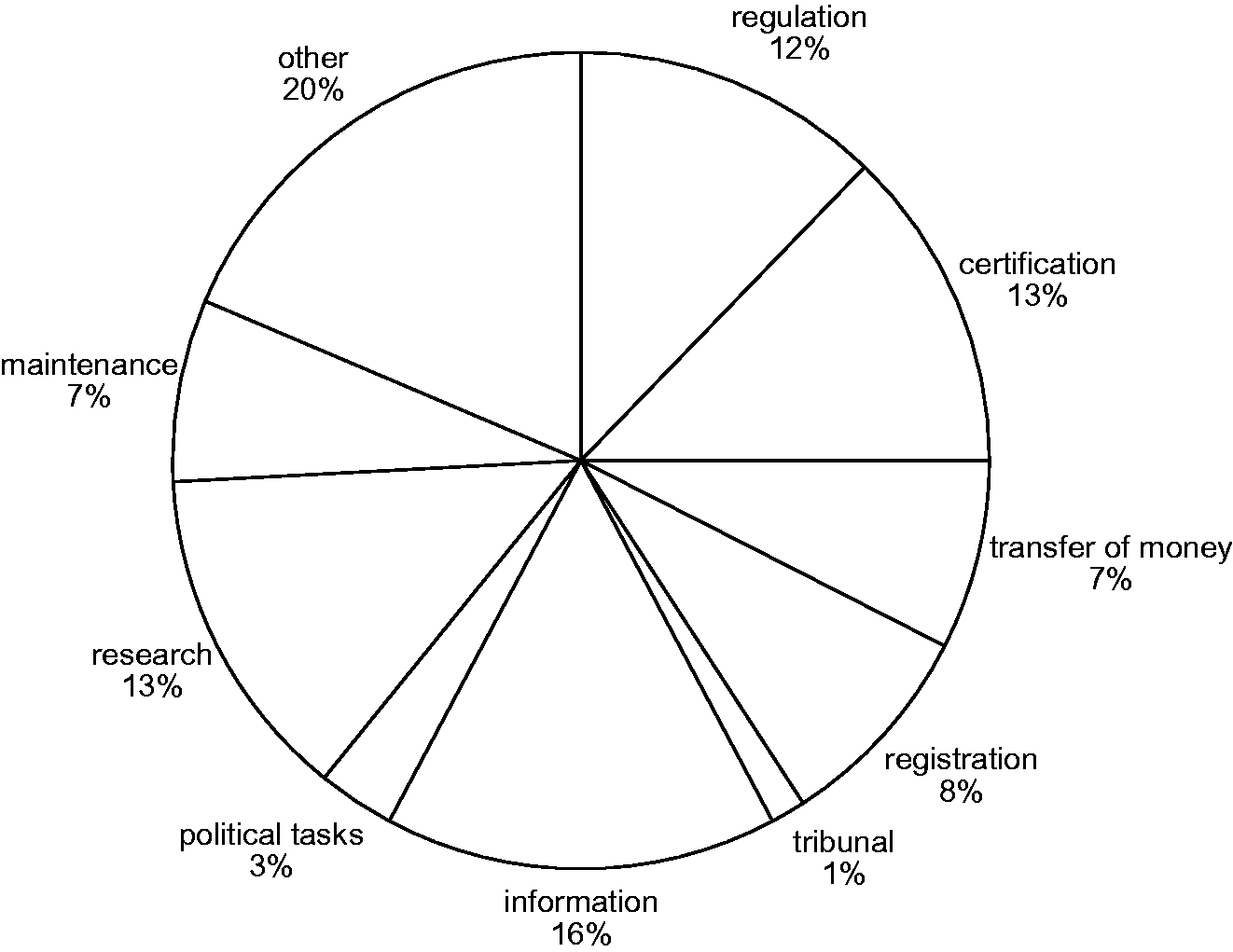
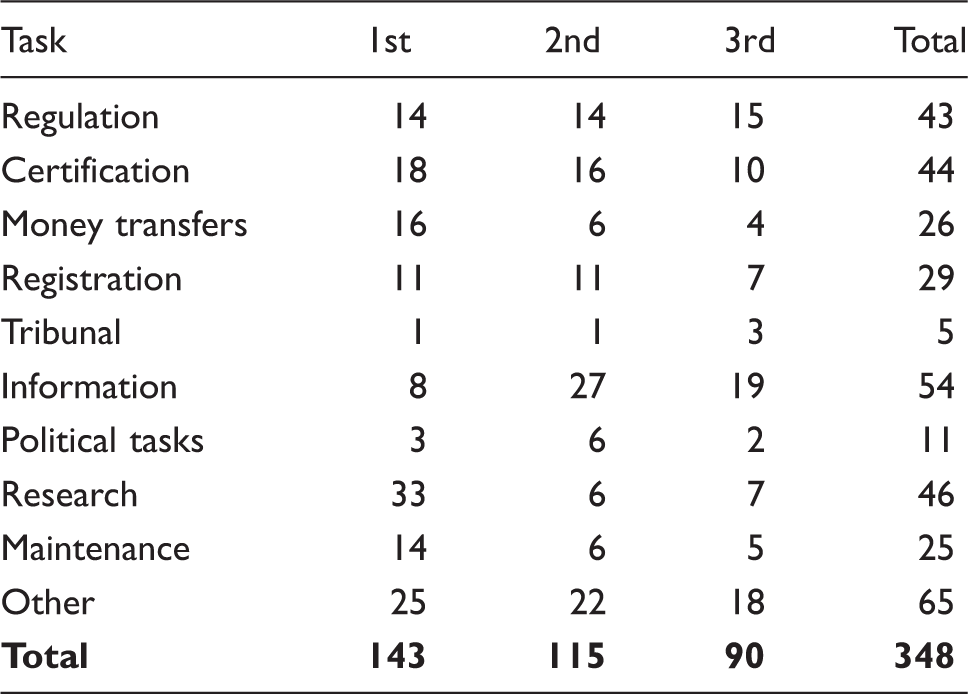
‘Information’ is the most frequent task (16%) albeit not as the primary task, followed by ‘research’ (13%), ‘certification’ (13%) and ‘regulation’ (12%). The large number of research agencies is caused by the large cluster of universities and polytechnics in our sample. Tasks involving ‘registration’ (8%), ‘money transfers’ (7%) and ‘maintenance’ (7%) form the middle group. ‘Political tasks’ (3%) and ‘tribunals’ (1%) are found least frequently.
As mentioned before, agencies often perform multiple tasks. Table 1 already demonstrates this as 80 percent of the agencies who have supplied information about their tasks report a second task and 63 percent even reports a third task. The three most frequent (and statistically significant) 3 combinations turn out to be: regulation and certification (12 cases in different combinations of first, second and third task); certification as first task with regulation second or third (9 cases); and research first and certification second (7 cases). Information is found in combination with almost all tasks, but as noted before usually not as the primary task. Additional analysis using dummy variables for the ten tasks reveals that ‘research’, ‘registration’ and ‘maintenance’ are typically not combined with other tasks (negative correlations with the most frequent tasks, statistically significant).
All 10 tasks as shown in Figure 1 will be used in the analyses below. Please note that we will thus include tasks that were not mentioned in the six categories we deduced from the literature. In particular, ‘information’, ‘registration’, ‘maintenance’ and ‘certification’ were not mentioned explicitly in the cited studies.
Based on the previous literature review, a number of expectations can be deduced that will be put to the test:
Agencies with service delivery tasks like the payment of benefits (money transfers) have more autonomy and more control (because of the measurability of their output) than agencies with other tasks. Regulatory agencies will have more autonomy and less control (because their task requires independence) than agencies with other tasks. A similar line of reasoning could be used to predict that tribunals will have more autonomy and less control. Agencies with ‘political’ tasks such as giving policy advice or developing legislation will have less autonomy and more control than agencies with other tasks. Regulatory agencies will have been established only after the first waves of NPM in the 1980s. Regardless of their task, agencies with a large budget will have less autonomy and more control than agencies with smaller budgets.
If we apply similar lines of reasoning to the tasks that were not mentioned explicitly in the literature review, we could posit that agencies in charge of ‘information’ and ‘registration’ are typical service delivery agencies and will therefore have more autonomy and more control than agencies with other tasks. The working process of agencies in charge of ‘certification’ could be seen to have similarities to what regulatory agencies do hence they would have more autonomy and less control than agencies with non-regulatory tasks. To be able to perform their task objectively and independently, research agencies could be expected to have more independence than most other agencies. And because agencies in charge of ‘maintenance’ tasks would have outputs that are easy to measure, they could have more autonomy and more control. However, such expectations are all highly speculative, so we will leave it to the analyses to find out if and what task effects exist for these categories.
As explained before, autonomy and control have been measured in a standardized fashion. In some cases, multiple items were presented for the same variable. In that case we selected one item, usually based on methodological criteria (for example, no multicollinearity or highest response rates).
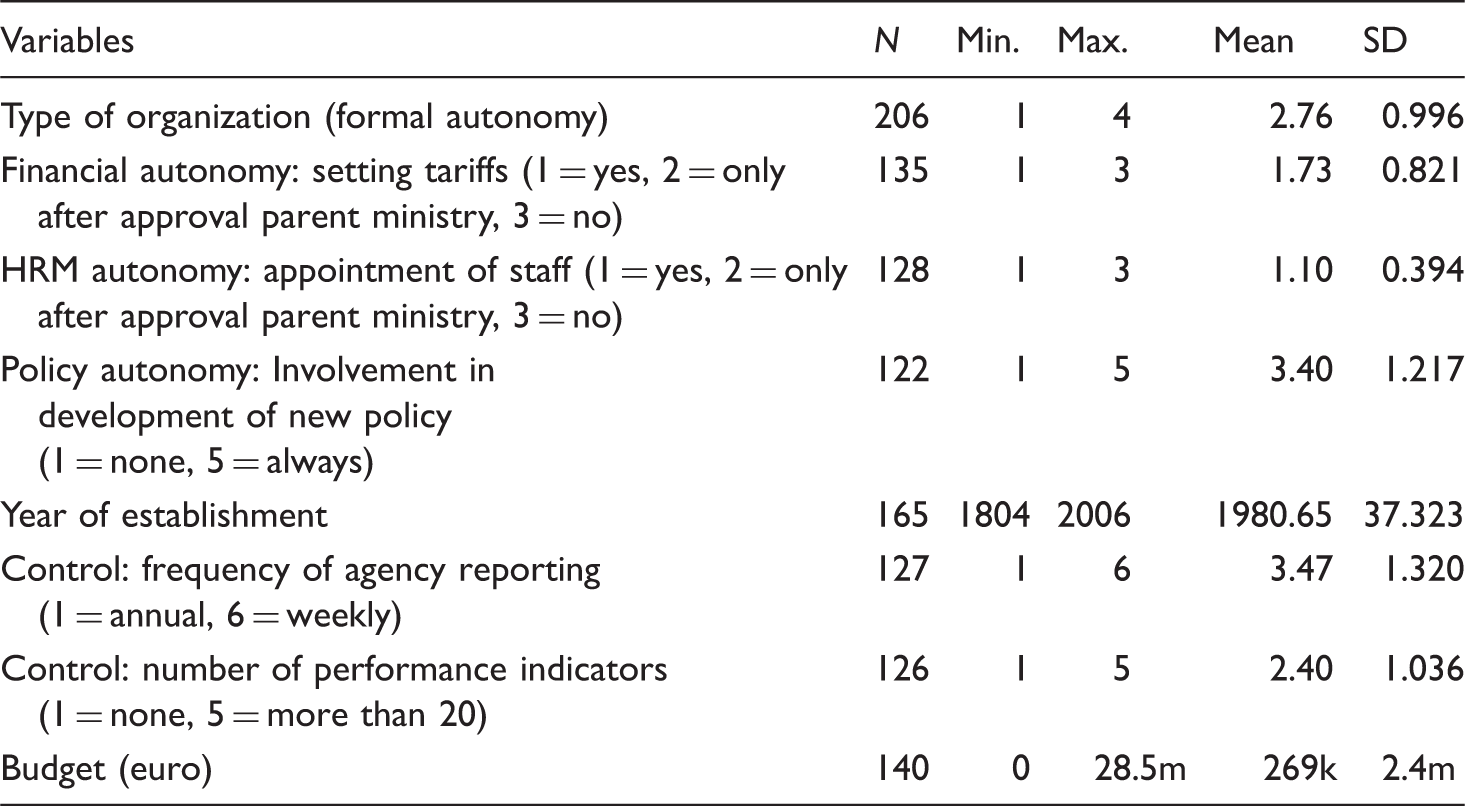
There are different types of autonomy (Verhoest et al., 2004). First, the legal form of an agency is indicative of its formal autonomy. There are four categories of agencies: contract agencies (lowest degree of formal autonomy), ZBOs, RWTs and government foundations (highest degree of formal autonomy). Second, there are two types of management autonomy: financial autonomy ( = the right to set tariffs without approval from the parent ministry) and HRM autonomy ( = the right to appoint employees without approval from the parent ministry). Finally, policy autonomy is measured as being involved by the parent ministry in the development of new policies.
Control is measured in two ways: reporting frequency (to the parent ministry) and number of performance indicators. Unfortunately, data on more informal measures of control (Flinders, 2008) like ‘number of contacts’ did not meet the methodological requirements (too low response) and could therefore not be included.
Descriptive statistics of variables
Results
The previous section already showed the most frequent tasks of Dutch agencies and confirmed that many agencies perform multiple tasks. Now we will investigate the effect of agency tasks on their autonomy, governance and control. Different analysis techniques will be used, on the one hand, cross tabulations and variance analysis (with 10 tasks as nominal variables), on the other hand, correlations and regression analyses (with dummy variables per task). Depending on the nature of the dependent variable, different types of regression analysis have been applied (bivariate, multivariate, ordinary least squares [OLS] and logistic regression).
Formal autonomy
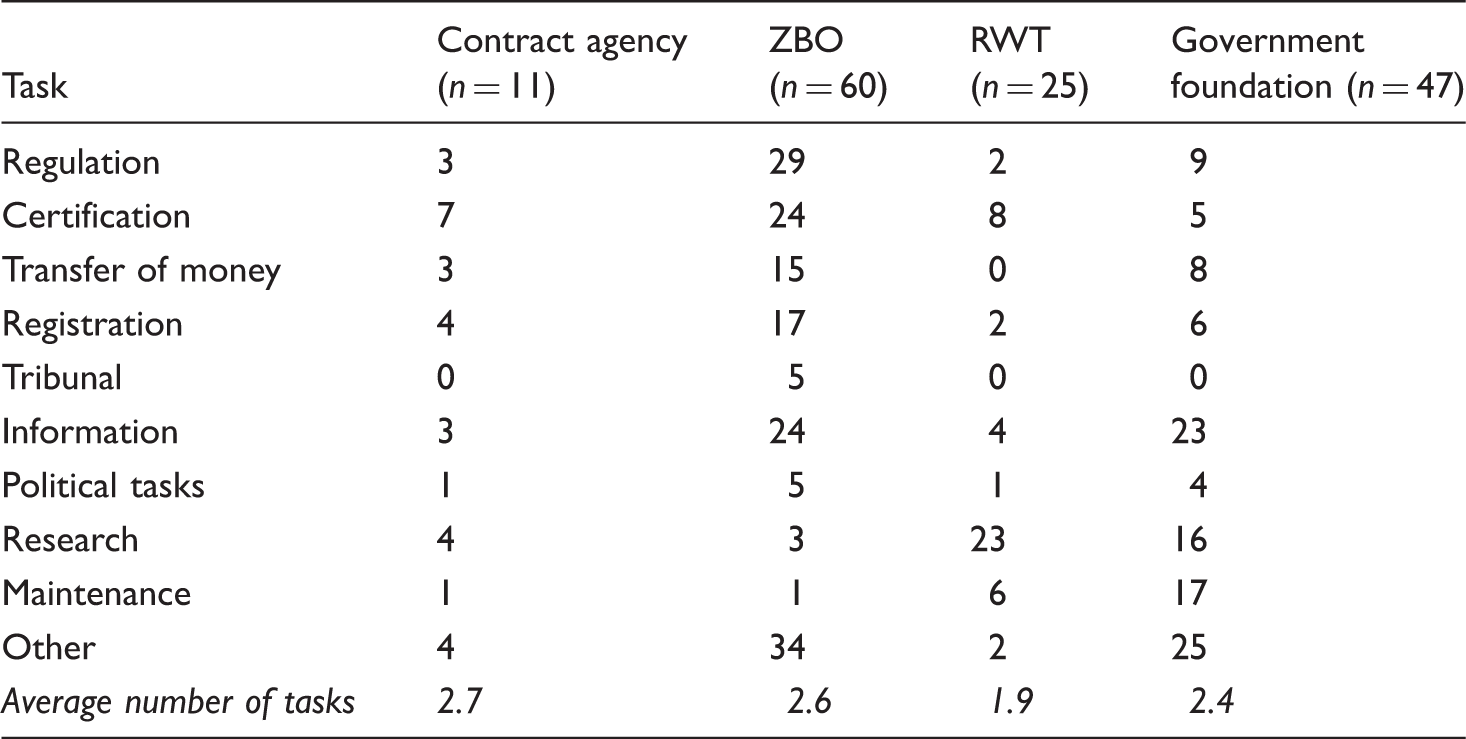
Tasks per type of agency (Netherlands, 2006), N = 143
Effect of task on formal autonomy (multiple regression analysis [OLS], beta and standard error), N = 143
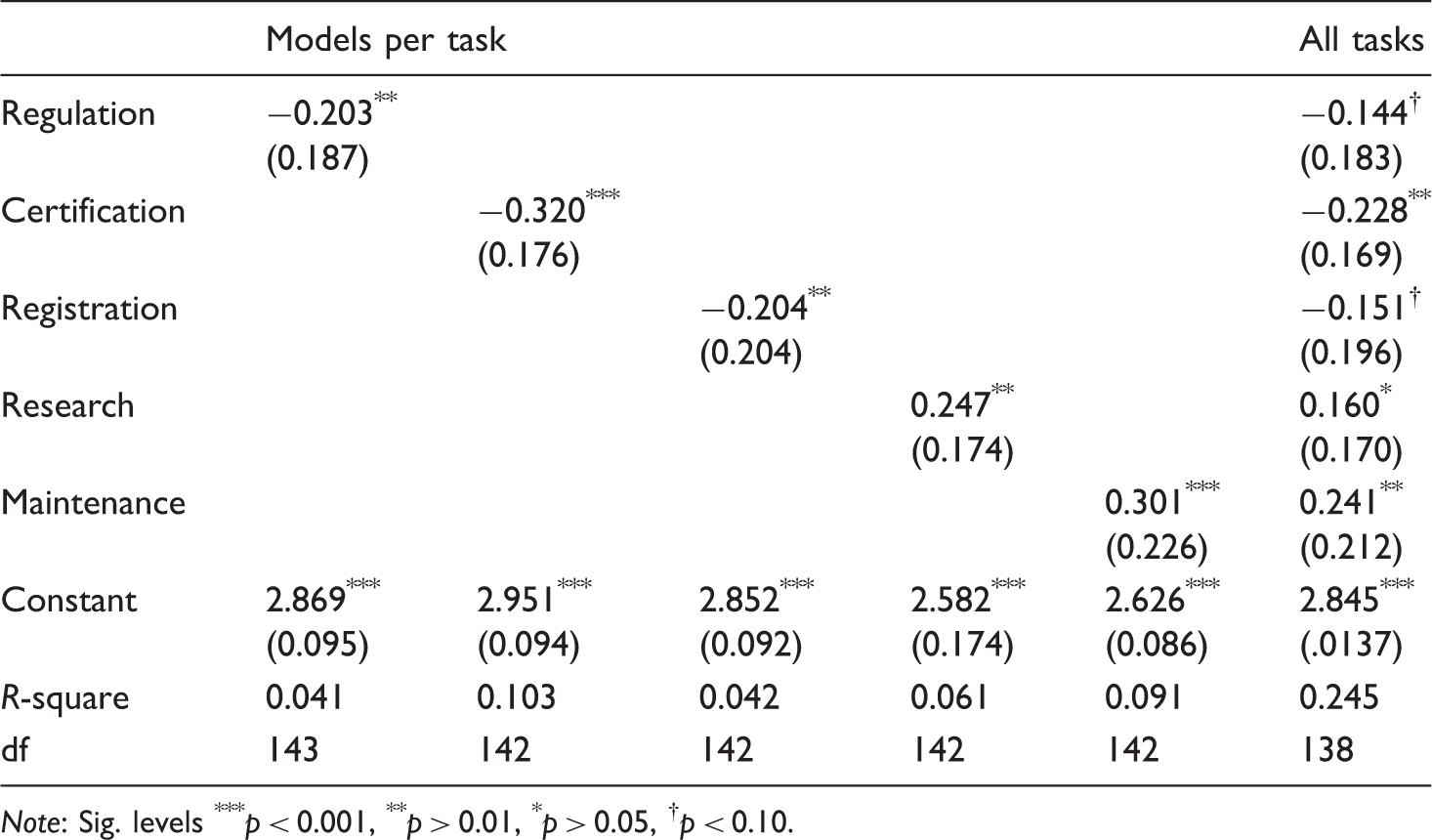
Note: Sig. levels ***p < 0.001, **p > 0.01, *p > 0.05, †p < 0.10.
Financial autonomy
The financial autonomy of agencies is measured as the right to set tariffs (cf. Table 3; please note that a higher score means lower autonomy). There is a direct link between formal and financial autonomy; contract agencies (mean 1.92) have statistically less financial autonomy than the average agency (1.73), and ZBOs (2.14) even less. RWTs (1.6) and government foundations (1.3) have more autonomy (Yesilkagit and Van Thiel, 2008). 4 This raises the question whether this is linked to the tasks that agencies carry out, in particular if/when these tasks concern the delivery of goods, products or services for which tariffs can be asked.
Analysis using cross tabulations shows that there are indeed some statistically significant relations between the primary task of an agency and its degree of financial autonomy (chi square 41.911 and Cramer’s V = 0.400, p < 0.001). Using correlations (dummy variables) we can identify for which three tasks this is the case: regulatory agencies have less financial autonomy (r = 0.191, p < 0.05), while research agencies (r = −0.176, p < 0.05) and agencies in charge of maintenance tasks (r = −0.285, p < 0.01) have more financial autonomy. Interestingly, these are perhaps not the tasks that one would expect to typically involve the setting of tariffs such as registration and certification. Moreover, because this coincides with previous findings about the legal type of agency that typically carry out these tasks (see above), a multiple regression analysis was carried out to test which effect (task or legal type) was strongest in explaining the financial autonomy of agencies. Table 5 presents the results. 5 Except for maintenance, the degree of financial autonomy of agencies does not depend on their task.
HRM autonomy
Dutch agencies have on average very high degrees of HRM autonomy (mean average is 1.10 on a scale from 1 = full autonomy to 3 = no autonomy). 6 This is probably related to the decentralization of personnel policies throughout the Dutch public sector (Van Thiel et al., 2007). Again we see a positive relation with formal autonomy: contract agencies (1.45) have the lowest degree of HRM autonomy, followed by ZBOs (1.11), and government foundations (1.06). RWTs have the most autonomy (1.0) in this respect. Despite the small differences, the findings are all statistically significant (ANOVA, F = 3.979, p < 0.05). However, there is no link between the task of an agency and its degree of HRM autonomy, no matter which analysis technique is applied (cross tabulations, correlations, multiple regression, logistic regression).
Policy autonomy
Effect of formal autonomy and three tasks on financial autonomy (multiple regression analysis OLS), N = 143
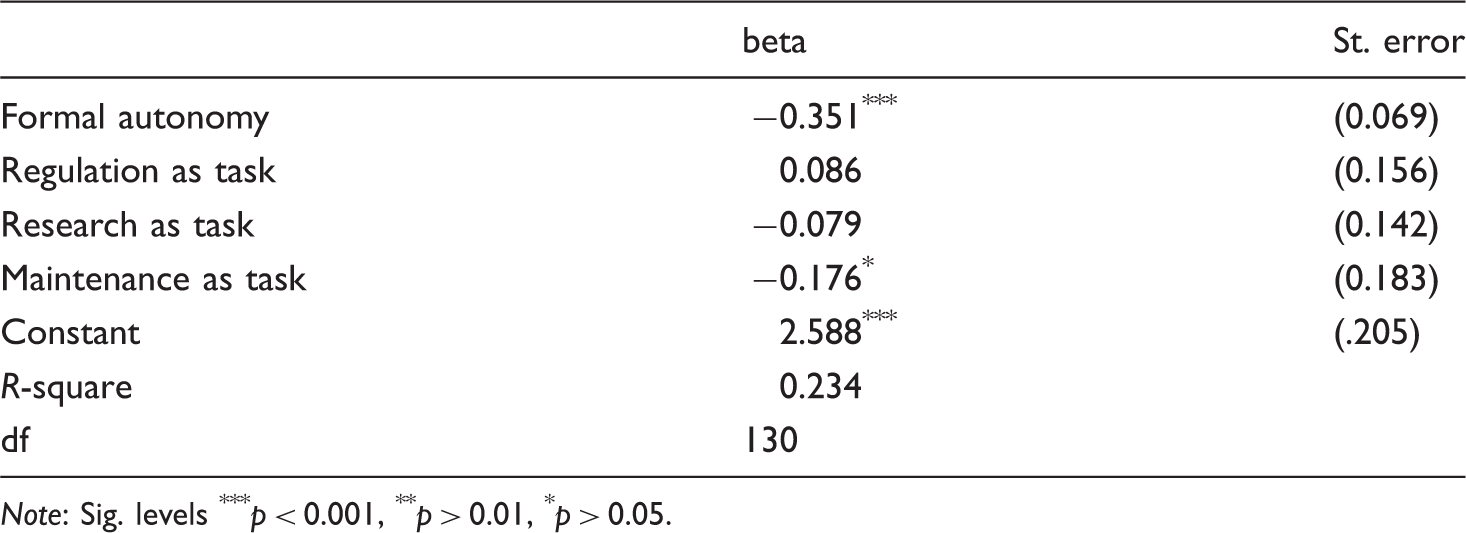
Note: Sig. levels ***p < 0.001, **p > 0.01, *p > 0.05.
Involvement of agencies in development of new policies, the Netherlands 2006
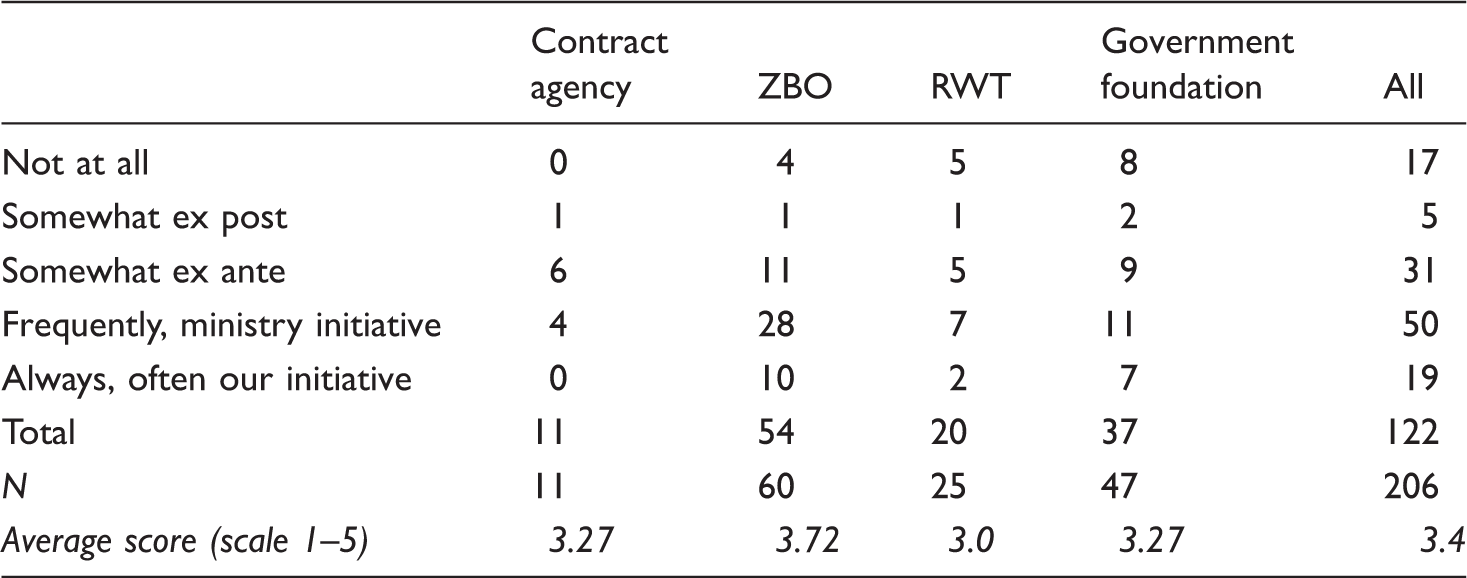
There is a relationship between the degree of policy autonomy and agency tasks, in two cases. First, regulatory agencies are statistically significantly more often involved in policy-making (correlation r = 0.237, p < 0.01; OLS regression analysis, beta = .239, s.e. = 0.266, p < 0.05). Second research agencies are less often involved (but only confirmed in correlation analysis, r −0.181, p < 0.05). Interestingly, there is no effect from ‘political tasks’ on policy autonomy, contrary to what would be expected. 7
Year of establishment
One of the expectations, based on the literature review, was that regulatory agencies are more frequently established after the first waves of NPM. Using cross tabulations, correlations and variance analysis, we have found no statistically significant relations between the tasks of agencies and the time of their establishment. The number of agencies has increased strongly since the 1980s and even more since the 1990s (see Figure 2), but this growth applies to agencies with all kinds of tasks.
The number of agencies established in three time intervals per task, the Netherlands (2006, N = 206)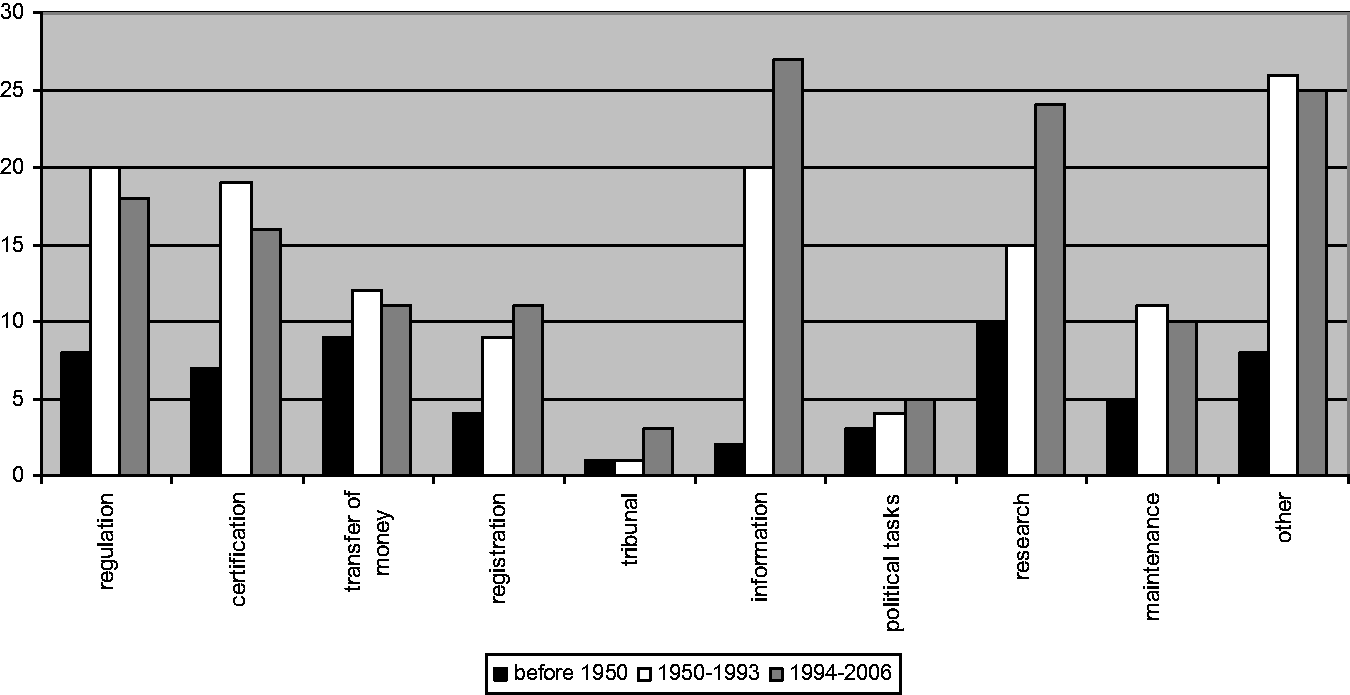
Control
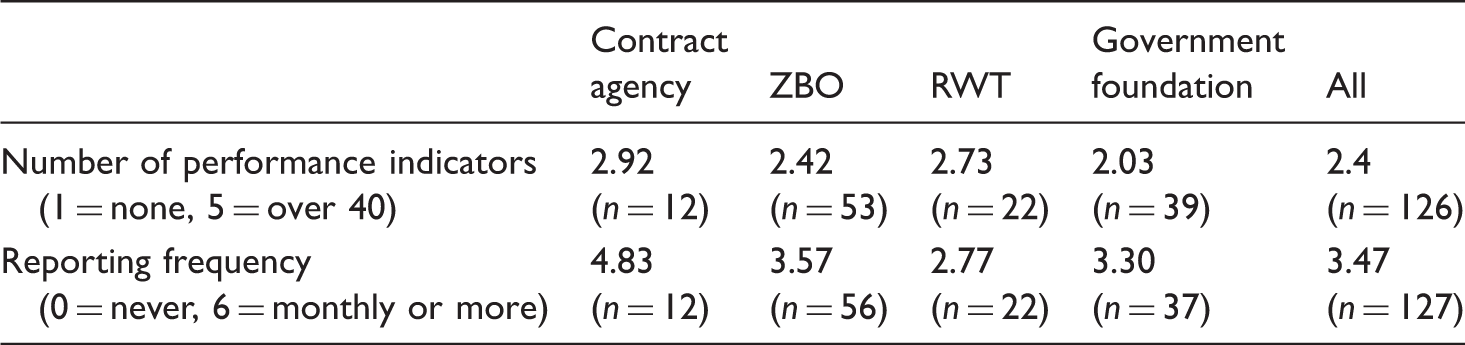
Indicators of control of agencies (average scores), the Netherlands 2006
Effect of formal autonomy and tasks on control (multiple regression analysis [OLS], beta and standard error), N = 143
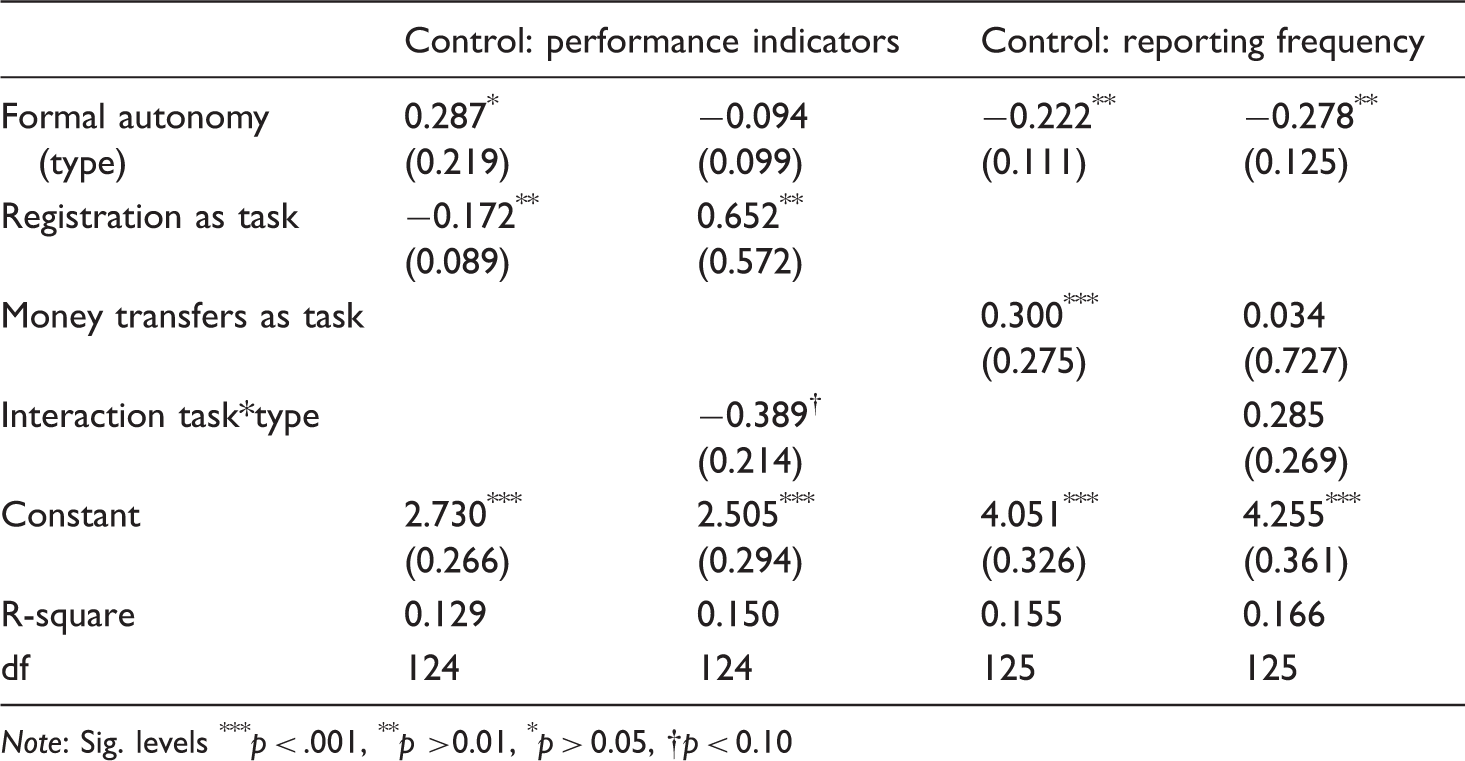
Note: Sig. levels ***p < .001, **p >0.01, *p > 0.05, †p < 0.10
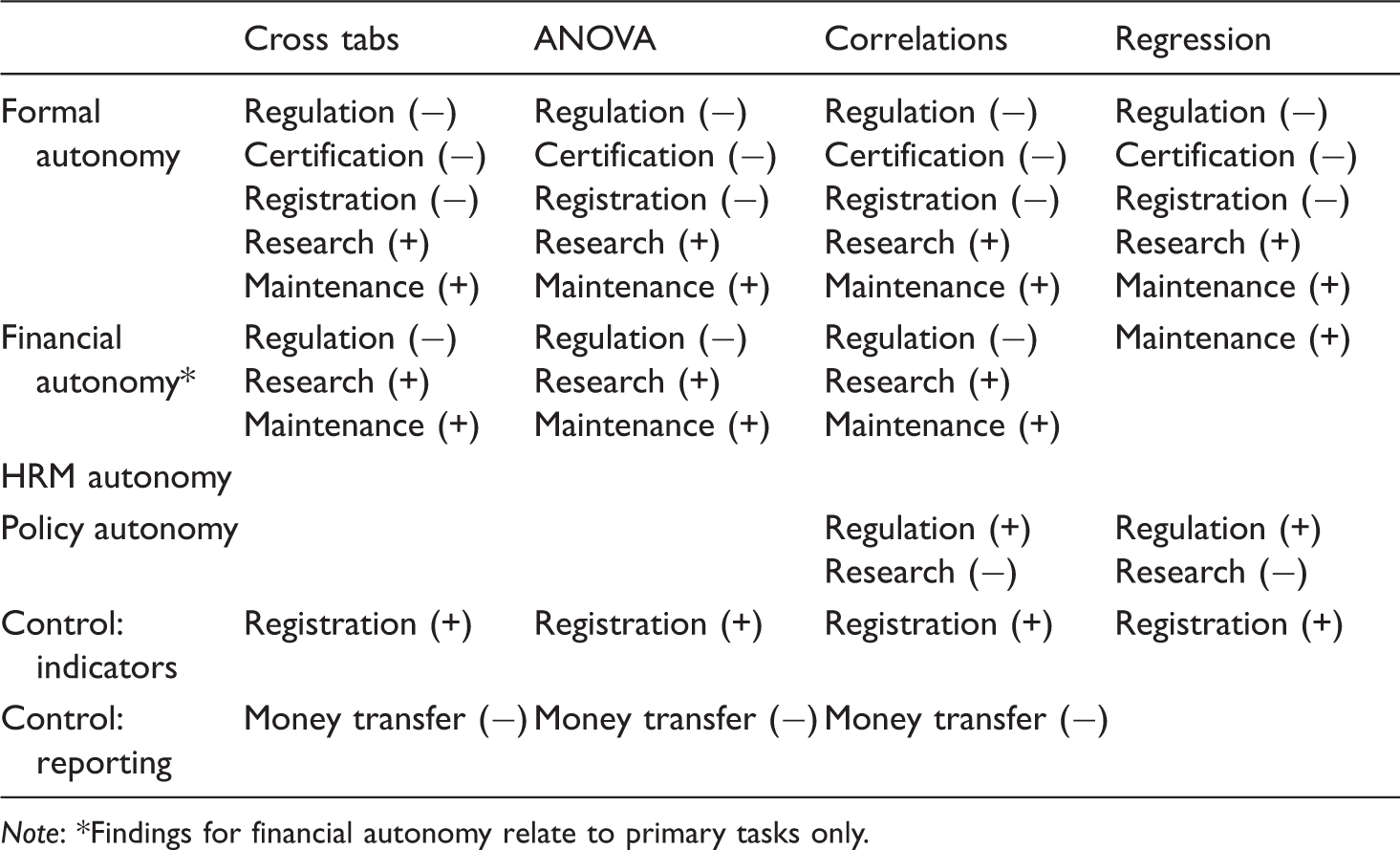
Overview of effects of task on autonomy and control of agencies, using different statistical techniques
Note: *Findings for financial autonomy relate to primary tasks only.
Size of budget
The average size of the budget varies strongly, between €0 and €28.5 million (cf. Table 2). 8 Because of the skewed distribution, we have eliminated the main outlier (with the highest budget). The net mean budget is then €65.4k (n = 139), with averages for the different agency types of €432k for contract agencies (n = 12), €34.7k for ZBOs (n = 58), €66.5k for RWTs (n = 26) and €4k for government foundations (n = 43). This shows that government foundations are on average very small, while contract agencies have the highest average budgets. These difference are statistically significant (ANOVA, F = 6.673, p < 0.001). Larger budgets are thus given to agencies with lower degrees of freedom, in line with Pollitt et al. (2004). This raises the question how budgets are related to tasks, autonomy and control.
Except for agencies in charge of money transfers, the size of the budget is not related to the task of an agency (ANOVA, correlations, OLS regression analysis n.s.). This supports the potential explanation for the relationship between the task of agencies in charge of money transfers and their control (reporting frequency) that was suggested above. However, the size of budget turns out not to be related to any of the three types of autonomy (financial, HMR, policy) nor to control through reporting. The only effect we have found is a positive relationship between size of budget and the number of performance indicators; agencies with larger budgets have to report on a larger number of indicators (correlations, bivariate regression analysis [OLS], p < 0.05). But this effect disappears when it is combined with formal autonomy (multiple regression analysis OLS). All in all, the effect of formal autonomy on control is much stronger than that of the size of the budget.
Discussion and conclusion
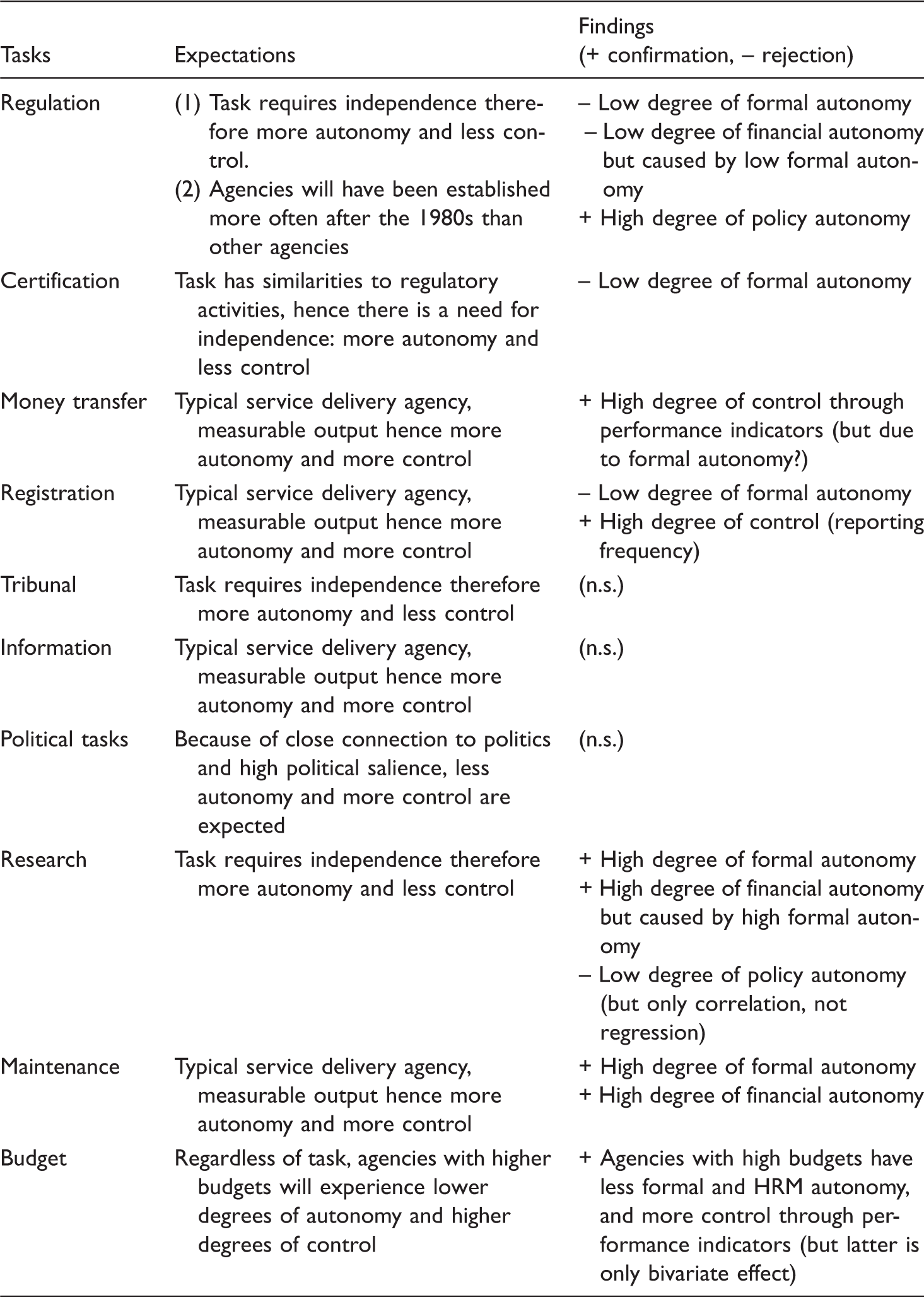
Overview of expectations and findings
Regarding the question whether it matters how tasks are measured, we found some differences, although in most cases we found similar patterns for task effects. See Table 9 for a short overview.
The use of dummy variables allows for more advanced statistical testing. Some effects that were found in the non-parametrical and bivariate analyses evaporated in multivariate analyses (see financial reporting and reporting to the ministry). Therefore, it does matter how task is measured; measuring task as a nominal variable can lead to overestimation of effects. In future research, the use of dummy variables should be preferred. Furthermore, we would recommend including multiple tasks in the analyses. The fact that we have found effects for some specific tasks that have not been (explicitly) studied before, like maintenance and research (cf. Table 10), proves that it is useful to make a larger distinction between task than simplified dichotomies (regulation versus service delivery).
An additional conclusion is that our study has not only confirmed that agencies perform multiple tasks, but it also shows that including all tasks in the analysis extends the possibilities to test task effects. As it turns out, agencies with lower degrees of autonomy carry out multiple tasks more often than agencies with lower degrees of autonomy (which seem more functionally focused). This is an interesting finding because it raises a number of questions. For example, why do agencies with lower degrees of formal autonomy carry out multiple tasks more often? Is that because the tasks in question are easier or more efficient to combine? Or is it because the government wants to keep these tasks closer? Or do these agencies have more success in obtaining new tasks? Furthermore, this finding has implications for future research into for example the effects of combining tasks or vice versa having more focused tasks.
Third, we did not find any effects regarding the timing of the establishment of agencies. It was expected that regulatory agencies were established more often after the onset of NPM, but this was not found. Apparently, the proliferation of agencies is not related to tasks. However, we should note that the data in our analyses only refer to the year of establishment in the current (2006) legal form of agencies. As agencies are frequently reorganized, renamed, merged or change legal types, a longitudinal design would be better suited to study the time effects.
A fourth general finding concerns the size of the budget. As expected, agencies with larger budgets have less autonomy and (slightly) more control, that is, performance indicators. However, this effect is predominantly linked to the formal autonomy of agencies; higher budgets are given to agencies with lower degrees of autonomy, which as we know face higher control demands. It is difficult to disentangle these effects or determine the causality of the relations. Based on the analyses we cannot say whether the importance of the budget variable is indicative of the political saliency of an agency or something else. This would require more advanced analyses. There is, however, no link between the size of the budget and the task of an agency except for money transfer agencies, which is self-evident or even tautological.
Now we turn to the findings for individual tasks. Table 10 gives an overview of our expectations and findings, per task. In most studies cited before, regulation as a task is expected to be an important variable. However, as the literature review showed, research findings seldom support the expected high degrees of autonomy and low degrees of control, or even find the opposite. Our study is no different; most Dutch regulatory agencies belong to the types of agencies with lower degrees of formal and financial autonomy. Only in the case of policy autonomy do regulatory agencies have more autonomy than other agencies. This would suggest that politicians do choose to put regulation at arms' length but not too far away. A similar explanation could be given for the findings for agencies in charge of certification. It was expected that they would have the same pattern of autonomy and control as regulatory agencies because of similar working processes. Given the similar findings regarding formal autonomy, this line of reasoning might still hold but because of the absence of other effects, it is only a tentative explanation.
Money transfer agencies are found in all legal types, which probably explains the lack of findings about their autonomy. As expected, they have to report about more performance indicators than most other agencies; however, this effect is not very strong. It could be related to the size of their budget, but that would require more research (see also footnote 7).
As far as agencies in charge of political tasks, information and tribunals are concerned, we did not find any statistically significant effects. In the case of political tasks and tribunals, this is probably caused by the low number of agencies with such tasks. Information has proven to be mostly a secondary or even tertiary task, much less often a primary task.
Almost all expectations about the autonomy of research agencies and agencies in charge of maintenance tasks were corroborated; we have found high degrees of formal and financial autonomy. It should be noted though that these expectations were based on very different arguments. Research agencies were expected to need autonomy to ensure objectivity in carrying out their task. Only in the case of policy autonomy did we find a lower degree than expected for research agencies (based on correlations, not corroborated in regression analysis). However, this could also be explained by the nature of their task; research agencies may provide knowledge for policy-making but would not necessarily be involved in policy development themselves – particularly not if they want to maintain objectivity. In the case of maintenance tasks a completely different argument was used to predict high degrees of autonomy, namely measurability of output. Unfortunately, our data do not allow us to find out why agencies with these two tasks have higher degrees of autonomy.
The results of the analysis of variables on agency control for research and maintenance agencies did not render statistically significant findings. However, the findings regarding autonomy point to the importance of distinguishing these tasks when studying agencies. Research as a task was mentioned by only one study (Bouckaert and Peters, 2004), while maintenance was not mentioned at all.
All in all, some tasks have proven to matter, in particular to agency autonomy, although not always in the expected direction. The most important effect of task is on the formal autonomy of agencies; through that effect, tasks can indirectly influence autonomy and control. Direct influences were found as well, but less often or less strong. Formal autonomy and the size of the budget have proven to be more decisive to explain the design, autonomy and control of agencies than tasks. This would suggest a theoretical model in which tasks determine the level of formal autonomy, which would in turn determine other degrees of autonomy and control. Such a model should be elaborated more, preferably using larger (comparative) datasets. Our analysis does not allow us to test the direction of the causality of this relationship; that would require further analysis, probably fed by more in-depth case studies (Groenleer, 2009; Verhoest, 2002).