







Abstract
Policy responses to the global financial crisis can be divided into pro- and counter-cyclical approaches. The former advocates reducing public spending in times of financial constraints. The latter approach advocates public spending to boost the economy. Using public opinion (N = 23,652) data from 27 EU member countries, we empirically test a model for citizen preferences for reducing spending in public services versus government investment in measures to boost the economy as a response to the financial crisis. We look at individual- and country-level determinants of attitudes to savings in public services, and concentrate on four groups of explanations: political disaffection, ideology, self-interest, and macro-economic conditions. It was found that political disaffection and the respondent’s ideological orientation both have effects on preferences, as well as whether one experiences economic strain or receives welfare services. Macro-economic conditions, such as a country’s government deficit level, public debt or public expenditure have, surprisingly, no effect on citizens’ financial policy preferences. We discuss the implications of our results for public administration theory and practice.
Points for practitioners
The article analyses citizens’ preferred government reactions to the financial crisis. It distinguishes between reducing public spending and measures to boost the economy. It was found that macro-economic conditions matter very little for these preferences. In fact, explanations for these attitudes and preferences need to be looked for primarily at the individual level, not the country level. Preferences for or against savings in public services are largely influenced by ideological dispositions, age, education, overall levels of political trust, and whether citizens are (potential) beneficiaries of welfare services. The article contributes to understanding why citizens support or oppose pro- or counter-cyclical policy measures to emerge from the crisis.
Introduction
The financial crisis has forced governments to take a variety of measures. At one and the same time, they are forced to reduce spending on public services in order to curb public debt and benefits, yet have to expand spending in order to support a growing group of unemployed citizens. Targeted reductions in public sector spending have gone hand in hand with massive investments in measures to stabilize the financial sector. Increased taxes in order to balance the budget have coincided with targeted tax cuts to stimulate selected economic sectors. Policy responses to the global financial crisis can be divided into pro- and counter-cyclical approaches (Armingeon, 2012). The former advocates reducing public spending and making savings in times of financial constraints. The latter approach advocates public spending to boost the economy. Not only do policy makers have to make tough choices, citizens too need to decide what they are and are not willing to sacrifice. Despite austerity, demands for more and better public services remain as present as ever (Pollitt, 2010). In this context, Moore et al. (2010) talk about a ‘loss aversion’ on the part of citizens to explain their reluctance to allow cutbacks in public services. Yet, academic research on citizen attitudes towards the financial crisis, and government responses to the crisis more specifically, is still in its infancy.
In this article we analyse determinants of citizen policy preferences regarding government responses to the crisis and more specifically pro- versus counter-cyclical responses in 27 EU member countries. We empirically test whether citizens’ partisan ideology, political disaffection and personal self-interest influence patterns of attitudes towards spending decisions when they come in response to a major economic crisis. We also examine whether those views relate to countries’ macro-economic conditions. To do so, we use opinion data on public preferences for savings in public services versus public investments in order to boost the economy in times of crisis. We first review the literature, develop a theoretical model for empirical testing and then introduce the data from 27 EU countries. Data is analysed looking at both individual-level and country-level variables. We then evaluate our findings and address limitations of this study and avenues for further research. Theoretical and practical implications of the results are discussed.
Explaining attitudes to public spending and austerity: four hypotheses
Since the eruption of the financial crisis, we have seen a gradual and in most recent years an exponential growth in research looking into the effects of the financial crisis on public services. Various authors have looked into or hypothesized about effects of the crisis on political and administrative decision-making and coordination (Fleischer and Parrado, 2010), politicization (Peters et al., 2011), or public service bargains (Lodge and Hood, 2012). Other streams of research have looked into government responses to the crisis, both in general (Khademian, 2011; Kickert, 2012a, 2012b, 2012c, 2012d; Massey, 2011; Peters, 2011; Posner and Blöndal, 2012) and in terms of fiscal measures (Armingeon, 2012). The long-term effects of the crisis on public spending remain to be discovered. Public attitudes and preferences, however, have not yet received much attention.
Theoretically, we relate our research to the wider body of research in public administration and political science on the (desired) role of government and the preferred size and composition of government spending, and on the determinants of government spending (for the latter, see, e.g. Busemeyer, 2007; Castles and McKinlay, 1976). This literature can be roughly divided into two streams. One looks at attitudes to government intervention in society and the economy and support for ‘big government’; the other looks at generic spending preferences and support for welfare spending more specifically. Our hypotheses will be derived from these bodies of research and will concentrate on ideology, self-interest, political disaffection and macro-economic factors. This article adds to that literature by specifically asking for citizens’ opinions in a time of major fiscal crisis, rather than for attitudes to public spending in non-turbulent times.
As a result of the availability of large multi-country opinion datasets such as the World Values Survey or the International Social Survey Programme (ISSP) data, various researchers have looked at public attitudes towards the size of government, and why some people are more supportive of ‘big government’ than others (see e.g. Borre and Scarbrough, 1995; Martin, 2011). Overall, there appears to be a considerable degree of ambivalence in opinions about the preferred role of government (Gainous et al., 2008). A substantial number of studies have asked citizens what they think government should spend its money on, with this research tradition especially established with regard to welfare spending (Confalonieri and Newton, 1995; Jacoby, 1994; Shapiro and Young, 1989). Research on citizens’ spending preferences, both in general and in relation to welfare spending, suggests that attitudes may be influenced by two major factors. The first argument emphasizes the role of more general ideological dispositions in shaping citizens’ preferences. The other emphasizes elements of self-interest in the formation of attitudes to spending.
The role of ideology
Partisan identification has been a recurrent explanatory factor, in the literatures on both the scope of government and attitudes to welfare spending. These two bodies of literature presume that behind personal ideology lie more general value systems that determine right and wrong in terms of the relationship between the state, the individual and other institutions (Battaglio and Legge, 2008, 2009; Hasenfeld and Raferty, 1989), and numerous studies do support this thesis (Feldman and Steenbergen, 2001; Feldman and Zaller, 1992; Jacoby, 1994). Using data from the National Election Study in the US, Jacoby (1994), for example, found that a symbolic politics orientation, such as party identification or liberal-conservative self-placement, have a strong impact on citizens’ attitudes towards government spending on social welfare. Battaglio and Legge (2008, 2009) looked at citizen support for electricity and hospital privatization across a set of industrialized countries. They conclude that support for privatization reforms can be partially explained by a combination of ideological predispositions and underlying values.
Francken (1986) looked into Dutch citizens’ preferences for public spending and found such preferences to be related to political affiliation, in line with earlier work by Lewis (1980, 1983; Lewis and Jackson, 1985). Yet this relation partly depended on the sector of public spending. In one of the few existing studies on attitudes to austerity, Popp and Rudolph (2011) found that ideology influences support for an economic recovery plan in an experimental setting, with conservatives being less supportive. However, they also found that attitudes depended on which politician actually proposed the plan.
In line with this literature, we expect citizens who place themselves on the left of the political scale not to be in favour of a reduction of public spending (see also the research by Francken and Lewis, and Svallfors, 1997). Furthermore, we assume that politically right-leaning respondents will be in favour of a reduction in public spending. It is unclear, however, how they feel about public investment to boost the economy. We expect left-leaning respondents to be against a reduction in public spending.
The government is wasting our money: the role of political disaffection
The ideological argument is related to citizens’ wider attitude to government. Spending preference is probably not just influenced by whether people think government should intervene in specific issues and areas, but also by whether they actually trust government. Indeed, perceived government waste is one of the items normally used in scales to measure political trust (Craig et al., 1990). This means that a preference for savings in public services may have little to do with (macro-)economic or budgetary considerations and more to do with wider attitudes towards government and its role. This ‘political disaffection’ thesis suggests a positive relationship between political distrust and anti-tax sentiment (Rudolph, 2009: 144) – if you distrust government, you are more likely to think taxes are too high (Beck and Dye, 1982). Still, contrary to expectations, Rudolph (2009) found that political trust actually increases support for tax cuts (but only among liberals). He explained this using a trust-as-heuristic explanation by introducing ideology as an additional variable. It should be added that while anti-tax attitudes often reflect low trust in government, such attitudes are often not absolute. Hadenius (1985), in Swedish research, found that citizens thought taxes were too high but they expressed a much more positive attitude to taxes when the survey question was presented as a trade-off between taxes paid and benefits received. In a similar way, Giger (2011) demonstrated that, contrary to popular argument, savings and retrenchment are not always unpopular, and that indeed (welfare state) ‘retrenchment is a popular policy choice for some voters’, including when they vote for religious or liberal parties (Giger and Nelson, 2011). In line with this literature, we expect citizens who don’t trust their government to be in favour of a reduction in public spending (anti-government attitude – political disaffection thesis). By testing this effect, we thus test whether people make a choice for savings in public services based on an anti-government attitude rather than based on budgetary or macro-economic considerations.
Protecting your own purse: the role of self-interest
A third explanatory factor found in the literature is self-interest. Ferris (1983) suggests that people make a cost–benefit calculation when preferring additional or reduced public expenditure. Extra government spending is less burdensome for high income groups; at the same time, he found that lower income groups prefer higher public spending in areas such as housing, and that respondents with children favour public expenditure in education. Self-interest thus plays a role; when you are likely to need or benefit from spending in certain areas, you are more likely to prefer higher public spending in this area (Brook et al., 1997). Research also found that support for general cuts in social spending is relatively low, while there is more support for specific cuts (Roller, 1999). Likewise, support for spending on development aid decreases in times of cuts and is replaced by local and domestic priorities (Lindstrom and Henson, 2011). In the literature on welfare spending, the self-interest argument states that those respondents who are (potential) beneficiaries of welfare-related services are more likely to have positive attitudes towards the welfare state and related concepts when compared to those who are ‘better off’. The self-interest argument has been widely supported by empirical investigations (Edlund, 1999; Groskind, 1994; Hasenfeld and Raferty, 1989; Svallfors, 1997). Using data from the International Social Survey Programme (ISSP), Svallfors (1997), for example, finds that public attitudes towards redistribution are structured by certain patterns, such as class differences, within different types of welfare regimes. Age also appears to play a role in decisions about spending for certain welfare services (e.g. pensions) (MacManus, 1995). The elderly also appear to be less likely to argue for spending cuts when forced to choose between raising taxes and cutting spending (MacManus, 1995).
We therefore expect self-interest to play a role in the choice of preferred policies in response to the financial crisis. Vulnerable and economically hard-pressed groups are more dependent on government-funded programmes and we therefore expect these groups to be against savings. In line with this argument, we also expect those groups who are currently receiving welfare services, or have welfare recipients in their immediate environment, to be against cuts in public services.
Macro-economic factors
People’s preference for certain government responses to the crisis may differ across countries, due to the general state of the economy or the financial situation of the government (public debt, deficit). This is based on the perception that in states where the economic opportunity structure is limited, citizens are in favour of state contributions to fill this gap. For instance, commentators have found that public support for spending on welfare policies is higher in countries where unemployment is high (Blekesaune and Quadagno, 2003) and where individuals are experiencing economic strain (Blekesaune, 2013). Likewise, Fraire and Ferrer (1995) found that support for unemployment benefit cuts is lower in countries with a high unemployment rate. As regards citizen support for hospital privatization, Battaglio and Legge (2008) found that within countries where levels of health spending were highest, the support for privatization reforms was comparatively low.
As a final hypothesis, we assume that in countries where government deficits, public debt and fiscal pressure are very high, demands for a reduction in public spending will be more substantial, possibly because of concerns about government debt and deficit getting out of hand. In countries where total government expenditure is high, we expect citizens to be in favour of a reduction of government spending rather than preferring further government expansion through taking measures to boost the economy. In a similar way, we expect a preference for savings in countries with high tax rates, in order to reduce fiscal pressure. Finally, in countries where GDP per capita change is low, and the economy thus slow, we expect respondents to be mainly in favour of government measures to boost the economy, and thus higher public spending.
Data and method
This research examines individual- and country-level factors that account for citizens’ preferences in response to the crisis. Hence, we utilize multilevel modelling techniques, which allow us to simultaneously examine the effect of country-level and individual-level variables on an individual-level dependent variable – in our case, citizens’ spending preferences in response to the global financial crisis. The reasons for using multilevel statistics are (1) to be able to use context variables that are not available at the individual level, and (2) because attributes of respondents within the same countries are correlated with each other. This means that the observations are not independent from each other (Hox, 2010). Individual respondents are thus nested within country groups.
We use data from the Special Eurobarometer 74.1 ‘Europeans and the Crisis’, collected in August and September 2010 using CAPI face-to-face interviews in respondents’ homes. A total of 26,635 respondents age 15 and above in the EU 27 member countries participated in the overall survey. They were selected following a multi-stage, random probability sample (standard random route procedure starting at a random starting address within administrative regions). At these addresses, a closest birthday rule was used to select respondents at that address. Approximately 1000 people were interviewed in each country (with the exception of Germany: 1600; Cyprus: 500; Luxembourg: 500; Malta: 500; the UK: 1300). After deleting cases with item non-response, a total of 23,652 cases were included in the analysis. Non-responses appeared to be similarly distributed across countries, which provides some evidence for the cross-national validity of our measurements.
Operationalization
In this section we will first introduce our dependent variable, individual-level independent variables and then the country-level predictors.
Dependent variable
The Eurobarometer survey contains a number of questions on the financial crisis. One is particularly relevant for public administration research, as it directly asks for citizens’ preferences in response to the crisis: Personally, would you say that to emerge from the crisis rapidly, EU Member States should first reduce their public spending or should they first invest in measures to boost the economy? Financial policy preferences (N = 23.652), percentages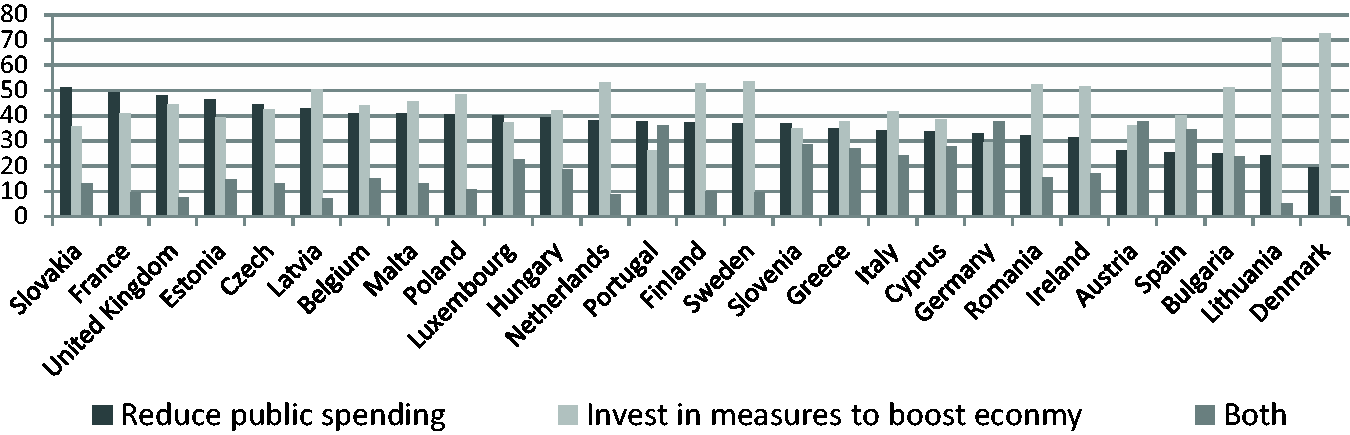
What is also apparent in the figure is that in some countries, a substantial number of respondents have chosen the ‘both’ option, even though this answer was not prompted by the interviewer. This has a number of implications for our model because we cannot directly use the saving–spending dichotomy as a binomial dependent variable. Furthermore, we assume that respondents opting for the both category are not only expressing their mixed preference, but also do so because they were not able to derive a distinct preference for any of the given categories (see Berinsky, 2005). Therefore, in a number of cases the ‘both’ option may be a substitute for the ‘don’t know’ category. Thus the focus of our analysis will be on contrasting those who prefer reducing public spending with those who prefer investment in the economy as a response to the crisis. Moreover, this assumption was also supported when estimating a multilevel ordered logistic regression model. A core assumption of the ordered logit regression is the proportional odds assumption, which assumes similar coefficients across logit equations (Long and Freese, 2006). We did run several specifications of our model and all violated this assumption. We therefore opted for a multinomial model with three categories in the dependent variable: reduce spending (1); both (2); and invest (3). 1 However, the focus of our analysis will be on contrasting preferences for ‘reducing spending’ with ‘investing in the economy’.
Independent variables
Due to the hierarchical data structure, we distinguish between determinants at the individual (respondent) level and determinants at the country level.
Individual level
At the individual level, we include measures for the political ideology of respondents, political disaffection, self-interest (economic strain, home ownership, employment status and welfare recipient status), as well as a range of controls such as traditional demographic measures (age, gender), marital status, education and place of residence/type of community.
As regards political left–right self-placement, people were asked: ‘In political matters people talk of “the left” and “the right”. How would you place your views on this scale?’ The scale ranges from 1 (left) to 10 (right). However, since this question typically produces a significant amount of missing cases we grouped answer categories in left (1–4 on the scale), middle (5–6 on the scale), right (7–10 on the scale), and missing (all missing cases).
We conceptualize political disaffection using a measure which captures the extent of anti-government attitudes. We added two variables: (1) ‘trust in parliament’ and (2) ‘trust in government’. Both are measured on a 10-point Likert scale, and measure an underlying latent construct. 2 Scores on both items were added. A low degree of institutional trust is thought to reflect high levels of political disaffection.
Self-interest is measured using a number of variables. Economic strain is measured using respondents’ answers to a question about their household’s financial situation: ‘A household may have different sources of income and more than one household member contributing to it. Thinking of your household’s total monthly income, is your household able to make end meet …?’ Answer possibilities ranged from 1 ‘very easy’ to 6 ‘with great difficulty’. This type of item has been previously used by numerous studies that have looked into respondents’ self-perceived economic pressure (e.g. Blekesaune, 2013; Vergolini, 2011; Whelan et al., 2001). Respondents that experience great economic hardship are more likely to be dependent on state contributions – be it now or in the future. Employment status was coded as ‘1’ when currently unemployed or temporarily not working, and ‘0’ for other. Homeownership was coded as ‘1’ when respondents own an apartment or a house and ‘0’ for other. Respondents were also asked whether they (or people they are close to) are recipients of social welfare services (or have received any in the last 12 months). Those services include long-term care services, child care services, public employment services, social housing services and social assistance. Respondents who are welfare recipients, or have people in their immediate social environments who are welfare recipients, are less likely to support cuts in public spending because they would then be personally affected by the cuts.
Control variables include age, gender, educational status, community size and marital status. We constructed four age groups: 15–24 years; 25–39 years; 40–54 years; and 55 years and older. Gender was recoded as 0 = female, and 1 = male. For educational status, we grouped respondents into three categories in accordance with their age when they left full-time education: basic education (<15 years), secondary education (16–19 years) and higher education (>20 years). In order to minimize effects, respondents who were still studying were assigned to one of the three categories corresponding to their age. Community size/place of residence registers the type of community the respondent lives in: a rural area or village (1); a small or medium size town (2); or a large town (3). Marital status was coded in a way that ‘1’ denotes respondents who are living in a relationship, while a ‘0’ was assigned to those who live on their own.
Country level
Actual economic conditions and governments’ actual fiscal responses to the crisis differ across countries (see, e.g. Armingeon, 2012, for an overview of pro- and anti-cyclical responses). In the analysis, we include five macro-level indicators at level-2 (country-level): government deficit change, GDP per capita change (in Purchase Power Standards), fiscal pressure, government spending and public debt. When using government deficit change and GDP change we look at the 2008–10 period. We use 2008 as the baseline year when macro-economic impacts of the financial crisis started to have a significant impact on government accounts. 3 By doing this, we try to take into account the dynamic nature of macro-economic effects of the financial crisis on countries’ budgets and their economic policy responses. Furthermore, we look at fiscal pressure using tax revenue as a percentage of GDP in 2010, as well as total general government expenditure as a percentage of GDP in 2010. Country statistics were taken from EUROSTAT (GDP, government deficit, government expenditure, government debt) and the World Bank’s World Development Indicators (tax revenues).
Analysis
We estimate a multinomial multilevel model, which allows individual-level predictors to have different estimates on the different outcome categories of our dependent variable. All country-level independent variables are grand mean centred, which makes the intercept interpretable (Hox, 2010; Luke, 2004). Estimations were carried out running MLwiN from within Stata, using the ‘runmlwin’ routine (Leckie and Charlton, 2013). Cases with missing values on any of the variables were deleted prior to the analysis.
In the first step of the analysis (model 0), we need to establish how the variance in opinions within countries relates to variance between countries, and whether multilevel analysis is actually needed. For the baseline model or the model with intercept only, we find a significant chi square (comparing a multilevel model with a pooled one), both for equation 1 (reduce public spending vs invest in measures) (χ2 = 468.3, df = 26, p <0.001); and for equation 2 (both vs invest) (χ2 = 1228.9, df = 26, p <0.001). This means that individual respondents within a single country are more alike than respondents in different countries, and that a multilevel analysis is therefore necessary. We furthermore estimate an interclass correlation of 0.032 which shows that only 3.2 percent of the total variance for the first equation (reduce vs spending) lies at level-2; for the second equation (both vs invest), 12.8 percent of the total variance can be related to differences across countries.
Modeling citizens’ preferences: reduce public spending versus invest in measures to boost the economy

Notes: We included one additional category (missing values) in the estimation (not reported in the model) in order to run our analysis with as few missing cases as possible. Explained between-countries variance using Model 0 as reference. In multilevel models using a binominal-link function we commonly use 3.29 (the variance of a standard logistic distribution) as the variance at the observational level to compute the interclass correlation (Hox, 2010).
Results show that, first of all, ideology matters. Respondents who regard themselves as left-leaning are more likely to prefer investment in measures to boost the economy. Those who are right-leaning, in contrast, are more likely to prefer reductions in public spending. These effects are statistically significant across all model specifications. We also acknowledge the potential endogenous nature of the measure for partisan ideology. This means that predictors such as economic strain, employment status, welfare recipient status or education also potentially determine respondents’ ideology. 4 This may bias the estimates of the measure for partisan ideology. These findings should thus be interpreted with caution. However, we also checked how strongly those predictors are actually related with ideology by looking at their correlations. 5 None of them displayed a correlation coefficient greater than 0.12, which provides some evidence that this kind of bias may be minor.
As regards political disaffection we find that institutional trust has a statistically significant but negative relationship with preferences for reducing public spending. In other words, the greater the institutional trust of respondents, the more likely they are to prefer investment as an appropriate policy response to the global financial crisis. Looking at the set of predictors for self-interest, only economic strain and welfare recipient status become statistically significant. It shows that experiencing economic hardship increases the probability of preferring investment as a way out of the crisis. Furthermore, being a recipient of welfare services, or being closely related to one, has the same effect: they prefer measures to boost the economy as a way out of the crisis, and not a reduction in public spending. This lends support to the self-interest hypothesis. Homeownership and unemployment, however, show no statistically significant effects.
The same holds true for models 2 to 6, where country-level variables have been added. Since most of the predictors are strongly correlated with each other, we examine their potential effects individually. However, none of these country variables are statistically significant. Furthermore, their explanatory power in terms of model fit is also rather limited, since they have only a very weak effect on reducing the variance of (the mean of) the intercept. Furthermore, when looking at the variance explained by the country predictors, only model 4 (change in government expenditure) has a minor effect. It increases explained variance at level-2 (when compared to the null model) by three percentage points. However, given a comparatively low interclass correlation of 0.032 for the null model, this is marginal. All in all we can be confident in claiming that none of the level-2 variables had a significant effect on the likelihood of respondents’ preferences in response to the crisis. These effects are also robust to different operationalization of the used indicators (using 2006 instead of 2008 as reference year, or using absolute government expenditures as an alternative measure). In other words, the macro-economic environment in a country or the national government’s fiscal situation in terms of tax revenues, deficit, or public debt are unlikely be related to individuals’ preferences for or against public spending as a response to the financial crisis.
As regards control variables, we find that age, education and living in a rural community are statistically significant. The remaining non-significant variables all have the expected preceding signs. More specifically, we find people in the age categories 25–39 and 40–54, when compared to the elderly, tend to prefer investments to boost the economy rather than reducing public spending as the best way to get out of the financial crisis. This is probably because when respondents come closer to retirement, they may fear cuts in this area. Following this interpretation, it is in line with our findings regarding the self-interest of respondents. When compared to those who left formal education at a later stage, however, the opposite holds true for less educated respondents. Interestingly, they prefer reductions in public spending as a means to get out of the crisis. One potential explanation is that lower educated groups consider savings to be the logical reaction to deficits. Respondents living in rural areas are also more in favour of reducing public spending. This may be so because in rural areas, social capital is found to be stronger than in more urbanized areas (Hofferth and Iceland, 1998). Thus, rural inhabitants favour cuts in public services since they know that their social networks will compensate for potential losses in the provision of public goods. Another possible explanation could be that rural respondents have a more conservative economic outlook and compare national economies to households, where savings are the only solution to a deficit.
In the second part of the analysis, we compared the category ‘both’ to ‘invest’. This analysis is only of secondary importance for our purposes, and estimation results are reported in the Appendix. Level-1 variables are statically significant only in the case of age and trust in government: younger respondents are more likely to prefer investment over opting for the both category. The same holds true for those respondents with a comparatively high political disaffection. In terms of level-2 predictors, again, as also observed for the ‘reduce’ versus ‘invest’ analysis, none of the macro-economic variables had a significant impact on the likelihood of preferring one of the options over the other. A more detailed discussion of these results and their methodological implications is provided in the following section.
Discussion and conclusion
In this article, we explored determinants of public preferences regarding government responses to the global financial crisis. Citizens were asked whether they preferred pro-cyclical (reducing public spending) or counter-cyclical (investing in the economy) policies as a way to get out of the crisis. We used a multinomial multilevel model consisting of individual- and country-level variables. We looked at four sets of explanations for attitudes to a reduction in public spending in response to the financial crisis: political disaffection, ideology, self-interest and macro-economic conditions. We found that political disaffection, ideological predispositions and elements of self-interest influence opinions on fiscal policies, and, surprisingly, that country-level macro-economic indicators are largely non-significant.
The individual-level findings appear to show that a more conservative political and economic outlook (as indicated by being older, and being more on the right of the political left–right self-placement scale) are related to a preference for a reduction in spending, rather than a preference for investment to boost the economy. These findings are in line with the literature on welfare spending and the role of government on the importance of ideology in attitudes to government spending.
Lower trust in government is related to a preference for a reduction in spending. This could be interpreted as an expression of political disaffection – a belief that government cannot be trusted with the people’s money, or a belief that government is not capable of investing wisely to boost the economy (or is not the right institution to take economy-boosting measures) as a way out of the crisis. Answers to the dependent variable are then not so much a measurement of financial policy preferences as an expression of distrust in government and political disaffection.
Some of the measures used to assess self-interest also influence citizens’ preferences for policy responses to the crisis. Findings are in line with Moore et al.’s (2010) findings on ‘loss aversion’. Respondents experiencing economic strain in their household or who are (potential) beneficiaries of welfare services are not in favour of savings, possibly out of fear of losing out personally.
The most remarkable finding is that the analysis suggested that differences in preferences are only partly explained at the country level rather than at the individual level. Yet at the same time we find that what we thought to be the most obvious variables – government debt, deficit change, GDP change, government expenditure and tax revenue – are of very limited explanatory power. This leaves differences in preferences at the country level unexplained. At the same time, only 3.2 percent of variance is located at the country level. This means that it is mainly individuals’ characteristics that matter, and that macro-level factors seem to matter very little after all. The next steps in explaining the country-level variance may focus on alternative explanations, including historic explanations (experience with previous savings rounds), or explanations related to administrative cultures.
One important limitation of this study is the apparent differences in response behaviour across countries, probably related to interviewer behaviour or training during the Eurobarometer data collection. This is often not acknowledged in other studies using these data, despite the observation that the methodological quality of Eurobarometer is inferior to that of surveys such as the European Social Survey or the European Values Survey (Kohler, 2007). As a result of these differences, the number of respondents opting for the ‘both (spontaneous)’ answer on the dependent variable differs widely across countries. This creates a number of challenges in the analysis. Second, item non-response on some variables remains problematic. Yet, at the same time we have no evidence of a link with answers to the dependent variable.
A further limitation, which is unavoidable when using secondary datasets, is that the items on crisis measures were preceded in the survey questionnaire by questions on poverty and social services. This may have primed opinions on the financial crisis. However, the battery of questions on poverty and social services also led to the inclusion of measures on socioeconomic status, economic strain and welfare recipient status in the questionnaire, which would not have been available had this Eurobarometer questionnaire focused exclusively on the crisis. Also, the level-2 variables all relate to the country level, thereby potentially masking regional differences within countries. A connected point relates to the measures for deficit and debt, which focus on central government, even in countries and environments where a substantial part of government spending, and thus deficit and debt, is located at the subnational or local level. For example, some federal or strongly decentralized countries such as Germany, Italy or Spain may exhibit strong regional disparities. 6 However, for the time being, our study has provided a first stepping stone, and is, unfortunately, limited to the representativeness of the sample at the national level, which does not allow for disaggregation in the analysis. Future studies that not only look at the country level but extend the analysis to the regional or local level would provide a further valuable contribution to the study of citizens’ attitudes towards the fiscal responses of governments to the crisis.
Further research and implications
The Eurobarometer surveys are conducted for policy purposes and measurement of concepts is generally done using single items instead of scales. Further research into public preferences regarding savings and austerity measures will have to develop more detailed measurement scales to increase both the (cross-country) validity and reliability of the measurement. The dependent variable only measured generic attitudes to savings or public investment as policy responses to the financial crisis. Attitudes to savings may differ across policy areas, for example in favour of savings in arts and culture, yet not in the area of education (see, e.g. Ferris, 1983).
Our main finding is that opinions on preferred policy options to cope with the global financial crisis are not just related to financial and economic factors but also to levels of institutional trust and to self-interest. This suggests that what is measured may not, in fact, be opinions about fiscal or economic policy, but instead wider attitudes towards government and expressions of disaffection. It is therefore risky for policy makers to interpret an attitude in favour of a reduction in public spending as an attitude that says that a spending reduction is desirable. An indicator that at first sight measures a financial policy preference is then in fact no more than an expression of discontent. Further research will have to look into the reasons why people use a reduction in spending as their way of expressing institutional distrust. A final important policy implication is that macro-economic factors apparently do not matter much in the formation of attitudes to savings. When policy makers want to respond to the crisis, they will have to develop a discourse that also answers to issues of trust, ideology and personal self-interest.
Footnotes
Acknowledgement
The research leading to these results has received funding from the European Community’s Seventh Framework Programme under grant agreement No. 266887 (Project COCOPS), Socio-economic Sciences and Humanities.