







Abstract
Regulatory administrations are increasingly fragmented. Regulation is produced by multi-actor multi-level constellations. Researchers have described how actors in such constellations coordinate with each other. This article explores how coordination affects the decision-making autonomy of agencies, using a case study of energy regulation in Belgium. It describes the extent of autonomy from the parent minister and explores how the regulator coordinates with other actors at multiple levels of government. The findings indicate that de facto discretion of regulators can be increased or reduced by other governmental actors besides the parent minister. This calls for the development of a ‘relational perspective’ on (regulatory) agency autonomy, which looks at relations with multiple actors, even when these actors have no direct principal–agent relationship with the agency.
Points for practitioners
In recent decades, many Western governments have created independent regulatory agencies. The accumulation of these agencies across policy sectors and across levels of government has been associated with the creation of new coordination mechanisms. However, these trends may have certain unintended consequences. When authority is fragmented, the capacity for single actors to intervene may be reduced. Coordination may affect the de facto decision-making capacity of regulators. When agencies use inter-organizational relations to build up expertise, the autonomy vis-à-vis the parent minister may increase. However, when coordination mechanisms are based only on informal, voluntary agreements, these mechanisms may fail to compensate for all resource dependencies.
Introduction 1
Regulatory administrations are becoming increasingly more specialized. Specialization is the creation of new organizations with limited objectives, out of traditional core administrations (Pollitt and Bouckaert, 2011). Vertical specialization refers to the delegation of authority to independent agencies (Jordana and Levi-Faur, 2004; Majone, 1997). Horizontal specialization means that functionally homogeneous organizations are split into different organizations. The ‘regulatory state’ involves a separation between policy-making and regulation (Scott, 2004: 148). Moreover, in order to regulate different markets (e.g. energy, telecom), specialized sectoral regulatory agencies have been created. A third form of specialization is the delegation of regulatory competences from national governments to other levels of government, both upward (i.e. EU level) and downward (i.e. subnational level).
Specialization has resulted in a proliferation of actors. Tasks are performed by a myriad of single-purpose bodies. The accumulation of different institutions with the capacity to intervene has made regulatory decision-making more fragmented (Jordana and Sancho, 2004: 296).
Regulation is shaped by ‘institutional constellations’ (Jordana and Sancho, 2004), a ‘regulatory space’ (Hancher and Moran, 1989; Thatcher and Coen, 2008) or regulatory ‘regimes’ (Hall et al., 2000; Hood et al., 2001), consisting of multiple actors at multiple levels of government. Fragmentation has been named the primary characteristic of contemporary regulation (Scott, 2006: 144), calling for increased coordination (Bouckaert et al., 2010).
This article explores how fragmentation and coordination affect the autonomy of independent regulatory agencies. Autonomy is defined here as the extent to which an agency can decide itself about matters it considers important (Roness et al., 2008; Verhoest et al., 2004). Previous research on autonomy has focused primarily on steering from political principals towards these independent agencies, taking mainly a dyadic perspective (see for example Christensen and Lægreid, 2006; Egeberg and Trondal, 2009b; Verhoest et al., 2010). The current article argues that de facto autonomy of such agencies is understood better by looking at the combined effect of steering from the minister and coordination with other regulatory agencies in the constellation.
Specialization and fragmentation make regulators more interdependent. Actors need to exchange information, coordinate each other’s actions and sometimes take joint decisions. When formal powers and resources are shared, the capacity of single regulators to intervene will be constrained by the mandate and powers of other actors in the constellation. One actor is no longer capable of determining a certain outcome. Rather, what is determinative is the constellation of bodies, of which the actor is only one member (Scharpf, 1997). Regulatory decisions are the outcome of negotiations and compromises between interdependent actors (Black, 2008). Multi-level regulatory governance involves ‘interacting, reinforcing and colliding rule-making and governance’ at various levels of government (Doern et al., 1999). Relations are characterized by mutual interdependence on each other’s resources (Hooghe and Marks, 2003), and sovereignty is mostly shared with other levels (Börzel and Risse, 2000). The article explores how such coordination with other regulators at different governmental levels affects autonomy. It presents a case study of energy regulation in Belgium, which can be considered a unique case: the degree of specialization is very high, because of the institutional set-up of Belgium as a federal state within the European Union. The findings demonstrate that coordination can restrict the decision-making capacity, but also suggest that agencies can use these relations strategically to increase their autonomy. The theoretical underpinning of such a relational-dynamic perspective on de facto autonomy is formed by combining elements of classical organization theory and resource dependency theory.
The article is structured as follows. First, we argue for a relational perspective on autonomy, using two existing theoretical frameworks as building blocks and by defining the basic features of each perspective. Next, we further define autonomy and coordination in the context of this research. In order to substantiate and develop the relational-dynamic perspective, we then present the single case study of the regional energy regulator in Flanders. Subsequently, the discussion further develops the basic elements of this relational perspective and frames hypotheses for future research.
Relational-dynamic perspective on autonomy
Previous research has developed four perspectives on de facto autonomy of agencies. These perspectives look at the effects of, respectively, organizational tasks (i.e. agencies with more measurable tasks will have more autonomy; see Pollitt et al., 2004), the formal-legal type (Verhoest et al., 2010), the institutional context within countries (i.e. politico-administrative culture, administrative traditions, see Meyer, 2008), path dependencies and culture at the organizational level (Christensen et al., 2007; Maggetti, 2012). None of these perspectives highlights how autonomy is strategically constructed within the relations between the agency and other actors. However, the work of Carpenter (2001) on bureaucratic reputation points to the relevance of such a perspective. In order to explore such a relational-dynamic perspective, we draw from insights from two theories that have linked autonomy and coordination: classic organization theory predicts that coordination reduces autonomy, while resource dependency arguments predict that coordination may increase autonomy.
Classic organization theory perspective
Classic organization theory considers coordination mechanisms as restricting the decision-making discretion of actors in order to increase coherence in the actions of these actors (Alexander, 1995; Gulick, 1937; Taylor, 1911; Weber, 1947). Such coordination mechanisms either impose central decisions upon these actors or force them to make their decisions dependent upon input, advice or co-decision by other actors. Mintzberg (1979) lists mechanisms such as standardization of work processes, outputs and skills, direct supervision and mutual adjustment, which are all considered to reduce the decision-making discretion of actors (Mintzberg, 1979: 3–5).
The literature on inter-organizational coordination largely follows the basic line that coordination reduces autonomy (Alexander, 1995). A central element of current post-NPM reforms is built upon the idea that more coordination by central government is needed in order to counterbalance the autonomy of agencies and the resulting fragmentation of policies (Bouckaert et al., 2010; Christensen and Lægreid, 2007). Coordination is imposed, with the aim of regaining control and to build more coherent policies. Current reforms are closely associated with terms like ‘reassertion of the centre’, ‘deautonomization’ and a ‘vertical tightening of the system’. Mechanisms include a strengthening of central agencies, conducive government-wide planning systems, central monitoring of performance, mandated mechanisms for concertation, joint actions and planning between agencies (see Bouckaert et al., 2010). Hence, coordination is expected to reduce the autonomy of individual agencies. In their analysis of telecom regulators in Belgium, the Netherlands, Switzerland and Ireland, Aubin and Verhoest (forthcoming) show how the autonomy of telecom regulators is constrained by the intensive coordination that they have to develop with other regulators, particularly in institutionally complex federal systems like Belgium and Switzerland (see also Ingold and Varone, forthcoming). Similarly, Yesilkagit and van Thiel (2012) seem to imply that autonomy is the result of influence exercised by the parent minister and by other actors.
Resource dependency perspective
An alternative perspective looks at coordination as a strategic initiative from the agencies themselves, instead of the parent ministers or the centre. In such a perspective, the need for coordination arises not from a concern for coherence but from a lack of resources (e.g. information, authority, legitimacy) that organizations have at their disposal. By engaging in coordination mechanisms, agencies can exchange resources with other organizations and reduce their dependence on the external environment.
Resource dependency theory considers organizations as open systems, dependent on contingencies in the external environment (Pfeffer and Salancik, 1978). It emphasizes the influence of external actors on organizational behaviour, as well as the responses of the organization to reduce these dependencies. Organizations attempt to reduce the power that actors have over them, and attempt to increase their own power over others. The basic argument of resource dependency is that: (1) the fundamental units for understanding intercorporate relations and society are organizations; (2) these organizations are not autonomous, but rather are constrained by a network of interdependencies with other organizations; (3) interdependence, when coupled with uncertainty about what the actions will be of those with which the organizations are interdependent, leads to a situation in which survival and continued success are uncertain; therefore (4) organizations take actions to manage external dependencies, although such actions are never completely successful and produce new patterns of dependence and interdependence, and (5) these patterns of dependence produce interorganizational as well as intraorganizational power, where such power has some effect on organizational behavior. (Pfeffer, 1987: 26–27)
General features of a relational-dynamic perspective
Viewing inter-organizational relations as a tool to reduce dependency points to the main difference with the classic organization theory perspective. The latter perspective argues that fragmentation has increased the autonomy of agents, calling for increased coordination. The resource dependency perspective argues that fragmentation spreads resources across multiple organizations, making agents dependent on other actors in the environment. These dependencies reduce the discretion of organizations to set goals or to allocate resources (Jung and Moon, 2007). Organizations coordinate with these other actors in order to secure their autonomy.
Both theoretical frameworks seem contradictory and mutually exclusive at first. However, we would argue that both frameworks are complementary, considering that organizations have relations with multiple (networks of) actors. While some relations are imposed by the centre, other relations are initiated by the agency itself. Therefore, we adopt a more general view, where coordination is assumed to have an effect on autonomy, but this effect can be negative or positive, depending on the relations at hand. Classical organization theory and resource dependency both regard autonomy as a relational concept: autonomy is reduced or increased through the relations that agencies have with other actors. This idea is also an underlying element in the concept of ‘multi-level administration’ as developed by Egeberg and Trondal, who argue that the European Commission directly influences national regulators, in addition to the national parent minister, and hence impact upon their autonomy (Egeberg, 2006; Egeberg and Trondal, 2011). A second feature of such a perspective is that autonomy is dynamic in nature, rather than static and unchangeable. Carpenter (2001) highlighted that agencies may increase their autonomy towards their parent minister by building strong legitimizing networks with external stakeholders. In our view, building coalitions with other agencies at different levels of government may also be used strategically to increase autonomy. The developing literature on international regulatory networks suggests that these networks help national regulators to accumulate expertise, legitimacy and influence (see Bach and Ruffing, 2013; Maggetti, 2014; Yesilkagit, 2011).
The relational-dynamic perspective will be developed further, using the single case study of the regional energy regulator in Flanders. We first discuss the concepts of autonomy and coordination.
Concepts of autonomy and coordination
Autonomy is the extent to which an agency can decide itself about matters it considers important (Roness et al., 2008). Maggetti (2012) defines autonomy as, above all, being able to translate (1) one’s own preferences (2) into (authoritative) actions, without external constraints. Although the notion of independence is often notion for regulatory agencies, we perfer to use ‘autonomy’, as one might argue that independence refers to an extreme case of decision-making autonomy, whereas autonomy refers more to a continuum and a more generic organizational feature (see for a discussion Maggetti, 2012). Verhoest et al. (2004) distinguish between managerial autonomy and policy autonomy. The focus in this article is on ‘policy autonomy’ of the regulatory agencies, which refers to the discretion they have in terms of regulatory decisions. In general, policy autonomy is the freedom to decide on the content or results of the primary organizational process, being ‘regulation’ in the case of regulatory agencies. The extent to which an agency enjoys policy autonomy depends on the extent to which it is steered by external actors on processes, outputs or effects. Applying this broader definition to the context of regulation, four types of policy autonomy can be discerned. Operational policy autonomy is the discretion to make decisions in individual, specific cases, such as deciding to grant licences to specific regulatees. Tactical and strategic decisions are more abstract and not bound to individual cases. Policy autonomy for tactical affairs refers to choosing which methodology will be applied to make operational decisions. With respect to licensing decisions, this is the freedom to design procedures that applicants must follow for obtaining licences. Policy autonomy for strategic affairs is the discretion to prioritize regulatory objectives for the next year (e.g. determining the target groups and the quantity of the regulations). Whereas these three types of policy autonomy concern the freedom to apply existing rules and to make decisions within the current policy framework, the fourth type is the role in the policy-making process. This refers to the extent to which the organization is involved in the evaluation of current policy and/or the preparation of new policy.
Coordination is defined as the instruments and mechanisms that aim to enhance the voluntary or forced alignment of tasks and efforts of organizations within the public sector. These mechanisms are used in order to create a greater coherence, and to reduce redundancy, lancunae and contradictions within and between policies, implementation or management (Alexander, 1995; Bouckaert et al., 2010: 15). In the perspective of this study, regulatory actors can interact with each other at different levels: with regard to strategic issues, tactical or operational decisions, or a focus on policy preparation. In sum, policy autonomy and coordination as used in this article can be said to mirror each other.
Energy regulation in Belgium
Belgium has a ‘dual federal’ system, where competences are allocated to either the regional or the federal level. Dual federalist systems aim to establish a clear separation of powers between levels of government: once a competence is allocated to a level, all legislative and executive powers rest within this level (Börzel and Risse, 2000).
Energy regulation in Belgium is characterized by the extent of specialization. First, multiple levels of government are active in this field. The federal level is exclusively competent for regulating production markets (i.e. generation of electricity in power plants or the pumping up of natural gas) and transmission networks (i.e. transport over long distances, via high-voltage power lines/high-pressure pipelines), while the regional level regulates distribution networks (transport via low-voltage/low-pressure lines) and supply markets (selling electricity or gas to end users, notably households and firms). The authority to set tariffs (i.e. tariffs that energy suppliers must pay to network operators for transporting energy to end users) remains the exclusive competence of the federal level, even for distribution tariffs. This makes the regulation of distribution networks highly fragmented. Companies that operate networks running across multiple regions are regulated by one federal regulator (for tariff setting) and up to three regional regulators (for setting technical standards of networks), one for each region in Belgium (Flanders, Brussels, Wallonia). Finally, the EU has been increasingly active in energy regulation, notably by the creation of supranational regulatory networks and the Agency for the Cooperation of Energy Regulators (ACER).
The second type of specialization is horizontal specialization (i.e. separation between policy-making and regulation). This article focuses on the energy regulator in the region of Flanders. The ‘Flemish Regulator for Electricity and Gas’ (Vlaamse Regulator voor de Elektriciteits- en Gasmarkt – hereafter VREG) regulates the supply market and the distribution networks in Flanders. The preparation of energy policy and the Flemish energy legislation is allocated to the Flemish Energy Agency (Vlaamse Energieagentschap – hereafter VEA).
Third, there is a high degree of vertical specialization. VREG is an externally decentralized agency, governed by a board of directors. Its parent minister has no hierarchical authority and cannot simply reverse the decisions of the agency. Yet certain control instruments are put in place. VREG is controlled ex ante by two ‘commissaires du gouvernement’ (Verhoest et al., 2012). These are appointed by the minister and have the authority to suspend any agency decision that they deem incompatible with the interests of the Flemish government. The minister also has a structural control capacity. The agency head and the board of directors are appointed by the Flemish government for a renewable term of five years. They can be dismissed by the Flemish government at any time. A final instrument is ex post control, which occurs via a multi-annual performance contract. This document defines the strategic objectives of VREG for a period of five years and must be signed by the minister and the regulator.
The great extent of specialization creates a need for coordination between multiple actors and multiple levels of government: Because of the federal structure of Belgium, certain fragmentation of energy policy and duplication of some measures is unavoidable. However, given the relatively small size of the country, it is critical to enhance information exchange, coordination and cooperation in order to increase synergies and maximise the benefit of limited human and financial resources. (International Energy Agency, 2009: 8) Coordination patterns between VREG and actor constellation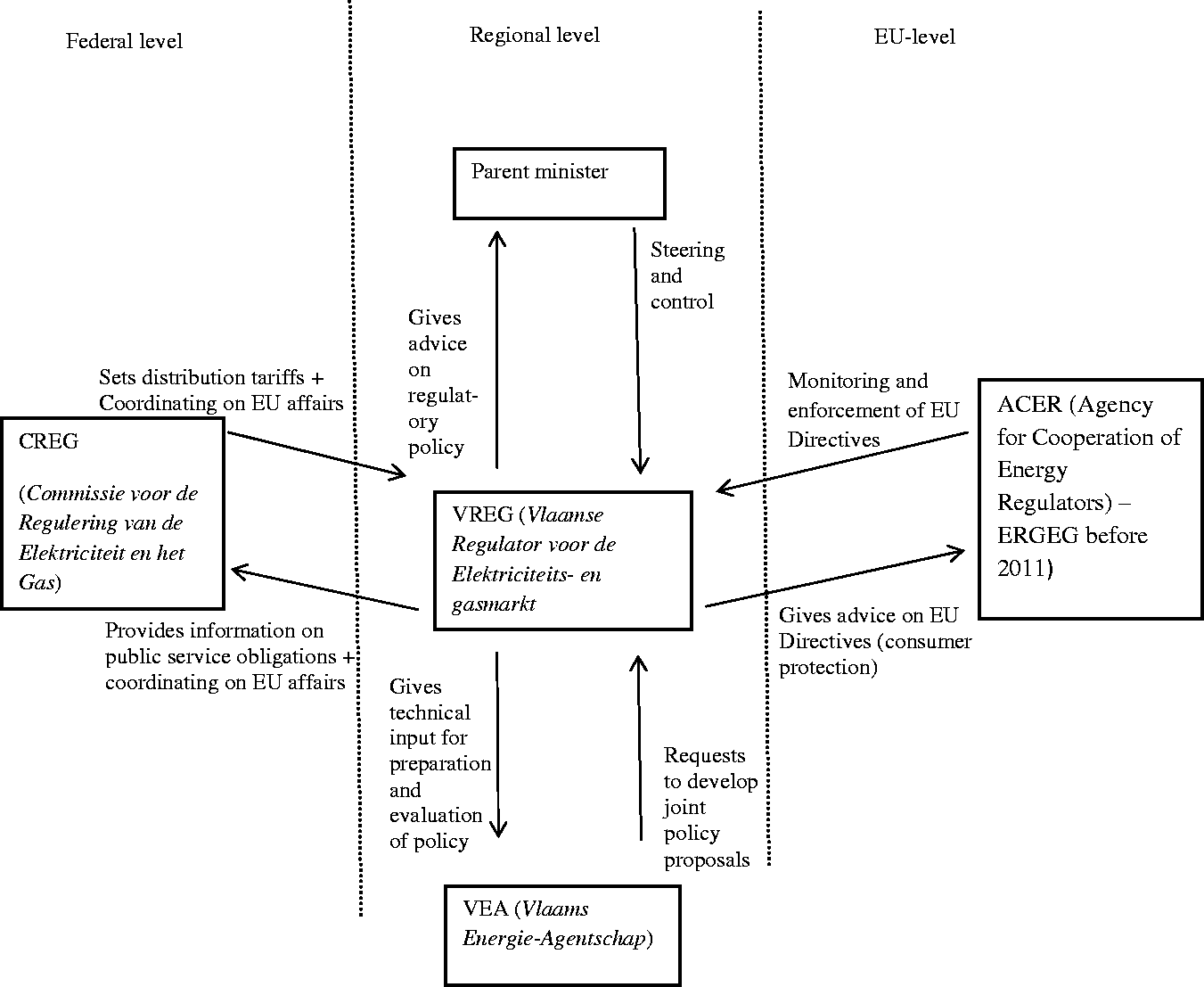
The data were collected via formal documents (annual reports, formal policy advice), internal documents and semi-structured interviews with personal advisers to the Flemish minister for energy and 20 senior executives from the organizations in Figure 1. Transcripts were analysed using a coding scheme, based on the main concepts (i.e. formal and factual patterns of autonomy of VREG and coordination on operational, tactical and strategic policy issues). We used Atlas.Ti to define associational relations between codes. The ‘co-occurrence explorer’ is a tool to assess proximity or association among coded quotations. Two codes are labelled as ‘co-occurring’ when they code quotations that are in some way touching each other (i.e. the first code either ‘overlaps’, ‘is overlapped by’, ‘follows’, ‘precedes’, ‘encloses’ or ‘is enclosed by’ the second code). A high degree of co-occurrence between two codes points to a certain association or covariance between codes. For instance, when respondents systematically mention ‘coordination on operational affairs’ in combination with ‘reduction in autonomy’, it is likely that these codes are associated (see Malina and Selto, 2001).
The next section of the article provides a more in-depth description of the coordination between VREG and the other actors in Figure 1.
Findings of single case study
Autonomy from parent minister
VREG has a high degree of formal policy autonomy for operational affairs. VREG is legally competent for making binding individual decisions, including economic regulation (e.g. imposing unbundling when network operators also have supply undertakings), technical regulation (e.g. demanding more investments from network operators to increase network capacity) and social regulation (e.g. imposing public service obligations). The agency considers this autonomy to be very important: ‘In any case, ministers must not interfere with operational decisions’ (Interview 3, quote 70).
The formal autonomy for strategic and policy affairs is lower. The performance contract defines the objectives of the regulator for a five-year period. VREG drafts its annual priorities in a corporate plan (ondernemingsplan). This must be approved by the minister and must be consistent with the strategic objectives as defined in the multi-annual performance contract.
VREG is not formally competent for preparing new policy. The energy laws are set by the Flemish government and prepared formally by VEA. However, the Flemish energy decree does allow VREG to produce advice on all legislative initiatives related to the Flemish energy market. For the regulator, being involved in policy is deemed important: Our core task is to regulate the market, not to prepare policy. But you cannot separate these two very strictly. Exerting oversight and making rules are complementary: we can see where things are going wrong and where policy should be adapted. When we feel that the market needs a new legislative initiative, we signal that to the minister. Sometimes you really have to take the initiative yourself. (Interview 5, quote 10)
Coordination with VEA
The authority to promote renewable energy is shared by VREG and VEA. VREG has an operational task to grant subsidies to producers, whereas VEA is responsible for determining the legal criteria of the subsidy scheme. In practice, VEA relies heavily on information delivered by VREG. Respondents indicated that VEA and VREG jointly evaluate policy and jointly draft legislative proposals.
The policy role of VREG is even more evident for regulatory policy issues. In 2009, the European Commission presented the Third Legislative Package on energy, with the aim of developing the Single Market for energy. The transposition of these Directives into Flemish legislation was prepared by VREG, and has been adopted with only minor adjustments. A personal adviser to the minister said: ‘There was really nobody else we could turn to’. VEA was perceived as having little expertise regarding technical standards for distribution networks (Interview 6, quote 48).
The role in policy-making is explained by the fact that VREG has a unique expertise, which is derived from networking with other actors. A respondent from the ministerial cabinet said: VREG has contacts with market actors, with regulators in other countries and with the EU. This allows them to build up an expertise that VEA does not have. So I don’t think VREG should only regulate. They should also prepare policy. I disagree with the idea that policy and regulation are two separate worlds. (Interview 6, quote 20)
Coordination at EU level
VREG coordinates with other national regulators and the European Commission via European Regulatory Networks (Eberlein, 2008). The European Regulators Group for Electricity and Gas (ERGEG) was established to ‘facilitate consultation, coordination and cooperation of national regulatory authorities’ and to ‘advise and assist the Commission in consolidating the internal energy market, in particular with respect to the preparation of draft implementing measures on any matters related to the internal energy market’ (European Commission, 2003).
ERGEG consisted of eight thematic working groups. VREG was a member of the working group on consumer protection, where it represented the Belgian viewpoint.
In July 2011, the Agency for the Cooperation of Energy Regulators – hereafter ACER – replaced ERGEG, but some ERGEG working groups continued to meet on a regular basis (Agency for the Cooperation of Energy Regulators, 2011).
Networking with other national regulators provides several advantages for VREG. First, it allows it to gain new expertise, such as new interactive ways to inform consumers about which suppliers offer the cheapest tariffs (VREG, 2011).
A second advantage of ERGEG membership is that the reputational power of VREG has increased (Interview 13, quote 2). ERGEG documents gained in moral weight because they represented the uniform viewpoint of the European regulators, and often resulted in Commission decisions (Interview 5, quote 7). Respondents indicated that it was much harder for parent ministers to ignore the advice of VREG when it reflected the opinion of the entire European network, since ministers would not risk deviating from ‘what Europe wants’ (Interview 15, quote 6).
Network membership may also help to increase formal autonomy from the parent minister. In an advice to the Flemish government, VREG argued that the Third Legislative Package required further insulation of the agency (VREG, 2010: 44–52). In particular, VREG referred to article 35 of Directive 2009/72, which states that national regulators should not take direct instructions from any public entity, including government. The minister acknowledged the need for more autonomy under the Third Package (Van den Bossche, 2010). A new decree was passed to transpose the Directives into Flemish law. The agency head and the members of the board are now appointed for a fixed term of five years, renewable once, making early dismissal by the minister much harder. In addition, the new decree abolishes the ‘commissaires du gouvernement’.
Coordination at federal level
VREG meets with the regulators at the federal level and the other Belgian regions (Brussels, Wallonia) via the Forum of Belgian Energy Regulators (FORBEG). This is an informal body, where regulators meet on a voluntary basis. FORBEG has been used primarily to coordinate on two issues: deciding on tariffs for distribution networks and the representation of Belgian energy regulators at the supranational level.
Distribution tariffs
VREG has imposed public service obligations on distribution network operators in Flanders. Operators must deliver a minimum amount of electricity free of charge to all households, in order to prevent energy poverty. Operators can recover the costs incurred by these obligations by increasing the tariffs charged to suppliers who use the distribution network to transport energy to end users. Since the federal regulator (CREG) is competent to approve these tariffs, VREG has to coordinate with CREG regarding the costs incurred by the public service obligations. However, CREG has consistently rejected these tariff proposals, making it impossible for network operators to comply with the Flemish regional public service obligations (Interview 7, quote 25, also Interview 8, quote 52). The FORBEG group failed to reach an agreement, after which VREG requested the Flemish government to negotiate a new division of competences with the federal government: In order to be able to develop a coherent Flemish energy policy, the region must have the authority over distribution tariffs. Flanders should continuously argue for a transfer of this competence to the regions. (VREG, 2008: 2)
Representation at supranational level
The regional and federal regulators have to agree on a uniform Belgian viewpoint that will be defended at the European level. The federal regulator CREG had traditionally been the single point of contact, because the European regulations concerned issues of federal competence (i.e. cross-border trade). As the EU became active in issues of regional competence (consumer protection, renewable energy), the representation of the Belgian regulators became more contested.
In 2006, VREG became a member of the ERGEG working group on consumer protection, where it represented all Belgian regulators. This was possible because the European Commission allowed Member States to designate ‘one or more competent bodies with the function of regulatory authorities’ (European Commission, 2003: article 2). For all other working groups, CREG remained the only Belgian representative. Via FORBEG, the Belgian regulators informed each other of activities in the European working groups.
The implementation of the Third Legislative Package posed problems for the relations between federal and regional regulators. The 2009 Directives require Member States explicitly to appoint a single national regulator to represent the Member State in the newly created ACER agency. Hence, the federal and regional levels have to agree who will become the single national representative. CREG claimed that only the federal regulator was entitled to be the national regulator, as it is the only body that has authority over the entire Belgian territory.
However, VREG has questioned this claim and proposed assigning a more formal role to FORBEG instead. Although FORBEG was originally designed as an informal body, VREG argued that FORBEG should act as a collegiate body that appoints the senior representative of Belgium on the Board of Regulators of the ACER agency (VREG, 2010: 43). CREG initially denied this request, since the three regional regulators would acquire a majority of votes in FORBEG. Notwithstanding, the regulators of the Brussels and Walloon regions have supported this proposal (Van den Bossche, 2010; Vlaams Parlement, 2009).
Discussion and conclusion
Our starting point was the assertion that fragmentation and coordination in multi-actor multi-level actor constellations may have an effect on the autonomy of independent regulators. Previous research has focused mainly on relations between agencies and parent ministers, from a principal–agent perspective. The findings show that VREG receives a great deal of operational policy autonomy from the parent minister, which is partly hollowed out by the authority of the federal regulator CREG. The extent to which VREG can impose public service obligations is constrained by its dependence on CREG to accept the proposed tariffs. Conversely, if we take into account the informal interactions between VREG and VEA, we find that the role of VREG in the policy-making process is greater than what is described in the legal statutes. In sum, looking at the combined effects of steering from the minister and coordination with other agencies provides a more reliable picture of the autonomy of VREG. In addition, the effect of steering from the minister is independent of the steering of the constellation: actors can score high on autonomy of the minister, while scoring low on autonomy from the constellation, and vice versa.
The relevance of the classical organizational theory perspective and the resource dependency perspective
The classic organizational perspective argues that coordination is imposed by the political principals, as a tool to reduce autonomy and to restore policy coherence. The establishment law of VREG does indeed oblige the agency to act ‘in close collaboration with ACER, the regulatory bodies of other Belgian governments and European Member States and the European Commission’ (Vlaams Parlement, 2009: article 3.1.4/1). In addition, the freedom of VREG to decide which viewpoints it will defend at the EU level regarding consumer protection is limited because of the need to find prior agreement with the other Belgian regulators via FORBEG.
However, these coordination mechanisms already existed before they were required by law and were actually initiated by the regulators. This points to the resource dependency perspective. Coordination at the EU level provides VREG with an informational advantage and explains why its role in policy-making is greater than formally prescribed (e.g. VREG prepared the transposition of the Third Package). Consistent with resource dependency theory, VREG aims to reduce the power of CREG by arguing for a transfer of the authority to set distribution tariffs. Furthermore, VREG forms a coalition with the regulators from the other regions, in order to turn FORBEG into a collegiate body.
The relevance of a relational-dynamic perspective
These findings suggest that autonomy is inherently a relational concept: autonomy is reduced or increased through the relations that agencies have with other actors. The case study helps us to further elaborate the components of such a perspective.
First, agency discretion is affected by other governmental actors besides the minister. Relations with the constellation do not uniformly reduce or increase the autonomy of VREG. Our tentative conclusion is that coordination on operational affairs reduces the discretion of VREG, whereas coordination on policy issues increases autonomy.
Cross-actor effects of coordination
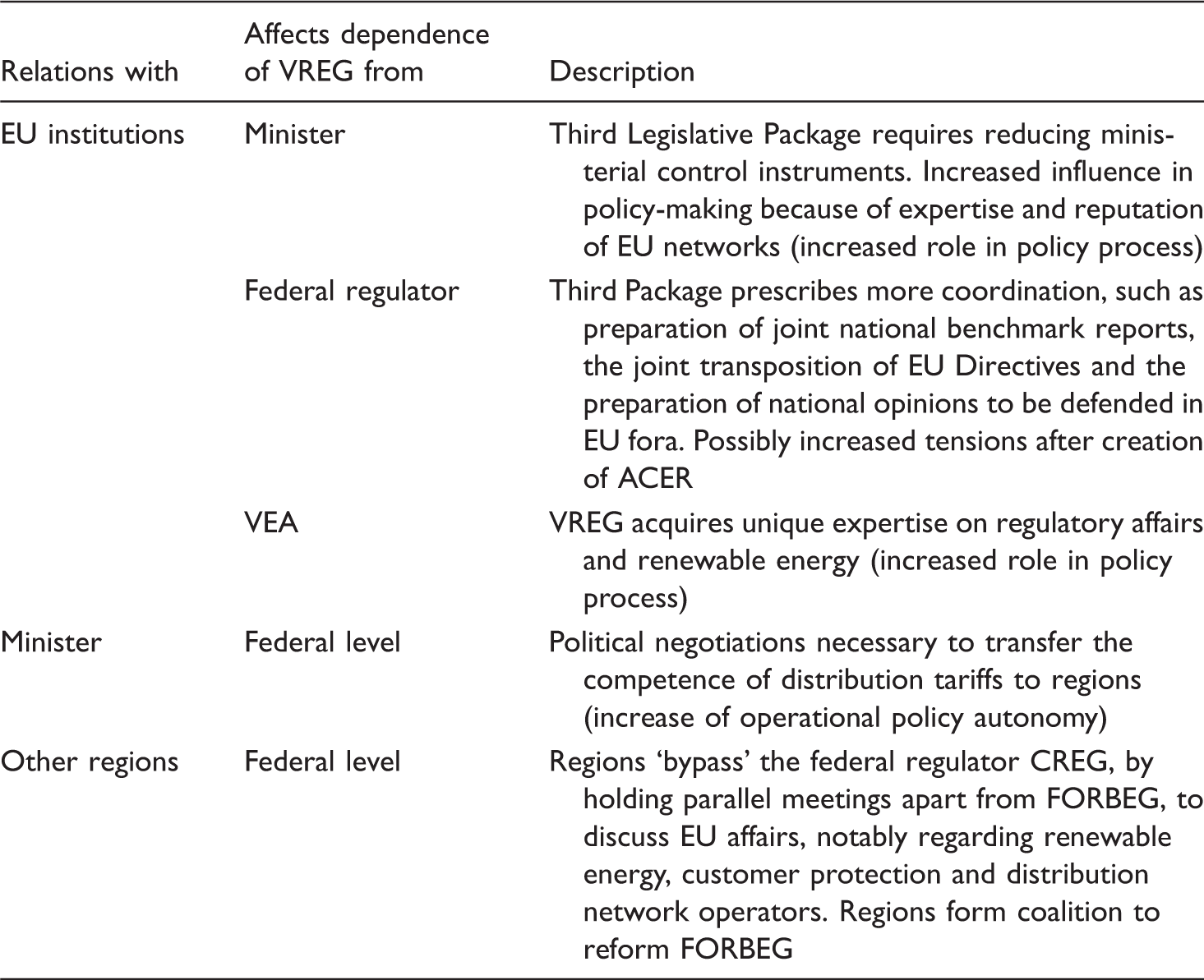
However, coalitions between actors are dynamic: VREG forms coalitions to increase its insulation from the minister, while at the same time approaching the minister to reduce dependencies on the constellation. The most evident examples are the relations with the federal level, where only the minister has the political authority to negotiate a transfer of competences to the regional level. VREG even engages in highly political processes, such as the negotiations on a new federal government and the reform of the state. VREG engages in coalitions with different actors, depending on the issue at hand.
A fourth aspect of the relational-dynamic perspective points to the embeddedness of social relations and the personal relationships that exist between actors. Relations between VREG and the ministerial cabinet were said to be based on frequent and informal contacts. VREG has e-mail and telephone contacts with the cabinet, almost on a daily basis, for regulatory policy (Interview 6, quote 50). Before a market monitoring report or policy advice is published formally, VREG has already discussed it informally with the cabinet. The importance of personal relations was also emphasized repeatedly to explain collaboration between VEA and VREG. Actors have regular contacts and know each other well, as they used to be part of the same ministerial department prior to agencification.
These factors were not mentioned in the relations between VREG and CREG. We hypothesize that this is related to the conflictual relations and the perceived reduction of autonomy for VREG. The relational strategy of VREG does not work well in relations with CREG. Future research may explore what determines the success of such a relational strategy. Having a shared history, combined with high frequency of interaction, has been said to create trust between actors. Previous research has suggested that trust shapes relations between agencies and principals and helps to explain differences in autonomy between agencies (Rommel and Christiaens, 2009; van Thiel and Yesilkagit, 2011). We hypothesize that trust plays a role in explaining (the lack of) information-sharing between actors in the constellation. Trust may prove helpful to improve interactions in ‘post-bureaucratic environments’, where relations are based on negotiation and consensus-building instead of hierarchy (Grey and Garsten, 2001).
In sum, developing a relational perspective may advance the study of agency autonomy in two ways. First, it provides an expanded view of autonomy because it acknowledges that other actors besides the principal can affect autonomy. Second, it points to the dynamic evolution of autonomy: on some occasions agents form coalitions to increase their autonomy from the minister but on other occasions they form coalitions with the minister, to reduce their dependence on the actor constellation.
Operationalizations of policy autonomy have mainly focused on the dyadic relationship between minister and agencies. Future measurement should add items on interaction frequency with and possible influence of other actors and levels of government, besides the parent minister. In their study based on COBRA data, Yesilkagit and van Thiel (2012) analysed the perception of agency heads on the influence of multiple actors on decisions about organizational strategy. Similarly, Egeberg and Trondal (2009a) and Wonka and Rittberger (2013) have studied the impact of multiple principals on the decision-making autonomy of officials in EU affairs. Future studies should expand upon that, looking at the intensity and content of interaction between these actors, as well as the extent to which agency managers feel that these interactions affect their room for manoeuvre. Social Network Analysis might be a useful method, as it grasps the perception of the other actors as well, in terms of interaction and influence (see e.g. Ingold and Varone, forthcoming, on the impact of multi-level regulation on the perceived autonomy of the telecom regulator in Switzerland). As the number of other regulatory actors in the constellation increases the possibilities for autonomy-restricting coordination, and also for strategic behaviour of the regulatory agency, we might hypothesize that, the greater the extent of fragmentation, the greater the relative influence of the constellation compared to the steering of the minister, on the perceived agency autonomy.