







Abstract
Coordinating organizations horizontally is a longstanding difficulty of public governance, often called departmentalism in central government systems. Several tools for horizontal coordination have previously been analysed but shared performance targets across departments have received relatively little attention. This article develops a control theory of shared performance target systems for horizontal coordination of departments consisting of ‘director’ (shared objective and target setting), ‘detector’ (shared monitoring of progress), and ‘effector’ (shared feedback to promote achievement of targets) components. The theory distinguishes between two kinds of shared targets: those promoting sequential coordination and simultaneous coordination among departments. The expectations of control theory are assessed for the Public Service Agreement (PSA) adopted in the United Kingdom. PSAs enabled a step change increase in discussion of shared policy objectives across departments. However, despite these benefits, the fundamentally separate broader ministerial and departmental accountability structures led to the setting of vague outcome targets, underdeveloped performance reporting, and fragmented delivery arrangements for shared targets.
Points for practitioners
The findings provide a cautionary tale for policy-makers seeking to implement horizontally shared targets across departmental organizations. The UK Government’s Public Service Agreement (PSA) system reveals that shared target systems for departments supervised by a finance ministry are a useful tool for incentivizing departments to collaborate with other departments in policy discussions and resource allocation. However, it was difficult for departments to set specific cross-cutting targets and to develop practical joint delivery and performance reporting strategies across existing departmental boundaries. The effects of the system were, for the most part, counteracted by departmentally focused resource and accountability structures. In some cases, broader structural reform to reorganize departmental structures to align with the formerly cross-cutting policy challenge was necessary rather than predominantly relying on shared targets to pursue policy goals.
Keywords
Introduction
Coordinating across organizational boundaries to bring their objectives and actions into a desirable overall state of affairs has long been at the heart of research on public organization. Many central or national-level governments of territorial nation states are composed of separate departments (typically defined by functional area, territory or client group served). Central points of political or managerial authority in the state, typically presidents, prime ministers, finance ministers and their related officials, have a particular concern with achieving effective horizontal coordination of departments since they need to take an overall, as opposed to narrowly departmental, perspective on policy and implementation (Bogdanor, 2005; Christensen and Lægreid, 2007a; Dunleavy and Rhodes, 1990; James, 2004; Mandelson and Liddle, 1996). The coordination of departments is necessary to avoid undesirable spill-overs of policy or implementation, to ensure that overall goals, such as systemic fiscal austerity, are pursued and to be able to form and implement policies that require the action of more than one department. The need for horizontal coordination is particularly pressing for complex or ‘wicked’ policy issues (Rittel and Webber, 1973), especially environment, security, welfare, employment or health policies that often cut across traditional departmental boundaries.
These concerns are longstanding but in recent decades have led to a range of initiatives sometimes called ‘joined-up government’ (especially in the UK), ‘whole-of-government’ or a reintegrated government approach. Several tools have been used to try and achieve horizontal coordination including shared setting of strategic objectives, budget systems and budgetary incentives, committee structures, movement of staff and development of shared norms of working across organizations (Bardach, 1998; Bogdanor, 2005; Christensen and Lægreid, 2007b; Halligan, 2007; Halligan et al., 2011; Hood et al., 1999; Osborne, 2010; Peters, 1998; Pollitt and Bouckaert, 2011). However, relatively little attention has been paid to the theory and practice of shared performance targets, with individual and sets of targets for particular policy areas shared across departmental boundaries, as a tool for central political leadership to promote horizontal coordination across departments within national executives. Instead, most work on performance targets has focused on their use in vertical command coordination and issues around target setting, valid and reliable measurement, reporting, and associated incentives and potential gaming (Hood and Bevan, 2006; Lægreid and Verhoest, 2010; Micheli and Neely, 2010; Poister, 2003; Talbot, 2010).
This article draws on control theory and the general literature on performance targets to develop a theory of horizontal coordination using performance targets set by a central authority and shared across different departments. The first section sets out how central political and managerial leadership can use shared performance targets to improve horizontal coordination across departments. Shared target systems entail director, detector and effector functions through the process of setting shared objectives, monitoring progress towards shared targets, and encouraging departments to achieve shared targets. The second section evaluates the expectations of control theory by analysing the ‘cross-cutting’ and departmentally shared performance targets in the UK Government’s Public Service Agreement (PSA) system which lasted from 1998 to 2010. The system was led by HM Treasury and was intended to mitigate the longstanding problem of narrow departmentalism. The final section presents conclusions that shared performance targets can help horizontal coordination of policy discussion across departments but has significant limitations as a way of coordinating implementation, as well as suggesting implications of these findings and avenues for future research.
Control theory and shared performance targets
Broadly defined, organizations are structured to undertake activities to achieve particular purposes by combining staff, technology, information, operating procedures and other modes of working and infrastructure. Organizational boundaries, and ways of mitigating undesirable effects brought about by these boundaries, have long been a central theme of public administration. Writing in the 1930s, Gulick argued that grouping work on the basis of its homogeneity may be undertaken according to purpose (such as furnishing water, controlling crime or conducting education), process (such as engineering or medicine), persons or things dealt with or served (such as immigrants or veterans) or the place where the service is rendered (such as a particular territory) (Gulick, 1937). The extensive modern literature on ‘governance’ notes that organizations delivering public policies are split along many dimensions, suggesting that this term is preferable to ‘government’ in part to reflect that fact (Lægreid and Verhoest, 2010; Rhodes, 1997). These boundaries between organizations include those associated with levels of government, distinguishing federal/central, state/regional and local levels, and distinctions between policy-focused or operational bodies. To complicate matters further, bodies influencing policy outcomes can have public or private ownership, funding or regulation, and the public/private boundary is multidimensional (Bozeman, 1987).
There has been increasing research into coordination of public organizations, collaboration between them both within the public sector and bringing public and private organizations together on shared projects (Alexander, 1995; Bardach, 1998; Farneti et al., 2010; Padovani and Young, 2008; Sullivan and Skelcher, 2002). A range of control tools have received attention including staff movement between levels in the hierarchy and attempts to disseminate shared strategic priorities and norms throughout the system (Bardach, 1998; Christensen and Lægreid, 2007b; Hood et al., 1999; James, 2000, 2003, 2004; Moseley and James, 2008; Osborne, 2010; Pollitt and Bouckaert, 2011). For example, in Australia, the ‘whole-of-government’ approach emerged from the government’s push for more integrated approaches to more complex strategic policy issues such as national security and attempts at integrated service delivery in particular policy areas (Halligan, 2007); meanwhile, in Canada attempts included refocusing services on citizens (Flumian et al., 2007). In addition, research has grown on strategic alliances in the private sector where businesses agree to pool their shared resources, capabilities, investments and core competencies to facilitate the manufacturing, or provision, and distribution of specific goods and services to achieve shared business objectives (Bamford et al., 2004; Hitt et al., 1997; Holmberg and Cummings, 2009). However, these literatures have not been specifically focused on shared performance targets as a way of improving horizontal coordination because the use of this tool is relatively unusual, which is why the case of PSAs in the UK is particularly interesting.
In this article we develop the theory and assess the practice of shared performance targets across organizational boundaries as a way of addressing the ‘horizontal’ coordination problem in government. This issue is sometimes called ‘departmentalism’, where boundaries between ministerial departments hamper effective government policy making and implementation (HMSO, 1999; Mandelson and Liddle, 1996). Horizontal coordination contrasts with vertical coordination where hierarchical coordination is necessary with lower-level units, for example, central department units often set policy making but executive agencies or local service units are responsible for policy delivery (Bogdanore, 2005; Christensen and Lægreid, 2007a, 2007b; HMSO, 1999; James, 2003; Peters, 1998). Horizontal coordination raises specific challenges. Policy issues often extend over departmental boundaries and multi-departmental collaboration is necessary in order to effectively tackle these problems and ‘externality’ spill-overs where departments affect each other (6 P, 2005; Baradach, 1998; Bogdanor, 2005; HMSO, 1999; James, 2000). However, departments are headed by different ministers with specific agendas and financial resources are allocated not by policy area but to each department (Bogdanor, 2005; Heclo and Wildavsky, 1981). While prime ministers and finance ministers can try to build sustainable collaborative partnerships across departments, often through shared party loyalty or command, the departments are less tied into a clear hierarchical order unlike many structures of vertical coordination (Heclo and Wildavsky, 1981; Peters, 1998). To make matters more difficult, each department often has its own distinctive work culture and set of links to the broader public sector, societal, and business interests, which leads to agendas and ways of working specific to each department (March and Olsen, 2006; Peters, 1998).
The contribution of formal shared performance target systems, in the form of sets of shared targets focused on cross-departmental policy objectives and individual shared targets, to improve horizontal coordination have not been systematically addressed theoretically or empirically in the literature on performance targets. Most work on targets and coordination issues has instead focused on performance targets for vertical coordination, since objectives and targets are often shared vertically between a department and a central regulator as an overseer of agencies or local bodies, such as hospitals or schools (Christensen and Lægreid, 2007a, 2007b; Hood and Bevan, 2006; James, 2003). Work on shared targets and horizontal coordination has been much more limited. Exceptions are Aristigueta et al. (2001), who discussed how shared interests across organizations supported by social outcome measures are able to encourage the actions of multiple agencies based on a case study of children’s policy in the United States. The case showed that cooperation based on shared objectives was beneficial for getting intended outcomes beyond organizational boundaries. Huxham and Vangen (2000) found that performance agreements setting out shared objectives between public organizations are most successful in situations where joint agreements are developed over time with constant interaction between the organizations, so that mutual trust is built up through collaborative work towards collective objectives. Similarly, studies of strategic alliances emphasize the importance of the quality of shared objectives which fully matched with the interest of the businesses involved, whereas the success of alliances also largely depends on what are sharable, to what extent, in what kind of format between those businesses in the substantial performance control process (Bamford et al., 2004; Hitt et al., 1997; Holmberg and Cummings, 2009). However, these outcome measures and performance agreements were not part of a formal performance target regime. More relevant is research on integrated service delivery in Australia that has highlighted the limitations of vertical purchaser–provider relationships and how this has led to horizontal integration of welfare service delivery focused on citizens at the local level (Halligan, 2007). Similarly, there has been some discussion of ‘shared’ target systems for horizontal joint work in a few policy areas in Canada, Australia and the UK (AGC, 2000; GAO, 2000; NAO, 2005). We build on these findings to specify a control theory for how a formal shared performance target system could be expected to improve horizontal coordination, and assess these expectations against the practice of PSAs in the UK.
Drawing on control theory, a system of shared performance targets incorporates three components: (i) setting shared organizational objectives with shared performance targets corresponding to those objectives (a director component); (ii) shared performance monitoring systems to assess progress relative to the above-mentioned targets (a detector component); and (iii) feedback systems to provide incentives and other encouragement for those involved in the system to improve performance against shared targets (an effector component) (Dunsire, 1978; Hood, 1983; Hood et al., 1999). The systems operate at two levels with the central authority (in the UK case of PSAs this was the Treasury) having some vertical control over the departments in setting, monitoring and responding to performance against shared targets, and the departments themselves using the system to help coordinate their activities. We distinguish two main forms of shared targets for horizontal coordination as summarized in Figure 1. In type (a) the targets for each department are for activities that occur in a sequence which contribute to an objective at the end which is also targeted overall. In type (b) the target is for simultaneous contribution with departments working to achieving the shared target.
Shared targets for horizontal coordination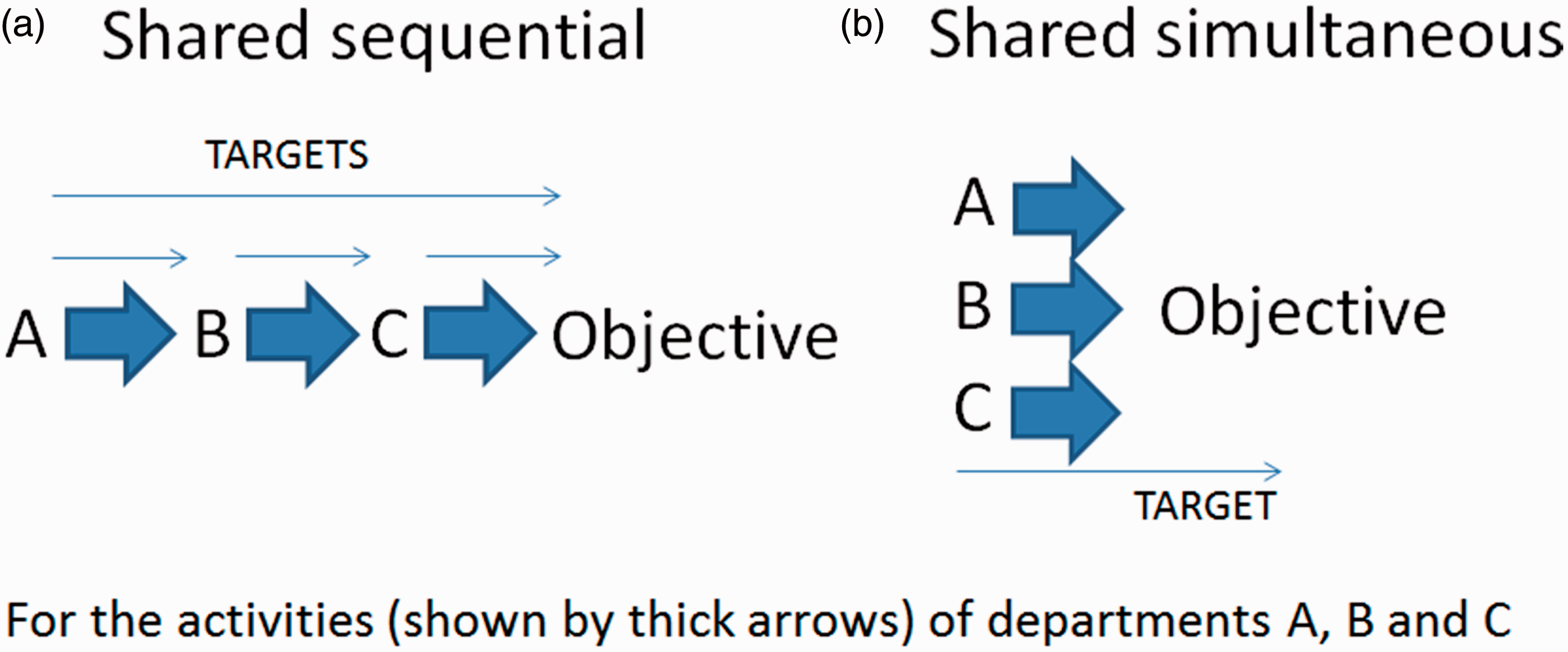
Public Service Agreements including shared targets in UK central government
The UK Public Service Agreement (PSA) offers an unusual opportunity to evaluate the theory of shared performance targets across the whole of a central government system. The PSA system was originally set up in 1998 with the purpose of reflecting the key policy priorities of the then Labour Party controlled government. The system was refined in 2000, which marked the emergence of the fully developed system which we analyse. PSA targets were published as part of Comprehensive Spending Reviews (CSRs) of expenditure in the years 1998, 2000, 2002, 2004 and 2007, before the system was abolished in 2010 by an incoming Conservative/Liberal Democrat coalition government.
Previous research on PSAs noted their use as a novel ‘tool of governance’ by the core executive part of the political and managerial executive (especially the Treasury) to steer the UK state (James, 2004). The use of PSAs in vertical coordination through the cascading of targets from central government level to lower tiers was noted to try and link up delivery with policy objectives (James, 2003: 142–143; 2004; Micheli and Neely, 2010). However, the use of shared targets in the PSAs for horizontal coordination across departments has not previously been subject to specific analysis. In this section we analyse the system overall and for the cases of the criminal justice system and employment policy. These areas of policy reflect key priorities of the government at the time and allow analysis of the two main types of shared target noted in Figure 1. The criminal justice system is an example of shared sequential targets (i.e. type a) and employment policy an example of simultaneous shared targets (i.e. type b).
Cross- and single-department targets by type PSA year 2000
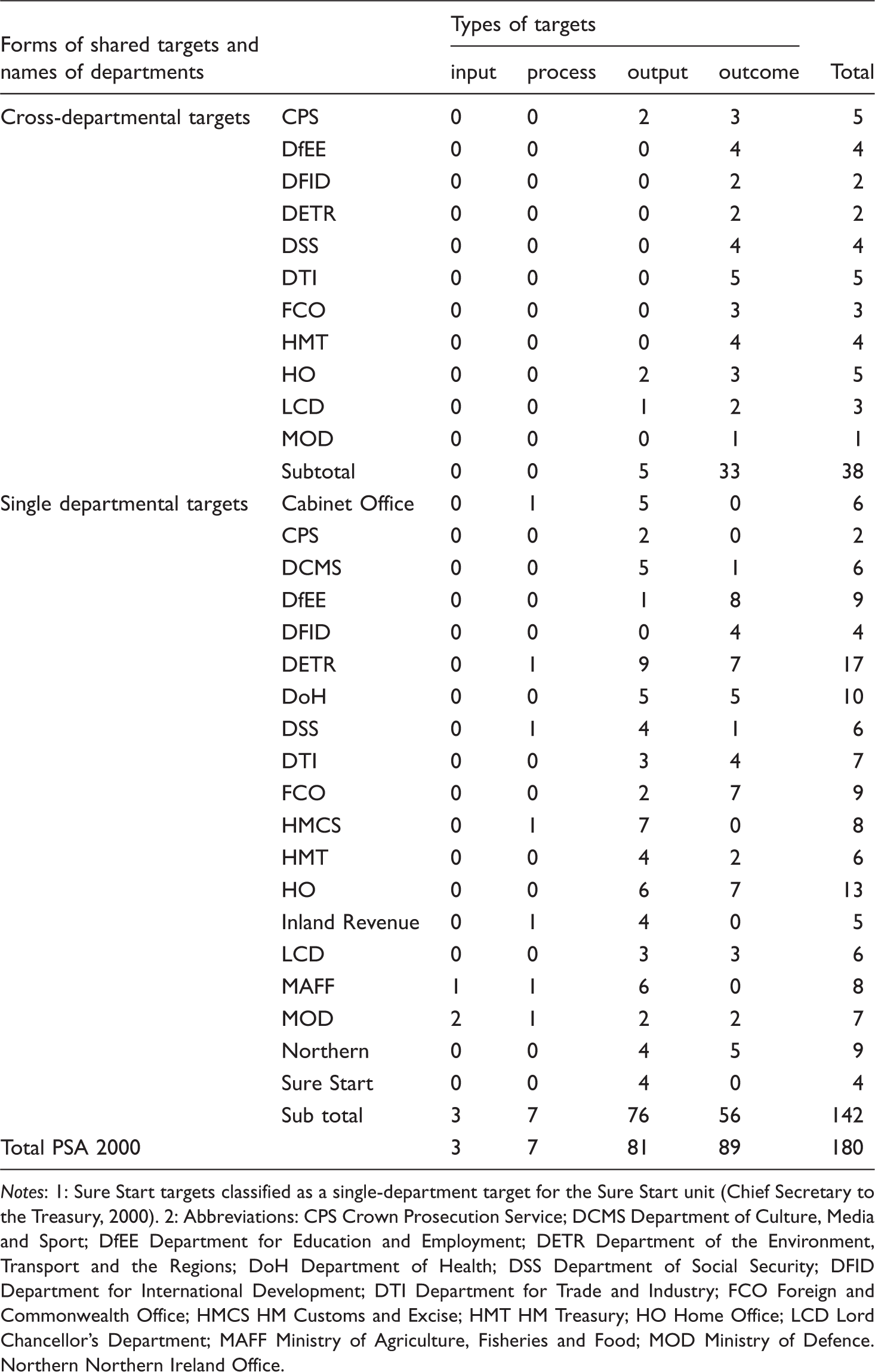
Notes: 1: Sure Start targets classified as a single-department target for the Sure Start unit (Chief Secretary to the Treasury, 2000). 2: Abbreviations: CPS Crown Prosecution Service; DCMS Department of Culture, Media and Sport; DfEE Department for Education and Employment; DETR Department of the Environment, Transport and the Regions; DoH Department of Health; DSS Department of Social Security; DFID Department for International Development; DTI Department for Trade and Industry; FCO Foreign and Commonwealth Office; HMCS HM Customs and Excise; HMT HM Treasury; HO Home Office; LCD Lord Chancellor’s Department; MAFF Ministry of Agriculture, Fisheries and Food; MOD Ministry of Defence. Northern Northern Ireland Office.
Characteristics of shared targets in the PSA system
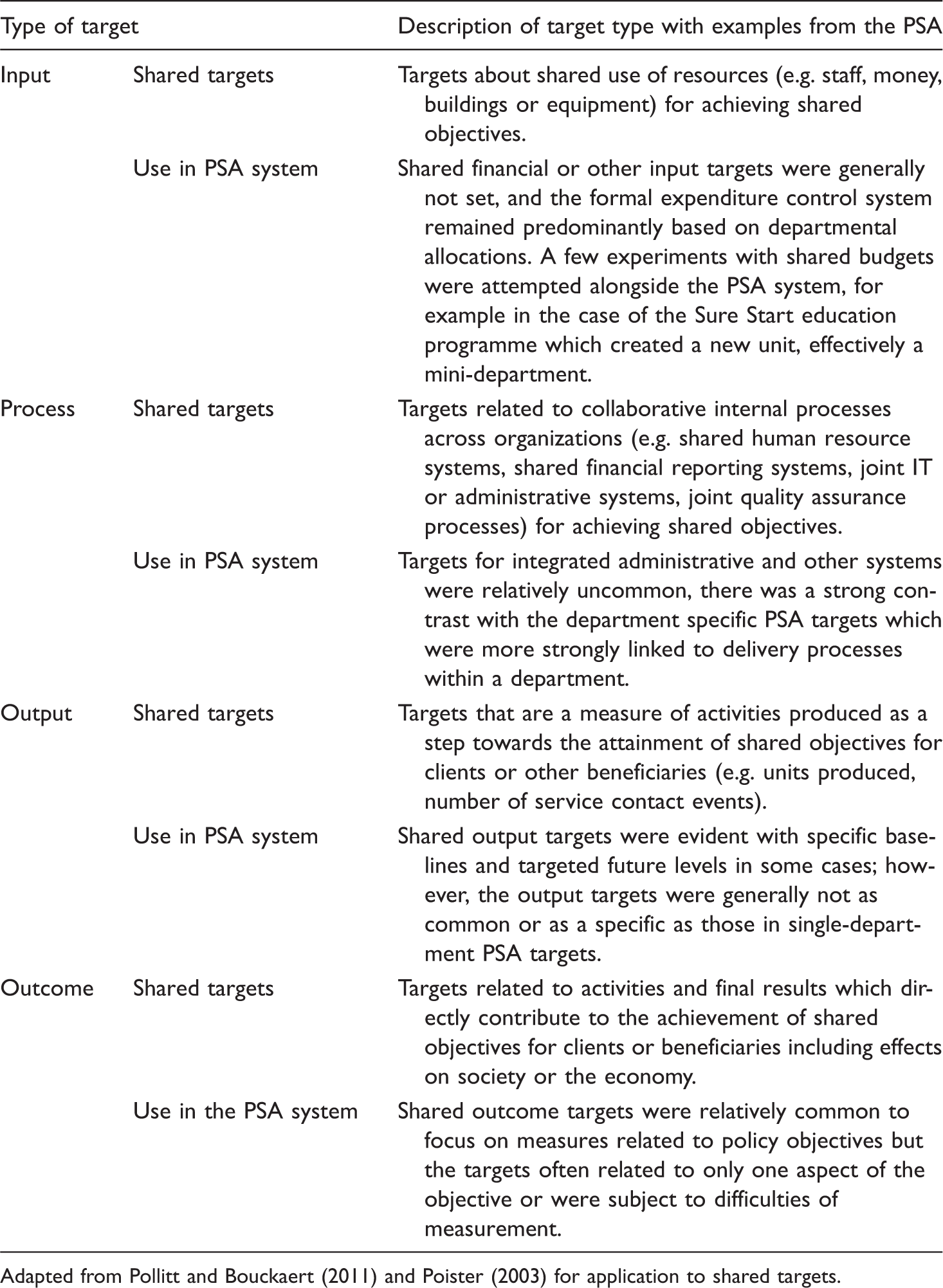
Adapted from Pollitt and Bouckaert (2011) and Poister (2003) for application to shared targets.
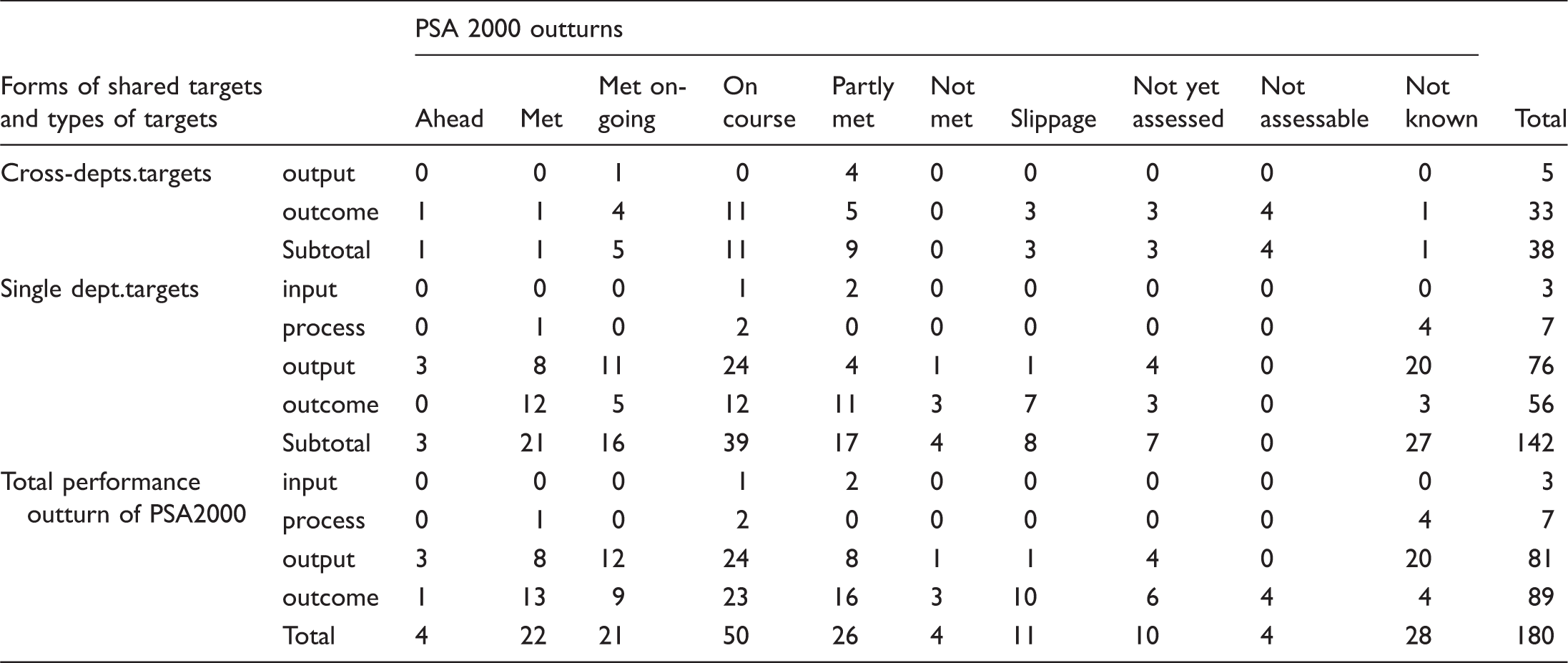
Performance against year 2000 PSAs: summary of outturns
Director component, shared organizational objectives and shared performance targets
Most government departments in UK central government interact with each other in some way, suggesting the need for a large number of shared objectives and targets. However, the PSA system was predominantly focused on systems of targets for individual departments’ separate activities. Many areas of major shared activity were neglected, notably the overlap between health provision using hospitals and potential health improvement activities in education and transport to prevent poor health, and between the environment and business policy. However, 10 policy-level civil servants we interviewed (three from HM Treasury and seven from five other departments) all agreed that the PSA regime was part of a significant step change increase in discussion about cross-department policy issues. They noted special progress in policy on employment/welfare to work, the criminal justice system, early childhood education and addressing local international conflicts. These priorities were reflected in 38 cross-departmental targets being set out of the 180 total PSA targets in 2000 (see Table 1).
Within the PSA system, specific ‘targets’ related to departments’ policy ‘objectives’ which were agreed with the Treasury (Chancellor of Exchequer, 1998, 2004; Chief Secretary to the Treasury, 2000). However, cross-departmental targets did not always reflect fully unified ‘objectives’ between the participating departments. In employment policy, an example of simultaneously shared targets, the Department of Social Security (DSS) had 10 targets in total for the PSA 2000, of which four were cross-departmental ones intended to improve the employability of people receiving welfare payments. The other major department involved, the Department for Education and Employment (DfEE), had 13 targets, and four of these were cross-departmental targets. Within these four targets, DfEE and DSS shared three identical performance targets, and each had a shared target with HM Treasury. However, whereas the DfEE’s objective in relation to employment policy was simply ‘helping people without a job into work’ (Chief Secretary to the Treasury, 2000: 6), the objective set out for the DSS covered much broader objectives related to employment; ‘promoting work as the best form of welfare for people of working age, whilst protecting the position of those in greatest need’ (Chief Secretary to the Treasury, 2000: 33). Even though these two departments nominally shared three identical targets, those targets corresponded to two slightly, but substantively important, different objectives set out for the departments.
In the case of the Criminal Justice System (CJS), the 2000 PSA listed nine targets along with eight policy objectives related to apprehending those suspected of criminal behaviour and processing them (Chief Secretary to the Treasury, 2000). Officials and ministers in the Home Office, the Lord Chancellor’s Department and the Crown Prosecution Service were required to be jointly responsible for those targets with each also having primary responsibility for their segment of the process (Chief Secretary to the Treasury, 2000: 50). However, among the nine PSA targets addressed to CJS, only five of those were shared as cross-departmental targets, one was a single-departmental target for the Crown Prosecution Service corresponding to a CJS objective about the rights of the defendant, and the other three were single-departmental targets for the Home Office, corresponding to three separate CJS objectives (i.e. ‘to reduce the level of actual crime and disorder’; ‘to reduce the economic cost of crime’; and ‘to ensure justice process and effective outcomes’) (Chief Secretary to the Treasury, 2000: 49). It was difficult for departments to exercise effective control over targeted activity which was mainly handled by other departments relating to their particular objectives. Thus, it was not possible to set out a clearly defined overarching set of objectives for the whole criminal justice system. Interviewees in criminal justice departments commented that this difficulty reflected its complexity and competing demands including those of due judicial process, speed of processing, efficiency, cost and victim and suspects' rights.
The types of target set for PSAs reflected the difficulties of setting meaningful shared performance targets across departments relative to single-departmental targets (even taking into account that single-department targets themselves often had problems). First, both single- and cross-departmental targets were predominantly output and outcome targets (see Tables 1 and 2) consistent with Bouckaert and Halligan (2008) who note that an emphasis on outcome and output targets tends to reflect attempts to agree upon meso-level policy effects. The PSAs were supposed to reflect policy objectives, so a focus on outcomes as concrete measures of progress towards achieving objectives was in some senses appropriate. Nonetheless, the reliance on outcome targets also reflects a weakness in the system because the outcome targets tended to be less tangible than input or process targets, and this is more evident in cross-departmental targets. Of the total of 38 cross-departmental targets, 33 were outcome targets while only five were defined as output targets; in contrast, of the total of 142 single-departmental targets, 76 were output targets and 56 were outcome targets. In employment policy, the DSS and DfEE had four shared targets, all of which were outcome targets. In criminal justice an outcome target related to improving ‘public confidence’ by closing a perceived gap between crime committed and people being brought to justice. However, this outcome was only loosely related to police and court activity and difficult to assess by simple indicators (Bradford and Jackson, 2009; Garside, 2004; Myhill et al., 2011).
The inputs to the system were set through the expenditure control process, which was related to PSAs, with performance against targets informing spending review discussions between departments and the Treasury, while not being fully linked as would be the case in a system of performance budgeting. Senior officials in both the Treasury and the spending departments commented in interviews that Treasury’s role in setting spending levels for departments was crucial in encouraging departments to work with each other to discuss shared objectives. However, the PSAs could not be directly linked to inputs in the form of performance budgeting because of political structures, which concentrated on the bilateral discussions between each department in the spending allocation process.
Detector component, shared performance monitoring systems for targets
Every department published their progress towards PSA targets in annual department reports, in principle using a standard performance attainment method (HM Treasury, 2003). Table 3 provides a summary of performance against the 2000 PSA in the period up to 2004 and reveals underdevelopment of performance monitoring systems for cross-departmental targets. Interviewees from spending departments commented that the targets had sometimes been set without sufficient regard for whether adequate performance measures to assess progress existed. Four cross-departmental targets out of 38 were reported as ‘not assessable’ (see Table 3), and NAO (2005) noted that shared targets were sometimes evaluated in different ways by different departments.
In employment, in measuring the outcome target to ‘increase employment over the economic cycle’, the DWP referred to trends in the employment rate over the previous 20 years based on the national Labour Force Survey (LFS) (DWP, 2002; ONS, 2001, 2002). Given the LFS’s finding that the seasonally adjusted annual employment rate (i.e. the proportion of the population of working age who are in employment) increased between 2000 and 2002, the DWP declared the above-mentioned target to be ‘met and on-course’ (DWP, 2002; HM Treasury, 2003). However, on an alternative measure, according to the unemployment measures established by the International Labour Organization (ILO), the annual UK unemployment rate increased over the stated period because it took into account an increase in the labour force, making the assessment of performance less positive (ILO, 2004). In criminal justice, it proved difficult to get measures that spanned across all the stages of the justice system. For example, the target to improve public confidence was assessed based on one survey question in the British Crime Survey which asked about how well the police did their job (Home Office, 2003a), which is only part of the overall system, a limited measure of the outcome (Bradford and Jackson, 2009).
The target for speeding up the criminal justice system provides a good example of the difficulties in developing targets intended to achieve a shared objective through the sequential performance contribution of departments as shown in type (a) of Figure 1. The target was aimed at reducing the overall time from arrest to sentence by 2004, corresponding to the CJS objective ‘to deal with prosecution cases in a timely and efficient manner in partnership with other agencies’ (Chief Secretary to Treasury, 2000). Hence the Home Office, the Lord Chancellor’s Department and the Crown Prosecution Service were required to sequentially contribute to the target. In order to distribute responsibility to each department, the PSA entailed following specific performance targets for each department; (i) reducing the time from charge to disposal for all defendants, with a target to be specified by March 2001; (ii) dealing with 80 percent of youth court cases within their target time; and (iii) halving from 142 to 71 days by 2002 the time taken from arrest to sentence for persistent young offenders and maintaining that level thereafter (Chief Secretary to the Treasury, 2000). However, these sub-targets did not work effectively to promote cross-departmental coordination in the performance monitoring system. In response to sub-target (i), the departments were unable to agree with the specific timeliness target by 2002 (CPS, 2003; Home Office, 2003b). In response to sub-targets (ii) and (iii), there were interim reports about the dates from arrest to sentence in March 2002 (CPS, 2003; Home Office, 2003b); however, the final outturn and achievement level against those targeted were never announced. Interviewees from the departments commented that barriers in information systems and modes of working across departments, especially at the local level of implementation of the departments’ responsibilities, combined with constitutional principles which give judges some autonomy in their action, prevented the system from being fully implemented.
Effector component, feedback from performance to promote future achievement of shared targets
The PSA regime involved regular reviews of performance, and senior officials and ministers were required to give an account of performance against targets. There was public reporting of progress and the Public Service and Expenditure Committee (PSX), a subcommittee of the Cabinet (formally chaired by the Chancellor of the Exchequer but less so in practice), met to discuss outcomes (Noman, 2008; Talbot, 2010). However, no formal or legal sanctions were handed down to ministers, officials or their departments flowing from target performance. The potential for blame diffusion between departments was more significant in cross-departmental targets than single-departmental targets. Departments tended to focus on planning the delivery of single-departmental targets because it was clearer who was to be blamed if policy delivery failed for those targets (James, 2004; NAO, 2005; Public Administration Select Committee (PASC), 2002, 2003a).
It was extremely difficult for departments to develop substantial joint delivery strategies and operational plans, called Service Delivery Agreements (SDA), in order to achieve cross-departmental PSA targets. The SDAs tended to be developed by the individual departments rather than jointly. Senior officials in employment and criminal justice commented in interviews that the operational structures of each department involved internally developed, specific working cultures and accountability to separate ministers, often with much activity at a local level which was difficult for the central department to change. These complexities of service delivery hampered the development and implementation of arrangements in support of joint targets. Reflecting these difficulties, the above-mentioned target about speeding up justice procedures was discontinued in CSR 2002. The Home Office (2003b) concluded that the target was met, and timeliness within the overall CJS remains a priority for the Department; however, sufficient information was not provided to judge the appropriateness of their conclusion. A similar style of targets entailing specific performance levels across departments and agencies were no longer set out in the later PSAs in criminal justice. Part of the justice speed target was merged into the justice gap PSA in CSR 2002, but the new target did not contain specific performance levels for the speed of justice.
In the context of difficulty in making progress on joint objectives, there were modifications to the target regime. As a Secretary of State for Education and Skills commented, departments wanted to share any credit for success in meeting cross-departmental targets, but nobody wanted to take the blame for poor results (PASC, 2003b). In employment, departments rolled over some targets into new spending years (Beattie, 2002; DWP, 2003, 2004). Among the five cross-departmental PSAs in criminal justice, four (fear of crime, protecting victims, justice gap, and public confidence) were rolled over to be met in later years. These tendencies obscured the end result for each target, and gave the impression to the general public that government kept on ‘moving the goalposts’ (Grice, 2008; Walker, 2008).
Interviewees in spending departments commented on the impact of performance target achievement on their personal performance assessments, while also mentioning that the discussions tended not to allot personal blame or credit to individual officials for policy outcomes, and still less so for targets shared across departments. This state of affairs was generally seen as sensible because policy outcomes have multiple determinants and could not be laid at the feet of individual officials in that way. Even so, however, one interviewee commented that performance against targets was a personal concern and that having numbers specified for aspects of performance shared with another department within his broader domain of activities did focus his attention on the activity much more than if they had not been there. These senior officials were involved in long-term networks of relationships with actors across the Whitehall system such that it was not sensible to get involved in public disputes that might harm longer term cooperation. Parliamentary committees and Members of Parliament had an interest in performance against targets as part of broader discussions of the policy sector (Johnson and Talbot, 2007). Nevertheless, the incentive effects were mainly limited to within the Whitehall system, and the public paid little direct attention to the operational processes and achievements of the regime (Grice, 2008; Walker, 2008).
Sometimes, the department most heavily involved in a PSA target collaboration became the lead department, thus partly solving the problem of responsibility. In criminal justice, the Home Office was often the lead department. However, this approach came at the cost of turning what was supposed to be a cross-departmental arrangement into one that was primarily focused on a single department. In employment, as time progressed, the joint Service Delivery Arrangement developed into a more radical solution of merging the education and employment departments and related bodies into a new Working Age Agency supervised by a single department. This reform ‘solved’ the coordination issue by changing the departmental organizational boundary rather than promoting working across organizational boundaries, illustrating the limitations of joint performance targets by themselves as a tool of horizontal coordination.
Conclusion
The cross-departmental objectives and associated targets in the UK PSA regime were successful as a ‘director’ mechanism in getting departments to focus on joint discussion of policy in a few areas that were key government priorities. The Treasury engaged departments’ interest through its role in spending allocations, and horizontal coordination occurred in the shadow of this control. The shared understandings of civil servants employed in the system provided a set of norms and career incentives to facilitate at least a degree of cooperative working. This cooperation was more than might be expected across boundaries across levels of government and between the public and private sectors. However, the formal system of joint targets could not radically address the fundamental institutional features that departments are under the control of different ministers, have different missions and bases of political and administrative support. These features compounded the difficulty that policies reflect complex and often conflicting values and embody particular ways of working that are difficult to re-engineer. These difficulties were reflected, in many cases, in a lack of joint input and process targets and difficulties of specifying clear joint service delivery plans across departments. It was also difficult to develop effective joint performance ‘detector’ monitoring systems for shared targets and the design of these systems reflected departments’ preoccupations with achieving their own targets above those associated with shared activities. In the case of employment policy, a more radical reorganization of functions to create a new department was necessary to achieve the policy objectives, showing the limitations of shared performance targets operating by themselves.
There was only weak ‘effector’ feedback from shared target performance in the form of incentives for civil servants and ministers to focus on shared objectives. In criminal justice, despite temporal stages to the process involving arrest, trial and detention which enabled different segments of the activity to be subject to specific targets, it was difficult to join them up into overall targets for the justice system. Where shared objectives involved simultaneous working, as was the case in employment and welfare support policy, the separate departmental structures were too divided to stimulate joint working. The experience with cross-cutting targets stands in contrast to findings about performance target regimes for local public service delivery bodies that stand in vertical relation, being hierarchically subordinate, to those setting the targets. In the case of vertical coordination using targets, concern has been expressed about the substantial incentive effects of targets. These have been described as a regime of terror for local-level public officials which has led to gaming behaviour, focusing too much on achieving targets to the exclusion of non-targeted activity, contributing to misrepresentation of performance (Hood and Bevan, 2006). In contrast, shared targets did not produce high-powered incentives to fundamentally modify behaviour to promote their achievement. Departments negotiated their own targets with the Treasury and were limited in changing their own systems and behaviour, seeking to avoid blame through adopting vague outcome targets rather than concrete input or process targets and delaying reporting performance.
The shared target system further illustrates that it is important to institutionalize the control structure for the long term if it is to change behaviour and performance. Instead of this outcome, the PSA regime was formally abolished after a change in government in 2010. There has been a retreat from setting out explicit aspirations for outcomes in policy areas with a focus instead on reducing budgets. Nonetheless, the government from 2010 established a coalition agreement which included some shared objectives across departments; in essence, a partial functional equivalent to the PSA system. The PSA regime was successful in getting departments to talk together to set out shared objectives. A case can be made that the system reflected an unusually ambitious attempt to grapple with complex problems and that the potential for shared targets to trigger this sort of discussion has not been fully explored in several areas of policy with potential overlap between departments, notably health prevention/healthcare and environmental policy. Re-engineering these systems to reflect potential cross-department working could lead to cost savings as well as more effective policy delivery. However, the difficulty of achieving cross-party consensus on performance regimes is a further barrier inhibiting the development and use of performance targets, including shared targets, for these purposes.
Footnotes
Acknowledgements
Funded as part of the Coordinating for Cohesion in the Public Sector of the Future (COCOPS) Work Package 5: The Governance of Social Cohesion: Innovative Coordination Practices in Public Management, European Union Seventh Framework Programme, Socio-economic Sciences and Humanities. We would like to thank the senior officials interviewed for this research and acknowledge comments received from other researchers in the COCOPS community.
