







Abstract
The performance-based reform programme launched by Fujian province in 2000 has been adopted by many other Chinese provinces, including Zhejiang, Hebei, Anhui and Sichuan, over the past 12 years. This article aims to explore the antecedents of the adoption of this programme, in particular, the effects of senior figures' political promotion incentives and diffusion mechanisms. Specifically, event history analysis based on probit regression is used to examine data from 31 Chinese provinces for the 2000–2012 period. The results show that leaders' relative age and chances of being appointed to the Politburo, and distance to the general election, are significantly negatively correlated with the reform programme's adoption, but top-down diffusion is significantly positively correlated with it.
Points for practitioners
This study confirms that the nomenklatura system in China shapes the diffusion of innovations through the mechanisms of political promotion incentives and intergovernmental interactions. Thus, the dynamics of innovation diffusion are, to some extent, rooted in particular political institutions and shaped by political contexts. Furthermore, the desire for political promotions may figure as a general deep reason for decisions about whether to adopt innovations; therefore, strengthening these incentives for adopting reforms becomes a key strategy.
Introduction
Recently, many countries have adopted innovative reforms to improve government performance (Borins, 2001; Brinkerhoff and Wetterberg, 2013; Walker, 2007; Wu et al., 2013). These include the well-known New Public Management practices used in Western countries and China's performance-based reform programme, which was launched with a comprehensive framework of performance-improving measures in 2000. Wejnert (2002) noted that reforms and innovations only become fully effective, leading to social change, when they are widely adopted by local governments and departments. Hence, understanding innovation diffusion has begun to attract the attention of many scholars (Berry and Berry, 2007; Damanpour and Schneider, 2006; Kim, 2013; Shipan and Volden, 2008; Walker, 2007). Although the Chinese reform programme is part of a global public management movement, the determinants of its diffusion in China have not been investigated.
Previous studies have argued that innovation diffusion is driven by two clusters of factors: socioeconomic factors that are internal to particular jurisdictions as parts of local policy environments (Damanpour, 1991; Damanpour and Schneider, 2006; Lee et al., 2011; Ma, 2013; Moon and deLeon, 2001; Walker, 2007); and diffusion mechanisms through which innovation ideas cut across jurisdictional borders (Berry and Berry, 1990, 2007; Kim, 2013; Mooney, 2001; Shipan and Volden, 2008; Welch and Thompson, 1980). However, both strands of the literature conceptualise government organisations as the ‘actors’ that adopt policies; they do not examine how individual leaders make decisions about policy innovations in their organisations. This omission is an important gap in the understanding of innovation diffusion in China, which is a centralised country with a monopolistic nomenklatura system (Burns, 1987, 1994; Chan, 2004; Kung and Chen, 2011). This public personnel system divides public positions into different ranks (Edin, 2003; Manion, 1985) and provides different degrees of political promotion incentives for different provincial leaders at different times (Burns, 1989). Our knowledge is still very limited about how innovations spread in the state administrative system and what role potential political promotion incentives play.
Furthermore, previous studies of the mechanisms of diffusion have focused on the federal system in the US and have emphasised horizontal interactions, especially between neighbouring states (Berry, 1994; Berry and Berry, 1990; Mooney, 2001; Oakley, 2009; Rincke, 2007). However, the drivers of innovation diffusion may be very different in centralised countries, and especially in China, due to different and significant vertical influences. For example, Heilmann (2008) found that an experimentation-based policy process, with a pattern of central–local interaction, was effective in Chinese reforms. Ma (2013) concluded that regional diffusion effects and upper-tier pressure were positively and significantly associated with the adoption of police microblogging, with upper-tier pressure having a greater contribution. Zhu (2014) used a case study to define ‘mandatory policy diffusion’, which is diffusion facilitated by administrative commands. However, vertical intergovernmental interactions are still under-researched in China and vertical diffusion effects (bottom-up and top-down) need to be further tested and explored empirically.
In this study, we focus on a particular performance-based reform in China and explore how political promotion incentives and diffusion mechanisms shaped its adoption by taking Chinese provincial governments as the basic unit of analysis. Specifically, the study addresses two key questions: ‘Does the Chinese nomenklatura system shape innovation diffusion through political promotion incentives?’ and ‘How have vertical and horizontal diffusion mechanisms collectively affected innovation adoptions?’ We first present an overview of the performance-based reform programme, its diffusion and the nomenklatura system; then, relevant hypotheses are formulated and the data sources, variables and models are described. Finally, we provide a statistical analysis and then discuss our major findings and implications.
The performance-based reform programme and its diffusion
In the 1990s, the Chinese public had limited access to public services, and officials treated requests from the public in a dilatory manner. In April 1999, the government of Zhangzhou city addressed this issue by initiating a comprehensive performance-based reform programme, named Xiaoneng Jianshe (XNJS), which involved all of the city's township authorities and institutions with administrative functions. The programme attracted the attention of the Fujian Provincial Commission for Discipline Inspection and Supervision Department, which after evaluating the programme, recommended its comprehensive adoption by provincial government organisations. In March 2000, the Chinese Communist Party (CCP) Fujian Committee led by Chen Mingyi and the Fujian Provincial Government lead by Xi Jinping officially issued the document Decision to Carry Out XNJS, marking the formal initiation of the reform at the provincial level.
Following this decision, Fujian introduced a series of measures to implement XNJS. First, Fujian established a group to lead the reform and an office for XNJS, with Xi serving as the team leader. Moreover, a centre for efficiency complaints was established in Fujian; the Centre issued The Service Regulations of this Centre and opened a 24-hour complaint hotline. In addition, Fujian developed eight guidelines for government personnel, such as: having clearly defined responsibilities for each job; explaining all the procedures and required materials to the customers one-time; having the first consulted official take full responsibility for answering questions and guiding the customers; processing applications within a specified time; having another official in a similar position perform the responsibilities of an absent official rather than waiting for him to return; and so on.
Fujian also became the first province to streamline its administrative procedures and eliminate red tape. Nearly two thousand items needing examination and approval were cancelled and hundreds of administrative examination procedures were simplified. An online platform was set up where citizens can submit applications and officials can examine them online. Furthermore, Fujian issued the Interim Measurements to Open Public Affairs, which described in detail principles of information disclosure, issues and items to be disclosed, and forms of disclosures. Since then, policies, regulations, procedures and standards have been disclosed on the portal websites of the Fujian government and some other departments. Finally, Fujian has emphasised democratic supervision and performance management. It has appointed 9457 citizen supervisors and completed more than 3000 open and private investigations (ming cha an fang) since 2000. Fujian also issued the Interim Measures of Efficiency Warning of Government Personnel in Fujian and Appraisal Plan of Government Units' Efficiency, which tied the individual performance of officials to their career promotion. In recent years, a democratic appraisal website has been established where citizens can appraise the performance of governments through the website or text messages.
Overall, the XNJS performance-based reform programme aims to improve government performance by using results-based management, transparency and citizen participation, and reducing red tape. By the end of 2012, after 10 years of development, it had spread to 22 provinces (see Figure 1) and had attracted much attention from the national media, scholars and practitioners. In 2013, the standing committee of the People's Congress of Fujian province approved the first legal regulation for XNJS, which means that it is now institutionalised.
Diffusion of XNJS among Chinese provinces.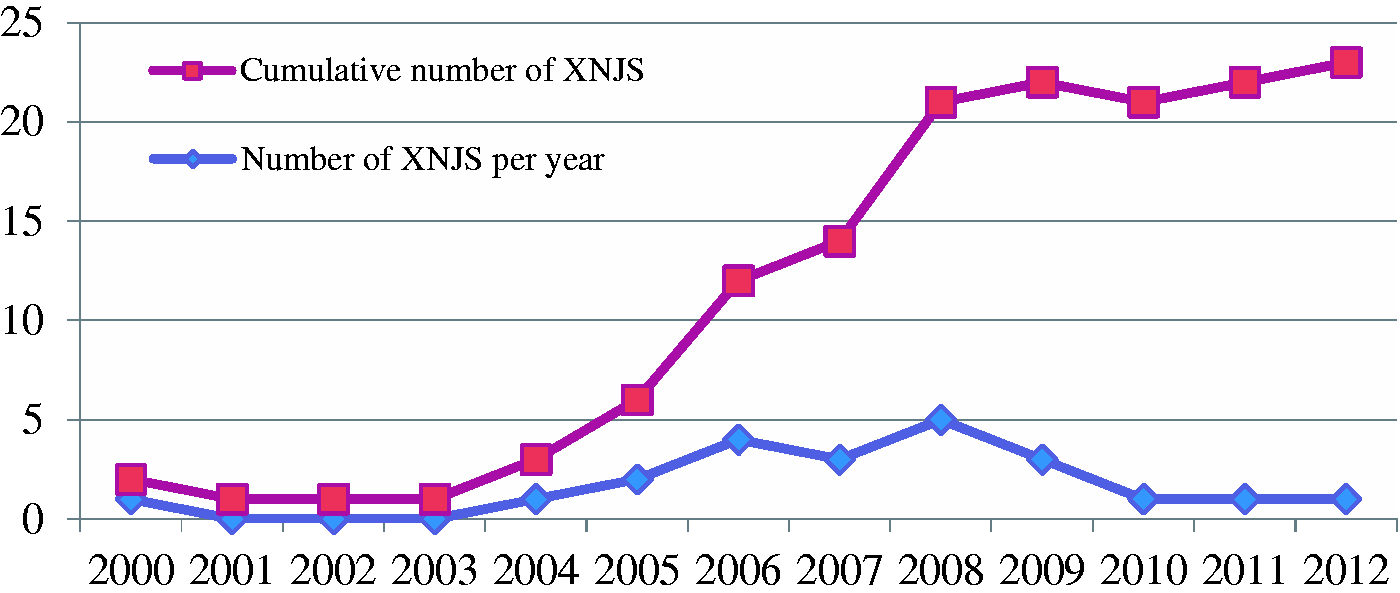
The nomenklatura system in mainland China
China is a party-state regime with five administrative tiers (central, provincial, municipal, county and township) and characterised by a hierarchical control-and-command chain. The CCP committee and its standing committees in all tiers are the de facto centre of authority, whereas the government operates as the administrative organ (Ma, 2013). The provincial tier is comprised of four municipalities (Beijing, Shanghai, Chongqing and Tianjin), five autonomous regions (Inner Mongolia, Ningxia, Tibet, Guangxi and Xinjiang), two special administrative regions (Hong Kong and Macau), and 23 provinces (including Taiwan). Nearly 3000 counties and municipal districts fall within the jurisdiction of more than 280 middle-ranking prefecture-level cities. The country's township governments are its lowest administrative level, in charge of villages and communities, which have a high degree of autonomy.
China's centralised authoritarian regime is characterised by a monopolistic personnel management mechanism, the nomenklatura (Burns, 1987, 1994; Chan, 2004; Kung and Chen, 2011), which originated in the former Soviet Union and other Eastern Bloc communist countries (Manion, 1985; Liang and Langbein, 2015). The Department of Organisation of the CCP established and institutionalised China's contemporary cadre management system in 1979 (Chow, 1988, Liang and Langbein, 2015). The term ‘nomenklatura’ means ‘a list of positions, arranged in order of seniority, including a description of the duties of each office’ (Manion, 1985). It generally refers to the lists of offices (zhiwu mingchengbiao) controlled by various party committees, that is, those offices over which the party committees have authority (Chan, 2004).
Under the Chinese nomenklatura system, cadre positions are divided into different ranks; members of the CCP Politburo have the highest ranking. The appointment, promotion, transfer or removal of any important party or state leader requires the approval of the party committee controlling the nomenklatura under which that leader's office is listed (Manion, 1985). Subordinate leading bureaucrats (i.e. party secretaries and government chiefs) are hierarchically accountable to the level of government immediately above, which exercises nomenklatura authority and makes personnel decisions about leadership positions (Edin, 2003; Liang and Langbein, 2015). Officials' personal performance records are used by their superiors to make decisions about appointments, transfer, removal, promotions, demotions and merit-based pay of bureaucrats, especially those in leadership positions (Liang and Langbein, 2015).
Political ambitions are the paramount motivations of individuals in the bureaucracy governed by the nomenklatura system in China, and career-oriented leading cadres desire to advance up the ladder of power and authority in the system (Liang and Langbein, 2015). It follows that the administrative behaviour of lower-tier bureaucrats who wish to advance will reflect the policy preferences of their hierarchical superiors making nomenklatura personnel decisions (Liang and Langbein, 2015). Burns (1989) has illustrated this clearly: In general, wealth, power and status in China go to those who can climb the ladder of official position. Because there is no real alternative to employment outside of the ‘mono-organisational’ cadre hierarchy, and because officials are almost completely dependent on their official sinecures for their livelihood, they need patrons at higher levels of the bureaucracy, particularly those who are well connected to party committees and core groups, to further their careers.
Hypotheses
Based on the Chinese nomenklatura system, hypotheses are therefore proposed from the perspectives of political promotion incentives and policy diffusion, respectively.
Political promotion incentives perspective
The effect of age on innovation diffusion is usually regarded as negative, as the cognitive resources needed to make decisions, such as learning, attribution and memory, decline with age (Bantel and Jackson, 1989) and younger managers are more adventurous (Hambrick and Mason, 1984; Huber et al., 1993). However, we argue that given the nature of political promotion in China, this may not be true in this system. Chinese provincial secretaries are generally more than 50 years old and 65 is the mandatory retirement age for top provincial leadership. 1 Age thus becomes important political capital, and differences in psycho-physiological competence (such as attribution, memory, etc.) appear to be smaller and less important. In fact, Li and Zhou (2005) found that older provincial secretaries are less likely to be promoted due to the disadvantage of their age. In addition to personal features, many other factors determine cadres’ promotion, especially performance (Li and Zhou, 2005). XNJS is a performance-based reform aimed at improving work efficiency, management effectiveness and social effects. Hence, we expect that older secretaries who are eager to increase their chances of promotion are more inclined to adopt performance-enhancing reforms during their limited career ‘life’, and thus the effect of the variable of relative age at the time of the next National Congress of the Communist Party of China (NCCCP) 2 will be significantly positive.
In addition, bureaucrats in different positions have different incentives under China's nomenklatura mechanism. Top-level bureaucrats, who are already at the pinnacle of power and authority, have little incentive to pursue actions that are tied to career prospects; the marginal rewards they received for political and economic achievement diminish and the time value of additional rewards is lower due to their greater age (Liang and Langbein, 2015). Research has found that lower-level, alternate members of the Central Committee of the CCP have much stronger incentives to pursue political radicalism than full members (full members have the second-highest political rank and Politburo members have the highest) (Kung and Chen, 2011). Provincial leaders who are Politburo members are expected to be less likely to adopt XNJS because they are at a higher level than those who are not.
The political environment is a key factor affecting government officials' desire to innovate, and the most important factor in the political environment is the election cycle (Berry and Berry, 1990), during which government officials generally have greater incentives to adopt innovative activities that have positive political effects (Kiewiet and McCubbins, 1985). Unlike the direct elections that take place in the US, local government officials in China are nominated by a higher level of government and appointed at the National People's Congress. It is thus crucial that they attract the attention of their superiors through their work (Chan, 2004). Ambitious officials are thus more likely to adopt XNJS, a performance-based reform programme, to improve government performance and impress their superiors in the years nearer to a general election.
Not only did cadres' differences in the position of authority lead to different estimates of political career prospects which can influence cadres' enthusiasm for pursuing policy agendas (Kung and Chen, 2011, Liang and Langbein, 2015), but leaders working in different provinces can also have distinct prospects of political promotion despite their similar positions. Under the Chinese nomenklatura system, the Politburo lies on the top (Burns, 1987, 1994; Chan, 2004; Kung and Chen, 2011). Though regional representation in the Central Committee of the CCP is becoming increasingly balanced, politicians from more powerful provinces such as Beijing and Shanghai are more likely to become Politburo members than those from other provinces (Liang and Langbein, 2015). Leaders with less chance of appointment to the Politburo may need to innovate more to increase their career prospects. Thus: H1: The relative age of a provincial secretary is negatively correlated with the adoption of XNJS. H2: A provincial secretary's position as a Politburo incumbent is negatively correlated with the adoption of XNJS. H3: Distance to the general election is negatively correlated with the adoption of XNJS. H4: Chance of appointment to the Politburo (political rank of provinces) is negatively correlated with the adoption of XNJS.
Policy diffusion perspective
Governmental interactions are an important focus of policy research (Berry and Berry, 1990, 2007). First, it suggests that there are strong and continuous interactions between governments at the same level, such as learning and competition (Berry and Berry, 2007; Christensen et al., 2008). Many studies in the US have shown that innovative activities of state governments and their departments will drive neighbouring states to adopt these activities (Berry, 1994; Berry and Berry, 1990; Mooney, 2001; Oakley, 2009; Rincke, 2007). Using these studies as a starting point, this study examines the effects of the interactions between adjacent provinces.
Furthermore, government units at a higher level can influence subordinate units in various direct ways, such as vertical mandates (Berry and Berry, 2007) and financial incentives for innovation adoption (Welch and Thompson, 1980). In addition, other more indirect signals may encourage innovation diffusion. For example, discussion and deliberation over a bill in Congress can influence policy adoption by state governments through information transfer (McCann et al., 2010), and a shift in national policy direction can send policy signals that drive policy diffusion (Kim, 2013). In the case of the XNJS reform, its sponsor, Xi, became a member of the Politburo standing committee of the CCP and was expected to be promoted to top leader of China in 2007. Figure 1 shows the marked increase in XNJS's adoption between 2007 and 2008, even though the State Council did not issue any mandatory documents or provide any incentive for its adoption. Xi's promotion may be considered a political signal under the Chinese nomenklatura system, and we argue that since 2007, provincial leaders have tended to advocate his innovation to enhance their own career prospects. 3
Some politicians have called on scholars to pay more attention to bottom-up diffusion (Shipan and Volden, 2006). In China's centralised system, successful innovation practices implemented by local governments are usually considered to be a type of ‘policy experiment’ that is then adopted by governments at a higher level (Lee and Warner, 2004; Xue and Zhong, 2012). In terms of the performance-based reform programme, Fujian province adopted this practice after the positive experience of Zhangzhou city. Therefore; H5: The number of adjacent provinces that have adopted XNJS is positively correlated with its adoption. H6: Xi Jinping being a member of the Politburo standing committee of the CCP is positively correlated with the adoption of XNJS. H7: The number of governed prefecture-level cities that have adopted XNJS is positively correlated with its adoption.
Methods
Data sources and measurements
Dependent variable
The data for the dependent variable are obtained from Internet searches for related government documents, meeting information and news reports. The keywords in the search are ‘Xiaoneng Jianshe’. This method has been used to measure the adoption of microblogging (Ma, 2013). Consistent with previous studies, a dichotomous (0 or 1) variable is used to measure the adoption of XNJS (Berry, 1994; Berry and Berry, 1990; Mintrom, 1997; Nicholson-Crotty, 2009). If a province adopts XNJS in the given year, the dependent variable takes the value of 1, and 0 otherwise. In this study, three criteria are used to determine whether a province has adopted XNJS. First, did the province publish XNJS regulatory documents in the given year? Second, did the province convene a meeting on the deployment of XNJS or hold an annual summary meeting? Third, are there any news reports about XNJS in that province in the study year? If the Internet searches for these three criteria yield no hits, the provinces are classified as not adopting XNJS in that year. If any of the criteria are met, the provinces are identified as adopting it. Given the dichotomous dependent variable, we use this method to avoid data collection bias to the greatest extent possible.
Independent variables
Relative age, Politburo incumbency, distance to the general election and chance of appointment to the Politburo are all coded according to provincial secretaries' archives or the Chinese political cycle. A leader's relative age is the difference between the year of the next NCCCP and the year of his birth as age in the year of the next general election is an important factor affecting a politician's promotion (A similar index was developed in Liang and Langbein, 2015) Politburo incumbency takes the value of 1 if the secretary concurrently has Politburo membership, and 0 otherwise. Distance to the general election is the difference between the year of the next NCCCP and the year under investigation; we measure it with this method because we expect cadres to have more incentives to adopt innovation in years nearer to the next NCCCP. Furthermore, we develop an index to estimate the historical likelihood of promotion to the Politburo for each province which is calculated using the Politburo membership representation from 1997 (the 15th NCCCP) to 2007 (the 17th NCCCP). For each NCCCP, one province gets one point for an incumbent Politburo member who worked or was working as the party secretary, governor or both. We measure this variable with the average score per NCCCP for each province. (A similar index was developed in Liang and Langbein, 2015). The score of the 15th NCCCP is used in the 2000–2002 period, that of the 15th to 16th NCCCP is used in the 2003–2007 period and that of the 15th to 17th NCCCP is used in the 2008–2012 period.
We use the number of neighbouring provinces that have adopted XNJS as a measure of the horizontal diffusion effect (Berry and Berry, 1990). In October 2007, Xi Jinping, the sponsor of this reform at the provincial level, was elected to the Politburo standing committee and was expected to be promoted to the top leadership position in China. To explore the effect of his promotion, we set an ordinal variable to measure the top-down diffusion effect. We expect the effect of this political signal to weaken over time as provincial leaders would adopt it as soon as possible to impress Xi in a timely manner. Hence, its value is set to 0 for the years before 2008, and to 5 for 2008, 4 for 2009, 3 for 2010, 2 for 2011 and 1 for 2012. Following Kim (2013), we also use a dichotomous variable, set to 1 for the years after 2007 and 0 for other years, in order to measure the top-down diffusion effect in case the empirical result is caused by our coding strategy. We use the number of governed prefecture-level cities that have adopted XNJS to measure the bottom-up diffusion effect.
Control variables
Description of variables, summary statistics and sources.

Sources: a Constructed by authors, mainly from online searches. b Constructed by authors, based on party secretaries' archives. c China Statistical Yearbooks of the National Bureau of Statistics of China.
Model specification
We use the standard approach for discrete-time EHA (Berry and Berry, 2007) to empirically examine the antecedents of the diffusion of XNJS. This approach divides time into equal discrete units using positive integer values (t1, t2, t3 …), and some independent individuals are observed from t1 to ti, at which point either the investigated event occurs or the observation is censored (Allison, 1982). The approach aims to model the conditional probability (hazard rate) that an individual will experience the event during an investigated time period, given that he or she has never experienced it before (Berry, 1994; Berry and Berry, 1990; Miao, 2015). Generally, the hazard rate is not directly observable and the observed dependent variable is dichotomous: a unit either experiences the event during the investigated period of time (taking the value of 1), or does not (taking the value of 0). The used data set is pooled cross-sectional time-series and composed of an observation for each unit for each time period when the unit is at risk of experiencing the event (Berry, 1994), for which the probit regression with maximum likelihood estimation techniques is suitable. In this work, the units are 31 provinces in mainland China (Hong Kong, Macau and Taiwan are excluded), the time periods are calendar years, and the event is the adoption of XNJS.
Specifically, the EHA model is as follows:

Results and discussion
Results of the probit regression analyses with the robust option.

Note: ***p < 0.01; **p < 0.05; *p < 0.1; N = 298.
Hypotheses H1–H4 examine the effects of political promotion incentives on the adoption of the reform programme. In models 3 and 5, the relative age of leaders is significantly positively correlated with the adoption of XNJS, which supports hypothesis H1. The effects of a leader's relative age are related to the nomenklatura system, in which older provincial secretaries are under greater pressure to get promotions. Disadvantaged leaders urgently need to adopt innovations to improve their career prospects. Our particular age variable is based on a different functional logic than that in previous studies (Damanpour and Schneider, 2006), which assumed that accumulated professional experience is a more important factor than career ambitions. Hypothesis H3 is also supported as distance to the general election is significantly negatively correlated with the adoption of XNJS, meaning that innovation diffusion is affected by the political cycle. As the NCCCP approaches, leaders have more incentives to adopt innovations to increase their chances of promotion. Likelihood of being promoted to the Politburo is significantly negatively correlated with the adoption of XNJS, supporting H4. Ambitious cadres with lower levels of power and reputation or from provinces with less representation on the Politburo must devote more effort to attracting their superiors' attention. Hypothesis H2 is rejected because the negative correlation between Politburo incumbency and its adoption is non-significant in models 3 and 5. Although no significant correlation is found between Politburo incumbency and the adoption of XNJS, the direction is always negative, which suggests that its effect needs to be explored further.
Hypotheses H5, H6 and H7 examine three diffusion mechanisms predicted by theories of policy diffusion. Top-down intergovernmental interaction, as measured by our ordinal variable, is significantly positively correlated with the dependent variable at the 10% or 5% level in models 2 and 3, fully supporting hypothesis H5. When we measure it with the second method in models 4 and 5, top-down intergovernmental interaction is still positively correlated with the adoption of reforms, proving that this effect is stable. The horizontal diffusion effect and bottom-up diffusion effect are not significantly correlated with the dependent variable (models 2, 3, 4 and 5), so hypotheses H6 and H7 are rejected. This suggests that governmental top-down interaction plays a more important role than horizontal interaction in China's centralised regime. The observation that in China, the status of the innovation sponsor is positively related to the adoption of XNJS represents a significant contribution to current innovation diffusion research. In China's authoritarian party-state regime, the top leader is the most powerful and influential individual. The 17th NCCCP established the promising core position of the sponsor of XNJS, Xi, in the next generation of Chinese leaders. In this situation, provincial leaders tend to promote Xi's reforms. This is inconsistent with the results of innovation diffusion research conducted in Western countries, which show that horizontal regional effects, measured as the number of adjacent provinces that have adopted the innovation, do not significantly affect diffusion (Berry and Berry, 1990; Gray, 1994; Mooney, 2001). These differences may be due to the effects of vertical diffusion in China. We do not find evidence that bottom-up diffusion drives the spread of XNJS. Although previous studies have identified the importance of Chinese ‘policy experiments’ at the local government level (Lee and Warner, 2004), they may only play an important role in the early stages of innovations, rather than throughout the process of innovation diffusion.
Conclusions
Over the past decade, the performance-based reform programme XNJS has spread rapidly at the provincial level of government in China and the belief that performance-based reform can improve the efficiency and effectiveness of public services has led to the introduction of many new issues and research agendas. Among these emerging issues, one relatively unexplored topic is the determinants of the adoption of performance-based reform programmes. What factors drive its diffusion in the centralised Chinese political system, which does not have a federal structure? As our literature review demonstrates, most prior studies of innovation diffusion are based on data collected in Western democratic societies rather than in countries with centralised governments (Berry, 1994; Berry and Berry, 1990; Damanpour and Schneider, 2006; McCann et al., 2010; Mooney, 2001); in such cases, innovation diffusion may not be connected to well-established centralised political institutions. This study addresses these missing gaps in our understanding of innovation diffusion in non-Western contexts.
First, we find that in China, the diffusion of performance-based reform programmes is affected by the political promotion incentives that characterise the Chinese nomenklatura system. Political promotion incentives are shaped by a leader's relative age, current position and chance of appointment to the Politburo. Leaders of older age, in lower-ranked positions and who work in less powerful provinces have limited opportunities for promotion (Li and Zhou, 2005). However, a performance-based reform programme, as an innovation expected to improve government performance, can allow them to improve government performance or impress central leaders and thus improve their career prospects. Previous innovation diffusion research has conceptualised government organisations as the ‘actors’ in policy adoption and have not examined how individual leaders make decisions about policy innovation. By highlighting the role of political promotion incentives, this study contributes to the current literature and confirms the view that innovation adoption is, to some extent, a reflection of top leaders’ political career prospects.
Second, we find that innovation diffusion is related to the political cycle. Provinces are likelier to adopt a reform in years nearer to the next general election, suggesting that local leaders in China have the incentive and capacity to manipulate government behaviours at crucial points during their tenure in order to improve their prospects of political advancement. Unlike Western officials in a democracy, Chinese officials are seen as catering to superiors rather than to the public. Additionally, the relationship between the political cycle and innovation diffusion varies with different kinds of innovation. As Berry and Berry (1990) have noted, new taxes are most likely to be enacted in a year immediately following elections and least likely to be adopted in election years as such an action gives the public the maximum amount of time to forget the government's unpopular action before the next election. However, our results suggest that performance-based reform is likelier to be adopted in years before the next election because it is aimed at improving government performance and is welcomed by both top leaders and the public.
Third, we find a new top-down diffusion mechanism driving innovation diffusion in China: the potential influence of political transition signals. In previous research, vertical mandates or coercion – ‘hard’ top-down mechanisms – were found to be important factors in the diffusion of innovation policy and practice (Berry and Berry, 2007; Dobbin et al., 2007). In recent years, researchers have begun to examine ‘soft’ top-down mechanisms. For example, studies have examined how discussion and deliberation over a bill in Congress can influence policy adoption by state governments through information transfer (McCann et al., 2010), and a shift in national policy direction can send policy signals that drive policy diffusion (Kim, 2013). However, this study shows that the political promotion of an innovation's sponsor as a political leader can drive its diffusion. This is a ‘soft’ top-down diffusion mechanism that works through sending political transition signals.
Our results have important implications. They reveal the strong effect of political promotion incentives on policy leaders' decisions to adopt an innovation, especially in the Chinese nomenklatura personnel management system. They also suggest that future research on innovation diffusion should be nested in particular institutional contexts. Furthermore, although the effects of horizontal diffusion have been the focus of studies of Western federal countries, top-down diffusion plays a more significant role in China. Thus, future studies must give more consideration to top-down interactions, especially in centralised countries. Our results show that officials are expected to adopt innovations to improve their government's performance or to cater to their superiors. In both democratic and centralised systems, government officials can manipulate their behaviours to increases their popularity among those to whom they are accountable. This can mean adopting a popular innovation or rejecting an unpopular innovation at a crucial time.
Finally, this assessment of the province-wide adoption of a performance-based reform programme provides the first step in understanding government performance management behaviour. Although the adoption of reforms is a necessary precondition of improved performance, it does not necessarily guarantee concrete performance improvement. How these reforms are actually used to guide changes in government behaviours and their effect in improving government performance needs to be investigated. In addition, it also has some measurement and data source limitations. The dependent variable is a simple binary variable as it is difficult to collect data about the extent to which individual provinces implemented XNJS in a given year. However, using previous studies of the US government reinvention movement (Moon and deLeon, 2001) as a reference, future studies can develop a scale to measure the key components and explore its antecedents with cross-sectional data. Another limitation may be that some of the independent variables are binary or counting variables coded according to objective archives. Although this method has been used in some studies (Berry, 1994; Berry and Berry, 1990; Ma, 2013), the results must be interpreted with caution and more robust evidence based on survey data should be examined in the future.
Footnotes
Acknowledgements
We are grateful to Chunping Hu, Li He, two anonymous reviewers and the editor of International Review of Administrative Sciences, who gave invaluable comments and suggestions on earlier versions of the article.
Funding
This work was supported by the National Natural Science Foundation of China (grant numbers 71173167, 71103140) and the Ministry of Education in China (grant number 13JZD015).