







Abstract
This article aims to explore the story of the front-line implementation of US welfare reform through analyzing the experiences of front-line workers with a grounded theory approach. There were deep concerns about the working poor and unelaborated programs for economic independence, which were attributable to the legislation’s thrust to work-first and a skill mismatch, without taking the quality of jobs into account. Welfare roll reduction resulted in taking a generous approach to welfare clients on the front lines. Although discretion resulted in the operation of more local initiatives on the front lines, it was not a substantial response to the demands of the real lives of clients. This article argues that the quality and sustainability of work is critical, prior to an emphasis on work-first. Front-line implementation must shift to increasing employers’ willingness to create incentives for skill-building and to giving clients some motivation to work.
Points for practitioners
A gap between policymaking and nonlinear policy implementation on the front lines is inevitable as local demands vary. Particularly, perspectives of front-line implementers are useful in reflecting various local demands and adjusting the different interests of clients in the process of refining welfare reform in lieu of federal policymakers. Although the discretion of front-line implementers is critical, less attention has been paid to how they put welfare reform into practice and what they learned. Qualitative exploration of such issues thus provides field-based evidence to improve its implementation to help the clients, which has rarely been examined in the literature.
Introduction
The US welfare reform of 1996, which recasts an entitlement program, ‘Aid to Families with Dependent Children’ (AFDC) as a block grant system, ‘Temporary Assistance for Needy Families’ (TANF), added a new directive to reduce dependence on public assistance (Gottschalk, 2005; Mead, 2007). The directive included a time limit on the receipt of benefits and work requirements to promote employment and changes in personal behavior to discourage welfare dependency (Riccucci et al., 2004). Welfare reform also pursued improved economic self-sufficiency for welfare recipients and enhanced parental responsibility to strengthen families through work (Jennings and Ewalt, 2004). Thus, it changed the focus of welfare from an entitlement program to a work-first approach that underlined the importance of economic self-sufficiency.
Since its first reauthorization in 2002, however, the policy priority in many states has moved from placing TANF clients into work to helping them retain jobs. Also, the American Recovery and Reinvestment Act of 2009 established an emergency contingency fund for state TANF programs and expanded states’ flexibility in the use of TANF funds carried over from one fiscal year to the next (US Department of Health and Human Services, 2009). 1 This effort was intended to give more financial resources to states to support families during an economic downturn period. These legislative efforts have caused front-line implementers to invest more time and resources in job preparation, training, and education programs designed to help the clients get more advanced job skills and increase intellectual capabilities for job retention (Riccucci, 2005).
However, despite a plethora of research on its implementation, few studies have taken up the questions of how welfare reform has affected the front lines of service delivery and what front-line implementers have experienced from local practices. Moreover, there has been little reliable information on what has happened to people on welfare and people who left welfare to better help them make a transition to work and support their families.
As welfare reform involves moving the TANF clients into stable local jobs, the experiences and perspectives of front-line implementers are suitable for hearing a real story about local practices from both programmatic and administrative standpoints (Maynard-Moody and Musheno, 2000; Riccucci, 2005). In particular, a careful examination of their views shows the importance of administrative discretion in the achievement of policy goals (Meyers et al., 1998; Riccucci, 2005; Riccucci et al., 2004; Sandfort, 2000). It would be useful to develop more elaborate programs or to improve the implementation of local programs, in particular, job training and employment programs for those on the welfare rolls or leaving welfare.
This article explores the questions of how welfare reform has proceeded on the front lines of service delivery and what the challenges are. To explore such questions, this article begins with a brief discussion about welfare reform and front-line implementation, which partially includes the issue of the TANF clients’ employment on the front lines. 2 It then reviews the grounded theory approach, a qualitative research framework, to draw conclusions via inductive reasoning with the experiences of front-line implementers. The state of Pennsylvania was selected because it has offered diverse policy contexts and experiences with the front-line implementation of welfare-to-work programs under a state-administered system since 1987, in which less devolution occurred. Based on its proximity to state agencies and the administrative load of past welfare recipients, ‘A’ county was selected to examine, in detail, how the TANF programs have been implemented on the front lines. While this selection does not claim to represent all states, as an explorative study, it offers a wide range of perspectives from the front lines. 3 To gain qualitative data, using theoretical sampling, this study interviewed front-line workers who have worked for the TANF clients’ transition to the workforce. 4
Welfare reform implementation: the front lines
Unlike entitlement programs, the 1996 welfare reform was seen as an unprecedented comprehensive policy reform that emphasized the values of work in ways that changed the behavior of individuals and their motivation to work. A programmatic change through TANF includes five-year time-limited benefits and work requirements imposed for receiving benefits for the first 24 months in which TANF clients must participate in work or work-related activities, such as skill-building activities (Mead, 2007). Welfare reform legislation thus prohibits states from using their block grants to provide benefits for adults who do not work after receiving benefits for the first 24 months or who have reached their lifetime limit (Jennings and Ewalt, 2004).
In fact, welfare reform has become a complex and varying experiment by state and local administrations to translate TANF’s goals into operation. Before TANF, federal AFDC regulations required state welfare agencies to have as their highest priority minimizing eligibility errors and issuing benefits on a timely basis. Welfare reform, however, has given substantial leeway to states to make their own spending decisions to help welfare recipients leave welfare (Meyer et al., 2007). With the flexibility, states can provide assistance to needy families, ensuring that their families are cared for, and reduce the dependence of needy parents on benefits by promoting a transition to employment and job-readiness (Riccucci et al., 2004). This administrative change is considered to be a shift in the dominant political mood in US society to reduce welfare rolls. In fact, welfare reform, remarkably, has increased the willingness of state and federal governments to decrease welfare rolls by levying work requirements (Bartik, 1998). This is why Mead (2007) asserted that welfare reform was a success for the federal government, but the political mood and states’ choices made the effects of welfare reform on future labor markets harder to predict because it resulted in an increased labor supply.
Likewise, welfare reform has taken up not only the question of whether it simply reduced welfare rolls, but also the question of whether it inspired low-income adults to seek greater financial security through ongoing investment in the development of new work skills on the front lines. Much research has examined the effects of the front-line practices on the clients, in particular, paying more attention to changes in the labor market-related characteristics of the clients, such as jobs or wage levels. Prior studies have taken account of a ‘displacement effect’, in which the large inflow of new entrants into the low-wage labor market could also reduce their wage levels in the long run (Bartik, 1998; Matsudaira and Blank, 2014). Thus, TANF clients entering the workforce are likely to compete for low-skill jobs with other job-seekers who have similar characteristics. Thus, as many clients leave welfare to work, the question of whether both good and enough jobs will be available remains.
Additionally, on average, their low levels of skills and education, and lack of recent work experience, provide little opportunity for forward movement in the labor market. In particular, skills mismatch is a serious difficulty for many disadvantaged workers leaving welfare (Gottschalk, 2005; Mead, 2007). Moreover, although TANF clients have been employed, they commonly showed a high job turnover rate in the labor market because supportive services such as childcare or transportation were hardly available to them, which later became barriers to job retention (Cancian and Meyer, 2004; Meyer et al., 2007). More importantly, the purchasing power of TANF cash assistance benefits has continued to decrease since 1996, after adjusting for inflation (Floyd and Schott, 2013: 1). Thus, policymakers and front-line workers do not have sufficient policy choices to provide family incomes sufficient to exceed the poverty line and to help needy families overcome poverty.
Despite the programmatic and administrative changes, it seems that there is no evidence yet that welfare reform has substantially improved the real lives of the clients. Moreover, the studies have not shown any dominant empirical evidence that discretion on the front lines contributed to a positive welfare program outcome, such as welfare roll reduction or employment of the clients at above minimum wage. Rather, it has moved the welfare poor to work and, for this, Mead (2007) asserts that what are needed are more elaborate policies that reduce the welfare poor’s financial strain and psychological distress.
Front-line implementation
Although a plethora of research on implementation addresses variables that affect successful implementation, it does not provide a concrete theoretical model for front-line implementation (Giacchino and Kakabadse, 2003; Mazmanian and Sabatier, 1989). For example, Mazmanian and Sabatier (1989) present a conceptual framework of the implementation process that consists of three categories of variables, such as the tractability of the problem and statutory and non-statutory variables. Likewise, other studies do not address a framework for front-line implementation, but explain two critical factors that affect policy outcomes: management practices, such as patterns of practice, supervision of performance, commitment, or goal congruence; and discretion.
First, as a ‘bottom-up’ approach, front-line implementation helps to explain the extent to which the implemented policy or delivered services reflect the intention of policymakers. However, front-line implementers, such as street-level bureaucrats, work with insufficient resources, increasing demand for services, goal ambiguity, and difficulty in goal achievement (Lipsky, 1980). Lipsky (1980) argues that to respond to this uncertainty, they tend to limit demand, maximize the utilization of resources, and modify their jobs to restrict their objectives, ultimately leading to their patterns of practice. Likewise, front-line implementers have difficulty in aligning policy goals with their routine objectives and feel the goals to be ambiguous because the goals have been added on to the traditional goals of welfare agencies (Lee, 2014; Riccucci et al., 2004). Moreover, Sandfort (2000) concludes that the collective beliefs of front-line implementers, such as norms or shared knowledge, have a more powerful influence on front-line practice than performance-based management or directives. Thus, a strategy for effective implementation will work only when there is minimal goal conflict between the front lines and policymakers; otherwise, it would result in the low commitment of the front lines (Mazmanian and Sabatier, 1989).
Another stream of literature discusses the discretionary power of the front-line implementers because the views of street-level bureaucrats and service providers about social justice affect policy implementation and its outcomes significantly. As Lipsky (1980) demonstrated, the ways in which street-level bureaucrats deliver benefits have considerable impact on people’s lives, with a good deal of discretion. There have been, however, debates on the relationship between increasing discretion in local administration or the front lines of welfare services and program performance. For example, the centralization of authority and increased levels of coordination in the provision of employment and training services for welfare recipients have the greatest influence on positive program outcomes (Jennings, 1994). In contrast, Riccucci (2005: 102) reported that discretion is an important determinant in TANF implementation and the reference point of discretion is the client. Similarly, along with empowerment, the experiences of local program professionals facilitate the effective implementation of welfare reform (Maynard-Moody and Musheno, 2000).
Welfare reform in Pennsylvania
In response to the federal legislation, Pennsylvania’s TANF legislation set out to address new challenges to the state’s public assistance program, entitled the ‘Road to Economic Self-sufficiency through Employment and Training’ (RESET), effective on 3 March 1997 (DPW, 2011). The legislation put great emphasis on a work-focused approach that can establish a work history, with increasing wages and benefits that lead, over time, to economic independence. To this end, all persons receiving TANF benefits on or after 3 March 1997 are subject to the same five-year lifetime limit and all work requirements. During the first 24 months of cash assistance, as an initial activity, individuals must conduct a job search for a minimum of eight weeks or until they are employed, whichever occurs first (DPW, 2011). At the end of eight weeks, if the recipient does not find employment, the individual is required to participate in additional work-related activities, which may include additional job searches (DPW, 2004). 5 After the first 24 months, the individual must be working or participating in one or more allowable work activities such as subsidized employment, on-the-job training, community service or workfare other than job searching or education, or training for at least an average of 20 hours per week (DPW, 2004).
Pennsylvania has run another statewide program designed to help welfare recipients move into the workforce without barriers, ‘Single Point of Contact’ (SPOC), since 1987, with state and local money, which provides all employment-relevant services at one site (DPW, 2004). It is closely associated with the operation of RESET because mandatory clients after the first 24 months of cash assistance can enroll in the allowable activities offered by SPOC for an average of 20 hours per week to carry out their work requirements (DPW, 2011). Thus, at a glance, Pennsylvania is seen as relatively liberal due to building such a safety net for mandatory clients.
The implementation depends primarily on a state-administered system, 6 where the state government administers the TANF program in 67 counties directly through the County Assistance Offices, a state agency, without giving discretion to counties as they did under the old AFDC (DPW, 2011). Due to the statewide system, each county receives only the number of clients that they have to serve without implementing any independent program.
Research methods
Grounded theory and qualitative study
The centerpieces for qualitative research are diversity of interpretations and better understanding of the context of a phenomenon where social interactions and processes occur. As a qualitative analysis method, grounded theory seeks to develop a substantive-level theory that describes an analytical schema of the phenomenon (Creswell, 1998: 56). However, it needs further empirical testing with more cases to become a formal or general theory because variables, relationships, and contexts come from field-oriented data (Glaser, 2007). Thus, grounded theory provides other empirical studies with a basis of logic to build a formal theory with higher generality.
To develop categories of information from qualitative data and explore how people react to the phenomenon, it provides a systematic coding procedure that includes open, axial, and selective coding (Strauss, 1999: 27). Coding is an essential process of abbreviation of a large set of qualitative data and extraction of categories of information. First, open coding opens up the inquiry by carefully examining and segmenting the text, and develops initial categories of information about the phenomenon (Strauss, 1999: 29). It takes a process of reducing a long text to a small set of categories until the information gained presents no further implications. Once initial categories are developed and saturated, axial coding identifies a single category that explains a central phenomenon and explores causal conditions and interrelationships between categories. It reports the cumulative knowledge about relationships between categories. In the selective coding phase, we delimit coding to the codes closely related to the core codes (Strauss, 1999: 33). Based on the core codes, we end with building a story that connects and integrates the categories in a form of a discursive set of theoretical propositions (Creswell, 1998: 57).
However, the logic between phenomenon and consequences is not always clear because relationships between categories derived from coding are very implicit (Strauss and Corbin, 1998: 128). For this, an organizational, analytic scheme – a ‘paradigm’ – can be used to organize the linkages between categories and identify contextual relationships (Strauss and Corbin, 1998: 127–142). Thus, this study uses the paradigm because it helps researchers explore interrelationships of categories by identifying what components are, such as phenomena, conditions, actions or interactions, and outcomes, and how such components are interconnected with other components in a sequential way. Strauss and Corbin (1998) explain that a phenomenon looks for repeated patterns of events or interactions that represent the thoughts of people answering the question of what is happening here, and conditions refer to a context that creates the issues and relates to the phenomenon in causal, intervening, and contextual ways. Actions or interactions explain how people respond to the situations or events and the final thoughts or behavior of people result in outcomes.
Qualitative data
Grounded theory studies consider a theoretical sampling that emphasizes the ability of individuals who contribute to the development of a theory (Creswell, 1998: 118). Thus, this study begins with selecting a homogeneous sample of individuals and then a heterogeneous sample. Thus, the first two interviewees were selected from county government because they had more than 20 years of work experience at the local level and a broad network on welfare reform. Based on their references and a snowball strategy, 13 interviewees as a heterogeneous sample were selected from various front-line agencies because their references, which were double-checked to avoid sampling bias, were best suited to select people. In sum, the 15 interviewees consisted of: three from a local branch of the state government; six from the county government; two from the city government; and four from community-based non-profit service providers. They have all been responsible for the delivery of TANF benefits, as well as the former entitlement program, and case management.
I conducted semi-structured interviews with these 15 front-line workers to collect qualitative data from 2005 to 2007 at the interviewees’ workplaces for about 90 minutes. All interviewees were asked the same set of questions to gain information on descriptive subjects, followed by several open-ended questions to better explore in-depth information. At the beginning of the interviews, confidentiality and anonymity were carefully mentioned to protect the informants’ rights. All interviewees appeared to be in their early 40 s to late 50 s and some confirmed their ages or work years, and, interestingly, some spoke off the record about more details of front-line implementation. During the interviews, I did not interrupt their answers but rather played a neutral role to hear more stories. This strategy was intended to make up for the limits of structured interviewing, such as capturing precise data of a codable nature within pre-established categories (Denzin and Lincoln, 1998).
As Strauss and Corbin (1998: 58) asserted, this study used a comparative method and microscopic examination during data analysis, in which all data were compared in detail, line-by-line, to new contexts from the field in a way that revised them with new information via second visits or emails until 2011. Thus, each interviewee could have a chance to review what they had thought and experienced in new contexts. This process helped categories of information become fully saturated, and the study build a better, elaborate theory from the qualitative data, with more reliability.
Results of data coding
Results of open coding and the categorization of concepts.

Axial coding explores causal conditions and the interrelationship of categories. In Strauss and Corbin’s (1998) paradigm, shown in Figure 1, the contextual relationships of categories that consist of the phenomenon, conditions, actions or interactions, and outcome could be identified by answering questions, such as why, where, when, how, and with what results. To identify these relationships, analysts must ‘relate a category to its subcategories through statements denoting how they are related to each other’ and find cues in the data, such as ‘since’, ‘when’, and ‘because’, that denote how major categories might relate to each other (Strauss and Corbin, 1998: 126).
Components of paradigm.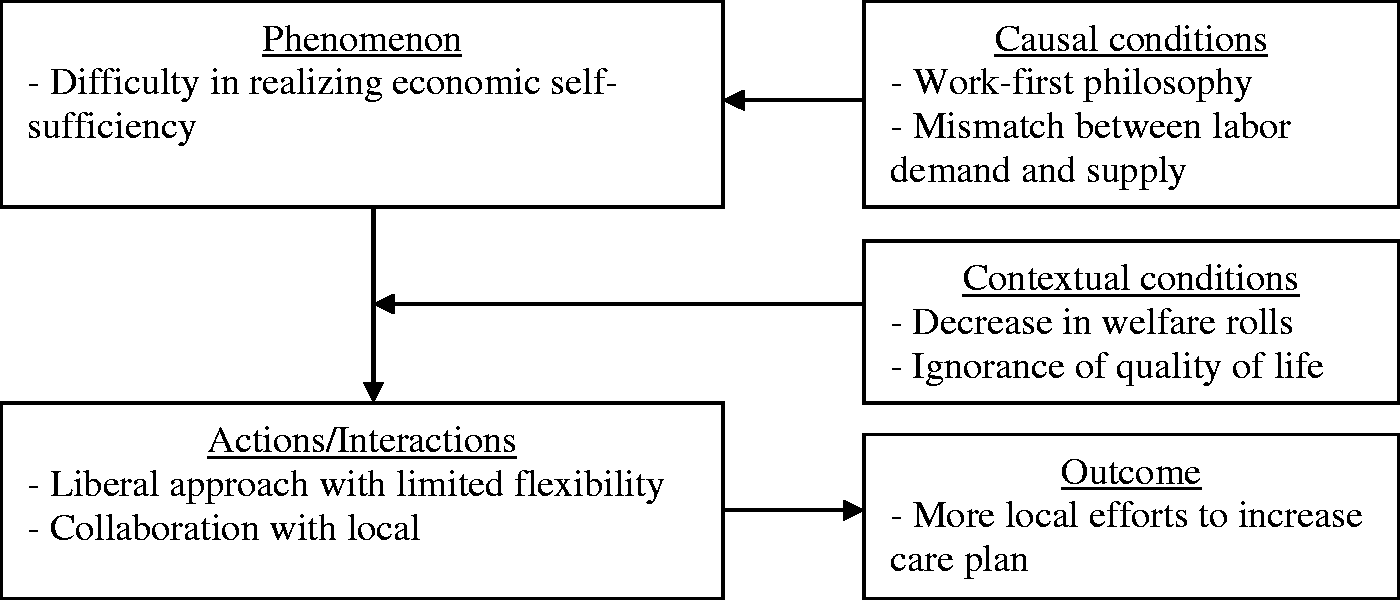
Briefly, the paradigm represents that through the work-first approach of legislation and the significant mismatch between clients and employers, people leaving welfare moved to the workforce, but many became working poor. Additionally, welfare roll reductions and less administrative effort in the real lives of their clients gave front-line workers fewer cases to deal with, and, thus, gave an opportunity for a tolerant approach. In response, they have taken a proactive and generous approach to the clients, such as giving extended time limits, and have increased direct collaboration with local agencies, which resulted in an increase in universal benefits and care plans for job retention given to the clients, albeit insufficiently.
Front-line implementation of Pennsylvania’s welfare reform
Gap between realities of TANF clients and rhetoric of legislation
Although welfare reform sought a comprehensive approach to put TANF clients rapidly into the workforce, front-line workers asserted that the legislation failed to answer the question of how the clients could find better-paying jobs and retain their jobs in a tight labor market. It also did not answer the question of how the realities of the lives of the people leaving welfare could be improved. As they recognized, without taking job-readiness and the quality of employment into account, the rapid attachment of people on welfare to the workforce, by legislation, caused them to still live in poverty and have difficulties in realizing economic independency (Cancian and Meyer, 2004). A typical mismatch between labor demand and supply was the biggest barrier to employment (Gottschalk, 2005), and along with the legislation, this caused the phenomenon of little change in the real lives of people leaving welfare: The rapid attachment to the labor market did not allow for a philosophy that included job training, education programs, and similar things, to better prepare people for the workforce. It just says ‘go work’. It does not care about what kind of job you’re getting. (Interview with a county welfare worker)
Front-line workers explained this phenomenon through two aspects: change in the number of working poor and local supportive services. First, the number of working poor has increased due to the excessive emphasis on work as an individual responsibility instead of a structural problem. Under welfare reform, less federal and state programmatic consideration was given to the quality of jobs, notwithstanding the intention of the law to decrease the poor (Riccucci et al., 2004). Likewise, they were also concerned with the disincentive of work, in which the more they work, the more they earn, and the more benefits from state and local governments they correspondingly lose. This might result in an increasing number of working poor on the front lines.
A more important problem lies in the fact that there were no local ancillary supportive services on the front lines in Pennsylvania to help people find and retain jobs, such as child support for women with dependent children, transportation to work, and health care. Although there had been a tailored statewide SPOC program operating at the local level in which all employment-relevant services could be integrated (DPW, 2004), it did not provide a wider range of supportive services to better respond to the demands for developing skills and education. A lack of supportive services in local employment from both government and employers caused considerable difficulties in maintaining jobs (Cancian and Meyer, 2004), as well as in advancing to higher-wage jobs, which failed to accord with the expectations of policymakers. Thus, the clients were more likely to get low-wage jobs, typically without such services, from employers in Pennsylvania. In particular, as front-line workers stated, putting single mothers on welfare to work might seriously jeopardize their children due to the lack of substantive child support during the workday, which might give rise to a matter of inheritance of poverty from mothers to children: It was about getting rid of people off the welfare rolls and making things punitive. If we would have been more about careers, opportunities, and self-sufficiency rather than about jobs, then we would it done better. (Interview with a county welfare officer) When you take people who do not have the skills demanded in today’s marketplace, inevitably, you need to start out at low-end jobs and most of us concede it because we all start out that way. That’s different when I have two or three little ones depending on me to pay rent, to buy decent food, for their medical care. They tend to be un-benefitted, no health care, no pension, retirement, etc. (Interview with a non-profit service provider)
Welfare roll reduction and ignorance of the quality of life
Front-line workers also pointed out that policymakers had been more interested in goal-oriented numbers, such as welfare caseload, which explains how many people on welfare get a job, than changes in the real lives of TANF clients and people leaving welfare. Mead (2007) argues that the welfare roll was drastically reduced by around 60% from 1994 to 2001 and around 71% of families leaving welfare worked or participated in work-related activities, such as on-the-job training. This is manifestly ascribed to not only the impetus of the legislation with the time-limited benefits, but also a fortunate, prompt match with economic growth that started in the early 1990s, which provided more job opportunities generally (Bartik, 1998). Furthermore, front-line workers pointed out that the reduction can also be induced by a passive attitude of state government in dealing with new cases. From a political perspective, states have been unwilling to open new cases in order to keep a federal mandate in which states must move at least 50% of their cases into the workforce by 2002, on pain of substantial block grant cuts and their maintenance-of-effort funds to compensate for the grant cuts (Mead, 2007). Thus, the state government was more likely to make the operating rules of public assistance programs that include eligibility assessments and cash benefit determinations more stringent to avoid an increase in the number of cases. This change in the state administration finally results in fewer people applying for the program, even though those people would have been eligible to receive public assistance. As Bartik (1998) argues, it becomes an entry barrier for eligible low-income people to access the public assistance program: ‘I believe sometimes bureaucratic tendencies just look at these goal-oriented numbers and do not look at the lives of people who are being affected. I don’t think public policy has given that much attention at all’ (Interview with a state welfare officer).
As front-line workers mentioned, welfare roll reduction gave states an opportunity to save on cash assistance and the latitude to create necessary services with a budget surplus (Riccucci, 2005; Sandfort, 2000). Relatively less effort, however, was applied at the front lines in tracing changes in the quality of individuals’ lives than to such number-oriented approaches, even though some still lived in poverty without sufficient income to sustain their families or appropriate skills to work, and some were even eager to return to welfare (Cancian and Meyer, 2004). Due to the powerful impetus of the legislation, which includes stringent administrative sanctions, as a front-line worker mentioned, policymakers in the federal and state administration put too much emphasis on personal responsibility to work over types of jobs and job preparation, which is vital to ensure that work is the only effective way to escape from poverty: No one knows what happened to the people who left welfare. No one knows whether they are living in a shelter and on the street or not. No one takes care of the quality of their lives. (Interview with a county welfare officer) I would call it an opportunity. With this surplus, the state and local administrations have an opportunity to begin to do some creative things around developing support for people, so that they can maintain the jobs now that they have them. (Interview with a city welfare worker)
Meanwhile, a lack of universal benefit and more elaborate training and education for better skill-building failed to alleviate the mismatch between skills and the demands for decent jobs. However, Meyer, Cancian, and Nam (2007) point out that since the first reauthorization of the legislation in 2002, state agencies started turning to issues of job training, job advancement, education, transportation support, and child support with the surplus. Thus, front-line workers were more likely to establish a plan to allow people leaving welfare to continually upgrade their skills to meet employers’ demands and to increase wages in an effort to guarantee income to meet the needs of families, which resulted in variations in states’ experiments (Riccucci, 2005). As mentioned later, this change was ascribed to a willingness of state and local governments to use an opportunity to enhance human resources for sustainable self-sufficiency: I think, from a public perspective, the change was a willingness to support people in state and local activities that support their work as long as they’re working. So we had a perception change about providing related things to people who were once welfare recipients. (Interview with a county welfare officer)
Local efforts with limited discretion
Welfare roll reduction and less effort to take care of the real lives of the clients gave rise to a change in discretion on the front lines and collaborations contextually. Interestingly, there was debate about two aspects of discretion from the interviews: the discretion of the state and discretion on the front lines. First, front-line workers did not regard the shift in discretion from the federal level to the state as real devolution that enabled the state to exercise its responsibilities without penalties. It built on strict federal regulations, such as work participation rates in order to qualify to receive block grants, and sanctions. Nevertheless, as DPW (2004) states, state welfare officers took a generous approach to TANF clients in which an extended time limit was given to the clients who failed to find employment in the first 24 months of cash assistance through the SPOC program with state and local money.
With respect to discretion on the front lines, the state maintained a state-dominated administration in which the state controlled the local expenditures in Pennsylvania, so that the state did not give much leeway to the front lines of service delivery (Floyd and Schott, 2013). Similar to the administration of AFDC, the same programs and basic rules were applied to each county, which resulted in little variation in front-line programs despite dealing with target groups with different interests (DPW, 2011). The state’s uniform actions may be explained by welfare roll reductions, so state welfare officers had fewer cases to deal with, which gave them an opportunity to take a more liberal approach to the clients. It also induced them to operate uniform programs at the local level, even though the demands of the clients varied. Simultaneously, it misled them into having an optimistic standpoint about welfare reform that resulted in a lack of administrative interests in people leaving welfare and the quality of their lives. However, as DPW (2004) states, to better respond to varying local demands, state welfare officers were determined to increase direct collaborations with local welfare agencies and service providers on the front lines, which resulted in a simultaneous and collaborative utilization of various resources, instead of reducing the state’s control or granting more discretion to the front lines. In contrast, county welfare officers recognized that the reform had failed to reflect a wider range of local demands for different local programs. What is needed, therefore, is more devolution to enable county and municipal governments to adopt their own programs to reflect various local demands for job preparation and different demographic and labor market conditions: It depends on who’s in charge at the state level. Some of the positive changes from our perspective that make it more friendly towards clients have occurred because we have increasing collaborations and partnerships at the local level. (Interview with a state welfare officer) That wasn’t as much devolution as we hoped for. It has been a bit more flexible in using some of the block grants, but there still has been not nearly the level of independence. (Interview with a county welfare officer)
Now, front-line workers recognize that changes in policy environments, such as a surplus in the state treasury and the importance of the real lives of people leaving welfare, gave them an opportunity to enhance human resources, in particular, women and children, by developing more supportive services to get living wages and retain jobs, and having caseworkers keep track of the clients. They put more local efforts directly into increasing universal benefits and gave more discretionary power to local governments and community-based organizations, closer to the clients than state governments. They also attempted to reinforce a case management system on the front lines that ranged from job placement to counseling and training in communities, and job advancement to better-paying jobs. Through these changes in actions, the more critical consideration is that front-line workers have a willingness to create incentives to help those people, and believe in the importance of local components in operating programs, particularly the SPOC program, and more flexibility to adapt to the policy environment and to reflect different local components.
Conclusion
The path-shaping efforts of front-line forces need to conform to the efforts of policymakers to successfully implement new social policy (Lee, 2014). This is because front-line implementers affect future policy decisions and their behaviors, and the outcomes of service delivery, but the implementation is often incongruent with the intent of a policy reform.
Since welfare reform, due to the impetus of legislation and a match with economic growth that provided more job opportunities, a large number of the clients have left welfare and some have worked as policymakers expected. However, only a few studies have explored fragmentary aspects of front-line implementation, such as administrative discretion (Riccucci, 2005; Riccucci et al., 2004; Sandfort, 2000), and, moreover, they have not listened to the real story from front-line implementers. This article found that front-line workers in Pennsylvania have been deeply concerned about the working poor and the unelaborated programs to realize their economic independence because people who moved to the workforce became involved in unstable, short-term jobs, with few benefits and wages too low to meet the basic needs of their families, and had difficulties in retaining jobs, without considering the quality of the jobs and the skills mismatch in the labor market. Moreover, its thrust to work-first may bring about considerable psychological distress to the clients, although to be able to work is a very self-esteem-enhancing activity.
Along with a failure to trace the quality of the lives of the clients, welfare roll reduction in Pennsylvania has been one of the issues in the political and scholarly discussion, and has created contextual circumstances for front-line workers to take a relatively generous approach to providing the clients with supportive service plans, notwithstanding a little discretion. As a safety net, SPOC, which offers alternative ways for mandatory clients to carry out their work requirements after the first 24 months, gave rise to this approach. Nevertheless, other outcomes that represent high job turnover rates and demands for continuing support from government have shown lower levels of success for welfare reform, as Mead (2007) argued about a success for the federal government. This is because employment and training programs in Pennsylvania have emphasized job placement and knowledge has been limited about services that promote job retention and job advancement, although more local efforts have been made on the front lines to develop supportive services since the reauthorization of the legislation. It implies that policymakers in state administrations have placed the highest priority on welfare roll reductions and clients’ quick transition to the workforce in order to end the entitlement model through comprehensive reform, in which front-line workers had limited discretion in how they complied with the priority.
Nevertheless, it is obvious that welfare reform gave more latitude to states in designing supportive programs for clients throughout the block grant system. Findings present two critical implications for state administrations and front-line workers. First, to prevent clients from experiencing financial hardship as they continue in the workforce, states need to set out their own processes for elaborating supportive services, in particular, childcare, transportation assistance, counseling, or health care, and give greater discretion to local institutions and front-line workers with strong missions for job retention and case management, contrary to Jennings’s emphasis on the centralization of authority. It highlights Sandfort’s thought about the collective beliefs of front-line workers to have a more positive influence on the clients and presents their detailed roles on the front lines. To increase adaptability on the front line, state administrations should also pay attention to a balance between personal responsibility and work opportunity, which is the hallmark of the legislation, because work is an essential way to get out of poverty only if its quality is guaranteed.
Second, with more flexibility shifted from the state, front-line workers should be more responsible for tracing changes in the reality of clients’ lives. This implication reifies Riccucci’s argument that the reference point of discretion is the client. Until now, they were not confident as to how well the clients progressed over a long period of time throughout the RESET and SPOC programs. Street-level bureaucrats should put effort into encouraging employers to have a willingness to create incentives for skill-building in the clients because they could advance to be more skilled human capital, ultimately leading to resolving the skills mismatch and reducing high job turnover rates through such methods as investment in skills advancement with community-based organizations. It should be noted that it is not simply expenditure that is needed, but an investment in human capital over the long run, to make the welfare reform more successful.
Lastly, this single case study has a limitation in terms of how far it can be generalized and did not trace changes in the real lives of the clients. For future research, multiple case studies would be preferred to explore the experiences of other states with different cultures and administrative systems. Furthermore, longitudinal studies are critical in tracing the clients over time because welfare reform stipulates their economic self-sufficiency.
Footnotes
Funding
This work was supported by Hankuk University of Foreign Studies Research Fund.