







Abstract
This article examines the efficacy of central attempts to influence the use of specific types of contracts, namely, cost-reimbursement versus fixed-price contracts, by individual departments within a decentralized procurement system. We draw five years of data (Fiscal Years 2004–2008) from the Federal Procurement Data System to examine the contract type decisions of three US federal agencies: the Department of Health and Human Services, the Department of Defense, and the Department of Homeland Security. The results of our analysis suggest that while departments have discretion to purchase products that meet their mission requirements, there is relative uniformity in the reliance on cost-reimbursement versus fixed-price contracts.
Points for practitioners
The driving factor in the use of one contract type over the other is not the department in question, but rather what the department buys. Following central regulatory guidance, the three departments in our sample tend to use cost-reimbursement contracts for complex products and fixed-price contracts for simple products. The practical implications for central policymakers is that focusing guidance on what departments buy may be more effective in maintaining overall budget control rather than focusing on how the department buys products.
Introduction
Governments the world round buy lots of things (e.g. Aguado-Romero et al., 2013; Johnston and Gudergan, 2007; Proeller, 2007). In Organisation for Economic Co-operation and Development (OECD) countries, government contracting accounts for 12% of gross domestic product (GDP). 1 In the US, in Fiscal Year (FY) 2014, federal agencies spent $445 billion on contracts, over one-third of all discretionary spending. 2 With procurement and contracting representing an increasing share of public budgets, central legislative and executive authorities often regulate the procurement process in an effort to achieve central goals. As with any delegated function, the challenge in regulating procurement and contracting is to balance the center’s goals with the individualized needs of delegated units (Schwartz, 2007).
The 15 cabinet-level executive departments of the US federal government offer a landscape to explore the balance between autonomy and control in procurement. The system is governed by an overarching set of regulations designed to promote standardization and control, while allowing departments to tailor their approach to their mission, culture, and product requirements. The stated goal of this system of regulations is ‘to deliver on a timely basis the best value product or service to the customer, while maintaining the public’s trust and fulfilling public policy goals’. 3 Given the US’s growing federal debt, one of the primary goals of US federal policymakers is to reduce cost escalation in government procurement. Cost-reimbursement contracts, which put the risk of cost overruns on the government, have been identified as a key cost driver (GAO, 2009a). In the absence of a hard cap on procurement spending, central officials have two basic options to reduce procurement cost growth: regulate how products are purchased or regulate what products departments buy. The how strategy involves issuing cross-cutting regulations that promote or mandate the use of fixed-price contracts instead of cost-reimbursement contracts. Alternatively, the what strategy involves reducing the procurement of products that are typically purchased with a cost-reimbursement contract. This article investigates which strategy is likely to curb the use of cost-reimbursement contracts by delegated departments within the current system.
We draw five years of data (FY 2004–2008) from the Federal Procurement Data System, the most comprehensive and largely untapped database on US federal contracting practices, to examine the contract type decisions of three federal departments: the Department of Health and Human Services, the Department of Defense, and the Department of Homeland Security. We complement the contract data with a survey of federal procurement professionals on the characteristics of different products. We use these data to chart contract type (i.e. fixed-price versus cost-reimbursement) across different products and across the three departments. We use interview data with procurement professionals to assist in interpreting our findings.
The results of our analyses suggest that while departments have discretion to purchase products that meet their mission requirements, there is relative uniformity in the reliance on cost-reimbursement versus fixed-price contracts. The three departments in our sample rely on fixed-price contracts in about three-quarters of all purchases and cost-reimbursement contracts for the remaining quarter. This suggests that departments already adhere to existing regulations governing how products are purchased. The departments in our sample tend to use cost-reimbursement contracts for complex products – those that are difficult to describe and difficult to make – and fixed-price contracts for simple products – those that are easy to describe and easy to make. The practical implication for central authorities is that regulating what departments buy will likely be more effective in reducing the use of cost-reimbursement contracts – and hence cost growth – than regulating how departments buy products.
This article is divided into five sections, including this introduction. In the second section, we explain how procurement provides a window into autonomy versus control in complex administrative systems and lay out our argument about the relative merits of regulating how and what products are purchased. We also provide context on US federal procurement. In the third section, we describe the data and the analytical method we employ. In the fourth section, we report our results. Finally, in a concluding section, we discuss our results and highlight implications for practitioners and avenues for future research.
Autonomy versus control in procurement and contracting
The classic means–ends question of whether central legislative and executive bodies can best achieve goals by promulgating policy from on high or by intervening in the implementation of the policy is best answered with a definitive ‘both’ (e.g. Pressman and Wildavsky, 1984). Administrative theory, inclusive of scholarship on public management and administrative law, emphasizes the construction of clear policy goals and sufficient monitoring and enforcement capacity as precursors for the achievement of central influence over implementation (e.g. Rainey, 2009). The insights of economic theory demonstrate, however, that information asymmetries between central authorities and delegated bodies, and the high costs of monitoring, constrain the center’s ability to control administrative units through regulatory mechanisms (e.g. Moe, 2006). Theories of political control of the bureaucracy highlight the challenges of goal alignment given the prevalence of divergent and conflicting goals among political and administrative overseers; different central actors often want different things of decentralized units (Callander and Krehbiel, 2014). These theories recommend combining simple and straightforward policy goals, a regulatory governance system that provides limited autonomy to implementing agencies, and targeted interventions to prevent drift from central objectives (Bianculli et al., 2015).
Procurement, the act of purchasing a good or service, provides a novel and rich tableau to examine the balance between central control and delegated autonomy in the implementation process. Procurement is increasingly a core implementation task: most public organizations have come to rely on highly sophisticated products 4 purchased from the market to fulfill their missions (Cooper, 2002). Delegating this authority provides departments discretion over the type, number, and price of the products they purchase. These choices influence a department’s budget and its ability to achieve program objectives.
Delegated procurement authority sets up a classic principal–agent problem (Yukins, 2010). Central authorities are likely to have strong preferences about budget and objectives, and these preferences may sometimes be different than the department’s preferences (Kauppi and Van Raaij, 2015). Departments generally have a better sense of what products will best help them achieve their mission. Furthermore, given the high volume of purchasing, departments have more information about the markets for different products and what contract steps are required to receive the best deal. Goal incongruence and information asymmetries between the principal (the central authority) and the agent (the purchasing department) increase the likelihood that the agent will pursue his own objectives at the expense of the principal’s goals.
Principal–agent theory focuses on the governance system – the contractual architecture of rules and incentives established to align the behaviors of the agent with the preferences of the principal – as the primary step in securing desired central goals (Yukins, 2010). Most systems allow delegated units discretion within broad policy objectives, generally securing ‘value’ for the government (Sclar, 2001). This usually equates to balancing quality, cost, and schedule: acquire products that help departments achieve their missions (quality), at a price they can afford (cost), and when they need it (schedule).
Central policymakers focus on how much autonomy to give departments over three basic choices: how to buy, what to buy, and who to buy from. When central bodies specify how a department purchases products, most often through the regulatory process, the central body is typically using procurement to achieve a broad goal that spans the missions of individual agencies. For example, if the US Executive Office of the President requires agencies to contract with vendors who pay a specific wage, then the President is setting national labor policy. 5 When central bodies specify what products an agency purchases, most often through the budgetary process, the central body is typically using procurement to influence the department’s mission or program goals. For example, if the US Congress instructs the US Department of Defense to buy a fleet of aircraft with capabilities designed for a particular setting, then Congress is essentially guiding the agency to plan for a specific combat mission. 6 When central bodies specify who to buy products from, either through the regulatory or the budget process, the central body is typically using procurement to assure that a specific stakeholder group receives public resources. For example, the US Small Business Administration administers programs that require federal departments to set aside a percentage of contract spending for targeted groups such as minority- or female-led firms.
We assess the ability of central bodies to control the use of a particular contract type – cost-reimbursement contracts – in an effort to rein in procurement spending. We focus on the relative impact of influencing how departments buy in comparison to what departments buy. 7 The how approach amounts to issuing regulations that proscribe or strongly recommend the use of a specific purchasing approach, in this case, the use of fixed-price contracts. The advantage of this approach is that the central authority can promulgate the regulation across all departments with relative ease. However, because each department purchases a different portfolio of products to achieve its mission, a cross-cutting mandate that fails to account for department-specific differences may find limited uptake. Departments may balk at the guidance if the increased use of fixed-price contracts upends their ability to achieve their centrally mandated missions. For the regulation to have teeth, it will require significant central investments in monitoring and enforcement. The alternative approach of controlling what departments purchase amounts to guiding agencies toward products typically purchased with fixed-price contracts and away from products procured with cost-reimbursement contracts. This is typically done through the budget process as departments present appropriations requests. Given differences in departments’ portfolios of products, this strategy requires central policymakers to tailor the approach to each department. This targeted department-by-department approach is likely to be effective in impacting department purchasing, but its efficacy will be limited to those departments where the center is able to focus its attention.
Projecting the relative effectiveness of each approach will also be a function of the overarching regulatory system governing procurement. Procurement regulatory systems provide varying degrees of guidance about how and what to buy. If the existing system already recommends a particular purchasing approach, the promulgation of additional guidance emphasizing that approach is unlikely to have meaningful impact. If, on the other hand, the system provides little guidance about a particular approach, a clear statement from central authorities proscribing that approach is likely to be more effective. In the following, we provide an overview of the US system before turning to the analysis of the projected effectiveness of each approach.
The US federal procurement regulatory system 8
The US federal government is a sprawling enterprise with each of the 15 cabinet-level departments pursuing a multitude of missions. Central authorities – notably, the US Congress and the Office of Federal Procurement Policy (OFPP) within the Office of Management and Budget (OMB) in the Executive Branch – simultaneously charge departments to pursue specific missions and achieve broad central policy goals. The US provides an insightful case for investigation because of the scale and scope of procurement and contracting: federal departments buy a wide array of products and buy a lot of them (Brown, 2013).
When federal departments write contracts to govern exchanges, they operate within the boundaries of public law (Cooper, 2002). Foremost among procurement statutes at the federal level is the Federal Acquisition Regulation. 9 The regulation’s thousands of pages are, at times, highly prescriptive, mandating specific contract rules for the procurement of different kinds of products. Each department has the authority to issue a supplement to the regulation, tailored to the specifics of the products it buys to serve its needs. A department’s supplement specifies clauses and prescriptions to be used in addition to the regulation’s requirements (Federal Acquisition Regulation 1.301). Most federal departments have opted to produce some kind of supplement. For example, the Department of Defense operates under the Defense Federal Procurement Regulation Supplement. At core, the Federal Acquisition Regulation functions as a set of rules laying out the boundaries of what is permissible, with the opportunity to supplement so that government procurement personnel can tailor the rules to meet the specific conditions of the products that their department purchases. In short, departments have discretion within a framework of regulations that set broad policy goals.
All things being equal, the Federal Acquisition Regulation’s guidance to departments is that fixed-price contracts are preferable to cost-reimbursement contracts because they incur lower risks of cost overruns for the government. At the same time, one size does not fit all circumstances. The regulation allows for alternative contract designs, like cost-reimbursement contracts, when it is unlikely that a vendor would enter into an exchange under a fixed-price contract. For example, if there is considerable uncertainty about a key cost element in the production of a product, like fuel, cost-reimbursement contracts are allowable (Federal Acquisition Regulation 16.301–2). Most of the regulation’s guidance is in line with the basic tenets of good contracting practice (Sclar, 2001). The use of contracts that place the cost risk on vendors is preferred, but contract scholars and analysts acknowledge that government procurement personnel should have some discretion to decide how best to assemble contracts in response to extant conditions (Kelman, 2009).
The next section analyzes whether the procurement regulatory system has effectively guided departments to rely on fixed-price over cost-reimbursement contracts or whether the discretion allowed in the system has led to variability in the use of different contract types across departments. If the latter is true, the implementation of additional cross-cutting regulations governing how departments purchase products may be required to achieve a reduction in the use of cost-reimbursement contracts. Alternatively, if the former is true, additional regulations governing how to purchase products are unlikely to be effective since departments are already following the guidance.
Methods and data
To assess the potential efficacy of the two approaches, we examine contract type decisions for different types of products across three federal departments. We draw data from the most comprehensive data set of federal contract actions available to create a pooled sample of five years (FY 2004–2008). This approach allows us to examine the contract type practices of different federal departments over time and provides insight into whether regulating how or what products are purchased will likely curb the use of cost-reimbursement contracts. We use logistic regression to analyze the data. We conduct follow-on interviews with federal procurement officials to aid in interpretation. 10
Research design
We examine three federal departments: the Department of Defense, the Department of Homeland Security, and the Department of Health and Human Services. We select these departments because they each engage in a considerable amount of contracting across a broad range of products. The Department of Defense is the largest purchaser in the federal government, buying everything from highly sophisticated information technology and advanced weapon systems to office supplies and laundry services. Its sheer scale and war-fighting mission make it unique among other federal departments. To provide a balanced cross-section of federal purchasing, we included the Department of Homeland Security, a domestic law enforcement and anti-terrorism department, and the Department of Health and Human Services, a social services department. Together, the three departments represent a wide range of missions and functions. In order to make comparisons across the three departments, we select 17 common products. By examining how each department purchases the same products, we can assess whether there are differences in the use of the two contract types across the departments. The unit of analysis is the initial contract agreement. 11
Data
The data used in this article are derived from the Federal Procurement Data System, the Bureau of Economic Analysis’ Benchmark Input-Output Tables, Dun and Bradstreet’s Million Dollar Database, and a survey of federal contract personnel of our own design. The data system catalogs all contract actions reported by 66 federal agencies (e.g. 5,614,758 contract actions were reported in the data system in FY 2009). We drew a stratified random sample from the data system of contracts for 17 product types in the three departments. To create our stratified random sample, we first selected the 17 product types and then created 51 lists (i.e. 17 product types times three departments) of all contract actions signed from FY 2004 to FY 2008. Next, we randomly drew 34 times from each of these lists to create our working sample. A contract consists of either a base contract or a base contract plus modifications. For this reason, we provided random numbers only to initial contracts, not to all contract actions in our sample, so that the probability of being selected is the same across all contracts in the population. If we had provided random numbers to all contract actions on a list, contracts with more modifications would have been more likely to be selected.
The data system is the most comprehensive catalog of federal contracting actions available. Contract managers from across the federal government are required to input data on a standardized form about the contract actions they engage in with each contract they oversee. This provides a remarkable window into the contract type decisions of agencies. Like all data sets, the data system has flaws. Most notably, there is no systematic way to monitor how contract managers actually input the data; as a result, many records are incomplete. In constructing our sample, we took care to ensure that we only drew complete, comparable records. For this reason, the actual sample size for each service type of 17 services in a department is typically less than 34. 12
Dependent variable
To measure contract type, we use the contract type on the original base contract agreement. The Federal Procurement Data System identifies 14 different types of contracts based on payment method, including five variations on cost-reimbursement contracts, six variations on fixed-price contracts, labor hour contracts, time and materials contracts, and order-dependent contracts in which the payment method is determined separately for each procurement off of a master contract (IBM, 2014). 13 We combined all of the cost-reimbursement contracts into a single category. We did the same for all of the fixed-price contracts. Both ‘time and materials’ and ‘labor hour’ contracts are variations on traditional cost-reimbursement contracts because labor hours can be adjusted later if requirements and funding are uncertain. Like cost-reimbursement contracts, these two contract types provide no positive profit incentive to the vendor for cost control or efficiency (GAO, 2007, 2009b, 2009c). In addition, the Government Accountability Office classifies ‘order’ contracts as partial cost-reimbursement contracts because they each lack clarity about the extent of cost-reimbursement obligations (GAO, 2009a). For these reasons, we combined ‘time and materials’, ‘labor hour’, and ‘order’ contracts into the cost-reimbursement category. Our dependent variable, Contract Type, is a dummy variable coded ‘1’ for cost-reimbursement contract types, and ‘0’ for fixed-price contract types. Note that we model the use of the target contract type – cost-reimbursement contracts – because this provides direct insight into the ability of central authorities to influence department behavior.
Independent variables
We include three categories of independent variables to model contract type decisions: variables that provide insight into how departments purchase products; variables that measure the types of products that departments purchase; and control variables.
We include two variables that shed light on how governments purchase products. First, we account for the fact that each of three departments has some degree of purchasing discretion within the existing procurement system by including dummy variables for the three departments in our sample, coded ‘1’ for each department, else ‘0’. We use the Department of Health and Human Services as our base category. Notable variability in the use of cost-reimbursement contracts for the same products across the three departments would suggest that each department uses their discretion differently.
Second, we measure whether departments opted to go out for bids or sought a waiver from competitive bidding. The Federal Acquisition Regulation permits departments to forgo competitive bidding when a department can demonstrate that there is only one source that can satisfy the department’s requirements, the need is urgent, a statute or international agreement provides authorization, or for a series of other special purposes (Federal Acquisition Regulation 6.302). We label this dichotomous variable Competition Procedure, coded as ‘1’ if the department went out for competitive bids, else ‘0’. A negative and statistically significant relationship between the use of the competition procedure and cost-reimbursement contracts would suggest that central policymakers can influence contract type decisions by regulating how departments engage the market.
Average specification difficulty and specialized investment ratings.
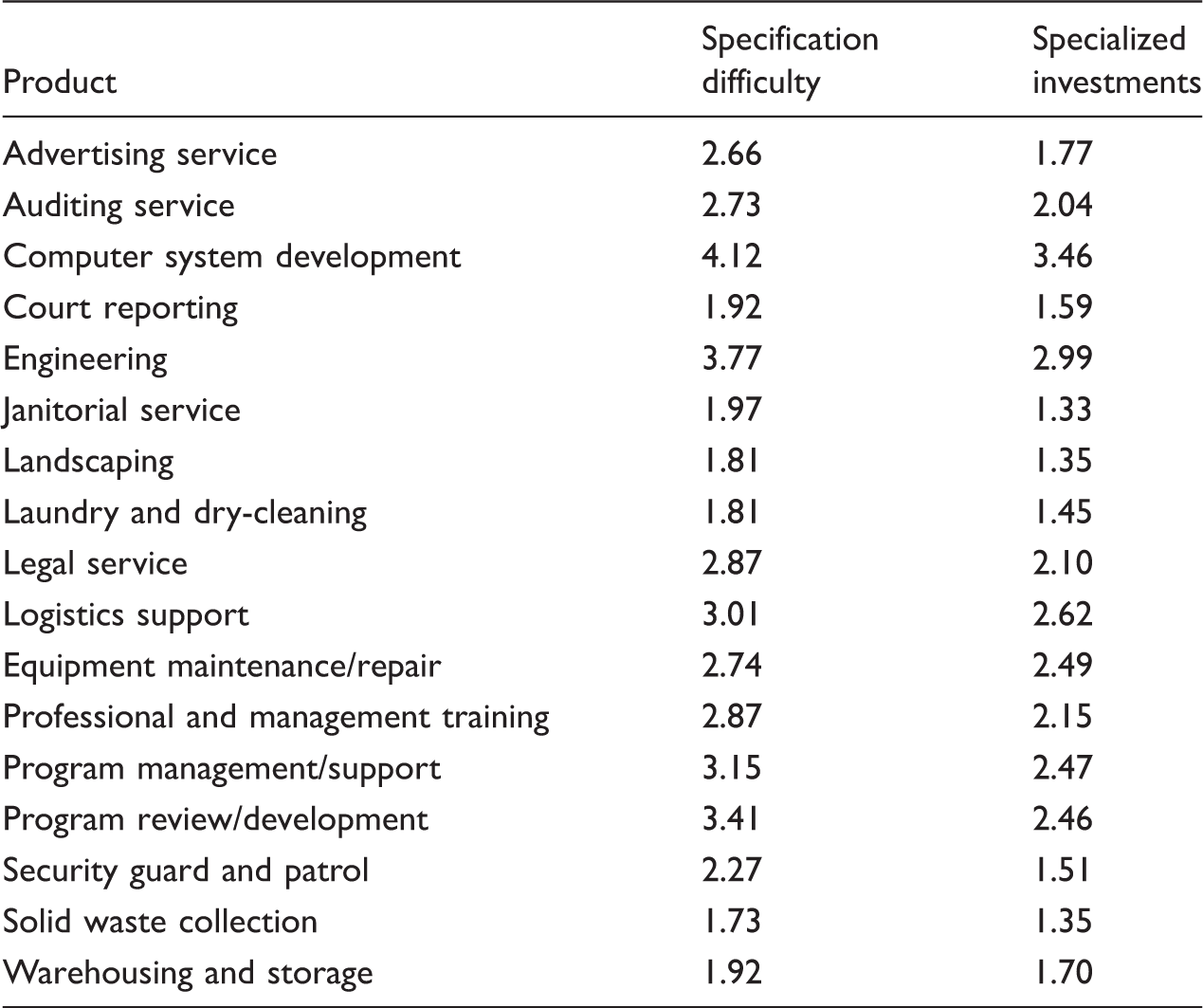
Our measures of product characteristics are derivative of well-established measures in the extant literature (Brown and Potoski, 2005; Hefetz and Warner, 2012; Levin and Tadelis, 2010). We followed the measurement scheme of Brown and Potoski (2005), with some important improvements. To assess the ease or difficulty of specifying the product’s attributes and requirements, survey respondents were asked to rate each product on a scale of 1 to 5, with 1 indicating that ‘requirements definition’ was easy and 5 indicating that it was difficult. To assess the degree of specialized investments required to produce a product, survey respondents were asked to rate each product on a scale of 1 to 5, with 1 indicating a low level of specialized investments and 5 indicating a high level. 17 In order to address instrumentation bias, respondents first rated the ease of requirements definition for all 17 products, followed by a series of questions about federal procurement practice, and then rated the degree of specialized investments for each product. The presentation of the 17 products was also randomized. Even with these steps to address instrumentation bias, respondents rated the products similarly on both dimensions (r2 = .93). To address collinearity in the measures, we combined the two scores into a single score with a range from 2 to 10. This measurement schema aligns with the simple versus complex product conceptualization: products with low scores are simple and products with high scores are complex. We label this variable Product Complexity. A positive and statistically significant relationship between the variable Product Complexity and the independent variable provides evidence that the type of products that departments buy influences their use of different contract types.
We include four control variables. First, we account for the market power of the federal government by including a measure of the percentage (ranging from 0 to 100) of total sales in each product category that are purchased by federal government agencies. This variable is labeled Federal Percentage of Sales. Second, we draw data from the Bureau of Economic Analysis’ Input/Output Tables to measure buyer scarcity; we use the data to calculate the total number of industries that purchase the product. We label this continuous variable as Number of Purchasing Industries. Third, we account for the dollar value of the contract by including the estimated cost of the contract at the time of purchase (per $100,000). We label this variable Contract Value. Finally, we control for time period by including dummy variables for each of the five years of data in our sample, coded ‘1’ for each year, else ‘0’. In our empirical analysis, we use FY 2004 as the base year.
Empirical methods
Descriptive statistics.
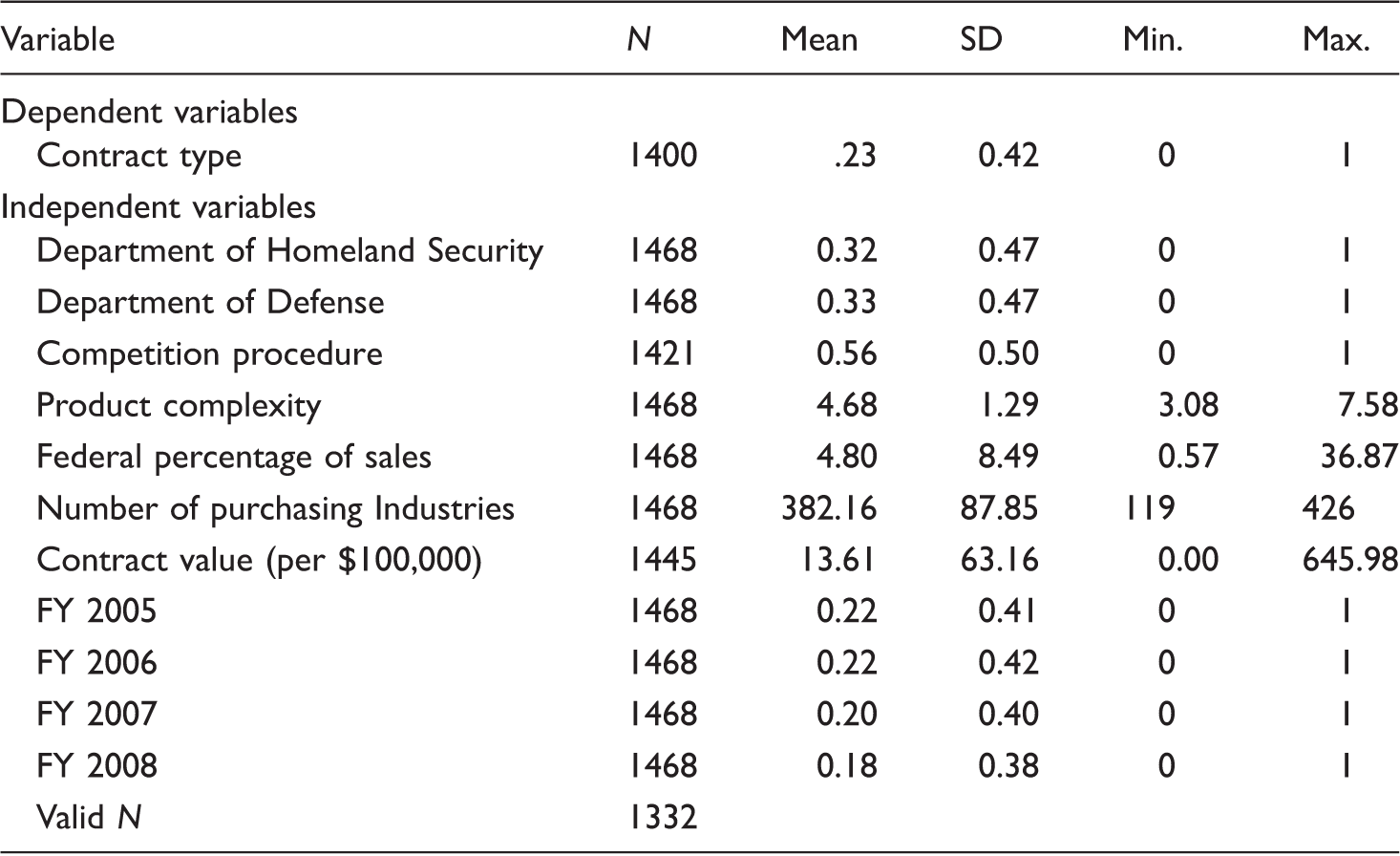
Notes: N = number of observations; SD = standard deviation; Min. = minimum; Max. = maximum.
Results
Logistic regression results of impact of independent variables on contract type, 2004–2008.
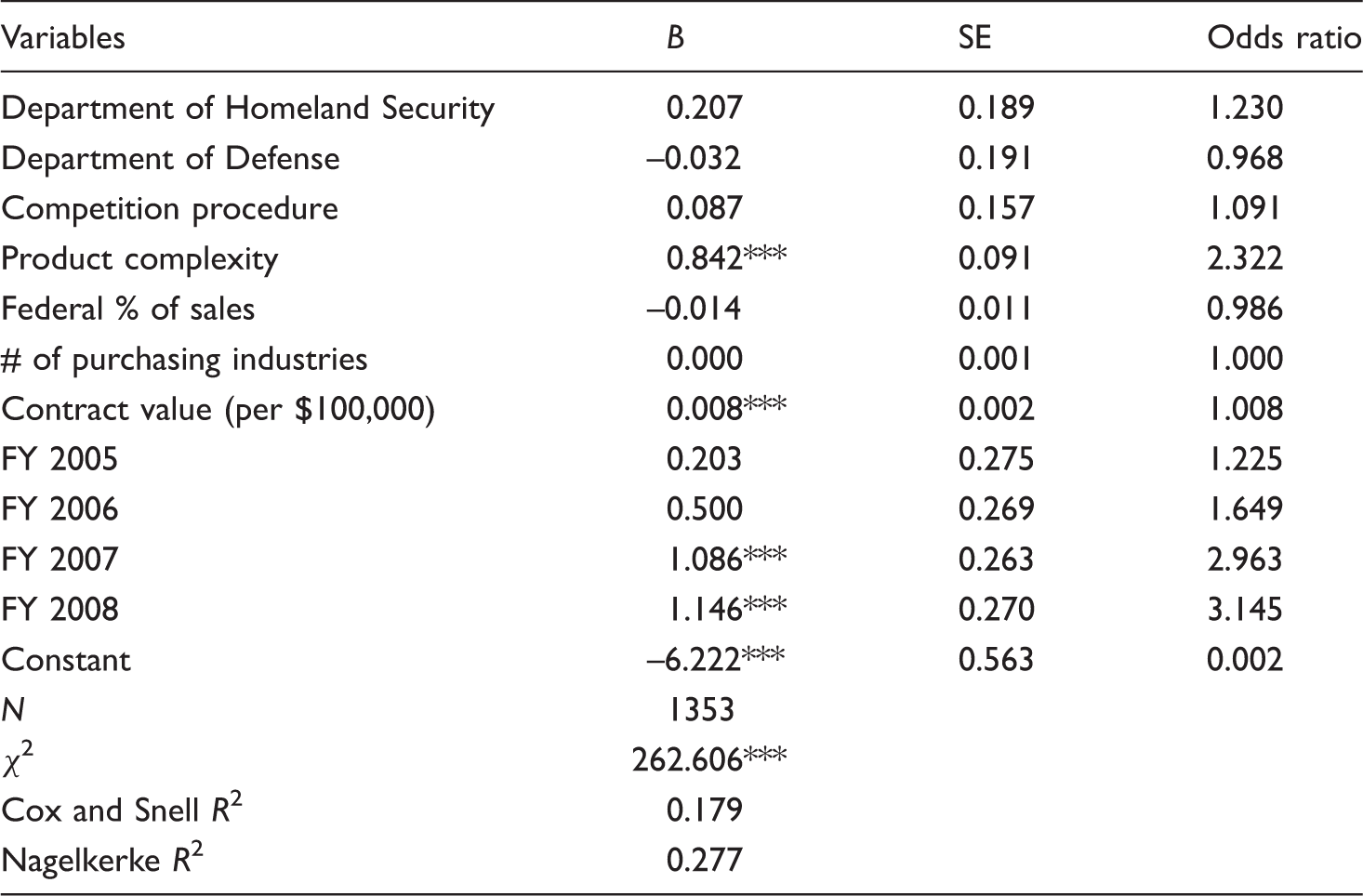
Note: Standard errors in parentheses. *p < .05; **p < .01; ***p < .001.
As Table 3 reports, there is no statistical difference between the three departments in the use of cost-reimbursement contracts. Separate analyses of each of the departments provide similar patterns of variable significance and effect size. The control variables for year indicate that the use of cost-reimbursement contracts increased annually, but the separate analyses by department indicate that this pattern was consistent across each department. These results provide evidence that while departments have autonomy to tailor regulations to meet their specific needs, these three departments have not drifted from the overall guidance to rely on fixed-price contracts for their bulk of their procurement.
The coefficient for the variable Competition Procedure is positive but not statistically significant. Seeking competitive bids does not appear to influence decisions about contract type.
The results indicate that cost-reimbursement contracts were more likely when contracting for complex products, those that are difficult to specify and require specialized investments. In Table 3, the coefficient for Product Complexity is positive and statistically significant at the .001 level. Holding all other variables constant, a one-unit increase in Product Complexity increases the odds of a cost-reimbursement contract by 2.322 times.
The results for the control variables – Federal Percentage of Sales, Number of Purchasing Industries, Contract Value and year – are mixed. The coefficient for Federal Percentage of Sales is negative and not statistically significant. 19 The coefficient for Number of Buying Industries is positive and not statistically significant. The coefficient for Contract Value is positive and statistically significant. A one-standard-deviation increase in Contract Value – about $6.3 million in the value of the contract – increases the odds of a cost-reimbursement contract by 1.504 times. This indicates that there is a positive relationship between the cost of a contract and contract type: higher cost contracts are likely to be cost-reimbursement contracts. The coefficients on all four time variables are positive and the final two years are statistically significant and have high odds ratios; this suggests that the likelihood of using cost-reimbursement contracts increased over the time period of our sample.
Conclusion
Regulatory rules shape the context in which departments procure products. In the US, the regulatory system balances central control to pursue central policy goals with departmental autonomy to use procurement to fulfill their missions. The results of our empirical analysis suggest that this regulatory system has largely been effective in achieving a primary central goal to rely on fixed-price contracts for the bulk of purchases. While the use of cost-reimbursement contracts increased over the five years in our sample, there is no statistically significant difference in the use of fixed-price and cost-reimbursement contracts across the three federal departments. Each of the three departments increased their use of cost-reimbursement contracts at about the same rate. Furthermore, when departments pursue competitive rather than sole-source bids, they are no more or less likely to use one contract type over the other. This provides further evidence that trying to influence departments’ use of cost-reimbursement contracts by further regulating how they purchase products, notably, by mandating increased use of competitive bidding, will have limited impact.
The results suggest that the regulatory system has effectively guided departments to pursue appropriate procurement strategies. Specifically, federal procurement personnel in the three departments in our sample appear to follow the guidance to match product characteristics to contract type. When products are easy to specify and easy to make, fixed-price contracts are more likely to be used; when products are difficult to specify and difficult to make, the likelihood of a cost-reimbursement contract increases.
In assessing the relative efficacy of future attempts to regulate how or what departments purchase, our results suggest that the emphasis should be on the types of products that departments buy. This should not be interpreted as a condemnation of regulations directed at how departments purchase products – the existing system’s rules governing how departments purchase products appear to have encouraged uniform purchasing behavior across departments for the same products. Procurement personnel are following the rules. Instead, our results suggest that the primary driver of contract type decisions is the complexity of the products that departments purchase.
These results have important implications for individual departments and central policymakers. Given the wide range of products that departments need – from paper clips to advanced weapons systems – the rise in cost-reimbursement contracts is not surprising; as departments purchase more complex products, those exchanges are likely to be governed by more flexible contract types. Cost-reimbursement contracts do present risks, particularly if a selected vendor has the advantage of being one of only a few providers of the product. In these instances, purchasing governments will need to invest in contract management to avoid the downside risks of cost overruns, delays, and poor-quality products. Training procurement personnel in effectively managing the complicated relationships that accompany the acquisition of complex products will be essential to ensure that both the purchasing department and the vendor receive value out of the transaction. Given the importance of many of these complex products to the achievement of departments’ missions, procurement will need to be elevated from its traditional back-office function to more of a critical management competency.
For central policymakers intent on curbing the use of what are thought to be risky contract types, at the surface level, the data we present here should give pause. Even though fixed-price contracts are by far the dominant type of contract used in the federal government, during the time period covered in our sample, the use of cost-reimbursement contracts increased. This rise has driven concerns that departments are opting for risky cost-reimbursement contracts instead of fixed-price contracts (Office of the Press Secretary, The White House, 2009). Our findings suggest that this rise is driven less by inappropriate contracting practices than by the increased procurement of complex products. If central policymakers want to mitigate contracting’s risks, they may be better served by focusing on the types of products that departments purchase rather than by admonishing departments for selecting cost-reimbursement contracts.
The simple approach to reduce the use of cost-reimbursement contracts is to limit the procurement of complex products through the budget process. In the US, this means putting faith in the wherewithal of legislators to prevent departments from purchasing cutting-edge information technology, advanced weapons systems, and sophisticated program management services. Given the increasing mission demands on federal departments – demands that often originate in the legislature – and the pressures to equip departments with the tools to achieve these missions, this approach is naive. Instead, central policymakers can take more programmatic steps to support department-level procurement personnel as they determine the types of products needed to fulfill their mission requirements. For example, central procurement personnel can work cooperatively with departments to develop policies and procedures for the effective use of different contract types within each of the more challenging and risky product categories (e.g. computer systems development). In sum, within the current regulatory system, central policy goals at overall budget control might be better achieved by focusing on what departments buy rather than on how they buy.
Footnotes
Funding
Funding for this research was generously provided by the Naval Postgraduate School's Acquisition Research Program (Award N00244-12-1-0061). Institutional support for gathering data was provided by the National Institute for Governmental Purchasing, the National Contract Management Association, and the IBM Center for the Business of Government.