







Abstract
From theories on middle managers’ entrepreneurship in private organizations, it is known that the structural network position of middle managers influences their innovative work behavior. Our study investigates if in a governmental setting, the intra-organizational networking behavior of public managers has a similar positive influence on innovative work behavior. As networking mechanisms may depend on the particular context and organizational norms, we also investigate the influence of networking motivations. According to social network research in private enterprises, social network links can be used to advance individual careers. According to public management and Public Service Motivation theories, public managers have a collective orientation aimed at producing public goods. Therefore, we investigate if, next to intra-organizational networking, an individual career motive or a collective motivation for networking explains innovative work behavior. In a case study on public managers of a municipality in Mexico City, we find a strong influence of networking on innovative work behavior. We also find support for additional influences of individual career motives, but no evidence for collective motivations.
Points for practitioners
Intra-organizational networking of public managers leads to increased innovative behavior in a governmental setting. In addition, when aiming at increasing innovative behavior, individual career motives seem to have stronger positive effects than collective motivations (such as teamwork-related motivations).
Keywords
Introduction
This study seeks to contribute to the literature on public managers’ innovative behavior by looking at intra-organizational managerial networking. Public managers are the linking pin between political appointees and bureaucratic operatives. They play an important role in daily operation, including duties such as monitoring the provision of services and meeting policy and budgetary deadlines. Attention to public managers’ behavior and their role in policymaking and public service provision increased in recent years, mainly as a consequence of the rise and institutionalization of the New Public Management movement (Boston, 2011). Although public managers have traditionally been portrayed as an obstacle to change (Huy, 2001), New Public Management and other contemporary administrative reforms build on the assumption that managers do play a crucial role in the strategic process of governmental organizations (Boston, 2011; Osborne and Gaebler, 1992). In addition, a number of contributions in the public administration literature have developed the notion that managerial behavior is crucial to organizational performance (e.g. Altman, 1979; Döring et al., 2015). In particular, public managers can play a central role in promoting organizational responsiveness, innovation, and policy renewal (Chen et al., 2017; Vigoda, 2002).
Networking and networks are important antecedents of organizational performance in the public sector (Peters et al., 2015; Randma-Liiv et al., 2015; Torenvlied et al., 2012). Managerial networking—that is, the frequency of contacts that managers maintain with other actors (Wolff and Moser, 2009)—seems to have a positive effect on performance by increasing access to support and resources (Meier and O’Toole, 2001). This echoes findings in the (private) managerial literature, where networking has been positively associated with organizational survival and increased output. Specifically, networking has been associated with performance via innovativeness: networking improves access to resources, support, ideas, and information, which, in turn, potentiate innovation and overall performance (Pappas and Wooldridge, 2007).
There are several ways in which public managers can make use of the social capital contained in their social networks. Previous studies in the public administration literature have focused by and large on understanding (organizational) performance, and have mainly studied processes of inter-organizational networking (i.e. networking in inter-organizational networks between managers and actors in the organizational environment). The core idea of these studies is that managers act as boundary spanners between the external environment and the internal organization. This boundary-spanning mechanism drives the relation between networking and performance. One simplifying assumption of this approach is a unitary actor perspective of the organization. This assumption leads to a limited interpretation of networking and neglects the possible effects of intra-organizational networking (i.e. networking among managers and other actors within the organization). To relax this assumption, we need to study intra-organizational networking, and how this allows public managers to mobilize resources and information that enable innovation (Burt et al., 2013).
From this perspective, the relation between managerial networking and innovative behavior implies that public managers are active intra-organizational networkers. However, such a relation does not occur in isolation. As public managers have limited resources, they have to decide if and to what extent they maintain social ties and networks in the organization. That is, in order to understand the importance of (intra-organizational) networking in enabling innovative behavior, we also need to consider the specific motivations that drive public managers. Introducing a relation between motivation and networking is not new. Early research on social networks suggested a strong positive influence of brokerage on innovation (Burt, 2004) and career opportunities (Burt, 2000: 358). More recent research also shows that these relations may be specific to particular contexts. A meta-study of Fang et al. (2015), found less support for the influence of brokerage. According to this study, brokerage mechanisms are typical for organizations where timely access to and control of information are crucial for individual success. This is not a surprise as brokerage is typically based on the assumption of the “apt individual” (Moran, 2005).
Regarding public sector settings, institutional characteristics of the public organization may also significantly influence managerial motivations to network. Previous research found that public managers place higher value than their private counterparts on political rewards and loyalty, which may indicate a higher propensity to maintain social ties in public and governmental organizations (see, e.g., Crewson, 1997; Grindle, 2012; Rainey, 1983; Rainey and Bozeman, 2000).
Although these relations cannot be attributed solely to institutional differences between the public and the private sector or to cultural differences, available evidence does suggest that the relation between networking and behavioral outcomes (such as innovative work behavior) needs to be studied in relation to the particular motivations of public managers. This study contributes to close this gap by theorizing on the effect of managerial networking in the public organization, as well as public managers’ motivations to network (particularly, teamwork-related motivation and individual career incentives). We then test our ideas using data from a sample of public managers from a municipality in Mexico City. The statistical analysis allows for testing the relative significance of networking and managerial motives on different roles of innovative behavior.
The remainder of this article is structured as follows. The first section presents the theoretical argument. The second section introduces the empirical study. The third section presents the results of the statistical analysis, and the fourth section concludes.
Theoretical background
Managerial networking
In public management research, two sorts of networks are studied: collaborative and managerial networks. Collaborative network studies consider the whole network as the unit of analysis and analyze the relation between network characteristics and performance. A major result coming from this type of studies is that networking increases coordination, which, in turn, results in improved performance due to increased stability and cohesion (Akkerman et al., 2012). Managerial network studies focus on the individual actor and define networking as the contact frequency of relations that (high-ranking) managers maintain with other managers (Wolff and Moser, 2009).
There are two major types of mechanisms that explain the relation between managerial networking and performance. The first one was proposed by academics in the Kennedy School of Public Management. It stresses the importance of external resources. According to this argument, support from politicians, the public, and other stakeholders is crucial for the performance of public managers (Moore, 1995). For example, Moynihan and Pandey (2005) found that political support positively influences the performance of public sector managers. Studies by Meier and O’Toole (2003, 2008) in Texas school districts showed that external networking can be used to reduce uncertainty and exploit resources in external networks, and has a stabilizing buffer function in case of external shocks.
A second type of mechanism is related to the internal managerial networking of public managers and extends the definition of networking to contacts with non-managers. Recent research (Van den Bekerom et al., 2016) shows that “downward” networking—that is, maintaining frequent contact with subordinates and work teams—is particularly important in mitigating the negative impact of external shocks on performance. It is assumed that downward networking increases coordination and consensus around strategic decisions, and may lead to new ideas to deal with external shocks. This finding is similar to a meta-analysis of 37 studies on team performance by Balkundi and Harrison (2006). These authors found that leadership-centrality in a team had a positive influence on team performance. Downward networking and the central position of a manager in a team improve coordination, increase interpersonal trust and group cohesion, and foster organizational learning. As a result, innovation and performance can increase.
Public managers’ innovative work behavior
The previous section described how the managerial networking of public managers may be a determinant of performance in public administration. While the benefits of inter-organizational networking rely strongly on access to external support and resources, the benefits of intra-organizational networking relate to increased performance due to increased cohesion (Akkerman et al., 2012), as well as innovations through creating flexibility, generating new ideas, and promoting the alternative use of resources (Van den Bekerom et al., 2016). We focus on the benefits related to innovation, which we define broadly as a process that can involve changes in four areas: products, processes, markets served, and the organization (OECD, 2005: 46). Public managers play a crucial role in this process. Managers are not merely implementers of strategies; they also actively contribute to and shape the strategies of superiors and elected officials. As public managers occupy a linking position between political principals and operatives, they can be compared to middle managers in private organizations. Similar to middle managers, public managers are not involved in daily operations, but responsible for the operations and performance of subunits (Wooldridge et al., 2008). Middle management theory suggests that middle managers’ networking influences their strategic involvement—a variable closely connected to the innovative work behavior of middle managers (Hornsby et al., 2002). Similarly, public managers can use their networks as a source of information and support, and as a means to coordinate operations (Burt, 2004; Fang et al., 2015; Mehra et al., 2006).
The contribution of public managers toward innovation can be diverse and depends on their strategic role (Floyd and Wooldridge, 1997). These strategic roles can be described using two dimensions: first, involvement can be upward- or downward-oriented; and, second, it can be divergent or integrative. The first dimension refers to the direction of strategic involvement. The second refers to the nature of the role. Crossing these dimensions results in four different roles, which are helpful to categorize the innovative involvement of public managers (see Figure 1). First, managers may champion new initiatives, which refers to the introduction and presentation of comprehensive strategic plans to upper management or political principals. Second, managers synthesize information, thus evaluating and communicating information upwards in the organizational hierarchy. Third, managers implement strategies and policies. Finally, managers facilitate adaptability by fostering flexible organizational arrangements that increase adaptability and readiness to change.
Middle managers’ strategic roles.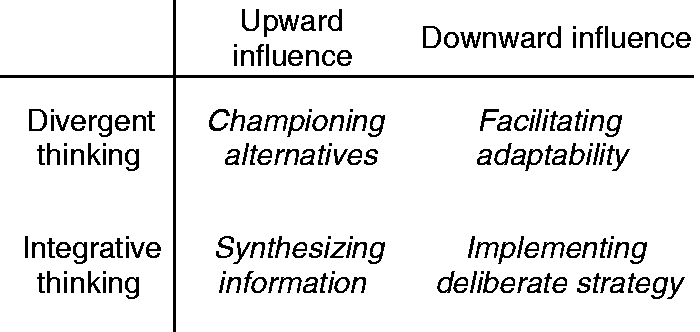
The first two roles (championing and synthesizing) are upward-oriented and strongly depend on new proposals and strategically relevant information. Rapid and precise knowledge of environmental developments is necessary to formulate new plans or to brief superiors with relevant information. The two other roles (implementing and facilitating) are downward-oriented (cf. Van den Bekerom et al., 2016). Next to passing on relevant information, these roles specifically rely on a manager’s ability to galvanize internal support and to coordinate teams closely. When this is done successfully, a team or subunit is better prepared for change and to deal with external shocks.
Intra-organizational networking can be an important reason for public managers to succeed in these different roles. First, networking increases access to resources and information. This results in better data, more knowledge, and increased support. Resources and information obtained through networking can be used upward for championing new initiatives or for synthesizing information toward higher echelons, as well as downward in preparing public employees for change and the implementation of policy. Managers in boundary-spanning positions are supposed to have better and faster access to fresh information and have been found to exert more strategic influence than others (Floyd and Wooldridge, 1997). Increased access to information can also be used downward to inform operatives about external contingencies, threats, and trends. This information can either be used to improve the alignment of deliberate strategies to the actual situation, or to improve adaptability to change. That is, intra-organizational networking can increase managerial innovative involvement, as formulated in the following hypothesis: H1 (networking)—A higher level of a public manager’s intra-organizational networking leads to an increase of his innovative behavior.
Public managers’ motivations
We hypothesized that public managers are active networkers and that their networking can have an important effect on performance via innovation. We assume that public managers are goal-directed and, as a consequence, next to networking, these goals also influence their innovative behavior. To define these instrumental goals, two characteristic goals/motivations can be identified in the literature that seem particularly important to disentangle this puzzle.
The first one originates from Public Management Theory and Public Service Motivation research, and assumes that public managers aim to create public value and meet organizational and policy objectives (Le Grand, 2003; Moore, 1995). That is, public managers are driven by the goal to meet collective objectives and comply with public sector expectations. Moreover, organizational norms (such as “being a team player”) have been identified in the literature as important antecedents for compliance and performance (Barker, 1993; Rainey, 2003; Tung-Mou and Maxwell, 2011). Managers who are motivated by the creation of public value through commitment to organizational goals and norms are, consequently, more likely to also be active in innovation. Furthering these goals requires coordination between departments, teams, and individuals, as well as creating an enabling environment for team members to perform optimally. Intra-organizational networking is instrumental to this because it facilitates obtaining critical resources to implement policy and to improve team performance. Therefore, it may be assumed that public managers who consider such collective goals as leading are also more successful innovators. This leads to the following hypothesis: H2 (collective goals)—Higher salience of collective goals is related to a higher level of innovative behavior.
However, networking is not the only manner in which to advance a career. It may be assumed that those public managers motivated by career goals will engage with higher probability in innovation, to the extent that innovative behavior is deemed instrumental in improving managers’ chances of maintaining or increasing career opportunities in the public service: H3 (career goals)—Higher salience of career goals is related to a higher level of innovative behavior.
Research method
Background and setting
We used survey data from public managers (N = 64) of the Milpa Alta municipality in Mexico City. Data were collected in June 2012. Managers received a personal invitation to participate in the study and respond to an online questionnaire (response rate = 69%). Public managers from all departments of the municipality were included in the study (Administration, Government and Law Enforcement, Public Works and Urban Development, Urban Services, Economic Development, Social Development, and Ecology and Environment).
Milpa Alta is a semi-rural community and the least populated of Mexico City’s 16 boroughs. It has the lowest gross domestic product and human development index score of Mexico City (though it is way above the national average). The Milpa Alta government lacks an established civil service system, which is not uncommon in Mexico and other developing nations (Grindle, 2012). This means that managerial positions are often appointed using discretionary and political criteria and not necessarily or exclusively professional merit. This characteristic is important to our study because it implies that we can directly compare collective versus career motivations (because career development is related to public managers’ behavior and not determined by an institutionalized career system). Also, the fact that all managers are concentrated in a single location facilitates comparison of individuals’ intra-organizational networking.
Measures
The four dependent variables that represent innovative behavior—championing new alternatives, synthesizing information, implementing strategies, and facilitating adaptability—are each measured using five Likert-scale items (1 = strongly disagree; 5 = strongly agree). Examples are communicate and sell top management initiatives (implementing), propose new programs to top management (championing), and assess and communicate business-level implications of new information to top management (synthesizing). A complete description of the items can be found in Floyd and Wooldridge (1996), which is based on Floyd and Wooldridge (1992). Cronbach’s alphas for these four scales vary between 0.75 and 0.81, indicating that the scales, which were originally developed for use in American private companies, are also reliable measures in the Mexican case.
In the public management literature, it is common to define networking as the frequency of contacts that managers maintain with other actors (Van den Bekerom et al., 2016). We measured networking by the amount of personal contact a public manager has with co-workers inside his department, compared to his peers (0 = much less; 4 = much more). We have limited networking to the department because departments in Milpa Alta’s case are relatively independent of each other. Therefore, measuring contact with peers in other departments might confound inter-organizational network effects and intra-organizational effects.
To measure the influence of network motives on innovative behavior, we asked two questions. For the career motivation, we asked if knowing people is important to develop a career, and to measure the collective motivation, we asked whether being a team player was crucial for success (0 = strongly disagree; 4 = strongly agree).
Sample descriptives.
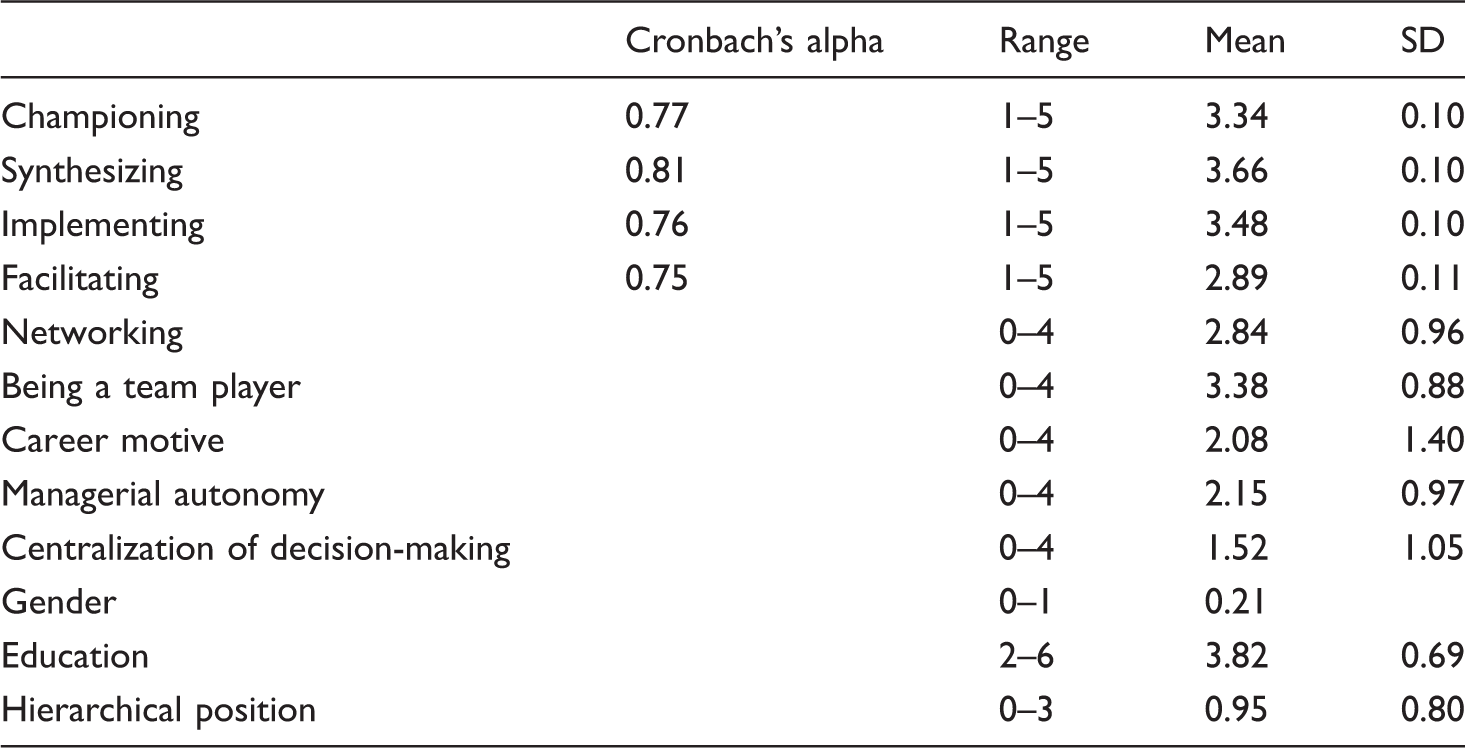
Note: Sample size = 19.
A potential risk of self-reported measures is systematic measurement errors due to common method variance (CMV). As a result, correlations may be inflated or attenuated; in either case, possibly leading to wrong conclusions (Conway and Lance, 2010; Favero and Bullock, 2015; Podsakoff et al., 2003). Despite this risk, we consider self-reports appropriate for our study. A number of our variables (networking, collective or individual motivation) focus on the opinion or motivation of participants. Variation in these variables reflects the subjective judgments of participants and is not necessarily a source of measurement error (Favero and Bullock, 2015). Innovative behavior is sometimes measured by counting the number of successful innovations. However, such a measure only reflects a part of innovative behavior. Innovative behavior starts with an assessment of new developments or information and a decision as to how to respond; a plan can be presented, information may be passed on, and nothing is done. The evaluations that underlie these decisions are only known to the middle managers themselves. Neither top managers nor lower-level managers are fully aware of middle managers’ assessment or innovative behavior, and we therefore choose self-reports to measure middle managers’ innovative behavior.
To reduce the risk of common method bias, a personal invitation for an online survey was sent to all participants. In this way, we could guarantee full anonymity to participants and assure that supervisors or peers had no access to the answers. The invitation was also used to explain that there were no right or wrong answers and that participants were free to express their own opinions. One objective of this explanation was to reduce the risk of socially desirable answers.
We also tested the results for evidence of CMV. Several tests to detect CMV are described in the literature, many of which do have theoretical drawbacks or limited efficacy. In a simulation study, Richardson, Simmering, and Sturman (2009) have investigated the characteristics of three tests in different settings. Their findings are that the Confirmatory Factor Analysis (CFA)-marker technique (Williams et al., 2010) is the only test that works reasonably to detect CMV. This CFA-marker technique uses a latent marker variable to represent measurement effects. This marker variable shares measurement characteristics with the substantive variables but is otherwise uncorrelated. Testing for common method bias can be done by comparing the fit of two similar models, one with and one without the influence of the marker on the correlation between the variables of interest. We carried out this test for each of the four dependent variables. The pairwise comparison of these models using chi-square difference tests leads to chi-square values ranging from 1.86 to 5.66, with six degrees of freedom. These values are smaller than the 0.05 chi-square critical value (12.59), meaning that we find no evidence for the influence of common method bias on the correlation of the variables under study. More details about this test can be found in Appendix 2.
Results
Regression outcomes for different dependent variables.
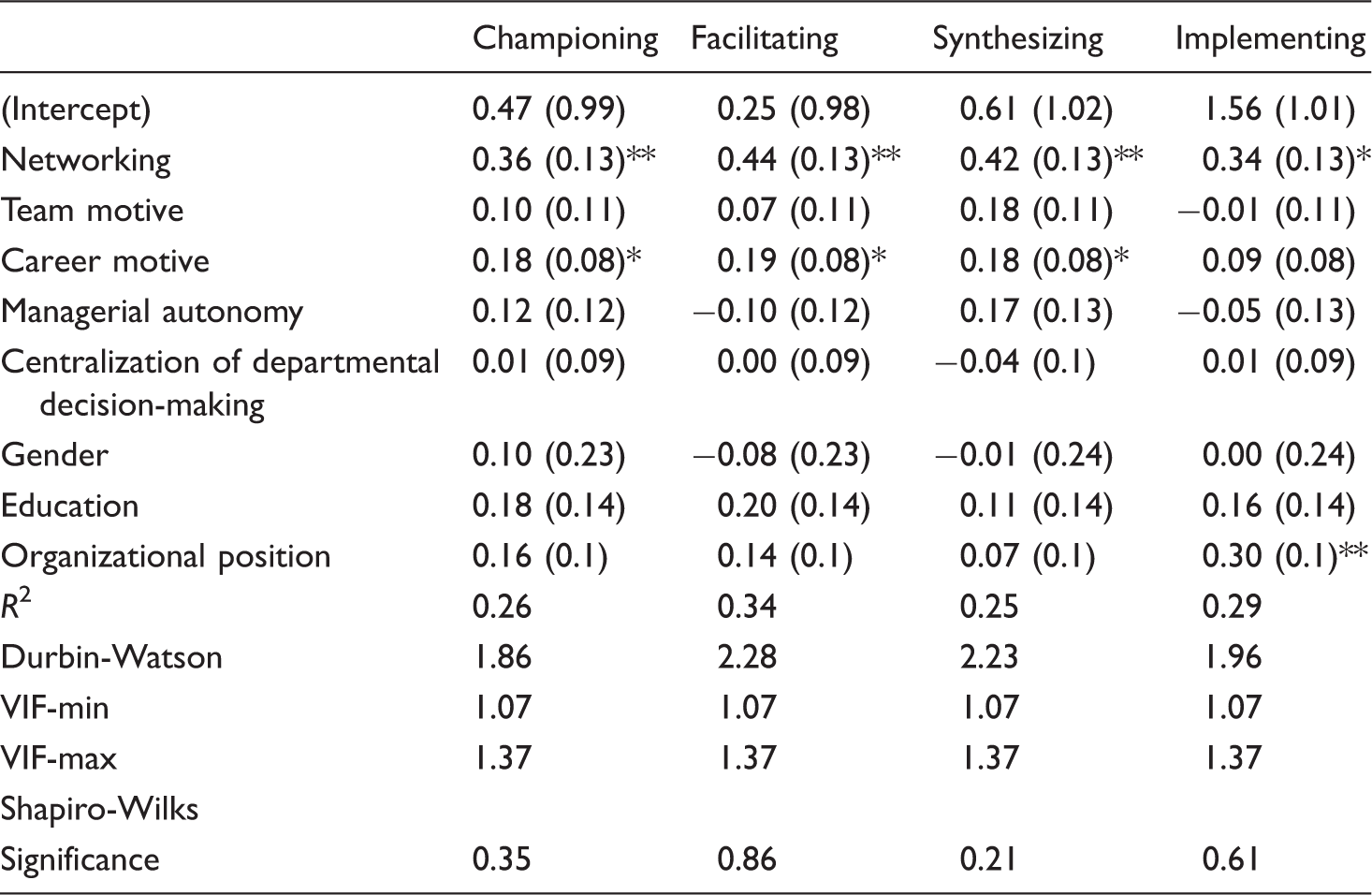
Notes: Standard errors in parentheses. *= 0.05 and ** = 0.01 significance. VIF = Variance Inflation Factor.
To justify the use of linear regression analysis, we tested common assumptions of linear regression. The Durbin-Watson test for autocorrelation in the residuals varies between 1.86 and 2.28, indicating that there is almost no autocorrelation. To test for collinearity, the Variance Inflation Factors (VIF) were calculated for estimated coefficients. These factors are all close to 1 and smaller than 5; hence, it can be concluded that there are no indications of collinearity. To test for the normality of residuals, Q-Q plots were visually inspected and showed no anomalies. Above this, Shapiro-Wilks statistics for the testing of normality were calculated. The p-values of these statistics are all well above 0.05 and there is no reason to doubt the assumption that residuals are normally distributed.
The championing, facilitating, and synthesizing roles show similar results and appear to be comparable. In all models, there is a highly significant and positive result for networking, varying between 0.34 and 0.44 (unstandardized). This clearly supports hypothesis 1. In all four models, we could not find any significant influence of a teamwork motivation on innovative behavior. However, in the championing, facilitating, and synthesizing models, we found a clear influence of career motivations, with a parameter around 0.18. In the implementing model, we found no evidence of career motives affecting implementing behavior. The control variables showed no influence apart from the organizational level positively influencing implementing behavior. This suggests that managers occupying higher positions are more involved in implementing strategies than lower-positioned managers.
Discussion
Our first hypothesis stated that the intra-organizational networking of a public manager leads to an increase of innovative behavior. Existing research on public managers’ networking has shown the value of managerial networking for organizational performance by securing access to external resources and by improving internal coordination and consensus (Torenvlied et al., 2012). Managerial networking of public managers is considered particularly useful in dealing with external turbulence and problems (Van den Bekerom et al., 2016). However, the specific question of whether managerial networking leads to increased innovative behavior (and thus induces increased performance), to the best of our knowledge, has never been researched in governmental settings.
Research on middle management in for-profit organizations has already shown that intra-organizational networking specifically can contribute to innovative behavior and so can lead to increased performance (Pappas and Wooldridge, 2007). Our findings on hypothesis 1 clearly indicate that in a public organization also, the networking behavior of public managers contributes to increased innovative behavior. One implication of this finding is that theories of middle managers’ innovative behavior and strategic involvement that are developed in Western private companies (Wooldridge et al., 2008) can be extended to a public management setting in a developing country. Although further research is necessary, it suggests that causal mechanisms related to middle management may also be informative in public settings.
The second and third hypotheses of our study explore the effect of public managers’ motivations as additional factors on innovative behavior. We reject the hypothesis that a collective motive influences innovative behavior. However, in our case study, we found evidence supporting the hypothesis that career-driven motivations for networking do influence (three of the four) innovative roles. Only for the implementing role did we find no evidence of the influence of career-driven networking motivation. It has to be noted that the implementing role is different from the other three roles in being oriented at a rather straightforward implementation of top management’s strategies. The other three roles—championing new initiatives, synthesizing information, and facilitating adaptability—all involve own initiative, as well as clear judgment.
An explanation for these results might be the politico-administrative specifics of our case. As mentioned earlier, in Milpa Alta, managerial positions are often appointed based on discretionary criteria. As a result, managers’ behavior may not necessarily be primarily aimed at meeting public goals or the successful implementation of policies; instead, it may be mainly motivated by furthering individual career opportunities. This does not discard more normative public service ideas, which claim that public managers strive for higher collective goals in order to create public value, but rather supplements them by stressing the importance of career incentives in the absence of institutions that reduce public officials’ career uncertainty.
This also suggests that a certain hierarchy of motivations may be at play. A primary goal is the public manager’s career goal. Only after this goal is secured and a reasonable career perspective is guaranteed can other higher-order goals such as creating public value or being a team player become salient in inducing innovative behaviors. Studies on bureaucracies in the public sector (Evans and Rauch, 1999; Rauch, 2001) show that offering civil servants rewarding and long-term careers leads to increased corporate coherence, a long-term focus on public goals, and reduced likelihood of unethical behavior. If such a career perspective is not offered, individual motives and interests become more prevalent. This shows that in both social network analysis and public management, the specific context influences the relative importance of individual versus collective goals. In our case, there is no long-term career perspective for public managers and not a strong collective orientation. This supports our findings that a career motive is more influential than a collective motive in explaining public managers’ innovative behavior.
The career motive for networking correlates with three of the four innovative roles: championing new initiatives, synthesizing information, and facilitating adaptability. It does not correlate with the fourth innovative role: implementing deliberate strategies. Rather unexpectedly, we found that a hierarchical position positively influences this role. Although one significant outcome in a small sample is always a reason for caution, these results seem to support our previous discussion. Higher-ranked public managers have already achieved a successful career, so this motive becomes less important for them. They also have higher power to execute plans; therefore, it is plausible that higher-ranking public managers can more often take on the implementation of policies and innovations than lower-ranking managers.
Clearly, additional research is needed to disentangle some of issues mentioned earlier. However, our data and results do suggest that intra-organizational networking and motivations arising from the institutional characteristics of the public organization may be important in explaining public managers’ innovative behavior. Results also imply that, in the case of some public organizations, the relation between networking and performance may run through innovative behaviors and the relative importance of career incentives.
Footnotes
