







Abstract
Grievance petitioning is a prevailing venue for voicing citizens’ discontent and seeking redress in China. Extant literature documents the simultaneous growth of citizen petitions and local containment, without addressing the dynamics of such a paradox. Inspired by the institutional logics perspective, this study surveyed over 300 onsite petitioners and explored how multiple institutional logics are at work and together produce the paradox. Citizens embrace the grassroots logic, flooding petitions into the grievance system. Local governments follow the state logic, engaging in comprehensive containment. Grievance agencies cope strategically with the rise of citizen petitions and bureaucratic influences, demonstrating the ombudsman logic. Despite local containment and often less than satisfactory resolutions, citizens still hold favorable attitudes toward the grievance system, as well as the top bureaucracy, thus sowing the seeds for more petitions. The paradox manifests the coexistence and interactions of multiple institutional logics, raising challenges for governance and accountability.
Points for practitioners
The simultaneous growth of citizens’ grievances and local containment presents a paradox. Citizens follow the grassroots logic, filing more petitions. Local governments adhere to the state logic, prescribing containment efforts. In face of competing demands, grievance agencies embrace the ombudsman logic. The coexistence of and interactions among different logics help to explain the recurrent patterns for all parties. Future reforms need to be designed with a sophisticated understanding of interactive institutional logics.
Introduction
Citizens file grievance petitions to seek justice and redress. Broadly defined as citizen-initiated efforts to reach the administrative apparatus to express problems and seek resolutions, petitioning has been “the dominant method for handling citizens’ grievances” in China (Bruckner, 2008: 92). Studies show the use of grievance petitions far surpasses that of formal legal institutions (Minzner, 2006). The rough estimate of the number of grievance petitions in China approaches 10 million a year nationwide. The annual number of mass incidents (i.e. protests, demonstrations, and even riots), the most severe kind of grievance petitioning, skyrocketed from roughly 10,000 in 1994 to over 80,000 in 2008 by government reports (Lee and Zhang, 2013; Yang, 2017), and to a rumored 180,000 in 2010 and possibly over 200,000 ever since. This “high tide” (Li et al., 2012) testifies that grievance petitioning has been deeply entrenched into the social fabric of Chinese, becoming the most prevalent venue to voice citizens’ discontent and seek redress.
The past decade witnessed the strong grip of bureaucrats and local governments (Huang, 2002), along with intensified efforts at “suppressing undesirable elements in the social order,” coined “stability maintenance” (Lee and Zhang, 2013; Yang, 2017). Massive grievance petitions spread “negative thinking” (Čábelková and Hanousek, 2004) and likely fuel social instability (Hou et al., 2018; Lee and Zhang, 2013; Lorentzen, 2013). Local bureaucrats have been driven by target-based performance metrics (Chen et al., 2018; Liang and Langbein, 2015) and policed by top-down formal and informal inspections (Huang, 2002; Wallace, 2016). Stability maintenance constitutes a “first priority” target that enjoys the “single item veto” power over bureaucrats’ career prospects (Yang, 2017). Given the potential threat, grievance petitioning is often grossly classified as “undesirable,” particularly in the views of local governments since petitioners often lodge complaints against them (O’Brien and Li, 1995). Thus, local bureaucrats and governments have strong incentives to contain grievance petitioning (Bruckner, 2008), including using coercive power with some regularity (Hou et al., 2018).
The simultaneous growth of both grievance petitions and local containment in China constitutes a paradox, calling for more sophisticated understanding. Based on a survey of over 300 citizens who filed onsite petitions in one provincial grievance agency, this inquiry attempts to unfold the cyclical dynamics of the paradox, particularly addressing how citizens are recurrently channeled into the grievance system and why local governments and citizens both show locked-in behaviors. The theory of institutional logics (Thornton and Ocasio, 2008; Thornton et al., 2015) provides a good lens. Defined as “the socially constructed, historical patterns of cultural symbols and material practices,” the institutional logics perspective serves “as a metatheoretical framework for analyzing the interrelationships among institutions, individuals, and organizations in social system” (Thornton et al., 2015: 2). One central premise is that individuals and organizations are all embedded within prevailing institutional logics and that each institutional logic presents different enabling and constraining impacts on both cognition and action. The presence of multiple institutional logics, as well as their interactive dynamics (Greenwood et al., 2010), thus presents great insights for dissecting the paradox.
Multiplicity of institutional logics
Institutional logics underpin the appropriateness of individual and organizational courses of action, as well as their interpretation in giving settings (Greenwood et al., 2010; Thornton et al., 2015). Multiple institutional logics may play out simultaneously within organizations (Besharov and Smith, 2014; Perkmann et al., 2019) or specific spheres (Greenwood et al., 2010; Zajac and Westphal, 2004). For instance, medical education sees two competing logics—care and science—with each being supported by different groups, creating dynamic tensions (Dunn and Jones, 2010). When Spanish firms downsize, they are not only constrained by the market logic, but also subject to the logics of state and family (Greenwood et al., 2010). In this light, citizen grievances represent a specific sphere wherein multiple logics prevail. Citizens file petitions, among which many are against local governments, manifesting the grassroots logic. Driven by top-down pressure for stability maintenance and incentivized by bureaucrats’ career prospects, local governments follow the state logic, often resorting to containment efforts. Grievance agencies struggle with conflicting demands from both citizens and local bureaucracy, demonstrating the ombudsman logic.
Studies on logic multiplicity yield divergent evidence on their impact, being contingent upon the extent to which multiple logics are compatible (Besharov and Smith, 2014). At one end of the continuum, conflicting institutional logics likely invite antagonisms, threaten performance and even lead to paralysis (Pache and Santos, 2010); yet, at the other end, organizations rise up to the challenges and adopt varying solutions to manage hybridity (Besharov and Smith, 2014; Currie and Spyridonidis, 2016; Greenwood et al., 2010; Perkmann et al., 2019). Two approaches have been further identified—blended hybrids and structural hybrids—with the former referring to the whole organization embodying varying elements of multiple logics, and the latter referring to different parts of the organization adhering to different logics, resulting in structural compartmentalization (Perkmann et al., 2019). It is noticeable that all logics, as well as their interactions, are historically and culturally embedded and subject to agencies’ interpretation (Currie and Spyridonidis, 2016; Greenwood et al., 2010; Perkmann et al., 2019). Citizen grievances involve locally situated people, each adhering to different logics. The grassroots logic likely conflicts with the state logic. While local governments follow the state logic in general, grievance agencies tend to be characterized as different compartments, featuring the ombudsman logic.
Citizens’ petitioning: the grassroots logic
Grievance petitioning is an alternative dispute resolution practice grounded in Chinese culture and history (Bruckner, 2008; Minzner, 2006). The culture of “justice from above” (Minzner, 2006; O’Brien and Li, 2006) implies that upper-level governments, due to their distancing from local influences and vested interest on social order, likely have more impartiality to address complaints, particularly when complaints are against local governments. Sometimes, well-intentioned policies from upper-level governments fail to benefit citizens, as local governments could stand in the way. The theory of rightful resistance (O’Brien, 1996; O’Brien and Li, 2006) provides a good elaboration for Chinese villagers, who often escalate their claims to higher authorities and see petitioning as a de facto strategy against predatory local bureaucracy. Chinese citizens show much more trust in the national government and successively less so for governments down the hierarchy (Li, 2004, 2008; Wang, 2005). The trust in higher authorities, at least in their good intents (Li, 2004, 2008), helps to justify citizens’ endeavors to climb the grievance pagoda (Michelson, 2007).
Grievance agencies coexist alongside and even within formal legal institutions, with easy access to all citizens. Filing petitions requires neither legal knowledge nor social resources. Studies show that petitioning is most frequently used by groups of “the marginalized and impoverished” (Diamant and O’Brien, 2015), and that petitioners often resort to “fundamental moral norms” and anchor “the expression of their sense of injustice in a normative arena presumably shared by the rulers and by the ruled” (Thireau and Linshan, 2003: 102). Scholars contend that the petitioning system is also a primary channel through which citizens express their interest and engage in political participation (Paik, 2012; Tsai and Xu, 2018), thus serving as a multipurpose governance tool (Minzner, 2006). The regime situates the petitioning system “in a privileged position vis-à-vis formal legal institution” (Bruckner, 2008: 93) and channels more disputes into petitions.
Local governments: the state logic
Grievance petitions disclose issues and injustices from the local to higher levels, which often signal the incompetence of local leaders, if not blatant defiance or intentional negligence. Such an information flow is, to say the least, not welcome by local leaders and often invites suppression efforts (Cai, 2008a; Kan, 2013; Lee and Zhang, 2013). Moreover, when communicated on a large scale, information flows likely mobilize citizens and stir mass incidents (Benney, 2016; Chen and Xu, 2017). The rapid rise of mass incidents is seen as a stability threat and renders immediate interventions from local bodies. Those with large numbers of petitions to central or provincial agencies are penalized and their leaders could be dismissed if mass incidents are not well managed (Lee and Zhang, 2013; Yang, 2017). For a short time, a ranking system was used to publicly shame local governments with more petitions and was only terminated due to the exposure of collusion between ranking agencies and local units (Gong, 2002; Yang, 2017). Rules have been made that performance on stability maintenance has a “single item veto” power for local leaders, among which managing petitions constitutes a critical part (Benney, 2016; Doyon, 2012; Hou et al., 2018; Kan, 2013). As a “life or death” issue, local leaders do whatever it takes to curtail petitions (Cai, 2008b).
Managing petitions takes a wide variety of practices and demands great flexibility. Large-scale mass incidents hold the strongest veto power against leaders’ careers and may force deals by demanding reasonable accommodations (Doyon, 2012; Lee and Zhang, 2013; Su and He, 2010). Indeed, governments at different levels have “accommodated close to 30 percent of the large-scale mass incidents with economic compensation” (Tong and Lei, 2010: 239). Although public rhetoric calls for reasonable accommodations, individual petitioners receive varying treatments and face substantial uncertainty. Local governments often struggle with multiple, sometimes contradictory, performance targets, within which managing petitions must compete with other priorities, say, economic development or a clean environment (Paik, 2012). Given that stability maintenance holds veto, but not rewarding, power, local governments may favor other priorities while keeping a watchful eye on individual petitioners. It is also often the case that local governments lack administrative authority or capacity to redress many complaints, falling prey to inconsistent policies, conflicting interests and other social or structural predicaments (Wang, 2015). Evidence suggests that local governments are actively engaged in information manipulation (Pan and Chen, 2018), avoiding penalties without actually redressing grievances (Wang, 2015), and that negative consequences for petitioners are prevalent, including but not limited to loss of property, jobs and even lives (Gong, 2000).
Grievance agencies: the ombudsman logic
Grievance agencies, titled as the Administration of Letters and Visits at all levels of governments in China, open the gate for citizen petitions. These agencies are subject to administrative leadership on the same level, while also supervised by their superior leaders in the petitioning system. Examining their missions, grievance agencies are committed to: (1) receiving and processing petitions; (2) collecting information to update administrative and superior leaders; and (3) facilitating the redress of grievances across agencies and regions. Short of substantial authority over other administrative units, grievance agencies are “the equivalent of ombudsmen” (Thireau and Linshan, 2003) and ill-prepared to tackle citizen grievances, particularly those against administrative units (O’Brien and Li, 2004; Yang, 2017). One study finds that in the early 2000s, 90.5% of petitions intended to disclose information to the central government and 88.5% attempted to exercise some pressure over local governments, while only 0.002% of petitions were somewhat solved (Minzner, 2006).
Exposed to competing demands from citizens and the bureaucracy, as well as from administrative and superior leaderships, grievance agencies manifest a pattern of structural hybrids (Perkmann et al., 2019), adhering to different logics within the administrative apparatus. With the flood of petitions into agencies, particularly at higher levels (Li et al., 2012; Tong and Lei, 2013), the system has been heavily restrictive, limiting entry points to only designated agencies without permission for petitioning to skip levels and imposing a myriad of exclusion rules and diversion procedures. In doing so, agencies are decoupled from citizens’ expectations for effectively advocating or realizing their interests (Paik, 2012). Equally important, grievance agencies deviate from the state logic, being divorced from containment efforts but institutionalizing procedure-oriented practices across different levels. This structural isomorphism is likely due to all three mechanisms (DiMaggio and Powell, 1983): coercive isomorphism from hierarchical regulations within the petitioning system; mimetic isomorphism from professional networks; and normative isomorphism from their identities and education. Such isomorphism allows agencies to cope strategically with competing demands from stakeholders (DiMaggio and Powell, 1983; Meyer and Rowan, 1977), helping to develop organizational identities and secure legitimacy and order in a complex environment (Greenwood et al., 2002).
Data
In partnership with one provincial grievance agency, we were granted access to a full list of petitioners (6350) who paid onsite visits in March 2018, and conducted a survey of over 300 subjects in June 2019. Due to a high level of sensitivity, the response rate was low, with one effective interview out of roughly 20 phone calls, resulting in a total of 315 effective responses. Comparison shows that interviewees were primarily male, less well educated and economically more disadvantageous. The sample merits special scrutiny. First, grievance petitions may be filed in multiple forms, including phone calls, letters, online filing, and onsite visits. Extant rules least favor onsite visits, as petitioners’ physical presence (particularly in large masses) could cause stability challenges for the administration. Onsite visits are often perceived by petitioners as a last resort when other forms fail to work.
Second, petitions are supposed to be secretive. A willingness to disclose them to irrelevant outsiders (i.e. interviewers) likely signals frustration and desperation, which is most likely seen among seasoned petitioners, that is, those who have been stuck in the petitioning system for a long time but not yet received a satisfactory resolution. Third, the high attrition rate of survey completion provides one more testament to the fact that the sample consisted of a disproportionate share of seasoned petitioners. Managing seasoned petitioners constitutes the toughest challenge for local governments and consumes enormous resources (Lee and Zhang, 2013). This inquiry represents an early effort to address institutional logics related to hardcore petitioners.
All petitions are mandated to start from the local level and are first channeled to county/district grievance agencies. If not addressed or satisfactorily resolved, petitioners can then escalate their cases hierarchically in ascending order from the municipal, to the provincial, and even to the national level. In reality, petitioners are often engaged in venue shopping and do not necessarily follow the hierarchical structure. By the time petitioners reach the provincial level, the majority have already had multiple interactions with grievance agencies at different levels.
Subjects were asked about their petitioning trajectories prior to March 2018, including where and when they filed petitions, whom they were against, durations, and petition causes. Focusing then particularly on petitions filed to the provincial administration in March 2018, subjects were asked how they were responded to by the provincial administration, as well as by local governments (i.e. county/district governmental units and their subordinate agencies), up to June 2019. Based on the interviews, grievance agencies were likely engaged in the following practices: petition denials, information assistance, transferring (to other agencies), compensation, and loss and punishment. Regarding local governments, respondents were asked whether they encountered the following after that specific visit:
previously entitled or granted benefits were lost (interest loss); governmental agencies provided more assistance (governmental assistance); encountered a chilly climate from people (chilly climate); and local governmental agencies levied more restrictions (levying more restrictions).
In addition, respondents were asked to what extent their petitions were satisfactorily resolved, with the four Likert scale responses ranging from “fully resolved,” to “primarily resolved,” “partially resolved,” and “not at all.” Respondents’ gender, education, income, and social status were also collected and incorporated.
Research findings
Petitioning trajectories
Table 1 maps respondents’ petitioning trajectories before March 2018. Approximately half of subjects responded to the questions regarding petitioning to the National Administration of Visits and Letters, among which 27% filed petitions. Thus, at a minimum, a quarter of subjects had the experience of ever petitioning to national grievance agencies. The average number of times of petitioning was eight, with 1% of respondents claiming “too many times to count.” The majority of petitions were filed to provincial, municipal, and county grievance agencies, as evidenced by the high response rates, high petitioning rates, and high numbers of petitions. Regarding petitioning to provincial agencies, 85% of interviewees responded, among which 79% petitioned, with the average number of times being approximately six and with 3% losing track of their petitioning number. More interviewees (89%) responded to the question of whether they had ever petitioned to municipal agencies, among which 84% petitioned, with the mean number of times being around 11 and with 7% petitioning too many times to count. On the county level, 84% responded, among which 74% petitioned, with the mean number of times being 14 and with 8% losing count. The findings show evidence of an “arms race” and strategic choices among petitioners, as they tended to escalate their petitions upward to municipal and provincial agencies even though county grievance agencies have geographical proximity. Added together, subjects filed an average of 45 petitions across different levels before reaching the provincial grievance agency in March 2018. The volumes and heavy repetitions well evidence the grassroots logic.
Petitioning trajectories across different levels.
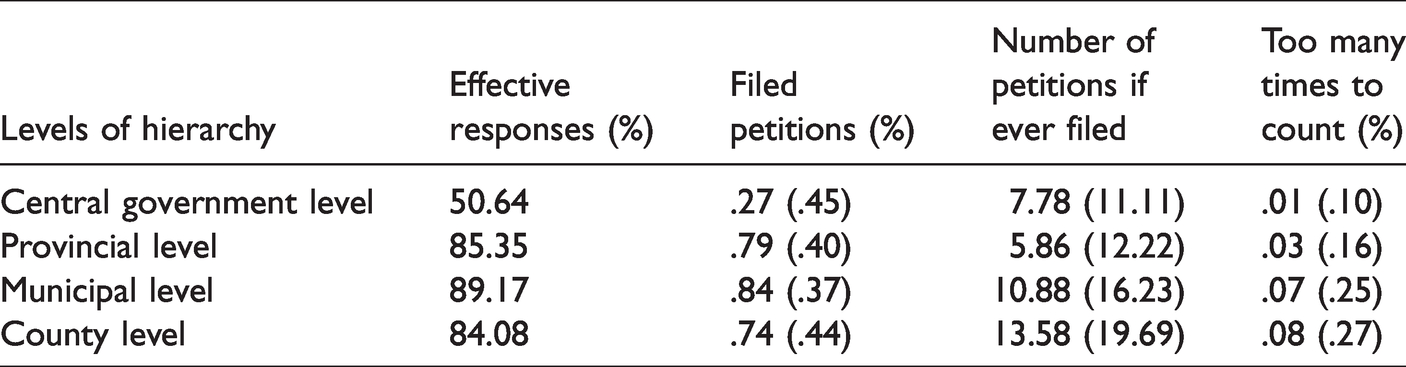
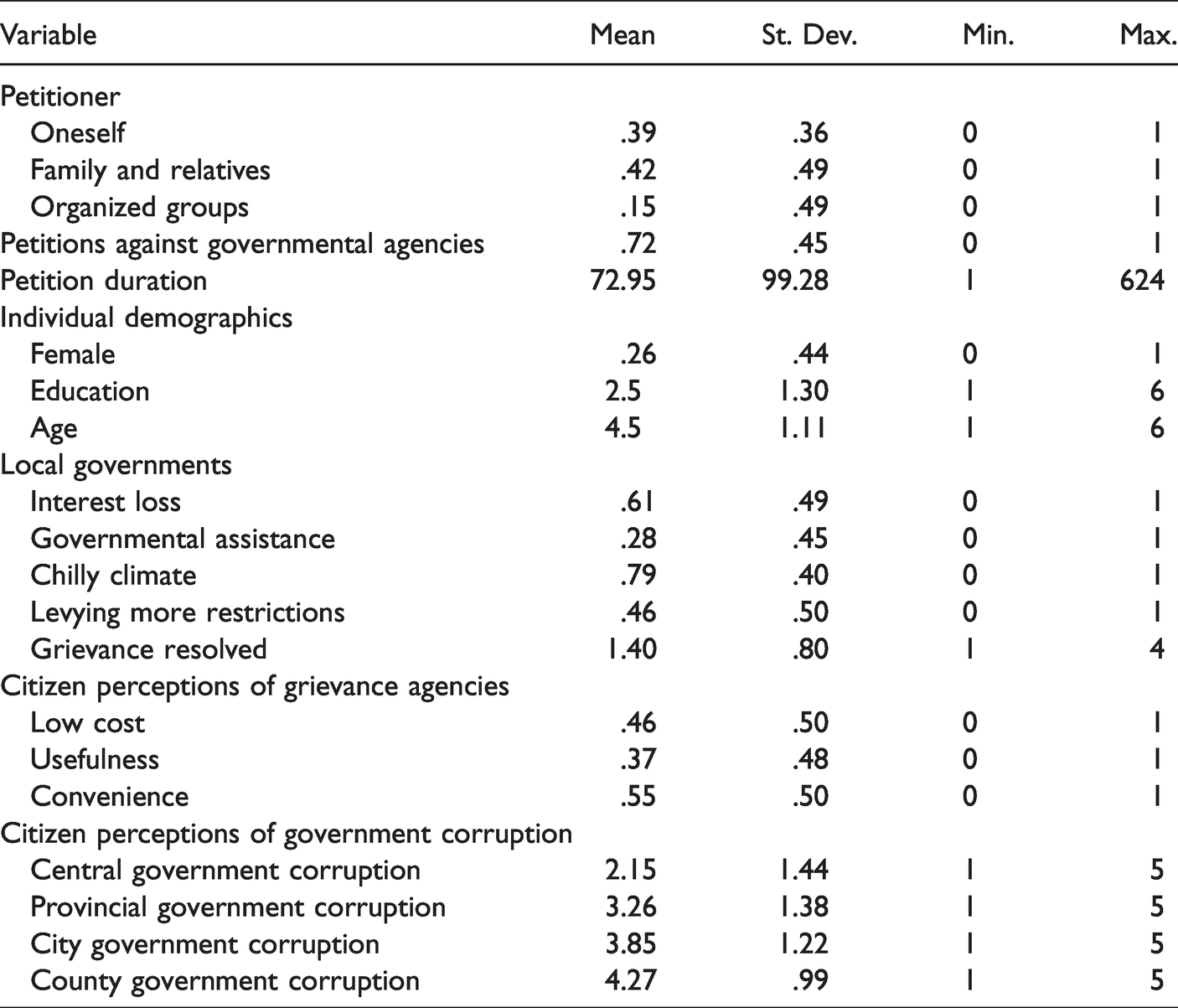
Table 2 presents information on the specific visit in March 2018, as well as responses afterwards. One-person petitions accounted for 39% and petitions involving family members, close relatives and acquaintances numbered about 42%. Approximately 15% of petitions were filed by organized groups. Most petitions were filed against governmental units, as was evidenced by 72% of such cases in the sample. Petitioning proved to be a long journey since the average duration was six years, with some extending to over a decade. In this sample, 26% of petitioners were female. The average level of education was slightly less than high school and the average age was around the 50s.
Descriptive statistics of grievance petitions.
Isomorphic responses within grievance agencies
Table 3 maps how petitions were responded to by grievance agencies. For the specific visit in March 2018 to the provincial administration, 18% were denied and 17% received information assistance. More than half of petitions (60%) were transferred to other administrative units. Roughly 1% of petitioners received some compensation and 1% suffered loss and punishment. The majority of petitioners filed the same petitions to lower-level grievance agencies before as only 21% were first-time petitioners in the sample. Among repeated petitioners (79% of subjects), 22% were denied and 15% received information assistance. Slightly over one-third (36%) were transferred to other administrative units. A total of 2% of petitioners were compensated, while 4% suffered loss and punishment. Given the hierarchical settings, t-tests show that the provincial grievance agency was significantly more likely to transfer petitions to other functional units and less likely to either compensate or punish petitioners than subordinate agencies. The descriptive statistics provide preliminary evidence that grievance agencies are the equivalents to ombudsmen. Agencies fail to champion wholeheartedly the interests of petitioners, as they impose substantial barriers against petitioners accessing the system and mainly resort to symbolic procedures once they are in the system. Also, agencies are not fully committed to containing the petitioning, but rather play a facilitator role.
Responses from grievance agencies.
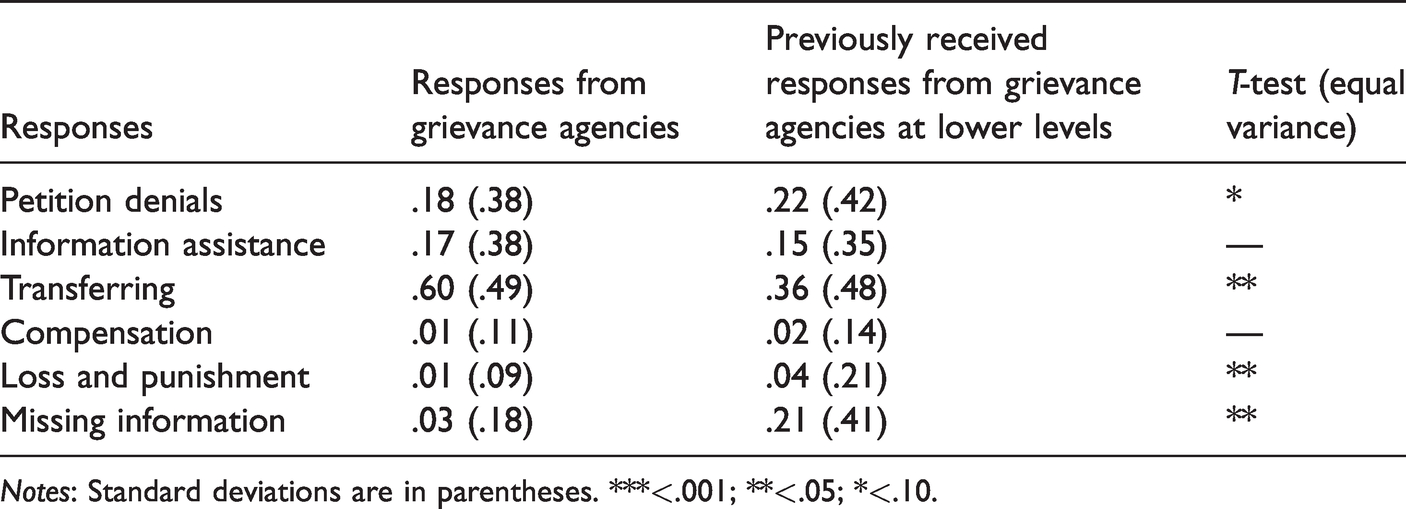
Notes: Standard deviations are in parentheses. ***<.001; **<.05; *<.10.
Table 4 reports logistic regressions with regard to three main practices—petition denials, information assistance and transferring—exploring to what extent these practices are isomorphic and institutionalized across levels. Model 1 shows that petitions denied by lower-level grievance agencies experienced a higher likelihood of denial by the provincial agency, with the odds ratios increased by three times. More prior petitions were also met with more denials on the provincial level. Model 2 suggests that petitions denied at lower levels had less chance to receive information assistance at the provincial level, with their odds ratios reduced by 77%. The same pattern was witnessed for petitions transferred to lower levels (89%). Model 3 finds that petitions transferred to lower levels were more likely transferred again to higher levels, with their ratios rising by 6.6 times. Petitions against governmental agencies saw higher chances of being transferred. Politically active petitioners experienced more transferring, yet those with more prior visits and lower education saw less. Together, petitions denied or transferred to lower levels were more likely to be treated the same by the provincial grievance agency, while in the meantime obtaining less information assistance. The findings demonstrate high levels of structural isomorphism within grievance agencies.
Isomorphic responses within the petitioning system.
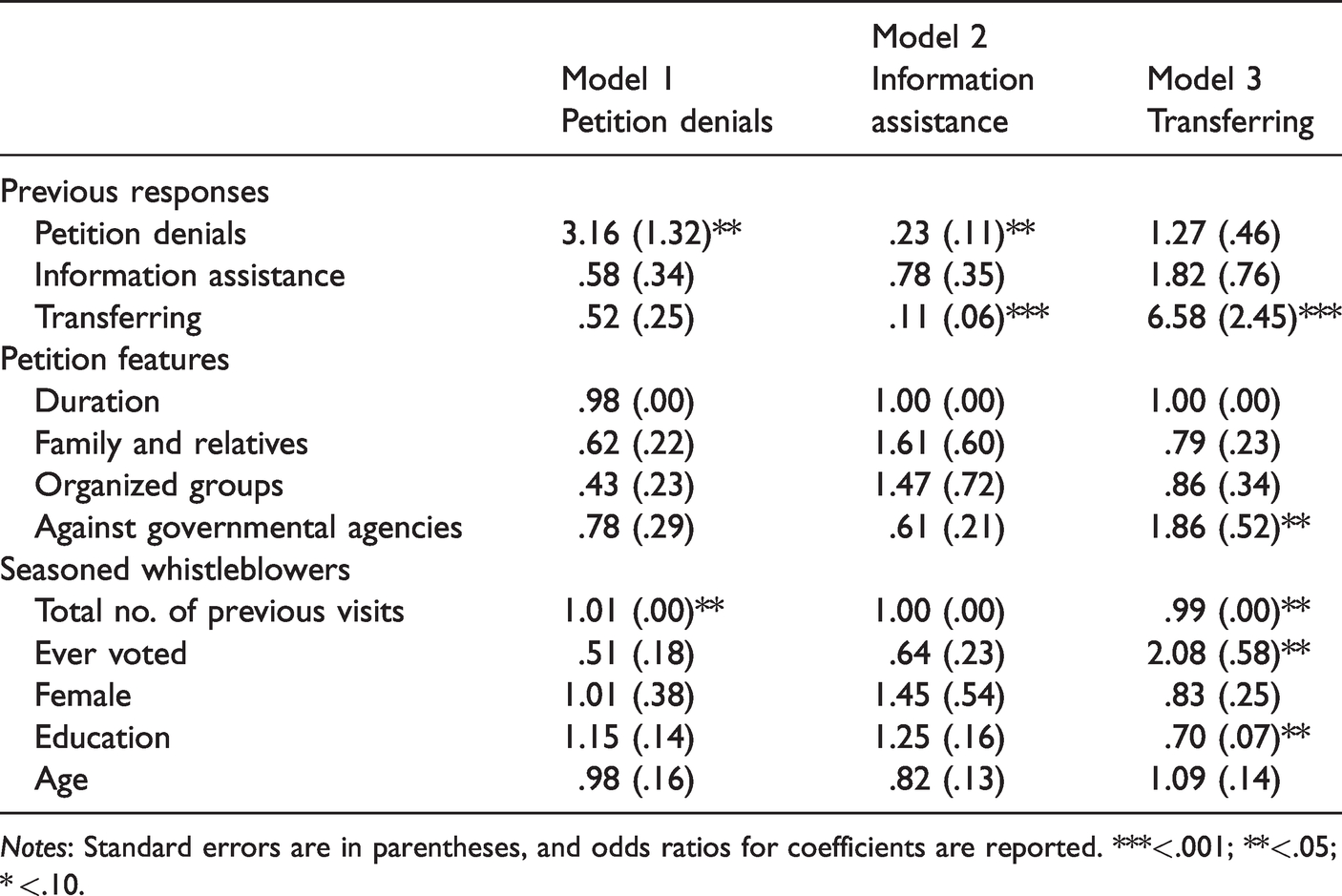
Notes: Standard errors are in parentheses, and odds ratios for coefficients are reported. ***<.001; **<.05; * <.10.
A concern arises as to whether the legitimacy of citizens’ grievances played a role in how their petitions were processed. Some petitions may be driven by ill motives or with illegitimate requests. However, the qualities of petitions, as well as petitioners’ emotions and motives, were hard to identify without digging into the nuanced, context-specific parameters of each petition. Future qualitative studies are warranted to explore different dynamics. In the meantime, the concern does not undermine the perspective of structural isomorphism. Whether or not petitions were reasonable, they were addressed pursuant to working rules and regulations, and received highly similar treatments. Such isomorphism was formed and reinforced as a responsive strategy against overwhelming volumes of petitions. The deference to lower-level decisions was also pragmatic as upper-level grievance agencies often suffer with severe information asymmetry on specific petitions.
Containment from local governments
Local governments are incentivized to contain grievance petitions. Part of the evidence for this is presented in Table 2. Over a year after the specific visit, 61% of petitioners reported the loss of previously entitled or granted benefits, whereas 28% received assistance. A total of 79% felt a chilly climate and 46% had more restrictions levied on them. Thus, petitioners were seemingly subject to multiple containment efforts simultaneously. A total of 74% of petitioners claimed that their grievances were not resolved “at all.”
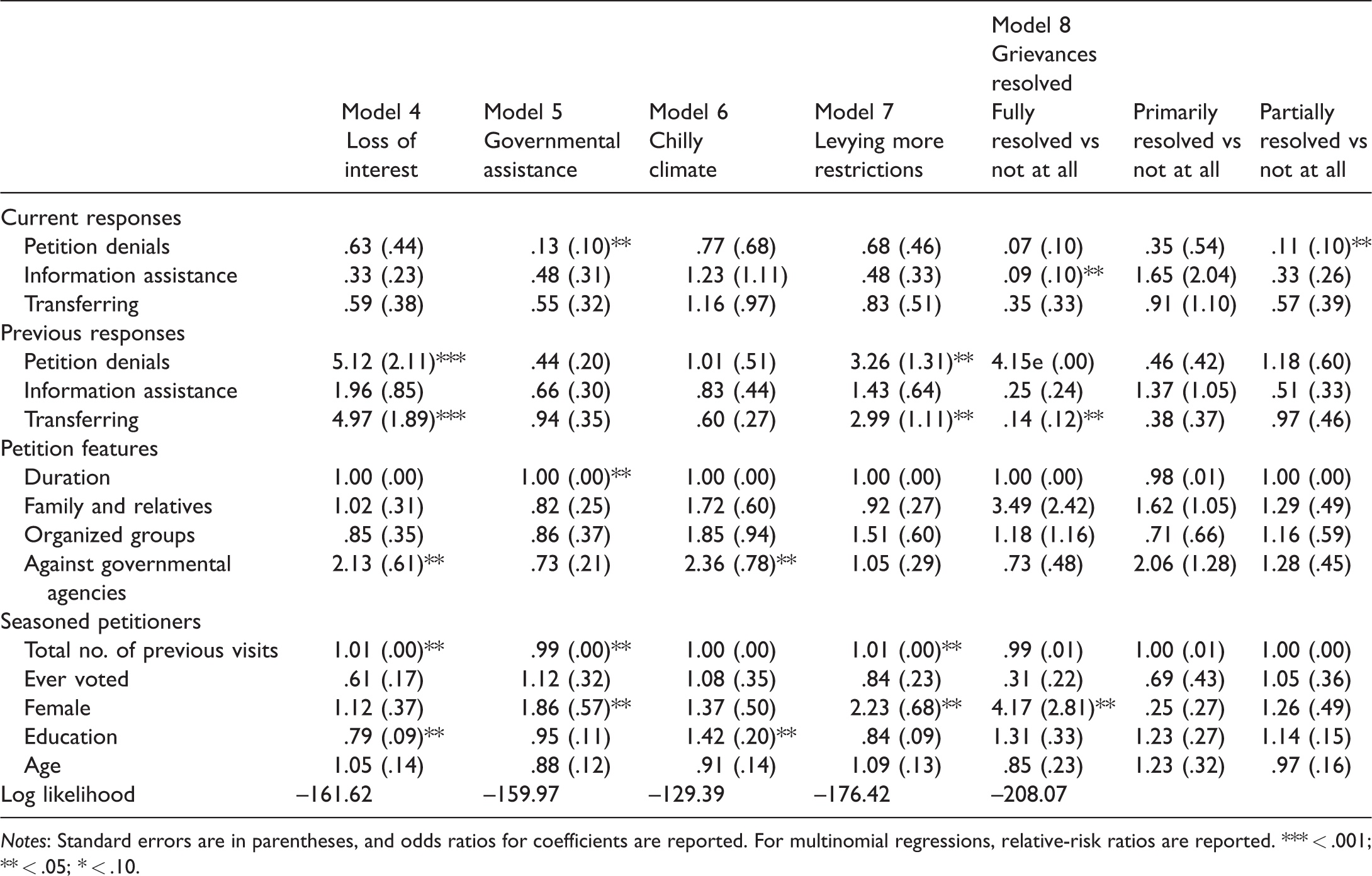
Table 5 runs regressions on local containment (i.e. loss of interest, governmental assistance, chilly climate, and levying more restrictions), as well as on how well grievances were resolved. Model 4 suggests that petitioners who were denied or transferred to lower levels experienced more losses of interest, with their odds ratios increased by roughly five times. Petitioners against governmental units also suffered more losses. Model 5 shows that petitioners denied by the provincial administration received less governmental assistance, with odds ratios reduced by 87%. Longer durations and those with more prior visits ended up with similar treatments. Petitioners against governmental units experienced a chillier climate, with their odds ratios increasing by 236% (Model 6). Model 7 shows that more restrictions were levied on petitioners when their petitions were denied or transferred to lower levels, with their ratios increased by roughly three times, respectively. Hence, a consistent pattern is manifested that petitioners were heavily contained by local governments.
Managing grievance petitions by local governments.
Notes: Standard errors are in parentheses, and odds ratios for coefficients are reported. For multinomial regressions, relative-risk ratios are reported. *** < .001; ** < .05; * < .10.
Model 8 explores the extent to which grievances were resolved a year after the visit, suggesting that most petitioners were out of luck. Those who received information assistance from the provincial agency or saw their cases transferred to lower levels were less likely to have their grievances fully resolved, with their odds ratios reduced by approximately 90%. Petitions denied by the provincial agency were (90%) less likely to be even partially resolved. Together, petitioners struggle with unresolved grievances and intensified local containment, fueling more adversity against local governments.
Dynamics of multiple logics
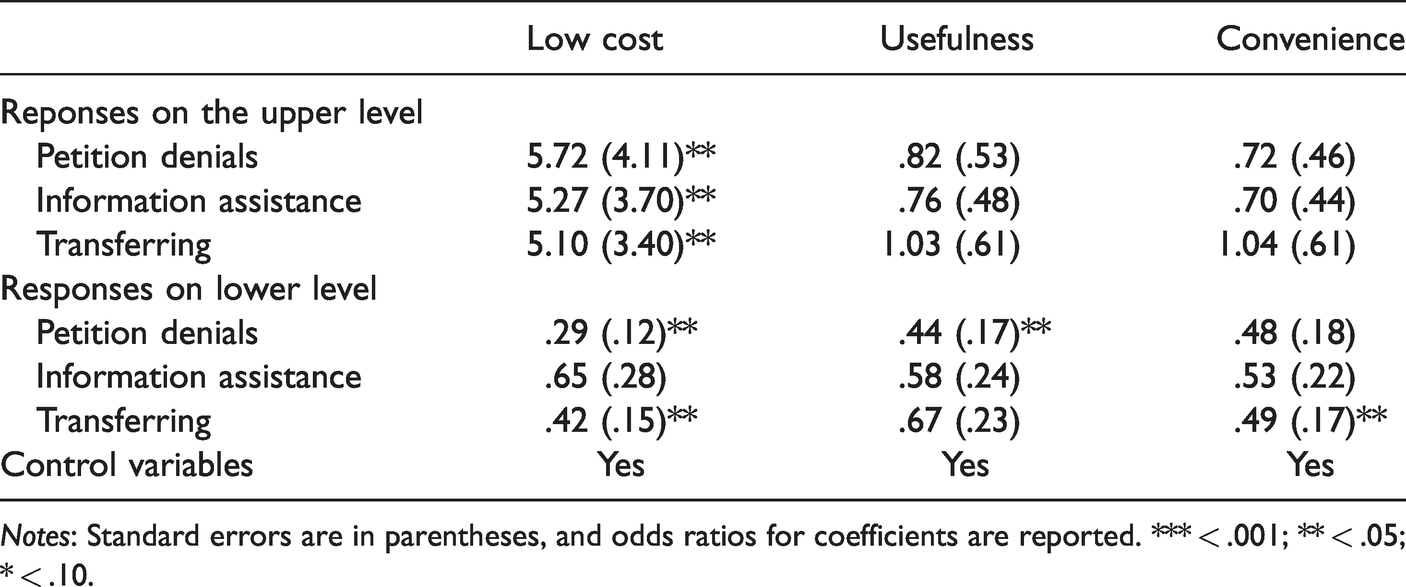
One question remains as to why petitioners still flood the system with grievances. Attention is hereby shifted to cultural aspects of institutional logics. Interviewees were asked about their perceptions of the petitioning system, particularly on features such as low cost, convenience, and usefulness. Table 2 presents descriptive statistics. Over a year after the specific visit, 46% of petitioners agreed that petitioning is low cost, while 55% thought highly of its convenience. A total of 37% perceived petitioning as a useful venue, despite procedural barriers and local containment. Table 6 presents logit regressions on three features. Petitioners who were denied or transferred by the provincial agency were more positive on the low-cost feature, with their odds ratios increased by over five times. Nevertheless, when their cases were processed in the same fashion by lower agencies, they were significantly more negative on this feature. Those being denied by lower agencies saw less usefulness of the system and those being transferred by lower levels were more negative on the convenience feature. Reaching upper levels increased citizens’ favorable attitudes toward the petitioning system.
Assessment of the petitioning system.
Notes: Standard errors are in parentheses, and odds ratios for coefficients are reported. *** < .001; ** < .05; * < .10.
Interviewees were asked to assess the extent of corruption across different levels of government, a good proxy for political trust (Li, 2004, 2008). Petitioners viewed central government to be the least corruptible, with ascending degrees through provincial, municipal, and county governments (see Table 2). Further regressions show that petitioners did not project their containment experiences onto their assessment of governmental corruption for central and provincial levels, and that despite local containment, petitioners saw higher levels of governments to be less corruptible (regression results not reported). The findings evidence that high trust in upper-level governments further more petitions into the system (Li, 2004, 2008) and petitioners could be acting more strategically (Bruckner, 2008).
Discussion and conclusion
Inspired by the institutional logics perspective, this inquiry explores the paradoxical cycles in citizen grievances in China: the simultaneous growth of grievance petitions and local containment. Based on a survey of over 300 onsite petitioners, the study finds that involved parties embrace different institutional logics and thus engage in locked-in behaviors. Citizens embrace the grassroots logic, flooding petitions into the system and climbing the grievance pagoda. Following the state logic, local governments are engaged in strong containment, subjecting petitioners to a loss of interest, chilly climate and penalty, though also accommodating a small fraction. In face of competing demands, grievance agencies are the equivalents of ombudsman and resort to procedure-oriented isomorphic practices: denying some cases, providing information assistance in others but predominantly transferring petitions to other administrative units. Despite procedural mazes and local containment, high proportions of petitioners still think that the petitioning system is low cost, convenient, and useful. Petitioners also demonstrate more political trust in the top bureaucracy, providing cultural support for escalating petitions up through the hierarchy. The coexistence of and interactions among multiple institutional logics thus helps to unfold the paradox of citizen grievances.
Our findings suggest that grievance agencies adopt highly isomorphic practices and that three main practices fail to resolve citizens’ grievances. In the meantime, petitioners who come onto the radar of local governments are subject to further containment. Those denied or transferred by lower grievance agencies experience more losses of interest or local restrictions, and when denied by the provincial grievance agency, their chances of accommodation are also reduced. Studies suggest that local containment triggers more petitions due to the losses and restrictions levied (Bruckner, 2008; Yang, 2017). Yet, despite negative consequences, petitioners show high trust in the top bureaucracy and favorable attitudes toward the petitioning system. With cultural and institutional support, citizens keep rushing in more petitions, particularly to higher levels. The cycles are formed and not easy to break, as involved parties all follow their institutional logics. Petitioners likely receive assistance from local governments, yet such assistance may best be seen as an integral part of containment against petitioning.
Our inquiry suggests that the cycles of grievance petitions are deeply embedded into institutional logics. There seem no easy exits, but rather deadlocks that multiple parties feel compelled to game against each other, reinforcing adversarial patterns. Citizens file enormous numbers of petitions (on average 45 times) and escalate their cases to higher authorities. Yet, a year after visiting the provincial grievance agency, up to 75% of petitions were not resolved at all. Despite local containment efforts, petitioners see cultural and institutional support, and are thus locked into petitioning activities. Similarly, prescribed by the state logic, local governments are deeply locked into strong containment. Grievance agencies are pressured by both citizens and the bureaucracy. Their needs for meeting competing demands push for highly isomorphic practices, which help little to break the cycles but likely fuel more adversity between citizens and local governments.
A potential challenge is that petitioners go out of their way to politicize their problems and broaden their grievances, and often engage in collective petitioning so as to generate elite involvement (Lu, 2011; Shi and Cai, 2006). By resorting to political influence and elite involvement, grievance petitioning serves as a multipurpose governance tool, yet provides little benefit directly to petitioners. Those poor and marginalized groups tend to bear a disproportionate share of such burden.
Limitations and implications
The findings have a few caveats. First, survey respondents were more reflective of seasoned petitioners. Their perceptions about grievance agencies and local governments could be biased. However, the findings lend strong support for the prevalence of grievance petitions in China, as well as the different logics manifested for the involved parties. It is noticeable that those who struggled most still showed favorable attitudes toward and strong “stickiness” with the petitioning system. Seasoned petitioners are not deterred from entering the system, but rather act more strategically. The system is likely challenged, particularly when other petitioners are not well managed and transform themselves into seasoned ones.
Second, our findings are anchored in one provincial grievance agency, and are therefore hard to corroborate without gaining access to other provincial counterparts. Third, the reductionist approach to different institutional logics may raise some concerns. For instance, local governments embrace the state logic, often prescribing containment efforts against petitioners. Yet, in light of the same logic, the upper-level bureaucracy may release favorable regulations mitigating the causes of citizen grievances. To what extent and in what forms different institutional logics are manifested across different levels solicits more research. Future studies are also warranted to address why citizens still hold favorable attitudes to the petitioning system despite their predicaments and to corroborate the generalizability of our findings. This study is an early effort to explore the dynamics of citizen grievances, which despite its popularity and prevalence in China, had not been well addressed in extant literature.
The implications are not very straightforward, but informative. The likely cycles between petitioners and local governments can hardly break if institutional logics fail to change. Holding local governments responsible for the mere occurrence of grievance petitions, regardless of the nature of petitioning, actively encourages local governments to suppress petitioners. Studies also document that petitioners tend to game the system by increasing the use of “more mobilized, extreme, mass petitioning tactics” (Michelson, 2007; Minzner, 2006; Shi and Cai, 2006), which present stronger threats to local bureaucrats and invite more containment. The patterns of negative reinforcement for both petitioners and local bureaucrats are deeply troubling and call for effective reforms.
Footnotes
Declaration of conflicting interests
The authors declared no potential conflicts of interest with respect to the research, authorship, and/or publication of this article.
Funding
The authors received no financial support for the research, authorship, and/or publication of this article.
