






Abstract
Maturity models (MMs) are used as a reference framework in various fields. In the public sector (PS), the principles of good governance have necessitated an evolution in financial reporting. This study aimed to design a model of accounting and financial maturity for PS reporting units. This study has a mixed-methods design. The initial MM was designed using a systematic review and expert panel discussions. Then, five focus group interviews were held over seven sessions. Next, a questionnaire was distributed among Iranian PS experts to validate the components of the MM. Thirty-two people filled out the questionnaire. A binomial test was used to validate the dimensions of the model. The outcome of this study was the design of a MM for accounting and financial reporting in PS units. The model was designed in five levels and includes eight dimensions, namely leadership, budgeting and financial planning, financial leadership and supervision, efficiency and effectiveness, rules and regulations, financial reporting, human capital and information technology. This model can be used as a basis for assessing the performance of PS units and to implement good governance in organizations. This model is applicable to all developing countries that utilize the revised International PS Accounting Standards and seek to establish a new PS management approach and performance-based budgeting.
Introduction
Since the late 1970s, developed countries and subsequently developing countries have been widely reforming their public sectors (PSs) (Munzhedzi, 2021). These evolutions commenced following the emergence of the new public management approach (Nyamita et al., 2015). Revising the role of government in society and the increasing demand for information transparency, accountability and integration demonstrate the need for a change in the Financial Management (FM) system of the PS (Alqooti, 2020).
Maturity models (MMs) have been introduced in various spheres of management, such as performance management and organizational capability (Jääskeläinen and Roitto, 2015; Al-Matari et al., 2021). Research shows that MMs can have a positive effect on organizations by describing the optimal characteristics (Bititci et al., 2015). Since organizations are constantly faced with pressures to gain and maintain a competitive advantage, identify ways to curb costs, improve quality, reduce time expenditures, etc., MMs are developed to help them (De Bruin et al., 2005).
Presenting accounting information in a more user-friendly format can enhance politicians’ comprehension of the accounting information (Budding and Helden, 2022). Thus, employing a maturity model could be a significant development in this field. In Iran, budgets and financial reports of PS organizations are available to the public, therefore, improving information can improve the governance In this regard, the development of MMs for financial reporting in the PS improves reporting in PS organizations and enhances performance measurement in these organizations and thus affects the achievement of good governance. New public management has paid attention to the efficiency and effectiveness in the PS and drawn attention to maturity in the FM of the PS.
This study seeks to develop a model of FM maturity for PS reporting units. Although this research has been carried out in Iran, its results can be used in other countries as well. In recent years, a move towards new FM has commenced in the PS in Iran. A performance-based budgeting system has been put on the agenda of governmental organizations in recent years. Iran is one of the countries that use the revised International PS Accounting Standards (IPSAS). Based on the annual status report (2021) by the International Federation of Accountants and the Chartered Institute of Public Finance and Accountancy, out of a total of 165 countries whose information is available, 50 countries use the cash basis, 66 countries the semi-accrual basis and 49 countries the accrual basis.
Prior research shows that IPSAS implementation leads to higher transparency and accountability in the resources allocation or the full costs of government activities and the provision of governmental statistics such as GFS, resulting in better financial and investment decisions for information users (e.g. Cuadrado-Ballesteros and Bisogno, 2021). Also, research shows a negative relationship between IPSAS implementation and economic policy uncertainty (EPU), which is in line with this notion that IPSAS enhances transparency and accountability, and therefore reduces EPU (Hesaezadeh and Behbahaninia, 2022). Maturity models have proved to be highly advantageous in identifying strengths and critical areas that require improvement (Jääskeläinen and Roitto, 2015). They are also recognized as tools that create a comparative basis between organizations based on comparable criteria (Garengo et al., 2005). Previous research has shown that MMs can have a positive impact on organizational performance (Bititci et al., 2015).
This study contributes to the existing knowledge in two ways. First, given the recent developments in PS laws and regulations, success in implementing IPSAS and the principles of new public management and good governance (Alqooti, 2020) demands strengthening the accounting and FM units of the PS, and this MM can help improve the aforementioned units. Second, the published MMs mainly focus on internal controls (Marx et al., 2012), management accounting (Lebedev, 2019) and auditing (Mantelaers and Zoet, 2018). No scientific and methodological documents on the existing FM models (e.g. the US Department of Treasury, 2017; the UK National Audit Office (NAO) (2012); McCarthy, 2018; New Zealand Government Enterprise Architecture, 2018; Wellington Audit Office, 2012) have been published either. These models are generally designed by organizations, institutions and professionals, and there is little documentation on how the model is designed, whether it is theoretically supported, and whether it has been tested, validated and generally accepted (Garcia-Mireles et al., 2012). Moreover, previous studies (e.g. Ghashghaei & Mashayekh, 2018) are applicable to private sector organizations. In addition, the designed model is based on detailed studies of 11 MMs and seems to have good theoretical support.
Previous research (De Bruin et al., 2005; Pöppelbuß and Röglinger, 2011) has emphasized that MMs can be adopted for descriptive, prescriptive or comparative purposes. Therefore, organizations can use the results of this research to evaluate the excellence of their PS units. The findings of this study can also be used by institutions and ministries to grant excellence awards to their top PS units. Today, excellence awards are given by institutions such as the Asian Productivity Organization (2016). After its introduction section, this paper reviews the research literature on PS FM and PS maturity models. The next section explains its research method, and finally, after presenting the model, derives conclusions and offers suggestions.
Theoretical foundations
PS FM
FM must design the organizational structures and controls needed to effectively fulfill the responsibilities and tasks associated with the financial domain (Patrick et al., 2017). The existence of appropriate accounting systems and transparent budgeting (Jovanović and Vašiček, 2021), an internal audit system (Nyakundi and Oluoch, 2021) and external monitoring and auditing (Patrick et al., 2017) constitute the dimensions of financial accountability and governance in the PS.
Various studies have been conducted on PS FM with a focus on governance, performance and management control mechanisms (Rana et al., 2019; Visser, 2016), and also on elements such as budgeting, financing, cost management, accountability, financial and audit reporting (Visser & Erasmus, 2013), the credibility and reliability of budgets, transparency in public financial affairs, asset and debt management, financial strategies and budgeting based on policies, predictability and control for budget implementation, accounting and reporting, external auditing and supervision (PEFA Secretariat, 2016), budget management, financial control, value management, governance and accountability (Wellington Audit Office, 2012).
Iranian PS FM
The financial reporting structure in Iran is centralized and has a central government. In recent years, Iran has had a growing trend in terms of achieving new public management. In Iran, from early 2009, to pave the way for an evolution in the PS accounting system, a Standards Development Committee was formed, and six accrual-based standards using the International Federation of Accountants model were approved by early 2015. From 2015 to 2017, eight other standards were also approved. Iran is among the countries that employ the revised IPSAS.
In Iran, owing to the increased volume of governmental activities in the PS, the PS size has increased significantly. The budgeting system of the PS is an operational budgeting system that is carried out on a cash basis. Most of the time, the operating budget of the country is balanced, and most of the institutions must return the funds received from the treasury that are not used to the treasury.
Prior to 2015, the basis for identifying financial events in the PS was adjusted cash. Since 2015, PS accounting standards on an accrual basis have been enforced, which resembles IPSAS greatly. These standards are being implemented in Iran, and according to the roadmap of the Iranian Ministry of Economic Affairs and Finance, by early 2025, accrual-based accounting will be fully implemented in this country. Another fundamental evolution has been the legal and legislative requirements regarding the establishment of a performance-based budgeting system (including the requirement set by the Sixth Five-Year Development Plan of the country and performance-based executive budgeting guidelines annexed to the Budget Circulars of 2017–2021). Therefore, it seems that the infrastructure for improving transparency and accountability is already in place in Iran, and FM MMs can be used for other developing countries with similar conditions to Iran.
MM
Over the past five decades, several MMs have been proposed that differ not only in the number of stages, factors affecting maturity and areas of intervention (Rocha, 2011), but also in quality and applicability (Pöppelbuß & Röglinger, 2011). Although the defined MMs have different levels, the most common of them are five-level models (De Bruin et al., 2005).
Maturity models help the organization identify its strengths and weaknesses compared with an independent and established model (Soin and Collier, 2013). Furthermore, by integrating formalism into activity improvement, internal organizational decision-makers can determine the extent to which potential benefits have been realized. Additionally, conflicts of interest can be avoided using a measurement model developed for the organization (Fraser and Vaishnavi, 1997). Maturity models serve as a reference point for assessing capabilities and a roadmap for improvement (Carvalho et al., 2019).
FM maturity models
Various MMs have been proposed for FM, including the US Department of the Treasury (2017) MM, the UK NAO (2012) MM, the McCarthy (2018) model, the New Zealand Business Capability (2018) MM and the Ghashghaei & Mashayekh (2018) model. The US Department of the Treasury (2017) MM emphasizes three areas, including operational efficiency, financial and reporting systems, and financial health. The NAO introduced a FM MM in 2012 and allowed it to be adopted as the basis for the McCarthy model (2018) for use in the Irish PS. The two models focus on financial leadership and governance, financial planning, information for decision-making, financial supervision and forecasting, and financial reporting and performance. The New Zealand Business Capability (2018) MM covers various domains such as planning and strategy, communications, management and human resources, FM, relationship management, knowledge and information management, risk management, ICT management and evolution management.
According to Becker et al. (2009), the MMs can be considered as valuable tools that aid in resolving the challenges associated with determining a company's current status quo in terms of its capabilities and deriving appropriate measures for improvement. As such, one of the most important applications of the financial MMs in PS reporting units is that they form the basis for awarding excellence in FM and accounting of the PS. The excellence award encourages successful units and improves the competitive environment among PS managers. PS excellence awards have been granted since 2002 by various institutions, including the Institute of Public Administration Australia and the Institute of Public Administration of Canada.
Research methodology
The design science research method was used in this study based on the methodology proposed for the development of MMs by De Bruin et al. (2005). The stages of work will be briefly explained next.
Systematic review
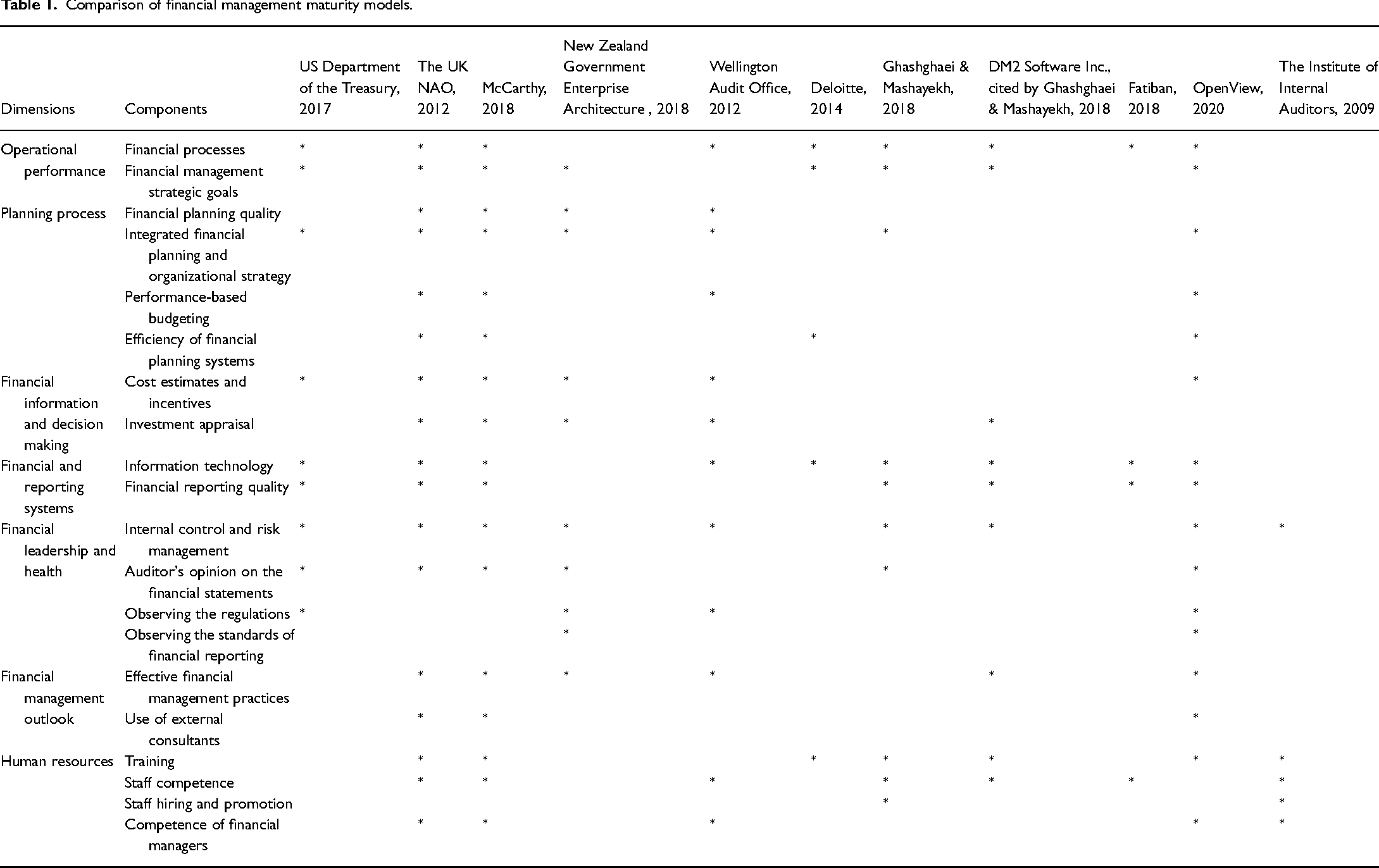
In the present study, the Tranfield et al. (2003) and Fisch & Block (2018) strategies were used to review the literature. To find English texts, the word “maturity” was combined with other relevant words such as “accounting”, “financial”, “public sector” and “government”. In the next step, searches were conducted on databases such as Web of Science, Scopus and Google Scholar as well as key websites and institutions in the PS globally. The search results with the above keywords showed 304 papers on Web of Science and 476 papers on Scopus. After deleting the duplicate papers, the researchers began to study the rest of the articles. The criterion for evaluation of the articles was that they examined a MM related to FM and met the objectives of the present research in developing the MM. Despite the wide range of papers available on MMs with the above keywords, the papers indexed in these two databases did not deal with the subject of the present study, i.e. a MM for FM. As for Google Scholar, this database contained only two papers in Persian by Ghashghaei & Mashayekh (2018) on the maturity level of private sector organizations. Other MMs (i.e. the US Department of the Treasury, 2017; the UK NAO, 2021; McCarthy, 2018) had been designed by the public and private sectors and ministries for use by institutions. Ultimately, based on 11 MMs retrieved from the articles, the main components and dimensions of FM in the PS were identified (Table 1).
Comparison of financial management maturity models.
Developing an initial MM
Based on the literature review and the 11 selected models, the researchers selected the levels, dimensions and components of the MM for PS FM and accounting in line with the conditions of the PS in Iran. Next, they developed an initial five-level MM (Figure 1).
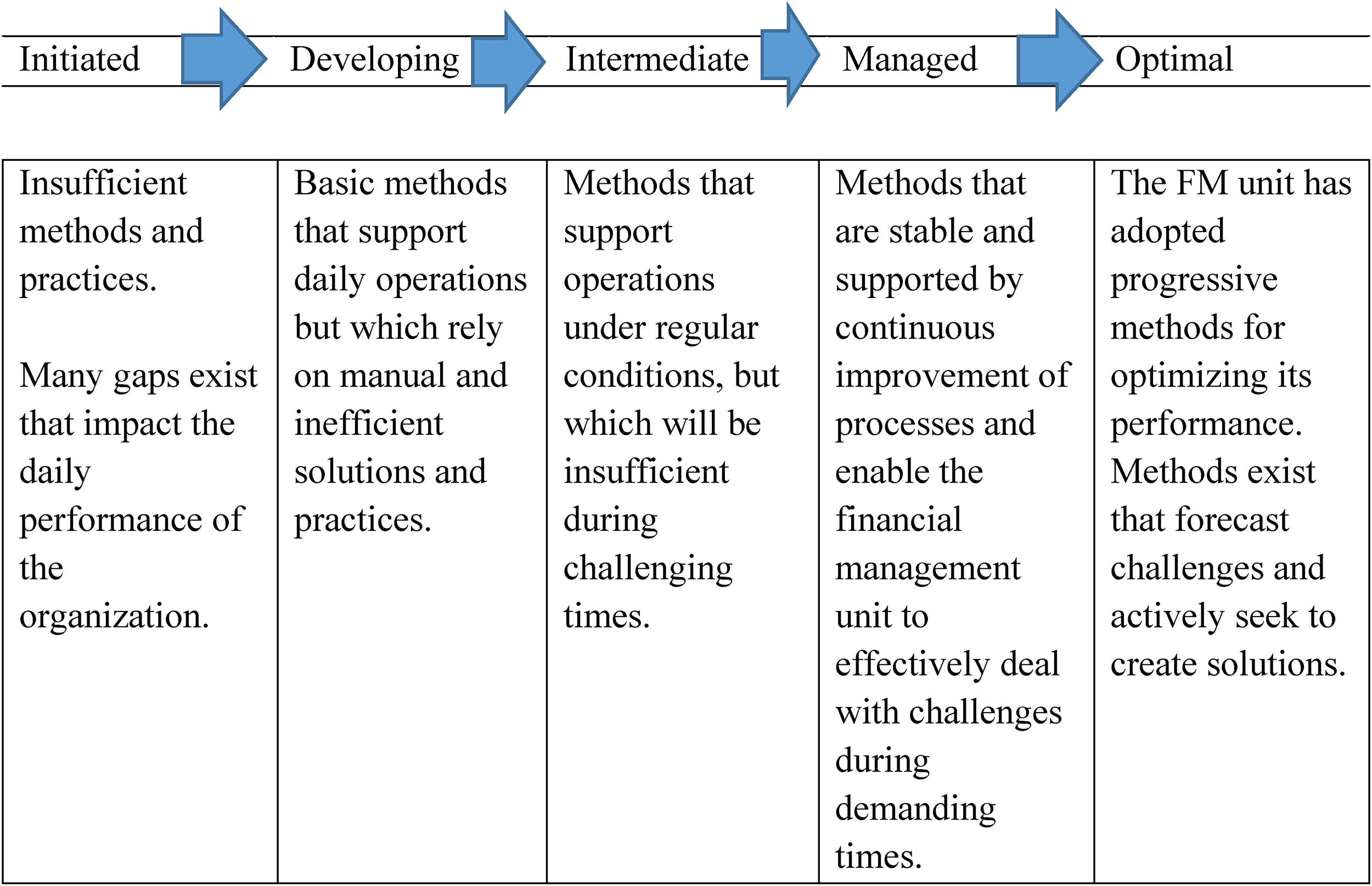
FM maturity model levels for public sector (PS) reporting units (according to The UK NAO, 2012; The US Department of the Treasury 2017; McCarthy 2018). FM: financial management.
The Ministry of Economic Affairs and Finance determines policies and guidelines for PS reporting units in Iran. According to the governance structure of Iran, the granting of excellence awards to top PS units will be assigned by this ministry. Then, to reach consensus on the dimensions, components and levels of the MM, a review panel was formed with researchers and six PS experts from the Ministry of Economic Affairs and Finance of Iran, which will be using the developed MM to grant an Excellence Award to the top units of the PS. In this meeting, the dimensions, components and levels of the MM selected by the researchers were discussed. Based on the meeting results, the initial MM was developed with five levels, seven dimensions and 26 components. To ensure that the dimensions and levels of the MM were appropriate, they were discussed among focus groups.
Setting up focus groups
Focus group interviews were used in this research. Focus groups enable the participants to listen to and give their feedback on different opinions discussed (Beyae & Nicholl, 2000). In this study, semi-structured interviews were used in focus groups. The focus groups in this study included people with the required expertise in diverse fields to voice their opinions and discuss all the identified dimensions of the initial model. A total of 75% of the experts had over 10 years of experience. The focus group participants included 12 financial controllers, financial managers and deputy financial managers (four from the Ministry of Economic Affairs and Finance and eight from reporting units, two members of the Standards Committee, five financial and software system analysts and managers, and one auditing director).
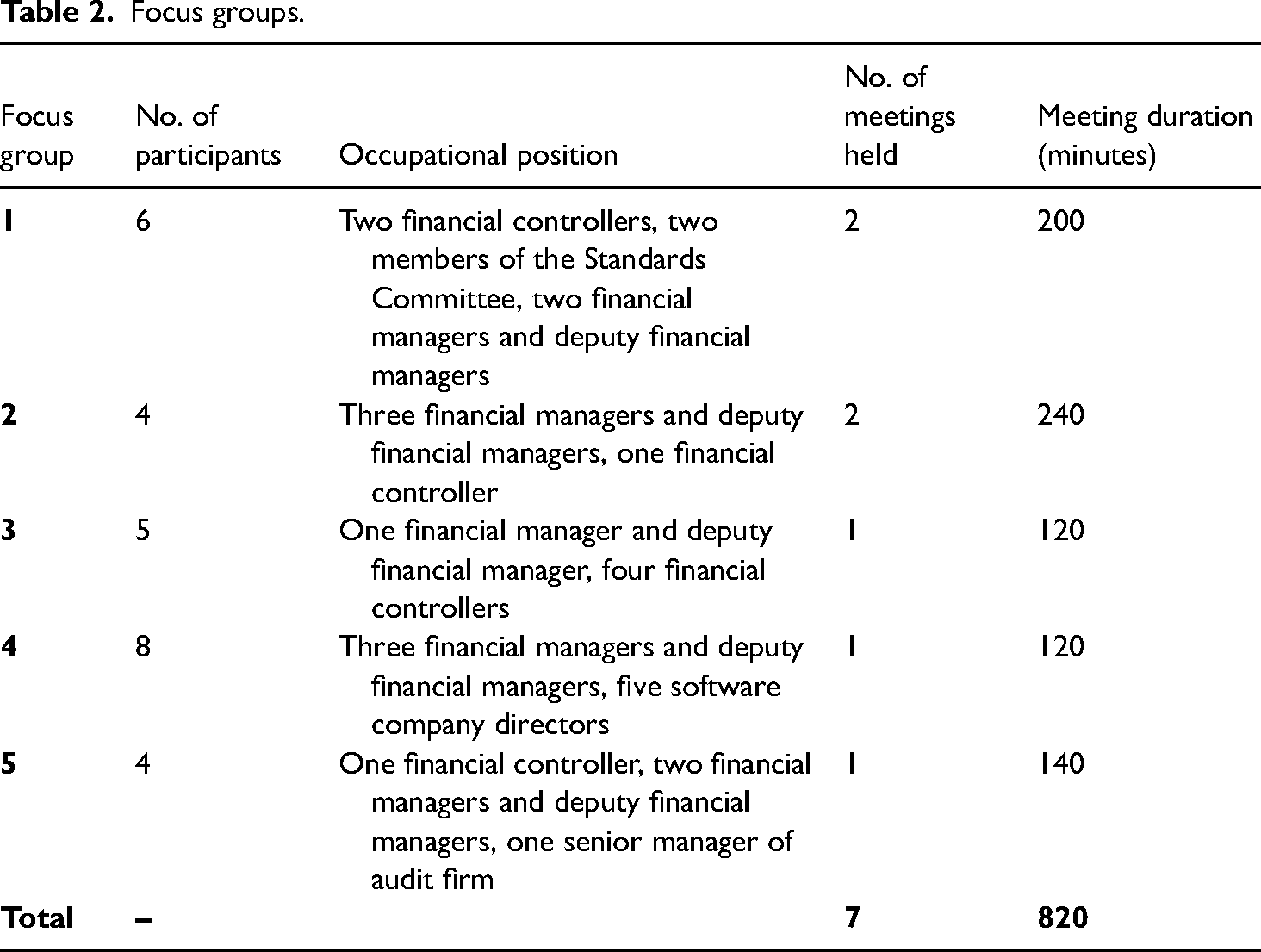
Efforts were made to discuss all the dimensions of the MM in the discussion meetings, since the participants had similar and diverse expertise that could help improve the synergy (Table 2). The interviewees were asked to give their views on the levels, dimensions and components of the initial MM and add any dimensions and components which may be missing from the draft. All the meetings were recorded with the permission of the interviewees. The interview process was ended after reaching data saturation. The interviews were analyzed using a thematic content analysis method which is qualitative data analysis.
Focus groups.
FM and accounting MM for the PS
In the focus group meetings, five levels were approved for developing the MM. The MM developed as a result of this research is shown in Table 3. Financial managers must play their part in strengthening the efficiency and effectiveness of their organization and value creation. Many researchers have focused on risk management in good governance, strategic decision-making and management control systems (Soin and Collier, 2013; Woods and Linsley 2017). According to the focus group meetings held on the maturity model, the “leadership” dimension was discussed with the components of project management processes, investment evaluation, and the role of the financial authority in risk management.
A maturity model (MM) for FM and accounting in the public sector (PS) of Iran.
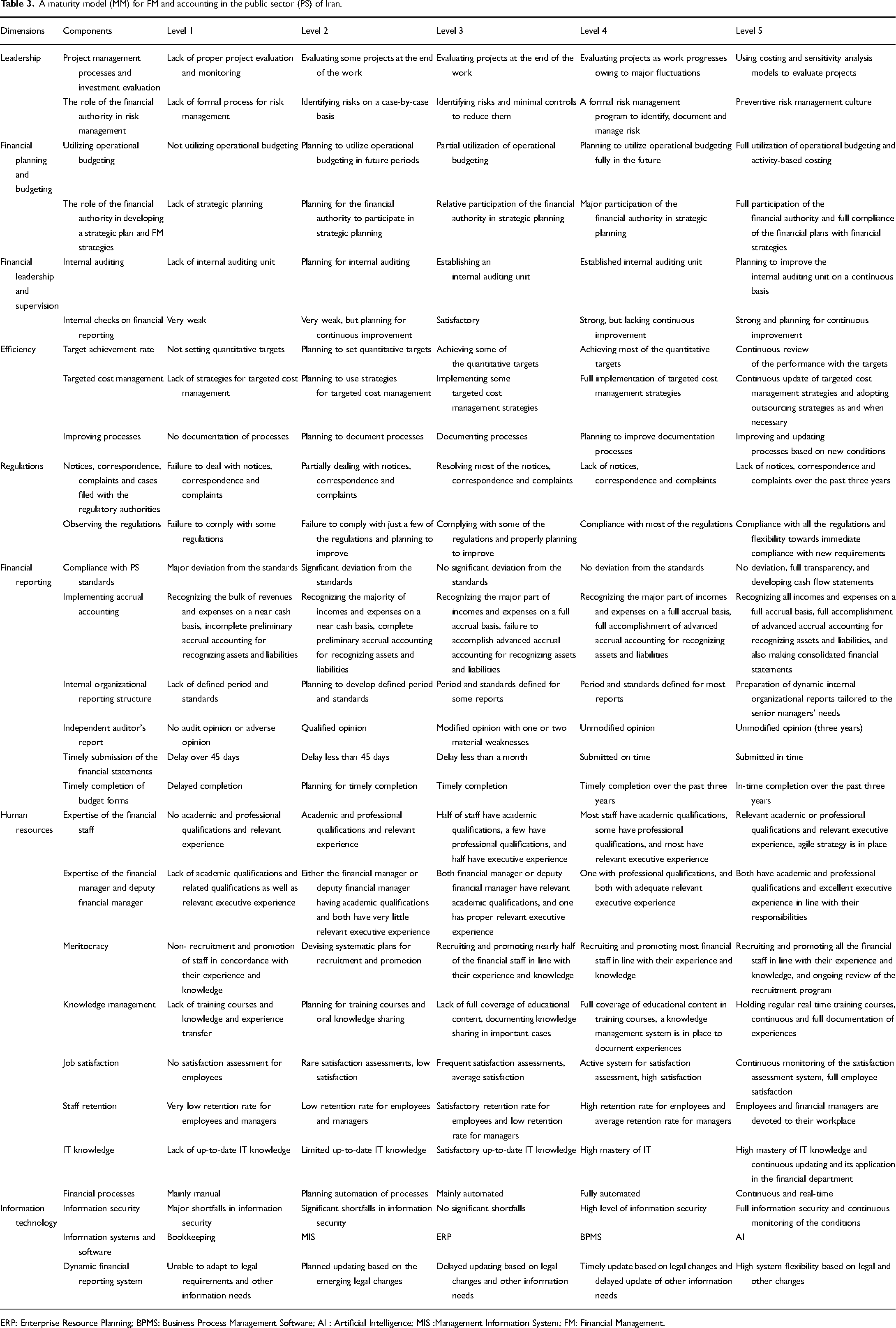
ERP: Enterprise Resource Planning; BPMS: Business Process Management Software; AI : Artificial Intelligence; MIS :Management Information System; FM: Financial Management.
The use of operational budgeting and the role of the financial authority in formulating strategic plans and FM strategies have been highlighted in the “financial planning and budgeting” dimension. In Iran, reforms in the budgeting system and the purposeful linking of resources to operational programs have been considered in shaping strategic policies for the Third Development Plan of the country. Consequently, from 2001 onwards, the government has been obliged to take essential measures in each annual budget bill to reform the budgeting system, with the focus mainly placed on reforming, preparing and adjusting the budget in an operational manner (Budget Law, 2001).
In the “financial leadership and supervision” dimension, emphasis was placed on having internal auditing and internal controls in the PS of Iran such that organizations in this sector can continue to grow further. The “efficiency and effectiveness” dimension was also discussed in the MM with the components of goal achievement, targeted cost management and process improvement.
The rule of law, the existence of legal frameworks and independent supervisory authorities were also proposed as some of the principles of good governance (Algotti, 2020). The Supreme Audit Court of Iran is a government agency responsible for monitoring PS organizations to ensure compliance with laws and regulations. Given that Iran is in the process of implementing the modified IPSAS standards, implementing accrual accounting according to the Ministry of Economic Affairs and Finance roadmap was forecast in the model. Considering that internal reporting by organizations is an important factor in optimal decision-making, efforts were made for the frequent application of internal organizational reporting in the financial reporting dimension.
The employees of a reporting team are its key assets. If the PS financial reporting management can use experienced employees and competent managers, it will be able to take long strides in a short time on the path to developing financial discipline in the country (Prasodjo, 2019). Thus, “human resources” were regarded as the seventh dimension in the MM. As the last dimension, information technology (IT) has been defined with the components of financial processes, information security, information systems and software and dynamic financial reporting systems. These instances underline the significance of updating financial and information systems in the PS.
Model validation
To validate the components of the MM, a questionnaire was prepared. After its validity was assessed, the questionnaire was purposefully distributed among PS experts who had appropriate experience in the PS and research topic. For this purpose, 47 questionnaires were distributed and 32 questionnaires were collected. Of these, 91% of respondents were men and 66% of respondents had over 15 years of work experience in PS. The participants included seven financial controllers, 10 financial managers and deputies, two members of the standards setting committee, nine auditors, two university professors and faculty members and two financial system managers and analysts. Some 62% of experts were external and not information providers.
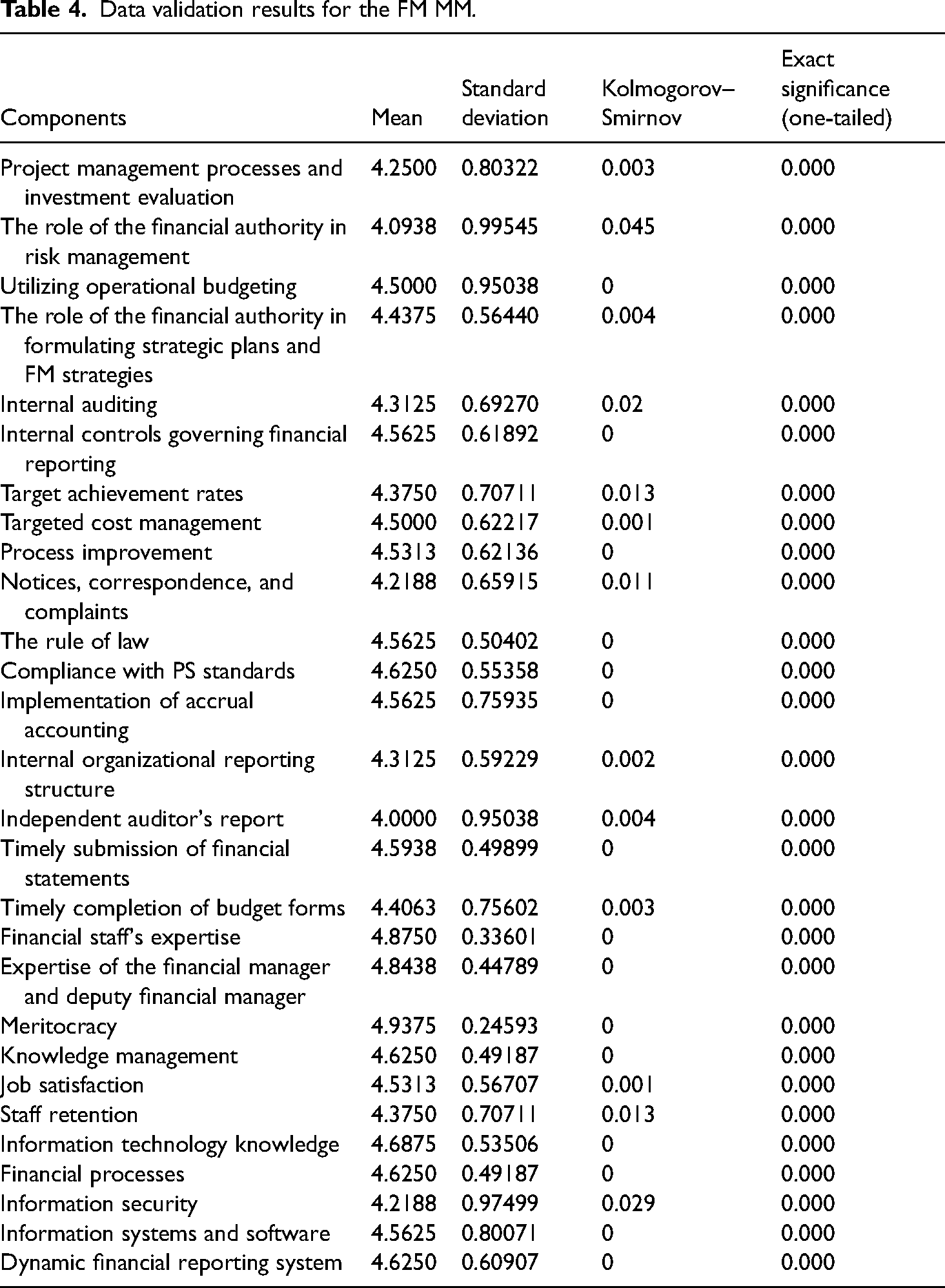
A five-point Likert scale (from strongly agree to strongly disagree) was used to assess the opinions of the experts. Cronbach's α statistic was used to measure its reliability; the α obtained for the 28 components was 0.848, which indicates a very good level of reliability. According to the Kolmogorov–Smirnov test, data distribution is not normal. Table 4 presents the results of the binomial test with a cut point of 0.6. For all the 28 components of the FM MM, the significance level is lower than 0.05 and the mean for the components is higher than 3, showing a significant consensus among the respondents over the 28 components.
Data validation results for the FM MM.
Conclusion
The main purpose of this research was to develop a MM for FM in the PS of Iran. After reviewing the research literature and carefully examining the 11 MMs and initial expert opinions, the most important factors affecting maturity were classified. In the next stage, the financial and accounting MM for reporting units in the PS was developed by the expert opinion of focus groups with expertise in the PS. Therefore, the output of this research enriches the theoretical literature and contributes to the application of the model in practice.
The model includes the eight components of IT, financial reporting, rules and regulations, financial planning and budgeting, financial guidance and supervision, leadership, efficiency and effectiveness, and human resources. A major part of the dimensions and components of the FM MM for reporting units of the PS is compatible with the MMs mentioned in the systematic review (The US Department of the Treasury, 2017; The UK NAO, 2012; Wellington Audit Office, 2012; Deloitte, 2014; McCarthy, 2018). Some of the criteria, however, including employee satisfaction, notices, correspondence, complaints, cases filed with supervisory authorities, staff retention and IT knowledge, were not mentioned in the other MMs. A questionnaire was designed to validate the components, and its results showed a consensus among the expert panel over the 28 components of the FM MM.
The MM designed in this research can be used for all countries in a transition period. From a methodological point of view, the model has the ability to accurately evaluate PS units based on the developments in the degree of transparency and financial information reporting. Designing this model is a first step in improving the transparency and financial accountability of PS reporting units. The next steps will be to study the extent to which and way in which this model is used by governments as well as specific measures to be taken to upgrade their levels.
Although the dimensions and components of this model are supported by a systematic review and the use of expert opinions and a questionnaire, it nevertheless contains a certain level of abstraction and has been influenced by the opinions of the experts and researchers. It is therefore recommended that it be tested in practice with the aim of generalizing to other developing countries and use across the PS and increasing its trustworthiness among the PS institutions and users. Iran applies the adjusted IPSASs. The reason for this is the differences in nature in the PS organizations of this country. Requirements to comply with the public accounting law and the budget law as well as the other laws governing these organizations, the major funding of PS organizations from the treasury and the lack of PS organizations that generate income are among the reasons why the model has been tested through internal users in order to have sufficient understanding of the environment in which this model is implemented and for the model be tested well. This model has been proposed to Iran’s Ministry of Finance and it is going to be used for ranking PS organizations as soon as possible. Retesting of the model after its implementation will be considered in future researches.
Future studies are recommended to explore some strategies to attain the levels specified in accounting and FM MMs and the challenges in this field. Owing to the diversity of PS units, including government units and not for profits, researchers can develop separate MMs tailored to each reporting unit in the PS. Also, given the developments in various areas of financial reporting, including accounting systems, rules and regulations, and standards, it seems that the development of an audit MM for PS units must also be considered. Moreover, issues such as mandating the units to attain certain levels of maturity as specified in the models or relying on the optional use of these models and how these decision affect the transparency and performance of the units in the long term can be further studied.
Footnotes
Declaration of conflicting interests
The authors declared no potential conflicts of interest with respect to the research, authorship, and/or publication of this article.
Funding
The authors received no financial support for the research, authorship, and/or publication of this article.
