







Abstract
Governments increasingly rely on digital channels to support public service delivery and facilitate citizen participation. This study examines how perceived social support, defined as citizens’ subjective experience of receiving informational and emotional assistance from peers, shapes citizen coproduction in social media-based e-government contexts. Drawing on survey data from 768 users of Chongqing Release, a municipal government Weibo account in China, the study applies structural equation modelling to analyse the motivational mechanisms underlying peer-to-peer interaction and voluntary contribution. The findings show that perceived social support has a significant direct effect on coproduction. In addition, it operates through psychological mechanisms associated with the satisfaction of basic needs, particularly relatedness and autonomy. These results indicate that citizen participation in digital governance is driven both by reciprocal responses to received support and by internally experienced social connection and autonomy. They further suggest that digital government platforms can support coproduction through formal service design as well as by facilitating low-cost, peer-to-peer interactions. Such participation appears to rely less on competence or expertise and more on relational and affective factors. This study shifts the focus of coproduction research from institutional arrangements toward everyday digital interactions and highlights the importance of socially embedded, lightweight forms of citizen contribution.
• Government social media should be managed not only as a channel for information delivery, but also as an interactional space in which citizens can generate public value through mutual support and peer-to-peer exchange.
• Public agencies should pay greater attention to emotional support, not only informational usefulness. In this study, emotional support showed the stronger overall effect on coproduction intention, suggesting that encouragement, recognition and responsive interaction may be especially important for sustaining citizen participation.
• Effective digital participation depends less on citizens’ expertise than on whether they feel socially connected and able to participate on their own terms. This implies that governments may achieve more by lowering psychological barriers and offering flexible, low-threshold participation formats than by relying on highly skilled users alone.
• The role of government in digital governance should extend beyond service provision to the facilitation of citizen-to-citizen interaction. Designing platforms that support visibility, acknowledgement and open engagement can help create the relational conditions under which coproduction emerges and persists.
Introduction
The growing disparity between escalating public service demands and limited government capacity has driven the exploration of citizen-centred innovations in public administration. Two prominent approaches have emerged: e-government, which leverages digital technologies to enhance transparency and administrative efficiency (Bertot et al., 2010; Twizeyimana and Andersson, 2019); and coproduction, which engages citizens as active contributors in designing and delivering public services, reflecting the idea that ‘many hands make light work’ (Alam, 2021; Johnston and Hansen, 2015). While both streams are well established, their intersection remains underexplored, particularly in social media-based e-government contexts. Scholars have increasingly begun to explore how citizen-to-citizen interactions on official government platforms generate public value through peer-driven collaboration, moving beyond traditional government-to-citizen service delivery models (Lember et al., 2019; Linders, 2012; Meijer, 2011; Scupola and Mergel, 2022).
The advent of Web 2.0 has transformed e-government from a one-way communication channel into a multidirectional civic space. Government-affiliated social media platforms, such as Weibo and Twitter (now X), now serve as arenas where citizens not only receive information but also engage in discussions, share experiences and offer emotional support (Bonsón et al., 2012; Meijer, 2011). These interactions enable a shift toward more citizen-driven forms of governance, where peer interactions shape public discourse and support collective understanding (Larsson and Skjølsvik, 2021). These dynamics reflect what Linders (2012) describes as the ‘Do-It-Yourself government’ model, which conceptualizes citizens as autonomous actors who self-organize and contribute to public value creation with limited formal institutional involvement.
Linders (2012) introduced a typology of information and communication technology (ICT)-enabled coproduction, including citizen-sourcing, government as platform and the decentralized ‘Do-It-Yourself government.’ The latter represents the most citizen-driven form of public service innovation, where services and knowledge are generated through digital collaboration. Prior studies suggest that such peer interactions can complement formal government efforts, yet their underlying motivational mechanisms remain insufficiently theorized, particularly regarding how informal interactions translate into sustained coproduction behaviour.
One particularly salient form of digital coproduction is the provision of social support, often expressed through comments, reposts and replies on official social media accounts. Social support includes informational assistance, such as advice and clarification, and emotional affirmation, such as empathy and encouragement (Carr et al., 2016). These exchanges can reduce ambiguity, reinforce belonging and support trust-building among citizens, complementing official communication under uncertainty (Zhu and Hu, 2023). However, the psychological mechanisms that sustain such interactions remain underexplored.
To address this gap, the present study investigates how citizens’ perceptions of social support within government social media environments shape their willingness to engage in peer-based coproduction. Drawing on survey data from 768 users of ‘Chongqing Release,’ a municipal-level Weibo account operated by the Chongqing city government, the study employs structural equation modelling to examine the motivational mechanisms underlying such behaviour. Specifically, it integrates the norm of reciprocity, which captures externally triggered responses to received support, with self-determination theory, which explains how participation is sustained through the satisfaction of basic psychological needs. This integrated perspective links external interaction processes with internal motivational dynamics.
This study contributes to the scholarly understanding of digital coproduction in three key ways. First, it advances the theoretical development of the ‘Do-It-Yourself government’ model by identifying the psychological processes associated with horizontal coproduction among citizens on official social media platforms. Second, it extends the application of self-determination theory to the context of low-barrier digital environments, illustrating how peer interactions in such settings may fulfil individuals’ needs for relatedness and autonomy. Third, it reconceptualizes social support as a lightweight yet meaningful form of public value, thereby expanding the scope of coproduction research beyond formal administrative transactions to include everyday civic interactions among citizens. These findings provide practical insights for supporting citizen engagement in digitally mediated governance contexts.
Background and theoretical underpinnings
Social media-based e-government and coproduction in social media-based e-government
E-government broadly refers to the use of ICTs to enhance government operations and public service delivery (Twizeyimana and Andersson, 2019). Its core objectives include strengthening transparency (Bertot et al., 2010; Bonsón et al., 2012; Jacob et al., 2019) and improving public service delivery (Feeney and Welch, 2016), as well as fostering relationships with stakeholders (Grönlund and Horan, 2005). Early e-government initiatives were largely characterized by one-way communication from government to citizens, emphasizing accessibility and information dissemination (Bekkers et al., 2011; Twizeyimana and Andersson, 2019), but often lacked active citizen participation.
The emergence of Web 2.0 technologies, particularly social media, has significantly transformed e-government. Social platforms enable interactive communication not only between governments and citizens but also among citizens themselves (Bonsón et al., 2012; Larsson and Skjølsvik, 2021; Lember et al., 2019; Meijer, 2011), shifting e-government towards a more participatory and dialogic model. In this study, social media-based e-government is defined as government-managed accounts on platforms such as Weibo and Twitter/X, where both vertical (government-to-citizen) and horizontal (citizen-to-citizen) interactions take place. In this context, citizens are no longer passive recipients of services but active contributors to public value creation (Larsson and Skjølsvik, 2021; Meijer, 2011).
The integration of social media into e-government closely aligns with the concept of coproduction. Coproduction, originally defined by Ostrom (1996), refers to the process whereby individuals outside formal organizations contribute to the provision of public goods or services. This concept emphasizes that citizens can actively participate in service delivery and contribute to collective outcomes (Bovaird, 2007). Digital technologies, particularly social media, are widely recognized as key enablers of coproduction, as they reduce barriers to participation and facilitate engagement in public issues (Bovaird, 2007; Fung, 2015; Lember, 2018; Lember et al., 2019). Among ICT-enabled forms of coproduction, Linders’ (2012) ‘Do-It-Yourself government’ model is especially relevant, as it captures decentralized settings in which citizens self-organize to exchange experiences, information and support with minimal government involvement.
Despite these advantages, the applicability of citizen-led coproduction is not universal. Many public services still require long-term planning, infrastructure and professional expertise (Denhardt and Denhardt, 2000). In practice, coproduction is more commonly observed in low-barrier contexts, such as neighbourhood watch programmes, teaching assistance, or auxiliary policing (Clark et al., 2013; O’Brien et al., 2017; Zou and Zhao, 2021), where participation requires limited resources and knowledge (Nabatchi et al., 2017; Yang and Pandey, 2011). Citizen-led coproduction may also create coordination challenges and tensions with formal governance structures (Nabatchi et al., 2017; Yang and Pandey, 2011), highlighting the need to identify suitable forms of coproduction and their underlying mechanisms.
The coproduction of social support represents one such form that aligns closely with the ‘Do-It-Yourself government’ model. Empirical evidence suggests that digital technologies enable citizens to self-organize into online communities that provide mutual support (Meijer, 2011), challenging the assumption that public services must be delivered solely by government actors (Sharp, 1980). In these contexts, citizens generate public value through peer-to-peer interaction, particularly through the exchange of experiential knowledge and emotional assistance. These practices are closely linked to social support, defined as the perception or experience of being cared for, valued and assisted within a social network (Wills, 1991).
In social media-based e-government, social support typically takes two forms: informational; and emotional (Carr et al., 2016; Meijer, 2011; Yan, 2020; Zhu and Hu, 2023). Informational support includes advice, guidance and problem-solving knowledge, while emotional support involves empathy and encouragement (Langford et al., 1997; Wills, 1991). These forms of support are particularly suited to digital coproduction, as they require minimal expertise, time and resources, and can be generated through everyday interactions (Oh et al., 2014). Moreover, such interactions are associated with important psychological and social benefits, including enhanced well-being and resilience (Carr et al., 2016; Yan, 2020; Zhu and Hu, 2023).
However, social support coproduction also faces limitations. Unlike traditional public services, it relies heavily on voluntary participation and spontaneous interaction, making it inherently uncertain (Linders, 2012). Understanding the mechanisms that motivate such participation is therefore essential for assessing its sustainability.
Motivation for social support coproduction in social media-based e-government
To investigate what drives citizens to provide social support in digital governance environments, this study draws on the norm of reciprocity and self-determination theory (SDT). In social media-based e-government environments, citizens are not limited to receiving information from official accounts but are also embedded in ongoing peer interactions through which informational and emotional support are continuously exchanged. These repeated exchanges of support are a relational environment in which coproduction is situated, as individuals are exposed to others’ needs, responses and contributions in a sustained and observable manner. Within such an environment, experiences of receiving support may alter both behavioural tendencies and the way participation is cognitively and socially framed.
From a reciprocity perspective, receiving support introduces an implicit expectation of return, thereby reinforcing patterns of mutual exchange and lowering the threshold for subsequent contribution (Falk and Fischbacher, 2006; Gouldner, 1960; Halbesleben and Wheeler, 2015). In social media-based e-government contexts, where interactions are visible, traceable and relatively low-cost, so this expectation becomes more readily activated and socially reinforced. Perceiving informational and emotional support from others may therefore increase individuals’ propensity to reciprocate by offering similar forms of assistance, linking prior support experiences to subsequent coproduction behaviour through a direct response mechanism (Wu et al., 2019; Zhu and Hu, 2023). Accordingly, perceived social support is expected to be positively associated with coproduction intention. The following hypotheses are proposed:
However, reciprocity alone is less able to explain why participation becomes sustained rather than remaining an immediate response. Coproduction in digital environments depends on whether participation is experienced as effective, socially embedded and self-endorsed. These dimensions correspond to the needs for competence, relatedness and autonomy emphasized in SDT (Deci and Ryan, 1985; Karahanna et al., 2018). Experiences of receiving informational and emotional support may enhance perceived competence by providing knowledge and feedback, strengthen relatedness by reinforcing social connection, and support autonomy by enabling individuals to express themselves within a flexible and non-coercive interaction context. Through these mechanisms, perceived social support extends beyond immediate reciprocity and contributes to the internal motivational processes that sustain coproduction over time.
Competence refers to an individual's need to feel capable and effective in interacting with their environment (Deci and Ryan, 1985). In the context of social media-based e-government, perceived social support provides individuals with access to knowledge, feedback and problem-solving resources, which may enhance their perceived ability to contribute. Informational support, such as advice and guidance, can improve individuals’ understanding, while emotional support, such as encouragement, may strengthen confidence (Khan and Krishnan, 2021; Leong et al., 2015). By enhancing individuals’ perceived capability to engage in discussions and provide assistance, perceived social support is expected to strengthen competence, which in turn increases coproduction intention. Accordingly, the following hypotheses are proposed:
Relatedness reflects individuals’ need to establish meaningful social connections (Deci and Ryan, 1985). In social media-based e-government environments, perceived social support emerges through interaction, communication and shared experiences among users. Such interactions may foster a sense of belonging by reinforcing social ties and mutual recognition within the community. Informational exchanges and emotional expressions both contribute to ongoing relational engagement, allowing individuals to perceive themselves as part of a supportive network (Seidman, 2013). As perceived social support strengthens individuals’ sense of connection with others, it is expected to enhance relatedness, which in turn promotes coproduction intention. Accordingly, the following hypotheses are proposed:
Research framework (source: authors’ own work).
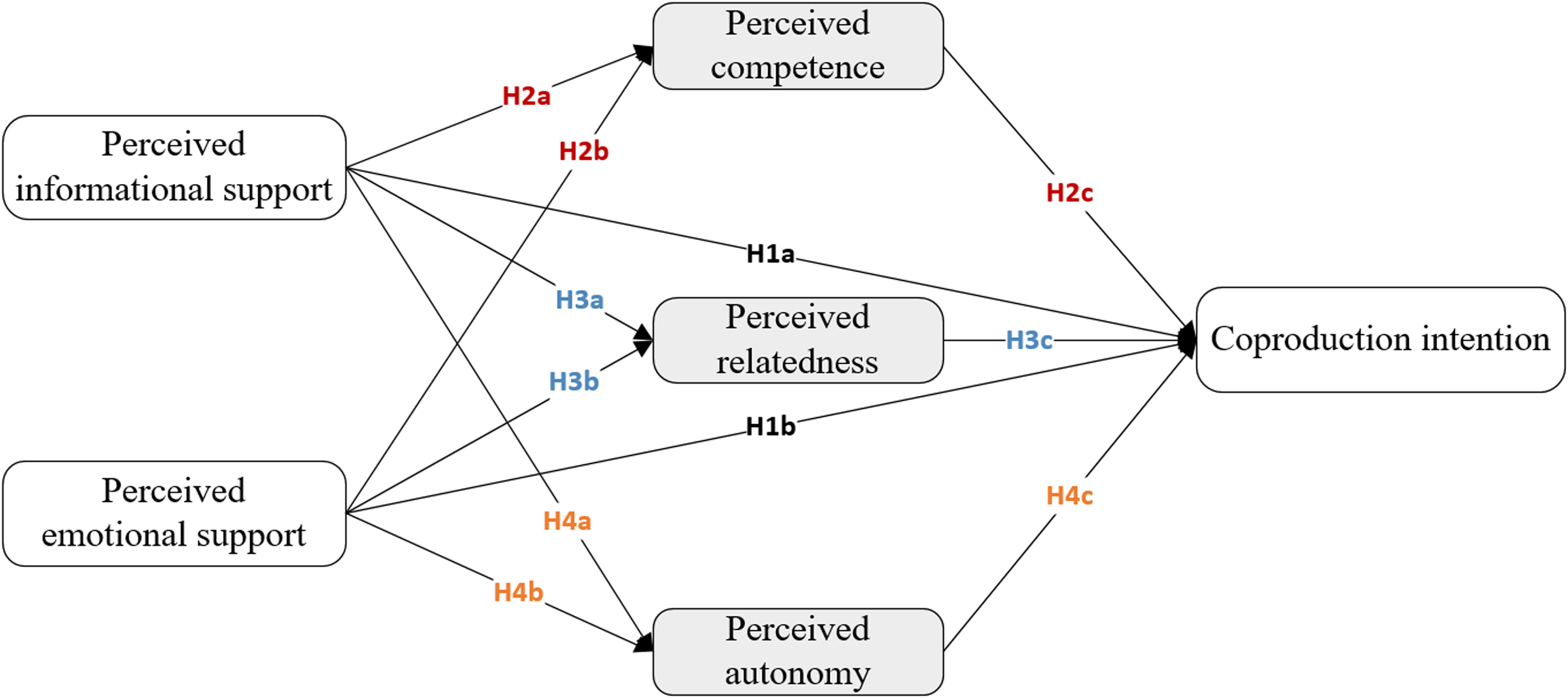
Autonomy refers to the extent to which individuals perceive their actions as self-endorsed and voluntary (Deci and Ryan, 1985). In social media-based e-government contexts, perceived social support may create an environment in which individuals feel encouraged to express their views and participate on their own terms. Supportive interactions that are non-coercive and responsive to individual input may facilitate a sense of self-directed participation. Informational and emotional support can reduce perceived barriers to engagement and enable individuals to contribute in ways that align with their own preferences (Chen and Bozeman, 2013; Karahanna et al., 2018). By enabling individuals to engage more voluntarily and expressively, perceived social support is expected to enhance autonomy, which in turn facilitates coproduction intention. Accordingly, the following hypotheses are proposed:
Method
Study design and procedure
This research was carried out in Chongqing, China, where respondents were selected to provide firsthand insights into their experiences with ‘Chongqing Release,’ a Weibo-based social media e-government account operated by the news office of the Chongqing municipal government. With over two million followers, this account serves as a representative case of social media-based e-government in the Chinese context. The decision to focus on a single account was intended to reduce variation associated with differences in platform characteristics, content orientation and local governance contexts. Although drawing on a single account may limit generalizability, this design enables focused empirical exploration and provides a foundation for further replication across platforms and regions. To ensure sample relevance, respondents were required to have prior engagement with government-related content on social media. Specifically, a screening item was included at the beginning of the questionnaire asking: ‘Do you regularly follow or browse “Chongqing Release” or use other social media to obtain government-related information?’ Respondents who selected ‘No’ were automatically excluded from the survey.
From January to February 2023, respondents were recruited from 21 communities across the city of Chongqing. To reach a broad cross-section of residents, the research team contacted community administrative staff, requesting them to distribute survey invitations via bulletin boards and community-based online chat groups. The survey was administered through Credamo, a widely used online platform for academic research in China. An online format was chosen to preserve participant anonymity and increase accessibility, which is consistent with the digital context of the study. Participants were informed that their responses would remain confidential and be used exclusively for academic purposes. To ensure data quality, two attention check questions were embedded within the questionnaire, and responses with unusually short or long completion times were excluded.
In total, 1567 observations were collected, of which 768 valid responses passed the screening and attention checks, resulting in a response rate of 49.01%. To assess potential attrition bias, we compared key demographic characteristics between the full sample and the final sample, and no substantial differences were observed. Detailed results are reported in Online Appendix 1. As anticipated, a substantial proportion of respondents were male (65.10%), aged 18–50 (85.55%), employed (74.35%), had at least a high school education (86.98%) and reported monthly incomes above 5000 RMB (83.59%). These characteristics describe a relatively active and socioeconomically stable group of users, which is appropriate given that participation in social media-based coproduction requires a certain level of access, engagement and familiarity with online environments.
Measures
This research centres on individuals’ subjective perceptions of their experiences with social media-based e-government, aiming to capture the micro-level exchange of social support. Whenever possible, key constructs were measured using multi-item scales validated in prior literature (see Online Appendix 2). All items were rated on a five-point Likert scale ranging from 1 (strongly disagree) to 5 (strongly agree). Most constructs were measured using three to four items, reflecting a balance between adequate construct coverage and the practical constraints of an online survey, where a longer questionnaire may reduce response quality. At the design stage, a broader pool of potential items was considered, and a pilot test was conducted to assess item clarity and preliminary measurement performance. Based on the pilot results, some items were revised or dropped in order to improve coherence, respondent comprehension and overall suitability for the final questionnaire.
Perceived informational support and perceived emotional support
The perception of social support is inherently subjective, making it well-suited to self-report measurement. This study drew on the Multidimensional Scale of Perceived Social Support (Zimet et al., 1988). While the original 12-item instrument assesses support from sources such as family, friends and significant others, our study emphasizes types of support rather than sources. To this end, the scale was adapted in accordance with the conceptual distinctions between informational and emotional support proposed by Langford et al. (1997).
To measure perceived informational support, respondents were asked whether they could find useful and relevant information, advice to address their concerns and tangible guidance through online interactions. The three-item scale exhibited acceptable internal consistency, with a Cronbach's α of 0.696, which is slightly below the conventional threshold but still within an acceptable range for exploratory research.
To measure perceived emotional support, participants were asked whether they could find others to talk to about their problems, share joy and sorrow and express emotional concerns during social interactions. This three-item scale also demonstrated satisfactory internal consistency, with a Cronbach's α of 0.798.
Perceived competence, perceived relatedness and perceived autonomy
These three psychological needs, including competence, relatedness and autonomy, are central to self-determination theory and are deeply rooted in individuals’ subjective interpretations of social experiences (Deci and Ryan, 1985). Measurement items were adopted from Kim and Drumwright (2016), who had previously adapted the validated nine-item Basic Psychological Need Satisfaction Scale (La Guardia et al., 2000) for the social media context. Additional wording adjustments were made to ensure relevance to the ‘Chongqing Release’ setting.
To measure perceived competence, respondents indicated whether they felt in control, capable and within their abilities while navigating or participating in social media interactions. The scale's internal consistency was acceptable, with a Cronbach's α of 0.801.
For perceived relatedness, participants rated whether they experienced a sense of interpersonal contact, felt emotionally close to others and perceived a meaningful connection during their engagement with the platform. The scale demonstrated high reliability, with a Cronbach's α of 0.871.
To assess perceived autonomy, respondents were asked whether they could make independent decisions, freely express opinions and act flexibly during their social media use. The four-item scale yielded a Cronbach's α of 0.858.
Coproduction intention
As a focal construct in this study, coproduction intention was measured using behavioural intention items adapted from the Technology Acceptance Model (Davis, 1989). Respondents were asked about their willingness to continually share information, provide advice and support, and participate in discussions within the social media-based e-government platform. This three-item scale achieved strong reliability, with a Cronbach's α of 0.817.
Analysis procedure
Structural equation modeling (SEM) was employed to test the full research model, including the potential mediating roles of perceived competence, relatedness and autonomy. Prior to testing the structural model, a confirmatory factor analysis was conducted to assess the measurement model. SEM enables the simultaneous estimation of both direct and indirect effects, allowing for a comprehensive examination of the psychological mechanisms underlying social support coproduction. The SEM analysis was conducted using AMOS 24.0 (IBM SPSS Amos), applying the maximum likelihood estimation (MLE) method. MLE is a standard estimation approach for latent variable models under the assumption of approximate normality. Model fit was evaluated using multiple goodness-of-fit indices, including the Chi-square to degrees-of-freedom ratio (χ2/df), comparative fit index (CFI), Tucker−Lewis index (TLI) and root mean square error of approximation (RMSEA). In addition, Harman's single-factor test was conducted to assess potential common method bias, with the first factor accounting for 32.7% of the total variance, suggesting that common method bias is unlikely to pose a serious threat.
Results
Measurement model assessment
To evaluate the reliability and validity of the measurement model, a series of tests were conducted, including assessments of internal consistency, convergent validity and discriminant validity. Model fit indices indicate acceptable fit for the measurement model (χ2/df = 3.383, RMSEA = 0.056, CFI = 0.965, TLI = 0.953, GFI = 0.949 and IFI = 0.965), demonstrating an adequate representation of the latent constructs.
Table 1 presents the descriptive statistics, factor loadings, composite reliability (CR), average variance extracted (AVE) and Cronbach's alpha for each latent variable. Internal consistency was assessed using CR and Cronbach's α. All CR values exceeded the recommended threshold of 0.70 (Nunnally, 1978), and Cronbach's α values were also above 0.70, except for perceived informational support (α = 0.696), which is within an acceptable range given the exploratory nature of the construct (Fornell and Larcker, 1981). In terms of convergent validity, all AVE values were above 0.50, meeting the threshold suggested by Hair (2009). Item loadings ranged from 0.59 to 0.91, indicating adequate indicator reliability. Although the loading of ATMY2 was comparatively lower than those of the other items, it remained within an acceptable range and did not materially undermine the reliability or validity of the autonomy construct. The item was therefore retained to preserve the conceptual coverage of perceived autonomy.
Univariate statistics, loading, composite reliability (CR), average variance extracted (AVE) and Cronbach’s α of the key constructs.
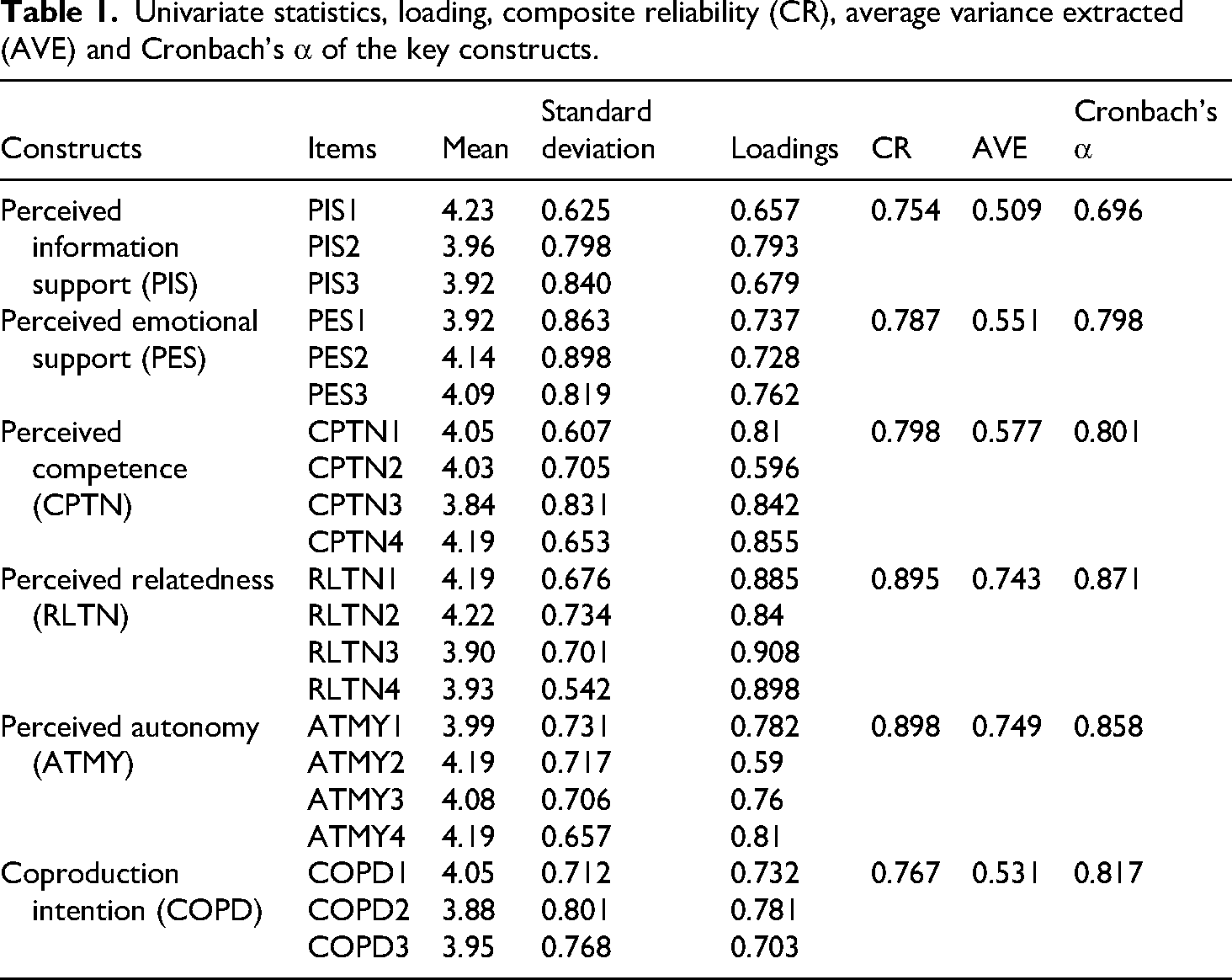
Table 2 displays the discriminant validity assessment. All inter-construct correlations ranged between 0.326 and 0.572, indicating moderate associations among constructs. The square root of AVE for each construct (shown in bold on the diagonal in Table 2) exceeds the corresponding inter-construct correlations, further confirming discriminant validity.
Discriminant validity analysis.
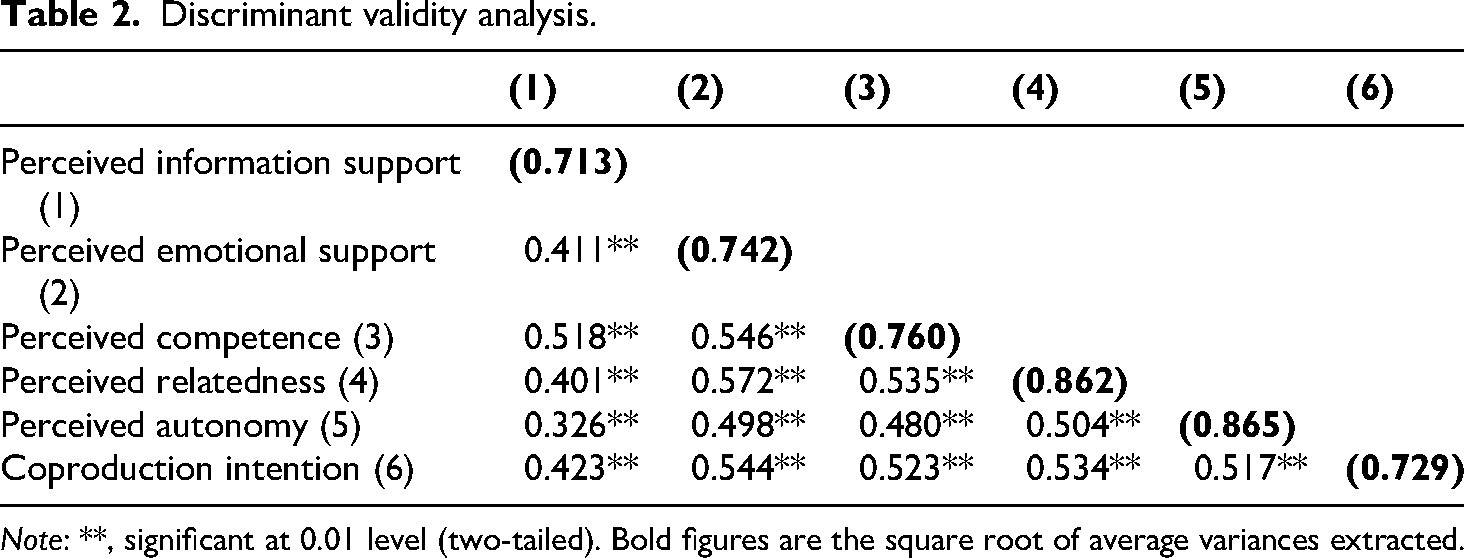
Note: **, significant at 0.01 level (two-tailed). Bold figures are the square root of average variances extracted.
Structural model and hypothesis testing
The hypothesis testing results are presented in Table 3 and Figure 2. The structural equation model exhibited a good overall fit (χ2/df = 4.661, RMSEA = 0.069, GFI = 0.929, NFI = 0.930, CFI = 0.944, TLI = 0.928 and IFI = 0.944), with an R2 of 0.505 for coproduction intention (see Figure 2). These fit indices fall within the commonly accepted thresholds, suggesting that the hypothesized model provides a satisfactory representation of the data.
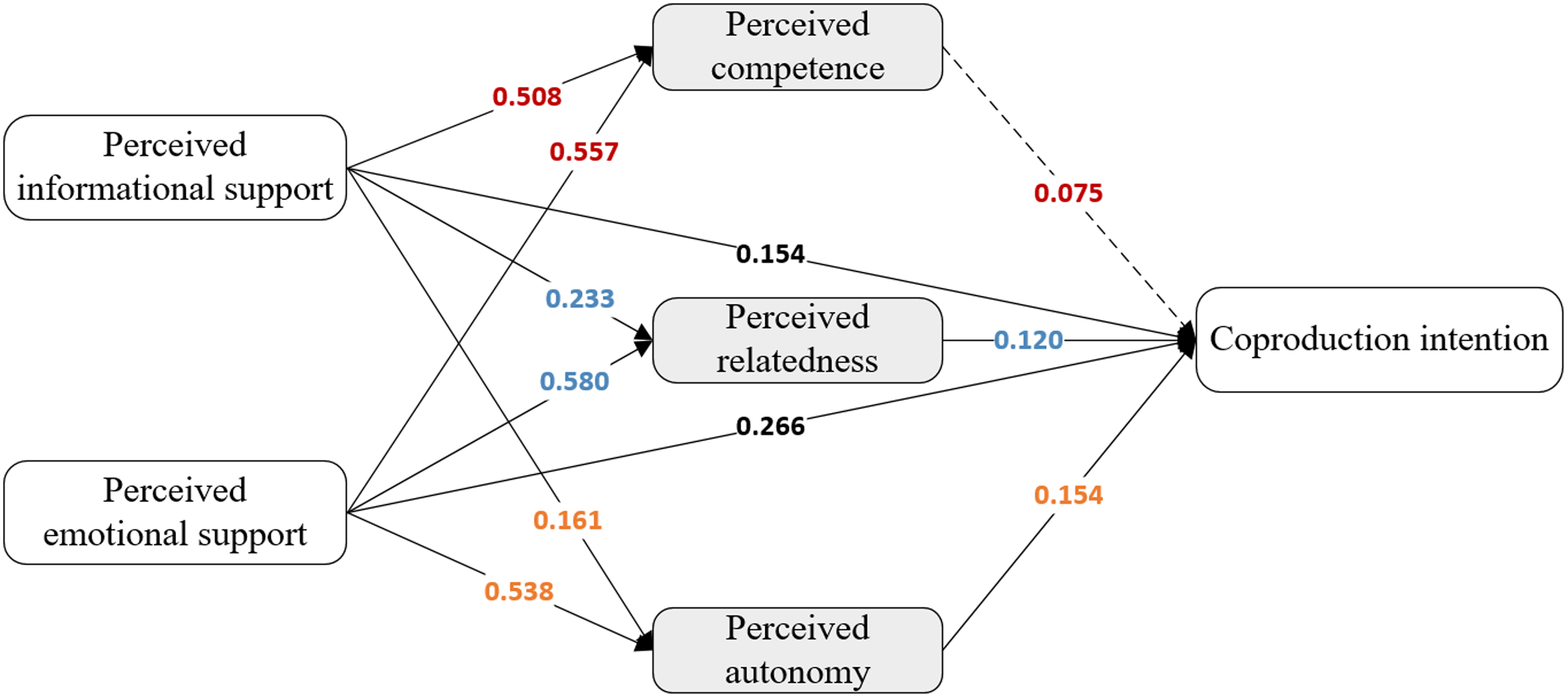
Structural model with path coefficients.
Structural equation modelling analysis.
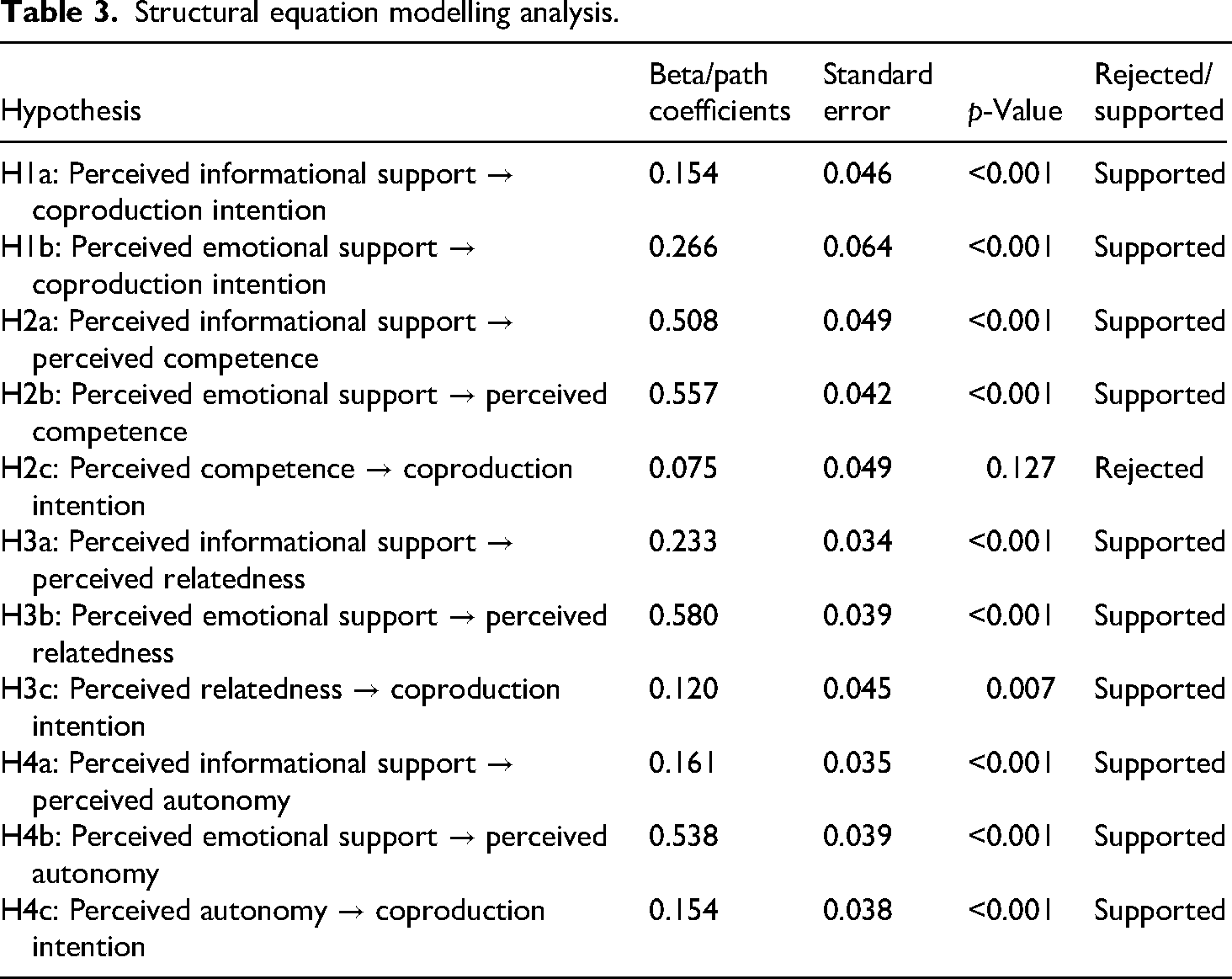
Most hypotheses were supported except for the path from perceived competence to coproduction intention, which was not statistically significant (p = 0.127). Notably, the direct effects of perceived informational support and perceived emotional support on coproduction intention are significant.
To further clarify the structural model results, Table 4 presents the direct, indirect and total effects derived from the path analysis. Notably, perceived emotional support demonstrates the strongest total effect on coproduction intention (0.424), comprising both a significant direct path (0.266) and an indirect effect (0.158) through psychological needs. In contrast, perceived informational support exhibits a smaller total effect (0.250), with its indirect component (0.096) distributed across multiple psychological pathways Among the three psychological needs, autonomy (0.154 direct path) and relatedness (0.120) exert notable impacts on coproduction intention, while the effect of competence (0.075, p = 0.127) is not statistically significant. These results underscore the central role of emotional support and highlight the differential mediating power of psychological needs within the model.
Direct and total effects for the structural model.
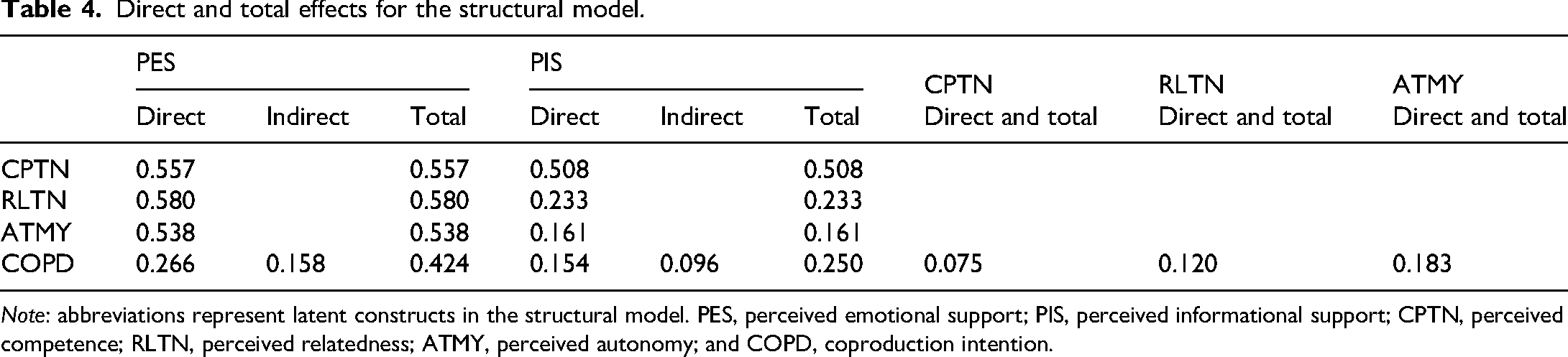
Note: abbreviations represent latent constructs in the structural model. PES, perceived emotional support; PIS, perceived informational support; CPTN, perceived competence; RLTN, perceived relatedness; ATMY, perceived autonomy; and COPD, coproduction intention.
Discussion
Coproduction mechanism
This study examines the motivational mechanisms underlying citizen-driven social support coproduction in social media-based e-government. It provides empirical support for Linders’ (2012) ‘Do-It-Yourself government’ framework. The findings show that coproduction intention is shaped by two linked pathways: an immediate reciprocity-based response to received support; and a more internalized process rooted in psychological need satisfaction. Digital civic participation therefore emerges from the interaction of external exchange and internal motivation.
The first major finding indicates that both perceived informational support and perceived emotional support are positively associated with coproduction intention. This finding aligns with the norm of reciprocity (Gouldner, 1960), suggesting that individuals tend to return received support through similar contributions. In decentralized digital spaces such as social media-based e-government, users who receive valuable information or emotional encouragement may reciprocate through low-cost actions such as replying, sharing, or offering support, thereby reinforcing ongoing interaction patterns (Bovaird and Loeffler, 2012; Gouldner, 1960). This suggests that perceived social support does not merely improve users’ experiences on the platform; it also helps generate a cycle of mutual contribution through which peer interaction becomes self-reinforcing.
Beyond this direct response mechanism, psychological need satisfaction, particularly relatedness and autonomy, emerges as an additional driver of coproduction. Consistent with self-determination theory (Deci and Ryan, 1985), individuals are more likely to engage when they experience social connection and a sense of self-directed participation. Perceived relatedness fosters belonging, while perceived autonomy supports self-expression, together reinforcing intrinsic motivation for participation. In this sense, citizens may continue to participate not only because they feel they should reciprocate, but also because participation itself becomes socially meaningful and personally endorsed. In contrast, perceived competence does not significantly influence coproduction intention, suggesting that participation in digital contexts is less constrained by capability and more dependent on accessibility and relational engagement. Many forms of online contribution require limited expertise, which shifts the motivational emphasis from skill-based capacity to social and psychological factors. This result may also indicate that competence is less salient in low-threshold digital settings, where citizens are not expected to possess specialized knowledge in order to comment, share experiences, or provide simple support. Under such conditions, feeling capable may matter less than feeling connected and free to participate. This finding implies that reducing psychological barriers may be more effective than enhancing skills in promoting digital coproduction.
The relatively modest magnitude of the indirect effects further reflects the characteristics of the behavioural context. In social media-based environments, participation is often immediate and low-cost, making behaviour more responsive to situational cues than to fully internalized motivation. Psychological need satisfaction therefore operates as a complementary mechanism, providing additional explanatory power without dominating the overall effect structure. At the same time, the modest indirect effects should not be interpreted as evidence that psychological mechanisms are unimportant. Rather, they suggest that in this context, internal motivation functions more as a reinforcing condition than as the sole basis of participation. Citizens may first react to support exchanges in a reciprocal way, while relatedness and autonomy help stabilize or deepen that willingness to contribute.
In conclusion, the results point to a hybrid motivational structure in digital coproduction, in which reciprocity-based expectations and internal psychological rewards jointly shape participation. This integrated perspective extends existing research by demonstrating how external social exchange and internal motivational processes coexist and interact in digitally mediated coproduction settings.
Implications
The findings of this study have implications for the design and governance logic of social media-based e-government, particularly in relation to the ‘Do-It-Yourself government’ model (Linders, 2012). As public service demands increasingly exceed the capacity of traditional bureaucratic systems, digitally mediated citizen participation can serve as a complementary mode of value creation in which citizens contribute through everyday interaction.
A key implication concerns the role of affective engagement in sustaining participation. While e-government platforms have traditionally emphasized informational efficiency, the findings suggest that these environments also operate as affective spaces in which empathy and encouragement shape user engagement. Design strategies that move beyond one-way information dissemination toward more interactive and responsive communication may therefore be critical. Recognizing citizen contributions, acknowledging user sentiment and facilitating peer-to-peer interaction can help sustain participation over time.
The results also highlight the importance of enabling self-directed participation. Flexible and minimally restrictive participation mechanisms may foster a sense of ownership and encourage continued engagement. More broadly, government agencies may function not only as service providers but also as facilitators of citizen-to-citizen interaction (Linders, 2012; Meijer, 2011). In this sense, the value of digital governance lies not only in delivering services, but also in enabling and sustaining interaction among citizens. These interaction dynamics may be especially relevant under conditions of uncertainty, when citizens rely more heavily on peer-based support.
Limitations and future work
This study has several limitations that should be addressed in future research. First, the analysis focuses on the norm of reciprocity and self-determination theory to capture core motivational mechanisms, but does not explicitly examine potential boundary conditions. The relationships identified in this study may vary across different individual and contextual settings. Variables such as perceived government transparency, responsiveness, trust and individual self-efficacy may moderate the proposed relationships. Incorporating these factors would help develop a more comprehensive and differentiated theoretical framework.
Second, the study relies on self-reported intentions rather than observed coproduction behaviours. Although intention is widely used as a proxy, it may not fully reflect actual engagement in digital environments, where participation is often spontaneous and situational. Future research could employ behavioural data, such as digital trace data or experimental approaches, to validate the observed relationships.
Third, the use of cross-sectional survey data limits causal inference. Although the model is theory-driven, the lack of temporal sequencing restricts conclusions about directionality. Longitudinal or experimental designs would strengthen causal claims. In addition, the data are drawn from users of a single government social media account in one city, which may limit generalizability. While this design ensures contextual consistency and aligns with the focus on social media-based coproduction, the findings should be interpreted within this specific context. Future studies could extend the analysis across platforms, regions and user groups to assess the robustness of the results.
Conclusion
This study contributes to ongoing discussions on the role of ICT in public service provision and the evolving form of ‘Do-It-Yourself government’ coproduction. It responds to Linders’ (2012) proposition regarding the potential of ICT to reshape the locus of collective action by examining how social support coproduction operates within social media-based e-government. The findings demonstrate that social media platforms function as channels for information dissemination while simultaneously serving as interactional environments in which citizens contribute to public value through everyday exchanges.
The results further indicate that coproduction in digital environments is shaped by a combination of reciprocal social exchange and internal motivational processes. ICT-facilitated networks enable decentralized participation, allowing citizens to engage in coproduction without direct government coordination. Participation is sustained through the satisfaction of basic psychological needs, suggesting that both social expectations and intrinsic motivations play a role in supporting continued engagement.
These findings point to a shift in how coproduction is conceptualized in digitally mediated settings. Rather than fitting within traditional models such as ‘citizen as sourcing’ or ‘government as platform,’ social media-based coproduction reflects a more distributed and interaction-driven form of governance consistent with the ‘Do-It-Yourself government’ model. Recognizing both its potential and its limitations is essential for understanding how such forms of coproduction can complement formal public service provision.
Supplemental Material
sj-docx-1-ras-10.1177_00208523261453339 - Supplemental material for How perceived social support encourages citizen coproduction: Evidence from government social media
Supplemental material, sj-docx-1-ras-10.1177_00208523261453339 for How perceived social support encourages citizen coproduction: Evidence from government social media by Mingxing Ma and Jing Tan in International Review of Administrative Sciences
Footnotes
Declaration of conflicting interests
The authors declared no potential conflicts of interest with respect to the research, authorship, and/or publication of this article.
Funding
The authors disclosed receipt of the following financial support for the research, authorship, and/or publication of this article: This study was supported by the Humanities and Social Science Foundation of the Ministry of Education in China (grant number 24YJC630190), the Chongqing Municipal Education Commission Humanities and Social Sciences Research Project (grant number 25SKJD009), the Fundamental Research Funds for the Central Universities (grant number 2025CDJSKDPT09), and the National Natural Science Foundation of China (grant number 72504042).

Supplemental material
Supplemental material for this article is available online.
Author biographies
References
Supplementary Material
Please find the following supplemental material available below.
For Open Access articles published under a Creative Commons License, all supplemental material carries the same license as the article it is associated with.
For non-Open Access articles published, all supplemental material carries a non-exclusive license, and permission requests for re-use of supplemental material or any part of supplemental material shall be sent directly to the copyright owner as specified in the copyright notice associated with the article.
