






Abstract
This article examines how populist radical right government reshapes state bureaucracy within a patronage-based administrative system. While patronage and personnel politicization are common features of such systems across governments of different ideological orientations, we argue that populist radical right governments pursue a distinct pattern of bureaucratic control with implications for administrative backsliding. Drawing on longitudinal data on political and bureaucratic turnover across Slovak ministries between 2015 and 2025, we analyze two substantive areas of personnel management, purges and patronage appointments, and the treatment of institutionalized bureaucratic expertise, across temporal and spatial dimensions. The findings show that, compared with previous governments operating in the same patronage context, populist radical right governments sustain exceptionally high and prolonged levels of bureaucratic turnover beyond the initial post-electoral period, expand formal political appointments, and generate extreme levels of personnel replacement in ideologically salient policy areas. More broadly, the analysis suggests that administrative backsliding may unfold across diverse administrative contexts when populist radical right incumbents intensify and repurpose existing mechanisms of bureaucratic control, regardless of whether these originate in merit-based or patronage systems.
Keywords
Points for practitioners
Bureaucratic turnover and patronage alone do not indicate illiberalism; only sustained, coordinated patterns of extreme turnover and targeting of expert bureaucrats do.
Populist radical right governments intensify and redirect existing politicization practices rather than introduce new ones, making early warning signs less visible in patronage settings.
Extreme bureaucratic turnover combined with structural politicization and expertise attacks erodes institutional memory and creates rupture.
Introduction
There is a growing body of academic research examining how populist and illiberal political leaders, once in power, attempt to politicize bureaucracy through various forms of illiberal pressure (Gomide and Morais de Sá e Silva, 2026). This literature documents attacks on the bureaucracy in well-known cases, such as Hungary under Orbán (Boda and Hajnal, 2025; Hajnal and Boda, 2021), the United States under Trump (Kucinskas, 2025; Moynihan, 2021), and Brazil under Bolsonaro (Lotta et al., 2024; Peci, 2021), but recently similar practices have been noted also in long established liberal democracies, such as Italy (Bellodi et al., 2024) and the United Kingdom (Kippin, 2025).
Research on populist strategies aimed at exerting political control and undermining bureaucratic autonomy highlights practices such as large-scale firings and hirings (Peters and Pierre, 2019), sidelining and replacement of expert bureaucrats to curtail their autonomy and influence (Bauer et al., 2021; Lockwood, 2018), and the use of internal pressures and threats (Bersch and Lotta, 2024; Koga et al., 2023). Although these studies have significantly enhanced our understanding of populism's implications for bureaucracy, research remains limited on how the populist radical right (PRR) treats the state bureaucracy in contexts where public administration is already characterized by routine patronage and politicization. Addressing this research gap, we ask: How do populist radical right governments’ attacks on the bureaucracy differ from the routine politicization of patronage-based bureaucracies by other ideological types of governments? What effects does populist radical right incumbency have on bureaucratic appointments and institutionalized expertise?
This article contributes to broader efforts to conceptualize, operationalize, and assess PRR governments’ approaches to bureaucratic hiring and firing and to the treatment of institutionalized expertise, notably in patronage-based administrative contexts, where high levels of bureaucratic turnover are already normalized. Theoretically, PRR participation in government has been associated with systematic attacks on bureaucracies, including the active dismissal of senior civil servants. In patronage systems, however, elevated turnover is routine, raising the question of whether PRR politicization differs from the routine patronage politicization. Methodologically, we address this question by introducing temporal and spatial dimensions of analysis, arguing that PRR behavior becomes distinguishable when examined across time (temporal perspective) and across policy areas (spatial perspective).
Research on populism in political science has devoted attention to ideological variation and internal differentiation within populism, but has paid comparatively little attention to bureaucratic governance. By contrast, public administration scholarship has examined bureaucratic politicization and illiberal interference, yet often treats populism as a largely undifferentiated phenomenon. This article attempts to bridge these literatures by examining how the PRR differs from routine patronage-based politicization in its approach to bureaucratic personnel management and institutionalized expertise. Empirically, we examine a highly politicized patronage bureaucracy using novel longitudinal data on appointments, turnover, and institutionalized bureaucratic expertise between 2015 and 2025.
The core argument of this article is that the PRR behaves in a distinguishably different manner even in environments characterized by routine politicization and patronage. Against a common baseline of patronage bureaucracy, where bureaucratic turnover is already high, PRR appointments are not only prolonged over time but also more extensive and unevenly distributed across policy areas. The evidence shows that, unlike other ideological types of governments, PRR engages in bureaucratic purges more extensively and long after consolidating power, including the dismissal of its own appointees. We interpret this pattern as a deliberate authoritarian strategy aimed at cultivating an “atmosphere of fear” within the bureaucracy, thereby repressing potential resistance and facilitating the execution of the government's preferred policies.
We also find evidence that the PRR disproportionately targets specific policy areas. In foreign policy, defence, justice, interior, and culture, interference with bureaucratic personnel and institutionalized expertise is extremely high, even relative to its already high levels of politicization elsewhere. This pattern is consistent with our conceptualization of populism as an ideology, as these policy domains are central to the PRR's ideological project and therefore subject to heightened political control.
The rest of the article is organized as follows. The next section outlines the scholarship on populist interventions in both merit-based and patronage bureaucracies and develops the article's conceptual framework and hypotheses. We then outline the research design and data, present the empirical findings, and conclude by reflecting on the implications of our results for understanding populism in power.
Populists’ and illiberal agenda
Populism has become one of the most intensely debated and researched concepts in both public administration and political science over the past decade, particularly as the illiberal transformation of public administration and bureaucracy has been linked to this phenomenon (Bauer et al., 2026). It is commonly conceptualized as a thin political ideology that attaches itself to more fully developed host ideologies, producing distinct variants (Stanley, 2008). In this sense, populism can combine with diverse ideological projects. For example, they can be driven by anti-corruption narratives or technocratic reformist appeals, whereas it is the PRR that emphasizes nationalism and anti-democratic features.
Given the distinct priorities advanced by the populists, the strategies they pursue once in office and the resulting effects on the bureaucracy are likely to differ. Nevertheless, although scholarly attention has increasingly turned to the ways in which populist leaders in power seek to reshape the bureaucracy, they are still commonly treated as a single, homogeneous category. This lack of conceptual clarity is problematic because it obscures meaningful variation in how different ideological actors in power approach public administration. Only recently have a few studies begun to recognize that some of these patterns need to be distinguished from routine politicization and patronage and are linked to the “populist radical right” (Lockwood, 2018; Mudde, 2007), a term that we use throughout this study. In the public administration literature, closely related phenomena are described under alternative labels, including illiberal populism (Boda and Hajnal, 2025; Morais de Sá e Silva and Gomide, 2024), extreme political polarization (Enyedi, 2016; Kopecký et al., 2022), authoritarian populism (Özdamar and Yanik, 2024), autocracy (Kucinskas, 2025), or simply populism (Lotta, 2025; Moynihan, 2021, 2022; Peci, 2021), particularly when such dynamics emerge within established liberal democratic regimes.
Several additional dimensions have been identified in linking populism to illiberal change, including resource allocation, accountability, the politicization of organizational structures and regulations, and the exclusion of external stakeholders (see the overview of analytical dimensions in Bauer et al., 2021; Boda and Hajnal, 2025; Moynihan, 2021). Because bureaucracy is both an instrument for implementing political priorities and a potential constraint on power, the way populist governments manage personnel relations offers crucial insight into their governing logic. These expectations, however, are typically derived from analyses of autonomous, merit-based state administration. Much less is known about how these dynamics unfold in patronage-based bureaucratic contexts.
We propose a framework consisting of two substantive areas of personnel management, each analyzed along temporal and spatial dimensions. The first substantive area concerns purging and patronage appointments (“firing and hiring”). The second substantive area focuses on the treatment of institutionalized expertise, identifying whether and how PRR government seeks to marginalize or dismantle expert knowledge within the administration. Both substantive areas are examined along spatial and temporal dimensions of politicization. The spatial dimension captures variation across policy areas and ministries in how bureaucratic politicization unfolds, while the temporal dimension looks into how these dynamics evolve over time.
Taken together, this structured framework assists in analyzing how the PRR translates into practice in a context of existing routine politicization and if it differs from other ideological governments.
Substantive area 1: Purges and patronage appointments (firing and hiring)
One of the key manifestations of populism in power is personnel purges and subsequent patronage appointments within both political and bureaucratic positions (Boda and Hajnal, 2025; Lotta et al., 2024; Moynihan, 2022). Politicization of bureaucracy has also risen in meritocratic democracies (Peters and Pierre, 2019), yet it usually takes subtle forms of administrative and functional politicization, rather than large-scale dismissals. Populist governments, by contrast, tend to rely on visible and disruptive personnel control that undermines bureaucratic continuity and neutrality by direct dismissals, forced resignations, and discretionary replacements of career bureaucrats.
Dimension 1: Temporal
Empirical evidence from around the world characterizes populist leaders as massively replacing “disloyal” civil servants with ideologically aligned supporters (Boda and Hajnal, 2025; Kopecký et al., 2022; Moynihan, 2021). However, these studies compare populist appointments to inherited merit-based bureaucracy. The resulting bureaucratic turnover is then by default perceived as high. There is a lack of research on temporal nuances or on the PRR taking power in bureaucracies with existing high levels of patronage appointments. In these, government alterations typically result in swift patronage appointments, immediately after taking office (first six months) and then stabilize (Staroňová and Rybář, 2021). When confronted with the PRR, Kopecký et al. (2022) show in the case of Hungary that Orbán continued to use party patronage also in subsequent years, suggesting that with deep political polarization firing and hiring evolves into a continuous instrument of domination.
Career officials were replaced by politically loyal appointees drawn from personal networks or the military, a process they describe as “hyper personalization”. Building on these insights, we expect the following.
Besides patronage appointments into bureaucracy, the PRR seems to expand also formal political appointments. This has been documented by countries experiencing a sudden surge of sustained and far-reaching replacements as intrinsic instruments of political control. For example, scholars in Israel (Cohen and Duhl, 2026) studied “exemptions from competitive or merit-based selection” as a measurable proxy for political appointments and showed that nearly one-third of top professional posts are no longer filled through merit-based procedures. In Brazil, political appointments brought military representatives into civil service positions (Peci, 2021). Moynihan (2021) demonstrated for the United States under Trump’s presidency how regulatory changes were to turn regular civil service into political appointments.
Dimension 2: Spatial
Most research on populism in power has examined contexts where a single populist center dominates the executive, typically a strong president in presidential systems such as Brazil or the United States, or a dominant prime minister (PM) in parliamentary settings such as Hungary or Poland. In such cases, bureaucratic politicization is treated as a top-down process driven by cohesive leadership, and patronage appointments are usually assumed to be uniform across the state apparatus (Hajnal and Boda, 2021; Kopecký et al., 2022).
Yet, emerging evidence suggests that even under centralized control, populists with authoritarian tendencies excessively target specific policy domains. These polarizing policy domains occupy a central place in PRR ideology, touching on national sovereignty, cultural identity, collective memory, and moral order (Mikola et al., 2025; Müller et al., 2026). Attacks on these ministries therefore extend beyond administrative restructuring. They aim to realign state policy with nationalist, anti-gender, and anti-green narratives, turning bureaucratic control into a vehicle of ideological governance. In their comparative study of Hungary, Poland, Turkey, and Russia, Özdamar and Yanik (2024) show that foreign policy and security institutions were among the first to be politicized. Similar patterns have been observed in Brazil, where populist executives reorganized foreign and defence ministries to align with nationalist and ideological goals (Peci, 2021).
Coalition governance may represent an additional factor contributing to institutional variation. When populists share executive power with coalition partners rather than monopolizing the government, bureaucratic politicization tends to follow a more fragmented logic. Coban and Yesilkagit (2025) argue that understanding administrative change under democratic backsliding requires moving beyond the traditional model of politicians versus bureaucrats toward a coalitional perspective. From this view, different political actors within the same government form temporary alliances and struggle over control of administrative structures, producing overlapping and sometimes contradictory pressures on the bureaucracy. Taken together, these studies indicate that politicization under PRR may be uneven across policy areas.
Substantive area 2: Sidelining institutionalized bureaucratic expertise
A growing body of research shows that the PRR rejects bureaucratic expertise and advice. In fact, experts and evidence-based policymaking are portrayed as obstacles to the (populist) agenda or as remnants of an elite order incompatible with the will of the people (Bauer et al., 2021; Peters and Pierre, 2019). The PRR did not merely bypass bureaucratic expertise but they ideologically delegitimized it, as populists portray professional administrators as unelected elites standing in the way of the popular will. As expert bureaucrats frequently advance policy solutions that diverge from populists’ agendas, they become the target of deliberate attacks. These attacks on bureaucratic expertise also serve symbolic purposes. By amplifying distrust toward bureaucratic experts, populists claim to act on behalf of ordinary citizens against technocratic elites. This strategy helps to create a moral polarization that consolidates political support (Koga et al., 2023; Lockwood, 2018). As a result, persistent attacks on expert authority contribute to a climate of fear, intimidation, harassment, and abuse of power (Hajnal and Boda, 2021; Kucinskas, 2025; Lotta et al., 2024). This represents a qualitatively different stage of bureaucratic transformation.
Dimension: Temporal
Once in office, populist incumbents tend to exhibit a marked preference for non-experts to be appointed (Bellodi et al., 2024; Lewis and Richardson, 2021; Moynihan, 2021). However, PRR leaders often move beyond personnel purges and appoint politically loyal but professionally unqualified individuals to senior roles (Lewis and Richardson, 2021). Moreover, they often restructure or marginalize institutionalized bureaucratic expertise to restrict their autonomy and access to decision-making (Boda and Hajnal, 2025; Schlaufer and Chalaya, 2025), with so-called structural politicization (Staroňová and Knox, 2024) that deliberately manipulates administrative structures and procedures to gain political control. This may include dismantling or sidelining (Moynihan, 2021) or creating parallel advisory structures that circumvent traditional channels of evidence-based policymaking (Bartha et al., 2020). On the basis of this insight, we expect the following.
Dimension: Spatial
As with the previous polarized substantive areas, the evidence remains fragmentary as to whether the PRR apply homogenous strategies toward expert knowledge. We expect that the PRR is more likely to attack internal expertise in polarized topics.
Research design
Case study selection
Our analysis focuses on successive populist governments in Slovakia between 2016 and 2025. Throughout this period, successive governments set the overall direction of governance. Despite their differing ideological orientations, all relied extensively on patronage in their interactions with the state bureaucracy. The 2016 parliamentary elections brought victory to the traditional left Smer–Social Democracy (Smer–SD), which formed a coalition with two smaller parties. Although the coalition changed its PM in 2018, it remained in power until the 2020 elections. Following the 2020 elections, a four-party coalition government was formed under the leadership of the centrist, anti-corruption populist movement Ordinary People and Independent Personalities (OĽaNO). This government also underwent a change in PM but stayed in office until 2023 (Table 1).
Type of governments in Slovakia 2016–2025.
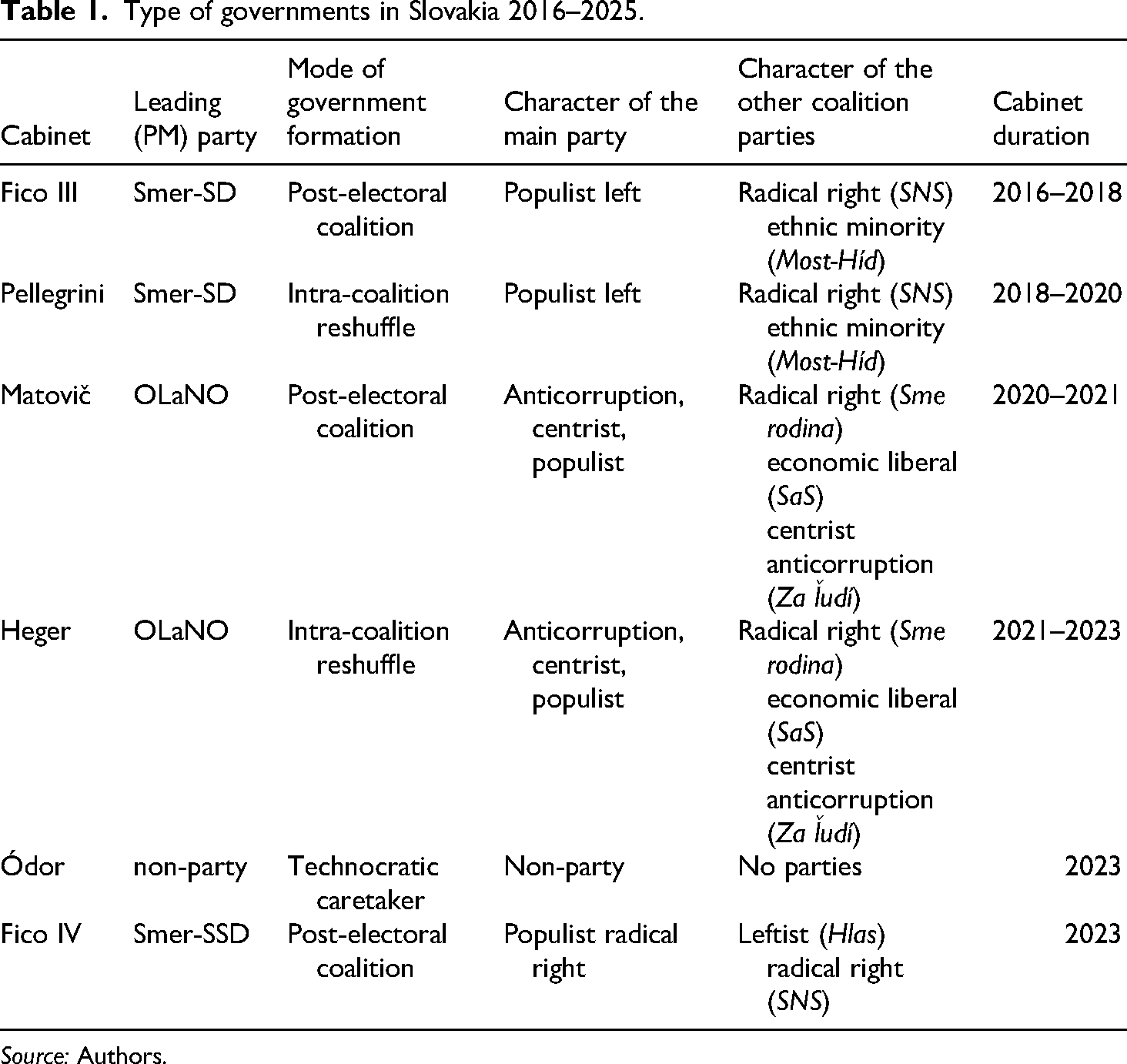
Source: Authors.
The 2023 elections returned Smer–SSD to power in a three-party coalition, following the party's rebranding to include “Slovak” in its Social Democracy designation, a change that reflected its ideological repositioning. Crucially, Smer–SSD in 2023 differed markedly from the earlier Smer–SD. Following an internal split and the departure of much of its leadership to a new party, it underwent a sharp ideological shift toward the far right (Haughton et al., 2025). Between 2020 and 2023, it aligned itself with anti-EU, pro-Russian, and anti-vaccination movements, fully embraced an anti-LGBT agenda, declared opposition to liberalism and progressivism, and promoted openly nativist and culturally conservative policies. By the time it returned to power, Smer-SSD had effectively transformed from a more centrist position in the early 2000s into a PRR party with a traditional–authoritarian position (Figure 1). As a result, Smer's pro-authoritarian shift ultimately eliminated the ideological difference between itself and its strategic radical right ally, the Slovak National Party (SNS).
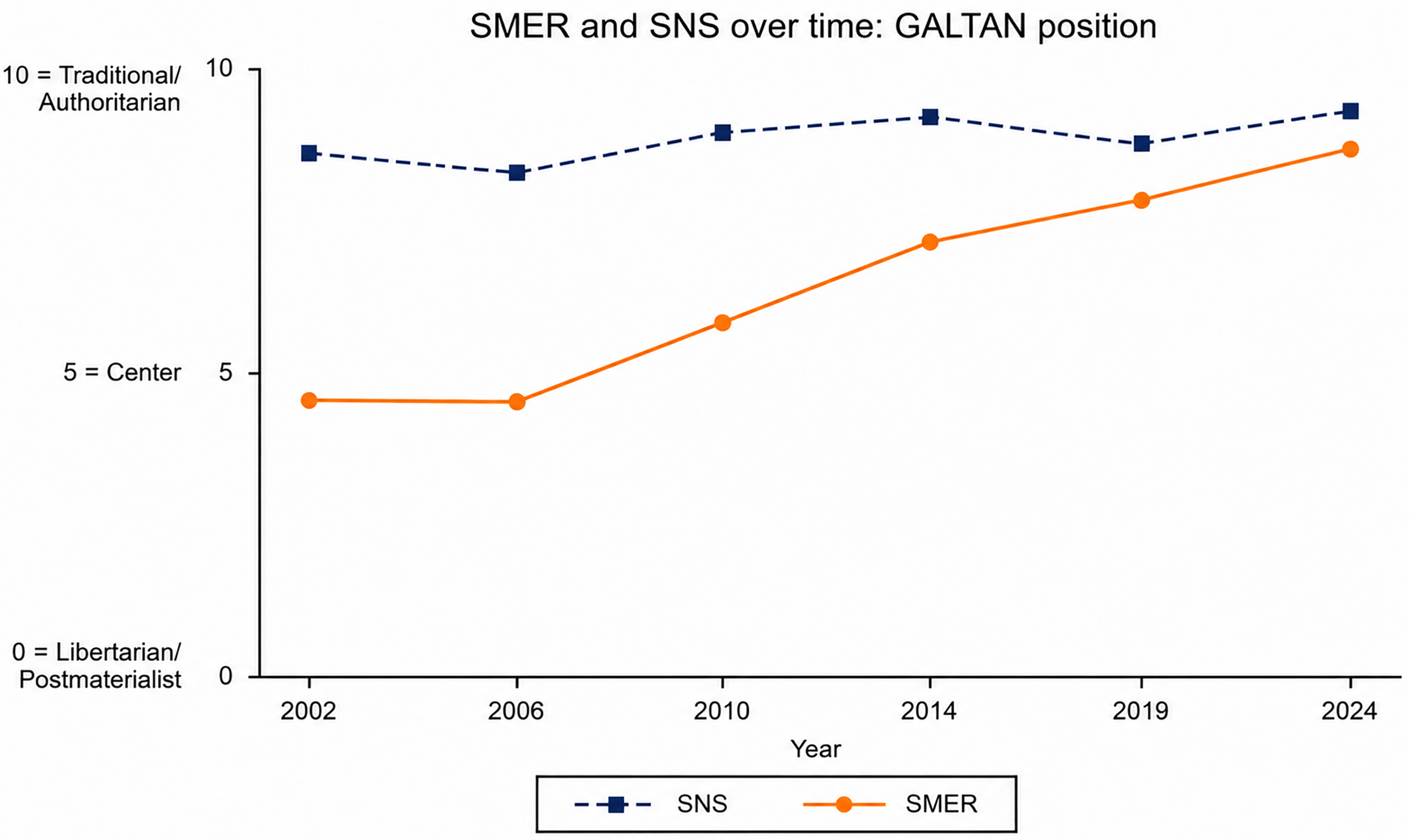
Transformation of the Smer into PRR.
Two additional aspects of the Slovak case merit attention. First, the executive in Slovakia consists of 16 highly autonomous ministries and the Government Office. Each ministry's top layer consists of formal political and career bureaucratic positions. The former includes two deputy ministers (state secretaries) and one chief administrative head (general secretary). The latter are directors general, the backbone of the career bureaucracy and formally meritocratic. Nevertheless, Staroňová and Rybář (2021) show that this layer is routinely subject to patronage appointments, following not only electoral but also ministerial changes. Thus, Slovakia's bureaucracy ranks among the most politicized in the OECD (Nistotskaya, 2021; Staroňová et al., 2026).
Second, despite these high levels of politicization, successive governments prior to 2023 continued to value high-quality analysis and evidence-based policymaking in substantive areas. To compensate for the erosion of expertise within the patronage-dominated bureaucracy, internal ministerial expert bodies, the so-called “analytical units” (AUs), were established from 2016 onwards under the coordination of the Ministry of Finance (MoF), which also served as the network's hub and the guarantor of quality and independence. Recruitment was competitive and transparent, overseen by the Committee for Analytical Units composed of AU heads and academics. This structure and culture fostered professionalism, quantitative expertise, and transparency in contrast to the secrecy typical of patronage bureaucracies (Sedlačko and Staroňová, 2018). Within ministerial hierarchies, the AUs were placed directly below the minister, with their heads elevated to top-tier career bureaucratic positions, above formal political positions. We focus on these AUs because they represent the core of institutionalized policy expertise within Slovakia's top bureaucracy.
Data
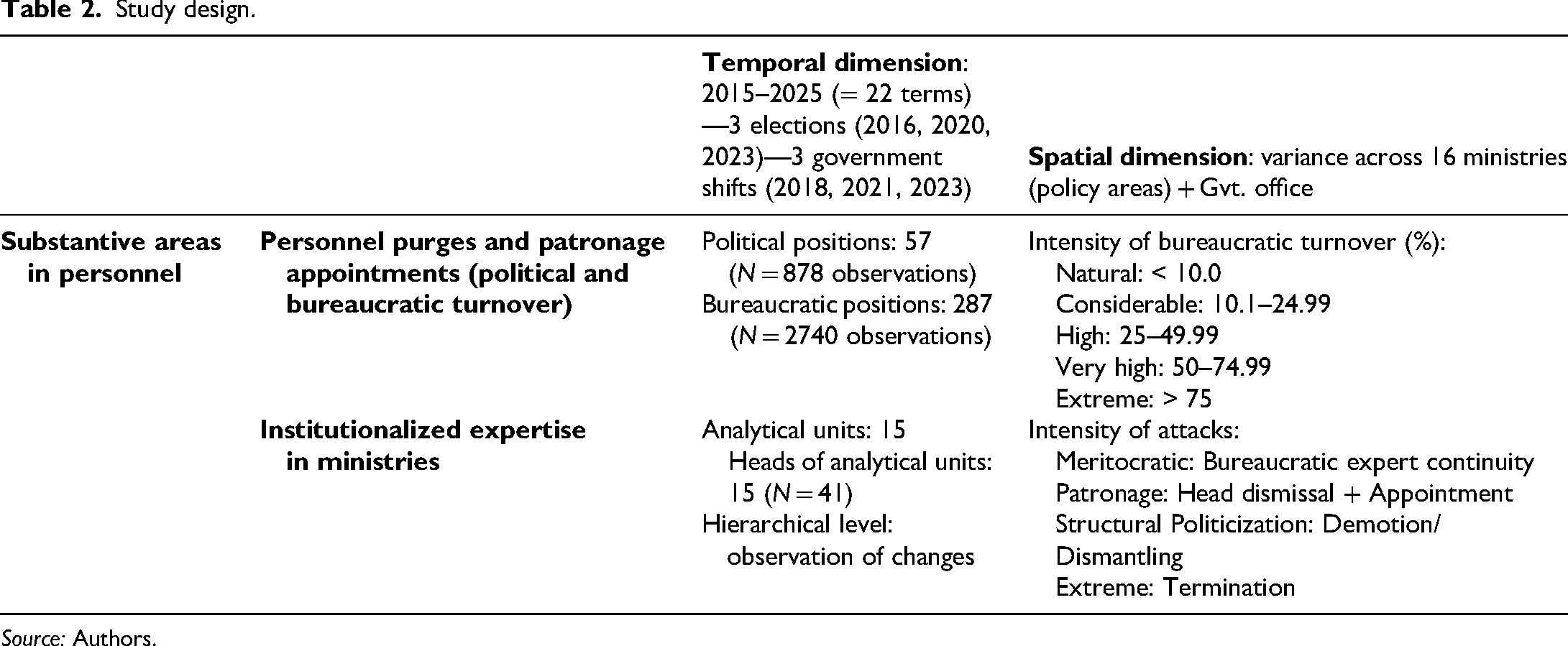
To empirically examine the expectations, we have constructed the following framework (see Table 2). In the first substantive area of purges and patronage appointments (firing and hiring), we use political and bureaucratic turnover rates as a proxy for patronage appointments following elections or government reshuffle, following the methodology of Staroňová and Rybář (2021). The dataset was constructed on the basis of freedom of information requests submitted to all ministries and the Government Office on a semi-annual basis (as of 1 January and 1 July). These requests sought the names of all individuals who occupied (a) political appointee positions, namely deputy ministers and chief administrative heads, and (b) career bureaucratic positions, specifically directors general of policy areas and of AUs. Our operationalization of turnover includes all cases in which the person holding the position changed.
Study design.
Source: Authors.
In the temporal dimension, the dataset covers replacements in political and bureaucratic posts across Slovak ministries between 2015 and 2025 (11 years, or 22 semi-annual terms). Within this time frame, we recorded an average of 57 political positions across 16 ministries, resulting in a total of 878 observations. For career bureaucratic positions, we captured approximately 287 posts, yielding 2740 observations. Our key independent variable (government change) distinguishes among different political contexts in which replacements may occur. It is specified as a categorical variable with seven values. Values 1–3 correspond to periods following government reshuffles without prior elections (2018, 2021, and 2023), while values 4–6 capture periods directly following the formation of new (populist) governments after general elections. Value 7 represents all other periods and serves as the reference category.
The spatial dimension corresponds to the variation of political control penetration across policy areas. We investigate whether some policy areas experience more extreme personnel changes than others, possibly reflecting how closely their agendas intersect with the governing populists’ priorities. To this end, we created five categories based on the proportion of career bureaucrats’ turnover within a given term: (1) natural turnover—up to 10% replaced; (2) considerable turnover—10.01–24.99%; (3) high turnover—25.00–49.99%; (4) very high turnover—50.00–74.99%; and (5) extreme turnover—75% or more replaced. Ministries were grouped into these categories according to their observed turnover rates. Because ministries differ in size, we applied weights based on the number of career bureaucrat positions in each ministry. This ensures that the analysis reflects the relative scale of replacements rather than treating all ministries as equal units. We identify those with extreme turnover.
The second substantive area examines if and how governments target institutionalized expertise within the state administration. Specifically, we focus on AUs within Slovak ministries, which represent the institutional core of bureaucratic expertise. The spatial analysis captures a range of strategies through which political leaders may seek to weaken or control these expert bodies, including patronage practices directed at the heads of AUs, the downgrading of such units within the ministerial hierarchy, and in some cases their complete dissolution. Data for both spatial and temporal analysis come from the turnover database described above, information requests to the MoF, which coordinates the network of AUs, and a structural analysis of ministerial organograms and internal rules of procedure.
Results
Substantive area 1: Firing and hiring (turnover)
The introductory discussion hinted at an increase in both political and bureaucratic patronage appointments when PRR comes to power. Figure 2 shows the turnover rate for both categories (political positions and career bureaucratic positions) over 10 years on a semi-annual basis and through three government changes after elections (2016, 2020, and 2023) and three government reshuffles without elections (2018, 2021, and early 2023).
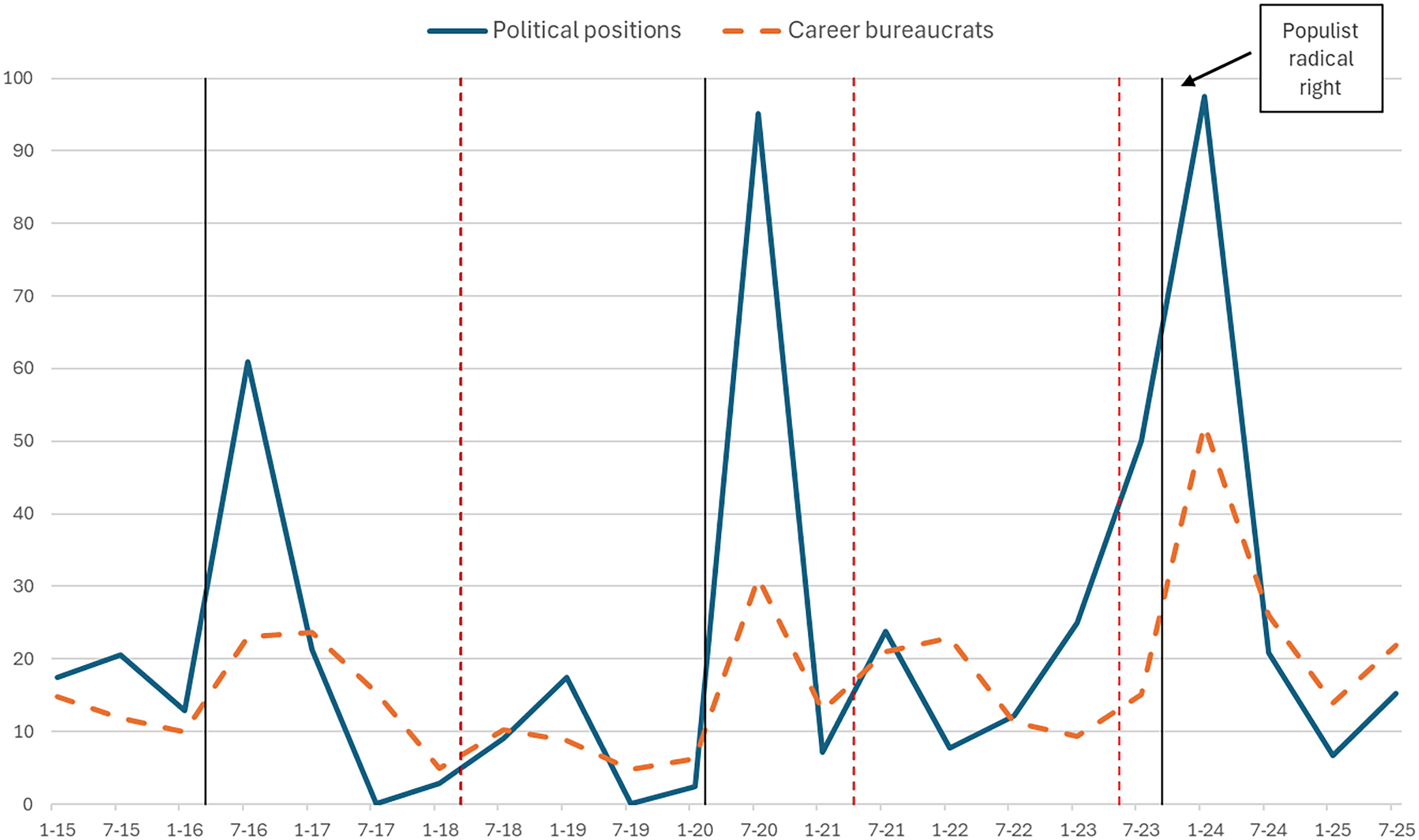
Replacement share of political and career bureaucratic positions.Note. Government change (independent variable) is either: (a) after elections = black vertical dashed lines; (b) without prior elections (reshuffle) = red vertical dashed lines.
Across all governments, political appointments are treated as partisan property: nearly all are replaced immediately following elections. The 2016 turnover rate was lower due to the continuity of the dominant party (Smer-SD) in government, while ministries retaining Smer-SD ministers witnessed minimal change. By contrast, any wholesale government change results in almost complete replacement of political appointees. On average, new populist government is accompanied by near-total turnover among political appointees, compared with an average of 15% turnover during routine periods. Under the PRR, this dynamic deepens. Not only are existing political appointees systematically replaced but also the number of political positions expands through formal politicization: introduction of third deputy-minister posts in roughly half of all ministries and the creation of an entirely new ministry, thereby broadening the scope of politicization.
The purge of career bureaucrats is substantial under any populist government. During government reshuffles without elections, ministers replaced roughly 10–15% of career bureaucrats, mirroring turnover among political appointees and suggesting personalization of politicization (Staroňová and Rybář, 2021). Following government change after elections, however, replacement rates surged to around 23–31% in 2016 and 2020, corresponding to regular patronage cycles. The 2023 elections with incoming PRR doubled these figures, purging more than half of all top-level career bureaucrats. This confirms that right-wing populists’ purges as a central instrument of control are visibly large scale even within patronage-based contexts.
Moreover, while earlier populist governments concentrated their replacements in the first six months after elections, PRR extended purges well beyond this initial transition. Approximately 20% of career bureaucrats were replaced even two years after the 2023 election, numbers approaching turnover after a government reshuffle and not far behind the replacements of bureaucrats directly following the general elections in 2020 and especially in 2016. These patterns are in line with Hypothesis 1 and confirm that PRR sustains continuous politicization over time rather than limiting it to the immediate post-electoral period.
We also find support for expectation Hypothesis 1b that the PRR increases the number of formal political posts in the executive. Notably, this was the only government that increased the number of deputy ministers by half (from 23 to 36) and amended the regulation granting ministers discretionary power to appoint a “plenipotentiary”. Although this increase may seem relatively modest, it is consistent with patterns observed under PRR governments elsewhere (e.g., Cohen and Duhl, 2026).
The results of a multilevel model confirm that the 2023 PRR government reaches a significantly higher magnitude of purges. We control for demographic factors, such as the gender of the person holding the position in the preceding period and the gender of ministers to capture gender-based differences in turnover (Table 3). The model also includes a binary variable indicating whether the ministry is controlled by a member of the PM’s party (1) or not (0).
Multilevel logistic regression predicting replacement of career bureaucrats.
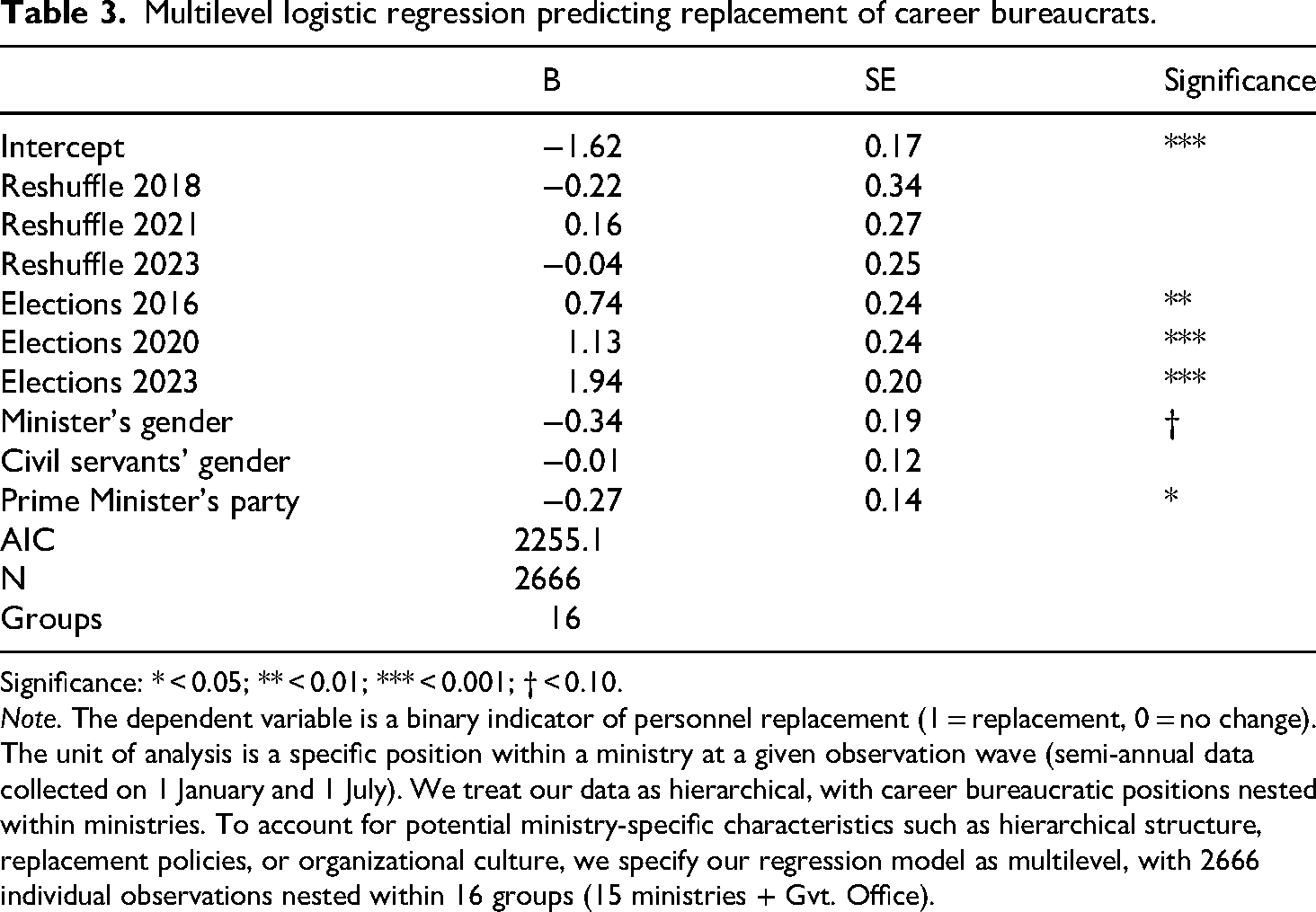
Significance: * < 0.05; ** < 0.01; *** < 0.001; † < 0.10.
Note. The dependent variable is a binary indicator of personnel replacement (1 = replacement, 0 = no change). The unit of analysis is a specific position within a ministry at a given observation wave (semi-annual data collected on 1 January and 1 July). We treat our data as hierarchical, with career bureaucratic positions nested within ministries. To account for potential ministry-specific characteristics such as hierarchical structure, replacement policies, or organizational culture, we specify our regression model as multilevel, with 2666 individual observations nested within 16 groups (15 ministries + Gvt. Office).
Figure 3 includes the results of the turnover models as described above. For simplicity, the results are separated into types of government change: (a) without elections and (b) after elections. The model clearly indicates that the 2023 elections, which brought in right-wing populists to power, had a profound effect on career bureaucrats’ probability of being replaced: about 60%. By comparison, the probabilities after the 2016 and 2020 elections were around 30% and 40%, respectively. With regard to government reshuffles, we do not find evidence that these periods led to an increased probability of replacements compared with the reference category.
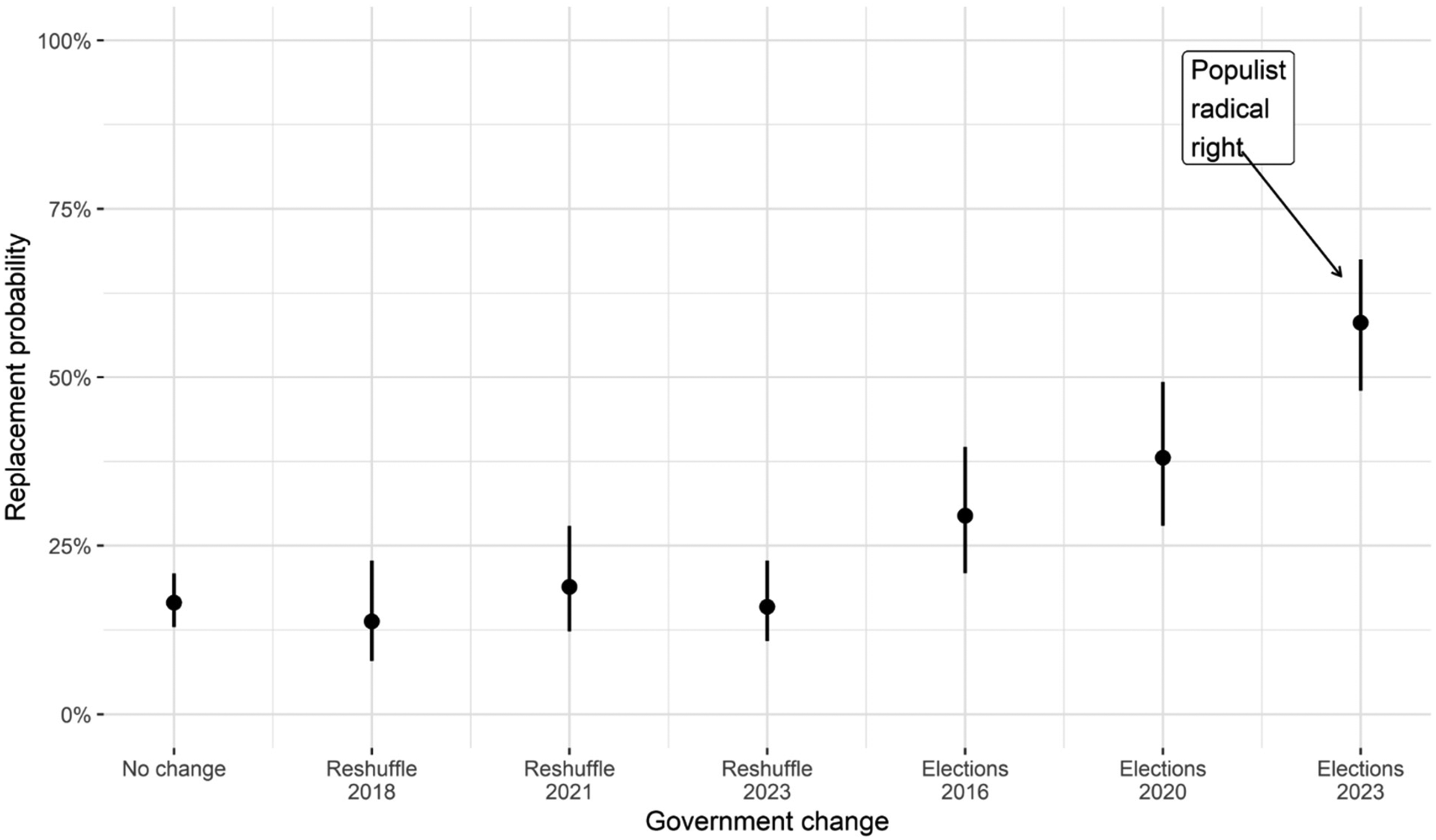
Probability of replacement of career bureaucrats.
Altogether, the data demonstrate that turnover among both political and bureaucratic elites under the PRR is systematic, sustained, and qualitatively distinct from the cycles observed under other ideological variants.
Spatial dimension: Policy-area variation
To capture institutional variation effect, we classified the 16 ministries and the Government Office into five categories based on the share of bureaucratic turnover: (1) natural—up to 10%; (2) 10–29.9%; (3) 30–49.9%; (4) 50–74.9%; and (5) extreme— above 75% (Figure 4). Extreme replacements exceeding 75% of senior staff were rare under previous populist governments, though not absent. Each populist government had one ministry experiencing such a dramatic purge: Agriculture in 2016 and Health in 2020. Even when major turnover followed elections, several ministries remained largely insulated from political interference, most notably Finance and Foreign Affairs, where turnover stayed around 10%, representing natural fluctuation typical of non-election years.
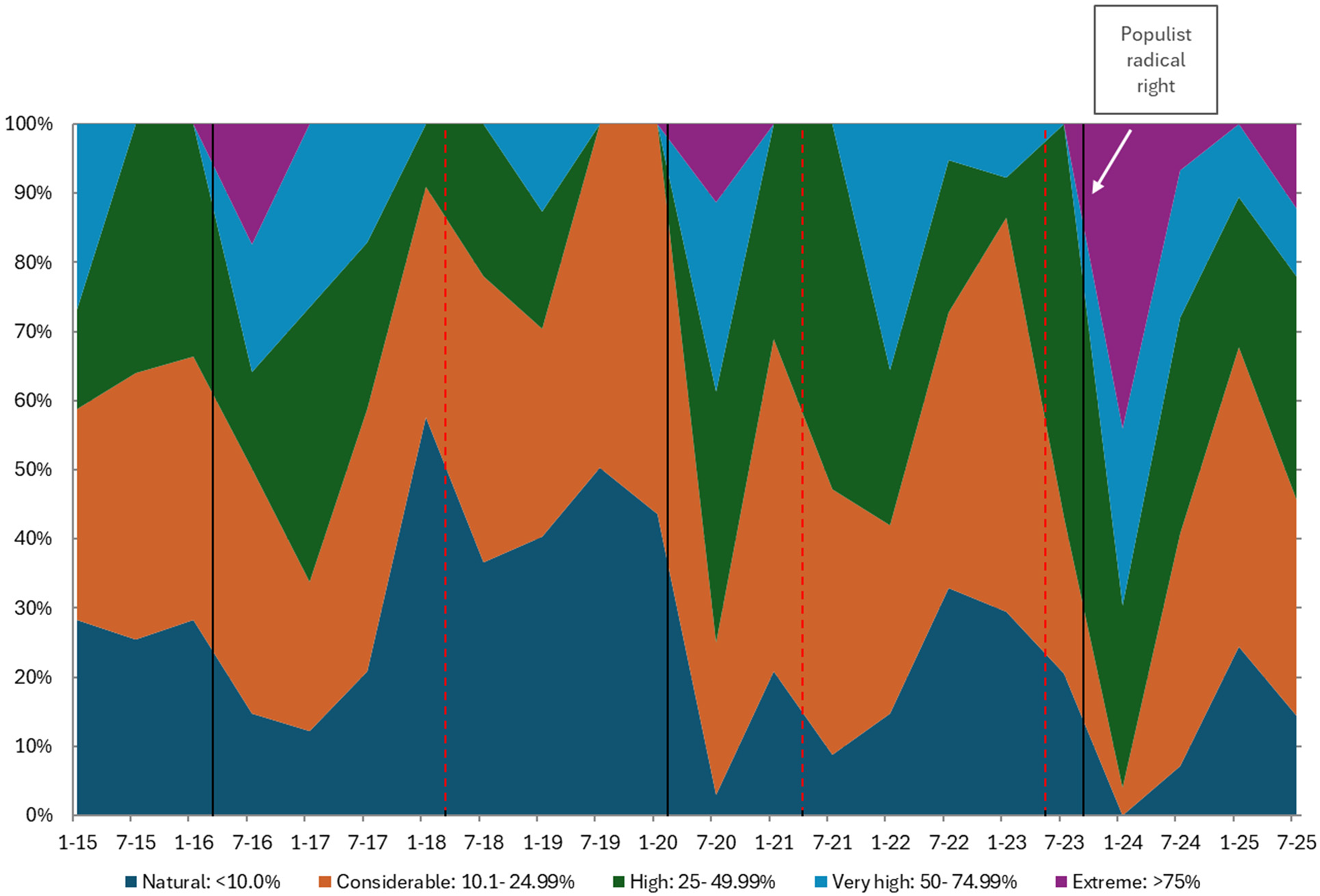
Scope and depth of bureaucratic turnover (from natural to extreme).Note. government change (independent variable) either by: (a) elections = black vertical lines; (b) reshuffle = red vertical dashed lines.
The PRR fundamentally disrupted this pattern. Immediately after taking office, approximately 70% of ministries carried out widespread replacements, with more than half of their career bureaucrats replaced; an unprecedented scale even in a high-patronage context. None of the ministries exhibited the low “natural” fluctuation in the immediate period after elections, characteristic of previous governments. The number of ministries experiencing extreme purges of 75% or more of their senior staff increased fivefold. The polarized policy areas of Ministries of Foreign Affairs, Defence, and Interior reflected conflicts over geopolitical issues, such as EU versus Russia orientation and war in Ukraine. Purges at the Ministry of Environment reflected the split over climate change, as did push for nativism and spread of disinformation via public broadcasters at the Ministry of Culture.
Subsequently, the number of ministries with very high turnover declined but remained elevated: two years after the 2023 elections, only three ministries, namely Finance, Transport, and Education, had cumulatively less than 75% (but still more than 50%) of their top career bureaucrats replaced. Cumulatively, PRR targeted eight ministries where senior staff replacement exceeded 100% over multiple rounds, suggesting that even their own appointees became disposable within an ongoing cycle of domination. These findings substantiate and show that bureaucratic politicization under PRR is both ideologically motivated and self-perpetuating.
Substantive area 2: Attack on expertise
AUs, established in 2016 under the Smer-SD-led government, were intended to strengthen evidence-based policymaking and were granted exceptional autonomy within ministerial hierarchy. This autonomy persisted across several government transitions. Even when five AU directors were dismissed after 2020, replacements were hired through merit-based procedures. These practices sustained professional standards despite high bureaucratic turnover.
Following the 2023 election, however, the PRR introduced a qualitative rupture. Initially, AU directors were sidelined only. After the first 10 months, the government advanced a set of unprecedented extreme measures: head dismissals followed by patronage appointments, structural dismantling and demotions of AUs, and even termination (see Table 4). The extreme measure of terminating the AUs completely was carried out at the Ministries of Defence, Justice, and Culture, accompanied by mass analysts’ dismissals without justification. At the same time, it structurally downgraded four additional AUs by merging them into lower-level departments and removing their direct ministerial reporting lines, thereby undermining their analytical capacity and autonomy. Finally, the government bypassed established recruitment rules through discretionary political appointments of new AU heads, consolidating political control over what had previously been meritocratic expert bodies.
Institutionalized expertise.
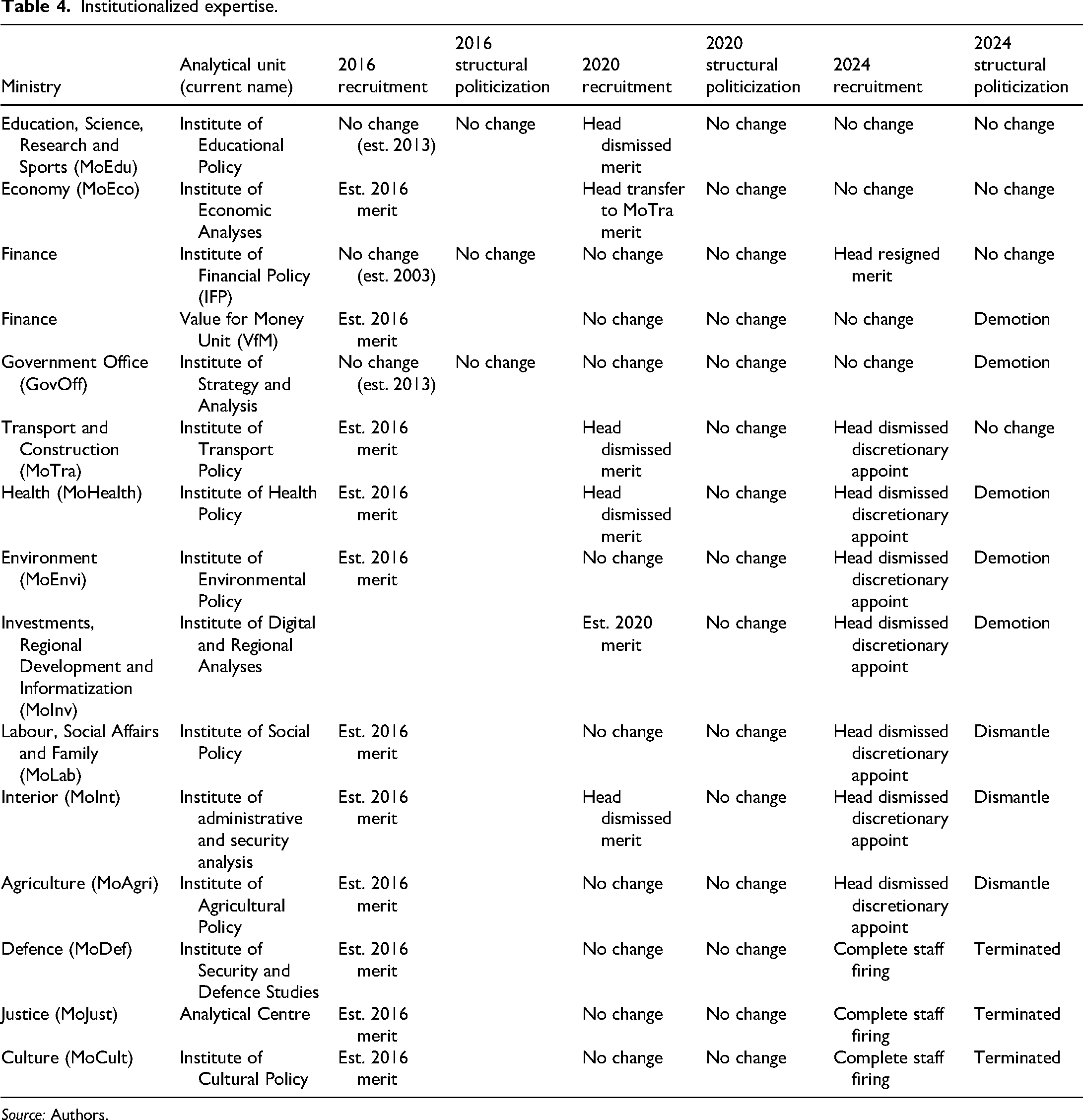
Source: Authors.
Only two AUs, within the Ministries of Economy and Education, remained fully intact in personnel, mandate, and procedures. One additional AU experienced a competitive reappointment following a voluntary resignation. Altogether, these interventions dismantled the institutional safeguards that previously protected analytical independence, demonstrating both expertise suppression and politicization. The PRR thus transformed AUs from autonomous centres of analytical capacity into politically subordinated units; strong evidence for Hypothesis 3 (structural politicization) and Hypothesis 4 (institutionalized expertise termination).
Discussion and conclusion
Administrative backsliding (Bauer, 2024) represents one of the most troubling manifestations of contemporary autocratization. However, current understandings of these processes remain incomplete and are largely shaped by cases characterized by legally protected, merit-based, and relatively autonomous bureaucracies, where politicization directed at the bureaucracy and bureaucratic expertise are assessed as a departure from established norms (Bauer et al., 2021; Lotta et al., 2024; Moynihan, 2022). In this article, we show that this perspective fails to capture how populist attacks on the bureaucracy differ from routine politicization practices by other ideological governments in their treatment of the state bureaucracy. Our analysis of a less commonly examined case, in which routine politicization operates within a patronage-based administrative system (Staroňová et al., 2026), provides additional insight into the authoritarian facets of populist strategies for successfully controlling the bureaucracy. Further research is needed to examine variation across different PRR, and the strategies they deploy under different institutional settings. Nonetheless, we argue that distinguishing between routine politicization and PRR politicization of the bureaucracy is analytically important, and that the contribution of this article advances the academic debates on autocratization in multiple ways.
First, even in systems where politicization and patronage are already normalized, PRR governments can advance administrative backsliding by reinventing and redirecting existing mechanisms of bureaucratic and expertise control rather than by introducing formally novel institutional reforms. This pattern is consistent with conceptualizations of administrative backsliding as a gradual process of democratic de-anchoring driven by cumulative changes in personnel, expertise, and executive dominance (Bauer et al., 2026). Moreover, what may be the subject of future research, if the PRR resorts to nuanced strategies depending on the presence/absence of routine politicization, a better understanding of these may provide more tailored recommendations for bureaucrats to resist the PRR and become guardians of democracy (Yesilkagit et al., 2024).
Second, utilizing longitudinal data on political and bureaucratic turnover in Slovakia between 2015 and 2025, draw our attention to the PRR mechanism of timing (Table 5). The analysis demonstrates that PRR governments do not merely intensify existing patterns of patronage politicization, but depart from its predictable logic in a fundamental way. Under routine politicization, bureaucratic turnover was concentrated in the immediate post-electoral period, declined and was stable thereafter, a pattern consistent with the instrumental use of patronage to secure political responsiveness and loyalty to ensure the capacity of the bureaucracy to implement programmatic priorities (Staroňová and Rybář, 2021). While PRR governments also engage in extreme (over 75%) rather than high replacement immediately after taking office, bureaucratic turnover does not stabilize once political control is consolidated. Instead, replacement remains persistently high over time and cumulatively exceeds 100% in some policy domains. This means that PRR governments not only remove inherited civil servants but also dismiss and replace their own appointees. In effect, personnel replacement becomes a continuous governing practice that installs fear (Kucinskas, 2025; Lotta et al., 2024). A possible explanation is that PRR goal is the systematic erosion of institutional memory within the bureaucracy, as accumulated expertise, informal knowledge, and organizational experience are repeatedly disrupted and lost.
“Routine” politicization vs populist radical right.
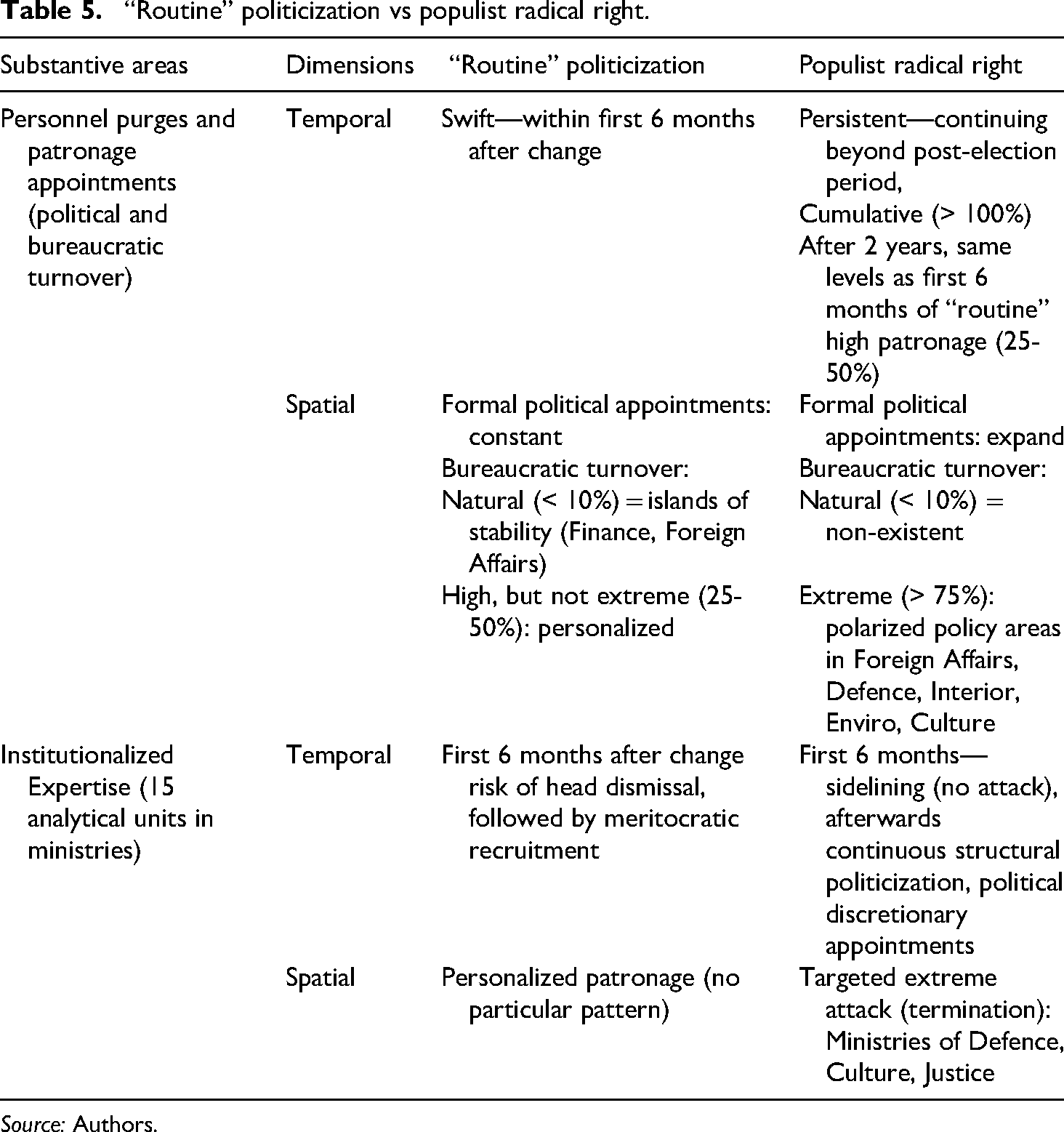
Source: Authors.
Importantly, this pattern suggests that the objective of PRR personnel policy differs from that of other populist governments operating in patronage-based systems. Although practices of routine politicization may be substantial, they remain temporally bounded and preserve a degree of institutional continuity and organizational memory. Whereas non-PRR governments use turnover primarily to secure trust based loyalty and political responsiveness at the outset of their term, PRR governments sustain turnover well beyond that point. The persistence and extremity of replacement indicate that the goal is not merely to align the bureaucracy with government preferences, but to maintain a state of permanent uncertainty and fear. Repeated dismissals, including of recently appointed officials, undermine expectations of tenure and stability and weaken the capacity of bureaucrats to act autonomously or resist political pressure.
Third, the spatial dimension of bureaucratic politicization reinforces this interpretation. Under routine (even though high) politicization, certain policy areas retained relative stability with natural turnover, particularly those associated with technical expertise or economic management. Under PRR government, such differentiation weakens considerably. Extremely high turnover becomes more widespread and is especially pronounced in policy areas central to PRR ideology, including foreign affairs, defence, justice, culture, and the environment. The concentration of extreme turnover in these domains indicates that personnel control is deployed strategically to neutralize institutional resistance where it is most politically consequential (Özdamar and Yanik, 2024; Peci, 2021).
An even sharper distinction emerges in the treatment of institutionalized bureaucratic expertise. Governments with reliance on routine politicization and patronage, largely preserved AUs as autonomous sites of evidence-based policymaking. Leadership changes occurred, but were typically followed by merit-based recruitment, allowing these units to retain organizational continuity and professional credibility. Under PRR governments, by contrast, AUs were initially completely sidelined during the first months in office, but were subsequently terminated, dismantled, downgraded, or subjected to discretionary political appointments. This process systematically weakened their autonomy and access to decision-making.
These interventions go beyond the pursuit of loyal personnel. By targeting institutionalized expertise, PRR governments undermine bureaucratic constraints that limit executive discretion and channel policymaking through professional standards and evidence. In this sense, the erosion of expertise complements sustained personnel turnover as part of a broader governing strategy. Together, these practices shift bureaucratic control away from securing loyalty and responsiveness toward intimidation and compliance. This is in line with findings from other contexts in which populist governments rely on fear, uncertainty, and institutional distrust to discipline the state apparatus (Kucinskas, 2025; Lotta et al., 2024; Moynihan 2021; Peci, 2021). Taken together, the findings demonstrate that the PRR represents a distinctive governing actor even within patronage-based administrative systems. While patronage and routine politicization are common instruments across ideological populist governments, PRR governments repurpose them into a sustained mode of threat governance that erodes institutional memory, weakens bureaucratic expertise, and destabilizes bureaucratic authority.
More generally, the analysis cautions against treating populism in power as a homogeneous phenomenon in public administration research. Ideological differentiation matters not only for policy outputs but also for how executive actors engage with bureaucratic institutions. By showing how the PRR deploys personnel turnover and the dismantling of expertise as tools of authoritarian governance rather than mere instruments of control, this article highlights the need for closer integration between political science research on populism and public administration scholarship on bureaucratic governance.
Footnotes

Funding
The authors disclosed receipt of the following financial support for the research, authorship, and/or publication of this article: This work was supported by the Grantová Agentura České Republiky (grant number GA22-21665S).
Declaration of conflicting interests
The authors declared no potential conflicts of interest with respect to the research, authorship, and/or publication of this article.