






Abstract
— Legislative-Made Reorganization under the Jones Law
During the critical period of development of self-government under the Jones Law, the Philippines had been actually successful as a test-laboratory of legislative-made reorganization. Indeed the Philippines had been, since the inception in 1916 of its autonomous government, the focal center of curiosity of political scientists, although not so well known to the world then, even for that singular achievement, as it is poetically glamorized as « Pearl of the Orient », or as it is now called, the « Show-window of Democracy ». Twice, under the Jones Law, was the administrative machinery overhauled at the initiative and under the auspices of the Filipino-controlled Legislature: in 1916–1917 (1) and in 1932–1933. (2)
The reorganization of the executive department was authorized by Act 2666, approved by the Legislature on November 18, 1916. But the changes authorized by that Act and the other reorganizational reforms were incorporated in Act 2711, popularly known as « the Revised Administrative Code of 1917 », which, according to its final section, « shall take effect upon the first day of October, nineteen hundred and seventeen. »
This reorganization was authorized by Act 4007, known as « The Reorganization Law of 1932 » (approved on December 5, 1932), which, according to its Section 45, « shall take effect on January first, nineteen hundred and thirty-three. »
With the promise stipulated in the very preamble of the Jones Law that America would grant the Filipino people their century-longed-for independence as soon as they could establish a stable government, their authorized spokesmen and leaders, who controlled both houses of the Legislature, naturally were inclined towards a legislative-made reorganization. They of course preferred this to a revamping of the governmental structure, effected either by private persons outside the government service, or by officials selected from the Executive Branch.
The reasons for the Filipino preference at that time for a legislative-made reorganization were perfectly understandable. In the first place, the authority expressly granted by the Jones Law to the Filipino-controlled Legislature, to reorganize the Executive Departments was one of the significant grants of autonomy for which Filipino leaders in the former Philippine Assembly had been clamoring time and again. It was, therefore, imperatively necessary to ratify and actively assert and exercise the new power (3). Otherwise, neglect or hesitancy on the part of the Legislature to reorganize the administrative machinery might give rise to the false impression, among American critics, that the Filipino leaders were not in earnest in their previous demands, or were lacking the self-reliance, initiative or constructive ability necessary for administrative reforms. In the second place, the adoption of an executive-made reorganization would have been totally meaningless in the light of the burning issue of Filipino capacity and readiness for independent self-government. Since, according to the strict requirement of the organic act, the Executive Branch should be headed by a Governor-General appointed by the President of the United States, who thereby represented American sovereignty rather than the Filipino nation, an executive-made reorganization would then neither express the popular will, nor demonstrate the capacity of the Filipino people to organize and maintain a stable democratic government of their own.
As Speaker Sergio Osmena emphasized in his remarks on the Reorganization Bill (H. B. No. 124), the Filipino leaders believed that « the country must exercise all the powers conferred upon it by the Jones Act, without sterile vacillation or cowardly renunciation », and that « the departmental direction of the administrative activities should, as far as possible, be in the hands of Filipinos. » (Diario de Sesiones de la Camara de Representantes, Vol. XII, page 123).
The first reorganization of the Philippine Government undertaken at the initiative and under the immediate control and responsibility of the popularly elected Chief Executive was authorized by Commonwealth Act No. 5 (Approved December 31, 1935). This law provided for the appointment by the President of the Philippine Commonwealth of a Government Survey Board composed of three persons who were not in the government service. President Quezon accordingly appointed Ex-Secretary of Finance, Don Miguel Unson, as Chairman of the Board, and Mr. W. Trinidad and Mr. J. Paez, as members. In his message to the first National Assembly on December 12, 1935, President Quezon said:
I am recommending a non-political board in order that we may profit by the experience of able men engaged in private enterprises. Moreover, by this means we shall allow the general public, so to speak. to look the Government over, and give us their views on the methods we employ in its administration. It is essential that the functioning of the Government be better understood by the people, and the Government itself brought closer to them.
… In the past, various attempts to effect economies met with the opposition of government officials, each seeking to establish the relative importance of his bureau or office to obtain the largest assignments for salaries and other appropriations. This Board will not be hampered by this almost inevitable competition and will be able to give us unbiased judgment regarding the minimum needs of each dependency of the Government.
As regards this non-political character of the composition of the Government Survey Board, it was strikingly similar to President Roosevelt's Committee on Administrative Management, which was created on March 20, 1936, and composed of Mr. Louis Brownlow, Chairman, and two other members, Professors Gulick and Merriam.
The second executive-made reorganization of the administrative machinery of the Philippine Government was accomplished in 1947, under President Roxas’ directives, by a Reorganization Committee, headed by the then Budget Commissioner Pio Pedrosa. The third executive-made reorganization was accomplished in 1950, under President Quirino's orders, by a Reorganization Commission headed by former Philippine Minister to St. James, Don Ramon Fernandez. Unlike the Hoover Commission which had mixed composition, comprising four members appointed by the President of the United States, four by the President pro tempore of the Senate, and four by the Speaker of the House of Representatives, both the Pedrosa Reorganization Committee and the Fernandez Reorganization Commission were composed exclusively of appointees of the Philippine President: some executive officials and some from outside the government service, but no senators or congressmen.
Moreover, both Republic Acts Nos. 51 and 422, under which the reorganizations of 1947 and 1950 were authorized, adhere closely to the pattern established in 1935 by Commonwealth Act No. 5. According to this pattern, « In order not to delay reforms in the Government organization that may appear urgent », the President was empowered « to effect, from time to time, for a period of not more than six months [one year allowed to Presidents Roxas and Quirino] from the date of the approval of this Act, by executive order, such reforms and changes in the different executive departments, bureaus, and offices as he may consider necessary … to effect economy and promote efficiency in the Government service ». He was required to submit such executive orders to the National Assembly (or the Congress) for approval, but « such action shall be valid and subsisting until the National Assembly (or the Congress) should provide otherwise ».
— Unique Features of the Reorganization Act of 1954
From the pattern thus followed during the administration of Presidents Quezon, Roxas and Quirino, two significant departures, on the other hand, are observable under President Magsaysay's Reorganization Act of 1954 (Republic Act No. 997). For one thing, the Government Survey and Reorganization Commission that was set up by that Act is composed, not exclusively of Presidential appointees but, like the Hoover Commission, of mixed membership, — four, who may not be officials of the government, to be appointed by the President of the Philippines; four senators to be appointed by the President of the Senate, one of whom shall not be of the majority party; and four congressmen to be appointed by the Speaker of the House of Representatives, one of whom shall not be of the majority party (4). Obviously, therefore, there is in the membership of the Government Survey and Reorganization Commission a numerical preponderance of legislators: eight, as against four Presidential appointees.
The Presidential appointees are Budget Commissioner Aytona, U.E. President Dalupan, Hermengildo B. Reyes, and Col. Andres O. Cruz; the Senators are Cipriano P. Primicias, Edmundo B. Cea, Jose C. Locsin, and Macario Peralta, Jr. (the last mentioned was replaced by Sen. Quintin Paredes as observer); and the Representatives are Arturo M. Tolentino, Apolinario R. Apacible, Isidro C. Kintarar, and Paulino A. Alonzo.
Moreover, it is also significant that President Magsaysay's Reorganization Act of 1954, insofar as its provisions governing the procedure of making reorganization plans effective are concerned, constitutes a sharp deviation from the traditional pattern established by the three previous reorganizations. Instead, it has patterned the principles of its procedure after the peculiarly distinctive provisions of the U.S. Reorganization Act of 1949 (Public Law No. 109). The President of the Philippines was directed, under the Reorganization Act of 1954, to submit, on or before March 15, 1955, [amended by Republic Act No. 1241, so that the period was extended to « the twentieth session day of the Third Regular Session of the Third Congress », in February 1956] to the Congress any reorganization plan or plans that the Government Survey and Reorganization Commission, after due investigation and study, may consider necessary to accomplish one or more of the following objectives: (1) Better execution of the laws, and more effective management of the government and expeditious administration of public business; (2) Economy to the fullest extent consistent with the efficient operations of the government; and (3) Increased efficiency of the operations of the government to the fullest extent possible.
Such reorganization plan, according to Section 6(a) of the Reorganization Act of 1954, would take effect after 30 calendar days of session [changed by Republic Act No. 1241 to « after the expiration of the seventy session days »] of the Congress, counting from the date of its transmittal, unless within that period either House by simple resolution disapproved the reorganization plan. In other words, the reorganization plans transmitted by the President to the Congress would automatically acquire the force and effect of law upon « default » or failure of either House of Congress to disapprove them within the limited period. Congress was also empowered to approve, by concurrent resolution, any reorganization plan submited to it by the President. And, in that way Congress could give the plan full force and effect within or before the expiration of the fixed period of time.
The Reorganization Act of 1954, like its counterpart the U.S. Reorganization Act, does not have any provision, such as was prescribed in Commonwealth Act No. 5 and in Republic Acts Nos. 51 and 422, expressly authorizing the President to issue, upon his initiative and discretion, reorganization orders which shall be immediately « valid and subsisting until Congress shall provide otherwise ». Therefore, the President could not issue such reorganization orders even during the time Congress was adjourned. This deficiency could obviously result here in considerable inconvenience and delay in effecting urgent organizational changes, because by our Constitution the regular session of Congress is limited to 100 days and its special session to 30 days each year, although the same deficiency could hardly have similar effect in the Federal Government of the United States, because no constitutional limitation is imposed there on the length of session Congress may decide to hold.
It is obvious that the adoption of the Reorganization Act of 1954 marked a turning-point in the trend of administrative development in the Philippines. Until then, executive influence and control had predominated, and legislative participation played a secondary balancing, revisory role in the administrative reorganization of the Government. Under the new Reorganization Act, this relative influence and control exerted by the President and the Congress markedly tended to be reversed. That this reversal is as clearly contemplated as it was deliberately intended by the law is expressed by Senator Cea in the Explanatory Note of Senate Bill No. 117, which substantially was consolidated into the Reorganization Act of 1954. Senator Cea said:
It is to be remembered that laws on Government Reorganization had been enacted by past Congresses… Under these laws, the power to reorganize the Executive Branch of the Government was delegated to the President of the Philippines without limitations worthy of the zealous guard which Congress must perforce keep over its constitutional prerogatives. Under these laws, reorganization plans made by the President of the Philippines took effect immediately upon submittal to Congress, thus leaving Congress no power at all to deliberate upon the plans nor to prevent their taking effect, save the right of subsequent disapproval which at most could only be curative and not a preventive gesture. These, then, made the act of reorganization almost purely an executive undertaking — an abnegation of powers which the Constitution restrains Congress from doing…
In view of the fact that the writer of this article had served as technical consultant to the Unson Government Survey Board, the Pedrosa Reorganization Committee and the Fernandez Reorganization Commission, he was not inclined, when he wrote an article entitled Reorganization Act of 1954 for the « Presidential Birthday Commemorative Greenbook », Vol. VII, No. 7, to make a detailed comparative appraisal of the achievements that may be credited to each of those past government revamp agencies. Much less is he inclined to do so now, after his connections with government reorganization have been further extended to include assignment, at first, as the Acting Executive Director of the Government Survey and Reorganization Commission, and later, as Chief Adviser to the Chairman of the Commission. Certainly, the limitation of space also makes it suffice here to point out only such of the distinct, incontrovertible achievements of the past reorganization agencies, as well as of the present Government Survey and Reorganization Commission, that may aptly serve as the foundation-stones for the constructive job still confronting both the Government Survey and Reorganization Commission and the Management Service of the Budget Commission in their tasks of detailed implementation and execution of the approved reorganization plans.
The present writer recalls that, in his remarks before several conferences on public administration, which he attended in his tour of duty in 1948 as Administrative Research Attache detailed to the U.S. Bureau of the Budget, he pointed out, among others, the following four fundamental features of the Philippines system of public management, that, he now believes, should be used, together with such other basic features recently adopted, as a jump-off ground for the accomplishment of the continuing, practical implementation and follow-through reorganizing tasks which will be inherited and carried on by the Management Service, after the lapse, at the end of the year 1956, of the existence of the Government Survey and Reorganization Commission:
First is the principle that bureaus, offices, agencies and other organizational units should, as far as feasible, be distributed among and grouped under corresponding executive Departments, on the basis of major function, so as to minimize conflicts, overlapping, and duplication of activities, and bring about, to the maximum extent possible, an integrated, uni-functional organization of the Departments. Since its adoption and application, for the first time in the history of the Philippines administrative system, as the basis of reorganization of the Government in 1916–1917, this first principle has been accorded, at each subsequent reorganization, so consistent a recognition of its undisputed validity and such increasing extent of application, that its acceptance by President Magsaysay's Government Survey and Reorganization Commission as an axiomatic principle was presumed. In fact, it was the eleventh guiding principle adopted by the Commission on September 7, 1954.
Second, and corollary to the integrated uni-functional organization of the Executive Departments, is a basic policy, first enunciated by the Unson Government Survey Board, and successively reaffirmed and further implemented in the two subsequent reorganizations. That policy stemmed from the familiar observation that, as a natural tendency to rear up a centralized, top-heavy administration in such a unitary system of government as our Constitution provides, « all converge towards one central hub, the President, and this inevitably places a heavy burden upon him ». Too often, officials obsessed with personal ambition and the importance of their offices, lobby and bring all sorts of influence and pressure to bear, in order to transfer their offices or raise them to the category of an Administration or a Commission, directly under the Office of the President. Their purpose is to gain more official glamour, prestige, and greater chances of getting an increased appropriation allotment. Unless counteracted or moderated, the tendency of the bulk of operational activities to thus gravitate to the Office of the President might have as detrimental a result as (quoting a practical observer) « apoplexy in the brain center and paralysis in the extremities ». To counteract this tendency, it has been the basic policy, since 1938 when it was enunciated in the report of the Government Survey Board, that as many functional or line agencies as could feasibly be transferred or assigned to any other Executive Departments, to whose major functions their activities are closely related, should be allocated to such Departmental supervision rather than to the President's direct control. In other words, as much as possible, the Office of the President should be restricted to over-all supervisory, coordinating or staff, rather than operational or line, activities. In this way, the President would be saved from being bogged down in the mire of too many administrative details, thereby enabling him to fulfill adequately his constitutional duties as Head of the Government, as well as those incumbent upon him as the foremost leader of the Nation, in the determination of top-level policies and momentous decisions of State.
This long-standing basic policy was actually reaffirmed in the fifth guiding principle adopted by the Government Survey and Reorganization Commission, which reads: « A clear distinction must be made between responsibility for planning, coordination and direction, on the one hand, and administrative detail, on the other ». The Commission observed that « Twenty years of accretion have made the Office of the President what it is now — a chaos of some 39 agencies vested with line, staff and auxiliary functions ». Consequently, in its Reorganization Plan No. 45-A, the Commission provided for the transfer from the immediate or direct executive control of both the President and the Executive Office of the following extraneous agencies and functions, thereby discontinuing the anomalous, excessively top-heavy concentration of operational responsibilities in the President's Office, and streamlining and making the Executive Office truly an auxiliary agency to the President, without line authority and responsibility with respect to the executive departments, but primarily to serve as « a channel facilitating the flow of executive authority down-ward and of departmental responsibility upward »:
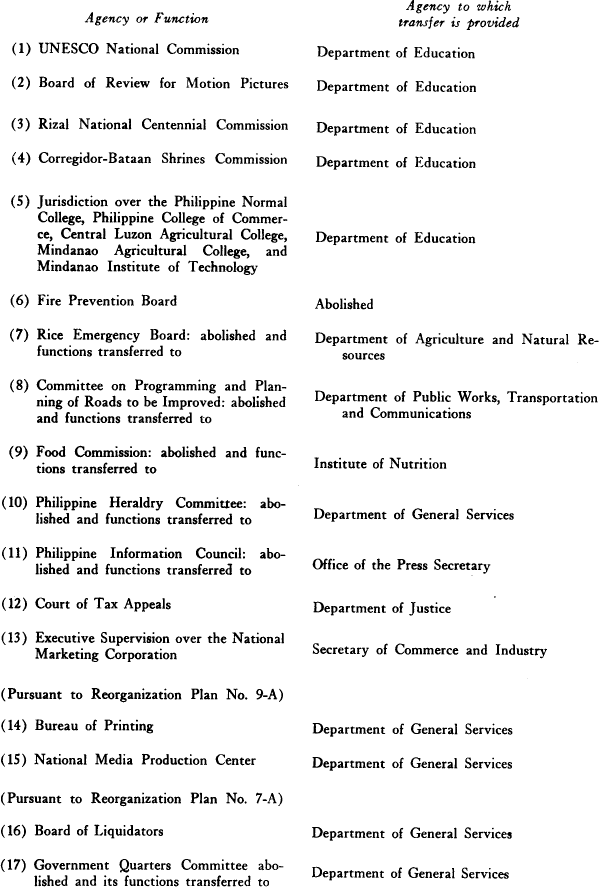
Third is one of the creditable achievements of the Pedrosa Reorganization Committee of 1947, which resulted from the statutory revision it had to undertake along with its reorganization task, particularly to synchronize the administrative mechanism, as provided in Section 77 of the Administrative Code, with our Constitution. The original provision of that Section, which the writer of this article had persistently urged to change since he first proposed its amendment in a lecture on reorganization he delivered in the First Alumni Institute in 1935 of the University of the Philippines, read as follows:
The position of Secretary of Public Instruction is held by the Vice-Governor. The other Secretaries of Departments shall be appointed by the Governor-General at the beginning of each Legislature, and shall hold office, unless sooner removed, until their successors shall have been appointed and qualified.
The foregoing provision of the Administrative Code as adopted as a result of the executive reorganization in 1916–1917, with the intention of making the term of office of Department Secretaries coterminous with the triennial life of the Legislature prescribed by the Jones Law. In that way, the greatest responsiveness and responsibility of the Secretaries to the Legislature, rather than to the Governor-General, was then sought by the Filipino leaders to be developed under the organic law, in accordance with the ideology of a responsible cabinet or parliamentary system of government which they preferred (5).
The Filipino leaders preferred a cabinet or parliamentary model so much that, in the original draft (H. B. No. 124) of the Reorganization Law of 1916, Representative Leuteric actually proposed to adopt the titles « Ministers » for designating the Heads of Departments. Vide an article entitled « Secretary of Minister » by Quirino E. Austria, in Herald Mid-week Magazine (March 8, 1939), pages 9, 12 and 14; and Francis Burton Harrison, The Cornerstone of Philippine Independence, page 203: « There is little doubt that what the Filipinos desired was a responsible ministry and a form of government like that of Canada, where the Governor-General is a mere figurehead ».
Since our present Constitution is patterned after a different type — the presidential or congressional type — the present writer again urged, in a memorandum he submitted soon after his assignment as Technical Consultant to the Pedro Reorganization Committee, that the original, long-obsolete provision of Section 77 of the Administrative Code be changed. This is a distinctly consoling instance where a researcher's persistence triumphed at long last. His recommendation was duly approved by the Reorganization Committee and President Roxas. And so, that Section was reworded, according to Section 4 of Executive Order No. 94, dated October 4, 1947, as follows:
The Secretaries of Departments shall be appointed by the President of the Philippines with the consent of the Commission on Appointments of the Congress, at the beginning of his term of office, and shall hold office, unless sooner removed, until the expiration of his term of office, or until their successors shall have been appointed and qualified.
Besides patterning the Government of the Philippine Republic after the presidential type more decisively than ever before, the foregoing amendment of the Administrative Code has also definitely and correctly fixed the tenure of office of Department Secretaries. In this respect, although the Constitution of the Philippines, like the Constitution of the United States, does not expressly stipulate the length of tenure of Department Secretaries, we have gone ahead of the American Federal Government where the term of only the Postmaster General is definitely fixed by statute (17 Stat. at large 284) « for and during the term of the President by whom he is appointed and for a month thereafter unless sooner removed ». As Attorney General William D. Mitchell stated, the other heads of departments in the Americal Federal Government « continue to hold office from the time they are commissioned until death, resignation, or removal ends their tenure ». In other words, in so far as the strict and formal provision of law is concerned, the American Cabinet Secretaries, except the Postmaster General, have a vague, indefinite tenure of office, although by political custom and usage they are required, as a general rule, to resign after the termination of incumbency in office of the President who originally appointed them.
On the other hand, now, with the correct synchronization of the tenure of office of our Cabinet Secretaries with that of the President through the aforestated amendment of the Administrative Code, the status of Heads of Departments or Cabinet Secretaries and their relation to the Chief Executive are defined and fixed correctly by law, in complete harmony with the well-known fundamental principle that in a presidential or congressional type of government, like that of the United States and our own under the present Constitution, the President constitutes the « one-man Executive », as distinguished from the « pluri-personal » Executive Council in Switzerland and Uruguay. The Executive power, under our Constitution as well as under the Constitution of the United States, is vested in the President alone. Consequently, the Heads of Departments or Cabinet Secretaries are legally mere subordinate agents of the President, politically and directly controlled by and responsible to him, and not to Congress. This principle is the basis for the recommendation on general policy, submitted on 13 February 1956, by the Government Survey and Reorganization Commission on page 14 of its Report on Presidency that while the « Cabinet should be the top advisory, coordinating and implementing agency … (it) should make no decisions … It is for the President to decide his policy ». The views of the Cabinet, even if supported by all its members, are but mere recommendations to the President. If he thinks they are not sound he is under no compulsion to adopt them. It is he, not the Cabinet members, who will have to bear ultimate responsibility before the country for whatever is done or not done.
Fourth is our present executive budget system, whose basic framework was adopted and instituted for the first time in the history of the Philippine Government in 1917, as a major reform and a part of the progressive reorganization program effected at the initiative and under the auspices and control of the Legislature. Its adoption then was a monumental tribute to the political sagacity, clear foresight, progressive outlook and constructive statesmanship of Don Sergio Osmeña, who was the recognized leader of the Filipino participation, and of Don Alberto Barreto, the first Secretary of Finance, who played the role of Chancellor of the Exchequer in the Filipino-controlled Government. The establishment of the executive budget system in 1917, in lieu of the legislative-made budget procedure developed here under the Philippine Bill of 1902 and which was as widely criticized in the United States as here because of the resulting wastefulness and irresponsibility associated with that procedure, really constituted a unique and splendid achievement of the Philippines. In thus modernizing a vital piece of its administrative machinery, the Philippines had then achieved the distinction together with only two or three state governments, of being among the first under the American flag to adopt the executive budget system. This achievement notably anteceded by four years even the adoption of a similar budget reform in the American Federal Government, which had not been accomplished until the approval in 1921 of the Budget and Accounting Act under President Harding's administration.
The political ideologies, usages and precedents developed within the framework of the budgetary system of 1917 and in consonance with Governor-General Harrison's policy of allowing the largest measure of Filipino self-government possible under the Jones Law, had largely molded the prototype of the budgetary system that was embodied seventeen years later, in 1935, in the present Constitution of the Philippines. Consequently, the budgetary provisions of our present fundamental law definitely contemplate the establishment, within the framework of a political system patterned after the American presidential type, of a budgetary system that is, on the other hand, largely patterned, as Harrison's traditional system was, upon English budgetary principles and precedents. The provisions of the Jones Law granting to the Chief Executive a selective veto power on particular items of the appropriation bill, and imposing upon him the duty to submit to the Legislature the annual budget, have all been reproduced, to be sure, in the present Constitution of the Philippines. But that is not all. In order to concentrate, as in the English budgetary system, upon the Executive Branch of the government the overwhelming weight of responsibility and power in determining public expenditures and in maintaining a soundly balanced budget, Section 19(1), Article VI of the Constitution imposes the restriction that « The Congress may not increase the appropriations recommended by the President for the operation of the Government as specified in the Budget, except the appropriations for the Congress and the Judicial Department ».
This restriction was grafted into our Constitution from the English budgetary system. It has no counterpart in the Jones Law, nor in the Federal Constitution of the United States. It was patterned after a Standing Order of the British House of Commons adopted in 1713, which stated that no request or proposal looking to a charge upon the public revenue shall be received or given attention in Parliament unless the outlay is asked for or supported by the Crown, which in effect means the Cabinet, particularly the Treasury that serves in the British Government as the counterpart of the Philippine Budget Commission.
Equally accepted as foundation-stones of the reorganizing task of the Government Survey and Reorganization Commission are the apt, enlightened and constructive measures heretofore adopted to implement the foregoing basic principles of our budgetary system, like the creation and allocation, upon recommendation of the Unson Government Survey Board, of the present Budget Commission under the Office of the President. This progressive change involved the transfer in 1936 of the Budget Office from the Department of Finance where it was formerly allocated, and its conversion into a vital staff agency directly under the President's control, thereby ante-ceding by three years similar reform accomplished through President Roosevelt's Reorganization Plan No. 1 (1939), which transferred the U.S. Bureau of the Budget from the Department of the Treasury to its present administrative allocation under the Executive Office of the President.
Another progressive, dynamic feature, which is calculated to further strengthen our financial system and which calls for continuing implementation on the part of both the Budget Operations Service and the Management Service of the Budget Commission, as well as of the other agencies of the government, is the development and operation of the performance budget. The substitution of this type for the out-moded line-item budget is required by a fresh mandate of Congress expressed in Republic Act No. 992 (Approved June 4, 1954), otherwise known as the Revised Budget Act. This law, besides reaffirming and continuing the present most appropriate allocation of the Budget Office under the direct and immediate control of the Chief Executive, adopted President Magsaysay's recommendation to develop and put into full effect, in the end, a performance budget. Under Section 2 of the Revised Budget Act, it is declared « the policy of Congress that the whole budgetary concept of the Government be based on functions, activities and projects, in terms of expected results ». Senator Puyat, the author of the Bill that became Republic Act No. 992, described the performance budget, in contrast with the line-item budget, as one that « lays emphasis on the character and relative importance of the work to be done, or on the services to be rendered, and less on the things to be required ». The development of a performance budget system, with its emphasis on what the late Harold D. Smith, while Director of the U.S. Bureau of the Budget, called the principle of « executive budget programming », is compatible with the English budgetary principles embodied in our present Constitution. Its complete adoption and full-scale implementation is also definitely in line with the development of the executive-made budget started in 1917.
Now, thirty-nine years after 1917, and when twenty years of close scrutiny and critical observation have clapsed, since the creation of the Budget Commission on April 25, 1936, the operation and usefulness of our present budget system may be appraised. It is but fair to acknowledge as a general consensus of well-considered judgment, that the laws and executive orders, rules and regulations which, in consonance with the basic policies enunciated by the Legislature in 1917 and with the recommendations of the Unson Government Survey Board, brought about the establishment and operation of the Budget Commission as a central staff agency under the President's direct control, and within its present scope of broadened responsibility and usefulness, have by and large positively proved their propriety and wisdom.
Recognition of that propriety and wisdom is further evinced by their substantial confirmation, strengthening, and continuance of their force and effect, as provided in Reorganization Plan No. 46-A, except as regards the Appointment Unit which is to be transferred to the Wage and Position Classification Office, and as regards the bulk of the accounting function which, as provided in Reorganization Plan No. 47-A, is to be transferred to the departments and major subdivisions of the National Government. Anyway, the issue of administrative allocation of the accounting service — whether it should be under a unified, centralized control or decentralized under the separate administrative control of the agencies — has been, much more markedly in the Philippines than elsewhere in the world, a subject of perennial controversy, so unsettled that the accounting function had several times been shifted to and fro like a « shuttlecock » (6). However, this seeming diminution or curtailment of the powers of the Budget Commission imposed by the two aforecited Reorganization Plans is offset by the addition, under Article I of Reorganization Plan No. 46-A, of the following functions and authorities to the Budget Commission:
Should the Accounting Function Be a Shuttlecock Again? by Q.E. Austria, « The Manila Chronicle Sunday Magazine », January 30, 1954, page 6; Should the Accounting Functions be Returned to the Different Bureaus and Offices? by Q.E. Austria, « Recorder » (Victory Special Number), February 1954, pages 110, 112 & 136-143; Du danger d'associer les services de comptabilité et de vérification - L'expérience du Gouvernement des Philippines by Q.E. Austria, « Revue internationale des Sciences administratives », année 1949, no 2; Philippine Accounting & Auditing Services by Q.E. Austria, « Social Science » (Quarterly Publication of Pi Gamma and the Academy of World Economics), April 1949, pages 103–6; and A Few Pointers on the Accounting Services of the National Government by Alfonso Pérez, in Odell Waldby, « Philippine Public Fiscal Administration », pages 350–358.
« To conduct research in modern management practices, to prepare programs for improvement in government administration to be conducted by the agencies, and to promote in all ways possible the adoption of modern business techniques in government ». This is implemented by the creation of the Management Service « as a staff arm » of the Budget Commissioner.
« To clear and coordinate legislative proposals of entities of the Executive Branch ». This is implemented by the creation of the Legislature Staff which « shall counsel the Commissioner in the analysis and review of specified legislation and legislative proposals ».
« To review, analyze, coordinate, and advise the President on estimates of income submitted by the various governmental agencies ». This is implemented by the creation of a Fiscal Policy Staff « to assist the Budget Commissioner in assuming this responsibility, to do the research and planning necessary to develop fiscal policies that reflect fully the current status of both income and expenditure in the short term, as well as to do the forecasting necessary for long-range fiscal planning. This staff should work closely with the Finance Department and its subdivisions, the Central Bank and the National Economic Council in developing the President's fiscal policy preliminary to requiring the entities of the National Government to submit their budgetary requirements ».
The creation of the Fiscal Policy Staff in the Budget Commission is one of the steps forward distinctly in line with the trend in modern budgetary administration. It is designed to achieve the greatest accuracy in revenue estimates that a careful fiscal survey, or thorough statistical or scientific calculation, could provide, instead of « manipulated estimates » or « guesstimates ». The wide discrepancy between estimated income and actual receipts of the Philippine Budget, which in the past ranged sometimes as high as 51 percent, in sharp contrast to the margin of variance in the English Budget which is narrowed down to an average not exceeding 2 percent, certainly is liable to impress any one that, in our process of estimating revenues, guesswork or luck and coincidence seem to be decisive factors. Formerly, the amounts of expected income of the entire Government were certified to the Budget Commission and to the Office of the President by the Secretary of Finance, after the revenue estimates originating from all the operating agencies had been studied, verified, coordinated and revised by him. This certificate was them adopted as a working basis for the action of the Budget Commission, the President and the Cabinet, in the formulation of the Budget. Now, on the other hand, in pursuance of the aforequoted provision of Reorganization Plan No. 46-A, the Budget Commission assumes the responsibility for screening, coordinating, revising and determining all the revenue as well as the expenditure estimates, in assisting and advising the President in the preparation and formulation of the Budget.
Such organizations, policies, and procedures as had been established in the past merely on a statutory basis are obviously subject to the discretion of the Government Survey and Reorganization Commission, to determine whether it would accomplish any objectives of the Reorganization Act of 1954 to change them or let them continue as they are. However, those basic features of our administrative machinery that have been sanctioned, crystallized, or incorporated in our fundamental law, like our unitary plan and presidential type of government, and our executive budget system which was largely patterned after the English model, in addition, of course, to such constitutional agencies as the Office of the President, the General Auditing Office, the Commission on Elections, and the Bureau of Civil Service, cannot be drastically changed, much less abolished, except through constitutional amendment. Nevertheless, the administrative area that remains within the range of the reorganizing process is immensely vast.
Very vast, too, seem to be the possibilities of administrative improvement that may result from the reorganization envisaged by Republic Act No. 997. The authority given to the Government Survey and Reorganization Commission, and specified in the Act, to accomplish the objectives of the reorganization, including « to do whatever is necessary and desirable to effect economy and promote efficiency in the government » is subject to two express limitations only: that « no office or agency or function of the government shall be made to continue beyond the period authorized by law or beyond the time when it would have terminated if the reorganization had not been made » [Section 4(7)], and that « such reorganization shall be within the limits of the current appropriations » [Section 5(a)].
Having been found to be actually an unnecessary and unreasonable curtailment of the reorganizing authority, the first of these limitations was eliminated by Republic Act No. 1241, amending the Reorganization Act of 1954.
Moreover, as the author of this article had pointed out in two memoranda both addressed to the Chairman of the Government Survey and Reorganization Commission, on November 6 and December 16, 1954, Republic Act No. 997 was markedly defective in that it permitted doubt to becloud the authority of the Commission to create any new or additional Executive Department, office or other agency, by its conspicuous omission from any of its provisions, of the clear-cut power, expressly granted under both previous reorganization laws (Republic Acts Nos. 51 and 422), « to … add to or abolish these [executive departments, bureaus, offices, agencies and other instrumentalities of the government] existing and create new ones ». The doubt arose not only from this omission, but also obtained indirect confirmation from Chairman Aytona's view, which was expressed in connection with the tenth guiding principle and approved by the Commission at its 3rd meeting on September 2, 1954, to the effect « that in the necessary organizations, we are not to add to those programs that are authorized by law. » Consequently, this obvious defect of the Reorganization Law was remedied by Congress through a provision, under Section 2 of Republic Act No. 1241, specifically widening the authority of the Commission, so as to include not only the power « to abolish departments, offices, agencies or functions which may not be necessary », but also to « create those which may be necessary for the efficient conduct of the government service, activities and functions ».
It was pointed out also that the Reorganization Act of 1954 was defective in that, while it was felt urgently necessary to make a full-scale administrative survey and submit reorganization plans for local governments, the vagueness of the scope of the reorganizing authority entrusted to the Government Survey and Reorganization Commission, by the original terms of the Reorganization Law, as already explained in the preceding paragraph, left a reasonable doubt as to whether the Commission is legally competent to directly provide, in any reorganization plans, for the creation or abolition or regrouping of any units, agencies, or functions and activities, or a drastic overhauling of the machinery of local government administration.
Attention was invited to Congressman Apacible's reply to the following interpellatory query of Congressman Macias, which reply, by tending to confine the reorganization to the « National Government » when the words were not originally in the law, rather intensified than cleared the doubt as to the Commission's competence to directly reorganize local governments:
Mr. Macias. I have not read the bill, but since the remarks of the sponsor will be terminated, as I suspect it will be, in a minute or two, may I ask the gentleman whether under the provisions of this bill, the reorganization covers both the National, as well as the provincial or local governments?
Mr. Apacible. The reorganization contemplated by the bill will cover only the executive branch of the National Government. (Congressional Record, House of Representatives, March 25, 1954, Vol. 1, No. 46, page 1354.)
Finally, the Congress turned down the Technical Staff's recommendation to include in the Commission's authority, the administrative survey and reorganization of « provincial, city and municipal governments ». Instead, it was definitely provided, under Section 1 of Republic Act No. 1241, that the work of the Government Survey and Reorganization Commission shall be confined to « a study of the present organization and methods of operation of all departments, offices, bureaus, agencies, and instrumentalities of the Executive Branch of the National Government ».
A tendency to by-pass the President's constitutional prerogative of « control of all the executive departments, bureaus, or offices … and take care that the laws be faithfully executed » was perceived in the provisions of H. B. No. 3113 for the implementation of approved Reorganization Plans. Consequently, President Magsaysay lost no time in vetoing this proposed amendment to the Reorganization Law. His veto message, dated May 3, 1955, in part, read as follows:
I am in full agreement with the purposes and objectives of H. B. No. 3113. One fundamental defect in it compels me, however, to withhold approval. I respectfully invite attention to the following new provision added to Sec. 6 of Republic Act No. 997;
« (c) After any reorganization plan shall have come into effect under subsection (a) hereof, the Commission, in consultation with the secretary or head of the department or agency concerned, shall implement the reorganization of such department or agency in accordance with the said plan. »
The foregoing provision vests primarily the implementation of the reorganization plans submitted to, and approved by Congress, to the Government Survey and Reorganization Commission, the membership of which is predominantly legislative. Implementation of the reorganization plans, intrinsically an executive function, would thus be left to an agency other than that contemplated by the Constitution. It is equivalent to Congress enacting a law and at the same time taking part in its execution. You will agree with me, I trust, that it is thus opposed to the fundamental principle of separation of powers enshrined in our constitutional system.
May I also invite your attention to the vagueness and ambiguity of the new subsection (c) added to Section 6 of Republic Act Numbered Nine Hundred Ninety-Seven by Section 4 of this bill.
The implementation of the various reorganization plans may mean: (1) the execution of the reorganization plans now possessing the force and effect of law, or (2) supplying of the details of the reorganization plan or plans.
The first would as above stated seem to be the responsibility of the Executive. So would the second. In addition, it is to be noted that under Republic Act No. 997, the Executive may approve or disapprove the reorganization plans prepared. This discretion granted the President of the Republic of the Philippines under the original law is withheld in this bill which vests primarily the implementation of the reorganization plan upon the Commission in consultation only with the secretary or head of the department or agency concerned. The objection proceeds thus not only from constitutional but also from policy grounds.
It may be well to consider that it is the Executive Department which is the subject of the reorganization provided for by the Act. It is the President, therefore, who should be clothed with the requisite authority to fulfill the responsibility that the reorganization plans may entail. It has been so in the past. No compelling reason calls for a different procedure now.
Moreover, it cannot be denied that matters of detail in the implementation thereof may give rise to controversies and may involve honest differences of opinion. Such a contingency can be avoided and closer cooperation between the two departments assured by entrusting their implementation to the Executive.
It is my considered opinion likewise that the stability of the Executive Department and the morale of the officials and employees therein will be adversely affected by the provision in question.
As a result of President Magsaysay's rejection of the proposed amendment, Congress substituted the following provision under Section 4 of Republic Act No. 1241, to remedy and replace the provision of H. B. No. 3113 that was black-balled in the veto message:
« (c) After any reorganization plan or plans or modifications thereof shall have been approved as provided under subsection (a) hereof, the Commission shall prepare the implementing details thereof, should such details be necessary and the same shall be submitted to the President, who, if he approves them, shall promulgate an executive order or orders for their immediate execution: Provided, however. That if any such reorganization plan or plans or modifications thereof is not implemented as above provided, the particular department, office, bureau, agency, or instrumentality of the Executive Branch of the National Government affected shall continue to exist and function. »
The writer of this article had occasion to submit his observations on the queries « (1) whether an executive order promulgating the implementing details of an approved reorganization plan has the same legal force and effect as the said plan; (2) whether the said executive order should be considered an amendment to the Administrative Code; and (3) as such an amendment, whether it should be concerned with general organization and broad definition and assignment of duties, functions and responsibilities, and not with so minute details as are prescribed in the proposed draft of implementing order on Budgeting. » His views are expressed in the following excerpts taken from a memorandum submitted by him on May 26, 1956. (7)
The same views and conclusions have also been expressed in a memorandum submitted to the Chairman of the Government Survey and Reorganization Commission, on 16 February 1955, on the subject: Reorganization authority of the Congress and the President, mode of implementing reorganization plans, and extent of Executive and Congressional control over performance budget implementation.
A duly approved reorganization plan has the same legal force and effect as an statutory enactment of Congress, although it originated from the Government Survey and Reorganization Commission and proceeded to its adoption by a special procedure prescribed in Republic Act No. 997, as amended by Republic Act No. 1241. These two enabling Acts, as well as the reorganization plan or plans approved in accordance with the said Acts, derive their authority from the undisputed constitutional power of Congress to reorganize the Executive Departments, which is stated in Section 11(1), Article VII of the Constitution: « The Executive Departments … shall continue as now authorized by law until the Congress shall provide otherwise. »
The President's authority to issue the implementing excutive order, in turn, is derived from the provision of Section 4 of Republic Act No. 1241 that « (c) After any organization plan or plans or modifications thereof shall have been approved under subsection (a) hereof, the Commission shall prepare the implementing details thereof, should such details be necessary and the same shall be submitted to the President, who, if he approved them, shall promulgate an executive order or orders for their immediate execution ». Moreover, it is an established principle of our constitutional system that an executive order, while not a law per se, has the force and effect of law. As a general rule, the condition sine qua non for the validity of an executive order is that it must not involve any violation, usurpation or encroachment of the prerogatives of Congress, nor of the Judiciary. It must be, in other words, a harmonious implementation of, or in accordance with the law, as provided in Section 58 of the Revised Administrative Code, which reads: « The President of the Philippines, as Chief Executive of the (Islands) Philippines, is charged with the executive control of the Philippine Government to be exercised in person or through the Secretaries of Departments, or other proper agency, according to law. » Hence, it is believed that an implementing executive order of the President promulgated by him, in pursuance of the specific authority prescribed in the aforecited Section 4 of Republic Act No. 1241 and in accordance with, and in harmonious implementation of the law, has the same legal force and effect as the approved reorganization plan, in so far as the said executive order is in fact, if not in name and form, an authorized supplementary or implementing reorganization plan itself.
It is self-evident, too, that such an implementing executive order of the President should be considered, and legally constitutes, an amendment to the Administrative Code, in so far as any of its provisions formally or substantially change or modify any provisions of the Administrative Code. As a matter of fact, the Reorganization Act (No. 2666) of 1916 was incorporated as an amendment into the Revised Administrative Code of 1917 (Act No. 2711), and all subsequent reorganization laws and orders were likewise considered as amendments thereto, although some of them have not been fully embodied verbatim into the text of the said Code, but referred to as such amendments in the footnotes only to avoid making the Code bulky and unnecessarily detailed.
It should be pointed out, however, that the present draft of implementing order on Budgeting is too detailed, if judged in the light of the standard practice established by previous reorganization committees, boards or commissions, as well as by the Present Government Survey and Reorganization Commission in providing the implementing details for Reorganization Plan No. 10 on Economic Planning. As a general rule, none of the reorganization laws or executive orders, heretofore enacted, not excluding Executive Order No. 119 of July 1, 1955, implementing the said Plan on Economic Planning, has meticulously provided for such details as the structural organization and definition of the duties, activities, and responsibilities of Sections and units of service smaller than Divisions. The advantages of the resulting administrative flexibility are too obvious to need restatement…
It is, therefore, suggested … that wherever feasible, the statement of duties and responsibilities of officials and agencies be in general terms, rather than in too meticulously detailed form, and be confirmatory of, and continuing, the same duties and responsibilities as prescribed by the existing laws, administrative orders, and regulations, unless substantial additions or modifications of the same are proposed, in which case these proposed additions or modifications should be specified.
The Government Survey and Reorganization Commission preferred, however, to exercise « a too minutious wisdom » in several cases of implementing details approved by it, instead of adhering closely to the precedents established by previous reorganization committees, boards or commissions, or to the pattern it had set whem it drafted and submitted the implementing details which were embodied in the aforecited Executive Order No. 119. A significant portion of this Executive Order, obviously permitting a wide measure of administrative flexibility, is tacked to Section 1, which provides « that the Chairman of the Council, with the approval of the Council and President, may, subject to the provisions of Reorganization Plan No. 10, make minor changes in the organization, functions and operations of the Council ».
Nevertheless, the present writer is of the opinion that even in those cases where the implementing details have deviated from the pattern set by the implementation of Reorganization Plan No. 10, on Economic Planning, such implementing details may subsequently be changed, amended or adjusted to suit new conditions and needs of the service, by the President's Executive Order alone, or by mere administrative orders, rules and regulations issued by Heads of Departments, bureaus and offices with the President's sanction, without the necessity of obtaining an amendatory statute from Congress, so long as such an Executive Order or administrative order, rule or regulation is in accordance with law and constitutes a harmonious implementation of the general policy or basic purposes and objectives of the approved reorganization plan concerned, and does not violate any of the essential conditions, standards or guidelines prescribed in the said plan. As a matter of fact, a provision confirming the aforestated opinion is embodied under Paragraph 5 of Reorganization Plan No. 19-A, which reads as follows:
The head of each entity is authorized to reorganize subordinate components, reassign or release personnel, and revise procedures and work processes in any manner which will result in greater economy and efficiency; provided, that such actions are taken within the limits of current laws, appropriations, and regulations.
The numerical preponderance of eight legislators over four Presidential appointees in the membership of the Government Survey and Reorganization Commission, at first blush, afforded ground, to be sure, for the expectation of a tendency to predominance of legislative control in the determination of reorganization plans, as well as in their implementation. Such potential predominance of legislative control could actually be asserted through concerted voting, log-rolling tactics, and other political by-plays calculated to bring into a decisive force the solid, overwhelming majority votes of the four Senators and four Congressmen who are members of the Commission. Any unbiased observer who had closely watched, listened to, and followed the debates, deliberations and proceedings of the Commission, however, would certainly not fail to note that, on the whole, this numerical preponderance of legislators in the Commission has not been abused to the prejudice or at the expense or relaxation of their loyalty to the broad, enlightened, enduring interests and welfare of the nation. In fact, in not a few instances, — such as when Budget Commissioner Aytona, a Presidential appointee, was elected unanimously to be the Chairman, by the legislators as well as by the other members of the Commission, and also when the voting on the Social Welfare Administration (SWA) 1955 Reorganization Plan persistently resulted in unbroken deadlock, cutting across even party lines, — the attitude, views and votes of individual members of the Commission were evidently dictated by sound concepts of government administration, broad-mindedness, and high statesmanship, rather than by the spirit of narrow partisanship, favoritism, group interest, regionalism, or selfish political advantage or expediency.
Those apt to overemphasize superficial simplicity and economy at the expense of efficiency and responsibility under a progressive democratic government, and who expect, as a result of the 1955–1956 plans for reorganization, reduction of the total number of administrative agencies and other units of the National Government that were covered in the current reorganizational survey (8), are bound to be disappointed. Exactly in the same way, those who took too literally and naively the clamor for the simplification of the governmental structure that had grown under the former American-controlled Commission regime were disappointed in 1917 when the four Executive Departments (Interior, Public Instruction, Finance and Justice, and Commerce and Police) were increased to six, with the creation, to replace the last-mentioned two, of four new departments, namely: Finance, Justice, Agriculture and Natural Resources, and Commerce and Communications. The fact was that a really more simplified and efficient pattern emerged from the reorganization of 1917, in the sense that, for the first time in the Philippines, departmental grouping of services was effected on modern uni-functional basis. Besides, by that reorganization all the conquests gained on behalf of increasing « Filipi-nization » and popular autonomy were formally reaffirmed, consolidated, and constituted into strategic springboards for further securing and establishing the largest measure of responsible, democratic self-government possible under the Jones Law.
The coverage of the work of the Government Survey and Reorganization Commission comprises 143 executive departments, bureaus, commissions, offices, boards, councils, committees, and agencies; 23 government-owned and controlled corporations; 1 state university; and 5 independent colleges, a total of 172 governmental entities.
So, since 1917, the concept began to be developed and crystallized as a precedent that neither increase of the number of Executive Departments, nor failure to reduce it or to prune down substantially the cost of government in terms of pesos and centavos, necessarily means no economy is achieved. This sounds paradoxical. But it was repeatedly demonstrated in the 1938, 1947, and 1950 reorganizations. The Unson Government Survey Board recommended, to be sure, the reduction of the total number (99) of administrative agencies of the government to 83. Its proposed creation, however, of the Department of National Defense, as an absolute requirement of the Commonwealth defense program, inevitably increased the number of Executive Departments then to eight. All the net reduction in the cost of government that the Pedrosa Reorganization Committee could claim to have effected amounted to only P 6,009,994, or 2 percent of the 1948 authorized appropriations for general expenditures totaling P 226,356,306. Neither did the net reduction of about P5 million that the Fernandez Reorganization Commission claimed to its credit appear substantial. Much less could it be considered spectacular, constituting, as it did, barely 1 percent of the total appropriations (P 494 million) authorized for the fiscal year 1951.
The Pedrosa Reorganization Committee justified, however, its recommendation of adding a new Executive Department to the ten existing at the beginning of the Republic, thereby increasing the total to the present number of eleven (including the Executive Office), by emphasizing that the « establishment of the Department of Commerce and Industry is the inevitable recognition of the vital role that the service, now forming part of the present Department of Agriculture and Commerce for the promotion of commercial and industrial activities, is required to play in the crucial present and future intensification and expansion of the nation's progress ». The Committee also stated, in its report, that, although it found it impossible to reduce the « peso » cost of government by 25 percent, as it was first desired by President Roxas, it considered « that it will be also complying with the instructions of the President if it will recommend a reorganization plan which, it is expected, will result in an increase of more than twenty-five percent efficiency, by streamlining the structure of the Government, eliminating overlapping or duplication of functions and activities, and simplifying governmental procedure, even if the total expenditure may have to be maintained as authorized by the current appropriation laws ».
The Fernandez Reorganization Commission was also faced by a perplexing dilemma: Drastic reduction of the 13 Executive Departments (including the Executive Office) and other government offices and personnel, which meant sacrifice of many essential services, or moderate reorganization primarily to secure efficiency. For over two months the Commission toyed with the eight-department plan, as proposed in a memorandum prepared by the writer of this article for Don Teofilo Sison, one of the most active and ablest members of the Commission. The plan involved the abolition of the Department of the Interior and the Department of Economic Coordination, and the following mergers: the Department of Justice with the Department of Labor; the Department of Commerce and Industry with the Department of Public Works and Communications; and the Department of Education with the Department of Health. The plan was eloquently advocated by Mr. Sison, and on July 25, 1950, it was approved and recommended by the Commission to the President, with the eight proposed Executive Departments, as follows: (1) Executive Office; (2) Department of Foreign Affairs; (3) Department of Finance; (4) Department of Justice and Labor; (5) Department of Agriculture and Natural Resources; (6) Department of Commerce and Communications; (7) Department of National Defense, and (8) Department of Education and Health.
« However, it later became apparent to the Commission that the practical implementation of the eight-department plan presented some difficulties. It was realized that joining two departments, each of which is already big and saddled with multifarious activities, might impair the efficiency of the integrated department. The fear has also been expressed that if two departments are joined, the functions and activities of each department might not receive the same emphasis as they did before the merger. Moreover, in this period of national reconstruction, each department must be allowed to finish the rehabilitation projet or projects assigned to it, unhampered by the adjustment resulting from a merger. » For these reasons, the Fernandez Reorganization Commission reconsidered its originally proposed eight-department plan and recommended finally the abolition of only the Department of the Interior and the Department of Economic Coordination and the retention of the present eleven Executive Departments (including the Executive Office).
The aforementioned memorandum prepared for Don Teofilo Sison urged the reduction of the number of Executive Departments as follows:
It is obvious that the maintenance of twelve Executive Departments (thirteen including the Executive Office) would not only be in violation of the policy of austere economy, but also make the present size of our Cabinet seem to be out of proportion to the status and resources of our country, in comparison with those of other countries, like the United States, whose Federal Cabinet has been recently reduced to only nine members by the integration of all the armed forces under a single Department of Defense (9). The practical consideration is also in order here that the danger of lessening the capacity of the Cabinet for maintaining itself at top-flight efficiency for purposes of Cabinet deliberation increases as its size is enlarged beyond twelve, which, as pointed out by the Reorganization Committee on page 45 of its final report, « seems, in the light of precedents established in other progressive countries, to be the most appropriate » under the circumstances then existing. In fact, it is noteworthy, in this connection, that although the members of the British Cabinet generally number over twenty, the British Machinery of Government Committee of 1918 recommended that « the Cabinet should be small in number —preferably ten or, at most, twelve ».
Increased to ten regular members by the creation of the Depanment of Health, Education, and Welfare upon approval of President Eisenhower's Reorganization Plan No. 1, effective on April 11, 1953. Five other officials also attend Cabinet meetings by invitation of the President, namely: the American Ambassador to the United Nations, the Director for Mutual Security, the Director of the Budget, the Chairman of the Civil Service Commission, and the Assistant to the President. (United States Government Organization Manual, 1954–55, page 61).
Moreover, even the best Executive Head can efficiently supervise only five, or at the most seven subordinates directly reporting to him. To try to supervise a greater number is to dare a supernatural feat. Considering this the limited span of control of a Chief Executive, a graver danger of over-extending it arises from the necessity imposed upon the President at present of having to supervise too many of key officials directly reporting and responsible to him. President Roosevelt's Committee on Administrative Management in its report transmitted to Congress on January 12, 1937, emphasized that « the primary purpose of a rational organization of the administrative agencies of the Executive Branch of the Government is to reduce to a manageable compass the number of agencies reporting to the President ». Reduction, such as is herein proposed, of the number of the Executive Departments to only eight, including the Office of the President, will, therefore, be not only nearly in accord with the principle of executive span of control, but will also bring about an « organizational arrangement conducive », as explained on page 33 of the final report of the late President Roxas’ Reorganization Committee, « to relieve the President of the Philippines as much as possible of too great volume of public business pressing upon his attention ».
The same reasons were also advanced against the proposed revival of the Department of the Interior. Those reasons, together with others, such as that the demotion of the Social Welfare Administrator from her Cabinet rank and the reduction of the Social Welfare Administration to the status of a mere subordinate Bureau of a Department, would obviously be in contravention of President Magsaysay's, as well as of his predecessors; expanding program of social justice, rural amelioration and improvement, were probably the main bases for disapproval of the 1955 Reorganization Plan proposing the revival of the Department of the Interior and the integration under that Department of the Social Welfare Administration.
The aforequoted reasons were again invoked in the memorandum on the subject, Office of General Service Administration, submitted to the Chairman of the Government Survey and Reorganization Commission, on January 12, 1955. They were raised, among other grounds of objection, particularly against creating a separate Department of General Services and investing its Head with the rank of a Cabinet Secretary, but not against the creation of such a centralized coordinating agency as an Office of General Service Administration. As a matter of fact, the author of this article has since before the war been advocating the establishment in principle of a central agency that should assume the responsibility of coordinating and controlling all « housekeeping » functions or auxiliary services of the government, like purchasing, property management, records management, and printing. However, he had to reiterate his objections to the creation of any additional Executive Department, because upon the creation of an additional Department of General Services and with the recent elevation of the Press Secretary to Cabinet rank his accession into Cabinet membership among four other officials without Departmental portfolio — the Executive Secretary, the Budget Commissioner, the Administrator of Economic Coordination, and the Social Welfare Administrator — there would be eleven regular Executive Departments in our government, as against ten in the United Stated, and our Cabinet membership would then be enlarged to sixteen, as against fifteen members comprising the American Federal Cabinet. Notwithstanding the recognized importance of the General Services Administration in the U.S. Government, the Hoover Reorganization Commission avoided making the Cabinet too large by not recommending that the Administration be established as a separate Executive Department, but instead, as an office « subject to the direction of the President » and to be headed, as it is now, by a Director who is not a Cabinet member.
Thus, the problem of our Cabinet becoming actually unwieldy and falling below the reasonable level of efficiency for purposes of high policy deliberation and decision would tend to be aggravated. Such a problem, of course, may at least, be partly obviated or minimized by some sort of « patch-over » or « skin-plaster » device, adopting the practices and precedents of overlarge Cabinets or Ministerial Councils of other progressive democracies. The British Cabinet, for example, besides insisting « that no matters shall be brought to it except those of first-rate importance; that everything shall have been discussed previously by the departments concerned; and that nothing be referred to the Cabinet that can be settled in such discussion », has been using the device of the « cabinet box » passed from office to office with memoranda or proposals that may thereby be assented to unanimously, without requiring the members of the Cabinet to assemble and subject such proposals to any previous collective deliberation.
Neither the consequent greater need for resorting to such somewhat irregular « patch-over » or « skin-plaster » device, as other over-large Cabinets have had to adopt, nor the feasibility of alternative allocation of the Office of General Services directly under the Executive Office or the Office of the President, like that of the Department of General Administration (DASP) in Brazil (10), which was suggested by the present writer, as well as by Professor John D. Millett in the latter's memorandum No. 3, submitted on July 15, 1954, could outweigh the emphasis which the Government Survey and Reorganization Commission was firmly determined to place upon the importance of a separate, modern, fully organized Department of General Services. As conceived by the Task Force on Administrative Services of the Commission, nothing less than such a full-fledged Department, to be headed by a Secretary who will be a Cabinet member, could fulfill the imperative requirements of « the basis for a new era in efficient operation of our government ».
The Brazilian Department of General Administration is headed by a Director, not by a Cabinet Minister. He is directly controlled by and responsible to the President. His Department is thus strategically placed close to the immediate central line of authority of the President as General Manager of the Administration, to serve positively and efficiently as an essential tool of management, and yet, as the Brazilian Departmento Administrativo do Serviço Publico is described on page 9, DASP by Arizio de Viana, « maintaining itself equidistant (impartial or neutral) to the Ministries to serve the requirements of general administration… ».
This firm insistence on the creation of the Department of General Services is understandable and partly justified, if the findings of the Commission are taken into account. « After a comprehensive survey of the operations of the ‘housekeeping’ services of the government, the Commission finds », according to its Report on Administrative Services (February 1956, page 29), « (a) an almost total lack of central planning for the rendering of general services; (b) poor coordination of the government entities in providing for common needs; and (c) waste and inefficiencies resulting from lack of coordination and planning ». For instance, among 42 entities surveyed, 8 percent of the requisitions were for items costing less than P 1 and 40 percent for items costing less than P 10. A total amount of P 100,000,000 a year is roughly estimated to be spent by the government for supplies. On this basis, since the unit cost of processing requisitions is conservatively estimated at P 6, the government is, therefore, wasting P 5 on processing requisition items of the average cost of P 1 each, and thereby incurring the stupendous waste of P 40,000,000 in processing 8 percent of P 100,000,000 yearly cost of government supplies.
In modern administrative practice, there are two forms or methods of reorganization for the improvement of the governmental machinery, namely: (1) the occasional, general or comprehensive, and (2) the continual, day-to-day, piecemeal or gradual overhauling. Drastic, general or government-wide overhauling or revamping of the administrative machinery had occasionally been effected in our country, as well as in other democracies, — in response to a popular demand or in the face of a financial stringency calling for full-scale drastic reforms, aimed, as it were, by « the single blow of the axe » (« abattements forfaitaires » as they are called in France) to eliminate overlapping and duplicating of functions, as well as activities and agencies that had become obsolete or useless, and also to simplify and improve the administrative system, to curtail superfluous personnel, and thereby effect greater economy and efficiency in the operations of the public services. In view of the frequency of reorganizational changes that have been effected in the Philippine Government, it is self-evident that an occasional or periodic, or even a continuing form of overhauling or revamping of the governmental organization and procedures is inevitable as a necessary concomitant of the expanding governmental activities and the increasing complexity and needs of social progress. In fact, Adolph Wagner, one of the noted economists who pioneered in the study (11) of be larger and larger as the increasing complexity of modern life and the urgent demands of social progress inevitably make their concomitant impacts on the multiplicity and expansion of governmental functions and services (12). It may be implied that this law public finance, developed his theory into an economic law based upon the common observation that, during normal times (except or excluding brief post-war periods of economic stagnancy), expenditures necessarily tend to of perpetual increase of governmental expenditures, as a necessary concomitant of continual expansion and growth of governmental functions and services, likewise makes it inevitable to provide modern governments with agencies empowered, on a continuing basis, to reorganize and control governmental expansion in accordance with an orderly, sound planning, as well as with the restraints of reasonable economy.
Finanzwissenschaft, Erster Theil (Leipzig 1883).
This upward trend is reflected in the steadily increasing total amonts of ordinary expenditures indicated below opposite the corresponding fiscal years (1946–56):
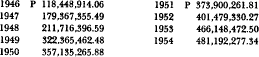

This law of public finance, whether one likes it or not, is just as inexorable as the law of gravitation, or the law of continual change in a living world. Governmental organization is inherently dynamic. It continually changes and grows. Consequently, the practice has developed and is increasingly put into effect in modern governments that, instead of having occasional reorganization or even periodical cleanings of the government, or to use the expression in the instruction given by the first Chief Executive of the Philippine Republic, President Roxas, to the Pedrosa Reorganization Committee — « sweeping away the cobwebs which have gathered in the corners of our government structure » during the preceding pre-war years — instead of having such periodic « house-cleaning » to eliminate useless and obsolete agencies, to correct faulty or inadequate assignment or overlapping and duplication of functions, there should be continual investigation, study, and research for organization and management improvement, as well as continual screening and control of all proposals to create agencies and to acquire and transfer or assign new functions and activities to various governmental agencies.
It is indeed a magnificent tribute to the progressive outlook of the Unson Government Survey Board that under Paragraph 5, they had provided for the performance of such duties of investigation, study and day-to-day control of continual or piecemeal reorganization, in their draft of the Executive Order which was recommended to, and promulgated by, President Quezon as Executive Order No. 25, dated April 25, 1936, in the following words that are substantially reproduced and continued under Section 6 (b) of the Revised Budget Act:
It shall be the duty of the Budget Commission to investigate and make a detailed study of the departments, bureaus and dependencies of the government, and with a view of securing greater economy and efficiency in the conduct of the public service, to recommend from time to time to the President the changes that should be made in (a) the organization, activities, and methods of operation of such departments, bureaus and dependencies; (b) the appropriations therefor; (c) the assignment of particular activities to particular services; and (d) the regrouping or coordination of services.
The foregoing paragraph was patterned after the corresponding provision of the U.S. Budget and Accounting Act of 1921, and substantially the same duties are being peformed now by the Office of Management and Organization in the U.S. Bureau of the Budget.
Similarly, in the United Kingdom, the day-to-day inspection of various services with a view to determining what changes or improvements in the organization and procedures of the Government should be adopted, are supervised and directed, on the Cabinet level, by the Government Organization Committee, composed of the Permanent Secretary of the Treasury, as Chairman, and the Permanent Secretaries of the other Departments or Ministries, as members. This Committee is aided by a full-time staff of inspectors on organization and methods or on management improvement service. These inspectors are assigned by the Machinery of Government Branch of the British Treasury O & M (Organization and Methods) Division. In each important British Ministry, but under the general oversight of the Government Organization Committee, there is also an O & M Division or service which takes charge of long-range studies, as well as of day-to-day investigations, planning of new work, and reorganizational control. This agency O & M Division or unit is headed by a Principal Establishment and Organization Officer « who is responsible to the Permanent Secretary [of the Ministry] not only for personnel management, training, and the provision of common services, but also for effective and economical staffing, and the improvement of organization and administrative methods ». (13)
Thomas Doyle Kingdom, Improvement of Organization and Management in Public Administration. International Institute of Administrative Sciences, Brussels, 1951, page 92.
In France, since 1946, there is a Central Investigating Committee on the Cost and Efficiency of the Public Services (Le Comité central d'Enquête sur le Coût et le Rendement des Services publics). It assumes the responsibility for continuous review and study of the deficiencies or inadequacies in the organizational structure of the government, or in the allocation of functions among the different Ministries, and for recommending needed improvements. Half the members of the Committee are representatives of employees’ unions, while the other half are government officials (including the Director of the Budget, the Director of the Civil Service Division and Inspectors General of various agencies). This Committee and the Division of Civil Service (Direction de la Fonction Publique) are both under a Minister: the Secretary of State to the Premier or Presidency of the Council, who is particularly charged with supervision over the civil service and administrative reform.
The duties imposed upon the Budget Commission by the aforecited Paragraph 5 of President Quezon's Executive Order No. 25, series of 1936, were mainly performed by the Service Inspection Division and the Administrative Research Service. The processing of proposed promotions and appointments for government employees, however, has since the Liberation so preoccupied the major attention of the Service Inspection Division that it has no time for current detailed administrative surveys. Neither was an adequate staff provided for the Administrative Research Service, nor for the Research and Law Division that succeeded it in 1952, to enable these two units to carry on an extensive continuing program of detailed studies, and agency inspections and administrative surveys, which the Service Inspection Division could conduct before the war. As the former had no more than three researchers and the latter on the average only five researchers, they had never, during the past ten years, been in a position to implement adequately the organization and management improvement functions of the Budget Commission, except in providing occasionally technical advice, know-how and assistance, such as those for the Budget Commission's and interdepartmental committees’ reports and comments on proposed legislation and special organizational problems, and for the accomplishment of the work of the previous Government Survey Board, Reorganization Committee and Reorganization Commission (14).
The author of this article, besides having served as Technical Consultant for the Unson Government Survey Board, the Pedrosa Reorganization Committee, and the Fernandez Reorganization Commission, was as Chief Administration Researcher assigned to make an administrative survey of the post-liberation Commonwealth Government, and his report thereon entitled « Organizational Reforms and Economy, Simplicity and Effiicency of the Public Service », was submitted on August 2, 1945. (Ten Months of President Osmena's Administration, page 34).
In order to reactivate and implement adequately these functions of the Budget Commission, Reorganization Plan No. 19-A creates a Council of Administrative Management, which is substantially similar to the British Government Organization Committee and the French Comité Central d'Enquête sur le Coût et le Rendement des Services publics. This Council « shall be responsible for recommending to the President ways and means of achieving greater economy and efficiency in administrative management and for providing leadership to all government entities in securing solutions to management problems of common interest. The Council is authorized to establish uniform standards and criteria, to assign specific problem areas to other entities for further study and recommendations, and to require periodic or special reports from other entities on management practices and techniques ».
The Council of Administrative Management shall replace the Government Advisory Board on In-Service Training, and « shall have the following members, plus such additional members as may be appointed by the President:
— Secretary, Department of Education;
— Executive Secretary;
— Commissioner of the Budget;
— Director, Institute of Public Administration;
— Commissioner of Civil Service;
— President, University of the Philippines;
— Secretary, Department of General Services. »
The Council is authorized to elect its own Chairman, and its Secretary « shall be designated by the Budget Commissioner from among the staff members of the Budget Commission. »
Reorganization Plan No. 19-A also provides for the establishment in the Budget Commission of an Organization and Methods Division, which has preferably been called Management Service, « to promote, economy and efficiency throughout the Executive Branch ». According to Section 12 of the Implementing Details approved by the Government Survey and Reorganization Commission, the Management Service « shall have such functions as may be assigned by the Commissioner, which shall include the following functions, among others:
perform continuing research and study of problems involving the effective organization and administration of government service;
develop management planning and control techniques, and recommend to the Commissioner standards and procedures for adoption by agencies in their management improvement programs;
develop, promote and assist in the installation of standard patterns of organization structure, delegation of authority, accountability patterns, staffing patterns, cost analyses, work processes, procedures control, forms control, reporting systems and control, space, equipment and materials utilization, and other common management improvement; and assist in adapting them to individual variations among agencies of the government;
develop and prepare materials on management practices for use in training programs, provide technical advice and assistance in the conduct of training programs, and maintain liaison with the Institute of Public Administration, the Bureau of Civil Service, and other agencies concerned with the development of government employees;
prepare materials for training and guiding budget examiners and agency personnel in their work relating to such matters as organization, staffing patterns, and operating methods;
develop and promote the application of improved statistical techniques in government related to the collection and analysis of performance data, the determination of management guides and standards, and the discrimination of data on work standards, and units of work measurement;
conduct specific studies of agency operations and report thereon, as directed by the Commissioner;
service as a center for the study, analysis, and reconciliation of jurisdictional issues or conflicts in functional authorities as between the several governmental entities; and when necessary, prepare recommendations for the President with regard thereto;
coordinate implementation of agency improvement programs with government-wide programs of management improvement, to avoid conflicts or duplications; and
provide technical and clerical services to the Council of Administrative Management.
The staffing pattern, as approved by the Government Survey and Reorganization Commission and embodied in the Implementing Details, provides 29 positions for management analysts under the Management Service. With such a relatively small staff, the Service has been organized, not on a more or less definitely compartmentalized, functionally or clientele-grouped basis, like the staff of the former Division of Administrative Management, now the Office of Management and Organization, of the U.S. Bureau of the Budget, but instead, on a project basis, similar to the flexible grouping of members of the staffs under the British Treasury O & M Division, and under the Canadian O & M Division, as well as to the basis of team grouping among « about 50 part-time investigators » used by the French Central Investigating Committee on the Cost and Efficiency of Public Services. Like these French investigators who are temporarily grouped, into panels from time to time as they are assigned « to missions, studying the organization of a ministry, or a group of ministries, or an overall problem or service common to ministries » (15), our management analysts are grouped temporarily into teams conducting the various agency or field surveys under the immediate and direct supervision of designated Project Team leaders. It is believed that this relatively flexible organization of our Management Service is advantageous in that it makes for the utmost broadening and versatility of experrience possible in the survey assignments. It also permits the greatest degree of administrative maneuverability possible in the deployment of the management analysts to such specific survey projects and research assignments as the Management Service may from time to time be required to accomplish, and where their respective personal abilities, background, and technical experience may be most useful.
Thomas Doyle Kingdom, op. cit., page 76.
Half a century of varied, impressive successes and experience that the Filipino people have had in the field of government reorganization, especially since 1907 when they began exercising an increasing measure of control over their governmental affairs under various democratic liberal regimes, should have endowed them with enough subtle prudence and wisdom to aim at present at long-range, enduring, really worthy improvements of the governmental machinery. These should not be evaluated in terms of the amounts of pesos and centavos representing actual savings or net reduction in the cost of governmental operation, as a direct or immediate consequence of the approval by Congress, in 1955 and 1956, of 34 Reorganization Plans. For this reorganization, which is by far the most elaborate, detailed and exhaustive (with the technical assistance and advice of numerous Consultants, such as staff members of Louis J. Kroeger & Associates and Booz, Allen & Hamilton), as well as the most expensive overhauling of the administrative machinery in the history of the Philippines, a total appropriation of half a million pesos has been authorized to be defrayed out of the Philippine National Treasury. This amount is relatively a big outlay for a country with limited resources, although it is one eighth of the 2 million dollars which the U.S. Government set aside for the Hoover Reorganization of 1947–1949. Nevertheless, the Government Survey and Reorganization Commission, after it had approved the creation of the Department of General Services and other numerous additional bureaus and offices, cannot probably claim to have achieved any success in bringing about an immediate, obvious, considerable reduction of the cost of government, nor of the total number of governmental agencies. Even as all the previous revamp bodies justified their claim to the successful accomplishment of their missions by emphasizing the increased efficiency of the governmental machinery resulting from their approved reorganization plans, so the Government Survey and Reorganization Commission's claim may be justified by its fulfillment of President Magsaysay's policy enunciated in his Proclamation No. 357 of October 12, 1956, that « Emphasis should be laid on the rendition by government officials and employees of effective services to the public », and that good administration should be geared, not primarily to the achievement of peso economy, but to the rendition of « efficient, honest and democratic public services ».
As a matter of fact, this supreme emphasis on the objective of efficiency of the public services is expressed in the delineation of the objectives of reorganization, under Section 2 (a) of Republic Act No. 997, the provision of which entirely lays stress on all the conceivable pertinent phases of administrative efficiency, and, under sub-paragraph (2), clearly subordinates the consideration of economy, important as this is, to the prime objective of efficiency, by the use of the expression: « To promote economy to the fullest extent consistent with the efficient operations ( * ) of the government. »
Author's italics.
It is noteworthy that this supreme emphasis on administrative efficiency laid by President Magsaysay's guidelines and directives, by Congressional mandate on reorganization, and by the various reorganization plans that have already acquired the force and effect of law, is wholly in consonance with the most enlightened concept in public administration prevalent in the progressive, free democracies of the world. The following passage taken from the report submitted on August 8, 1950, by the National Economy Commission of the French Republic, illustrates the modern concept:
There are two conceptions which, though they are not necessarily in conflict, must be carefully distinguished — economy and administrative reform.
Economy is an end: an administrative reform is a means, aiming at greater efficiency, or better results, in the public service. This is to say that a reform conceived as leading to economy may well at the outset give rise to extra expenditure, then require a substantial period to take full effect, and finally produce no absolute economy at all — only a relative economy in the sense that there has been improvement of service.
Conversely, if economy can be an element in administrative reform, or the spark that sets it going, it does not always work out in that way. An economy can be diametrically opposed to rational reform and can simply prevent the healthy running of a department.
Thus a systematic policy of retrenchment has serious drawbacks: … it runs the risk of paralysing activities that are useful to the State and may turn out to be expensive in the long run.
It is the most significant fact to note, in resume, that the approved reorganization plans have not only kept intact, as already pointed out, the fundamental features of the Philippine system of public management, but have also provided, in addition to President Mag-saysay's directives, distinct basic guidelines for their further implementation, development, and readaptation to changing conditions and future needs. Nothing can serve better than such directives and guidelines, to guide, urge and inspire us towards good administration. There cannot be a more inspiring goal to achieve, for instance, than to effect an orderly, efficient, and sound deconcentration and decentralization of governmental services, as contemplated in Reorganization, Plan No. 53-A on Field Operations, to counteract the traditional centralistic tendency of our unitary system of government, and thereby bring, according to President Magsaysay's policy, the public services nearer the people in the barrios. Our success in this direction will give the Philippines the distinction of pioneering, together with the French Republic which, confronted with similar handicaps of traditional centralism, has committed itself in its 1946 Constitution to such reforms as, without discarding the unitary system of government, will « bring the central administration closer to the people ».
Nor can there be a more imperative challenge to the sense of duty of both the Management Service and the Budget Operations Service of the Budget Commission, as well as of all other branches of the Government concerned, than the successful, complete implementation and development of the performance budget within the basic framework of our budgetary system. Soon after the approval of these budgetary provisions by the Constitutional Convention twenty-one years ago, the writer of this article expressed his misgivings and doubts over the feasibility of the innovation, in one of his pre-war pamphlets entitled The Budgetary System of the Philippine Commonwealth (16), concluding that « The ingrafting of the English budgetary system upon the political plan of our new fundamental law which is based upon the American presidential type, has made our new constitution, in respect to this particular feature, an experiment without parallel ».
The Philippine Social Science Review, July 1935, pages 170–192.
It is very gratifying to observe that these budgetary provisions of our Constitution seem to have worked on the whole far better than the skeptical observers could have expected twenty-one years ago. They have proved far more effective in reducing to a minimum the legislative propensity to enact recklessly such extravagant amounts of supplemental or additional appropriations as to complicate or upset the budgetary balance, than the provision of the U.S. Legislative Reorganization Act of 1946, which is now practically dead, and which authorized the Congress upon recommendation of its Joint Committee on the Legislative Budget to fix, with mere parliamentary self-restraining force, the overall ceiling to be appropriated for expenditures as well as the estimated overall Federal receipts for each fiscal year. The curtailment of the legislative initiative, as ingrafted into our Constitution from the English budgetary system, to increase the amount of appropriations recommended by the Executive in the Budget is fixed by constitutional mandate in but very few other countries, like Chile, El Salvador, Haiti, Nicaragua, Uruguay (17). In almost all other Latin-American countries, such limitations are prescribed by statutes merely, and, as Don Abel Cruz Santos in his treatise on El Presupuesto Columbiano observed, are not effective, « porque no es posible pensar en cerrar al Congreso la válvula de los gastos, con leves que son reformables por el mismo ».
El presupuesto en los gobiernos de hoy, por A. E. Buck, traducido y complementado con notas sobre la legislatiôn presupuestal de los paîses latinoamericanos por Mario A. de Tezanos Pinto, Profesor de Finanzas de la Universidad Nacional de Buenos Aires (1946); Is the Philippine Budgetary System Sound? by Quirino E. Austria, in « Manila Chronicle Sunday Magazine », 28 November 1948, pages 8, 9 & 31.
When the implementation of the performance budget system, within the basic framework of our Constitution, shall have been successfully accomplished, as surely it will be, then it will constitute another salient landmark in the history of the development of the Philippine system of public management. It will be an achievement as unique as that accomplished by the Philippines in 1917 when our Government was foremost among the few state governments under the American flag that successfully pioneered in the institution of the executive budget system, and again as in 1935 when the Philippines spearheaded the constitutional innovation ingrafting the English budgetary system upon a political framework patterned after the American presidential type of government. Moreover, it will be a signal vindication of the wisdom, foresight and practicality of the Reorganization Plans of 1955–1956, ingeniously conceived and actively implemented within the fundamental, tested framework of the Philippine administrative system, through dynamic conservatism.