







Abstract
This article reports on the results of a survey of 540 Chinese school children’s adjustment in temporary school relocation after the Wenchuan earthquake. The overall results depicted a positive picture of functioning. The findings were contrary to expectations, as earlier observational reports suggested that pupils had adjustment difficulties.
Introduction
A devastating earthquake, of 8.0 magnitude on the Richter scale, struck Wenchuan county, Sichuan province, and the surrounding regions (particularly Shaanxi and Gansu provinces) on 12 May 2008. Sichuan, which is located in southwest China, is well known for its spicy cuisine, pandas and spectacular scenery of Jiuzhai Valley National Park (a UNESCO World Heritage Site). The earthquake claimed close to 90,000 lives and injured 375,000 (International Federation of Red Cross and Red Crescent Societies, 2008). Official news channels reported that the earthquake caused 5335 student deaths (Bai, 2009) and damage to about 14,000 schools in 159 counties in Sichuan province (Xinhua News Agency, 2008a). One of the schools is the subject of this article and referred to as school Z.
The second author, together with local university (Department of Social Work) working partners, potential donors, and colleagues from The Hong Kong Polytechnic University visited several quake-affected schools in October–November 2008 to assess the needs of students. They identified four schools (total student enrolment of 3560) that were willing to collaborate in providing school social work services within the school compound (referred to as social work stations in Chinese) (see Sim, 2011, for more information about the Sichuan expanded school mental health project). Not only was school Z badly damaged, the town and nearby villages also suffered serious damages and had to be rebuilt. Fortunately, none of the teachers or pupils died. According to the school principal, only three pupils were seriously injured while another 47 were slightly injured. However, the school buildings were structurally unsafe and a new school had to be built. In the interim period, the whole school relocated to a city in a different county in August 2008, about 300 km away, but within the same province. The host school offered the use of its facilities, including dormitories and playground, to the quake-affected school, under the Wenchuan earthquake twinned-provinces assistance (duì-kŏu-yuán-zhù) policy (see Ng, 2011, for information on the assistance policy). The relocation of students and schools to different sites is a new education policy, introduced by the Chinese Ministry of Education (2008) and initiated in response to the damage done to schools by the earthquake. It is referred to as yì-dì-fù-kè in Chinese and can be translated as resumption of schooling in a different location.
Best practice guidelines suggest that re-establishing routines of daily life and schooling serve to buffer the disruption of disaster on children’s lives and to promote their social and psychological well-being (Masten and Osofsky, 2010; Morris et al., 2007). In their research on children who survived Hurricane Katrina, Fothergill and Peek (2006) concluded that restoring children to health and back in school was the ‘major cornerstone of both family and community recovery’ (p. 123). Mainland China had done well to quickly resume schooling for its school children, after the earthquake. One of the earliest schools to open its doors to quake-afflicted children was in Xindu District, Chengdu City (the provincial capital), on 18 May 2008 (within six days of the earthquake). Some 166 children from seriously afflicted areas of Pengzhou, Dujianyan, and Mianzhu were relocated there; some of these children lost their parents in the earthquake (Liu et al., 2008). On 19 May, about 4000 third-year high school students from Dujianyan moved to Chengdu Vocational College of Agricultural Science and Technology to resume study and prepare for the National Higher Education Entrance Examination; these students came from nine different schools (Zhao, 2008). There were many other similar reports of resumption of schooling; some went as far away as Liaoning and Guangdong provinces and requiring one day’s travel by train.
By 1 September 2008, the start of the new school year, all the 3.4 million students in Sichuan province returned to schools, whether in their former buildings, prefabricated classrooms, or schools elsewhere (Xinhua News Agency, 2008b). Nearly 20,000 students in the worst-hit areas left their home towns or villages to continue schooling elsewhere, within and outside of Sichuan province (Xinhua News Agency, 2008b).
Unlike most disaster research that is focused on post-traumatic stress disorder (PTSD), this article is concerned with pupils’ adjustment to the temporary relocation of school. A preliminary report of school Z by Song (2008), our Chinese collaborator, indicated that some students were experiencing difficulties in adjusting to a different environment with cramped dormitories and being separated from their family members. Our own site visit to school Z in March 2009 confirmed the reports of rather dismal physical conditions of the place: the dormitories were poorly lit and crowded, with no space for individual lockers to store personal items; there was no heating; there was one basketball court and some table tennis tables in the playground; there were not enough seats in the canteen so many students stood around to eat their meals; there were inadequate clothes lines from which to hang their laundry; the worst criticism however was the condition of the toilets, the stench from which could be detected from afar. The description of dire conditions was not meant to be an indictment of the host school or city but to indicate the impetus and context for the study results. It also reflected researchers’ urban background, which was different from the rural quake-affected residents in this study. Some of the students found the living conditions to be acceptable, saying that their home conditions were no better, whereas others found it problematic, having higher expectations.
Literature review
According to the literature on disaster recovery, the distress expressed by disaster survivors is often related to the difficulties and hardships encountered in the process of recovery and rebuilding, rather than the disaster event itself (Benight and Bandura, 2004; Hutton, 2001). Some of these stressors include loss of jobs or livelihoods; loss of residence and possessions; personal injuries and disabilities; death or injuries of family members; and so on (Hutton, 2001). Coping with stressors and the adjustment to new living conditions are closely linked to an individual’s available social support, as disruption to the social support tends to be associated with poorer psychological health (Cohen and Wills, 1985, and Salzer and Bickham, 1999, cited in Hutton, 2001; Kaniasty and Norris, 2009).
Whilst China’s overall policy of restoring education quickly is laudable, the sub-policy of resumption of schooling in a different location works against the conventional wisdom of keeping family members together in a post-disaster situation. Attachment theory suggests that children should not be separated from their families in post-disaster situations, so as to minimize psychological distress (Morris et al., 2007; Shrubsole, 1999). For children, one of the important considerations in disaster relocation, besides attachment to their parents, is the loss of friends and familiarity that are essential to their sense of security. They may resist going to new schools and having to make new friends as it is often difficult to gain acceptance by existing peer groups. Hence, in theory, moving from a familiar to an unfamiliar locality is likely to lead to poorer functioning for children. However, in the case of the school being investigated (and other schools under the yì-dì-fù-kè policy), the breaking and building of friendship ties may not be major issues since the existing social network, comprising peers and teachers, is intact. Fothergill and Peek (2006) found that for those children displaced by Hurricane Katrina ‘the absence or presence’ of their former schoolmates mattered to their school adjustment, whether in a new community or returning to their old community (p. 106). They sought to maintain peer support by keeping in touch with them and, where possible, enrolling in the same school. Fothergill and Peek (2006) referred to their efforts as a coping strategy. They also found that some schools recognized the value of peer support and tried to place friends in the same classroom. Hence, moving whole or part of a school is based on a well-established principle of not disrupting the pre-existing social support that is provided by classmates, teachers, and principals.
Theoretically, social support – social interactions that provide individuals with assistance and loving care in times of need – offers protection against stress and distress (Benight and Bandura, 2004; Kaniasty and Norris, 2009). Those who provide support offer more than just an emotional buffer against environmental stressors; they may also be a role model in getting information and tangible help in coping with stress and thereby enhance self-efficacy (Benight and Bandura, 2004; Kaniasty and Norris, 2009). Disaster victims may have a number of people who provide social support to them but they vary in terms of closeness of relationships and intensity of assistance. Using the concept of circles of support, Rosenfeld et al. (2005) place family members, relatives, and friends as being in the innermost circle of a child victim/survivor’s life, as they are the ones who provide direct and personalized support. Those in the outer circles include teachers, mental health workers, principals, aid workers, and disaster relief organizations. Disaster research has demonstrated that during stress the parent–child relationship becomes particularly salient for children, as they depend on their parents for guidance in making sense of what is happening and tend to take behavioural cues from them in how to respond to environmental challenges (Rosenfeld et al., 2005).
Furthermore, individuals and social groups are not necessarily passive victims when coping with stressors. They may well make active efforts to adapt and cope as best they can. However, individuals are also known to vary in their coping capacity, one important factor being self-efficacy, referring to the perceived capability to manage one’s functioning in the post-disaster situation (Benight and Bandura, 2004).
Where empirical studies are concerned, there is limited literature on the effects of temporary relocation of schools and students after a natural disaster. Najarian et al.’s (1996) small study of children (n = 74) exposed to the 1988 Armenian earthquake showed that those who were relocated were no different from those who remained in the earthquake zone, on measures of PTSD, depression, and behavioural disorders. It is important to note that they were relocated together with their family members. The finding was contradictory to prevailing opinion that survivors should remain in a familiar environment. This was explained in terms of the constant reminders of the earthquake trauma for those who remained behind whereas those who had relocated had no such reminders and in addition, had access to water, electricity, and heat in their new homes. A summary of the theories and limited empirical studies reviewed is provided in Table 1.
Summary of literature review.
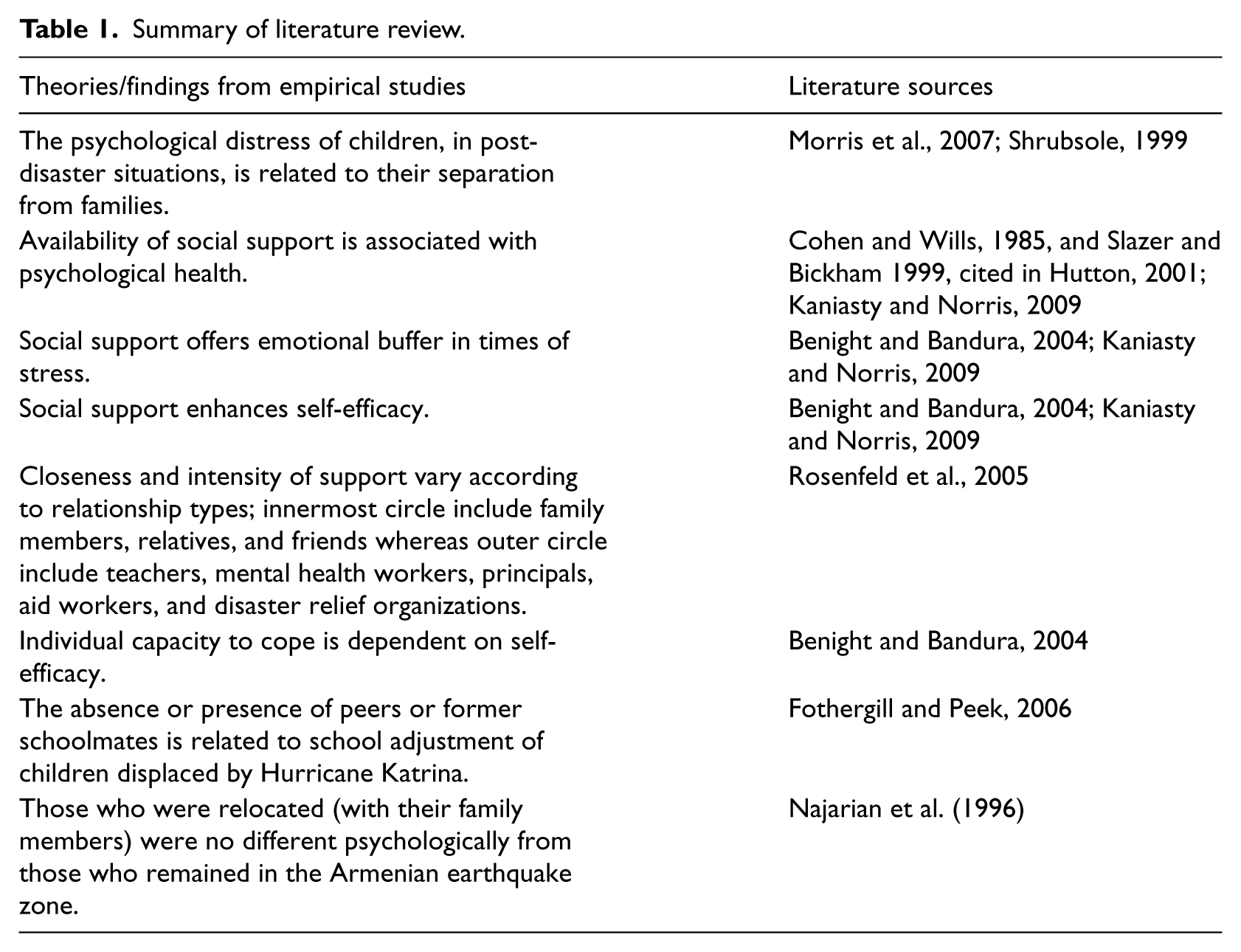
Given the paucity of research on the temporary relocation of schools, in the context of post-disaster recovery, this study aimed to make a contribution to the field of disaster research by investigating how school children were coping with the relocation stressor, drawing on concepts from disaster literature, namely distress symptoms, social support, self-efficacy, coping resources, and family functioning. Furthermore, this study also aimed to contribute to disaster research on children displaced in post-disaster context. Several researchers have identified children as representing a vulnerable, neglected and under-studied population in the aftermath of disasters and that it is important to obtain child reports directly, as parents may not know exactly how they have been affected (Shrubsole, 1999; Silverman and La Greca, 2002).
Method
This article primarily reports on the findings of a quantitative study of pupils, and supplements it with relevant findings from a qualitative study (see Ng, forthcoming, for more information on the qualitative study). Both studies were part of a bigger research project that aimed to address the broad research goal of finding out how the pupils, teachers and parents responded and adapted to the official policy of school relocation in the aftermath of an earthquake. The research project employed a mix of both quantitative and qualitative methods. The specific research questions addressed in the quantitative study were: i) how long did it take the children to adjust to the relocation? ii) Which demographic and psychosocial variables predicted distress symptoms? iii) Did distress symptoms, perceived social support, ways of coping, family functioning, general self-efficacy, and adjustment period predict self-reported health, controlling for demographic variables? iv) Did distress symptoms, perceived social support, ways of coping, family functioning, general self-efficacy, and adjustment period predict self-reported study result, controlling for demographic variables?
Choice of school
At the time the research was conceived, it was the only school in the Sichuan expanded school mental health project that was relocated. Of the four schools, it was also the only school that was a junior middle school; the rest were primary schools. The choice of school for study was based on availability, building on the trust that was developed between the second author, Chinese collaborator, and school Z.
Design
The qualitative study was conducted between late April and June 2009 whereas the survey was conducted in June 2009. The original research design was to do a follow-up study in year two of their stay (expected to last 24 months), that is in 2010, to see if there were changes over time, but the duration of the school relocation was shortened to one year with the completion of the new school in July 2009. The whole school moved back to the town in which it was originally sited. A follow-up study was therefore not carried out.
Participants
Permission to conduct the study was obtained from the school principal. There were 24 pupils in the qualitative study. We asked a social worker in the social work station to select them, based on two criteria: equal number of boys and girls; and a mix of home background (living in towns versus villages), since we did not have prior information about their socio-economic status. The pupils were told that participation was voluntary and to get permission from their parents for the interviews to be conducted. Interviews of parents were conducted first (April–May) in their home towns or villages, prior to the interviews of pupils (May–June) in school. Of the 24 pupils interviewed, there were more females (15 versus nine) (we were not able to achieve equal numbers during fieldwork). The pupils were interviewed in school. The age range was between 13 and 16. There were slightly more ethnic minorities (54%) than Han Chinese (42%) (missing value = 4%). Most of the parents were in their 30s, with a few in their 40s.
The survey questionnaire was administered in classes by two social workers from the school social work station. Parental consent for the survey was not obtained since the pupils were in the custodial care of the school and not co-residing with their parents at the time of the survey. The school enrolment, which was 848 in August 2008, dropped to 593 in June 2009, when the survey was administered. It was decided to administer the survey to all the pupils, rather than to use sampling, since it was administratively easier to do so. However, there was no obligation to participate. The number of pupils who returned the questionnaire was 542 but two were excluded from analyses (pattern of set response or incomplete). The study participants therefore consisted of 540 pupils (292 girls and 248 boys), ages ranging between 12 and 17 years. About half of them were in junior level 1 and a quarter each in junior level 2 (27%) and junior level 3 (24%); that meant about half the number of pupils who joined school Z came from different primary schools. The ethnic composition was 56 percent Han Chinese, 38 percent Tibetan, and 6 percent other ethnic minorities. The educational attainment of their fathers was mostly at junior high level (56%), followed by primary school level or below (39%); only a small proportion had senior high or tertiary education (5%). The educational attainment of their mothers was lower: mostly primary school or below (55%), followed by junior high (40%); very few had senior high or tertiary education (5%).
Study instruments
Interview guide for qualitative study
Standardized interview guides were used, one each for parents (interviewed back in their hometown) and school children (interviewed on school site). The questions were standardized, mainly because the interviews were conducted by seven research assistants, from Sichuan, given the comfort level of respondents in speaking the Sichuanese dialect, rather than Putonghua (Mandarin Chinese) language. The average time taken for the interviews was 100 minutes and 55 minutes for parents and children, respectively. Interview time for parents was generally longer as they had more to say and some sidetracked into other issues, whereas the children were more focused in answering questions.
Survey questionnaire for quantitative study
A brief introduction to the questionnaire (in Chinese) informed respondents of the institutional affiliation of the researchers, the purpose of the study, the confidentiality of information, that there were no right or wrong answers, and that there were no consequences on their study results (passive informed consent). They were asked to consider their responses to the various items, in terms of their situation two months ago, rather than their situation then (in June 2009), as they were due to go home at the end of the school year and the summer vacation was about to begin.
In order not to confound the results with measurement errors due to translation most of the instruments selected had already been translated into Chinese, tested with Chinese samples, and shown to have acceptable reliability and validity. The questionnaire comprised a total number of 98 items. On average, participants took 20 minutes to complete the questionnaire.
To find out how long the pupils took to adjust to the relocation stressor, we used an open-ended question: how long did you take to adapt to life and studies in a different school location? Responses were coded as a continuous variable (number of months). Two other variables – health condition and study results – were also one-item measurements. Respondents were asked to self-report of their study results (1 = excellent to 4 = poor) and health condition (1 = poor to 4 = excellent). It might have been more objective to use their actual academic results but the loss of school records during the earthquake made this difficult. These were recoded into dichotomous variables (1 = mediocre–poor and 0 = non-poor for study results; 1 = poor and 0 = non-poor for health condition) when using logistic regressions. It was decided to combine mediocre and poor categories together as Chinese society attaches high importance to education and so mediocre results would be considered as less than satisfactory.
Distress symptoms were measured using Distress Symptoms Scale (DSS), which was an adaptation of an instrument originally developed by Greenwald and Rubin (1999), for use with children aged 8 through 13 years old, to measure PTSD. The original instrument consisted of 25 items on a three-point scale. Internal consistency (Cronbach’s alpha = .91) and test-retest reliability (correlation of .80, p < .001) were high. We selected only 15 items that were symptomatic of distress, as our aim was not to study PTSD, though it is a common topic in disaster research (Neria et al., 2009). Throughout the questionnaire, no reference was made to their traumatic experience in the Wenchuan earthquake, so as not to re-traumatize them. Items included ‘I find it hard to concentrate; I worry that bad things will happen; I get headaches; I feel sick or have pains.’ These were translated into Chinese by a research assistant and verified by our Chinese collaborator. We also changed it to a four-point scale: 1 (none) to 4 (always).
For demographic variables the following measurements were used. Gender was coded 0 for males and 1 for females. Age was a continuous variable. The class level of the pupils was 1, 2, and 3 (ordinal variable). Ethnicity was dummy coded as Han (reference category), Tibetan, and Others.
The 12-item Multi-dimensional Scale of Perceived Social Support (MSPSS) was used to measure social support (Zimet et al., 1988). The Chinese version of the scale was obtained from Chou (2000), who tested for reliability and validity among 475 Chinese adolescents. The internal consistency (Cronbach’s alpha) for the Chinese scale was .89. It used a four-point anchor: 1 (strongly disagree) to 4 (strongly agree).
To measure self-efficacy, the Chinese Adaptation of the General Self-Efficacy Scale (CAGSS) was adopted. This scale, with only 10 items, was translated into many languages (Cronbach’s alphas ranging from .76 to .90). The Chinese version, developed by Zhang and Schwarzer (1995), was used. The response choices ranged from 1 (completely untrue) to 4 (completely true).
As for coping, the Chinese Ways of Coping Questionnaire (CWCQ) was chosen. The scale, in Chinese, was developed by Chan (1998) to measure ways of coping with daily living events among Chinese secondary school students and teachers. The concurrent validity of the scale was shown to be related to a reduction in the effect of stressors. It comprised 16 items, coded from 1 (have not used) to 4 (frequently used). Regarding family functioning, the General Functioning Scale of Family Assessment Device (GFS-FAD) was utilized. The Chinese version of this 12-item instrument was developed by Shek (2001), whose study reported acceptable internal consistency (between .81 and .86) and test-retest stability (correlation = .77). We also used a four-point response scale: 1 (completely disagree) to 4 (completely agree). Items indicating poorer functioning were reverse coded.
Internal consistency of the various scales in this particular study sample − .78 and .82 − was within the conventionally acceptable range of Cronbach’s alpha, with the exception of GFS-FAD, which was low (.50) (see Table 2).
Correlation matrix and descriptive statistics.
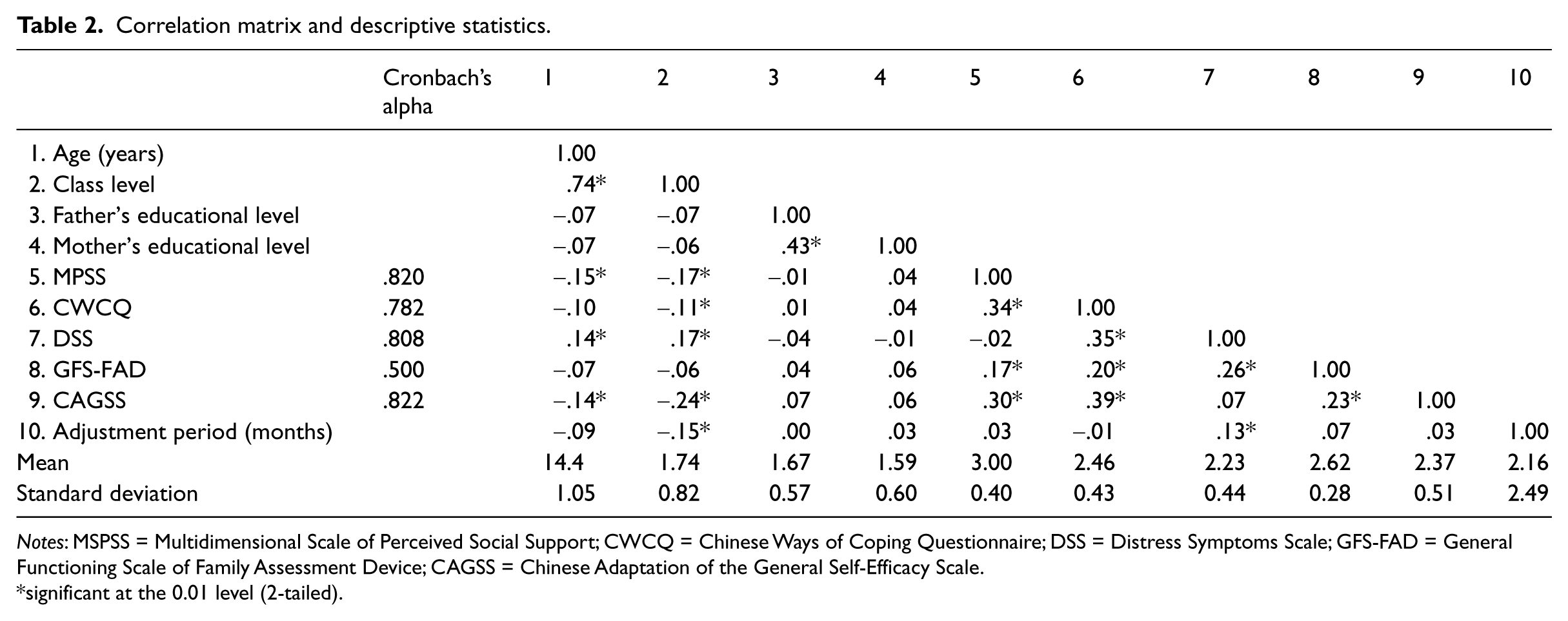
Notes: MSPSS = Multidimensional Scale of Perceived Social Support; CWCQ = Chinese Ways of Coping Questionnaire; DSS = Distress Symptoms Scale; GFS-FAD = General Functioning Scale of Family Assessment Device; CAGSS = Chinese Adaptation of the General Self-Efficacy Scale.
significant at the 0.01 level (2-tailed).
Data analysis
To identify predictors of distress symptoms, self-reported health condition and self-reported study results, regression analyses were conducted. Two control variables – father’s educational level and mother’s educational level – were added to the third regression model on self-reported study results. To correct for inflated type I error as a result of doing multiple statistical tests, the procedure proposed by Holm (1979, cited in Norman and Streiner, 2008) was used to correct the alpha level to .01, when reporting statistical significance of the regression results. Statistical analyses were conducted using SPSS version 16.0.
Results
Correlation matrix and descriptive statistics of the various measurements, used in the survey, are presented in Table 2. Of the 45 pairs of variables, 19 were significantly correlated. The responses to the open-ended question about the adjustment period showed a wide range, from a few days to one school year, with a mean period of 2.16 months (SD = 2.49). The mean for distress symptoms was 2.23 (SD = 0.44), which was closer to the rating of ‘occasionally’ rather than ‘often’ of the Likert scale.
Whilst the survey indicated fast adaptation of about two months, the qualitative study showed that the pupils reported the most difficulties in the first few weeks of moving to the temporary school relocation and that adjustment was ‘slow’. Many pupils and their parents reported that there was a lot of crying and wanting to go home in the initial period of the stay. The children were homesick and could not concentrate on their studies. Many complained of the mosquitoes at night that kept them awake. They reported better adjustment by semester two, as some of their parents had visited them during semester one and they had an opportunity to go home during the winter vacation. The pupils expressed much happiness in seeing their parents face-to-face and gratitude to their parents for making the long-distance trips to see them, considering the costs and time required to travel by public transportation. Some said that their parents exhorted them to persevere in their studies, despite the hardships and separation. Parents and pupils reported less frequent telephone calls in semester two, as compared to the first few weeks of arrival in semester one. Most of the adjustment problems reported by pupils had to do with the food served in the canteen, which was different from home-cooked food and of ‘poor quality’. Another area of adjustment was the cramped dormitory space and difficulties in sleeping at night, as there were 12 to 25 pupils in each dormitory and they tended to be noisy. Some pupils also expressed anxiety about the safety of parents and other family members back home as they heard reports of frequent quake aftershocks and were not always able to maintain telephone contacts with them, due to interruptions in telephone network connections.
The multiple regression results are presented in Table 3. Model 1, showing the results of regression on DSS, was statistically significant [F(10, 473) = 19.65, p < .0001]. Of all the demographic variables, only gender was significantly related to distress symptoms. Being female was positively associated with distress symptoms (ß = .15, p = 0003). The qualitative study tended to confirm that female pupils were more ready in saying that they ‘cried and cried’. However, there were also male pupils who were unreserved in saying that they cried in the initial period of adjustment and were always thinking about home.
Multiple regressions.
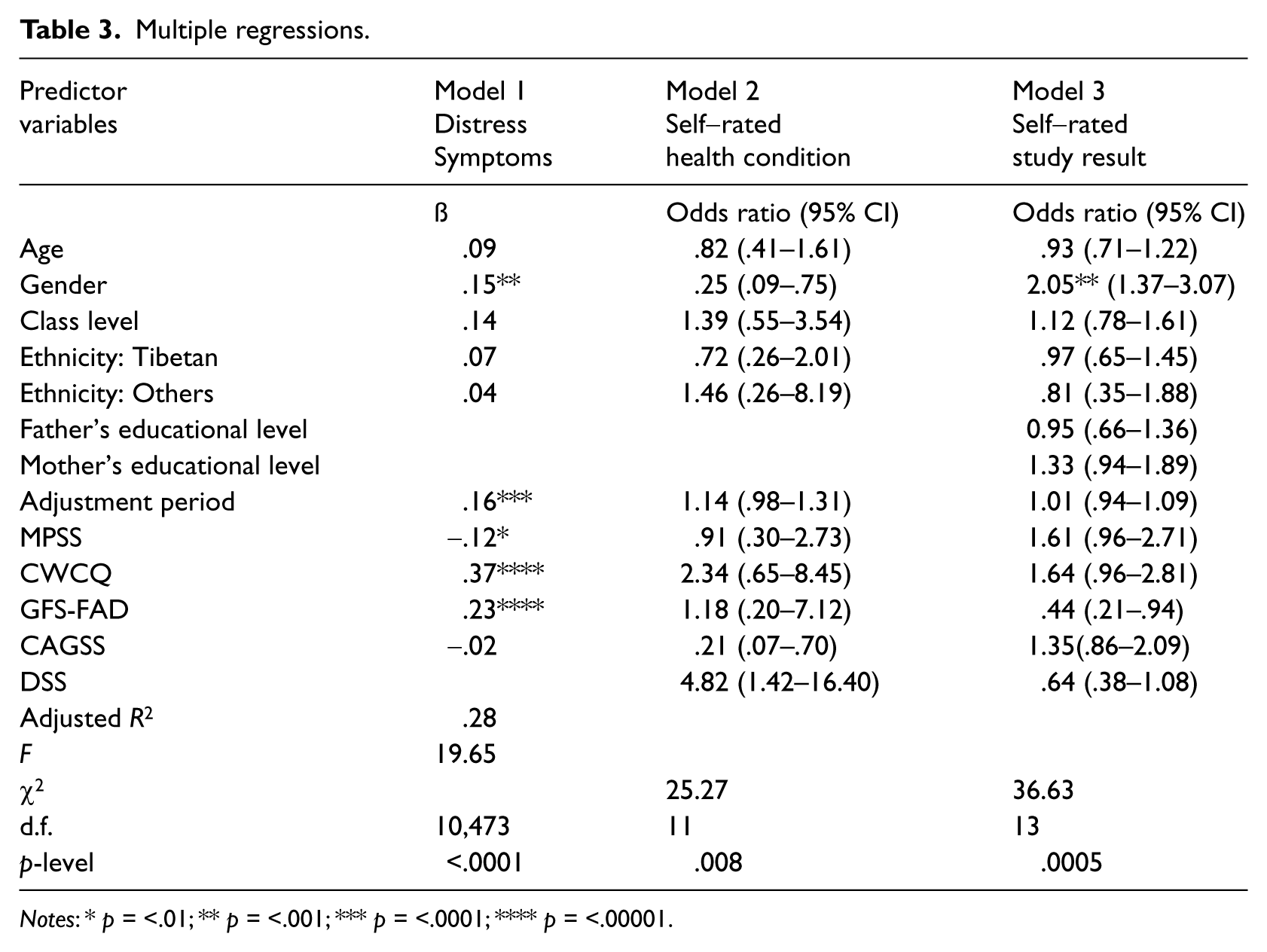
Notes: * p = <.01; ** p = <.001; *** p = <.0001; **** p = <.00001.
The results also showed that adjustment period, MPSS, CWCQ, and GFS-FAD were predictive of distress symptoms (p < .01). MPSS was inversely related to DSS, indicating that higher levels of social support were associated with lower levels of distress symptoms (ß = -.12). Adjustment period ((ß = .16), CWCQ (ß = .37), and GFS-FAD (ß = .23) were positively related to distress symptoms, that is, those who took a longer period to adjust, used more Chinese ways of coping, and whose family functioning were healthier were all associated with higher distress symptoms. The results confirmed the findings based on bivariate regressions, with the exception of perceived social support, which was not significantly related to distress symptoms [F(1,537) = .29, p = .59]. The zero-order correlation between perceived social support and distress symptoms was not significant and negative (see Table 2). As there appeared to be a ‘suppression effect’, further analyses were conducted to investigate the dynamics among the predictors. The results showed that with the inclusion of MPSS, the beta weight of CWCQ improved (from .346 to .401).
For self-reported health, the results showed that a majority (78%) of the pupils rated themselves as good or excellent, 18 percent as ‘acceptable’, and 4 percent as ‘poor’ (see Table 2). The logistic regression results (see Table 3, model 2) indicated that the model was statistically significant (χ2 = 25.27, p = .008). However, none of the predictors was statistically significant in predicting health condition, based on the more stringent alpha value adopted (if the conventional cut-off point of .05 was used, three variables were statistically significant: gender, distress symptoms, and self-efficacy). Except for a few pupils who reported (in the qualitative study) that they were more susceptible to the influenza virus in the past year, the rest said that their health condition was not much different from before.
In the self-rating of study result, a majority (54%) rated themselves as good or excellent, a minority (6%) rated themselves as poor, and the rest as mediocre. The logistic regression model (see Table 3, model 3) was statistically significant (χ2 = 38.52, p = .0001). Only gender (odds ratio = 2.04, p = .0003) was statistically significant; girls were twice as likely than boys to rate their study results as mediocre–poor. The qualitative study corroborated these findings. There were mixed reports of pupils who said they did better than before, others who said their academic results got worse, and yet others who said there was no difference. A number of parents however reported that not only did their children fare worse, their impression was that generally the study results of other pupils had also gotten worse. There was no obvious gender difference in the children’s reports on mediocre–poor study results but those transitioning from primary six tended to say that they found middle school more stressful, as there were more subjects to study and the level of difficulty was higher. One pupil said that the school seemed to pay more attention to those in junior level one.
Discussion
The survey results seemed to paint a positive picture of adjustment and functioning: the pupils mostly adjusted quickly (79% within 2.5 months) to the relocation stressor and a majority assessed their own study result and health condition as excellent or good. The findings were contrary to the qualitative study, which showed that the pupils generally took about one semester to adjust and that the first few weeks were the hardest, as expressed in their wanting to go home and asking their parents to visit them. Most of them said that they asked their parents not to visit them anymore in the second semester as they had become used to the boarding school life, did not want to add to their parents’ financial burden (almost all the parents were financially stretched with the rebuilding of homes in the quake-affected areas), and they were going home soon. In Ariely’s (2010) own studies and his review of studies on adaptation to pain and hedonic adaptation (the process of getting used to the place of living, homes, etc.), he found that human beings ‘adapt more quickly and to a larger degree than we imagine’ (p. 160). He explained that in adapting to a new situation (new home, new school, new relationship, new job, etc.) we go through emotional leveling out, that is, initial emotions, whether good or bad, fade out over time. In the qualitative study, though the pupils said that they had adjusted to the temporary relocation, it was revealed by one pupil that when it was finally confirmed that the school was moving back to the new premises in the new school year the female pupils in her class broke down and cried; they shed tears of joy.
Another contributing factor to the differences in perception of adjustment difficulties was the process of attrition, where most of those who were not able to adapt, for various reasons, had already left the school. According to one male pupil, some of his classmates had a fight with boys from a senior level and packed their bags to go home. A few went out to work and never returned. Some 186 pupils left the school between August 2008 and February 2009. The majority (66%) of those who left were in junior level one (these were the younger pupils who transitioned from primary school to middle school), followed by those in junior level three (32%) (these were the older pupils who found jobs or transferred to vocational schools; School Social Work Station Report, 2009). An external factor that could also have influenced the pupils’ adaptation was the psychosocial services provided by the school social work station (e.g. arranging for parental visits, organizing social and recreational activities, organizing play during school recess time, conducting summer holiday activities, getting the pupils to report on their school activities through newsletters that were then distributed to parents, providing physical rehabilitation service in collaboration with rehabilitation therapists) and other volunteer groups. Many pupils, in the qualitative study, expressed appreciation of the social workers (one male and one female) and referred to them as ‘elder brother’ and ‘elder sister’.
Notwithstanding the overall positive findings about functioning, it should be noted that there was a wide range in the adjustment period, reflecting individual variations in adaptation. Also, the positive association between adjustment period and distress symptoms could reflect difficulty in adaptation; either those who were distressed took a longer time to adjust or that those who took a longer time to adjust became distressed.
The positive association between gender and distress symptoms was consistent with other disaster studies showing that girls generally reported higher levels of anxiety, worry, and fear than boys (Groome and Soureti, 2004; Masten and Osofsky, 2010) and that girls adopted different coping styles from boys in a high exposure area of the Wenchuan earthquake (Zhang et al., 2010). However, some had cautioned that gender differences as reported in research may reflect girls’ and women’s willingness to ‘reveal stress and distress’ rather than a substantive distinction between the two genders (Aldwin, 2007: 240).
Perhaps, the most interesting finding in this study was the detection of the suppression effect, which is often overlooked in regression analyses (Lancaster, 1999). The positive association between coping and distress symptoms was in line with empirical studies on the relationship between problem- and emotion-focused coping and negative health outcomes (Chung et al., 2005, cited in Benight et al., 2009). But contrary to theoretical expectation (see e.g. Benight and Bandura, 2004; La Greca et al., 1996), social support had no predictive value in this study, serving instead to remove error variance (statistically speaking) from the Chinese ways of coping variable. In practical terms, the dynamics between social support, Chinese ways of coping, and distress symptoms require some unraveling. The empirical results indicated it had something to do with one of the four sub-scales of Chinese ways of coping (rational problem-solving; resigned distancing; seeking support and ventilation; and passive wishful thinking). Of the four, seeking support and ventilation had the highest correlation with perceived social support (r = .40) and the lowest correlation with distress symptoms (r = .16). One would expect seeking support and ventilation to act similarly to perceived social support in relation to distress symptoms but they might have ‘counterbalanced’ one another instead (perceived social support was negatively related to distress symptoms whereas seeking support and ventilation was positively related). The qualitative study suggested that one possible clue was the parents’ exhortation to the children to ‘eat bitterness’ (a Chinese saying about enduring hardships) when they complained about their adjustment difficulties. One parent told her child that he was not going there for a vacation and not to expect a comfortable lifestyle. Some parents admonished their children to appreciate what society and the government had provided for them in terms of resumption of education (provided additional funding for living expenses). One pupil said that her teacher advised them not to burden their parents with negative reports and to report ‘good news’ instead. Over time, the children might have realized that though distressed, ventilating about their situation and seeking support might not necessarily secure the kind of support they were looking for; their parents were not going to take them out of the school and the parents could not do much to improve their comfort level.
Another finding that was contrary to expectations (see e.g. Benight et al., 2009) was the lack of association between self-efficacy and distress symptoms. However, these ‘contradictory’ findings were consistent with that of Yang et al. (2010), who also did not find associations between social support and self-efficacy with psychological condition among adolescents in a study of Wenchuan earthquake survivors, one month after the quake.
The finding about the greater presence of distress symptoms among those who reported healthier family functioning was a puzzle. The qualitative study suggested that where parents and children spoke warmly of each other, there were also more reports by the parent–child dyads that they missed one another a lot (particularly their mothers and at times, grandparents) and telephone calls to each other were more frequent. One mother reported that upon arrival in the new location, her crying son called her several times and asked to go home. In contrast, there was a case of a father (aged 43) who reported a ‘generational gap’ in communicating with his 16-year-old son, who said that he did not miss home much and did not call home often.
Limitations of study
As with other studies, this study had several limitations. First, though originally intended to be a longitudinal study with two measurement points, due to a change of circumstances, only a cross-sectional design was used. As such, it was not possible to define causal relationships. Another limitation was the use of the self-report method, which was subject to distortions due to social desirability, recall bias, and self-awareness. Lastly, this study did not use comparison groups. Hence, it was not possible to say if the adjustment of the pupils in this case study was reflective of other schools affected by the yì-dì-fù-kè policy. To the extent that the school was a typical middle school in a rural county it could be said to be a non-special case, and might be generalizable to schools that moved to another location, within the same province. The results, however, could not be generalized to schools with high casualties, as the exposure of trauma would not be the same, or to those who relocated to another province, where the local dialects, customs, and food could be quite different from Sichuan, possibly adding to the distress.
Implications for policy, practice, and research
The study results seemed to indicate that despite the disruptive effect of the yì-dì-fù-kè policy the pupils seemed to have adjusted considerably better than expected, whether it was due to inherent human adaptability or the prospect of returning home, earlier than expected. Further research among other affected schools however would be more instructive in assessing the policy impact.
The Distress Symptoms Scale used in this study may be useful for the purpose of screening those who require attention from social workers or school personnel, who may then request formal assessment of their mental health. However, validation studies are required to establish its usefulness as a screening tool for Chinese adolescents and to establish a cut-off point for referrals. Furthermore, social workers and school personnel may want to pay attention to possible gender differences in the manifestation of distress symptoms, explore the effectiveness of certain ways of coping, and deal with the potentially negative influence of family separation. Though social support and self-efficacy were not statistically significant predictors in this study it did not necessarily mean that the pupils did not require support or that their capacity to manage was inconsequential. In this particular school relocation context, most of the parents, though empathetic toward the plight of their children, were unable to provide instrumental support (caring for children when they fell ill, cooking ‘comfort food’ for them, and washing their clothes, etc.) as they were separated by geographic distance. Parental visits were much appreciated by their children but were too costly and not all parents could afford the trip to see their children, which might have intensified the distress for this sub-group of pupils. Emotional support was important in helping their children to adjust to the relocation stressor but communication was limited to mobile phone calls and sms and even then, some families could not afford to buy mobile phones and their children had to use public telephones. From a school policy perspective, more could be done to facilitate support by parents, such as choosing a site that is nearer to their hometown, organizing parental visits in groups, subsidizing travel costs and communication for poor families.
Besides the social work services mentioned earlier it was helpful to have the local social work station supervisor to provide the link between his place of work, which was a teachers’ training college, and school Z. He was able to facilitate recruitment of college students as volunteers, in conducting recreational activities and providing one-month relief teaching, so that teachers could go home for a period of time, since for some of them, their family members remained behind in their hometowns. Some of the pupils seemed to enjoy the teaching by relief teachers (reported in the qualitative study).
Lastly, it is important to reach out to those who may take a longer period to adjust and are distressed, though they may be a minority. One perceptive child, in the qualitative study, pointed out that there were some pupils who tended to be alone or isolated and that teachers should reach out to them and help them to ‘blend into our big family’.
Footnotes
Acknowledgements
We are indebted to the school that kindly gave permission for our research work to be carried out and to our Chinese collaborator, Song Jun, and the two social workers, Liu Xiao and Yang Qian, who helped to administer the survey questionnaire.
Ethical clearance
Approval to conduct the research project was obtained from the Human Subjects Sub-Committee of The Hong Kong Polytechnic University.
Funding
This work was supported by the Department of Applied Social Sciences, The Hong Kong Polytechnic University (grant no. G-YH66).