







Abstract
This article presents an approach to resolving religious and sexuality based schism amongst UK social work students. It explores how this classroom schism mirrored current religion and sexuality based tensions in wider society including social work education and social work services. It also identifies the challenges involved in attempting to resolve such a schism. A teaching model is proposed that examines the limits of any claims to anti-discriminatory practice; that clarifies what is and what is not a social work task in relation to religious texts; and the risks involved for each side of the schism.
This article describes an approach to resolving a schism that developed within a cohort of pre-registration social work students in the UK when one group expressed faith-based views that homosexuality is sinful, and the other, that anyone who thinks that homosexuality is sinful is not suitable to become a social worker. The schism could broadly be described as between an anti-homosexuality (AH) group and an anti-religious (AR) group with many assumptions being made on both sides about the values and beliefs within the other group. Paradoxically, the schism appeared to include all members of the cohort so although the group was divided it was not fragmented. However, considerable tension developed between the two groups of students, within the academic staff group and between staff and students.
The purpose of developing this approach was to support students to continue on their learning journey together and to neither under or over react to their current expressed views. This meant fully engaging with the debates, however uncomfortable, and searching for a solution that offered greater scope than established procedural responses to conduct in the classroom, such as student disciplinary processes or professional regulatory body fitness to practice procedures. The cohort were at the beginning of their training undertaking a module designed to orientate them to the university and to the study of social work at masters level. However, they were also at the point of getting to know each other and whether they could openly share their views without fear of alienation from each other.
The approach aimed to provide a supportive environment so that, by the end of their training, both groups could demonstrate to their tutors that they could meet the requirement to practise in an anti-discriminatory way. This was not a simple task as it needed to also challenge students to demonstrate this requirement in relation to women or men who are lesbian or gay and people of any or no faith. However, it was also based on what Ross (2007) refers to as giving students the opportunity to engage in issues of social justice through the ‘living curriculum that we engage in as educators and students when grappling with differences between us’ (p. 492). As such what appeared at first sight to be a considerable problem was also perceived as a unique and rich learning opportunity. The possibility of ‘mutual transformation’ existed not simply because we were jointly a diverse group but because our diversity brought us into conflict with each other and potentially into conflict with our professional values (Spano and Koenig, 2007; Todd and Coholic, 2007).
The article begins by describing how this classroom schism mirrored similar, and at present, unresolved divisions within society and the wider discourses that have been generated on the subject. It then describes the process of negotiating different procedural imperatives relating to the regulation of social work education in the UK and the values that underpin anti-discriminatory practice in these areas. The multi-dimensional approach that was developed to resolve the tension through teaching as opposed to other interventions is then presented. This included the promotion of reflection in conjunction with dialogue and debate; re-focusing on what is and what is not a social work task; a shared recognition of how claims to anti-discriminatory practice can only ever be partial; developing insight into shared risks of maintaining either position; and recognition that it was possible for both groups to develop social work professional values from either starting point. The model is offered as a possible next step in our understanding of how to respond to diversity where there are inherent conflicts and tensions.
The problem in context
The tensions described here arose in a cohort of social work students in a UK university. However, their experiences, and our responses to them, occurred in the wider context of oppression and structural inequalities in society and within the profession of social work. Mullaly (2007, 2010) argues that individual experiences of oppression can only be fully understood by looking at the complex network of these structural inequalities that exists based on individual, economic and political dimensions of power and domination. However, understanding the impact of these multifaceted phenomena is limited if we homogenize individuals who belong to a particular oppressed group, if we only permit individuals to belong to one group, or if we only permit individuals to belong to apparently compatible groups (Mullaly, 2010). In the example presented here it was initially perceived to be one group against another with little possibility of finding any common ground or shared values.
However, we are also influenced by our own experiences of oppression including when that oppression becomes internalized (Fook, 2002). Our earliest experiences in this regard only serve to collude with a model of society as a binary construct of what may be normal and what may be abnormal (Butler, 1990; Fook, 2002). This can create barriers to our ability to recognize the discrete nature of oppression and subsequently to challenge its manifestation.
There have also been many debates and discourses in recent years that have focused explicitly on the connection between the oppression of lesbian women and gay men and faith-based proscriptions about homosexuality (Cosis Brown and Cocker, 2011; Todd and Coholic, 2007; Vanderwoerd, 2002; Yip, 1997, 2003). These debates have also been evident within cohorts of social work students (Black et al., 1999; Weiss et al., 2010). However, they are frequently polarized debates which fail to recognize that homophobia and heterosexism can and do occur in many different institutions and do not necessarily occur within religious groups. Institutions where homophobia has been found include social work and social work education (Brownlee et al., 2005; Chinell, 2011; Cosis Brown and Cocker, 2011; Cox and Hirst, 1995; Fish, 2008; Jeyasingham, 2008). One reason for this might be that social workers in the UK have been influenced by a range of historical approaches that regarded homosexuality as an illness, a criminal act or a ‘lifestyle’ choice that is not as legitimate in terms of key relationships and family life as heterosexuality (Logan, 2001; Logan et al., 1996). However, literature is sparse on how to understand the fine-grain detail of such tensions (Cosis Brown and Cocker, 2011). Furthermore, debates often locate the source of the problem within fundamental religious beliefs. This is not necessarily helpful to social workers who may have to work equally with people who hold such beliefs or they may hold them themselves. Just as challenging in terms of helping students to resolve this tension is the negative relationship that appears to exist between religion and sexuality, whether concerned with heterosexuality or homosexuality (Yip, 2003, 2010). In addition, the arguments underpinning these tensions are often centred on the physical expression of genital sexuality as opposed to relational or political dimensions of sexuality. This in itself can be problematic for students of what strives to be a relationship-based profession such as social work. Social workers are also concerned with safeguarding children and vulnerable adults from abuse and for intervening when abuse comes to light. Religious institutions do not have a good track record of safeguarding children or vulnerable adults from sexual abuse perpetrated by ordained minsters or lay leaders within those institutions (Kennedy, 2002; Schwab, 2003). However, religious institutions of many denominations have also been found to ‘cover up’ such abuse when reported. Perpetrators have been permitted to carry on in ministry with further access to vulnerable adults and children and further opportunities to abuse (Hamilton, 2007; Kennedy, 2002). This places social workers, whether religious or not, in a difficult relationship to such institutions who do not share the same value base or the same urgency to deal with abuse. In addition, there have been many examples of where child sexual abuse within religious organizations has been perpetrated by male ministers against male children. This makes it a complex challenge for social workers to understand this fine-grain detail of when religion and sexuality collide.
Assumptions are often made that if you identify as belonging to a particular religion you will therefore support all of its defining features or are in agreement with the public discourses in its name (Herman, 1996). These kinds of assumptions were evident in the classroom but on both sides of the schism. On the one hand, the AR group expressed the view that, in viewing homosexuality as wrong, the AH group would also agree with some religious texts calling for severe punishment for so-called offenders. On the other hand, the AH group expressed the erroneous view that homosexuality is not only wrong but a serious health threat and that gay men (but less so lesbian women) are intrinsically a sexual threat to children.
As educators we could have anticipated that some gender-based tensions may arise between students. The cohort reflected the current gender bias within the profession whereby 80 percent of social work practitioners are women and 20 percent men until at management level where the percentages are reversed (Kirwan, 1994). We also know that gender biased discourses about homosexuality are characterized by the increased visibility of gay men (Cobb, 2005) but the continuing invisibility of lesbian women (Kinnari, 2009). Legal imperatives on social workers and services have not helped with a plethora of developments in the UK in a relatively short space of time (Dugmore and Cocker, 2008). Until 1990 the legacy of the eugenics movement, advocated by such prominent social reformers as Doctor Barnardo, supported the classification of homosexuality as a psychiatric illness (Rentoul, 1904). The stigma and discrimination as a result of such policies still impact on access to mental health care for many lesbian women and gay men (Meyer, 2003). Conversely, being involved in a religion or faith can be a mental health protective factor but as yet little research exists into whether this holds true for lesbian women and gay men (Dahl and Galliher, 2010).
The most recent changes in UK policy and law aim to protect the rights of lesbian women and gay men to live their lives free from discrimination and harassment including within services provided by social workers (Equality Act 2010). This imperative is enhanced by the regulatory body standards of proficiency for social workers in England which require social workers certainly to practise in a non-discriminatory way and to challenge discrimination – but does not take account of the need to resolve competing priorities or tensions in this regard (Health and Care Professions Council, 2012a). However, the same law also protects people of faith or no faith from discrimination and harassment (Equality Act 2010). The UK Equality and Human Rights Commission plays a key role in ensuring that human rights enshrined in the Equality Act 2010 are upheld through the publication of guidance and Codes of Practice (Equality and Human Rights Commission, 2011). Based on the principles established in UK and European case law, we are cautioned to draw a distinction between holding a particular religious belief and how that belief may be manifested. In the case of religion and belief it remains an unqualified right to hold any or no belief. However, there are limitations on the right to how that religion or belief can be manifested if it impacts on the rights of others. More specifically this refers to the right to a private and family life (including the right to a same gender relationship) or the right to freedom of expression (including sexuality) (Equality and Human Rights Commission, 2011: 37). However, guidance on tensions between religion and sexuality refers to the need for ‘reasonable accommodation’ on both sides (Woodhead and Catto, 2009). The authors also point to the need for religious literacy if those accommodations are going to be effectively constructed (Woodhead and Catto, 2009).
These debates occur in a society that is equally divided and equally lacking in ideas about how to resolve such tensions. In 2003, hostility at the appointment of the openly gay Gene Robinson as Bishop of New Hampshire by the US Episcopal Church and, in the same year in the UK, the appointment and then withdrawal of the openly gay but celibate Jeffrey John as Bishop of Reading, threatened to trigger a worldwide schism in the Anglican Communion over homosexuality. The feared schism may not have occurred at a global level but locally there has been little progress or resolution.
In 2011 in the UK, a couple who had been foster parents in the past, sought a judicial review of the decision to turn down their application to be foster parents again. The case hit various newspaper headlines based on the fact that the couple were Pentecostal Christians. They had been honest with the local authority that would employ them and said that if a child was placed with them, and that child asked them about homosexuality, they would feel compelled to respond by saying that homosexuality is wrong. The court ruled against them setting a clear precedent that in a pluralistic society such as ours, the needs of a child not to be discriminated against on the grounds of sexuality took precedence over the right of the couple to express their religious views. Media headlines ranged from ‘Christian foster couple lose ‘‘homosexuality views’’ case’ (BBC News, 2011) to ‘Anti-gay Christian couple lose foster care case’ (The Guardian, 2011). After the ruling the couple stated that they were prepared to love and accept any child but the spokesperson for the council who rejected them stated:
It would be inappropriate for the council to approve foster carers who cannot meet minimum standards. It would be difficult and impractical to match children with Mr and Mrs Johns if they feel that strongly. (The Guardian, 2011)
This case has set a legal precedent. However, it is of limited help to social workers if we are to resolve the inherent conflicts outlined here. For example, it is unclear how the same local authority would respond to other couples, who may foster children who hold faith based views that homosexuality is wrong, but who find themselves unable to support the child with those views. These are difficult issues and unlikely to ever be fully resolved through legal processes.
Social work values
The intrinsic links between social work as a profession and spirituality have not been a significant focus of research in spite of social work’s ethos and value base explicitly mirroring those of many religions (Gray, 2008). However, recently there has been an encouraging increase in the literature on how to understand and support the spiritual needs of service users (Furman et al., 2004; Holloway, 2007) or on ensuring that social work is conducted in an anti-discriminatory or anti-oppressive way with people of any religious faith or belief (Gilligan and Furness, 2006). There have also been attempts to understand the distinctions between spirituality as opposed to religion or faith and where sexuality may feature in such discourses (Wong and Vinsky, 2009). However, the main focus of these debates remains firmly in the arena of how social workers should understand service users’ spiritual needs. This article argues that we are limited in our ability to do that effectively without resolving some of these inherent tensions for us as individual practitioners. The model presented here is one starting point in terms of how well we can support social work students to resolve their own personal conflicts and tensions at the start of their professional journey.
The literature on social work and sexuality has largely focused on understanding the impact and nature of experiences of sexual abuse; heterosexism and homophobia as experienced by service users; or policy related debates about whether lesbian women or gay men or same sex couples should be permitted to foster or adopt children. However, one recent study in Canada (Chinell, 2011) focused on lesbian and gay social work students’ experiences in the classroom. Based in part on her own experiences of her social work training, Chinell (2011) found a lack of courage to challenge either homophobia or heterosexism in the classroom by either students or professors. As such this study paints a depressing picture of how ill prepared some social workers are to fulfil the requirement to be anti-oppressive in practice with lesbian women or gay men (Chinell, 2011).
The practice of social work has also only recently become formally regulated in the UK (General Social Care Council, 2002; Health and Care Professions Council, 2012a). This has given the profession’s codes of practice greater weight in terms of what can happen if they are breached (British Association of Social Workers, 2012; General Social Care Council, 2002; Health and Care Professions Council, 2012b). However, to date there has been no guidance on how to apply the relevant sections of the codes in practice where there may be conflicting priorities or values present – thus making adherence problematic. In the US similar conflicts arose when the Council for Social Work Education grappled with its list of proscribed ‘isms’ after receiving complaints centred on whether religion was listed first or sexuality (Vanderwoerd, 2002). Ironically, whether religion is listed before sexuality or vice versa they are usually either near or at the end of such lists as in the British Association of Social Workers Code of Ethics (British Association of Social Workers, 2012). For example, in the UK the Quality Assurance Agency benchmark statement for social work states that social work education should include: ‘. . . explanations of the links between definitional processes contributing to social differences (for example, social class, gender, ethnic differences, age, sexuality and religious belief) to the problems of inequality and differential need faced by service users’ (The Quality Assurance Agency for Higher Education, 2008: 5.1.1). However, the Equality Act 2010 does not include social class but lists as protected characteristics: ‘age; disability; gender reassignment; marriage and civil partnership; pregnancy and maternity; race; religion or belief; sex; sexual orientation’.
Butler (1990) and Fook (2002) argue against adopting a binary approach to understanding the diverse populations that social workers work with. In practice, service users can only be effectively understood and supported if the full heterogeneity of their lives and experiences are recognized. This diversity could never be successfully captured by a list of ‘isms’ (Butler, 1990; Chinell, 2011; Vanderwoerd, 2002). As Vanderwoerd (2002) helpfully points out:
In fact, much of social work practice involves working with clients who engage in choices and behaviours that the social worker believes are unhealthy or unwarranted. (p. 61)
Homogenization of groups that may have significant differences within them is also unhelpful. For example, within organized religion, some faith groups are larger and more dominant than others or have stronger collective influence (Hodge, 2005).
Literature on how to resolve such conflicts or tensions is also sparse. Banks (2006) gives some helpful comments on conflicts arising from different loyalties within social work such as to society, employers and service users. This is brought into sharpest focus when social workers have to balance the need to sometimes care with the need to sometimes control through exercising legal powers invested in them (Banks, 2006; Dillon, 2007; Watkinson and Chalmers, 2007). Hafford-Letchfield’s (2010) evaluation of teaching methods to address issues of sexuality and adoption does recognize that there can be values based conflicts within social work practice.
Spano and Koenig (2007) offer some hopeful solutions for social work education and propose a six-step approach to resolving the conflicts that can exist between personal values and professional values. Their approach includes developing self-awareness of one’s personal world view; reflection to understand the implications of those views; understanding relevant individual professional codes of ethics or practice, how to apply them and how to compare them with your own views; identifying what needs to be done to uphold the codes; and monitoring how it works in practice (Spano and Koenig, 2007). However, in terms of adherence to our professional codes of ethics or practice they propose a useful term that takes lack of adherence out of the language of legal imperatives and compliance and reminds us that we are in a relationship of trust with our profession.
Professionals must make decisions about what needs to be done to be faithful to their professional ethical responsibilities. (Spano and Koenig, 2007: 12)
This article proposes that the role of the social work educator is to support students in grappling with their consciences in order to both become and remain faithful to their relevant professional codes of practice or ethics.
Teaching session
Students on social work programmes are encouraged to debate with each other as much as with academic staff and so they are part of a shared endeavour and on a learning journey together. This enterprise also mirrors shared tasks in practice and in particular in multi-disciplinary teams and so resolving such schism provides a good model for future practice.
The teaching session was therefore predicated on some shared principles. These included an acknowledgement that the development of professional values starts from an awareness and understanding of personal values (Banks, 2006). However, key dimensions of professional values are that they are shared, have been developed over time and cannot simply be imposed (Banks, 2006). Instead each individual who wishes to enter a certain profession has to take time to assess their own ability to take them on board. This process requires that everyone embarks on a journey that is characterized by openness about their individual personal starting point and a commitment to reflect on the length and duration of their individual journey to good enough professional values. Along that journey the most worrying values are hidden values so openness and the creation of an atmosphere, where personal values can be expressed, challenged and influenced, is essential. This is unlikely to happen where fear of having those values crudely or harshly judged, or where the security of a place on the programme is threatened, by the overzealous or premature use of fitness to practise processes. As this is a shared journey there may be some risk of individuals being upset with each other’s views but this may be unavoidable in the same way it is unavoidable in practice in the real world.
Model
The model consists of three stages. The first is aimed at a realistic appraisal of what can be achieved within the anti-discriminatory imperative. Second, the model proposes a review of what is and what is not a social work task in terms of understanding and incorporating faith-based texts or imperatives in contemporary social work practice. Finally, the model proposes an in-depth exploration of risks within either position.
Students are at the start of their learning journey so time needs to be taken to create the safe space to explore where professional values may conflict with their personal values.
The anti-discriminatory imperative
In any situation where a group of people has become divided it is important to identify areas of common ground. In this scenario it may be that teaching staff have also been caught up in the schism and align themselves more closely to one faction than the other. Either way they are likely to assert that their positions are right, underpinned by either the professional code of practice (General Social Care Council, 2002), current legislation (Equality Act 2010) or the most recent discernment of faith-based texts by religious leaders. These individual and opposing claims to hold the moral high ground are indicative of what Spano and Koenig (2007) refer to as ‘shrill encounters’ and claims to the truth ‘with a capital or authoritative “T”’ (Spano and Koenig, 2007: 1). A useful starting point is therefore to dispel the myth of claims of anti-discriminatory practice and for the lecturer to make the following potentially unifying statement:
There is no-one involved in this programme, in social work locally, nationally or internationally, or in our society, including myself and other teaching staff, who can claim to be completely devoid of discriminatory approaches.
It is then useful to ask participants to reflect on whether they agree with the statement or not and if so what are the reasons it may be true. One irrefutable reason that it is true, is that we have yet to know all there is to know about discrimination and how it affects individuals and groups in our society. We have yet to develop that knowledge and we have yet to apply it to our practice. It is important to remind students that we live in a shared (our) society rather than depersonalizing it to simply ‘society’ as this also helps to establish common ground and a common investment in the resolution. It is also helpful to review how awareness about discrimination has developed over time in key areas such as disability, gender, caring, mental health needs, etc., as well as about religion and sexuality.
Another common factor is that social workers will almost never work with anyone who has identical personal values to their own and so will need to navigate tensions in every social work encounter. This requires students to be taught and understand the fine-grain detail of discrimination against people who may fall into one or more categories on the list of ‘isms’ as well as those whose voices are not yet collectively formed and heard or are yet to emerge.
Discernment of faith-based texts and codes of practice
The next key statement to make is:
It is not a social work task to discern or prescribe the meaning of religious or faith based texts in the way that a leader of a religion might be expected to do. However, it is a social work task to understand, consider and develop religious literacy to work effectively with vulnerable people.
However, it is the task of social workers (jointly as part of a dynamic profession) to discern the meaning and application of shared professional values as enshrined in their national professional codes of practice. This takes skill and experience and can only happen over time as we understand more clearly how oppression and discrimination affect individuals and groups. Contemporary discernment, as illustrated by research and case examples from regulatory body fitness to practice hearings, can inform that sensitivity but each individual will need to have confidence to do that in each individual situation that they face in practice. This includes challenging discrimination in colleagues and services on the grounds of sexuality and religion and faith.
Risk assessment
The third part of the model emphasizes the need for each group to be aware of and reflect on the fine-grain detail of risks involved in holding either position. These include risks to service users, risks to colleagues and also risks to their own future professional and employment prospects. Table 1 presents a template for students to complete and then share with each other and their tutors.
Reflecting on risks inherent in each position.
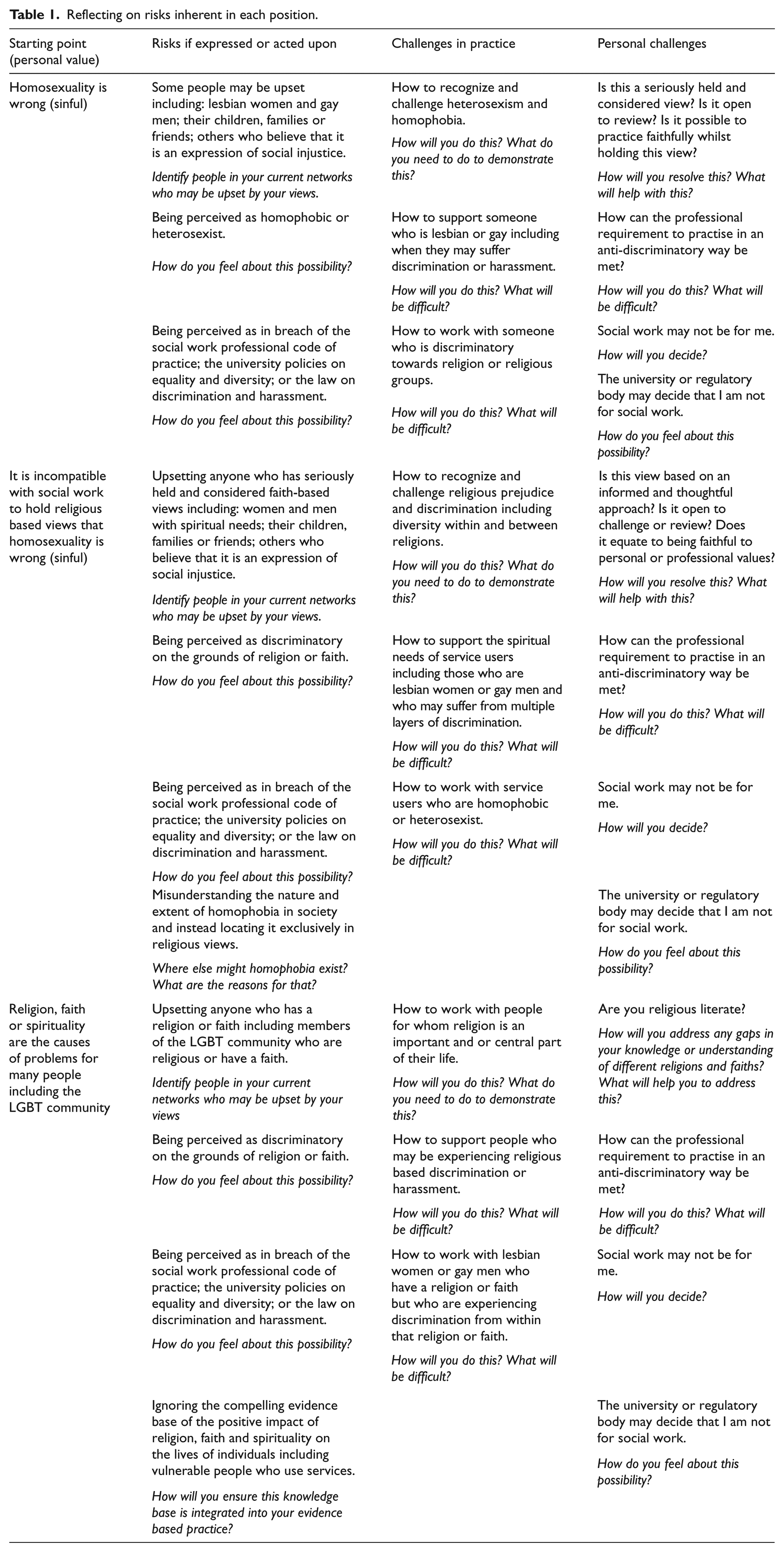
In laying out the detail in this way it presents students with the challenges that they mutually face. This process is to emphasize the fact that they are each on an individual learning journey; they each have a distance to travel – some further than others; and that the journey involves an honest appraisal of whether their personal values can be attuned to social work professional values by the time they qualify.
Discussion
It may have been a coincidence that this particular group of students became divided down these particular lines. However, the strength of feeling and fear generated in a small space of time warrants some reflection. As social work educators we began the process by being shocked by the powerful views that were expressed. However, we were aware of the imperative to teach students about professional values and ethics so that their practice reflected those once qualified. We were also aware that the starting point for this is personal values (Banks, 2006); so we could have been better prepared for the expression of those personal values at the start of the programme. One immediate challenge though was to ensure that the cohort did not become an unsafe group for any gay or lesbian students (Chinell, 2011). We also had duties under the Equality Act 2010, as a provider of education services to our students, to ensure we did not breach any legal imperatives in relation to sexuality or religion. Although there is a wealth of literature on the subject of religion, and spirituality and social work, on sexuality and social work, and on the relationship between the two, we found no guidance on how to resolve the tension presented here. However, the model worked by focusing not on the immediate reduction of the tension, but rather refocusing it onto the considerable challenges that each side faced. In the scenario described here a model was developed as a response to a crisis. However, the model provides a useful starting point for exploration of personal values and could usefully be implemented at the start of pre-registration training to generate debate and dialogue about these issues. It is also applicable to other professions that are subject to similar value bases or the provisions of legislation such as the UK Equality Act 2010.
Conclusions
This model was developed following a religious and sexuality based schism within a cohort of social work students in the UK. The cohort was near the beginning of their training and so had time to examine how their personal values were in conflict with professional values. This generated high degrees of tension for them as well as within the teaching staff who were also grappling with whether there were any tools at their disposal other than regulatory body or conduct procedures. The need to resolve such personal conflicts is not always given primacy in social work education (Trotter and Leach, 2003) and in this example we were propelled by the circumstances to develop our own model. However, further work can be done to fully evaluate its usefulness and possibly to apply it to similar areas of potential personal/professional value conflicts.
Footnotes
Funding
This research received no specific grant from any funding agency in the public, commercial or not-for-profit sectors.